







Abstract
Images of Middle Eastern women in the Western media tend toward the exotic, erotic, or abject. The women are often styled as the victims of patriarchal institutions and depicted as in need of being saved by their supposedly more enlightened Western sisters. These stereotypes carry over into Western media assumptions about the participation of Arab women in science and technology as well; few people are aware of the existence of professional women in STEM (science, technology, engineering, and mathematics) fields in the Middle East. This article discusses the experiences of expatriate Arab women in high-tech start-ups and other scientific enterprises in the United Arab Emirates and other countries of the Middle East. Among the issues addressed are experiences in the field and on temporary job locations, citizenship quandaries, family and community responsibilities, private versus governmental and semigovernmental employers, apparel/veiling considerations, and gender and racial prejudice. The essay is based on conversations with young women from Belorussia, Egypt, Jordan, Kuwait, Lebanon, and Palestine who work primarily as engineers and computer scientists.
Keywords
Introduction
Images of Middle Eastern women in the Western media often tend toward the exotic, erotic, or abject. The women are often styled as the victims of patriarchal institutions and depicted as in need of being saved by their supposedly more enlightened Western sisters. These stereotypes carry over into Western media assumptions about the participation of Arab women in science and technology as well; few people are aware of the existence of professional women in STEM (science, technology, engineering, and mathematics) fields in the Middle East. This article discusses the experiences of expatriate Arab women in high-tech start-ups and other scientific enterprises in the United Arab Emirates and other countries of the Middle East. Among the issues addressed are experiences in the field and on temporary job locations, citizenship quandaries, family and community responsibilities, private versus governmental and semigovernmental employers, apparel/veiling considerations, and gender and racial prejudice. The essay is based on conversations in summer 2015 with 12 young women from Belorussia, Egypt, Jordan, Kuwait, Lebanon, and Palestine who work primarily as engineers and computer scientists in the United Arab Emirates (UAE), Lebanon, and elsewhere in the region (see Table 1 for details of nationality, education, and work history).
Characteristics of Participants.
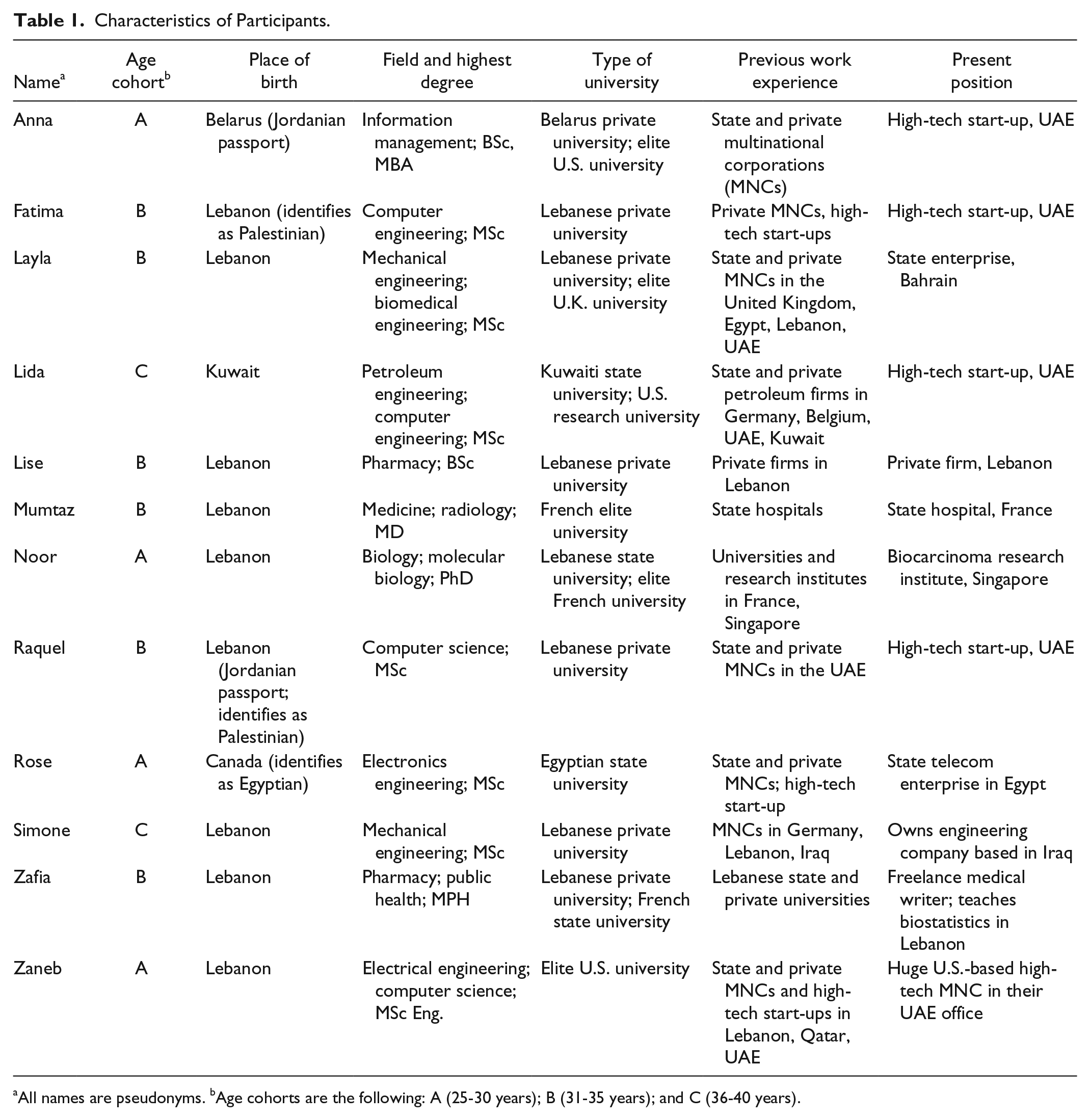
All names are pseudonyms. bAge cohorts are the following: A (25-30 years); B (31-35 years); and C (36-40 years).
Discussions were informal rather than structured; the women are acquaintances rather than test subjects. My methodology was a modified case study approach, concentrating on the descriptive aspects, as is appropriate for a preliminary, small-scale study (Yin, 1994). The women were chosen by means of snowball sampling. I initially approached women computer engineers in a high-tech start-up in Abu Dhabi, and found them extremely willing to talk with me and introduce me to their colleagues. As it turned out, I had tapped into a network of Arab women professionals, almost all of whom knew each other through their present or former ties with one of the largest engineering consultancy firms in the world. (For reasons of confidentiality, I am not naming this or any other enterprises at which the women have worked, but will describe the types of organizations in general terms: state or private firms, multinational corporations [MNCs], high-tech start-ups, government ministries, etc.)
Women in STEM Fields: International Perspectives
For a variety of reasons, it is difficult to obtain reliable data on international comparisons of women in STEM fields (Koblitz, 1995a, 1995b, 2005). Aggregate figures do not tell us much, especially since terminology describing educational levels, content of majors, job categories, and other markers varies from country to country. In the United States, women’s participation in most engineering fields is quite low (between 10% and 20% of total majors), and specialists have noted decreases in women’s interest in computer science and engineering over the past two or three decades. In several other Western countries, including Great Britain and the Netherlands, most STEM fields (outside of the biological sciences, which are often approximately half women) have relatively few women (Wyer, Barbercheck, Cookmeyer, Öztürk, & Wayne, 2014). Interestingly, percentages of women in STEM areas considered masculine preserves in the West can sometimes be significantly higher in other parts of the world. For example, certain areas of computer science and basic science in Turkey (Acar, 1991), Kuwait (al-Mughni & Tétreault, 2000), and Malaysia (Mellström, 2014) have higher participation of women than in the United States or Great Britain.
Scholars have noted that throughout most of the 20th century, modernizing elites in the Middle East have stressed scientific and technical education as essential, and women have responded favorably to this message (Acar, 1991; Ahmed, 1999; al-Mughni & Tétreault, 2000; Kandiyoti, 1991). Although there has been some retrogression in the past three decades as Islamist movements have gained traction throughout the region (Abu-Lughod, 1998), nevertheless the young women I spoke with do not consider their commitment to engineering and other high-tech fields as particularly unusual or worthy of remark. They do not depict their choice of specialty as connected to modernization or development goals, however, as their mothers or grandmothers might have done (Abu-Lughod, 1998; Kandiyoti, 1991). Rather, they portray their high-tech professions in more individualist terms as pleasurable and intellectually stimulating paths to advancement for themselves and their families.
Context: The United Arab Emirates (UAE)
When people outside of the region think of Dubai, Abu Dhabi, and the other states of the UAE and the Persian Gulf, they might think of oil wealth, or desert sheiks, or veiled women in exotic bazaars. They might know that the UAE and several other Gulf states have an inordinately high percentage of migrant workers as opposed to citizens, and they might have heard something of the oppressive conditions under which many of these migrants labor (Kapiszewski, 2001; Mahdavi & Sargent, 2011). Some people might recall seeing surreal images of the Dubai or Abu Dhabi skylines, with their spectacular futuristic skyscrapers and (in Dubai) the tallest building in the world. I am virtually certain, however, that most people in most countries outside of the Middle East have no idea that the region, in particular the UAE, is a magnet for young, dynamic Arab women making successful careers for themselves in a variety of high-tech and other scientific fields; “land of opportunity,” “a tech-person’s paradise,” and yes, even “mecca” were among the terms used to describe the UAE by the women I met.
The high-tech workforce is overwhelmingly noncitizens, although governmental and semigovernmental enterprises hire more citizens than do the private and multinational corporations, and there is a policy of “Emiratization” that is aimed at moving more Emirati citizens into responsible positions in industry and education. Most private companies, however, have very few people native to the UAE below the level of CEO. Males constitute approximately 80% of the noncitizen workforce of the UAE, and noncitizens are 7.8 million of the UAE’s 9.2 million population. The percentage of women in the professional and high-tech employment sectors appears to be somewhat larger—perhaps as much as one quarter to one third—than among working-class migrants (Bryceson & Vuorela, 2002a; Malit & Al Youha, n.d.). 1
Lebanese Connections
Women in high tech in the UAE come from all over the world, but most of the women I talked with were from the Middle East—primarily from Lebanon. This visibility of Lebanese women was at first surprising to me. But my acquaintances pointed out that the long civil war (1975-1990) and a more recent period characterized by invasion, bombings, and assassinations of political leaders (2005-2012) had generated a significant exodus from the war-torn country—not only of people but also of capital (Tabar, 2005; Tabar & Skulte-Ouaiss, 2010). Many Lebanese transnational companies moved their headquarters to the UAE, and they tend to favor their compatriots when hiring.
Those I asked gave a number of reasons for the predominance of Lebanese women in scientific and technical areas, including the secular nature of Lebanese society; conscious efforts by the government to achieve gender equality in education; the lingering influences of a French-inspired school system; and the poor economic prospects in Lebanon for professional employment in those areas, which seems to discourage men more than women. (Men leave the country at far higher rates than women do, and a standing joke among professional women is that they will have better luck getting a Lebanese husband abroad than at home. One woman went further and said that for women staying in Lebanon, unless they start loving one another, they are going to be lonely all their lives.)
It should also be noted that my impressions are likely to have been skewed because most of the women I talked with initially were Lebanese, as were most of the subsequent women to whom they introduced me. Everyone I spoke with, regardless of their nationality, agreed that Lebanese professionals, both men and women, are numerous and conspicuous in the Persian Gulf states. But as one Kuwaiti woman computer engineer cautioned me, it would be “incomplete” to portray Lebanese women as the only Arab women carving out exciting careers for themselves in technical fields. Indeed, the women I spoke with were Belorussian, Egyptian, Jordanian, Kuwaiti, and Palestinian as well as Lebanese, and had studied or worked in Abu Dhabi, Bahrain, Belgium, Canada, Dubai, France, Germany, Iraq, the Netherlands, Oman, Qatar, Saudi Arabia, the United Kingdom, and the United States.
Supportive Families and Mentors
Several women noted that far from having to combat sexism at the university, they had had supportive mentors of both sexes, and had sometimes been the beneficiaries of explicit policies designed to encourage women in nontraditional fields. For example, when Layla (all names of the women interviewed are pseudonyms) was a student at a private Lebanese university, the chair of mechanical engineering was a woman who eagerly welcomed female undergraduates; Layla’s other professors were equally supportive. Noor’s graduate advisor in France (whom she calls “my second dad”) urged her to apply for a postdoctoral research fellowship in Singapore rather than return to Lebanon and become a teacher. Zaneb’s professors at an elite U.S. university’s recently established electrical engineering/computer science program gave her many opportunities. (An intriguing aside: Almost all of the few women in that university’s engineering departments were from outside of the United States; the other woman in Zaneb’s program was Jordanian.)
Parents of both sexes were in general also supportive. All of the women I talked with said that their parents wanted them to get as much education as possible and had no objection to their choosing a major in the sciences and technology. Even Lida’s Kuwaiti father, whom she described as “traditional,” was eager for his daughters to succeed. As Lida explained to me, “traditional” is not the same as “conservative.” Just because someone is religious and eschews Western dress does not mean that he is not proud of his educated daughters.
Pressure to “Settle Down”
The situation was a bit more complicated when it came to deciding on a career path after graduation, however. Especially among the Lebanese women, there appears to be some pressure to either settle down in a stereotypically feminine area such as teaching (even if the teaching is in a scientific field), or to stop traveling and perhaps start a small business near the rest of their family.
For example, Noor’s parents, especially her father, were enthusiastic about her biomedical studies and even came to her PhD graduation ceremonies in Paris. They have been resistant, however, to her decision to move to Singapore to work in a research institute of the national university, though they have not outright forbidden her to go. Noor says that her parents find it difficult to understand her passion for biomedical research. They think that she has been outside of Lebanon long enough, and do not see why she cannot take a teaching position in Beirut. But there is no laboratory anywhere in the country doing cancer research of the caliber of that being done in Singapore. Noor agreed with her doctoral advisor that a return to Lebanon would destroy everything she had worked so hard to achieve; she is a research scientist rather than a pedagogue, and teaching in Lebanon would mean giving up an important part of her identity.
Family and Community
Noor’s experience was perhaps somewhat extreme, since no one else I talked with mentioned parental pressure to rein in their aspirations, and most parents seemed accepting of (or at least resigned to) their daughters’ peripatetic wanderings. But several women did speak of the conflict between the demands of family life and their high-powered careers, and alluded to their decisions (which they portrayed as self-initiated) to scale back on their hours and acceptance of field assignments once the children came. Raquel, a Palestinian computer engineer based in Abu Dhabi, said that although her husband is very supportive, working efficiently in a high-tech start-up while making time for her children means that she is “paying the price” in terms of her health. She has carved out the hours from 4 p.m. to 8 p.m. as a time when her work colleagues know that she will not reply to electronic messages. But other than that, she is on call pretty much all the time.
In her previous position, at one point, Raquel felt constrained to work around the clock through several weekends as her team brought a large computer network online and ironed out the bugs. Once too often she woke up to breastfeed with her Blackberry in her hand, at which point her husband (also an IT professional) insisted that she had to cut back on her working hours before she exhausted herself completely. Raquel finds the situation at her present position more congenial, in the sense that there are better benefits and no 24-hour-a-day assignments, but she still carries her work phone on family outings.
In general, Anna, a Belorussian information systems manager with an MS degree from an elite U.S. university, finds her working conditions at a high-tech start-up in Abu Dhabi extremely good. The benefits are much better than what her friends employed in similar jobs in the United States are getting, and income in the UAE is tax-free. The team Anna leads is located all over the world, so she can set her own hours and work from home on occasion (though conference-calling with a worldwide team can entail getting up in the middle of the night). For private companies, the UAE mandates 45 days maternity leave, which Anna took, and she had her daughter in the United States just as she was graduating with her master’s degree (her program was a “hybrid” with online and in-person components). The couple knew that they were expecting a daughter, and her Bedouin husband initially did not think that they needed to provide the advantage of U.S. citizenship to a girl. Anna was able to convince him that their daughter deserved equal opportunities to advance in the world, so her husband agreed that the baby should be born in the United States and that eventually they will enroll the child in an American-style school in the UAE.
Layla, a biomedical consultant working for the government of Bahrain on health care expansion in the kingdom, contrasted the attitudes of Lebanese women professionals with those of Bahraini and Emirati women. While she said there are quite a few women professionals of the latter nationalities, they tend to specialize in more traditionally feminized areas such as teaching and nursing. 2 Also, she noted that Bahraini and Emirati women tend to leave their professions after they have children, while Lebanese women tend to work outside the home even after their children are born. 3
Fatima, a Lebanese computer engineer who works in information technology management in Abu Dhabi, said that she had decided to put her “more aggressive” career aspirations on hold until her two young sons were a bit older. The fast-track positions in IT management and consulting generally require long hours and a lot of travel, so once her children came she opted for a position in which she can occasionally telecommute. A couple of times, Fatima has been approached by head hunters, but when they find out that she has two young sons, they back off. Most of the plum assignments involve intensive travel, so the head hunters prefer men and unmarried women.
Experiences in the Field
Fully three quarters of the women I talked with have needed to travel extensively for their work. Most of the discrimination they described to me has occurred in the context of internships and field assignments (see Al Marzouqi & Forster, 2011). Raquel, for example, noted that the semigovernmental company for which she previously worked preferred not to hire women on the grounds that overnight assignments were a required part of the job. Zafia believes that the analogous discrimination that her women friends in the medical field in Lebanon have encountered is not so much about gender per se as about marital status; she thinks that employers are reluctant to expend resources on women who might get pregnant or refuse a trip for family reasons.
Lise, who travels all over Lebanon as a pharmaceutical representative for a Lebanese company whose main offices are in Dubai, says that she has to be careful in the more devoutly Muslim regions of the north and south (as opposed to the central area around Beirut, which is much more cosmopolitan). A small minority of Muslim male doctors do not want to deal with a woman (she herself is a Christian). But on the whole, Lise says that as long as she dresses modestly, and gently and humorously rebuffs all attempts at flirtation, she gets along well with virtually everyone with whom she deals.
Zaneb experienced some tensions at the first engineering firm she worked for, and noted that a couple of years after she left the company, they stopped hiring women for jobs in electrical engineering (as opposed to human resources and other nontechnical positions). She has had temporary job postings in Qatar, Dubai, and Abu Dhabi and flies back to Lebanon every week for personal reasons. Zaneb finds the environment in Abu Dhabi and Qatar more conservative than in Dubai or Lebanon, so she does not think it is a good idea to bring her family to Abu Dhabi (where she is currently based). 4 While she herself finds the atmosphere at work congenial enough, she is concerned that her partner and children would have a difficult adjustment.
Gender Discrimination
Of the women I talked with, Zaneb seemed most conscious of gender discrimination in the high-tech consultancy field. While she herself has not experienced prejudice, she said that many companies have a differentiated pay scale, with married men receiving the highest salaries and benefits packages and single expatriate women getting the short end of the stick. Raquel also mentioned gender discrimination in benefits; in many companies, women do not receive a housing subsidy or medical insurance and education allowances for dependents, even if their husbands are contract workers (and thus are not getting full benefits either). Raquel noted that so far the telecom start-up at which she is currently employed has equal benefits for all. But, she stressed, that is only so far. When her previous company was just starting, they did not discriminate in benefits. But when they began to get government contracts and became a parastatal enterprise, they openly listed discriminatory benefits packages in their human resources information and would not make exceptions even if a woman’s husband’s position was inferior to hers.
Simone believes that gender was the reason why she was not selected for an oil and gas internship in Afghanistan. She then began working for a German engineering concern setting up a vehicle inspection system in her native Lebanon and amusedly recalls an occasion when one of her supervisors noted approvingly (but condescendingly) that “the only man [really] working here is a little woman.” Simone has since started her own mechanical engineering company and does most of her business in Iraq, where she installs the equipment for remote vehicle inspection stations and conducts training workshops. Simone’s experiences in the field have been overwhelmingly positive. In fact, she said her biggest surprise has been the respect she has received from Iraqi men—her business partner is an Iraqi Shiite Muslim, her head mechanic is Sunni, she herself is Christian, and everyone gets along well. As an example, she recounted a story of the time when she was installing heavy machinery in a remote Iraqi village and looked up to find herself surrounded by a group of men in traditional dress taking cell phone and camera pictures of her. Clearly, a woman in such a role struck the men as unusual, but by no means threatening or unacceptable.
Layla’s experiences at job sites have not been quite so positive as Simone’s. Like Simone, Layla got her mechanical engineering degree at a well-known private university in Lebanon, but she followed that up with a master’s degree in biomedical engineering from an elite university in the United Kingdom. She has traveled to job sites all over the Mideast, and is at present in Bahrain. As stated earlier, Layla has encountered many Bahraini professional women, and a large number of them are in medicine. Layla, however, is an engineer who travels to hospital sites to inspect medical equipment, and in Bahrain (as indeed, in Egypt and Lebanon), most men are skeptical about the very existence of women engineers. She is the only woman engineer working for the Bahraini health ministry and sometimes has difficulties, especially in remote areas. The same was true in Egypt, she said—men typically hate to work under women superiors, especially outside of Cairo.
Rose, a Canadian citizen whose parents moved back to their native Egypt when she was young, studied electrical engineering at a prestigious private university in Cairo. She had several engineering internships in Egypt before she moved into IT management for a large multinational tech consulting firm, but her internship experiences were not terribly satisfying. In part, this was because engineering was not considered a woman’s job; at one place there were only three or four women out of 100 or so engineers. But more important for Rose was the rote nature of the work she was expected to do. As she put it, “Egypt is not a technology-producing country,” and she got tired of just checking imported technologies and making small adjustments here and there.
By contrast, Lida, a computer engineer born and raised in Kuwait by a Kuwaiti father and Lebanese mother, had excellent early job experiences. Her first job was in the oil sector (“a rite of passage for someone from Kuwait”), and she spent 4 years working for the Kuwaiti petroleum industry in Germany and Belgium. She then moved back to Kuwait to a position at a boutique energy consulting company but soon decided to switch to telecommunications consulting. Now she is working for a famous U.S.-based conglomerate in their Dubai offices, and is enjoying herself hugely. For Lida, Dubai is a stimulating place. “It is a melting pot, it has a visionary ruler, it’s vibrant, with lots of smart people. . . .” Lida belongs to a touch rugby league and running groups and looks forward to years of transferring from one exciting temporary job location to another while working for her globe-spanning corporation.
Private Versus Governmental and Semigovernmental Enterprises
Several women noted that there are significant differences, especially in the UAE, between their work experiences in private companies and in those that are owned by the state or subsist largely on government contracts. The gender differences in benefit packages have already been mentioned. There also seem to be different hiring patterns. On the one hand, the UAE has been recognized by the Arab Women Foundation as having made more strides toward gender equity than many countries in the region (Al Marzouqi & Forster, 2011; “UAE ranks top,” 2015; “Women power,” 2015). In addition, policies of “Emiratization” can sometimes work in favor of hiring women in government-owned companies, as exemplified by Etihad’s impressive number of Emirati women pilots and technical personnel, noted above (“Etihad Airways,” n.d.; see also Sharp, 2005).
But, on the other hand, in comparison with the private sector, most governmental and semigovernmental enterprises seem to be more prone to discriminate on the basis of gender, citizenship status, and whether women veil or not. Raquel, Anna, Zaneb, Fatima, and Lida all noted that in general the atmosphere in the MNCs is more relaxed and open, regardless of whether their head offices are in Lebanon, Dubai, Abu Dhabi, or somewhere in the West. When they did consulting work for governmental or parastatal entities, they often felt more constrained and noticed that there were markedly fewer women in roles other than support staff or custodial services.
To Veil or Not to Veil
Traditionally, Islam has required that women (and indeed, men) “dress modestly.” But the definition of what that phrase means varies widely across religious sects, generations, and regions of the world. In some contexts, a simple head scarf and covered shoulders and knees suffice, while in others, overgarments concealing everything but the eyes, hands, and feet are required. In general, when the women I spoke with used the term “veiling” or “covering,” they meant something closer to the former than the latter: a scarf concealing the hair, nothing sleeveless or excessively formfitting, slacks or a below-the-knee skirt, or at most a fashionably embellished and sometimes virtually transparent abaya (a full-sleeved, floor-length overdress). 5 None of the women I spoke with veiled on a regular basis. But several had encountered situations in which dress codes were at issue in one way or another.
As mentioned earlier, Lise took care to dress modestly and wear a head scarf when she met with Muslim physicians outside of the Beirut region. Lida turned down a position at a tech services company in Kuwait because the head of human resources told her that mandatory veiling was company policy. She also described being uncomfortable during a consultancy stint at an Islamic bank. Strictly speaking, the consultants were not expected to veil, although all women directly employed by the bank were required to do so. But not veiling in an environment in which all the other women covered themselves made Lida feel “very awkward.”
The stories the women told indicate some rather complex and sometimes amusing situations. For example, Lida mentioned a Polish woman acquaintance who spoke fluent Arabic and converted to Islam when she married a Kuwaiti. Lida had recommended her for a job and was surprised when her contacts at the firm said that she had not been hired because she was “too conservative.” It turned out that the woman had shown up to the job interview fully covered. This surprised Lida because in general the woman did not veil at all.
Perhaps the Polish woman thought veiling would give her an advantage in the job market. In some circumstances, of course, it would have—the Islamic bank or the tech services company Lida mentioned earlier would have required all women employees to be covered. (Another possibility is that the woman was trying to combat the overly sexualized stereotype of young Slavic women that is so prevalent in the Gulf; this will be discussed further below.) And Rose believed that her friends who veiled during their internships in Cairo had smoother interactions with their work colleagues than she had had.
But there are other circumstances in which veiling is viewed as an indication of a conservatism not welcomed in multinational workplaces. Zaneb reported that a huge multinational engineering firm based in Dubai simply will not hire veiled women, presumably because unveiled women symbolize modernity and progress. (Lida said much the same about a different multinational engineering consultancy firm where she had worked for a couple of years.) Several women thought that this association of unveiled with modern was one reason why Lebanese women are so strongly represented in high-tech enterprises in the region—Lebanese professional women almost never veil.
Some of the larger multinational tech corporations are flexible enough to accommodate various preferences in women’s dress. Fatima’s company has numerous professional women at all levels; some of them are covered, some not. There is even a Saudi woman employed in her office in Abu Dhabi. Saudi women in general use the overgarments that reveal only the eyes and a bit of the forehead, and they prefer to be secluded from men in the workplace. Fatima’s company even has special facilities to deal with this level of purdah.
The multinational telecom firm Lida works for currently has both veiled and unveiled women in its Dubai offices and elsewhere in the region. More women are uncovered than veiled, but Lida notes that there is at least one veiled woman even in the company’s Dublin offices. She believes that in this particular corporation, a conscious policy of welcoming cultural diversity works in women’s favor whether they are veiled or not.
Citizenship and Its Discontents
Since the majority of the women I talked with are not citizens of the country in which they are employed, 6 questions of citizenship came up often (see Joseph, 2000a, 2000b, 2009). A common complaint among many expats working in the UAE is that citizenship is almost impossible to obtain. Since visa renewal is contingent on continued employment, women mention occasionally being pressured into accepting less favorable benefits packages or longer hours in order to retain their visas. The expat women also evince a certain amount of resentment against Emiratization and other policies that favor citizens. 7 Raquel, Anna, Fatima, and Zaneb were especially vocal about this, claiming that the policy just means that the firms hire Emirati citizens as window dressing and then contract out all their computer and engineering tasks to expats.
Some women experience other tensions concerning their citizenship status. For example, Rose’s parents are both Egyptian, and she returned with them from the United States when she was an adolescent. But her passport is Canadian, and she feels herself to be “culturally a bit of an outsider.” 8 It has been difficult to form friendships, and she believes that her Canadian citizenship might impede her chances of promotion. Rose left her huge international engineering consulting firm for an Egyptian telecom company in part because she felt that her constant travel was alienating her from her compatriots and making it harder to blend in. For the same reason, she has so far resisted the lure of jobs in the UAE and the other Gulf states.
Mumtaz, a physician who has just finished her residency in radiology in Paris, found that her acquisition of French citizenship opened doors that had previously been closed to her as a Lebanese national. She noted with some resentment that less qualified applicants from countries of the European Union are constantly given preference over Lebanese and others from the Mideast. Mumtaz was certain that her upcoming position in Lyon would not have been possible had she remained a Lebanese citizen, despite the fact that she had completed all 6 years of her medical schooling in France and graduated with high marks.
Belorussian-born Anna had a different take on citizenship. As mentioned above, she bore her daughter in the United States so the child could have a U.S. passport as well as the Jordanian one of her father. Anna herself took her husband’s name and nationality for strategic reasons to be discussed further below. A couple of women complained that Lebanese and Jordanian laws reckon nationality of children by their birthplace, not the nationality of the mother (Amawi, 2000; Joseph, 2000a). This is a particularly sensitive point because the women who mentioned this are Palestinian and wish their children to be considered Palestinian as well. But their passports list them as Jordanian or Lebanese because that was where they were born.
Gender, Race, and Prejudice
Several of the women who spoke with me recounted stories in which they were not clear whether the most salient discrimination at issue was racial, ethnic, sexual, citizenship-based, or a combination of these. This was the case with differential benefits and salaries, for example. Raquel, Anna, Zaneb, Layla, Rose, Lida, and Fatima all spoke of such differences (though for the most part not in their current positions). Some women suggested that the discrimination might be excusable if it is based on family circumstances or even said “well, that’s just the consulting lifestyle” (i.e., men are “naturally” more mobile than women and so obviously get the higher salaried positions that such mobility makes possible).
Noor did not herself experience any prejudice during her undergraduate and graduate years in Paris studying microbiology, but she believes that this was in part due to the lightness of her skin. By contrast, a Lebanese male friend of hers had considerable difficulties that Noor was certain were caused in part by his dark complexion. And recall that Mumtaz spoke of analogous prejudices against Mideasterners in French medical schools and hospitals (see Al-Ariss & Ozbilgin, 2010).
The only person to explicitly complain of racial attitudes in the UAE was Zaneb. She said she is appalled by the way unskilled migrant workers from South Asia are treated. The custodial and service staff at the high-tech companies are condescendingly called “office boys” and barely paid a living wage. The conditions under which day laborers work are horrendous. Salaries are low, their housing is substandard, their passports are often taken away from them, and they are threatened with deportation if they protest. Zaneb’s observations echo those of many commentators on the exploitation of migrants in the UAE and other countries of the region and, indeed, of the world (Kapiszewski, 2001; Mahdavi & Sargent, 2011).
A curious experience of stereotyping that I had not expected was revealed by Anna. One reason why Anna decided to adopt her Jordanian husband’s name and nationality was that she hoped to lessen the discrimination she was experiencing as a young Slavic woman. It turns out that Russian, Belorussian, Ukrainian, and other Slavic women suffer because of the widespread assumption that they are sex workers or mail-order brides, and they are often sexually harassed and propositioned. Anna recounted several stories of her friends having to fend off unwanted attention after they agreed to meet someone at a café for what they thought was an interview for a professional position. (Anna herself had one such interview invitation, but she defused the situation by asking her husband to accompany her.) In the UAE, the sexual assumptions about Slavic women are so common that Anna’s husband does not want her to speak Russian to their daughter on the street.
General Impressions
All of the women I spoke with conveyed an overwhelming impression of dynamism, professional competence, and self-assurance. With the exception of two women in pharmacology (a largely female specialty in many parts of the world), they are thriving in fields dominated by men. They are working in countries whose cultures are generally seen as patriarchal and conservative, and most of them are away from home and family for long periods of time. Their mobility, confidence, and enthusiasm for their work are especially remarkable under these circumstances.
Perhaps most surprising is how nonchalant the women are about their achievements and how reluctant they are to portray themselves as unusual or worthy of admiration. For the most part, they reported few experiences of gender discrimination during their student years and relatively few in the workplace. In part, this might be because all the women I spoke with were under 40 years of age, and so had grown up at a time when there was at least some consciousness of gender issues just about everywhere in the world. In the workplace (at least for the five women currently working in the UAE), another possible explanation is that as foreigners they suffer less gender discrimination because they are seen as less threatening to male authority than local women. By contrast, the Emirati women in information technology interviewed by Ahlam Hassan Al Marzouqi and Nick Forster experienced significant resistance from their families and told many stories of unequal treatment in the workplace (Al Marzouqi & Forster, 2011).
Limitations
Clearly, any observations based on snowball sampling and case study approaches suffer from the inherent limitations of the method (Miles, Huberman, & Saldaña, 2013; Yin, 1994). Most of the women were Lebanese; discussions were informal and unstructured; the participants decided for themselves how much they chose to elaborate on any given topic; and the fact that they were largely part of a network of women with past or current ties to the same engineering consulting conglomerate meant that there was the potential for sameness in their responses. In no sense can I claim that the women’s experiences are generalizable to all Arab women professionals in STEM fields as a whole. As Table 1 shows, however, there wound up being a reasonable amount of variety in the women’s backgrounds, work experiences, and fields of expertise, so it is to be hoped that their views can shed some light on Arab women in high-tech fields.
Ironies
The conversations I had with these women were fascinating and inspiring. All of them defied stereotypes, conveyed excitement about their lives and careers, and looked toward the future with eager anticipation. Of course, being young and working primarily in the dynamic, ever-evolving world of high-tech start-ups, their situations could change at any time. Improving circumstances might call some of the Lebanese women back to Lebanon, demands of spouses or children might persuade them to cut back on their travel, a changing energy market could make the UAE and the other Gulf states less prosperous, their start-ups could fold or be absorbed into more conservative enterprises, the head offices of their high-tech consulting firms could shift to a different part of the world, Emiratization could force some of them to look elsewhere for jobs, and so on. But at present, their prospects seem good.
The buoyant outlook of the women who spoke with me indicates a singular lack of angst about life and future prospects. Far from longing to return to the country of their birth, or portraying themselves as torn between their native land and their present place of employment, the women have a sensibility that might be described as optimistically transnational. This does not mean that they experience no difficulties or tensions regarding their citizenship status (as described above). Rather, they do not make such concerns the center of their lives, and nostalgia about their homeland (whether that is Kuwait, Lebanon, Palestine, or wherever) is not central to their self-image. Instead, they appear to see themselves, to borrow Suad Joseph’s (2009) felicitous phrase, as “neither here nor there, but everywhere” (p. 138). In other words, they are citizens of the world taking full advantage of the possibilities of a globalized economy and the demand for a mobile high-tech workforce.
All of the women I spoke with were happy to share their stories. Several of them complained that the prevailing images of Arab women in the Western media style them as abject, ignorant, oppressed, and in need of being saved. For most people outside of the region, especially in the West, Arab professional women are completely invisible, as if they did not exist at all. That Etihad Airways has a higher percentage of women pilots and technical personnel than U.S. airlines (as mentioned earlier) would seem virtually inconceivable to the vast majority of Westerners.
Many of my interlocutors deeply resent this invisibility, and in part, their eagerness to speak to me reflected their determination to counteract prevailing assumptions. Lise was perhaps the most vocal, saying explicitly that I should tell my friends that Arab professional women are not terrorists, not suffering under the weight of patriarchal masters, not absent from public life. Rather, they are educated members of their societies striving to make a better future for their countries, themselves and their families, and encountering reasonably favorable conditions in which to pursue their goals.
The irony of the situation is rather glaring. Silicon Valley is located in a region that regards itself as one of the most enlightened and socially progressive in the world. Yet the sexism and misogyny in high-tech start-ups in Silicon Valley and elsewhere in the United States are notorious. In February 2015, Newsweek magazine published a long cover story documenting the extremely hostile work environment for women engineers, computer scientists, and other high-tech professionals; this article is one of many on the subject (Burleigh, 2015; Rivers & Barnett, 2015; Snyder, 2014). The immature, obnoxious, and occasionally threatening behavior of many males involved in the high-tech subculture in the United States is appalling, and there have been few signs of improvement. In all the discussions I have seen on the subject, no one even hints that the situation might be better for women in high-tech start-ups elsewhere in the world. Certainly no one even remotely suggests that the Gulf States could have a more favorable environment in this regard than Silicon Valley. And yet, that indeed seems to be the case.
Footnotes
Declaration of Conflicting Interests
The author declared no potential conflicts of interest with respect to the research, authorship, and/or publication of this article.
Funding
The author received no financial support for the research, authorship, and/or publication of this article.