







Abstract
Existing research has examined if undergraduate factors influence chemistry and physics, or physical science, doctoral degree entry and whether variables during PhD programs associate with graduation. Yet research on the transition from bachelor’s degree to doctoral degree entry (i.e., PhD entry in less than 6 months, attainment of a master’s degree prior to doctoral degree entry, or working in a science-related job for more than a year prior to doctoral degree entry) on PhD degree graduation remains scarce. Our study examines the transition from bachelor’s to doctoral degrees to see if experiences therein associate with female PhD graduation, after doctoral degree enrollment. Our logistic regression analysis, of female chemistry and physics doctorates (n = 867), indicated that attainment of a master’s degree did not change the likelihood of graduation, when compared to direct entry into physical science doctoral programs. Meanwhile working in a science-related job for a year or more is associated with a significantly lower likelihood of physical science doctoral graduation when compared to women who entered directly into PhD programs or received a master’s degree prior to enrollment.
Keywords
Introduction
Students entering PhD programs in chemistry and physics (physical science) have lower completion rates compared to other fields of science and engineering (Sowell, 2008). Of these physical science students, women have decreased graduation rates when compared to men at 52% and 59%, respectively, and women remain underrepresented as chemistry and physics graduates overall (National Science Board [NSB], 2014; National Science Foundation [NSF], 2013; Sowell, 2008). This article seeks to understand what factors might contribute to such trends in women’s graduation rates from physical science doctoral programs.
Research has focused on factors prior to physical science doctoral school entry, such as undergraduate school grades and experiences, to explain career choice and graduate program entry in physical science (Dabney & Tai, 2014a; Dabney & Tai, 2014b; Ferreira, 2003; Fox, 2001). Other studies have focused on factors during PhD programs to understand persistence and graduation of women with PhDs (Barthelemy, Grunert, & Henderson, 2012; de Valero, 2001; Fox, 2001; Ivie, Czujko, & Stowe, 2002; Maher, Ford, & Thompson, 2004; Neville & Chen, 2007). However, there is a paucity of research regarding factors occurring during the transition from, or time spent between, bachelor’s graduation to doctoral program entry and its potential role, following PhD entry, in the completion of doctoral programs for women in these fields (Dabney & Tai, 2014a; Dabney & Tai, 2014b; Miller & Wai, 2015).
Given the trends of attrition during doctoral programs, the underrepresentation of women with physical science PhDs (NSF, 2013; NSB, 2014; Sowell, 2008), and the lack of research on the bachelor’s degree to doctoral continuum, our study examines the transition from bachelor’s graduation to doctoral degree entry to see if experiences therein (i.e., entry in less than 6 months, attainment of a master’s degree, and work in a science-related career for more than a year) associate with female PhD graduation, after doctoral degree enrollment. The overall aim of this study is to provide a better understanding of which bachelor’s to PhD transition experiences are predictive of female retention in doctoral programs within chemistry and physics fields, thus potentially adding to our knowledge about how to better support women early in PhD programs in order to retain them and build a truly representative and demographically diverse workforce of research scientists.
Theoretical Framework
This research is guided by the social cognitive career theory framework building off Bandura’s (1986) social cognitive and self-efficacy theory. According to this framework, career interests and career choices develop and evolve over time, influenced by factors such as self-efficacy or belief in one’s ability, outcome expectations, as well as personal goals and experiences that individuals use to accomplish a task (Lent, 2000; Lent, Brown, & Hackett, 1994). We argue that development of self-efficacy happens early, prior to physical science doctoral degrees, and in the context of this study, researching and understanding transition experiences (i.e., bachelor’s to doctoral degree experiences) could be crucial to understanding later doctoral graduation outcomes. There are strong positive associations between self-efficacy, academic achievement, career interests, experiences, and outcome expectations in math and science fields (Turner & Lapan, 2002; Turner, Steward, & Lapan, 2004). As such, bachelor’s to PhD transition variables may provide important clues to understanding and supporting persistence and graduation of women enrolled in PhD programs, specifically in chemistry and physics.
Literature Review
Bachelor’s Degree Factors and Doctoral Degree Enrollment
Current research in science, technology, engineering, and mathematics (STEM) shows that factors prior to doctoral programs such as undergraduate academic achievement (Dabney & Tai, 2014a; Dabney & Tai, 2014b; Maher et al., 2004; Neville & Chen, 2007) and specific school and personal experiences (Ampaw & Jaeger, 2011; Hollenshead, Younce, & Wenzel, 1994; Barthelemy et al., 2012; Davis, 1999; Neville & Chen, 2007; Sax, 1994; Tan, Barton, Kang, & O’Neill, 2013; Viefers, Christie, & Ferdos, 2006) may predict career choice, undergraduate degree attainment, and doctoral program entry among women. In order to provide a better understanding of bachelor’s to PhD transitions on doctoral graduation, we will first examine known findings regarding bachelor’s degree factors on doctoral degree entry.
Academic Achievement
Farmer, Wardrop, and Rotella (1999) found that women who value math and science and take a greater number of these courses early on are more likely to choose science careers as compared to women who do not. Prior academic grades (especially cumulative grade point average of 3.5 or higher out of 4.0) predicts a higher likelihood of doctoral program enrollment while lower GPAs decrease the likelihood of pursuing doctoral studies (Neville & Chen, 2007). Additionally, grades in undergraduate physical science courses have a strong association with doctoral program entry for women in chemistry and physics (Dabney & Tai, 2014a). However, undergraduate coursework grades were not predictors of time to doctoral completion (Dabney, 2012).
Experiences
Field-specific positive experiences in chemistry or physics may propel women into doctoral programs and careers in the same field. Such positive experiences include having encouraging parents, inspirational teachers, and/or supportive advisors and acquiring undergraduate research experiences and/or informal science opportunities (Espinosa, 2011; Hollenshead et al., 1994; Sax, 1994; Davis, 1999; Ivie et al., 2002; Maher et al., 2004; Viefers et al., 2006; Barthelemy et al., 2012; Dabney et al., 2012; Tan et al., 2013; Dabney & Tai, 2014a; Dabney & Tai, 2014b). For example, participation of women in STEM living and learning programs increased the likelihood of their aspiration to pursue STEM graduate degrees (Szelenyi, Denson, & Inkelas, 2013). Overall, undergraduate academic achievement and field-specific experiences may positively influence physical science doctoral degree entrance for women.
Bachelor’s to PhD Transition
Women can also gain additional academic and science-related experiences during the transition from bachelor’s to PhD degrees. Yet there is a paucity of research examining what occurs during this period of time in the academic trajectory. Most of the existing literature looks at the proportion of women in the various stages of the academia and not time that elapses, along with experiences therein, between earning a bachelor’s degree and entering a PhD degree (e.g., Ivie & Ray, 2005; Miller & Wai, 2015; NSF, 2013).
Although women are more likely than men to have earned a master’s degree within 10 years after graduating with a bachelor’s degree, men are much more likely than women to have earned a doctoral degree in the same span of time (Neville & Chen, 2007). In addition, Neville and Chen (2007) found that women wait longer than men to start a graduate program, either master’s or PhD, after completing a bachelor’s degree. However, this finding is based on a broad variety of disciplines examined in 2003 and is not necessarily reflective of current trends in physical science. The role of time and experiences therein between undergraduate and graduate degrees in relation to persistence and graduation is a relatively understudied and dated area, especially for women in physical science.
Sax (2001) discovered that about 77.9% students in physical science seek a PhD degree rather than a master’s degree following bachelor’s degrees. This percentage is higher than that of students who pursue doctorates in the biological sciences (62.8%) or engineering (31.4%). Yet whether direct entry into a doctoral degree or attainment of a master’s degree beforehand is more beneficial to doctoral graduation is unknown. Meanwhile, Fox and Stephan (2001) found that after doctoral degree attainment, the proportion of individuals (both men and women) working in fields unrelated to their training is the highest in physics and chemistry. However, for those who take time off from academia between their bachelor’s degree and doctoral program entry, the influence of science-related jobs on PhD graduation remains unclear.
Research Question
Despite existing research on undergraduate factors predicting graduate school entry, we know little about how time spent during the transition from bachelor’s degrees to enrollment in PhD programs might affect doctoral program completion, specifically for women in chemistry and physics. This study was conducted using variables from the Project CROSSOVER Survey data set through a sample of female chemistry and physics (n = 867) scientists. A logistic regression analysis was performed to uncover what associates with females’ doctoral graduation in physical science, following degree enrollment. Our analysis examined the following transitions from bachelor’s degree to doctoral degree entry: PhD entry in less than 6 months, attainment of a master’s degree, and work in a science-related job for more than a year. Our research question is as follows: “On average, do female chemistry and physics doctoral scientists that graduate, compared to those not retained, vary in their transitions from bachelor’s degree graduation to doctoral degree entry?”
Methodology
The analysis described in this article examines Project CROSSOVER Survey data. Prior publications describe Project CROSSOVER as “a sequential mixed methods study that examines variables influencing entrance into physical science doctorate programs in addition to the transition from graduate students to independent scientists” (Hazari, Potvin, Tai, & Almarode, 2010). The preliminary portion of the study used semistructured interviews of 125 doctoral students and scientists in physical science to generate the subsequent Project CROSSOVER survey.
The survey was developed from prior research within the field as well as the aforementioned interview data and consisted of 145 questions. Themes examined in the survey included demographics and background experiences such as interest, experiences, and academic achievement. A list of prospective participant names was obtained from the American Physics Society and the American Chemical Society. In 2007, a random sample of 17,500 individuals was sent online as well as hard copies of the survey. Of this, 3,600 did not fit the respondent group as they were nonscience degree holders, and 550 of the surveys were undeliverable and therefore returned. A total of 4,285 participants returned completed surveys from the 13,350 possible survey respondents for a response rate of 32.1%. The final survey sample consisted of physics and chemistry doctoral students, researchers, and holders of other physical science doctorates. The sample was found to be nationally representative based on a comparison to the National Science WebCASPAR data set with a focus on employment backgrounds (universities, profit, government agencies, nonprofit, and others) and demographics (race, ethnicity, and gender; Hazari et al., 2010).
Our study uses epidemiological survey methods. Although our research is not causal, “it provides the ability to show either that a relationship does not exist or identify relationships that are associative and, therefore, worthy of follow-up studies in the future. Similar designs have been used in other fields such as public health (Elwood, Little, & Elwood, 1992). The accuracy and reliability of self-reported data depend primarily on the context, relevance, and clarity of a survey (Bradburn, 2000; Niemi & Smith, 2003). In a review of existing research on self-reported data, Kuncel, Credé, and Thomas (2005) concluded that self-reported data can be characterized as particularly accurate in samples where surveys address issues relevant to the respondents. Our survey falls into that category as it is conducted with physical science scientists where participants’ reflection on their prior experience is commonplace” (Dabney & Tai, 2014b).
Survey
Study Sample
This article presents a series of analyses that focus solely on data collected from female chemistry and physics scientists who enrolled in PhD programs. Project CROSSOVER’s survey is particularly pertinent to these analyses because it has one of the broadest and most extensive sets of data for female chemists’ and physicists’ educational experiences ranging from high school through doctoral education. Chemistry and physics female scientists who entered PhD programs, and are no longer doctoral students, were 898 of the survey respondents. The final sample for this study consisted of 867 female participants due to list-wise deletion of missing data for 31 participants based on doctoral graduation outcome and participants who had multiple responses or missing responses for individual control and predictor variables. Four percent identified as African American, 4% Latino/Hispanic, 17% Asian, 73% Caucasian, and the remaining respondents specified that they were in other ethnic groups or minimally represented. Finally, this sample of women consisted of 67% chemists and 33% physicists.
Analyses
Logistic regression was chosen as our method of analysis for this study as it provided the opportunity to differentiate among women based on a binary outcome variable (i.e., doctoral graduation or attrition) with continuous and dichotomous control and predictor variables (Pedhazur, 1997). In addition, logistic models have more lenient multivariate assumptions with predictor variables based on individual outcome selections (Grimm & Yarnold, 1995; Pedhazur, 1997; Tabachnick & Fidell, 1996). Predictor variables were provided via odds ratios in order to give the reader a better understanding of how the factors associated with doctoral graduation. The analysis in this study was completed with SPSS 24.0.
Outcome Variable: Graduation
Gender and factors prior to graduate school have frequently been used to analyze STEM career choice in science in order to inform education and public policy (Tai, Liu, Maltese, & Fan, 2006; Xie & Shauman, 2003). Recent research has found that undergraduate differences within females in chemistry and physics are significantly predictive as to whether they select a doctoral career in either field (Dabney & Tai, 2014a; Dabney & Tai, 2014b). Given the underrepresentation of women with chemistry and physics PhDs (; NSB, 2014; NSF, 2013) and low retention rates overall, doctoral graduation as an outcome variable could provide education researchers and stakeholders with a thorough understanding of females’ transitions from bachelor’s degree graduation to doctoral degree entry and the predictive impact of these transitions.
Question 39 from the Project CROSSOVER Survey examined respondents’ doctoral graduation or attrition (see the appendix). The question asked participants to mark whether doctoral graduation happened or did not occur. Data were dummy coded so that if a participant indicated that she graduated, it was coded as a “1,” and if she did not graduate, it was coded as a “0.” Eighty four percentage of the participants reported that they graduated with physical science doctoral degrees, and 16% were not retained (i.e., did not graduate with a doctorate).
Predictor Variables
Predictor variables in this study consisted of the following questions written in respect to bachelor’s to PhD transitions: PhD entry in less than 6 months (Appendix Question 32), attainment of a master’s degree (Appendix Questions 6 and 32), and work in a science-related job for more than a year (Appendix Questions 31 and 32). Our analyses sought to apply these factors to determine their association with female doctoral graduation once enrolled in either chemistry or physics.
We separately coded each transition in order to best determine their potential impact. The variable attaining a master’s degree, prior to PhD entry, was coded as a “1,” and the rest were coded as a “0.” Participants who worked for more than 1 year in a science-related job, either within or outside their discipline, were coded as a “1.” All others were coded as a “0.” Meaning, all participants that did not indicate one of the two choices above were coded as a “0” in order to use PhD entry in less than 6 months as the baseline in our model.
The percentage of participants for each of these transitions were as follows: 60.3% entered a PhD in less than 6 months, 25.5% attained a master’s degree, and 14.2% worked in a science-related job for more than a year.
Control/Demographic Variables
Seminal literature on variables prior to doctoral participation in physical science (Xie & Shauman, 2003; Jacobs, Finkens, Griffin, & Wright, 1998; Dabney & Tai, 2014a; Dabney & Tai, 2014b), career interest in STEM (Tai et al., 2006), and time to degree completion (deValero, 2001) influenced decisions about which control variables were used in our statistical analyses. Based on these prior studies, the following control variables were included in our regression model: age, racial and ethnic group, citizenship status, guardians’ or parents’ highest level of education, early interest in science, average undergraduate chemistry and physics grades in undergraduate school, and physical science program. Age by decade and guardians’ or parents’ highest level of education by degree were coded as continuous variables. All of the rest of our control variables were recoded as dummy variables. Finally, the predictor variables were cross-tabulated with our control variables, and no systematic bias was discovered based on participants’ survey responses.
Missing Values
We examined our outcome, predictor, and control factors for data missing prior to building the logistic regression model. Variables within the analysis had missing data proportions ranging from 0.02% to 3.58%. Missing data analysis was employed in order to determine if data were not missing, missing, or missing completely at random. Systematic bias was not found, given that our control and predictor factors did not change with the outcome of doctoral graduation. Due to the low percentages of missing data and a lack of systematic bias, procedures for missing data were not used within our analyses (Enders, 2010; Rubin, 1987).
Results
A logistic regression analysis model was created to provide a clearer understanding of how specific bachelor’s to PhD transitions may be predictive of female physical science doctoral graduation. The model included one of each of the predictors (i.e., PhD entry in less than 6 months, attainment of a master’s degree, and work in a science-related job for more than a year). PhD entry in less than 6 months was used as a baseline in our model to allow for a clearer comparison of each of the transitions with each other.
Our logistic regression model (see Table 1) indicates that attainment of a master’s degree was nonsignificant, when compared to entering a PhD in less than 6 months. Meanwhile, work in a science-related job for more than a year had a negative association with doctoral graduation. The logistic regression model summary shows that the χ2(degrees of freedom = 12) = 585.073 (p < .001) and that the pseudo R2 (Cox & Snell) is .560. As such, the summary indicates that control and predictor variables combined together accounted for an estimated 56% of the variance of whether women in the model graduated from physical science doctoral programs. When compared to a model without predictors, this logistic regression model at an α level of .05 was significant.
Logistic Regression Model Summary Predicting Female Physical Science Doctoral Degree Graduation With Bachelor’s Degree to Doctoral Degree Entry Experiences.
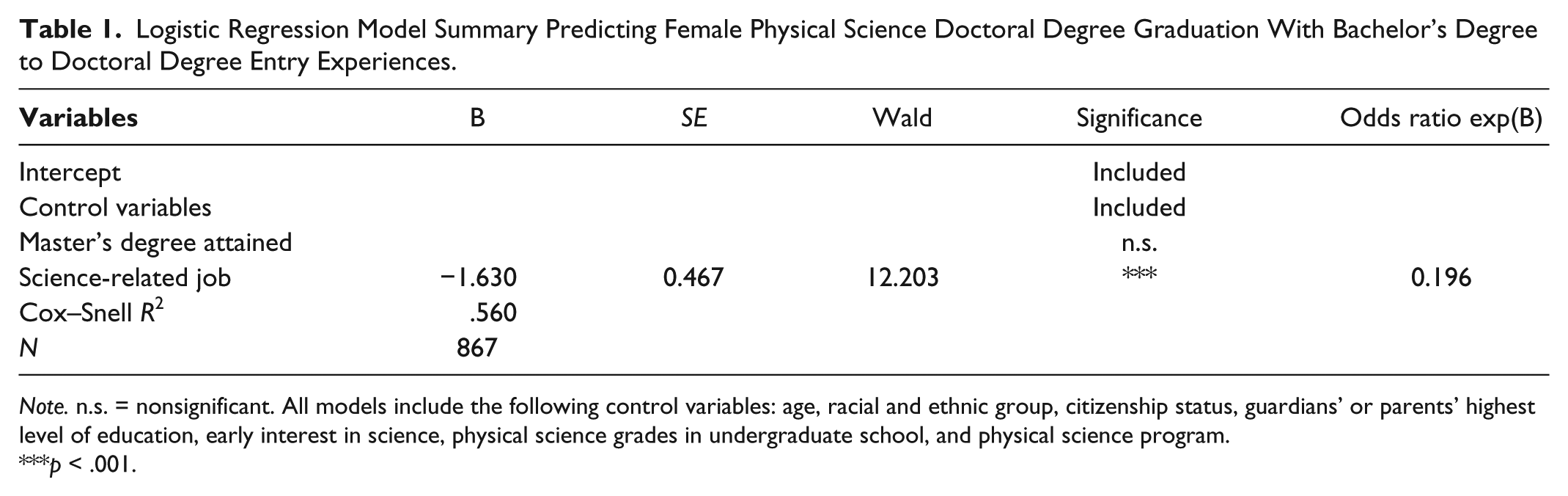
Note. n.s. = nonsignificant. All models include the following control variables: age, racial and ethnic group, citizenship status, guardians’ or parents’ highest level of education, early interest in science, physical science grades in undergraduate school, and physical science program.
p < .001.
Findings show that women who attained a master’s degree prior to entering a doctoral program did not differ from those directly entering their PhD, in less than 6 months, in their likelihood of graduating from a physical science doctoral program. But females who worked for a year or more in a science-related job, prior to PhD degree entry, are 5.1 times less likely to graduate (1/0.196) than those directly entering a PhD in less than 6 months or who attained a master’s degree beforehand. Put in other words, female students following a bachelor’s degree that work in a science-related job for a year or more prior to doctoral degree enrollment, are one fifth as likely to graduate with a physical science PhD.
Next, interactions were modeled with our logistic regression model by crossing individual control factors (e.g., racial and ethnic group, highest parent education, and physical science program) with attainment of a master’s degree and work in a science-related job. None of these interactions were significant once placed in the model.
Discussion and Recommendations
The findings of these analyses provide a unique perspective into understanding the experiences of women’s transition from bachelor’s degrees into chemistry and physics doctoral programs. Our study shows that the influence of these transition factors continue to persist even after women have been accepted and enrolled into these physical science PhD programs. This is surprising as all of our participants went through the same admission process and deemed qualified for doctoral degree enrollment. Thus experiences occurring between bachelor’s degree graduation and doctoral degree entry persevere, regardless of the admissions process, and they may influence later female retention and achievement of doctoral degrees.
Prior statistics have shown that students entering doctoral programs tend to wait the least amount of time, under 2 years, following their bachelor’s degree (Neville & Chen, 2007). Yet it is unknown what students are doing during this transition period of time and how it may be predictive of graduation. Looking at our odds ratios, women who attained a master’s degree prior to enrolling in a doctoral program when compared to those that directly entered a physical science PhD program were equally likely to graduate with a PhD. Thus, staying in academia, either through direct entry into a PhD or gaining a master’s and then entering a doctorate, is predictive of retention of women in physical science.
We next examined women who took a more nontraditional path during their transition time between their bachelor’s to doctoral degree entry. Based on national statistics, it is important to note that these women may fall into the almost 80% that choose to pursue a doctorate first, instead of a master’s degree and then a doctorate, as the details of this statistic are dated and unclear regarding transition time and experiences therein (Sax, 2001). Results showed that females who work for a year or more in a science-related job are less likely to graduate from a doctoral program. Thus, women who leave academic, get a science-related job, and then enroll in PhD programs have a decreased probability of being doctoral holders. Furthermore, the likelihood of graduation is abysmal with women who choose this transition having 20% of the graduation rate of those who either directly enter PhD programs or attain a master’s and then do so. While in some doctoral fields, working for a few years in the field is advisable if not required; our results show physical science doctoral programs may not be meeting the needs of women who are nontraditional students.
An initial interpretation of our findings may lead administrators, educators, and students to encourage direct entry from bachelor’s to doctoral degrees or to pursue master’s degrees and then return for a doctorate. However, this is not always preferable, available, or affordable for all students. Our data alone show that almost 14.2% of our participants chose a nontraditional path via working in a science-related job for a year or more. The attrition of women from physical science PhDs is steep for these students, who work first and enroll later, indicating that this is one place where administrators and faculty may shore up retention of women once enrolled in physical science doctoral programs. Thus we encourage university administrators and educators to provide better support of women who pursue nontraditional pathways into chemistry and physics doctoral programs, especially given reduced nationwide funding to support students in science programs.
In addition, there is a need to further research and examine bachelor’s to PhD transition factors and academic supports that could potentially link with female graduation. The term used commonly in this context is total time to doctorate, which is the time between undergraduate completion and doctorate entry, and accounts for any length of time spent away from the university while transitioning between these two programs (Seagram, Gould, & Pyke, 1998). As studies in this domain are sparse, we encourage the development of future studies to examine how “total time to doctorate” is spent and whether it has any bearing on the doctoral retention and graduation of PhD students.
There are inherent limitations regarding self-reported data. Furthermore, our findings are limited to a select sample, and they are not generalizable to women across all the STEM doctoral programs, or even to all women in chemistry and physics. Significant transition factors into doctoral degrees found in this article are associated with an equal, or decreased, likelihood of female graduation with physical science PhDs. As such, these findings are not causal. Furthermore, we acknowledge that there might be many other factors, including other transition factors that were not used in this study but may predict female chemistry and physics doctoral retention and graduation.
Despite these limitations, our results indicate that there should be a greater focus on bachelor’s to PhD transition factors for women in physical science. Women may not achieve chemistry and physics doctorates, once enrolled in physical science PhD programs, due to the groundwork laid prior to doctoral degree entrance. Our educational focus should, therefore, be on providing greater support of women’s transition into PhD programs to ensure not only physical science career selection and doctoral degree entry but also later retention and graduation once enrolled in a PhD. From an administrative and faculty perspective, these results are eye-opening in regard to female acceptance into physical science doctoral programs and support once in doctoral programs. Research wise, this study begs the following question: “What can education and public policy do to further support females following nontraditional transitions into chemistry and physics doctoral degrees to graduate and have positive experiences?” Prior studies focus on STEM career choice and degree entrance and do not specifically examine and differentiate chemistry and physics doctoral completion, once enrolled, of women based on bachelor’s to doctoral transitions. Overall, our findings indicate that focus needs to shift toward support given to females who follow nontraditional pathways into physical science doctorates as these may present deciding factors not only in graduate career choice and entry but also in doctoral degree completion.
Footnotes
Appendix
Acknowledgements
We thank all the participants of Project CROSSOVER. We also thank our colleagues from Project CROSSOVER who helped with data collection.
Authors’ Note
The opinions expressed here are solely those of the authors and do not represent the policies of the National Science Foundation, Robert N. Noyce Foundation, or staff members. Data, samples, and/or models can be accessed through written correspondence with the Grant PI.
Declaration of Conflicting Interests
The author(s) declared no potential conflicts of interest with respect to the research, authorship, and/or publication of this article.
Funding
The author(s) disclosed receipt of the following financial support for the research, authorship, and/or publication of this article: This work was supported by grants from the National Science Foundation (NSF DRL 1010935, NSF REC 0440002) and the Robert N. Noyce Foundation.