







Abstract
As gene editing technologies such as CRISPR have become increasingly prominent, so have media portrayals of them. With this in mind, the present study builds on theoretical accounts of framing effects, cultivation effects, and genre-specific viewing effects to examine how different forms of media use predict attitudes toward applications of gene editing. Specifically, the study tests how news use, overall television viewing, and science fiction viewing are related to such attitudes. The analyses draw on original data from two surveys of the U.S. public, one conducted in 2020 and the other in 2021. The results from both surveys indicate that news use and overall television viewing predict support for uses of gene editing, whereas science fiction viewing is not significantly related to opinion. The findings suggest that media frames and images may carry implications for the trajectory of public opinion about gene editing technologies and, ultimately, the social context for their development and adoption.
Gene editing technologies that allow scientists to change the DNA of organisms have become increasingly prominent in terms of their real-world applications. For example, new tools such as CRISPR (Clustered Regularly Interspaced Short Palindromic Repeats) have led to breakthroughs in medical treatments (National Human Genome Research Institute, 2019). As these technologies have advanced, recent developments surrounding gene editing—including claims by a team of Chinese scientists to have modified genes in human embryos as well as a series of legal and policy battles in the United States—have helped to fuel news coverage of the topic in outlets ranging from the New York Times to CNN to satirical news programs such as Last Week Tonight with John Oliver (Annenberg Public Policy Center, 2018). The advent of CRISPR has also inspired depictions of gene editing in Hollywood films such as Rampage (starring Dwayne “The Rock” Johnson, 2018) and television programs such as the paranormal drama The X-Files (1993–2018) and the superhero drama Luke Cage (2016–18).
As the visibility of gene editing technologies grows, public opinion toward them may play important roles in shaping decisions regarding their funding, regulation, and adoption (Brossard & Nisbet, 2007; Gaskell et al., 2017; Nisbet, 2018). Recent surveys have found that respondents in many nations, including in the United States, hold complex opinions toward gene editing. In part, attitudes toward uses of gene editing depend on the application and population in question (Delhove et al., 2020; Howell et al., 2020; So et al., 2021). For example, majorities support using gene editing to treat diseases in babies but oppose using it to make babies more intelligent (Funk & Hefferon, 2018; Funk et al., 2020). Previous studies also suggest that a variety of factors — including political values, religiosity, interpersonal discussion, and demographic factors — can shape public knowledge about and support for uses of gene editing (Anderson et al., 2021; Funk & Hefferon, 2018; Kohl et al., 2019; Nisbet, 2018).
Given the increasing media attention to CRISPR and other gene editing technologies, media messages could also influence public support for uses of gene editing. Most members of the public rely on the media for information about scientific issues and emerging technologies, including gene editing (Anderson et al., 2021; Marcon et al., 2019; Nisbet, 2018). In keeping with this, previous research has shown that individuals’ media habits can predict their attitudes toward topics such as agricultural biotechnology (Besley & Shanahan, 2005), cloning (Nisbet & Goidel, 2007), and stem cell research (Ho et al., 2008). Thus, exposure to news framing of CRISPR and related technologies as tools of progress or sources of risk could shape support for uses of gene editing. Similarly, Hollywood images of scientists using CRISPR to create dangerous monsters (as in Rampage), bioweapons (as in The X-File), or superheroes (as in Luke Cage) might influence public opinion toward such technologies.
With all of this in mind, the present study examines how different forms of media use are related to opinions about uses of gene editing. To develop a framework for doing so, it draws on theoretical accounts of news framing effects (Entman, 1993; Gamson & Modigliani, 1989; Nisbet, 2009; Scheufele, 1999), cultivation effects from television viewing (Dudo et al., 2011; Gerbner, 1987; Gerbner et al., 1981; Nisbet et al., 2002), and genre-specific viewing effects (Brewer & Ley, 2021; Brossard & Dudo, 2012; Nisbet & Dudo, 2013; Nisbet & Goidel, 2007). It then uses original data from two surveys of the U.S. public—one conducted in 2020 and the other in 2021—to test how news use, overall television viewing, and science fiction viewing predict support for uses of gene editing. The results highlight the potential role of media frames and images in shaping public opinion on the topic.
Framing, Cultivation, and Attitudes Toward Gene Editing
The present study builds on the premise that members of the public use media messages to understand and evaluate emerging technologies (Besley & Shanahan, 2005; Brossard & Shannahan, 2003; Brossard & Dudo, 2012; Ho et al., 2008; Liu & Priest, 2009). Specifically, this study focuses on how news framing can influence opinions about such technologies by highlighting some aspects of them while deemphasizing others (Cobb, 2005; Gamson & Modigliani, 1989) and how exposure to the dominant portrayals of science and technology on television can cultivate attitudes among viewers (Gerbner, 1987; Gerbner et al., 1981).
Media Framing
As defined by Gamson and Modigliani (1989), a frame is a “central organizing idea or story line that provides meaning to an unfolding strip of events, weaving a connection among them” (p. 143). At its core, the framing process revolves around the salience or absence of information within media messages (Entman, 1993). Frames consist of symbolic devices—including metaphors, catchphrases, and images—that help individuals make sense of complex topics (Gamson & Modigliani, 1989). For example, media outlets can frame an emerging technology as a tool for social progress or as a Pandora’s box that will unleash new dangers (Gamson & Modigliani, 1989; Nisbet, 2009). Exposure to such frames within media messages can shape individuals’ opinions, attitudes, and beliefs about a multitude of subjects (Lecheler & de Vreese, 2018; Scheufele, 1999), including science and technology (Cobb, 2005; Druckman & Bolsen, 2011). In particular, positively framed news coverage can foster links between news consumption and support for emerging technologies (Besley & Shanahan, 2005; Brossard & Shanahan, 2003; Liu & Priest, 2009).
Previous studies of U.S. news coverage regarding biotechnology have found that stories tend to frame this technology positively in terms of progress and benefits, while also highlighting potential risks (Nisbet & Lewenstein, 2002; Priest & Ten Eyck, 2003). Recent studies focusing specifically on news framing of gene editing have revealed similar patterns. Analyzing English-language news coverage of CRISPR from 2012 to 2017, the Annenberg Public Policy Center (2018) found that though a plurality of stories featured balanced coverage with both positive and negative frames, positively framed stories outnumbered negatively framed ones by a two-to-one margin. For example, a February 7, 2014 Los Angeles Times headline stated, “To prevent serious medical conditions, scientists should be able to edit people’s DNA, panel says,” and a December 14, 2016 NPR headline read, “To fight malaria, scientists try genetic engineering to wipe out mosquitoes.” Similarly, Marcon et al. (2019) found that around two-thirds of all stories about CRISPR in the U.S. and Canadian press from 2012 to 2017 were mostly or entirely positive, whereas only a small proportion were mostly or entirely negative.
Building on findings that news coverage of gene editing tends to emphasize positive frames, along with previous findings that exposure to positive news framing can foster favorable attitudes toward emerging technologies, the present study testing the following hypothesis:
Cultivation
Cultivation theory posits that long-term exposure to the dominant messages within a media system can influence individuals’ perceptions and attitudes (Gerbner & Gross, 1976). In particular, this theory suggests that heavy viewers of television will be especially likely to hold perceptions of the world that reflect the messages in popular television programs (Gerbner et al., 1981; Morgan and Shanahan, 2010). Although scholars have highlighted limitations of cultivation theory (Hirsch, 1980; Hughes, 1980), particularly in an increasingly fragmented and polarized media environment, overall television exposure can still help explain public perceptions of social reality (Morgan & Shanahan, 2010; Morgan et al., 2015; Simis et al., 2015).
One strand of cultivation research has examined whether—and, if so, how—television viewing is linked to perceptions of science and technology. Early research on this topic emphasized how prime time television often portrayed scientists as strange and science as dangerous (Gerbner, 1987; Gerbner et al., 1981). This research also concluded that higher levels of television viewing went hand in hand with less favorable attitudes toward science and technology. In short, the prevailing perspective was that “the more people watch television, the less favorable they are about science” (Gerbner, 1987, p. 113).
However, subsequent research has yielded a more nuanced picture. Dudo et al. (2011) found no direct negative effect of overall television viewing on science attitudes, though they did find an indirect negative effect through time displacement of activities that increase science knowledge. Building on the argument that entertainment television offers both positive and negative portrayals of science, Nisbet et al. (2002) concluded that overall television viewing fostered reservations about science but also belief in the promise of science. More recently, Brewer and Ley (2021) reported that entertainment television has increasingly portrayed scientists in a positive light while continuing to portray them as disproportionately likely to suffer injury or death. These authors found that overall television viewing was simultaneously linked to perceptions of scientists as good and perceptions of scientific work as dangerous.
Taken together, these findings suggest conflicting expectations about how television viewing will predict attitudes toward uses of gene editing. One possibility is that television’s enduring portrayal of science as dangerous will reduce support for such uses. Alternatively, the increasingly positive image of scientists that television conveys could translate into greater support for uses of gene editing. Given that prior studies point to potential relationships in either direction, the present study asks the following research question:
Science Fiction Viewing
Though cultivation studies initially focused on the impact of overall television viewing, subsequent research has extended the framework to consider the effects of genre-specific media (Potter, 1993; Simis et al., 2015). In the context at hand, the science fiction genre stands out as a potential influence on how audience members form opinions about science and technology (Green, 2019; Hamilton, 2003), including biotechnology (Nisbet & Goidel, 2007). In part, such effects could reflect how popular films and television programs portray scientists as characters. Contrary to the historical stereotype of the “mad, bad scientist” (Haynes, 2016; see also Weingart et al., 2003), Hollywood science fiction has increasingly tended to portray scientists as good and even heroic (Brewer & Ley, 2021; Perkowitz, 2007). Dr. Kate Caldwell from Rampage is a typical example: she risks her life to defeat an evil corporate executive and rescue Chicago from genetically mutated monsters. In keeping with this pattern, Brewer and Ley (2021) found that people who watched science fiction films were particularly likely to perceive scientists as working for good.
Science fiction effects on public opinion could also reflect depictions of specific technologies and their uses. Looking at Hollywood science fiction from the late 20th century and the first decade of the 2000s, Perkowitz (2007; see also Chapin & Chapin, 1994; Gordon, 2009) observed that films such as Jurassic Park (1994) and Gattaca (1997) present applications of gene editing as wondrous but also warn against their potential dangers for society. More recent Hollywood films about gene editing, such as 2015’s Jurassic World—in which scientists use gene editing to revive and modify dinosaurs—and the aforementioned Rampage have followed a similar pattern. For example, Dr. Caldwell from the latter film highlights both the promise and perils of gene editing. “My brother got sick, but I knew CRISPR could save him,” she says, while also pointing out that a biotechnology company was secretly using her scientific breakthroughs to “build weaponized DNA.”
Considering the largely positive depiction of scientists in recent science fiction films and television programs in conjunction with science fiction’s more ambivalent portrayal of gene editing, viewing the genre could plausibly foster support for or opposition to gene editing. Thus, the present study asks the following research question:
Other Factors
Along with media consumption, a range of other factors may shape support for uses of gene editing. To begin with, interpersonal communication about science and technology can shape knowledge about topics such as gene editing (Anderson et al., 2021) along with attitudes toward biotechnology (Liu & Priest, 2009). In addition, members of the public can use values such as party identification, political ideology, and religious worldviews as heuristics, or information shortcuts, in evaluating issues involving science and technology, including biotechnology (Nisbet, 2005; Ho et al., 2008). Finally, demographic factors may shape attitudes toward emerging technologies, including gene editing (Funk & Hefferon, 2018; Funk et al., 2020). Though the present study does not focus on these factors, the analyses that follow account for them as potential predictors of support for uses of gene editing.
Methods
This study draws on data from two national online surveys. The first was designed by the authors and fielded by the National Opinion Research Center (NORC). For this survey, a nationally representative sample of 1,936 adult U.S. residents were interviewed from March 17 to 27, 2020. The respondents were sampled from NORC’s AmeriSpeak panel. The second survey was designed by the authors and fielded by Qualtrics. For this survey, a national sample of 1,035 adult U.S. residents were interviewed from August 23 to September 2, 2021. The respondents were selected from Qualtrics panels using quotas for gender, age, race, education, income, and region to match population values.
Attitudes Toward Uses of Gene Editing
Each survey included questions measuring attitudes toward three uses of gene editing that recent media messages have highlighted (Annenberg Public Policy Center, 2018; Brewer & Ley, 2021). Respondents in the NORC survey were asked whether they strongly supported (coded as 4), somewhat supported (3), neither supported nor opposed (2), somewhat opposed (1), or strongly opposed (0) “using gene editing to cure diseases in babies before they are born” (M = 2.69, SD = 1.11), “using gene editing to eliminate the species of mosquitoes that carry diseases” (M = 2.65, SD = 1.14), and “using gene editing to bring extinct species back to life” (M = 1.67, SD = 1.25). Support for the first and second uses was greater than support for the third (p < .01 for each comparison). The three items were averaged to create an index of support for uses of gene editing (M = 2.65, SD = 1.14; Cronbach's α = .69)
The Qualtrics survey included the same questions but offered four response options: strongly support (coded as 3), support (2), oppose (1), and strongly oppose (0). As in the first survey, mean support was greater (p < .01) for “using gene editing to cure diseases in babies before they are born” (M = 1.99, SD = .88) and “using gene editing to eliminate the species of mosquitoes that carry diseases” (M = 1.98, SD = 1.02) than for “using gene editing to bring extinct species back to life” (M = 1.41, SD = 1.01). Again, the three items were averaged to create an index of support for gene editing (M = 1.79, SD = .76; Cronbach's α = .73)
News Use
The NORC survey asked respondents how often they “read, watch[ed], or listen[ed] to news about technology” (M = 1.60; SD = .98), coded to range from 0 (less than a few times a month) to 4 (nearly every day). The Qualtrics survey asked respondents how closely they “follow[ed] news about science” (M = 1.67; SD = 1.00), coded to range from 0 (not at all) to 3 (very).
Overall Television Viewing
Each survey included items asking respondents how much time they spent on an average day “watching television shows and movies (including viewing on a computer or mobile device)” coded to range from 0 (0 h) to 4 (four or more hours). For the NORC survey, M = 2.55; SD = 1.15; for the Qualtrics survey, M = 2.95; SD = 1.10.
Science Fiction Viewing
The NORC survey asked respondents how often they “watch[ed] science fiction shows and movies” (M = .97; SD = .90), coded to range from 0 (less than a few times a month) to 4 (nearly every day). The Qualtrics survey asked respondents how often they “watch[ed] science fiction shows” (M = 1.08; SD = 1.02), coded in the same way.
Control Variables
To measure interpersonal discussion, the NORC survey asked respondents how often they “talk[ed] to family members, friends, or co-workers about new kinds of technology” (M = 1.15; SD = .94), coded to range from 0 (less than a few times a month) to 4 (nearly every day). The Qualtrics survey asked respondents how often they “talk[ed] to family members, friends, or co-workers about science” (M = 1.04; SD = 1.07), coded in the same way. Both surveys included standard measures of party identification (NORC: M = 2.77; SD = 1.96; Qualtrics: M = 2.74; SD = 2.20), coded to range from 0 (strong Democrat) to 6 (strong Republican), and political ideology (NORC: M = 2.60; SD = 1.61; Qualtrics: M = 3.25; SD = 1.69), coded to range from 0 (extremely liberal) to 6 (extremely conservative). To capture religiosity, the NORC survey measured attendance at religious services (M = 2.93; SD = 2.75), coded to range from 0 (never) to 8 (several times a week), whereas the Qualtrics survey asked respondents how important religion was in their life (M = 1.79; SD = 1.12), coded to range from 0 (not at all) to 3 (very).
Demographics
Each survey also included a battery of demographic measures. Of the respondents in the NORC survey, 47% identified as men (coded as 0) and 53% as women (coded as 1). In the Qualtrics survey, the percentages were 46% and 54%, respectively. The mean age in years was 48.80 (SD = 16.71) in the NORC survey and 47.44 (SD = 18.16) in the Qualtrics survey. In terms of race, 11% of respondents in the NORC survey and 12% of those in the Qualtrics survey self-identified as Black. For self-identification as Hispanic, the figures were 16% and 19%, respectively; for self-identification as Asian American, they were 2% and 5%. Education was measured on a five-category scale (M = 2.26; SD = 1.00) in the NORC survey and a six-category scale (M = 2.41; SD = 1.50) in the Qualtrics survey. Income was measured on an 18-category scale (M = 8.98; SD = 4.18) in the former and a 12-category scale in the latter (M = 5.35; SD = 3.38).
Results
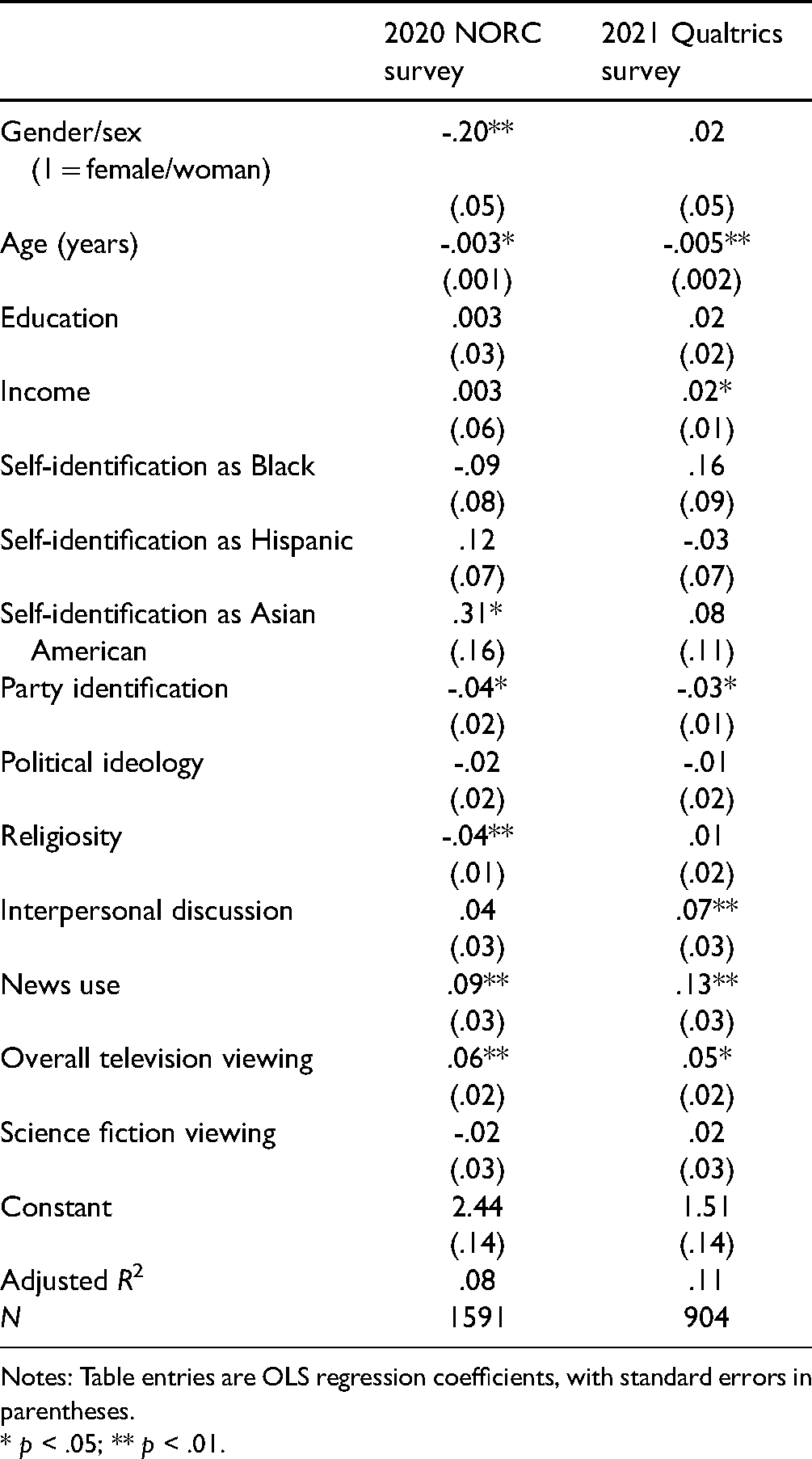
Ordinary least squares (OLS) regression analyses tested whether the key independent variables predicted support for uses of gene editing in the 2020 NORC sample and the 2021 Qualtrics sample. Table 1 presents the results from each analysis.
Predictors of Support for Uses of Gene Editing.
Notes: Table entries are OLS regression coefficients, with standard errors in parentheses.
* p < .05; ** p < .01.
As the first column in Table 1 shows, news use was positively and significantly related to support for uses of gene editing in the 2020 NORC sample (b = .09; p < .01). Similarly, the second column of this table shows that news use predicted support for uses of gene editing in the 2021 Qualtrics sample (b = .13; p < .01). Thus, both analyses yielded clear support for H1. These results suggest that the news framing of gene editing—which tends to be more positive than negative—fosters support for applications of the technology.
In response to RQ1, the analyses found that overall television viewing was positively related to support for uses of gene editing. A significant relationship emerged in both the 2020 NORC sample (b = .06; p < .01) and the 2021 Qualtrics sample (b = .05; p < .05). This pattern suggests that television viewing may cultivate favorable opinions toward applications of gene editing.
Turning to RQ2, the analyses yielded no evidence that science fiction viewing was related to support for uses of gene editing. The coefficient for this variable was not significant in either 2020 or 2021. Thus, portrayals of gene editing in science fiction do not appear to produce discernible effects on opinion among the public as a whole.
Turning to the other independent variables in the model, party identification stood out as a consistent predictor of support for uses of gene editing (in 2020, b = -.04; p < .05; in 2021, b = -.03; p < .01). In both studies, Democrats were more likely than Republicans to favor such uses. Political ideology was not significantly related to support in either analysis. Higher levels of religiosity predicted opposition in 2020 (b = -.04; p < .01) but not in 2021. Discussing technology did not significantly predict opinion in 2020, but discussing science was positively related to support for uses of gene editing in 2021 (b = .07; p < .01). The inconsistent results for religiosity and interpersonal discussion could reflect differences across the two surveys in the measures for these variables, differences across survey firms (NORC versus Qualtrics) in methods, differences in sample composition, and/or change over time.
Among the demographics, age was a consistent predictor of opinion toward uses of gene editing (in 2020, b = -.003; p < .05; in 2021, b = -.005; p < .05). Specifically, older respondents were less likely than younger ones to favor such uses. Education, self-identification as Black, and self-identification as Hispanic did not significantly predict opinion in either analysis. The results for the other demographic variables were inconsistent. Women were less likely than men to support uses of gene editing in 2020 (b = -.20; p < .01) but not in 2021. Income did not predict support in 2020 but was positively related to support in 2021 (b = .02; p < .05). Finally, Asian American respondents were particularly supportive of gene editing uses in the 2020 sample (b = .31; p < .05) but not in the 2021 sample. Again, methodological differences across the two studies and/or change over time may account for these inconsistent results.
Conclusion
Understanding public opinion about emerging technologies such as gene editing can help to illuminate the broader context for public adoption of and public policy toward these technologies (Brossard & Nisbet, 2007; Gaskell et al., 2017; Nisbet, 2018; So et al., 2021). Toward this end, the present study examined how media habits among the public predict attitudes toward uses of gene editing. The results suggest that multiple forms of media use may play roles in shaping such attitudes.
The finding that following news about science and technology predicts support for gene editing applications is consistent with previous arguments that media framing can shape public opinion about emerging technologies (Cobb, 2005; Druckman & Bolsen, 2011) and that positive patterns of coverage foster support for such technologies (Besley & Shanahan, 2005; Liu & Priest, 2009). Given that news outlets tend to frame biotechnology in general (Nisbet & Lewenstein, 2002; Priest & Ten Eyck, 2003) and gene editing in particular (Annenberg Public Policy Center, 2018; Marcon et al., 2019) in positive ways, the results from both 2020 and 2021 suggest that exposure to such framing may lead audience members to view gene editing more favorably. Furthermore, these results suggest that a continued news media focus on social progress frames that highlight benefits from gene editing technologies (Gamson & Modigliani, 1989; Nisbet, 2009) could reinforce support for their uses. At the same time, a shift toward Pandora's box frames that highlight dangers from gene editing could erode such support.
The findings also extend previous research on cultivation in the context of science and technology. Whereas initial cultivation research pointed to potential links between overall television viewing and negative perceptions of science and scientists (Gerbner, 1987; Gerbner et al., 1981), the results of this study dovetail with research that presents a revised picture. Specifically, the positive relationship between overall television viewing and support for uses of gene editing in both 2020 and 2021 parallels findings that such viewing can foster belief in the promise of science (Nisbet et al., 2002) and perceptions of scientists as working for good (Brewer & Ley, 2021). The pattern observed here may reflect positive depictions of science within entertainment television along with the growing tendency of entertainment television to portray scientists as good (Brewer & Ley, 2021; Dudo et al., 2011; Nisbet et al., 2002).
Looking beyond overall television viewing, some studies have found that genre specific viewing—specifically, science fiction viewing—can influence opinions about science and technology, including biotechnology (Green, 2019; Hamilton, 2003; Nisbet & Goidel, 2007). However, the present study yielded no evidence of a relationship between science fiction viewing and support for uses of gene editing. One possibility here is that popular science fiction shows and movies do not portray gene editing technologies often enough, or prominently enough, to shape attitudes about the topic. Another possibility is that the ambivalent portrayals of gene editing in Hollywood films and television (Brewer & Ley, 2021; Perkowitz, 2007) do not exert a consistent overall impact on audience members.
Other factors also predict public opinion about uses of gene editing. In line with previous research, Democrats were more likely than Republicans to support gene editing (Nisbet, 2005; Ho et al., 2008). This pattern may reflect signals from political leaders regarding science in general as well as issue-specific cues about gene editing. In addition, older respondents were less likely than younger ones to support uses of gene editing. The findings for other background factors were either null or inconsistent.
The present study is not without its limitations. One key limitation revolves around its use of cross-sectional survey data, which precludes strong conclusions about causal relationships. Both surveys also relied on self-reports to capture media use. To be sure, previous experimental studies have demonstrated that exposure to media frames and images can shape public opinion about science and technology (Cobb, 2005; Druckman & Bolsen, 2011); thus, similar effects in the context of gene editing seem plausible. However, future studies could use experimentation to conduct direct tests of such effects. Researchers could use the same approach to explore the potential moderators and mediators of these effects. Additionally, research using other methods—including focus groups (Gamson, 1992)—could capture the specific processes through which members of the public use media frames and images to form understandings of gene editing applications.
Another set of limitations revolves around the study's measures for attitudes about uses of gene editing. These measures captured opinions about multiple applications featured in recent media messages (Annenberg Public Policy Center, 2018; Brewer & Ley, 2021), but they do not cover the full range of important uses. Accordingly, future research could examine a wider array of opinion measures, including attitudes toward other uses (e.g., modifying babies for nonmedical purposes) and trust in different actors to perform gene editing.
Finally, it is important to note that the present study focused on opinion during a relatively brief period (2020–2021) in one nation. Given that opinion formation about emerging technologies can vary across both time periods and populations (Funk et al., 2020), additional research should examine how media use predicts support for gene editing in different contexts. Future shifts in media messages regarding gene editing may also alter the patterns observed here. For example, misinformation linking vaccines to gene therapy (Lee, 2021) could affect how members of the public form opinions about gene editing technologies.
Within these constraints, the results of the current study provide foundations for understanding how the public forms attitudes toward emerging forms of gene editing. In particular, the findings highlight the potential role of media frames and images in explaining support for uses of these technologies. Ultimately, the links between the public's media habits and their opinions about tools such as CRISPR may help shape the broader social context for their development and adoption.
Footnotes
Funding
The first survey reported in this study was funded by a grant from the Charles Koch Foundation. The authors bear all responsibility for the design of the study as well as the analyses and interpretation of the data.
Declaration of Conflicting Interests
The author(s) declared no potential conflicts of interest with respect to the research, authorship, and/or publication of this article.
Funding
The author(s) disclosed receipt of the following financial support for the research, authorship, and/or publication of this article: This work was supported by the Charles Koch Foundation,
