







Abstract
The Internet presents a great challenge for families that want a safe digital environment for their children, yet few studies have been performed of facilitators and barriers to the processes by which parents mediate Internet use. Our study reviews the literature indexed in WoS, Scopus, and ERIC since 2000 and identifies factors related to children, parents, and cultural differences due to context. It also performs a qualitative study with at-risk families in southern Spain using focus group technique. Our findings show that parents primarily perceive barriers, emphasizing lack of control over their children's Internet access and usage. Negative beliefs about Internet use also contribute to these challenges. There is a critical need to design programs that give families tailored tools and resources. Addressing educational needs in this context remains a significant challenge for both research and practice. To enhance children's digital safety, it is crucial for parents, educators, and policymakers to collaborate actively. Future research efforts should aim to develop more effective strategies in this direction.
Rapid technological transformations in recent years have influenced our culture and way of interacting with each other. The variety of devices that enable Internet access form part of the everyday lives of young people and children (Domoff et al., 2019). The digital society presents families with new educational challenges, but families do not always have the competences and resources needed to face these challenges. They find parental mediation difficult and express a need for support (Danet, 2020; Goedhart et al., 2019).
Intensification of Internet use is associated with greater opportunity but also with greater exposure to risky experiences (Martínez et al., 2020). Parents must have the right parental mediation strategies (cyber-parenting) to understand the importance of digital education for their children.
The crisis caused by the COVID-19 pandemic has revealed the effects of the digital gap at different levels, especially in low-income families (Sciacca et al., 2022; Vuorikari et al., 2020). This situation provides an opportunity to analyze the specific difficulties families face online, as well as families’ resilience (Bassot et al., 2020). The most vulnerable families face greater difficulties in guaranteeing a secure digital environment for their children and need more support from institutions to overcome these difficulties (Goedhart et al., 2019; Vuorikari et al., 2020).
Any family may experience a complex situation and find insufficient support to face today's multiple challenges. This study focuses on disadvantaged families, especially those vulnerable to the risk of digital exclusion, which can exacerbate other forms of pre-existing exclusion and increase the difficulty of educating children and adolescents (Castro Rodríguez et al., 2019; Goedhart et al., 2019; Sorj, 2008).
Families’ responsibility for their children's education in the digital society involves multiple factors and decision-making in various situations, requiring versatility competences that are not always available (Máiquez et al., 2000, 2019). The most vulnerable families express their intention to give their children better resources and their motivation to learn more about digital technology to help and supervise their children's activity on the Internet (Goedhart et al., 2019).
Factors Influencing Parental Mediation of Internet Use
Parental mediation encompasses the diverse strategies and interventions parents implement to navigate and manage their children's online activities (Livingstone et al., 2017). These strategies, which include discussions, rule-setting, restriction and co-viewing, aim to optimize the benefits of Internet use while promoting safe and responsible behavior (Kirwil, 2009; Livingstone & Helsper, 2008). By mediating their children's technology use, parents can mitigate potential negative influences and enhance the positive impacts associated with interactive technology (Cavallini & Caravia, 2021; Jiow et al., 2017; Steinfeld, 2021). In essence, parental mediation involves a balance of active guidance and boundary setting to create a secure and positive digital environment for children. It includes all actions parents perform to create a secure digital environment for their children and provide a resilient perspective to reduce risks on the Internet (Iqbal et al., 2021; Nikken, 2017). Parental mediation is a dynamic process co-constructed by parents and children according to context, underscoring the importance of adaptability and flexibility in parental mediation strategies (Smahelova et al., 2017). This adaptability allows mediation strategies to be tailored to each child's specific needs and circumstances (Benedetto & Ingrassia, 2020). Effective parental mediation involves utilizing specific tools and possessing adequate digital competence. These factors are crucial for educating children about healthy, safe, and responsible Internet use (Mendoza, 2019; Young & Tully, 2023).
Various factors influence parental mediation of Internet use (Goedhart et al., 2019; Livingstone et al., 2017). The literature describes factors related to children and parents, as well as other types of factors, which we term context-related factors.
Factors Related to Children
Children's age, their electronic skills, and the use they make of the Internet seem to have the strongest influence on parental mediation strategies (Smahel et al., 2020; Tomczyk & Wąsiński, 2017). Gender seems to influence models of parental mediation (Giménez et al., 2017). Some studies identify and describe gender stereotypes (Aierbe et al., 2019; Duek & Moguillansky, 2020), although this relationship is not consistent in all studies (Livingstone & Helsper, 2008).
Factors Related to Parents
Parents’ attitude toward and involvement in Internet use influences the mediation strategies they employ (Gong & Piller, 2017; Nikken & Schols, 2015; Tomczyk & Wąsiński, 2017). Parenting styles seem to influence digital practices and strategies for mediating Internet use (Martínez et al., 2019). The parent's gender is viewed as an influential factor; mothers show higher levels of involvement in parental mediation (Goedhart et al., 2019; Livingstone et al., 2017). Parents’ digital competence is decisive in enabling their children to take maximum advantage of their opportunities while minimizing risks (Livingstone et al., 2017).
Context-Related Factors
Electronic devices that enable Internet access are increasingly varied, making it easier to access the Internet from any place and more challenging for families to control the amount of time their children spend on the Internet, the type of activities they perform, and the content they access (Livingstone et al., 2015, 2017).
Various studies (Livingstone et al., 2017; Martínez de Morentin et al., 2014) describe cultural differences in parental mediation models.
At-Risk Families’ Internet Use
Our literature review found few studies that analyze the models of parental mediation used by at-risk or disadvantaged families. Some studies consider the socioeconomic or socio-educational status among their variables and provide some data on the characteristics of these families’ parental mediation models.
Families considered as at risk or disadvantaged are those experiencing disadvantage or vulnerability due to socioeconomic, psychosocial, or contextual factors that place them in a state of poverty and/or social exclusion (Jorquera, 2020). These families may face difficulties in fulfilling their basic needs, accessing quality services, and providing a safe environment for their members. The risk of exclusion is thus a complex, multidimensional, and dynamic phenomenon (Contreras-Montero, 2020). The digital society creates new forms of poverty, vulnerability, and exclusion. Lacking sufficient resources or having only minimal digital competence impedes access to the opportunities the Internet provides and increases vulnerability to online risks (Martínez et al., 2020).
Internet use can affect at-risk families in various ways, primarily due to limited access, online risks, and the digital gap (economic, geographical, generational, or competence-related). At-risk families may have difficulty accessing the Internet due to economic or geographical barriers (Goedhart et al., 2019; Observatorio de la infancia & INCIBE, 2019). They often face challenges in acquiring the digital competence needed to take maximum advantage of the Internet, and such challenges increase digital exclusion, undermining their capability to participate fully in the digital society (Ross et al., 2022). Further, family members may be vulnerable to online exploitation, cyberbullying, inappropriate or dangerous content, online fraud, and other risky situations. Limited Internet access can also increase the opportunity gap between at-risk families and those with constant access to information and online resources. This situation can affect at-risk families’ ability to look for work, access social services, obtain online education, and participate in civic and community activities. The digital gap has especially significant implications for inequality of opportunity. People who lack Internet access or digital competences are at a disadvantage in areas such as education, employment, civic participation, and access to essential services. Proper family mediation can help to bridge the digital gap and promote acquisition of basic digital competences (López-Sánchez & García del Castillo, 2017; Olarte Encabo, 2017).
Some studies show that parents of at-risk families (those with low socioeconomic or educational status) may face more significant difficulties in mediation and often prefer more restrictive mediation models (Livingstone et al., 2015; Nikken & Opree, 2018). Other studies (Zhao et al., 2023) argue that these families underutilize active mediation because they perceive less risk in using the Internet, specifically in using social networks. According to previous studies, parents of families with low socioeconomic status tend to spend less time with their children, give them less guidance and instruction, and communicate less frequently (Li et al., 2020; Zhao & Phillips, 2013). Other studies (Rideout & Robb, 2020; Tandon et al., 2012) indicate that children and adolescents from vulnerable families are more likely to spend more time using technology.
It is crucial to recognize that families, particularly those at a disadvantage, believe they lack digital skills (Garmendia et al., 2020). They experience heightened insecurity in their competences and express greater concern (Nikken & Opree, 2018). We need to understand the barriers and facilitators that disadvantaged families perceive in order to formulate a response to their needs and advance digital inclusion of the most vulnerable individuals.
Facilitators and Barriers in Parental Mediation
We currently lack a clear view of the relevance of these factors and how they influence parental mediation. Little research has been performed on what factors facilitate or hinder parents’ tasks. What factors can be considered facilitators? What factors are barriers? How do we evaluate whether a variable acts as a facilitator or a barrier?
This study defines barriers as obstacles, limitations, concerns, or challenging situations that parents may encounter when they mediate in their children's Internet use.
We define facilitators as opportunities, educational or enabling factors, strengths, or situations that help or support families in parental mediation processes.
Analyzing the barriers and facilitators of parental mediation can give families resources that meet their needs for regulating their children's online behavior and reducing the risks associated with Internet use.
Understanding how parents navigate barriers and leverage facilitators to guide their children toward healthy, safe, and responsible Internet use is crucial. This involves conscious and balanced interaction with online resources, promoting well-being while minimizing digital risks. Key practices include informed decision-making, privacy protection, critical information evaluation, and ethical participation. Special attention should be given to at-risk families due to their increased vulnerability. Vulnerable families are more susceptible to risks in Internet use due to socioeconomic disparities, limited digital literacy, and gaps in education. These factors hinder their ability to navigate the digital landscape safely and effectively, emphasizing the need for targeted support and resources.
Children and Adolescents’ Internet Use
The digital society gives children and adolescents undeniable opportunities for learning, socialization, participation, creativity development, and expression of identity, as well as access to cultural resources and various leisure options. The Internet also facilitates children and adolescents’ participation in society (Martínez et al., 2020). According to the Digital Economy and Society Index (DESI), in 2022 almost a third of the Spanish population lacked basic digital skills, yet 93% of people 16–74 years old used the Internet regularly (Eurostat, 2021). Those who access the Internet without basic digital skills are more vulnerable to online risks and have more limited access to benefits and opportunities, affecting their ability to access online services, participate in social life, and seek employment (Chen et al., 2022; Golomski et al., 2022).
The goal of educating and mediating Internet use is to ensure that children and adolescents acquire the necessary digital competences to take full advantage of the opportunities the Internet provides. Equally important is the need to minimize risks. The family's educational role is thus essential, providing emotional and practical support usually associated with greater resilience and family well-being. This approach can reassure parents and caregivers about their children's safety in the digital world.
The needs of families—major stakeholders in children's acquisition of fundamental life competences—should be analyzed and addressed so that these needs are met. Guaranteeing acquisition of digital competence is crucial to guaranteeing citizens’ active participation in the knowledge society (Lemish, 2021).
This study addresses the need for more research on how disadvantaged families manage parental mediation of internet use. It starts with a systematic literature review and continues with focus groups to explore their specific experiences.
In order to achieve this goal, the following research questions are posed:
RQ1: What factors facilitate or hinder families’ parental mediation of Internet use? RQ2: How do at-risk families perceive parental mediation of Internet use?
Methods
Search Process
Understanding the barriers and facilitators disadvantaged families face in parental mediation of internet use is one of the critical objectives of this study, which aims to improve the digital inclusion of vulnerable groups. However, studies conducted on this topic with disadvantaged families are scarce, which presents limitations in the current literature. For this reason, this study begins with a systematic review of the literature to identify the barriers and facilitators of parental mediation. Since these results do not specifically address disadvantaged families, the study focuses on focus groups with disadvantaged families in Spain to explore their experiences.
Our study tackles a complex, multidimensional phenomenon using two stages of analysis to answer the research questions and thus enabling exhaustive examination of the phenomenon. We start from a mixed systematic literature review in WOS, Scopus, and ERIC and then deepen the study through qualitative analysis of at-risk families’ experience. For the qualitative study, a total of 95 people participated in nine focus group discussions performed in collaboration with five foundations and associations that work with at-risk families in the city of Granada (Andalusia, Spain). Over 280 transcriptions were analyzed and classified, starting from preestablished categories based on the results of the literature review.
Methodology
The first stage was a mixed systematic literature review (Pluye & Hong, 2014) guided by the PRISMA statement (Page et al., 2021).
We designed a comprehensive search strategy to explore WOS, SCOPUS, and ERIC databases. The search was conducted within the Social Sciences domain, specifically focusing on studies published in English and Spanish between 2000 and 2023. We utilized Boolean operators (AND, OR) to combine the search terms “parental mediation,” “mediation,” “Internet,” “barrier,” “facilitator,” and “avail.” The initial search retrieved a total of 125 results (WOS = 116 results; SCOPUS = 8 results; ERIC = 1 result). Two researchers performed the search process independently and entered the results in a shared online file. The data were then purified by eliminating duplicate files. To ensure that the review was optimal and valid (Bennett et al., 2005), 109 abstracts were reviewed independently. The results were then compared to select the articles that fulfilled the inclusion and exclusion criteria (other different databases and records prior to 2000). The inclusion criteria defined for this stage were: (1) the study's focus is clearly defined as mediation of Internet use; (2) the study population includes parents and legal guardians; and (3) the study describes factors that can facilitate or hinder processes for mediating Internet use.
A total of 16 studies passed this filter and were subsequently subjected to in-depth independent review. Mendeley® software was used to organize the references. An information analysis template was created to facilitate analysis and synthesis of the data. Two researchers performed content analysis of the studies independently. After independently extracting the data, the researchers reached consensus on the data extracted.
The second stage consisted of fieldwork with at-risk families using focus group discussion (Nyumba et al., 2018).
The focus groups participants were parents from disadvantaged families, identified and accessed through local foundations and associations in the city of Granada (Andalusia, Spain) that work with at-risk groups. These families were classified as ‘at-risk’ based on several criteria: they may have low socio-educational and socio-economic levels, belong to minority or ethnic groups at risk of exclusion, and generally reside in neighborhoods with poor infrastructure and deficient resources. The groups of participants ranged from 8 to 12 adults who participated in the care and education of the children for whom they were responsible in their families. The study observed the necessary ethical considerations for performing the research. Participation was informed and voluntary, the data obtained were fully anonymized, and the participants were free to leave the study at any time. The associations provided places to hold the focus group discussions to facilitate participation. One of the researchers participating in the project conducted the focus group. A script available in Appendix A was used to conduct it. Data collection was performed by recording the different transcriptions of each participant's input during the focus group participation. Two people created the record—the researcher/coordinator in the focus group discussion and the person who acted as the link in the different associations, and who collaborated and attended the discussions.
A directed content analysis was conducted (Hsieh & Shannon, 2005), ensuring that the qualitative data analysis is systematic and reproducible, improving the reliability and validity of the results. Conducting the analysis with data obtained from the systematic literature review ensured rigor and transparency in the study's categorization and analysis (Kidd & Parshall, 2000). A deductive category application is carried out (Mayring, 2000), starting from developing the coding framework, creating initial coding categories, and determining detailed definitions and examples for each category. Starting from categories previously identified from the review results and then expanded from the analysis. It was determined whether any categories emerged that did not correspond to those previously established to determine if a new category or subcategory was created (Hsieh & Shannon, 2005; Mayring, 2000).
The coding researchers have been prepared to understand and apply the coding categories. Two researchers performed the coding independently, using the program MAXQDA 2022. After initial data coding, the researchers shared their results and analyzed possible differences. They then reached an agreement on the categories established in this analytical process. Table 1 shows how the definition of a classification was obtained, including the coding system, concepts, and examples. This table refers to the coding of the focus groups. After all the coders have coded the data, their codings are compared. This resulted in an 89% intercoder agreement. Disagreements between coders were resolved by consulting the data and developing a consensus on the categories representing the participants’ perceptions. The analysis expanded the number of categories to include one coded parental support among facilitators, a category not among those established based on the prior literature. Subsequent analysis was performed to search for possible relationships among the data provided by the participants in the nine focus group discussions. The qualitative narrative results highlight facilitators and barriers identified in the analysis.
Coding System, Concepts and Examples a .
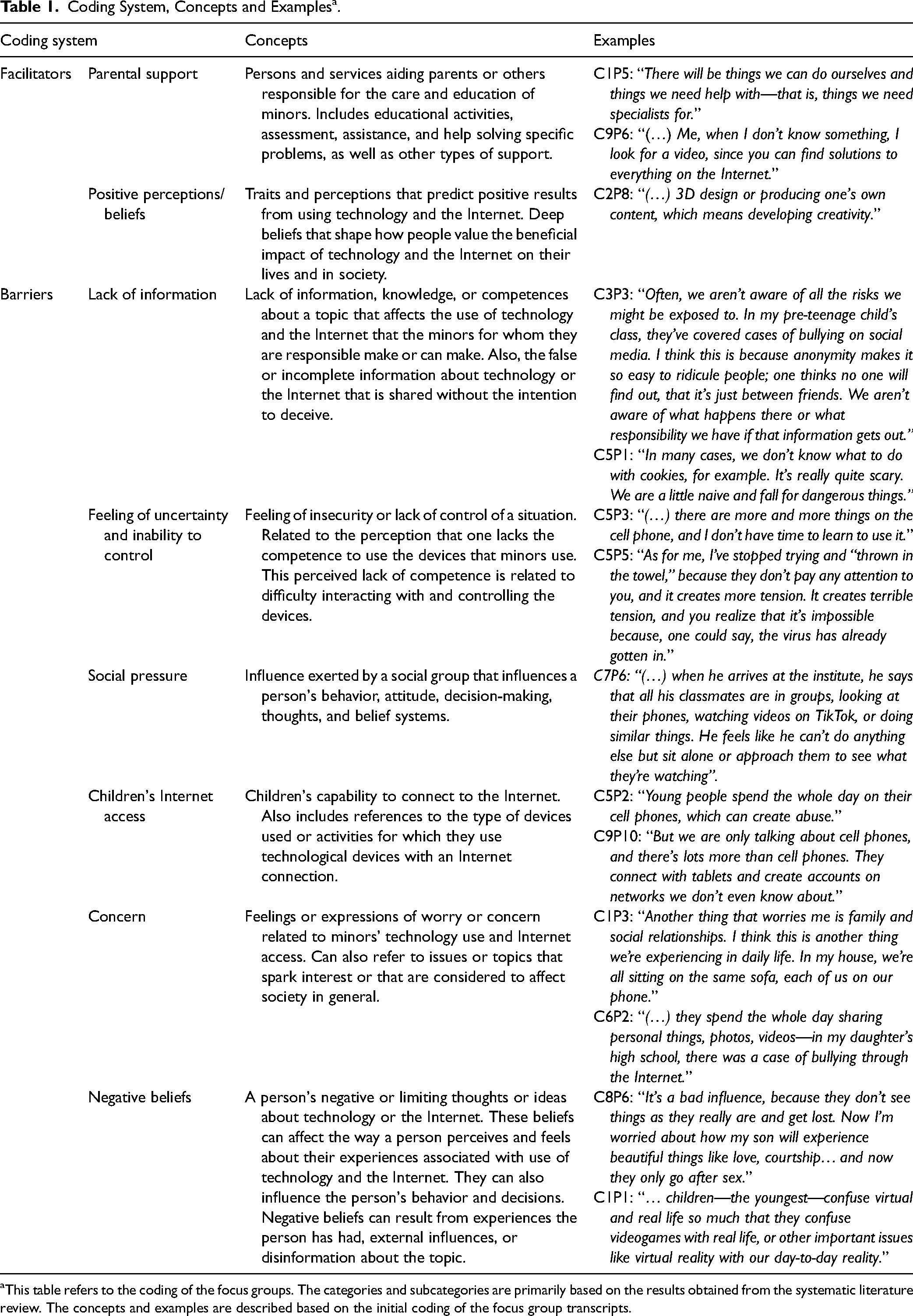
This table refers to the coding of the focus groups. The categories and subcategories are primarily based on the results obtained from the systematic literature review. The concepts and examples are described based on the initial coding of the focus group transcripts.
Parents participants were invited to check the results to ensure the trustworthiness of the findings. Participants were asked to identify the accuracy of the results from their own experience and the consistency of the results— All participants in the verification perceived that the results were consistent with their contributions in the focus groups. This process of member verification, known as “member checking,” is a widely recognized technique in qualitative research to validate data by verifying its accuracy and credibility, providing feedback on its precision (Creswell, 2009; Creswell & Guetterman, 2019).
Results
Systematic Literature Review Results: Facilitators and Barriers to Parental Mediation
Most of the studies analyzed do not provide information on the sociodemographic characteristics of the participating families, except for a few studies (Aierbe et al., 2019; Durak & Kaygin, 2020; Freeman et al., 2008) that provide information on the socio-educational level or profession of the parents. It makes it unclear whether the families were at risk or not, and there needs to be more information to analyze the specific characteristics of the most disadvantaged families.
Barriers in Parental Mediation
Following the analysis of the results from the systematic literature review conducted in this study, both facilitators and barriers in parental mediation were identified. The barriers in parental mediation encompass negative beliefs, concerns about inappropriate content, children's access to devices, feelings of uncertainty and uncontrollability, social pressure, and lack of information about the educational opportunities associated with digital technology use. Additionally, the relationship of these variables may change with the age of the children, particularly regarding their Internet access and use of different devices. The facilitators in parental mediation include positive perceptions and beliefs about Internet use, highlighting benefits such as competence development, critical thinking, access to information, and opportunities for child development.
Among the studies of factors that can act as barriers, Aierbe et al. (2019), Bartau-Rojas et al. (2018), and Fidan et al. (2021) discuss negative beliefs—that is, negative conceptions and beliefs about the consequences for children and adolescents of the Internet or online videogames.
Another barrier is described as concern (Aierbe et al., 2019; Bartau-Rojas et al., 2018; Fidan et al., 2021; Kucirkova & Flewitt, 2022; Nikken & Jansz, 2014; Nuhla et al., 2018). This factor includes parents’ concerns about inappropriate content, access to devices at an early age, excessive or improper use children may make of this technology, and risks associated with Internet use.
Children's Internet access (Aierbe et al., 2019; Eichen et al., 2021; Fidan et al., 2021) is described as children's access to different devices that permit access to the Internet, the location of these devices, and children's access to them in different contexts (accompanied, unsupervised, at the homes of relatives or friends).
The feeling of uncertainty and uncontrollability (Aierbe et al., 2019; Bartau-Rojas et al., 2018; Fidan et al., 2021; Kucirkova & Flewitt, 2022; Nuhla et al., 2018) is described as the impotence or inability to control the time children and adolescents spend on the Internet or to fulfill the standards agreed upon for its use. This factor also includes family members’ feelings of uncontrollability and uncertainty about their children's online activities and behavior. Parents suffer from these feelings much more than other family members (Dedkova & Smahel, 2020).
Aierbe et al. (2019) describe social pressure as a barrier that requires families to make greater efforts to establish limits or improve communication to counteract dominant trends in use time, activities performed, or content children wish to access.
Kucirkova and Flewitt (2022) describe lack of information as parents’ insufficient information about the educational opportunities associated with digital technology use.
Facilitators in Parental Mediation
Unlike barriers, factors that could act as facilitators hardly appear in the studies analyzed. Fidan et al. (2021) and Freeman et al. (2008) describe as positive perceptions and beliefs those beliefs and evaluations of the benefits and positive results associated with Internet use. Some examples of positive beliefs are competence development, critical thinking, access to information, and opportunities that the Internet provides for child development.
As to the possible relationship of the variables that act as barriers and facilitators to other factors, Eichen et al. (2021), Fidan et al. (2021), and Kucirkova and Flewitt (2022) indicate that the value of these variables may change with children's age, especially variables involving children's Internet access and use of different devices to access the Internet.
Qualitative Findings: Perceptions of Parental Mediation in At-Risk Families
The focus group results show that the factors identified influence the parental mediation strategies chosen by parents in at-risk families. Before delving into the results, clarifying the identifiers used in this study is important. These codes, such as C9P10, represent the focus group and participant code, with ‘C9’ referring to the focus group and ‘P10’ indicating the participant. Respecting the privacy of our participants, we have maintained their anonymity by refraining from including any identifying data such as gender or age in this report.
Barriers in Parental Mediation
Analysis of the transcriptions shows a greater perception of factors that act as barriers. The most prominent factors for the parents are children's Internet access and feelings of uncertainty and uncontrollability. As to children's Internet access, the great variety of devices enabling Internet access makes it harder for parents to mediate in their use. The following transcription provides a clear example of this idea:
C9P10: “But we are only talking about cell phones, and there's lots more than cell phones. They connect with tablets and create accounts on networks we don’t even know about.” That's why I say that it's not just a matter of saying “no” to cell phones, because they go online anyway on tablets and computers. Depending on the applications, they can even access applications through a Smart-TV.”
Parents also note the difficulty of managing the amount of time children use the different devices, sometimes because children use devices outside the home, as the following transcriptions explains:
C9P5: “Sometimes they go to our neighbors’ house—neighbors who have a problem with videogames. And when they go there, they play way too much.”
or because excessive use is hard to control:
C5P1: “Now our children get anxious if they’re not in communication with their phones. My daughters are eating, and they hear a message ping and want to get it. Of course, I’m there to establish limits, which often means an argument, but you start to eat and they are totally dependent on their phones.”
C9P6: “My nieces and nephews have problems with videogames. Sometimes they have to hide the machines in the car.”
The parents describe the feeling of uncertainty and uncontrollability as impotence or lack of control of the situation (generalized Internet use; the speed at which devices are updated, requiring continual updating of one's own competences). For the participants, these factors condition the way that they mediate (or do not mediate) children's Internet use. Some transcriptions that exemplify this problem are:
C5P5: “As for me, I’ve stopped trying and ‘thrown in the towel,’ because they don’t pay any attention to you and it creates more tension. It creates terrible tension. You realize it's impossible because, one could say, the virus is already inside them. I have to let my daughter manage her time, leave everything, because you create chaos in the family and they often fight. I’ve realized I can’t do anything. I am incapable of doing anything.”
C5P3: “There are more and more things on the cell phone, and I don’t have time to learn to use it. The same thing happens if you buy a Mercedes with six gears, air-conditioning, and other extras and only know how to use first, second, third, and reverse. You try to put down the window and wonder, ‘How do I do this? How am I going to help my children if I don’t even know? There are also lots of things I can’t use, and sometimes my children explain them to me and I learn little by little.’”
Negative beliefs and worries about online risks (concern) seem to condition the mediation models used, which in this study are related to the most restrictive parental mediation models:
C9P2: “At a friend's birthday party, it turned out that everyone else had their cell phone, and my daughter doesn’t have one. The next weekend, she got on my phone to see the videos that the others had recorded and wanted me to see the videos. They weren’t sexual or anything, but the kids were dancing and fooling around on Internet sites where everyone could see them. I think it's atrocious and tell her that. This is why I don’t want her to have a phone.”
C9P5: “When we find out about things like that, I tell my son, ‘See? This is why we think it's better we strictly forbid phones.’”
C8P6: “Not all apps have parental control. Videogames are deceptive, can easily trick them, and you can’t activate parental control on them. I had to uninstall Fortnite® because my son told me he was doing to play with some classmates. The father was there. All of a sudden, at the start, he heard a French man calling our son by his name. When I asked who he was talking to, he told me that it was someone else who was playing this round. I told him, ‘Leave the game right now!’ And since then, I haven’t let him play anymore.”
Social pressure is described as a factor that conditions children's Internet use and the content they access on the Internet. Based on the study participants’ experiences, children exert the social pressure that they feel on their families so they can follow the trends of the moment with their peers. Some transcriptions that illustrate this factor are:
C9P5: “My son had problems because they ostracized him and laughed at him for not having a phone or understanding about music or games the others shared, and I had to talk to the teacher. Sometimes he asks me, ‘Why can’t I have something?’”
C7P5: “We just don’t realize the danger of these things. And how hard it is to go against the group's social pressure. They say, ‘My friends do it….’”
Finally, as to factors described as barriers, lack of information may be related to lack of digital competence and lack of awareness of online risks. In this study, lack of information is most often explained as something perceived at the social level or in other people. Some examples that illustrate how this factor is perceived are:
C5P1: “In many cases, we don’t know what to do with cookies, for example. I don’t believe in the Internet either, but it's really quite scary. We are a little naive and fall for dangerous things.”
C9P2: “Today it's really complicated. Families would have to be educated, but even when activities are organized, very few families go, and those who need it almost never go.”
Facilitators in Parental Mediation
Very few transcriptions mention factors perceived as facilitators. Among the few that participants do mention is the one we coded parental support, a category that emerged directly from the content analysis of the focus group results. They refer to this factor when they describe assistance, training, or support that has helped them to deal with specific problems. The help is usually obtained from technicians at centers for digital competences, open innovation, and Internet access; other family members (including children and grandchildren); or Internet searches on the topic. Here are some examples:
C7P3: “Me, when I don’t know something, I ask on Guadalinfo (center for digital competences, open innovation, and Internet access). I would try to help him/her and, if I can’t, I ask for help there—they do a good job guiding you.”
C9P6: “(…) It [Technology] is already everywhere. And it's also helpful. Me, when I don’t know something, I look for a video, since you can find solutions to everything on the Internet.”
To a lesser extent, the participants also describe positive perceptions and beliefs as a facilitating factor. The transcriptions relate these factors to characteristics of models with active parental mediation and co-use of the Internet with children. For example:
C2P8: “But it's important to know what our children are doing. (…) It's good to teach other uses of the technologies, for other purposes—for example, 3D designs or producing one's own content, which means developing creativity.”
Discussion and Conclusions
The qualitative results of this study provide an in-depth understanding of the barriers and facilitators disadvantaged families face in parental mediation of internet use. The systematic review of the literature revealed that most studies did not specifically consider disadvantaged families, representing a significant limitation in the current literature. Parental mediation of Internet use is complex. Not all families face this responsibility with the same skills and tools, and this difference can worsen the digital gap. We analyzed the study results by comparing at-risk families’ perspectives on parental mediation of Internet use with the findings of previous studies, which typically focus on the general population. This approach identified unique challenges and similarities that at-risk families face and determined how these challenges influence parental mediation of Internet use.
Living in disadvantaged contexts with inequalities in education and cultural capital can increase the difficulties families face in mediation processes (McDonald-Brown et al., 2017). Analyzing the difficulties and challenges families face when trying to educate their members about Internet use or generate safe digital environments is key to guaranteeing children's online safety and promoting safe responsible Internet use. Knowing what factors facilitate families’ task of educating is indispensable to the ability to offer resources that help families develop sufficient digital skills and knowledge suited to their needs.
Parents’ attitudes and involvement in Internet use influence their mediation strategies (Gong & Piller, 2017; Tomczyk & Wąsiński, 2017). Parents’ commitment to mediating their children's online activities fosters these processes and creates opportunities for dialogue, increasing desirable online behavior and the development of a positive attitude (Tomczyk & Wąsiński, 2017). These outcomes are consistent with our study findings. The participating families are engaged. They describe how Internet use is encouraged as an educational resource and a gateway to other experiences that develop creativity or allow children to access content that would otherwise be difficult to access. Recent studies in the context of the COVID-19 pandemic observe similar commitment from the most disadvantaged families. These studies note that such families have made a more significant effort to access technology, recognizing this access as essential for their children's future (Friedman et al., 2021; Martínez-Domínguez & Fierros-González, 2021).
Parents’ digital competence is decisive in enabling their children to take maximum advantage of their opportunities while minimizing risks (Livingstone et al., 2017). As parents’ competence level influences their participation in their children's online activity (Tomczyk & Wąsiński, 2017), insufficient technical knowledge can hinder parents’ role in their children's educational process (Özgür, 2016). Our study results show that lack of information influences the way parents mediate in Internet use. Not knowing the benefits associated with digital technology use can influence families’ decision-making and cause children to miss opportunities (Kucirkova & Flewitt, 2022). This idea is consistent with the experience described by the participants in our study, some of whom reveal that they use more restrictive parental mediation models because they do not know the potential benefits of Internet use. Others, in contrast, exercise no parental mediation of any kind because they do not know the risks to which children and adolescents can be exposed (Benedetto & Ingrassia, 2020; Floros et al., 2013). Other studies reinforce these conclusions, showing the high proportion of children and adolescents who browse the Internet completely unsupervised (Giménez et al., 2017).
Some researchers show that educational passivity and overconfidence in one's abilities can make parents less involved (Lou et al., 2010; Tomczyk & Wąsiński, 2017). The results of our study seem to indicate, however, that the feeling of uncontrollability described in numerous studies (Aierbe et al., 2019; Bartau-Rojas et al., 2018; Fidan et al., 2021; Kucirkova & Flewitt, 2022) leads parents to abandon attempts to exercise any control or influence over a situation they feel is beyond them (Nikken, 2022). The results of these prior studies coincide with those expressed by the participants in our study, who feel overwhelmed by all that digital education for children and adolescents entails.
Electronic devices that enable Internet access are increasingly varied, making it easier to access the Internet from anywhere and more challenging for families to control the amount of time their children spend on the Internet, the types of activities they engage in, and the content they access (Livingstone et al., 2015, 2017). Families with lower socioeconomic status face challenges in adopting and integrating technology into daily routines (Katz, 2017). Such challenges can make these families more vulnerable to the digital divide. For example, these families probably use a smaller range of devices. Our results also agree with previous studies (Katz et al., 2018) in noting the need for support in the development of digital competences so that families can to manage used of devices whose risks they do not perceive, as the results of our study show. Our study found that families with lower socioeconomic status often struggle to manage their children's Internet use due to lack of digital literacy skills and financial constraints. Similar perceptions emerge in other contexts (Aierbe et al., 2019; Eichen et al., 2021; Fidan et al., 2021).
Staying up to date with constant technological advances is difficult, and parents can come to feel that their children surpass them in technological knowledge (Martínez de Morentin et al., 2014). Many families find that they are experiencing inverse mediation in response to this phenomenon. Research thus describes new scenarios in which families share the challenge of learning how to do things on the Internet together. This situation encourages all members of the family to gain experience on the Internet to close the generation gap and contribute positive educational influence that encourages safe responsible behavior and attitudes (Smahel et al., 2020). The results of our literature review do not describe this phenomenon as a factor that facilitates parental mediation, but the study participants do refer to the phenomenon of inverse mediation and describe specific situations. It is important to remember that children and young people with high levels of technical knowledge do not necessarily have a good understanding of the types of content or risks associated with Internet use. Children can underestimate a parent's ability to help because their judgment is based on what they perceive as their parents’ low level of technical skills (McDonald-Brown et al., 2017).
Our study uncovers a pivotal concern: the absence of knowledge regarding online risks and the online activities of children and adolescents poses a significant barrier to effective parental mediation. As underscored in prior research, this information and training deficit accentuates the necessity of equipping parents with pertinent, accessible educational resources (Symons et al., 2017). These resources are indispensable for bolstering their digital competence and capacity to oversee and mediate their children's Internet usage, thereby ensuring their safety. Earlier studies have indicated that parents show a keen interest in subjects that enable them to gain deeper insights into the implementation of parental mediation, with the ultimate goal of maintaining their children's safety, security, and happiness (Stanley et al., 2017).
As previous studies suggest (Ren et al., 2022), the increased vulnerability of children and adolescents from disadvantaged families to online risks further underscores the importance of intervention strategies that are not merely accessible but also compelling in order effectively to reach those who need them the most.
While our study's findings align with previous research (Nikken & de Haan, 2015), they also provide a unique perspective on support for families and training in digital competences. We find that families perceive the support received as a factor facilitating parental mediation—a view that previous studies have not explored extensively. Our study also echoes previous research (Nikken & de Haan, 2015) in identifying positive perceptions and beliefs as facilitators that link these factors to an increased sense of parental competence.
Another key facilitating factor identified in our study is the role of open and effective communication as a key facilitator in parental mediation of internet use. Our findings align with previous literature emphasizing the preference for open and effective communication between parents and adolescents (Vaterlaus et al., 2014). This active involvement helps establish reasonable rules and promotes safe and responsible use of technology. This active mediation, coupled with open lines of communication, can foster trust and mutual understanding, thereby facilitating effective parental mediation of internet use.
Implications for Further Research
We find evidence of factors that influence models of parental mediation of Internet use. Why do some factors come up more often in the research, and why are others less visible? What factors could explain researchers’ decisions to include some factors and omit others?
Accessing vulnerable or disadvantaged populations for research purposes presents significant challenges, and these challenges have conditioned this study's sample size. The difficulties encountered include limitations in participant access, challenges in recruiting people to participate in the study, and practical barriers such as the need for more financial and human resources to achieve a larger sample. That previous studies of vulnerable groups have experienced similar difficulties highlights the challenge of accessing this population and reflects the inherent complexity of working with at-risk groups (Anderson & Hatton, 2000; Walker & Read, 2011). Despite these limitations, successful strategies have been implemented to access this population, such as collaboration with organizations that work with the hard-to-reach population (Ven et al., 2022). Although not generalizable, our results demonstrate that these at-risk families have specific needs. This study contributes to the literature by providing empirical evidence on the experiences of at-risk families. The findings provide valuable insights and starting points for future research to explore these issues with larger samples. They also contribute significantly to the existing literature by highlighting the importance of developing local support networks and community programs tailored to the needs of at-risk families. Our study thus addresses the digital divide holistically and offers informed recommendations for creating policies and practices that promote safe responsible Internet use and digital inclusion. Its results provide an empirical basis for developing local support networks and community programs to educate families. Such assistance can improve families’ digital competences and provide tools to overcome the difficulties that parents encounter in educating their children. Furthermore, by identifying effective strategies and specific barriers in digital mediation, our study broadens the field's understanding and underscores the importance of addressing the digital divide from a holistic, community-based perspective. Providing opportunities to improve parents’ digital competences and online family resilience is a necessity and a challenge that current policies must address to guarantee development of digital citizenship. It is important to tackle these challenges and guarantee that at-risk families have equitable Internet access, as well as the support and education needed to use the Internet in a safe, beneficial way. Meeting this need requires policies and programs to promote digital competence. Future research can study the tools needed to improve on issues mentioned in this study, such as connectivity, digital literacy, and awareness of online risks; and to provide support to foster healthy and balanced family interaction.
It would also be beneficial for future research to conduct comparative analysis of at-risk and not-at-risk families. Such a study would highlight these two populations’ unique challenges and similarities, providing a deeper understanding of the dynamics that influence parental mediation of Internet use. A comparative approach could also provide the foundation from which to develop more informed recommendations and specific policies that address each group's needs.
Footnotes
Acknowledgments
Support received from the Spanish Ministry of Education and Vocational Training FPU19/00505.
Author Contributions
All authors contributed to the final manuscript. Conceptualization: MMGR. Methodology, Formal analysis: MMGR & MJGA. Writing: MMGR & MJGA. Review: MJGA. All authors read and approved the final manuscript.
Data Availability
The data generated and analyzed during this study are available from the authors on request.
Declaration of Conflicting Interests
The authors declared no potential conflicts of interest with respect to the research, authorship, and/or publication of this article.
Funding
The authors disclosed receipt of the following financial support for the research, authorship, and/or publication of this article: This study was financed by Operational Program FEDER 2014-2020/Andalusian Regional Government/the Regional Ministry of Economic Transformation, Knowledge, and Universities of Andalusia/Project B-SEJ-102-UGR18. Funding for open access charge: University of Granada/CBUA. Spanish Ministry of Education, Culture, and Sport.
