






Abstract

Authors are encouraged to submit manuscripts on any of the following topics to https://mc.manuscriptcentral.com/tecse. For questions, contact Erin Barton; e-mail:
Editor’s Note: Please remember also that quality manuscripts on any relevant topic (i.e., “open topic manuscripts”) may be submitted at any time and, if accepted, will be published when space permits or in a scheduled Open Topic issue of the journal.
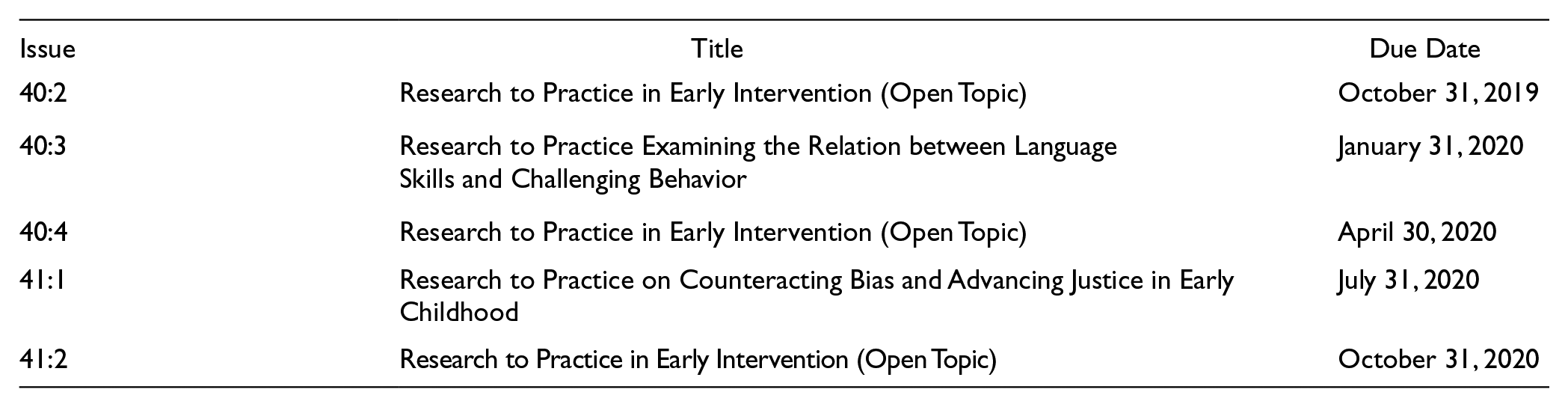
Issue 40:2— Research to Practice in Early Intervention (Open Topic)
This is an open, nontopical issue for manuscripts on any aspect of early intervention for infants, toddlers, preschoolers and their families. Authors are encouraged to submit reports of original research, literature reviews, conceptual statements, position papers, descriptions and evaluations of effective programs, and reactions to previous manuscripts published in TECSE. Articles may address topics that have been featured in previous issues of the journal or topics that have not been addressed. Acceptable manuscripts will be published on a space-available and first-come first-served basis; therefore, authors are encouraged to submit their work as early as possible. Due Date: October 31, 2019
Issue 40:3— Research to Practice Examining the Relation between Language Skills and Challenging Behavior
Young children with language delays frequently exhibit elevated rates of challenging behaviors when compared to same-age peers with typically developing language. Although there is evidence of a high degree of comorbidity between language delays and challenging behaviors, few studies have examined the impact of language interventions on children’s challenging behaviors or analyzed the complex moderators of the long-term language and behavior relation. The purpose of this topical issue is to advance understanding of the relation between early delays in language and behavior development in young children. We are specifically interested in manuscripts that address: (1) factors that might moderate the relation between language skills and behavior problems in preschool children, particularly those from low-income environments; (2) effective support strategies for both language and behavior in complex classroom environments; or (3) the contribution of measurement to assessments of co-occurrence of language and behavior. We welcome the submission of manuscripts that include descriptions of empirical research, systematic reviews of the research literature, and conceptual discussions of the aspects of this complex relation, which should be considered in the development of a theoretical model, interventions, and professional training for teachers to support children’s language and behavior. Please email Erin E. Barton (Editor) at
Issue 40:4— Research to Practice in Early Intervention (Open Topic)
This is an open, nontopical issue for manuscripts on any aspect of early intervention for infants, toddlers, preschoolers and their families. Authors are encouraged to submit reports of original research, literature reviews, conceptual statements, position papers, descriptions and evaluations of effective programs, and reactions to previous manuscripts published in TECSE. Articles may address topics that have been featured in previous issues of the journal or topics that have not been addressed. Acceptable manuscripts will be published on a space-available and first-come first-served basis; therefore, authors are encouraged to submit their work as early as possible. Due Date: April 30, 2020
Issue 41:1— Research to Practice on Counteracting Bias and Advancing Justice in Early Childhood
All young children have the right to early learning opportunities in which they are positioned to participate as valued members of their families, early childhood programs, and communities. However, substantial inequities plaguing society directly impact access to equitable education for all children. Young children are navigating social worlds in which ableism and racism (and other intersecting oppressions) operate. Hateful rhetoric and outward displays of ableism and racism have increased in recent years (Crandall, Miller, & White, 2018; Paluck & Chwe, 2017; Southern Poverty Law Center, 2016). Ableism and racism also work in neutralized and invisible ways (Annamma, Connor, & Ferri, 2013), structuring implicitly biased interactions that pathologize young children based on ability and/or race. Whether explicit or implicit, bias can have real material, social-emotional, and psychological consequences in early childhood contexts—directly affecting the ways in which young children develop and learn. In this topical issue, we recognize a critical need to address both explicit and implicit bias in early learning contexts, and the ways ableism, racism, and other intersecting oppressions operate. Manuscript topics might include: anti-bias education and curriculum, addressing bias in early childhood personnel preparation, examining biased interpretations of young children’s behavior, addressing systematic exclusion of young children from early care and education programs, or bias in family-professional communication. We welcome the submission of manuscripts that include theoretically-grounded descriptions of empirical research, reviews and syntheses of the literature, discussions of pertinent policies and programs, and conceptual perspectives. We also are particularly interested in supporting authors who are under-represented in academic publishing. Please email Erin E. Barton (Editor) at
Issue 41:2— Research to Practice in Early Intervention (Open Topic)
This is an open, nontopical issue for manuscripts on any aspect of early intervention for infants, toddlers, preschoolers and their families. Authors are encouraged to submit reports of original research, literature reviews, conceptual statements, position papers, descriptions and evaluations of effective programs, and reactions to previous manuscripts published in TECSE. Articles may address topics that have been featured in previous issues of the journal or topics that have not been addressed. Acceptable manuscripts will be published on a space-available and first-come first-served basis; therefore, authors are encouraged to submit their work as early as possible. Due Date: October 31, 2020