







Abstract
In this exploratory study, we used a person-centered approach to examine 117 U.S. early childhood and elementary school teachers’ perceptions of their social and emotional practices within an evidence-based framework. A latent profile analysis revealed a 4-profile model with four distinct groups. Teachers’ level of education and years of experience were associated with lower or higher perceptions of child behavior. Results reveal how teachers’ perceptions of their social and emotional implementation and child behavior impact the intensity and variety of their practices, as well as differences in teachers’ perceptions based on their professional characteristics. Implications for this research suggest a need to further examine the contextual and causal factors that influence teachers’ implementation of social and emotional practices and perceptions of child behavior.
Social and emotional development is defined as “the developing capacity of the child from birth through 5 years to form close and secure adult and peer relationships, experience, regulate, and express emotions in socially and culturally appropriate ways, explore their environment, and learn all in the context of family, community, and culture” (Yates et al., 2008, p. 2). Some children who enter early childhood settings may demonstrate low levels of these skills requiring responsive social and emotional instruction. Data show that social and emotional challenges began early with one in six (17.4%) children between the ages of 2 and 8 years being diagnosed with a mental, behavioral, or developmental disorder (Center for Disease Control and Prevention, 2023). These percentages will likely increase due to persistent child exposure to adverse childhood experiences (Finkelhor, 2020), including the social isolation and economic recession many children and families experienced during the coronavirus pandemic (Brooks et al., 2020). Importantly, children may not have accessed the full benefit of protective factors (i.e., early care and education, peer relationships, school services, predictable routines; Yule et al., 2019) because of pandemic-related stressors (e.g., health, social isolation, financial insecurity, remote educational instruction; Zheng et al., 2021), requiring a need for enhanced social and emotional support in early childhood environments.
Impact of Remote Instruction on Social and Emotional Development
Some studies have documented the deleterious effects of the COVID-19 pandemic on children’s social and emotional well-being (Doepke & Zilibotti, 2020; Patrick et al., 2020), including for young children (e.g., Barnett et al., 2021, Egan et al., 2021; Ling et al., 2023; Wahman, Rispoli, & Cascarilla-White, 2024; Weiland et al., 2021). Specifically, young children experienced an increase in anxiety, depression, irritability, and fear (Loades et al., 2020). Many early childhood environments pivoted to remote-only, or hybrid instruction and this disruption to children’s daily routine is associated with higher levels of externalizing and internalizing behaviors and fewer prosocial behaviors (Sun et al., 2022). That is, the abrupt change in the mode of instruction resulted in a loss of learning opportunities for children to practice key social and emotional skills (Barnett & Jung, 2021; Hamilton & Gross, 2021), such as playing with peers (i.e., sharing, turn-taking, waiting), and participating in structured routines and activities (Egan et al., 2021). Accordingly, both parents and teachers reported concerns about children having fewer opportunities to practice social and emotional skills, as well as limited access to social and emotional support during remote instruction (Timmons et al., 2021). Not surprisingly, research shows that some children demonstrated fewer gains in social and emotional skills during the pandemic than in previous years (Bassok et al., 2020, 2021). Further, a separate study found that children enrolled in preschool who experienced in-person instruction received more favorable ratings from their caregivers on their social and emotional skills compared to those who were not enrolled or did not receive in-person instruction (Wahman, Rispoli, & Cascarilla-White, 2024). These facts highlight the need for evidence-based social and emotional support for young children as educators respond to the residual impact of the pandemic on children’s well-being. When social and emotional challenges are not addressed early on, children experience a continued progression of negative life outcomes that impact their social, emotional, behavioral, and academic well-being (e.g., Hauser-Cram & Woodman, 2016; Jones et al., 2015; Oberle et al., 2014). Therefore, it is critical that early childhood educators provide responsive support to enhance children’s capacity for social and emotional growth.
The Pyramid Model
An important aspect of advancing young children’s social and emotional growth is ensuring teachers are equipped to proactively respond to their needs. Decades of research have documented the positive and long-term impact early childhood environments have on young children’s social and emotional development (Bakken et al., 2017; Bierman et al., 2014; Greenberg, 2023). Fortunately, there is evidence that early childhood teachers can be successfully trained to facilitate these outcomes using practices within a tiered model, such as the Pyramid Model Framework (e.g., Hemmeter et al., 2016, 2021). Drawn from Positive Behavior Interventions and Supports (PBIS; Sugai & Horner, 2020), the Pyramid Model organizes core evidence-based social and emotional practices within a multi-tiered framework focused on promotion, prevention, and intervention. It incorporates a variety of strategies across varying levels of intensity (universal, targeted, and individualized) to promote young children’s social and emotional learning and prevent perceived challenging behaviors (see Fox et al., 2021 for a comprehensive overview of strategies). For example, practices include building positive relationships with children, families, and colleagues, arranging the physical environment to facilitate positive and supportive interactions with peers and adults, and teaching social and emotional skills (e.g., how to follow rules and expectations, problem-solve, manage anger, develop friendships). Finally, strategies also include designing individualized intervention and instructional support for children with social, emotional, and behavioral needs. Most importantly, the Pyramid Model provides a framework to monitor the implementation of social and emotional instructional approaches, as well as the quality of teachers’ implementation. Notably, the Preschool-Wide Evaluation Tool (Pre-SET), the Teaching Pyramid Observation Tool (TPOT), the Teaching Pyramid Infant Toddler Observation Scale (TPITOS) are measures that have been developed to examine teachers’ social and emotional practice use and to describe the quality of social and emotional practices implemented. Studies using these measures have shown that teachers can implement these practices with fidelity creating more emotionally supportive classrooms (Fox et al., 2014; Steed & Pomerleau, 2012). Thus, the evidence for teachers’ implementation of these practices is strong. However, more research is needed to understand teacher-related factors (i.e., teacher’s years of teaching experience, teacher ethnicity/race; Hanson-Peterson et al., 2016; Thierry et al., 2022; Wanless & Domitrovich, 2015; Williford et al., 2015) that influence the uptake of core social and emotional practices due to mixed findings across the literature (Downer et al., 2009; Driscoll et al., 2011; Ringwalt et al., 2002, 2003; Rohrbach et al., 1993).
Teacher Perceptions of Child Behavior
While research has documented that teachers’ relationships with young children are a key indicator of high-quality classroom practice and can predetermine how children respond behaviorally (e.g., Hamre & Pianta, 2001; Pianta & Stuhlman, 2004; Sabol & Pianta, 2012), scant literature exists on how teachers’ perceptions of child behavior impact their implementation of high-quality social and emotional practice (e.g., Coplan et al., 2015; Dobbs & Arnold, 2009; Thijs & Koomen, 2009; Yoder & Williford, 2019; Zinsser et al., 2014, 2015). However, related literature suggests that differences in teachers’ implementation of high-quality social and emotional instruction are mediated by their beliefs about emotions, the value placed on social and emotional practices through the kinds of social and emotional strategies used, and their perception of their role as a facilitator of children’s emotions (Zinsser et al., 2014, 2015). For example, Zinsser et al. (2014) observed teacher’s interactions with children in the classroom and interviewed teachers about the value of their social and emotional practices. Findings indicate that teacher beliefs about social and emotional learning were associated with their emotionally supportive interactions with children. Specifically, while highly supportive teachers placed a high value on social and emotional learning as demonstrated through the design of daily activities and their responsive interactions with young children, moderately supportive teachers were more instrumental in their practices and integrated social and emotional learning approaches into their classroom as a checklist, relying on social and emotional curriculum and prepackaged lessons. In a separate study, Zinsser et al. (2015) found that highly and moderately supportive teachers had similar beliefs about emotion expression but differed in how they addressed emotion regulation practices in their classrooms. For example, while highly supportive teachers successfully modeled how to self-regulate and calm negative emotions, less emotionally supportive teachers minimized negative emotion expression and were more comfortable modeling positive emotions. These interactions were directly related to teachers’ perception of their knowledge and understanding of emotions. Taken together, teachers’ beliefs about emotions and teachers’ emotion knowledge can impact the quality of social and emotional practices implemented. Of note, across both studies, a larger percentage of highly supportive teachers had more years of experience in early childhood education than moderately supportive teachers. Thus, years of experience in early care settings may enhance teachers’ social and emotional competence.
Relatedly, in a study that examined 405 preschool teachers’ perceptions of child behavior using a series of short vignettes and questionnaires, teachers perceived externalizing behaviors (i.e., aggression, socially defiant) more negatively than internalizing behaviors (i.e., social withdrawal) (Coplan et al., 2015). In this study, teachers’ years of teaching were not associated with their perception of child behavior, a similar observation in Yoder and Williford (2019). This still leaves questions about how contextual and causal factors such as teachers’ professional characteristics impact their perception of child behavior. Overall, however, outcomes mimic results in an earlier study where teachers provided more corrective, or reactive statements to respond to children who engaged in externalizing behaviors of concern while children with more internalizing problems received more praise or positive attention (Dobbs et al., 2009). These results suggest that teachers respond differently to children based on the type of behavior they demonstrate underscoring the relationship between teachers’ perception of child behavior and the potential role of bias in their social and emotional implementation practices.
Purpose of Study
There is an absence of studies on teachers’ perceptions of child behavior during remote instruction. While some studies have shown that teachers’ demographic characteristics (i.e., race/ethnicity, years of teaching experience) influence their uptake of social and emotional practices (Thierry et al., 2022; Wanless & Domitrovich, 2015; Williford et al., 2015), few studies have examined how teacher’s demographic characteristics influence their perceptions of child behavior (Alter et al., 2013; Wymer et al., 2022) and related social and emotional practices (Yoder & Williford, 2019). Thus, the field has a nuanced understanding of what contextual factors, such as teachers’ professional characteristics, impact their perception of child behavior and related social and emotional practices because these variables have not been integrated in the literature. To address these gaps in the literature, examining teachers’ use of social and emotional strategies in person and online and the contextual and causal factors (i.e., teacher characteristics) that impact their perception of child behavior and use of social and emotional strategies is warranted.
We used a person-centered approach to examine common patterns of teachers’ implementation on social and emotional indices during the Covid pandemic. A person-centered approach addresses the co-occurrence of teachers’ characteristics and classroom practices and the reciprocal nature of these variables and their related outcomes (Jeon et al., 2016). Identifying patterns of teachers’ implementation practices can provide a fuller picture of teacher characteristics that are associated with individualized profiles of teacher behavior. This deeper understanding of teacher profiles and related behaviors can drive targeted professional development and support as described in previous research using this approach (Fettig et al., 2021). The following research questions guided this study: (a) What are the common underlying profiles of Pyramid Model Practices (PMP) implemented by early childhood and early childhood special education teachers? (b) How do profiles of teachers’ implementation on social and emotional strategies vary across teachers’ professional characteristics (i.e., level of education and years of experience teaching)?
Method
Sampling and Administration Procedures
The participants included general and special education teachers from a university-affiliated child care facility and a U.S. Midwestern public school district. An anonymous online survey link was disseminated to 252 teachers using Qualtrics Survey Software™ and 155 teachers accessed the survey link. Among them, 117 teachers responded to the survey and were qualified based on the inclusion criteria (46.4% response rate). Participant responses were included as part of the sample if teachers taught children between the ages of 3 to 8 years in special education and general education classrooms. Responses were excluded for teachers serving children older than age 8, related service personnel (i.e., speech pathologist, social worker, resource room teacher), and/or school administrative staff.
The survey was piloted prior to dissemination with three early childhood teachers that provided feedback on the design and questions of the survey. Their feedback was addressed and changes were made to the survey based on their feedback. Piloted data was not included in adjusted survey data. The final survey was disseminated using the university-supported Qualtrics Survey Software™. For the local school district, Qualtrics was used to input teacher email addresses and track participant responses. For the child development center, the school administrative assistant disseminated the survey link to the teachers. Initial email requests to participate in the survey were sent in early Winter of 2020 and up to three reminders were sent over the course of 3 months. Participants did not have a set of definitions when responding to the survey. Participants received an Amazon electronic gift card for their participation. The study was approved by the Institutional Review Board and all participants consented to participate in the study prior to responding to the survey questions.
Setting
The university-affiliated child-care facility is a full day preschool facility that offers programs for children ages birth to kindergarten entrance. It has accreditation from the National Association for the Education of Young Children (NAEYC). The child-care center often has children of faculty members, graduate students, as well as students from the surrounding community. It serves primarily White and middle-income children and families. 7.14% of the sample population was recruited from this school.
The public school district is located in an urban city where it serves 10,621 students in preK-12 grades. The school district has an enrollment of 75% students of color and/or who are multilingual which is greater than the average for the Midwestern State. 39% are African American students, 25% are White, 19% are Hispanic, 10% are Multi-Racial, 6% are Asian or Pacific Islander, and 1% are American Indian. The district is ranked in the bottom 50% of all school districts in the State based on combined math and reading test scores for the 2018-2019 school year. 92.86% of the sample population was recruited from this school district. This survey study was disseminated during the Coronavirus pandemic. As such, teachers taught their students in a range of settings from online (82%), to hybrid (1%), to in person (17%).
Participants
This study included a total of 117 teachers in early childhood programs and elementary schools (PreK through third grades). Among them, 62.5% (n = 73) indicated that they are not special education teachers. About 30% (n = 35) of the participants were teaching at preschool level, 28% (n = 32) were teaching children in kindergarten, and 49% (n = 57) were teaching children in grades 1 through 3. The majority of teachers were female 98% (n = 114), 88% (n = 102) identified as White, non-Hispanic, 1.71% (n = 2) identified as Latino or Hispanic, 5.13% (n = 6) identified as Black, 4.27% (n = 5) identified as Asian or Pacific Islander, and 0.85% (n = 1) identified as Multi-Racial/Ethnic. Among the demographic and professional characteristics, there were 3.4% (n = 3) of missing data in participants’ years of ECE experiences, 4.3% (n = 5) in years of special education experiences, 5.1% (n = 5) in class size, and 15.4% (n = 18) in the area of higher education degrees.
Social and Emotional Teaching Practices Measure
Teachers were asked to complete questions on the universal practices implemented within the Pyramid Model Approach (Fox et al., 2003). The survey did not directly measure teachers’ implementation of social and emotional practices but self-reported implementation of teacher practices. The measure used is appropriate for classrooms birth to age 8. The Pyramid Model Practices Implementation Checklist was used to develop these questions (National Center for Pyramid Model Innovations, 2020). While this tool does not have any psychometric properties, they are designed as a coaching tool and is aligned with the Teaching Pyramid Observation Tool (TPOT; Hemmeter et al., 2014) which has promising psychometric evidence for dependably measuring teachers’ implementation of Pyramid Model practices (Snyder et al., 2013). To the best of our knowledge, we are the first to use the checklist as a survey for teachers however there is good evidence for asking teachers to rate their use of social and emotional practices (Golden et al., 2021, 2024). These data support the idea of having teachers reflect on practice and identify their own strengths and needs. While teachers in this study were not educated on the Pyramid Model practices, we used said indices as a benchmark to assess teachers’ global understanding of typical social and emotional practices recommended within the field of early childhood. The practices were used as a baseline assessment of teachers’ understanding given that it serves as a standard of practice for social and emotional teaching.
Questions targeted responsive relationships, supportive conversations, positive attention, predictable daily routines, creating effective classroom routines, promoting children’s engagement, teaching expectations, and rules, teaching social and emotional skills, including friendships skills, problem solving, and emotional literacy. We asked questions about three different domains of teachers’ social and emotional practices. First, 16 items were asked about teachers’ perceptions of children’s social and emotional behaviors (e.g., “How often do students communicate emotions?” or “How often did your students engage in positive interactions with their peers?”). Teachers responded to each item using a 6-point Likert scale (1 = Very frequently, 6 = Never). For one item examining teachers’ perceptions of the variety of peer discussion topics among children, teachers reported whether their children are using each of the five peer discussion topics in yes or no. The proportion of discussion topics covered by children was calculated. Second, the intensity of teachers’ social and emotional strategies was measured by nine items. Teachers were asked to respond to what extent they use each strategy, using a 6-point Likert scale (1 = Very frequently, 6 = Never). Items were included in the exploratory factor analysis (EFA) to create subscales by calculating mean scores of the items in each subscale. Finally, the variety of teachers’ social and emotional strategies were examined by 19 items (e.g., “Strategies to soothe upset children” and “Strategies to support student conversation”). Within each item, teachers were asked to indicate whether they are using the range of social and emotional strategies falling under each theme.
Demographic and Professional Backgrounds
Teachers’ age was included as ordinal variables with five categories (1 = Younger than 25 years old, 5 = Older than 55 years old). Teacher race/ethnicity was entered as a binary variable with White coded as 1 and all other race/ethnicity coded as 0. Due to the small cell size for each race/ethnicity category, we could only include the largest category, White, non-Hispanic, to account for teachers’ race/ethnicity in the model. Teachers’ educational attainment was included as a binary variable with having a master’s degree coded as 1 and below master’s degree as 0. Two binary variables were included to indicate whether teachers have a bachelor’s or master’s degree in early childhood/elementary education or in special education. Years of experiences in early childhood education were accounted by an ordinal variable with five categories (1 = 1 to 5 Years, 5 = More than 25 Years). Class size was entered as a continuous variable. The mode of instruction was included as a binary variable with online instruction coded as 1 and other formats (i.e., hybrid or in-person) as 0. Finally, grade levels taught by teachers were included as two binary variables to indicate whether the teachers worked with children in early childhood (1 = Yes, 0 = No) and in elementary grades (1 = Yes, 0 = No).
Data Analysis
We used a latent profile analysis to identify membership patterns in early childhood and early childhood special educators’ teaching practices who provide remote instruction and examine which profiles were associated with specific social and emotional practices. All data analyses were conducted using Stata 17.0. First, we conducted three sets of EFA to identify underlying factors in each of the three domains. All items were standardized to be included in the EFA. Bartlett’s Test of Sphericity (Bartlett, 1950) indicated that items in each of the three domains are adequate for factor analysis. Iterated principal axes and promax rotation were used. These approaches handle issues related to multivariate normality and correlation between factors. We considered eigenvalues, scree plot, factor loadings greater than 0.30 (i.e., a moderate item-factor correlation explaining 10% of variance; Peterson, 2000; Tavakol & Wetzel, 2020), and conceptual alignment when we determine the factor structures. Once we identified the best factor structure from EFA, we estimated the model fit for each of the three models using multiple indices, such as the chi-square statistics with p-values greater than .05, a root mean square error of approximation (RMSEA) less than .05, and a comparative fit index (CFI) greater than .90 (Browne & Cudeck, 1993).
After the EFA was conducted, mean scores of the items were calculated to represent each subscale. The proportions of the strategies being used within each theme were calculated, then standardized. Further, subscales were created by calculating the mean scores of the items in each subscale. Composite scores for all subscales included in the study demonstrated acceptable normality (i.e., ± 2 for skewness and ± 7 for kurtosis; Hair et al., 2018).
Based on six factors identified through the three sets of factor analysis, we created six subscales representing different aspects of teachers’ social and emotional practices. Then, using these as indicators, we identified profiles of teachers’ social and emotional practices using the latent profile analysis (LPA) models. All six subscales were standardized and recoded where higher scores indicate more desirable practices to allow easier interpretation. To identify the best model, we compared five different models with different numbers of latent profiles. Multiple fit indices were used for the model comparison, including Akaike’s information criterion (AIC) and Bayesian information criterion (BIC; lower values indicate more preferable models), and the log-likelihood ratio test (p-values greater than .05 indicate that more complicated model is preferred). In addition to the model fit indices, we also considered the meaningfulness and interpretability of the profiles for the model comparison. There was no missing data for LPA. After identifying the best latent profile model, we compared descriptive statistics of participants with a membership to each latent profile to understand potential differences in their characteristics.
Results
Exploratory Factor Analysis
First, we examined the factor structure of the three domains of teacher social and emotional practice. Eigenvalues and factor loadings for each EFA model are reported in Tables S1 to S3 in the supplemental materials. In the first domain on teachers’ perceptions of children’s social and emotional behaviors, we initially included all 16 items within the domain. However, two items (“When your students had meltdowns, were they able to calm themselves with/without adult support?” and “Compared to the last academic school year (2019–2020), were your students’ social and emotional adjustment better or worse?) were excluded because of the low factor loadings (less than 0.30). Among the remaining 14 items, 11 items were loaded to the first factor, named as Teachers’ perceptions of positive child behaviors (α = .80), and 4 items were loaded to the second factor, named as teachers’ perceptions of negative child behaviors (α = .75). One item, “How often did your students follow your (or another adult’s) directions?”, demonstrated sufficient factor loadings to both factors, and the item was Sly aligned with both factors. We, therefore, included this item in both subscales. This first EFA model demonstrated a good model fit, χ2 (62) = 61.19, p = .50; RMSEA = .000 (90% CI [0.000, 0.061]); CFI = 1.000. The composite scores were recoded in the way that higher scores indicate teachers’ perceptions of better student outcomes (i.e., more positive behaviors and less negative behaviors).
For the second measure representing the intensity of teachers’ social and emotional practices, an EFA model with nine items were examined. Two items (“I enforced clear rules and expectations” and “How often did you reward your students for appropriate behavior?”) were excluded after this initial trial because of the low factor loadings. Two factors were found and named as Acknowledgment for Student Behavior (four items, α = .76) and Routine Support for Student Behavior (three items, α = .57). Although the second factor had an eigenvalue less than 1.0 and the internal reliability was low, examination of the scree plot, factor loadings, and conceptual meaning of items demonstrated that the two-factor model is favored. The items on the second factor were held together conceptually to represent teachers’ routine support for student behavior. The two-factor model had an adequate model fit, χ2 (12) = 17.57, p = .13; RMSEA = .066 (90% CI [0.000, 0.128]); CFI = .962. Both subscales were recoded so that higher scores indicate greater intensity of social and emotional practice.
Finally, the EFA model on the third domain, the variety of teachers’ social and emotional practices, initially included 19 items. Among them, three items (“Which of the following book reading strategies did you use to teach social and emotional skills?”, “What type of non-verbal feedback did you provide students who engaged in a transition appropriately?”, and “How did you soothe or provide comfort to a student who was upset?”) were excluded due to low factor loadings. With the remaining items, a two-factor solution was identified as the best model. “Which of the following strategies did you use to teach a daily schedule?” and “Which of the following strategies did you use to teach your students expectations and rules?” had factor loadings greater than .30 for both factors, thus these items were included in both subscales, named Key Practices (13 items, α = .91) and Strategies to Respond to Challenging Behaviors (5 items, α = .66). For both subscales, higher scores indicate that teachers are using greater variety of social and emotional strategies. This model demonstrated a good model fit, χ2 (86) = 89.37, p = .38; RMSEA = .020 (90% CI [.000, .059]); CFI = .996. Among six subscales created overall, Key Practices had four participants (3.4%) who did not provide responses for any of the indicators. The other subscales had no missing data after calculating the mean scores.
Latent Profile Analysis
Correlations among the six subscales included in the LPA models are presented in Table 1. After comparison of five different models, we identified the three-profile model as the best model (Supplemental Table 2). The three model fit indices (i.e., log-likelihood ratio test, AIC, and BIC) demonstrated mixed findings; the log-likelihood ratio test and AIC favored the four-profile model while BIC favored the two-profile model. Among them, the four-profile model provided the most meaningful distinctions of profile memberships with adequate proportion of participants assigned in each profile. Therefore, we selected the four-profile model as our final model. Please see Figure 1 (Supplemental Document) for means of latent profile indicators.
Correlations Among Latent Profile Analysis Indicators.
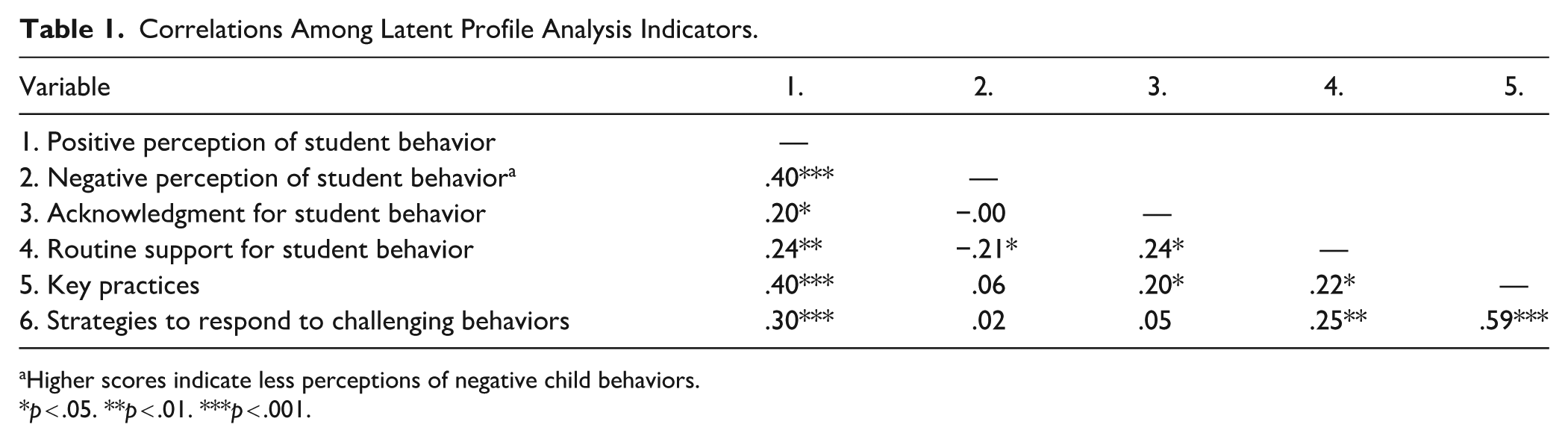
Higher scores indicate less perceptions of negative child behaviors.
p < .05. **p < .01. ***p < .001.
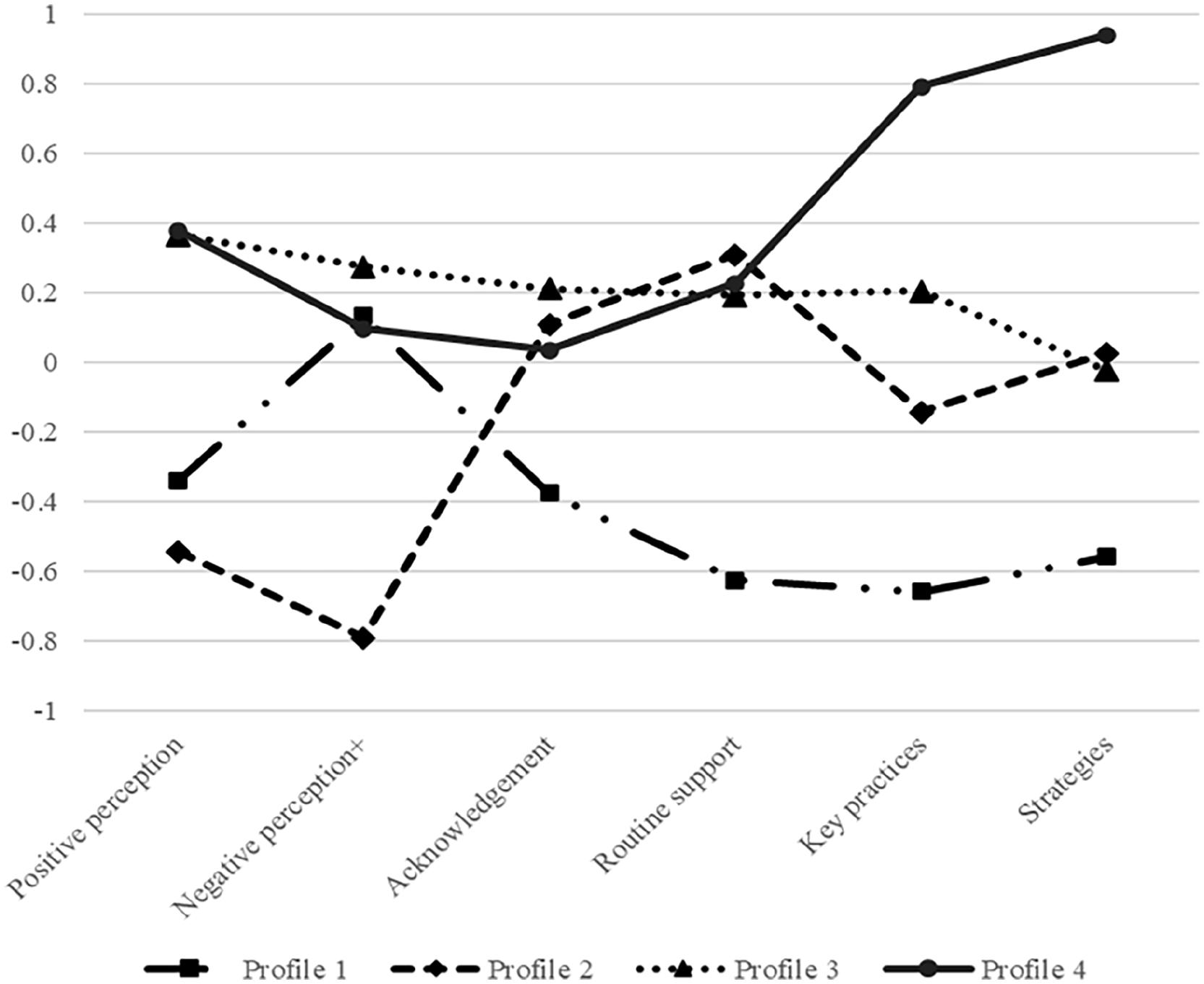
Marginal means of latent profile indicators.
In our sample, 25.6% of the participants had a membership to profile 1, 20.5% had a membership to profile 2, 39.3% had a membership to profile 3, and 14.5% had a membership to profile 4. The first profile was labeled as “Lower perceptions of positive child behavior and the average level perceptions of negative child behavior, with lower intensity and variety of social and emotional learning practices.” Teachers having membership to this profile were likely to perceive lower levels of positive behaviors among children. However, these teachers used less frequent social and emotional practices, and tended not to use various social and emotional strategies. The second profile was labeled as “Lower perceptions of positive child behavior and higher perceptions of negative child behavior, with average levels of social and emotional learning practices.” These teachers had negative perceptions of overall child behaviors. They displayed the average levels of social and emotional practices with slightly less variety of key practices. The third profile was labeled as “Higher perceptions of positive child behavior and lower perceptions of negative child behavior, with average levels of SEL practices.” This profile represented teachers who had positive perceptions of child behaviors. Teachers in this profile also demonstrated average levels of frequency and variety of social and emotional practices. Finally, the fourth profile was labeled as “Higher perceptions of positive child behavior and the average level perceptions of negative child behavior, with higher variety of SEL practice.” These teachers tended to perceive higher levels of positive behaviors among children. While their acknowledgment of child behaviors and routine support for child behaviors were at average level, they were likely to use greater variety of key practices and used various strategies to respond to challenging behaviors.
Next, we compared the demographic and professional characteristics of teachers having a membership to each profile (Supplemental Table 3). While teachers in the four profiles showed no significant variations for most of the demographic characteristics, teachers having a membership to profile 2 (Lower perceptions of positive child behavior and higher perceptions of negative child behavior, with average levels of SEL practices) were more likely to have a bachelor’s or master’s degree related to special education. Also, teachers having a membership to profile 1 (Lower perceptions of positive child behavior and the average level perceptions of negative child behavior, with lower intensity and variety of SEL practices) tended to have longer experiences in early childhood education, compared to teachers having a membership to other profiles.
Discussion
The present study aimed to explore teachers’ perceptions of their implementation of social and emotional practices and differences in their implementation of these practices across individualized teacher profiles. We used a latent profile analysis to examine which profiles were associated with the perception of child behavior and the intensity of teacher-reported social and emotional practices. The LPA provided four distinct groups of teacher profiles where variations in teacher perceptions of child behavior were associated with differences in the variety and frequency of their social and emotional implementation practices. Notably, differences in teachers’ perceived implementation practices were found for teachers with a bachelor’s or master’s degree related to special education and teachers who had longer experiences teaching in early childhood. These results move the field forward in understanding how teacher professional characteristics are associated with their perceptions of their social and emotional practices. Hence, there are several points for discussion.
First, our study shows that the quality of teachers’ perceived implementation of social and emotional practices varied based on their perception of child behavioral needs. Over twenty years of research have established the relationship between the quality of teachers’ instructional social and emotional practices and child behavior and the importance of matching the intensity of support with the level of need (e.g., Dunlap et al., 2018; Sugai & Horner, 2020). When the quality of social and emotional support is poor, children are at risk for poor social and emotional competence which can negatively impact their developmental outcomes long term (Shonkoff & Phillips, 2000). While notable differences in teachers’ perceived social and emotional practices were based on their perception of child behavior, it could be that teachers were responding to children’s level of perceived need. Alternatively, teachers’ perceived differences in the quality of their social and emotional practices and their perceptions of children’s behavioral needs highlight teachers’ inability to respond appropriately to children’s social and emotional development. A wealth of prior research indicates that teacher’s lack of responsiveness toward children could be related to factors such as a teacher’s social and emotional capacity (Buettner et al., 2016), teacher well-being (Byun et al., 2022), teacher stress (Jeon et al., 2019), working conditions (Grant et al., 2019; Jeon et al., 2016), and teacher bias toward children based on child demographics (i.e., gender, race/ethnicity, and disability; Childs & Wooten, 2023; O’Grady & Ostrosky, 2024; Zeng et al., 2021). While these factors may have influenced teachers’ perception of their responsiveness to children in this current study, the contributing role of these variables is unknown based on our current data.
In the present study, there is evidence of a misalignment in teacher reported social and emotional instruction and their perceptions of child behavior across all teacher profiles. Teachers’ approaches to social and emotional instruction may be due to their own understanding and beliefs about emotions and their role as emotionally supportive facilitators in the classroom. Research shows that early childhood teachers’ beliefs about emotions mediated the quality of their interactions with preschool children (Zinsser et al., 2014). That is, teachers’ beliefs about emotions and emotion knowledge influenced the level of emotional support teachers provide to children and the quality of their social and emotional practices. These differences in teacher-child interactions were symptomatic of underlying understandings about emotion knowledge and how to regulate emotions. Thus, highly emotionally supportive teachers who implemented high quality social and emotional instruction were found to be more intentional and comprehensive in their pedagogical approach to social and emotional instruction when compared to moderately supportive teachers (Zinsser et al., 2015). In fact, Collie et al. (2015) found that teachers’ implementation of social and emotional instruction was associated with differences in their level of comfort and perceived support, but not commitment. Consistent with the literature, teachers in this present study perceived varying levels of social and emotional needs amongst children in their classroom however reported perceived differences in the intensity of instruction provided. Of note, differences in instructional support could be due to a wide variety of factors that include teachers’ comfort in implementing said practices, knowledge of key social and emotional strategies, and pedagogical support for implementation.
An additional point for discussion is the impact of teacher burnout on teachers’ perceptions of child behavioral needs and their implementation practices. Our outcomes showed a statistically significant relationship between teacher education and levels of experience and teachers’ perception of child behavior and their social and emotional instruction. That is, teachers who reported using average levels of social and emotional instruction had higher levels of education related to special education. However, teachers who reported lower positive perceptions, average negative perceptions of child behavior, and use of lower intensity and variety of social and emotional practices tended to have longer experiences teaching in early childhood education. Despite having more experience and/or expertise, teachers implemented lower intensity and variety of social and emotional practices. It is important to note that teachers completed the survey during the Covid pandemic context. Thus, it is likely teacher burnout impacted the intensity and frequency of their implementation practices which is consistent with the current literature (Sandilos et al., 2020, Wong et al., 2017). Given the stressors caused by the pandemic it can be assumed that this burnout was even more pronounced as early childhood teachers had greater demands and less support, including access to resources, emotional support, and training on how to provide effective instruction remotely (Steed et al., 2022). Differentiated training and coaching matched to teachers’ capacity, level of need, and professional characteristics may prove beneficial, however (Fettig et al., 2021). That is, a person-centered approach to training early childhood teachers in social and emotional instruction could result in more effective implementation of social and emotional practices with differentiated instruction for classroom teachers, particularly for those teachers who are fatigued. In fact, the literature clearly documents that practice-based coaching (Kranski & Steed, 2022; Snyder et al., 2015), group coaching (Fettig et al., 2016), a tiered coaching model (Artman-Meeker et al., 2023), and performance feedback (Hemmeter et al., 2015) intensifies the approaches to learning for early childhood teachers resulting in an enhanced application of social and emotional instruction.
Finally, it is likely that for those teachers who provided online instruction, teachers were not adequately prepared to adapt their social and emotional instruction to an online format thereby reducing the quality and intensity of the instruction children received. For example, a few studies documented the challenges early childhood educators (Weiland et al., 2021) and early childhood special educators (Steed et al., 2022) faced in providing remote instruction to young children. Some of these challenges included lack of training and support to provide remote instruction, feeling overwhelmed with providing instructional content to young learners in an online format, having little time to tend to ones’ own needs with rapid changing demands, and limited time to provide instruction due to planning and communicating with families. Notably, teachers’ job stress can mediate teachers’ perceptions of children’s developmental outcomes, including their behavioral development (Jeon et al., 2019). However, Zieher et al. (2021) and colleagues found that increased district-wide support of social and emotional learning predicted fewer challenges with the implementation of social and emotional learning during remote instruction. Hence, the pandemic context helps to clarify teachers’ perceived social and emotional practices and their associated implementation needs.
Limitations
There are several limitations that should be noted. First, this study evaluated teacher report about their own behavior. Social desirability, or self-report bias, can certainly impact the accuracy of participant responses. While classroom teachers are known to reliably assess child behavior (Halle et al., 2011), their reports are often prone to bias based on child characteristics related to gender and socioeconomic status (Graves et al., 2012). To enhance the accuracy of teacher report, teacher observation data would provide a more comprehensive picture of child behavior, how teachers varied in their interactions with young children based on their perception, and their social and emotional implementation practices. (Zinsser et al., 2014, 2015). Further, it is still unclear whether teachers’ perceptions of child behavior impacted their implementation of social and emotional practices or if teachers’ knowledge and implementation of said practices is what impacted teachers’ perception of child behavior. Of note, no other teacher characteristics were associated with the implementation practices.
A second limitation of this study is the inability to generalize our results to other populations due to a small and White-majority sample limited to one geographic location, and a lack of rigor in our sampling techniques. While we aimed to capture differences in teacher outcomes based on teacher characteristics, teachers likely vary in their perceptions of child behavior and their social and emotional implementation practices due to variations in classroom characteristics as well. A more rigorous sampling technique and a larger sample would provide a more robust understanding of variations in teacher behavior based on these characteristics.
Third, the checklist used to create the survey measure is not a standardized measure. The survey questions were not normed on a diverse sample of teachers using standard psychometric criterion. Thus, we are unable to compare survey responses across participants or create a composite score that would provide a more reliable understanding of teacher behavior. Finally, while teachers answered questions to the best of their ability based on how they implemented social and emotional instruction in-person and online, we are unable to verify the differences in participant responses based on changes in mode of instruction due to the pandemic. That is, for some teachers, it was not clear how, or if, they modified their social and emotional instruction for an online format. Teachers’ social and emotional instruction may have differed online versus in-person, and it is likely survey responses did not fully capture this variation across modes of instruction.
Implications for Practice and Future Research
Our study has two important implications. First, the results from our study align with recommendations to address the causal and contextual factors that impact teachers’ implementation of social and emotional practices through use of a person-centered coaching model (e.g., Artman-Meeker et al., 2023; Fettig et al., 2021). For the past decade, research has linked Practice-Based Coaching, which uses extensive coaching and feedback, to teachers’ effective implementation of evidence-based social and emotional practices (Hemmeter et al., 2016, 2021; Snyder et al., 2015). However, a recent study has demonstrated emerging effectiveness of a Tiered Coaching Model (Artman-Meeker et al., 2023) resulting in teachers’ successful implementation of social and emotional practices within our current program-wide models of social and emotional support (Fox et al., 2021). A Tiered Coaching Model is a person-centered approach that offers three types of coaching support: self-guided, small group, and individual “expert” coaching. Research shows this approach can lead to successful implementation of practices within the Pyramid Model framework, and also address factors (i.e., teacher characteristics) that influence teachers’ implementation of said practices.
Second, while our study did not explicitly measure teacher bias, it is important to highlight the potential role of bias in teacher’s implementation practices and perceptions of child behavior particularly given the wealth of literature that has demonstrated an association between child behavior and teachers’ exclusionary discipline practices. In fact, the role of teacher bias based on specific behavior topographies and child demographics (i.e., race/ethnicity, gender, and disability; Gilliam et al., 2016; Gilliam & Reyes, 2018; O’Grady & Ostrosky, 2024; Zeng et al., 2021) is substantiated in the literature. Teachers’ perceptions influence the quality of their relationships with young children (Thijs & Koomen, 2009), and their families (Zulauf-McCurden & Zinsser, 2022; Wahman, Steed, et al. 2024; Wahman et al., 2022), as well as their discipline procedures (Zulauf-McCurdy & Zinsser, 2021). Race/ethnic match between teachers and students have also been noted as a key factor that impacts perceptions of behavior (Wymer et al., 2022). Use of reflective consultation, a key practice in the field of early childhood mental health, enhances teachers’ social and emotional implementation practices, reduces exclusionary discipline practices (Silver et al., 2023), and addresses teacher burnout and stress (Dexter & Wall, 2021). Thus, reflective consultation is a critical additive component to person-centered coaching. Taken together, a person-centered approach that offers opportunities for teachers to self-reflect on the implementation practices they choose and why is a key approach to target perspectives that influence their.
Our field has made substantial progress in determining evidence-based ways to alter teacher behavior to improve their social and emotional instruction. Teachers’ response to their perceptions of child behavior is a key ingredient that warrants further investigation. While it is possible that across all profiles teachers were responding to children’s perceived level of need, our data show that with more teaching experience, teachers also implemented strategies less frequently. Future research should examine the causal and contextual factors that impact teachers’ perceptions of child behavior, their implementation practices, including the role of teacher burnout and working conditions, and how reflective supervision mediates teachers’ perceptions about child behavior and implementation practices.
Conclusion
This exploratory study examined teachers’ perceptions of child behavior and their implementation of social and emotional practices within an evidence-based framework. Responsive and nurturing care is a key practice that can facilitate social and emotional growth for young children. While teachers need continued training in evidence-based social and emotional practices, teachers also need support to accurately perceive their implementation practices and child behavior, as well as appropriately match the intensity and quality of social and emotional supports. Data in this study captured particular challenges teachers faced during the coronavirus pandemic and it is likely these trends will continue due to the childcare shortage, high rates of teacher burnout, and need for high quality instruction in early care environments. Thus, further examination of contextual and causal factors that influence teacher practice and perceptions of child behavior is warranted.
Supplemental Material
sj-docx-1-tec-10.1177_02711214241302807 – Supplemental material for Teachers’ Implementation of Social and Emotional Practices During Remote Instruction
Supplemental material, sj-docx-1-tec-10.1177_02711214241302807 for Teachers’ Implementation of Social and Emotional Practices During Remote Instruction by Charis L. Wahman, Sooyeon Byun, Lieny Jeon, Allison White-Cascarilla, Karen Houston, Marianna Moustaka and Kathleen Artman-Meeker in Topics in Early Childhood Special Education
Supplemental Material
sj-docx-2-tec-10.1177_02711214241302807 – Supplemental material for Teachers’ Implementation of Social and Emotional Practices During Remote Instruction
Supplemental material, sj-docx-2-tec-10.1177_02711214241302807 for Teachers’ Implementation of Social and Emotional Practices During Remote Instruction by Charis L. Wahman, Sooyeon Byun, Lieny Jeon, Allison White-Cascarilla, Karen Houston, Marianna Moustaka and Kathleen Artman-Meeker in Topics in Early Childhood Special Education
Supplemental Material
sj-docx-3-tec-10.1177_02711214241302807 – Supplemental material for Teachers’ Implementation of Social and Emotional Practices During Remote Instruction
Supplemental material, sj-docx-3-tec-10.1177_02711214241302807 for Teachers’ Implementation of Social and Emotional Practices During Remote Instruction by Charis L. Wahman, Sooyeon Byun, Lieny Jeon, Allison White-Cascarilla, Karen Houston, Marianna Moustaka and Kathleen Artman-Meeker in Topics in Early Childhood Special Education
Footnotes
Declaration of Conflicting Interests
The author(s) declared no potential conflicts of interest with respect to the research, authorship, and/or publication of this article.
Funding
The author(s) received no financial support for the research, authorship, and/or publication of this article.

References
Supplementary Material
Please find the following supplemental material available below.
For Open Access articles published under a Creative Commons License, all supplemental material carries the same license as the article it is associated with.
For non-Open Access articles published, all supplemental material carries a non-exclusive license, and permission requests for re-use of supplemental material or any part of supplemental material shall be sent directly to the copyright owner as specified in the copyright notice associated with the article.
