







Abstract
Although peer play behaviors in naturalistic settings provide important insights into young children’s development, few studies have examined their utility for identifying early autism spectrum disorder risk. We investigated peer play profiles among a normative sample of Korean preschoolers and their associations with autism spectrum disorder likelihood. We included 1,018 children from the Panel Study on Korean Children, whose preschool teachers rated classroom play behaviors. Latent profile analysis revealed three profiles: sociable (n = 640), rough-and-tumble (n = 325), and isolated (n = 53). Children in the isolated group—marked by high disconnection, low interaction, and elevated disruption—showed greater likelihood of autism spectrum disorder than peers in other groups. Our findings suggest that teacher-reported peer play profiles represent practical, developmentally appropriate indicators of neurodevelopmental risk. Peer play profiling may serve as a scalable, low-cost tool in preschool settings to support early identification and referral before formal diagnostic assessment.
Keywords
Autism spectrum disorder is a neurodevelopmental condition primarily characterized by difficulties in social communication and interaction, which often render children with autism spectrum disorder less socially oriented and motivated (Gliga et al., 2014). Empirical research has consistently shown that the play behaviors of children with autism spectrum disorder differ markedly from those of typically developing peers. Specifically, children with autism spectrum disorder tend to exhibit lower levels of cooperation and imagination (Ziviani et al., 2005), engage in more repetitive play (Honey et al., 2007), and show less spontaneity and flexibility in play contexts (Bauminger-Zviely & Shefer, 2021). These atypical play patterns are considered core features of autism spectrum disorder, and many standardized diagnostic tools include items assessing such behaviors (Bauminger-Zviely & Shefer, 2021; Pierucci et al., 2015).
Given these distinctions (Bauminger-Zviely & Shefer, 2021; Pierucci et al., 2015), it is plausible that children at elevated likelihood for autism spectrum disorder may also exhibit play behaviors resembling those of diagnosed children. That is, if a child’s peer play profile in a naturalistic preschool setting mirrors behavioral characteristics typical of autism spectrum disorder, it may reflect an increased likelihood of autism-related developmental challenges. This study therefore explores the potential of peer play profiles as a practical, transdiagnostic tool for identifying preschoolers who may be at risk for autism spectrum disorder. It is important to clarify that the current study does not attempt to diagnose autism spectrum disorder; rather, it examines behavioral patterns associated with an elevated likelihood of autism spectrum disorder-related characteristics based on a validated screening tool.
Screening young children at developmental challenges through their play profiles in natural settings offers several advantages over traditional testing methods. Since no child relies on single play behavior when interacting with peers, play should be understood through both between-child and within-child variations across multiple behaviors. A play profile, composed of various play behaviors, provides a holistic perspective on a child’s strengths and challenges in social play. Moreover, these play profiles have strong developmental validity and authenticity, as they reflect how children naturally engage with peers in familiar environments (O’Keeffe & McNally, 2023). Building on these strengths, this study aims to identify peer play profiles within a normative preschool sample and examine whether children whose play profiles reflect the play characteristics of children with autism spectrum disorder exhibit an increased likelihood of being on the spectrum.
Identifying Peer Play Profiles Within a Normative Sample of Korean Preschoolers
To identify peer play profiles within a normative sample of preschoolers, we employed a person-centered approach using latent profile analysis. Unlike variable-centered approaches, which examine relationships between variables, the person-centered approach focuses on identifying distinct subgroups of individuals who share similar behavioral patterns (Woo et al., 2024). Latent profile analysis is a statistical technique that determines the optimal number of latent subgroups within the sample population and probabilistically assigns individuals to distinct groups based on patterns in their behaviors (Lanza & Rhoades, 2013; Mori et al., 2020). The unique combinations of responses to behavioral indicators define the profile of each subgroup (Lanza & Rhoades, 2013).
The person-centered approach combined with latent profile analysis has been widely used to find hidden clinical phenotypes among the general population (Mori et al., 2020). Researchers have identified mutually distinguished subgroups of children within a population based on common characteristics and proposed that some groups have distinct developmental challenges. For example, Kim (2022) identified three groups of children based on their temperament traits during infancy and proposed that the group of children characterized with low sociality and activity temperament levels are vulnerable to the risk of smartphone overdependence at age 10. Brown et al. (2021) identified four groups of adolescents based on patterns of movement behaviors and proposed that the group of adolescents characterized with high physical activity and low screen time are robust to depressive symptoms. To date, no studies have classified children into distinct peer play behavior profiles and examined their associations with the likelihood of autism spectrum disorder. This study anticipates the presence of distinct groups of preschoolers who share similar play behavior patterns and expects that certain peer play profiles may be associated with a higher likelihood of autism spectrum disorder compared to their peers.
It is important to note that the results of latent profile analysis are inherently data-dependent, particularly regarding the number, size, and characteristics of the profiles (Muthén & Muthén, 2000). To enhance the generalizability of peer play profiles, it is essential to analyze a normative sample of the target population. Therefore, this study utilizes a nationally representative dataset of 4-year-old children from the Panel Study on Korean Children, conducted by the Korea Institute of Child Care and Education.
Additionally, to ensure that peer play profiles are applicable in real-world educational contexts, the peer play behaviors used as profile indicators should be both developmentally appropriate and contextually valid in reflecting young children’s peer interactions in natural settings. Accordingly, we adopted three peer play behaviors proposed by Fantuzzo et al. (1995): play interaction, play disruption, and play disconnection. These behaviors are widely recognized as robust indicators for assessing the quality and quantity of peer play and have been validated as effective measures for identifying developmental needs across diverse early childhood populations (Choi & Shin, 2011; Hampton & Fantuzzo, 2003).
Peer Interaction, Play Disruption, and Play Disconnection of Children with Autism Spectrum Disorders
The three peer play dimensions proposed by Fantuzzo et al. (1995) are conceptual frameworks embedded in the Penn Interactive Peer Play Scale (Fantuzzo et al., 1995, 1998) to assess young children’s interactions during play. Play interaction encompasses creative, cooperative, and supportive behaviors that foster successful peer play experiences. Play disruption involves aggressive or antisocial behaviors that disrupt sustained peer interactions. Play disconnection reflects withdrawn or avoidant behaviors that limit access to and active participation in peer play.
Few studies evaluated the play behaviors of children with autism spectrum disorder with the three peer play dimensions. Clark et al. (2020) examined parents’ and teachers’ ratings of play interaction, play disconnection, and play disruption in school-aged children with autism spectrum disorder. Both raters showed significant agreement, commonly identifying play disconnection as a major area of difficulty for these children. Jones et al. (2021) evaluated peer play in children with autism spectrum disorders (ages 9 to 13) using the three play dimensions. Children with autism spectrum disorder displayed significantly higher levels of play disconnection, moderately higher levels of play disruption, and lower levels of play interaction. While play disruption slightly decreased with age, no changes were observed in play interaction or play disconnection between ages 9 and 13. These findings, based on children diagnosed with autism spectrum disorder, suggest that children with an elevated likelihood for autism spectrum disorder in general population may have a peer play profile characterized by relatively high levels of disconnection and low levels of interaction, compared to their peers.
Peer Play Profiles and the Elevated Likelihood of Autism Spectrum Disorder
Children’s behaviors toward peers are closely linked to various developmental outcomes. For example, sociable interactions are associated with cognitive and language competence (NICHD Early Child Care Research Network, 2001), while disruptive and dysregulated behaviors correlate with difficulties in classroom adjustment and peer conflicts (Miller et al., 2004). Similarly, withdrawn behaviors are linked to internalizing problems (Luis-Joaquin et al., 2020). However, children often exhibit these behaviors simultaneously when interacting with peers. The dynamic interplay between the quantity and quality of these behaviors can either facilitate or hinder peer relationships and developmental outcomes (Bell et al., 2016; Sekino, 2006). Therefore, children’s play should be assessed as a combination of peer play behaviors rather than as isolated play behaviors.
Some studies classified peer play profiles of children with play interaction, play disruption, and play disconnection (Fantuzzo et al., 1995) as the profile indicators and compared the associated developmental outcomes by groups. Sekino (2006), using cluster analysis, identified six groups of children in a large sample of predominantly African American children enrolled in an urban Head Start program: the high disconnection/low interaction type (12.1%), the low disconnection type (17.5%), the high interaction/low disruption/low disconnection type (15.5%), the low disruption type (18.8%), the high disruptive/low interaction type (13.8%), and the average all type (22.3%). This study suggested differential outcomes among these groups, specifically, the high disconnection/low Interaction type and the high disruptive/low interaction type were more vulnerable to school adjustment and academic outcomes compared to the other types.
Bell et al. (2016) found four groups of children with different peer play profiles among Head Start children: high engagement with peers (70%), below average engagement with peers (15%), average engagement with mild disruption (11%), low engagement with high disruption (4%). Among the four profiles, children with the high engagement with peers profile displayed the highest skills in science, mathematics, and literacy. Conversely, children with the low engagement with high disruption profile displayed the lowest skills in science, mathematics, and literacy.
Lim and Park (2024) identified three distinct peer play profiles among 316 Korean preschoolers aged 3 to 5: competent children (48%), attempting children (41%), and disconnected children (11%). Among the three profiles, children with the disconnected profile exhibited the lowest levels of emotional regulation compared to the other groups. These findings highlight the meaningful associations between peer play profiles, academic skills, and overall adjustment. However, the relationship between peer play profiles and the likelihood of autism spectrum disorder remains unexplored.
The Current Study
Although numerous studies have documented the distinctive play behaviors of children diagnosed with autism spectrum disorder, and others have explored the developmental implications of peer play profiles in normative preschool populations, no research to date has directly examined whether naturally occurring peer play profiles are predictive of an elevated likelihood of autism spectrum disorder in the general population of young children. Specifically, while past studies (e.g., Clark et al., 2020; Jones et al., 2021) have confirmed that children with autism spectrum disorder tend to exhibit high play disconnection and low play interaction, and others (e.g., Bell et al., 2016; Lim & Park, 2024; Sekino, 2006) have identified peer play typologies associated with various developmental outcomes, there is a critical gap in linking these typologies to neurodevelopmental risk, particularly autism spectrum disorder.
We caimed this innovative trial at identifying hidden clinical phenotypes of children with autism spectrum disorder, focusing on peer play behaviors in natural settings. To our knowledge, no researchers have applied a person-centered analytical approach, such as latent profile analysis, to identify play behavior profiles in a nationally representative sample of preschoolers and examine their potential utility in early autism spectrum disorder risk screening. The research questions we used to guide our work included:
Do Korean preschoolers exhibit distinct peer play profiles based on teacher-reported observations of play behaviors in naturalistic classroom settings?
Do children classified into different peer play profiles differ in their likelihood of exhibiting characteristics associated with autism spectrum disorder?
Regarding the first research question, it is anticipated that distinct peer play profiles will emerge among Korean preschoolers based on teacher-reported play behaviors. Specifically, consistent with prior studies (e.g., Bell et al., 2016; Lim & Park, 2024; Sekino, 2006), we expect to identify three to five meaningful profiles that vary in levels of play interaction, play disruption, and play disconnection. These profiles are expected to capture both adaptive and maladaptive patterns of peer engagement in natural preschool settings.
Regarding the second research question, it is anticipated that children assigned to certain peer play profiles—particularly those characterized by low interaction and high disconnection—will exhibit a significantly higher likelihood of autism spectrum disorder characteristics compared to children in more socially engaged profiles. This expectation is informed by prior findings (e.g., Clark et al., 2020; Jones et al., 2021) that children with autism spectrum disorder display elevated play disconnection and reduced play interaction. Therefore, play profiles reflecting these behavioral tendencies may serve as indicators of heightened autism spectrum disorder risk, even within a general population sample.
Method
Participants
The Panel Study on Korean Children (PSKC) is a nationwide data collection project conducted by the Korea Institute of Child Care and Education, designed to provide comprehensive information on child development, parenting, and family functioning in Korean households. The study began in 2008 with a nationally representative cohort of 2,150 households with infants born that year. To ensure representativeness, households were selected using a stratified multi-stage probability sampling method. First, the country was divided into six regional strata, and within each stratum, medical institutions such as hospitals and maternity clinics that delivered babies were identified. Families with eligible newborns were then recruited from these institutions. Study staff contacted mothers shortly after delivery, explained the purpose of the study, and invited them to participate. Participation was entirely voluntary, and written informed consent was obtained at recruitment as well as reaffirmed during each subsequent annual data collection wave. This recruitment procedure allowed PSKC to establish a large, geographically diverse, and demographically representative sample of Korean households with newborns, which has been followed longitudinally since the initial wave.
The datasets from the Panel Study on Korean Children are accessible to the public, enabling researchers and interested parties to freely download and utilize them. At the 5th wave in 2012, the retention rate of participants was 82% (1,703 households). For this study, data of 1,018 preschoolers, whose play behaviors rated by their preschool teachers were available, were extracted from the 5th wave of data collection. As presented in Table 1, the average age of the participants was 51 months (SD = 1.21; 48–54 months). The males were 51.8%. About 70% of the participants’ parents had completed at least 2 years of college.
Characteristics of Participants.
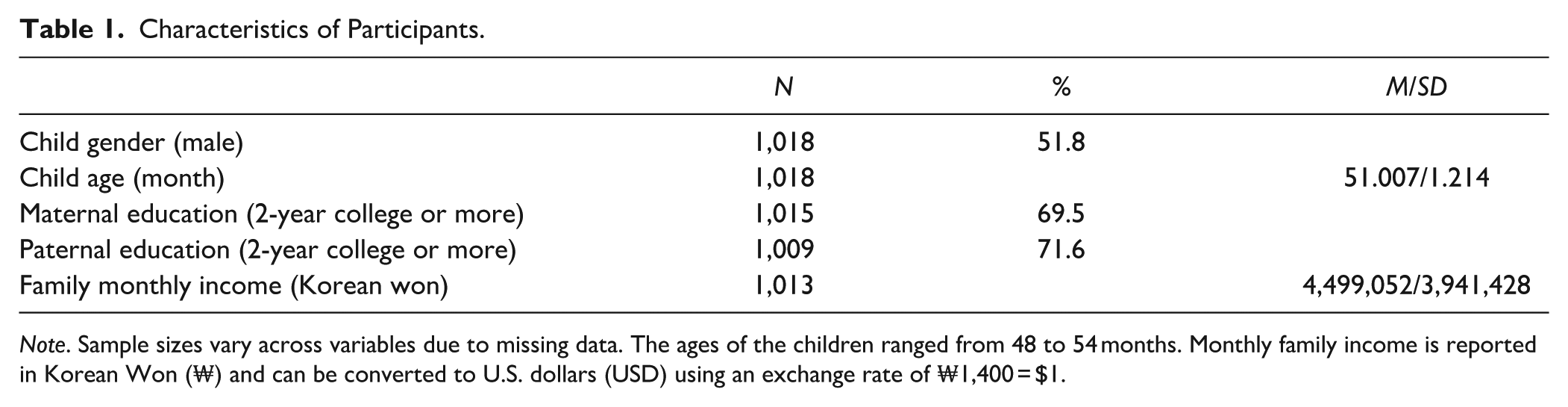
Note. Sample sizes vary across variables due to missing data. The ages of the children ranged from 48 to 54 months. Monthly family income is reported in Korean Won (₩) and can be converted to U.S. dollars (USD) using an exchange rate of ₩1,400 = $1.
Based on responses from 1,013 households, the average monthly family income was ₩4,499,052 (SD = ₩3,941,428; approximately $3,214 USD), with a median of ₩4,000,000 (≈ $2,857 USD). Reported monthly incomes ranged from ₩0 to ₩60,000,000 (≈ $0–$42,857 USD), indicating wide variability across households. Because the mean was higher than the median, the distribution was positively skewed, reflecting the influence of high-income households.
Measures
Peer Play Behaviors
The Penn Interactive Peer Play Scale (PIPPS; Fantuzzo et al., 1998) originally consisted of 32 items across three factors: play interaction, play disruption, and play disconnection. Based on the validation study by Choi and Shin (2008), the Panel Study on Korean Children research team adopted 30 PIPPS items in the fifth wave of data collection (Panel Study on Korean Children, 2025). Two items—”Needs teacher’s guidance/instruction” and “Has difficulty shifting from one activity to another”—were eliminated because they showed either poor factor loadings or cross-loadings in the factor analyses conducted by Choi and Shin (2008). However, a preliminary examination of the structural validity of the 30-item PIPPS revealed that some items did not adequately represent their corresponding factors. Consequently, through exploratory and confirmatory factor analyses, this study refined the scale to 19 items (RMSEA = 0.059, CFI = 0.913, TLI = 0.900). Detailed information on the structure of the 19-item PIPPS based on a confirmatory factor analysis is provided in Supplemental Table 1.
Play interaction (four items) indicates prosocial behaviors such as comforting and helping peers, positive conflict solving, and creativity in peer play. Play disruption (eight items) indicates aggressive and antisocial behaviors such as physical verbal aggression toward peers and rule violations in peer play. Play disconnection (seven items) indicates withdrawn and isolated behavior such as nonparticipation, wandering aimlessly, and being ignored in peer play.
Teachers were asked to rated preschoolers’ play behaviors from 1(never) to 4(always). The sum score divided by the number of items of each factor were used as data for variables play interaction, play disruption, and play disconnection and the internal consistencies of the three factors were 0.62 0.87, and 0.80 respectively.
The Likelihood of Autism Spectrum Disorder
The likelihood of autism spectrum disorder in children was assessed using the DSM-Pervasive Developmental Problems Scale from the Korean version of the Child Behavior Checklist for Ages 1.5–5 (K-CBCL 1.5–5; Oh & Kim, 2009). The K-CBCL 1.5–5 is a standardized parent-report measure designed to evaluate adaptive and maladaptive functioning in Korean children aged 1.5 to 5 years, based on the widely used CBCL 1.5–5 developed by Achenbach and Rescorla (2000). Parents rate their child’s behavior over the past 2 months using a 3-point Likert scale (0 = not true, 1 = somewhat or sometimes true, 2 = very true or often true).
The DSM-Pervasive Developmental Problems scale consists of 13 items drawn from the original 100-item CBCL and has been validated as an effective Level 1 screener for identifying children at risk for autism spectrum disorder (Rescorla et al., 2015). Although the scale was later revised and renamed the DSM-Autism Spectrum Problems scale following the removal of the item “afraid to try new things” (Rescorla et al., 2019, 2020), the present study employed the original 13-item version. This decision was based on the fact that the Panel Study on Korean Children, from which our data were drawn, used the DSM-Pervasive Developmental Problems scale as part of its standardized protocol beginning in wave 5. Moreover, prior research has shown that differences between the 13-item DSM-Pervasive Developmental Problems scale and the 12-item DSM-Autism Spectrum Problems scale are minimal, yielding highly comparable screening results (Chericoni et al., 2021). Thus, the use of the DSM-Pervasive Developmental Problems scale ensured both methodological consistency with the PSKC data collection procedures and comparability with earlier studies that relied on the original version.
The internal consistency of the 13-item scale was acceptable (Cronbach’s α = .73). The total score was used both as a continuous measure of autism spectrum concern and as a categorical indicator of the likelihood of clinical-level autism spectrum disorder. Following standardized scoring criteria, a T-score of 65 or higher indicates a clinically significant elevation in autism spectrum–related behaviors (T-score ≥ 65 = 1; <65 = 0). In this dataset, 71 of 1,013 children (7%) scored at or above the clinical threshold. In this study, the term autism spectrum concern or likelihood of autism spectrum disorder refers to elevated behavioral risk identified through this standardized screener and does not represent a formal clinical diagnosis. This distinction is critical because the study draws on observational data from a large-scale, population-based sample rather than structured clinical evaluations.
Analysis
Latent profile analyses were conducted using Mplus version 8.0 to identify peer play profiles among children. Latent profile analysis is a statistical technique designed to reveal hidden clusters within observed data. This approach determined the optimal number of peer play profiles and the likelihood of children belonging to specific profile groups (Lanza & Rhoades, 2013; Mori et al., 2020). Various criteria were used to identify the best-fitting profile solutions, including the Bayesian Information Criterion (BIC; smaller values indicate better fit), entropy (closer to 1.0 is better), p-values from the Lo-Mendell-Rubin adjusted ratio test (LMR), and the size of the smallest class (at least 5% of the total sample; Ferguson et al., 2020). The relationships between peer play profiles and the likelihood of autism spectrum disorder were examined using analysis of covariance and binary logistic regressions, controlling for child sex, maternal and paternal education, and family monthly income.
Results
Peer Play Profiles of Korean Preschoolers
Table 2 presents the results of the latent class profile analyses from one to four classes for determining the best solution for peer play profiles of Korean preschoolers. The three-class solution shows the highest entropy along with the sound BIC, and LMR p values. The smallest class size (n = 53, 5.206%) meets the standard which is the minimum 5% of the total sample suggested by Ferguson et al. (2020). The independence between classes is graphically verified with mean plots (Figure 1). Hence, the three-class solution is adopted for describing the peer play profiles of Korean preschoolers.
Model Fit Statistics for the Latent Profile Analysis of Peer Play (N = 1,018).
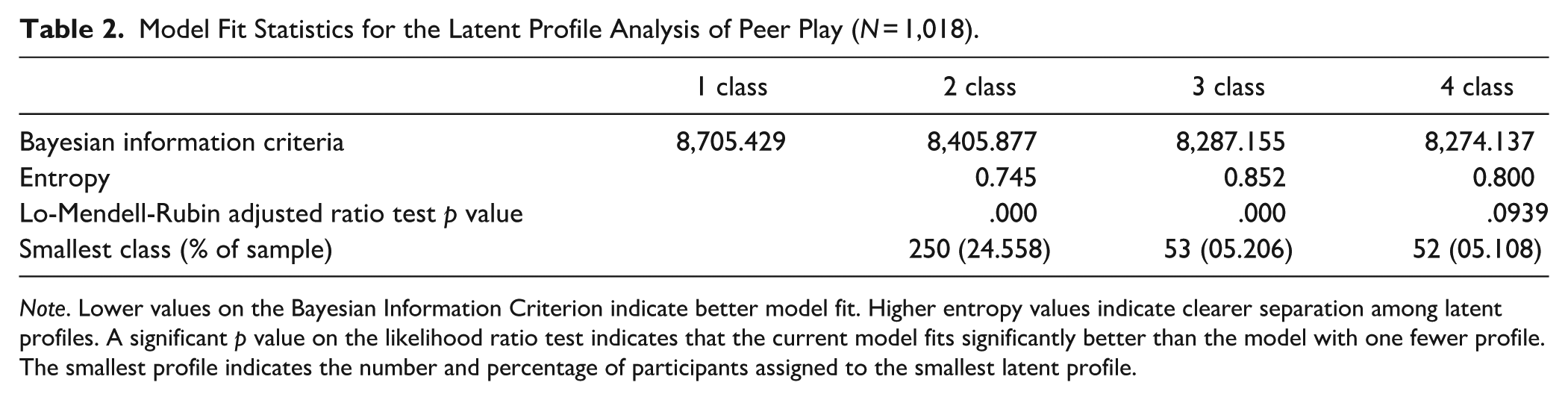
Note. Lower values on the Bayesian Information Criterion indicate better model fit. Higher entropy values indicate clearer separation among latent profiles. A significant p value on the likelihood ratio test indicates that the current model fits significantly better than the model with one fewer profile. The smallest profile indicates the number and percentage of participants assigned to the smallest latent profile.
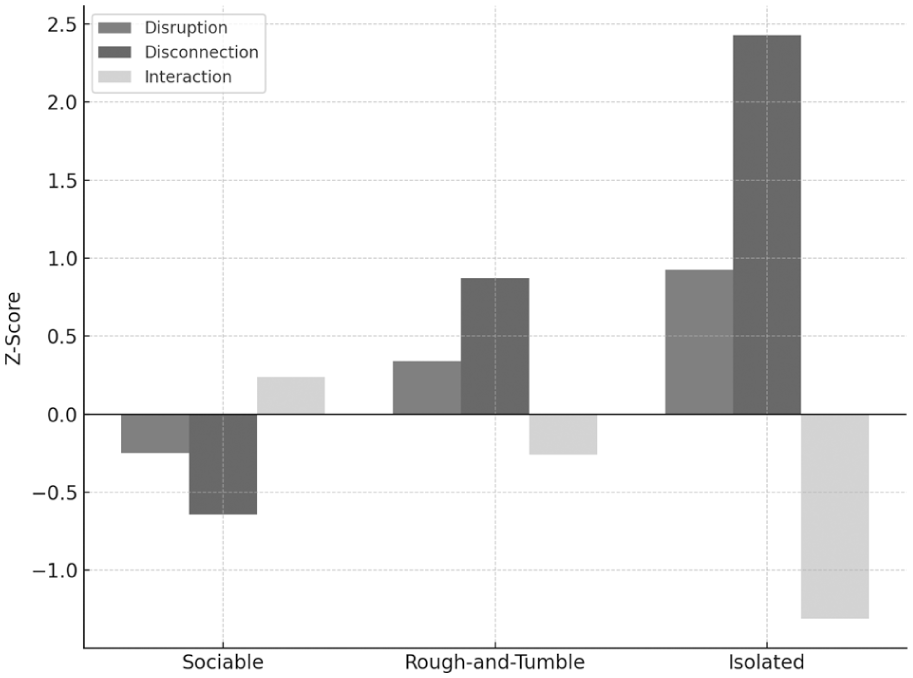
Standardized peer play behavior scores across identified profiles.
Figure 1 shows the standardized (z-score) levels of play disruption, disconnection, and interaction across the three peer play profiles (sociable, rough-and-tumble, and isolated). Using z-scores enabled direct comparison across subscales with different scoring ranges (see Supplemental Table 2 for details). The largest group, comprising 62.9% of the children, exhibited high levels of peer interaction but low levels of peer disruption and disconnection. This group was labeled “sociable.” Another group, representing 31.9% of the preschoolers, showed moderate levels of peer interaction along with slightly elevated levels of peer disruption and disconnection, earning the label “rough and tumble.” Finally, a small group (5.2%) displayed extremely high levels of peer disconnection and extremely low levels of peer interaction. These children were classified as “isolated.”
Peer Play Profiles and the Likelihood of Autism Spectrum Disorder
Table 3 presents the bivariate correlations between peer play behaviors and autism spectrum concerns, measured as the total score on the DSM-Pervasive Developmental Problems scale. Autism spectrum concerns were small but positive in correlation with peer disconnection (r = .159, p < .001) and small but negative in correlation with both peer interaction (r = −.131, p < .001) and peer disruption (r = −.087, p < .01).
Correlations Between Peer Play Behaviors and Autism Spectrum Concerns.
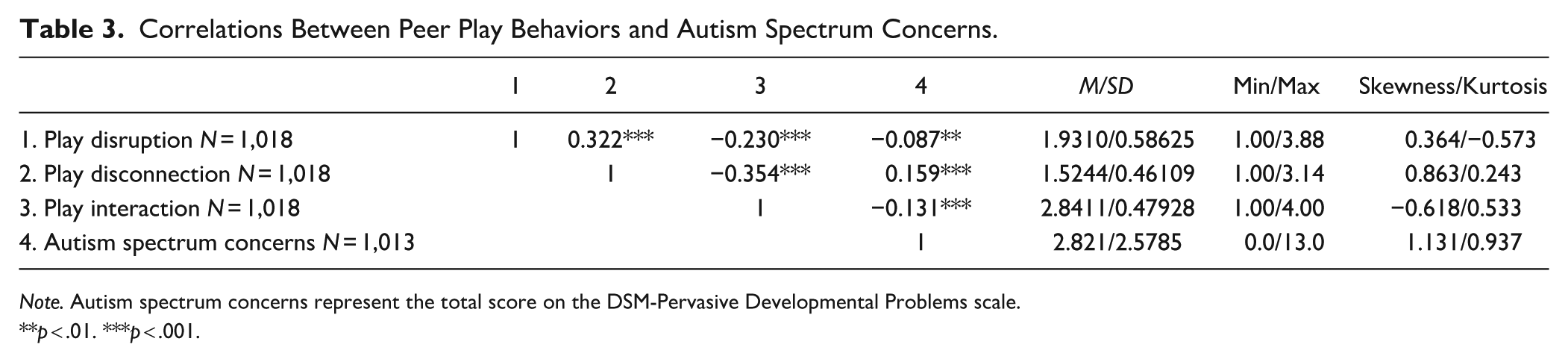
Note. Autism spectrum concerns represent the total score on the DSM-Pervasive Developmental Problems scale.
p < .01. ***p < .001.
Table 4 reports the main effects of peer play profiles on autism spectrum concerns (total score on the DSM-Pervasive Developmental Problems scale). Peer play profiles had a small but significant effect on autism spectrum concerns, F(2, 993) = 10.160, p < .001, partial η² = .020, after controlling for child sex, maternal and paternal education, and family monthly income. Post hoc comparisons (Bonferroni) indicated that the isolated group exhibited significantly higher levels of autism spectrum concerns compared to both the sociable group and the rough-and-tumble group (Table 5). However, no statistically meaningful difference emerged between the sociable and rough-and-tumble groups.
The Main Effect of Peer Play Profiles on Autism Spectrum Concerns (N = 1,000).
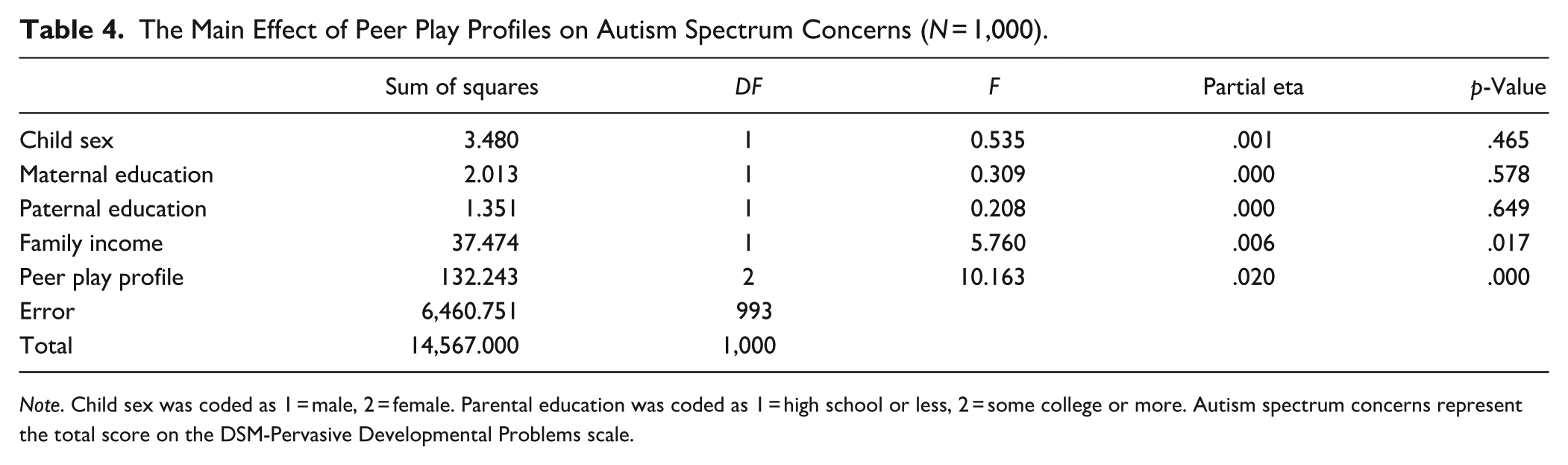
Note. Child sex was coded as 1 = male, 2 = female. Parental education was coded as 1 = high school or less, 2 = some college or more. Autism spectrum concerns represent the total score on the DSM-Pervasive Developmental Problems scale.
Autism Spectrum Concerns by Peer Play Profiles.
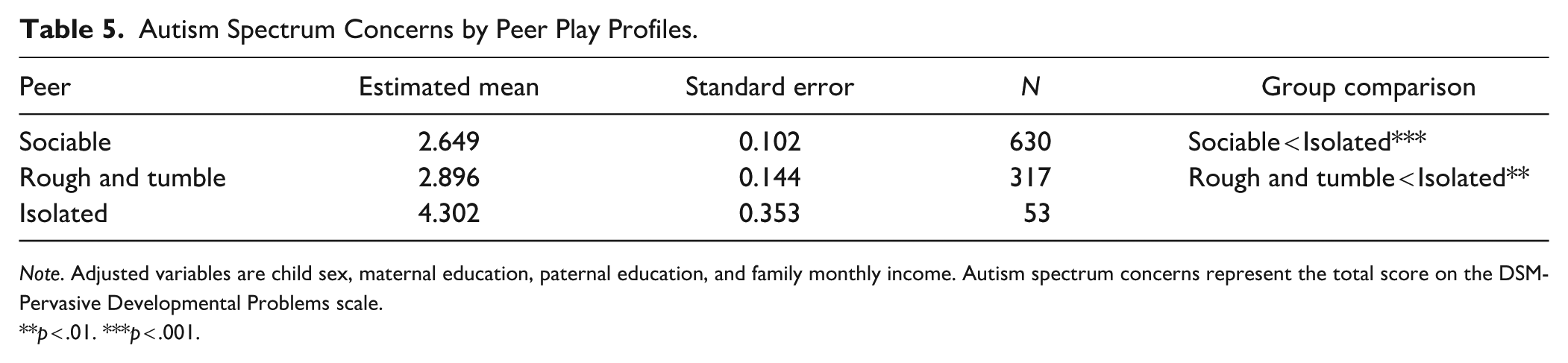
Note. Adjusted variables are child sex, maternal education, paternal education, and family monthly income. Autism spectrum concerns represent the total score on the DSM-Pervasive Developmental Problems scale.
p < .01. ***p < .001.
As presented in Table 6, the likelihood of reaching the clinical threshold for autism spectrum disorder differed by peer play profile. Children in the isolated peer play profile were significantly more likely to meet the clinical cutoff (DSM-Pervasive Developmental Problems scale T score ≥ 65) than those in the sociable group, OR = 4.680, 95% CI [2.290, 9.570], p < .001. Similarly, compared to the rough-and-tumble group, children in the isolated group had significantly higher odds, OR = 6.910, 95% CI [3.030, 15.750], p < .001. These odds ratios suggest a moderate-to-strong effect size in terms of clinical risk. No significant differences were observed between the sociable and rough-and-tumble groups.
Peer Play Profiles and the Likelihood of Clinical Level Autism Spectrum Disorder (N = 1,000).
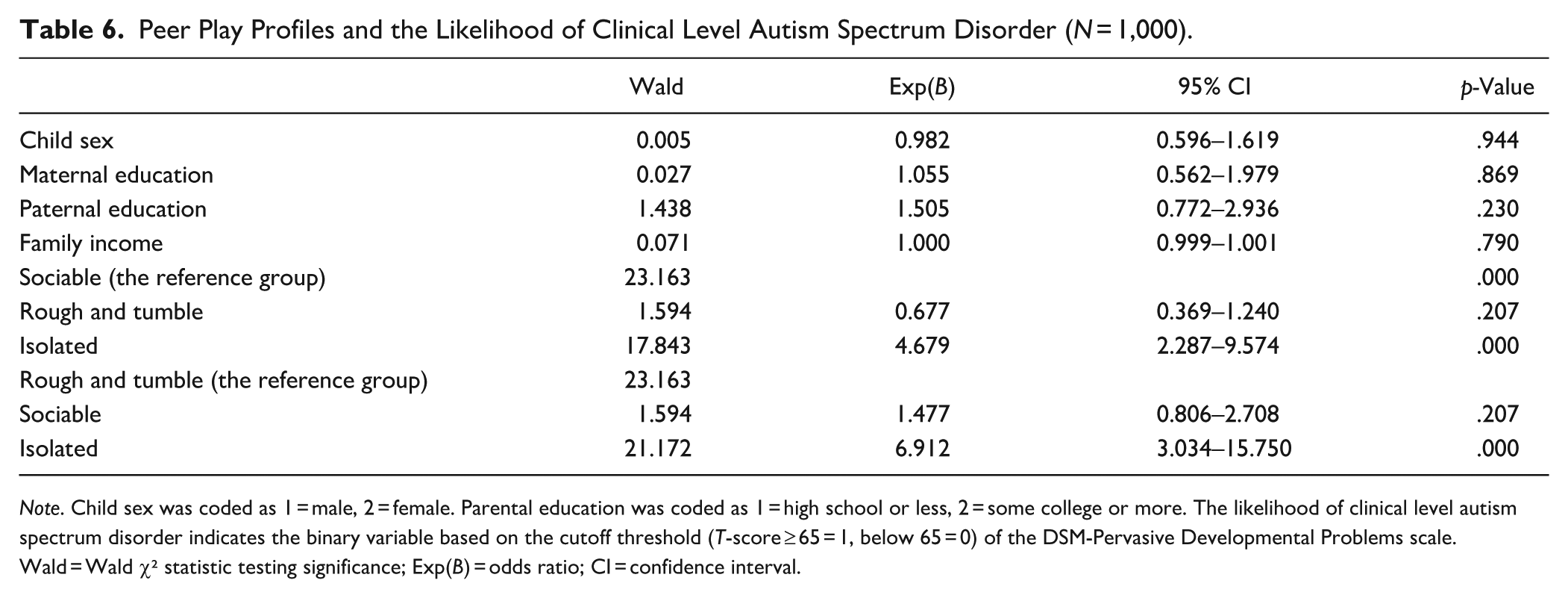
Note. Child sex was coded as 1 = male, 2 = female. Parental education was coded as 1 = high school or less, 2 = some college or more. The likelihood of clinical level autism spectrum disorder indicates the binary variable based on the cutoff threshold (T-score ≥ 65 = 1, below 65 = 0) of the DSM-Pervasive Developmental Problems scale. Wald = Wald χ² statistic testing significance; Exp(B) = odds ratio; CI = confidence interval.
Discussion
The current study examined whether peer play types in natural settings can serve as an informative tool for identifying preschoolers at increased likelihood of autism spectrum concerns within a general population. The findings revealed the presence of three distinct peer play profiles among Korean preschool children, each characterized by unique combinations of peer play behaviors with varying prevalence rates. Furthermore, the study found meaningful associations between these peer play profiles and the likelihood of autism spectrum disorder.
Using latent profile analysis, Korean preschoolers were classified into three distinct peer play profiles: sociable, rough and tumble, and isolated. The sociable profile (62.9%), the largest group, showed the lowest levels of play disconnection and play disruption, and the highest level of play interaction. These children primarily engaged in positive peer interactions, suggesting minimal difficulty initiating and participating in peer play. This profile closely resembles the competent children group (48%) reported by Lim and Park (2024) and the high engagement with peers group (70%) identified by Bell et al. (2016). Notably, these profiles consistently represent the largest portion of samples across studies and cultures, suggesting a normative peer play pattern in preschoolers.
The rough and tumble profile (31.9%) was characterized by moderately high levels of play disconnection and play disruption, and slightly lower play interaction. Children in this group exhibited a balanced mix of all three behaviors, with mean scores typically ranging between −1 SD and +1 SD. Children in this group appeared more physically active or behaviorally intense, sometimes challenging in group settings, but did not exhibit social isolation. This profile is similar to the attempting children profile (41%) in Lim and Park (2024) and the below-average engagement with peers profile (15%) described by Bell et al. (2016). These intermediate profiles commonly emerge as the second-largest peer play group in cross-study comparisons.
The isolated profile (5.2%) was marked by a significant disparity between high play disconnection and low play interaction, along with elevated play disruption. Mean scores for this group showed play disconnection above +2 SD, play interaction below −1 SD, and play disruption near +1 SD. They frequently appeared disengaged from peer activities, exhibiting nonparticipation, aimless wandering, and being ignored or excluded by others, while also demonstrating aggressive behaviors and difficulty following social rules. This pattern aligns with the low engagement with high disruption profile (11%) identified by Bell et al. (2016) and the disconnected children profile (4%) reported by Lim and Park (2024). Across studies, this profile consistently represents the smallest peer play group.
Overall, most preschoolers were classified into a peer play profile characterized by high levels of positive behaviors and low levels of negative behaviors. A sizable portion of children showed a more balanced mix of positive and negative behaviors, while a small subset exhibited a stark contrast—very high levels of negative behaviors and very low levels of positive engagement. Although cross-cultural comparison was not a central aim of this study, the consistency of peer play profile patterns and proportions with those found in previous research (e.g., Bell et al., 2016; Lim & Park, 2024) suggests that these profiles may be replicable across different populations and cultural contexts. Further research with diverse samples is needed to confirm the generalizability and stability of peer play profiles across settings.
Second, this study hypothesized that the peer play profile characterized by high levels of play disconnection and disruption, coupled with low play interaction, would be associated with an elevated likelihood of autism spectrum disorder. This hypothesis was grounded in prior research suggesting that such play behavior patterns are commonly observed in children diagnosed with autism spectrum disorder (Clark et al., 2020; Jones et al., 2021). Consistent with this expectation, the findings revealed that children classified within the isolated profile—whose play behaviors reflect the solitary, disconnected, and disruptive tendencies typical of autism spectrum disorder—had a significantly higher likelihood for the disorder compared to those in other profiles.
Autism spectrum disorder is primarily a biologically based neurodevelopmental condition, underpinned by genetic and neurological factors, with core behavioral traits that exhibit relatively little variation across cultures (Gliga et al., 2014; Mandy et al., 2014). Therefore, children at increased likelihood for autism spectrum disorder may display similar patterns of spontaneous, naturalistic play across diverse cultural settings. Future research should investigate whether the isolated play profile identified in this study consistently emerges across cultures and whether children within this profile are particularly vulnerable to autism spectrum disorder. If these findings are reliably replicated, the isolated peer play profile could be recognized as a behavioral phenotype of autism spectrum disorder in early social play, providing a valuable marker for distinguishing children with autism spectrum disorder from their typically developing peers.
Interestingly, children in the rough and tumble profile, who exhibited moderate levels of disruption and disconnection alongside average interaction, did not show elevated levels of autism spectrum concerns. Post hoc comparisons confirmed that this group’s autism spectrum disorder likelihood was statistically indistinguishable from that of the sociable group. This suggests that disruption—possibly resulting from physically expressive or high-energy play behaviors toward peers—and disconnection as an accompanying side effect may reflect normative variation in play behavior rather than signs of neurodevelopmental challenges. Such behaviors, while sometimes challenging for teachers and peers in classroom management, may still fall within the range of developmentally appropriate play in natural settings (Pellegrini, 2021), particularly when not coupled with pronounced social withdrawal or isolation.
Implications
Although distinctive play characteristics are a defining feature of autism spectrum disorder (Bauminger-Zviely & Shefer, 2021; Pierucci et al., 2015), and peer play profiles in natural settings have been used to examine developmental strengths and weaknesses (Bell et al., 2016; Lim & Park, 2024; Sekino, 2006), few studies have integrated these two approaches. The findings of this study suggest that peer play profiles, based on teacher ratings of behavior in naturalistic settings, may serve as a sensitive marker of elevated autism spectrum disorder likelihood in preschool-aged children.
These findings carry significant practical implications for researchers, intervention practitioners, and caregivers. First, the use of peer play profiling through a person-centered approach should be recognized as a valuable tool for understanding and supporting children—especially those at likelihood for neurodevelopmental disorders. Despite the widespread use of social play as a central mechanism in many intervention programs (Parsons et al., 2019; Wilkes-Gillan et al., 2016), there remains a lack of empirical evidence detailing how children with neurodevelopmental challenges actually engage in peer play. This study addresses that gap by identifying a peer play profile linked to elevated autism spectrum disorder likelihood. Future research should build upon these findings by investigating profiles associated with other neurodevelopmental conditions, such as attention-deficit/hyperactivity disorder, speech and language disorders, and intellectual disabilities. A nuanced understanding of these play profiles is essential for creating tailored support systems that respond to the unique developmental needs of each child.
Second, the isolated peer play profile—marked by a clear gap between high play disconnection and low play interaction—may make affected children more easily identifiable by teachers and caregivers in everyday preschool settings. However, this visibility also presents challenges, particularly within child-centered curricula that emphasize spontaneous, self-initiated play. In such learning environments, children are expected to acquire skills through active engagement with peers and adults during routine activities (Jin et al., 2024). Children within the isolated profile are less likely to participate in meaningful play or social interactions that foster developmental growth, increasing their likelihood of falling behind (Jordan, 2003). To better support these children, educators and parents should incorporate guided play and individualized learning opportunities into daily routines to promote skill development (Cade, 2023; Shire et al., 2015). Importantly, prior work suggests that children with ASD are more likely to engage socially during play activities they have already mastered, whereas activities they are still learning or do not fully understand may reduce their social participation (Pierce-Jordan & Lifter, 2005). Recent findings further indicate that developmentally matched play targets are more effective than strictly age-matched ones (Agana et al., 2024; Pane et al., 2021). Thus, guided play interventions should not only provide opportunities for social interaction but also be tailored to children’s developmental trajectory in play, building on existing competencies while gradually scaffolding new skills.
Third, these findings offer a methodological contribution by underscoring the value of person-centered approaches in early childhood research. While variable-centered analyses, such as simple correlations, suggested a negative association between play disruption and autism spectrum concerns, person-centered analysis revealed a distinct subgroup of children—the isolated profile—characterized by both high play disruption and an elevated likelihood of autism spectrum disorder. This apparent contradiction highlights the limitations of relying on single behavioral indicators, which may obscure meaningful heterogeneity within groups. Person-centered methods, such as latent profile analysis, facilitate the identification of distinct behavioral constellations, offering a developmentally sensitive and ecologically valid framework for detecting risk patterns. Such approaches may enable more precise identification of at-risk children and support the development of targeted, individualized interventions.
Fourth, given the accessibility and continuity of teacher observations in natural settings, peer play profiling enables teachers, parents, and clinicians to understand both what children bring to play and how their play skills develop over time. This perspective is particularly important for children with neurodevelopmental disorders, whose play skills may diverge from those of their peers and progress more slowly. By monitoring both current capacities and developmental changes for each participant in the peer groups, peer play profiling can provide a fuller picture of children’s strengths and challenges, thereby supporting earlier and more targeted interventions.
At the same time, active communication about neurodevelopmental concerns among clinicians, teachers, and families—essential for maximizing the potential of children with developmental challenges (Cioni et al., 2016; Hadders-Algra, 2021)—is often hindered by mental health stigma (Farooq & Ahmed, 2020) and the wide variability in early development, which makes it difficult to distinguish typical from atypical behaviors (Rosenbaum, 2006). Peer play profiling offers a practical and non-threatening communication tool that can help bridge these gaps and serves as a meaningful first step toward strategies that build resilience and promote long-term developmental success for children with neurodevelopmental challenges. Moreover, as a scalable approach grounded in teachers’ everyday observations, peer play profiling may be particularly valuable in resource-limited contexts where access to formal assessments is constrained.
Conclusion
The current study identified three peer play profiles among Korean preschoolers—sociable, rough and tumble, and isolated—each characterized by distinct patterns of play behavior and differing prevalence rates. The consistency of these profiles—both in structure and distribution—with those reported in previous studies suggests their robustness. This points to a promising direction for future research: examining the replicability of peer play profiles across diverse cultural and developmental contexts.
Furthermore, the differing levels of autism spectrum disorder likelihood associated with each profile highlight the practical utility of peer play profiling as a tool for early identification. These findings provide valuable insight into how specific patterns of peer interaction may serve as early behavioral markers of neurodevelopmental challenges. They further underscore the need to examine potential associations between peer play profiles and a broader spectrum of neurodevelopmental conditions, including attention-deficit/hyperactivity disorder, language impairments, and intellectual disabilities.
Limitations and Suggestions for Future Research
The current findings should be interpreted in light of several limitations. First, it is important to emphasize that exhibiting extreme levels of specific play behaviors (e.g., high play disconnection) or being classified within the isolated profile does not, in itself, constitute a diagnosis of autism spectrum disorder. The DSM-Pervasive Developmental Problems Scale used in this study serves as a screening instrument, and the term “likelihood of autism spectrum disorder” refers to behavioral risk, not clinical confirmation. Although this study demonstrated that certain peer play profiles—particularly the isolated type—were associated with an increased likelihood of autism spectrum disorder, only a relatively small proportion of children (7%) met the clinical cutoff on the DSM-Pervasive Developmental Problems scale. This low base rate presents a limitation for both the analysis and interpretation of results, as the findings may not fully capture the heterogeneity of children at elevated risk. Future research should therefore examine the sensitivity and specificity of peer play profiles as a screening tool and determine how accurately these profiles identify true cases while minimizing false positives. Establishing this evidence will be critical for validating the practical utility of peer play profiling in early identification efforts.
Second, the peer play profiles and their associated likelihood levels for autism spectrum disorder identified in this study are specific to the early childhood period within the Korean cultural context. Caution should therefore be exercised in generalizing these findings to other developmental stages or cultural settings.
Third, although this study examined autism spectrum disorder likelihood in relation to peer play profiles, the play behavior ratings were based on a single time point. As such, the results do not provide insight into the stability of these profiles or their predictive value for long-term developmental outcomes. Future research should investigate whether these profiles persist over time and how they relate to later social, academic, or clinical functioning.
Fourth, this study used a modified version of the original PIPPS measure, which, while capturing key aspects of social, disconnected, and disruptive play, did not cover the full range of peer play behaviors. Important domains such as symbolic play, imaginative play, or solitary constructive activities were not directly assessed. Moreover, the reliability of the play interaction subscale was only marginal. Future studies would benefit from employing more comprehensive and psychometrically robust peer play assessments, as well as play assessments for the participating children, specifically designed for preschool populations to enhance both ecological validity and measurement accuracy.
Finally, the generalizability of this study may be limited by sample attrition in the Panel Study on Korean Children. Of the 2,150 households initially recruited in 2008, 1,703 (82%) remained by the fifth wave. From this retained sample, data from 1,018 preschoolers whose play behaviors were rated by teachers were used in the current analysis. This represents 47.3% of the original cohort. To assess representativeness, parental education levels were compared: in the original sample, 68.8% of mothers and 71.5% of fathers had completed at least 2 years of college, compared to 69.5% and 71.6%, respectively, in the analytic sample. These comparable rates suggest minimal demographic deviation despite attrition; however, findings should still be interpreted with caution due to the reduced sample size and the potential for unobserved selection bias.
Supplemental Material
sj-docx-1-tec-10.1177_02711214251403545 – Supplemental material for Peer Play Profiles and Autism Spectrum Disorder Risk in Korean Preschoolers: A Population-Based Study
Supplemental material, sj-docx-1-tec-10.1177_02711214251403545 for Peer Play Profiles and Autism Spectrum Disorder Risk in Korean Preschoolers: A Population-Based Study by Yeon Ha Kim in Topics in Early Childhood Special Education
Footnotes
Data Availability Statement

Declaration of Conflicting Interests
The author declared no potential conflicts of interest with respect to the research, authorship, and/or publication of this article.
Funding
The author received no financial support for the research, authorship, and/or publication of this article.
Ethical Considerations
This study analyzed de-identified secondary data from the Panel Study on Korean Children conducted by the Korea Institute of Child Care and Education. All data were anonymized prior to release, and no personally identifiable information was accessible. Accordingly, this study did not require additional ethical approval.
Informed Consent Statements
Informed consent was obtained from all participating families at the time of initial enrollment in the panel study. Participants were informed of the study purpose, procedures, and their right to withdraw at any time. No additional consent was required for the present secondary data analysis.
References
Supplementary Material
Please find the following supplemental material available below.
For Open Access articles published under a Creative Commons License, all supplemental material carries the same license as the article it is associated with.
For non-Open Access articles published, all supplemental material carries a non-exclusive license, and permission requests for re-use of supplemental material or any part of supplemental material shall be sent directly to the copyright owner as specified in the copyright notice associated with the article.
