






Abstract
Some preschool children with autism spectrum disorder (ASD) experience difficulties acquiring foundational early numeracy skills, including single-digit addition. We evaluated the effectiveness of a virtual–representational–abstract (VRA) instructional sequence using a multiple-probe design across participants (single-case experimental design) to teach symbolic single-digit addition (e.g., 3 + 5 = __) with sums not exceeding 9. Three children with ASD attending a preschool setting in Türkiye (ages 4–7 years) participated. The instructional materials included 36 tasks (excluding addends that included 0). Results suggested improved accuracy in computing symbolic addition following the introduction of the VRA phases for each participant. Performance was maintained at 10 and 20 days after the intervention. Participants demonstrated person generalization when assessed by a different implementer, and teachers rated the procedures and outcomes favorably. Future research needs to examine VRA-based instruction for other foundational mathematics skills and with broader groups of children with disabilities.
Keywords
Introduction
Preschool years are characterized by rapid developmental change, and children enter early childhood programs with diverse learning experiences and varying levels of pre-academic skills. When foundational skills are not adequately supported, these differences may widen over time. Mathematics is one domain in which early differences may have long-term consequences, as mathematical understanding develops through daily experiences and can be strengthened through explicit instruction. Early numeracy includes skills such as number identification, understanding quantity, counting principles, and operations. These early numeracy skills are long-term predictors of later mathematical achievement (Nguyen et al., 2016; Watts et al., 2018). Longitudinal evidence shows that early mathematics predicts later mathematics achievement and is also associated with later reading performance (Claessens & Engel, 2013). Executive function appears to be one mechanism that helps explain these links (ten Braak et al., 2022). These findings highlight why early mathematics instruction is a high-priority target in early childhood education.
Addition is a core early mathematics skill that supports later arithmetic development and fluency with number relations. However, successful addition learning depends on the acquisition of foundational number knowledge. Instruction may be particularly effective when numerals, quantities, and operations are linked in coherent and meaningful ways. Reviews of early numeracy emphasize that early number knowledge and related cognitive skills (e.g., working memory and language) are relevant for mathematical development and for identifying children who may need more intensive support (Raghubar et al., 2016).
ASD is a neurodevelopmental condition characterized by persistent differences in social communication and restricted or repetitive behaviors (American Psychiatric Association, 2013). Global prevalence estimates also indicate that ASD is common worldwide, though estimates vary across studies and contexts (Zeidan et al., 2022). Importantly, academic development in ASD is heterogeneous. Some children with ASD demonstrate age-appropriate mathematics performance, whereas others experience substantial difficulties acquiring mathematical skills (Chen et al., 2019). Evidence on academic development shows that mathematics growth trajectories vary across disability groups and over time, supporting the need to examine how early instruction can alter learning pathways for students who struggle (Wei et al., 2013). A recent meta-analysis reported lower mathematics performance in ASD than in typically developing peers, with moderators such as age and cognitive characteristics influencing outcomes (Tonizzi & Usai, 2023). Related work also suggests that mathematics performance in ASD is shaped by cognitive and clinical factors, rather than being uniformly high or uniformly low across individuals (Oswald et al., 2016). These findings indicate that a uniform conclusion would be inappropriate. Traditional instruction may be sufficient for some children with ASD, but it may not meet the needs of others, particularly when instruction is not well matched to learners’ profiles and support needs.
For children who need more structured mathematics instruction, the concrete–representational–abstract (CRA) framework has been widely used. CRA is typically described as moving from hands-on materials (concrete) to drawings or visual models (representational) to numerals and symbols (abstract). A synthesis of CRA research for students with learning disabilities supports CRA as an evidence-based approach, while also underscoring variation in how CRA is implemented across studies (Bouck et al., 2018). Recent meta-analytic evidence similarly supports CRA as an effective approach in mathematics interventions, including those evaluated with single-case methodologies (Ebner et al., 2025). This literature also distinguishes between CRA as a strict sequence versus CRA as a flexible framework. In the framework view, instruction may integrate stages or adjust the timing of transitions based on student performance and task demands. For example, an integrated CRA approach may blend representational and abstract components earlier, which can influence efficiency and learning outcomes (Morano et al., 2020).
Manipulatives play a central role in CRA-based instruction. They help learners externalize quantities and relations, reduce cognitive load, and connect conceptual understanding to procedures. In recent years, virtual manipulatives have received increasing attention. Virtual tools may offer advantages such as consistent presentation, immediate access to multiple representations, and high engagement. These features can be especially relevant for some children with disabilities when physical materials are difficult to manage, when attention and motivation are fragile, or when instruction must be delivered with high consistency across sessions. Evidence syntheses also indicate that virtual manipulatives support mathematics learning for students with ASD and intellectual and developmental disabilities (Long et al., 2023).
Building on CRA, researchers have increasingly tested virtual-first instructional sequences. In a virtual–abstract (VA) sequence, instruction begins with virtual representations, then transitions to abstract symbolic work. VA studies suggest that virtual representations can facilitate the acquisition of a range of mathematics skills (Bouck, Park, et al., 2017; Bouck et al., 2019, 2020). Related comparative studies have also examined virtual versus concrete manipulatives for learners with ASD, with findings indicating that virtual supports can be at least as effective as concrete materials for some students, depending on learner characteristics and instructional conditions (Bouck et al., 2014; Shurr et al., 2021).
In the present study, we evaluated the VRA intervention. VRA extends the logic of CRA by explicitly using a virtual stage to introduce and practice mathematics content, followed by representational work, and then abstract symbolic work. This progression is intended to support students who may benefit from structured transitions across forms of representation. For some young children with ASD, acquiring mathematical concepts may require additional support across increasingly abstract forms of representation. A structured progression may provide opportunities to interact with mathematical ideas through visual and interactive representations before transitioning to more abstract symbolic forms, while the representational phase encourages learners to generate their own representations and connect virtual actions, visual representations, and symbolic equations (Geary, 2026). It also allows instruction to capitalize on features of virtual environments (e.g., consistency and engagement), while still ensuring that learners engage with representational models and ultimately with the abstract symbolic format that dominates school mathematics. Although VA has been studied in multiple contexts (Bouck, Park, et al., 2017; Bouck et al., 2019, 2020), the VRA sequence may be particularly useful when a representational bridge is needed to support transition from interactive virtual work to independent abstract performance. This question is especially relevant for young children with ASD, whose learning may be sensitive to how instruction scaffolds generalization across materials and response formats.
We investigated the effectiveness of a VRA instructional sequence for teaching single-digit addition facts (with sums not exceeding 9) to preschool children with ASD. The evaluation was conducted using a multiple-probe design across participants. Consistent with single-case reporting expectations, the study was designed to allow a clear, replicable description of procedures and outcomes (Tate et al., 2016). The research questions were:
Does the VRA instructional sequence improve the accuracy of preschool children with ASD in computing symbolic single-digit addition with sums not exceeding 9?
Do participants maintain performance at 10 and 20 days post-intervention?
Do participants demonstrate generalization across implementers?
How do teachers evaluate the acceptability, feasibility, and perceived outcomes of the VRA instructional sequence?
Method
Research Design
This study used a single-case experimental design to evaluate the effects of a VRA instructional sequence on preschool children’s acquisition of single-digit addition (sums not exceeding 9). The evaluation was conducted using a multiple-probe design across participants. The study followed a planned sequence. First, baseline performance was assessed for all participants. Next, the VRA intervention was introduced sequentially across participants. Full-probe assessments were conducted at participant transition points before the intervention was initiated with the next participant. Finally, maintenance and generalization data were collected to evaluate maintenance of effects and generalization across people. The study included baseline sessions (BL), full-probe sessions (FP1, FP2, FP3), and intervention phases delivered sequentially as virtual (V), representational (R), and abstract (A). No instructional intervention was delivered during baseline or full-probe sessions. Following intervention, maintenance sessions and person generalization sessions were conducted.
Participant
Three children with a formal diagnosis of ASD participated. Participants were identified in collaboration with their teachers and parents. Four children initially met the inclusion criteria; one was designated as a reserve participant to reduce the risk of attrition. Written parental consent was obtained before participation, and pseudonyms were used to protect confidentiality. All participants had an ASD diagnosis verified in Türkiye through the Child Special Needs Report (Çocuk Özel Gereksinim Raporu [ÇÖZGER]) and a diagnosis made by a child and adolescent psychiatrist, with documentation indicating eligibility for special education supports. According to the ÇÖZGER reports, all participants had intact vision, hearing, and motor abilities, and no additional support needs were indicated in these functional domains.
Inclusion criteria were that participants (a) attended school regularly, (b) could follow 4–5 word verbal instructions, (c) could imitate modeled responses, (d) could discriminate colors and numerals, (e) could count rhythmically up to nine, and (f) could demonstrate one-to-one correspondence between numbers and objects up to nine. Eligibility was confirmed via teacher consultation and administration of a prerequisite skills screening tool (see Supplementary Materials). Baseline assessment indicated that participants did not yet perform single-digit addition accurately (sums not exceeding 9). Demographic characteristics are presented in Table 1.
Demographic Characteristics of Participants.
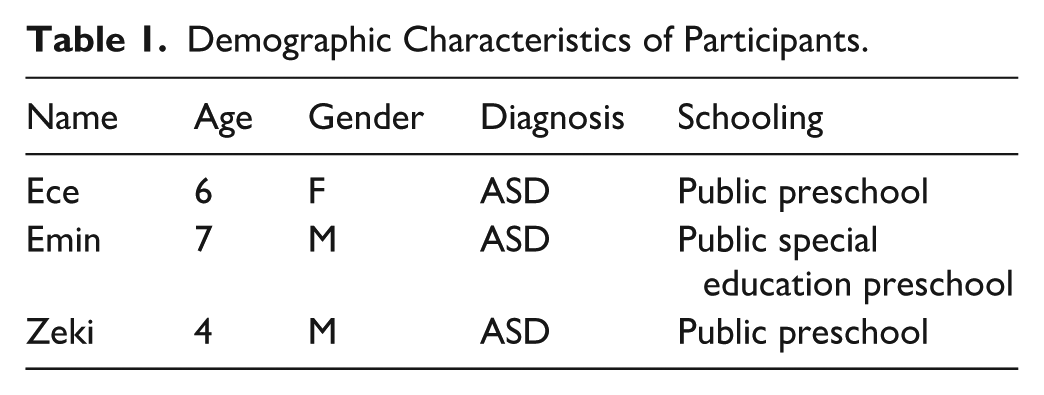
None of the participants displayed severe challenging behavior that would interfere with participation, such as aggression or self-injury. However, all participants showed some degree of behavioral or emotional regulation difficulties. Specifically, Ece occasionally exhibited intense emotional reactions (e.g., crying), whereas Emin and Zeki showed anger-control difficulties that sometimes resulted in disruptive behavior.
Ece was a 6-year-old girl with a mild ASD diagnosis who had attended full-time inclusive preschool for two years and received support services. She could follow simple directions, communicate using short sentences, and sustain attention to individual or group activities for approximately 15 to 20 min, although she sometimes displayed emotional dysregulation. She could rhythmically count from 1 to 10, write numerals, and perform object–number matching (e.g., giving a requested number of objects). She had not participated in prior VRA/CRA-type instruction and did not demonstrate accurate single-digit addition performance at baseline.
Emin was a 7-year-old boy with a mild ASD diagnosis who attended a public special education preschool and received services from a rehabilitation center 1 day per week. He could follow simple directions, communicate using short phrases, rhythmically count from 1 to 10, write numerals, and perform object–number matching (e.g., stating how many objects were presented and giving a requested number). He showed difficulties in initiating and maintaining peer interaction and had challenges adapting to unfamiliar people. He did not demonstrate accurate single-digit addition performance at baseline.
Zeki was a 4-year-old boy with a mild ASD diagnosis who had attended full-time inclusive preschool for 1 year and received services from a rehabilitation center 1 day per week. He could respond to visual and auditory stimuli and follow simple directions, and he communicated using two- to three-word sentences. During one-to-one activities, he could sustain attention for approximately 10 to 15 min, but he had difficulty adapting to peer activities due to limitations in initiating and maintaining communication. He could count rhythmically from 1 to 10 and write numerals, and he could perform object–number matching by counting presented objects and stating the total or giving a requested number of objects. He did not demonstrate accurate single-digit addition performance at baseline and had not participated in an instructional program that included the stages of the VRA instructional sequence. Based on the parent report, Zeki had limited prior exposure to technological devices; therefore, brief preparatory touchscreen activities (e.g., matching tasks) were implemented before intervention to increase familiarity with the tablet-based interaction required in the virtual phase.
Setting
The study was conducted in Türkiye in two public school settings. Each participant attended preschool education in a city in Eastern Anatolia, Türkiye. The study was conducted in a preschool setting that served children with disabilities and emphasized individualized routines, structured play-based learning, and early academic readiness goals alongside communication and self-care supports. The classroom included five children with ASD.
Sessions were delivered twice daily (one in the morning and one in the afternoon). All sessions were conducted individually by the practitioner in the school library where the participants were enrolled. During sessions, the practitioner sat side by side with the student at a table, and the table and chair heights were adjusted to the participants’ physical characteristics to support comfort and accessibility.
Teachers reported that mathematics activities were implemented at least 3 days per week in this preschool context. According to teacher reports, most other children in the same setting had already acquired basic addition skills. However, despite exposure to typical preschool mathematics activities, none of the study participants had acquired single-digit addition at study entry. This pattern supported the need for a more explicit and individualized instructional approach for these children. To reduce the likelihood of unplanned additional practice on the target skill outside study sessions, families and teachers were asked not to provide any instruction or activities related to the dependent variable during the intervention period. Throughout the study, regular communication with teachers and families provided verbal confirmation that no additional instruction targeting the study skill was delivered. All sessions were recorded using a camera, and recordings were stored for later analysis and for coding prompt data if needed. To identify reinforcers that could be used to sustain motivation, a reinforcer survey form was completed by participants’ teachers.
The instructional context aligns with Türkiye’s National Preschool Special Education Curriculum for Individuals with Special Education Needs (37–78 months), which specifies mathematics-related outcomes within the cognitive development domain. These outcomes include early number and quantity competencies (e.g., rhythmic counting, numeral naming, one-to-one correspondence, and answering “How many?” questions) and number relations/operations (e.g., comparing sets, increasing set size, and simple addition with small totals using pictures and verbal expressions; Ministry of National Education, 2018). Consistent with these curricular expectations, the prerequisite skills screening tool used for inclusion verified foundational skills relevant to early arithmetic learning (e.g., number discrimination, rhythmic counting up to nine, and one-to-one correspondence up to nine).
Materials
The VRA instructional sequence used phase-specific materials for the virtual, representational, and abstract stages. Across phases, addition was presented as numeric equations (e.g., 3 + 5 = __), rather than word problems. The instructional content focused on single-digit addition with sums not exceeding 9, and problems containing 0 were excluded. The item pool consisted of 36 single-digit addition equations that met these constraints, including commutative pairs (e.g., 2 + 3 and 3 + 2; see Appendix in Supplementary Materials). Each probe included five items.
Virtual phase (V). During the virtual phase, participants solved addition equations using the Color Tiles virtual manipulative application (Brainingcamp, 2018). The activity workspace included a color-tile palette and a structured area with frames used to show the two addends and the sum (see Figure 1). The workspace illustrated in Figure 1 can be accessed on Brainingcamp by entering the share code “LUXSPG9V” in the share code field. Participants responded by moving tiles on the screen to show each addend and then entering the sum in the response space. The application was used as a manipulation and workspace tool. The application did not provide evaluative correctness feedback (e.g., correct/incorrect). Instructional feedback was delivered by the practitioner during teaching components.
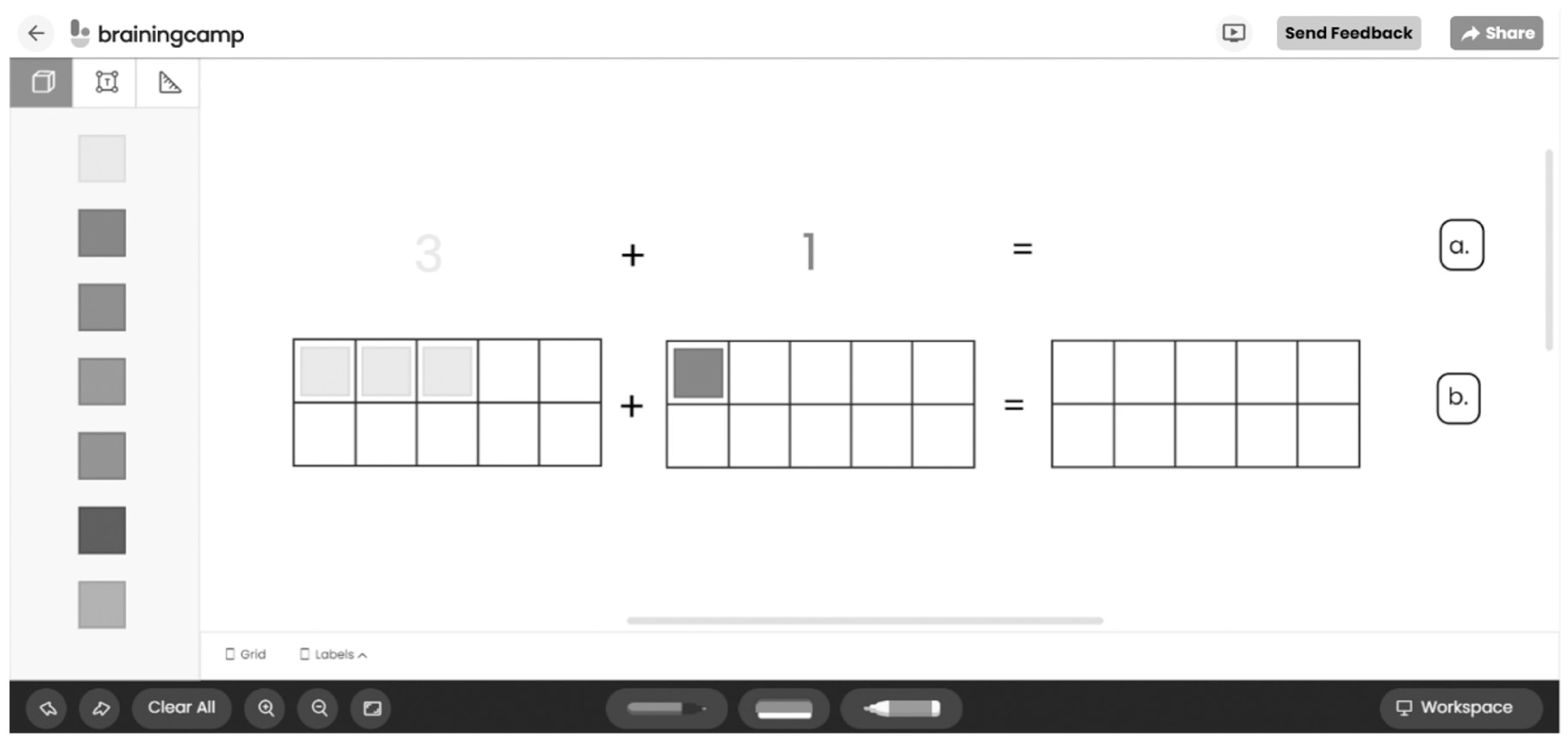
Color Tiles virtual manipulative interface used during the virtual phase.
Representational phase (R). For the representational phase, printed worksheets were used as a paper-based adaptation of the virtual activity format. Each worksheet displayed the equation at the top (e.g., 4 + 2 = __) and included structured spaces for drawing to correspond to each addend and the total. Participants produced lines to correspond to each quantity and then combined the lines to determine the result. Responses were recorded by writing the numeral in the blank.
Abstract phase (A). In the abstract phase, participants completed printed worksheets containing only the numeric equation in a large, high-contrast format to support readability. Participants solved each item without visual support and wrote the answer in the response space. Probe sheets were used during baseline, full-probe, and maintenance sessions. Each probe sheet contained five horizontally formatted equations with a response blank. Probe items were selected to ensure broad representation of numbers (1–9) and addition combinations across the instructional item pool, including both smaller-to-larger and larger-to-smaller addend arrangements. Learning sheets were used during the intervention phases to support the instructional sequence. For each instructional session, three pages were prepared: one page for modeling, one for guided practice, and one for independent practice (five trials per page). Items used during independent practice were different from the items modeled and guided within the same session. Across phases, the child wrote each answer, and the practitioner scored each response as correct or incorrect and marked the outcome on a data recording form.
Independent and Dependent Variables
The independent variable was a direct instruction-based VRA instructional sequence delivered sequentially across phases. The dependent variable was participants’ accuracy on single-digit addition presented as numeric equations (e.g., 3 + 5 = __). Word problems were not used. Accuracy was calculated from five-item assessments and expressed as a percentage correct (i.e., number correct divided by five, multiplied by 100). Each trial began with the presentation of one addition equation. A correct response was defined as the participant writing the correct sum within 10 s of the task direction. An incorrect response was defined as writing an incorrect sum or not responding within 10 s. If a response was not provided within 10 s, the trial ended, and the next trial began.
To distinguish measurement contexts, baseline, full-probe sessions, maintenance, and generalization were conducted under probe conditions (assessment only), whereas intervention-phase data points reflected performance checks collected during independent practice after teaching. No prompts or evaluative correctness feedback were provided during probe-condition sessions or during intervention-session independent practice checks. Generalization was assessed using probe formats aligned with the VRA sequence under the same assessment-only conditions. Phase changes were based on a mastery criterion of at least 80% correct across three consecutive sessions.
Experimental Design
A single-case experimental design using a multiple-probe design across participants was used to evaluate the effects of the VRA instructional sequence on single-digit addition performance. The functional relation was evaluated through (a) measurement before intervention, (b) staggered introduction of the intervention across participants, and (c) replication of effects across individuals. As shown in Figure 2, the study included baseline sessions, full probe sessions, and intervention phases delivered sequentially as V, R, and A, followed by maintenance and generalization. After baseline was established for all participants, the intervention was introduced to the first participant, whereas the remaining participants continued to complete probes under baseline conditions until the intervention was introduced to them. When a participant met the mastery criterion and the intervention shifted to the next participant, a full-probe session was conducted to evaluate the current performance of all participants. Thus, full probe sessions were scheduled strategically to evaluate performance at transition points while limiting repeated assessment for participants who had not yet entered intervention, consistent with multiple-probe logic. Baseline continued until performance was considered stable before introducing intervention for each participant. Stability was defined as minimal variability with no accelerating trend across at least three consecutive sessions. Two sessions were conducted per day (one in the morning and one in the afternoon), with at least a 2-hour interval between sessions. Each data point on the x-axis represents one session.
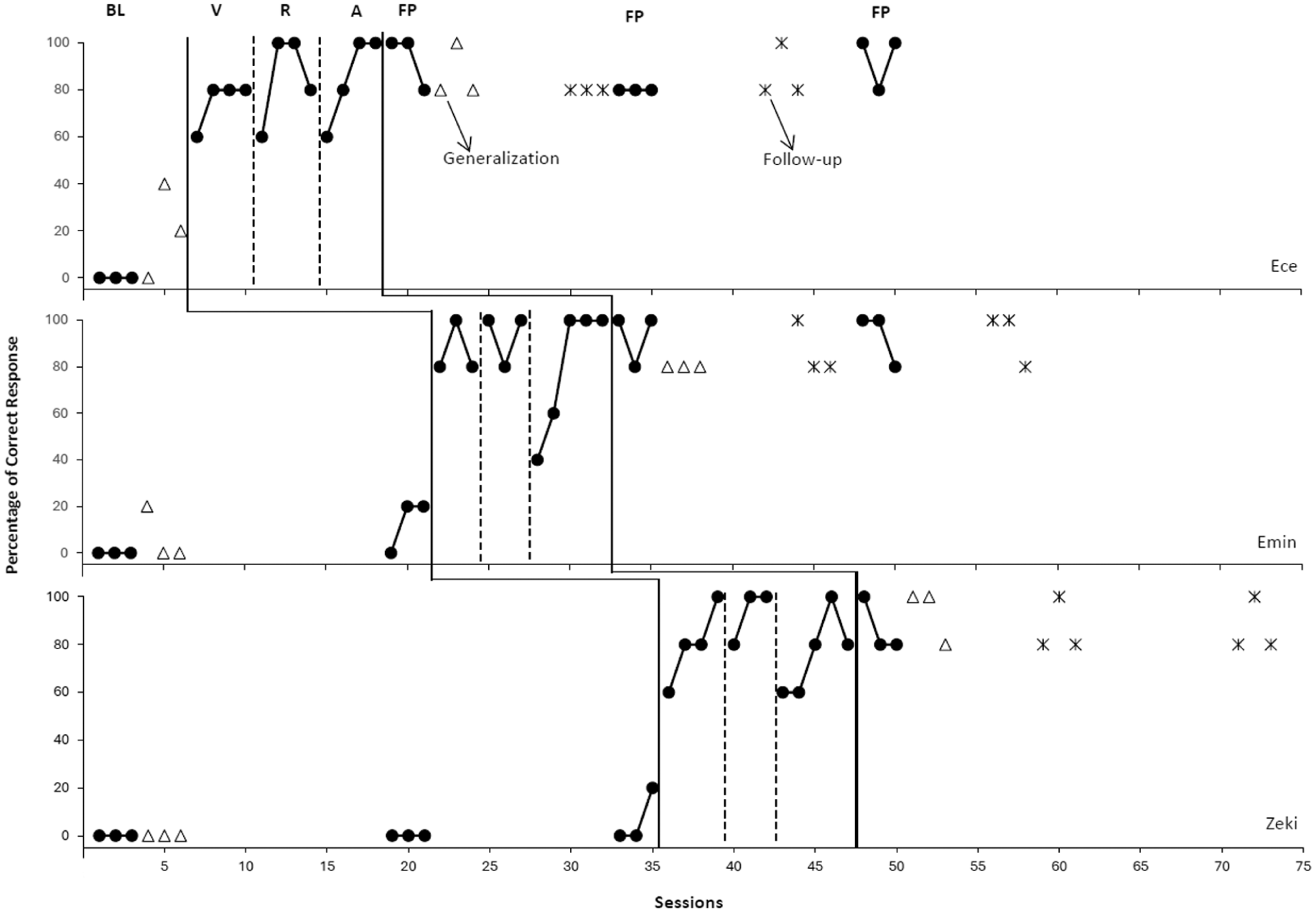
Percentage of correct responses in the baseline, VRA instructional sequence, generalization, and follow-up sessions.
Procedure
All intervention sessions, except for generalization sessions, were implemented individually by the first author, who had training and experience in teaching mathematical skills to children with disabilities. Sessions were conducted one-to-one, with the practitioner delivering instruction and monitoring performance. The intervention period lasted approximately two months; phase length varied across participants depending on mastery. Sessions were video recorded to support accurate scoring and to allow subsequent coding of instructor prompting. Each instructional component (modeling, guided practice, and independent practice) included five trials. A response interval of 10 s was used for each trial. Participants recorded their answers on phase-appropriate response materials (tablet-based worksheet in the virtual phase; paper response sheets in the representational and abstract phases), and the practitioner scored each response as correct or incorrect on a data recording form.
Pilot Study
A pilot study was conducted with a 6-year-old child with ASD who did not participate in the main study and who demonstrated the prerequisite skills. The pilot included three baseline sessions and one session each of the virtual, representational, and abstract phases. Session recordings were reviewed with two faculty members (one in special education and one in mathematics education). Based on feedback, two revisions were made before implementation: (a) all addends on worksheets were printed in a single color (black), and (b) each instructional component (modeling, guided practice, independent practice) included five trials.
Baseline
Baseline sessions were conducted to assess initial performance on single-digit addition under probe conditions (assessment only). During baseline, participants completed a five-item probe independently. No prompts, evaluative correctness feedback, or manipulatives/visual supports were provided. Each trial consisted of one numeric addition item (e.g., 3 + 5 = __), and the participant had up to 10 s to write an answer. Baseline data were collected for all participants before introducing the intervention. Consistent with multiple probe logic, after intervention began with Ece, the remaining participants completed probes under baseline conditions at strategically scheduled points (i.e., full probe sessions) until intervention was introduced to them.
Intervention
The VRA instructional sequence was implemented using an explicit instruction approach across three phases: virtual, representational, and abstract. Sessions followed a consistent structure across phases: (a) modeling, (b) guided practice, and (c) independent practice. In modeling, the practitioner demonstrated the target response for the phase using think-aloud. In guided practice, the participant responded, and the practitioner provided prompts as needed. Prompts included brief verbal prompts (e.g., “What comes next?”; “Keep counting—what number follows?”) and, when necessary, physical guidance limited to supporting tile manipulation in the Color Tiles application when participants experienced difficulty moving tiles. Prompt frequency and type were coded from video to describe instructional support over time.
Independent practice served as the primary performance check for each session. During independent practice, no prompts or evaluative correctness feedback were provided. The five independent-practice items were not the same as the modeling and guided-practice examples used earlier in the session. Items were drawn from an item pool spanning combinations from 1 + 1 through 8 + 1 (excluding items that included 0), with sums not exceeding 9. To describe instructional time requirements, the duration of each session component was recorded. Modeling components lasted approximately 4 min, guided-practice components approximately 6 min, and independent-practice components approximately 6–10 min. Mastery and phase changes were based on performance during independent practice. Participants advanced to the next session when they achieved at least 80% accuracy (≥4/5 correct) in independent practice. Participants advanced to the next phase (e.g., virtual to representational) after demonstrating ≥80% accuracy across three consecutive sessions. If the criterion was not met, the same instructional sequence was repeated in the subsequent session.
Virtual Phase
Virtual-phase sessions used the Color Tiles application (Brainingcamp, 2018). Participants placed tiles within ten frames to build each addend and then combined tiles to determine the total. The application did not provide evaluative correctness feedback (e.g., correct/incorrect). During modeling and guided practice, participants completed each item using the on-screen tiles and recorded the sum by writing their answer on the tablet-based worksheet. Verbal prompts were provided as needed. Physical guidance was used only when participants had difficulty moving tiles on the screen. Independent practice consisted of five virtual-format items completed without prompts or feedback.
Representational Phase
Representational-phase sessions used paper-based worksheets in which quantities were shown using lines corresponding to each addend. Participants determined the total by counting the lines and wrote the answer on the response sheet. Modeling and guided practice followed the same session structure. Independent practice consisted of five representational format items completed without prompts or feedback.
Abstract Phase
Abstract-phase sessions were conducted without manipulatives or drawings. Items were presented in numeric format, and instructions emphasized a counting-on strategy. Specifically, participants started from the first addend and counted on using their fingers for the second addend to reach the total, then wrote the answer on the response sheet. Modeling included think-aloud demonstrations of this counting-on process. Guided practice included verbal prompts as needed. Independent practice consisted of five abstract-format items completed without prompts or feedback.
Maintenance
Maintenance sessions were conducted to evaluate whether participants maintained single-digit addition performance after completing the VRA intervention. Sessions occurred 10 and 20 days following intervention and were implemented under probe conditions. Each maintenance session included five items. No prompts or evaluative correctness feedback were provided. Responses were scored as correct (+) or incorrect (−) on the data sheet.
Generalization
Generalization sessions were conducted to examine whether participants’ addition performance generalized across people. Generalization was arranged as a pre-test and post-test and was conducted in the school setting. Either the participant’s teacher or parent served as the implementer. Before generalization sessions, the implementer received a brief (2–3 min) orientation emphasizing that no prompts and no evaluative correctness feedback should be provided. During these sessions, the teacher or parent presented the materials, delivered the task direction, and administered the session without providing prompts, corrective feedback, or instructional assistance. Generalization was assessed under probe conditions.
In each generalization assessment, participants completed three probe formats aligned with the VRA sequence: a virtual format probe, a representational format probe, and an abstract format probe. Each format included five items (15 items total per generalization sessions). Responses were scored as correct or incorrect.
Interobserver Agreement (IOA) and Treatment Fidelity
Interobserver agreement (IOA) data were collected to evaluate the reliability of the dependent variable scoring. IOA was based on the comparison of two independent observers’ records of participant responses, with identical records scored as agreements and nonidentical records scored as disagreements. For virtual-phase sessions, observers independently scored participant responses from video recordings of the digital activity using the same scoring criteria applied across phases. IOA was calculated using the event-recording formula: agreements / (agreements + disagreements) × 100 (Erbaş, 2018). Consistent with recommendations for single-case research, IOA was sampled from at least one session in each phase (baseline, virtual teaching, representational teaching, abstract teaching, maintenance, and generalization; Kırcaali-İftar & Tekin-İftar, 2020). IOA was coded for a minimum of one session per phase for each participant (i.e., at least six sessions per participant). The two observers were associate professors who held doctoral degrees in child development and measurement and evaluation, respectively, and they were oriented to the scoring rules and use of the IOA form prior to coding (Erbaş, 2018). IOA was 100% across participants and phases.
Treatment fidelity data were collected to document the extent to which the independent variable was implemented as planned. Fidelity was assessed using a phase-specific checklist completed by the same two independent observers while viewing video recordings. Because phase lengths varied, fidelity sampling was planned to ensure coverage across phases rather than a fixed per-phase percentage. For teaching sessions, checklist items included: preparing materials, securing attention, stating the instructional goal, stating the planned reinforcer, delivering the task direction, modeling/guiding the response, adhering to the response interval and intertrial interval, responding neutrally to student performance, and reinforcing student cooperation. For baseline/full-probe, maintenance, and generalization sessions, items included: preparing materials, securing attention, delivering the task direction, waiting for the response interval, remaining neutral to student responses, adhering to the intertrial interval, and reinforcing student cooperation. Each step was scored as implemented (“+”) or not implemented (“–”). Treatment fidelity was calculated as implemented steps / planned steps × 100 (Erbaş, 2018). Treatment fidelity was 100% across participants and phases.
Social Validity
Social validity data were collected from participants’ teachers after the completion of teaching, probe, maintenance, and generalization sessions. A social validity form consisting of five open-ended questions was used. Before the interview, teachers were provided with a brief explanation of the instructional sequence and the implementation process.
Teachers also viewed sample video excerpts selected from the recorded sessions. To support an objective and representative set of examples, video excerpts were selected using a stratified random approach. Specifically, a pool of eligible excerpts was created for each phase of instruction and for each instructional component (modeling, guided practice, independent practice). One excerpt was then randomly selected from each stratum, ensuring that the set of videos represented the full instructional sequence and all core session components.
After viewing the videos, teachers responded to the open-ended questions regarding (a) whether students learned the addition skill following the intervention, (b) the perceived ease or difficulty of learning, (c) the perceived usability of the VRA instructional sequence in classroom practice, (d) whether the instructional sequence would be sufficient for children with ASD, and (e) perceived advantages and disadvantages of the instructional sequence.
Data Analysis
Data were analyzed using visual analysis consistent with single-case experimental design conventions. Graphs were examined for changes in level, trend, variability, immediacy of effect, overlap, and consistency of effects across similar phases and across participants. Evidence for a functional relation was evaluated through (a) repeated assessment of performance before intervention, (b) staggered introduction of the intervention across participants, and (c) replication of effects across individuals.
Primary interpretation focused on performance under probe conditions (baseline and full-probe sessions), which were conducted as assessment-only sessions (i.e., no teaching trials occurred immediately before responding). Maintenance and generalization probes were interpreted using the same logic. Performance data collected during intervention sessions (independent practice completed after teaching) were summarized descriptively to characterize progress within each phase and to support phase-change decisions, but conclusions about functional relations were based on the pattern of results demonstrated in probe conditions and their replication across participants.
When performance was summarized by response format (V, R, A), the same visual-analysis features (level, trend, overlap, and consistency) were considered within and across formats, and interpretations were anchored to probe-condition data. Prompting data coded from video were summarized descriptively to contextualize performance patterns during teaching sessions.
Baseline stability was evaluated before introducing the intervention to each participant. Stability was defined as minimal variability with a stable pattern or a non-accelerating trend across at least three consecutive sessions. Full-probe sessions were scheduled at planned points to evaluate the current performance of all participants while limiting repeated assessment for participants who had not yet entered intervention, consistent with multiple-probe logic.
Results
Figure 2 depicts the percentage of correct responses for all three participants across baseline, full-probe sessions, intervention phases (V, R, A), and maintenance and generalization probes. Each data point reflects accuracy on a five-item probe or independent practice measure; thus, 80% corresponds to 4/5 correct, which was the mastery criterion required across three consecutive sessions. During baseline, all participants consistently performed at 0% accuracy across three consecutive probes, indicating no initial independent performance on single-digit addition with sums not exceeding 9 under probe conditions. Following the introduction of the VRA sequence, participants’ correct responding increased across the intervention phases. During the virtual phase, independent-practice accuracy ranged from 60% to 100%, and during the representational phase, performance remained within a similar range (60% to 100%). During the abstract phase, some early sessions reflected lower accuracy (40%–60%); however, participants subsequently improved and reached stable levels of 80%–100% in later sessions.
Ece’s performance remained at 0% during baseline. Following intervention onset, Ece’s accuracy increased during the virtual phase and remained generally high across the representational and abstract phases. Post intervention full probe performance remained at or above the mastery criterion, and Ece continued to demonstrate high accuracy during maintenance and generalization probes. Emin demonstrated 0% accuracy during baseline. Before intervention exposure, full probe 1 showed a modest increasing trend. After intervention onset, Emin’s performance increased during the virtual and representational phases and reached consistently high levels during the abstract phase. Full probe and follow-up probe performance remained high after intervention, indicating sustained responding under probe conditions. Zeki demonstrated 0% accuracy during baseline. Before intervention exposure, full probe 2 showed a slight increasing trend. Following intervention onset, Zeki’s accuracy increased during the virtual phase and remained generally high across the representational and abstract phases. Post-intervention full probe performance was high, and Zeki maintained accurate responding during maintenance and generalization probes.
Across participants, each child completed 11–12 intervention sessions, corresponding to 55–60 independent-practice trials in total (five items per session). All participants met the mastery criterion (≥80% accuracy across three consecutive sessions) and demonstrated continued performance during maintenance and generalization probes. Because modest upward trends were observed for some participants in selected full-probe phases prior to intervention exposure, conclusions were based on the overall pattern of improvement following intervention onset, the staggered introduction of the intervention across participants, and replication of effects across individuals, consistent with multiple-probe logic.
Figure 2 also summarizes participants’ performance by response type (virtual format, representational format, and abstract format). Following intervention, accuracy was high across formats, indicating that participants could respond accurately when items were presented in virtual, representational, and abstract formats. These format-level summaries are interpreted alongside the time-series patterns and are anchored to data collected under probe conditions.
During teaching sessions, prompting occurred only during guided practice. Prompts consisted of brief verbal prompts used to support task engagement and counting steps when needed. Physical guidance was limited to the virtual phase and was used only to support tile manipulation when participants experienced difficulty moving tiles on the touchscreen. No prompts and no evaluative correctness feedback were provided during baseline/full-probe sessions, independent practice, maintenance, or generalization probes.
Maintenance
Maintenance probes were conducted 10 and 20 days following completion of instruction. As shown in Figure 2, all participants maintained performance at levels generally consistent with post-intervention outcomes, with accuracy remaining near or above the mastery criterion across sessions.
Generalization
Generalization was assessed as pre-test and post-tests conducted by a different implementer (teacher or parent) under probe conditions (no prompts and no evaluative correctness feedback). Following intervention, participants demonstrated higher post-test performance relative to pre-test performance, indicating generalization of single-digit addition responding across people within the school context.
Social Validity
Teachers’ responses to the social validity questions indicated positive perceptions of the intervention goals and procedures. Teachers reported that teaching single-digit addition was an important target and described the VRA sequence as feasible and acceptable in the preschool setting. Teachers also noted improvements in students’ participation and responding following instruction and highlighted practical advantages of the structured session format. Suggestions focused on applying the approach to additional mathematical skills and extending instruction to other children with ASD.
Discussion
This study evaluated the effectiveness of a VRA instructional sequence for teaching single-digit addition (sums not exceeding 9) to three preschool children with ASD using a multiple-probe design across participants. Results suggested that participants increased correct responding following exposure to the VRA sequence, met the mastery criterion, and demonstrated maintenance and generalization across people under probe conditions. Because intervention-session outcomes were measured during independent practice following teaching, interpretation was anchored to probe-condition data patterns, the staggered introduction of the intervention, and replication across participants, which are core features of multiple-probe logic (Horner et al., 2005; Tate et al., 2016).
The present findings align with literature showing that structured, representation-based instruction can support mathematics learning for students with disabilities. Evidence syntheses identify the CRA approach as a promising framework, particularly when instruction is explicit and opportunities to respond are frequent (Bouck & Park, 2018; Ebner et al., 2025). Virtual manipulatives also show potential benefits for learners with ASD and related developmental disabilities, especially when instruction is systematic and progress is monitored closely (Bouck, Bassette, et al., 2017; Long et al., 2023). In addition, comparative studies indicate that virtual formats can be feasible and effective for some students with ASD, although responsiveness may vary across learners and tasks (Bouck et al., 2014; Shurr et al., 2021). Extending this line of work to early childhood, the current study provides preliminary evidence that a staged VRA sequence may support accurate responding on single-digit addition for some preschool children with ASD.
A notable pattern in the current data was the initial difficulty observed during the abstract phase for some sessions. Early abstract format performance was lower for at least one participant before improving to stable responding at or above the mastery criterion. This pattern is consistent with the view that shifting to abstract responding can increase cognitive demands in early childhood and may require additional supports during transitions (Dumontheil, 2014). Representation-based instruction may be implemented as a staged sequence or as a flexible framework in which formats are integrated or revisited based on learner needs (Bouck & Sprick, 2019). Comparative research suggests that earlier integration of abstract responding can sometimes reduce transition difficulty and improve efficiency for students with disabilities (Morano et al., 2020). Future research should compare staged VRA sequences with integrated or bridged variants (e.g., brief sessions combining representational and abstract formats) and evaluate whether such adaptations improve efficiency while maintaining accuracy for young children with ASD (Morano et al., 2020).
Internal validity considerations should also be noted. In this study, some participants showed modest upward trends during selected full probe phases prior to intervention exposure, which introduces plausible maturation or history threats and warrants cautious interpretation (Horner et al., 2005). To address this concern, conclusions were based on (a) changes following intervention onset, (b) staggered introduction across participants, and (c) replication of improvements across individuals, consistent with multiple probe standards (Horner et al., 2005; Tate et al., 2016). Prompting-related confounds are also important to consider. In the current procedures, prompting occurred only during guided practice in teaching sessions. Prompts consisted of brief verbal prompts as needed, and physical guidance was limited to supporting tile manipulation in the virtual phase. No prompts and no evaluative correctness feedback were provided during baseline/full probes, independent practice, maintenance, or generalization probes. These features reduce the likelihood that improved probe performance can be attributed to in-the-moment prompting. However, because prompting was not delivered through a systematic hierarchy and prompt frequency was not quantified in the primary analyses, future studies should specify prompting procedures, report prompt type and frequency, and examine prompt fading over time to strengthen inferences about independent responding and improve replicability (Tate et al., 2016).
Maintenance probes at 10 and 20 days suggested durability of responding under probe conditions. Although this is consistent with prior VRA/VA research reporting sustained responding after instruction, conclusions should remain limited to the follow-up interval assessed here (Bouck, Chamberlain, & Park, 2017; Bouck et al., 2020). Generalization was evaluated across people (teacher or parent implementer) within the school context. Post-test performance exceeded pre-test performance, indicating generalization across implementers under the conditions tested. Because generalization was not assessed across additional settings, broader materials, or varied problem structures, conclusions should be limited to generalization across people rather than broader transfer claims (Horner et al., 2005). Teachers’ social validity ratings were positive, which is consistent with work indicating that technology-supported instruction can increase engagement and provide accessible practice opportunities for learners with ASD (Syriopoulou-Delli & Gkiolnta, 2022; Valencia et al., 2019; Yakubova et al., 2016, 2023). At the same time, social validity was based on the teacher’s report. Future studies should include additional stakeholders and broader indicators of contextual fit.
In summary, results suggested that a staged VRA sequence may support the acquisition of single-digit addition for some preschool children with ASD. The observed challenges during the abstract phase highlight the importance of carefully supporting transitions to symbolic responding and further examining alternative instructional sequencing arrangements. Research is needed to better understand the conditions under which VRA instruction is most effective for young learners with ASD (Bouck et al., 2019).
Limitations and Suggestions
Several limitations should be considered when interpreting the findings. The study included three preschool children with ASD within a single educational context, which limits generalizability to other learners, settings, and instructional arrangements. Replication with larger and more diverse samples, including children with different learning profiles and support needs, would strengthen external validity. Internal validity should also be interpreted cautiously. Although the multiple-probe design provided staggered introduction and replication across participants, modest upward trends were observed for some participants during selected full-probe phases prior to intervention exposure. Such patterns may reflect maturation or history-related influences and reduce certainty about the extent to which change can be attributed exclusively to the intervention. Future research can strengthen control by increasing probe-condition data points at key transitions, applying clearer decision rules when trends emerge, and considering designs that further reduce ambiguity when upward trends are present.
Measurement timing differed across phases. Baseline and full probe sessions were conducted under probe conditions (assessment only with no prompts and no evaluative correctness feedback), whereas intervention outcomes were measured during independent practice following teaching. Although interpretation in the present study prioritized probe-condition patterns and replication logic, future studies should incorporate additional probe-only assessments that are temporally separated from teaching (e.g., later in the day or the next day) to better isolate independent responding from immediate post-instruction effects. Prompting procedures represent another limitation. Supports were individualized and delivered as needed during guided practice rather than through a systematic prompting hierarchy. Physical guidance was limited to supporting tile manipulation in the virtual phase, but prompt frequency was not quantified in the primary analyses. Subsequent studies should operationally define prompt types and levels, implement a planned prompting and fading sequence, and report prompt frequency and fading patterns over time to improve replicability and strengthen causal inference.
The instructional content and assessment scope were intentionally narrow. The target skill was limited to single-digit addition with sums not exceeding 9 and was measured with five-item probes. Future research should extend VRA instruction to additional mathematics domains and examine whether effects generalize to varied item pools, presentation formats, and classroom-embedded tasks. Generalization and social validity outcomes were also limited in scope. Generalization was evaluated across people within the school context and was not assessed across settings, broader materials, or varied task structures. Social validity data were obtained from teachers only. Future studies should test generalization across settings (e.g., classroom routines), materials, and task variations, and collect perspectives from families and child-friendly indicators of acceptability to provide a more comprehensive evaluation of contextual fit.
In light of these limitations, future research should replicate findings with larger and more heterogeneous samples, strengthen internal validity through additional probe-condition assessments, quantify and report prompting and fading, compare staged VRA sequencing with integrated or bridged variants, examine whether instructional effects generalize to new implementers who deliver the intervention, and broaden generalization and social validity assessments to better reflect authentic early childhood learning contexts.
Conclusion
This study evaluated a VRA instructional sequence for teaching single-digit addition (sums ≤ 9) to three preschool children with ASD using a multiple-probe design across participants. Correct responding increased following intervention exposure, all participants met the mastery criterion, and performance was maintained at 10- and 20-day follow-up probes. Generalization probes indicated improved responding across implementers (teacher or parent) within the same school context. Thus, the findings support generalization across people in that setting, but not broader transfer across settings, materials, or task conditions. The findings suggest that VRA may be a feasible and educationally meaningful approach for supporting early addition in preschool children with ASD.
Supplemental Material
sj-docx-1-tec-10.1177_02711214261461232 – Supplemental material for Supporting Mathematical Skill Acquisition for Preschool Children with Autism Spectrum Disorder Using a Virtual–Representational–Abstract Intervention: A Single-Case Experimental Design
Supplemental material, sj-docx-1-tec-10.1177_02711214261461232 for Supporting Mathematical Skill Acquisition for Preschool Children with Autism Spectrum Disorder Using a Virtual–Representational–Abstract Intervention: A Single-Case Experimental Design by Muhammed Celal Uras and Yasin Soylu in Topics in Early Childhood Special Education
Supplemental Material
sj-docx-2-tec-10.1177_02711214261461232 – Supplemental material for Supporting Mathematical Skill Acquisition for Preschool Children with Autism Spectrum Disorder Using a Virtual–Representational–Abstract Intervention: A Single-Case Experimental Design
Supplemental material, sj-docx-2-tec-10.1177_02711214261461232 for Supporting Mathematical Skill Acquisition for Preschool Children with Autism Spectrum Disorder Using a Virtual–Representational–Abstract Intervention: A Single-Case Experimental Design by Muhammed Celal Uras and Yasin Soylu in Topics in Early Childhood Special Education
Supplemental Material
sj-jpg-3-tec-10.1177_02711214261461232 – Supplemental material for Supporting Mathematical Skill Acquisition for Preschool Children with Autism Spectrum Disorder Using a Virtual–Representational–Abstract Intervention: A Single-Case Experimental Design
Supplemental material, sj-jpg-3-tec-10.1177_02711214261461232 for Supporting Mathematical Skill Acquisition for Preschool Children with Autism Spectrum Disorder Using a Virtual–Representational–Abstract Intervention: A Single-Case Experimental Design by Muhammed Celal Uras and Yasin Soylu in Topics in Early Childhood Special Education
Footnotes
Acknowledgements
This study is derived from the first author’s doctoral dissertation under the supervision of the second author.
Ethical Considerations
This study was approved by the Atatürk University Social and Humanities Sciences Ethics Committee with decision number 30, dated 5 July 2023. Written informed consent was obtained from the parents of all participants.
Declaration of Conflicting Interests
The authors declared no potential conflicts of interest with respect to the research, authorship, and/or publication of this article.
Funding
The authors received no financial support for the research, authorship, and/or publication of this article.

Supplemental Material
Supplemental material for this article is available online.
References
Supplementary Material
Please find the following supplemental material available below.
For Open Access articles published under a Creative Commons License, all supplemental material carries the same license as the article it is associated with.
For non-Open Access articles published, all supplemental material carries a non-exclusive license, and permission requests for re-use of supplemental material or any part of supplemental material shall be sent directly to the copyright owner as specified in the copyright notice associated with the article.

