







Abstract
This study examined young adolescents’ experiences with best friendship dissolution. Participants were 77 sixth-grade students (M age = 11.63 years, SD = .36; 11.00-12.69 age range) who reported on past experiences with (1) complete dissolutions (when friendship ties are completely severed), and (2) downgrade dissolutions (when the best friendship dissolves but the adolescents become “good” friends). Self-report measures assessing emotional reactions (anger, sadness, happiness) to both types of dissolution, current best friendship involvement, and loneliness were also administered. Results indicated that downgrade dissolutions were more common than complete dissolutions and girls were more likely than boys to report both types of dissolution. Adolescents reported more sadness than anger about both types of dissolution. Adolescents who experienced downgrades and were currently without best friends reported greater loneliness than those who experienced downgrades but had current best friendships. Results suggest that dissolutions, and particularly downgrade dissolutions, during early adolescence warrant further investigation.
Most adolescents have at least one mutual same-sex friend in their grade and school (Rubin, Bukowski, & Parker, 2006). Developmental psychology theory and research emphasizes the importance of having friends, and especially best friends, for positive social and emotional adjustment and well-being (e.g., Hodges, Vitaro, Boivin, & Bukowski, 1999; Parker & Asher, 1993). Yet, many best friendships are unstable and dissolve over time (e.g., Bowker, 2004; Chan & Poulin, 2007; Wojslawowicz Bowker, Rubin, Burgess, Rose-Krasnor, & Booth-LaForce, 2006). Multiple factors may affect best friendship stability (i.e., aggression, lack of similarity; Bowker, 2004), but there is clear evidence that best friendship loss and instability are significant risk factors for psychosocial maladjustment during early adolescence (e.g., Chan & Poulin, 2009; Ford, Cillshaw, Meltzer, & Goodman, 2007).
Previous studies of best friendship dissolution have focused exclusively on complete dissolutions (e.g., Ford et al., 2007). A complete dissolution occurs when a best friendship dissolves and the adolescents no longer consider themselves friends. In terms of prevalence, Bowker (2004) found that approximately 30% of young adolescents’ best friendships completely dissolved within a 6-month period. This type of dissolution is significant because complete dissolutions have been associated with such psychological difficulties as loneliness and unhappiness (e.g., Park, 1992; Parker & Seal, 1996).
It is important to recognize however that there is another type of best friendship dissolution: some adolescents experience downgrade dissolutions where their best friendship dissolves but they continue to be friends because their best friendship evolves into a good or close friendship. In one study, 13% of mutual best friendships were later reciprocated as close, but not best friendships (Bowker, 2004). The difference between best friendships and good or close friendships is significant because the former are more intimate, more stable, and more influential on adjustment than the latter (e.g., Urberg, 1992). Accordingly, changes from best to close friendships might be viewed and experienced by adolescents as interpersonal losses—losses that are not “complete” but still very painful.
With the exception of the Bowker (2004) study, no investigators have examined the extent to which downgrade dissolutions occur. Results from Bowker (2004) support the notion that downgrades occur and suggest that they occur less often than complete dissolutions, but the findings were based on the extent to which one best and two close friendship nominations were reciprocated, which may have underestimated the extent to which both types of dissolution occur. For instance, it is possible that when a best friendship is downgraded, it evolves into a close friendship that is ranked even lower than a second or third close friendship. Indeed, adolescents’ best friendships are often embedded within larger friendship networks whose members have relationships that vary in degrees of closeness (e.g., Baines & Blatchford, 2009; Rubin et al., 2006). Consequently, the first goal of the present study was to examine the prevalence of past complete and downgrade dissolutions during early adolescence (10-14 years), the developmental period during which best friendships become more intimate and more influential on adjustment, but when friendship networks are thought to be most fluid and changeable (e.g., Chan & Poulin, 2007). Due to the varied ways in which best friendships may be downgraded and the fact that self-perceptions of relationship involvement and change are often most meaningful in studies of relationships and adjustment (e.g., Benenson & Christakos, 2003; Chan & Poulin, 2009; Sbarra, 2006), self-reports of past complete dissolutions and downgrades were considered. This more nuanced approach to studying best friendship dissolution was expected to reveal that best friendship dissolution is a more common experience during early adolescence than previously demonstrated and that downgrades occur in greater frequency than complete dissolutions.
Young adolescents’ feelings about their best friendship dissolutions also have not been thoroughly addressed by previous investigators. Yet there is considerable evidence that adolescents’ emotional reactions to stressful life events play a significant role in how they think about and cope with the situation and their subsequent adjustment (for recent review, see Luthar, 2006). Thus a greater understanding of young adolescents’ emotional reactions to dissolutions may help to set the stage for future studies on social-cognition, dissolution, and coping. Benenson and Christakos (2003) provided an initial demonstration that many young adolescents report feeling “badly” when imagining the potential termination of their friendships and when thinking about an actual past complete dissolution. However, this study was limited by its focus on complete dissolutions and the ambiguous nature of feeling “badly.”
The current study was designed to extend this work by inquiring about anger and sadness. These two emotions were chosen because they are often experienced with peers during early adolescence (e.g., Chaplin, 2006; Hubbard, 2001; Silk, Steinberg, & Morris, 2003) and are the two most commonly studied emotions in relation to disruptions in close relationships across the lifespan (e.g., Chan & Poulin, 2009; Sbarra, 2006; Sbarra & Emery, 2005; Sbarra & Ferrer, 2006). Adolescents may experience sadness following both types of dissolution because individuals often experience sadness following interpersonal losses involving parents, friendships, and romantic partners (e.g., Lazarus, 2001). It is known that adolescents often respond to peer rejection with externalizing emotions and behavior (e.g., Hubbard, 2001). Adolescents may also often respond to friendship breakups with anger since it is likely that many dissolutions are perceived as interpersonal rejections.
Some best friendships may come and go as individuals develop new interests, competencies, and values. In addition, some best friendships may be expected to change in response to normative developmental changes in environments as well as more idiosyncratic changes (e.g., moving location). Thus some disruptions may be viewed positively. To examine this possibility, adolescents were also asked how “happy” they felt following dissolutions. Previous researchers have shown that sadness and anger are the strongest emotions when close, romantic relationships end (e.g., Sbarra, 2006). Therefore, stronger feelings of anger and sadness than happiness were expected, but because downgrade dissolutions may be more normative than complete dissolutions, stronger emotional reactions of anger and sadness were expected in response to complete dissolutions.
If both types of best friendship dissolutions reflect significant interpersonal stressors, then one might expect that experiences with dissolution would be concurrently associated with psychological ill-being. Although there is ample empirical evidence that complete dissolutions are linked to loneliness (e.g., Park, 1992; Parker & Seal, 1996), no researchers have considered the psychological correlates of downgrades. Due to the special importance of having best friends during early adolescence (Rubin et al., 2006), it is likely that both types of dissolution during early adolescence will be associated with loneliness, which involves an awareness of deficiencies in one’s close relationships and feelings of sadness and longing for union with others (Asher & Paquette, 2003). Research by Sbarra and Emery (2005) indicates that when dating couples break up during young adulthood, individuals report greater distress on days when in contact with their former partners, most likely because continued encounters act as constant reminders of the loss of intimacy. Young adolescents who experience either type of best friendship dissolution may be similarly at risk for feelings of loneliness since most young adolescents form best friendships with same-grade and same-school peers with whom they are in daily contact, at least during school hours (Rubin et al., 2006). However, it was reasoned that adolescents who experience downgrades may be especially at risk for loneliness because they may interact more with their former best friends (due to their continued relationship) inside and outside of school.
On the other hand, it has been found that best friendless adolescents report more loneliness than those with mutual best friends (e.g., Parker & Asher, 1993) and that new best friendship replacement following dissolution protects young adolescents from peer victimization (e.g., Wojslawowicz Bowker et al., 2006). These findings suggest that the amount of loneliness felt after dissolutions may depend on whether best friendship replacement has occurred. Thus it was expected that adolescents who report dissolutions but are currently without best friends will report greater loneliness than those who report dissolutions but have current mutual best friends.
Sex Differences
Relative to boys, girls report more complete dissolutions and their friendships tend to be more unstable (Benenson & Christakos, 2003). Girls also report greater internal distress when asked about imaginary friendship termination, most likely because it is during this developmental period that the importance of dyadic relationships is greater for girls than boys (Rose & Rudolph, 2006). Thus it was predicted that girls would report more complete and downgrade dissolutions and report greater psychological distress (loneliness, anger, and sadness) following any dissolution than boys.
Study Summary
In summary, the first objective was to study the extent to which two different types of best friendship dissolution occur during early adolescence. The second objective was to ascertain to what degree adolescents report different emotional reactions (anger, sadness, happiness) to complete and downgrade dissolutions. The third objective was to determine whether experiences with dissolution and current best friendship involvement (or lack thereof) explain individual differences in loneliness. Sex differences in the occurrence and psychological and emotional experiences of both types of dissolution were examined.
Method
Participants
Participants were 77 sixth-grade students (45 girls) from one public middle school in the Western New York State area for whom written parental permission and child assent were received. All sixth-grade students in the school, who were in their 2nd year of middle school, were invited to participate in the study. Of those students who returned their parent consent and child assent forms, approximately 80% agreed to participate (approximately 61% of all potential participants). The focus on sixth-grade students who had transitioned into middle school after the fourth-grade permitted the analysis of a variety of different dissolutions (i.e., those that occurred naturally during the school year), and not simply those that occurred due to the middle school transition. The mean age of the sample was 11.63 years (SD = .36), with an age range of 11.00 to 12.69 years. Ninety-six percent of participants self-identified as White, whereas 4% self-identified as being Hispanic/Latino or of a mixed-ethnicity group. Although demographic information was not available for nonparticipating adolescents, available schoolwide demographic information indicated that the study sample was similar to the larger school in ethnic composition. Families in this school district were primarily working and middle class.
Procedures
During the Fall (December) semester, trained research assistants administered questionnaires in group-format in classrooms. All participants first reported on their current best friendships, second they reported on any dissolutions and their emotional reactions, and third, they completed the loneliness measure (see below). Participants were told that their answers were confidential and that they could choose to stop completing their questionnaires at any time. Non-participating adolescents remained in their classrooms, working on homework or other class work.
Measures
Current best friendship involvement
Participants were asked to write the names of their current two same-sex best friends from their grade and school. Only mutual best friendships were subsequently considered. Adolescents were considered “best friends” if they were each other’s first or second best friend choice. Sixty-eight percent of participants had a least one mutual best friendship in the present study, which is similar to percentages reported in other studies of best friendship involvement during early adolescence (e.g., Parker & Asher, 1993). An exploratory chi-square analysis did not indicate any sex differences in the likelihood of having a mutual best friendship.
Best friendship dissolution
Adapted from Benenson & Christakos (2003), participants were asked about previous complete dissolutions (“Have you had a close best friend of the same-sex with whom you are no longer friends?”) and downgrade dissolutions (“Have you had a close best friend of the same-sex with whom you are now only a good friend?”). Participants circled either “yes” or “no” in response to both questions and reported on how angry, sad, or happy they felt after each type of dissolution on a 5-point scale, with values ranging from 1(did not care) to 5 (felt very angry, sad, or happy). It is important to note that no students asked for clarification about these dissolution items during the data collection, and previous research indicates that young adolescents can distinguish between different types of friends, including “best” friends, and “close” or “good” friends (e.g., Bowker, 2004; Simpkins, Parke, Flyr, & Wild, 2006). Since subjective reports of relationships are most strongly associated with relationship satisfaction and well-being, it was not necessary that the dissolution was confirmed by the former friend (Chan & Poulin, 2007, 2009). Students were also asked to write when the dissolution occurred. Not all students reported a date, some participants reported on both types of dissolutions, and many responses could not be coded for an exact date (due to responses such as “a little while ago” and “last year”), but 60% of complete (16 out of 27) and 92% of downgrade dissolutions (34 out of 37) were classified as occurring within the past 2 years. Thus the majority of participants were reporting on relatively recent best friendship dissolutions.
Loneliness
This self-report measure consists of 16 items measuring feelings of loneliness and social dissatisfaction (Asher, Hymel, & Renshaw, 1984). Researchers have demonstrated adequate reliability and validity of this measure (Asher & Wheeler, 1985), and the reliability in this study was also acceptable (.88). Mean scores were calculated with higher scores indicating greater loneliness.
Results
Percentages of Dissolution for Young Adolescent Boys and Girls
Percentages of each dissolution reported by boys and girls are presented in Table 1. As expected, downgrades were found to be more common than complete dissolutions, the majority of participants reported at least one type of dissolution, and a sizable minority reported that they had experienced both types of dissolution in the past. Chi-square analyses revealed that girls were more likely to report complete dissolutions, χ2 (1) = 7.34, p = .007, ϕ = .31, downgrade dissolutions, χ2 (1) = 15.42, p = .001, ϕ = .45, any type of dissolution, χ2 (1) = 16.06, p = .001, ϕ = .46, and both types of dissolution, χ2 (1) = 10.01, p = .001, ϕ = .36, than were boys.
Percentages of Participants Reporting Complete and Downgrade Dissolutions for the Overall Sample, and Boys and Girls
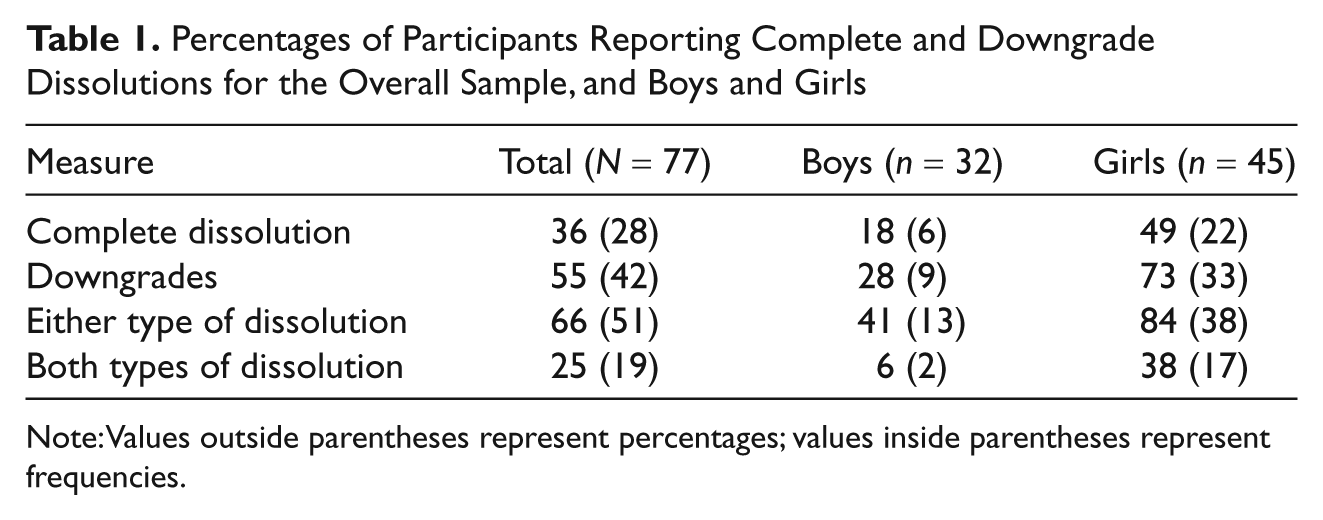
Note: Values outside parentheses represent percentages; values inside parentheses represent frequencies.
Emotional Reactions to Dissolution
The next set of analyses, a series of paired samples t tests, tested whether the intensity of emotional reactions differed across dissolution type (e.g., do adolescents report more anger about downgrades than complete dissolutions?) and whether the strongest emotion differed within dissolution type (e.g., do adolescents report more sadness than happiness about downgrades?). Means, standard deviations, and ranges for the emotion variables are reported in Table 2. The ranges for the variables indicate significant variation in emotional reactions to both types of dissolution. For instance, on ratings of sadness about complete dissolutions, 32.20% reported a 1 or a 2, 35.70% reported a 3, and 32.10% reported a 4 or a 5. Only 3 participants (all of whom were reporting on a downgrade) reported a 1 (indicating did not care) across all three emotions. There were no significant differences in the intensity of anger, t (18) = 1.20, p = ns, d (Cohen’s d) = .39, sadness, t (18) = 1.13, p = ns, d = .38, and happiness, t (18) = 1.97, p = ns, d = .69, across dissolution type, but adolescents reported more sadness than anger about complete dissolutions, t (27) = 3.21, p = .003, d = .58, and downgrade dissolutions, t (41) = 2.10, p = .04, d = .65. Independent t tests revealed that boys reported significantly more anger in response to downgrades than did girls, t (40) = 2.45, p = .02, d = .90. These significant differences remained after employing Hochberg’s (1988) modified Bonferroni technique to control for Type 1 error. Results from other comparisons that yielded nonsignificant differences across dissolution type and sex are available from the first author upon request.
Means (Standard Deviations) for Emotional Reactions to Complete and Downgrade Dissolutions for the Overall Sample, and Boys and Girls
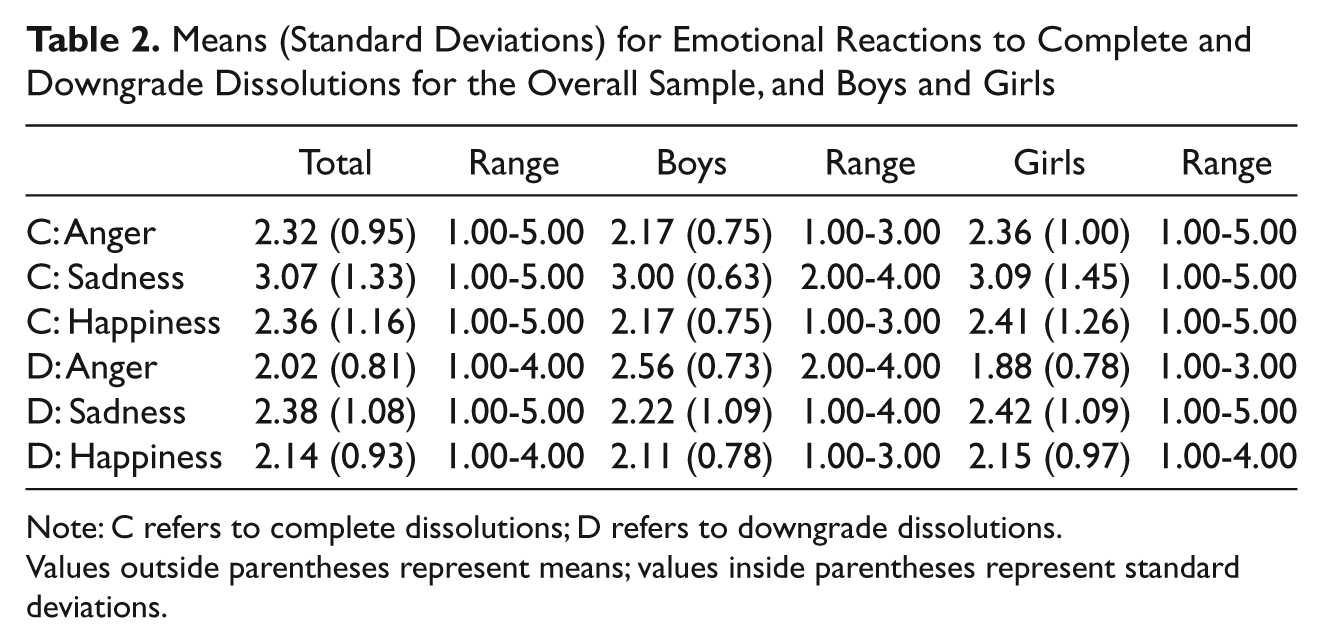
Note: C refers to complete dissolutions; D refers to downgrade dissolutions.
Values outside parentheses represent means; values inside parentheses represent standard deviations.
Dissolution and Current Best Friendship Involvement Group Comparisons of Loneliness
The final set of analyses tested whether experiences with dissolution and current best friendship involvement (or lack thereof) explain individual differences in loneliness for boys and girls. One 2 (Dissolution group: did not report dissolution, did report dissolution) × 2 (Sex) × 2 (Current mutual best friendship group: absence, presence) ANOVA was performed for each dissolution type with loneliness as the dependent variable. Due to the small cell sizes, the three-way interaction between sex, current best friendship group, and dissolution group were not included in these models. The degrees of freedom for these models were reduced because it could not be determined whether 16 participants had a mutual current best friend because both their best friendship choices were nonparticipating students or could not be identified.
When the dissolution type was complete dissolution, there were no sex, F(1, 54) = 1.96, p = ns, η2 = .04, complete dissolution, F(1, 54) = .03, p = ns, η2= .001, or current best friendship main effects, F(1, 54) = .05, p = ns, η2 = .001, or interaction effects between sex and complete dissolution group, F(1, 54) = 1.09, p = ns, η2= .02, complete dissolution and current best friendship group, F(1, 54) = .38, p = ns, η2 = .01. However, a significant sex × current best friendship group interaction was found, F(1, 54) = 5.29, p = .03, η2 = .09, with follow-up simple effects tests with sidak corrections indicating that boys with current best friends (M = 1.46, SD =.14) reported less loneliness than boys without current best friends (M = 2.18, SD =.23), F(1, 54) = 7.03, p = .01, η2 = .13. There was no significant difference among girls, F(1, 54) = 1.75, p = ns, η2 = .03, but girls without current best friends (M = 1.38, SD =.29) were less lonely than boys without current best friends, F(1, 54) = 4.67, p = .03, η2 = .09. The difference between boys and girls (M = 1.73, SD =.57) with current best friends was not significant, F(1, 54) =3.60, p = ns, η2 = .06.
When downgrades were considered, a significant main effect for dissolution group emerged, F(1, 54) = 4.61, p = .04, η2 = .08, with adolescents who had experienced a downgrade (M = 1.70, SD = .55) reporting more loneliness than those who had not (M = 1.60, SD = .55); and a significant dissolution group × current best friendship group interaction effect was revealed, F(1, 54) = 5.67, p = .02, η2 = .10. Follow-up simple effects with sidak correction revealed a significant current best friendship group difference in loneliness among adolescents who had experienced a downgrade, F(1, 54) = 3.84, p = .05, η2 = .07. Adolescents who had experienced downgrades and currently were best friendless reported more loneliness (M = 1.95, SD = .98) than those who experienced downgrades but had current best friendships (M = 1.65, SD =.45). There was no difference between groups of adolescents who had not experienced downgrades, F(1, 54) = .18, p = ns, η2 = .001. In this analysis, there was also a significant sex main effect, F (1, 54) = 3.03, p = .05, η2 = .07, with girls (M = 1.71, SD = .55) reporting more loneliness than boys (M = 1.58, SD = .53). But neither the current best friendship group main effect, F(1, 54) = .29, p = ns, η2= .01, nor the interaction effect between sex and downgrade group were significant, F(1, 54) = .28, p = ns, η2 = .01.
Discussion
By adopting a more nuanced view and analysis of best friendship dissolution among sixth-grade middle school students, this preliminary study extended prior dissolution studies in several important ways. First, it was found that downgrade dissolutions were more common than complete dissolutions, results that clearly highlight the importance of considering downgrades during early adolescence and the importance of distinguishing between downgrade and complete dissolutions. Findings might be explained by the developmental period of our participants and, specifically, the fluid nature of friendship and social networks during early adolescence and the fact that young adolescents may gravitate towards different friends at different times due to changing social needs and identity development (e.g., Rubin et al., 2006; Rubin, Fredstrom, & Bowker, 2008). Second, 66% of all adolescents in the current study reported at least one dissolution, with 84% of girls reporting a downgrade or complete dissolution in their past. The results further showed that girls were more likely to report any or both types of dissolution than were boys, findings that are consistent with, but more specific than, previous research documenting sex differences in the stability of friendships during early adolescence (e.g., Benenson & Christakos, 2003). Overall, these findings suggest that best friendship dissolution may represent a central feature of sixth-grade students’ best friendship experiences and that this is especially true for girls.
Another novel finding of this study was that young adolescents reported more sadness than anger for both types of dissolution. These findings were obtained by querying adolescents about the degree to which they felt anger, sadness, and happiness following complete dissolutions and downgrades, the first investigation to do so. Results complement the growing literature demonstrating that significant relationship losses during early childhood and young adulthood are more strongly associated with internalizing than externalizing emotions and difficulties (e.g., Park, 1992; Sbarra & Emery, 2005). Although it was expected that the intensity of emotional reactions would vary across dissolution type, the lack of significant differences are notable because they imply that adolescents do not experience “complete” losses in best friendships as more negative or as more emotionally charged social events than “partial” losses. This may be due to the fact that both types of dissolution involve the loss of a special best friendship that is unique from other friendships in time spent together, intimacy, and importance to psychological well-being (e.g., Rubin et al., 2006). Furthermore, both types of dissolution likely lead to a potentially painful asymmetry in affection between the two former best friends.
Further analysis indicated that boys reported more anger following downgrade dissolutions than did girls. Overall, these findings demonstrate that best friendship dissolutions are emotionally charged experiences for young adolescent boys and girls and suggest that further research clarifying these sex differences is needed. Boys’ friendships are often embedded in larger peer groups and are more oriented toward power and competition than are girls’ friendships (Rose & Rudolph, 2006). Feelings of powerlessness have been associated with anger in men, at least during adulthood (e.g., Brooke, Thomas, & Droppleman, 2007). Thus one potential explanation is that in such relationship contexts, a downgrade represents a significant loss in power and prestige and a threat to the self, which in turn fosters feelings of anger (e.g., Leadbeater, Blatt, & Quinlan, 1995).
Another key finding emerged when group differences in loneliness were considered. Young adolescents who experienced downgrades reported more loneliness than those who did not. Group differences were not found when complete dissolutions were considered, suggesting that downgrades may represent more salient and significant interpersonal stressors during early adolescence. Of course, results may also reflect the fact that a greater proportion of downgrade dissolutions had occurred within the past 2 years than complete dissolutions. Nevertheless, results further indicated that it was the combination of past downgrades and current best friendship involvement that best explained individual differences in loneliness. Adolescents who experienced downgrades and were not able to form new best friendships reported significantly more loneliness than those who experienced downgrades but had mutual best friendships, suggesting that forming a new best friendship helps to diminish feelings of loss and psychological pain that develop from the continued contact with a former best friend. This study was the first to jointly consider past dissolutions and current best friendship involvement in relation to loneliness, providing initial evidence that best friendship replacement is critical for young adolescents’ psychological well-being when downgrades occur. Since no sex-by-group interactions emerged, best friendship replacement following downgrades appears to be equally important for boys and girls.
A significant study limitation was that longitudinal data were not collected. Therefore, the possibility that new best friendship formation preceded some of the downgrades cannot be ruled out. With this order of events, an adolescent might report less loneliness because a new best friendship had already been established before the loss occurred. A longitudinal design could also test the extent to which some best friendships are on-again/off-again relationships (Dailey, Pfiester, Jin, Beck, & Clark, 2009). Of course, other variables that influence how individuals emotionally react when romantic relationships end (e.g., whether the dissolution was decided mutually or unilaterally, the acceptance or nonacceptance of the breakup; the degree to which former partners continue to interact; attributions regarding the cause of the breakup; e.g., Tashiro & Frazier, 2003; Sbarra, 2006) may also contribute to how adolescents experience best friendship dissolution and should be considered in future research. Because adolescents may experience other emotions about friendship dissolutions not addressed in this study, the assessment of emotional reactions in future studies should be expanded. For example, one might hypothesize that some adolescents may feel jealousy following downgrades since the introduction of a third party or new friend to intact friendships is associated with strong feelings of jealousy (Parker, Low, Walker, & Gamm, 2005). Other emotional reactions to consider may be embarrassment, anxiety (especially if there are concerns about being ostracized, perhaps by a larger friendship group or social network), hope (that the relationship might be re-formed or upgraded), and relief.
Many of the significant findings were moderate or large in effect size following Cohen’s (1988) recommendations that defines d = .2 and η2 = .01 as small, d = .5 and η2 = .06 as medium, and d = .8 and η2 = .14 as large effects. Nevertheless, this study was limited by its focus on a small sample of young adolescents with a modest participation rate from primarily one cultural background. Similar analyses should be carried out in larger samples of older adolescents and younger children who are more ethnically and racially diverse to test for generalizability and/or possible age and cultural differences. A larger sample would also allow for comparisons between adolescents who experience both types of dissolution and those who only experience one. Since friendships may be especially vulnerable across school transitions (e.g., Hardy, Bukowski, & Sippola, 2002), future work should consider complete and downgrade dissolutions before and after the middle school transition and also in samples of adolescents who do not transition from elementary into middle school.
Despite these limitations, results from the current study suggest that downgrade dissolutions are more common than complete dissolutions, but downgrade dissolutions, and especially the combination of downgrade dissolutions and best friendlessness, may place sixth-grade students at risk for loneliness. With these findings, this brief report suggests the possibility of a new dimension to the extant literature of temporal changes in young adolescents’ friendships and that peer relations researchers should be careful not to define best friendships during early adolescence based on long-standing commitment or a lengthy relationship history, and sets the stage for future peer relations studies of temporal changes in best friendship involvement, coping, and psychosocial adjustment.
Footnotes
Acknowledgements
The author gratefully acknowledges Ken Rubin, Bill Bukowski, Matt Bowker, Jamie Ostrov, Bridget Fredstrom, and Melissa Menzer for their insightful comments on previous versions of this article and East Aurora Middle School for their participation in this study.