







Abstract
Although attitudes strongly predict later sexual behaviors, few studies have investigated the factors that influence early adolescent attitudes toward sex. Using a general population sample of urban seventh-grade students (N = 1,736), we examined how supportive parenting, television viewing, perceived social norms, and having a friend and/or sibling who is a teen parent were uniquely associated with the probability and extent that early adolescents endorse favorable attitudes toward sexual activity. Supportive parenting was negatively associated with the probability of endorsement but not the strength of the endorsement. Perceived social norms and having a friend who is a teen parent were positively associated with both probability and strength of endorsement. Having a sibling who is a teen parent and greater television viewing were significantly and positively associated with the probability and extent of favorable attitudes toward sexual activity for females. Implications for prevention efforts targeting parenting and school policies are discussed.
Keywords
Understanding why some youth view sexual activity in early adolescence to be acceptable is important for designing interventions to delay sexual debut. Studies have linked youth attitudes toward sex with intentions to have sex in the near future, sexual behavior, and early onset of intercourse (Buhi & Goodson, 2007; Sieverding, Adler, Witt, & Ellen, 2005). Still, few studies have explored the antecedents that influence attitudes toward sexual relations during early adolescence.
Research suggests that early onset of sexual behaviors can be harmful both physically and emotionally for adolescents (e.g., Zimmer-Gembeck & Helfand, 2008). Thus, youth in early adolescence who view sex at their age to be normative or desirable may be at particularly high risk of adverse outcomes related to sexual activity in adolescence. Because most early adolescents have not yet begun engaging in sexual intercourse, identifying predictors of attitudes toward sexual behavior is an important step in shaping prevention strategies designed to delay the onset of intercourse and reduce rates of pregnancy and sexually transmitted infections (STIs) among adolescents. Using a population-based sample of seventh-grade students in an urban school district in the South Central United States, this study examines how supportive parenting, having a sibling and/or friend who is a teen parent, perceived social norms, and television viewing affect early adolescent’s endorsement of favorable attitudes regarding youth their age engaging in sexual activity.
Ecological Influences on Attitudes in Early Adolescence
A review of over 250 studies identified 100 antecedents to adolescents’ sexual behaviors (Kirby, 2002). Although youth’s attitudes toward sex were mentioned as an important predictor of sexual behavior, none of the reviewed studies looked at factors that directly shape these attitudes. The theory of attitude-behavior relations (Ajzen & Fishbein, 1977) suggests that a person’s behavior is determined by an intention to perform the behavior, and the intention results from attitudes toward the performance of the behavior. Thus, the behavior can be predicted from the attitude if the intention is strongly correlated with the behavior. Research has confirmed the pathway between attitudes, intentions, and youth’s sexual behaviors and adverse outcomes (e.g., pregnancy or STIs) with youth’s attitudes toward sex being strongly predictive of intentions to have sex; and youth’s intentions to have sex being the strongest predictor of actual sexual behavior (Buhi & Goodson, 2007).
Ecodevelopmental theory (Bronfenbrenner, 1979, 1986) suggests that as children and early adolescents explore their sexuality, they experience positive or negative reactions to their attitudes (and behaviors) through interactions at the microsystemic level with parents, siblings, and peers. Direct influences may also interact to influence outcomes through actions such as parental monitoring of peer relationships (Markham et al., 2010). Patterns of relationships that influence developmental trajectories are, in turn, shaped by the characteristics of the contexts in which these interactions occur (Settersten, 2004). For example, sexual content in the mass media (Collins, Martino, Elliott, & Miu, 2011) and the perceived prevalence of teens who are pregnant at school may form and shape adolescents’ attitudes about what is normal and accepted behavior by reducing the awareness of the negative consequences associated with teen pregnancy (Mollborn, 2010).
Males and females physically develop at different ages, with females’ pubertal development occurring approximately 1 year ahead of males’ development (Blakemore, Burnett, & Dahl, 2010). Because the average age of participants in our sample is 13, we expect the majority of females have reached menarche (S. E. Anderson & Must, 2005), whereas the majority of males are at a less developed pubertal stage. Because pubertal development is linked to cognitive development (Blakemore et al., 2010), activation of social and motivational behaviors (Forbes & Dahl, 2010), and because there are gender differences at all ages regarding attitudes toward sex (Petersen & Hyde, 2011), it is important to consider gender differences in the development of sexual attitudes in early adolescence.
It is generally assumed that teen pregnancies are unintended and result from a lack of, or inconsistent use of contraception. Although research supports this assumption, several studies have found that an important proportion of teens report some level of intention or ambivalence about becoming pregnant (e.g., Finer, 2010; Guilamo-Ramos et al., 2007; Heavey, Moysich, Hyland, Druschel, & Sill, 2008; Jaccard, Dodge, & Dittus, 2003; Kelly, Sheeder, & Stevens-Simon, 2004; Sheeder, Teal, Crane, & Stevens-Simon, 2010). Ambivalence about becoming a teen parent has been shown to be particularly salient among early adolescents because they are not yet proficient in integrating their opposing views about the advantages and disadvantages of pregnancy (Chisolm & Buchanan, 2007; Deptula, Henry, Shoeny, & Slavick, 2006).
Extrapolating this finding to early adolescent attitudes toward engaging in sexual relations, we suggest that youth may also express either ambivalence or a positive attitude toward engaging in sex. To account for this, we use a zero-inflated Poisson (ZIP) modeling approach (described more fully later) to simultaneously estimate whether different covariates are associated with the probability of expressing ambivalence or endorsement, and if so, the extent of the expressed endorsement.
Proximal Factors
Parenting Behaviors
Numerous studies have provided strong support for the significance of parent-child relationships as predictors of sexual behavior in adolescence. In particular, parental connectedness, warmth, communication, and monitoring are associated with postponed onset of sexual intercourse, consistent contraception use, and reduced teen pregnancy risk (see Markham et al., 2012, or Miller, Benson, & Galbraith, 2001, for a review). However, few studies have explicitly examined how parenting behaviors affect early adolescent attitudes toward sex. In one related study, Guilamo-Ramos and colleagues (2007) found that, at least for some topics, the more adolescents reported having had conversations with their mothers about a given topic, the more likely they were to have formed expectancies congruent with refraining from sex. However, these associations did not hold for the topics most strongly related to adolescents’ intentions to have sex. Based on the literature that shows a strong relationship between parenting behavior and adolescent sexual behaviors, we hypothesize that supportive parenting will also be negatively associated with both the probability of youth endorsing a favorable attitude toward early adolescents engaging in sex and the strength of the endorsement for those who view sex at their age to be normative.
Sibling Attitudes and Behaviors
Multiple studies have shown that having an older sibling become a teen parent increases the risk of pregnancy for the younger sister (e.g., East & Jacobson, 2001; East, Reyes, & Horn, 2007; Monstad, Propper, & Salvanes, 2011). One study found that having an older sister who had given birth as a teenager increased a teenage girl’s own odds of becoming pregnant by 400% to 600% (East et al., 2007). Although the processes that increase this risk are less clear, Social Learning Theory (Bandura, 1977) suggests that older siblings hold potential to influence sexual attitudes of younger siblings due to the frequency of interaction, which increases the capacity for modeling to affect attitudes and behavior. At least two studies have found that sibling modeling affects sexual attitudes and behaviors of younger adolescents (Kowal & Blinn-Pike, 2004; Widmer, 1997). Still, another study examining the effects of an older sibling becoming a teen parent on a younger sibling’s attitudes toward sex found no significant effects; although, younger siblings’ perceptions of problems associated with teen pregnancy did increase dramatically (East & Jacobson, 2001). Due to the mixed findings, we do not form a directional hypothesis for the association of having a sibling who is a teen parent on the probability of an early adolescent reporting a favorable attitude toward sex, and explore what association, if any, a sibling who is a teen parent may have with endorsing a positive attitude toward engaging in sex among early adolescents.
Peer Attitudes and Behaviors
Studies in the United States (Kinsman, Romer, Furstenberg, & Schwarz, 1998; Kirby, 2002; Metzler, Noell, Biglan, Ary, & Smolkowski, 1994) and internationally (Blum & Mmari, 2004) have established how peers influence the sexual attitudes and behaviors of adolescents. Surprisingly, few studies have examined the influence of having a friend who is pregnant or already a teen parent on youth’s attitudes about sex or pregnancy. One of the few studies examining the role of friends found that youth’s positive perceptions of friends who became pregnant and parental approval of the pregnancy were strongly associated with youth’s positive attitudes toward sex (Barber, Gatny, Kusunoki, & Yarger, 2010). A second study found that having a best friend get pregnant influenced youth’s decisions to have a second pregnancy (Gillmore, Lewis, Lohr, Spencer, & White, 1997). We hypothesize that having a friend who is a teen parent will increase the likelihood of an early adolescent endorsing a favorable attitude toward youth having sex during early adolescence.
Contextual Factors
Perceived Social Norms
Because adolescents spend so much of their time at school, schools are a primary context for adolescent development. Each school presents a unique interpersonal, moral, and academic culture and forms a bridge between microsystem and macrosystem influences (Eccles & Roeser, 2011; Roeser, Urdan, & Stephens, 2009). Research has provided growing recognition of the role culture plays in shaping sexual socialization and risk among adolescents (Tolman & McClelland, 2011). The aggregate social background and characteristics of the student body form cultural influences, referred to as social norms, that have been found to affect adolescent attitudes and behaviors (e.g., Crosnoe, 2009; Frank et al., 2008; LeBlanc, Swisher, Vitaro, & Tremblay, 2007). At the microsystemic level, adolescents’ perceptions of social norms and peer scrutiny, for example, have been found to influence sexual behavior (e.g., Bearman, Moody, & Stovel, 2004; Santelli et al., 2004). Likewise, intervention studies have found school context to be an important factor at a more macro level. In a study of the effect and impact of virginity pledges, school context moderated the effect of pledging on delaying intercourse (Bearman & Bruckner, 2001); and a review of interventions to prevent teen pregnancy and substance use found that addressing the school ethos and environment was one of the more promising approaches (Jackson, Henderson, Frank, & Haw, 2012). Similarly, we suspect that early adolescents’ experiences in school, such as seeing teen pregnancy as common, will influence their perception of what is normative behavior, which, in turn, will shape their attitudes regarding sex. Therefore, we hypothesize that perceiving pregnancy as common in a social context such as school will be associated with the probability of youth endorsing a positive attitude toward having sex during early adolescence.
Television Viewing
Broader social influences have also been linked to adolescents’ attitudes and behaviors. Studies have found that media directed at adolescents includes high rates of sexual content and innuendo but few consequences of risky sexual behaviors (Huston, Wartella, & Donnerstein, 1998; Kunkel et al., 2003). For instance, 83% of the top 20 Nielson-rated shows directed at adolescents portrayed some sexual content (about 3.2 scenes per hour), but only 12% of the sexual content addressed sexual risks or responsibility (Kunkel et al., 2003). The Media Practice Model (Steele, 1999) argues that adolescent media choices are strongly correlated with the salient issues confronting them, which includes their nascent interest in sex. Although youth are exposed to numerous forms of media, television continues to be the most prevalent, with adolescents watching, on average, 4.5 hours per day (Rideout, Foehr, & Roberts, 2010). Several studies have established a link between television viewing and intentions to have sex and early onset of sexual activity (e.g., American Academy of Pediatrics, 1995; Collins et al., 2011; Pardun, L’Engle, & Brown, 2005). How television viewing affects attitudes about sex among early adolescents is less clear (Ward, 2003); furthermore, most research has examined adolescents together (i.e., from 12 to 17) making it difficult to determine patterns in early adolescence (Pardun et al., 2005). This is an important omission when studying the impact of media exposure on sexual attitudes and behaviors because of the amount of physical and cognitive development that occurs from early to late adolescence. For instance, 12-year-olds were found to have only limited understanding of the sexual innuendos in television shows compared with 15-year-olds (Silverman-Watkins & Sprafkin, 1983), and preadolescent females were either uninterested or reacted negatively to sexual media content (Brown, White, & Nikopoulou, 1993). We extend this literature by exploring the associations of television viewing with early adolescent attitudes toward youth their age engaging in sex. Given the mixed findings in the literature, we make no directional hypothesis and leave this as an exploratory research question.
Method
Procedure
The current study was part of a larger program of research exploring risk and resilience factors affecting school attrition among early adolescents. Participants included the cohorts of seventh-grade students from 12 schools in an urban school district in the South Central United States. The University’s Office of Research Compliance, the public school district’s Planning, Research, and Evaluation Department, and the principal of each school reviewed the study protocols and granted permission to conduct the study, which included a waiver of parental consent and active youth assent. Parental permission forms were sent home for parents to review, and copies of questionnaires were available at local libraries and at the school offices, and online for parents to view. A waiver of parental consent required parents to return the permission form only if they did not want their child to participate. All students whose parents did not object to their participation, assented to participate, and were present the day of data collection at each school were surveyed, resulting in a participation rate of 98% of seventh-grade students present the day of data collection and a total response rate of 83% of all possible seventh-grade student participants (N = 1,736). Data were collected over a 2-week period in May 2009 using standardized self-report surveys in English or Spanish. Questions were read to students to avoid confounding due to literacy and to help children stay on task. Students with cognitive disabilities severe enough to be exempt from annual end-of-instruction exams were not included in the sampling frame. Students received US$5 for participation.
Participants
Mean age of the participants was 13.14 years, and 50% were female. The sample was primarily low-income with over 85% receiving free or reduced lunch; 41% reported living with both biological parents who were married. Participants were racially/ethnically diverse (31.1% Hispanic, 39.4% Black, 17.9% White, 3.8% Asian, 3.6% Native American, and 4.2% Other). Missing values for the study variables were low, ranging from 0.1% to 4%. Missing values were handled using Full Information Maximum Likelihood estimation in Mplus v6.0 (Muthén & Muthén, 1998-2010).
Measures
Endorsement of sex
Endorsement of sex in early adolescence was measured by two items that asked youth to express their agreement to the following statements: (a) Having sexual relations is normal behavior for boys your age and (b) Having sexual relations is normal behavior for girls your age. The response set for each item was a standard 4-point Likert-type scale with strongly disagree scored as “0.” Items were summed to create a single measure of endorsement of sex ranging from 0 to 6, with higher scores indicating greater endorsement of sexual behavior.
Supportive parenting
Supportive parenting was measured by a latent construct with four items adapted from measures of parental care and support used in prior survey research with adolescents (Resnick et al., 1997). Items were designed to capture the adolescent’s perception of effective parenting, as represented by level of parent-child relationship conflict, parental positive regard for child, parental behavioral monitoring, and communication. Sample items include the following: My parents/guardians know how I think or feel about things important to me, and We often have arguments that end in fights. Items for the latent construct were placed on a 4-point scale ranging from strongly disagree to strongly agree so that higher scores indicate more effective parenting. Internal consistency for the four items was adequate (α = .65).
Sibling influence
Having had a sibling who was/is a teen parent was measured by a single item that asked youth, Do you have a brother or sister who has become a teen parent? The response set for the item was binary with no and yes as the only valid responses.
Peer influence
Having had a friend who was/is a teen parent was measured by a single item that asked youth, Regarding yourself, do you have close friends who have become a teen parent? The response set for the item was binary with no and yes as the only valid responses.
Perceived social norms
The degree to which teen pregnancy is seen as common in their school, as a primary social context was measured with a single item that asked youth, Do you agree that it is common for teen girls from your school to become pregnant? The response set was a standard 4-point Likert-type scale with strongly disagree scored as “0.”
Television viewing
The extent to which teens viewed television was measured with a single item that asked youth, On an average school day, how many hours do you watch TV? The response set ranged from none, scored as “0,” to 7 or more hours.
Race
Race was measured by a single item that asked youth, With which race/ethnicity do you most closely identify (pick one)? A series of dummy codes was created for African American/Black, Hispanic/Latino, and Other. Due to small percentages of participants who identified with Asian/Pacific Islander, Native American/Alaska Native, or Other (open), these were combined into one category. White was the reference category.
Analytic Plan
A structural equation model (SEM) tested the effects of parenting, peer, and sibling influences, and television viewing on attitudes toward sex in early adolescence. The outcome variable, endorsement of sexual behavior, is ordinal, which we treated as a count variable. When numerous participants do not endorse a behavior, this variable can be called zero-inflated (Long, 1997). In our data, a significant proportion of participants (29.6%) indicated strongly disagree (0) for both males and females, and only 125 youth (7.3%) endorsed strongly agree for both males and females. Comparing the Bayesian Information Criterion values from a standard Poisson model and a ZIP is a test for the zero inflation assumption. Differences of 10 or more are considered strong evidence (Raftery, 1995). Results indicated a significant difference between the two models for attitudes toward sex, so we proceeded with the ZIP model. The ZIP model allowed us to simultaneously estimate two regressions. First, a logistic regression assessed the probability of being in the true non-endorsing category (i.e., a latent class of individuals who would never endorse sexual activity that year). The second regression used a Poisson distribution to assess the strength of endorsement among the latent class of those who endorsed sexual activity and are estimated to endorse it zero times according to the Poisson distribution. It should be noted that both the “probability of endorsement” and the “strength of endorsement” resulted from the same original endorsement of sex variable. Path coefficients to predict the binary portion of the outcome variable were translated into odds ratios (OR) or the percentage increase in the odds of endorsement given a one-unit increase in the covariate. Likewise, path coefficients to the count portion of the outcome variable were understood as incidence rate ratios (IRR) or the percentage increase in the odds of increasing the expected count by one for endorsement given a one-unit increase in the covariate. The null hypothesis used to understand OR and IRR values is 1.00, with values under 1.00 indicating a negative association and values over 1.00 indicating a positive association. Because the sample is nested among 12 schools, we adjusted for the non-independence due to clustering in the data using the Type=Complex command in Mplus. Mplus v.6 (Muthén & Muthén, 1998-2010) was used to estimate the ZIP model with full information maximum likelihood with robust standard errors.
Model Building
Following the two-step modeling approach recommended by J. C. Anderson and Gerbring (1988), we tested a measurement model of the hypothesized latent variable before evaluating our structural path models of interest. Confirmatory factor analysis (CFA) was used to test the factor structure of the latent construct. With large samples, adequate fit between the sample and fitted covariance matrices is indicated by a normed chi-square (χ2 model / df) ≤ 5 (Bollen, 1989), comparative fit index (CFI) > .95, Tucker–Lewis Index (TLI) > .95, and/or a root mean square error of approximation (RMSEA) ≤ .06 (Hu & Bentler, 1999). The CFA for supportive parenting showed an adequate fit to the data, χ2(1) = .025, p < .875, CFI = 1.00, TLI = 1.00, RMSEA < .001.
Next, we developed a structural model to simultaneously test direct associations among the study constructs controlling for race with White as the reference category. Finally, the structural model was estimated using a multi-group model by gender using the Knownclass command in Mplus (Muthén & Muthén, 1998-2010).
Results
To test model paths for moderation by gender, a stepwise freeing of equality constraints was used starting with a fully constrained model compared with an unconstrained model. Because the fully constrained model was significantly different from the unconstrained model (Δχ2 = 38.31, df = 8, p < .001), each path from a covariate to the outcome was subsequently constrained and tested against the unconstrained model. Among the five covariates, only the path from perceived social norms to the probability of endorsing a favorable attitude toward engaging in sex was moderated by gender with the relationship being significantly stronger for males than for females (Δχ2 = 6.46, df = 1, p = .001). Black and Latino males were also significantly more likely than Black and Latino females to endorse a favorable attitude toward sex (Δχ = 4.69, df = 1, p = .003) and (Δχ = 7.40, df = 1, p = .007), respectively. Gender did not significantly moderate any of the associations between the covariates and the strength of the endorsement. Notwithstanding the lack of paths significantly moderated by gender in our model, in Figure 1, we report paths for males and females from the unconstrained model to provide the reader with a more nuanced understanding of our findings. Although not shown in Figure 1, models controlled for race. Coefficients for race are reported in Table 1.
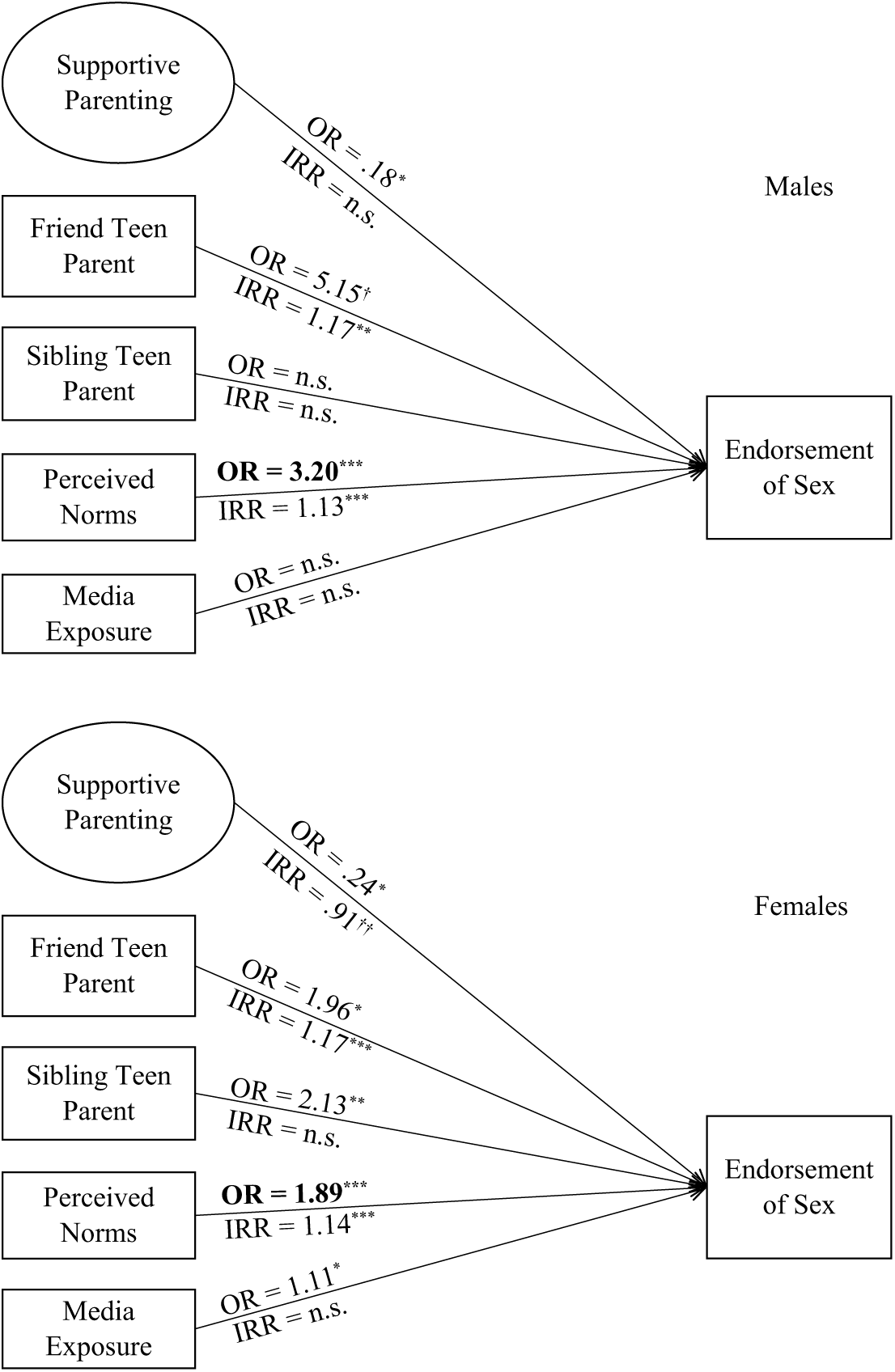
Path models for males and females.
Odds Ratios, Incident Rate Ratios, and 95% Confidence Intervals for SEM Analyses.
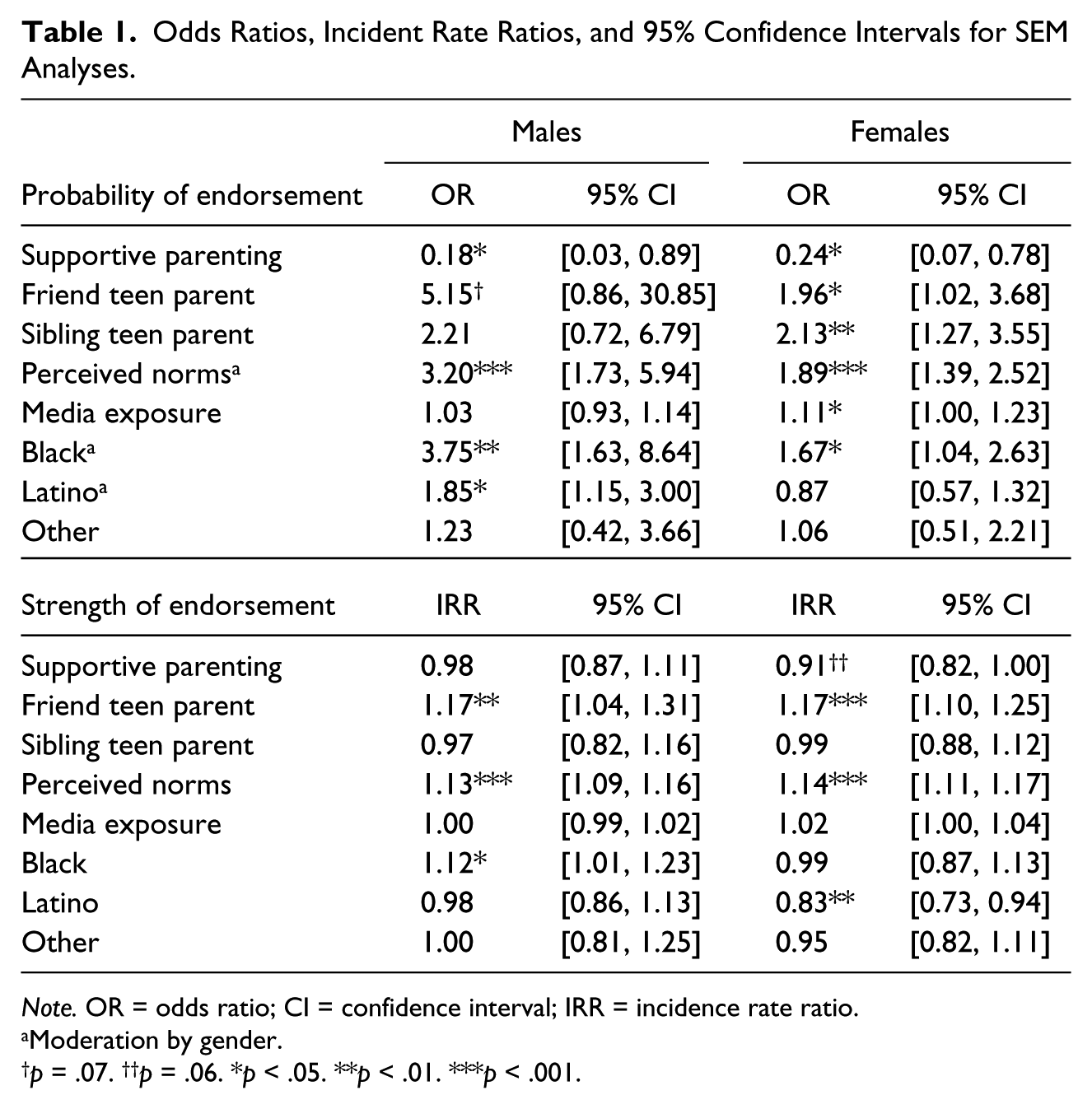
Note. OR = odds ratio; CI = confidence interval; IRR = incidence rate ratio.
Moderation by gender.
p = .07. ††p = .06. *p < .05. **p < .01. ***p < .001.
Supportive Parenting
Our first hypothesis was partially supported. After accounting for the other variables in the model, a unit increase in supportive parenting decreased the odds of endorsing a favorable attitude toward sex for males (OR = .18, p < .05) and females (OR = .24, p < .05). However, for those who endorsed a favorable attitude toward sex in early adolescence, supportive parenting was not associated with the strength of that endorsement for males and was only marginally associated with the strength of endorsement for females (IRR = .91, p = .06; see Table 1).
Friend and Sibling Influence
Having a friend or sibling who had become a teen parent increased the odds of endorsing a favorable attitude toward sex (OR = 1.96, p < .05) and (OR = 2.13, p < .001), respectively, among early adolescent females. Among males, having a friend who had become a teen parent was associated with a substantial, albeit marginally significant increase in the OR of endorsing a favorable attitude toward sex (OR = 5.15, p = .07), but having a sibling who had become a teen parent was not. Having a friend who had become a teen parent was positively associated with the strength of the endorsement of a favorable attitude toward sex for both males and females (IRR = 1.17, p < .05, males; IRR = 1.17, p < .001, females). Having a sibling who had become a teen parent was not significantly associated with the strength of the endorsement.
Perceived Social Norms
Agreement that teen pregnancy is common in their school was associated with both the odds of endorsing a favorable attitude toward sex and the strength of that endorsement for males and females. The effect on the odds of endorsing a favorable attitude toward sex was significantly stronger for males (OR = 3.20, p < .001) than for females (OR = 1.89, p < .001). However, there was no difference between males and females for the strength of the endorsement among endorsers (IRR = 1.13, p < .001, IRR = 1.14, p < .001, respectively).
Television Viewing
After controlling for the other variables in the model, each additional hour increase in television viewing was significantly associated with increased odds of females endorsing a favorable attitude toward sex in early adolescence (OR = 1.11, p < .05). However, the association between increases in television viewing and the strength of the endorsement among female endorsers was not significant. No significant associations were found for males.
Discussion
This study examined environmental factors associated with youth’s favorable attitudes toward early adolescents engaging in sexual relations, and the degree to which youth endorsed favorable attitudes. Consistent with prior research, we found a strong negative association between supportive parenting and the odds of endorsing a favorable attitude toward sex. After controlling for the other variables in the model, for every unit increase in parental support, the odds of strongly disagreeing that it is normal for teens their age to engage in sex increased by 455% for males and 316% for females. Thus, the more that early adolescents report having a supportive relationship with parents characterized by parental caring, open communication and perceiving frequent behavioral monitoring, the less likely they are to agree that it is normal for teens their age to engage in sex. Although communication about sexual topics has generally received support in the literature as a deterrent to risky sexual behaviors (Jaccard, Dodge, & Dittus, 2002) and mixed findings as to its effects on sexual expectations among adolescents (Guilamo-Ramos et al., 2007), it is important to note that our measure of parental support did not include any specific items on parent-child communication about sex. This may be more indicative of parenting style as compared with specific conversations about sex; for example, a more authoritative approach to parenting adolescents has been linked to less youth involvement in risky behaviors (Baumrind, 1989; Larzelere, Morris, & Harrist, 2013). Another plausible explanation is that a more supportive parenting style increases the trustworthiness of the messages parents communicate about sex and creates a better venue for the transmission of parental values about adolescents engaging in sex (Jaccard et al., 2002).
A more surprising finding was that parental support did not affect the strength of the endorsement for youth who endorsed a favorable attitude toward sex. Having a friend who had become a teen parent or perceiving pregnancy as common in school were the only covariates significantly associated with increases in the strength of a favorable attitude toward sex among endorsers. Consistent with Coercion Theory (Patterson, 1982; Patterson, Reid, & Dishion, 1992), it may be that more supportive parents effectively communicate their opposition to youth engaging in sex through their continued involvement. More authoritarian or permissive parents, on the other hand, may not communicate their values as effectively to their offspring, or may be more relaxed in their views toward adolescents engaging in sex. Because teens of authoritarian parents are more prone to reject parental values, and permissive parents tend to be more ambiguous in rule setting (Larzelere et al., 2013), the attitudes of many early adolescents may be shaped more by peers and perceived norms at school than by parents. This is also consistent with Whitaker and Miller (2000), who found that parental discussions about sex or condoms moderated the association between peer norms and adolescent sexual behavior.
For females, after accounting for supportive parenting, all of the variables in the study were significantly associated with increased odds of endorsing a favorable attitude toward sex (i.e., friend and/or sibling a teen parent, perceiving pregnancy as more common in school, and television viewing). For males, however, perceiving pregnancy as more common in school was the only significant factor, and having a friend become a teen parent was a strong but marginally significant factor. This may be due to developmental differences between males and females in early adolescence. Because males are typically less physically developed in the seventh grade compared with females, it may be a rarer event to have a friend become a teen parent, but when it does happen, it causes a strong impression that influences the formation of the youth’s attitudes, thus explaining the marginal significance and wide confidence intervals (CIs), but strong ORs. It may also be that because teen parenthood is visible for females but not males, the males in our study may not be as aware of parenthood among male friends.
Although a significantly stronger association for males, both males and females were more likely to have a favorable attitude toward sex in early adolescence if pregnancy was perceived as common in their school, and for endorsers, perceiving pregnancy as common also increased the odds of more strongly endorsing a positive attitude toward early adolescent engagement in sex. These findings suggest the need for thoughtful prevention strategies for schools, which, due to budget constraints, must combine middle schools and high schools together on the same campus, or that cut funding to alternative schools for pregnant teens compelling them to choose between receiving a substandard education and being mainstreamed into the general population. It may be that mainstreaming pregnant teens into the general population has the inadvertent side effect of increasing the perception among early adolescents that engaging in sex is normal and acceptable, especially among young males. Several other studies have found that perceived peer sexual norms is a stronger predictor of sexual behavior and youth intention to engage in sex than actual peer behaviors (e.g., Kinsman et al., 1998; Lewis, Lee, Patrick, & Fossos, 2007; Martens et al., 2006; Whitaker & Miller, 2000). Still, most studies directly ask students about their perceptions of peer sexual behavior. As far as we can tell, this is the first study to look at the association between perceived commonality of pregnant teens in a school and the formation of attitudes toward sex in young adolescents. Further research is needed to explore how policy decisions that increase contact between pregnant teens and younger adolescents influence the development of ambivalence toward becoming pregnant among teens.
We found that having a sibling who is a teen parent significantly increases the odds of endorsing a favorable attitude toward sex among early adolescent females. Intuitively, it would seem that a younger teenage sister might see the problems associated with adolescent motherhood and be less likely to hold a favorable attitude toward sex for youth her age. However, research suggests that a sizable number of adolescent females do not see becoming a teen mother as a completely negative proposition (Afable-Munsuz, Speizer, Magnus, & Kendall, 2006; Sheeder et al., 2010; Spear, 2001). They are not unaware of contraception, nor are they ignorant regarding the consequences associated with teen pregnancy; but they see pregnancy as a way to be more responsible in achieving their goals, become closer to their families, and increase their level of intimacy with their boyfriends (Afable-Munsuz et al., 2006; Spear, 2001). Because of their level of cognitive development, younger adolescents have difficulty integrating the pros and cons of becoming pregnant into their “ambivalent state of mind” (Sheeder et al., 2010, p. 91). It seems that having an older sister who has become a teen parent may expose the younger sibling to both good and bad aspects of teen motherhood, which can accentuate their ambivalence and lead to complacency regarding pregnancy. This finding supports the previous argument that pregnancy prevention strategies are needed that specifically and uniquely target young women whose older siblings have become a teen parent (East et al., 2007).
Our study found that television viewing was significantly associated with females endorsing a more favorable attitude toward sex but not males. These findings are consistent with other studies that have shown that males’ attitudes and behaviors toward sex are more affected after exposure to pornography, while females attitudes and behaviors toward sex are more affected by television viewing (Aubrey, Harrison, Kramer, & Yellin, 2003; Ward, 2003). This may be due to earlier onset of puberty for females compared with males. Pubertal development has been found to moderate the effect of television viewing on early adolescents’ perceptions of how frequently friends engaged in sexual behaviors (Eggermont, 2005). Others have suggested that the sexual content in mainstream television does not sufficiently capture the attention of adolescent male viewers, so their sexual attitudes are less affected by this genre (Ward, 2003). This being the case, our findings suggest that television viewing during early adolescence is an important factor associated with more permissive sexual attitudes among younger teen girls.
Conclusion
Several limitations to this study should be noted. First, because the nature of the study is cross-sectional, the normal cautions against attributing causality apply. Second, although the recruited participants included all seventh graders in a particular urban school district, the sample is not representative of all early adolescents in the United States. Caution should be taken not to over-generalize the current findings. Third, the measures for this study are self-reported from a single reporter and thus may be biased. However, as is the case with many adolescent behaviors that are not easily observed, there is no perfectly valid way to collect data, and self-report is still the most common means of collecting data for almost all studies (Wagner & Anthony, 2002). Finally, because the study was not originally designed to specifically look at youth’s attitudes toward early adolescent sexual behavior, some of the measures used may not capture important nuances in early adolescent behaviors. For example, we do not capture the degree to which adolescents may or may not have talked to their parents about sexual attitudes or behaviors. Likewise, as do other researchers (e.g., Markham et al., 2010), we use an ambiguous term sexual relations in the dependent variable. Phrasing the measure this way captures adolescent attitudes in general, as they define the term, and avoids the sometimes complex and politically charged option of asking young teens explicit questions about sexual behavior. Future research that uses a less ambiguous term may provide more insight into what forms early adolescent attitudes toward sex. Other measures were proxies for other variables or were single item measures such as TV viewing as a proxy for media exposure, and the degree to which youth perceive how common teen pregnancies occur was used as a proxy to explore how school characteristics might influence attitudes. Future studies that use more complete and specific measures of these constructs are needed to validate the current findings. For example, other forms of media (e.g., music), and the use of social media among early adolescents are important areas to explore.
Notwithstanding these limitations, the current study is one of few that address predictors of early adolescents’ attitudes toward sex. While a large majority of early adolescents have not engaged in sexual intercourse, assessing their attitudes toward sex is an important component of early intervention strategies because youth attitudes about sex are strongly associated with sexual behaviors (Buhi & Goodson, 2007). Because younger adolescents are particularly at risk of teen pregnancy and STIs due to more inconsistent contraceptive use (Magnusson, Masho, & Lapane, 2012), this is an important stage at which to intervene. Our findings suggest three primary prevention strategies: (a) Promoting basic parenting skills and assisting parents to interact in more supportive ways may be an effective intervention that helps buffer against negative peer and contextual influences without directly teaching parents how to better communicate with their child about sex; (b) reducing factors at schools that inadvertently promote normalizing teen pregnancy may also be an important consideration for future intervention and prevention efforts; and (c) young adolescent females who have an older sister who is a teen parent may be a special subgroup to target for teen pregnancy prevention. Although more research is needed to confirm these findings, this study contributes to efforts aimed at delaying the onset of intercourse, therefore reducing the risk of teen pregnancy and STIs among youth.
Footnotes
Authors’ Note
An earlier version of this article was presented at the 2011 National Council on Family Relations annual conference in Minneapolis, Minnesota.
Declaration of Conflicting Interests
The author(s) declared no potential conflicts of interest with respect to the research, authorship, and/or publication of this article.
Funding
The author(s) disclosed receipt of the following financial support for the research, authorship, and/or publication of this article: Funding for this project was provided in part by the College of Human Sciences, Oklahoma State University.