







Abstract
This study examined physiological and coping responses to peer-evaluative challenges in early adolescence as predictors of academic outcomes. The sample included 123 young adolescents (
Young adolescents frequently experience peer evaluations of their competence and likeability (Parker, Rubin, Erath, Wojslawowicz, & Buskirk, 2006). Social-cognitive development and physical maturation, as well as increasing positive and negative peer experiences, may amplify the significance of these peer-evaluative challenges in early adolescence. Indeed, concerns about negative peer evaluation escalate in adolescence (Beidel & Turner, 2007; Westenberg, Gullone, Bokhorst, Heyne, & King, 2007) and are corroborated by heightened physiological responses to social challenges (Stroud et al., 2009; Sumter, Bokhorst, Miers, Van Pelt, & Westenberg, 2010). The transition to middle school may exacerbate peer challenges, as this transition often introduces a larger and more diverse peer group, realignment of existing peer networks, and adult expectations of independence with peers (Eccles, Lord, & Buchanan, 1996).
Academic functioning may be particularly susceptible to rising peer challenges across the transition to middle school due to the salience of peer relationships in early adolescence as well as the common occurrence of peer stressors at school (Nishina & Juvonen, 2005). Indeed, LaFontana and Cillessen (2010) reported that prioritizing peer status over achievement peaks in middle school. Maladaptive responses to peer challenges may lead to peer problems, such as friendlessness, rejection, and victimization (Kochenderfer-Ladd, 2004; Sandstrom, 2004; Zimmer-Gembeck, Lees, & Skinner, 2011), and these peer problems are well-documented predictors of poorer academic performance (Buhs, Ladd, & Herald, 2006; Crosnoe, 2011; Nakamoto & Schwartz, 2010; Ryan, 2011; Wentzel, 2009). Even in the absence of worsening peer problems, maladaptive responses to peer challenges may fail to mitigate or overcome normative peer challenges, thereby producing increased peer-related stress that interferes with academic performance. Adaptive responses to peer challenges, in contrast, may allow adolescents to preserve positive emotion and attentional focus on academic demands even in the context of normative peer challenges. The present study examined real-time physiological and coping responses to peer-evaluative challenges as predictors of academic performance across the transition to middle school and academic adjustment following the transition to middle school. In addition, social anxiety and peer victimization, both indices of peer-evaluative stress, were tested as mediators of associations between earlier responses to peer-evaluative challenges and academic outcomes in middle school.
Responses to Peer Challenges
Many young adolescents feel some anxiety about interacting with unfamiliar peers or experience exclusion or rebuff from peers, especially during the transition to middle school. Consistent with stress-coping theories (Lazarus & Folkman, 1987; Zimmer-Gembeck & Skinner, 2011), however, these peer-evaluative experiences are not necessarily correlates or causes of maladjustment. Rather, adolescents’ responses to peer challenges may be adaptive or maladaptive and thereby contribute to positive or negative adjustment across a range of domains, including emotional, behavioral, and academic outcomes (Compas, Connor-Smith, Saltzman, Thomsen, & Wadsworth, 2001). Responses to peer challenges include voluntary-coping and involuntary-physiological responses, each of which may influence adjustment. Theories of coping (Compas et al., 2001) and psychophysiology (Porges, 2007) suggest that responses to challenges may be engaged or disengaged across voluntary-coping and involuntary-physiological levels.
Voluntary-Coping Responses
Coping refers to “conscious volitional efforts to regulate emotion, cognition, behavior, physiology, and the environment in response to stressful events or circumstances” (p. 89, Compas et al., 2001). Voluntary engagement strategies seek to influence events or conditions (e.g., problem-solve), directly regulate emotions, or involve attempts to adapt to the environment through cognitive reappraisal. Voluntary disengagement strategies are directed away from the stressor or away from thoughts and emotions about the stressor, and include avoidance, distraction, and denial (Compas et al., 2001). Generally, research has linked engaged coping strategies with lower internalizing and externalizing problems and higher social competence, particularly when coping was assessed in response to more controllable situations (Clarke, 2006; Compas et al., 2001; Skinner & Zimmer-Gembeck, 2007). For example, Erath, Flanagan, and Bierman (2007) found that young adolescents’ problem-directed coping strategies during a conversation challenge (e.g., conversation focus) were associated with observed conversation skills and peer-reported acceptance, whereas self-directed coping strategies (e.g., distraction) were associated with peer-reported victimization. In addition, several studies have linked engaged coping strategies with indices of positive academic functioning. In a meta-analysis including six studies with children and adolescents, Clarke (2006) reported a modest positive association (r = .12) between active coping (e.g., problem-solving, cognitive restructuring) with a variety of interpersonal stressors (e.g., sibling, peer, person you know) and academic performance.
As discussed by Compas et al. (2001) and Zimmer-Gembeck and Skinner (2011), however, the types and effectiveness of coping strategies may vary across contexts, such as family, peer, or academic contexts (Jaser et al., 2007; Sandstrom, 2004). Despite the fact that negative peer experiences often occur at school (Nishina & Juvonen, 2005), relatively few studies have examined associations between coping with peer stress and academic outcomes. In one recent study, young adolescents’ self-reported engaged coping responses to a range of peer stressors (e.g., being around rude peers, having problems with a friend, feeling pressured) was positively correlated with academic achievement as rated by adolescents and their teachers (Swanson, Valiente, Lemery-Chalfant, & O’Brien, 2011). In a well-known study, Causey and Dubow (1992) found that self-reported problem-solving coping responses to a peer argument scenario were positively correlated with grade point average (GPA) among fourth through sixth graders, but other coping responses (e.g., seeking support, distancing) were not associated with academic performance. To our knowledge, no published studies have examined coping responses to peer stress as prospective predictors of academic outcomes across the transition to middle school.
Physiological Responses
Involuntary-physiological responses to peer challenges may also influence academic outcomes. The autonomic nervous system (ANS) is a major psychophysiological component of the human stress system, and the parasympathetic nervous system (PNS) is the regulatory branch of the ANS. According to Polyvagal Theory (Porges, 2007), the PNS serves as a “brake” (via the vagus nerve) that decelerates heart rate and facilitates calmness, attentional focus, and social engagement under normal circumstances. The deceleration in heart rate produced by higher vagal output to the heart is reflected in heart rate variability across the breathing cycle (e.g., slower heart rate during exhalation than inhalation), which is referred to as respiratory sinus arrhythmia (RSA). Under challenging or threatening conditions, the vagal brake can be withdrawn, yielding an incremental and efficient increase in heart rate and metabolic output that may allow individuals to engage with environmental demands and use active coping strategies in a regulated manner. Thus, greater reductions in vagal tone (higher respiratory sinus arrhythmia reactivity or RSAR) in challenging situations should reflect emotion regulation and flexible adaptation to environmental demands (Porges, 2007).
Consistent with contemporary physiological perspectives, research has reliably linked higher RSAR with fewer internalizing, externalizing, and social problems in community samples (Graziano & Derefinko, 2013). For example, Graziano, Keane, and Calkins (2007) reported that young children’s higher RSAR (i.e., higher vagal withdrawal) during cognitively and emotionally challenging tasks was modestly associated with higher teacher-reported social skills and peer-nominated social preference. In addition, several studies have found associations between higher RSAR and more positive cognitive or academic functioning. A recent meta-analysis of 10 studies revealed a modest association (r = −.16) between higher RSAR and fewer cognitive/academic problems among children and adolescents (Graziano & Derefinko, 2013). Studies included in this meta-analysis used a variety of tasks to elicit RSAR, including reward, negative emotion, and cognitive tasks, but not normative peer stress tasks. To our knowledge, no published studies have examined RSAR in the context of peer stress as a prospective predictor of academic outcomes across the transition to middle school.
The Present Study
The present study examined RSAR and engaged coping responses as predictors of academic performance across the transition to middle school and academic adjustment to middle school. At T1, RSAR and engaged coping were assessed in real-time during lab-based simulations of normative peer-evaluative challenges. A lab-based measure of engaged planning also assessed engagement with peer-evaluative stress and was included in an effort to corroborate results using the engaged coping variable. Academic performance was assessed with adolescent, parent, and teacher reports of academic performance before (T1) and after (T2) the transition to middle school. Academic adjustment was assessed at T2 with parent reports of more general academic adjustment during the first year of middle school. We hypothesized that higher RSAR and engaged coping would predict better academic outcomes. Because peer-evaluative challenges are prevalent in early adolescence, we reasoned that these peer challenges would be less likely to interfere with positive academic outcomes among young adolescents whose physiological responses indicate awareness of challenges and well-regulated responses to challenges (i.e., higher RSAR). We also reasoned that peer challenges are more likely to be mitigated or solved in a manner that supports positive emotion and academic focus among young adolescents who use engaged (rather than disengaged) coping strategies.
We also conducted three sets of follow-up analyses. First, we examined the interaction between RSAR and engaged coping (and planning) as a predictor of academic outcomes. In one recent study, coping responses moderated the association between RSAR and social competence, such that lower RSAR was associated with lower social competence among young adolescents with less engaged coping responses but not among young adolescents with more engaged coping responses (Erath & Tu, 2013). Results suggested that adolescents with disengaged physiological (lower RSAR) and coping responses may be least attuned to challenging peer situations and thus least likely to solve social problems effectively. Consistent with these results, we anticipated that lower RSAR would particularly predict poorer academic outcomes among young adolescents who reported less engaged coping or planning.
Second, we tested for sex differences in associations linking RSAR and engaged coping with academic outcomes. Although we did not specify hypotheses, sex differences in responses to peer stress and sex-linked norms regarding behaviors and coping responses (Rose & Rudolph, 2006) suggest that responses to peer challenges may predict academic outcomes differently among boys and girls.
Finally, we considered whether experiences of peer-evaluative stress in middle school mediate associations between earlier responses to peer-evaluative stress (RSAR and engaged coping or planning), assessed just before the transition to middle school, and academic outcomes in middle school. Earlier responses to peer-evaluative stress may predict later experiences of peer-evaluative stress, which may account for poor academic outcomes associated with earlier responses to peer-evaluative stress. Although “peer-evaluative stress experiences” have not been defined and measured in precise terms, we conceptualized adolescent-reported social anxiety and peer victimization as developmentally salient indices of peer-evaluative stress experiences. Social anxiety is characterized by distress in social situations due to intense fears of negative evaluation (Beidel & Turner, 2007; La Greca & Lopez, 1998). Peer victimization refers to being the target of direct (physical or verbal) or indirect (relational) peer aggression, which often involves negative evaluation (e.g., insults) and stress (e.g., anxiety; Nishina & Juvonen, 2005). Both social anxiety (Beidel & Turner, 2007; Sumter, Bokhorst, & Westenberg, 2009) and peer victimization (Williams & Guerra, 2007) generally increase across the transition to adolescence. We anticipated that lower RSAR and less engaged coping (and planning) responses to peer-evaluative stress at T1 would predict increases in social anxiety and peer victimization from T1 to T2, and that T2 social anxiety and peer victimization would at least partially account for associations linking earlier physiological and coping responses with later academic outcomes.
Method
Participants
In all, 123 fifth and sixth graders (
Procedures
The short-term longitudinal design of the present study involved two waves of data collection spaced approximately 10 months apart. Participants were recruited in 2 cohorts separated by 1 year through flyers sent home with fifth- and sixth-grade students at five elementary schools in the southeastern United States. At T1, parents who responded to the school flyers were given information about the study, including the lab protocol, and were scheduled for a research visit over the phone in the spring. Teachers completed questionnaires near the end of the school year (May). Adolescents and their parents visited the lab for about 2 hours in the summer (mostly in June). Following an introduction and consent procedures, parents completed questionnaires and adolescents participated in lab activities while their physiological activity was recorded. After completing lab activities, participants were debriefed and given a snack break before they completed questionnaires.
The lab protocol included peer evaluation and peer rebuff periods. Following 5-minute acclimation and 3-minute baseline periods, adolescents were asked to act as if an adult research assistant (RA; same sex) was someone about their age, and to lead a 3-minute conversation to get to know the RA. To lead the conversation, adolescents were told that they could tell about themselves, ask questions about the RA, and talk about anything they wished. They were told that the conversation would be viewed via one-way Skype (an Internet-based video-chat program) by three same-age, same-sex peer judges, who were actually fictitious. Participants were told that the peer judges would decide how well they performed in the conversation activity compared with two other participants the peer judges had watched on video. The peer evaluation period refers to the 3-minute conversation activity. Three minutes after post-conversation interview questions, participants received a text message via Skype, ostensibly from the peer judges, indicating that the peer judges chose the other two participants as the best performers in the conversation activity. Participants were then told that they may have a chance to change the peer judges’ opinions by reconnecting through Skype and speaking directly to the peer judges. The peer rebuff period refers to the 3 minutes following the feedback from the peer judges, during which participants considered their potential response to the peer judges. Following the peer rebuff period and several interview questions, the task was ended and participants were carefully debriefed using a process debriefing procedure informed by Underwood (2005) and Hubbard (2005). In particular, participants were led to their own conclusion that the peer judges were not real, and the rationale for deception and purpose of the study were discussed with participants.
Parents were re-contacted during the spring of adolescents’ first year in middle school for a follow-up visit (T2). Adolescents and their parents visited the research lab in the spring and completed questionnaires. Parents and adolescents were asked to select the teacher who knew the student best to complete teacher reports. Teachers were contacted to participate and completed questionnaires in the spring. Adolescents, parents, and teachers were compensated monetarily. All study procedures were approved by the University Institutional Review Board.
Measures
Physiological assessment
RSA was measured during acclimation (5 minutes), resting baseline (3 minutes), speaking baseline (3 minutes), peer evaluation (3 minutes), waiting (3 minutes), peer rebuff (3 minutes), and recovery (3 minutes) periods. Pre-task (resting baseline) and peer-evaluative stress (mean of peer evaluation and peer rebuff periods) levels of RSA were used in the present study. Peer-evaluative stress levels of RSA were not collected for three participants because they chose not to participate in the peer stress procedures or their uncomfortable appearance led us to forego the peer stress period. One of these participants said that he did not want to participate in the conversation activity and two of these participants did not speak to researchers and appeared anxious while researchers provided instructions and attached electrodes.
Respiratory sinus arrhythmia reactivity
RSA data acquisition followed standard guidelines (Berntson et al., 1997) using a MindWare data acquisition system (MindWare Technologies, Inc., Gahanna, OH). Electrocardiography (ECG) data were collected through disposable Ag-AgCl electrodes (1½″ foam sensor, 7% chloride gel) placed on participants’ right clavicle and left and right rib by a same-sex RA. RSA scores were quantified using the spectral analysis method (Berntson et al., 1997) with MindWare HRV analysis software and expressed in units of ln(ms2). The very few artifacts that were detected were corrected manually using standard procedures (Berntson et al., 1997). RSA levels during the peer evaluation (
Engaged coping with peer-evaluative stress
Real-time coping with peer-evaluative stress was assessed with adolescents’ open-ended responses to questions that immediately followed the peer evaluation and peer rebuff periods. After the peer evaluation period, participants were asked, “Having a conversation with someone you don’t know, while being judged by peers, can be challenging—how did you cope with this situation?” Following their initial response, participants were asked, “Did you use any other coping strategies to make yourself feel better or to help you get through the conversation activity?” After the peer rebuff period, participants were asked, “Not being chosen by peers can be challenging—how did you cope with this situation?” They were also asked, “Did you use any other coping strategies to make yourself feel better or to help you plan your response to the peer judges?” Responses were transcribed from video-recordings of the laboratory procedures.
Following extensive training with coping responses from a prior study (Erath et al., 2007), the first author and trained doctoral students coded coping responses as problem-focused (e.g., focused on the conversation, thought about what to say to the peer judges), emotion regulation (e.g., calmed down, took deep breaths), positive appraisal about the self (e.g., told myself that I did my best), positive appraisal about the situation (e.g., thought of the RA as a friend, figured that you cannot win all the time), disengaged (e.g., did not think about the peer judges, thought about something else), and other (e.g., no response, unclear response, involuntary motor response). All responses were double-coded, and inter-rater reliability was good (κ = .77). All discrepant codes were resolved by consensus.
Consistent with a well-established coping taxonomy (Compas et al., 2001; Connor-Smith, Compas, Wadsworth, Thomsen, & Saltzman, 2000), engaged coping responses included problem-focused, emotion regulation, and positive appraisal (self and situation) codes, and disengaged coping responses included only disengaged coping codes. The proportion of engaged coping with peer-evaluative stress was computed by dividing the sum of engaged coping responses during the peer evaluation and peer rebuff periods by the sum of all coping responses (engaged, disengaged, other) during the peer evaluation and peer rebuff periods.
Engaged planning
Following the peer rebuff period and questions about coping with peer rebuff, participants were asked about their inclination to reconnect with the peer judges and their plan for reconnecting. Participants’ inclination to reconnect was assessed with interviewer ratings (1 = no; 2 = very reluctant, preference not to; 3 = little reluctant, but willing; 4 = yes) of participants’ responses to the question, “What do you plan to do—do you want to speak directly to the peer judges?” If they were in favor of speaking with the peer judges (rating of 3 or 4), participants were prompted with, “Tell me about how you plan to respond to the peer judges, or what you plan to say to the peer judges.” If participants were not inclined to speak with the peer judges (rating of 1 or 2), they were prompted with, “I understand that you do not want to speak with the peer judges, but if you were to speak with the peer judges, tell me about how you would respond to the peer judges, or what you would say to the peer judges.”
Responses were rated on a scale of engaged planning from 1 to 4, with lower scores representing lack of planning (e.g., no plan; simple or vague plan, such as “talk to them”) and higher scores representing more specific and elaborate planning (e.g., planning to raise open-ended topics, such as favorite activities; conversation strategies such as identifying common interests and talking about them). Participants’ plans were double-coded and inter-rater reliability was high (intraclass correlation = .98). Whereas the measure of engaged coping is based on adolescents’ self-reported coping strategies, the measure of engaged planning is based on the degree to which adolescents developed a plan for dealing with the peer stress situation, which should reflect their engagement with the situation.
Academic performance
Academic performance was assessed at T1 and T2 with teacher, parent, and adolescent ratings of performance in five subject areas: English/Language, Reading, Mathematics, Science, and Social Studies/History. Respondents used a 5-point rating scale (1 = failing, 2 = below average, 3 = average, 4 = above average, and 5 = excellent). Inter-item reliability was high within each informant, ranging from α = .73 to .98. Similar academic performance ratings have been validated with cross-informant correlations and school-issued report cards (Graham, Updegraff, Tomascik, & McHale, 1997; Swanson et al., 2011; Valiente, Lemery-Chalfant, & Swanson, 2009). In the present study, cross-informant correlations ranged from .49 to .63 at T1 and from .48 to .66 at T2. We averaged across informants (teacher, parent, early adolescent) to create an academic performance score. Cross-informant reliability was good (α = .78 at T1 and α = .78 at T2).
Academic adjustment
At T2, parents provided ratings of adolescents’ academic adjustment across the transition to middle school with six academic items from the School Adjustment–Parent Report measure created by the Fast Track project (Conduct Problems Prevention Research Group, 1997). Items refer to the transition to the new school year (e.g., “My child had an easy time handling the new academic demands made on him/her,” “My child liked the new things about school this year”) and therefore were assessed only at T2, following the transition to middle school. Parents provided ratings on a 5-point scale (1 = strongly disagree, 5 = strongly agree) and inter-item reliability was high (α = .84).
Social anxiety
At T1 and T2, adolescents completed the well-validated Social Anxiety Scale for Adolescents (SAS-A; La Greca & Lopez, 1998). Eighteen items were rated on a 5-point scale (e.g., “I worry about what others think of me”; 0 = not at all to 4 = all the time). Internal consistency was strong at T1 (α = .92) and T2 (α = .94).
Peer victimization
Adolescents completed eight items from the Social Experiences Questionnaire (e.g., “How often do you get pushed or shoved by other peers at school?” and “How often have other kids said mean things about you to keep other people from liking you?”; Crick & Grotpeter, 1996), which were rated on a 5-point scale (1 = almost never to 5 = almost always). Internal consistency was high at T1 (α = .85) and T2 (α = .86).
Demographic variables
Gender, ethnicity, and T1 grade level were represented by dichotomous variables (male = 0, female = 1; European American = 0, ethnic minority = 1; fifth grade = 0, sixth grade = 1, respectively). Parents reported annual household income on a 6-point scale (1 = less than US$10,000 to 6 = more than US$75,000).
Results
Preliminary Analyses
Descriptive statistics and correlations are shown in Table 1. Two RSAR values were considered outliers based on their deviations from the mean (+3.4 and −3.9 SDs); analyses presented below include these values because analyses were repeated without the outlier values and revealed no substantive differences compared with analyses that include all data. On average, mean RSA levels did not change from the pre-task period (
Descriptive Statistics and Correlations Among Primary Study Variables.
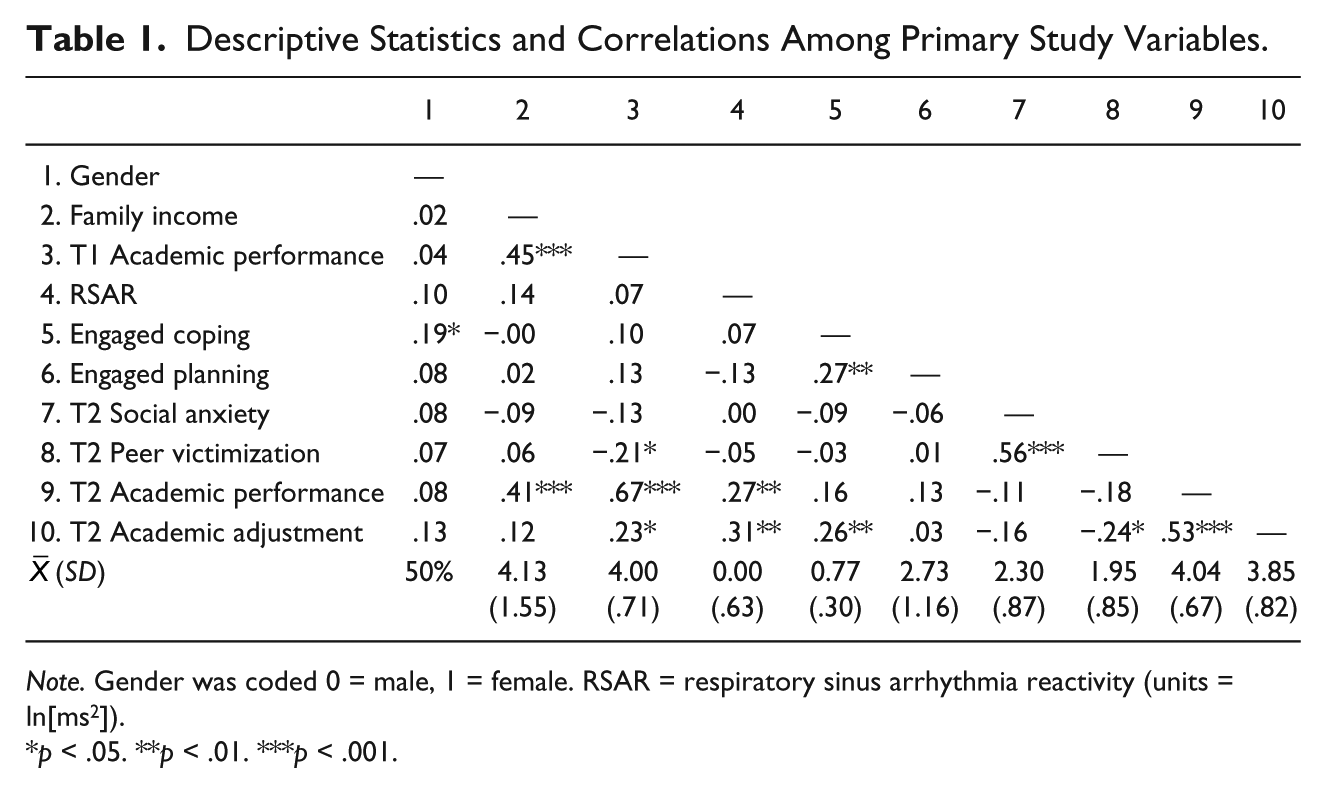
Note. Gender was coded 0 = male, 1 = female. RSAR = respiratory sinus arrhythmia reactivity (units = ln[ms2]).
p < .05. **p < .01. ***p < .001.
Engaged coping responses to the peer-evaluative stress protocol (77% of responses) were more common than disengaged (14%) or other (9%) coping responses. On average, adolescents reported 2.64 (SD = .88) total coping responses across the peer-evaluative stress protocol, including 2.06 (SD = 1.11) engaged responses, 0.38 (SD = .61) disengaged responses, and 0.20 (SD = .44) other responses. Participants were generally reluctant to reconnect with the peer judges (
As shown in Table 1, gender was correlated with engaged coping with peer-evaluative stress, such that girls reported more engaged coping than boys. Higher family income was correlated with better academic performance at T1 and T2. Grade level and ethnicity were not correlated with physiological, coping, or academic variables. RSAR was positively and significantly correlated with T2 academic performance and adjustment, and engaged coping was correlated with academic adjustment but not academic performance.
T1 social anxiety was marginally correlated with less engaged planning (r = −.16, p < .10), but T2 social anxiety was not correlated with RSAR, engaged coping or planning, or academic outcomes. T1 and T2 peer victimization were significantly correlated with poorer academic performance at T1 (r = −.25, p < .01 and r = −.21, p < .05, respectively) and poorer academic adjustment at T2 (r = −.25, p < .05 and r = −.24, p < .05, respectively). T2 peer victimization was also marginally correlated with poorer academic performance at T2 (r = −.19, p < .10). However, neither T1 nor T2 peer victimization was significantly correlated with RSAR, engaged coping or planning, or academic performance at T2.
Regression Analyses Predicting Academic Performance and Academic Adjustment
Regression analyses were conducted in AMOS (Arbuckle, 2012) to take advantage of full information maximum likelihood (FIML) estimation of missing data. Regression analyses tested predictive associations linking RSAR and coping responses with changes in academic performance from T1 to T2 and academic adjustment at T2 (Table 2). All continuous control and predictor variables were mean-centered for regression analyses. Gender and income were entered as control variables in each analysis due to their correlations with either predictor or outcome variables (ethnicity and grade level were not included as control variables due to lack of correlations with predictor or outcome variables).
Predictive Associations Linking RSAR and Engaged Coping With Academic Outcomes.
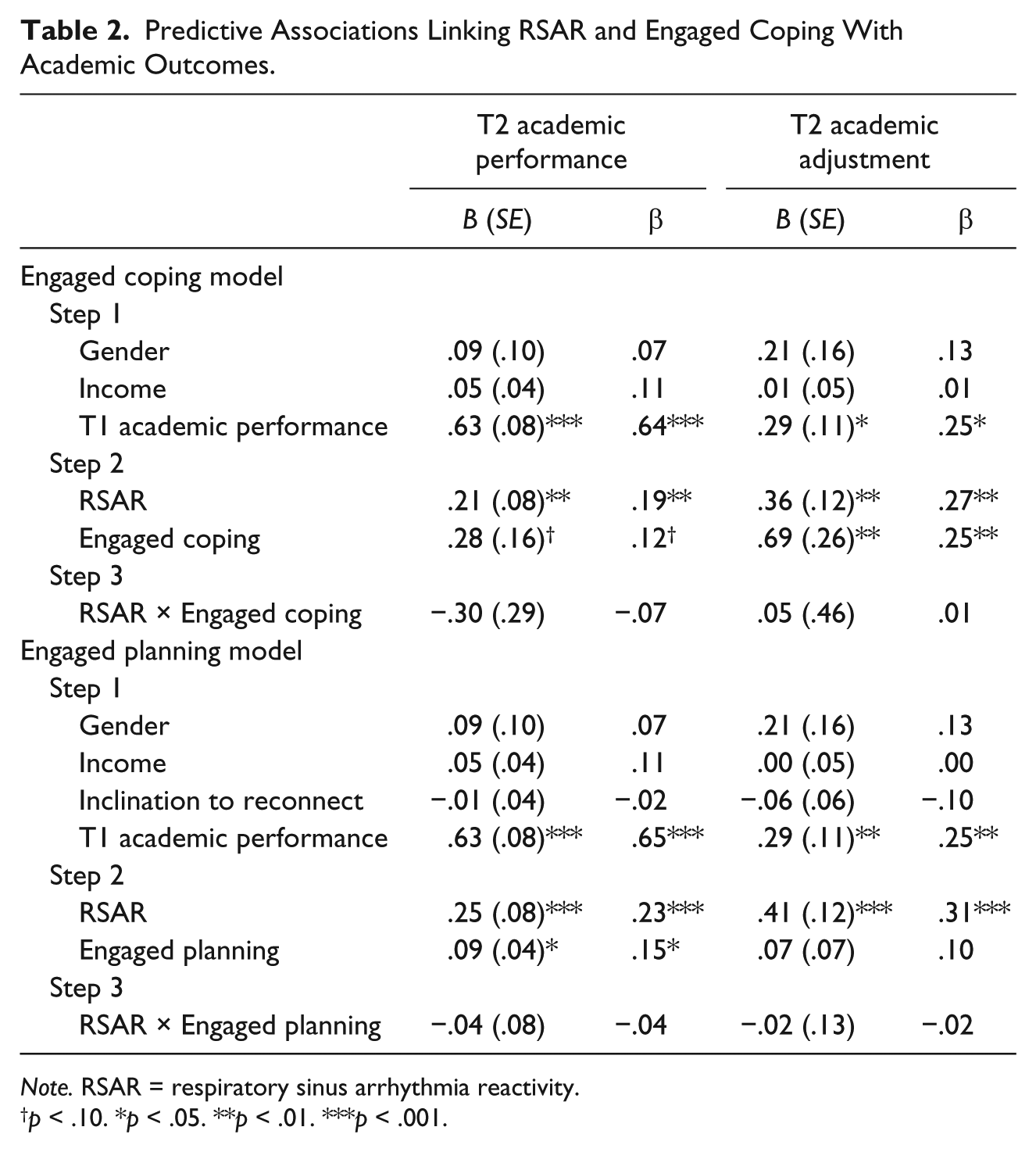
Note. RSAR = respiratory sinus arrhythmia reactivity.
p < .10. *p < .05. **p < .01. ***p < .001.
Two separate sets of regression analyses were conducted—one for academic performance and one for academic adjustment. The first regression analysis in each set (top half of Table 2) included RSAR and engaged coping. The second regression analysis in each set (bottom half of Table 2) included RSAR and replaced the engaged coping variable with engaged planning, to test corroborating evidence for the role of engaged coping. Analyses that included engaged planning as a predictor variable also included participants’ inclination to reconnect with the peer judges as a control variable; controlling for inclination to reconnect helped rule out the possibility that the effects of engaged planning are explained simply by inclination to reconnect (i.e., young adolescents who are more outgoing, or more socially confident, are more likely to plan to respond to the peer judges and perform better academically) rather than actual engagement with the challenging situation (i.e., young adolescents who develop more prosocial plans for reconnecting with the peer judges perform better academically). T1 academic performance was controlled in the regression analyses predicting T2 academic performance. Because our measure of academic adjustment reflects adjustment to a new school, T1 levels were not collected; thus, analyses predicting T2 academic adjustment do not account for prior levels of academic adjustment. In the absence of a measure of T1 academic adjustment, we used T1 academic performance as a proxy and controlled for T1 academic performance in regression analyses predicting T2 academic adjustment.
Follow-up analyses tested interactions between RSAR and coping responses as well as interactions between gender and both RSAR and coping responses. These interactions were tested by entering either (a) the RSAR × Engaged coping (or planning) product term or (b) the Gender × RSAR and Gender × Engaged coping (or planning) product terms on the final step of the regression analyses. Interactions between RSAR and engaged coping (or engaged planning) did not predict academic outcomes (either changes in academic performance or T2 academic adjustment) so these analyses are not presented below. When interactions with gender emerged, simple intercepts and slopes were estimated (Aiken & West, 1991; Holmbeck, 2002).
In addition, follow-up analyses examined the possibility that social anxiety or peer victimization mediated the effects of RSAR or engaged coping (or engaged planning) on academic outcomes. These analyses included the same predictor and control variables described above in addition to T1 social anxiety or T1 peer victimization; T2 social anxiety or T2 peer victimization served as the outcome variable in step one of the mediation tests. Neither RSAR nor engaged coping (nor engaged planning) predicted T2 social anxiety or T2 peer victimization; thus, mediation was not possible and these analyses are not presented.
Predicting academic performance
As shown in Table 2, T1 academic performance strongly predicted T2 academic performance. Gender and income were not associated with T2 academic performance above and beyond T1 academic performance. In the model with engaged coping (top half of Table 2), RSAR significantly predicted positive differences in academic performance between T1 and T2, and engaged coping responses predicted positive differences in academic performance between T1 and T2 at the non-significant trend level. Adolescents with higher RSAR (i.e., higher vagal withdrawal) or more engaged coping responses outperformed their peers with lower RSAR or less engaged coping responses. The addition of RSAR and engaged coping variables explained an additional 3% of the variance in academic performance above and beyond T1 academic performance and control variables (2% unique to RSAR and 1% unique to engaged coping), resulting in a total of 53% of the variance explained. Gender did not interact with RSAR, β = −.15, B = −.24, SE = .15, p = .12, or engaged coping, β = −.10, B = −.37, SE = .33, p = .26.
In the model with engaged planning (bottom half of Table 2), both RSAR and engaged planning significantly predicted positive differences in academic performance between T1 and T2. Again, higher vagal withdrawal and greater engaged planning were each associated with better academic performance. The addition of RSAR and engaged planning explained 4% of the variance in T2 academic performance above and beyond T1 academic performance and control variables (3% unique to RSAR and 2% unique to engaged planning), resulting in 54% of the variance explained. Gender did not interact with engaged planning, β = −.07, B = −.06, SE = .08, p = .44, but the interaction between RSAR and gender predicted T2 academic performance in this model, β = −.21, B = −.33, SE = .15, p < .05. Simple slopes analysis revealed a stronger association between RSAR and academic performance among boys, β = .40, B = .45, SE = .10, p < .001, compared with girls, β = .11, B = .12, SE = .11, p = .27.
Predicting academic adjustment
As shown in Table 2, T1 academic performance, but not gender or income, predicted academic adjustment following the transition to middle school. In the model with engaged coping, both RSAR and engaged coping significantly predicted better T2 academic adjustment, explaining 12% of the variance beyond control variables (6% unique to RSAR and 5% unique to engaged coping). This resulted in a total of 20% of the variance in academic adjustment explained. Adolescents with higher RSAR (i.e., higher vagal withdrawal) or more engaged coping responses were reported by their parents to exhibit better academic adjustment following the transition to middle school. Gender did not interact with RSAR, β = −.15, B = −.28, SE = .24, p = .24, or engaged coping, β = −.16, B = −.73, SE = .52, p = .16.
Finally, in the model with engaged planning, RSAR again predicted better academic adjustment at T2, but engaged planning did not predict academic adjustment. The addition of RSAR and engaged planning accounted for 10% of the variance in T2 academic adjustment beyond control variables (10% unique to RSAR), resulting in a total of 19% of the variance explained. Gender did not interact with RSAR, β = −.19, B = −.37, SE = .24, p = .12, or engaged planning, β = −.12, B = −.12, SE = .14, p = .37.
Discussion
The present study examined physiological and coping responses to salient social challenges as predictors of academic outcomes in early adolescence. More specifically, we investigated predictive associations between physiological and coping responses assessed prior to the transition to middle school (T1) and academic outcomes assessed after the transition to middle school (T2). RSAR and coping responses were assessed in the context of peer-evaluative challenges. Participants were asked to lead a conversation while under evaluation by fictitious peer judges and to consider a response to the peer judges after receiving feedback that they were not chosen as one of the best performers. Academic performance was assessed with multiple informants before and after the transition to middle school. RSAR significantly predicted improved academic performance from T1 to T2 and positive academic adjustment at T2. Engaged coping marginally predicted improved academic performance and significantly predicted positive academic adjustment; these results were partially corroborated by analyses with engaged planning, which significantly predicted better academic performance from T1 to T2. These associations were not mediated by changes in social anxiety or peer victimization across the transition to middle school and little evidence emerged for gender differences in predictive associations. An interaction effect suggested that RSAR may predict academic performance more strongly among boys compared with girls, but this result must be considered very tentative because it was not replicated in other analyses.
Engaged physiological responses (i.e., higher RSAR) and engaged coping responses (i.e., prosocial problem-solving and planning, positive cognitive appraisal) each independently predicted improved academic performance from T1 to T2 and positive academic adjustment at T2. In other words, less engaged physiological and coping responses predicted poorer academic performance and adjustment. These results are consistent with research that links RSAR with better cognitive and academic functioning (Graziano & Derefinko, 2013) as well as studies that connect active coping with academic performance (Clarke, 2006). However, the present study is the first to examine physiological or coping responses to peer stress as prospective predictors of academic performance across the transition to middle school and academic adjustment in middle school.
One potential explanation for predictive associations linking earlier engaged physiological and coping responses with later academic outcomes is that engaged responses may actually reduce subsequent peer stress experiences which, in turn, may promote academic performance and adjustment. However, in the present study, RSAR and engaged coping did not predict two developmentally salient indices of peer-evaluative stress (social anxiety and peer victimization) across the transition to middle school. Thus, whereas RSAR and engaged coping with peer stress may be important dimensions of social competence in early adolescence (Erath et al., 2007; Erath & Tu, 2013; Graziano & Derefinko, 2013; Reijntjes, Stegge, & Meerum Terwogt, 2006; Zimmer-Gembeck et al., 2011), these stress responses may not necessarily predict short-term (i.e., 10 month) changes in peer stress, as represented by social anxiety and peer victimization in the present study. Indeed, engaged responses may not reduce peer stress overall because engaged responses involve awareness and attention to peer challenges.
Instead, during a period when peer-evaluative challenges become increasingly salient, engaged responses may prevent spillover, or negative cascading (Masten & Cicchetti, 2010), of peer stress to other domains of development, such as academic functioning. That is, engaged responses may allow young adolescents to better compartmentalize peer challenges such that they do not undermine other important developmental tasks. Adolescents with higher RSAR or engaged coping responses may recognize and resolve peer-evaluative challenges and more easily focus on academic activities. In contrast, peer challenges may remain unresolved and interfere with academic focus among adolescents with less engaged responses to common peer-evaluative challenges. Lack of signal or support at the physiological level (e.g., lower RSAR) or lack of cognitive or behavioral attention (e.g., distraction, denial, avoidance) to peer-evaluative challenges may allow these challenges to disrupt academic functioning.
In the present study, RSAR and engaged coping were unrelated and each independently predicted academic outcomes. It is important to note that, like the present study, other studies find no evidence or limited evidence for associations between involuntary ANS responses and voluntary-coping responses among children and adolescents (Connor-Smith et al., 2000; Dufton, Dunn, Slosky, & Compas, 2011; see also Gunnar, 1987). Likewise, dual-process frameworks contend that automatic (e.g., physiological) and reflective (e.g., logical) emotion response systems are relatively independent and elicit behaviors via different mechanisms (e.g., motivational orientations vs. knowledge about values and consequences; Evers et al., 2014; Strack & Deutsch, 2004). Another possibility is that adaptive physiological responses (e.g., RSAR) that increase arousal in response to stress do indeed support more engaged voluntary-coping responses (Porges, 2007); at the same time, however, adaptive physiological responses may reflect a more familiar or automated process that reduces the need or opportunity for deliberate, voluntary coping. Both processes may be operative, in which case physiological and coping responses may be modestly associated at most, yet both may contribute to adaptive stress management that facilitates positive outcomes, such as academic performance. Future research that examines the conditions under which physiological and coping responses are associated and contribute to adjustment independently or interactively will be very informative.
It is important to consider several limitations of the present study and additional directions for future research. Although the peer challenges in the present study are developmentally relevant and allowed assessment of real-time physiological and coping responses to social interaction in the context of peer evaluation, lab-based responses to peer challenges may not reflect responses in more naturalistic circumstances such as during peer-evaluative challenges at school. School-based physiological and coping responses would be very difficult to measure in real-time, but future research under more naturalistic conditions could reinforce the current results and perhaps reveal stronger connections with academic outcomes. It would also be informative to assess responses to a greater number of peer stress situations, which would yield a greater number of coping responses and allow more fine-grained analysis of coping responses, such as distinctions between behavioral problem-solving and cognitive appraisal (Zimmer-Gembeck & Skinner, 2011). Measures of engagement with peer stress included self-reports of coping immediately following a peer challenge (engaged coping) as well as coping as potentially reflected in a plan for dealing with the peer challenge (engaged planning). Coping strategies are commonly measured with self-reports, and measuring coping as reflected in a planned response may provide further evidence that engaged coping actually occurred. These measures of engagement were correlated, but only moderately, and predicted academic outcomes similarly, but not identically. Future research that compares and contrasts multiple methods of coping assessment will continue to improve the reliability and validity of coping measures. Future research that further investigates the academic implications of responses to other types of stressors (e.g., cognitive-academic, family) would also be informative.
In addition, results of the present study suggest that responses to peer stress may control the spillover of peer stress to other domains of development (i.e., academic functioning), and future research could extend this research to other developmental domains such as physical health. Indeed, the voluminous body of research showing that engaged coping with various stressors predicts various indices of adjustment (Compas et al., 2001; Skinner & Zimmer-Gembeck, 2007) may be explained, in part, by the potential compartmentalization (i.e., spillover prevention) function of engaged physiological and coping responses. Importantly, although we used multiple reporters to assess adolescents’ academic outcomes across the transition to middle school, we did not include a direct measure of achievement such as GPA nor did we use objective assessments of cognitive achievement. The inclusion of such measures in future studies may provide insight into the role that physiological and coping responses may play in fostering academic success. In addition, in contrast to academic performance, academic adjustment was assessed at T2 only; thus, results of the present study do not provide information about whether physiological and coping responses predict change in academic adjustment (though T1 academic performance was included as a control variable in analyses predicting T2 academic adjustment). Future studies that include multiple assessments of adjustment following the transition to middle school may provide important information about change in academic adjustment in the context of peer stress. RSAR was assessed at T1 only; multiple assessments of RSAR in future research would allow investigations of change in RSAR across novel or stressful transitions. Finally, the present study considered social anxiety and peer victimization as potential mediators, but the effects of engaged physiological and coping responses may be mediated by other indices of peer-evaluative stress or other social or psychological factors. Understanding mediators would further inform interventions.
Despite several limitations, this study provides new evidence about physiological and coping responses that predict academic performance and adjustment across the transition to middle school. Results suggest that promoting young adolescents’ positive engagement with peer challenges should support academic success. It will be important for future research to examine how changes in coping responses may influence physiological responses, which may further inform interventions designed to facilitate adaptive responses to peer stress (e.g., Lochman, Wells, & Murray, 2007).
Footnotes
Acknowledgements
We thank the families and teachers who participated in this study.
Declaration of Conflicting Interests
The author(s) declared no potential conflicts of interest with respect to the research, authorship, and/or publication of this article.
Funding
The author(s) disclosed receipt of the following financial support for the research, authorship, and/or publication of this article: This research was supported by a grant from the National Science Foundation (BCS 0921271).