







Abstract
The present three-wave panel study (N = 968,
Keywords
In Western society, the prevalence of body dissatisfaction is reaching concerning levels already by pre- and early adolescence. Approximately, one in two early adolescents (age range = 9–14 years) feels dissatisfied with her or his body and desires a thinner or more muscular body shape (Dion et al., 2016; Jongenelis, Byrne, & Pettigrew, 2014). These body image concerns coincide with sexualized media imagery, emphasizing that a person’s value is derived from his or her appearance and sex appeal and that (sexual) attractiveness should be evaluated against narrow standards, such as slenderness for girls and muscularity for boys (Simpson, Kwitowski, Boutte, Gow, & Mazzeo, 2016). In line with this, scholars emphasize the role of idealized media images (i.e., slender-ideal for girls and muscular-ideal for boys) in adolescents’ body image and point to media internalization as the crucial mediator of the relationship between idealized media exposure and body dissatisfaction (e.g., Anschutz, Engels, Van Leeuwe, & van Strien, 2009). Media internalization pertains to the adoption of media-defined appearance ideals as a personal standard of attractiveness (Thompson & Stice, 2001) and is reflected by individuals’ tendency toward actual-ideal body image comparisons. Due to the unrealistic nature of media ideals, comparisons between the internalized ideal and one’s actual appearance usually result in body dissatisfaction (e.g., Rousseau & Eggermont, 2018).
Given the central role of media internalization in early adolescents’ negative body image, it is important to investigate the conditions under which sexualizing media exposure leads to more or less media internalization. Prior research has shown that associations between media exposure and media internalization vary across early adolescents (Grabe, Ward, & Hyde, 2008) and that this variation may be explained by appearance-related dispositions (e.g., appearance schematicity; Rousseau, Gamble, & Eggermont, 2017). The current study contributes to the existing literature by considering appearance-related developmental factors that can reinforce or mitigate the relationship between sexualizing magazine exposure and media internalization. Drawing on the idea that motivationally relevant information is more deeply processed (limited capacity model of motivated mediated message processing [LC4MP]; Lang, 2000, 2006), we hypothesize that early developing adolescents are more likely to pay attention to and store appearance-related media content, resulting in greater media internalization. In addition, expanding on Katz and Lazarsfeld’s (1955) filter hypothesis (i.e., personal communication mediates the impact of mass communication), we hypothesize that cross-sex peer interactions may invalidate idealized appearance norms in media and therefore buffer the adverse impact of early pubertal timing on media internalization.
Using a three-wave longitudinal survey design of 968 early adolescent boys and girls (age range = 9–13 years), the purpose of the present study is therefore to (a) examine the moderating influence of pubertal timing on the relationship between sexualizing magazine consumption and media internalization, and (b) test the buffering role of heterosocial involvement in this relationship (see Figure 1)
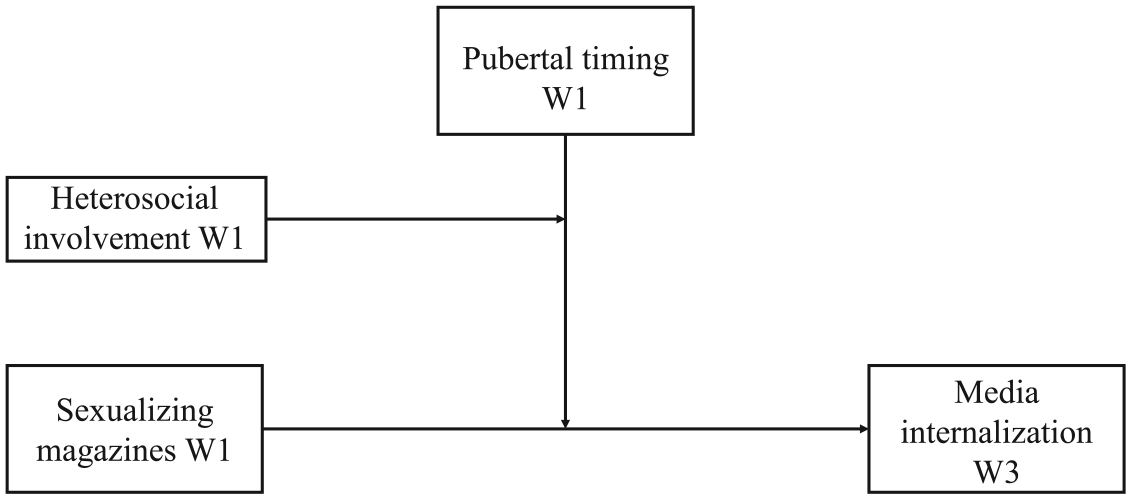
Hypothesized model testing whether the relationship between sexualizing magazine reading and media internalization depends on pubertal timing, and whether the two-way interaction between sexualizing magazine reading and pubertal timing depends on heterosocial involvement.
Sexualizing Media and Early Adolescents’ Media Internalization
Mass media, including prime-time television shows, magazines, and music videos, are replete with messages about how men and women should ideally look like (see Vandenbosch, 2017, for a review). Generally, sexualizing media promote a muscular and mesomorphic ideal for men and a curvaceous yet athletically thin body for women (Dallesasse & Kluck, 2013; Flynn, Park, Morin, & Stana, 2015). Moreover, sexualizing media portray these appearance ideals as providing an important advantage for attracting the opposite sex, emphasizing the importance of attractiveness in socioromantic interactions (e.g., Simpson et al., 2016). For instance, in their content analysis of popular prime-time shows, Greenberg, Eastin, Hofschire, Lachlan, and Brownell (2003) demonstrated that overweight characters are less likely to be covered in affection-focused behavior: they have fewer interactions with romantic partners and are involved in fewer sexual behavior. Similarly, in music entertainment television, sexual attraction is often emphasized in combination with appearance ideals (Vandenbosch, Vervloessem, & Eggermont, 2013). Print media have also been criticized for their sexualizing content. Especially, fashion and teen magazines appear to prioritize appearance over personality and consider bodily attractiveness as an important advantage in successful dating and social life. For instance, advertisements in fashion and fitness magazines oftentimes include images of idealized models (e.g., young, thin Caucasian women) that emphasize appearance over performance (e.g., Wasylkiw, Emms, Meuse, & Poirier, 2009). Teen-geared magazines also tend to emphasize the importance of attractiveness. A content analysis of teen magazines (e.g., Daniels, Layh, & Porzelius, 2016) revealed that most stories about the body and appearance center on topics related to body image improvement (e.g., teaching readers how to emulate idealized and sexualized looks). Similar results emerged for sports magazines; Depictions of male athletes emphasize muscularity, whereas depictions of female athletes emphasize slimness (Neumann, 2016). In addition, female athletes are mostly shown in passive, sexually objectifying poses (e.g., a female soccer player topless holding a ball in front of her breasts) while male athletes are predominantly depicted in active poses associated with their sport (e.g., a soccer player tackling the ball), supporting hegemonic masculinity (Frisby, 2017).
Researchers testing principles of sociocultural theory have pointed to media internalization (e.g., Anschutz et al., 2009; Rousseau, Aubrey, & Eggermont, 2020) as the mediating link between sexualizing media exposure and body image disturbance. The present study specifically focuses on the link between sexualizing magazine consumption and media internalization because of the following reasons. First, research has shown that the processes through which sexualizing media contribute to body dissatisfaction differ across different media. For instance, Tiggemann (2003) demonstrated that while media internalization mediated the link between sexualizing magazine consumption and body dissatisfaction, it did not link sexualizing television exposure to higher levels of media internalization. Second, reading magazines, or reading in general, is a more conscious activity that demands a higher level of attention than consuming broadcast or online media. Related to this, audiences are more likely to multitask with radio, television, and Internet than magazines (Jeong & Fishbein, 2007; Pilotta & Schultz, 2005). Given that (a) media message attendance is necessary for media internalization to take place, and (b) multitasking interferes with information acquisition (Lee, Lin, & Robertson, 2012), we believe that media internalization is more likely to take place after magazine exposure compared with broadcast exposure. Third, reading magazines is usually a solitary activity and thus inhibits external influences (Hempel-Jorgensen, Cremin, Harris, & Chamberlain, 2017). On the contrary, early adolescents’ television viewing is mainly done with others, for example, in a family setting (Padilla-Walker, Coyne, & Fraser, 2012), which might lead to more external influences. External influences might generate extraneous cognitive load that burdens the working memory (Lee et al., 2012), reducing the likelihood that a long-term mental representation of the idealized media content is created and stored in memory (thus inhibiting media internalization).
As explained in the introduction, media internalization entails the adoption of media appearance ideals as a personal norm and is reflected by individuals’ tendency toward actual-ideal appearance comparisons (Thompson & Stice, 2001). Drawing on this definition, it is important to consider developmental factors that encourage early adolescents to attend to appearance-related cues in magazines and engage in comparison with idealized media models. Developmental changes associated with early adolescence create individual differences between early adolescents on biological and social levels, which might influence the way magazine content is used and processed. The present study aims to identify developmental factors that mitigate/reinforce the association between sexualizing magazine consumption and media internalization. During early adolescence, two developmental triggers may be especially related to media internalization: The adolescent’s level of puberty in relation to his or her peers (i.e., pubertal timing) and the adolescent’s gradual increase in cross-sex interactions (i.e., heterosocial involvement).
The Moderating Influence of Pubertal Timing
According to the LC4MP (Lang, 2000, 2006), individuals are more likely to attend to, encode, and store media messages if these messages contain information that is motivationally relevant to them. For example, if information is instrumental in achieving a personal goal, individuals allocate more cognitive resources to encode, store, and retrieve the observed information. Deeply processed information, in turn, leads to better memory performance as this information is more strongly connected to existing knowledge structures in long-term memory (cf. depth of processing theory; Craik & Lockhart, 1972). Hence, motivationally relevant media information is more likely to be internalized and used to inform goal-directed actions. Based on these premises, it is important to gain insight into the conditions under which sexualized media ideals become more relevant for early adolescents. Early pubertal timing might be one factor that increases the perceived personal relevance of idealized media messages.
During early adolescence, the first visible signs of puberty appear. As a consequence, the early adolescent phase is characterized by great variation in pubertal timing or the level at which one physically matures relative to same-sex same-aged peers (Cumming et al., 2011). Among girls, early pubertal timing is associated with increased body dissatisfaction, as pubertal body changes distance girls from the slender ideal. Although boys’ physical maturation is thought to move them toward a preferred athletic body type (e.g., increased muscularity and body height), these puberty markers remain largely hidden during the early adolescent years. The athletic advantages that come with advanced physical growth are most prominent during the mid- and late adolescent years. During early adolescence, boys primarily undergo changes that carry negative social consequences (e.g., acne and a voice that awkwardly cracks). In line with this, recent research has indicated that early pubertal timing relative to peers causes feelings of body image insecurity and anxiety among both early adolescent girls and boys (Zimmer-Gembeck, Webb, Farrell, & Waters, 2018). Moreover, early maturation also fosters alienation from the peer group (as early developers feel different from, and more mature than, on time peers), which causes early developing adolescents to seek out and socialize with older peers who resemble them physically (Laursen & Hartl, 2013; Skoog & Stattin, 2014).
Experiencing all these feelings of discomfort concerning their outward appearance, early developers may be especially motivated to look for ways to improve their physical appearance (Cash, Santos, & Williams, 2005; Choma, Shove, Busseri, Sadava, & Hosker, 2009). In order to improve aspects of their body that they evaluate as deviating from “the norm,” they may engage in upward comparisons (Festinger, 1954) with idealized others (e.g., idealized media models). Early developing boys and girls also report more negative appearance pressure from peers (e.g., peer rejection and peer teasing) compared with on time and late maturers (Lawler & Nixon, 2011; Lindberg, Grabe, & Hyde, 2007). This appearance-related criticism from peers may discourage early developing adolescents from consulting their peers and instead encourage them to turn to media for appearance-related information. Therefore, we suggest that early maturing boys and girls may use idealized media models to compare with and aspire to, rather than on time peers (see Myers & Crowther, 2009, for a review). We hypothesize that, compared with late and on time maturers, early maturing boys and girls are more likely to make upward comparisons with idealized media models and internalize media ideals as a personal norm and standard (Choma et al., 2009; Festinger, 1954).
Taken together, early adolescents who reach puberty before their peers may actively seek out media for relevant appearance-related information and designate more resources than their peers to the processing of this information. In turn, expanding on the LC4MP framework (Lang, 2000, 2006), higher levels of attention and encoding increase the chance that a long-term mental representation of the media information is created, and that this stored information is transformed into personal norms that guide behavior (i.e., media message internalization).
The Protective Role of Heterosocial Involvement in Media Internalization
A second factor that may be associated with media internalization is heterosocial involvement, which refers to early adolescents’ engagement in cross-sex peer interactions. Entering early adolescence, children form new social relationships and gradually shift from same-sex peer groups to mixed-sex peer groups (Arndorfer & Stormshak, 2008).
Expanding on the filter-hypothesis (Katz & Lazarsfeld, 1955), which states that individuals interpersonally discuss media content to negotiate its validity and relevance (Metzger, Flanagin, & Medders, 2010; Schmitt-Beck, 2003), we suggest that cross-sex peer interactions may influence the way media appearance ideals are processed and adopted as a personal goal and standard. In particular, we suggest that cross-sex peers can communicate body acceptance and criticize idealized media norms and, in doing so, reduce early adolescents’ tendency toward media internalization. The potential protective role of cross-sex peer interaction in early developing adolescents’ media internalization can be explained in two ways.
First, cross-sex interactions go hand in hand with an increased interest in dating and romantic relationships, encouraging early adolescents to enhance their physical attractiveness and, in doing so, their dating potential (Arndorfer & Stormshak, 2008). Most early adolescents, however, have little to no experience with dating and romantic relationships and thus lack knowledge of what is perceived as attractive by their cross-sex peers. As media show abundant examples of successful dating and link sexual attraction with gender-specific appearance ideals (Gondoli, Corning, Salafia, Bucchianeri, & Fitzsimmons, 2011), early adolescents may turn to media as a source of information. This media content generally produces gender codes in which appearance norms for men and women are embedded (Bordo, 2003; Pope, Phillips, & Olivardia, 2000). The underlying message is that approximating appearance standards as embodied by media models results in positive outcomes, such as romantic attention (Graves & Kwan, 2012). Nevertheless, despite the informational value of media, appearance-related information provided by cross-sex peers may be motivationally relevant as well. Interesting in this context is the suggestion that cross-sex peers may challenge the media’s message that romantic desirability is contingent on one’s conformity to sexualized appearance ideals (e.g., Rousseau & Eggermont, 2017). For example, cross-sex peers may emphasize that humor or other non-appearance-related characteristics render a person romantically desirable as well. This “media-peer-discordance” may decrease early adolescents’ willingness to comply with media-promoted standards of attractiveness. Put differently, if media and peer messages are discordant, early adolescents’ may be discouraged from accepting the sexualizing media message and, in turn, may not use this media information to guide self-perceptions (thus inhibiting the internalization of media ideals).
Second, although heterosocial involvement is usually linked to romantic experiences (e.g., Arndorfer & Stormshak, 2008), research has shown that early adolescents engage predominantly in platonic kinds of activities with cross-sex peers (e.g., Compian, Gowen, & Hayward, 2004). In their study, Compian and colleagues found that most (43%) early adolescent girls have platonic relationships with boys without any romantic considerations, with only a small minority (3%) of girls being romantically involved with boys. This platonic opposite-sex involvement can sometimes serve as a protective force against negative emotional outcomes. For instance, compared with romantic cross-sex experiences, a platonic relationship between peers of the opposite sex is not related to body dissatisfaction and depressive symptoms (Compian et al., 2004). Moreover, it has been suggested that platonic cross-sex involvement may foster positive adjustment as it can elicit perceptions of being accepted by and integrated within the peer group (McDougall, Hymel, & Zarbatany, 2000). In the context of positive body image, Compian et al. (2004) found a significant interaction between platonic involvement and pubertal status: Girls who were less sexually mature but who also reported more platonic involvement with boys reported greater body image satisfaction. The protective role of platonic cross-sex interactions in body image outcomes might stem from the fact that platonic relationships reduce the perceived pressure to conform to specific sexualized heterosexual scripts (Larson, Clore, & Wood, 1999).
The Current Study
Relying on a heterosexual perspective, the current study uses a three-wave longitudinal survey design to examine how appearance-related developmental factors influence early adolescents’ level of media internalization. Drawing on the idea that motivationally relevant information is more deeply processed (LC4MP; Lang, 2000, 2006), we reason that early developing adolescents are more likely to actively seek out, encode and store appearance-related information, which increases the likelihood of transforming the stored information into personal norms and standards. Based on these premises, we expect a stronger relationship between sexualizing magazine exposure and media internalization among early maturers compared with on time and late maturing adolescents. Therefore, we posit that
In addition, expanding on the filter hypothesis (Katz & Lazarsfeld, 1955), we suggest that cross-sex peer interactions may stimulate the belief that one does not need to strive for a media-promoted ideal appearance in order to be (romantically) liked or accepted by the opposite sex. Based on the assumption that perceived incongruence between media content and peer norms encourages individuals to discount the messages in the media, we hypothesize that
Method
Sample and Procedure
The present study draws on a three-wave panel survey, with an interval of 6 months, which was conducted among early adolescents between October 2014 and October 2015. Approval for the survey was granted by the institutional review board of the host university.
In all, 1,971 early adolescents completed the survey at baseline (52.6% boys). The mean age of this sample was 11.30 years (SD = 1.06), 31.6% were fifth graders, 35.5% sixth graders, and 33% seventh graders. A majority of the sample was born in Belgium (93%); only a small minority (1.9%) was born in a non-European country. In the second wave, 1,602 pupils who had participated in the first wave participated again (response rate of 81%); 968 respondents were tracked over three waves (49% of total). A MANCOVA (controlling for age, body mass index [BMI], and gender) using Pillai’s Trace, V = .03, F(6, 591) = 2.44, p = .018,
Participants were selected by a two-step sampling method. In the first step, drawing on a list of the Belgium Department of Education, elementary and secondary schools from different educational and geographical backgrounds were randomly selected and requested to participate in the study. By the end of this stage, 24 elementary schools and 13 secondary schools agreed to participate. Schools that participated in the study were similar demographically and in terms of education type to those that did not participate. Next, principals, teachers, parents, and pupils were informed about the study and active informed consent was obtained from the legal guardians of all enrolled pupils. During the second stage, research assistants visited the selected schools and administered the survey by asking all enrolled students to complete a self-administered paper-and-pencil questionnaire. All students completed the survey at school, during school hours, in a data collection room that provided individual desk carrels with dividers between them to ensure confidentiality. In order to reduce social desirability, participants were informed that all answers would be treated confidentially. To further emphasize confidentiality, each student was given an envelope to put the questionnaire in after completion.
Measures
Media variables
Predictor variable
For our measure of sexualizing magazine consumption, we selected magazine genres that are known for their focus on appearance (e.g., Trekels & Eggermont, 2017). Using a 5-point scale ranging from 1 (never) to 5 (almost every day), respondents indicated how often they read four different types of magazines (i.e., magazines for women, magazines for youth, sports magazines, and celebrity magazines). Item scores were averaged to create an estimate of participants’ level of magazine reading.
Control variables
The MTV music television channel was selected to measure sexualizing music television exposure as this channel not only shows sexually objectifying music videos (Aubrey & Frisby, 2011) but also broadcasts reality dating TV shows (e.g., Geordie Shore, Ex on the Beach) that contain sexualized and narrowly defined gender portrayals (e.g., Bond & Drogos, 2014; Vandenbosch et al., 2013). Using a 7-point scale ranging from 1 (never) to 7 (almost every day), participants indicated how often they watched the MTV music television channel. Prime-time television viewing time was measured using timelines, a procedure that has been used successfully in prior research (e.g., Eggermont, 2006). Six timelines ranging from 7:00 a.m. to 2:00 a.m. the next day were presented. Each hour was divided into two checkboxes, each representing 30 minutes. Respondents indicated when they watch television on a typical weekday and a typical Saturday or Sunday by marking all corresponding checkboxes. Next, we added up all the marked checkboxes between 8:00 and 11:00 p.m. and divided the total score by 2 to convert the estimates into hours. To calculate the respondent’s mean weekly prime-time television viewing, we multiplied the weekend day viewing hours by 2 and added the result to the number of hours reported for the 5 weekdays.
Pubertal timing
Pubertal timing was measured by an adapted version of the Pubertal Development Scale (PDS; Petersen, Crockett, Richards, & Boxer, 1988). Boys and girls were asked to report their perceived development on four indices of pubertal growth: growth spurt, body hair, skin changes (pimples), voice-related changes (boys only), and breast development (girls only). We excluded the fifth item concerning menarche as some of the teachers and school heads indicated that this question was inappropriate. For boys, we excluded the item measuring facial hair growth, as—in our questionnaire—the item measuring body hair growth also referred to the presence of facial hair. Answers were scored on a 4-point Likert-type scale ranging from 1 (not yet started) to 4 (seems complete), except for the item assessing skin changes, which was dichotomized into no skin changes, coded 1, versus skin changes, coded 4. Within each age cohort (i.e., participants of the same age), mean scores were then computed for boys and girls separately, resulting in a scale with an acceptable internal consistency (Cronbach’s alpha ranging from .69 to .79). Next, the total PDS scores were standardized within each age and gender cohort to create a measure of pubertal timing (e.g., Skoog, Sorbring, & Bohlin, 2015), with higher scores indicating earlier maturation relative to age-mates of the same gender.
Media internalization
To measure respondents’ appearance-related comparison with media models and endorsement of media-promoted appearance ideals as a personal goal and standard, we used the Internalization-General subscale of the Sociocultural Attitudes Toward Appearance Scale–3 (Thompson, Van Den Berg, Roehrig, Guarda, & Heinberg, 2004). To avoid response fatigue, we shortened the original nine-item scale to five items, and selected only positively worded items with a factor loading greater than |.40|. In doing so, we followed Sánchez-Carracedo et al.’s (2012) recommendation of not including reverse-coded items as the use of scales with a mixed format adversely affects early adolescents’ responses to negatively worded items (Marsh, 1986). The remaining five items were scored on a 5-point Likert-type scale ranging from 1 (I totally disagree) to 5 (I totally agree). A sample item reads, “I compare my body to the bodies of TV and movie stars.” An exploratory factor analysis (EFA) using direct oblimin extracted one factor with an eigenvalue of 3.45 and explained 69.04% of the variance. By averaging the item scores, an estimate of early adolescents’ media internalization was created, with higher scores indicating greater media internalization. Internal consistency was acceptable in each wave (αw1 = .89; αw2 = .90; αw3 = .92).
Heterosocial involvement
To measure respondents’ involvement in mixed-gender peer activities, we used the Heterosocial Involvement Scale (HSIS; Gondoli et al., 2011). The HSIS is intended to assess cross-sex peer group activities typical of early adolescents rather than the dating activities common among older adolescents. Using a 7-point Likert-type scale, ranging from 1 (never) to 7 (once a day), respondents reported how often they engaged in a range of cross-sex activities. A sample item reads, “About how often do you spend free time after school with a group of boys and girls?” By averaging the item scores, an estimate of early adolescents’ heterosocial involvement was created, with higher scores indicating greater heterosocial involvement. The scale showed good internal consistency (αw1 = .85).
Demographics
Age, gender, and BMI were included as control variables. Self-reported measures of height and weight were used to estimate BMI, which was calculated as weight (kilograms) per square height (meter). BMI scores were standardized within each age cohort to create age-specific BMI z scores.
Results
Descriptive statistics for, and zero-order correlations between, all main variables included in the model are presented in Table 1. Respondents were below the scale midpoint for sexualizing magazine consumption (Wave 1). They reported rather low levels of media internalization with means below the scale midpoint at each wave. And, finally, respondents reported a mean on pubertal development that was at the scale midpoint and a mean on heterosocial involvement below the midpoint. We found low to moderate correlations between media internalization, sexualizing magazine exposure, pubertal timing, and heterosocial involvement (all p < .001).
Descriptive Statistics and Zero-Order Correlations.
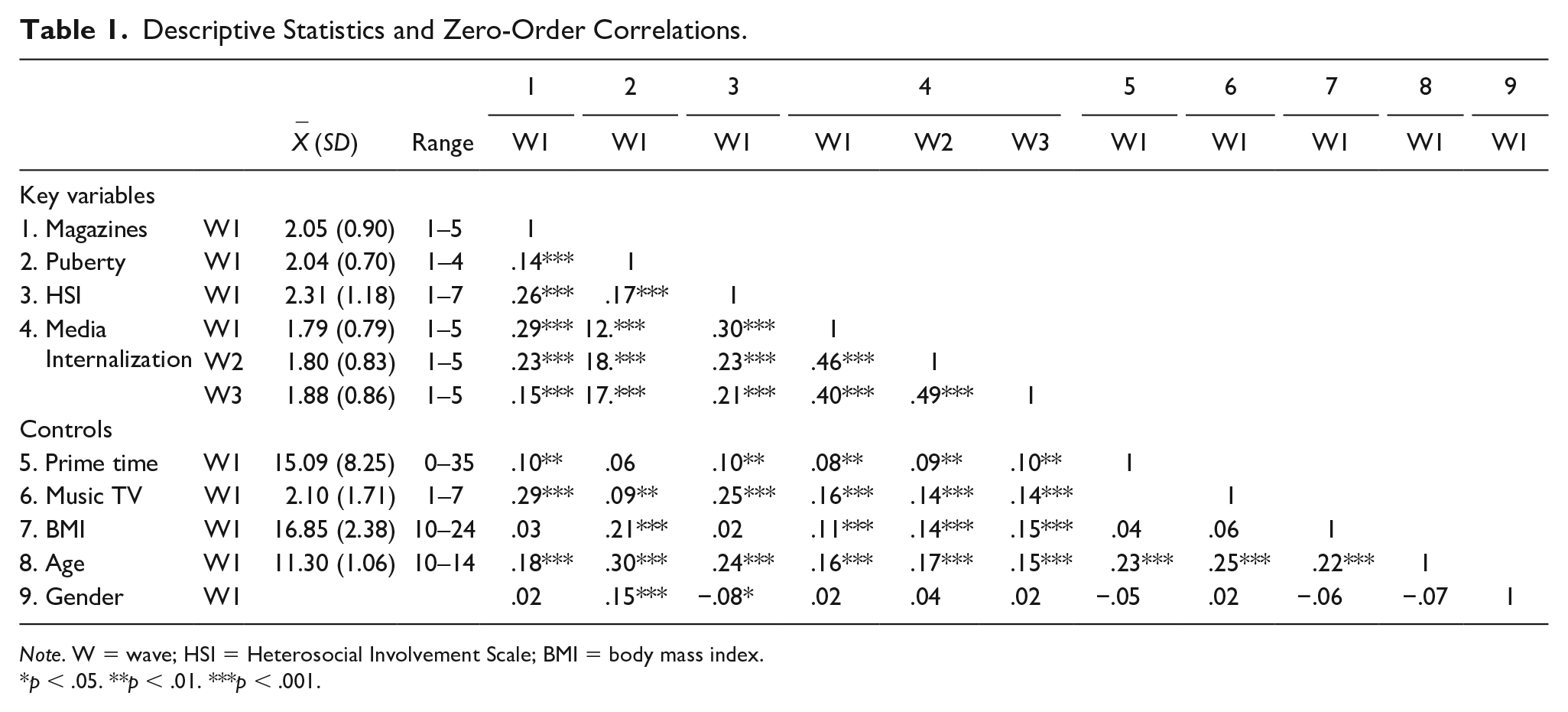
Note. W = wave; HSI = Heterosocial Involvement Scale; BMI = body mass index.
p < .05. **p < .01. ***p < .001.
Testing the Moderated Moderation Hypotheses
To test H1 and H2, the moderating role of pubertal timing (H1) and the heterosocial involvement (H2) on the relationship between magazine reading and media internalization, we used Hayes’ (2013) PROCESS macro for SPSS, Model 3. This so-called moderated moderation model tests whether the relationship between sexualizing magazine reading (Wave 1) and media internalization (Wave 3) depends on pubertal timing (Wave 1), and whether the two-way interaction between sexualizing magazine reading and pubertal timing varies depending on heterosocial involvement (Wave 1; see Figure 1). The controls used in the model were Wave 1 values for age, BMI, gender, and prior values for media internalization (Wave 1 and Wave 2). To assess the unique contribution of magazines as a sexualizing medium, we also included prime-time television and music television (both Wave 1) as control variables in the analysis. All estimated effects reported are unstandardized regression coefficients (as recommended by Hayes [2013]).
In line with H1, the two-way interaction between magazine reading (Wave 1) and pubertal timing (Wave 1) was significant, b = .26, SE = .09, p = .006, 95% confidence interval (CI) = [.075, .439] (see Table 2).
Ordinary Least Squares Regression Analysis Predicting Media Internalization (w3).
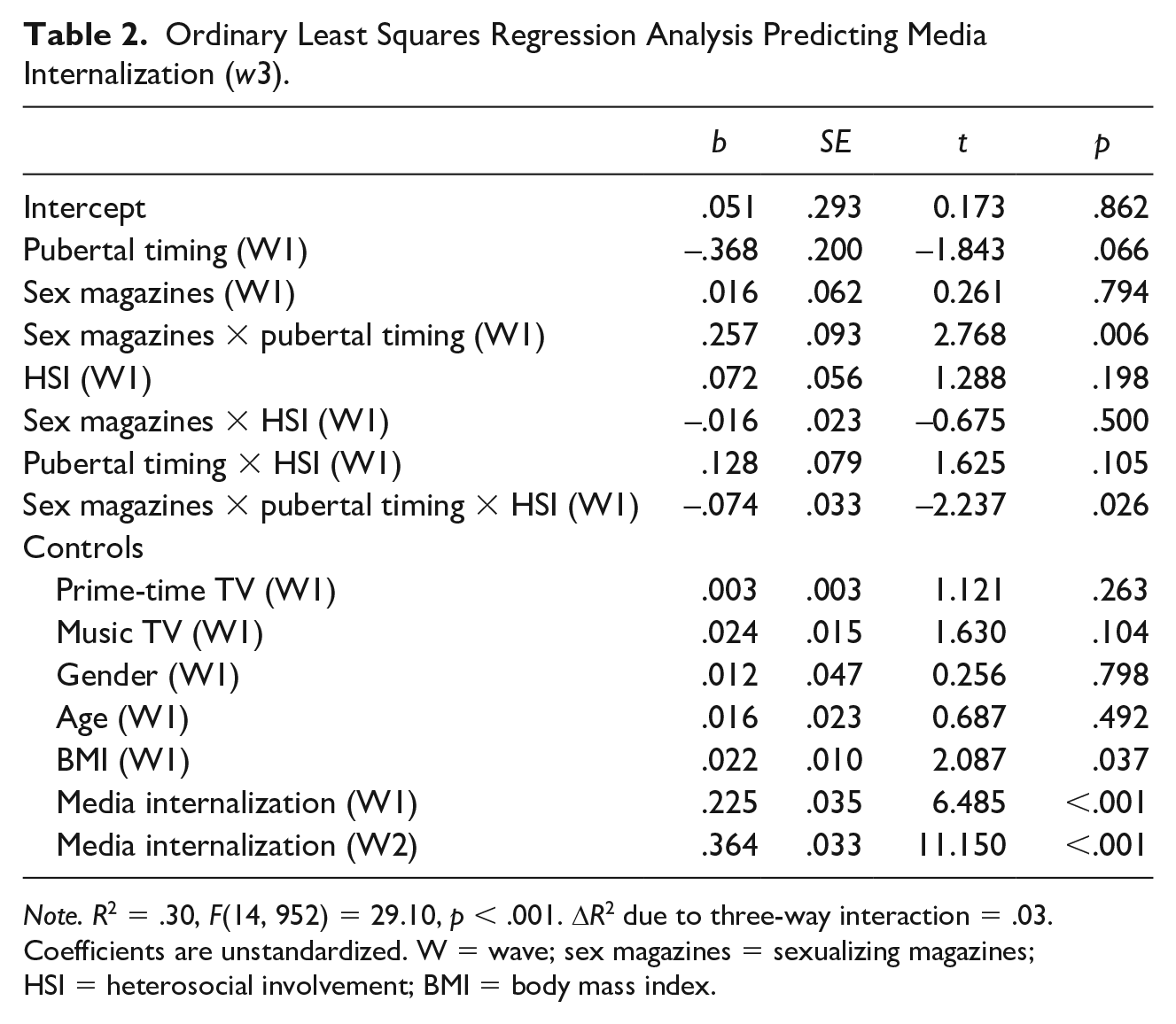
Note. R2 = .30, F(14, 952) = 29.10, p < .001. ΔR2 due to three-way interaction = .03. Coefficients are unstandardized. W = wave; sex magazines = sexualizing magazines; HSI = heterosocial involvement; BMI = body mass index.
Thus, the influence of magazine reading (Wave 1) on early adolescents’ media internalization (Wave 3) varied depending on their level of pubertal timing (Wave 1). Simple slopes analyses
1
revealed that magazine reading (Wave 1) positively predicted media internalization (Wave 3) when pubertal timing (Wave 1) was high,
Next, to test H2, we probed the conditional two-way interaction between magazine reading (Wave 1) and pubertal timing (Wave 1) as a function of heterosocial involvement (Wave 1). The results revealed a significant three-way interaction between magazine reading, pubertal timing, and heterosocial involvement (see Figure 2), indicating that the moderation by pubertal timing was dependent on heterosocial involvement (Wave 1), b = –.07, SE = .03, p = .026, 95% CI = [–.140, –.009]. Results of the Johnson–Neyman technique indicated that the two-way interaction between magazine reading and pubertal timing was positively associated with media internalization (b = .08, SE = .04, p = .028, 95% CI = [.010, .177]) for heterosocial involvement scores lower than 2.358 (62.87% of the sample). These results indicate that the moderating influence of pubertal timing on the relationship between magazine reading and media internalization is buffered when heterosocial involvement is moderate or high.
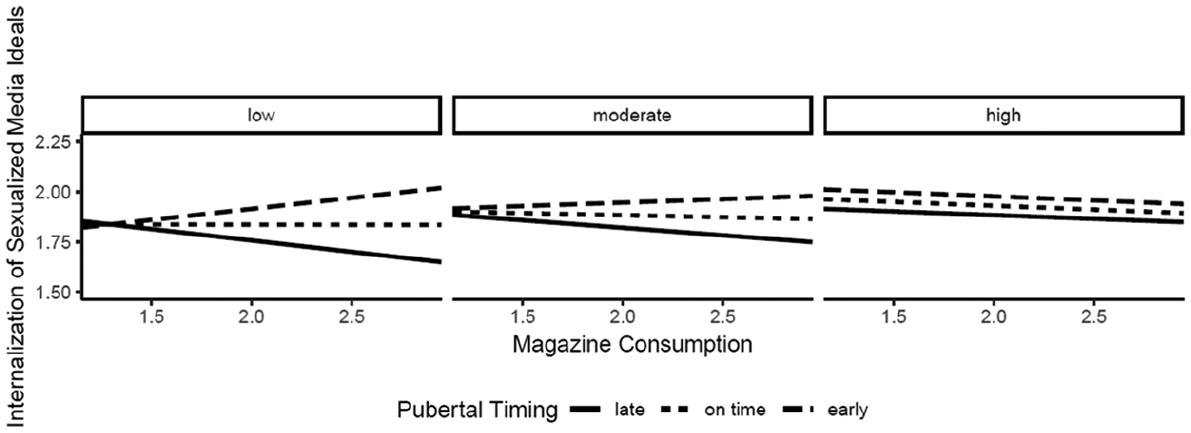
The interaction between sexualizing magazine reading and pubertal timing on media internalization by level of heterosocial involvement.
Additional analysis
In addition, we examined whether the patterns observed for sexualizing magazine consumption do also apply to other types of sexualizing media as well, such as music television and prime-time television. We conducted two additional moderated moderation analyses: one with music television as the independent variable and one with prime-time television as the independent variable. We used Hayes’ (2013) PROCESS macro for SPSS, Model 3. The controls used in the model were Wave 1 values for age, BMI, gender, and prior values for media internalization (Wave 1 and Wave 2). To assess the unique contribution of prime-time television/music television as a sexualizing medium, we included magazines and music television (if prime-time television was the predictor variable) or prime-time television (if music television was the predictor variable; both Wave 1) as control variables in the analysis. Regarding the moderating role of pubertal timing in the association between music television and media internalization, we found that the two-way interaction between music television (Wave 1) and pubertal timing (Wave 1) was not significant, b = –.001, SE = .03, p = .998, 95% CI = [–.048, .048]. The influence of music television exposure (Wave 1) on early adolescents’ media internalization (Wave 3) did not vary by pubertal timing (Wave 1). There was also no direct relationship between music television exposure (Wave 1) and media internalization (Wave 3), b = .026, SE = .02, p = .090, 95% CI = [–.004, .057]. Similarly, we could not find a significant three-way interaction between music television exposure, pubertal timing, and heterosocial involvement, b = –.001, SE = .02, p = .984, 95% CI = [–.033, –.033]. In the same way, the two-way interaction between music television (Wave 1) and pubertal timing (Wave 1) was not significant, b = –.003, SE = .003, p = .271, 95% CI = [–.003, .009]. The influence of music television exposure (Wave 1) on early adolescents’ media internalization (Wave 3) did not vary by pubertal timing (Wave 1). There was also no direct relationship between music television exposure (Wave 1) and media internalization (Wave 3), b = –.002, SE = .01, p = .705, 95% CI = [–.011, .007]. Similarly, we could not find a significant three-way interaction between music television exposure, pubertal timing, and heterosocial involvement, b = .002, SE = .004, p = .555, 95% CI = [–.006, .010].
Discussion
Extending earlier research on early adolescents’ sexualizing media exposure and media internalization (e.g., Grabe et al., 2008; Rousseau & Eggermont, 2017), the present study aimed to investigate the conditions under which sexualizing magazine exposure results in more or less media internalization. More specifically, we aimed to provide novel insights into the relationship between sexualizing magazine consumption and media internalization by taking into account the moderating role of appearance-related developmental factors, that is, pubertal timing and heterosocial involvement. Employing a three-way longitudinal survey design, we hypothesized that early pubertal timing relative to one’s peers would moderate the association between sexualizing magazine consumption and media internalization 1 year later. Moreover, we predicted that the two-way interaction between sexualizing magazine consumption and pubertal timing would be conditional on the extent to which early adolescents engage in cross-sex interactions (i.e., level of heterosocial involvement). The results of the current study supported our predictions and offer three important take-home messages that can guide future research.
First, our results emphasize the importance of investigating the interplay between media variables and developmental factors in predicting early adolescents’ media internalization. As expected (H1), the interaction between sexualizing magazine consumption and pubertal timing significantly predicted media internalization. Early maturation positively influences the extent to which sexualizing magazine consumption results in the internalization of media appearance ideals. The LC4MP framework (Lang, 2000, 2006) helps explaining the significant two-way interaction between pubertal timing and sexualizing magazine consumption. Early developing adolescents experience pubertal changes in an early stage and therefore look physically different from their on time peers. This discrepancy triggers a sense of alienation from the peer group and is associated with heightened body image awareness and dissatisfaction (Cumming et al., 2011; Lindberg et al., 2007). Due to feelings of peer alienation, early developers are less likely to consult peers for appearance-related information, making appearance-related media content more motivationally relevant to them (Lang & Bailey, 2015). As a consequence, early developers may actively seek out appearance-related media messages and allocate more resources to encoding this information (Lang, 2000, 2006; Lang & Bailey, 2015). Higher levels of attention and encoding increase the likelihood that mental images of media-promoted ideals are stored and subsequently transformed into personal standards that guide one’s behavior (i.e., media message internalization; Lang, 2000, 2006). Experimental research using eye-tracking technology is needed to (a) collect data on early maturers’ selective attention to appearance-related media messages, and (b) examine how attentional biases relate to media internalization. In addition, qualitative research should examine whether early maturers consider media models as more relevant comparison referents than their on time and/or late maturing peers.
Moreover, in line with our second hypothesis, increased heterosocial involvement weakens the aforementioned moderating influence of early pubertal timing. Specifically, among early pubertal timers, higher consumption of sexualizing magazines did not make them more likely than their on time peers to internalize media ideals when cross-sex interactions were moderate or high. Although early pubertal timers may consider appearance information in sexualizing magazines relevant and process this information more thoroughly (Lang, 2000, 2006), our results suggest that they also consult their peer network to (in)validate the observed information (Metzger et al., 2010; Schmitt-Beck, 2003). Mixed-sex peer interactions may prompt awareness of the fact that compliance to media-promoted appearance ideal is not a necessity to be liked and accepted. Our findings point to the complexity of the relationship between sexualizing media exposure and media internalization. We recommend applying a bioecological perspective when studying the impact of media on youth sexualization as this study suggests that individual (pubertal timing), cultural (sexualizing magazines), and interpersonal (heterosocial involvement) factors interact with each other in predicting media internalization.
The second take-home message relates to the finding that cross-sex peer interactions can serve as a protective factor against the negative influence of pubertal timing on media internalization. The moderating influence of pubertal timing on the relationship between sexualizing magazine reading and media internalization is buffered when heterosocial involvement is moderate or high. This finding is novel, as earlier body image and media effects research has almost exclusively focused on same-sex peers and their potential negative influences (e.g., peer appearance criticism; Jones, Vigfusdottir, & Lee, 2004; Rousseau et al., 2020). Based on the filter hypothesis (Schmitt-Beck, 2003), which states that personal communication can reinforce or weaken media messages, we assume that belonging to a mixed-sex peer group creates a certain awareness of the unrealistic nature of media appearance ideals. A high level of heterosocial involvement may therefore protect early adolescents’ from internalizing idealized appearance norms in media. Expanding on Schmitt-Beck’s (2003) filter hypothesis, we offer two possible explanations for our results.
One possible explanation is that most cross-sex interactions are platonic in nature and not inspired by romantic considerations (Compian et al., 2004). Prior studies show that involvement in platonic cross-sex interactions is not associated with body dissatisfaction but rather gives adolescents the feeling of being accepted by the peer group (Compian et al., 2004; McDougall et al., 2000). We therefore suggest that early maturers who engage in moderate to high mixed-sex peer activities may not feel pressure from their friends to comply with sexualized ideals shown in magazines and refrain from internalizing these ideals. Early maturing boys and girls belonging to heterogeneous friend groups may learn that having an ideal appearance is not a prerequisite for being accepted by cross-sex peers and that looks are one of many elements that define one’s likability and attractiveness (McGee & Shevlin, 2009). Thus, in line with the filter hypothesis, interpersonal communication with other-sex peers may counter idealized appearance-related media messages. That way, cross-sex peers may form a protective layer against repeated exposure to persuasive idealized messages in magazines. Continuing along the same lines, it might also be that interacting with cross-sex friends makes early adolescents aware of the fact that their peers too do not comply with cultural beauty standards.
Although most cross-sex interactions among early adolescents are platonic, some adolescents are involved in a romantic cross-sex relationship (Arndorfer & Stormshak, 2008). Such romantic relationships may also challenge media-promoted appearance ideals. When one’s romantic partner stresses that non-appearance-related characteristics are at least as important as outward appearance, appearance-related media information may become less credible and lose its relevance, resulting in lower levels of media internalization.
The observed protective role of cross-sex peers in media internalization accords with previous research emphasizing the importance of peers in (early) adolescents’ development of critical media literacy skills (e.g., Rousseau & Eggermont, 2017). The efficacy of peer-led media literacy programs has already been shown in research on tobacco use prevention (e.g., Austin, Pinkleton, Hust, & Cohen, 2005) and media portrayals of sex (Pinkleton, Austin, Cohen, Chen, & Fitzgerald, 2008). Less consensus, however, exists about the usefulness of media literacy interventions in mixed-sex settings. Previous research is divided as to whether (early) adolescents should receive body image/media literacy interventions in mixed- or single-sex groups. This study suggests that it might be useful to develop materials that encourage girls and boys to discuss media-related appearance pressures with each other as such cross-sex discussions can break normative, appearance-related expectations regarding the opposite sex.
To better understand how cross-sex interactions may serve as a buffer against early adolescents’ media internalization, we recommend future research to examine the distinct roles of platonic and romantic heterosocial involvement in early adolescents’ perceived appearance-related pressure and media internalization. Both quantitative and qualitative research is needed to measure (a) the nature of early adolescents’ cross-sex peer interactions (platonic or romantic), and (b) examine how different types of cross-sex involvement differently relate to early adolescents’ perceived peer pressure to comply with media appearance ideals.
Third, our results suggest a differential impact of media type on early maturers’ media internalization. We observed a two- and three-way interaction between magazine reading, pubertal timing, and heterosocial involvement in predicting media internalization, but did not observe a similar pattern for prime-time television viewing and music television exposure. We suggest three explanations for this finding. First, as explained in the introduction, media internalization refers to the extent to which people endorse and aspire to attain media-promoted appearance ideal, and is reflected by individuals’ comparison with idealized media models (Thompson & Stice, 2001). While prime-time and music television portray idealized images of men and women, it might be that still images in magazines (compared with moving images) make it more easy to engage in actual-ideal body image comparisons. Second, reading magazines, compared with consuming broadcast or online media, is a more conscious activity that demands a higher level of attention. Although early maturers may be motivated to attend to appearance-related media stimuli in both magazines and broadcast media (e.g., Rousseau et al., 2017), it may be that magazine content is more thoroughly processed due to higher levels of attention. Given that media message attendance and processing is necessary for media internalization to take place, this might explain why media internalization is more likely to take place after magazine exposure compared with broadcast exposure. Finally, as explained by Harrison and Cantor (1997), magazines offer more explicit behavioral guidelines for how to achieve an ideal body than music and prime-time television. In addition, they also more explicitly emphasize the rewards associated with attaining an ideal body. According to principles of social cognitive theory (i.e., retention and social rewards; Bandura, 2009), we suggest that reading sexualizing magazines encourages early maturers to store this salient information in the form of appearance standards for themselves and, due to anticipated rewards, motivates them to engage in behavior to attain an ideal body. Mixed-methods research designs are needed to (a) analyze how idealized media images are portrayed and framed in different types of media, and (b) examine how different types of media-portrayed ideals relate to appearance-related comparison and media internalization.
Limitations
Although the current study reveals important insights into early adolescents’ media internalization, some limitations are important to note. First, we used only self-report measures of pubertal timing. It might be the case that some early adolescents overestimated or underestimated their level of pubertal timing. Although it is vital to have data on early adolescents’ perceived pubertal timing, future research should include objective measures of pubertal timing (e.g., age at peak height velocity) as well to get the full picture. Second, we do not have data on early adolescents’ body image. As such, we can merely assume that early maturers rely on media for coping with body image stress related to early pubertal changes. Our results cannot rule out the possibility that early maturers might be more influenced by sexualized images because they are more interested in sex and romance due to their heightened pubertal hormone levels or self-perceived maturity. Given that media-promoted appearance standards are equated to being sexually attractive, it might be that early maturers endorse and aspire to attain the ideals promoted in sexualizing magazines to increase their sexual attractiveness. Future studies should investigate the mediating role of body image coping between pubertal timing and media internalization. Third, we focused on the influence of traditional media (i.e., magazines). Future research should investigate the impact of visual social media, such as Facebook and Instagram as these social media are extensively used by early adolescents and often depict altered, idealized images of peers (Kim & Chock, 2015). Idealized online pictures of peers may give the impression that media-promoted ideals are attainable and supported by peers (Ho, Lee, & Liao, 2016), which may encourage early adolescents to engage in behaviors to obtain an idealized body. This could potentially undo the protective value of offline cross-sex peer interactions. In addition, we selected magazine genres known to be high in sexualization (Ward, 2016). It would have been better to include specific measures of exposure to sexualizing magazine content such as content analysis–generated estimates of sexualizing magazine exposure. Fourth, as we conducted the study in a Belgium context, the recruited sample mainly consisted of White early adolescents. Due to ethnic differences in the relationship between pubertal timing and body image (Compian et al., 2004; Hamlat et al., 2015) and between heterosocial involvement and body image (Compian et al., 2004), the findings are difficult to generalize to more ethnically diverse populations. Further research should conduct similar studies among other ethnic populations. Fifth, the EFAs were done on the same sample. Finally, we did not measure sexual orientation. Given that early adolescents are less likely to store and internalize information that is perceived as less personally relevant (Lang, 2000, 2006), we cannot preclude that the observed relationships may be different among lesbian, gay, bisexual, or transexual (LGBT) early adolescents. Future studies are encouraged to investigate how sexual orientation may influence the role of developmental factors in the relationship between sexualizing magazine consumption and media internalization.
Conclusion
Despite its limitations, the present study provides useful insights into how biological (puberty), social (cross-sex interactions), and cultural (sexualizing magazines) factors jointly contribute to early adolescents’ media internalization over time. Our results indicate that it is useful to consider appearance-related developmental factors when investigating which early adolescents are particularly vulnerable to sexualizing media messages present in magazines. While early pubertal timing strengthens the relationship between sexualizing magazine consumption and media internalization, mixed-sex peer involvement appears to be a protective factor in this relationship. Moderate to high cross-sex peer interactions buffer the moderating impact of pubertal timing on the link between sexualizing magazine consumption and media internalization. Thus, as expected, appearance-related developmental factors have a critical influence on early adolescents’ internalization of media appearance ideals. We hope that our findings encourage further research to investigate the long-term and conjoint effects of biological and sociocultural factors in young adolescents’ media internalization.
Footnotes
Declaration of Conflicting Interests
The author(s) declared no potential conflicts of interest with respect to the research, authorship, and/or publication of this article.
Funding
The author(s) disclosed receipt of the following financial support for the research, authorship, and/or publication of this article: This research was funded by a subsidy from the Flemish Fund for Scientific Research (FWO).
