






Abstract
We aimed to determine whether early adolescents who report higher levels of teacher connection have a greater prevalence of flourishing and whether this association is present across levels of parent connection. We analyzed cross-sectional data, collected in the International Survey of Children’s Well-Being (2016–2019), from 33,269 11- to 13-year-olds in 25 countries. The teacher connection score, analyzed as quartiles, asked about care, support, and respect from teachers. The flourishing score (range 0–10) was based on items about self-acceptance, purpose in life, positive relations, growth, environmental mastery, and autonomy. The prevalence (95% confidence interval) of flourishing (score > 8) was 66.0% (65.4%, 66.5%). The covariate-adjusted difference in flourishing prevalence between those in highest and lowest quartiles of teacher connection was 26.8% (25.2%, 28.5%). This difference was similar across groups with varying levels of parent connection. Teacher connection may contribute to adolescent flourishing, in addition to academic achievement and the avoidance of negative outcomes.
Introduction
As adolescents across the world experience declines in their mental health, it is important to identify modifiable factors that promote their well-being (Centers for Disease Control and Prevention, National Center for HIV, Viral Hepatitis, STD, TB Prevention, 2023; Racine et al., 2021). Despite the growing importance of peer relationships during adolescent development, positive relationships with adults continue to be influential in adolescents’ lives, including connection with non-parental adults, like teachers (García-Moya, 2020; Roorda et al., 2011; Scales et al., 2022). Relationships with adults provide the support, trust, validation, and safety that adolescents need to confidently navigate and explore their world, recognize their strengths and limitations, and develop a sense of meaning and purpose (Carter, 2014; Cozolino, 2014; Feeney and Collins, 2015; Feldman, 2017). Using a measure that reflects eudaimonic or psychological well-being (Ryff, 1989), what we here call flourishing, we examine the association between adolescent flourishing and teacher connection in a global sample of 11- to 13-year-olds.
Adolescent Flourishing
Adolescents’ well-being is a complex, multidimensional construct (Ben-Arieh et al., 2014). Different philosophical orientations toward one’s existence, within and across cultures and during different stages of development, explain why there is keen interest, yet little consensus, about the assessment of well-being. Flourishing is a term that has been used as a synonym for well-being in some conceptual frameworks of well-being (Ben-Arieh et al., 2014; Huta and Waterman, 2014; Keyes et al., 2002; National Research Council, 2013; Ryan and Deci, 2001) and instruments to assess well-being (Diener et al., 2010; Kern et al., 2015; VanderWeele, 2017). In this study, as in our prior work (Whitaker et al., 2020, 2021, 2022a), we use the term flourishing to refer specifically to eudaimonic or psychological well-being, as conceptualized by Carol Ryff (1989), which includes the six dimensions of self-acceptance, purpose in life, positive relations with others, personal growth, environmental mastery, and autonomy. Ryff’s framework is rooted in the interpretation of the ancient Greek concept of eudaimonia as knowing yourself and becoming what you are (Ryff and Singer, 2008), which “requires discerning one’s unique talents (the daimon that resides in us all), and then working to bring them to reality” (Ryff, 2014, p. 11). The framework also integrates several well-established theories from existential and humanistic psychology, such as Maslow’s theory on self-actualization and Rogers’ theory on the development of the fully functioning person (Ryff, 2014). In Ryff’s (2014) framework, someone who is flourishing has: a sense of meaning and purpose in their life (purpose in life), use of their gifts and potential (personal growth), deep connection with significant others (positive relationships), knowledge and acceptance of who they are (self-acceptance), success in managing their life across contexts (environmental mastery), and the ability to live in alignment with their personal beliefs (autonomy). For those who work with adolescents, there are several reasons to consider the outcome of flourishing. Flourishing is a developmental aspiration that can occur in the presence of adversity, including traumatic life experiences and chronic illness in childhood and adolescence (Ivtzan et al., 2015; Ryff and Singer, 2003; Whitaker et al., 2020, 2021). Flourishing is not merely the absence of poor mental health, but it neither requires nor excludes the feelings of positive affect, satisfaction, or happiness that encompass hedonic frameworks of well-being (Huta and Waterman, 2014; Ryan and Deci, 2001). Conceptualizing flourishing in this way allows for a definition of well-being that is responsive to and inclusive of life’s inevitable challenges. Although, there is evidence that flourishing in mid-life is associated with later health, even across levels of socioeconomic status (Ryff, 2017; Ryff et al., 2021), flourishing is an end in itself (child well-being), and it is not merely a means to achieving other adult outcomes (child well-becoming) (Ben-Arieh et al., 2014). Interest in flourishing among adolescents has recently led to the development of measures to assess it at the population level (Casas and González-Carrasco, 2021; Nahkur and Casas, 2021), providing the opportunity to also examine modifiable correlates of adolescent flourishing at the population level.
Adult Connection and Adolescent Flourishing
The causal mechanisms explaining the association between adult connection and flourishing among adolescents have not yet been established, but there are plausible biopsychosocial mechanisms based on attachment theory (Cozolino, 2014) and the neurobiology and evolutionary biology of affiliation (Carter, 2014; Feldman, 2017). In Feeney and Collins’ (2015) theoretical model of thriving through relationships, relationships are conceptualized as the foundation for well-being, providing validation, enthusiasm, and a secure base for exploration and engagement in new opportunities in the absence of adversity. During times of adversity, relationships provide safety, strength, motivation, and reframing to allow for growth following the adversity, rather than merely a return to baseline (Feeney and Collins, 2015). We have previously suggested that an adolescent’s perception of these relationships or connections can reflect feeling “safe and seen” (Whitaker et al., 2022a; Whitaker et al., 2022b), and such a feeling may be experienced as psycho-physiologic safety, particularly under stress (Porges, 2022). Consistent with attachment theory and the value of a secure base for exploration and necessary returns to safety (Thompson, 2006), adolescents who routinely feel connected to an adult can flourish because they can more confidently explore relationships and activities through which they learn who they are (self-realization) and how they might apply themselves to achieve a sense of purpose and meaning (self-actualization), while also seeking support and safety as needed.
There is already evidence that parent connection, conceptualized as the capacity of parents or other primary caregivers in the home to develop and maintain safe, stable, and nurturing relationships with children (Garner and Yogman, 2021), is associated with flourishing among adolescents (Whitaker et al., 2022a), young adults with chronic disease (Whitaker et al., 2020), and mid-life and older adults (An and Cooney, 2006; Chen et al., 2019; Huppert et al., 2010; Lee et al., 2015; Moran et al., 2018; Rothrauff et al., 2009; Whitaker et al., 2021). In three of these studies, the association between parent connection and flourishing was examined across levels of childhood adversity and found to be similarly strong (Whitaker et al., 2020, 2021, 2022a). However, less is known about the association between flourishing in adolescence and connection with non-parental adults, such as teachers.
Teacher Connection
Student-teacher relationships, what we here call teacher connection, have been characterized in ways that are also similar to parent connection, whereby the student perceives qualities in the teacher such as warmth, support, empathy, closeness, and interest (Centers for Disease Control and Prevention, 2009; García-Moya, 2020; Roorda et al., 2011). Teacher connection is often assessed as part of the multidimensional constructs of school climate and school connectedness (García-Moya et al., 2019; Hodges et al., 2018; Kutsyuruba et al., 2015; Wang and Degol, 2016; Zullig et al., 2010); but within these larger constructs, teacher connection appears to be a key factor in student outcomes (García-Moya et al., 2019; Kutsyuruba et al., 2015). Greater levels of teacher connection have been associated with lower levels of numerous negative outcomes, including substance use, mental illness, and bullying, and with higher levels of academic achievement, school engagement, and school belonging (Chu et al., 2010; Cortina et al., 2017; García-Moya et al., 2015; Quin, 2017; Resnick et al., 1997; Roorda et al., 2011; Rose et al., 2022; Scales et al., 2020; ten Bokkel et al., 2022; Wang and Degol, 2016; Waters et al., 2010). These associations have been shown in prospective studies across adolescence (Jose et al., 2012; McNeely and Falci, 2004; Reddy et al., 2003) and into adulthood (Steiner et al., 2019).
Like parents at home, teachers may foster safety, stability, and nurturance for students at school. In a review describing the potential benefits of student-teacher relationships, the mechanisms mentioned include secure attachment and social support, reflecting an attunement and responsiveness of the teacher that supports the adolescent’s trust in themselves and the world, facilitating a feeling of safety (Wentzel, 2016). Adults who are in relationship with adolescents, including teachers and parents, can offer adolescents the experience of connection or being safely seen.
Teacher Connection and Adolescent Flourishing
Despite the potential benefits of teacher connection, we could only identify two peer-reviewed studies among adolescents (Ciarrochi et al., 2017; Tapia-Fonllem et al., 2020) that examined the association of teacher connection with a measure of flourishing aligned with Ryff’s conceptualization of eudaimonic well-being (Ryff, 1989). These studies were conducted within single countries. In one study, conducted with 10- to 12-year-olds in four public elementary schools in Mexico (Tapia-Fonllem et al., 2020), a more positive school climate, which included items assessing teacher connection, was associated with an overall measure of well-being, but the association between teacher connection and flourishing was not evaluated separately. In the other study, conducted with eighth and 11th graders in 16 secondary schools in Australia (Ciarrochi et al., 2017), adolescents who reported the highest levels of flourishing were those who reported high levels of support from all three sources—teachers, parents, and peers, but the study did not evaluate the association of flourishing with teacher support alone.
Current Study
In the current study, we used cross-sectional data from the International Survey of Children’s Well-Being (ISCWeB) to determine whether adolescents who report higher levels of teacher connection have a greater prevalence of flourishing. Our secondary purpose was to determine whether a positive association between teacher connection and adolescent flourishing was present across levels of parent connection. Our epidemiologic study was designed to address an applied aim—to determine whether, and in whom, increased teacher connection, which is potentially modifiable in schools, might increase flourishing among early adolescents. Further, demonstrating that this association was present across all levels of parent connection, an established predictor of flourishing (Whitaker et al., 2022a), would suggest that any school-wide efforts to increase teacher connection might be of potentially similar benefit to students, regardless of the levels of a parent connection (VanderWeele and Knol, 2014).
Methods
Study Population and Survey Design
Data for this study were obtained from the third wave of the ISCWeB, conducted between 2016 and 2019 in 35 countries. The survey assessed children and adolescents’ perceptions of their well-being, daily activities, and time-use. Detailed survey methods are described elsewhere and summarized here (Rees and Main, 2015; Rees et al., 2020; Children’s Worlds International Survey of Children’s Well-Being, 2021). Separate questionnaires were administered to 8-, 10-, and 12-year-olds in their respective language. Teams of investigators used random sampling of mainstream schools across their country or within specific region(s) of their country to reach respondents. Because of the scale of this survey, a full sampling frame of potential respondents could not be established; therefore, a response rate is not reported. Each team received ethical approval for the survey within their country, with all children and adolescents providing informed consent and parents providing active or passive consent for their children and adolescents to participate.
We used the de-identified, publicly available data provided by the ISCWeB team in July 2021. We examined data from those who completed the 12-year-old questionnaire, because it was the only questionnaire assessing psychological well-being (what we are calling flourishing). Ten countries were not included in our analysis: five did not survey the 12-year-old group, three did not include all the survey items we used to measure teacher connection, and two did not have public data on age or gender. The ISCWeB had 39,665 respondents to the 12-year-old questionnaire in these 25 countries. Within sampled schools, specific grades were targeted to receive the 12-year-old questionnaire. We restricted our analysis to the 11- to 13-year-old respondents (early adolescents) to the 12-year-old questionnaire in order to decrease variability around the target age of 12 years, leaving a sample of 37,832 early adolescents.
Measures
Flourishing
We used six items to create our flourishing score. Each item was aligned with a dimension of Ryff’s Psychological (eudaimonic) Well-Being Scale (Children’s, 2020; Ryff, 1989; Ryff & Keyes, 1995): self-acceptance (“I like being the way I am”), environmental mastery (“I am good at managing my daily responsibilities”), positive relations with others (“People are generally friendly towards me”), autonomy (“I have enough choice about how I spend my time”), personal growth (“I feel that I am learning a lot at the moment”), and purpose in life (“I feel positive about my future”). On an 11-point Likert-type scale, ranging from 0 (“not at all agree”) to 10 (“totally agree”), adolescents were asked to rate their level of agreement with each item. We calculated a mean flourishing score (range 0–10), including only those with complete data on at least five of the six items. The scale’s reliability and construct validity have been established using data from the third wave of the ISCWeB collected from the 12-year-old group. There was acceptable reliability for the six-item measure across all countries, and results from confirmatory factor analyses indicated good fit indices for the measure when using the country-pooled sample (Casas and González-Carrasco, 2021; Nahkur and Casas, 2021). In our sample, the internal consistency (Cronbach’s alpha) of the flourishing score items was .85. We created a binary measure for flourishing (scores > 8). This cut-point was based on unpublished data, which were collected in focus groups of 12-year-olds that were conducted by the ISCWeB investigative team and reported by Crous (2017). In this qualitative work, more than half of 12-year-olds considered scores of 7 and 8 to be the midpoint on the scale. Previous research has shown that the use of various thresholds for psychological well-being do not meaningfully impact findings (Crous, 2017), but we also conducted secondary analyses that defined flourishing with an alternative cut-point (scores > 9). A binary outcome was chosen for two reasons: the flourishing scores were skewed (Figure A1), and we wanted to make the findings easier to interpret.
Teacher Connection
We used three items to create our teacher connection score. Each item asked about a dimension of connection with teachers in the adolescent’s school context: care (“My teachers care about me”), support (“If I have a problem at school my teachers will help me”), and respect (“My teachers listen to me and take what I say into account”). Adolescents were asked to indicate their level of agreement with each item on a 5-point Likert-type scale, ranging from 0 (“I do not agree”) to 4 (“I totally agree”). We calculated a mean teacher connection score (range 0–4), including only those with complete data on all three items. In our sample, the internal consistency (Cronbach’s alpha) for the teacher connection score items was .83. To facilitate interpretation of the findings, we created a categorical variable based on sample-defined quartiles of the teacher connection score: low (<2.5), med-low (2.5 to <3.25), med-high (3.25 to <4.0), and high (4.0).
Covariates
Our analyses included eight covariates, each considered a potential confounder of the association between teacher connection and flourishing. The covariates, as previously described in detail (Whitaker et al., 2022a), were all based on adolescent self-report: age (whole years), gender (girl/boy), household structure, material resources, family financial worry, food sufficiency, parent connection, and country. A parent connection score (previously called the family connection score) (Whitaker et al., 2022a) was based on five survey items, each of which asked about a dimension of connection: care, support, safety, respect, and participation. Adolescents indicated their level of agreement with each item using a 5-point Likert-type scale from 0 (“I do not agree”) to 4 (“I totally agree”). A mean score (range 0–4) was determined from those with complete data on at least four items, and a categorical measure of parent connection was also created that divided the sample into approximate quartiles: low (<3.0), med-low (3.0 to <3.5), med-high (3.5 to <4.0), and high (4.0).
Statistical Analysis
The pragmatic goal of our study was to establish the unconfounded association of teacher connection, a factor that might ultimately be modifiable by a school-based intervention, with flourishing in early adolescence. Therefore, our analytic approach was designed to investigate the independent association of teacher connection with flourishing and to also determine if that association was present across groups of early adolescents with different levels of parent connection. Our analytic sample included 33,269 of the 37,832 (87.9%) adolescents with completed surveys after excluding 4,563 adolescents with missing data on either the exposure (teacher connection) and/or outcome (flourishing) (Table A1). Statistical analyses were conducted using Stata/MP version 15.1 (Stata Corp). We used the svyset command with two ISCWeB variables (caseweight and stratum) to account for weighting and sample design (stratification), working to obtain results that are as representative as possible of adolescents in mainstream schools (Children’s, 2020). All percentages reported were weighted.
We examined the mean teacher connection score (95% confidence interval [CI]) and flourishing prevalence (95% CI) across levels of each covariate. Spearman’s rank correlations were used to assess bivariate associations between study variables. In a logistic regression model with all eight covariates, we first used the teacher connection score as a categorical independent variable (quartiles), with the lowest quartile of teacher connection (<2.5) as the reference group. We estimated the adjusted prevalence (95% CI) of flourishing at each quartile of teacher connection using regression-based margins, and the adjusted prevalences were standardized to the distribution of the covariates in the sample population (Cummings, 2009, 2011). We then used a logistic regression model with all eight covariates to estimate the probability (95% CI) of flourishing across the entire range of teacher connection scores. In our analyses, 5,840 cases (17.6%) of the analytic sample were missing data on one or more covariates. Sequential regression imputation (Raghunathan et al., 2001) was used to impute missing data for these covariates (Cummings, 2013), and reported model parameters were aggregated across the 20 imputed datasets. The associations between teacher connection and flourishing were also examined separately within each of the four levels of parent connection (i.e., four separate models, each adjusted for seven covariates). In secondary analyses, we also examined the association between teacher connection and flourishing separately for each country (i.e., 25 separate models, each adjusted for seven covariates).
Results
Teacher Connection Score and Prevalence of Flourishing by Participant Characteristics.
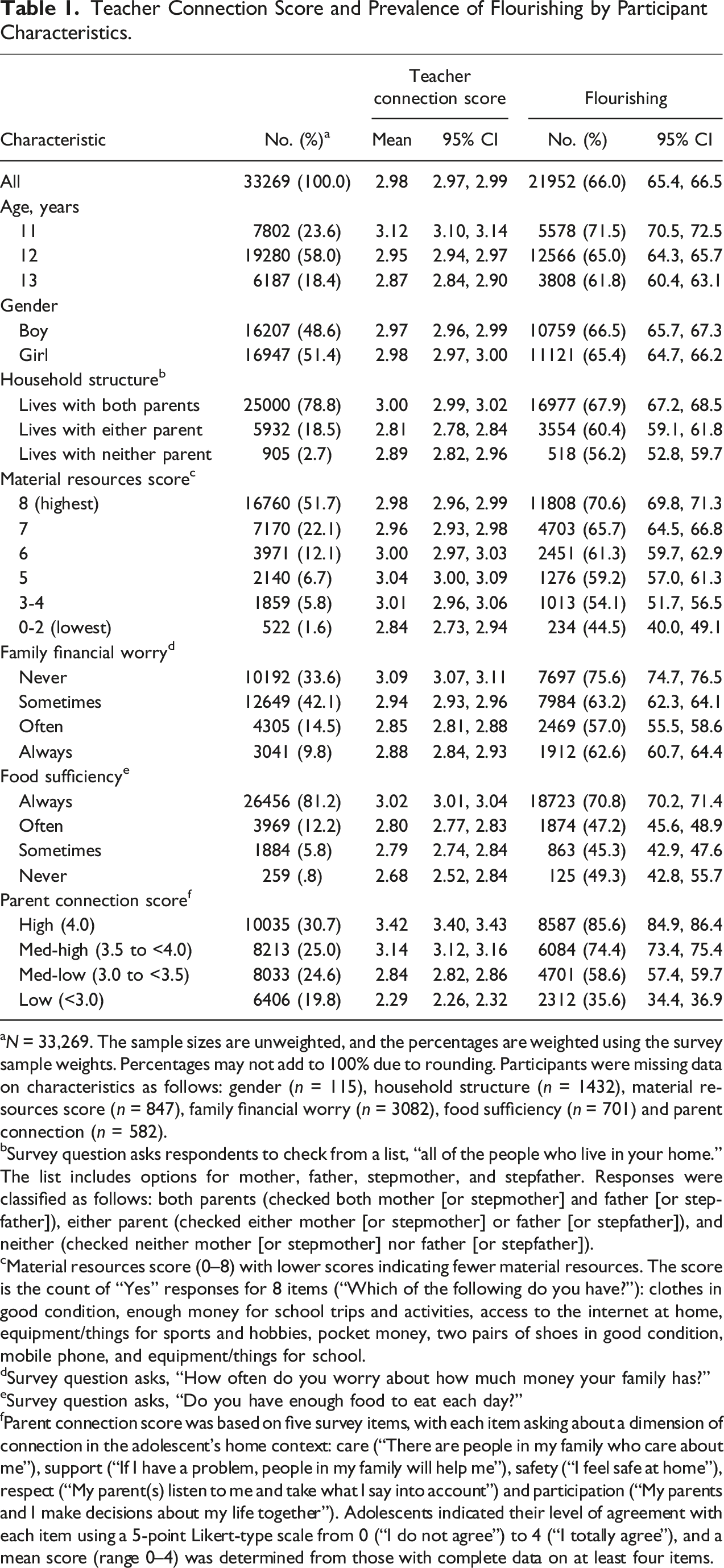
aN = 33,269. The sample sizes are unweighted, and the percentages are weighted using the survey sample weights. Percentages may not add to 100% due to rounding. Participants were missing data on characteristics as follows: gender (n = 115), household structure (n = 1432), material resources score (n = 847), family financial worry (n = 3082), food sufficiency (n = 701) and parent connection (n = 582).
bSurvey question asks respondents to check from a list, “all of the people who live in your home.” The list includes options for mother, father, stepmother, and stepfather. Responses were classified as follows: both parents (checked both mother [or stepmother] and father [or stepfather]), either parent (checked either mother [or stepmother] or father [or stepfather]), and neither (checked neither mother [or stepmother] nor father [or stepfather]).
cMaterial resources score (0–8) with lower scores indicating fewer material resources. The score is the count of “Yes” responses for 8 items (“Which of the following do you have?”): clothes in good condition, enough money for school trips and activities, access to the internet at home, equipment/things for sports and hobbies, pocket money, two pairs of shoes in good condition, mobile phone, and equipment/things for school.
dSurvey question asks, “How often do you worry about how much money your family has?”
eSurvey question asks, “Do you have enough food to eat each day?”
fParent connection score was based on five survey items, with each item asking about a dimension of connection in the adolescent’s home context: care (“There are people in my family who care about me”), support (“If I have a problem, people in my family will help me”), safety (“I feel safe at home”), respect (“My parent(s) listen to me and take what I say into account”) and participation (“My parents and I make decisions about my life together”). Adolescents indicated their level of agreement with each item using a 5-point Likert-type scale from 0 (“I do not agree”) to 4 (“I totally agree”), and a mean score (range 0–4) was determined from those with complete data on at least four items.
Association Between Quartile of Teacher Connection and Prevalence of Flourishing.

aN = 33,269. The sample sizes are unweighted, and the percentages are weighted using the survey sample weights.
bThe prevalence of flourishing significantly increased across quartiles of teacher connection (chi-square test for trend z = 63.04, p < .001).
cBased on a logistic regression model with adjustment for gender, age, household structure, material resources score, family financial worry, food sufficiency, parent connection score, and country. The adjusted prevalence differences (and 95% CIs) describe the adjusted prevalence of flourishing among those in the higher quartiles of teacher connection score relative to the adjusted prevalence of flourishing among those in the lowest quartile of teacher connection score.
dIn a logistic regression model, after adjusting for all eight covariates, the addition of quartiles of teacher connection to the model significantly improved model fit, as assessed by the Wald test (F [3, 33116.6] = 366.73, p < .001).
The graded association between teacher connection and flourishing (Figure A2) was similar across levels of parent connection (Figure 1). Among those with the lowest level of parent connection, the difference in the adjusted prevalence of flourishing between those in the highest and lowest quartiles of teacher connection was 25.5% (20.4%, 30.6%). By comparison, the adjusted prevalence difference was 22.6% (19.7%, 25.5%) among those with the highest level of parent connection (Table A3). Predicted Probability of Flourishing across Teacher Connection Scores by Level of Parent Connection Score.Note. Each point represents the predicted probability (and 95% CI) of flourishing at a given teacher connection score (N = 32,687) within each level of parent connection score. Sample size does not include those missing data on parent connection (n = 582). The line and 95% CI bands are derived from a logistic regression model and are adjusted for the following covariates (with imputation of data for missing covariates): gender, age, household structure, material resources score, family financial worry, food sufficiency, and country. Separate models were run for each level of parent connection. The predicted probabilities and 95% CI values were computed using the margins command in Stata/MP (v 15.1).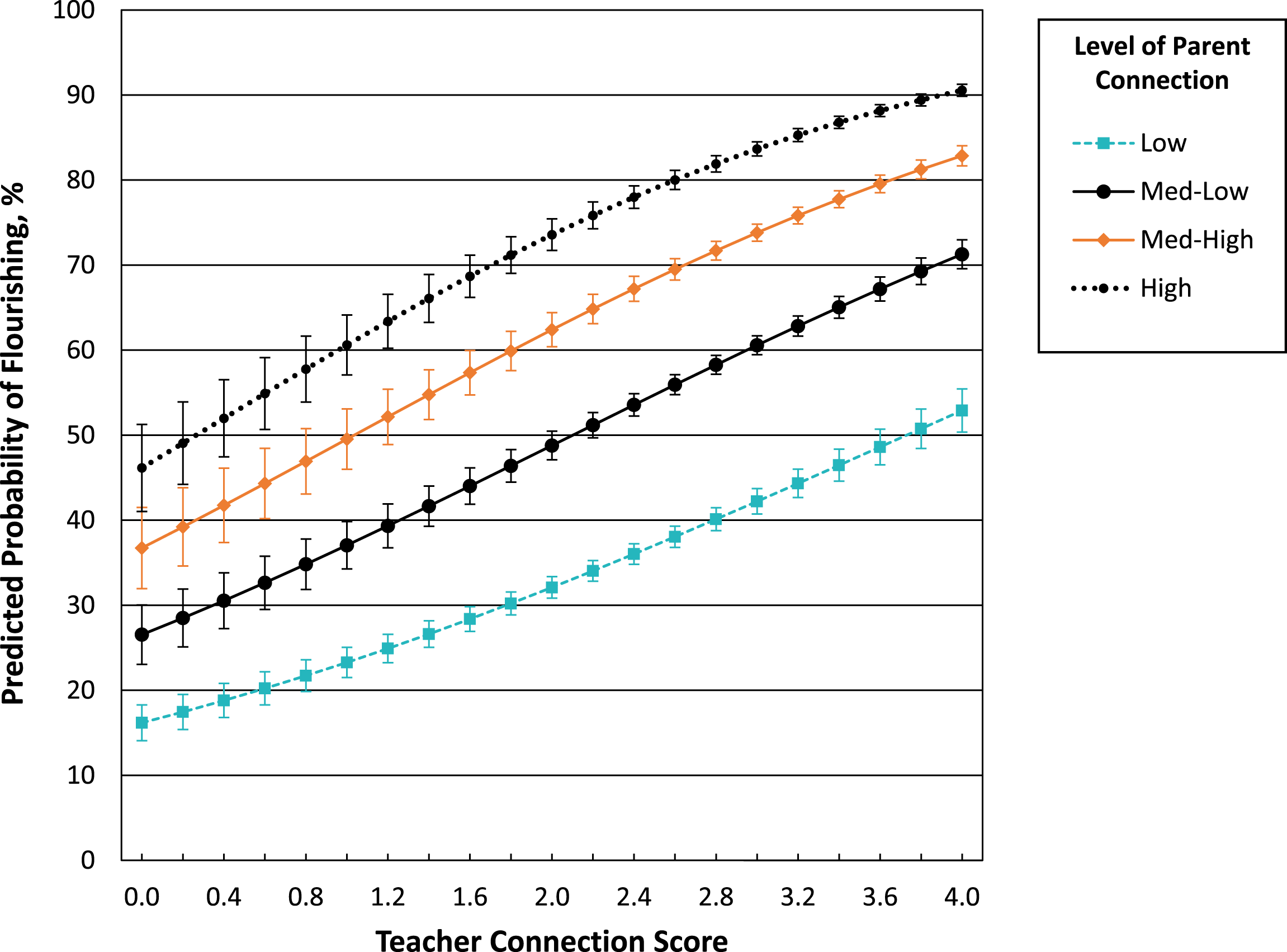
In secondary analyses, the association between higher teacher connection score and a greater prevalence of flourishing was seen within each country (Table A4). The graded association between teacher connection scores and flourishing was also seen when we used a different cut-point to define flourishing (score > 9) (Table A5).
Discussion
Key Findings
Using cross-sectional survey data collected from over 33,000 early adolescents in 25 countries, we showed that higher levels of teacher connection were associated with a greater prevalence of flourishing. The graded association between quartiles of teacher connection and prevalence of flourishing was present after adjusting for potential confounders, including parent connection. In stratified analyses, we showed that in groups of early adolescents with either the highest or lowest level of parent connection, the association of teacher connection with flourishing was equally strong.
Findings in Context
In the English-language literature, we identified only two studies of adolescents with comparable findings on the association between teacher connection and flourishing, based on Ryff’s conceptualization of psychological (eudaimonic) well-being (Ryff, 1989). In a study of fifth- and sixth-grade students (10- to 12-year-olds) in four schools in Mexico, there was a significant, unadjusted correlation (r = .284) between flourishing and the academic dimension of school environment, which included items measuring student-teacher relationships (Tapia-Fonllem et al., 2020). However, the authors did not report the association between flourishing and student-teacher relationships alone. In a study of eighth- and eleventh-grade students in 16 secondary schools in Australia, the authors examined the association of flourishing with social support profiles from teachers, parents, and peers (Ciarrochi et al., 2017). Significant correlations were reported between teacher support and flourishing in both eighth-grade (r = .406) and eleventh-grade (r = .424), but these were not adjusted for parent support. We did not identify any studies that examined the association between teacher connection alone and flourishing among early adolescents while adjusting for potential confounders, such as parent connection.
Though not directly comparable, our findings are also consistent with research in the field of positive youth development, which has identified the value of both connection (Benson et al., 2011; Lerner et al., 2005) and sense of purpose (Damon et al., 2003) among adolescents. Our present and prior findings (Whitaker et al., 2022a) also align with others’ work suggesting that parent and teacher connection may prevent negative outcomes and promote positive capacities in adolescents (Butler et al., 2022; Ciarrochi et al., 2017; Jose et al., 2012; Murray, 2009; Resnick et al., 1997; Steiner et al., 2019). Similar to us, others have shown that the association of student outcomes with teacher support or school assets did not differ by level of parent support or family functioning (Sharkey et al., 2008; Wentzel, 1998).
Limitations
The cross-sectional design does not allow us to make causal inferences or exclude the possibility of reverse causality. The ISCWeB was international in scope but did not collect nationally representative samples in participating countries. Additionally, the school-based sampling frame excluded adolescents not enrolled in mainstream schools, and survey-wide response rates at the school or student levels were not available. There are limitations with the instruments used to measure teacher connection and flourishing. In the ISCWeB, only a single item was used to assess each dimension of flourishing, and, to our knowledge, no study of adolescents has compared the flourishing measure used in the ISCWeB to responses from Ryff’s scales of psychological well-being (Ryff, 1989). Additionally, self-reported measures of well-being typically have a more skewed distribution (Casas, 2011). To conduct an applied analysis with interpretable findings in the face of such a distribution, we chose to use a binary outcome. Because there was not a strong empirical basis for a specific cut-point on the flourishing score, we repeated our analysis using an alternative cut-point, and these analyses yielded results consistent with our primary analysis. Because the understanding of the flourishing items may vary across countries, cross-country comparisons of flourishing and its correlates must be interpreted with caution (Casas and González-Carrasco, 2021; Nahkur and Casas, 2021). We are not aware of another study that assessed teacher connection with the same three items used in the ISCWeB. However, these items assessed the dimensions of care, support, and respect that are indicative of teacher connection from the perspective of adolescents (García-Moya, 2020). The ISCWeB measure asked adolescents to consider “my teachers,” but other measures of teacher connection use phrases like “the teachers at this school” or ask adolescents to consider a single teacher they feel particularly close to (García-Moya et al., 2019). The level at which teacher connection was assessed (individual, classrooms, school) may affect its association with flourishing.
Implications
To our knowledge, this is the largest study of the association between teacher connection and adolescent flourishing, assessed as eudaimonic or psychological well-being, and the only study of this association to have adjusted for parent connection. Although this study extends a large body of work showing the potential importance of student-teacher relationships (Akiva et al., 2022; García-Moya, 2020; Pianta, 1999; Rodgers & Raider-Roth, 2006; Wentzel, 2016), our findings on the outcome of flourishing are unique. While other positive outcomes like academic achievement, engagement in learning, and school belonging have been associated with teacher connection, eudaimonic well-being transcends the narrower objectives of education. Our findings on flourishing suggest that teachers’ relationships with adolescents, beyond parental relationships, contribute to the potential for adolescents to thrive in life, not just in school, and even in the face of adversity.
The association between teacher connection and adolescent flourishing should be replicated in other studies, ideally with a prospective design. Despite the cumulative evidence favoring the strengthening of teacher connection in schools, there appear to be barriers for teachers in making connections with adolescents. In prior qualitative work, adolescents described teacher connection as relationships that were (1) humanizing, in which they felt known and respected and in which teachers allowed themselves to be known; (2) empathic, in which the teacher conveyed an understanding of the adolescent’s perspective; and (3) supportive, in which the teacher was approachable and helpful, even with non-academic problems (García-Moya, 2020). However, both teachers and students have described barriers to forming connections, such as how perceptions of authority could interfere (García-Moya, 2020). Therefore, before developing and evaluating interventions to strengthen student-teacher relationships, it may first be necessary to assess potential barriers to forming these connections, ideally through qualitative research.
Some systemic challenges to fostering teacher connection, such as a lack of time, inadequate training, and dysfunctional relationships among the adults in schools, have already been identified (Pekel, 2017). However, for teachers to make meaningful and sustainable connections with adolescents, we must also consider how the values of authority, confidentiality, and expertise shape the boundaries of teachers’ relationships with adolescents (García-Moya, 2020). While there are necessary and positive aspects of these values, they may also be barriers to connection. For example, teachers’ authority that arises from age, experience, or professional credentials contribute to teachers’ power, which they can use to create a sense of safety for adolescents. However, their power can also be used to coerce and control adolescents. Adolescents who expect confidentiality in trusting relationships with teachers may be more willing to discuss and disclose their need for help. However, there are limits to confidentiality that may prevent teachers from fully engaging with adolescents because of concerns about having to report a disclosure. Teachers have certain expertise to offer adolescents, but they may feel constrained or uncertain when moving outside their socially defined role as experts to meet the needs expressed by the adolescent, especially concerning social and emotional health. Although authority, confidentiality, and expertise can contribute to safety, they can also reduce safety if relational boundaries keep adults from expressing enough authentic interest, vulnerability, or humility in the relationship to make the adolescent feel safe and seen.
We believe being safely seen is the foundational requirement for adolescents to flourish through their relationships with adults. While future research may confirm or reveal additional barriers to connection, adults can begin now to increase their connection with adolescents. Teachers can consider setting aside, for a few moments, certain expectations about their professional roles to give an adolescent one authentic invitation, “Tell me about you,” and listen with engaged presence and affirmation (Rodgers & Raider-Roth, 2006).
Supplemental Material
Supplemental Material - The Association Between Teacher Connection and Flourishing Among Early Adolescents in 25 Countries
Supplemental Material for The Association Between Teacher Connection and Flourishing Among Early Adolescents in 25 Countries by Robert C. Whitaker, Tracy Dearth-Wesley, Allison N. Herman, Thomas L. Benz, Sidney A. Saint-Hilaire and Dean D. Strup in The Journal of Early Adolescence.
Footnotes
Acknowledgements
On October 11, 2022, we presented some of the findings contained in this manuscript at Research Grand Rounds at the Bassett Research Institute in Cooperstown, NY.
Declaration of Conflicting Interests
The author(s) declared no potential conflicts of interest with respect to the research, authorship, and/or publication of this article.
Funding
The author(s) received no financial support for the research, authorship, and/or publication of this article.

Supplemental Material
Supplemental material for this article is available online.
Appendix
Author Biographies
References
Supplementary Material
Please find the following supplemental material available below.
For Open Access articles published under a Creative Commons License, all supplemental material carries the same license as the article it is associated with.
For non-Open Access articles published, all supplemental material carries a non-exclusive license, and permission requests for re-use of supplemental material or any part of supplemental material shall be sent directly to the copyright owner as specified in the copyright notice associated with the article.
