







Abstract
This study explored the separate and interacting relations of family (cultural pluralism, promotion of mistrust) and school (equal treatment, intercultural learning) ethnic-racial socialization with cultural (heritage culture and German) identity among adolescents of immigrant descent. Analyses were based on survey data from 311 early to mid-adolescents in Germany (M age = 13.85, SD = 1.82). Higher family cultural pluralism and intercultural learning at school were related to higher heritage culture identity, while higher equal treatment at school was related to lower heritage culture identity. Higher intercultural learning and equal treatment at school were related to higher German identity. Family promotion of mistrust had no direct relation to heritage culture or German identity. The interaction of family promotion of mistrust and equal treatment at school had relations to heritage culture but not to German identity. These findings expand our understanding of the complementary roles of family and school for supporting cultural identity development.
Introduction
Adolescents develop an understanding of their ethnic-racial identity through ethnic-racial socialization, defined as “the myriad ways that varied agents of socialization transmit messages about ethnicity and race to children (Hughes & Watford, 2021, p. 3). 1 Ethnic-racial socialization occurs in various social contexts, such as families, schools, peer groups, neighborhoods, and the internet (Byrd & Ahn, 2020; Wang et al., 2015). Most research has focused on social contexts separately. For instance, family (especially parental) (Huguley et al., 2019; Umaña‐Taylor & Hill, 2020) and school ethnic-racial socialization (Byrd & Legette, 2022; Saleem & Byrd, 2021; Schachner et al., 2021) relate to adolescents’ ethnic-racial or cultural identity development. Nevertheless, because adolescents negotiate the complex socialization messages from both family and school, it is important to examine the two contexts together. The ways adolescents understand and define their ethnic-racial or cultural identity may differ if the messages they receive in one context (e.g., family) and the messages they receive in another context (e.g., school) are congruent or incongruent (Benner & Mistry, 2007; Wang & Benner, 2016). In the current study, we explored the separate and interacting relations of family and school ethnic-racial socialization with cultural identity among adolescents of immigrant descent (i.e., adolescents who either themselves or at least one of their parents were born abroad, (Federal Government Expert Commission, 2021).
Cultural identity is a multidimensional concept referring to adolescents’ conception of their identity in relation to the values, customs, and practices of their cultural background(s). For adolescents of immigrant descent, the formation of a cultural identity happens through forming a sense of belonging to their heritage culture identities (i.e., the culture(s) of the family’s country of origin) and national identity (i.e., German identity). These aspects merge into an overarching cultural identity that includes both (Meca et al., 2019; Vietze et al., 2019). In this study, we focus on the extent to which youth endorse a sense of belonging to their heritage culture and German identities rather than an examination of how these identities together conflict or cohere. In addition, cultural identity develops through different processes such as exploration and commitment. Exploration refers to adolescents’ engagement in reflections and actions to understand their identity and eventually gain clarity about their cultural identities. Commitment refers to adolescents’ positive feelings and attachment to their cultural group(s) (Phinney & Ong, 2007). This study focuses on both exploration and commitment processes for the development of heritage culture and German identities.
The Role of Separate and Interacting Social Contexts in Ecological Theories
We drew on two ecological theories to inform the hypothesized relation between social context and identity development. First, the ecological theory of human development (Bronfenbrenner & Morris, 2007) posits that adolescents’ understanding of their identity is a dynamic process resulting from the interactions with their proximal social ecologies such as family and school. The ecological theory of human development argues for “the importance of goal consensus between settings at the level of mesosystem” by highlighting the importance of the interaction between proximal social ecologies (Bronfenbrenner, 1979, p. 240). Meaning that if the messages of socialization agents are congruent across settings, this may facilitate internalization of the socialization messages. On the other hand, if the messages of socialization agents are incongruent (e.g., one context promotes positive values towards diversity and the other treats diversity as a problem), this may challenge the internalization of messages (Benner & Mistry, 2007; Wang et al., 2019; Wang & Benner, 2016). In sum, the extent to which one social context relates to adolescents’ identity might depend on factors in other contexts (Miklikowska et al., 2019).
Building on Bronfenbrenner’s consideration of multiple contexts in human development, Spencer et al.’s (2015) phenomenological variant of ecological system theory (PVEST) argues for the necessity of considering identity development in light of societal dynamics between ethnic-racial groups and inequalities. PVEST posits cultural dissonance between multiple contexts as a risk factor for identity development, especially among racially and ethnically minoritized children and adolescents. Unlike their peers who hold more privileged positions in racially and ethnically diverse societies, minoritized children and adolescents are more likely to receive incongruent messages from the society/school which fails to affirm their identities and from their families trying to promote and protect their children from discrimination (Spencer et al., 2015). Thus, PVEST also suggests proximal social ecology (e.g., family and school) may harbor risk and promotive factors that minoritized youth must negotiate to develop their identity. Therefore, the higher the cultural dissonance across contexts is, the harder it is to form a sense of identity. In sum, both theories propose that the negotiation of proximal social ecologies youth navigate (e.g., family and school) may have separate and intertwined contributions to adolescents’ understanding of their cultural identity. In the following sections, we review existing literature to explain separate and interacting relations of family and school ethnic-racial socialization to cultural identity development.
Family Ethnic-Racial Socialization and Cultural Identity
Family ethnic-racial socialization has two functions for the development of adolescents. First, it serves as a promotive tool for transmitting knowledge to children about their heritage culture(s) to foster pride in their culture(s). Second, it serves as a protective tool for families to help their marginalized children maintain a positive view of themselves while navigating societies and interactions where their identities are not affirmed and valued (Simon, 2021). This study focuses on the less studied dimensions of family ethnic-racial socialization across ethnic-racial groups in the U.S — cultural pluralism and promotion of mistrust (Hughes et al., 2006; Umaña‐Taylor & Hill, 2020).
Cultural pluralism refers to messages that value people of different cultural backgrounds and their perspectives that might be different from one’s own (Juang et al., 2021). Few studies explored parents as sources of cultural pluralism messages and, if done, most often with Asian American and Pacific Islander families (Nieri et al., 2024). In a study with Asian-American emerging adults, parental cultural pluralism was positively related to ethnic identity (Juang et al., 2021). In another study where parental cultural pluralism items combined with socialization (i.e., messages about cultural history and pride) items, cultural pluralism-socialization was related to stronger ethnic identity (Brown & Ling, 2012). Additionally, studies suggested diverse social networks as important contexts fostering identification with both heritage culture and national identity (Benet‐Martínez & Haritatos, 2005; Mok et al., 2007). Therefore, family cultural pluralism socialization as supportive of forming relationships with people of their own culture(s) and displaying openness towards other cultures (Meca et al., 2019) may facilitate a strong commitment to both heritage culture and national identities. Thus, we expected that family cultural pluralism would be positively associated with heritage culture identity (H1a) and German identity (H1b).
Promotion of mistrust refers to messages that instill suspicion of people from other cultural groups. The motivation behind family promotion of mistrust is to protect adolescents against biased interactions. However, ethnic-racial socialization literature argues that promotion of mistrust mainly provides negative messages about cultural groups and does not offer support to cope with discrimination (Atkin et al., 2019; Simon, 2021; Umaña‐Taylor & Hill, 2020). Thus, it has been mainly associated with negative outcomes such as higher depressive symptoms and behavioral problems (Kwon et al., 2022; Umaña‐Taylor & Hill, 2020 for a review). In terms of identity, studies with Asian-American participants found that promotion of mistrust was negatively related to ethnic identity (Gartner et al., 2014; Kiang et al., 2019), and unrelated to American identity (Gartner et al., 2014). Along similar lines, in a longitudinal study with Asian-American youth, higher perceived parental promotion of mistrust decreased ethnic-racial identity among Filipino youth but increased American identity among Korean youth after a year (Woo et al., 2020). Recently, a cross-sectional study with Korean minority adolescents in China also found that parental promotion of mistrust was unrelated to ethnic identity (Shen et al., 2021). In sum, empirical studies testing the relations of promotion of mistrust to identity display mainly inconsistent results such null and negative associations for heritage culture identity, and null, negative, and positive associations for national identity. Because promotion of mistrust itself does not provide coping strategies to protect adolescents’ heritage culture identity against discrimination experiences, this may lower their identification with heritage culture identity. At the same time, promotion of mistrust messages may instill suspicion toward the society and lower their identification with German identity (Hughes et al., 2006). Thus, we expected that promotion of mistrust would be negatively associated with heritage culture (H2a) and German identity (H2b).
School Ethnic-Racial Socialization and Cultural Identity
School is another important proximal context of socialization for adolescents besides the family context. Curriculum, policies, and practices, relationships with teachers, staff, and peers, as well as discrimination experiences convey explicit and implicit messages about race, ethnicity, and culture in the school context (Graham, 2018; Hughes et al., 2011; Saleem & Byrd, 2021; Umaña-Taylor et al., 2018). Saleem and Byrd (2021, p. 1110) suggest that “the content of school ethnic-racial socialization can be conceptualized within the construct of school climate which are the norms, goals, values and interpersonal relationships, teaching and learning practices and organizational structures of a school”. Similar to this definition, informed by the socio-historical context and policies, classroom cultural diversity climate in the European context is based on how schools and main actors of the context (teachers and students) approach cultural diversity (Schachner, 2019). Therefore, we operationalized school ethnic-racial socialization as the ways that schools and teachers contribute to cultural diversity climates that are more or less supportive of diverse identities. Drawing on studies focusing on students’ perceptions of cultural diversity climate at schools with a high number of students from different cultural backgrounds, two multidimensional contents of cultural diversity climate were identified: cultural pluralism and equality/inclusion (Schachner et al., 2021).
One main approach to diversity that draws on multiculturalism and culturally responsive teaching (Gay, 2015) is cultural pluralism. It refers to treating cultural diversity as a resource in the school context. In this study, we focus on intercultural learning (a sub-dimension of cultural pluralism) as one commonly used approach at schools in Germany. It refers to learning about diverse perspectives of people from different cultures and promoting intercultural relations (Civitillo et al., 2017). Engaging in intercultural learning in the classroom may facilitate adolescents’ identification with their heritage culture (Schachner, 2019). Studies with adolescents of immigrant descent in Italy and Germany found positive associations of teachers’ support for cultural pluralism with ethnic identity (Moscardino et al., 2019; Schachner et al., 2016). However, perceived cultural pluralism at school and adolescents’ national identity were unrelated in a study in Germany (Schachner et al., 2016). Nevertheless, a school context highlighting the importance of positive intercultural relations and aiming to eliminate potential negative intergroup experiences may reduce threats to adolescents’ identities, and may facilitate the development of committing strongly to both heritage culture and national identities (Phalet & Baysu, 2020; Schachner, 2019). Thus, we expected that intercultural learning would be positively related to adolescents’ heritage culture (H3a) and German identities (H3b).
A second approach to diversity, equality and inclusion, aims to create cooperative relations among students of different cultural backgrounds and to foster a climate of equal status between cultural groups (Pettigrew & Tropp, 2006; Schachner et al., 2021). In this study, we focus on equal treatment (a sub-dimension of equality/inclusion) as a commonly used approach by culturally diverse schools in relation to identity development (Schachner et al., 2021). Equal treatment refers to treating students equally regardless of their heritage culture backgrounds at school. A study with German adolescents of immigrant descent found that perceived equality/inclusion combining equal treatment and contact/cooperation in the classroom was positively related to adolescents’ national identity, but not related to their ethnic identity (Schachner et al., 2016). A study of 8–10-year-old first-, second- and third- generation Latinx adolescents of immigrant descent showed they had more positive evaluations towards their ethnic identity when they perceived their teachers behaving fair to all students in the classroom while valuing who they are (Brown, 2017). Taken together, a school context addressing culture-based fair treatment (by actively eliminating discriminatory behaviors) may establish a setting for adolescents to maintain a strong commitment to their heritage culture and national identities (Kende et al., 2021). Thus, we expected that equal treatment would be positively related to adolescents’ heritage culture (H4a) and German identity (H4b).
Interacting Relations of Two Contexts: Family and School Ethnic-Racial Socialization
Ecological theories of child development highlight the importance of understanding how socialization messages interact across contexts. These interacting messages from family and school contexts might manifest in three forms: enhancing, compensatory, and buffering (Cohen et al., 2013). Socialization messages that are congruent in terms of the content (e.g., messages both at home and school encourage positive intergroup relations) and high in frequency across contexts could enhance their effects. For example, a study of adolescents in the U.S. found that those who participated in a school-based ethnic-racial identity intervention engaged in greater ethnic-racial identity exploration compared to a control group. Moreover, this positive effect was enhanced if the adolescents in the school intervention also reported greater ethnic-racial socialization at home (Sladek et al., 2021). Another study with ethnic-racial minority adolescents in the U.S. showed that congruently high family and peer cultural socialization predicted higher well-being among adolescents compared to those who received incongruent messages and congruently low cultural socialization messages (Wang & Benner, 2016). Therefore, we expected a similar enhancing effect such that adolescents who experience greater cultural pluralism at home and intercultural learning and equal treatment socialization at school would demonstrate the highest levels of heritage culture and German identity (H5a).
When the level of endorsement regarding positive intergroup relations (i.e., congruent content) is high in one context and low in another (i.e., incongruent frequency), one context could compensate for the other. A study found that for Italian adolescents, classroom diversity climate supportive of heritage and intercultural learning mattered for adolescents’ heritage culture identity resolution (Schachner et al., 2023). But it mattered more for those who did not participate in a school-based cultural identity intervention that encouraged exploration of diverse identities as well as positive intergroup relations. In other words, this positive classroom diversity climate compensated for the lack of support that the intervention offered (Schachner et al., 2023). We therefore also expected high levels of family cultural pluralism at home to compensate for low levels of intercultural learning and equal treatment socialization at school for adolescents, allowing them to maintain high levels of heritage culture and German identity or vice versa (H5b).
Incongruency of content of socialization messages refers to the dissimilarity between messages and their purposes. For example, messages may encourage intergroup relations in one context (e.g., emphasizing intercultural learning and equal treatment in school) and urge caution against intercultural relations in another (e.g., promote mistrust at home). A longitudinal study with Swedish adolescents of non-immigrant descent showed how incongruent socialization messages between home and school made a difference for adolescents’ prejudice towards immigrants (Miklikowska et al., 2019). Adolescents whose parents were prejudiced towards immigrants were also more likely to be prejudiced themselves, but this relation was weakened if adolescents attended a highly diverse classroom. The authors argued that greater classroom cultural diversity buffered the negative effects of prejudiced attitudes of parents, presumably through positive inter-ethnic peer contact socialization (Miklikowska et al., 2019). Thus, for incongruent socialization messages and frequencies, we expected a similar buffering effect whereby socialization in the school context endorsing positive intergroup relations (i.e., intercultural learning and equal treatment) could weaken the negative effect of promotion of mistrust in the family to cultural identity (H5c, see Figure 1 for all potential theoretical combinations for the congruency of the content and frequency of the message in family and school contexts). Potential theoretical combinations for the congruency of socialization in family and school contexts. Note. We formulated hypotheses for those combinations highlighted with grey. Congruency of the content refers to those messages that aim to improve intergroup relations both at home and school. For example, intercultural learning and cultural pluralism refer to messages endorsing positive intergroup relations by emphasizing respect and engagement. Incongruency of the content refers to those messages that encourage positive intergroup relations in one context and urge caution against intergroup relations in another. For example, emphasizing equality would encourage improving intergroup relations while promotion of mistrust would discourage positive intergroup relations by highlighting the inequality between groups.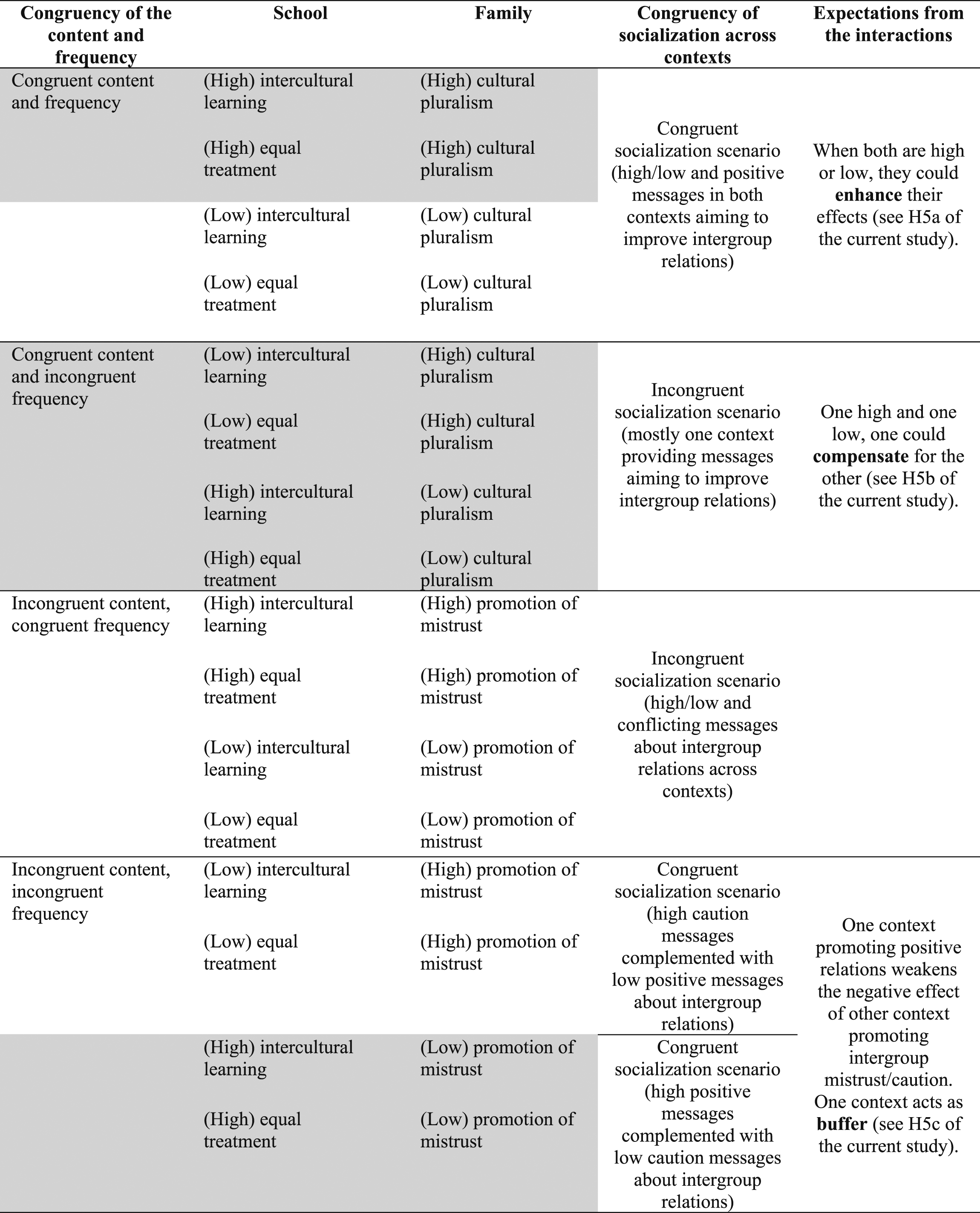
The Moderating Role of Developmental Period
Ecological theories and family ethnic-racial socialization literature suggest that the strength of the relation between socialization messages and developmental outcomes may differ depending on the developmental period (Huguley et al., 2019; Spencer et al., 2015). Adolescence is an active period for identity development due to improved complex socio-cognitive skills (e.g., abstract thinking) and the increased importance of multiple socialization contexts outside of the family, such as the school (Erikson, 1968; Hughes et al., 2011). For example, the meta-analysis by Huguley et al. (2019) found that the relation of family ethnic-racial socialization to perceptions of self (e.g., concept, esteem, efficacy) was larger during early adolescence (between 11 to 13 years old) compared to childhood (ages 6–10), middle adolescence (ages 14–17), and late adolescence/emerging adulthood (ages 18–24). However, evidence for variations in ethnic identity by developmental period for the specific family ethnic-racial socialization aspects (e.g., cultural pluralism, promotion of mistrust) is scarce (Douglass & Umaña-Taylor, 2016). Furthermore, school ethnic-racial socialization studies so far have not reported variations by developmental period. As the empirical evidence is limited, our tests for the moderating role of age for the direct and interacting relations of family and school ethnic-racial socialization to cultural identity were exploratory.
The Present Study
The present study examined the separate and interacting relations of family and school ethnic-racial socialization with adolescents’ cultural identity. We expand previous knowledge on ethnic-racial socialization and cultural identity in two ways. First, in Germany, family socialization in relation to cultural identity has been mainly researched through implicit ways of socialization such as parental prejudice, parents’ own acculturation, and parenting styles (Jugert et al., 2016; Spiegler et al., 2016) with one exception focusing on parental acculturation expectations as explicit socialization messages (Schachner et al., 2014). Thus, explicit forms of family ethnic-racial socialization in relation to adolescents’ cultural identity development in Germany are still underexplored. Second, research on the role of ethnic-racial socialization effects in multiple proximal contexts is scarce (for exceptions, see Miklikowska et al., 2019 in Sweden; Sladek et al., 2021 in the U.S.). Importantly, Germany is an immigration society and scholars have identified racism as a persisting problem (Ateş et al., 2023 for a nation-wide study; Juang et al., 2021), and studies have identified school (Schachner et al., 2021) and family ( Spiegler et al., 2016; Uygun-Altunbas, 2017) as contexts where youth receive explicit messages about culture, religion, and discrimination. Thus, we explore the interplay of ethnic-racial socialization in two proximal contexts of adolescents (family and school) in understanding cultural identity development. While testing these associations, we controlled for age, gender, and socioeconomic status (SES) and structural diversity (diversity of the heritage countries represented in the classroom) as they are related to the cultural identity.
Method
Sample and Procedure
Cross-sectional data 2 were collected in highly diverse, urban areas in the federal state of North-Rhine Westphalia, Germany (N = 647), as part of a cross-national study on identity in 2015/2016. This study focuses on 311 early to mid-adolescents of immigrant descent (ages 11–17, 6th, 8th and 10th grade students, Mage = 13.85, SD = 1.82, 48.9 % female, 50.8% male, 0.6% gender not reported) from 29 classrooms in seven schools. 3 The number of participants per school ranged from 24 to 67. We relied on adolescent’s and parents’ country of origin 4 to determine the category of immigrant descent, which includes adolescents who were either themselves born abroad or who had at least one parent who was born abroad. The subsample of adolescents of immigrant descent thus comprised 1st (born outside Germany, 13.8% of the sample) and 2nd and later (born in Germany with at least one parent born abroad, 86.2% of the sample) generations. For 27.7% of the adolescents, heritage country referred to Eastern European countries (e.g., Bulgaria), for 23.9% to Turkey, and for 21.6% to regions in Asian/African continents (e.g., Sri Lanka, Morocco, Angola). When youth were asked about the cultural groups they feel they belong to, almost half (47.9%) of the adolescents in our sample self-identified as bicultural (e.g., Hungarian-German), 32.5% identified only with their heritage culture(s) (e.g., Albanian or Italian-Turkish), 15.4% identified only as German, 2.3 % identified as multicultural German (e.g., Turkish-Kurdish-German), and 1.6% did not report (see Table S1 for demographics in detail). 5 Before conducting the study, we obtained consent of school principals, parents, and adolescents. Adolescents filled out the paper-pencil survey during class time. The adolescents first answered questions about their demographic information and their heritage culture and German identity. Then, they respectively responded to the family and school socialization questions.
Measures
Unless stated differently, the response scale of the measures used in this study ranged from 1 (do not agree at all) to 5 (definitely agree). Mean scores were calculated for all subscales, with higher values indicating higher levels of the constructs. Some items developed in the US context were adapted by replacing “ethnic-racial” with “culture” or “heritage culture” as contextually more meaningful terminologies.
Demographic Information and Covariates
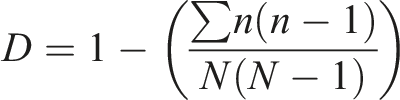
Covariates included adolescents’ gender (male = 0, female = 1), age (in years), and immigration generation (0 = second or later, 1 = first). In addition, socioeconomic status (SES) was measured by assessing adolescents’ subjective social status (Goodman et al., 2001). The SES measure used a ladder drawing with 10 steps (ranging from 1 to 10). We told adolescents to imagine that on the top of the ladder, there were people who are the most educated and whose work was the most respected in Germany. At the bottom, there were people who had the lowest education degree, whose work was the least respected or that did not have a job. Comparing their current situation to the other people in Germany, we asked adolescents to report on which step of the ladder they would place themselves and their family. Finally, classroom diversity was measured by calculating Simpson’s diversity index (Graham, 2018; Simpson, 1949). This index considers both the variety (the number of different groups) and evenness (the size of each group) of diversity. We identified the number of heritage countries represented (n) and the total number of students (N) in a classroom. Simpson’s diversity index values for each classroom range from 0 to 1, with higher values indicating higher cultural diversity in the classroom. Simpson’s Diversity Index is calculated as follows:
Family Ethnic-Racial Socialization
Family cultural pluralism was measured using three items from the Adolescent Racial and Ethnic Socialization Scale in African American Families (e.g., “At home, I am encouraged to have friends from other cultural groups; α = .78 Brown & Krishnakumar, 2007). Family promotion of mistrust was measured using three items adapted from the Racial-Ethnic Socialization scale (Hughes & Johnson, 2001, e.g., “At home, I am told to keep away from people from other cultures”; α = .80). Exploratory factor analyses were conducted to ensure the scales’ factor structure (see supplemental materials Table S2). 6
School Ethnic-Racial Socialization
Perceived intercultural learning was measured using four items developed by Schachner et al. (2016), (e.g., “We learn to respect each other even though we are from different cultures”, α = .79). Perceived equal treatment was measured using five adapted items (based on Green et al., 1988; Schachner et al., 2016, e.g., “The teachers at school treat students from different cultural groups fairly”, α = .83). Exploratory factor analyses were conducted to ensure the scales’ factor structure (see supplemental materials, Table S3).
Heritage Culture and German Identity
The revised Multigroup Ethnic Identity Measure (MEIM-R) was used to measure heritage culture and German identity (Phinney & Ong, 2007). This measure included items assessing two dimensions of heritage culture identity: exploration (three items, e.g., “I have often talked to other people in order to learn more about my heritage culture”) and commitment (three items, e.g., “I feel a strong attachment towards my own heritage culture”). We formed a single composite score of heritage culture identity due to a single factor structure and the high correlation between exploration and commitment (r = .79, p < .001, see Table S4). The inter-item reliability of heritage culture identity was α = .89. German identity exploration and commitment were measured using the same items used to assess heritage culture identity but replacing the word “heritage culture” with “Germany” or “German culture”. Due to a single factor structure, we also formed a single composite score of German identity, mirroring the procedure for heritage culture identity (see Table S5 and Table S7). Inter-item reliability of German identity was α = .81.
Results
Missing Data Patterns, Data Preparation, and Data Analysis Plan
The percentage of missing data was less than 12% for all of the study variables. The highest percentage of missing data was from the heritage culture identity variable. Based on Little’s test (1988), missingness was completely at random (χ2 (99) = 109.82, p = .21). We used Mplus 8.0 and its default Full Information Maximum Likelihood estimation to handle missing values (Enders, 2022). As a predictor, promotion of mistrust was negatively skewed. We performed a log 10 transformation to obtain less biased statistical results. We mean-centered all predictors to reduce multicollinearity while introducing the interaction terms and used bootstrapping to generate 95% bias corrected bootstrap confidence intervals of the parameter estimates. Finally, as the data collected from students were nested in classrooms, we checked the intraclass correlation coefficients (ICCs). ICCs were 5% for equal treatment, 9% for intercultural learning at school, and 2% for cultural pluralism and 1% for promotion of mistrust in the family (ICCs see Table S6). As ICCs above 5% variance at the classroom level are considered sufficient to account for classroom level relations, we used the “type is complex” function in Mplus to account for the variance due to between group (class) differences (Geiser, 2012). We tested the direct paths and added the interaction terms one at a time. Later, we performed simple slope analyses to explore significant interactions.
Bivariate Correlations and Model Results
Standardized Estimates and Standard Errors.
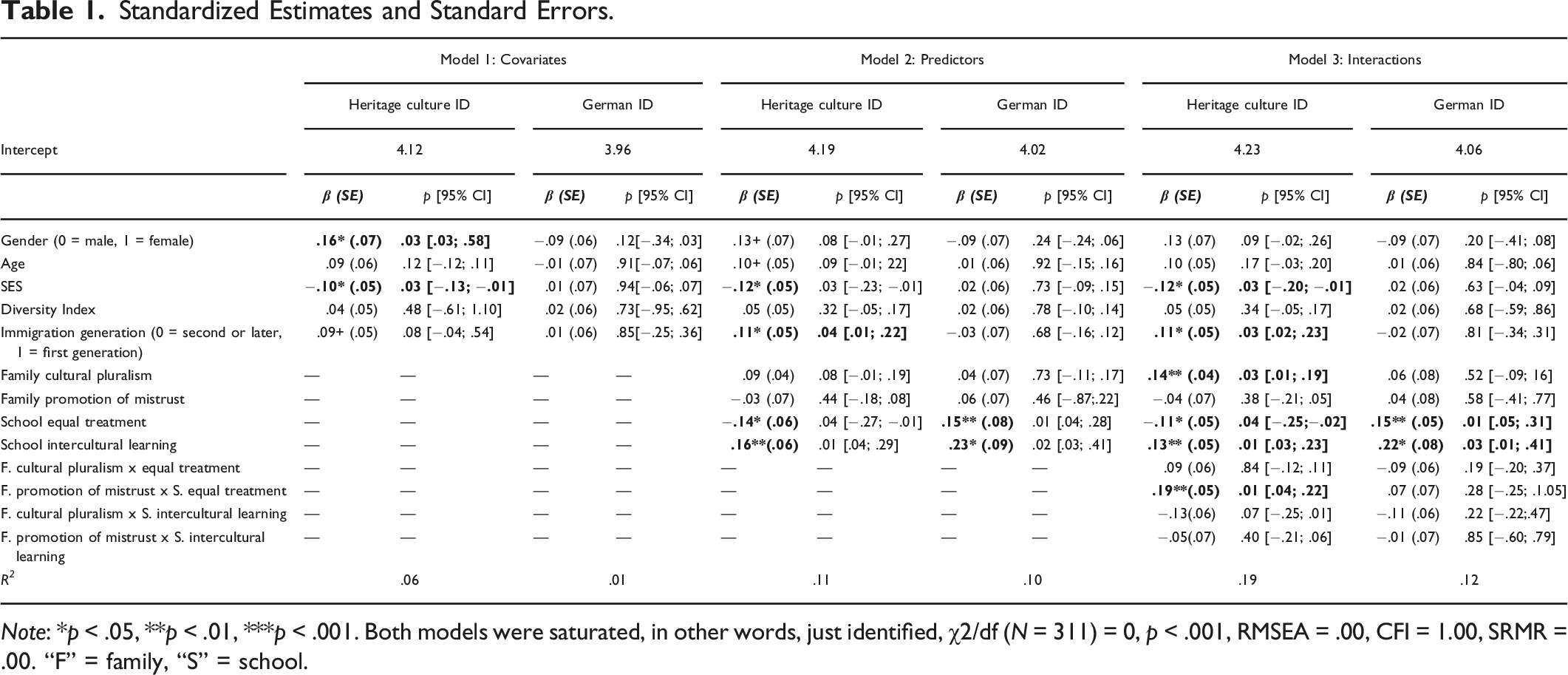
Note: *p < .05, **p < .01, ***p < .001. Both models were saturated, in other words, just identified, χ2/df (N = 311) = 0, p < .001, RMSEA = .00, CFI = 1.00, SRMR = .00. “F” = family, “S” = school.
We then added the interaction terms to the model one interaction at a time (Model 3, see Table 1). Interactions between the two contexts were significant only in relation to heritage culture identity. There was a significant negative relation between family promotion of mistrust and heritage culture identity when equal treatment at school was low. However, for those with high levels of equal treatment at school, family promotion of mistrust was not related to heritage culture identity (see Figure 2). Model 3 that included all interaction terms explained 19.1% variance in heritage culture identity and 12.5% of variance in German identity. Adolescents’ age did not moderate the direct and interacting relations of the socialization to cultural identity.
8
Interaction Effects of Family Promotion of Mistrust and Equal Treatment at School (Low = − 1 SD Below the Mean, High = 1 SD Above the Mean) on Heritage Culture Identity. Note: +p < .10, *p < .05, **p < .01. Interaction effect size, d = .11.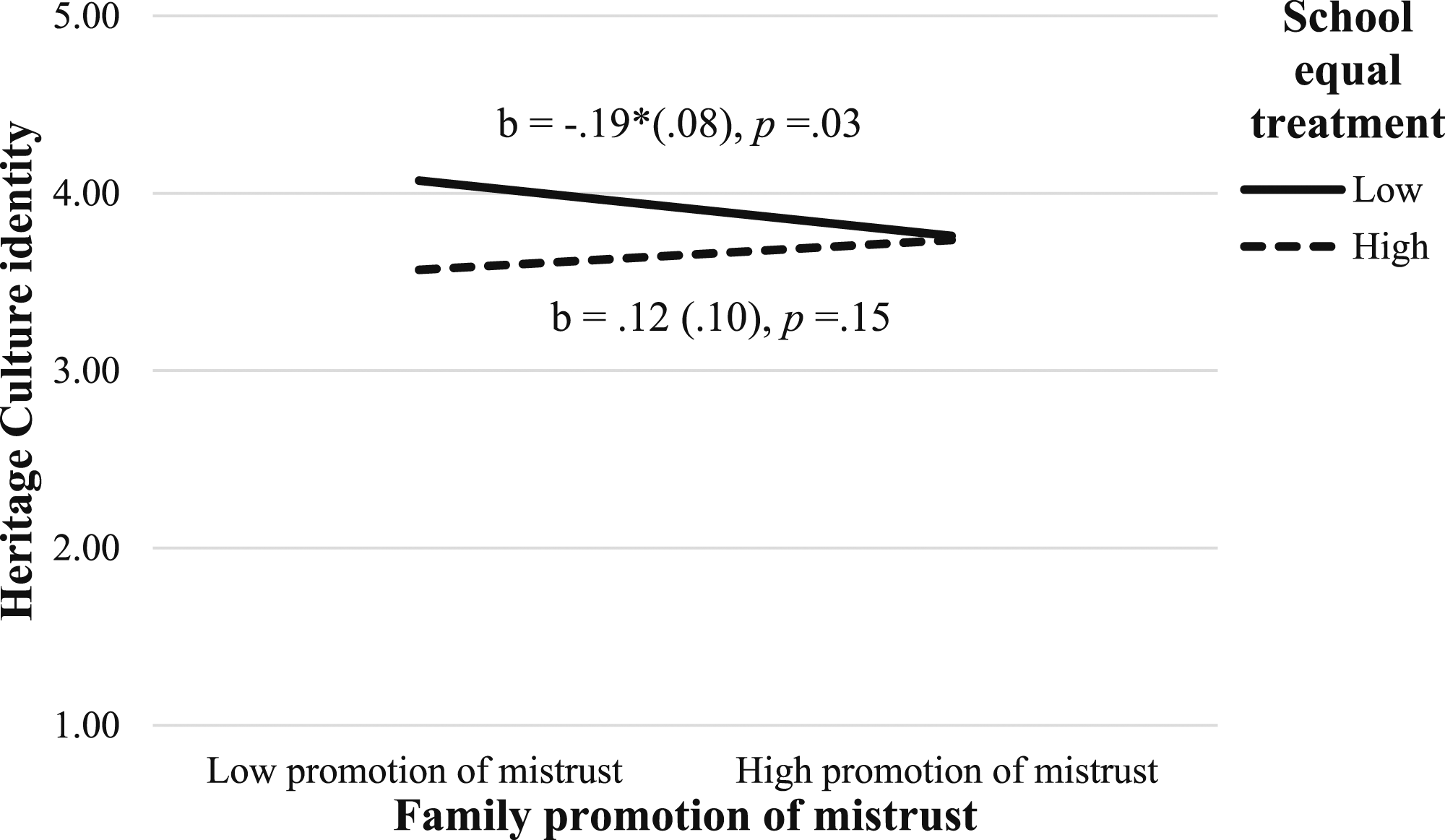
Discussion
For adolescents with ties to multiple cultures, cultural identity development is an important developmental task (Spencer et al., 2015) and positively relates to psychological well-being and academic achievement (Miller-Cotto & Byrnes, 2016; Rivas-Drake et al., 2014). Adolescents’ cultural identities are informed by the ethnic-racial socialization messages they receive in various contexts. This study explored separate and interacting relations of family and school ethnic-racial socialization to cultural identity. Our findings demonstrated stronger direct relations of school socialization (intercultural learning, equal treatment) than family (cultural pluralism, promotion of mistrust) to adolescents’ heritage culture and German identity. Moreover, heritage culture was strongest when youth at least in one context received messages highlighting strained and preferential intergroup dynamics.
Regarding demographics, gender and SES were related to heritage cultural identity. Girls reported higher heritage cultural identity than boys. Similarly, in a recent study with mid-adolescents in Germany, 14-year-old girls also reported higher sense of belonging to their ethnic group than boys (Veerman et al., 2022). While gender variations in heritage culture identity have not been observed consistently across other age groups (Hoffman et al., 2021), one possible explanation is that gender variations could be age specific as participants in the current study were also early to mid-adolescents. Second, lower socioeconomic status was related to higher heritage culture identity. Contextual factors such as neighborhood or peer group diversity might play a role in the link between SES and ethnic-racial identity. Studies found that those who report lower socioeconomic status are more likely to live in ethnically homogenous neighborhoods and form friendships with people who have similar ethnic-racial backgrounds (Sanchez & Garcia, 2012) and thus stronger ethnic-racial identities. Similarly, Faas (2009) found that 15 year-old German youth of Turkish heritage studying in schools with a majority coming from working-class families favored their ethnic identity more than those in middle-class schools. The schools we collected data from were in a federal state with a large population of immigrant descent. Therefore, contextual factors, such as socioeconomic status of the neighborhood and school context, might have played a role in the significant relation between individual-level SES and heritage culture identity.
In line with previous studies that found positive relations between parental cultural pluralism and ethnic identity (Brown & Ling, 2012; Juang et al., 2021), greater family cultural pluralism was related to higher heritage culture identity (supporting H1a). Thus, when families explicitly encourage their children to form same and cross-cultural friendships, adolescents may develop a strong sense of belonging to their heritage culture. Based on theoretical models of acculturation, families are grouped as a private (vs. public) domain, where socialization mostly happens in relation to the heritage culture (Arends-Tóth & Van de Vijver, 2004). Therefore, it is not surprising that family messages about forming culture-based relations was related to higher heritage culture identity. However, unlike our expectations (Benet‐Martínez & Haritatos, 2005; Mok et al., 2007), family cultural pluralism was not related to German identity (not supporting H1b). Thus, a family context displaying openness to form relations with people from other cultures did not predict adolescents’ endorsement of German identity. It is possible that instead of internalizing explicit and verbal encouragement, children may develop positive intergroup relations through more implicit messages such as observation of their parents having intercultural relations (Smith et al., 2015) which may help build belonging to the broader society (Umaña-Taylor et al., 2020).
Contrary to our expectations suggesting that family promotion of mistrust is a risk factor for identity (Atkin et al., 2019; Umaña‐Taylor & Hill, 2020), it was not significantly related to heritage culture and German identity (not supporting H2a and H2b). Nevertheless, this finding reinforces some of the empirical research reporting its non-significant associations with ethnic-racial identity (Huguley et al., 2019; Shen et al., 2021) and with national identity (Gartner et al., 2014). The items for mistrust refer to people from “other cultures” thus, depending on the target cultural group of mistrust messages, its relations to cultural identity might differ. For example, if the mistrust items referred specifically to discouraging relations with people who identify as German, adolescents might have been less likely to identify with German identity. Future studies could use more targeted measures and differentiate the mistrust messages towards different groups.
Higher intercultural learning at school was positively related to higher heritage culture identity (supporting H3a). These results are consistent with previous theoretical frameworks and empirical studies supporting the positive implications of learning about different cultures at school for heritage culture identity (Civitillo et al., 2017; Gay, 2015; Schachner et al., 2016). Higher intercultural learning at school was also positively related to higher German identity (supporting H3b). While this finding was also in line with our theoretical expectations (Phalet & Baysu, 2020; Schachner, 2019), it was contradictory to previous empirical work that found no significant relations between cultural pluralism at school and German identity among adolescents (Schachner et al., 2016). Yet, Schachner et al. (2016) measured cultural pluralism as a broad dimension which included heritage learning, intercultural learning and multicultural learning. Our study only explored the relations of intercultural learning. Therefore, it might be that intercultural learning as a subscale of cultural pluralism may have stronger relations to heritage culture and national identity development among adolescents. Overall, the specific focus of intercultural learning on improving positive relations between different cultures might have the power to facilitate embracing two cultural identities (heritage culture and German) for adolescents.
Higher equal treatment was related to lower heritage identity (not supporting H4a) and higher national identity (supporting H4b). The relation of higher equal treatment to lower heritage identity was unexpected. However, Schachner et al. (2016) also reported similar negative relations between equal treatment and ethnic identity, but only at the classroom (and not individual) level. Although higher equal treatment is theoretically expected to be a protective factor and predict higher cultural identity, equal treatment messages within historical and present unequal conditions in broader society might have been perceived as not meaningful within the classroom. As representative studies show, people of immigrant descent have been disproportionately impacted by discrimination in different parts of society, such as less access to and unfair treatment in educational contexts, the healthcare system, and housing market (DeZIM, 2023; Wieland & Kober, 2023). Therefore, students might have perceived the norms concerning equal treatment of cultural groups as a promotion of sameness, ultimately endorsing a color-evasive ideology, in a context where assimilation of immigrants to German society has been the dominant discourse around culture(s) (Ehrkamp, 2006). Socialization messages promoting sameness might be one explanation for the negative relations between equal treatment and heritage identity. In sum, through the promotion of equality (i.e., sameness) at school, adolescents might have felt less rejected and thus less inclined to strongly identify with their heritage culture group and more inclined to identify with the national group. Future studies could focus on different dimensions of equality/inclusion approaches used in schools (e.g., contact/cooperation; Schachner et al., 2021).
The main effect of equal treatment should be interpreted with caution, however, considering the interaction between equal treatment at school and family promotion of mistrust. We had expected to find higher equal treatment to buffer negative relations of promotion of mistrust for adolescents to maintain high levels of heritage cultural identity. Unlike our expectations, heritage culture identity was strongest when both family promotion of mistrust and school equal treatment were low – an incongruent content combination indicating dissonance between the content of the messages yet congruent in frequency. On the other hand, heritage culture identity was weakest when family promotion of mistrust was low, and school equal treatment was high – incongruent content and frequency. In sum, our results suggested that school equal treatment may promote identity assimilation as it relates to high German identity and low heritage culture identity, unless family intervenes by promoting mistrust to other groups. Low but still a sufficient amount of parental mistrust annihilates the assimilative effect of school equal treatment, at least for heritage culture identity (buffering effect). Further, our results provided no support of enhancing or compensatory effects. Therefore, these results contradicted our theoretical expectations highlighting congruent contexts as a resource and incongruent contexts as a challenge for forming a sense of identity (Bronfenbrenner & Morris, 2007; Spencer et al., 2015).
Based on frequencies of the messages, adolescents perceived high family cultural pluralism, school intercultural learning and equal treatment. On the other hand, they reported low family promotion of mistrust. Thus, overall, both family and school contexts displayed congruently high support for forming positive intergroup relations. However, the relations of these messages to heritage culture and German identities differed depending on the context. Therefore, although the motivation of the messages in both contexts was similar, their separate relations to cultural identity differed. For example, while high levels of cultural pluralism at home, and intercultural learning at school was related to higher heritage culture identity, equal treatment was related to lower heritage culture identity.
As a potential moderator, age did not moderate the relations of family and school ethnic-racial socialization to heritage and German identity encompassing exploration and commitment processes. The levels of ethnic-racial socialization content and two identity processes fluctuate (exploration and commitment) throughout adolescence (Byrd & Legette, 2022; Phinney & Ong, 2007). For example, Douglass and Umaña-Taylor (2016) found that until age 15, family cultural socialization had strong relations to both ethnic-racial identity exploration and resolution. However, during later adolescence (after age 15), the relations of family cultural socialization with identity exploration became stronger while the relation with resolution weakened. Future research could test the interacting relations of family and school socialization contents with two processes of cultural identity development (exploration and commitment) separately.
Limitations and Future Directions
Our study has some limitations related to the study design and measures. The study has a correlational design therefore, we cannot claim causality among the study variables. Most of our intercultural learning and equal treatment items referred broadly to the school context, but few items specifically referred to the teachers as one of the agents within the context. A clear distinction and examination of socialization contexts and multiple agents (teachers, peers) is necessary as developmental outcomes might differ depending on the agent, for example, for discrimination (Benner & Graham, 2013; Civitillo et al., 2023). Therefore, future studies should include measures of socialization messages across multiple agents within family and school contexts. Furthermore, as Wang and Benner (2016) did in their study, using similar items across contexts could better operationalize congruent and incongruent messages and identify overlapping messages across contexts. In addition to self-report measures, observational methods using video recordings of discussions between conversation partners could be used to check the reliability of the self-reported socialization messages (Smith-Bynum, 2023). For example, observational methods could provide insights into how equality messages are conveyed at schools to better understand the negative relations of equal treatment at schools to heritage culture identity.
Heritage culture and German identity do not necessarily develop separately, but potentially interact and inform one another. Therefore, the degree to which these identities are compatible or in conflict has been the question of bicultural identity integration research (Nguyen & Benet-Martínez, 2013). Future studies could test to what extent there are direct and interacting relations of family and school ethnic-racial socialization to bicultural identity integration using recent scales (Huynh et al., 2018). As some youth identify with multiple cultural groups (e.g., Polish-Hungarian-German), measures capturing the integration of multiple identities beyond a dichotomy should be considered. In addition, future research could test the interactive effects of incongruent messages on other developmental outcomes such as well-being, family and peer relationships and school achievement. Importantly, adolescents are not just passive receivers, they display agency through reflections of these messages and when deciding whether to internalize or reject them (Jones & Rogers, 2023). Our study design did not allow us to display the process of negotiation of the incongruent messages. Future studies could use mixed method designs to identify when, where, and how adolescents assert their agency. Our data were collected in culturally diverse schools and neighborhoods of a highly diverse state in Germany. Future studies in other national contexts could center the interactions of various components of structural diversity (e.g., state, neighborhood, school, classroom) and socialization content across multiple contexts to test these relations.
Conclusion
The present study contributes to the ethnic-racial socialization literature centering the interactions between multiple social contexts (Miklikowska et al., 2019; Sladek et al., 2021, 2022). For families, our results demonstrate the benefit of promoting same and cross-cultural relations for adolescents to develop a positive heritage culture identity. For schools, the current study extends previous findings demonstrating benefits of engaging in intercultural learning for various developmental outcomes (Aral et al., 2022; Moscardino et al., 2019). Thus, it also highlights the necessity of ensuring teachers are able to create culturally inclusive classrooms. Although teachers are often inclined to foster equal treatment in culturally diverse classrooms (Civitillo et al., 2017), the contradictory (negative or null) relations of equal treatment to cultural identity in school context should be investigated further (Aral et al., 2022; Schachner et al., 2016). As long as youth receive messages highlighting strained and preferential intergroup dynamics at least in one context (in our case this was family promotion of mistrust), they may develop a stronger heritage culture identity. Given the interacting relations, understanding how adolescents construct their cultural identity while navigating various contexts will need more attention.
Supplemental Material
Supplemental Material - The Social Contexts of Cultural Identity Among Adolescents of Immigrant Descent: Separate and Interacting Relations of Family and School Ethnic-Racial Socialization
Supplemental Material for The Social Contexts of Cultural Identity Among Adolescents of Immigrant Descent: Separate and Interacting Relations of Family and School Ethnic-Racial Socialization by Tuğçe Aral, Linda P. Juang, Miriam Schwarzenthal, Maja K. Schachner, and Byron G. Adams in The Journal of Early Adolescence
Footnotes
Declaration of Conflicting Interests
The author(s) declared no potential conflicts of interest with respect to the research, authorship, and/or publication of this article.
Funding
The author(s) received no financial support for the research, authorship, and/or publication of this article.

Supplemental Material
Supplemental material for this article is available online.
Notes
Author Biographies
References
Supplementary Material
Please find the following supplemental material available below.
For Open Access articles published under a Creative Commons License, all supplemental material carries the same license as the article it is associated with.
For non-Open Access articles published, all supplemental material carries a non-exclusive license, and permission requests for re-use of supplemental material or any part of supplemental material shall be sent directly to the copyright owner as specified in the copyright notice associated with the article.
