






Abstract
The paper investigates gender differences in coolness dynamics among early and middle adolescents in a Hungarian panel dataset, which followed students from grade 5 (age 11–12) to grade 8 (age 14–15). Drawing on Gender Prototypicality Theory, we expected significantly different gendered patterns in the association between coolness and various forms of aggression, academic performance, physical attractiveness, BMI, and two forms of risk behavior (smoking, drinking). However, our multilevel models showed that behaviors traditionally considered masculine tended to be associated with coolness for both sexes, but in particular for girls. Some traditionally masculine behaviors (such as verbal aggression, smoking, or lower GPA) tended to be more strongly or only associated with status among girls. On the other hand, while physical attractiveness was associated with status for both sexes, this association was stronger among boys. Cultural and contextual explanations, as well as policy implications, are also discussed.
Introduction
Status among their peers is one of the most central concerns for adolescents (Coleman, 1961; LaFontana & Cillessen, 2010). A significant body of research has demonstrated that one’s position in the status hierarchy is associated with a wide variety of developmental and academic outcomes including students’ mental health, well-being, academic (dis)engagement, and engagement in different forms of risk behavior (Rubin et al., 2015). Importantly, similarly to rejected and low-status peers, high-status peers are also often at risk of negative outcomes (e.g., Engels et al., 2017; Mayeux et al., 2008; Prinstein et al., 2011; Schwartz & Hopmeyer Gorman, 2011). Further, high-status adolescents have a strong influence over the norms of the peer group (e.g., Gommans et al., 2017; Sandstrom, 2011), thus they can actively contribute to the spread of both anti- and pro-school values, verbal and physical violence, and different forms of risk behavior, which underlines the salience of their investigation.
In the peer status literature, generally, two forms of status have been distinguished: one that is related to the extent one is liked or disliked by their peers (called acceptance, preference, or “sociometric” popularity) and one that is related to the power, prestige, and visibility of the individual within their peer group (most typically measured by peer perceived popularity or coolness) (Mayeux et al., 2011; van den Berg et al., 2020). The two constructs are moderately correlated in early adolescence, but this association gets weaker as students progress toward higher grades, especially in the case of girls (van den Berg et al., 2020). Further, the two status dimensions have been associated with different behavioral and academic profiles: widely liked students are generally prosocial, low in aggression, and academically engaged, while students who are perceived as popular but are not well-liked tend to be more aggressive and sometimes academically disengaged (de Bruyn & Cillessen, 2006; Rodkin et al., 2000; van den Berg et al., 2015).
It has been widely documented in the literature that different forms of peer relations, such as friendships or romantic relations, show significant differences by gender (Furman & Rose, 2015). Similarly, differences have also been observed in the case of peer status. Those boys who are perceived as good-looking, athletically skilled, dominating over others, and involved in disruptive behaviors tend to be perceived as popular (e.g., Adler & Adler, 1998; Mayeux & Kleiser, 2020; Rose et al., 2011). In the case of girls, perceived popularity is predominantly associated with physical attractiveness, prosocial behavior, and as pupils get older with relational aggression (the ability to manipulate social relations) (e.g., Adler et al., 1992; Mayeux & Kleiser, 2020; Merten, 1997; Rose et al., 2011). Theoretically, it has been proposed that, in adolescence, popularity is disproportionately attributed to those peers who possess characteristics or display behaviors that are considered “gender-typical” (Mayeux & Kleiser, 2020). However, what is considered gender-typical may be culture-specific, and most of our knowledge about peer status comes from the North American and North and Western European context (for a few exceptions, see e.g., Lu et al., 2018; Niu et al., 2016 on Chinese adolescents). Therefore, it seems important to explore the development of gender differences in status dynamics in other cultural-geographical areas as well.
Although the reputational status dimension is generally measured by peers’ perception of popularity, recently, a number of studies have used “coolness” instead (e.g., Jamison et al., 2015; Kiefer & Wang, 2016; Wilson & Jamison, 2019). While the two constructs are not identical, they are closely related and both refer to a similar form of high social status that is distinct from social preference/acceptance (Bellmore et al., 2011, p. 778; Kiefer & Wang, 2016, p. 53). Coolness is a fluid social construct defined by adolescents themselves (Adler et al., 1992) and represents the “embodiment of some combination of attributes that wins approval or earns the attention of others” (Jamison et al., 2015, p. 384). Additionally, the construct of coolness can avoid the alternate connotations that may be associated with the concept of popularity (Jamison et al., 2015, p. 385). Preparatory interviews for the research presented in this paper also found significant ambiguities related to the meaning of the Hungarian word for popularity (népszerűség).
While gender differences in popularity have already been studied in the literature, less is known about gender differences in coolness dynamics. Some studies have found a positive association between coolness and relational aggression in the case of girls (Kiefer & Wang, 2016) and a negative association with academic reputation in the case of boys (Jamison et al., 2015). The current study addresses this gap by exploring gender differences and gender-specific patterns in coolness dynamics in a Hungarian primary school dataset that followed students from grade 5 (age 11–12) to grade 8 (age 14–15). In Hungary, relatively strong gender stereotypes and traditional gender norms exist (European Commission, 2017), which suggests that a strong association between gender typicality and peer status may be expected. This association would presumably be stronger than in the case of the “Western” samples in the literature. Since status is associated with various developmental and academic outcomes, it seems important to see whether its physical and behavioral correlates follow a strictly gendered pattern.
Gender Prototypicality Theory
Although peer status is an empirically widely documented phenomenon in the Western literature, there are few theoretical approaches that address its emergence, functioning, or consequences. One exception is the Gender Prototypicality Theory (GPT) of popularity proposed by Mayeux and Kleiser (2020). According to GPT, popularity emerges in early adolescence as a distinct form of peer status as the result of intensifying cross-sex interactions and in response to “youth’s developing identities as romantic and sexual beings and their desire to be seen as mature and ready for romantic relationships” (Mayeux & Kleiser, 2020, p. 296). Consequently, characteristics that are expected to attract opposite-sex attention gain significance and these characteristics follow a gendered pattern. In the Western context, opposite-sex attention is generally related to dominance, activity, and physical attractiveness in the case of boys, and to physical attractiveness and prosocial behavior (helping, caring for others) in the case of girls. As a result, popularity is disproportionately ascribed to those peers who possess these gender-typical traits and exhibit gender-typical behaviors (Mayeux & Kleiser, 2020).
Empirical research, as will be outlined below, does provide support for GPT. Additionally, studies that directly investigated the relationship between popularity and peer-perceived gender-typicality also found a positive association between the two constructs (Jewell & Brown, 2014; Kleiser Polk & Mayeux, 2023). Although GPT addresses the emergence and functioning of popularity, it can be extended to other related constructs. For instance, Kleiser and Mayeux (2021) tested the association between a variety of popularity-related attributes and gender-typicality in physical appearance and extracurricular activities and interests. Their experimental study found a positive relationship between gender-typicality and most popularity-related attributes (including coolness) among first-year college students.
It is worth mentioning that the emergence of popularity as a distinct form of peer status during early adolescence coincides in the United States and the Netherlands, where the bulk of the related literature comes from, with the transfer from elementary to middle school (US) or high school (Holland). Indeed, the related literature largely draws on the idea that the new, larger peer group and the increased opportunities for cross-sex interactions do change peer dynamics (e.g., Cillessen & Mayeux, 2007; Pellegrini & Long, 2007). However, not all school systems have this transfer at around the age of 12. For example, the vast majority of Hungarian students go to elementary school for eight years and transfer to high school at around the age of 14, which may have an impact on how the gendered patterns of status dynamics play out.
Gender Differences in Coolness and Popularity
This section summarizes the empirical literature on gender differences related to the reputational status constructs “popularity” and “coolness”. These differences have primarily been documented with regard to different forms of aggression, academic engagement, physical attractiveness, and, to a smaller degree, different forms of risk behavior. As most of the literature comes from the United States and the Netherlands, the findings presented below refer to these two countries unless otherwise indicated.
The qualitative, primarily ethnographic, literature on popularity 1 has long documented gender differences in status dynamics. This literature has found that popular boys are athletic, physically strong (able to intimidate and dominate others), academically disengaged, involved in disruptive behaviors, and successful in cross-sex interactions. In contrast, popular girls have good social skills (they are “nice”, but also “mean” and manipulative), they are fashionable (and consequently relatively wealthy), and are perceived as attractive, especially by boys (e.g., Adler & Adler, 1998; Adler et al., 1992; Eder, 1985; Merten, 1997). Ethnographic and interview findings from the United Kingdom (e.g., Duncan, 2004; Duncan & Owens, 2011) and Canada (e.g., Currie et al., 2007) also underline the importance of “meanness” (i.e., relational and overt verbal aggression) in girls’ popularity. Quantitative research on larger survey samples has often found similar results, but the presence and scale of gender differences are often more limited (Rose et al., 2011). The following paragraphs will primarily focus on these quantitative findings.
The association between status and different forms of aggression has been widely covered in the literature (for a review, see Mayeux et al., 2011; for meta-analyses, see Casper et al., 2020; Wiertsema et al., 2023). Quantitative studies tend to distinguish between two types of aggression: direct/overt aggression (such as pushing, hitting, or mocking someone) and indirect/relational aggression, which aims at sabotaging the other person’s reputation and social relations (such as spreading gossip or excluding someone). While both forms of aggression have been positively associated with popularity, the association with overt aggression has been found to be stronger for boys (e.g., Waasdorp et al., 2013). In the case of relational aggression, most quantitative studies did not find statistically significant gender differences (Casper et al., 2020; Rose et al., 2011). However, a few studies did find the latter association to be stronger for girls (e.g., Cillessen & Mayeux, 2004; Rose et al., 2004). Additionally, some studies found that after controlling for relational aggression, the effect of overt aggression on popularity became non-significant (e.g., Rose et al., 2004; Waasdorp et al., 2013). With regard to coolness, although research has also underlined its positive association with overt (Bellmore et al., 2011; Kiefer & Wang, 2016; Rodkin et al., 2000, 2006) and relational aggression (Bellmore et al., 2011; Hoff et al., 2009), less is known about gender differences. With respect to relational aggression, Kiefer and Wang (2016) found that its association with coolness was only statistically significant in the case of girls, while Hoff et al. (2009) found no gender differences in the association between either form of aggression and coolness. Research studies conducted in non-Western contexts also found a positive association between popularity and aggression in Chinese 2 samples (Lu et al., 2018; Niu et al., 2016; Schwartz et al., 2010) and a positive association between popularity, coolness, and aggression in a Chilean sample (Berger et al., 2015). However, studies that investigated gender differences in this association found no gender effect in early and middle adolescence (Lu et al., 2018; Schwartz et al., 2010), only towards the end of high school (Lu et al., 2018). Additionally, a recent study among Korean children and early adolescents (Kim & Cillessen, 2023) found that overt aggression negatively predicted popularity without gender differences. Interestingly, relational aggression was positively associated with popularity for boys but not for girls.
Importantly, most quantitative studies do not distinguish between physical and overt verbal aggression, but conflate them into one variable. On the other hand, ethnographic studies do distinguish between these two forms of overt aggression. They suggest that boys’ popularity is associated with being “tough”, i.e. both physically and verbally dominating/intimidating, while verbal intimidation is also associated with girls’ popularity (e.g., Adler & Adler, 1998; Eder, 1985; Eder et al., 1995).
Similarly, physical attractiveness has also been shown to be an important predictor of reputational status for both sexes. Ethnographic (e.g., Adler et al., 1992) and some quantitative studies (e.g., Closson, 2009) suggest that it is more important for girls, while most quantitative studies did not find significant gender differences (Rose et al., 2011). Importantly, what counts as physically attractive is culturally defined and may show gendered patterns (Murnen & Karazsia, 2017). For instance, Wang et al. (2006) found a negative linear association between (self-reported) body size and (peer-perceived) popularity among girls but a curvilinear relationship in the case of boys, where both thin and heavy body shapes were associated with lower levels of popularity, while muscular body shapes were associated with the highest level of popularity.
Another area widely investigated in the literature is the relationship between school engagement and peer status. Studies on both popularity (Engels et al., 2017; Hopmeyer Gorman et al., 2002) and coolness (Kiefer & Wang, 2016) have found positive association with different forms/measures of school disengagement. Although quantitative studies typically have not found gender differences (Rose et al., 2011), qualitative results show a stronger connection between popularity and disengagement, and unpopularity and engagement, in the case of boys (e.g., Adler et al., 1992; Read et al., 2011). With regard to academic performance, Hopmeyer Gorman et al. (2002) found a slight negative association between GPA and popularity, while Meijs et al. (2010) found no statistically significant association. Neither of the two studies found gender differences. Some studies on coolness have investigated its relationship with academic reputation (Jamison et al., 2015; Wilson & Zhao, 2021), a performance-related construct. Wilson and Zhao (2021) found a positive association between academic reputation and coolness in late childhood and early adolescence (grades 3–6) in their urban African American sample, with this association weakening by each grade but without gender differences. Jamison et al. (2015) investigated a racially mixed early adolescent sample (grade 7) and found that in the autumn semester academic reputation was positively associated with coolness for girls but not associated for boys. In the spring semester, there was still a positive association for white girls, but the association became negative for white boys and there was no association for African American girls.
Finally, reputational status has generally been positively associated with different forms of risk-taking activities (risk behavior) including substance use and sexual activity (e.g., Franken et al., 2017; Hawke & Rieger, 2013; Mayeux et al., 2008; Prinstein et al., 2011). However, this relationship depends on multiple factors including gender and the level of peer status. For instance, Prinstein et al. (2011) found that popularity increases were associated with higher levels of cigarette use only for peers with average levels of popularity, while among already popular girls, increases in popularity were negatively associated with cigarette use.
The Hungarian Context
Since the literature on peer status predominantly comes from Northwestern Europe and North America, it may be useful to consider characteristics of the Hungarian context. According to the work of Geert Hofstede and his colleagues on cultural dimensions, Hungary and the Central and Eastern European region are different from both Northwestern Europe and the “Anglo” countries (US, UK, Canada, Australia, Ireland, and New Zealand). While Hungary scores similarly on power distance and individualism to these countries, it scores significantly higher on uncertainty avoidance and restraint (Hofstede et al., 2010). In countries high in individualism, behaviors related to competition (e.g., athleticism, aggression) may be associated with higher reputational status than in more collectivist contexts (Bukowski, 2011). The higher restraint score on the indulgence-restraint dimension can imply that Hungarian adolescents may experience stronger pressure to adhere to social norms than their “Western” peers. However, support for the first assumption is mixed. As we have seen, studies among Chinese adolescents found a positive association between popularity and aggression (Lu et al., 2018; Niu et al., 2016), while a Korean study (Kim & Cillessen, 2023) found a positive association with relational aggression but negative association with overt aggression. With regard to the second assumption (adherence to social norms), the Hungarian population has shown one of the highest levels of gender stereotypes among the member states of the European Union (e.g., European Commission, 2017, pp. 5–7), while traditional gender roles and the fight against “gender ideology” has also long been central in the Hungarian right-wing government’s public discourses (e.g., Kováts & Pető, 2017). Consequently, the question arises to what degree these social norms and political discourses “trickle down” to adolescents’ everyday practices and behavior, including the (potentially) gendered patterns of status dynamics. Group interviews conducted at the end of grade 6 (age 12–13) with a subsample of the sample used in this paper showed that pupils’ accounts of popularity followed a gendered pattern similar to what has been described in the literature. However, while the lack of “masculinity” was negatively judged in the case of boys, no similar discourses of “unfemininity” emerged, which implies that gender norms were more rigid and had a stronger influence on boys’ peer status.
Present Study
In this paper, we investigate gender differences and gender-specific patterns of coolness dynamics among Hungarian early and middle adolescents using a Hungarian panel dataset that followed students from grade 5 (age 11–12) to grade 8 (age 14–15). We have argued above that coolness is a closely related but distinct construct from popularity, which is defined by adolescents themselves, and can effectively avoid the alternate connotations that are related to being popular. Indeed, preparatory interviews prior to the survey research showed that pupils were confused about the meaning of popularity in grade 4 (age 10–11) (cf. Mayeux & Kleiser, 2020; van den Berg et al., 2015). On the other hand, group interviews conducted in grade 6 showed that by that time, most students had an understanding of the meaning of popularity, which they frequently equated with coolness. They sometimes also distinguished „good” and „bad” types of popularity (the latter typically referred to aggressive behavior and social manipulation). This suggests that in the Hungarian context, at least during the early waves of the panel data collection, coolness may have been a more straightforward conceptualization of peer status than popularity.
Based on the literature, we expect gender differences in the association between coolness and the various forms of aggression, academic performance, physical attractiveness, body shape, and risk behavior. Since Hungarian society is a predominantly individualistic society with relatively strong social constraints and conservative values regarding traditional gender roles, we expect similar overall associations to the ones observed in Western literature, but with more marked gender differences. First, with regard to aggression, we hypothesize that physical aggression will be positively associated with coolness only in the case of boys, while overt verbal aggression and relational aggression will be positively associated with coolness for both genders. We expect the positive association between relational aggression and coolness to be stronger for girls. Second, we expect physical attractiveness to be positively associated with coolness for both genders, but more strongly for girls. In line with Western cultural ideals of body shape, we expect a negative linear association between body mass and coolness for girls, and a curvilinear association for boys, where both high and low body mass would be more negatively associated with status than the “normal” BMI range. Unfortunately, we cannot distinguish between muscular and overweight body shapes in our data, which could be a relevant distinction in the case of “heavier” boys (see Wang et al., 2006). Nevertheless, considering the age range of our sample (age 11–15), we assume that muscular boys would mostly still fall within the “normal” range of body mass. Third, we expect the association between academic performance and coolness to be positive for girls and non-significant for boys. We have seen above that, in the American context, the association between coolness and academic reputation (i.e., peer-perceived academic performance) was positively associated up to grade 6, but in grade 7 the association turned negative in the case of boys (Jamison et al., 2015; Wilson & Zhao, 2021). Unfortunately, our dataset does not contain a measure of academic reputation, but it does contain the end-of-semester grades of students. In the Hungarian context, grades are widely known by peers, therefore the actual GPA and academic reputation may approximate each other well. Further, we expect cultural differences between the Hungarian and the American contexts. Among American adolescents, the negative relationship between (reputational) status and academic performance may be historically rooted in the anti-intellectualism of the wider society (Garner et al., 2006). We expect such anti-intellectualism to be less dominant in the Hungarian context, thus we expect the association for girls to remain positive and for boys non-significant throughout the observed time period. Finally, with regard to different forms of risk behavior, our dataset contains information on alcohol consumption and smoking. Due to the relatively young age of our sample (age 11–15), we do not expect a strong association between these behaviors and peer status. However, we tentatively hypothesize that these behaviors may be weakly but positively associated with coolness for boys and weakly but negatively for girls.
Method
Participants and Procedure
The data comes from a six-wave panel dataset collected among Central and Northern Hungarian primary school students between 2013 and 2017. The survey questionnaire focused on ethnic segregation, status hierarchies, and social dynamics among pupils. Originally, data collection was planned for four waves, and data was collected once per semester in grades five and six. This was subsequently extended on a smaller subsample with two additional waves in the spring of grades seven and eight. The data was collected through self-administered surveys that students completed on tablets under the supervision of trained research assistants on school premises during regular teaching hours. The data collection took the time period of one school class (45 minutes) in each classroom. Participants were assured that their answers would be kept confidential and only used for research purposes. Since respondents were under-aged, parental consent was obtained for each participant. A written consent form was delivered to the parents of all students prior to data collection with the help of the schools. Only those students who brought back the signed consent form could complete the survey. Additionally, end-of-semester grades for the semester preceding each wave were obtained from schools.
The data used in this paper includes the second, fourth, fifth, and sixth waves of the original dataset (the spring data collection for each grade), which were renamed to waves one to four for the sake of convenience (corresponding to grades 5, 6, 7, and 8, respectively). The sample includes 1131 pupils from 58 school classes in grade 5, 1054 pupils from 53 classes in grade 6, 743 students from 39 classes in grade 7, and 663 students from 37 classes in grade 8. With regard to the socio-demographic composition, the proportion of male students varied between 50% and 54%, the proportion of self-reported Roma ethnicity between 34% and 36%, and the average parental educational level between 2.6 and 2.7 (where 1 = primary school or lower, 4 = tertiary education). The parental consent rate was 92% in grade five, 97% in grade six, 95% in grade seven, and 96% in grade eight. With regard to the actual completion rates, in grade five, 88% of all students attending the classes completed the questionnaire, in grades six and seven 90%, and in grade eight 89%.
Measures
All measures presented below were collected at each time point with the exception of parental education, which was only collected in grades 6–8. Peer nominations were unlimited.
Peer Nominations
Coolness
Students were asked to select those peers from the list of all classmates whom they considered “cool”. Selected students were coded to 1, and all other students to 0. A score ranging from zero to 1 was then calculated for each student by aggregating incoming nominations and dividing them by the number of possible nominators (number of respondents in the class minus one).
Physical Aggression
Students were asked to select those peers from the list of all classmates who regularly pushed, hit, or beat them. A score ranging from zero to 1 was then calculated for each student in the same way as described above.
Verbal Aggression
Students were asked to select those peers from the list of all classmates who regularly mocked or insulted them. A score ranging from zero to 1 was then calculated for each student in the same way as described above.
Relational Aggression
Students were asked to select those peers from the list of all classmates whom they believed regularly talked about them with other classmates behind their backs. A score ranging from zero to 1 was then calculated for each student in the same way as described above.
Physical Attractiveness
Students were asked to select those peers from the list of all classmates whom they considered “pretty or handsome”. A score ranging from zero to 1 was then calculated for each student in the same way as described above.
Social Preference
Students were asked to indicate their relationship with all their classmates on a five-point scale: “I would never be friends with him/her” (−2), “I do not like him/her” (−1), “He/she is indifferent to me” (0), “I like him/her” (+1), “He/she is my good friend” (+2). A score ranging from −2 to +2 was calculated for each student by aggregating the scores they received and dividing them by the number of possible nominators (number of respondents in the class minus one).
Self-Reported Measures
Ethnicity
Students could choose from the following four options: “Hungarian”, “Roma”, “both Hungarian and Roma”, or “member of another ethnicity”. For the present analysis, students who selected the second or the third option at least once during the four waves were coded as “Roma”, the others as “non-Roma”. While switches between ethnic categories did occur (primarily between the “Roma” and “Roma and Hungarian” options), the stability of our “Roma” and “non-Roma” categories was between 90% and 94% in consecutive waves, and 88% between the first and the last wave. Since 12–14% of ethnicity data is missing in each wave, this imputation was important for our regression models. The “member of another ethnicity” option was only selected by 1–3% of the respondents in each wave.
Family Education
Students were asked about their parents’ educational background in grades 6–8. They could select from the following seven options: “Did not finish primary school”, “primary school”, “trade school” (szakiskola), “vocational school” (szakmunkásképző), “maturity exam”, “college”, or “university”. The maturity exam/matura (in Hungarian: érettségi) is an exit examination students take at the end of general secondary education (gimnázium) and in technical secondary schools (szakgimnázium, previously called szakközépiskola) in several Central and Eastern European countries. The other two technical school types do not include the matura. In order to simplify the taxonomy, the answers were recoded into four categories: “primary school or lower”, “technical school qualification”, “maturity exam”, and “higher education”. This categorization also reduces the potential error of student reports as pupils may get confused about the different types of secondary education or whether their parents have college or university degree, but they probably have a good understanding whether, for instance, their parents have the maturity exam certificate, or whether they have a higher education degree. To ensure the largest reliability of the answers (and since parental education typically does not change), we used grade 8 data for parental education and only imputed from grades 6 or 7 if grade 8 data were missing. If parents had different levels of education, we took into consideration the higher of the two.
Smoking
Students were asked whether they smoked. They could choose from the following options: “yes, regularly”, “yes, but only in company”, “no, but I have tried it”, or “no, never”. Pupils were considered smokers if they selected one of the first two options.
Alcohol Consumption
Students were asked whether they drank alcohol. They could choose from the following options: “yes, at least once a week”, “yes, but rarely”, “no, but I have tried it”, or “no, never”. Pupils were considered “drinkers” if they chose one of the first two options.
BMI
Students were asked about their weight and height. The BMI scores were calculated following the
Grades
GPA
Grade point averages were calculated from the following four subjects: Hungarian grammar, Hungarian literature, mathematics, and history. For each wave, we used the end-of-semester grades students got at the end of the previous semester. The Hungarian school system uses a five-point grading scale ranging from 1 (fail) to 5 (excellent).
Descriptive Statistics.
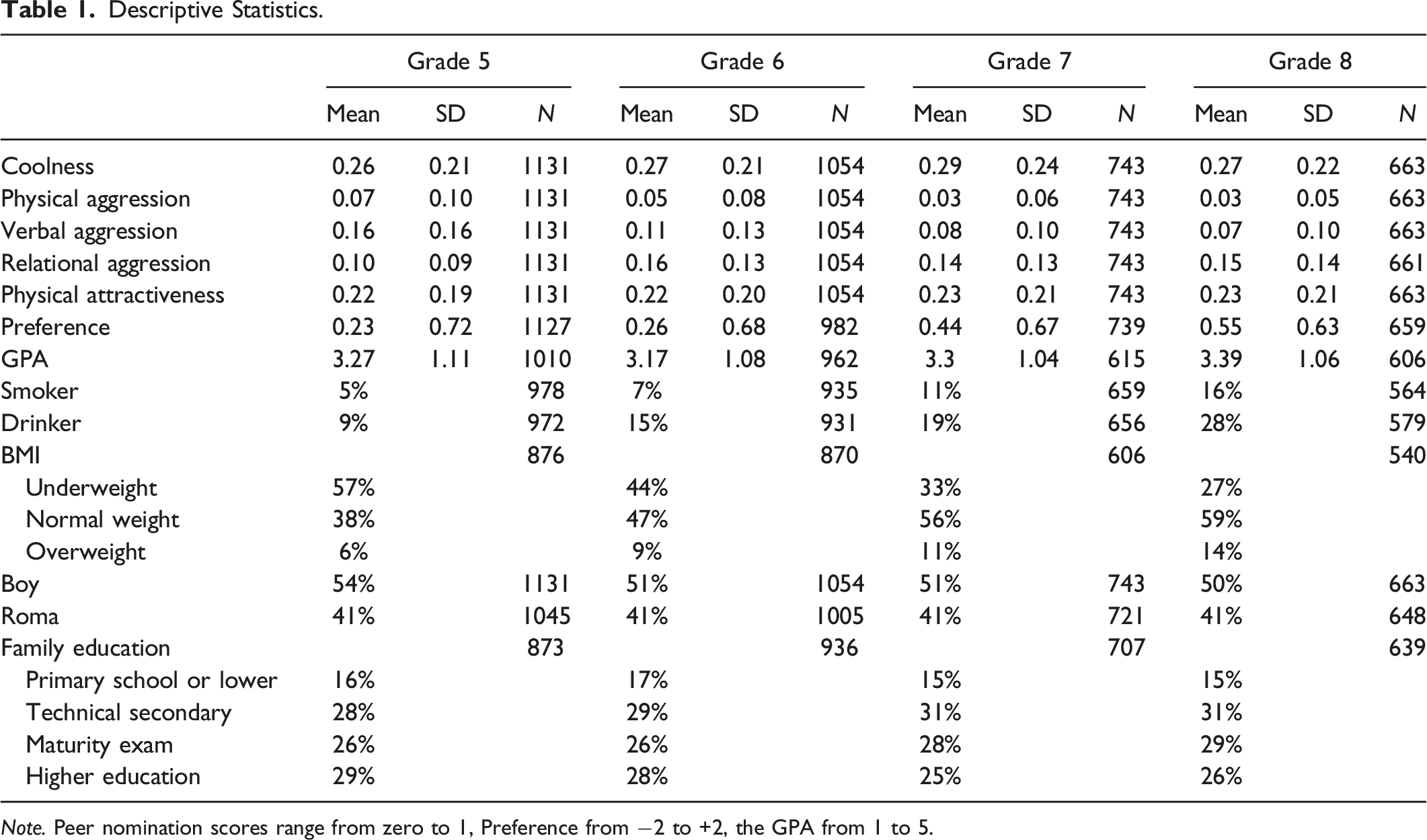
Note. Peer nomination scores range from zero to 1, Preference from −2 to +2, the GPA from 1 to 5.
Plan of Analysis
We applied multilevel regression models for data analysis: we built three-level correlated random effects (CRE) models (Antonakis et al., 2021; Wooldridge, 2016, pp. 445–447) with random slopes. In CRE models, the cluster means for predictor variables are also included to effectively decompose the within- and contextual effects. A simplified version of our models, without random slopes, is shown by the equation below:
While CRE models have several strengths, including the decomposition and correct estimation of the within and contextual effects, the appropriate modeling of interactions and random slopes poses some challenges (Schunck, 2013). The first is a technical issue related to the built-in interaction command of specific statistical software, which can be resolved by manually creating the interaction term and its cluster mean (Schunck, 2013, p. 74). For random slope CRE models, the interaction terms between the slope variables and their cluster means need to be added as controls (Antonakis et al., 2021, p. 467).
In our models, we considered different forms of aggression (verbal, physical, relational), physical attractiveness, social preference, and the GPA as time-varying independent variables and consequently involved them at all three levels, whereas gender, ethnicity, and family background were treated as time-invariant and consequently were included in levels 2 and 3 (the reasons for treating ethnicity as time-invariant were described in the Measures section above). Our first model (M1) involved these key variables of interest, while our second model (M2) also included two forms of risk behavior (drinking, smoking) and body mass. 4 We ran both models on the male and female subsamples separately in order to investigate whether status dynamics were qualitatively different between the two genders (cf., Rose et al., 2011). Our models had random intercepts at level 2 (individual) and level 3 (classroom) and random slopes for verbal aggression, relational aggression, physical attractiveness, and preference at the classroom level. Selection between the random intercept and different random slopes models were based on model fit shown by the Akaike information criterion (AIC) and the Bayesian information criterion (BIC). Spaghetti plots for these slopes can be found in the Appendix.
Further, we ran two additional sets of interaction models on the full sample. Our first set of models (M3, M4) added gender interactions to the two CRE models described above to compare effects between the two sexes directly. The second set involved a random effects model (M5) with time interactions (the waves of data collection) on the two subsamples to observe the temporal development of the investigated associations.
Since the dependent variable is a proportion and a relatively large number of participants scored zero in some of the peer nominations (coolness: 11%, physical attractiveness: 16%, relational aggression: 19%, verbal aggression: 34%, physical aggression: 58%), we also tried to run multilevel generalized linear models. We built CRE generalized linear models with logit link function and binomial distribution (as recommended for dependent variables which are proportions by Hox et al., 2017, Chapter 6). However, probably due to model complexity, the random slope models did not converge, and even the models with only random intercepts converged very slowly and with unrealistically large standard errors. At the same time, the coefficients showed similar trends to the linear CRE models.
Missing Data and Attrition
Panel attrition in the dataset is primarily related to class dropout: five classes dropped out between waves 1 and 2, 14 classes between waves 2 and 3, and two classes between waves 3 and 4. In total, 37 of the 58 classes (64%) participated in all four waves of data collection. With regard to pupils, 14% of the starting sample (N = 1131) dropped out by wave 2, 43% by wave 3, and 49% by wave 4. Attrited students were compared to their non-attrited peers on key variables in the wave before their attrition (Table A1 in the Appendix). The statistical significance of the differences between the two groups was judged by the Mann–Whitney U test in the case of peer nominations, preference, and GPA, while compositional differences along gender, ethnicity, and family background were assessed by Pearson’s chi-square test. Attrited students scored significantly lower on preference and GPA, and in grades 6-7 slightly but statistically significantly higher on verbal and physical aggression. In grade 7, they also scored lower on coolness. This aligns with the school research literature, which shows that non-participants tend to have lower status and adjustment than participants (Cillessen & Marks, 2017).
Besides attrition, respondents also have some missing data in certain variables (Table A2 in the Appendix). Missingness in GPA (11%) is related to the classroom level as grades were obtained from schools. Similarly, missingness in social preference scores (2%) is mostly related to a technical error during data collection that involved three classrooms in grade 6. Additionally, there are missing values due to pupils’ absence or item non-response in smoking (13%), drinking (13%), BMI (19%), ethnicity (5%), and family background (12%). Missingness in family background is partly due to the fact that five classes dropped out after the first wave, as this information was only collected in grades 6–8. On the other hand, scores calculated from peer nominations are available for almost all students, except for the preference scores mentioned above. In the case of variables with missing values due to pupils’ absence or item non-response, missing cases scored significantly lower on coolness, preference, relational aggression, physical appearance, and GPA than non-missing cases (statistical significance was judged based on the Mann–Whitney U test). This implies that students with these missing items, similarly to attrited students, tend to have lower peer status and school adjustment.
We assume that respondents’ missing values in our models are missing at random (MAR), that is, missingness can be explained by the observed variables in our dataset and is not related to unobserved variables. Drawing on the MAR assumption, participants’ missing data was addressed by multilevel multiple imputation. The imputed dataset was created in the Blimp 3 software (Keller & Enders, 2022) using fully conditional specification (FCS) taking into consideration the three-level structure of the data and all modelling variables (N of imputations = 20; burn-in iterations = 300,000; iterations = 10,000). The process was conducted separately on the male and female subsamples. The imputed dataset was analyzed in Stata using the mi estimate command and the same model specifications as the non-imputed models. In the case of multilevel models with incomplete interactive or nonlinear terms, the standard missing data handling procedures, including multiple imputation, may produce biased estimates (Enders et al., 2020). As some of the models presented in this paper contain incomplete interactive terms (the additional models with gender and time interactions), the results of multiple imputation need to be interpreted with caution in these models. 5
Finally, it is important to emphasize that nonrandom missingness may also be at play in some instances. In particular, in the case of smoking, drinking, and body mass, missingness may be related to the question itself: for instance, smokers may be less willing to answer the question about smoking than non-smokers. Similarly, panel attrition is likely to produce nonrandom missingness. We have seen above that most attrition is related to classes/schools leaving the study and attrited students and, consequently, classrooms had lower levels of peer status and GPA and higher levels of aggression than non-attrited students and classrooms.
Results
Pairwise comparisons of the average coolness scores over gender, ethnicity, smoking, and drinking were conducted in each wave on the full sample and the male and female subsamples (Table A3 in the Appendix). To test the statistical significance of these pairwise differences, the Mann–Whitney U test was applied. Results show that boys, Roma pupils, smokers, and “drinkers” had higher coolness scores than girls, non-Roma pupils, non-smokers, and non-drinkers, respectively, in all samples and each wave. The substantial difference (in most cases approximately .10 point) between boys and girls, as well as between Roma and non-Roma pupils, was statistically significant in all waves and samples. The difference between smokers and non-smokers was statistically significant in grades 6–8 in the full sample, but only in grade 8 in the male subsample and in grades 6 and 8 in the female subsample. Similarly, the difference between drinkers and non-drinkers was statistically significant in all grades in the full sample, but only in grades 5–6 in the male subsample and grades 6–8 in the female subsample.
Additionally, average coolness scores over family background and BMI categories (Table A3 in the Appendix) were compared by applying the Kruskal–Wallis test. Regarding family background, students with the lowest and highest levels of parental education tended to have slightly higher coolness scores than the other two categories. However, the Kruskal–Wallis test was statistically significant only in grade 8 in the case of the full sample and the male subsample. Concerning the BMI, overweight pupils tended to have lower coolness scores than the other two categories, especially among girls, while there was no clear trend between underweight and normal-weight pupils. The Kruskal–Wallis test was statistically significant in grades 6–7 on the full sample and the male subsample, but only in grade 5 on the female subsample. Importantly, in our sample, the proportion of smokers and drinkers was higher among Roma than non-Roma students (in the panel dataset it is 17% vs. 3% in the case of smokers, 25% vs. 10% in the case of drinkers). Similarly, more Roma than non-Roma students had lower levels of parental education (35% vs. 4% primary school or lower, 38% vs. 24% technical secondary qualification).
Bivariate Correlations With Coolness (Pearson’s R).
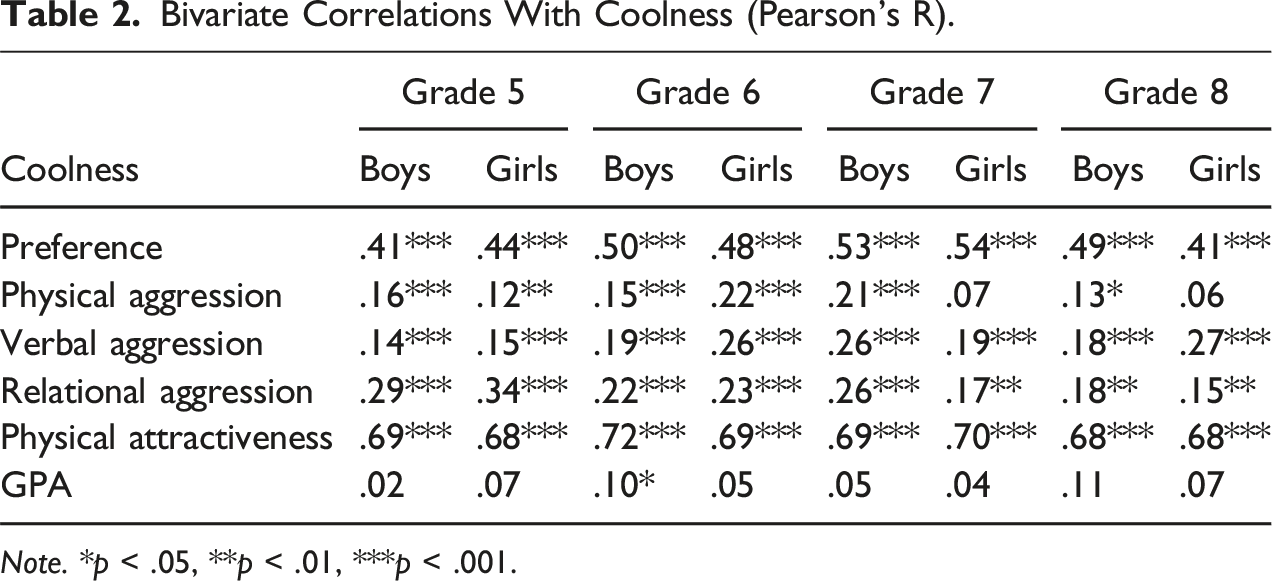
Note. *p < .05, **p < .01, ***p < .001.
Correlated Random Effects (CRE) Models. 6
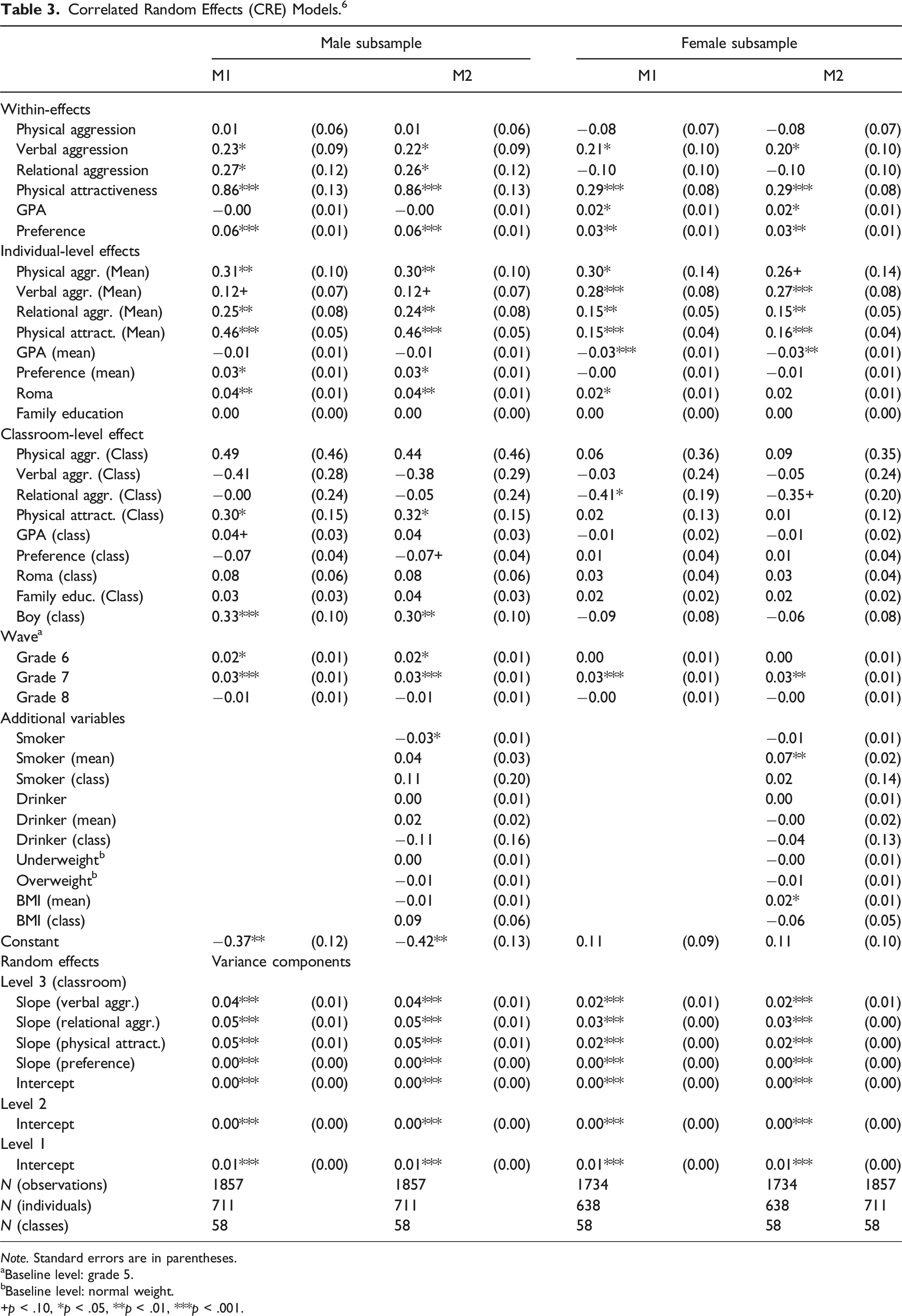
Note. Standard errors are in parentheses.
aBaseline level: grade 5.
bBaseline level: normal weight.
+p < .10, *p < .05, **p < .01, ***p < .001.
Gender Interaction Models (Full Sample).
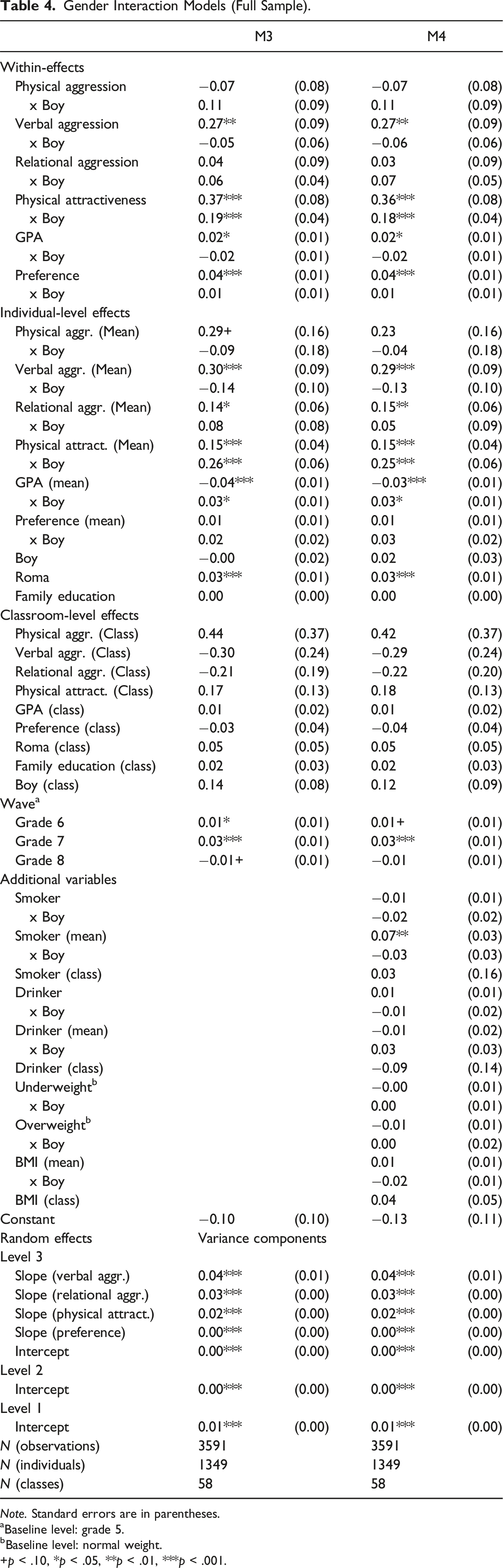
Note. Standard errors are in parentheses.
aBaseline level: grade 5.
bBaseline level: normal weight.
+p < .10, *p < .05, **p < .01, ***p < .001.
In order to investigate the temporal development of the observed associations, we interacted the key variables with time (waves) in the male and female subsamples in an additional random effects (RE) model (Table A4 in the Appendix). The reference category in all interactions was grade 5. The positive association between coolness and verbal aggression became statistically significantly stronger in higher grades for both genders: among boys in grade 7 and among girls in grade 8. Joint coefficient tests of the main and interaction terms show that physical aggression was only statistically significantly associated with coolness among boys in grade 5 (reference category), but not in grades 6, 7, or 8 (p = .18, p = .79, and p = .62, respectively). Among girls, the joint coefficient test shows that physical aggression was only associated with coolness in grade 6 (p = .05). With regard to relational aggression, the joint coefficient tests show that it was not statistically significantly associated with coolness in grades 6 and 8 among boys (p = .10 and p = .06, respectively), nor in grades 6, 7, and 8 among girls (p = .39, p = .08, p = .34, respectively). The time interactions show that the positive association between coolness and preference became stronger over time among boys but not among girls. The associations with physical attractiveness and GPA did not change over time. However, it is important to emphasize that, unlike CRE models, this RE model cannot decompose the effects of within-individual changes and between-individual differences, which, as we have seen above, can show a more refined picture.
Discussion
The paper investigated gender differences and gender-specific patterns in coolness dynamics among Hungarian early and middle adolescents. Based on gender prototypicality theory (Mayeux & Kleiser, 2020) and context-specific considerations, we expected similar associations to the ones observed in the “Western” literature, but with more marked gender differences. However, our results only partially support these expectations.
Regarding aggression, we hypothesized that physical aggression would only be associated with coolness in the case of boys, while we expected verbal and relational aggression to be associated with coolness for both genders. In the case of relational aggression, we expected this association to be stronger for girls. While bivariate correlations showed all forms of aggression to be associated with coolness in all waves and for both genders (except for physical aggression in grades 7–8 for girls), the multilevel models showed a more refined picture. In the separate models (M1-M2), contrary to our expectations, coolness was positively associated with the average levels of all three forms of aggression in the case of girls, while the average level of verbal aggression was not associated with coolness among boys. Interestingly, within-individual increases in relational aggression were positively associated with coolness among boys but not among girls. Additionally, within-individual increases in verbal aggression were positively associated with coolness for both genders. Therefore, it seems that all three forms of aggression can have some unique contribution to peer status, even after controlling for the other two types of aggression and various other variables. The models with gender interactions (M3-M4) found no statistically significant gender differences in these associations. The models with time interactions (M5) showed that the importance of verbal aggression increased over time for both sexes, while physical aggression and, interestingly, relational aggression were only associated with coolness in lower grades. It is also important to emphasize that there was significant classroom-level variation in the strength (and sometimes even in the sign) of the associations between coolness and verbal and relational aggression (see Figures A1-A3). This points to the importance of classroom-level peer norms in understanding status dynamics (see e.g., Dijkstra & Gest, 2015; Laninga-Wijnen et al., 2018).
While the positive association between reputational status and overt verbal aggression among girls can be explained by findings of the qualitative literature (e.g., Eder et al., 1995), the positive relationship between coolness and physical aggression is surprising and certainly contradicts the gendered expectations and traditional gender norms of the wider Hungarian social context. There may be two explanations for this. First, we have seen that, on average, boys had higher coolness scores than girls, which may align with the ethnographic observation that the construct of coolness is more linked to boys’ status (Adler et al., 1992). Therefore, it is conceivable that coolness is not only associated with dominance and influence, but also with “masculine” behavior in general, and girls who want to be considered cool have a higher chance of doing so by exhibiting such typically masculine behaviors as physical aggression. Alternatively, girls who apply physical aggression may “stand out” and get perceived more easily than boys who do the same. Research on masculinity norms (e.g., toughness, autonomy) does document adherence to such norms among girls, which has also been associated with lower levels of psychological and social well-being (Rogers et al., 2020). Second, we have seen that our sample contains a high proportion of ethnic Roma pupils. There is evidence in the literature that socially disadvantaged ethnic minorities sometimes create “oppositional” subcultures to majority school and societal values, which may involve physical violence more frequently than is the case of non-minority or non-disadvantaged girls (e.g., Eriksen, 2019). Research on masculinity norms has also found that ethnic minority girls and girls with lower socioeconomic backgrounds report higher levels of adherence to masculinity norms (Rogers et al., 2020). Bivariate correlations indeed show that physical aggression is weakly associated with coolness for Roma (0.13) but not for non-Roma (0.02) girls in our sample. Interestingly, the relationship works reversely for boys: the bivariate correlation between physical aggression and coolness is zero (0.002) for Roma boys, while there is a weak association for non-Roma boys (0.17).
We expected physical attractiveness to be positively associated with status for both genders but more strongly for girls. However, our gender interaction models showed that it was more strongly associated with coolness among boys. Further, the models with time interactions showed no developmental change in the association between coolness and attractiveness over time. Based on gender prototypicality theory, we could expect physical attractiveness to become increasingly important in status dynamics as pupils get older. Nevertheless, the lack of transition from elementary to middle/high school at the age of 12, and consequently the absence of a larger peer group and increased opportunities for cross-sex interactions, may have counterbalanced the effects of emerging romantic identities and intensifying cross-sex interest.
Regarding GPA, we expected a positive association with coolness among girls and no association among boys. Both the separate and the gender interaction models supported the expectation in the case of boys, while in the case of girls these models showed a slight positive association between improvements in GPA and coolness and a slight negative association between the individual average GPA and coolness. Importantly, we found no developmental changes in the association between GPA and status from grades 5 to 8. Although GPA reflects academic performance and not necessarily perceived or real academic engagement, its importance is crucial since grades and the knowledge they reflect on are strongly associated with the secondary school track pupils will take, which largely determines whether they would pursue post-secondary education and consequently their future labor market positions. Our results showing no or minimal association between status and GPA, and the lack of developmental changes in this association, are therefore reassuring.
With regard to risk behaviors (smoking, drinking), we expected a slight positive association with coolness among boys and a slight negative association among girls. However, our models showed a positive association between smoking and coolness among girls, but none of the other associations were statistically significant. This, in combination with the findings on physical aggression, suggests that high-status girls exhibit a variety of behaviors traditionally considered masculine to gain or maintain status. The lower association between attractiveness and coolness among girls may also contradict the expectations based on gender prototypicality. It seems that the attainment or maintenance of status, at least when status is measured by coolness, can be more successfully achieved among Hungarian early and middle adolescents by behaviors traditionally considered masculine for both genders, but especially for girls, in spite of more conservative cultural norms. It remains a question whether this association between masculinity and status pertains to later stages of adolescence among Hungarian girls, especially following the transition to secondary school at the age of 14. It is possible that this is simply a characteristic of early adolescence and/or the context of the investigated primary schools. Alternatively, it can also reflect on a shift toward less rigid gender norms for girls among Hungarian youth.
Finally, it is important to mention that in our models on the full sample without gender interactions (not shown in Table 4), being a boy was still positively associated with coolness, despite the involvement of the wide variety of independent and control variables. Therefore, it seems that gender has some unique contribution to coolness even beyond the exhibition of traditionally masculine behaviors.
There are some limitations to our research study. First, our sample comes from only two regions of Hungary, and thus, it is not representative of the Hungarian school population. However, we believe this limitation is counterbalanced by the high response rates, which are key to sociometric data collection, and by the wide variety of available variables in the dataset (including the distinction between different forms of aggression). Second, although we could investigate a wide variety of correlates of status, prosociality measures are missing from our data. The literature has documented some gender differences in prosocial behavior, while prosociality may also mediate the association between aggression and reputational status (e.g., Puckett et al., 2008). Third, our dataset contains dyadic, not reputational, measurements of the different forms of aggression. This results, most probably, in lower aggression scores, which, in fact, represents the proportion of classmates victimized by the given students or classmates with whom they are mutually aggressive towards one another. While the means of these scores are indeed low (see Table 1), the proportion of students not selected by any of their classmates is also relatively low: 58% in the case of physical aggression, 34% in the case of verbal aggression, and 19% in the case of relational aggression. This suggests that the majority of students are involved, at least to some degree, in some forms of aggression and aggression is a widespread phenomenon in the sample. It would be interesting to see whether reputational measures of peer aggression would result in stronger associations with status. Fourth, panel attrition also limits the generalizability of our findings. We have seen above that attrited students had, prior to their attrition, lower GPA and peer status and higher levels of aggression than their non-attrited peers. Although most attrition is related to the dropout of whole classrooms and a high response rate was maintained in the classes remaining in the study, attrited classes differed from non-attrited classes along some key indicators mentioned above.
Finally, there are some policy implications worth considering. First, interventions that weaken the positive association between peer status and aggression could be beneficial. While anti-bullying programs are increasingly implemented in many countries, they are so far less widespread in Hungary. Additionally, aggression between more or less equal parties should also be addressed. Although the widespread cultural ethos related to “toughness” for boys (and ethnic minority girls) and “meanness” for girls propagated and reinforced by popular culture and everyday discourses may be difficult to address at the school level, the redirection of pupils’ energy towards sports activities and arts may be more easily realizable. However, in the case of Hungary, this also requires significant infrastructural and human resources investments. Second, while the lack of a negative association between the GPA and status is reassuring, programs promoting a positive association would be beneficial. Most importantly, this could be achieved by programs helping underperforming students, who increasingly experience failure and frustration on a daily basis in the school setting. Third, we saw that the construct of coolness may be “biased” towards boys. We believe this is not a simple measurement issue, but it reflects a social reality where girls, on average, have lower status (conceptualized as power, prestige, and visibility) and less influence than boys do within the peer culture. Importantly, if girls want to increase their status, they may need to apply “masculine” behavior. However, they may be discouraged from doing so as it contradicts societal expectations. Therefore, educational practices that strengthen the voice and position of girls (and non-dominant boys) in classroom discussions and decision-making could be beneficial.
Supplemental Material
Supplemental Material - Gender Differences in Coolness Dynamics Among Early and Middle Adolescents
Supplemental Material for Gender Differences in Coolness Dynamics Among Early and Middle Adolescents by Ákos Bocskor in The Journal of Early Adolescence
Footnotes
Declaration of Conflicting Interests
The author(s) declared no potential conflicts of interest with respect to the research, authorship, and/or publication of this article.
Funding
The author(s) disclosed receipt of the following financial support for the research, authorship, and/or publication of this article: This work was supported by the Grantová Agentura České Republiky 23-07283M.

Data Availability Statement
The dataset used for the analysis belongs to the CSS-RECENS Research Group at the HUN-REN Centre for Social Sciences. The datasets generated and/or analyzed during the current study are available from the corresponding author upon reasonable request.
Supplemental Material
Supplemental material for this article is available online.
Notes
Author Biography
References
Supplementary Material
Please find the following supplemental material available below.
For Open Access articles published under a Creative Commons License, all supplemental material carries the same license as the article it is associated with.
For non-Open Access articles published, all supplemental material carries a non-exclusive license, and permission requests for re-use of supplemental material or any part of supplemental material shall be sent directly to the copyright owner as specified in the copyright notice associated with the article.
