






Abstract
Studies suggest that men and women with stronger gender stereotypes are more likely to report that men make funnier jokes than women. However, the extent to which this perception is influenced by social context remains unclear. Here, we attempted to provide initial evidence for this question by analysing the interaction between gender stereotypes and the perception and production of humour in 10- to 12-year-old children (N = 137) in Western Europe. The children rated the funniness of verbal jokes (humour perception) and created humorous jokes themselves (humour production). In humour perception, we found an effect of gender but no significant effect of gender stereotypes. Boys attributed the funniest jokes more often to boys than girls did. Overall, humour production was not significantly associated with gender stereotypes. However, children who rated themselves as being more feminine produced funnier jokes. In summary, this study did not find clear evidence that gender stereotypes influence how 10- to 12-year-old children perceive and produce humour.
Keywords
The Interaction Between Gender Stereotypes and Humour in Children
Humour is a phenomenon present in all human cultures and social contexts (Kennison, 2020; Vanutelli et al., 2024). Throughout life, we laugh and (at least try to) make others laugh (Hoicka & Akhtar, 2011; Reddy & Mireault, 2015). Humour has different forms: Humour production is the ability to produce funny remarks, create funny ideas, and make others laugh (Greengross et al., 2020). Humour perception refers to the ability to recognise that something is intended to be funny (Ruch & Hehl, 2010). In most cognitive models (Wyer & Collins, 1992), this process involves two complementary components. First, the listener or reader identifies an incongruity, meaning that part of the joke conflicts with what they initially expected based on the storyline. Second, the individual attempts to resolve this incongruity by finding an alternative interpretation that makes sense of the unexpected element. When this reinterpretation is successful, it often elicits a feeling of amusement.
Thus, humour perception includes both understanding the joke (detecting and resolving the incongruity) and appreciating it (experiencing it as funny). These two components are conceptually distinct: one can understand a joke without necessarily finding it amusing.
Already infants and preschoolers perceive and produce humour (Ger et al., 2024; Hoicka & Akhtar, 2011; Reddy & Mireault, 2015). These abilities continue to develop into early adulthood (McGhee, 2002). However, it remains an open question to what extent the social context shapes the sense of humour. The social context, particularly gender stereotypes, seems to play a role in adult humour: Men were often perceived to be funnier than women, even though their actual humour production did not differ (Hooper et al., 2016). This suggests that raters’ gender stereotypes about the presumed differences in men’s and women’s ability to produce humour may have biased the results. In light of this, it is particularly relevant to investigate whether, and if so, to what extent, gender stereotypes influence the sense of humour at a developmental age. In this work, we attempted to provide a first answer to these questions by investigating the interaction between the production and perception of humour and gender stereotypes in school-age children. We mainly focused on jokes as a specific form of humour.
Development of Humour and Gender Stereotypes in Childhood
Previous work suggests that both cognitive and social factors contribute to the development of humour in childhood. For example, Theory of Mind (ToM) has been associated with children’s ability to understand the intentions behind humorous situations and to produce contextually appropriate humorous responses (Paine et al., 2022). This indicates that ToM may support both humour comprehension (perception) and humour production, as children must recognise another person’s perspective to detect incongruity and to tailor a joke to an audience.
Studies by Paine and colleagues further show that children’s humour during interactions with siblings or peers is shaped not only by cognitive factors but also by relational and demographic characteristics such as age and gender (Paine et al., 2019, 2021, 2022). Their work on humorous exchanges during free play demonstrates that humour production varies according to the structure of sibling relationships (e.g., age spacing, gender composition), and that gender-related patterns begin to emerge around age seven.
Other studies describe a continuous development of humour in early childhood (Goldstein & Ruch, 2018; Hoicka & Akhtar, 2011; Hoicka & Gattis, 2012; Johnson & Mervis, 1997). At school age, children’s sense of humour reflects their understanding that a word can have different meanings (from 5–7 to 9–11 years; Neely et al., 2012; Vrticka et al., 2013). Around 10 years, children’s humour becomes similar to that of adults, and they use conventional riddles and jokes and understand more complex punchlines (Goldstein & Ruch, 2018). Boys and girls seem to differ in their humour perception and production (Masten, 1986; Warnars-Kleverlaan et al., 1996). For example, Paine et al. (2019) revealed that same-sex male sibling dyads produced more humorous instances than same-sex female sibling dyads. In middle and late childhood, boys tend to use negative humour more than girls, particularly aggressive humour, which consists of laughing at others to diminish their status. Furthermore, boys, unlike girls, tend to use self-deprecating humour, in which a person makes jokes at their own expense. Gender stereotypes may contribute to these patterns by shaping what kinds of humour children feel comfortable or encouraged to express. Some evidence suggests that girls may internalise gender norms earlier or more strongly than boys, potentially because feminine norms are often prescriptive (e.g., “girls should be kind and polite”), whereas masculine norms are more frequently proscriptive (e.g., “boys should not cry”). According to socio-cognitive theory, children adjust their behaviour to match the gendered expectations they observe in their environment. This may lead boys to feel more permitted to display humour, while girls may inhibit humour expression, without implying differences in humour ability (Fox et al., 2013; Martin et al., 2003).
Gender stereotypes are socially shared and stable belief sets about men’s and women’s personal attributes (Ashmore & Del Boca, 1979). Gender stereotypes may develop differently in boys and girls (Baker et al., 2016; Shutts et al., 2017; Solbes-Canales et al., 2020). Baker et al. (2016) tested gender stereotypes in children aged 3 to 6.5 years, asking them whether specific activities and behaviours would be more likely to be performed by boys, girls, or both. Whereas boys did not express stereotypical beliefs, girls displayed multiple stereotypical beliefs in different domains. According to the authors, preschool boys may have less experience with gender stereotypes or, in line with socio-cognitive theory (Bussey & Bandura, 1999), girls may be more likely to learn gender norms and internalise social beliefs about what it means to be a “girl”. According to the socio-cognitive theory, children develop their conceptions of gender and choose activities consistent with gender stereotypes after observing the different frequencies with which women and men perform these activities. Finally, given that female gender norms are typically prescriptive (e.g., “Girls wear skirts”) rather than proscriptive (e.g., “Boys don’t wear skirts”), it may be easier for girls to absorb this information (Halim et al., 2013).
Taken together, this body of work suggests that both humour and gender-related beliefs are already developing and potentially interacting during middle childhood. However, the literature uses several related but conceptually distinct terms, gender differences, gender bias, and gender stereotypes, that are often conflated. For clarity, it is therefore important to distinguish these constructs before formulating our hypotheses.
Humour and gender are often intertwined in social perception. In this context, it is essential to distinguish between gender differences (empirically observable differences between boys and girls, e.g., frequency or type of humour used), gender bias (systematic perceptual distortions, e.g., assuming boys are funnier), gender stereotypes (socially shared beliefs about traits or abilities typically associated with men or women, e.g., “boys tell better jokes”).
These constructs represent different levels of explanation. For example, boys and girls may produce similar humour (no gender difference), while observers may still perceive boys as funnier (gender bias) because they endorse the stereotype that “men are funnier than women”.
Interplay Between Humour, Gender, and Gender Stereotypes
Gender is defined as “a person’s self-representation as male or female, or how that person is responded to by social institutions based on the individual’s gender presentation. Gender is shaped by environment and experience” (Riecher-Rössler, 2017, pp. 189–196). Children’s gender-related behaviours and social preferences emerge gradually through socialisation processes. Research shows that gender roles and expectations are socially constructed and develop over time as children are increasingly exposed to social norms, while allowing for substantial variability in individual socialisation trajectories (Lorber, 2018).
A recent meta-analysis (Greengross et al., 2020) investigated gender differences in adult verbal humour production. It included studies that explored how men and women perceive other people’s humour productions without being aware of the producer’s gender (Lehman et al., 2001; Saroglou & Jaspard, 2001). Verbal humour was rated funnier when produced by men than by women. The effect was robust across various moderators and study characteristics, including the type and nature of the samples and the country in which the data were collected. Another meta-analysis, however, reported no consistent gender effects in adults’ humour appreciation and production (Hofmann et al., 2023). In line with this, Hooper et al. (2016) indicated a more differentiated view on the impact of gender on humour. They showed cartoon captions by male and female authors to a group of men and women and asked them to rate the funniness of the captions without knowing the author’s gender. The cartoons were then presented a second time. During the second presentation, participants were asked to guess the author’s gender. No difference was found between participants’ funniness ratings of male- and female-authored cartoon captions during the first presentation. However, during the second presentation, both men and women attributed the funniest humour productions to men. Hence, although no gender difference in humour production emerged, men were perceived as funnier than women. These results may reflect the stereotype that women are perceived as less funny than men rather than actual differences in humour. This is in line with previous literature indicating that men and women with higher gender stereotype scores often suggest that men make funnier jokes than men and women with lower gender stereotype scores (Liben et al., 2002).
A gender bias in humour perception and production may already exist in childhood (Masten, 1986; Warnars-Kleverlaan et al., 1996). For example, 12-year-old boys and girls rated boys as funnier than girls (Warnars-Kleverlaan et al., 1996). Also, teachers rated boys as having a greater sense of humour, and boys were reported to be the initiators of humour more often. At the same time, girls were the appreciators or audience at school (Bergen, 1998). Furthermore, a functional near-infrared spectroscopy (fNIRS) study suggested that 6- to 8-year-old boys and girls process humour differently (Mayseless & Reiss, 2021). Boys showed a more pronounced coherence for funny videos, especially in frontoparietal networks, compared to girls. However, in contrast to these findings, 5-year-old boys and girls did not differ in their understanding and explaining the incongruities presented in humour (Bergen, 1998).
Previous literature indicates that gender and gender stereotypes affect adults’ perception and production of humour and suggests that a similar phenomenon exists in children. However, it is still unclear whether and how the observed gender differences in humour (Fox et al., 2013; Martin et al., 2003) are intertwined with and related to the development of gender stereotypes. Similar to the evidence from adult studies (Greengross et al., 2020; Hofmann et al., 2023), boys and girls might be equally funny but perceive each other’s jokes according to their gender stereotypes.
Research Question and Hypotheses
The social world in which children live and interact provides them with continuous cues about gender categories (e.g., role models, reinforcement of socially appropriate gender behaviour) that will often lead them to exhibit behaviour that conforms to social norms (McKown & Weinstein, 2003; Whitebread, 2018). However, although we know that children’s acquisition of stereotypes increases with age, it is unclear when and how children begin to interpret social reality based on these stereotypes and when and how these stereotypes influence the development of other skills, such as humour (McKown & Weinstein, 2003). Gender stereotypes may not yet have the same impact on humour in children as in adults. Preliminary evidence of a different perception of humour in school-age boys and girls has been reported. Namely, it seems that boys and girls judged boys to be funnier than girls (Warnars-Kleverlaan et al., 1996). However, it has not been clarified whether these differences are influenced by specific gender stereotypes held by children or by other factors, and whether similar findings might also be found regarding humour production in boys and girls.
In this study, we asked whether 10- to 12-year-olds’ perception and production of humour are already influenced by their gender stereotypes. We chose this age range for three reasons: First, boys and girls at this age seem to differ in how they perceive the humour of their peers (Warnars-Kleverlaan et al., 1996). Second, children at this age create verbal jokes and understand complex punchlines (similar to adults; Goldstein & Ruch, 2018). Third, gender stereotypes are present in school-aged children and may impact children’s humour (Solbes-Canales et al., 2020). Based on the empirical evidence observed in adults and children (Greengross et al., 2020; Warnars-Kleverlaan et al., 1996), we hypothesised that if gender stereotypes already influence humour in this age group, production and perception of humour differ between boys and girls.
In particular, we assessed different facets of gender stereotypes using the COAT questionnaire (Children Occupation Activity Trait; Liben et al., 2002, translated by German-English bilingual speaker): Attitude Measure, capturing beliefs about what boys and girls can or should do; Feminine Personal Measure, measuring children’s identification with stereotypically feminine traits and activities; Masculine Personal Measure, measuring identification with stereotypically masculine traits.
These dimensions may relate to humour in distinct ways: attitudes toward others may affect expectations about who is “supposed” to be funny, while self-endorsement of gender-typed traits may influence children’s own willingness to express humour. We have revised the hypotheses accordingly to clarify how these different aspects of gender stereotypes could relate to humour perception and humour expression.
In particular, we expected that, compared to children with lower gender stereotype scores, children who endorsed stronger gender stereotypes, that is, children who more often attribute specific traits, activities, or roles to boys or girls, would be more likely to show a gender bias in humour perception and therefore attribute the funniest jokes to boys.
Furthermore, if gender stereotypes influence how children express rather than produce humour, we expected stereotype-consistent behavioural patterns: boys might feel more encouraged to display humour, whereas girls might inhibit humour expression if they believe humour is less typical of their gender. Importantly, we did not expect boys with stronger gender stereotypes to be inherently funnier or more skilled than those with weaker stereotypes; rather, we expected them to be more likely to display their humour.
In particular, we expected that children with stronger gender stereotype endorsement, defined as a greater tendency to attribute specific traits, activities, or roles to boys and girls, would be more likely to exhibit a gender bias in humour perception, attributing greater funniness to jokes associated with boys compared to children with lower stereotype endorsement.
If, moreover, gender stereotypes primarily shape the expression rather than the production of humour, stereotype-consistent behavioural patterns would be expected: boys may feel more encouraged to display humour, whereas girls may inhibit its expression if they perceive it as less typical of their gender.
Importantly, this effect does not imply differences in humour ability; rather, children with stronger stereotypes would be more likely to express their humour.
To test these hypotheses, we measured children’s gender stereotypes, humour perception, and production within their home environment. To assess humour perception, the children were asked to rate how funny several existing jokes are and to guess the author’s gender (task adapted from Christensen et al., 2018). To measure humour production, children were asked to make funny inventions, describe a boring and awful situation in a humorous way, and produce funny captions for cartoons (task adapted from Christensen et al., 2018). All children completed a questionnaire on gender stereotypes (Children Occupation Activity Trait; Liben et al., 2002). A group of university students rated the children’s humour productions to quantify them.
Methods
Participants
In this study, N = 137 10- to 12-year-old children participated with their mothers and/or fathers. The participants were recruited in a medium-sized city in Western Europe via telephone and email through the database of the (local university, blinded for review). The database consists of children whose parents have expressed their interest in participating in developmental psychology studies. From all the families, n = 98 children and their parents provided complete data sets. The final sample consisted of 46 girls (M = 10.94 years, SD = 0.03 years) and 52 boys (M = 11.12 years, SD = 0.68 years; gender as indicated by the participating children). All the children were white and belonged to families with high-medium socio-economic status. The sample size was chosen in accordance with previous studies, for example, n = 84 (Brodzinsky & Rubien, 1976), n = 93 (Masten, 1986), n = 81 (Mickes et al., 2012). A post hoc sensitivity analysis conducted with G*Power (Faul et al., 2007) for linear multiple regression with two predictors (our analyses of the humour perception task) indicated a power of .95 to detect an effect size of .16 with 98 children at a .05 alpha level. All participating children were fluent in German, had at least four years of schooling, and could read and write without help. Therefore, reading and writing skills were not considered influencing factors and were not measured. All participating parents were the children’s biological parents. All parents gave informed consent. Children received an age-appropriate magazine after participation (worth approx. USD 7,-).
In addition, N = 30 undergraduate students (n = 15 female, n = 15 male) aged 19 to 49 years (M = 22.33 years, SD = 5.60 years) were recruited via the students’ mailing list of the (local university and department blinded). The sample size was chosen in accordance with previous studies using similar analyses (Christensen et al., 2018; Primi, 2014). All students understood German natively. Students received course credits toward their psychology degree for their participation.
All procedures were approved by the local ethics committee and were performed in accordance with the ethical standards of the 1964 Declaration of Helsinki and its later amendments. This study was preregistered on the Open Science Framework (OSF). The data and the analytic code necessary to reproduce the analyses presented here are publicly accessible (https:/osf.io/46mwf/?view_only=). The materials required to attempt to replicate the findings presented here are publicly accessible (see Appendix).
Materials and Design
Children’s humour perception and production were investigated in a cross-sectional observational study. Students rated children’s answers in the humour production task (given in the previous questionnaire) in an online questionnaire at home. For all participants, the online platform SoSciSurvey (https://www.soscisurvey.de/) was used to present the questionnaires.
Procedure Children
Children were instructed to complete a series of tasks independently. The questionnaire started with questions on demographic variables (i.e., age, gender, grade), followed by the Humour Perception Task, the Humour Production Task, the Gender Stereotype Questionnaire, and a short debriefing. All tasks were presented in a fixed order and were to be completed in writing. There was no time limit.
Humour Perception Task
In the humour perception task, children rated the funniness of ten age-appropriate jokes using a five-point smiley Likert scale (see Appendix). Furthermore, they were asked to indicate whether the protagonist in the joke was a girl or a boy (task adapted from Christensen et al., 2018). The jokes were presented in the same order to every child. As preregistered, we calculated a humour perception score for each child using the proportion of the funniness ratings of the jokes that the child attributed to a boy per the child’s funniness ratings of all jokes.
The jokes were selected from age-appropriate children’s joke books and child-friendly humour websites, and then linguistically adapted for our target age group. Three humour-research experts independently reviewed all jokes to ensure comparability in length, comprehensibility, and type of incongruity.
Humour Production Task
Humour production was measured with three sub-tasks (5 questions in total, see Appendix; tasks adapted from Christensen et al., 2018). In the first sub-task, children were asked to invent something funny (i.e., object, person) and describe their invention like they would to their best friend. Children were given one example before engaging in the task. In the second sub-task, children were presented with two descriptions of awful or boring situations and asked to retell them in a funny way as they would to their best friend. In the third sub-task, children were asked to create a funny caption or statement for two cartoon pictures. For instance, children saw a woman pushing a pram across a bumpy road. The baby in the pram was illustrated to be shaken up by the road the woman had chosen. One child wrote the following caption: “Luckily, I wear soft nappies.” another: “Next time, I’d rather go to the Blue Fire [a famous roller coaster] to sleep!”. If children did not complete a sub-task, this was coded as a missing value and not included in the analyses.
All responses were independently rated by two trained coders using a 3-point scale (0 = not unusual/funny/clever; 1 = somewhat; 2 = clearly). The final humour production score for each child corresponds to the average of the two raters’ scores across all completed items.
Consistent with developmental humour research, we chose the broader criterion “unusual, funny, or clever” because children’s humorous productions often take the form of creative or incongruent responses that may not be explicitly laugh-inducing but nonetheless reflect humour generation. This approach allows us to capture the full range of developmentally appropriate humour production. If a child did not provide a response for a given sub-task, the item was coded as missing and excluded from the humour production score calculation.
The humour production score reflects the extent to which children expressed humour in response to the task prompts, as judged by independent adult raters. Importantly, this measure captures humour display within a structured context rather than children’s inherent humour ability or overall funniness in everyday interactions.
Gender Stereotype Questionnaire
Children’s gender stereotypes were measured using a German translation of the COAT questionnaire (Children Occupation Activity Trait; Liben et al., 2002, translated by German-English bilingual speaker). We selected this instrument because it has a high internal and external validity (Liben et al., 2002). The COAT includes two scales addressing three domains: occupations, activities, and traits. The first scale assesses attitudes towards others (Attitude Measure). For this scale, children indicate whether only men, only women, or both men and women may hold each of the 25 occupations (e.g., baker, computer programmer, dentist; occupation domain), whether only boys, only girls, or both boys and girls can perform each of the 25 activities (e.g., gymnastics, build things with tools, set the table for dinner; activity domain), and whether only boys, only girls, or both boys and girls should have a particular trait (e.g., be affectionate, misbehave, be confident; trait domain). The second scale assesses gender-typing towards oneself (Personal Measure). This scale indicates how masculine (Masculine Personal Measure) and feminine (Feminine Personal Measure) the children score themselves. Children indicate how much they would want to have a certain profession (25 items; occupation domain), do a certain activity in their free time (25 items; activity domain), or have a certain trait (25 items; trait domain) on a four-point scale (“not at all” to “very much”). We calculated three separate gender stereotype scores for each child according to the questionnaire manual (Attitude Measure, Feminine Personal Measure, Masculine Personal Measure; Liben et al., 2002, gender distribution see Figure A1).
Procedure Adults
Parents
Before the study, parents were given an explanation of the study, specifically it was explained that the study aimed to investigate the development of a sense of humor in children. Both of the children’s parents filled out the State-Trait-Cheerfulness-Inventory (STCI; Ruch & Hofmann, 2012), measuring their partner’s and their child’s cheerfulness. This questionnaire was not analysed for this study.
Students
To rate children’s performance in the humour production task, we used a humour rating system previously used to rate humour and creativity (Nusbaum et al., 2017; Wilson et al., 1953). Each student was randomly assigned to 50 of the children’s answers (ten answers per question asked in the humour production task). Because we had n = 30 raters, each of the children’s answers was rated three times by independent students. We asked students to judge whether the children’s answers were “unusual, funny, or clever” on a 5-point scale (“not funny at all” to “very funny”), and to indicate whether a girl or a boy gave the answer. Students’ raw judgments of the funniness of children’s answers were used as the humour production score. The student raters were blind to the study hypotheses and did not have access to the child’s actual gender. Although raters were asked to guess the gender of the child for exploratory purposes, this perceived gender was not used in any of the statistical analyses, and the gender of the raters was not included as a predictor or covariate.
Results
We adapted the analyses proposed in the pre-registration. In contrast to the preregistered analyses, we also included gender as a predicting factor. This was done to capture the relative association of gender stereotypes and gender on children’s humour perception and production. We compared models that included gender, gender stereotypes, and their interaction as predictors. We chose the models that best fit the data (for the other models and their comparison, see Supplemental Information). The preregistered analyses are reported in the Appendix.
Humour Perception
On average, M = 5.82 (SD = 1.21) jokes (out of 10 jokes) were attributed to boys and M = 4.17 (SD = 1.21) to girls. The mean funniness rating of all jokes was M = 31.85 (SD = 6.75) for boys and M = 34.20 (SD = 6.42) for girls. The funniness rating of jokes attributed to boys was M = 19.79 (SD = 5.92) for boys and M = 17.22 (SD = 5.31) for girls. To analyse children’s humour perception, we ran three linear regressions on children’s humour perception score (see equation (1)). That is, the proportion of the funniness ratings of the jokes that the child attributed to a boy per child’s funniness ratings of all jokes. In each model, we included children’s gender and one of their scores in the three gender stereotype scales (Attitude Measure, Feminine Personal Measure, Masculine Personal Measure).

Linear Regressions on Humour Perception Score
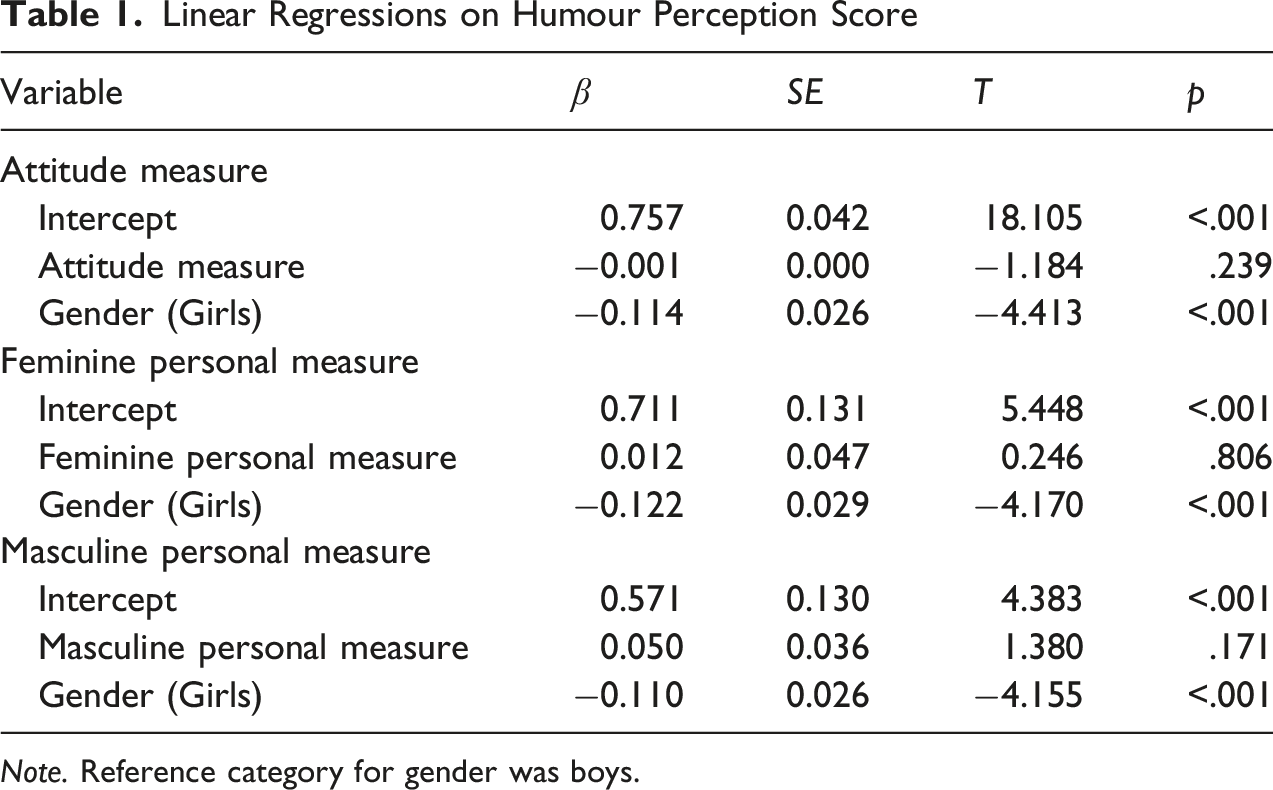
Note. Reference category for gender was boys.
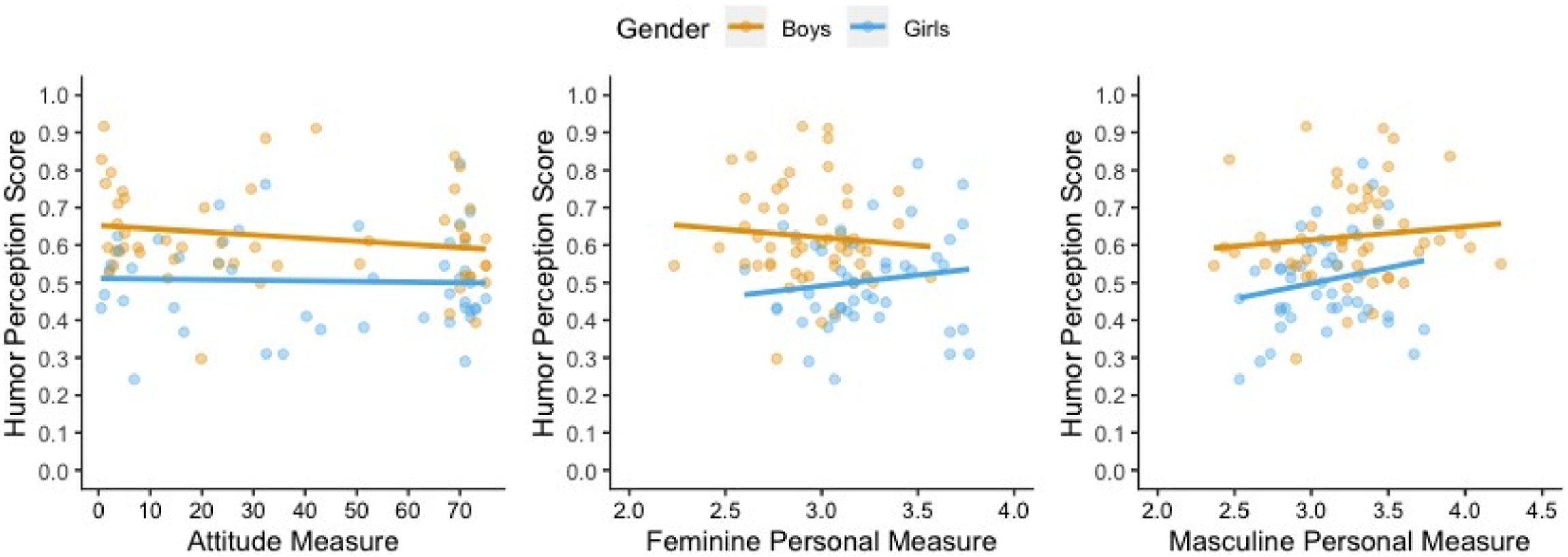
Boys’ (orange) and girls’ (blue) humour perception score per gender stereotype score, Attitude Measure (right), Feminine Personal Measure (middle), Masculine Personal Measure (left)
Humour Production
The mean humour production score was M = 2.93 (SD = 0.44) for boys and M = 2.93 (SD = 0.46) for girls. To analyse children’s humour production, we ran three mixed-linear models on children’s humour production score (see equation (2)). We included children’s gender, their score in one of the gender stereotype scales, and their interaction as fixed effects and rater, child, and question as random effects.
Mixed Linear Models on Humour Production Score
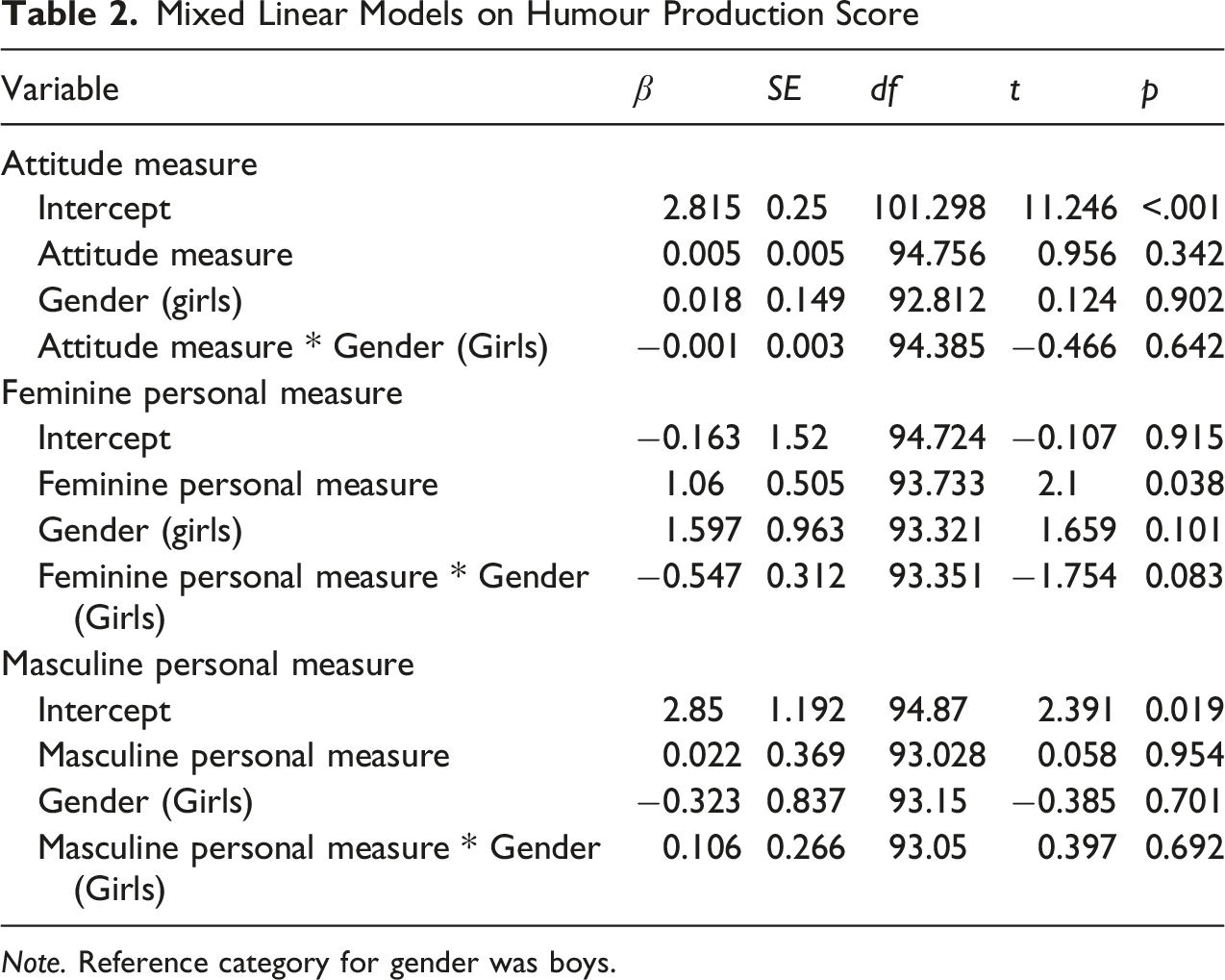
Note. Reference category for gender was boys.
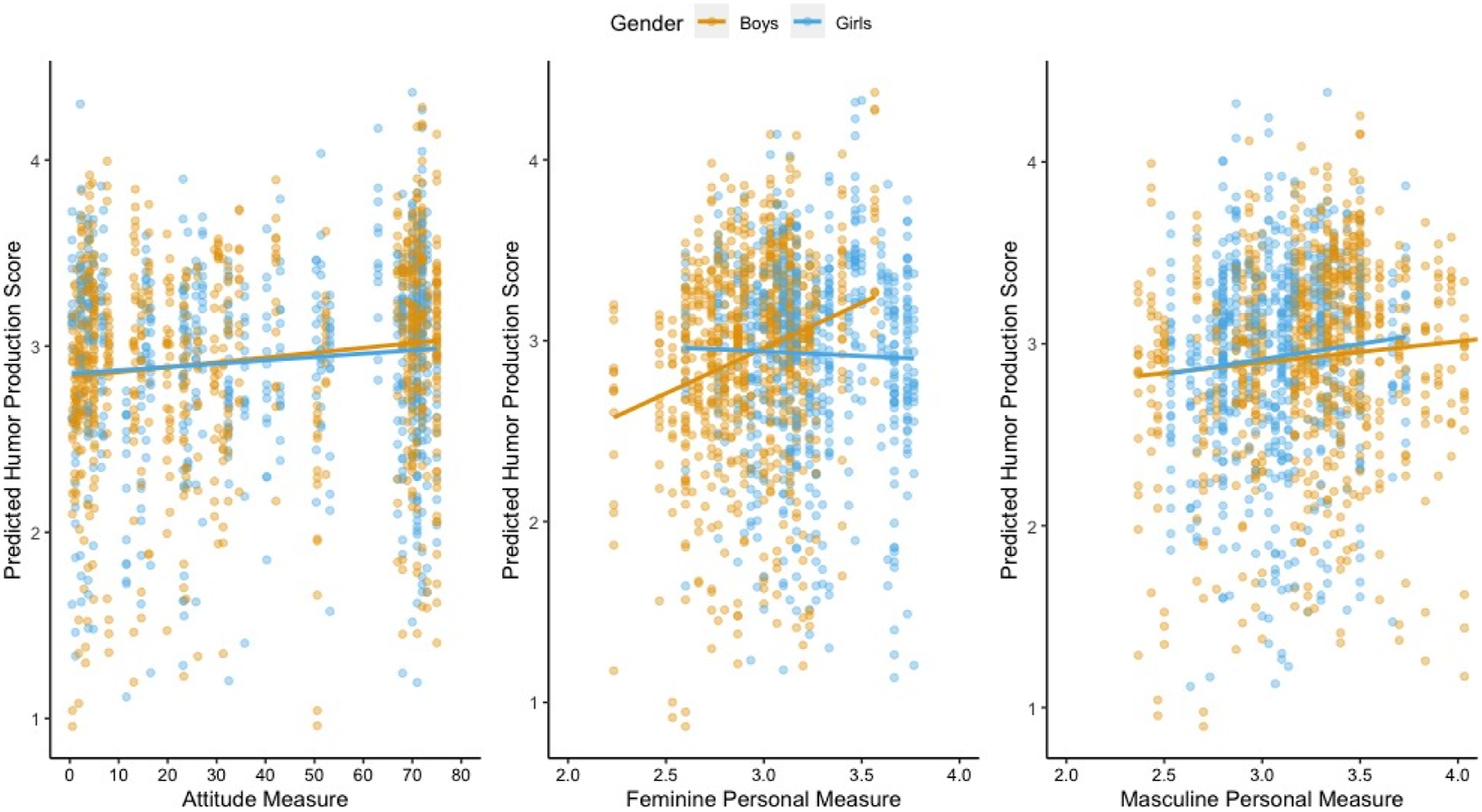
Boys’ (orange) and girls’ (blue) predicted raw humour production score per gender stereotype score, Attitude Measure (right), Feminine Personal Measure (middle), Masculine Personal Measure (left)
Discussion
The present work investigated whether girls and boys aged 10 to 12 differ in their humour perception and production, and whether their gender stereotypes influence and modulate their humour appreciation. We measured children’s gender stereotypes and their humour production and perception. The results showed a main effect of gender on children’s humour perception score; boys rated the jokes they thought were made by boys as being funnier than girls did. Furthermore, children who described themselves as more feminine (i.e., with higher scores on the Feminine Personal Measure) made jokes that were rated as funnier than jokes made by children who described themselves as less feminine. No other significant associations between children’s humour perception and production and their gender stereotype scores emerged.
Humour Perception
The results showed that children’s gender does not exert a global effect on humour perception; that is, boys and girls did not differ in their overall humour perception scores. However, a specific effect emerged once gender-stereotype scores were taken into account: boys, more than girls, tended to attribute the funniest humour productions to male protagonists. Our exploratory analyses further suggest that this effect is not symmetrical. While boys perceived boys as funnier than girls, girls did not show any bias in their humour perception with respect to the protagonist’s gender. These findings align with previous research on adults (Hooper et al., 2016), which also found differences when participants guessed the author’s gender of funny humour productions. In particular, previous research observed that both men and women attributed the funniest humour productions to men.
This absence of an in-group preference among girls may reflect well-documented gender asymmetries in social identity processes. Research consistently shows that boys tend to display stronger in-group favouritism than girls across several evaluative domains (e.g., (Halim et al., 2013).
However, the evaluation of their humour productions in the previous blind humour task showed no difference between men and women, indicating that adults’ humour perception is not influenced by the producer’s gender when the source is unknown. A possible explanation for our results could be related to the social identity theory (or self-categorisation theory; Ellemers & Haslam, 2012), according to which individuals shape their identity based on their affiliation with important social groups such as ethnic or gender groups, friends and work colleagues. Furthermore, this same theory postulates that group identity (e.g., race, gender) produces inter-group biases, favouring the in-group over the out-group. Children tend to prefer their in-group peers over their out-group peers from an early age (Hailey & Olson, 2013) and, for instance, share more with in-group peers than out-group peers (Sierksma et al., 2015). Thus, from childhood onward, peers tend to affiliate based on similar characteristics (Vermeersch et al., 2010) and gender-typed behaviours, reinforcing a sense of identity and in-group belonging (Halim et al., 2013). Based on this assumption, the attribution of the funniest humour productions to boys by boys would reflect the feeling of affiliation and similarity that binds them to their gender group in our study. Therefore, it could be possible that neither gender stereotypes nor gender per se may have modulated the perception of humour in this study, but rather the striving for in-group belonging and gender identity. Based on this interpretation, it is interesting to note that this affiliation feeling is manifested through humour in boys but not in girls. This raises new questions about the role of humour in group affiliation in boys and girls in developmental age beyond gender stereotypes. One possible explanation is that humour may not serve the same affiliative function for girls as it does for boys during childhood. While social identity theory predicts in-group favouritism, girls may rely on different strategies to signal group belonging, such as relational closeness, cooperation, or emotional attunement, rather than humour display.
Humour Production
In contrast to our hypotheses, children’s humour production was only significantly related to the Feminine Personal gender stereotype measure. Children who described themselves as more feminine produced funnier humour, independent of their gender. This association may have resulted from one item of the Feminine Personal Measure (“Be charming”). The item was the only one on the Feminine Personal Measure scale that showed a significant correlation with the average score for humour production (r = 0.25, p = .013). However, the analysis of the Feminine Personal Measure of children’s humour production, without this item, still revealed a significant effect of the gender stereotype. Furthermore, although we found no significant interaction between gender and gender stereotypes, the graph suggests that the impact of the Feminine Personal Measure is driven mainly by boys (see Figure 2). The preregistered analyses further support this assumption (see Appendix). In these analyses, we only found a significant effect of Feminine Personal Measure for the boys but not the girls. Boys who have a more feminine view of themselves make funnier jokes. This result may have been partly due to how gender stereotypes were measured (see Limitations and Future Directions).
No other significant associations of gender or gender stereotype scores were found. Although we cannot interpret this as the absence of effects of gender or gender stereotypes on children’s humour production, it nevertheless suggests that potential effects are neither strong nor robust. This is in line with studies on adults showing that, when rated blindly, funniness ratings for humour produced by men and women did not differ (Hofmann et al., 2023; Hooper et al., 2016). However, it contrasts the recent meta-analyses on adults, indicating that humour produced by men is perceived as funnier than humour produced by women, even when the author’s gender is not known (Greengross et al., 2020). Similarly, studies with children suggest gender differences in humour production (Bergen, 1998; Warnars-Kleverlaan et al., 1996) with boys rated as funnier than girls.
We propose that gender stereotypes may not influence children’s humour production at 10 to 12, but start to have a more significant impact later in development. In line with this, our results on humour perception suggest that school-aged girls and boys are already aware of the gender stereotype concerning male and female humour. It is possible that, alongside their humour development, children adhere more strongly to this gender stereotype with increasing age. Girls and boys might take up behaviours that align with what they think their gender ought to be like, which may be further reinforced by the corresponding feedback (Halim et al., 2013).
Specifically, boys may receive more positive reinforcement (e.g., laughter, attention) when they display humour, whereas girls may receive less, or even be discouraged. Over time, this can create different expectations: boys anticipate positive reactions and are more likely to express humour, whereas girls may self-regulate and inhibit humour despite similar ability (Skočajić et al., 2020).
These processes likely intensify in adolescence, when peer feedback and gender identity become especially salient (Hailey & Olson, 2013). For these reasons, it will be important for future research to examine how humour expression interacts with reinforcement patterns, gender norms, and gender stereotypes in older age groups. Conversely, girls might receive less positive reactions to their humour production and, consequently, inhibit their sense of humour. To test this assumption, future studies may investigate the influence of gender, gender identity, and gender stereotypes in adolescents and young adults.
Limitations and Future Directions
Contrary to our hypotheses, we did not find a significant effect of gender stereotypes on children’s humour perception and production. This might be due to a particular kind of gender stereotype, which was measured with the COAT questionnaire (Children Occupation Activity Trait; Liben et al., 2002). Whereas the questionnaire covers various aspects of gender stereotypes (e.g., how children see others and themselves across different domains), it may be too general to capture children’s stereotypes about humour. Furthermore, it is important to emphasise that changes in society and school policy in the early years have increasingly exposed children to more flexible ways of understanding and interpreting gender (Diamond, 2006; Kostas, 2021). This may affect children’s representation of gender. Therefore, new instruments that measure gender stereotypes, taking into account the fluidity of gender representation at a developmental age, will be needed in the future.
Furthermore, as measured in this study, children’s humour perception and production may not correlate with their daily behaviour. Humour is often a highly socially shared experience that extends beyond the production or appreciation of individual jokes (e.g., playful teasing, clowning). Previous evidence has shown a reciprocal relationship between children’s use of humour and their psycho-social adaptation (Warnars-Kleverlaan et al., 1996). When fourth-graders rated the sense of humour and popularity of the other children in their class, humour ratings were strongly correlated with popularity, indicating that children perceived to have a better sense of humour were more liked by their peers (Sherman, 1988). Interestingly, this association was stronger among same-sex peers than among opposite-sex peers. In our humour perception task, children were prompted to rate and produce verbal humour in accordance with specific guidelines. This might depend on the children’s vocabulary (Purser et al., 2021) and may differ from their spontaneous, multimodal humour in everyday life. Therefore, it could still be true that boys spontaneously produce more and funnier humour than girls (e.g., are more often categorised as “class clowns”). In contrast to this assumption, Wagner and Ruch (2023) found no consistent gender differences in self-reported everyday humour among adolescents. Nevertheless, studying children’s spontaneous humour may be an interesting avenue to explore through observational studies. In addition, because humour ratings were based on subjective judgments, student raters’ own gender stereotypes could have influenced both their funniness ratings and their guesses of the child’s gender. Although several aspects of the design mitigated this concern (e.g., independent ratings, rater blinding), we acknowledge that potential rater-level bias remains a limitation of the study. A further limitation is that we did not include direct measures of language comprehension or information-processing skills, which may contribute to humour perception. Due to the remote, home-based data collection and the need to keep the session brief, these measures could not be included. Future studies should consider incorporating cognitive measures as covariates to better disentangle their role in humour perception.
Moreover, while our study provides insights into children’s verbal humour in response to structured prompts, it does not directly capture their spontaneous humour in natural settings. Children’s everyday humour can include not only verbal jokes but also spontaneous and multimodal forms (e.g., playful teasing, mimicry, gestures, facial expressions). Our findings, therefore, reflect humour expressed within a structured task, rather than humour occurring in daily interactions. Future research using naturalistic observations or open-ended interactions will be necessary to investigate these multimodal and spontaneous forms of humour.
Another limitation concerns the socioeconomic characteristics of our sample. Most participating families reported medium to high socioeconomic status, with parents generally having high levels of education. Therefore, our findings do not allow conclusions about how socioeconomic factors may influence children’s humour expression, humour perception, or endorsement of gender stereotypes. Given that parents’ educational level, cultural exposure, and home communication style may shape children’s humour and gender-related beliefs, future research should include more socioeconomically diverse samples to examine these potential influences.
Finally, another limitation concerns the humour perception task. One item (item 4) differed from the others in that the humorous response was produced by an adult rather than by the child protagonist. Although this item was included to reflect more naturalistic conversational contexts, it is less conceptually homogeneous with the rest of the measure and should therefore be interpreted with caution. Future studies should aim to ensure greater consistency across items in terms of the source of the humorous response.
Taken together, these findings highlight several methodological and conceptual limitations that should be addressed in future work. Future research will be needed to clarify how humour and alternative affiliative strategies contribute to group identity and social bonding in boys and girls across development.
Conclusion
In the present study, we explored the effects of gender and potential gender stereotypes on schoolchildren’s perception and production of humour in Western Europe. We did not find a significant effect of gender stereotypes on children’s perception and production of humour, although an effect of gender did emerge. Boys attributed the funniest jokes to boys more often than girls. Thus, the results of this study suggest that at age 10, when children are still developing, humour and gender stereotypes are less correlated than in many studies of adults.
Supplemental Material
Supplemental Material - Funny Boys, Reluctant Girls? The Interaction Between Gender Stereotypes and Humour in Children
Supplemental Material for Funny Boys, Reluctant Girls? The Interaction Between Gender Stereotypes and Humour in Children by Mirella Manfredi, Moritz M. Daum in The Journal of Early Adolescence
Footnotes
Acknowledgement
We express our deep gratitude to Vanessa Infanger for preparing the stimuli and collecting the data. Without her help, this project would not have been possible.
Ethical Considerations
All procedures were approved by the local ethics committee of the University of Zurich and performed in accordance with the ethical standards of the 1964 Helsinki declaration and its later amendments.
Consent to Participate
All parents gave informed consent before data collection.
Funding
The authors disclosed receipt of the following financial support for the research, authorship, and/or publication of this article: The project was supported by the Department of Psychology (https://www.psychologie.uzh.ch) and the Jacobs Center for Productive Youth Development ( ) of the University of Zurich. The funding sources had no role in study design, analysis of data, interpretation of results, or writing of the report.
Declaration of Conflicting Interests
The authors declared no potential conflicts of interest with respect to the research, authorship, and/or publication of this article.
Supplemental Material
Supplemental material for this article is available online.
Author Biographies
References
Supplementary Material
Please find the following supplemental material available below.
For Open Access articles published under a Creative Commons License, all supplemental material carries the same license as the article it is associated with.
For non-Open Access articles published, all supplemental material carries a non-exclusive license, and permission requests for re-use of supplemental material or any part of supplemental material shall be sent directly to the copyright owner as specified in the copyright notice associated with the article.
