







Abstract
Quantitative structured assessment of 193 scenes depicting substance use from a convenience sample of 50 Brazilian movies was performed. Logistic regression and analysis of variance or multivariate analysis of variance models were employed to test for two different types of outcome regarding alcohol appearance: The mean length of alcohol scenes in seconds and the prevalence of alcohol use scenes. The presence of adolescent characters was associated with a higher prevalence of alcohol use scenes compared to nonalcohol use scenes. The presence of adolescents was also associated with a higher than average length of alcohol use scenes compared to the nonalcohol use scenes. Alcohol use was negatively associated with cannabis, cocaine, and other drugs use. However, when the use of cannabis, cocaine, or other drugs was present in the alcohol use scenes, a higher average length was found. This may mean that most vulnerable group may see drinking as a more attractive option leading to higher alcohol use.
Keywords
Introduction
Drugs as a cinematic theme is as old as cinema itfself. 1 One of the earliest films that centered on drug use is Chinese Opium Den by William Kennedy Dickson made in 1897. Following this, many well-known American and British films have portrayed several aspects of substance misuse and users. These facets have included hedonism, as well as social and medical impairments consequent of drug usage. The latter have aroused major interest among the mental health professionals including psychiatrists to explore and discuss psychopathology as displayed in the films. Films such as Trainspotting (1996), Drugstore Cowboy (1989), Rush (1991), Performance (1970), and London Kills Me (1991) have shown the psychopathology and its consequences in a realistic manner. It is interesting to note that Aina and Olorunshola 2 and Strasburger and American Academy of Pediatrics 3 have argued that the portrayal of drug use and misuse in films can affect public health behavior among audiences, especially among adolescents. It must be stressed that a requirement for this claim’s truthfulness is the existence of a certain degree of vulnerability among adolescents. However, most of the previous studies in this area have investigated the content related to the use of alcohol and drugs with focus on teaching psychiatry through the use of films or for discussion of certain diagnoses.4–6 Others have also recommended using films for teaching purposes in general psychiatry.7–10
Of course, cinema is an art form which not only imitates life but also can modify it and influence it through the creative process. 11 There remains a kind of bi-directional relationship between films and society where the former affects the latter and vice versa. Thus, both these aspects—influence or imitation on or of behaviors found in society—can be the concern of public health advocates 12 as well as interventions. The possibility that the representation of alcohol and drugs in movies could influence their audience has been investigated in some studies13–15 but the findings are equivocal. An experimental study showed that movie scenes showing alcohol consumption increased alcohol use during the movie for young men but not young women. 15 Alcohol use in movies and its association with binge drinking by teenagers has also been reported in some large high-school samples in the United States and Germany.13,14 Similarly, portrayal of smoking in movies has been shown to influence rates of smoking among German adolescents, closely replicating findings from a longitudinal study of White U.S. adolescents in a cross-cultural cohort comparison. 16 A systematic review confirmed that there was indeed strong empirical evidence that smoking in movies is more likely to introduce adolescents to smoking. 17 In India, the government has taken the decision that smoking should not be shown in films and if it is there should be warning during the scene on the screen. In spite of this, more studies are needed to test these hypotheses to explore and understand cause and effect.
Considering the long history of representation of drugs and their use in movies, and a possible role in the attitudes and behaviors of their audience, as posited by some other authors, it is of interest to investigate factors associated with portrayal of alcohol use portrayal in the media, in order to determine which “message” a is given through media studies b . 11 As a result, we selected alcohol and objective measures in the portrayal for study. Alcohol was the drug selected for this investigation because of the highest number of scenes easily identified in films 18 as well as due to large extent of scientific literature focusing on excess of exposure in media,19,20 especially when experienced by youth.
A few Brazilian studies have analyzed media content in the field of alcohol and drugs focusing on the influential (actual and potential) role that beer advertising plays among adolescents and children.21–23 Previously we had studied the prevalence of portrayal of drug use in a convenience sample of 50 Brazilian Movies. 18 Rates and amount of substance use and misuse in these scenes were almost similar to those reported among general population. However, main differences were found in portrayal of cocaine and tranquilizers use (over- and underexposure in movies, respectively). However, it is not just a question of exposure quantity but how the drug use is presented. Different associations of drug use in scenes (i.e., gender, age, police involvement, film genre) could have different influences on consumption. Our previous study 18 did not explore the correlations of type of drug and length of scenes with other variables. Based on the findings of media studies with beer advertising in Brazil,21–23 the present study sought to investigate the relationship between alcohol use and presence of adolescent characters. Giving that there is an excessive appeal to teenagers to consume alcohol from beer advertisements in this country,21–23 there may also be some type of association between alcohol consumption and adolescents in other types of local media.
Considering that background, our hypotheses are that the presence of adolescent characters is associated with (a) a higher prevalence of alcohol use scenes compared to nonalcohol use scenes and (b) longer scenes of alcohol use. As secondary aims, we test for other associations with these outcomes related to characters and films. We report on a convenience sample of 50 Brazilian films and 193 scenes in these films, which show drug use. The period selected was from 2000 to 2008 largely due to accessibility of films made and released during this period. We decided to focus on two types of outcomes: (a) mean duration (length) of alcohol scenes and (b) the frequency of alcohol scenes; with regard to adolescent characters presence and other variables of secondary interest, such as other drugs use portrayal, characters’ gender and age group, police involvement, and film genre.
Methodology
Type of Study
Media content analysis.
Sample
A convenience sample of 50 recent Brazilian movies in DVD format available for rental in shops was selected. These films were selected for ease of availability and by the censor board drug use indicative stamp. In these films, a total of 193 scenes met the inclusion criteria and these were analyzed using a standard method and protocol (available from the first author).
The inclusion criteria for the present study were created by the research team, with the aim of assessing all depictions of drug use and the wide range of behaviors that may be associated with it. Frequently, the drug use is not shown, but several indirect or direct effects can be detected. The inclusion criteria were as follows.
Brazilian (production or coproduction) movie scenes; Portuguese-language movie scenes (originally); Scenes from movies released between 2000 and 2008; Scenes which present any signs or symptoms of disorders related to alcohol or drugs other than tobacco according to the ICD-10
24
or DSM-IV-TR
25
; Scenes that presented some behavior related to, associated with, or leading to, the use of alcohol or drugs other than tobacco.
Assessment Tools
An information sheet was developed in order to evaluate and record scenes with alcohol and drug-related contents. Information was collected on the name of the film, its story synopsis, director, actors in the scene, the scene’s start and end times, signs and symptoms displayed, completion of the DSM-IV-TR criteria, type of disorders or symptoms (intoxication, abuse or harmful use, dependence, withdrawal, etc.), and type of substance shown (alcohol, marijuana, hypnotics, cocaine, hallucinogens, other than tobacco) and multiple drug use if shown. In case of alcohol use, the type of alcoholic beverage was noted.
Procedure
We studied films, identifying subjects and the censor board classification of the films according to the themes. In addition, we also selected 50 films from 10 different rental companies in the cities of São Paulo and Campinas to double-check that themes were not being missed. Ease of availability was an important factor in the selection of films. All the films were initially studied and protocols completed by the first author (alone in a room) with a focus on selected scenes, the information being recorded on the information sheet, and watching the scenes repeatedly to make sure that correct information was added.
Measurements
Two types of outcome were measured in the identified scenes: (a) the mean length of alcohol scenes in seconds and (b) the prevalence of alcohol use scenes. Other identified variables included presence of portrayal of cannabis, portrayal of cocaine, portrayal of other drugs, male characters, female characters, adolescents characters, children characters, elderly characters, police involvement, and the two main genres of movies (comedy and drama c ).
Statistical Analysis
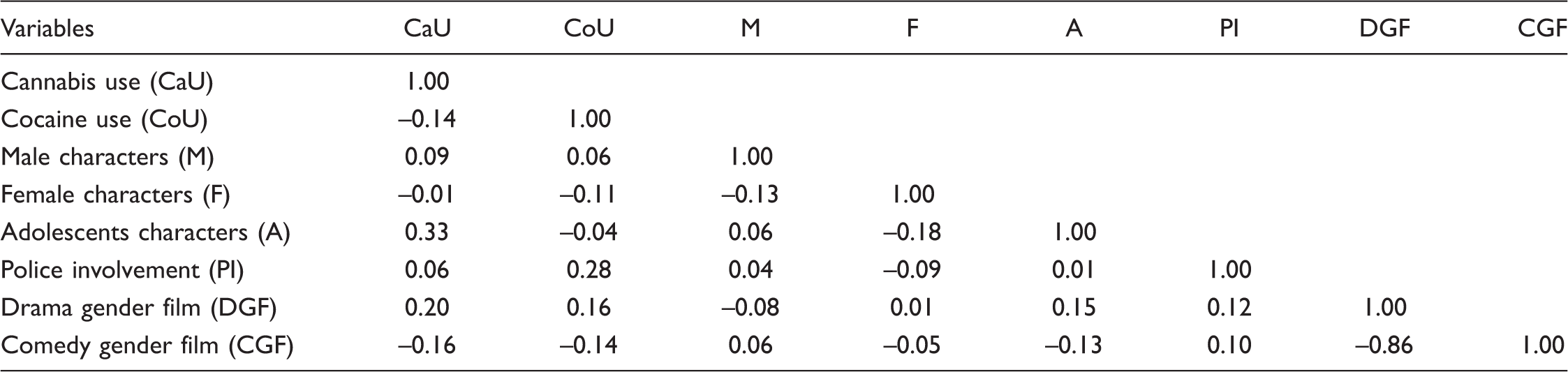
Statistical analysis was performed using STATA software, version 11.2 (Statacorp, TX, US, 2009). First, we carried out a descriptive analysis of the two outcome variables. All variables that had low prevalence were removed from further analysis (i.e., “elderly” and “child characters”). Second, we performed a linear correlation analysis among the variables we were interested in. A strong correlation was found between the “Drama film genre” and “Comedy film genre.” We chose to keep the last variable considering the large number of missing data within the variable “Drama film genre.” Finally, we carried out univariate logistic regression and analysis of variance (ANOVA) models. Then, we used the ENTER method to include the variables in the multivariate logistic regression and analysis of variance models (MANOVA). We chose the value of p < .05 for a significant correlation.
Results
Descriptive Data of a Sample of 193 Brazilian Film Scenes That Portrayed Drug Use by Alcohol Use, 2000 to 2008.
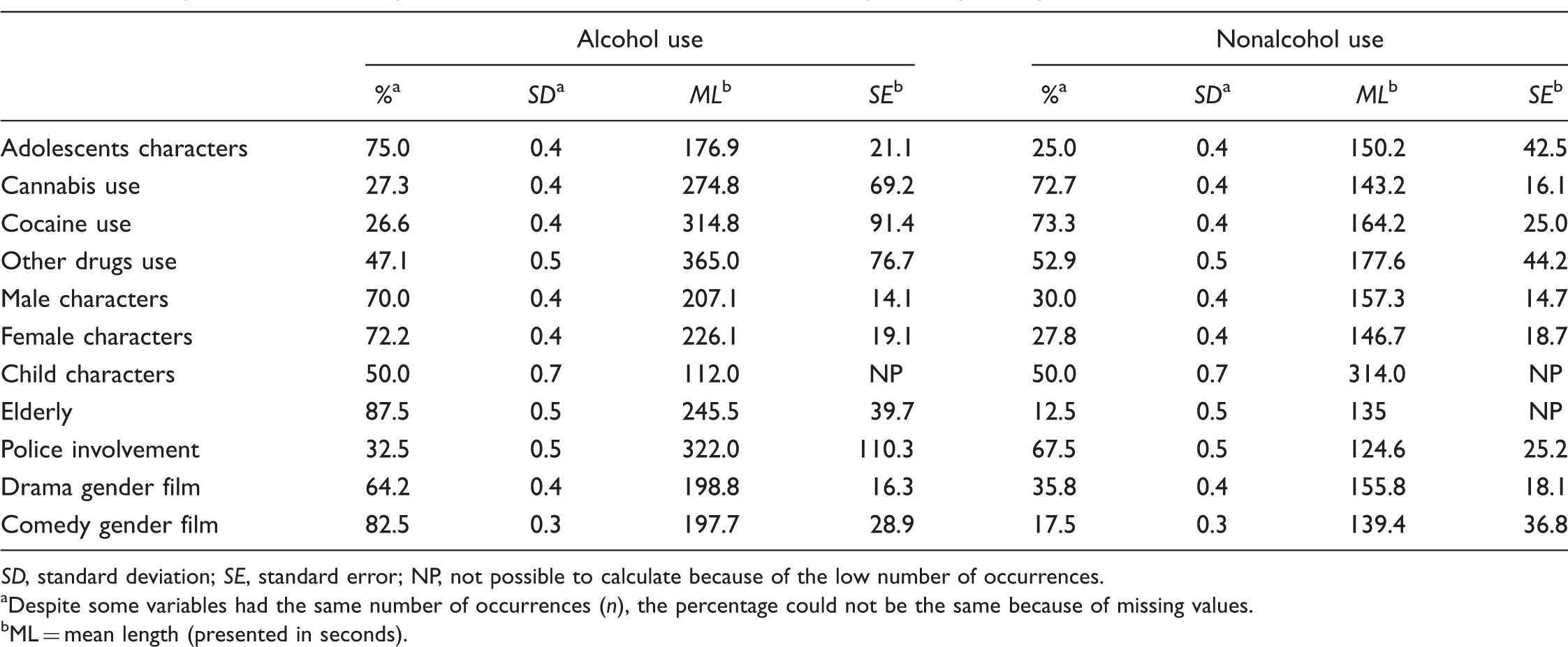
SD, standard deviation; SE, standard error; NP, not possible to calculate because of the low number of occurrences.
Despite some variables had the same number of occurrences (n), the percentage could not be the same because of missing values.
ML = mean length (presented in seconds).
Linear Correlation of the Variables Considered for Entering the Regression and the Analysis of Variance Models, in a Sample of 193 Brazilian Movie Scenes, 2000 to 2008.
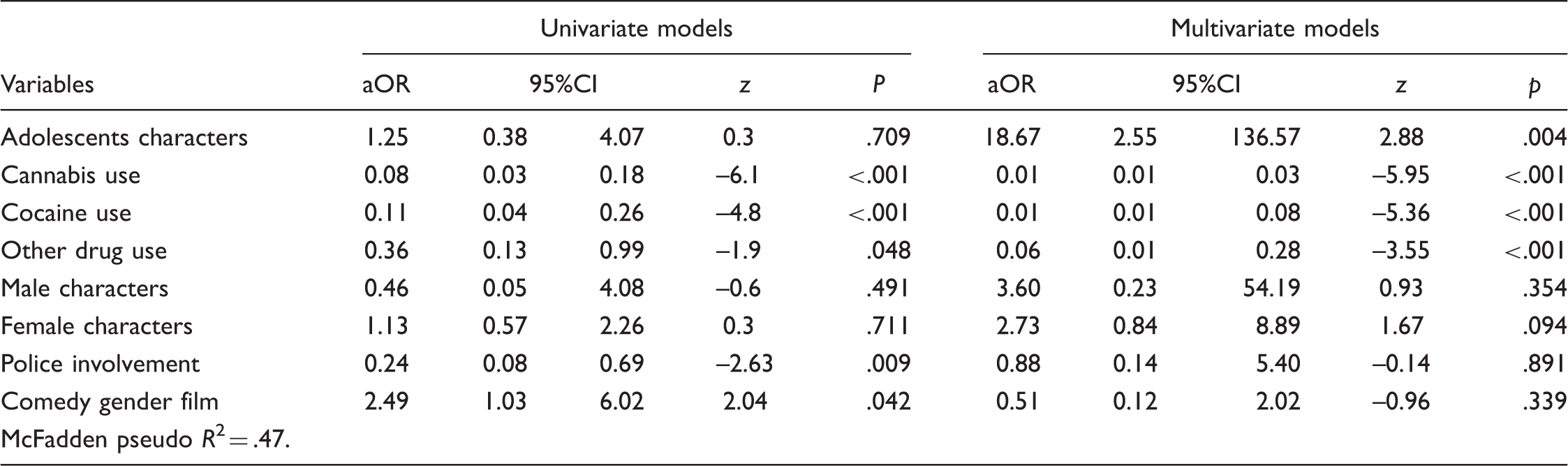
Multinomial Logistic Regression Models for Portrayal of Alcohol Use in a Sample of 193 Brazilian Film Scenes That Portrayed Drug Use, 2000 to 2008.
ANCOVA and MANOVA Models for Length of Alcohol Use Scenes in a Sample of 193 Brazilian Film Scenes That Portrayed Drug Use, 2000 to 2008.
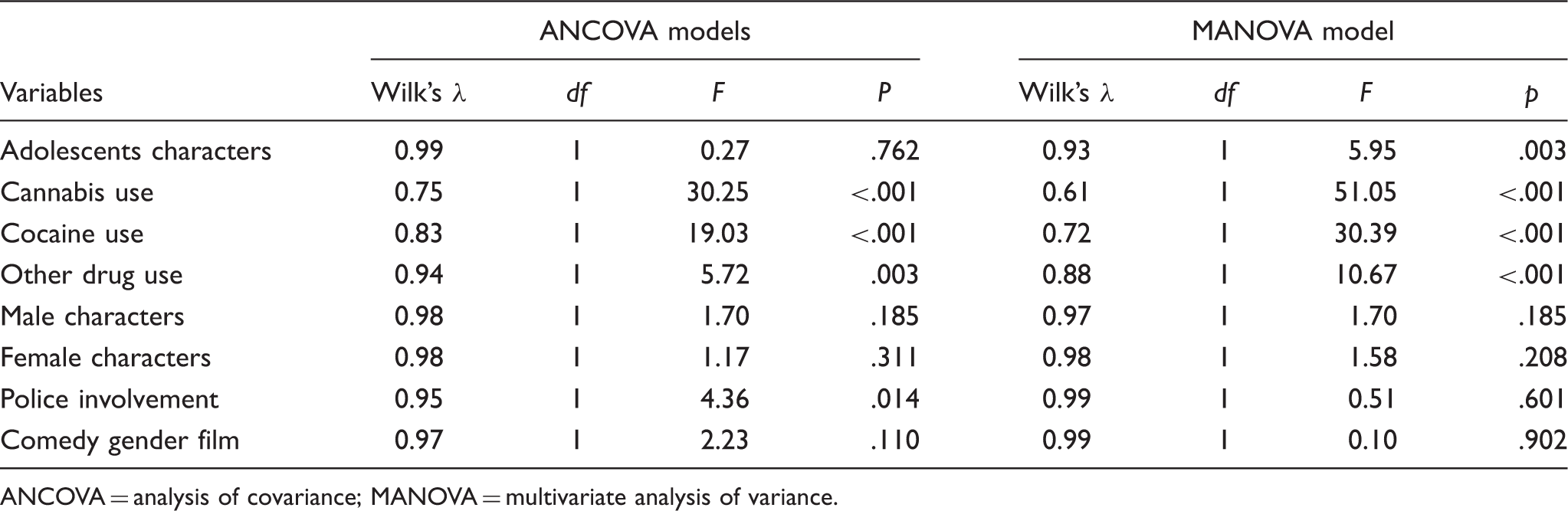
ANCOVA = analysis of covariance; MANOVA = multivariate analysis of variance.
Discussion
Our study should be seen as a pilot study as we aimed to investigate some of the associations of variables of interest related to the portrayal of alcohol use in scenes in films and comparing these across various factors. We confirmed our first hypothesis, that the presence of adolescent characters was associated with a higher prevalence of alcohol use scenes compared to nonalcohol use scenes in this sample of scenes that portray drug use in our sample of films. The presence of adolescents was also associated with a higher than average length of alcohol use scenes compared to the nonalcohol use scenes. Interestingly we also found that alcohol use was negatively associated with cannabis, cocaine, and other drugs use. However, when the use of cannabis, cocaine, or other drugs was present in the alcohol use scenes, a higher average length was found.
The association between the presence of adolescent characters and alcohol use scenes and longer alcohol use scenes raises some interesting issues. This could mean that adolescents may be consuming more alcohol, or that other people are consuming more alcohol in front of them in Brazilian films, or maybe it just means that youth is associated with drinking. This may reflect a society in transition where drinking may be seen as a more desirable activity but this needs to be explored further and investigated. This needs further and serious exploration so that adequate steps can be taken at a public health level. On the other hand, parallels can be drawn between the representation of alcohol use in movies and in other forms of media in Brazil such as beer advertising. A violation of the rules of self-regulation by beer advertisers has been noted 22 and its potential influence on alcohol use in adolescents21,23 have also been identified. Five beer advertisements rated as most appealing by a sample of Brazilian adolescents were also perceived by them to have violated the two key principles of Brazilian self-regulation code governing the marketing of alcoholic beverages, aimed at protection of children and teenagers and the prohibition against encouraging excessive and irresponsible alcoholic beverage consumption. 22 If these scenes are seen as getting longer in more recent films that may show us that there is a disjunction between what the self-regulation is failing to achieve. Another point that will be of interest in further exploration is that of product placement in films and how this may by-pass the self-regulation and code of conduct.
The association between youth and drinking is in line with findings reported in a recent survey. 26 These authors studied adolescents in Brazil, on the use of psychoactive substances in 761 participants (aged 14–19 years). More than half of the adolescents interviewed were regular alcohol users and 1 out of 10 were abusers or dependents. 26 In addition, a statistically significant increase in lifetime use for alcohol in the Brazilian general population over a 5-year period 27 and the elevated prevalence rate for the previous month use of alcohol (48%), among Brazilian school students, 28 calls for prevention programs in Brazil against alcohol use, especially among adolescents. This again reflects problems of cause and effect situation indicating that careful longitudinal studies are indicated to explore the potential changes in portrayal and prevalence in the population.
In the present study, alcohol use was negatively correlated with cannabis use, cocaine use, and other drugs use, presenting a trend of representing the use of only one type of drug per scene (or alcohol or other drugs). This may reflect the drug use behavior in real life, as alcohol is used mainly alone by people, in place of being used associated with illegal drugs. 29 Perhaps these results could be different if this study had included scenes of tobacco consumption, since the association of concurrent use of alcohol and tobacco is the most common and prevalent. 30 However, it is interesting to find scenes depicting alcohol consumption in combination with illegal drugs to be longer. This may reflect a special interest of directors for this kind of scene and further contextual research is indicated to determine social and cultural contexts within which the films are made and written. The use of higher number of drugs may reflect the multiplicity of different portrayals. 1
Finally, similar to the beer advertising content analysis studies,21–23 our study highlights a need for public discussion on the representation of alcohol and other drugs in Brazilian media vehicles. It is worth asking whether the presence of adolescents in alcohol use scenes influences a larger consumption or experimentation with this drug. Or whether the simple presence of adolescents in alcohol use scenes awakes a greater public interest. It is possible that the presence of adolescents in alcohol use scenes, which shows alcohol consumption by them or others around them, make people (i.e., adults and elderly) more habituated and thus more tolerant of alcohol use by adolescents or in front of them. Further research also needs to explore whether Brazilian films are different from those of other nationalities cinemas regarding this association. The challenges embedded in self-regulation need further exploration and addressing especially in the context of public mental health agenda.
As we did not set out to address any of these issues, we can surmise that our observations need further exploration and to clarify what types of messages the media need to convey to the audiences.
Limitations
Our study has a small size and it is a sample of convenience due to limited resources. They also reflect only one country. Some variables produced large 95% confidence intervals due to low numbers within some of their categories, included in the regression models. Moreover, only a single judge assessed the scenes. Ease of availability of films was a relevant and important factor for the choice of the movies and could have biased our findings. However, it would be very hard to select a truly representative sample of world movies.
Conclusion
This study therefore should be seen as a pilot study. Presence of adolescent characters in the scenes presenting alcohol use and also a longer time in such scenes is an unusual and significant finding, which needs further study. The role films play in attracting adolescents who are also the main target audience is a crucial one. This may mean that most vulnerable group may see drinking as a more attractive option leading to higher alcohol use.
Footnotes
Declaration of Conflicting Interests
The author(s) disclosed the following potential conflict of interest for the research, authorship, and/or publication of this article: Dr. Castaldelli-Maia receives Pfizer Independent Grant for Learning and Change (IGLC) managed by Global Bridges (Healthcare Alliance for Tobacco Dependence Treatment) hosted at Mayo Clinic, to support free smoking cessation treatment training in addiction/mental health care units in Brazil (grant IGLC 13513957), which had no relationship with the present study. Dr. Andrade is Executive President of Center for Information on Health and Alcohol (CISA), which had no funding relationship with this project. All other authors have no conflicts of interest.
Funding
The author(s) received no financial support for the research, authorship, and/or publication of this article.