







Abstract
Arsenic induced cancer is a major public health issue in Indo-Gangetic plains of Bihar, India where 22 out of 38 districts report arsenic contamination of groundwater. Its psychological aspect is under studied in contrast to the physiological and social. This baseline correlational survey research explores the relationship and role of proactive coping on depression, anxiety and stress among this population. Depression, anxiety and stress were assessed in 77 consenting arsenic induced cancer patients with depression, anxiety and stress scales. Proactive Coping was assessed with proactive coping inventory. Results demonstrated negative association and influence of proactive coping on stress, anxiety and depression. Avoidance coping associated positively with depression and reflective coping predicted for depression and anxiety. The findings advocate for more research attention on psychological aspects of arsenic induced cancer. Timely psychological interventions to build proactive coping are warranted to alleviate depression, anxiety and stress among this population.
Keywords
Introduction
Bihar, one of the Indian states located at the Ganga-Meghna-Brahmaputra (GMB) basin is rich in groundwater. Unfortunately, the Gangetic plains of this state are now facing serious problems of arsenic contamination in groundwater which is the main source of drinking water for its natives. Compared to many other states located at the Indo-Gangetic plains the situation at Bihar is critical with known public health concerns. Here, 22 districts out of 38 have been identified as arsenic prone area, 1 for having arsenic concentration beyond the permissible limit of drinking water i.e., more than 0.01 mg/l (10ppb). 2
Arsenic is carcinogenic to humans and its intake for a longer duration mostly causes arsenicosis, a massive chronic poisoning. Symptoms of arsenicosis may consist of skin manifestations like melanosis, keratosis and hyperkeratosis. 3 Figure 1 shows arsenic induced cancer patients with typical arsenicosis symptoms in sole and palm. Recent researches have also reported cancer as one of most prevalent and deadly disease in these areas of Indo-Gangetic plain.4–6
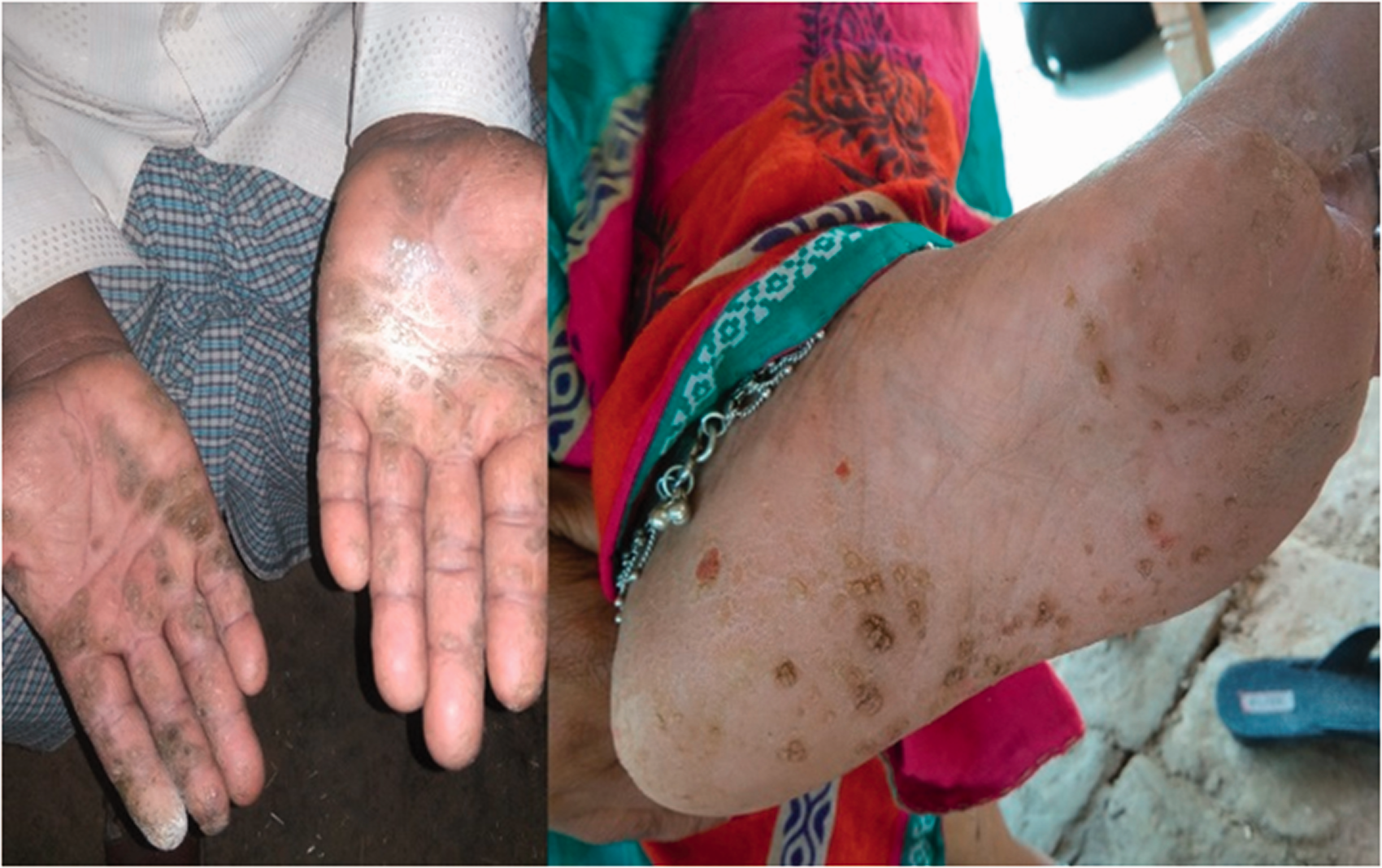
Showing typical symptoms of Arsenicosis in sole and palm in arsenic induced cancer patients from Tilak Rai Ka Hatta village of Buxar district, Bihar.
Physiological health consequences of arsenic induced-cancer have been extensively researched and well established in these areas. The US National Research Council reports concluded that 1 in every 100 cases can develop cancer risk with the exposure of 0.05 mg/l (50ppb) arsenic. 7 Cancers of skin, lung, liver, kidneys, breast, prostate and gall bladder could also be due to long term arsenic exposure.4–6,8–10
Arsenicosis and so do arsenic exposure has serious social consequences for its patients and their family such as instable social life, discrimination and stigma, boycott by community and family, isolation. Patients’ personal life and relationship too suffer, evidenced with increase in cases of divorce, separation, domestic violence etc. Stigmatized patients often get expelled from their job and forced to live a below standard life.11,12 Sometimes directly and sometimes indirectly, these social consequences of arsenic-induced-cancer led to psychological problems too, such as depression, anxiety and stress. Studies show that cancer patients are 5 times more vulnerable to major depression than non-cancer patients.13,14 The Agency for Toxic Substances and Disease Registry said that loss of memory and rapid and exaggerated changes in mood are resulted from exposure of acute inorganic arsenic. 15 Neurotransmitters related to depression can also be affected due to long term exposure to arsenic. Some feeling may be common in chronic diseases, like anxiety; fear and disorganization. 16 Some significantly higher mental health issues are also found in arsenicosis patients for example, depression, agitation, insomnia, drowsiness, weakness and loss of appetite. 17
Humans, when in stress, often use coping strategies or behavioral efforts to deal with their emotions. 18 Coping strategies are the significant and very important factor that contribute in one’s physical health 19 as well as psychological wellbeing.20,21 In this regard proactive coping is relatively a newer concept, in which a person makes strategies beforehand to deal with upcoming antecedents of stress. 22
Proactive coping is not just a single response to any upcoming negative event in near future rather it has a set of stable and ongoing behavior pattern and thought processes; and perceiving a stress in a positive way.16,22 A cognitive aspect of proactive coping that is future oriented thinking has been found to have negative association with general psychological distress. 23 In the study of Uskul and Greenglass, proactive coping was found negatively related to general depressive symptom among Turkish immigrants in Canada. 24 Wagner and Martin also found anxiety and depression were negatively predicted by proactive coping. 25 It was also revealed in a study that stress and proactive coping is significantly related. 26
Physical and social consequences of cancer in arsenic contaminated area have been much researched.4–6,8–14 However, unfortunately psychological consequences has been rarely explored worldwide among the arsenic-induced cancer patients.15,17 Brinkel, Khan, and Kraemer has also suggested further studies in these areas to get more information about mental health and arsenic exposure. 27 This is the first kind of study in the middle Indo-Gangetic plain of India that tried to explore few of its psychological consequences. From psychological perspective, proactive coping may be a protective psychological factor against depression, anxiety and stress. Hence, this study aimed firstly to examine the relationship between proactive coping and anxiety, stress and depression. Secondly, the role of proactive coping on these three emotional states (depression, anxiety and stress) of arsenic induced cancer patients from arsenic affected Indo-Gangetic plains of Bihar, India would also be explored.
Method
Hypotheses
Research Design
This study followed a quasi-experimental research design. A correlational survey research was conducted to explore the statistical relationship between proactive coping and the three emotional states of depression, anxiety and stress among arsenic induced cancer patients from Indo-Gangetic plains of Bihar.
Sample
A total of 77 (N = 77) consenting arsenic induced cancer patients (age range between 32 to 60 years; mean age = 48.94 years) were sampled through purposive sampling from the Mahavir Cancer Sansthan and Research Centre (MCSRC), Patna, Bihar. The participants met all the following important inclusion criteria of the study. They resided in the arsenic affected Indo- Gangetic plains of Bihar (such as Bhagalpur, Buxer, Patna, Khagaria, Chhapra, Samastipur etc) for more than 10 years. Their differential diagnosis for arsenic-induced cancer was made by the researchers at MCSRC based on respective clinical history for presence of arsenicosis and absence of any clinical co-morbidity. Differential diagnosis was based on the prominant biomarkers viz., arsenic in nail, arsenic in hair, arsenic in blood and arsenic in drinking water from drinking water source used by the participants. Out of 77 patients, 52 were without visible symptoms of arsenicosis while 25 were with visible symptoms of arsenicosis. 14 (18.18%) suffered from lung cancer, 14 (18.18%) had liver cancer, 21 (27.27%) had gallbladder cancer, 13 (16.88) suffered from skin cancer and 15 (19.48%) with kidney cancer A majority of the participants were from rural area (79.2%) and 20.8% were from urban area (for socio-demographic details see supplementary file; Table 1).
Correlation table showing association between seven strategies of proactive coping and three related emotional states (Depression, Anxiety and Stress) among arsenic induced cancer patients from Bihar.
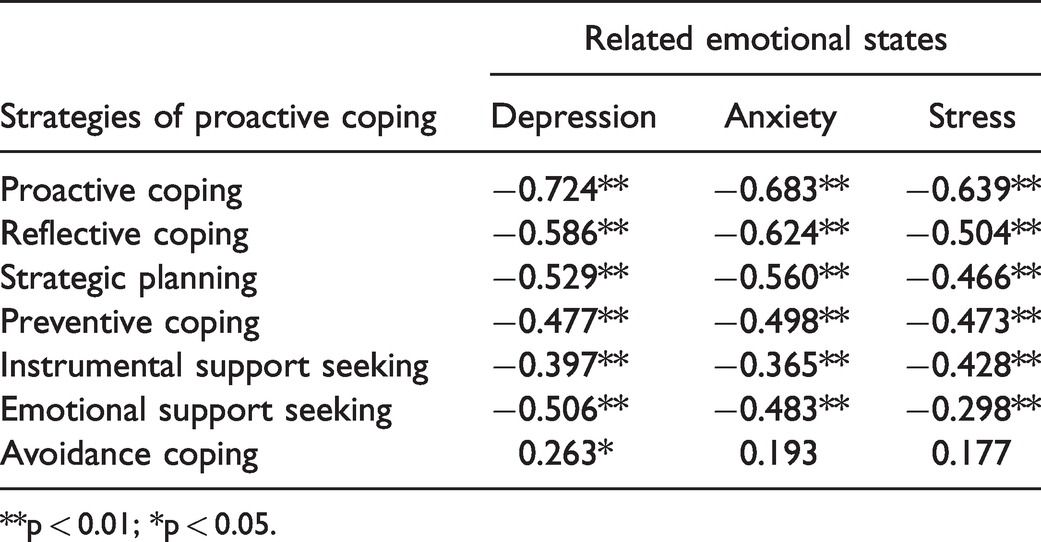
**p < 0.01; *p < 0.05.
The sample being clinical in nature smaller number of cases were found in the arsenic induced cancer with visible symptoms of arsenicosis group (n=25) (i.e., melanosis, keratosis and hyperkeratosis etc.). Both the groups of cancer (with and without visible symptoms of arsenicosis) qualified for the inclusion criteria and only differed in skin manifestation as visible symptoms of arsenicosis. Hence, non-parametric statistical tool of Mann Whitney U- test was further used to ascertain homogeneity of these two sub-groups of arsenic induced cancer. Twenty five cases (n=25) from each sub group were used for the non-parametric analysis. These two sub groups were comparative with respect to major socio-demographic variables. The analysis yielded a non-significant result (see supplementary file; Table 2). The non-significant group means difference with respect to the three emotional states (anxiety, stress and depression) established the two groups to be homogeneous, irrespective of difference in skin manifestations as visible symptoms. Hence, the data/sample being free from selection bias the two sub-groups (arsenic induced cancer with and without visible symptoms of arsenicosis) were further analyzed as one homogeneous group (N=77) in the study.
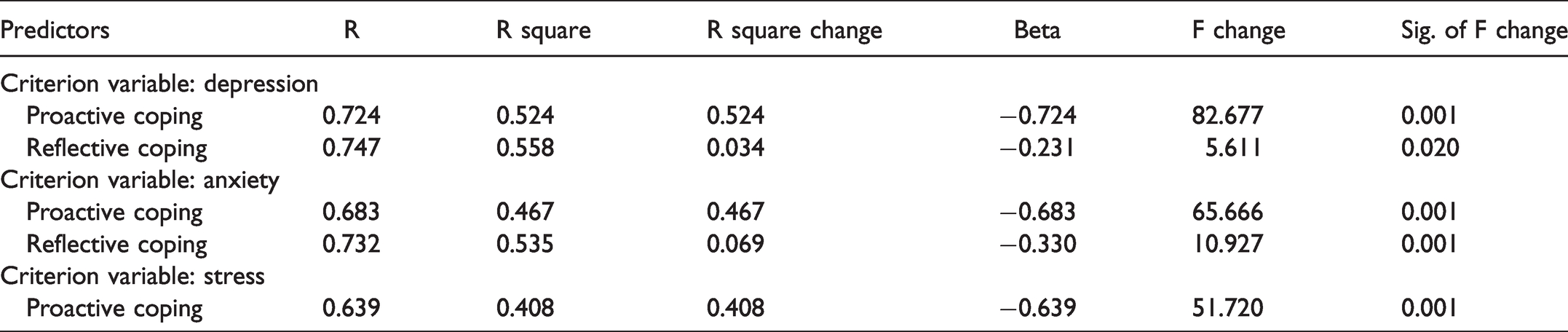
Showing results of step wise linear regression analysis using strategies of proactive coping as predictor variables (IV) and related emotional states (Depression, Anxiety and Stress) as criterion variable (DV).
Tools
The following standardized tools were used to collect the data-
Procedure
Arsenic induced cancer patients were identified by the trained clinicians of MCSRC, Patna. This identification and referral was based on the following biomarkers: arsenic in nail, arsenic in hair, arsenic in blood and arsenic in drinking water from drinking water source used by the participants. Henceforth, socio-demographic and clinical data sheet was used to collect relevant socio-demographic information from these referred cases to screen out the cases as per the set inclusion criteria. Informed consent was taken from each consenting patient/participant. Proper rapport was established and the purpose of the study was explained. It was also informed that their participation would be voluntary and confidential. After clarifying all doubts, psychometrically sound self-report measures/tools were used to assess proactive coping, depression, anxiety, and stress among the sampled arsenic induced cancer patients. The ethical guidelines of American Psychological Association 30 were followed thoroughly while dealing with the human participant of the study. On completion of data collection, the participants were thanked for their honest and active participation. Correlation and regression analysis was done using statistical package for social sciences (SPSS) version- 22 to test the hypotheses framed.
Results
To test the hypotheses framed inferential statistics were used. Correlation was used to check the association between variables (proactive coping and the three related emotional states). Step wise linear regression was used to predict variables causing effect on the other (role of proactive coping on stress, depression and anxiety). SPSS version-22 was used to analyze the data.
Table 1 shows that six strategies of proactive coping are negatively associated with 3 of the related emotional states (i.e., Depression, anxiety and stress). Depression is found to be negatively associated with proactive coping (−0.724, p < 0.01), reflective coping (−0.586, p < 0.01), strategic planning (−0.529, p < 0.01), preventive coping (−0.477, p < 0.01), instrumental support seeking (−0.397, p < 0.01) and emotional support seeking (−0.506, p < 0.01).
Anxiety is also negatively associated with proactive coping (−0.683, p < 0.01), reflective coping (−0.624, p < 0.01), strategic planning (−0.560, p < 0.01), preventive coping (−0.498, p < 0.01), instrumental support seeking (−0.365, p < 0.01) and emotional support seeking (−0.483, p < 0.01). Stress is also found negatively associated with proactive coping (−0.639, p < 0.01), reflective coping (−0.504, p < 0.01), strategic planning (−0.466, p < 0.01), preventive coping (−0.473, p < 0.01), instrumental support seeking (−0.428, p < 0.01) and emotional support seeking (−0.298, p < 0.01). Avoidance coping is significantly and positively associated with only depression (0.263, p < 0.05).
Hence, it can be concluded that the hypothesis-1 stating “strategies of proactive coping would significantly associate with emotional states (depression, anxiety and stress) of arsenic induced cancer patients” is accepted.
Table 2 demonstrates that depression is significantly influenced and predicted by proactive coping and reflective coping among cases of arsenic induced cancer from the Indo-Gangetic plains of Bihar. Proactive coping emerged as the best predictor of depression. Proactive coping explains 52.4% of total variance in the depression level of arsenic-induced cancer patient residing in the Indo-Gangetic plains of Bihar. In addition, reflective coping explained 3.4% of total variance in their depression level.
Proactive coping and reflective coping emerged as significant predictor of anxiety as well. In the regression model proactive coping emerged as the best predictor of anxiety. 46.7% of total variance in the anxiety level of the arsenic induced cancer patients was attributable to proactive coping. Moreover, reflective coping explained 6.9% of total variance in their anxiety level.
Stress was also significantly predicted by proactive coping. Proactive coping explains a total of 40.8% of total variance in the stress level of these cancer patients. Hence, this result supports hypothesis-2 stating “Strategies of proactive coping would influence the emotional states (depression, anxiety and stress) of arsenic induced cancer patients” of this study.
Discussion
The psychological aspects/consequences of arsenic induced cancer in the Gangetic plains have been rarely studied worldwide. This study was one of its kinds to explore the much under studied psychological aspects of arsenic-induced cancer prevalent in the Indo-Gangetic Plains of Bihar state. The aim of the study was to examine the role of proactive coping on emotional states (depression, anxiety and stress) of arsenic induced cancer patients from arsenic affected Indo-Gangetic plains of Bihar, India. The findings of the present study would contribute in understanding the relationship between proactive coping and the three emotional states (depression, anxiety and stress) among the arsenic-induced cancer patients, coming from arsenic prone middle Gangetic plains of Bihar. Outcome of the study may help and encourage policy makers, researchers and social workers to intervene with appropriate timely interventions to cater to the much-warranted psychological needs of this population. It may also help health care workers to enhance treatment adherence of these cases.
Statistically significant association is found to exist between proactive coping strategies and the three related emotional states (i.e. depression, anxiety and stress) of the arsenic induced cancer cases. Specifically, six proactive coping strategies (viz. proactive coping, reflective coping, preventive coping, instrumental support seeking, emotional support seeking and strategic planning) were negatively associated with depression, anxiety and stress. Avoidance coping alone associated positively with depression among these patients.
In the face of problems that are neither easy to fight back nor to take flight off the situation, people generally resort to emotion focused coping strategies whereby they shift their emotion from the problem or situation, the so called “avoidance coping”. This could have short lived benefits of decline in problem related negative emotions such as stress, worry, tension, depression, anxiety etc. In long term, avoidance coping remains ineffective rather only escalate these negative emotions. 31 The negative impact of avoidance coping on mental wellbeing of breast cancer patients are well documented. 32 Similar to many other studies26,33 done on different populations, stress and proactive coping are negatively associated in this population too. Proactive coping strategies emerged antagonistic in nature to the negative emotional states of depression, stress and anxiety. Wagner and Martin had earlier shown that proactive coping negatively predicts anxiety and mental wellbeing.25,32
Proactive coping strategies are futuristic in orientation with proven positive consequences. Depression and proactive coping share a strong negative association in general 34 and in arsenic induced cancer condition too. Thus, practicing proactive coping strategies to deal with stressful situations may safeguard one from depressive aftereffects. Empirical findings that report negative relationship between proactive coping and traumatic experiences again promote the protective features of proactive coping strategies against bad times in life. 35 Some researchers believe that proactive coping could create opportunities too to generate resources and enhance personal growth which in turn helps accomplishment of life’s challenging goals 22 while others have concentrated on the efforts that may help to prevent future threats to personal goals. 16
Based on earlier research and present findings the protective and empowering nature of proactive coping is emphasized on and proposed to develop in arsenic-induced cancer cases to overcome stress, 26 depression24,34,36 and anxiety. Timely interventions to promote and develop proactive coping is needed to enhance psychological wellbeing 37 and quality of life of these people from the Indo-Gangetic plains of Bihar.
Hallis and Slone earlier stated coping strategies as mediator between psychological distress and life events. 38 The present study, on further exploration, found proactive coping and reflective coping to have strong predictive power for depression and anxiety. By virtue of reflective coping, one generally acts in advance that prevents any future stresses and so do loss of interest, hopelessness, sleep problems, worry, increased heart beat or blood pressure, loneliness etc. Proactive coping emerged as the best predictor of all the three emotional states (depression, anxiety & stress). Reflective coping has predictive power for depression and anxiety only and not stress. A simple understanding emerges that reflective coping may or may not influence the stress level experienced but definitely assures prevention of depression and anxiety. It might be said that if cancer patients were examining and planning in a systematic fashion to deal with future stressor then he/she might escape and overcome depression and anxiety.
The findings of the present study come as an advocacy for working on and developing proactive coping skills to help effectively manage and control the three negative emotions and their consequences in the arsenic induced cancer patients of Indo-Gangetic plains of Bihar. In other words, adapting and internalizing proactive coping strategies can be useful in overcoming/escaping depression, anxiety and stress commonly experienced as adverse psychological consequences of arsenic-induced cancer.
Conclusion
Arsenic induced cancer is a major public health issue in Indo-Gangetic plains of Bihar, India. The psychological aspect of arsenic-induced cancer is significant and calls for more research attention worldwide 27 not only to understand but also to cater to the psychological needs of this population. Unfortunately, psychological, in contrast to physiological and social consequences of arsenic-induced cancer has been rarely studied in the Indo-Gangetic plains of Bihar. For the very first time any research endeavor has scientifically attempted to explore the psychological aspects of cancer caused by prolonged exposure to carcinogenic arsenic, grossly prevalent in the Indo-Gangetic plains of Bihar. It examined the possible relationship and role of proactive coping on the three relative emotional states namely, depression, anxiety and stress. The findings of this study advocates for proactive coping as a protective psychological factor against anxiety, depression and stress, commonly found in this population.
All the seven proactive coping strategies have strong association with all the three emotional states viz., stress, anxiety and depression. Proactive coping, specially, bears strong influence on the stress, anxiety and depression level. Primarily, six strategies of proactive coping except avoidance coping strongly associated with these emotional states in inverse direction. Positive association prevails only between avoidance coping and depression. Proactive coping stands out as the best predictor of all the emotional states while reflective coping could predict strongly only depression and anxiety.
These findings clearly show that proactive coping plays a significant role in maintaining a healthy emotional state of this stigmatized population. In another words, for arsenic-induced cancer patients proactive copying is a protective psychological factor that guards against anxiety, stress and depression adversely affecting their treatment and recovery.
This study also draws attention of the future researchers, social workers and policy makers towards the most ignored psychological aspects/consequences of arsenic-induced cancer patients. More research endeavors are warranted not only to find but also to understand and alleviate the psychological needs of this under studied population. Timely psychological interventions that inculcate proactive coping practices may help manage these negative emotional states promoting healthier psychological health. The findings also give an insight for similar researches, in future, to explore the understudied psychological aspects of arsenic induced cancer/disease in other arsenic affected Indo- Gangetic plains.
Implications
Supplemental Material
sj-pdf-1-qch-10.1177_0272684X211033460 - Supplemental material for Depression, Anxiety and Stress Among Arsenic-Induced Cancer Patients in Indo-Gangetic Plains of Bihar: Role of Proactive Coping
Supplemental material, sj-pdf-1-qch-10.1177_0272684X211033460 for Depression, Anxiety and Stress Among Arsenic-Induced Cancer Patients in Indo-Gangetic Plains of Bihar: Role of Proactive Coping by Shishu Kesh Kumar and Das Ambika Bharti in International Quarterly of Community Health Education
Footnotes
Acknowledgment
The authors acknowledge the ethical committee of Mahavir Cancer Sansthan and Research Center, Patna for ethical approval to collect data. We would also acknowledge Prof. A. K. Ghosh, Head, Research Cell, Mahavir Cancer Sansthan and Research Center, Patna and his colleagues for the required cooperation during the data collection. The authors thankfully acknowledge the two anonymous reviewers for their insightful review of the manuscript that has greatly enhanced the quality of the manuscript.
Ethical Approval
The ethical approval was obtained from the Departmental Research Degree Committee (DRDC), Department of Psychological Sciences, School of Human Sciences, Central University of South Bihar, Gaya. The ethical committee of Mahavir Cancer Sansthan and Research Center, Patna also approved the present study before permitting/providing the data collection from their Centre. The ethical guidelines of American Psychological Association
30
were followed while collecting data from the human participants of the study.
Declaration of Conflicting Interests
The author(s) declared no potential conflicts of interest with respect to the research, authorship, and/or publication of this article.
Funding
The author(s) received no financial support for the research, authorship, and/or publication of this article.
Data Accessibility Statement
The data that support the findings of this study are available on request from the corresponding author. The data are not publicly available due to privacy or ethical restrictions.

Supplemental Material
Supplementary material for this article is available online.
Author Biographies
References
Supplementary Material
Please find the following supplemental material available below.
For Open Access articles published under a Creative Commons License, all supplemental material carries the same license as the article it is associated with.
For non-Open Access articles published, all supplemental material carries a non-exclusive license, and permission requests for re-use of supplemental material or any part of supplemental material shall be sent directly to the copyright owner as specified in the copyright notice associated with the article.
