







Abstract
African Americans experience higher incidence and prevalence of Alzheimer’s disease (AD). Yet, they continue to be underrepresented in AD research, limiting the ability to generalize findings to the increasingly diverse US population. To reduce AD disparities, targeted efforts are needed to increase the representation of African Americans in AD research. This mini review identified evidence-based strategies that increased research participation among older African Americans. Four recruitment strategies emerged from eight published peer-reviewed studies that directly evaluated the effectiveness of strategies aimed at increasing the number of African American participants in Alzheimer’s research. The strategies include community outreach and education, face-to-face discussions, remote access, and referral and partnership with local organizations. Across different locations, these strategies increased the number of African Americans enrolled into AD research, the number of people that signed up to donate their brains for AD research upon death, and the knowledge and perception of AD in the communities. Targeted efforts are effective in increasing AD research participation among older African Americans, especially when combined with approaches that emphasize transparency and mutual trust and involve the community as stakeholders in the research process.
Introduction
African Americans are twice as likely to be impacted by Alzheimer’s disease (AD) compared to their white American counterparts. 1 It is projected that the number of African Americans, aged 65 and older, affected by AD will double by 2030. 2 Despite the higher incidence and prevalence of AD among African Americans, this group continues to be underrepresented in AD research, especially in clinical trials. Although African American adults make up approximately 9% of the older adult population in the United States, they constitute less than 5% of research subjects in clinical trials of therapeutic agents for AD.3,4 The majority of AD research in the US is done primarily with highly educated, white participants, limiting the ability to generalize findings to the broader demographics of the US population. 5
The most cited barriers to African American participation in AD research are mistrust of the scientific community, fear of exploitation, and unfamiliarity with research.6–8 These concerns may be exacerbated by literacy and language barriers, transportation costs, lengthy appointments, lack of cultural competency among researchers, and high turnover of research staff. While previous research has focused mostly on identifying barriers to research participation among older African Americans, relatively few studies focus on effective strategies to enhance participation of this underrepresented subgroup.
This mini review aimed to identify evidence-based recruitment strategies that have been shown to increase participation among older African Americans in AD research.
Method
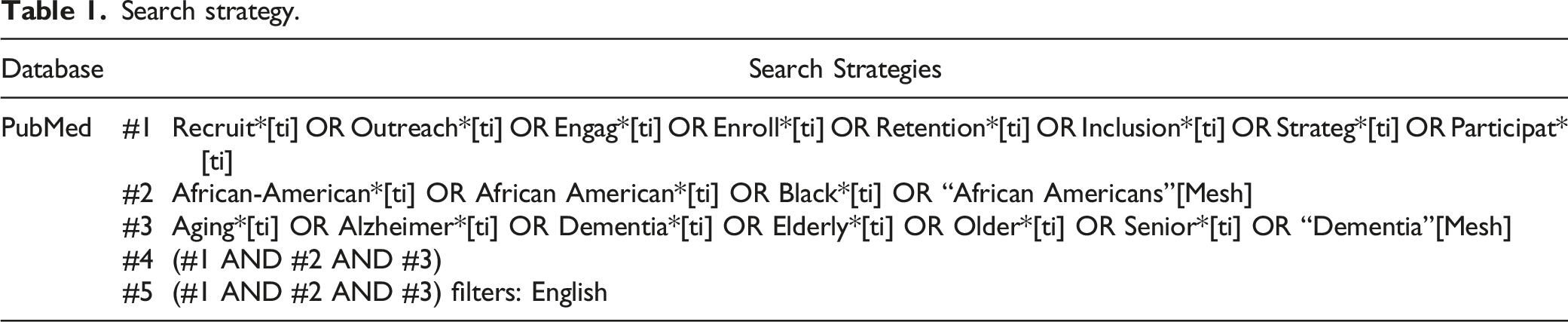
Search strategy.
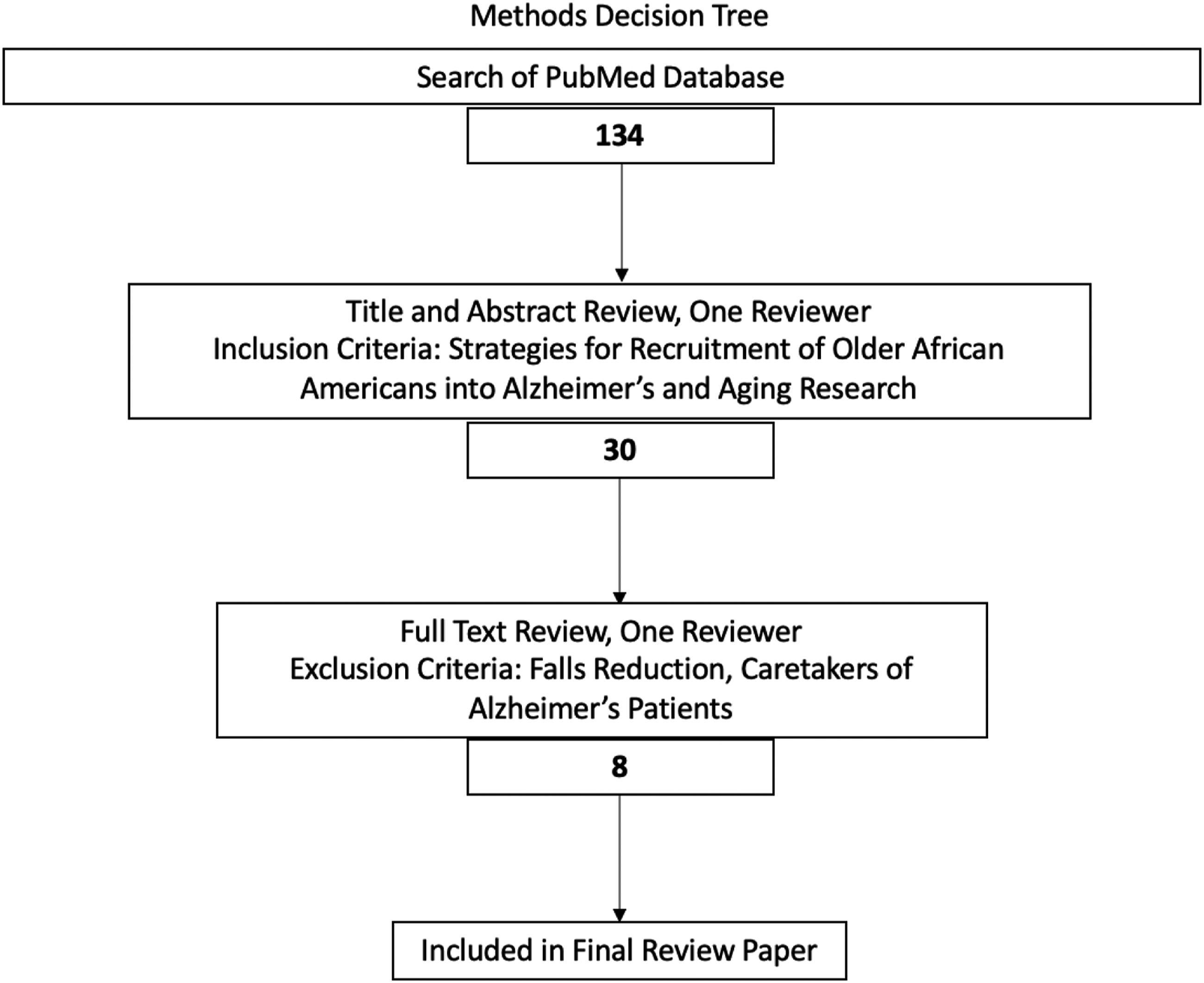
Methods decision tree.
Article titles and abstracts were reviewed individually by a single reviewer (C. Y.). The full-text articles were located and reviewed for studies that appeared to meet inclusion criteria. A discrepancy in articles deemed eligible, such as articles that merely described recruitment strategies in the research study, was solved by consent from one of the senior authors (B. A. F). To be inclusive, there were no exclusion criteria based on publication date. The final studies included in the results were published between 1993 and 2018. All studies were conducted in the United States.
We identified eight published peer-reviewed studies that evaluated the effectiveness of recruitment strategies aimed at increasing the number of African American participants in AD research. The studies included six with a pretest-posttest design and two with retrospective cohort analyses to assess the effectiveness of recruitment strategies.
Results
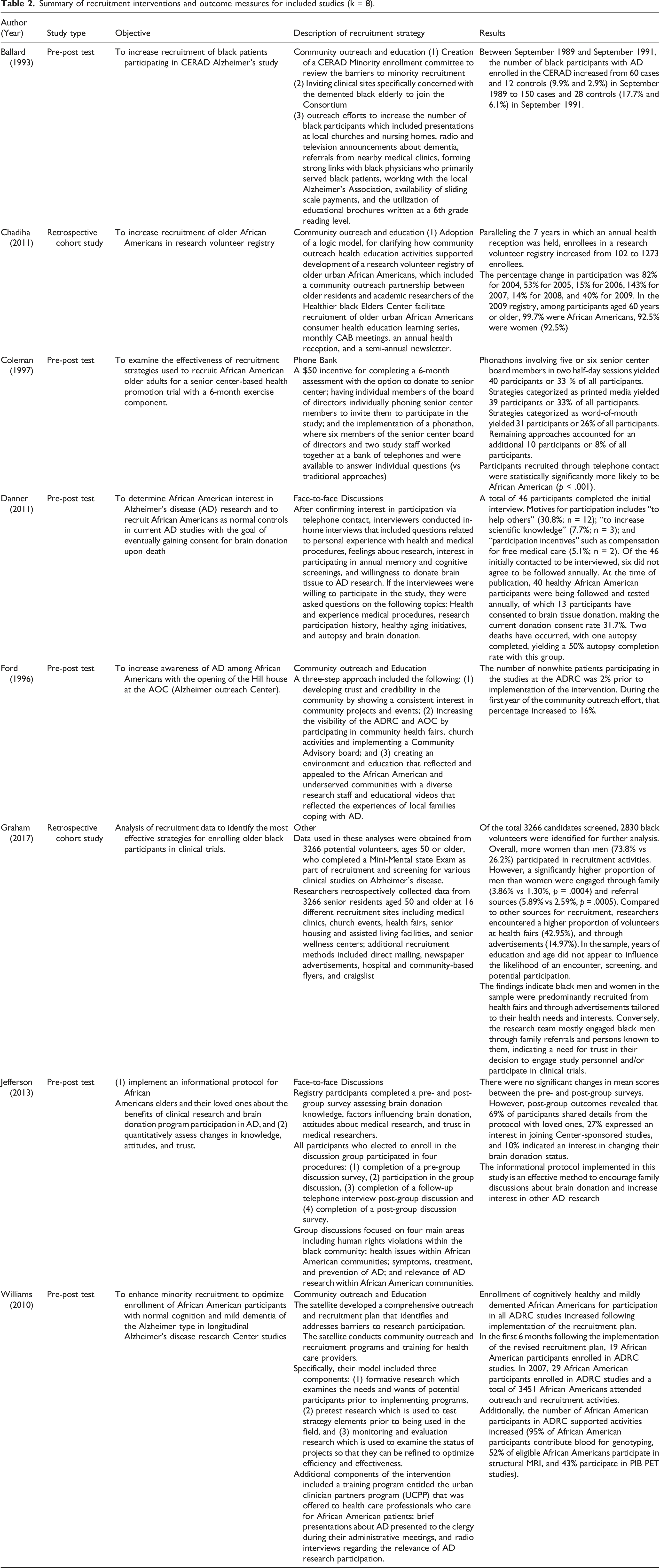
Summary of recruitment interventions and outcome measures for included studies (k = 8).
Community Outreach and Education
Community outreach and education was the most recurring theme for recruitment interventions evaluated in the papers that we identified.6,9–11 The first study evaluated an intervention that aimed to recruit clinical sites with a special interest in AD among older Black Americans as contributors to a larger database. 9 The second study evaluated a community outreach partnership between older residents and academic researchers to increase the recruitment of older urban African Americans for a research volunteer registry. 10 The third study evaluated a satellite program that was established to increase the awareness of AD among African Americans and historically medically underserved communities. 11 Finally, the fourth study evaluated a comprehensive outreach and recruitment plan that sought to identify and address barriers to research participation. 6 Below, we summarize the major aspects of the interventions that made them successful.
Across the four studies, community outreach interventions were reported to be effective at increasing the participation of older African Americans in AD research. The interventions utilized strategies that created continued and long-lasting community partnerships between academic researchers and older Black community members. For example, the Consortium to Establish a Registry for Alzheimer’s Disease (CERAD) worked with clinical sites to form a CERAD Minority Enrollment Committee—tasked with reviewing the barriers to and strategies for enhancing minority recruitment. The efforts of CERAD included presentations at local churches and nursing homes; radio and television announcements about dementia; referrals from nearby medical clinics; forming strong links with Black physicians who primarily served Black patients; working with the local Alzheimer’s Association; availability of sliding scale payments based on an individual’s income for medical services rendered as part of the research study; and the utilization of educational brochures written at a 6th-grade reading level. 9
Targeting areas with a large percentage of African Americans (e.g., Lexington, KY; St. Louis, MO; and Boston, MA) and utilizing a social marketing business approach as a primary recruitment approach also emerged as effective recruitment strategies. For example, the Washington University Alzheimer’s Disease Research Center’s (ADRC) social marketing approach included three components: (1) formative research to examine the needs and wants of potential participants prior to implementing programs; (2) pretest research to test strategy elements prior to being used in the field; and (3) the monitoring and evaluation of research to examine the status of projects so that they can be refined to optimize efficiency and effectiveness. 6
Common across all four recruitment interventions were training of partners and stakeholders who are community members and/or who provide essential services to the community, such as pastors, counselors, health center workers, mayors, peer educators, and leaders. To exemplify, the ADRC had a training program entitled the Urban Clinician Partners Program (UCPP) that was offered to health care professionals in the St. Louis, Missouri, area who care for African American patients, brief presentations about AD presented to the clergy during their administrative meetings, and radio interviews regarding the relevance of AD research participation.
Finally, despite the differences in community outreach efforts, the studies show that the following approaches were effective to reach African Americans and increase their enrollment in AD research: (1) developing trust and credibility in the community by showing a consistent long-term interest in community projects and events; (2) participating in community health fairs, church activities and implementing a Community Advisory Board; and (3) creating an environment that reflected and appealed to African American communities with a diverse research staff and educational videos that reflected the experiences of local families coping with AD.
Face-to-Face Discussions
Face-to-face discussions emerged as an effective strategy for increasing enrollment of African Americans into AD research.12,13 This strategy involved structured, in-depth at-home interviews with older African Americans. On the one hand, this strategy helped the researchers to explore the life experiences, feelings about scientific/medical research, current health behaviors such as annual cognitive screening, and willingness to participate in scientific/medical research studies among older African Americans. On the other hand, face-to-face discussions provided participants with the opportunity to receive detailed clarification about research procedures in an intimate, familiar setting. Darnell and colleagues (2011) reported that the University of Kentucky Sanders-Brown Center on Aging successfully utilized this strategy to gain consent for brain donation upon death. 12
Another face-to-face strategy, using a group setting, assessed attitudes towards medical research and brain donation. Using this strategy, the researchers gained an in-depth understanding of the (1) current perceptions of the historic healthcare-related ethical and rights violations on African Americans; (2) health issues within African American communities as identified by the communities and not the researchers; (3) knowledge of symptoms, treatment, and prevention of AD; and (4) relevance of AD research within African American communities. 13 This technique allowed the researchers to develop a better understanding of the barriers and facilitators to brain donation for research purposes.
Remote Access
Remote access leverages technological innovations combined with convenience and accessibility. One study implemented a “phonathon” where six members of the senior center board of directors and two study staff members worked together at a bank of telephones to recruit participants and were available to answer individual questions from potential research participants about the research study. 14 The effectiveness of this intervention was compared to previous traditional approaches to recruitment. Phone conversations effectively reached a higher number of active and mobile older African Americans within a short time and eliminated challenges related to travel to research sites/laboratories.
Referral and Partnership with Local Organizations
Personal referrals proved effective in attracting African Americans to AD studies. Graham and colleagues (2018) showed that older African Americans might be more likely to participate in research when the recommendation originates from familiar and trusted individuals such as community leaders, pastors, and local physicians. 15 Also, partnership with different local organizations that served as recruitment sites such as medical clinics, churches, community health centers, senior housing and assisted living facilities, and senior wellness centers was an effective intervention strategy to increase AD research participation among older African Americans. 15 The strategy allowed researchers to engage with older African American participants within trusted and familiar spaces. 15
Discussion
Long-standing community outreach and education are consistently found to be the most effective means to increase AD research participation among older African Americans. A longer period of exposure to research information and more frequent contact with research staff will likely increase familiarity with the proposed study, encourage more enthusiastic participation, and maintain engagement. 9 By reassuring participants that they will be provided with adequate protection and given full transparency of the study purposes and protocols, researchers will be better positioned to attract and retain older African Americans to AD research studies.
Other observational and case-study papers on this topic did not meet eligibility criteria but offer additional support for the effectiveness of tailored recruitment strategies in African American communities. The observational and case-study papers identified facilitators and barriers to African American participation in research and noted that orchestrating community partnerships and facilitating a two-way learning process are key strategies to improve research participation.16,17 Rexroth et al. (2010) suggested that researchers address economic factors that may hinder research participation by providing transportation or reimbursement for transportation, having convenient hours to accommodate the participants' schedules, and conducting the research study in a familiar place such as their home or a local community center. 18 A study by Ballard et al. (2010) identified that the research staff’s transparency and cultural sensitivity were facilitators of research participation. 7 The study also concluded that both the researchers and community members participate in disseminating research findings. 7
Consistent with the findings of this review, some studies have identified that building long-term relationships and formalizing community involvement are keys to increasing AD research participation among older African Americans. For example, Gluck and colleagues found that older African American participants in the Newark area were recruited to research primarily from long-standing partnerships with local churches and senior centers and from public and subsidized housing sites. 19 They also reported that the creation of a community advisory board that reflects the breadth of the older African American communities in the area helped guide research activities and provided a bridge to community needs and interests. 19 Similarly, Mitchell and colleagues (2020) reported that the formation of a community advisory board, which oversees research recruitment of fellow minority older adults and supports community health programming, has led to successful recruitment and retention of older African Americans in metro Detroit to research studies over the past 20 years. 20
Another important factor to consider while conducting research among older African Americans is the power differentials that exist between researchers and participants. Reed et al. (2003) argued for incorporating recruitment strategies that increase autonomy in an environment where community members may feel pressure to participate. 21 This can be accomplished by providing complete and accurate communication about research and maintaining a consistent presence in the community, 21 and by ensuring that information is presented in a clear, understandable format that conveys how these studies can potentially benefit the African American community.21,22 While gaining the trust of older African American participants may be difficult, researchers who have committed themselves to the local community have shown notable successes in recruitment. Having minority researchers, including race-concordant study staff, has also been shown to be helpful. 23
Future Directions
The current mini-review provided evidence that tailored strategies are needed to increase the recruitment and retention of African Americans to longitudinal and interventional research—a vital step toward improving our ability to generalize research findings to the diverse US population and reducing AD disparities. Older Americans are becoming increasingly diverse, and additional efforts are needed in recruitment science to create and maintain consistent methods for recruiting and retaining diverse older Americans for Alzheimer’s disease and aging research. 24 Second, because probable AD is often diagnosed through procedures that may be viewed as invasive or carrying some risk (e.g., PET and lumbar punctures), future research is needed to understand better appropriate educational and motivation techniques geared to improve participation by older African Americans in these procedures. 25 Finally, across all aging and AD research programs, there is a notable lack of African American men who participate relative to higher levels of participation by African American women. Because of the importance of examining sex as a biological variable to influence AD risk and progression, identifying validated methods for increasing participation by African American men is critical.
Implications for Expanding African American Participation in Future Alzhemier’s Studies
Recruiting and retaining sufficient numbers of African Americans for Alzheimer’s research remains an essential public health task because, through research, we can better understand the risk and protective factors for AD. In turn, knowledge of these factors has the potential to inform future interventions to reduce AD disease burden within the African American community. Currently, the absence of older African Americans in AD research limits the ability to generalize research findings to this population, further perpetuating AD disparities. A better understanding of the prevalence of AD in African Americans will be informative as we discover treatments and potential cures for AD suitable for diverse older adults.
Footnotes
Declaration of conflicting interests
The author(s) declared no potential conflicts of interest with respect to the research, authorship, and/or publication of this article.
Funding
The author(s) disclosed receipt of the following financial support for the research, authorship, and/or publication of this article: This work was supported by National Institute of Health and grant id 1R01AG053961.
