







Abstract
Marketing educators have long recognized the value of engendering students’ deep learning of course content via experiential pedagogies. In this article, the authors describe a semester-long, team-based retail audit project that is structured to elicit active student engagement with consumer behavior course material via concrete, hands-on, real-world experience. For the project, students form teams to organize and conduct an observational audit of a live retail setting. In the process of completing the project, students engage with course content on their own, with their team members, and importantly, within a focal store environment, thus experiencing for themselves the effects of that content on their own shopping behavior, as well as that of others. Compelled by the project’s active pedagogy to engage in discovery, students learn not only the “what” and “why” of marketing concepts, strategies, and techniques but also “how to” implement them. Anchored in conceptual perspectives relevant to the project, the article explains the components and structure of the project and explicates its key benefits with an emphasis on the students’ perspectives. The article includes results of qualitative and quantitative analyses that support the effectiveness of the project and suggests future directions for extending pedagogical research in this area.
Keywords
Marketing scholars and educators have long advocated for and studied the effectiveness of the shift in emphasis in college marketing courses from passive to active learning approaches (e.g., Craciun & Corrigan, 2010; Karns, 2005; Laverie, Madhavaram, & McDonald, 2008). In accordance with contemporary, student-centered, active learning paradigms (Karns, 2005), faculty routinely seek to engage students in as many components of a marketing course as possible, with the goals of stimulating students’ cognitive capabilities, engendering their deep learning of key course concepts, and developing skills that are transferable into the workplace and into their lives as consumers. For the past 7 years, we have used in our consumer behavior courses a semester-long, team-based retail audit assignment that we created to bring about active student engagement via a concrete, hands-on, real-world experience.
This retail audit project enables us to address 10 key student outcomes in the consumer behavior course, 6 of which are pedagogical and 4 of which involve the development of transferable work/life skills. The course’s pedagogical outcomes are based on the six levels in the cognitive domain of Bloom’s taxonomy of educational objectives (Anderson & Krathwohl, 2001; Bloom & Krathwohl, 1956). These are the ability to (1) remember and define basic consumer behavior terms, concepts, and theories; (2) understand and articulate the consumer decision-making process and the major sources of influence on this process; (3) apply and use consumer behavior knowledge in a live or “real-world” situation; (4) analyze how consumer behavior concepts relate to one another and to “real-world” situations; (5) make judgments about the effectiveness of consumer behavior strategies; and (6) put the elements of the course together to create consumer-oriented marketing strategies and tactics in a “real-world” situation. The practical skills-based outcomes are rooted in the deep learning process and experiential learning. These are (7) an increase in students’ awareness of the potential effects of marketing messages, promotional information, and store environment on their own shopping and consumption behaviors; (8) the students’ progress toward becoming more aware and informed consumers; (9) the students’ ability to use course information with respect to modifying their own shopping behavior; and (10) the students’ ability to develop transferable skills, such as working in teams and conducting consumer research, which are valuable to potential employers. We have found that students who participate in the retail audit project perform very well across our stated pedagogical outcomes and complete the consumer behavior course with new and useful work/life skills.
The retail audit project engages students in observational research in a live retail setting. Working in teams, students choose a retailer to audit, conduct data collection and analysis, and present a report of their findings in both oral and written formats. They apply their knowledge of course material in a detailed analysis and evaluation of the retail environment and work with course concepts on their own, with their team members, and importantly, within a focal store environment, thus experiencing for themselves the effects of that content on their own shopping behavior, as well as that of others.
Our presentation of this article is motivated by our own success with the project and the awareness that exposition of such experiential assignments can be of interest to marketing educators (Desai, Damewood, & Jones, 2001). The article’s most significant contribution to the literature arises from the distinctive nature of the project itself. Throughout the body of work in marketing education, we know of no other published article that describes a comprehensive, team-based retail audit. We believe that marketing educators will find the retail audit valuable because it is designed to achieve a range of educational objectives, its effectiveness in achieving those objectives is well supported with empirical evidence, it is easily adaptable to a variety of courses, and, importantly, students find the project engaging and relevant.
We begin with a section on the conceptual perspectives informing our discussion and provide a description of the retail audit project. We then present results of qualitative and quantitative analyses that support the effectiveness of the project and conclude with a brief discussion of the article’s findings, limitations, and future directions.
Conceptual Perspectives
Among the conceptual perspectives that provide support for the incorporation of the retail audit in a consumer behavior course are Bloom’s taxonomy, deep learning, and experiential learning. The key pedagogical student outcomes outlined in the previous section reflect our desire to have our students work through virtually all the levels in the cognitive domain of Bloom’s taxonomy with respect to consumer decision making, shopping behavior, and retailer strategies and tactics with the goal of achieving deep learning (Marton & Säljö, 1976). In addition, the scope, structure, and the experiential nature of the retail audit project are designed to help our students—and us—to achieve desired course outcomes.
Bloom’s Taxonomy of Educational Objectives
The often-cited taxonomy of Bloom and his colleagues (e.g., Bloom, Hastings, & Madaus, 1971; Bloom & Krathwohl, 1956) provided educators with one of the earliest classification systems of thinking processes and intellectual behavior, which still is widely used by instructors to assess students’ abilities and determine their achievement levels with respect to course objectives (e.g., Forehand, 2005). The taxonomy is a hierarchical scheme of classifying thinking according to six cognitive levels of complexity, each requiring mastery of the prior skill before the next one can be achieved. Numerous alternative frameworks have been proposed (e.g., Hauenstein, 1998; Merrill, 1994), but Anderson and Krathwohl’s 2001 update of Bloom’s taxonomy is now dominant. In order to better reflect the contemporary active learning paradigm, Anderson and Krathwohl changed Bloom’s terminology from nouns to verbs. Their terms and definitions for the six cognitive levels are as follows:
(1) Remembering: retrieving, recognizing, and recalling relevant knowledge from long-term memory; (2) Understanding: constructing meaning from oral, written, and graphic messages through interpreting, exemplifying, classifying, summarizing, inferring, comparing, and explaining; (3) Applying: carrying out or using a procedure through executing, or implementing; (4) Analyzing: breaking material into constituent parts, determining how the parts relate to one another and to an overall structure or purpose through differentiating, organizing, and attributing; (5) Evaluating: making judgments based on criteria and standards through checking and critiquing; [and] (6) Creating: putting elements together to form a coherent or functional whole; reorganizing elements into a new pattern or structure through generating, planning, or producing. (Anderson & Krathwohl, 2001, pp. 67-68)
Students engaged in learning at the three highest levels of Bloom’s taxonomy—analyzing, evaluating, and creating—gain experience in honing the skills that are among those most sought-after by managers and recruiters of business students. Critical thinking, analytical reasoning, and oral and written communication are among the top skills mentioned by corporate executives when they are asked what they were looking for in a job candidate (Chapman, Meuter, Toy, & Wright, 2010).
Deep Learning
Based on the seminal work of Marton and Säljö (1976), what students focus on during learning can vary along a qualitative dimension, from the surface of the material (i.e., the sign, the facts, or the terminology, per se) to the deeper intended meaning of the material (i.e., what is signified, and how this relates to previous knowledge). Deep learning “involves the critical analysis of new ideas, [the] linking [of new ideas] to already known concepts and principles, and leads to understanding and long-term retention of concepts so that they can be used for problem-solving in unfamiliar contexts” (Houghton, 2004, p. 9). It is important to note that deep learning is both a process that carries a student through the learning environment and an outcome resulting from a student’s engagement with the learning environment (Entwistle, 1991; Marton & Säljö, 1976).
In the classroom, the process of deep learning involves the actions students take to combine the course materials and experiences with their preexisting skills and capabilities in order to gain knowledge (Houghton, 2004). Students achieve deep learning when they transcend rote memorization of basic facts (i.e., surface learning) and engage in elaborative processing to discover additional meanings and associations in the course material (e.g., Bacon & Stewart, 2006). Experiential projects and active learning exercises help students achieve deeper comprehension by encouraging them to make more mental connections with the material. When students are required to rearrange material and link it to their existing knowledge structures during such activities, they both enhance their command of relevant concepts and definitions, or declarative knowledge, and develop their understanding of “how to do things,” or procedural knowledge (Conway, Cohen, & Stanhope, 1991).
Since procedural knowledge requires connecting and using multiple elements of declarative knowledge and, therefore, creates more traces within memory, it is considered to be deep knowledge; that is, more stable, more firmly understood, and more easily recalled than knowledge obtained through rote, or surface learning (Conway et al., 1991). When students learn “how to do things” by applying course content in a project, their retention of that content is likely to be greater than when they learn via more passive pedagogies, such as lecture (Bacon & Stewart, 2006).
Although there is a degree of overlap between Bloom’s taxonomy and deep learning, this overlap should not suggest that the content of one pedagogy is mirrored in the other. Bloom’s taxonomy’s value largely resides in its structure as a hierarchy of increasingly difficult tasks for exercising the knowledge and skills required to solve a problem. In other words, it is well suited as an instructional strategy (McGee, 2003). Although Bloom’s taxonomy does not explicitly evoke from students the thought processes necessary for solving the problem (i.e., it does not necessarily engender deep learning in students), working through the higher order tasks of the taxonomy (applying, analyzing, evaluating, creating) requires students to transcend the surface-level, rote learning of the lower order tasks, exercise their critical-thinking skills, and engage with course material at a more profound level.
As McGee (2003) suggests, it is important for the instructor to be aware of and manage the relationship between the instructional strategy (i.e., what the teacher does) and students’ approaches to the material (i.e., what the learner does). Requiring students to interact with and use the course material via structured experiential processes is a best practice for engendering deep learning (e.g., Diamond, Koernig, & Iqbal, 2008; Houghton, 2004). At the heart of this notion is Marton and Säljö’s (1976) discovery that the character of what students are expected to understand shapes the character of the knowledge they acquire. That is, the demands created by a particular type of assignment cause students to adapt their level of processing to what is being demanded of them. When we attempt to engender deep learning by requiring students to analyze, evaluate, and create, past research and current practice dictate that they will rise to the challenge. Therefore, we incorporate objectives that relate to both Bloom’s taxonomy (instructional strategy) and deep learning (learner-focused outcomes) into our consumer behavior courses and, specifically, in the retail audit assignment.
Experiential Learning
According to seminal work by Kolb (1984), experiential learning is “a process whereby knowledge is created through the transformation of experience” (p. 38). In other words, students become actively engaged in creating their own knowledge (Morgan, Allen, Moore, Atkinson, & Snow, 1987; Slavin, 1980). Experiential learning has been found to be effective in a variety of marketing courses including principles of marketing (Drea, Singh, & Engelland, 1997), marketing strategy (Razzouk, Seitz, & Rizkallah, 2003), marketing ethics (Hunt & Laverie, 2004), and consumer behavior (Titus & Petroshius, 1993). Notably, a number of consumer behavior researchers (e.g., Krishnan & Porter, 1998; Titus & Petroshius, 1993) and textbook authors (e.g., Lantos, 2011) have suggested that the best way to learn about consumer behavior is to put it into action. We, too, believe that experiential learning is a natural fit for the consumer behavior course and, therefore, developed the retail audit project as a value-added exercise to augment the already highly experiential character of the course. Shopping, buying, and consuming are all experiences. Rather than just discuss these types of experiences in class, the students actually engage in these types of experiences as part of the course. As participant observers, students see and feel the effects of the retail environment in a new way. Learning becomes active and personal as students make enduring connections between their own experiences and concepts from the course.
Experiential projects similar to our retail audit have been shown to enhance students’ ability to use marketing concepts and theories to solve marketing problems. Such projects have been developed to focus on a variety of skills, such as decision making, planning, and written and oral communication (Bobbitt, Inks, Kemp, & Mayo, 2000). Although the challenges inherent in developing interesting and effective experiential learning projects have caused some instructors to be hesitant in adopting the experiential learning paradigm (Bobbitt et al., 2000), the benefits of this student-centered approach have been well documented. Furthermore, empirical evidence suggests that students believe that active pedagogies, such as projects, cases, and discussions, contribute most to their learning (e.g., Karns, 1993).
Having students work on projects in teams has additional benefits. When students engage fully in team-based experiential learning activities that require higher order thinking, they may add to their portfolios what may be the number one skill their future employers will seek: the ability to work effectively as part of a team (e.g., Chapman et al., 2010; Laverie et al., 2008). Team-based projects emulate the workplace (Laverie et al., 2008) and facilitate students’ development of leadership, problem solving, task-completion, time management, and team cooperation skills. Furthermore, when properly facilitated (Prichard, Bizo, & Stratford, 2006), team-based activities foster the ability to collaborate, compromise (Katzenbach, 1997), and cooperate with and tolerate others (Abson, 1994), all skills that are transferable into students’ broader lives and relationships, as well as into their careers.
Description of the Project
The retail audit assignment is based on concepts from the book Why We Buy by Paco Underhill (1999, 2009), which is required reading for the course. Underhill, a retail anthropologist and the founder and director of a retail consulting firm, Envirosell, studies shopper behavior patterns by tracking consumers’ movements through stores and observing and recording their browsing and buying behaviors. Why We Buy summarizes key findings of Underhill’s research in three main areas: (1) consumers’ sensory reactions to the physical aspects of store layout and placement of merchandise; (2) psychological reactions to features, placement, and packaging of merchandise; and (3) distinctive behaviors of the genders and generations, all of which are concepts relevant to the study of consumer behavior.
For the project, student teams collect and analyze qualitative and quantitative data on key store atmospherics and evaluate how these atmospherics affect shopper and buyer behavior. Each team is required to synthesize material from Why We Buy with other course content, evaluate a retailer, and deliver a written and oral report that includes results and recommendations for the retailer. The teams examine topics such as store location, traffic flow, crowding, signage, and buyer movements and behaviors. (For a more detailed description of the topics, see Appendix A.)
The retail audit is designed to be a semester-long project worth about 25% of the overall course grade. Lectures, readings, and discussion of the material are interwoven with student execution of the group project. We provide students with information on conducting observational research very early on in the semester. Sources we have found useful in teaching observational techniques include Babbie (2001), McDaniel and Gates, (2006), and Zikmund & Babin, (2007). Student teams form early in the semester, also. (We recommend no later than Week 3 for a 15-week term, Week 2 for a 10-week term.) During the first 5 to 6 weeks of the course, we conduct in-class quizzes and discussions on the key concepts in Why We Buy. In addition, we provide students with a handout stating the project objectives and topics to be covered (Appendix A), a grading rubric for the retail audit paper (Appendix B), an example of the final grading sheet for the retail audit paper and presentation (Appendix C), and a peer evaluation form for the retail audit project (Appendix D). The objectives and topics document (Appendix A) and the grading rubric (Appendix B) provide students with a “big picture” of the required content and grading criteria for the project; the final grading sheet (Appendix C) gives the students a section-by-section breakdown of the potential and actual points allocated to each required component of the project, whereas the peer evaluation form (Appendix D) specifies the areas of student performance that teammates will evaluate. As Walvoord and Anderson (1998) suggest, such documents allow for effective communication of the assignment’s expectations and give the students clear points of reference as they complete the assignment.
Students are charged with designing their own research, including the observational method(s) they choose to use (shadowing, mystery shopping, etc.) and how to allocate tasks among team members. We use this structure with the intent of increasing students’ level of psychological ownership, or control, of their work, which has been shown to increase students’ intrinsic motivation to complete tasks, involvement and satisfaction with course material, and willingness to take responsibility for their own learning (Wood, 2003; Young, 2005). Teams must complete a minimum of 10 hours of observation (usually 2-2.5 hours per member depending on the number of students on a team) and make at least one visit to the retailer as a group. Each student must have a speaking role (even if it is brief) in the final presentation. These requirements reinforce the idea of a team in that everyone brings his or her own unique skills to the project and that tasks may be distributed across each team based on these skill sets, all of which are managed internally by each team. The instructor provides support for student teams throughout the project in the form of guidance and advice, as well as any necessary interactions with store personnel. (Interaction is at the discretion of the instructor.)
Two important facilitation issues for instructors are helping students understand the in-store process of observing and assisting students in managing their own in-store activities. Typically, students choose their own retail locations, with assistance from the instructor. Larger, high-traffic stores where browsing is common are most suitable for this project. Such retail environments permit students discreetly to observe what is going on in the store while “pretending to shop” with minimal chance of being detected by other shoppers. Examples include department stores, such as Dillard’s, Kohl’s, and Sears; category killers, such as Toys R Us and Lowe’s; grocery stores, such as Albertson’s and Safeway; and superstores, such as Wal-Mart and Target. The instructor should be(come) familiar with nearby retailers that fit this description. In locations where it is difficult for teams to access larger, high-traffic stores, the instructor (or the teams, should the instructor prefer) may choose to approach smaller retailers, such as family-run retail businesses, explain the purpose of the assignment and how it could be useful to the business, and have the team present the findings to the retailer at the end of the term.
Undoubtedly, managing team-based experiential learning projects can involve a great deal of time and effort on the part of the instructor. For the semester-long retail audit project, there are several practical matters that can present significant challenges, including (1) evaluating the trade-offs of large versus small stores as study sites, (2) managing student procrastination due to the duration of the project, and (3) ensuring that students to do not take shortcuts (i.e., use the silo approach) in dividing up teamwork. We discuss our approaches to each of these, in turn, below.
One of the most important aspects of the retail audit project—data collection—occurs inside local retailers, which is well outside the instructor’s direct supervision. The effectiveness of in-store student activities depends on the suitability of the retailer as a study site. Ultimately, this is up to each instructor, but we have found some clear distinctions based on store size. On the plus side, large stores are easier to observe in without being detected and they often have more diverse shoppers, distinct peak and off times, and lots of effective and not-so-effective displays for students to analyze. However, we have also found it to be quite difficult to get managers of large stores interested in student research. So, when students study a large store, they likely forego the opportunity to present their project results to store management. With small stores, the owners are usually willing to support students’ in-store observations and are often very grateful to be the beneficiaries of “free” research reports. The main drawback, however, is that even with the store owner’s support, it is often difficult for students to conduct observations inside small stores and remain undetected by customers. Because the integrity of the research depends on the observed shoppers remaining unaware of the observers, small stores can be problematic study sites. Therefore, although there have and will be exceptions, we guide students toward choosing larger stores, with emphasis on the importance of exercising the utmost discretion during in-store observations. In short, because it is easier for the students to study large stores, which in turn makes it easier for instructors to manage the project, large stores are preferred.
As a semester-long team project, the retail audit can present some interesting challenges with respect to time management. The length of the project and the degree of control that students have over scheduling project activities may feed into many students’ tendencies to wait until the last minute to get things done. In order to mitigate some of the negative effects of student procrastination while still allowing students to learn by doing, we require the student teams to submit a draft of their retail audit paper a bit more than halfway through the semester. Such a midterm check point assures that student teams have ample time before the final due date to adjust their task scheduling and work flow, if necessary, and it presents an opportune juncture for students to come together to discuss what they have learned so far. When supervising this project, we provide detailed feedback on the draft, which is also an opportunity for us to help students succeed in their work. Moreover, many students recognize the draft feedback we provide as a signal that we are, indeed, interested in helping them succeed. Finally, the draft compels us to conduct a midterm assessment of student learning and achievement. Importantly, it also affords us a chance to make any necessary adjustments in our team guidance activities and avoid an end-of-the-semester pileup of (potentially headache-inducing) project completion issues. In short, we have found that the benefits of the required midterm draft far outweigh its costs.
Last, to ensure that students do not use the silo approach, where each student only works on an isolated component of the project and, therefore, does not gain the full learning experience, the instructor should have at least one meeting with each team about midway through the semester, ask who is responsible for each task, and then ask someone else from the team to report where the team stands on that task. This procedure can be replicated during a discussion session in the classroom following each final presentation or in a meeting between the team and the teacher, if the teacher chooses to do so. In addition, after the projects are submitted and presentations have been made, students submit a peer evaluation (Appendix D), in which they assign each teammate a grade and provide comments to support the grade. If the instructor chooses, the information on the peer evaluations can be used to adjust an individual team member’s score to reflect the student’s exceptionally strong or weak performance on the project.
Method
After eight semesters of assigning the retail audit in our consumer behavior courses, we decided to evaluate the effectiveness of this well-honed class project more systematically. Although student feedback about the assignment had routinely been positive, we desired more concrete evidence of the project’s effectiveness. The first stage of our research was to content analyze qualitative data that each team submitted as part of their write-up of the retail audit; the second stage was to administer a quantitative instrument to measure students’ beliefs about the project’s effects on their learning.
We administered our data collection at a public university in the southeastern United States. The qualitative portion of the data collection, which lasted for four semesters, was a thematic analysis of the written comments from 60 teams, made up of a total of 308 students. The teams were composed of upper-division marketing students who were enrolled in one of eight sections of the consumer behavior course taught by the researchers. As part of the retail audit paper that was due at the end of the term, each team reported on the most important things the members learned by doing the audit, with their responses focused on consumer behavior concepts, theories, and applications as well as the “team” nature of the project. After collecting the data, each researcher evaluated the qualitative responses. The purpose of the initial coding of 30 pages of text was to remedy differences in coding labels derived by the two coders. Once we identified and agreed on themes for those quotes on which we differed initially, we used the amended codebook to recode all 118 pages of text. In the second round, we agreed on the coding theme in 91.67% of the cases, indicating a high degree of interrater reliability. Through discussion, we were able to agree on the coding for the remaining 8.33% of the cases.
We used the themes identified from our qualitative analysis to understand students’ views regarding the effectiveness of the project in meeting the course objectives. We also used the findings to inform the development of a quantitative pretest and posttest, which we administered to 84 upper-division marketing students who were enrolled in subsequent sections of the consumer behavior course. The students were asked to complete the pre- and posttests regarding their views of shopping. Seventy-two students completed both instruments, for a response rate of 86%.
The pretest was administered in Week 2 of the term and the posttest at the end of the term. We developed the survey items from our course objectives, which, as mentioned earlier, are rooted in established pedagogical paradigms, including Bloom’s taxonomy, deep learning, and experiential learning. In both the pretest and the posttest, students were asked to indicate their beliefs about “learning about the science of shopping this semester” and “the techniques marketers use to influence consumers’ shopping behavior.” Responses to these two questions were measured on a pair of 7-increment semantic differential scales (not interesting, interesting; not valuable, valuable). Students’ familiarity with the techniques marketers use to influence shopping behavior was measured using a Likert-type scale. (“I am familiar with the techniques marketers use to influence shopping behavior”: 1 = strongly disagree and 7 = disagree.) A Likert-type scale also was used to measure the influence of the shopping environment on shopping behavior. Students were asked four questions, “When I shop, I find the store environment influences what (why, where, how much) I buy” (1 = strongly disagree and 7 = agree).
The end-of-the-term questionnaire included the just mentioned questions, as well as additional questions regarding the 10 course objectives. Students were asked “how effectively the various readings, lectures, activities, assignments, etc. in the consumer behavior course met each objective” and “how effectively the consumer behavior course would have met each objective if the course had NOT included the retail audit project.” All the questions in this set were measured on a 7-point scale (1 = not at all and 7 = a great deal).
Results
Qualitative Results
The key themes that emerged from the qualitative analysis were (1) the active, experiential nature of the project enhanced students’ understanding of the material (deep learning) and their enjoyment of the course; (2) working in teams is challenging, but learning how to manage teamwork is beneficial; (3) conducting an observational research project offers students the opportunity to hone a variety of career-oriented skills; (4) participating in the project has changed the way many students shop. We now address each of these themes and provide representative supporting quotes from students.
Active, experiential nature of the project
The active, experiential nature of the project enhances learning and enjoyment. First and foremost, students indicated that the active pedagogy helped them achieve a deeper understanding of course material:
This project was one that allowed us to learn with first-hand experience the things that should and should not be happening in a store. Along with the knowledge that we got from the classroom and the book we read, we learned a lot of things that, before this, we might have overlooked. This project gave me the opportunity to see many of the different subjects we covered in the course. I realized that there is a lot more that goes into a store than I had originally suspected, especially in things like the layout of the store. I did not realize how many different things that managers needed to take into account, like having milk and juice towards the back of the store so shoppers see more of the merchandise when they walk to the checkout.
Students also indicated that they developed a deeper understanding of multiple course concepts via the higher level cognitive activities, such as analyzing:
This project gave me first-hand experience into how complex the shopping experience is, and how hard it is to predict consumer behavior. We were able to understand these complex issues by analyzing the specific tactics used by the store to entice customers into buying things. This gave our group great insight as to the importance of how products are positioned and arranged in any store.
Students found the experiential nature of the project to be enjoyable, as indicated in the following quotes:
Because each of our members approached the project with positive expectations, we were able to enjoy ourselves while conducting the research rather than struggle because the project was just another boring assignment necessary for a grade. All in all, it was a very exciting project, and we are happy to have had the opportunity to put what we learned to use.
Working in teams is challenging; learning how to manage teamwork is beneficial
Students developed specific mechanics to manage the teamwork aspect of the project, suggesting their grasp of deep learning processes. The following two quotes point out that they figured out how to handle scheduling and time management issues:
We learned how to work as a group and how to manage our time as a team. Because everyone has a different schedule, we learned to try and schedule the right time for everyone. Before we stared the project, we all had lunch together to get to know each other. It was fun. We got to be friends, so we worked better with no conflicts. We learned that you must always stay in contact when trying to achieve a goal and help each other with time management. Working together helped us be aware of how busy everyone is and so, set deadlines that fit everyone’s schedule.
Students understand that the benefits of effective teamwork extend far beyond the university setting:
Team projects are the norm for today’s business world. From mergers and acquisitions, to producing new products, all require working with other people. Team members need to learn, understand, and practice the principles of good teamwork. Communication is the key to successful team projects.
Opportunity to hone career-oriented skills
Conducting an observational research project is an opportunity to hone a variety of career-oriented skills. Many of the skills required are particular to marketing and related careers, but many are more broadly transferable, as indicated in the following quote:
Prior to this project, our team shopped as most typical consumers do. But after reading the book and applying the ideas behind it, we have learned a great deal about the “shopping experience.” The knowledge provided from the book gave us the techniques to understand the essence of shopping. As business majors, this information is incredibly valuable and will certainly help us provide better service to our customers in the future.
Student comments demonstrated their insight into how this project can benefit them in the future:
Another thing that we learned is that we can apply Paco Underhill’s theories in any real business setting. We now look at retail stores with different eyes and pay more attention to detailed issues about consumer behavior in stores.
In addition, students gained competence in observational research, a methodology used by marketing research companies and large consumer products firms such as Procter & Gamble to examine stages in the consumer decision-making process (a key course concept):
We learned how to shadow and observe consumers. As a whole, we learned the core of the consumer decision process concept. While observing, we were able to see consumers search for information, evaluate alternatives, and then make a purchase. We were also able to observe how the retailer was able to influence their customers’ purchases through the use of several factors . . . the atmosphere . . . the layout . . . and the customer service of the store.
Changes in shopping behavior
Participating in the project has changed the way many students shop. Students frequently indicated that, because the project made them focus on specific aspects of a store’s atmospherics and layout, they became much more aware of the effects of these factors on their own shopping behavior. The following quotes are particularly for this point:
Many things that we never paid any attention to were suddenly very obvious to us all, some will change the way we shop forever. Overall, our group has learned many things that we didn’t know in the beginning and now are common knowledge to every one of us. One thing is certain: we will never shop the same way again. The biggest change (the project) has had on me is the way I shop. As I shop now, I am more aware of the store’s layout, signage, product position (top or bottom of aisle), product placement, transition zone, lighting, etc. I now realize that the placement of everything inside a store should serve a purpose and not be just random.
Quantitative Results
The quantitative findings from the data collection provided information about students’ understanding of the science of shopping and marketing techniques, as well as their perceptions of the value of including the retail audit assignment on the course objectives. In the paragraphs that follow, we report a set of descriptive statistics from the beginning-of-the-term and the end-of-the-term data analyses. We also report the results of a series of paired samples t tests that reflect the changes in students’ responses from the beginning to the end of the term and their evaluation of the course in meeting the stated objectives with and without the inclusion of the retail audit project.
When examining the beginning-of-the-semester results, we found no significant differences across course sections; therefore, we present the data in aggregate (see Table 1). At the outset of the term, the students were somewhat familiar with the techniques marketers use to influence shopping behavior (Mfamiliar/pre = 4.56). They believed that learning about the science of shopping and the techniques marketers use to influence shopping behavior would be both interesting (Msci_interest/pre = 5.93; Mtech_interest/pre = 6.00) and valuable (Msci_valuable/pre = 5.74; Mtech_valuable/pre = 5.97). When asked about the influence of the store environment on their own buying behavior, students reported that the shopping environment influences what they buy (Mwhat/pre = 4.58), why they buy (Mwhy/pre = 4.46), where they buy (Mwhere/pre = 5.39), and how much they buy (Mamount/pre = 4.44).
Student Responses to Questions Appearing on Both the Pretest and the Posttest
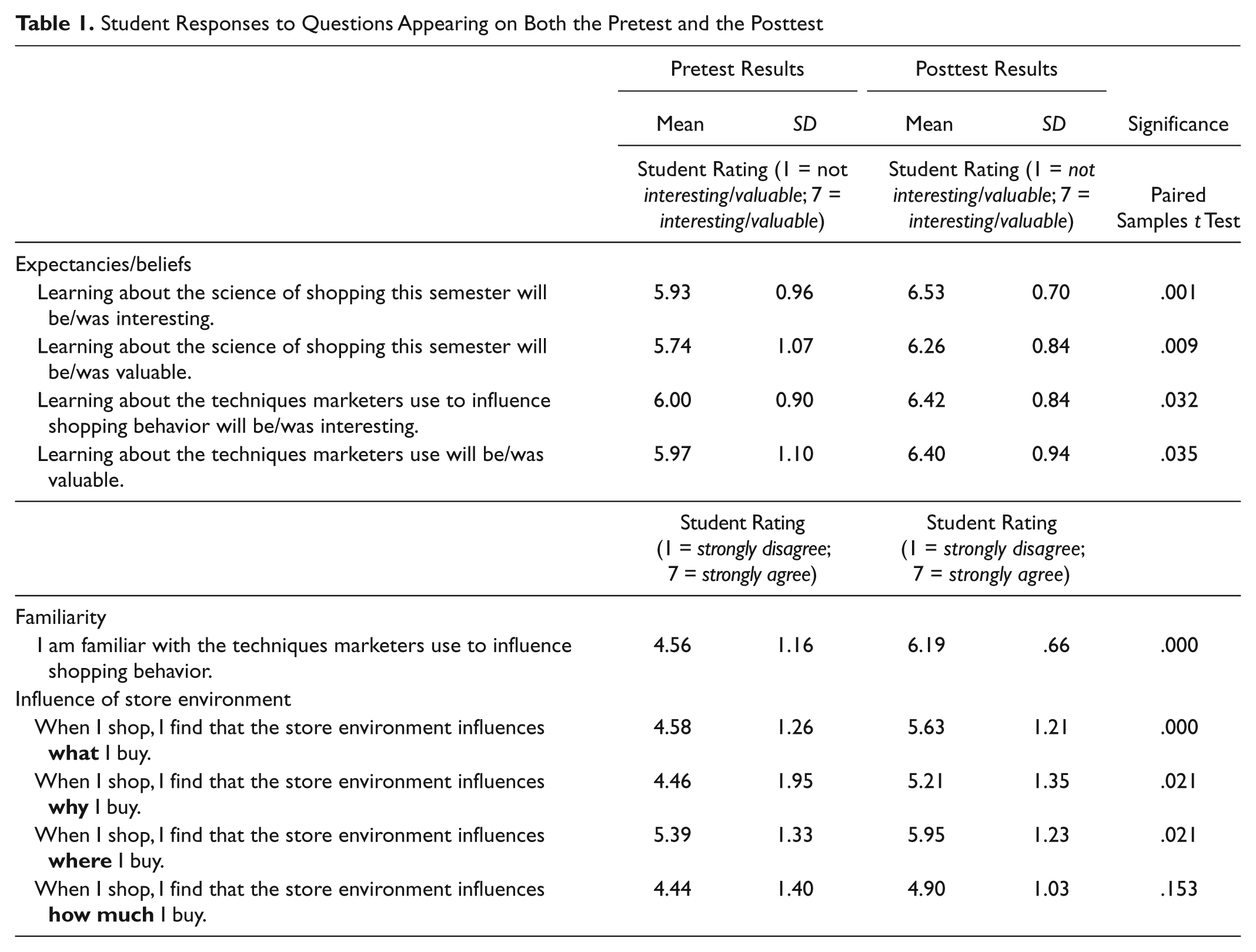
When examining the end-of-the-term data, we again found no significant differences in the results among the three sections of the course and so present the data in aggregate. At the end of the semester, students stated that they were very familiar with the techniques marketers use to influence shopping behavior (Mfamiliar/post = 6.19). They also found the science of shopping and the techniques marketers use to influence shopping behavior to be very interesting (Msci_int/post = 6.53; Mtech_int/post = 6.42) and very valuable (Msci_valuable/post = 6.26; Mtech_valuable/post = 6.40). When asked about the influence of the store environment on their own buying behavior, students’ scores averaged above the midpoint on the 7-point scale, stating that the shopping environment influences what they buy (Mwhat/post = 5.63), why they buy (Mwhy/post = 5.21), where they buy (Mwhere/post = 5.95), and how much they buy (Mamount/post = 4.90).
We used paired samples t tests to compare each student’s responses with the questions that were asked on both the pre- and posttests. The findings are worth noting. Students’ familiarity with the techniques marketers use to influence shopping behavior increased significantly over the course of the term (Mfamiliar /pre = 4.56; Mfamiliar/post = 6.19; p = .000). In addition, their level of interest in learning about the science of shopping increased significantly (Msci_interest/pre= 5.93; Msci_interest/post = 6.53; p = .001) as did their level of interest in learning about techniques marketers use to influence shopping behavior (Mtech_interest/pre= 6.00; Mtech_interest/post = 6.42; p = .032). Similarly, their ratings on how valuable they found learning about the science of shopping increased significantly (Msci_interest/pre = 5.74; Msci_interest/post = 6.26; p = .009) as did how valuable they found learning about the techniques marketers use to influence shopping behavior (Msci_tech/pre = 5.97; Mtech_interest/post = 6.40; p = .035).
The paired samples t tests also reflected upward changes from the beginning to the end of the term. In every instance, the students’ mean scores were higher on the posttest than the pretest, and in all but one case, these differences were statistically significant. The influence of the shopping environment on what the participants buy increased significantly (Mwhat/pre = 4.58; Mwhat/post = 5.63; p = .000) as did the influence of the shopping environment on why the students buy (Mwhy/pre = 4.46; Mwhy/post = 5.21; p = .021), and when they buy (Mwhen/pre = 5.39; Mwhen/post = 5.95; p = .021). The one question in this set for which there was not a significant difference (p = .153) was the influence of the shopping environment on how much the participants buy (Mamount/pre = 4.44; Mamount/post = 4.90).
In addition to learning about the just-mentioned areas of students’ general beliefs about shopping and marketing’s influence on their shopping behavior, we were especially interested in determining the students’ perceptions of the effectiveness of the retail audit project in meeting the course’s six pedagogical course objectives and four work/life skills objectives. It is in these results that we can see the assignments’ value in addressing the six cognitive levels of Bloom’s taxonomy, deep learning, and experiential learning.
We used paired samples t tests to evaluate whether there were any significant differences in students’ responses to a question about how effectively the various readings, lectures, activities, and assignments in the consumer behavior course met each of the objectives versus how effectively the consumer behavior course would have met each of these objectives if the course had not included the retail audit project (see Table 2). There were significant differences on all 10 pairs of questions. In every instance, the students assigned a higher score to the course’s ability to meet the stated objective with the inclusion of the retail audit assignment than to the course’s ability to meet with stated objective without the project.
Student Responses to Questions Regarding the Course Outcomes With and Without the Retail Audit Project
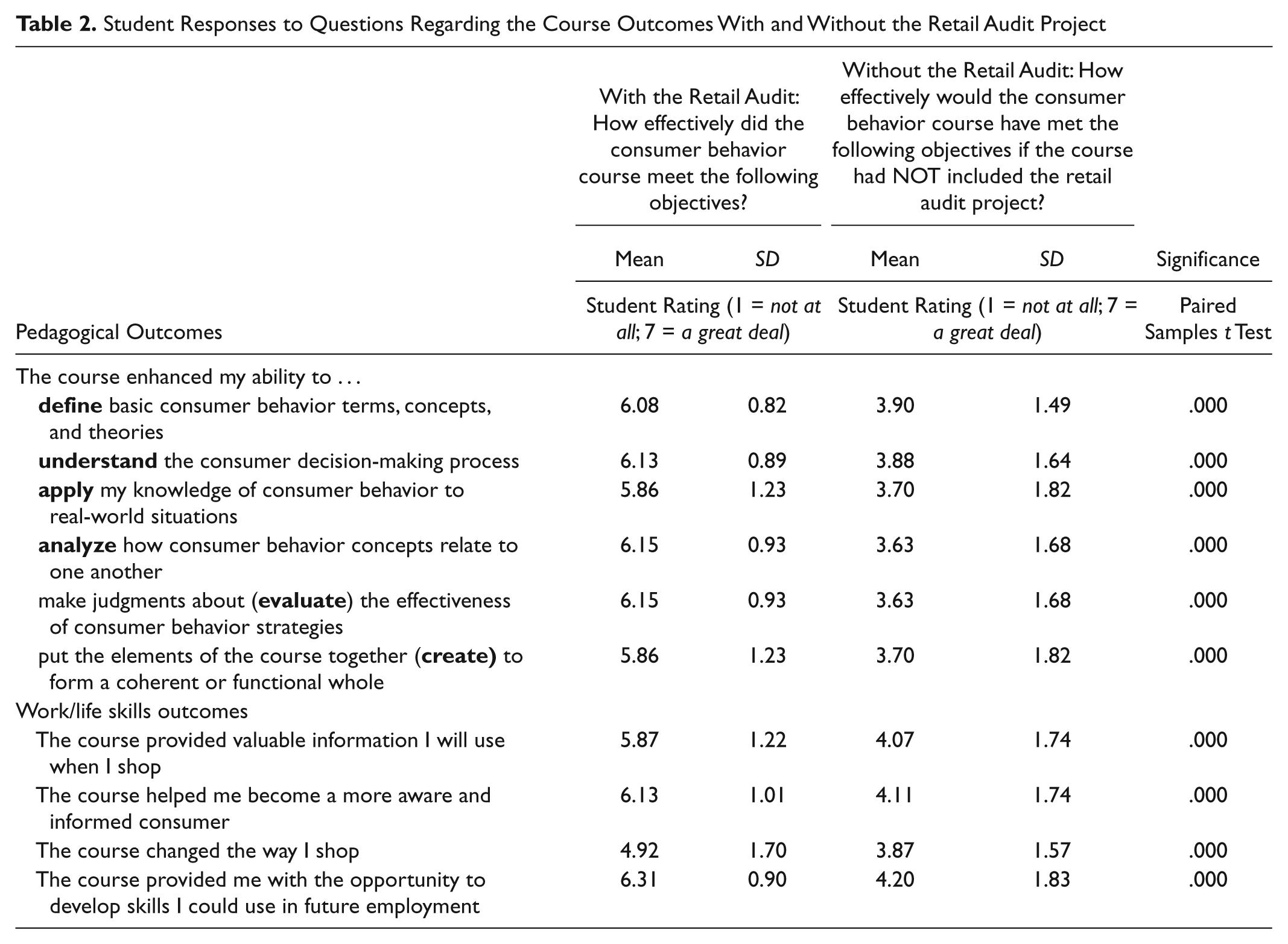
The scores show that students perceive that the inclusion of the retail audit in the course enhances their ability to achieve all six cognitive levels of Bloom’s taxonomy: Level 1—define basic consumer behavior terms, concepts, and theories (Mwith = 6.08; Mwithout = 3.90; p = .000); Level 2—understand the consumer decision-making process (Mwith = 6.13; Mwithout = 3.88; p = .000); Level 3—apply their knowledge of consumer behavior to “real-world” applications (Mwith = 5.86; Mwithout = 3.70; p = .000); Level 4—analyze how consumer behavior concepts relate to one another (Mwith = 6.15; Mwithout = 3.63; p = .000); Level 5—evaluate the effectiveness of consumer behavior strategies (Mwith = 6.15; Mwithout = 3.63; p = .000); and Level 6—put the elements of the course together to form a coherent or functional whole (Mwith = 5.86; Mwithout = 3.70; p = .000).
The findings also indicate that students perceive that the experiential nature of the retail audit enhances the course’s ability to meet work/life goals. They believe that the course provides valuable information they will use when they shop (Mwith = 5.87; Mwithout = 4.07; p = .000), helps them become more aware and informed consumers (Mwith = 6.13; Mwithout = 4.11; p = .000), changes the way they shop (Mwith = 4.92; Mwithout = 3.87; p = 000), and provides them with the opportunity to develop skills they can use in future employment (Mwith = 6.31; Mwithout = 4.20; p = .000).
Discussion and Implications
With Why We Buy as a foundation for the assignment, we have seen that the retail audit engages students in multiple aspects of the consumer behavior course, engenders comprehension and retention, and provides an opportunity for students to develop career and life skills. Compelled by the requirements of the retail audit’s active pedagogy to engage in discovery, students learn not only the “what” and “why” of marketing concepts, strategies, and techniques but also “how to” implement them. Our own perspective on the benefits of the project’s pedagogy notwithstanding, the retail audit’s perceived value to students is evident in both the qualitative and quantitative data we collected.
The findings strongly support the retail audit project as an effective mechanism for achieving the consumer behavior course’s pedagogical and work/life objectives. Students participating in the project exercise their cognitive skills at all six levels of Bloom’s taxonomy (e.g., Anderson & Krathwolhl, 2001), and in so doing, deepen their comprehension and command of course material, keystones of the deep learning process (Houghton, 2004). Students also clearly see the experiential link, as evidenced by their appreciation for the future applicability of team-based learning, the value of information they can use when they shop, and content-related knowledge about consumers and consumption behavior that they can use during their careers.
One finding suggests that the shopping environment does not affect “how much” students buy. There are possible explanations for this result. First, students may not perceive quantity purchased as being driven by marketers. College students often have limited discretionary funds and limited storage space in their dorm rooms and thus, are limited in terms of the amount they can buy. In other words, they may be more needs-driven at this point in their lives. Furthermore, as revealed by Paco Underhill (2009) in Why We Buy, many of the significant differences in shopping behavior are driven by gender, including motivation to purchase. Because we did not ask for any identifying information from students other than numerical codes for matching pre- and posttests, we do not know if gender influenced this result. However, this is something that merits further examination.
In general, this article presents the team-based retail audit project as a valuable experiential exercise that engages students cognitively and enhances their deep learning processes and outcomes in the consumer behavior course. More broadly speaking, the team-based retail audit project is also suitable as a template for the development, implementation and measurement of other experiential learning projects in other courses. For example, in retail management, the instructor could follow our template with additional focus on location and merchandising; in marketing research, the instructor could use Why We Buy (Underhill, 1999) as an exemplar for naturalistic inquiry and qualitative data collection (Lincoln & Guba, 1985). The project can provide value to educators as well as it can help instructors seeking to link their own classroom activities to important learning outcomes. This is particularly important in light of the increasing emphasis being placed on regular, formal assessment of student outcomes by higher education accreditation agencies such as the Association to Advance Collegiate Schools of Business.
Limitations and Future Directions
There are limitations and future directions pertinent to this research. First, the research was limited to consumer behavior undergraduate students in face-to-face courses at one institution. Thus, the findings may or may not be generalizable to undergraduate students at other institutions, in other courses, or in an online environment, and/or to students at the graduate level. Although we believe that the retail audit is highly applicable in other courses and institutions, further research on its effectiveness in enhancing student outcomes in diverse educational settings is necessary to reveal the true robustness of the exercise.
Second, although we have been using the retail audit project for quite some time, our systematic study and evaluation of the project has been conducted only during the most recent 3 years. We plan to continue to use and adapt the project based on student feedback and additional qualitative and quantitative assessments. For example, we are in the planning stages for a longitudinal study to be conducted with former students who have participated in the project. We believe that the responses of the former students would provide further insight into the long-term benefits of the retail audit’s lessons.
Furthermore, the availability of retail contexts for students to audit may depend on where the course is delivered. For example, one of the authors taught consumer behavior and used this project in a small university town where few suitable retailers were located. Under these circumstances, more than one team was permitted to audit the same retailer. Another solution to geographic limitations would be to expand the scope of the project to include different types of retail service locations, such as restaurants, convenience stores, and specialty retailers. We expect that further interesting adaptations of the retail audit project may be driven not only by the location of the school and the students but also by other relevant environmental and situational factors. Finally, as different instructors have different approaches to teaching and learning, it would also be interesting to discover other instructors’ experiences and evaluations of the project and learn of any exciting modifications they might develop to enhance student learning via the retail audit assignment.
Footnotes
Appendix A
Appendix C
Appendix D
Authors’ Note
Both authors contributed equally to this research.
Declaration of Conflicting Interests
The author(s) declared no potential conflicts of interest with respect to the research, authorship, and/or publication of this article.
Funding
The author(s) received no financial support for the research, authorship, and/or publication of this article.