







Abstract
Drawing on identity theory, this conceptual inquiry posits a need to redefine the standard that individuals use to judge themselves as a “business student.” Learners will be more likely to succeed in a corporate context if they experience daily interactions throughout a curriculum that approximate a professional environment. These social interactions will reinforce a revised business student identity if carefully orchestrated. A conceptual argument is presented to this end that builds toward a curricular-level solution emphasizing experiential learning that has broad focus beyond marketing students to all business students. A number of obstacles and opportunities are identified while developing a set of propositions linking curriculum design with granular day-to-day interactions. Experiential learning is presented as a path forward but must be implemented in an exhaustive and theoretically sound manner in order to facilitate student transition from an academic to a corporate environment.
As business schools strive to graduate capable young leaders, corporate managers and recruiters commonly voice concerns about new hires. The Wall Street Journal recently reported that employers are calling for “soft skills” such as critical thinking in newly hired business school graduates (Davidson, 2016). These concerns have spurred business schools to innovate in many ways and to identify the characteristics that comprise a “work-ready” graduate (McCorkle et al., 1999; Schlee & Harich, 2010). Arguably, employers seek graduates who can readily transition into a corporate environment which suggests that calls for soft skills are a symptom of a more systematic problem with business graduates (cf. Stewart, 2006; Walker et al., 2009). New business graduates may possess superior technical knowledge but have comparatively less training and ability to function effectively as entry-level managers or employees.
Our inquiry assumes a unique and broader perspective on what comprises a “work-ready” graduate. The root of the problem is graduates being conditioned throughout their student years to succeed in an academic environment. They cannot adapt quickly to a corporative environment where standards and assessments differ. Students move through their academic careers while building a standard for the “business student” role-identity. This identity and its standard are shaped by feedback from a diverse social sphere (e.g., Kleine, 2002). Identity standards between individuals grow to be conventional because they lead to sought-after affirmative feedback and are thus reinforced through everyday interaction as well curriculum-driven structural factors. Theory suggests that becoming work-ready requires development of an educational environment that is socially similar to a corporate context and provides feedback about workplace-required abilities and skills (Burke & Stets, 2009). So doing will redefine identity standards related to the “business student” role-identity and prepare graduates for transition into corporate environments.
Drawing on identity theory, we propose that “business student” identity standards should be redefined to comprise behaviors needed by a working professional (Burke & Stets, 2009; Stets & Burke, 2000; Walker et al., 2009). If identity standards held by most students only drive academic-appropriate behavior, graduates with this “conventional” identity standard will struggle in a corporate environment. However, if the identity standards reinforced in the business school are portable to a corporate environment, an institution may be able to claim that they have “work-ready” students more likely to succeed after graduation (Walker et al., 2009). Careful and broad application of experiential learning may provide a work-like environment able to effect such an outcome (Karns, 2005; Marcus, 1979; Smith & Van Doren, 2004).
In developing a conceptual argument consistent with identity theory, obstacles and opportunities are identified. Issues include establishment of different standards for a “student” identity, integration of specific feedback methods into curriculum, and student as well as instructor satisfaction/retention. We begin by establishing some identity-oriented definitions of what it means to be a “business student” (Burke & Stets, 2009). We then provide a fuller explanation of identity theory, apply it to creation of “work-ready” business students, and develop a set of propositions to guide future research and curriculum development efforts. We further utilize the implications of these propositions for interpreting existing findings related to experiential learning as well as one attempt to make the assessment methods within a course more work-like. Summarily, the present inquiry asserts experiential learning as a path to graduating business students with a portable “work-ready” identity standard.
Business Student Role-Identity
While the special issue focuses on “work-ready” marketing graduates, many of the same issues encountered by marketing educators are relevant to most if not all other business disciplines. Some evidence suggests that marketing students are not highly different from majors in other business disciplines (Elam & Spotts, 2004). Other evidence points to how being a marketing student can be a “role-identity” and source of self-definition (Kleine, 2002). In this inquiry, we will emphasize undergraduate business students in general. We make this choice acknowledging that marketing is a common and integral part of the business school curriculum. With a focus broadened from marketing student to business student, we note some relevant definitional issues related to what may be described as a role-identity.
It is useful to assume that business students at any institution tend to behave per prototypical expectations. These business students are similar to others within and across institutions to be reflective of a role, or social position (Hunt, 2003; Stryker, 1980, 2001). Essentially, considering “business student” as a social role means having relatively stable behavioral tendencies over time and being recognizable by relevant others. Business students can be recognized and engaged by other students, faculty, staff, and administrators given their organization around and identification with the social role of “business student.” Most have some amount of concern for career success and engage in a common behavior of completing a curriculum that has received scrutiny of an accrediting body such as AACSB. This curriculum is quite stable with incremental change being most typical, partly due to accreditation (Pfeffer & Fong, 2004). The institutional nature of the university environment leads most students to follow rules and norms such as those embodied in a business school curriculum (Arminen, 2000, 2005). Individuals within a business school environment are thus likely to behave as expected owing to their social position within the institution. While enacting this role, sufficient commitment on the part of the individual will lead him/her to become a self-identified role actor and have a business student role-identity (McCall & Simmons, 1978; Stryker, 1980).
Given formalization of business student as a role-identity, identity theory can be utilized to represent and develop predictions about how to shape individuals’ behaviors and expectations within a given context (Burke & Stets, 1999, 2009). As presented in Table 1, business students may have differing standards related to a “business student” role-identity. A “conventional” identity standard implies prototypical behaviors and interactions with professors. These include an emphasis on meeting of stated expectations and a typical student–professor structural relationship. A “work-ready” business student identity standard implies a modified set of behaviors and relationships. These would be directionally similar to those useful in a corporate environment such as acceptance of ambiguity and changing expectations. Moreover, the student–professor relationship would be less prototypical including gradual revelation of expectations and comparative evaluation of student performance.
Conceptual Differences Between Conventional and Work-Ready Identity Standards for Business Student Role-Identity.
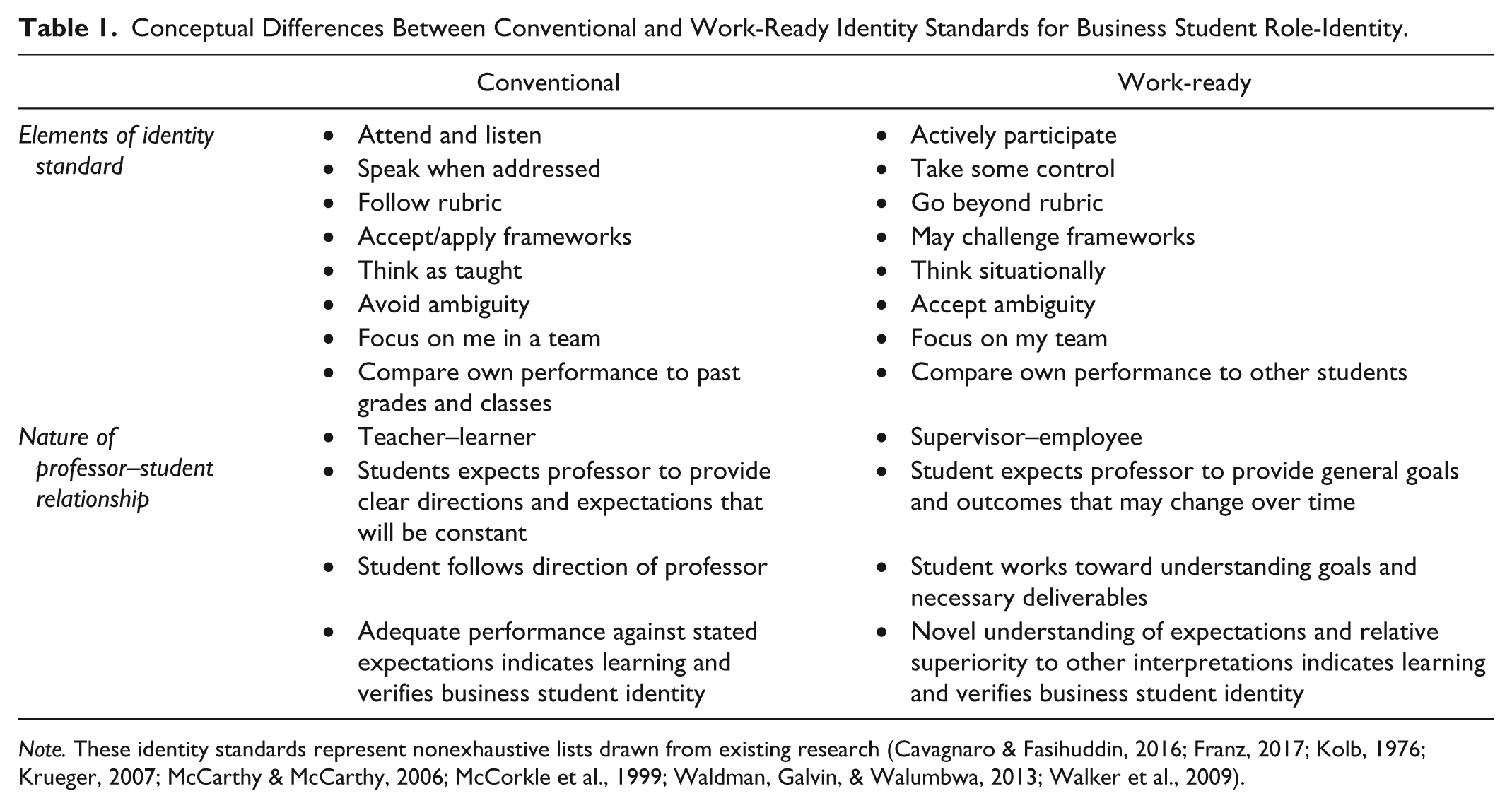
Note. These identity standards represent nonexhaustive lists drawn from existing research (Cavagnaro & Fasihuddin, 2016; Franz, 2017; Kolb, 1976; Krueger, 2007; McCarthy & McCarthy, 2006; McCorkle et al., 1999; Waldman, Galvin, & Walumbwa, 2013; Walker et al., 2009).
Identity standards such as “conventional” and “work-ready” in Table 1 are changeable. Change with intent requires crafting interaction patterns to reinforce new expectations. Such efforts need to be mindful of how individuals behave within role-identity contexts as well as the nature of relevant social linkages that predict interactions. Identity theory thus suggests that creating work-ready business graduates able to quickly transition and function in a corporate environment will be a major task requiring linkage between curriculum and everyday student–professor interactions. A program will need to be in place as early and as widely as possible to shape student identity standards toward work-ready behavior and methods of assessment.
We now develop some specific background related to identity theory, couch this theoretical area in the context of business school teaching, and present a set of propositions. We will then revisit some existing research on experiential learning as a point of departure for implementing recommendations derived from identity theory. Our goal is to provide a lens through which academic decision makers may consider some oft-overlooked issues with respect to cultivating undergraduate students. Content recommendations are not the primary focus of this inquiry. Rather, the emphasis is upon highlighting micro-level interactional issues as well as macro-level curriculum concerns that are theory-consistent and helpful in creating work-ready marketing and other business graduates.
Feedback, Standards, Contexts, and Relationships
Within role-identity contexts, behavior is guided and shaped by social interaction through reflected appraisals (Burke & Stets, 2009; Shrauger & Schoeneman, 1979). Reflected appraisals are inferences about others’ evaluations and are compared against identity standards (Cooley, 1902; Laverie, Kleine, & Kleine, 2002; Lundgren, 2004; Mead, 1967; Stryker, 1980). Identity standards are thus the key point of comparison for identity-related feedback (Burke & Stets, 2009; Trettevik, 2016). Identity standards are largely shared between persons due to the social role basis of a role-identity. Burke and Stets (2009) model identity-driven behavior as a negative feedback loop that settles toward stability and is self-correcting. Individuals desire to have their role-identities verified as source of self-esteem and accomplishment. Having standards consistent with convention facilitates behavior most likely to receive affirming feedback (Burke & Stets, 2009; Trettevik, 2016). Verification leads to stability in identity standards and behavior. Nonverification also leads to stability as identity standards and/or behavior are revised to increase likelihood of future verification.
A representation of the cyclic process central to identity theory is reproduced in Figure 1 and is adapted from Burke and Stets (2009). Figure 1 presents a generalized depiction of two individuals interacting. The system portrayed comprises simultaneous and cyclic identity verification processes. This may be extended to more than two people but is kept minimal here for brevity. Notably, the processes for each person in Figure 1 include input and output variables for capturing the movement of feedback and behavior over time. Input and output variables may also be considered as roughly delineating the boundary between the external social situation and each person’s internal identity verification mechanism. In the present inquiry, the input and output variables are included mostly for consistency with the systems theory orientation of Identity Theory (Burke & Stets, 2009).
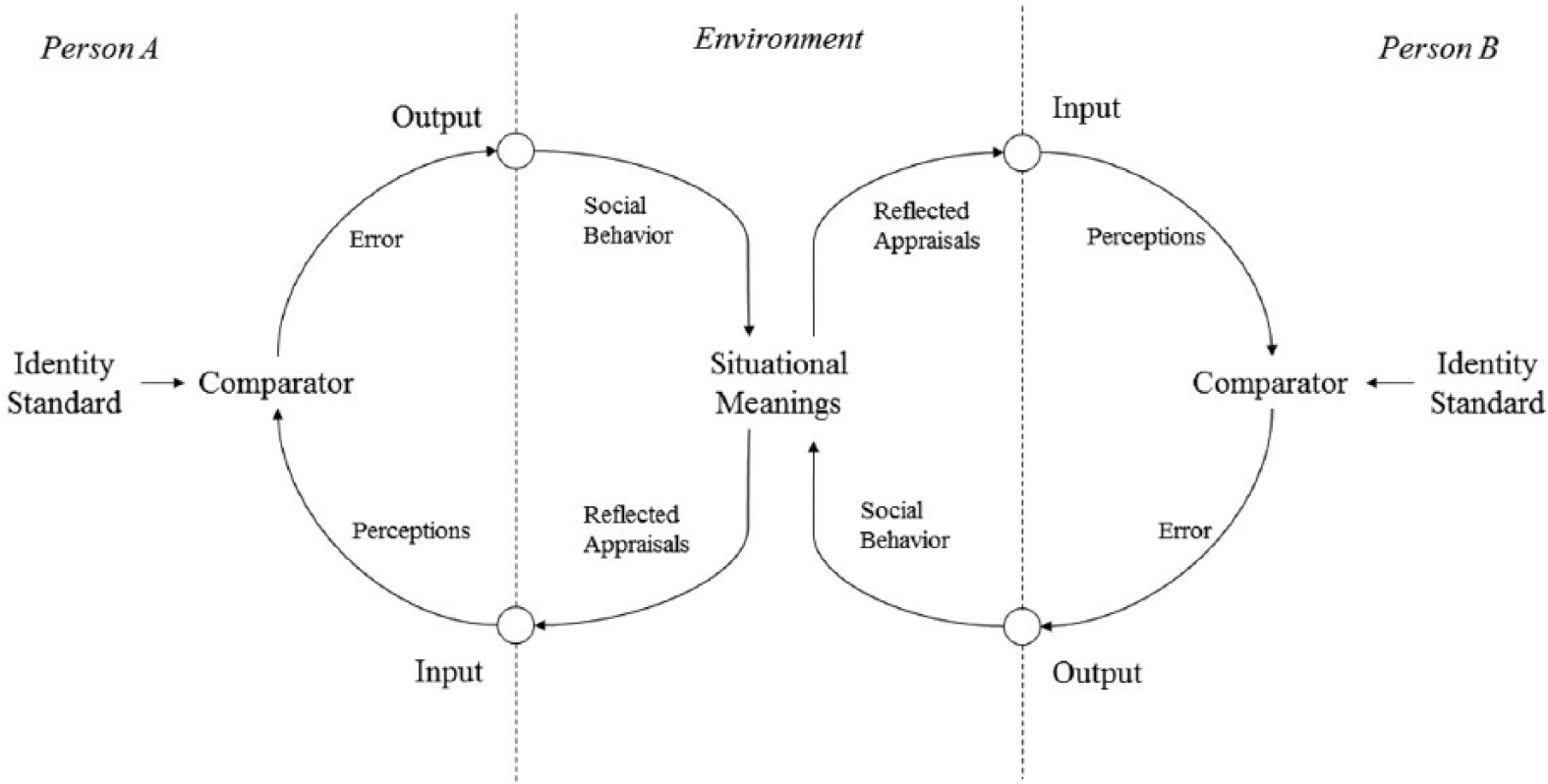
Social interaction with simultaneous identity verification processes.
In a dyadic situation like Figure 1, both individuals wish to verify their active identities (Burke & Stets, 2009). Identity verification happens simultaneously for all parties involved as individuals provide and receive feedback. Moreover, they evaluate feedback in terms of their identity standard and use discrepancies as a guide for (a) further behavior and/or (b) shaping of interpretations within the interaction. If both are successful, behavior continues in a similar fashion. If either believes his/her identity is not verified, efforts will be made to influence the situation to achieve verification or to mitigate effects of nonverification.
Portions of the processes in Figure 1 are internal to each person while other parts are more observable. Generally, the process depicted is one of feedback sourced from assessments of the situational context. Evaluation of this feedback guides subsequent behavior. A more detailed view indicates that each participant compares feedback sourced from their unique interpretation of the situation (i.e., reflected appraisal) against an identity standard. Feedback is specifically drawn from situational factors including outwardly discernible social behaviors (e.g., verbal statements, expressions, and physical actions) as well as the interactive context (e.g., environmental setting, other individuals observing). These factors lead to a summative collection of internal reactions defined as situational meanings. Situational meanings are thus on average equivalent to the perceptions of everyone in the interaction. However, identity theory indicates that each person considers observable behaviors and context to form unique reflected appraisals of the situation (Burke & Stets, 2009). Reflected appraisals then provide the primary input to internal perceptions of what the individual believes others think of him/her. Differences between perception-based reflected appraisals and the comparator (a point-in-time reference based on the individual’s identity standard) create errors and predict identity verification.
Errors are the primary output of the processes in Figure 1 that guides subsequent observable behavior. If there is no error (e.g., feedback is consistent with self-view as a student), the identity is verified, behavior is likely to continue, and identity standards will remain constant. If there is an error (e.g., feedback is not consistent with self-view as a student), nonverification occurs and behavior and/or the identity standard may be modified to increase the likelihood of future verification. Behaviors are more malleable than identity standards but both change given sufficient time. This process is the kernel of identity theory (Burke & Stets, 2009).
The effects of the interactive environment and associated structural relationships between identities are key. Backing up to the level of the role or social position, we note that specific role-identities have prototypical environments and social connections (Kernan & Sommers, 1967; Solomon & Buchanan, 1991; Stryker, 1980). For instance, the professor role is more natural in a college classroom than in a fitness center. Behaving as a professor in a classroom is more likely to verify the “professor” role-identity than behaving the same way at a fitness center. Thus, the structural relationships associated with this role are mostly confined to those with others engaged in similar and associated activities (e.g., professor peers, current students, prospective students, administrators). Essentially, a person committed to a role (i.e., having a role-identity) is most likely to behave in commensurate ways when in the role’s natural context and when with others germane to the role (Sluss & Ashforth, 2007).
Identity theory suggests three general factors influence behavior related to role-identities. Identity standards guide feedback interpretation and future behavior, the interactive context influences likelihood of identity enactment and identity verification, and social connections related to given role-identity provide the key source of identity-related feedback (Burke & Stets, 2009). Modifying any or all factors may be useful in changing the current and future behavior of individuals. The established and predictable nature of the business student role provides a platform for intervening within the context to direct more students to have “work-ready” identity standards. These standards lead to feedback received in corporate settings to be more consistent or verifying with a sizeable portion of their sense of self.
Interactive Context of the Business Student Role-Identity
Identity theory indicates that interactions provide feedback to all involved. Thus, business students interacting with one other (verbally or in a generalized fashion) simultaneously verify one another’s identities (Burke & Stets, 2009). Similarly, interactions between professors and business students also evidence simultaneous feedback albeit for two different but socially connected role-identities (professor–student).
Figure 2 applies the framework from Figure 1 to a hypothetical interaction between a student and professor. While the interaction is hypothetical, it is representative of the authors’ experiences in attempting to make student–professor interactions more “work-like.” In the example of Figure 2, the professor asks the student to lead a discussion. The student appears uncomfortable and believes the professor to be disappointed in his/her performance at Time 2. Simultaneously, the professor concludes the student is confused by the request. At Time 3, the student considers his/her current behavior and feedback from the professor. The professor reflects on the inaction of the student. At Time 4, the student thinks in terms of his/her student identity standard and a discrepancy motivates a behavior change. The professor compares his/her professor identity standard with the current outcome and the discrepancy motivates continued effort. At Time 5, the professor reframes his/her request in the context of a corporate environment consistent with the identity change that he/she is seeking to instill in students. The student responds positively once his/her discrepancy is resolved by the further explanation.
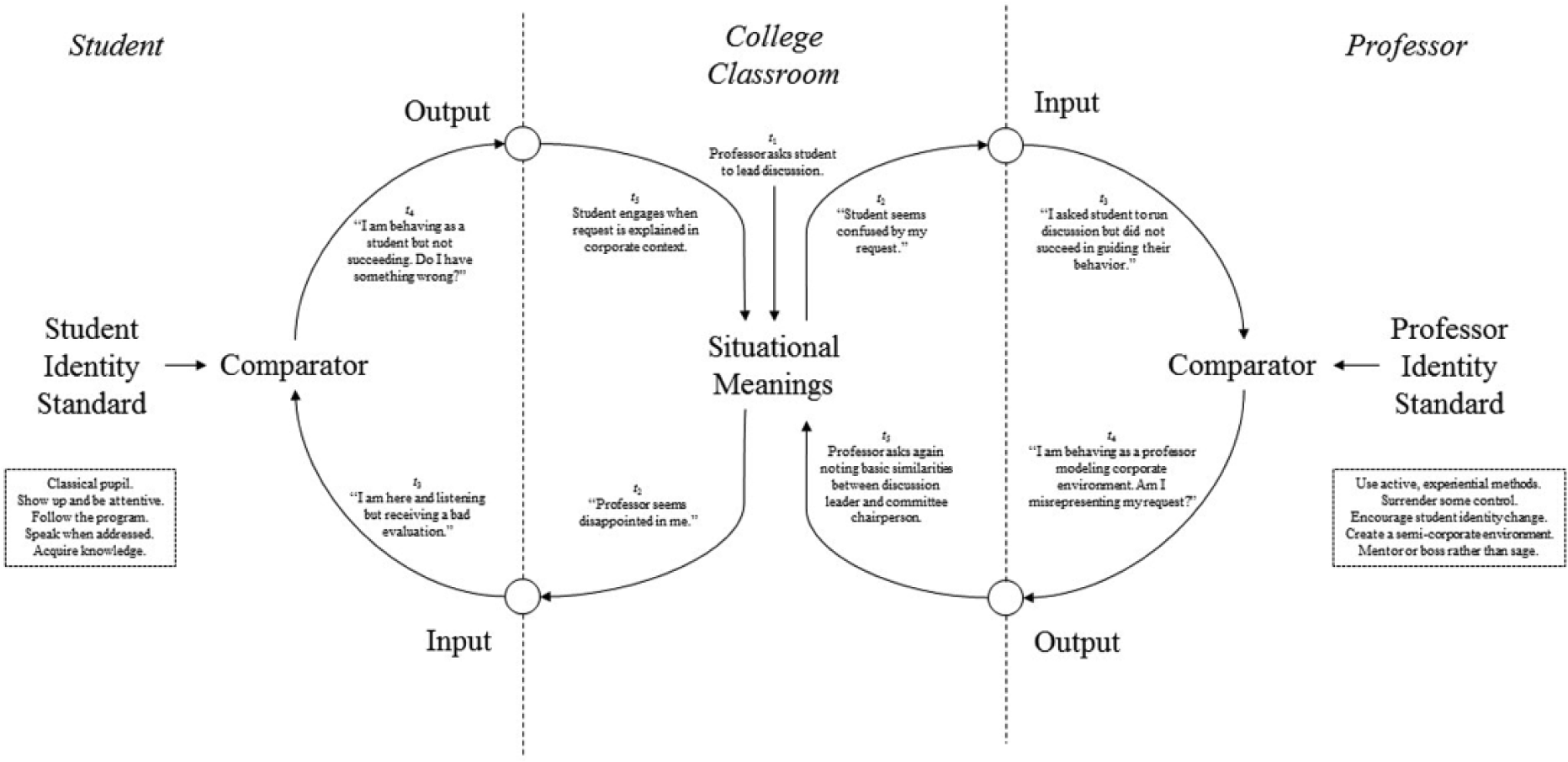
Example of student–professor interaction in classroom setting with simultaneous identity discrepancies.
Nonverifying feedback in the aforementioned example (e.g., student behaving as a typical student; professor behaving toward students as work-ready individuals) creates internal conflict (Trettevik, 2016). Such conflict induces reflection on identity standards. This can be productive if it motivates intended change (e.g., student revises identity standard to include aspects more in-line with being work-ready). However, the conflict can be counterproductive if it is encountered inconsistently. Failure to maintain internal conflict stemming from identity nonverification will attenuate efforts to change students’ identity standards. The conflict can also be counterproductive if it is too drastic to be maintained by professors or endured by students. High levels of negative emotion and dissatisfaction will ensue (Trettevik, 2016). This may decrease student success and retention as well as employee satisfaction.
Essentially, identity theory suggests caution when seeking deep changes in the identity standards and subsequent behavior of students. Deliberate steps will need to be taken to shape identity standards and retain instructors able to redefine the student–professor relationship. A programmatic rather than single course solution will be necessary owing to a multitude of factors that will need to be controlled. Identity standards of all parties involved in day-to-day interaction need to be shaped early and continually.
Implications of Identity Theory for Creating “Work-Ready” Students
Identity theory applied to graduating work-ready students implies several propositions to guide curriculum design. However, so doing will require a basic assumption about the malleability of identity standards that guide behavior (cf. Burke, 2006). Identity standards may be influenced over time by direct teaching/explanation as well as through reinforcement of desired expectations to affect a change. Successful application of Identity Theory will depend on having a characterization of what is a “work-ready” standard for a student. This definition needs to be relatively shared among parties involved including students, instructors, administrators, and staff so as to be organizing of interpersonal interaction and self-reflection (cf. Kleine, 2002).
We define a “work-ready” business student as one with an appropriately modified role-identity standard. This may be viewed as a contrast between the bases of comparison used by a “conventional” versus a “work-ready” business student (see Table 1). The business student role will thus need to be reconsidered by direct actors (i.e., students) and associated individuals (e.g., instructors, peers, administrators) in terms of identity standards more typical of corporate roles such as employee, manager, or trainee. This will enable implementation of curricula that encourages social interaction more similar to corporate environments while also verifying the redefined business student identity. Immersion in such a context will prepare the student to be able to process feedback in “real” corporate environments after they transition out of an academic environment. This is an achievable outcome for students but one that will be difficult to implement due to fundamental differences between university and business organizational goals (cf. Bacon, 2005). With this in mind, we present some likely basic differences between a work-ready business student and a conventional one. These do not form a conclusive definition but align with the contents of Table 1 and aid interpretation of subsequent propositions.
Instilling comfort with conceptual ambiguity and a desire to take ownership may be general keys to transforming higher education toward practice (Cavagnaro & Fasihuddin, 2016). Others highlight the need for students to take measured risks in the classroom and engage in independent thinking (Franz, 2017). Kolb (1976) highlights the importance of managers and change agents being able to seek out organizational problems and develop solutions. Characteristics such as these align with a motivation to lead and growth in self-efficacy (McCarthy & McCarthy, 2006; Waldman et al., 2013). In the present investigation, these qualities are also consistent with self-starting, critical thinking mentality, and team management capabilities sought by employers (Krueger, 2007; McCorkle et al., 1999; Walker et al., 2009).
Carrying the aforementioned qualities into a contrast between identity standards, a “conventional” business student may experience identity verification by developing correct answers to a situational business problem based on and consistent with previous instruction. A “work-ready” business student may experience identity verification by enduring complicated and information asymmetric situations while also developing specific and implementable recommendations. This contrast is oversimplified and not exhaustive. Local social constructions of a “work-ready” business student identity standard are likely to vary according to factors such as hiring employer profile, institution norms, student body profile, and geographic location. Nonetheless, a simple contrast between “work-ready” and “conventional” business student identity standards serves as an outcome reference point for the propositions developed subsequently.
Changing Student Identity Standards
A “work-ready” identity standard should be reflected at multiple levels from individual social interactions to formal assessment to program design. Deliberate interactions need to be embedded throughout a curriculum. Broad application encourages consistent interactions that shape and reinforce a “work-ready” business student identity standard. Essentially, macro-level effects of curriculum must consider micro-level interactions involving business students.
Careful shaping of interactions combined with an understood “work-ready” standard for business student will eventually reinforce an identity standard capable of transition into a corporate environment. Interactions characterizing the example in Figure 2 should become commonplace. This will be most likely to happen if curriculum and everyday interactions are directed toward experiences nearer that of a corporate environment. Over time, students in such a program will be more likely to interpret feedback received in comparison to a revised identity standard. In short, identity verification from work-like experiences will be more likely if student identity standards are revised in a manner like the aforementioned definition of “work-ready.” This suggests a fundamental proposition that allows for change in identity standards over time:
Identity standards develop over time and are shaped by verifying and nonverifying feedback. Existing research supports the importance of initial experiences in shaping the expectations of an individual cultivating a student role-identity (Young, 2010). Undoubtedly, the starting point for a given identity standard is relevant. However, also important is sufficient time and feedback to affect meaningful change via verification (Burke, 2006). It is likely that a student nearing graduation who first encounters a curriculum meant to guide them toward work-ready behavior will have little in the way of permanent change. A student who has grown proficient in behaving as a “conventional” student will receive less identity verification from carefully shaped student–professor interactions meant to create a “work-ready” identity standard.
As the example in Figure 2 suggests, feedback interpretation occurs against an identity standard. Efforts to reinforce a work-ready business student identity standard need to early in a curriculum so as to have sufficient time to condition this point of comparison. A business student with an identity standard nearer its formative stages presents an opportunity for shaping how this individual interprets future feedback. Once an identity standard becomes sufficiently established to be receiving verification on a regular basis, it will only change slowly (Burke, 2006; Burke & Stets, 2009). The nature and extent of any change in identity standard affects verification for the individual as well as those in related roles. This suggests a proposition:
Management of Student–Professor Interactions
The student identity and professor identity are linked at the level of the social role, through institutional rules/norms, and simply in various forms of everyday interaction. Efforts to make students “work-ready” will require professors to be intimately engaged in the process. Changes to the business student identity standard will have ramifications for verification of the professor identity well. Specifically, changes to the business student identity standard will influence the likelihood of verification for professors interacting with these students. A redefined professor identity standard with an orientation toward behaving in a work-ready or professional manner will depend on receiving feedback consistent with this direction.
Behaving toward students and receiving feedback perhaps as a boss or supervisor, may need to become common. Individuals in the professor role who are rigid in their view about what it means to be a professor and how the student–professor relationship operates are unlikely to receive identity verification from such efforts. Professors without work experience may be less likely to receive verification from teaching in a curriculum that shapes “work-ready” student identity standards. Such occurrences would be due to a mismatch between environmental context and the professor identity standard. This suggests an additional proposition:
Students’ identity standards for the business student role-identity may not change as early or quickly as would be ideal (e.g., Young, 2010). Efforts to create work-ready students will need to have transitional measures in place (Walker et al., 2009). For instance, movement from more conventional forms of student assessment to those more consistent with a corporate environment may create distress. Such methods will create additional distress in students who have a more conventional student identity standard. Explanation of methods associated with a “work-ready” standard for a business student identity in more familiar terms may guide feedback interpretation as in the example of Figure 2. So doing will support revision of the identity standard.
Identity theory allows for interpretation of feedback to be influenced through context and careful presentation (Burke & Stets, 2009). The nature of the student–professor relationship and interactive context makes this a manageable task. With many exceptions, there are also number of activity and performance evaluation analogues between the academic course and professional worlds. These include such areas as research projects, plan development, and assessment (Kolb, 1984; Moore, Boyd, & Dooley, 2010; Scalzo & Turner, 2007; Wharton & Parry, 2003). Presenting activities such as a performance review of a student’s work in more familiar terms of a comprehensive grade or exam may help provide identity verification against a conventional business student identity standard. Such presentations may need to be built into a redefined curriculum. However, so doing would not necessarily verify a business student identity with a work-ready standard. Trade-offs may need to be made as student expectations transition over time. Active shaping of perceptions of feedback provides a method for influencing the extent to which it is viewed as verifying. So doing may eventually condition business student identity standards to change toward a work-ready direction. This suggests an additional proposition:
Context for Identity Standard Shaping Provided by Curriculum
Identity standards may change over time, and modifications are most likely with recurrent nonverification. This has implications for interventions seeking to modify an identity standard. Behaviors that are inconsistent with being “work-ready” need to be reinforced as not appropriate. Modifying the student identity standard needs to be consistent within and across courses as well as related extracurricular activities. Siloes of reinforcement will not lead to reliable changes. Curricular arrangements should be directed toward a daily emphasis on shaping feedback. Absence of such an emphasis will be detrimental. Moreover, inconsistent arrangements may be prone to discontent as feedback appears unpredictable and/or capricious (Trettevik, 2016). This suggests a further proposition:
Identity theory indicates that standards for role-identities are largely shared between individuals but evidence interpersonal variability (Burke & Stets, 2009). As steps are taken to change a student identity standard toward one that is more “work-ready,” it is likely that this variability may increase between students. Efforts to shape student identity standards toward “work-ready” will not change these points-of-comparison for each student at a constant rate owing to the subjective nature of individual experience. The same feedback is likely to be interpreted differently as identity standards change at differing rates. Essentially, variability in identity standards between persons may lead to different interpretations of the same feedback. This is relevant in the business school setting as professors lead groups of students. The mixed nature of the student population in terms of identity standards changing from conventional to work-ready will need to be considered in everyday micro-level interactions as well as macro-level curriculum and cohort decisions. Variance in terms of “work-ready” identity standards coupled with efforts to influence these standards suggests a further proposition:
The organized nature of the business school environment implies that influence of students should be a coordinated effort by a group of educators. This group will be composed of individuals with different standards of what it means to be a “professor” or an “instructor.” There is also likely to be varying commitment to efforts directed at creating “work-ready” students. Such commitment brings with it at least a partial need to revise standards for “professor” or “instructor.” Different behaviors, teaching methods, tools for assessment, and demeanor all may be necessary to create meaningful change in student identities as well as subsequent behavior. Such difference from convention will lead to variability in how professors view themselves. As these individuals implement different aspects of a curriculum, variability in feedback and its interpretation is likely to manifest. Identity theory indicates providing inconsistent feedback is likely to not verify an identity reliably. This suggests another pragmatic proposition:
Side-Effects of Modifying Identity Standards
Given that verification is a key driver of identity-sourced behavior, attention must be given to the linkage between identity standards and level of commitment to an identity. Verification is guided by how feedback is compared with identity standards. We may add to this process that the identities comprising a person’s sense of self vary in commitment or relative importance (Kleine, 2002; Stryker, 1980). Even the most important parts of a person’s sense of self are the product of evaluations from others (Burke & Stets, 2009). Moreover, identity verification is most valuable for identities to which an individual is highly committed.
Shaping a student’s perspective such that he/she can succeed in a corporate environment means influencing a portion of their sense of self to which they are committed: being a business student. Assuming a high level of commitment further means great care must be taken in keeping a high probability of identity verification while shaping a “work-ready” identity standard. Conventional features of the business student role-identity may need to be reconciled into a forward-looking and “work-ready” identity standard hat melds the traditional and forward-looking notions of what it means to be a student. This rationale suggests a proposition:
Shaping Identity Standards in Practice
One of the authors anticipated some of the aforementioned issues and made several decisions consistent with identity theory in redesigning a marketing capstone course. Notably, a major capstone is a context where some emphasis on the college-corporate transition is typical. However, it is likely too late in a student’s career (Proposition 2) and too isolated (Proposition 5) to be the sole source of change in identity standards. Nonetheless, a consideration of the effort is diagnostic.
Two goals for delivery of this marketing capstone course were to provide a notable amount of corporate-like experience while also being replicable from one academic session to another. A live case or client project would have provided practical experience but required ample preplanning to ensure a pipeline for future course deliveries. Moreover, inconsistency in the central element of the course would make comparison of students between sessions and course optimization more difficult. A more conventional approach utilizing an integrative marketing management text and possibly a few small case studies would have addressed the replication issue. However, such a method would do little to provide a work-like environment.
Instead of adhering to either of the aforementioned approaches, a decision was made to organize course content around typical daily activities for an entry-level marketing coordinator or manager (e.g., hiring/evaluation, short-term spending decisions, and customer account servicing). This included selecting case studies with an emphasis on these activities from an appropriate point-of-view (e.g., middle management vs. executive suite), utilizing a simulation that provided multiple paths to success and was competitive within the course (i.e., zero-sum performance evaluation), and generally setting expectations for the instructor to be viewed as a supervisor or discussion leader evaluating behavior in a manner closer to a corporate setting. This evaluation took the forms of rank-order grading of students in terms of outcomes rather than effort, direction for randomly assigned groups to manage any internal personnel issues, and expectation for individuals to lead discussions from time to time.
When listed as above, these choices look typical of a conventional marketing capstone course with an experiential flavor. However, a notable additional factor embedded and associated with each of these course elements was an effort to draw parallels between the course design and a corporate setting consistent with Proposition 4. Active explanation centered on differences from what was typical in the curriculum as well as how embracing a unique or even disliked element of the course would be a beneficial experience in anticipation of a career start.
For instance, many required written deliverables were quite technical and nuanced. Moreover, these submitted pieces were graded on a relative basis meaning that success on an assignment meant another student would receive at least a slightly lower mark. Such an arrangement would typically lead a student to try and demonstrate how much he/she knows with a lengthy submission. The rank-order approach to grading is also likely to be a source of dissatisfaction. The “data dump” behavior in terms of assignment submission length was disallowed, and the dissatisfied reaction was discouraged through explanation of context. Students were expected to submit a thorough analysis that could be communicated and justified in one page or less. The rationale presented to the students for this expectation was that it was not meant to make the assignment easier. Instead, students were provided an explanation that a large consumer packaged goods firm expects that communication of even very complicated analysis and recommendations should never to more than a single page.
The formal feedback that students would receive in terms of a grade on a given assignment would thus be upon work that was made more difficult by a length requirement in the face of rank-order grading. A forced distribution was used to assign letter grades to student work. This too is a somewhat conventional approach to grading but was not typical at this institution. The forced distribution was explained in terms of personnel performance evaluation. Students were told that a large multinational conglomerate has in the past required a similar forced distribution for evaluating employees. It was also shared that such an approach was not viewed fondly even in its “real world” application. However, students were challenged to take on this unique and arguably unfavorable assessment method as an opportunity. It was a technique that they may encounter as they transition into their first jobs. Student expectations were thus set to be somewhat analogous to what they may encounter in a corporate setting.
Using a “live” case or textbook/lecture orientated capstone were more common at the institution when this approach was implemented. However, even with a course design that was unconventional and potential source of dissatisfaction, student course evaluations were the same or higher than with past more conventional implementations. Considering the implications of identity theory, it seems reasonable that the shaping of both feedback and teaching of linkages between conventional vs. work-like expectations were responsible for these student reactions.
Experiential Learning Research and Identity Theory
If these sorts of expectations and modeling of future supervisor behavior as in the aforementioned marketing capstone example were reinforced throughout a curriculum, an imitable path for shaping student identity standards through feedback would be apparent. It would have potential to equip students for the everyday life of their first job rather than only graduating with enthusiasm for thinking about problems more typical of upper management. The learning environment and associated interaction patterns will need to reinforce the intended identity standards as well future behavior (Burke & Stets, 2009; Hanna, Crittenden, & Crittenden, 2013). Experiential learning fits this need (Waldman et al., 2013). If a learning outcome is to be a redefined identity standard, wider adoption of experiential learning may create a relevant environment over many courses that is closer to a corporate setting (Hanna et al., 2013; Smith & Van Doren, 2004).
Pivoting curriculum toward experiential learning holds promise because enthusiasm for and adoption of the method is established. Relevant research within the Journal of Marketing Education alone spans the inaugural issue through present day (Canhoto & Murphy, 2016; Kurpis & Hunter, 2016; Marcus, 1979). The method provides students with some experience in the day-to-day decision-making of a practitioner (Marcus, 1979). More recent research points to the effectiveness of active, experiential learning that can provide feedback and be “gamified” while also encouraging deeper reflection as well as personal change (Canhoto & Murphy, 2016; Kurpis & Hunter, 2016; Moore et al., 2010). However, if experiential learning is relatively common and can train practically qualified students, practitioner dissatisfaction with many business school graduates suggests a problem. Identity theory provides a possible explanation for why enthusiasm for experiential learning has not translated into work-ready graduates.
Experiential Learning and “Work-Ready” Identity Standard Variance
At the MBA level, evidence suggests that students seem drawn to experiential learning as a teaching method (Li, Greenberg, & Nicholls, 2007). Active, experiential methods are common at the graduate level with these often taking the form of intensive case analysis and discussion. For graduate students, experiential learning fits well with an orientation toward career advancement. Tools and insights may appear to be more applicable. Furthermore, assessing students based on application is likely easier when they see higher levels of value and everyday relevance.
Identity theory has a complementary explanation for acceptance of experiential learning by advanced students. Experiential learning is likely to provide identity verification to a “working student” because such methods are more aligned with their business student identity standard. This is consistent with Proposition 1 and Proposition 8. MBA students are more likely to have a work-ready orientation given a higher proportion having already functioned in a corporate environment. This experience informs their business student identity standard. Thus, experiential learning may be better received at the graduate level because it is more like the “real world” and corresponding identity standards (Smith & Van Doren, 2004).
Identity theory suggests the undergraduate-graduate distinction may be a useful area for future study. Elements of business student identity standards held by graduate students may be a source of imitation at the undergraduate level. Graduate students likely have greater depth of relevant knowledge and skills sought by employers than an undergraduate (Schlee & Harich, 2010). Furthermore, work experience likely shapes graduate student behavior to be distinct from a conventional undergraduate student. Study of how graduate MBA students view themselves as “students” may provide insight into identity standards more portable to a corporate environment.
Feedback Predicts Change in Identity Standards
Hunter-Jones (2012) considers generational (i.e., X, Y, Z) differences in learner disengagement as predictive of success of experiential learning efforts. “Formulaic learners” are observed to be most opposed to experiential learning. Experiential learning is a threat to the success of these students owing to lower levels of learner control (Hunter-Jones, 2012).
An identity theory interpretation suggests at least two courses of action. P8 asserts that a method designed to provide work-like experiences will not verify a conventional student identity due to a mismatch between identity standard and feedback. This may also explain the findings of Kirschner, Sweller, and Clark (2006). Those authors found that “minimal guidance” teaching methods are inefficient and possibly ineffective. Identity theory suggests that this may be fixed over time by reframing the identity standard for “business student.” For instance, earlier versus later and broad-based versus isolated usage of experiential learning are more likely to succeed in effecting this change. Nonverification may also be managed by providing contextual explanation around experiential learning and its unique methods of engagement and assessment. This is the province of Proposition 4 and Proposition 6 wherein explanation of and assisting with interpretation of environment feedback is asserted to make future experiences in a similar setting more likely to verify the student identity.
Helping students interpret feedback received within an experiential learning context as “conventional” versus “work-ready” student will aid identity verification. Another reason for providing context (or external guidance) is so that identity verification becomes more likely through shaping of perceptions. Nonverification is thus better managed and a source of reflection. This assumes that the student has a traditional or conventional standard for student. Recommending this sort of feedback interpretation and management is not as relevant for a student with a “work-ready” identity standard (Smith & Van Doren, 2004).
Creating a “Real” Learning Environment
In terms of the classroom context and social interactions created by experiential methods, Karns (2005) found that students value internships, discussions, and case analysis. The implication of these findings is that perhaps the implementation of experiential learning is problematic. Work-ready students are still not being created in sufficient numbers (Hart Research Associates, 2013). Students appreciate experiential methods, reasonably an indicator of the absence of nonverification of the student identity. However, the findings of Karns (2005) were from a sample of advanced students at several institutions. A novel teaching method may be evaluated positively when encountered late in the student’s time in a program. Such a method may not have sufficient time to change student identities (if it does so at all).
Late-stage appearance of experiential methods may be valued by advanced students nearing graduation as more “real.” However, application at this point in a student’s academic career is unlikely be as a strong driver of identity standard change. Experiential methods in insolation may thus not be sufficient to effect lasting change in identity standards or increase future identity verification (Marcus, 1979). Proposition 2 and Proposition 4 relate to identity standards changing relatively slowly over time due to reinforcement and nonverification.
Essentially, experiential learning may run counter to “conventional” courses and be nonverifying with prototypical standards for student and professor identities. This is the province of Proposition 3, Proposition 7, and Proposition 8 speaking to conventional students and professors. Efforts to expand experiential curriculum will flounder without faculty buy-in. Experiential learning when used in only some courses may do also little to verify the professor identity on a consistent basis. This complements an argument made by Proposition 5, which asserts that organization-wide implementation of experiential learning is more likely to produce graduates with a “work-ready” identity standard.
Application of identity theory requires attention to the identities and identity standards of all involved in a curriculum. Shaping business student identity standards to be resilient in the workplace will take substantial time (Burke, 2006; Hogan & Cheek, 1983; Loevinger et al., 1985). Interpreting Marcus (1979) in terms of identity theory and a conceptual work-ready business student identity standard suggests piecemeal application of experiential learning will not affect meaningful change. Efforts to shape student identity standards toward a different basis of comparison will require a wider implementation. Codification into a curriculum as well as reinforcement through lower levels will be necessary. The negative feedback loop of identity verification needs to cycle regularly and predictably in order to shape a “work-ready” identity standard and consequent student preparedness for a corporate transition.
Discussion and Implications
An identity-based approach to creating work-ready business graduates will necessitate organizational focus upon identity standards. Broad adoption to this end of a teaching method such as experiential learning will require substantial commitment on the part of students, faculty, administrators, and other parties linked with the “business student” role-identity. Of concern is documentation of identity standards, establishment of continuing sources of verification, and consideration of issues related to instructor qualification and evaluation.
Detailed composition of a conventional versus work-ready identity standard is needed beyond that briefly presented in this inquiry (e.g., Table 1). Some efforts have been made in the area (e.g., Hart Research Associates, 2013; Walker et al., 2009). Other evidence also suggests that the overall goal for an identity standard should be less specific to emphasize personal agency and a bias for learning (Knez, 2016; Loevinger et al., 1985). Reinforcing any such qualities will require provision of linked and repeated experiences that occur in everyday interactions (Ellis & Kruglanski, 1992). Additional research will illuminate how these experiences can be dealt into an entire program. What cultivates a “work-ready” graduate within one discipline or at one institution may not succeed elsewhere (Kleine, 2002; Walker et al., 2009).
Additional documentation of identity verification sources for undergraduates is also needed. Intuition suggests professors and other students as key sources (Kirschner et al., 2006). However, there may be other sources and these may vary according to institution. For instance, first generation business students may receive a great deal of verification while interacting with others who have not attended an institution of higher learning. How such a situation may interact with an experience-intensive curriculum is currently unclear. If used to evaluate the effects and process of an experiential curriculum, an understanding of local trends in student interaction patterns as well as standards and subjective meanings related to these role-based identities is advisable (e.g., Burke & Tully, 1977). This could be coupled with understanding of how identity standards and verification sources map to the local social space. Such efforts would help prioritize various relevant relationships (e.g., student–professor, student–student, student–parent, and/or student–administrator) for cultivating work-ready identity standards.
Further consideration of instructor qualifications/training would be also helpful. Existing instructors need clear understanding of the process meant to occur as an experiential and identity-verifying curriculum unfolds before a student. Commitment to the premise that everyday interactions matter and induce change in aggregate will be necessary when seeking to shape student identity standards. As a curriculum evolves toward this end, hiring and professional evaluation efforts should give some consideration to an instructor or prospect’s ability and interest in creating a work-like environment. Corporate experience as well as curriculum fit with personal teaching philosophy may be especially valuable factors to consider during hiring and extraordinary evaluation processes.
Instructors and others interacting with students may also benefit from regular and ongoing immersion in corporate environments. Instructors should be encouraged to implement measures from their own experiences. Consulting, improvement leaves, and/or networking events that are practitioner intensive may also be rich sources of instructors developing a more “work-like” identity standard over time. Whether participation in instructor training and immersion efforts should be voluntary, required, or incentivized is beyond the scope of this inquiry and likely a local matter. However, it is absolutely critical that instructor ability and commitment to effecting change in student identity standards be widely present. Formal discussion of how a curriculum influences a learner’s role-identity over time needs to happen within the institution. This issue needs official consideration on a regular basis, partially owing to the cyclic nature of the process underlying role-identity change.
Instructor evaluation is also an area that warrants concern. As implied by the dichotomy of Table 1, students may be reluctant and even upset about being treated closer to employees. This is likely to lead to dissatisfaction, reduced student evaluations of instructors, and possibly retention issues for instructors and students alike. Formal evaluation of instruction will likely to need to change along with implementation of corporate-like elements to the courses in a curriculum. This may take the form of modified questionnaires that reflect an institution’s emphasis on creating a work-like environment. Student quantitative marks as well as qualitative comments after reflection upon the stated goals of the curriculum may lead to instructor assessment that is fairer (to the instructor). Subjective analysis of pre/post student comments and behavior may also be an indicator of curricular success (Canhoto & Murphy, 2016).
Summarily, the implications of identity theory suggest a way to reshape professional development within the business school. The path to success has major obstacles and requires broad implementation of theory-based changes. A focus upon reinforcing identity standards that will lead to the behaviors sought by employers conceivably requires the whole interactive environment of the business school to change. Curriculum modifications that influence instructor daily interactions will be necessary. Retention and satisfaction issues may emerge among student and personnel constituencies alike. Thus, not only curriculum but also wider organizational changes may necessary. Bearing these issues in mind, experiential learning may provide an opening as a base from which to begin to implement wider changes toward producing “work-ready” graduates. If carefully directed toward redefining a business student identity standard, enacted down to the level of student–professor interactions, implemented on a curriculum-wide basis, and evaluated with an emphasis on the feedback process, experiential learning holds new promise for graduating a greater number of “work-ready” students.
Footnotes
Acknowledgements
The authors thank the collaborative efforts of the editors and three anonymous reviewers for helping improve this research.
Declaration of Conflicting Interests
The author(s) declared no potential conflicts of interest with respect to the research, authorship, and/or publication of this article.
Funding
The author(s) disclosed receipt of the following financial support for the research, authorship, and/or publication of this article: This research was supported by a summer support grant to the second author by the James F. Dicke College of Business Administration at Ohio Northern University.