Abstract

According to the National Retail Federation, the retail industry employs about 13 million people and contributes $2.6 trillion to the total gross domestic product. As educators, it is essential that we prepare students for careers in this highly dynamic, engaging, and competitive industry. Today’s retail landscape is evolving rapidly. From self-checkout counters to humanoid robots on the sales floor, technology is changing the way retailers operate. The omni-channel nature of retailing empowers customers to interact with retailers on their terms and when convenient. Retailers must ensure that appropriate inventory levels are maintained so that customers can experience a seamless shopping experience across the multiple channels. Social media allows customers to read reviews from other customers, quickly compare information, and disseminate information to a broad network. Mobile technology is allowing consumers to access retailers on the go and providing retailers with an opportunity to deliver more customized messages to consumers. In-store, the experiential nature of the retail encounter is becoming increasingly important as a competitive differentiator. Even pricing models are changing with the popularity of renting merchandise or purchasing from consignment stores.
The retailing industry is fast-paced and is reflective of changes in technology, supply chain management, and consumer behavior. The purpose of this issue is to share innovative ways of engaging students and incorporating retailing trends into the classroom. We are excited that the special issue includes eight articles that provide insights on innovative teaching methods, innovative pedagogical tools, and an overview of retailing education (see Table 1).
Overview of Articles Included in this Special Issue.
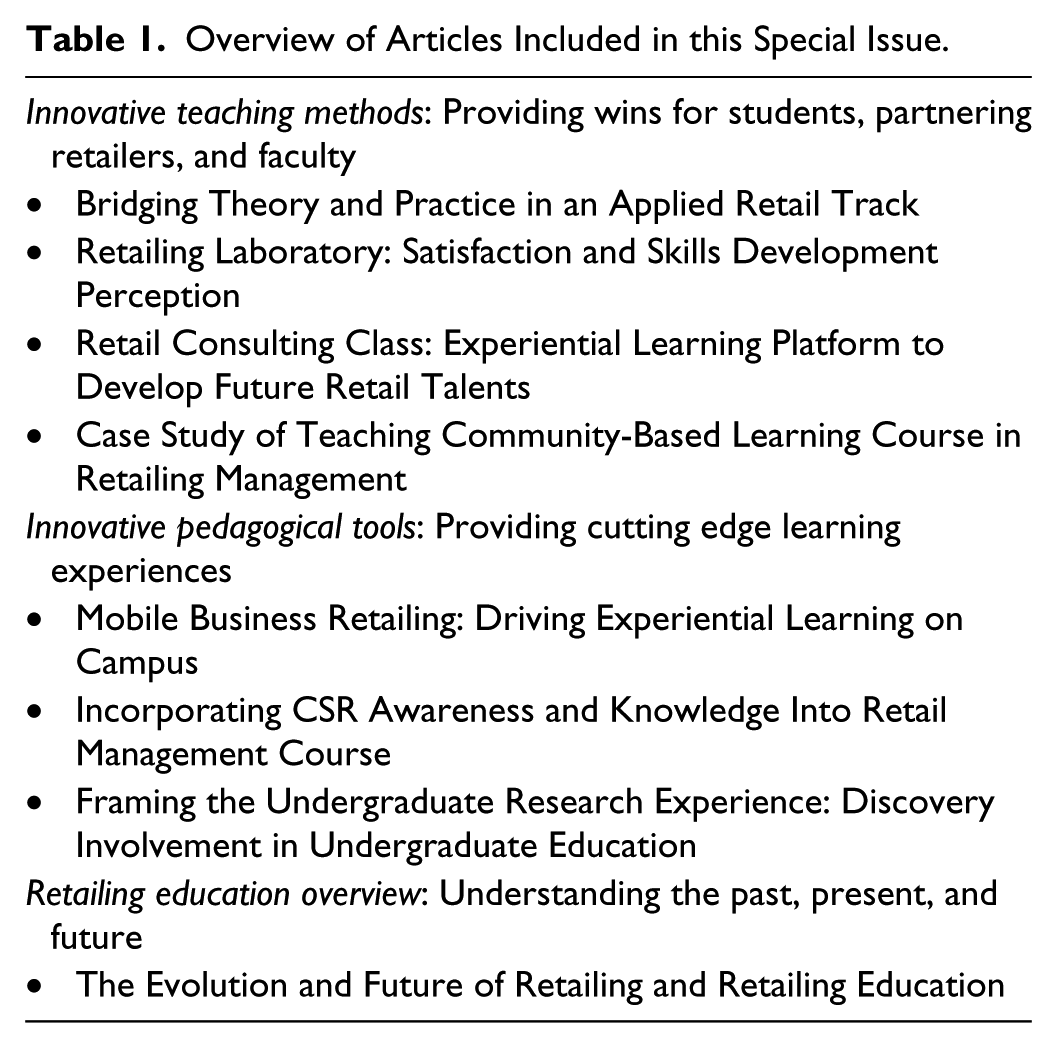
The four articles focusing on innovative teaching methods showcase how retailing curricula can develop cross-functional partnerships with retailers. These articles highlight how these methods can provide wins not only for the students in their learning but also for partnering retailers in providing new insights on an issue they may be facing or gaining exposure to bright students who might work with them in the future. Faculty also benefit from remaining cutting edge in challenges and opportunities facing the retail industry.
“Bridging Theory and Practice in an Applied Retail Track” is a big picture article that describes how faculty at the Stockholm School of Economics and partnering retail companies offer a specialized retailing track that runs parallel to traditional courses during the students’ 3-year bachelor program. The detailed description of the framework highlights how educators are shifting from a dissemination of knowledge model to an experiential, situation, and skill-based learning model. The pedagogical tools discussed include workshops, company visits, themed lectures, career-planning and training, and consultancy projects.
“Retailing Laboratory: Satisfaction and Skills Development Perception” describes the unique opportunities for students, retailers, and faculty when using a retail laboratory. The retail laboratory is a large space on the campus of Tecnologico de Monterrey that sells grocery, office supplies, and athletic clothing and has a linked learning center with one-way mirrors and video cameras allowing students to analyze consumers as they shop. The laboratory also allows students to test emerging retail technologies such as quick response codes, radio-frequency identification technology, and smart fitting rooms. The retail laboratory partners with retailers who are interested in understanding how consumers react to new merchandise or technologies to test these questions in a more controlled environment. The authors then describe how this active learning results in enhanced value for the students in terms of building business capabilities, enhancing critical, analytical thinking, and decision-making skills.
“Retail Consulting Class: Experiential Learning Platform to Develop Future Retail Talents” provides a framework for how an instructor can build a cross-functional team experience for their students while having them solve real-world retail issues in a client-based project. In this semester-long project at the University of Florida, the instructor works with local businesses to create real-world projects that provide students with examples of unique challenges that these local retailers are currently facing. By focusing on current challenges, the course ensures that it is always cutting edge in this evolving retail marketplace. Students thus gain skills in consulting, in understanding context, in gathering and analyzing information, in developing business recommendations, and in communicating insights to managers and business leaders.
In a similar vein, “Case Study of Teaching Community-Based Learning Course in Retailing Management” describes how students and community organizations can work together to meet the organization’s needs and student requirements. The detailed project, which is offered at Stonehill College, has students developing a SWOT (strengths, weaknesses, opportunities, and threats) analysis, surveying customers, developing insights, and forming strategies. All these innovative teaching methods offer excellent learning opportunities for students, benefits for clients, and new perspectives for faculty.
The next three articles focus more on innovative pedagogical tools that instructors are incorporating into their classes. “Mobile Business Retailing: Driving Experiential Learning on Campus” describes how students can learn from mobile business retailing by developing a concept and objectives, conducting market research and developing a persona, attending a mobile business event where they can get hands-on experience, and developing a marketing plan which integrates marketing materials they develop.
“Incorporating CSR Awareness and Knowledge Into Retail Management Course” is an assignment that has the students taking a deep-dive into a company to understand how the retailer relationship with consumers and suppliers affects their corporate social responsibility. Students are required to consider challenges to the company’s corporate social responsibility. These could include such things as labor laws, environmental regulations, or consumer relations.
“Framing the Undergraduate Research Experience: Discovery Involvement in Undergraduate Education” then moves to discuss the role of involving students in research projects. These projects are designed to enhance the student’s learning about retail businesses. By involving students in research, these faculty, at Michigan State and the University of Tennessee, are teaching the students to take an abstract concept, experiment with it, discover findings, and reflect on the experience. What is interesting about this approach is the ability to apply it to a wide variety of research projects from theory building and testing, to empirical research, to practitioner oriented projects to create projects.
This issue also includes an article, “The Evolution and Future of Retailing and Retailing Education,” which explores the past, present, and future of retailing education from a textbook perspective. The authors focus primarily on the role of technology in the retail industry and how retailing education has adapted to accommodate the fast-paced changes in the industry. In this article, the authors discuss some of the major technological shifts affecting retailing, such as mobile shopping, social media, artificial intelligence, and cyber currencies. The authors also provide insights into how these technologies could best be addressed in the retailing classroom.
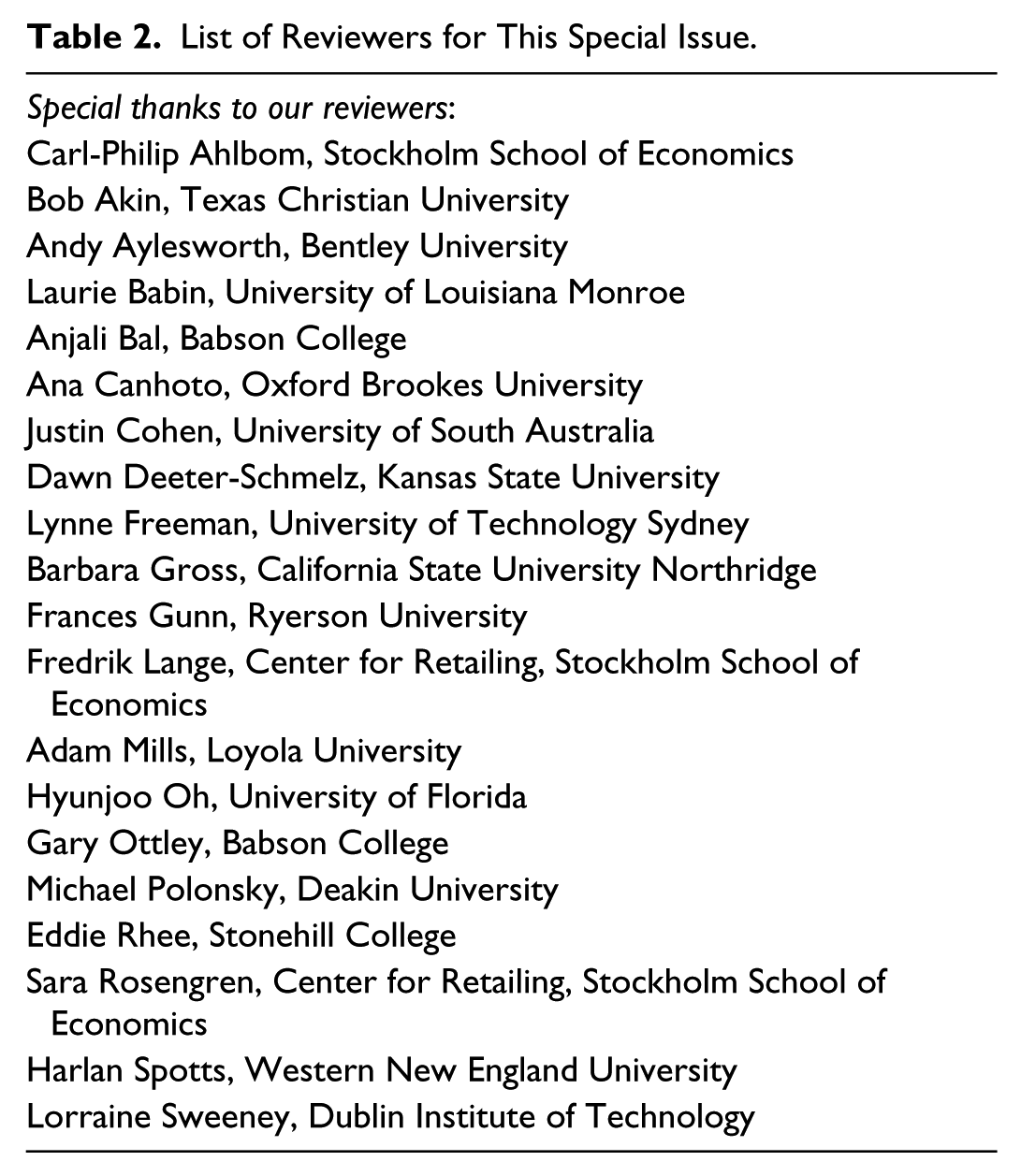
While each article takes a different approach to educating students about retail, consistent across them is the experiential nature of the learning experience. Experiential learning results not only from students having both hands-on, active involvement with the activity but also the opportunity to reflect and advance their knowledge and thought processes. What is also interesting is recognizing that the experiential learning described in all these articles is not limited to students. Faculty and practitioners also have experiential learning as they are working on new projects, learning about new companies, or technologies and pushing their own knowledge and understanding. For us, as special issue editors, this also has been a wonderful experiential learning opportunity. Not only have we had the privilege to read articles describing a wide variety of approaches but we have also been able to read and reflect on the wonderful and constructive feedback reviewers have provided. We are extremely grateful to all the reviewers (see Table 2) who took the time and effort to provide constructive feedback to the authors and helped further shape and improve the manuscripts. Putting together this editorial together has made evident the wonderful diversity and innovative approaches being used to educate the students of today to be the retailing leaders of tomorrow.
List of Reviewers for This Special Issue.