







Abstract
Marketing educators have long been interested in the value of the education they provide, and the importance of educational value has accelerated in an age of increasing educational options, rising college tuition and residential costs, and rapidly changing market needs. The present study surveys marketing managers and utilizes Thurstone pairwise comparisons, a methodology that has previously been overlooked in this context, to estimate the dollar value of several components of marketing education. These components include types of undergraduate and graduate degrees, industry certifications, internships, graduate academic certificates, additional undergraduate coursework, and written communication and Excel skills training. We provide recommendations concerning how marketing academic program directors can modify their programs to increase the return on investment for their students.
As marketing faculty teach students the importance of being market-oriented, commonsensically, marketing faculty should examine the value of their product, a marketing education, in the marketplace. The value of a marketing education can be explored from the perspective of employers, students, faculty, or society in general. As the value to employers is likely highly related to the value to students, the present research focuses on the employers’ perceived value of marketing education. In our study, the value of marketing education is defined as an increase in compensation that an employer would expect to offer based on the potential employee’s marketing education and skills.
Greater knowledge of how various marketing education options affect compensation would be extremely useful to marketing academic program managers. Program delivery is time-consuming and expensive. With an improved understanding of how different components affect compensation, curricular design choices could be made to enhance the return on investment (ROI) to prospective students, thus increasing the value proposition of the programs.
Many previous articles have examined the value of a marketing education, but each study has limitations when estimating the dollar value of the components of marketing education. The most common method in prior research is surveys with rating scales (e.g., Finch et al., 2013; Kelley & Gaedeke, 1990); however, there are also studies using salary regressions (Bacon, 2017; Hunt et al., 1986) or job postings analysis (Schlee & Harich, 2010; Schlee & Karns, 2017). The present research introduces Thurstone’s (1927) pairwise comparisons, a methodology not previously employed in this context, that has advantages over previous methods and enables dollar value estimates of several components of marketing education.
The goal of the present research is to estimate the dollar value of several possible components of a marketing education, including the types of undergraduate and graduate degrees, industry certifications, internships, graduate academic certificates, additional undergraduate coursework, and training in written communication and Excel skills. The value of each of these components can then be compared with each other, providing marketing program managers with insight into which components, if enhanced, would offer the greatest financial value to prospective students.
While the goal of this article is primarily descriptive and exploratory, we first review several theories of the financial value of marketing education that individually provide a foundation for interpreting results. We discuss several components of marketing education; some components have long been of interest to marketing educators, and some, especially those related to digital marketing and analytics, have garnered growing interest among faculty and practitioners in recent years. The review describes the hypothetical profiles that are presented to marketing managers with hiring experience. The methodology is described in some detail given that the approach’s novelty merits explication. We present the study’s results and discuss the implications for marketing educators. Importantly, the findings provide guidelines concerning how educators can increase the perceived value of their graduates to prospective employers.
Literature Review
Several theories exist concerning how higher education and marketing education, in particular, are valuable to employers. Most marketing education studies implicitly accept the human capital theory (HCT) of education, wherein employers value marketing education because the educational process provides graduates with the skills that increase their productivity in marketing jobs (Becker, 1964/1993). While HCT is an intuitively appealing and widely accepted explanation of educational value, some published evidence contradicts this explanation. As discussed in Bacon (2017), salary regressions generally find that a marketing degree is no more valuable in a marketing career than is any other college degree.
The value of marketing content taught in college courses does not appear to be proportional to the time required for a major or a degree. In their classic critique of the MBA, Pfeffer and Fong (2002, p. 81) noted that many consulting firms were hiring people without business degrees and offering these hires relatively short, 3- or-4-week basic business programs. Consequently, the hires performed as well as hires without MBAs. In Pfeffer and Fong’s view, part of the problem with business education is a growing gap between academia and practice; they note that in 2001, only 20% of the Top 10 Best Business Books were written by academics. Academic knowledge may be even less useful to small businesses. In a survey of small business marketing decision makers, Bacon and Schneider (2019) found that on-the-job training and peers accounted for 43% of the marketing knowledge needed to make decisions; formal education of any kind (e.g., high school, college, or graduate school) accounted for approximately 13%, and academic journals accounted for only 1%. Bacon and Schneider contend that one reason for the lack of relevance in formal marketing knowledge is the vanishing representation of practitioners on journal editorial review boards. In 1965, 60% of the Journal of Marketing board members did not have academic affiliations; this number dropped to 4% in 1985 and 0% in 2019.
Further evidence of marketing academia’s lack of practical relevance comes from Hughes et al. (2018), who examined impact case studies in the United Kingdom. As part of the UK’s Research Excellence Framework (REF 2014, https://ref.ac.uk/2014/), universities were encouraged to submit impact case studies showing “any effect on, change or benefit to the economy, society, culture, public policy or services, health, the environment or quality of life, beyond academia” (Hughes et al., 2018, p. 3). Of the 410 business and management impact cases they identified, only 13 were related to marketing (3.2% of total cases). Thus, the practical impact of marketing academic research appears to be particularly low.
Furthermore, what value there is in marketing knowledge learned in school may not be retained for long. Bacon and Stewart (2006) found that most content that students learn in consumer behavior classes is forgotten within 2 years. Elaboration, repeated study, and practice are necessary for longer term retention (Bacon & Stewart, 2022), but such opportunities are usually lacking in programs with many stand-alone courses. Thus, the marketing knowledge taught in college may not help students to be more effective marketers.
For many years, employer surveys have indicated that employers more highly value general or interpersonal skills than marketing knowledge. In their survey of employers, Kelley and Gaedeke (1990) found that the most important characteristics of college graduates are oral communication, enthusiasm, self-confidence, and initiative. College major ranked 13th on the list of 34 characteristics. In a similar study, marketing knowledge ranked 19th out of 22 characteristics (McDaniel & White, 1993). Finch et al. (2013) conducted an employer survey and found that follow-through, initiative, the ability to work with others, and creative problem-solving were more important than any of the marketing content areas. In a study of job postings, 81% of the employers emphasized applicants’ oral communication skills, 75% emphasized written communication skills, and 54% highlighted team skills (Schlee & Karns, 2017). The top marketing content areas in their study fell below these skills, with 44% emphasizing selling skills and 32% emphasizing knowledge of digital marketing.
Digital marketing knowledge may be emerging as the exception to the pattern of preference for general skills over marketing knowledge. The value of digital skills in marketing appears to be growing (see also Spiller & Tuten, 2019), and these skills are arguably one area where marketing programs can provide value. However, marketing programs have been slow to develop a complete digital curriculum (Langan et al., 2019) although there has been increased attention in the Journal of Marketing Education, including several special issues about digital marketing.
Thus, through a lack of practical value in the marketing knowledge itself, and/or students forgetting content briefly covered in class, a college degree in marketing may not provide useful marketing knowledge and skills in the short or long terms. Both findings challenge human capital theory as the explanation of marketing education’s financial value. Indisputably, college graduates on average earn higher wages than noncollege graduates. However, this wage premium can be explained by other causal mechanisms.
Filtering is one alternative to the HCT explanation of a marketing education’s value. Filtering contrasts sharply with HCT because, in filtering, a college education contributes in no way to an individual’s knowledge or skills (Arrow, 1973). In filtering, “higher education serves as a screening device, in that it sorts out individuals of differing abilities, thereby conveying that information to the purchasers of labor” (Arrow, 1973, p. 194). The admissions process creates the first filter, where only the more able candidates are admitted. Completing the degree requirements is the second filter, where only the students with a sufficient work ethic, intelligence, and perseverance are awarded degrees.
Evidence for filtering is found in the larger starting salaries that are paid to graduates of higher ranked MBA programs. Iacobucci (2013) demonstrated that most of the variance in starting salaries could be explained by the characteristics of the students entering the program. The predictive power of prior characteristics supports the hypothesis that at least some programs select or filter to acquire the students with the best abilities, and employers use this filtering to identify the higher potential job candidates.
Signaling also provides an alternative explanation for the value of marketing education. In signaling, a college education can signal to potential employers that the individual possesses certain traits that are difficult to observe (Spence, 1973). In the signaling model, the only job candidates who choose to attend college are those who believe that the benefits of attending college (e.g., higher wages) will exceed the costs of attending college, including financial and psychological costs. Spence refers to those who perceive college costs to be lower for them personally as high productivity people. These individuals would be more productive in their college work (more success with less effort), and the choice to attend college would signal to employers that they would be more productive in the workforce. The signaling model assumes that education itself is “unproductive” (Spence, 1973, p. 21) as there are no valuable skills or knowledge that results; however, this assumption is not essential to Spence’s model.
Interestingly, the signaling perspective proposes that a candidate’s decision to go to college signals productivity to employers even when the student does not explicitly consider college to be a signal (Spence, 1973, pp. 10–11). College students may not believe that college is merely sending a signal about prior ability; instead, they may believe that they gain knowledge and skills in college that are valuable to employers. Faculty may also believe that the content of their courses drives value in higher education. Essentially, signaling may be driving market pricing even if students and faculty believe that HCT is driving pricing. An interesting analogue is found in ancient Viking beer brewing, where brewers were completely unaware of the importance of brewers’ yeast; however, they did recognize that it was important to use the family “brew stick” (covered in yeast) when stirring their work in process (Connelly, 2011).
In our view, most students and indeed most faculty believe that HCT is driving the college wage premium, and this belief creates additional value for a college degree. If students believe in HCT, we would expect that students’ perceived self-efficacy will be enhanced in college (the belief that one is capable of performing particular tasks, Bandura, 1977, 1997). In a sense, students are signaling competence to themselves as they accumulate college credits. Following Bandura, students with high self-efficacy are more likely to take on difficult tasks than be intimidated by them. They will set higher goals for themselves and have a greater commitment to those goals.
In their meta-analysis, Stajkovic and Luthans (1998) found a significant correlation (r = .38) between self-efficacy and work-related performance. This enhanced self-efficacy is likely reinforced by campus cultures that support the view that students become increasingly capable as they progress through their courses to graduation. Thus, college graduates are more likely to assume and commit to marketing challenges that would have been more daunting before completing the degree. This added confidence may increase the college graduate’s value to employers even when there is no gain in useful knowledge or skills. Self-confidence is a trait that is often rated highly in employer surveys (ranked 8th most important by Kelley & Gaedeke, 1990, above major [13th]). While this increased confidence could be considered an educational outcome, herein we regard this effect as a form of signaling (perhaps self-signaling) as it does not presume any gains in useful knowledge or skills.
Although HCT, filtering, and signaling can be seen as competing theories, in more recent writing about signaling, researchers often accept that a college degree’s value is partly due to the knowledge and skills gained. However, the signaling or filtering components of value are more substantial (Weiss, 1995). Thus, there may be some truth to all three theories. In some more recent studies, filtering is referred to as screening (Suleman, 2021), and signaling is considered a broader term encompassing filtering, screening, and signaling (Weiss, 1995). We expect that the data presented here will support both HCT and signaling to some degree.
Components of Interest in Marketing Education
Reflecting on these issues, several components of marketing education and their perceived value merit further exploration. Obviously, college degrees are of interest to marketing faculty. The degrees relevant to marketing include a bachelor’s degree in marketing, a Master of Science in Marketing degree (MSM), and a Master of Business Administration degree (MBA). These degrees could represent the accumulation of marketing knowledge, and/or they could serve as a useful filter or signal to employers.
Additional degrees of interest in the marketing profession include a bachelor’s degree in journalism and an online MBA degree. We include the bachelor’s degree in journalism in this study to directly compare the results with Bacon’s (2017) salary survey. (The phrasing “Journalism/mass communications” was used in the present survey to exactly match Bacon’s terms.) Bacon found no significant difference in salary across individuals with the bachelor’s degrees in marketing or the bachelor’s degree in journalism, suggesting that a marketing education’s value was more the result of filtering and signaling than the education itself.
We include online MBA students in the present study because online MBA programs are increasingly popular (Byrne, 2022). Some sources indicate that the MBA’s marketplace value is the same for the online and face-to-face delivery formats (Driscoll, 2021), and such equivalence would be expected if the education itself was driving the market value. In Bacon and Stewart’s (2022) review of the business education literature, online learning was as effective as face-to-face learning. However, a face-to-face format may create a stronger signal. Face-to-face MBA candidates are often willing to leave the workforce for a time and/or relocate, incurring a higher personal cost to obtaining the degree. This higher cost may signal greater self-confidence, motivation, willingness to relocate, or commitment to a successful career in marketing; any of these characteristics would be valuable to employers.
Formal marketing education can occur without an additional degree, and the value of this incremental education would be insightful to measure. For example, a journalism student may take several electives in marketing (perhaps as a minor) or a marketing major may take more marketing courses than necessary to obtain the degree. This coursework could provide additional education and/or additional signaling of interest and motivation in a marketing career. In the present study, we explore the value of three additional undergraduate marketing courses in an undergraduate marketing degree program. The graduate certificate in marketing is an additional program of interest. The certificate often requires only a few courses (four at the research site), whereas an MSM typically requires 10 to 12 marketing courses (Wikipedia Contributors, 2021; 11 courses at the research site).
As previously noted, studies often find that soft skills are more valued by employers than marketing knowledge (Schlee & Karns, 2017). To understand the relative value of each variable in the present study, we include profiles with substantial written communication skills, described in the survey as candidates with skills in the top quartile of typical candidates (or 75th percentile). Bacon et al. (2008) demonstrated a method for improving written communication skills in marketing. At the same time, there is substantial interest among faculty and practitioners in marketing analytics and customer insights (e.g., the December, 2021, special issue of Journal of Marketing Education), and Excel skills are highly sought in the marketplace (Schlee & Karns, 2017, see their Table 4). Some profiles are included in the present study with Excel skills in the top quartile of typical applicants. Written communication and Excel skills are studied here because each skill set is specifically important in marketing and both sets are representative, but not exhaustive, of the broader category of personal skills.
As we’ve suggested, a marketing education may not increase valuable skills because the skills taught are not valuable to business and/or they are soon forgotten. In the present study, we explore industry certifications and internships, which are two alternatives to a traditional college education. Each alternative may provide the benefit of acquiring more useful knowledge, and they may provide other benefits as well.
Certifications
Digital marketing skills may be more valuable than other marketing skills, as these particular skills often appear in job postings (Schlee & Karns, 2017). Digital marketing skills can be acquired in the classroom or through certification programs such as Google Analytics certification (Cowley et al., 2021; Spiller & Tuten, 2019). An interesting question is whether these specific digital certifications are more valuable to employers than college courses because of the skills learned or because of some other kind of sent signal. However, employers will value specific certifications differently, making it difficult to model the value of many different certifications. To reduce ambiguity in the present study, the survey asked respondents to identify the certification they would value the most, and then indicate how valuable that certification would be. The resulting estimate is therefore at the high end of a possible range of value.
Internships
Gault et al. (2000, see their Table 3) found that internships were associated with 9% higher starting salaries and 54% reduced time in obtaining a first job. Internships may be valuable to employers because they teach students how marketing is done in the “real world.” Students may learn tools and techniques that are not taught in school (marketing knowledge and skills), and they may gain more general insights into the world of work such as the prevalence of ambiguity and the changes in marketing technologies. If these skills are highly valued, then internships may be more valued than marketing courses. Employers may also value students who have taken internships because they signal students’ ambition and/or perseverance to potential employers. Along these lines, whether an internship is paid or unpaid, or for credit or not for credit may provide additional signals. Such details are not specified in the present study to keep the scope manageable.
In the present study, the degrees and additions to marketing education are included in combinations referred to as profiles. The profiles included in this study are shown in Table 1. One advantage of the pairwise comparison method is that the researcher can exert complete control over the profiles compared, excluding less meaningful combinations of attributes and enabling tests of specific interactions. Some conjoint approaches may have combined attributes that make less sense together (e.g., a graduate certificate with an MSM, or an MSM with an MBA), or they may have excluded all interactions. The profiles are listed in the order of the research team’s a priori beliefs about the relative value, from least to most valuable. Such ordering is helpful in optimizing information gained in the questionnaire; more information is gleaned by comparing profiles of similar value than those of disparate value. As will be shown, the resulting values were in a similar order but with some interesting differences.
Profile Descriptions.
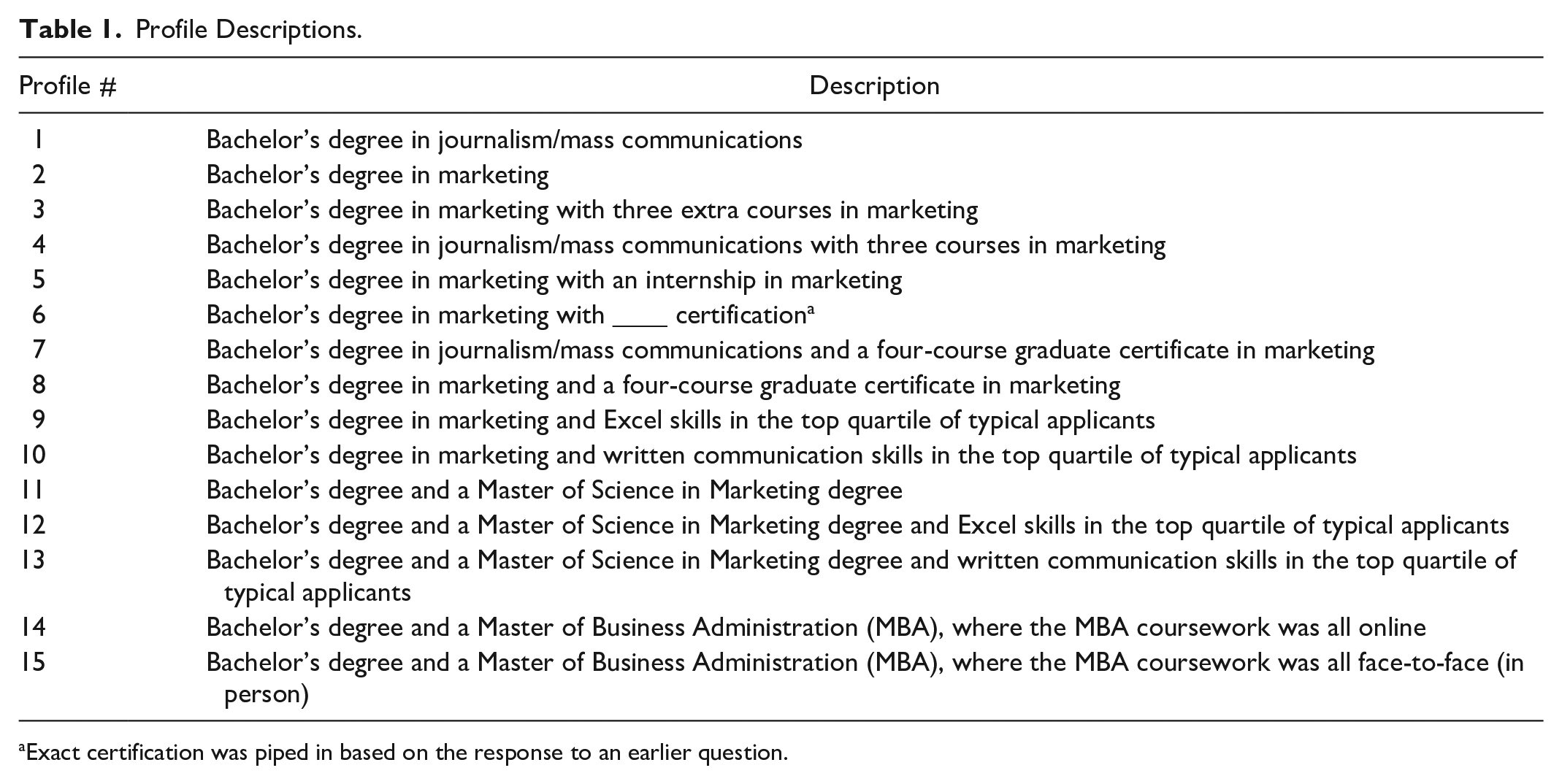
Exact certification was piped in based on the response to an earlier question.
After estimating the location of each profile on a latent dimension, the latent scale can then be translated to a currency scale by using salary estimates of two points along the scale. This translation is analogous to translating degrees Fahrenheit into degrees Celsius. That is, knowing the freezing point of water (32°, 0°, respectively) and the boiling point of water (212°, 100°, respectively) in each temperature scale, the equation of a line can be generated to estimate any Celsius value from any Fahrenheit value. In the software used here, profiles are scaled with a metric of logits. Knowing the salary value of two points along the line will enable the translation of the logit location metrics into a salary-scaled metric for any of the profiles in Table 1.
Method
Over the years, several studies in the marketing literature have empirically estimated the relative value to employers of a variety of marketing skills and knowledge. Nearly all of the studies utilize employer surveys where, using rating scales, employers estimate the importance of employee characteristics such as communication skills or marketing knowledge (e.g., Finch et al., 2013; Kelley & Gaedeke, 1990). However, rating-scales estimates of an attribute’s importance are problematic because nearly all attributes will be rated as important, limiting the ability to clearly discriminate the importance of many attributes (Chrzan & Golovashkina, 2006).
An alternative approach to value estimation is to survey marketing professionals about their own educational backgrounds and current salaries, and then apply regression analysis to estimate how well a marketing education predicts income (Bacon, 2017; Hunt et al., 1986). This methodology has two important advantages: regression models provide dollar-scaled estimates of value, and the method captures the quantitative value of marketing education in the marketplace, rather than solely the hiring managers’ perceptions of value. However, salary regressions present two important limitations. First, the regression analyses compare only the levels of education that are sufficiently prevalent in a random sample of the population to provide a robust estimation of coefficients. For example, relatively few marketing practitioners have a Master of Science in Marketing degree; consequently, estimating the degree’s value with a regression model is problematic (as seen in Bacon, 2017). Second, salary is driven by a large number of attributes and characteristics, and many are unmeasured. These unattended variables increase the noise in the regression model and diminish the model’s statistical power. Value estimation methods using job listings can provide new insights, but they present similar challenges (Schlee & Harich, 2010; Schlee & Karns, 2017). In addition, job listings rarely indicate a specific salary, and they do not specify all job attributes. These ambiguities and omissions hamper efforts to understand how marketing education attributes affect market value.
The use of pairwise comparisons in the present study provides some of the advantages of rating scales and regression models without a number of their limitations. In pairwise comparisons, marketing managers are asked to compare two objects, which in this context is the relative economic attractiveness of two hypothetical potential hires. When a large, systematically selected set of possible pairs are evaluated, robust estimates can be obtained of the differences among all of the potential hires in the set.
The present approach uses contemporary estimation methods that extend the pioneering work done by Thurstone in the 1920s (Thurstone, 1927). While the technique is not new, we believe this study is the first application of pairwise comparisons in the context of educational value, and it provides several advantages in this context. Like rating scales, the method estimates the relative value of many different educational components; however, unlike rating scales, the forced-choice comparisons provide greater discrimination among alternatives. Like regression models, pairwise comparisons provide financial metrics for the value of different components. Unlike regression, components can be included that are not yet common in the respective industry. Also, skills can be evaluated within pairwise comparisons that would be difficult to capture in regression analysis.
Thurstone’s classic 1927 paper, in which he explored the relative seriousness of several different types of crime, provides an excellent introduction to the pairwise comparison method of scaling. To empirically estimate the relative seriousness, Thurstone asked survey participants to evaluate pairs of crimes and, for each pair, indicate which one was the more serious crime. For example, his questionnaire asked if rape is a more serious crime than arson, or is vagrancy more serious than burglary. Thurstone studied 19 crimes and used 171 (19 × 18/2) paired comparisons. Thurstone recognized that if most respondents (e.g., 99%) thought crime A was more serious than crime B, then crime A was probably much more serious than B. However, if A was rated as more serious by a slight majority (e.g., 55%), then crime A was probably only slightly more serious than crime B. Thurstone then applied an ingenious statistical analysis. He assumed that the perceptions of crimes were normally distributed, enabling him to estimate the exact distance between all crimes on a latent scale of seriousness.
In the decades since 1927, many advancements have been made that are related to Thurstone’s original idea. In particular, Bradley and Terry (1952) developed a maximum likelihood algorithm to estimate locations on a latent scale that allowed for unbalanced designs and small samples. Linacre (1995) extended this work by demonstrating that the Rasch model could be used to obtain equivalent estimates while allowing for missing data and not requiring the assumption that latent perceptions be normally distributed. Rasch and other IRT analyses have been applied previously in the broader marketing literature (e.g., de Jong et al., 2008; Ewing et al., 2005) and in the marketing education literature as well (e.g., Bacon & Stewart, 2006).
Questionnaire
Given the use of 15 profiles in this study (Table 1), 105 paired comparisons (15 × 14/2) would be necessary using Thurstone’s original methodology. Consequently, two changes were made to shorten the questionnaire. First, profiles were evaluated in groups of three, where respondents were asked to rate the most valuable and the least valuable profile in each set of three profiles (a triad). From this single question, all possible pairwise comparisons (three possible pairs) can be inferred for the three profiles. Thus, only about 35 questions would be necessary to evaluate all possible pairs in the study.
The other modification leveraged the ability of Rasch analysis to work with missing data. In this regard, not all pairs need to be compared, as long as sets of comparisons are linked. For example, if profiles A, B, and C are compared in one triad, and profiles C, D, and E are compared in another triad, profile C is in both triads and so the sets are linked. All five profiles can be located on the same latent scale. With as few as seven sets of triads, all 15 profiles can be located on the same scale. To obtain additional reliability, four additional triads were included in the survey beyond the seven-set minimum, for a total of 11 triads. Thus, each respondent provided insight into 33 paired comparisons (three comparisons within 11 triads). For improved linking across the sample, three different sets of 11 triads were generated. Respondents were randomly assigned to one of these three forms. The order of triads was randomized within each form, and the order of profiles was randomized within each triad.
Hypothetical job applicant profiles have been used in past research, but we are not aware of any published studies using pairwise comparisons via triads. For example, Protsch (2021) used vignettes to describe job applicants in an experimental design, and Tormala et al. (2012) used hypothetical resumes in an experimental design. A sample triad is shown in Figure 1.
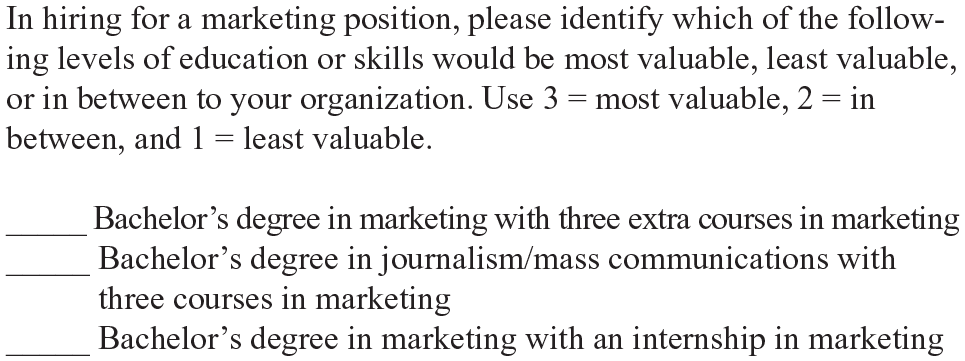
Example of Triad From Questionnaire.
Several other questions were included in the questionnaire for respondent screening, model estimation, and sample description. For screening, respondents provided their role in the organization and their experience in hiring marketing employees. For screening and model estimation, respondents indicated the annual salary they would expect to offer a recent graduate with a bachelor’s degree in marketing, and they provided a similar estimate for a recent graduate of a face-to-face MBA program. For model estimation and firmographics, respondents provided the percentage of their marketing work that involved digital marketing and what industry certification they would value most in a new hire. The respondents were asked a few background questions about themselves and their organizations. The questionnaire and all data collection procedures were reviewed and approved by the institutional review board at the authors’ institution.
Sample
The sample was recruited through a Qualtrics panel targeted at individuals with experience in hiring marketing professionals. The survey’s screening questions ensured that respondents were at least 18 years old and employed full-time in the United States. Potential respondents were included in the final sample if they worked in (a) marketing or advertising; (b) management, professional, and related positions; or (c) human resources and they were involved in hiring decisions for marketing positions in the past 2 years.
Additional checks were conducted to ensure a valid sample. In one check, the salary the respondent would offer a marketing job candidate with a bachelor’s degree was compared with the salary they would offer a marketing job candidate with an MBA. If the first context was larger than the second context, we assumed that the respondent lacked familiarity with the marketing job market, and the respondent was excluded from the sample. In other checks, comparisons were identified that would have one logical answer if the respondent was answering questions carefully. These questions often involved comparing a profile with A to a profile with A and B. As additional skills would be more valuable, A and B should always be preferred to A alone. Of course, some inaccuracies in responses would be expected. Four such comparisons were in each form of the survey. Respondents were excluded from the study if they answered one or none of these questions in the expected direction. In one final check, respondents were dropped if they indicated that their most valuable industry certification was provided by the Advertising Conference of America, a fictitious organization specifically used in the survey for screening purposes. Working with the data supplier and using these criteria for dropping cases, the sample size retained for further analysis included 137 respondents. As each respondent evaluated 33 paired comparisons, the total number of responses was 4,521 (33 × 137).
Results
Before proceeding to the value estimate of various marketing education options, several respondent background variables were examined, and the salary estimates were compared with other published studies to evaluate the general validity of the responses. Several respondent descriptors are shown in Table 2. The participants’ average age was 39, 54% were male, and the median number of marketing hires in which respondents were involved was six. On average, 59% of the employees at the respondent’s organization had at least a bachelor’s degree.
Respondent Background Variables.
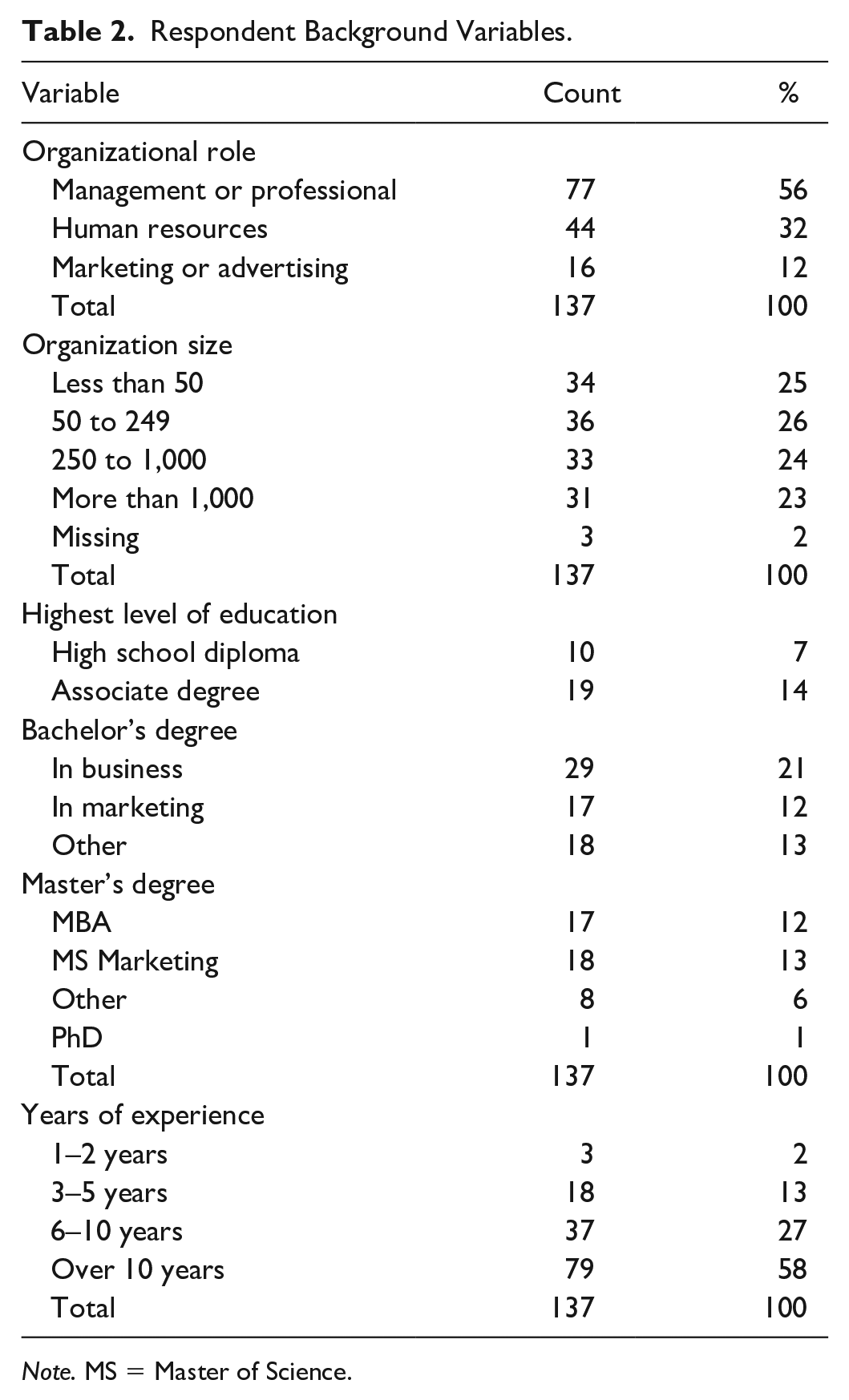
Note. MS = Master of Science.
On average, 65% of the marketing work done in respondent organizations was related to digital media. The industry certifications selected as the most valuable are shown in Table 3. Although the level of interest in the AMA Digital Marketing Certification was higher than what we see at our school, such interest may not be unusual for respondents who are not working in marketing themselves. In summary, we concluded that respondents with this overall profile should be able to provide meaningful responses to questions about the value of potential marketing hires.
Responses to “Which of the Following Certifications Do You Most Value in a Marketing New Hire?”.
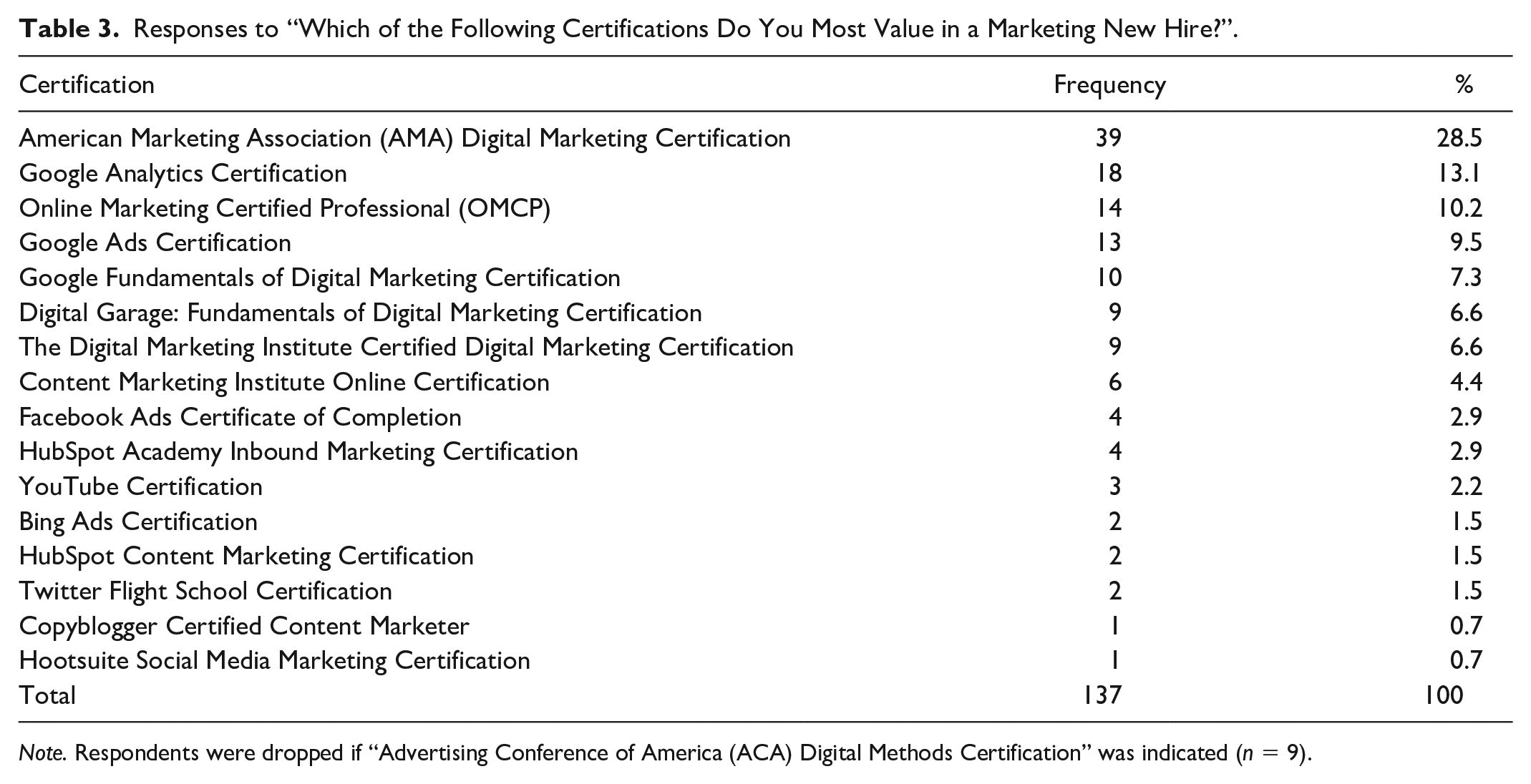
Note. Respondents were dropped if “Advertising Conference of America (ACA) Digital Methods Certification” was indicated (n = 9).
As a validity check, we compared the survey salary estimates to those from other studies. The survey mean starting salary in marketing for a candidate with a bachelor’s degree in marketing was $43,606 (SD = $16,089), which is in the ballpark of marketing starting salary estimates from online sources, including a median of $41,600 (Talent.com, 2022), a mean of $46,500 (Glassdoor, Inc., 2022), and a mean of $48,900 (SimplyHired.com, 2022). The mean salary for an MBA graduate with no experience (i.e., from the survey, a marketing individual who “went straight through college and has now finished a bachelor’s degree and a Masters of Business Administration (M.B.A.))” was estimated to be $59,102 (SD = $25,718), which is 36% higher than the undergraduate estimate. Bacon (2017) estimated that MBA salaries were 44% more than undergraduates in marketing, which is also in the ballpark, although Bacon’s study included some individuals with much more work experience. Thus, these aspects of the survey’s results exhibit face validity.
We then estimated a Rasch model for the data in hand, using Winsteps software (Linacre, 2022). Winsteps is typically used for evaluating test items and individuals; in the present application, we measured profiles and responses. Measures of model fit, such as mean-square residual statistics of infit (information-weighted mean-square) or outfit (outlier-sensitive fit, the metric recommended at in Linacre, n.d.-b), can be interpreted for profiles and for responses in the present case (see
The resulting Rasch measures and estimated salaries for all profiles are shown in Table 4. The counts shown reflect the fact that all of the profiles were rated in several comparisons for each respondent, although some profiles were rated more frequently than others. The substantial effective counts lead to relatively small standard errors in the measures. (Specific guidance for t-tests in Winsteps software can be found at https://www.winsteps.com/winman/t-statistics.htm.) Our salary estimates for the bachelor’s degree in marketing and the MBA degree (both italicized in the table) were used as two points along a line to then estimate the salary for all remaining profiles. In this table, degrees without any additional coursework or skills are shown in bold. The margin of error (MOE) shown reflects the MOE based on the Rasch model estimation and not the sampling error around the two salaries estimated directly from the survey. In the analyses to follow, the value of specific additional components is estimated separately, along with some interactions.
All Profile Measures and Estimated Salaries.
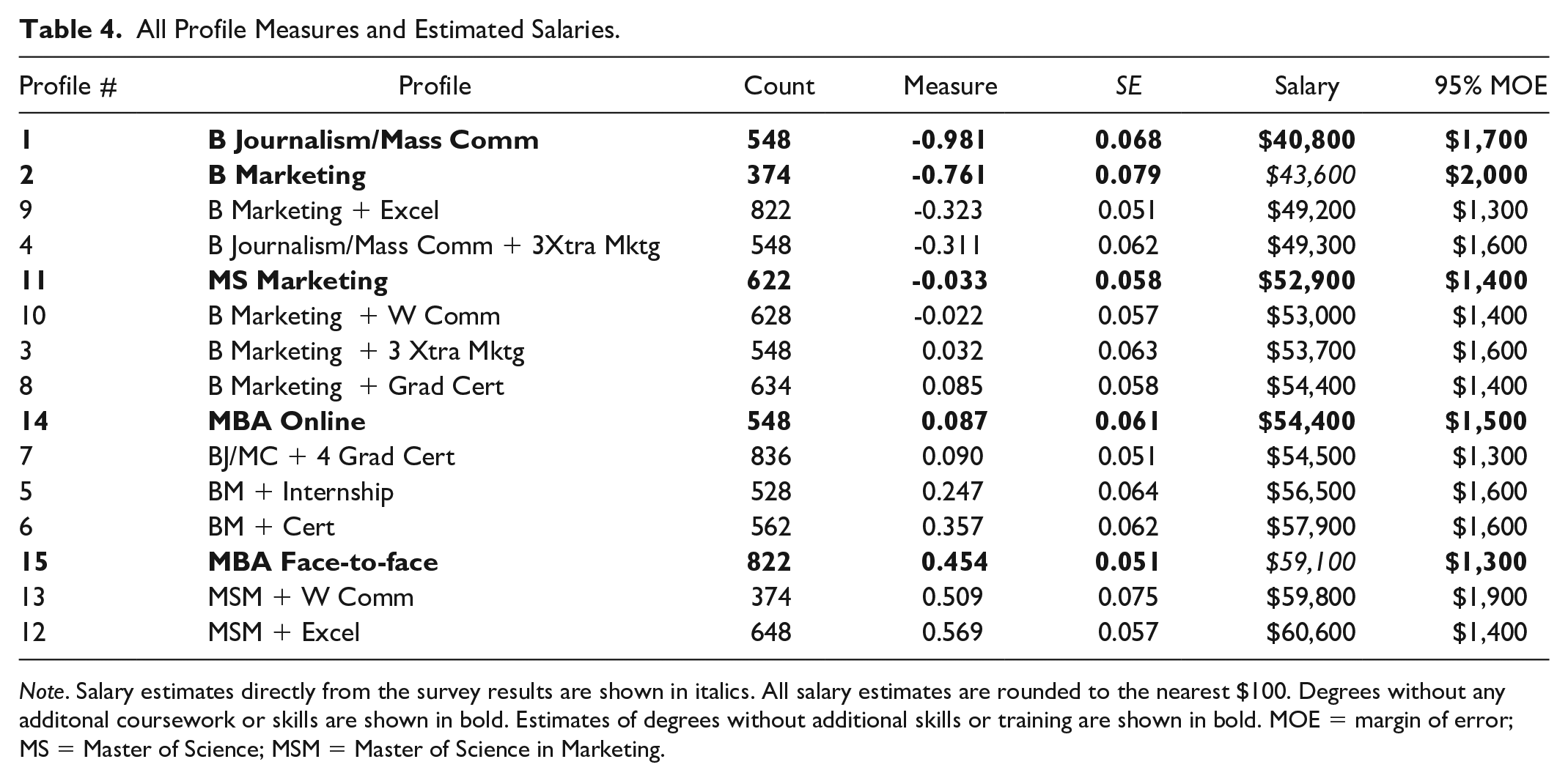
Note. Salary estimates directly from the survey results are shown in italics. All salary estimates are rounded to the nearest $100. Degrees without any additonal coursework or skills are shown in bold. Estimates of degrees without additional skills or training are shown in bold. MOE = margin of error; MS = Master of Science; MSM = Master of Science in Marketing.
As an additional validity check, the salary difference estimated between a bachelor’s degree in journalism or mass communications and a bachelor’s degree in marketing was compared with the difference found in Bacon (2017). The estimated difference is $2,800 ($43,600–$40,800), and the difference estimated from Bacon’s (2017) analysis is approximately 8.1% (15%–6.9%, Table 6, p. 117) or $3,418 (.081 × [$43,600 + $40,800]/2). Interestingly, the difference observed here is statistically significant (ΔM = $2,800, t[920] = 2.09, p = .04, d = 0.14), but the difference is not significant in Bacon’s study, perhaps because of the substantial error variance in salary regressions, as noted earlier. We found significant differences between a bachelor’s degree in marketing and a Master of Science in Marketing degree (ΔM = $9,300, t[994] = 7.57, p < .001, d = 0.48), and between an online MBA degree and a face-to-face MBA degree (ΔM = $4,700, t[1368] = 4.59, p < .001, d = 0.25), but the difference between a Master of Science in Marketing degree and an online MBA degree was not statistically significant (ΔM = $1,500, t[1168] = 1.42, p = .155, d = 0.08).
To explore the value of various additional components of a marketing education, the value of a degree with an added component was subtracted from the estimated value of the degree by itself. The results of this analysis are shown in Table 5, sorted from most to least valuable. The MOEs are larger than those in Table 4 because each estimate reflects the difference between two random variables, each with its own variance. Where a component value was estimated as an addition to two different degrees, a t test was conducted to determine if the difference in value across degrees was statistically significant. As shown in the table, none of these interactions were significant; however, the difference between a graduate certificate added to a bachelor’s degree in journalism versus a bachelor’s degree in marketing was nearly significant, with the addition of a journalism degree having a larger point estimate.
The Value of Additional Marketing Education Components.
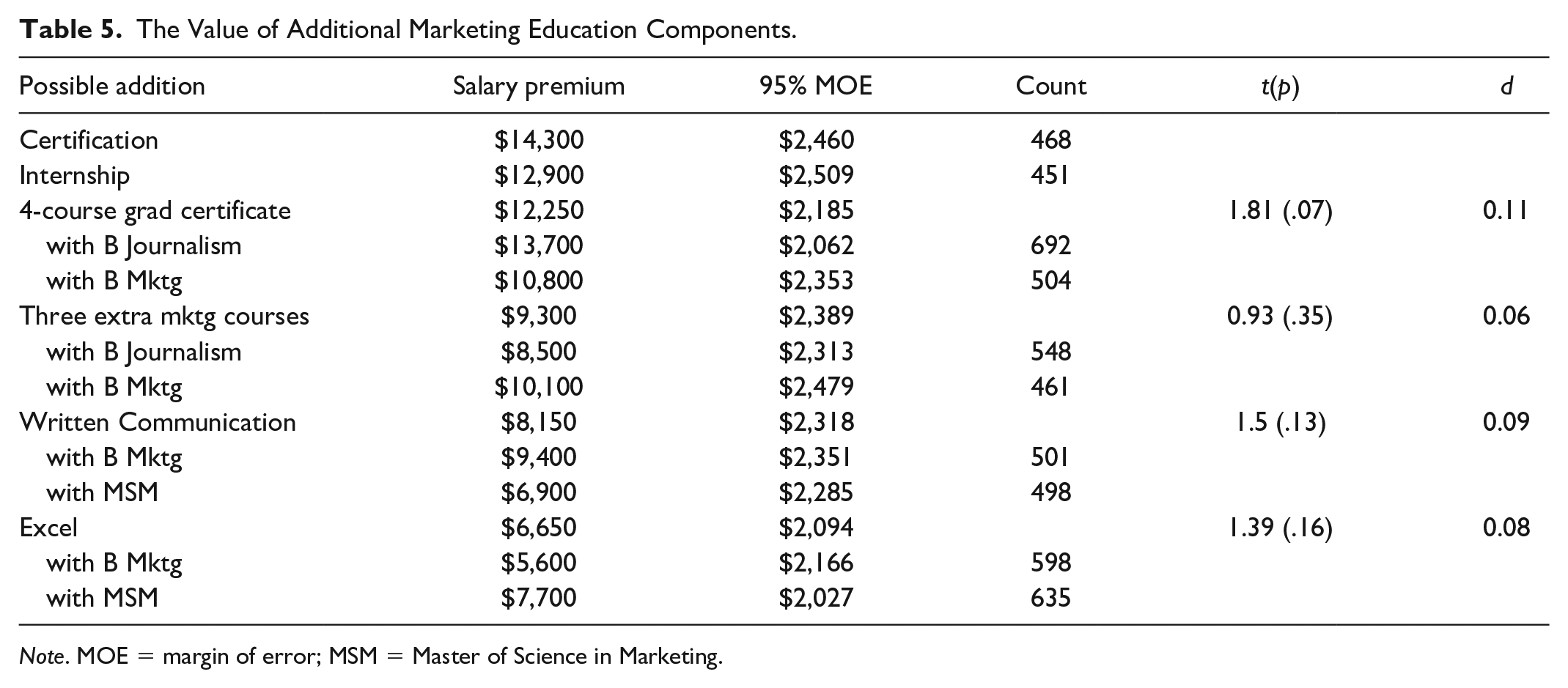
Note. MOE = margin of error; MSM = Master of Science in Marketing.
Exploring Differences in Value Across Subgroups
Testing for differences in responses across respondent subgroups is possible within Rasch analysis. For example, one might wonder if those making marketing decisions, such as managers or marketing professionals (a combined 68% of the sample, Table 2) value some education levels differently than human resources professionals (32% of the sample). In Rasch modeling, each profile in this analysis is referred to as an “item,” and differences in responses to items across groups are known as differential item functioning (DIF, Bond & Fox, 2001). Testing for all possible DIF in this sample would involve hundreds of tests and thus a high risk of capitalizing on chance. Instead, DIF tests are conducted here across one background variable for illustrative purposes.
Differences in item functioning, or in this case, differences in the value estimates for the 15 profiles studied here, were examined across the sample split (managers and marketers v. human resource professionals) using procedures described in the Winsteps manual (Linacre, 2022). Across the 15 tests, one profile was found to be rated significantly different (p < .05) across these two groups. Managers and marketers valued the bachelor’s degree in journalism less than did human resource professionals. As shown in Table 4, the combined sample measure for the journalism degree was −0.981, which corresponded to a salary estimate of $40,800. In the DIF analysis, the measure was −1.222 for managers and marketers and −0.551 for human resource professionals (Rasch-Welch t[386] = 3.34, p = .001, d = .29, see Linacre, n.d.-c for more specific information about this test), corresponding to salaries of $37,700 and $46,300, respectively. One might think that managers and marketers rated the business degree as more valuable because they are more likely to have business degrees themselves. However, managers and marketers were no more likely to have business degrees (undergrad or MBA) than human resources professionals (p = .27). Interestingly, no other statistically significant differences in value were found across these two groups.
It should be noted that the sample size available here for DIF analysis is modest, and thus the statistical power is questionable. While the sample of respondents is small for Rasch (93 in one group and 44 in the other), each respondent evaluated each profile more than once, yielding effect counts here of 372 and 176, respectively, or a total count of 548. The statistical power of DIF tests in Rasch is an area of ongoing research and likely depends on how many items and how many respondents are included, and how many items are expected to exhibit DIF. Studying small scales, Scott et al. (2009) suggest that sample sizes in each subgroup would need to be around 1,000. Belzak (2020) reports that a total sample of 200 would be far underpowered for detecting small DIF effects and somewhat underpowered for detecting medium DIF effects unless there were several DIF items in the study. However, Linacre (n.d.-a) suggests that sample sizes of as few as 30 in each subgroup could be used for informal tests in pilot studies. Reflecting on these power studies, we conclude that a full analysis of DIF within the current sample would have questionable statistical power. Thus, the results just presented provide an example of the potential of the Rasch model in this context, but a full exploration of this potential is left to future research with larger samples and more focused research questions.
Discussion
The findings regarding the value of degrees provide some support for HCT and signaling. The bachelor’s degree in marketing is more valuable than the bachelor’s degree in journalism but by a modest amount ($2,800, Table 4), and three extra courses in marketing are valued at $9,300 (Table 5) or $3,100 a course. Thus, a bachelor’s degree in journalism with a single marketing course might be valued similar to a bachelor’s degree in marketing. The average undergraduate marketing program offers approximately 14 different marketing courses (Langan et al., 2019, p. 38), the research site offers 30 different marketing courses, and nine courses are required. The financial value of a marketing degree is approximately one marketing course more valuable than a journalism degree. This result indicates that the specific knowledge taught in marketing is not highly valued by employers. Why then are three extra marketing courses valued as highly as they are? In our view, this particular achievement likely signals the applicant’s interest, motivation, and drive more than an additional mastery in marketing, and employers value these personal characteristics. The four-course graduate certificate is valued at $12,250 (Table 5) or about $3,062.50 a course. Per course, this is no more valuable than the extra undergraduate marketing courses. Such equivalence indicates that employers do not place a premium on the “graduate” nature of the coursework nor do they place substantial signaling value on a candidate earning a certificate.
Among the graduate degrees, the MSM degree is $9,300 more valuable than the bachelor’s in marketing degree, which is equivalent to three extra undergraduate courses. In the program at the research site, MSM candidates are required to complete 11 graduate marketing courses. Clearly, the market does not value the knowledge gained in the extra marketing courses, and the degree itself has little if any signaling value. The face-to-face MBA program, with typically less marketing content than an MSM degree program, was valued at $6,200 more than the MSM degree. These data again support the conclusion that the marketing knowledge gained in the MSM degree program is not highly valued, nor is the degree’s signal. The knowledge gained in the MBA degree program may be more valued; perhaps the added finance and accounting knowledge are valued more than marketing knowledge even for those in marketing positions. The face-to-face MBA degree program may also send a stronger signal. At present, it may be more difficult to be accepted into and to complete an in-person MBA degree program, signaling to employers that the candidate has greater potential.
The lack of market value in the MSM degree is disappointing but not surprising in our view, in particular the author who directed the MSM program at the research site for many years. In conversations with students in our program, we find that many students simply enjoy marketing, and they are willing to pay for the experience. Other students lack a clear career direction, and they value the personal and professional insights gleaned as they progress through the program. For many of these students, getting a good start in a personally fulfilling career is likely more valuable than the degree’s financial return on investment.
Surprisingly, educational components that are not the focus of many schools still emerged as the most valuable options in this study. Industry certifications top the list and are valued at $14,300. This number should be interpreted as a maximum value, as employers were asked to rate the certification of greatest value in their own new hires. Savvy undergraduate students might acquire a handful of industry certifications that are popular in their area of interest, and the acquisition of these certifications would likely add more value than a more expensive graduate certificate or MSM degree. Similarly, internships are highly valued, with a premium of $12,900. Again, savvy undergraduates might benefit much more from one or more internships than from additional formal education in marketing.
As would be expected from prior research, soft skills and specific technical skills are highly valued. Written communication skills in the top quartile are valued at $8,150, and Excel skills in the top quartile are valued at $6,650. Each of these skills would be more valued than two additional marketing courses, and the worth of written communication skills approaches the value of three additional marketing courses. It is possible that the bachelor’s degree in journalism signals stronger communication skills, and this signal (and the related skills) is valued about as much as marketing knowledge. The considerable value of communication skills to employers could explain why a bachelor’s degree in marketing is only slightly more valuable than a bachelor’s degree in journalism.
Recommendations
The study findings provide several recommendations for directors of marketing academic programs who want to modify their programs to increase the return on investment for their students.
Integrate More Certifications
The present data indicate that the most valuable industry certification will be far more valuable than the average marketing course. Selecting the best certification in the current dynamic market remains a challenge. Cowley et al. (2021) provide guidance on some of the most popular industry certifications, and Spiller and Tuten (2019) describe methods of integrating these certifications into the marketing curriculum, including integrating specific certifications in closely related marketing courses (see especially the course alignment shown in their Table 4). We have had some success with this approach at our own school and have also experimented with allowing students to complete one or more certifications as for-credit independent studies. Some educators may be reluctant to adopt this emphasis on tools because of concern that the emphasis may neglect the development of critical thinking skills. However, we agree with Spiller and Tuten that higher-level thinking skills can be taught in the context of industry certifications.
Increase Use of Internships
Internships have long been of interest to marketing educators (Gault et al., 2000), and the present data provide more emphasis on the need to engage students with these learning opportunities. Schools should consider making internships a program requirement as we have done in the MSM program at our school. In our program, internships are a zero-credit, required course that is waivable under certain conditions. The zero-credit nature of the requirement circumvents the problem of students having to pay the university for an experience that is primarily provided by a different entity, and it also eliminates the financial stakes for any disagreements about waivers. The program director can waive the requirement under one of three conditions: the student (a) already has sufficient work experience in marketing, (b) is currently in a job that will become full time after graduation, or (c) has accepted an offer of full-time employment after graduation. Many students work through the career center to find internships, but many others find them on their own. Waivers of the requirement reduce the need to find internships for all students.
Client projects may be closely related to internships, and they are also of interest to educators (see, e.g., Clark et al., 2012). Shanahan et al. (2021) present a framework for sourcing and managing client-based projects that could be modified to include internships. Exactly how these experiences should be designed to optimize employer value remains an under-researched area in business education. Still, the present research indicates that the increased inclusion of internships is expected to add substantial value to marketing education.
Enhance Specific Skills
Strong written communication skills and Excel skills are each financially valued as much or more than two marketing courses. Each skill can be taught in stand-alone marketing courses, although integrations throughout the curriculum would be more effective as this integration involves repeated student study and practice (Bacon et al., 2008; Bacon & Stewart, 2022). Marketing educators may view teaching certain skills as the responsibility of other departments such as English or information technology; however, full integration into marketing would likely lead to much more valuable graduates. The same might be said for other abilities, such as oral communication skills or team skills, although the relative value of these and other skills is left to future research.
These recommendations suggest an undergraduate or graduate curriculum that uses marketing and marketing technology as the context for teaching skills such as written communication or Excel abilities, and possibly critical thinking and other skills. The present data do not support the conclusion that the marketing content itself, and its elaborate set of vocabulary and models are what drive the value of marketing education. The suggested reduction in marketing content implied here is consistent with Bacon and Stewart’s (2022, p. 14) Recommendation 9, to “Reduce the content breadth and increase the content depth.”
At the same time, employers are not the only stakeholders that marketing educators must consider as students are often the decision makers concerning whether to purchase a marketing education—in selecting and pursuing an undergraduate major or a master’s degree. For hopefully most of them, the study of marketing concepts and theories is interesting and stimulating. We suspect that a program that promoted its arduous Excel training, or the extreme challenge of its communication skill training, would be exciting to employers but much less so to many potential marketing students. In our experience, students do seem excited about client projects and internships and are often very tolerant of obtaining certifications. Essentially, marketing content is the sugar that helps the medicine go down, where the medicine includes developing such abilities as Excel skills and communication skills. To date, we suspect that too many marketing faculty have seen the marketing content as the medicine itself. The artful academic program manager should find a way to mix in a substantial number of skills and applied experiences with enough marketing content to attract and retain marketing students.
Limitations
While the present study has shed new light on a topic of perennial interest, this study and its methodology have limitations. One of the study’s most difficult tasks was narrowing the selected educational components to include in the study to a manageable number. As the target population for the survey, marketing employers are busy people and are unlikely to complete a long questionnaire. Many variables merit examination in terms of their contribution to the perceived value of job candidates. The additional variables we considered, but have left to future research, include:
Reputation of the school, school ranking.
Dual degrees and majors versus minors.
Program length (e.g., one-year master’s degrees, two-year master’s degrees).
Variations in delivery modes: all online, hybrid, high flex, or all in person.
Client projects.
Internship variations: paid or unpaid, for-credit or not-for-credit, same or different industry as target firm.
Work experience compared to college education.
Other meta skills (e.g., critical thinking or leadership).
Wage biases related to diversity dimensions, including gender, race or ethnicity.
The study’s methodology can be seen as a cousin of asking employers to directly rate the importance of job characteristics. Consequently, a social desirability bias exists in that employers may feel that they should or should not value certain job candidate characteristics. The omission of consideration of diversity dimensions is a distinct limitation of this methodology. Also, we did not include levels of education below a bachelor’s degree because in a pilot study, many managers indicated they would not hire an applicant without a bachelor’s degree.
Another limitation is that the combinations of educational outcomes may not be fully additive. Would a bachelor’s of marketing graduate with a certification, an internship, strong written communication skills, and strong Excel skills be worth $85,600 ($43,600 + $14,300 + $12,900 + $8,150 + $6,650)? Would a similar candidate with two more internships be worth an additional $25,800 (2 × $12,900)? The reader should exercise caution in extending value estimates beyond the profiles examined here. The exact value that these components add in various combinations is left to future research.
We are skeptical that the ambitious marketing graduate mentioned in the previous paragraph would actually be worth $111,400 ($85,600 + $25,800), and this overestimation may be due to inferences that respondents made about missing attributes or an overweighting of attributes that some profiles had in common. In such conditions, intransitive preferences have been observed (Kivetz & Simonson, 2000). The Rasch model employed here treats the data as unidimensional and any intransitive preferences are regarded as unexplained errors. The possibility of meaningful intransitive preferences is left to future research.
Considering possible inferences, respondents may have inferred that an MBA candidate had better Excel skills than a journalism candidate, and thus the added impact of Excel skills on an MBA degree would not be as much as Excel skills on a bachelor’s degree in journalism. Ideally, all skills would be tested with all degrees to provide the best estimates; however, such a full factorial design would require a much longer survey, likely leading to lower response quality due to subject fatigue and lower response rates. In the present design, the choice was made to focus on interactions with undergraduates, who comprise most of our students, but an exploration of additional interactions would be an interesting area for future research.
Finally, academic program directors should recognize that financial return on investment may not be the only component of value to students in a marketing program. Students likely also value other outcomes such as a boost in confidence, finding their true calling, building lifelong relationships and networks, and even a sense of personal transformation. In the past, we have heard a colleague state that because the financial ROI on our MSM degree program is low, it is not sustainable. As of this writing, the base price of tuition alone of our MSM degree is more than seven times the expected salary increase, and this analysis does not include other expenses and lost income. However, we note that enrollments have been stable for many years; apparently, an emphasis on financial ROI alone misreads the customer’s value equation. While a higher ROI would no doubt be beneficial, program directors should not overlook other components of value.
In conclusion, the present research has utilized an old methodology in a new way to gain new insights into the value of various components of marketing education. Applied experiences are generally much more valuable than the average marketing course, and specific skills, such as written communication or the use of Excel, are also more valuable than the typical marketing course. Directors of marketing academic programs could increase their students’ ROI by increasing these dimensions, even if these changes would mean reductions in marketing content. At the same time, marketing faculty should realize that there is likely more that marketing students value in their college experience than financial ROI.
Footnotes
Acknowledgements
The authors are extremely grateful for the assistance with the methodology from J. M. Linacre. His expertise in Rasch modeling is as great as his patience and compassion in guiding others in the field.
Declaration of Conflicting Interests
The author(s) declared no potential conflicts of interest with respect to the research, authorship, and/or publication of this article.
Funding
The author(s) disclosed receipt of the following financial support for the research, authorship, and/or publication of this article: The authors gratefully acknowledge research funding from the Daniels College of Business for this article.
