






Abstract
This study follows a cohort of business students for more than 5 years after their first collegiate exposure to sales education. We investigate whether student intent to pursue a sales career carries through to post-graduation employment. Following 396 students surveyed a week after their first exposure to sales via an introduction to marketing class lecture, we show that students’ self-declared interest in a sales career, as reported on the Intent to Pursue Sales Careers (ITPSC) scale, predicts their first job after college. Taking a sales curriculum during college more than doubles the likelihood of ending up and remaining in a sales role after graduation; however, this effect is explained by students’ early intent. Specifically, 2.6 years after initial data collection, ITPSC scores predict first-role post-college employment in both frontline employee and sales roles, overpowering the explanatory effect of sales curriculum enrollment. Moreover, even 2.9 years after graduation and 5.1 years after the first measurement, the ITPSC score continues to predict whether young professionals are in selling or frontline roles.
Introduction
The sales literature—both pedagogical and practitioner focused—has long railed against the dearth of college graduates interested in pursuing a sales career despite a growing backlog of positions. A renewed focus on sales education at universities attempted not only to lure students into newly formed experiential classes designed to diminish the power of the used-car-salesman myth but also to connect these students with firms eager to hire (Lanzrath et al., 2024). The promise? A win-win proposition: person-job fit for students looking to pay back loans (Raelin, 1983) and new hires with lower turnover and higher performance for firms (Beuk et al., 2014; Bolander et al., 2014). But have marketing education efforts helped to put students in sales classrooms and in sales roles after graduation?
Attempts to measure the impact of sales education have been plentiful in the last two decades. Among them was the development of the Intent to Pursue Sales Careers (ITPSC) scale (Peltier et al., 2014), which has been utilized among a wide variety of student populations and national cultures and contexts; yet, only two studies present evidence that ITPSC is linked to actual sales behaviors. Both of these studies support that ITPSC is linked to students’ choices to enroll in sales classes and one includes measurement of its performance after 6 months (Beuk et al., 2023; Scott & Beuk, 2020). Despite widespread use, there is a lack of research on how ITPSC performs over longer periods of time and if ITPSC can predict actual student behavior in the job market. While a college major or coursework may be expected to result in a given career choice after graduation, this is not always the case. And for sales, the lack of a predictable pathway from classroom to career is even more apparent, as less than 4 out of 10 college-educated salespeople hold a business degree regardless of major (Carnevale et al., 2011).
This study directly addresses these shortcomings and extends the literature by extending the validity of the ITPSC scale in two important ways. First, this paper extends the ITPSC to predict career choice after graduation and after holding an initial job. Second, the ITPSC scale is shown to have value when assessing both (1) the type of sales career selected (sales, frontline employees [FLEs], non-sales FLEs) upon graduation and (2) the sales role held over time (even years after graduation). In addition, this research directly explores the impact of additional factors evidenced or suggested in the literature to impact the choice or interest in a sales-related career including the Big Five personality traits and collegiate sales course enrollment.
The results, borne from following a cohort of students at a large Midwestern public university in the United States for over 5 years, can help the literature explain business students’ eventual and continued employment across both sales roles and frontline roles with selling activity. The findings offer insights to marketing and sales educators, schools partnering with professional salespeople in Sales Center or similar reciprocal partnerships, and sales recruiters who increasingly look to university marketing programs to help fill their dwindling ranks.
Theoretical Background and Hypothesis Development
Sales and Selling Activity Roles
In their seminal paper, Hartmann et al. (2018) identify that there are employees who have a sales role and customer-facing employees who may engage in selling activities. The latter category is substantially broader than the specific sales role category and is often referred to as frontline employees (FLEs). Central to the FLE role is the direct interaction with customers in service encounters. FLEs perform an essential role in shaping customer perceptions of service quality, satisfaction, and value (Di Mascio, 2010; Zablah et al., 2012). In a sense, the frontline role can be seen as the “steward of customers” (Schepers et al., 2012).
FLEs frequently identify both with the organization and the customer (Korschun et al., 2014). As such, FLEs tend to manage a wide range of relationships, not only with customers, but also with other employees both within and outside their organization (Plouffe et al., 2013; Plouffe et al., 2016). Given these descriptions, all salespeople can be considered FLEs, but the reverse is not true. Non-salesperson examples of FLEs include customer service representatives (Schepers et al., 2012), concierges (Di Mascio, 2010), flight attendants (Zablah et al., 2012), wait staff, and cashiers (Korschun et al., 2014). This paper explores our model’s ability to predict actual post-graduation employment of both sales employees and FLEs (selling activity) with the understanding that sales skills and sales education are applicable and transferable across industries and roles (Loe & Inks, 2014).
Importance of First Job
The first full-time job is critical to establishing a career trajectory and forms the basis of a worker’s attitude and motivation, work stability, and job satisfaction (Raelin, 1983). A job deemed good economically is often delineated by pay or working conditions, and the power of a well-paying first job toward lifetime earnings and advancement potential is well-documented (e.g., Schwandt & Von Wachter, 2023). But there is also a strong focus in the literature on the subjective aspect of job quality. Person-job fit is the worker’s perception of their own compatibility with the traits, knowledge, abilities, and preferences required by the position (Ballout, 2007). One manifestation of poor fit is underemployment, which research shows can be more detrimental to employer interview call-backs than unemployment itself (Nunley et al., 2017).
Achieving person-job fit affects many aspects of well-being, from job satisfaction to self-efficacy and psychological strain (Hecht & Allen, 2005). Conversely, failure to achieve person-job fit contributes to increased turnover and reduced employee effort when faced with workplace challenges (Luksyte et al., 2011). A mismatch between a person’s characteristics and the job requirements creates stress, contributing to role overload, anxiety, depression, and burnout (Christiansen et al., 2014).
From an employer’s perspective, maintaining a productive salesforce is a concern due to both recruitment and turnover challenges. Sales positions are one of the hardest to fill (Lanzrath et al., 2024), while first-year salesperson turnover approaches 60% (Cespedes & Weinfurter, 2016). A study of workers up to 20 years out of college found 71% remain in the field/career in which they began (EdX Press, 2018). Considering the difficulty of recruiting and retaining new graduates and converting later-stage workers, room for error is small.
Theory of Planned Behavior and Sales
The Theory of Planned Behavior (TPB) is an expectancy-theory model that posits human behavior stems directly from behavioral intentions and indirectly from attitude formation (Ajzen, 1991; Ajzen & Fishbein, 1977). The intent to act (behavioral intent) is a function of evaluations (positive or negative) of the behavior (subjective norms) and the individual’s perceived ability to perform the behavior (perceived behavioral control or PBC). Used extensively to explain intentions and behaviors, TPB is especially useful for developing decision-making frameworks that investigate high-stakes decisions like career choice (Gorgievski et al., 2017) and college major (Tan & Laswad, 2009). Investigations of sales career choice have relied on TPB (Inks & Avila, 2018), and TPB is used to explain the subdimensions of the Intent to Pursue Sales Career (ITPSC) scale among students: perceived sales knowledge, perceptions of sales ethics, perceptions of salespeople, and perceptions of the sales profession (Cummins & Peltier, 2020).
Theory of Planned Behavior is predicated on the interaction of different psychosocial elements that interact and influence a given behavior and its outcomes. Among these elements is PBC. Often termed self-efficacy, PBC is the person’s perception of their own ability based on their knowledge and skills to perform the behavior. If a person’s PBC related to a career is higher, they believe a greater range of opportunities is available to them in that career (Johara et al., 2017). The other elements of TPB include attitudinal (experiential and instrumental) and subjective norms. As they relate to sales employment or education, subjective norms are society’s at large or specific others’ views about a behavior—such as the perceived prestige of the sales profession or a parent’s opinion of the career path. Experiential attitudes relate to the individual’s beliefs about the behavior being enjoyable (e.g., selling activities or engaging in the sales process), while instrumental attitudes relate to the outcome or value of the behavior (e.g., income, promotion, etc.). For a detailed review of how the TPB informs each of the subdimensions of ITPSC, and its end goal of predicting sales employment, see Cummins and Peltier (2020).
The sales literature has investigated both the reality of subjective norms (Hartman, 2006) and how to impact these subjective norms related to sales as a profession (Hawes et al., 2004). Impacting the attitudinal elements of students is a focus of the sales education literature (e.g., Beuk, 2016; Cummins et al., 2016; Lanzrath et al., 2024; Paden et al., 2016). Using TPB, prior research shows that student knowledge and attitudes toward sales, as measured by the ITPSC scale, can predict students’ choice to enroll in sales education (Beuk et al., 2023; Scott & Beuk, 2020). This paper investigates if (1) ITPSC predicts sales activity employment after college and (2) the intermediate behavioral choice of sales education mediates the relationship (see Figure 1).
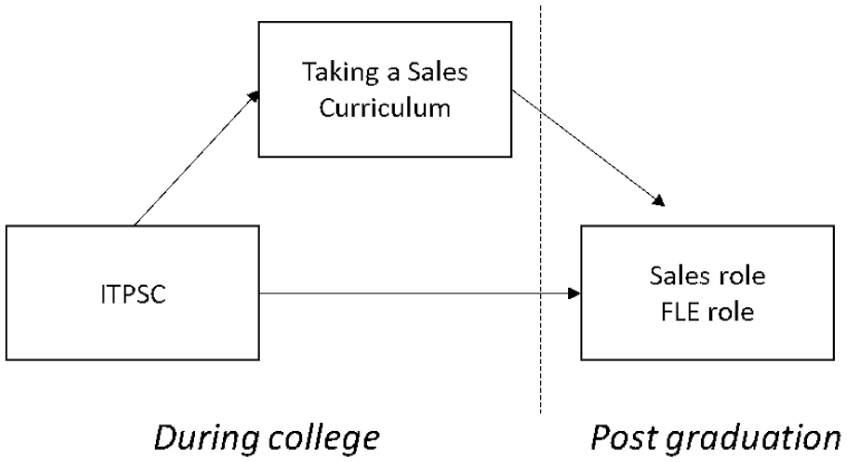
Model of choice of sales activity job.
ITPSC and Sales Employment
Used at least a dozen times since its development, the ITPSC scale has been validated across universities (Cummins et al., 2015), cultures (Herlache et al., 2018) and national contexts (Ballestra et al., 2017). Authors have applied the scale across different student populations including high schoolers (Inks & Avila, 2018), undergraduates (Deeter-Schmelz, 2015) and graduate students (Miller, 2023). While most studies are among business school students, Scott and Beuk (2020) extended its use among engineering majors. Peltier et al. (2022) showed that scores on ITPSC were indirectly influenced by the COVID-19 pandemic.
The ITPSC scale measures student perceptions related to five dimensions: sales knowledge, selling ethics, salespeople, perception of the sales profession, and intention to pursue a sales career (Peltier et al., 2014). Based on earlier works (Bristow et al., 2006; Churchill et al., 1974; Pettijohn & Pettijohn, 2009; Karakaya et al., 2011) assessing student perceptions and attitudes toward sales and selling, the ITPSC instrument was created to be more parsimonious and to test the efficacy of educational interventions (Peltier et al., 2014). While the ITPSC instrument is explicitly grounded in the Theory of Planned Behavior as described above, only two studies present evidence that ITPSC is linked to actual sales behaviors. These studies find strong support that ITPSC is linked to students’ choices to enroll in sales classes across two different populations. The first shows that ITPSC scores are linked to engineering students’ choice to enroll in a sales certificate program (Scott & Beuk, 2020); and the second extends this finding to business students, showing that including the ITPSC improves predictions fourfold of which students will be enrolled in a formal sales program 6 months later (Beuk et al., 2023). These studies clearly show evidence of a link between ITPSC and behavior; yet the linkage between the intent to pursue a sales career and actual jobs has yet to be investigated.
Similarly, we can find no work specifically investigating the link between the ITPSC scale and FLE employment choice. Investigation of FLE choice is sparse, with studies exploring the motivation of firms’ customers who seek employment in FLE roles (Wang et al., 2017) and the usefulness of public service users (customers) recruiting others to public-serving FLE roles (Trischler & Kaluza, 2021). We can find no studies of first-time college graduate selection of FLE roles. This may be because many researchers expect FLE workers to be non-college graduates (Bhaskaran et al., 2022).
While college students’ sales role interest is shown to be impacted by recruiter knowledge (Weilbaker & Merritt, 1992; Wiles & Spiro, 2004) and recruiter advertisements (Deeter-Schmelz et al., 2020), studied factors influencing FLE recruitment among college students is lacking. A variety of studies outside of sales look at factors among college students influencing job candidates including organizational reputation (Slåtten et al., 2019) and strategic corporate philanthropy (Ricks & Williams, 2005); but the majority of the literature studying recruitment of FLEs resides in the general workforce (e.g., location, remuneration, and perceived person-job fit) rather than looking at the choice of first-time or recent college graduates (e.g., Straker & Atchley, 1999).
This paper explores how ITPSC can be theorized to impact both investigated forms of sales employment: sales roles and FLE roles. To explore this relationship, we detail each of the dimensions of the scale to understand how the overall intent scale (ITPSC) will differentially impact the selection of sales roles and FLE roles post-graduation. An extension of the Theory of Reasoned Action (TRA), TPB attempts to explain and understand why a person may perform certain behaviors (Ajzen, 1991) such as chosen employment. Extended to ITPSC, intention demonstrates individuals’ motivation in terms of their conscious decision or plan to exert effort to find, be selected, and choose to perform a sales job (Conner & Armitage, 1998; Gorgievski et al., 2017). As a general rule, a greater probability of performance can occur from an individual’s stronger intention to engage in a behavior (Ajzen, 1991). In essence, TPB postulates that a student’s intention toward holding a sales role can be predicted with high accuracy from their attitudes toward performing the job, PBC in the job, and subjective norms of the job (Ajzen, 1991).
Attitude represents the degree of an individual’s assessment of a sales behavior as favorable or unfavorable (Ajzen, 1991). In other words, attitude toward holding a sales role depends on a student’s overall evaluation of that behavior (experiential) and belief in its desirable outcomes (instrumental). In the sales and ITPSC literature, students’ positive experiential attitudes toward selling as a profession would center around feelings of fun, interest, enjoyment, and excitement while performing sales functions. Relatedly, positive instrumental attitudes would stem from outcome-related measures when performing sales functions like worthwhile, valuable, pay, and success (Bristow et al., 2011; Castleberry, 1990). Generally, more positive individual attitudes toward a behavior can lead to greater intention of performing that behavior (Ameer & Halinen, 2019). Thus, if students believe a sales role is favorable and will bring positive outcomes to them, they will seek out a role that is clearly identifiable as a sales role, where selling is the primary function and job duty.
PBC is explained as the perceived difficulty or ease of performing an action (Ajzen, 2002), or more precisely, PBC shows individuals’ choice to engage in a sales role based on their beliefs in the possibility of access to the required resources and opportunities for achievement or success of the role. In the ITPSC scale, PBC is represented by the dimension of sales knowledge, or the extent the student believes he or she understands the domain of professional selling, including the following content areas of sales knowledge: improving student understanding of the changing role of professional selling in the marketplace, including increased teamwork, enhanced use of technology, and a focus on innovation and customer orientation (Peltier et al., 2014). The results of empirical studies demonstrate the direct influence of PBC on intention to pursue careers (Aga & Singh, 2022; Hsu, 2012). Accordingly, strong intention of individuals to perform a particular action would result from a high degree of control over themselves (Kolvereid, 1996). Extended to students’ intention and choice to pursue a sales career, when individuals feel that they have the relevant knowledge, skills, and resources to achieve sales role success, they will more likely form an intention to hold a sales role (Arcidiacono et al., 2012). Prior sales performance research shows that perceived sales knowledge and related dimensions of sales abilities and selling skills are established proxies for self-efficacy (Peterson, 2020).
Finally, personal perception of a behavior under the influence of other people’s attitudes provides the subjective norm as a social factor (Ajzen & Fishbein, 1980). In the ITPSC dimensions, both perceptions of salespeople and perceived ethicality of salespeople represent subjective norms in TPB. Subjective norms are the degree or extent to which the student perceives that others hold positive perceptions about (1) salespeople in general and others’ expectations for (2) salespeople to engage in (un)ethical behaviors while selling. Individuals’ perception of important people’s approval of a selling behavior/role is enough to motivate their intention of performing that behavior (Avlonitis & Panagopoulos, 2010; Ballestra et al., 2017; Bright et al., 2005; Esposito et al., 2016). In the case of ITPSC, if a student feels that there are positive perceptions of salespeople and sales ethics, they will be more likely to seek out and obtain a clearly identified sales role (Peltier et al., 2014).
When considering the potential difference in impact of the ITPSC on sales and FLE roles, we must first fully understand the difference between these roles. Stemming from the service-dominant logic, “[T]his reconceptualization highlights the importance of distinguishing between salespeople and broader sets of actors who engage in selling activities” (Hartmann et al., 2018, p. 2). Thus, sales roles are akin to the traditional use of the word “salespeople,” whose professional role is sales-centric or “purified” to primarily engage in selling, persuasion, or dialog with customers resulting in commitment or purchase. In contrast, FLE roles are characterized as the broader “selling actor” roles who perform selling or sales-related tasks regardless of their role, but not as the primary focus of the role. These individuals may provide pre- or post-sale service, relationship building, or other customer-centric service with sales tasks as a portion of their role.
Students who have yet to have the option to enroll in sales courses likely have a rudimentary and uniform view of sales, not yet understanding the scale or degree of selling present in different roles. Many are likely unexposed to a wide variety of sales-related tasks and selling situations and thus may have a simplistic perception of sales as “ABC: always be closing.” Nuanced differences between transactional/linear/dyadic selling and more non-linear/multi-party/consultative or enterprise selling are likely nothing more than word soup (Hartmann et al., 2018) to these students.
Thus, while positive attitudes and perceptions in the form of collective ITPSC can be expected to impact a student’s perception of any sales role, we expect the effect to be stronger for easily identified sales roles. That is, these early college students may not understand that sales professionals represent the array from sales-centric to broader “selling actors” who perform selling tasks but are not limited to them (Hartmann et al., 2018). Thus, strongly positive or negative perceptions of subjective norms (salespeople and salesperson ethics), attitudes toward the role (sales profession), and PBC (sales knowledge) are likely to align more strongly with the more sales-centric “pure” sales roles and less with sales-adjacent FLE roles. Often deemed “stickiness,” the concept of stronger associations yielding increased prediction power is common in TPB models and employment attitudes (Bergman & Chalkley, 2007; Glerum, 2021; Staw, 1986). Thus, it is expected that ITPSC will be more strongly associated with the selection of sales roles as compared to FLE roles.
Role of Sales Education
Recently, there has been an explosion of research on sales education (see Cummins et al., 2013, 2020 for reviews). While much of this work explores specific activities designed to improve narrow topics related to sales communication, negotiations, sales management, etc., other research has more broadly explored the impact of sales education on student outcomes. Single collegiate sales courses are found to allow exploration of person-job fit within a sales role (Luthy, 2000), improve attitudinal perceptions of sales as more rewarding, satisfying, fun, exciting, and challenging (Bristow et al., 2006); and can allow marketing majors to obtain jobs that utilize their knowledge and skills (Schlee & Harich, 2010). Yet very little research explores the impact of major, concentration, certificate, or other educational sales pathway. Conventional wisdom would suggest that major choice is a key driver of employment. Nurses, engineers, and teachers largely determine their profession by choosing a college major. But do students who take sales courses become professional salespeople? This study seeks to answer that question by investigating the impact of collegiate sales education on sales employment post-college.
Much research focuses on student reticence in pursuing a sales career stemming from a lack of knowledge of sales and selling, resulting in a perceived mismatch between students’ skills and selling success (Ballestra et al., 2017; Inks & Avila, 2018; Peltier et al., 2014). The effort of many sales educators has been to decrease this divide by focusing on collegiate acquisition of sales knowledge (Cummins et al., 2015; Cummins et al., 2016; Paden et al., 2016). Yet more scholars have attempted to bridge the divide by focusing on experiential sales skill acquisition through service-learning projects (Hagenbuch, 2006) and real selling projects (Bussière, 2017; Chapman et al., 2015; Inks et al., 2011; Levin & Peterson, 2015; Pelletier & Hopkins, 2018; Rippé, 2015). Some collegiate sales programs and research focus on the involvement of sales professionals to better educate students and move them toward sales careers. Cummins and Peltier (2020) showed how one classroom-based exposure to a sales professional could impact students’ intent to pursue a sales career. Other research has focused on the involvement of sales professionals to increase sales course enrollment (Neeley & Cherry, 2010), drive networking and internship offers (Cummins, 2021), or increase student interest in employment with specific companies (Nielson & Cummins, 2019).
As noted, two papers show that a subset of the ITPSC scale is an important predictor of student enrollment in formal sales curricula across engineering (Scott & Beuk, 2020) and business (Beuk et al., 2023) student populations. This is consistent with TPB, where an expectation to engage in a behavior (post-college career) can encourage behaviors (enrollment in courses) to grow the skills and abilities needed to succeed in that behavior (Tan & Laswad, 2009). Consistent with TPB, enrollment in sales curriculum is reflective of the student’s self-efficacy related to acting as a salesperson post-college and the applicability of further sales training during college. If, through additional sales education, students believe the sales activities they will engage in match their abilities, and thus expect to do well, they are more likely to pursue a sales career or further sales education (Arcidiacono et al., 2012).
Many studies utilizing the ITPSC scale have attempted to link educational interventions with an increase in ITPSC, suggesting that the role of faculty is merely to encourage as many students as possible toward a sales career, but not considering the type of sales role. This paper posits that a sales career can be many things to many people, and the goal of faculty and sales education should be to allow students to find a person-fit match between their interests, skills, and abilities and those of a given sales role. Just as skill and ability are not stagnant, neither is interest. Our discipline believes that sales skills and abilities can be impacted by sales education. Similarly, ITPSC research has asserted that a person’s intent to pursue a sales career can be shaped and increased through educational interventions; but importantly, that intention is transitory and should be studied as such. Interest must be translated into an actual sales role or potentially be lost to another career path forever. To explore the mediation of sales education on the relationship between ITPSC and the actual career choice of students post-graduation, we again turn to the components of ITPSC.
While education is never one-note, and different programs, courses, instructors, and encounters can provide unique “aha” moments for different students, sales education as a whole can be expected to impact the attitudes, perceived control, and subjective norms of students as it relates to sales and FLE roles. While sales education can be expected to mediate the relationship between ITPSC and all sales roles through enhanced attitudes of the job (sales profession), perceived behavioral control in the role (sales knowledge), and subjective norms of the position (salespeople and sales ethics), we hypothesize a differential impact of sales education on sales roles and FLE roles.
First, sales education is highly experiential, asking students to not only study the sales process but also engage in a wide array of selling activities (see Cummins et al., 2013, 2020). Students in these courses are likely to engage in not just persuasive selling, but also requirement gathering, impact exploration, after-sales service, or negotiation activities, which may stretch existing understanding of what sales roles entail. Because sales education involves a multitude of professionals from across the sales function, from recruiters to sales managers, students are likely to be exposed to a wider array of sales and FLE positions. Through exposure to professionals as guest speakers, at career fairs, experiential role-plays, job shadows, field trips, and more, students are likely to expand the menu of roles from which they ultimately select employment. Increased education, including exposure to a wider array of potential sales jobs and employers, should work to improve “student understanding of the changing role of professional selling in the marketplace, including increased teamwork, enhanced use of technology, and a focus on innovation and customer orientation” (Peltier et al., 2014). Because a student engaged in sales education will be exposed to more sales paths without increased individual effort; by sheer likelihood, they are more likely to encounter FLE roles, which are more plentiful than sales roles. Indeed, despite companies’ preference for recruiting for sales roles, they hire and employ more FLE roles. In addition, sales education can be expected to improve student exposure to the wide variety of selling situations and methods used in markets, not just prototypical dyadic selling. This awareness of the team approach to selling will naturally increase the number of FLE jobs from which students select eventual employment. In turn, this increased exposure to FLE roles through sales education that were less known to students than prototypical sales roles before sales education can be expected to differentially drive FLE employment post-graduation as attitudes toward such roles would increase through the increased exposure.
Perceived behavioral control, or self-efficacy of FLE-related and sales role–related tasks should also be driven differentially through sales education. Increased knowledge of and experience with sales technology (e.g., Customer Relationship Management systems [CRMs]) through sales education may improve students’ perceived knowledge and self-efficacy in a sales support role. Experiential projects may drive a student to develop confidence in their technical abilities and search for and choose a role as a technical consulting specialist. Internships in sales-related roles driven by sales classes result in countless students being hired full-time into sales support positions as they recognize the integral nature of customer service in sales and, specifically, FLE roles. Due to the opportunity to engage in realistic selling encounters (experiential) and achieve an element of success through performance-based feedback from others—whether peers, faculty, or sales professionals (instrumental)—students enrolled in a sales curriculum are likely to grow their perceptions and self-efficacy of the value, fun, enjoyment, and worth of both sales and sales-aligned FLE roles.
While a main driver of sales education and the ITPSC literature has been the goal of disrupting the persistent negative subjective norms of the used-car salesman, it is worth exploring if sales education would have a differential impact on sales and FLE role norms. Research would suggest that roles adjacent to a stereotypical role do not necessarily carry the same baggage—positive or negative—as the stereotypical role. For example, attitudes toward police and security officers are not synonymous despite performing similar work (Van Steden et al., 2013). Similarly, doctors and nurses, while each is viewed as trusted, have differential societal norms associated with the level of care and decision-making each should be trusted with (Campbell-Heider and Pollock, 1987). Aligning with these findings, we expect that stronger perceptions toward the favorability of salespeople and sales ethics can be cultivated through exposure to actual sales professionals in various roles (both FLE and sales) and also stories and examples of sales guidelines, penalties, and successes of encountered ethical dilemmas. However, because subjective norms students hold prior to sales education, formed over their entire lives, should stick more strongly to pure sales roles, the impact of sales education on sales-adjacent FLE roles is expected to be greater. Simply, sales education will make up ground on the myths of the used car salesman, but may only be strong enough to move students toward FLE roles, not toward the more closely myth-aligned sales role. Taken together, sales education is expected to have a stronger mediation impact on the attitudes, perceived control, and subjective norms of ITPSC’s relationship with FLE roles than sales roles. Thus, this study proposes:
Personality and Career Choice
The Big 5 personality traits (Extraversion, Openness to Experience, Agreeableness, Conscientiousness, and Neuroticism or Emotional Stability) are used across educational, employment, and sales research. In sales employment, most research looks at the relationship between salesperson performance and personality (e.g., Canales-Ronda, 2023; Furnham & Fudge, 2008; Judge et al., 2013; Plouffe et al., 2017; Sitser et al., 2013; Thoresen et al., 2004). This collective body of research shows mixed results across each trait as they relate to salesperson performance. Despite the literature’s interest in this relationship, there is very little that shows an impact of personality trait on sales career choice.
In education, scholars have studied personality’s impact on choice of major (Lakhal et al., 2012; Rubinstein, 2005) and satisfaction with major (Logue et al., 2007; Lounsbury et al., 2003). Only one study has looked more specifically at students’ Big Five personality traits and their choice of sales class enrollment (Scott & Beuk, 2020). This paper showed inconsistent results for the Big Five measures of personality on students’ enrollment in sales courses. Among engineering students, extraversion was associated with an increased likelihood of taking a sales class; while for business students, trait competitiveness was the lone significant predictor (Scott & Beuk, 2020). While personality is considered stable throughout life (Judge et al., 1999), there is no clear evidence that students’ Big Five personality traits reliably impact job choice post-graduation; thus, personality traits are included as exploratory variables in this research.
Methods
This study follows a cohort of students through their college careers at a large Midwestern university in the United States, combining survey data with educational records and LinkedIn profiles. Approval for the study was obtained from the school’s Institutional Review Board.
Sample
A group of 396 undergraduate business students were tracked over a 5-year period. Initial data was collected in nine sections of the second-year (200-level) Principles of Marketing class across the 2019 to 2020 academic year. This course is mandatory for all business majors; thus, the initial sample represents a cohort of business majors at a large Midwestern public university in the United States. Survey participation was 88%. Based on the curriculum map, a typical student would require 3 more years to graduate after course completion. By increasing our sample frame to 5 years, we ensured that nearly all students in the cohort were included in the final sample. Upon collecting job information, only nine students, or 2%, had information on their LinkedIn profile indicating they were still completing their undergraduate degree. The average time between ITPSC measurement and graduation was 938 days or 2.6 years. See Figure 2 for the data collection plan.
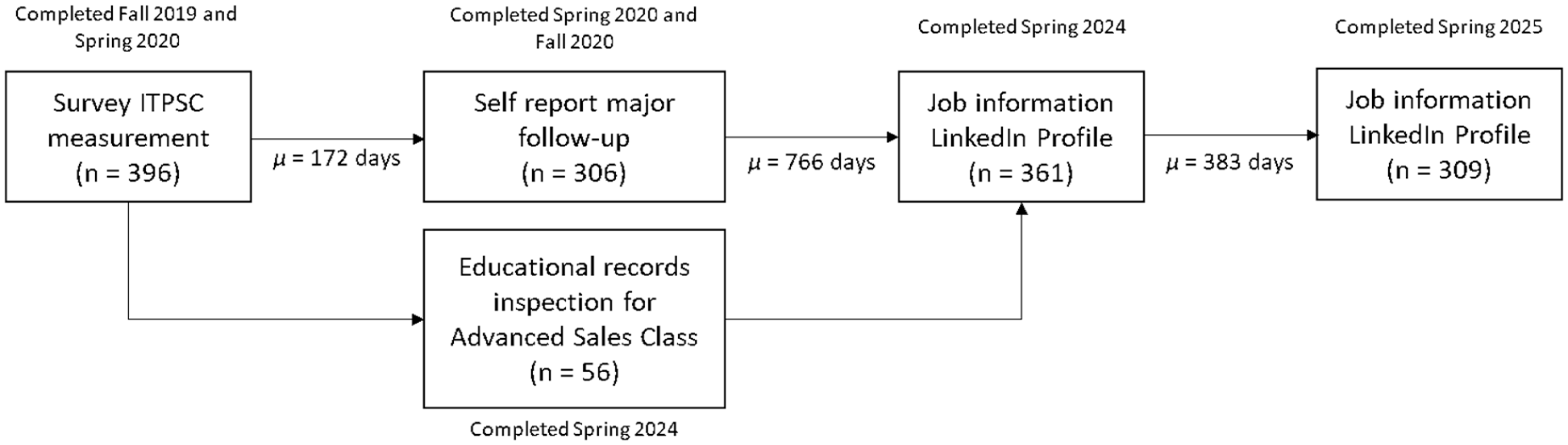
Data collection process.
Job Classification
We evaluated the first full-time job post-graduation of each respondent. To assess whether the job was a sales job, FLE job, or neither, we evaluated the job titles respondents listed on their LinkedIn profiles, as well as the skills and job descriptions they listed for these jobs. Students were searched on LinkedIn, and the associated URL was logged in a spreadsheet. Two authors independently classified each first-role post-graduation as a sales job (Y/N) or an FLE job (Y/N).
Sales jobs were operationalized as roles with “sales,” “account management,” or “selling” in the job title (e.g., Territory Sales Rep), or when the skills the employee listed on LinkedIn for the job included “selling” or related words (e.g., sales, sales and marketing). Thus, these students clearly identify themselves as primarily engaged in sales or selling professionally. FLE jobs were operationalized as roles where the title, skills, or job description indicated that the person was interacting with people outside the organization. This included all sales roles, as well as non-sales roles (e.g., client services, patient care coordinator, recruiter, etc.). If necessary, roles were also identified based on the listing of skills related to “customers” or “clients” within the LinkedIn job description. If the title was ambiguous (e.g., coordinator, consultant) and too few details were included on LinkedIn to assess the role, the authors searched for the role and company to review the job posting description. Company written job descriptions were accessed by one author for 13% of the sample for confirmation, showing that the employee-presented information was largely sufficient to assess role type. Sample members still listed as students (2%) were omitted.
After independent job categorization by two authors, inter-rater reliability was calculated using the proportional reduction in loss method (Rust & Cooil, 1994). Initial reliability was 97.7%, with 13 out of 569 possible disagreements. After author conferral, agreement was reached on the categorization of all roles, with 2 students removed from the sample due to inability to confirm their role (LinkedIn profile removed or too few details to assess the role [e.g., “owner”]). Difficult cases that required investigating and discussing the specific positions included (across all three categories): (1) FLE positions of spa coordinator, assistant athletic director, assistant golf professional, loan analyst, pharmaceutical technician; (2) Sales positions of: human capital management consultant and associate financial advisor; and (3) non-FLE/non-sales positions of: adjudication specialist, digital marketing coordinator, co-owner.
Based on our conceptualization, these job categories are not mutually exclusive. All sales roles are also FLE roles, but not all FLE roles are also sales roles. Hence, we create three binary variables: (1) sales roles, (2) FLE roles, including all sales roles of the first variable, and (3) FLE/non-sales roles. 1
The most common first job for cohort graduates was a non-FLE role (52.7%). These ranged from staff accountant and supply chain planner to teacher and infantryman. Breaking down the remainder of frontline workers within our variables: sales roles represented 14.2% of the sample (e.g., territory sales rep, account rep, sales development associate); FLE roles encompassing selling activities (e.g., admissions coordinator, campus recruiter, marketing and event coordinator) accounted for 23.7% of roles, and FLE roles without selling activities (customer service representative, cashier, assistant manager) accounted for 9.4%.
A listing of non-duplicative job titles from the sample delineated across FLE, sales, and non-FLE roles is included in Appendix A. Importantly, this listing shows that some titles can be very similar or the same across categories, which is why employee job descriptions and skill listings (along with company job descriptions in some cases) were critical in accurately coding the individual roles. An “owner” was in some cases determined to be actively engaged in sales (e.g., owner of a lawn care business who conducted all sales and account management), and in other cases determined to be occasionally interacting with clients (e.g., digital storefront developer/co-owner), and in other cases not engaged in selling or interacting with customers at all (e.g., owner of an online e-commerce t-shirt website). Finally, we counted the number of jobs that respondents reported on their LinkedIn profile in the Spring of 2025. We separated both internal promotions and new roles with different employers.
Survey Measures: ITPSC and Big Five Personality Traits
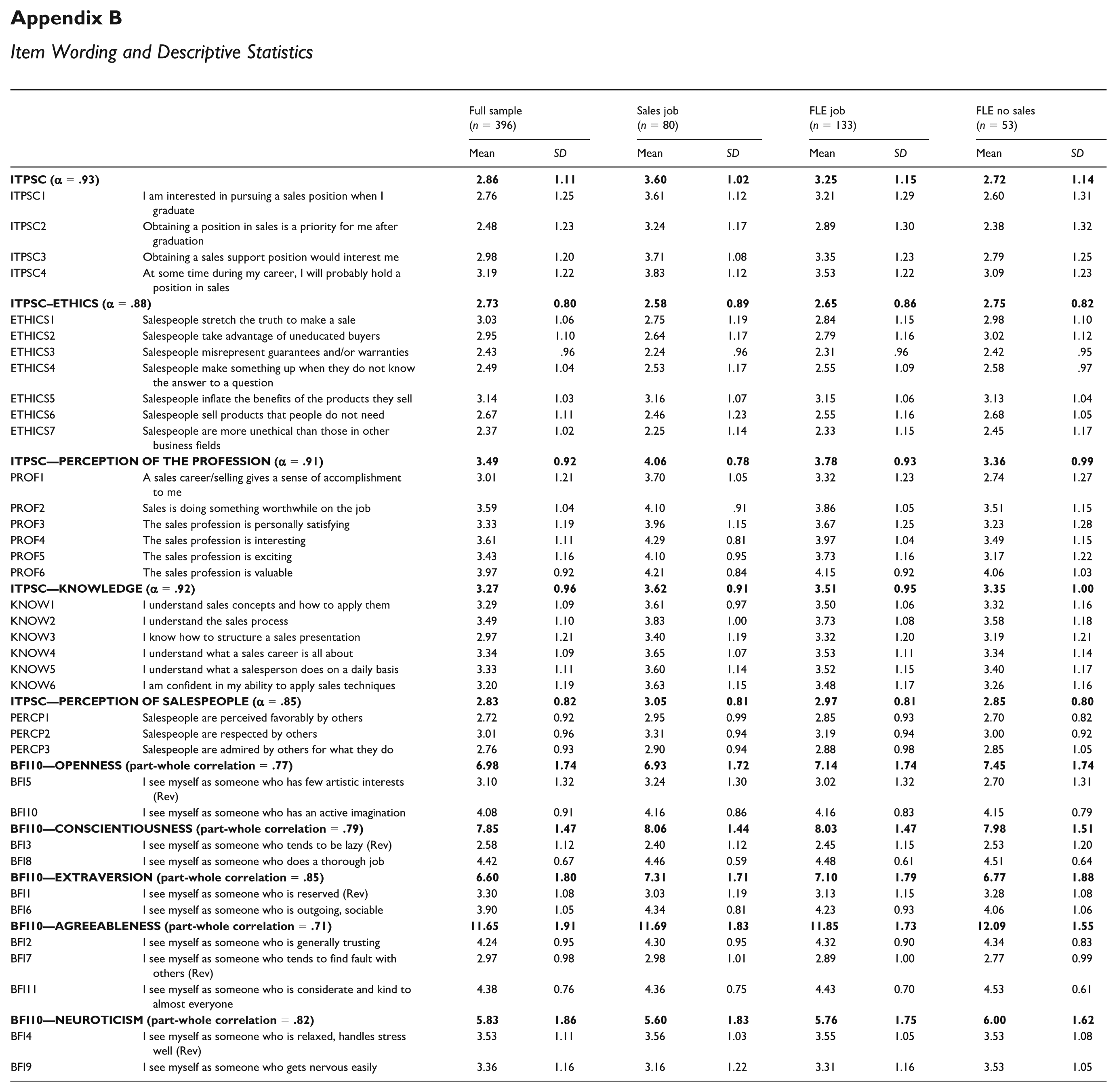
Initial data collection was conducted through the Introduction to Marketing classes in two consecutive semesters. At week 11 or 12 in the semester, the topic of sales is covered. Seven days after this lecture, students took the 22-item ITPSC instrument (Peltier et al., 2014) and the Big Five Inventory–10 or BFI-10 by Rammstedt and John (2007). Each statement asks respondents to indicate their level of agreement on a five-point Likert-type scale where higher scores denote higher levels of agreement. Basic demographic questions such as age, gender, and major were included. The exact wording for all items is included in Appendix B.
Sales Education
Students in the cohort sample were assessed for additional, non-mandatory sales education during their collegiate careers. Utilizing 5 years of sales course enrollment records, we determined for each student if they had completed a sales major, minor, certificate, or the advanced senior-level sales course across any major. Collectively, we refer to this as Taking a Sales Curriculum in our analysis, operationalized as a dichotomous variable. Everyone in the sample could elect to take a sales curriculum, with most not having declared a major at the time of initial sample collection. Capacity in the sales program was not a constraint, with all classes offered every semester and most in multiple parallel sections. In total, 12 to 13 sales sections were offered each semester during the years studied. The sales program is well supported by administration, with additional sections routinely added if demand warrants. Relatedly, there is no policy that offers preferential registration for majors or minors; thus, any student is able to select sales courses.
Results
A first observation is that students low in ITPSC are unlikely to engage in any sales curriculum during the remainder of their time in college. On average, of those with a score of less than 3 on the 5-point ITPSC measure, only 6% engage in a sales curriculum at any point in time. See Figure 3A and 3B. Conversely, students with ITPSC scores equal to or higher than 3 are 5.17 times more likely to take a sales curriculum than those with ITPSC scores below 3, F = 279.3, p < .001.
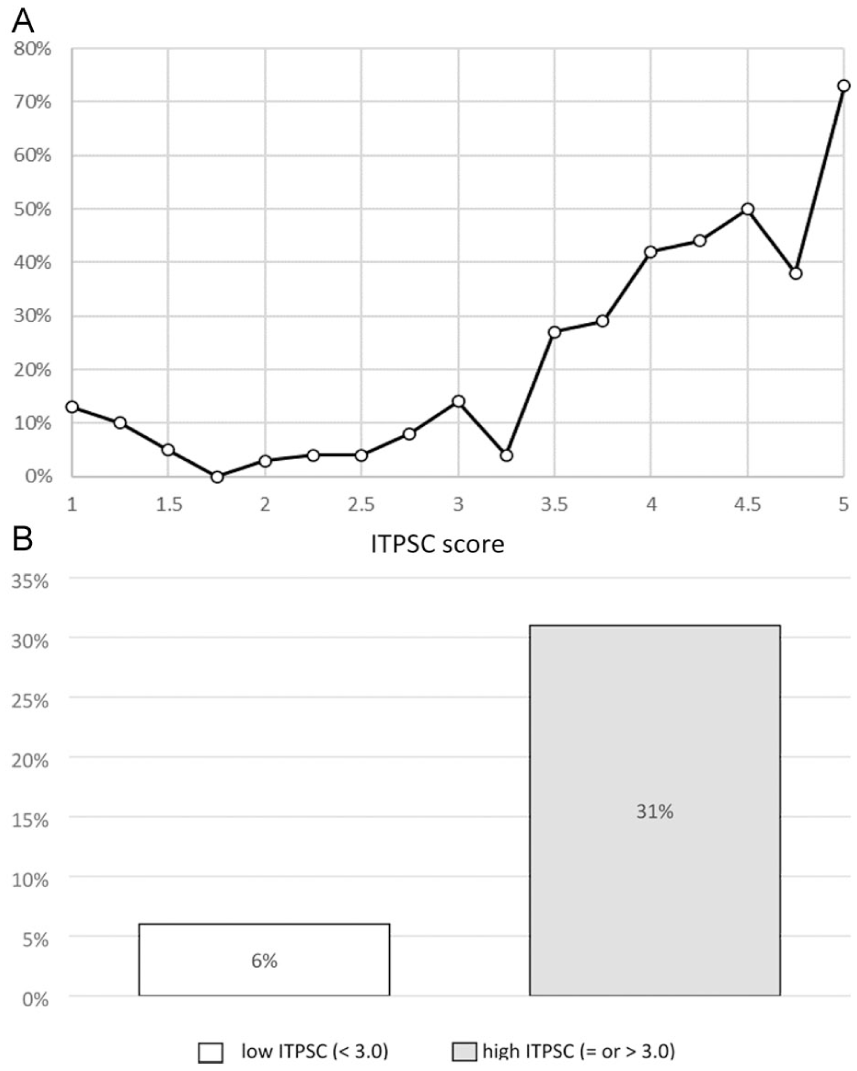
(A) Proportion of students taking a sales curriculum based on ITPSC scores. (B) Proportion of students taking a sales curriculum based on low/high ITPSC scores.
Further, group comparisons between those with high ITPSC scores and those with low scores show a clear effect on job choice, with those high in ITPSC being 3.7 times more likely to take a sales job (F = 181.9, p < .001) and 1.9 times more likely to find employment as a FLE (F = 6.74, p = .01). However, for frontline roles that do not involve selling, both high and low ITPSC groups are equally likely to select these positions (F = 2.54, p = .11). See Figure 4.
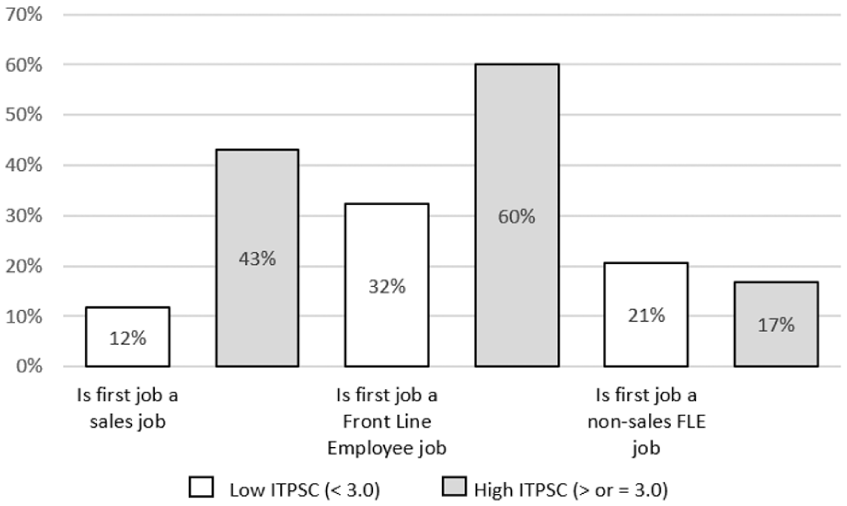
Proportion of students starting their career in sales, FLE, or non-sales FLE based on high/low ITPSC score.
Next, we ran three logistic regression models explaining whether the first job was a sales job, a FLE job, or a FLE job that is not in sales. The independent variables are ITPSC and whether students took a sales curriculum in college, while controlling for the Big Five personality factors and gender. Results indicate that ITPSC strongly predicts whether the student will take a sales job upon graduation (B = 0.78, p < .001). The odds ratio for ITPSC is 2.18, suggesting that each unit increase in ITPSC results in more than doubling the likelihood that someone will end up in a sales role upon graduation (see Table 1). Interestingly, taking a sales curriculum, when also considering the ITPSC scores, has no significant incremental effect on the likelihood of ending up in a sales job (B = 0.55, p = .13). Post hoc power analysis with α = .05 and given our sample and observed effect sizes was conducted with G*Power 3.1.9.7, indicating an achieved power (1 − β) of .89, well above the common cut-off of .80 (Faul et al., 2009).
Descriptive Statistics and Correlations.
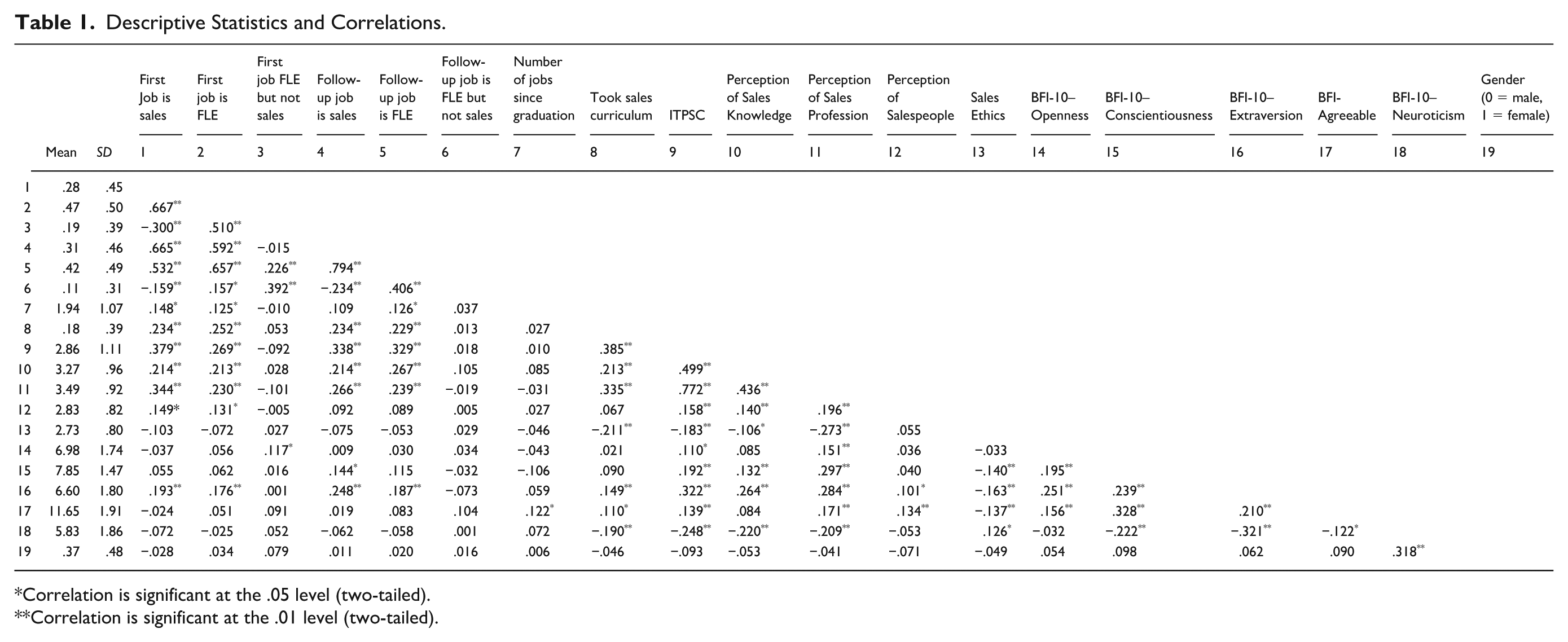
Correlation is significant at the .05 level (two-tailed).
Correlation is significant at the .01 level (two-tailed).
When using the same model for frontline roles that include sales roles, we see that ITPSC still has a significant positive impact on the likelihood of accepting a FLE role upon graduation (B = 0.38, p < .01), but that partaking in the sales curriculum also increases the likelihood of accepting a FLE role (B = 1.02, p < .01). Here, those who did take a sales curriculum at college were 2.77 times more likely to end up with an FLE role. Achieved power for this analysis was .98, again well above the recommended cut-off.
In our third model, we investigate the effect of ITPSC and Taking a Sales Curriculum on taking a FLE role that is not a sales role. As this job categorization excludes sales jobs, it is no surprise that higher ITPSC scores are negatively related to accepting a non-sales FLE role, B = −0.32, p = .04. As a whole, however, this third model is not significant (χ2(8) = 13.07, p = .11). This is also echoed by our post hoc power analysis that indicates the achieved power given our sample size and the small observed effect size was only 0.22, well below any commonly accepted threshold. Details of these logistic regression results are shown in Tables 2 and 3.
Logistic Regression Models—First Job Upon Graduation.
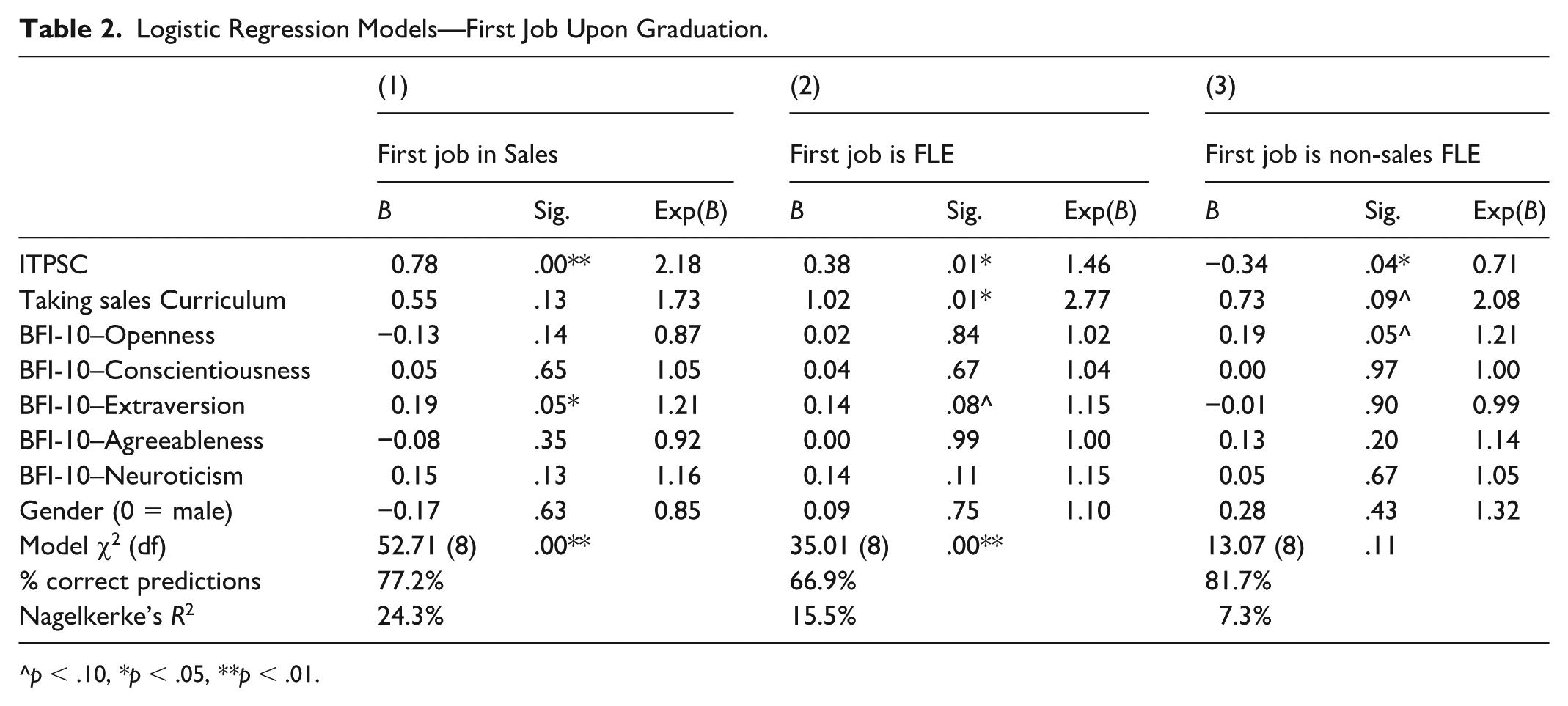
p < .10, *p < .05, **p < .01.
Logistic Regression Models—Follow-Up 2.9 Years After Graduation.
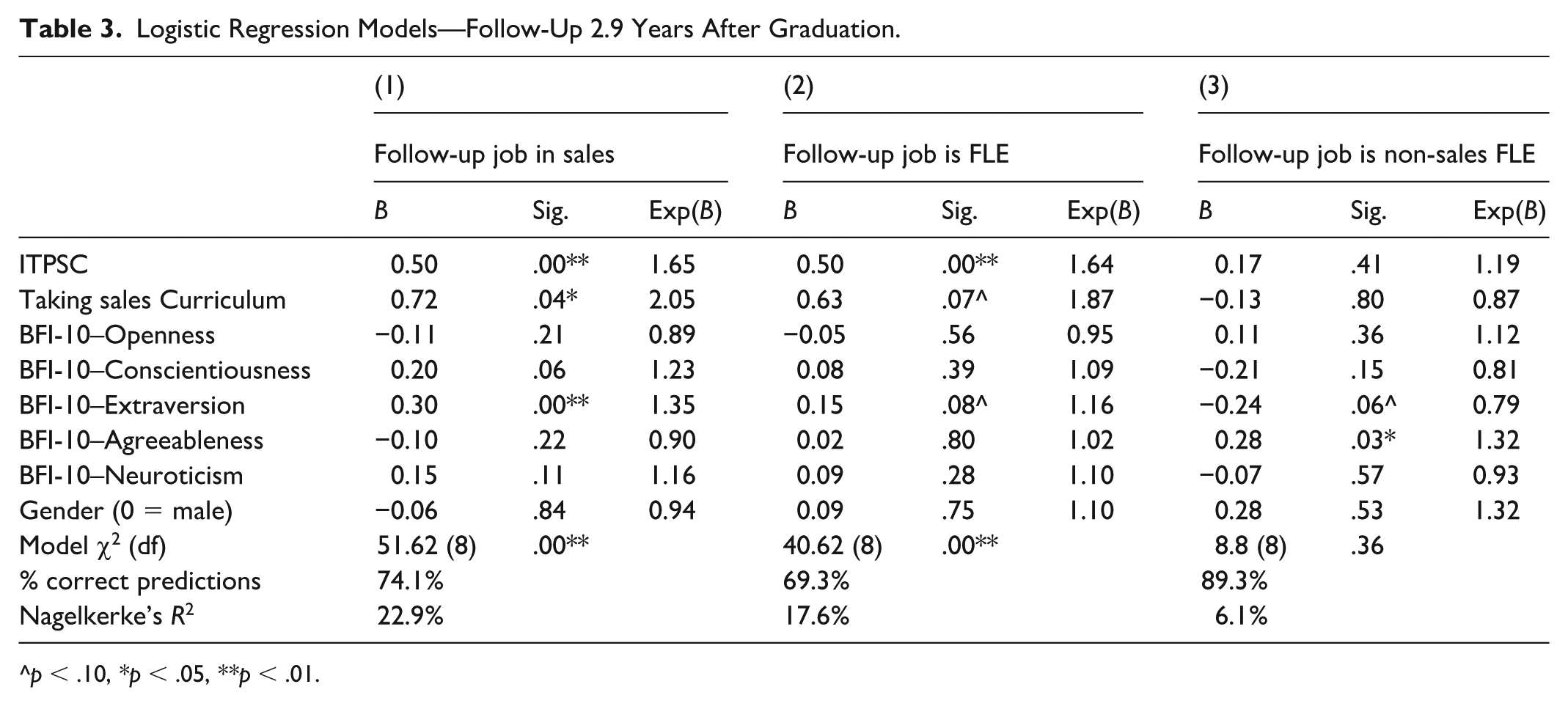
p < .10, *p < .05, **p < .01.
For the first two models reaching significance with adequate achieved power, we conducted mediation analyses using Hayes’ (2022) PROCESS macro (Model 4) in SPSS. The dichotomous dependent variables, first job in sales (SalesJob, n = 285) and first job as a FLE (FLEJob, n = 284), were each regressed on the continuously scaled ITPSC measure, with Taking a Sales Curriculum in college (SalesCur) entered as the mediator. Because both outcomes are binary, the Y-equation is estimated via logistic regression and all effects on Y are reported in log-odds units; the M-equation predicting SalesCur is estimated via OLS. Significance of indirect effects is assessed using percentile bootstrapping with 5,000 resamples, consistent with Hayes’ (2022) recommendation against Sobel-based inference. In both models, a likelihood ratio test confirmed that the effect of SalesCur on the outcome did not vary as a function of ITPSC (SalesJob: χ2(1) = 1.96, p = .161; FLEJob: χ2(1) = 1.23, p = .267), supporting the adequacy of the simple mediation specification in each case.
Across both models, ITPSC significantly predicted Taking a Sales Curriculum in college (SalesJob model: b = 0.146, SE = 0.020, t = 7.44, p < .001, R2 = .163; FLEJob model: b = 0.146, SE = 0.020, t = 7.40, p < .001, R2 = .163), confirming the a-path in each analysis.
In the SalesJob model, ITPSC exerted a significant direct effect on first job in sales (c’: b = 0.786, SE = 0.154, Z = 5.11, p < .001), while SalesCur did not significantly predict SalesJob once ITPSC was controlled (b = 0.430, SE = 0.351, Z = 1.22, p = .221). The bootstrapped indirect effect was small, and its 95% confidence interval included zero (ab = 0.063, BootSE = 0.055, 95%CI = [−0.049, 0.170]), indicating a non-significant indirect effect. We therefore conclude that Taking a Sales Curriculum does not mediate the effect of ITPSC on initial placement in a sales role.
In the FLEJob model, both ITPSC and SalesCur significantly predicted first job as a FLE (ITPSC direct effect c’: b = 0.388, SE = 0.124, Z = 3.13, p = .002; SalesCur: b = 0.934, SE = 0.349, Z = 2.68, p = .007). The bootstrapped indirect effect was significant, with a 95% confidence interval entirely above zero (ab = 0.136, BootSE = 0.055, 95% CI [0.036, 0.252]). Because the direct effect of ITPSC on FLEJob remains significant after the mediator is included, we conclude that Taking a Sales Curriculum partially mediates the effect of ITPSC on initial placement as a FLE.
A follow-up assessment conducted in the Spring of 2025, an average of 2.9 years after graduation and 5.1 years after ITPSC was first collected, showed that ITPSC remained a significant predictor of sales and frontline employment. Graduates with higher ITPSC scores were more likely to hold a sales role (B = 0.50, p < .001, odds ratio = 1.65) and more likely to be in any FLE role, including sales (B = 0.50, p < .001, odds ratio = 1.64). Taking a sales curriculum during college also predicted holding a sales position at follow-up (B = 0.72, p = .04, odds ratio = 2.05) and showed a marginal association with frontline roles (B = 0.63, p = .07, odds ratio = 1.87). No significant predictors emerged for non-sales FLE roles. In terms of career mobility, the average graduate, 2.9 years after graduating, was just about to start their second role (M = 1.94 roles). The number of distinct jobs since graduation did not differ significantly between high and low ITPSC groups (M = 1.96 vs. 1.93 roles, n.s., d = 0.03). However, despite not reaching significance at the p < .05 level, high ITPSC graduates reported modestly more internal promotions, defined as distinct roles within the same employer, than those low in ITPSC (M = 0.41 vs. 0.27, p < .10, d = 0.20).
In addition, when looking at the ITPSC scores across employment contexts, we find significant differences in two of three comparisons. Students who began their careers in a sales role scored meaningfully higher on ITPSC at graduation than those whose first job was not in sales (M = 3.60 vs. M = 2.66, F(1, 283) = 47.55, p < .001, η2 = .144), with the effect accounting for 14.4% of the variance in ITPSC scores. This pattern held at the Spring 2025 follow-up: respondents currently employed in sales continued to report higher ITPSC scores than those not in sales (M = 3.47 vs. M = 2.64, F(1, 288) = 37.24, p < .001, η2 = .115). However, among the subset of respondents who had started their career in sales (n = 76), those who exited the sales profession altogether scored lower on ITPSC than those who remained employed in a sales role (M = 3.29 vs. M = 3.63). However, as only 14 people in our sample started their career in sales and were no longer employed in sales by Spring 2025, this difference did not reach significance (F(1, 74) = 1.29, p = .260, η2 = .017).
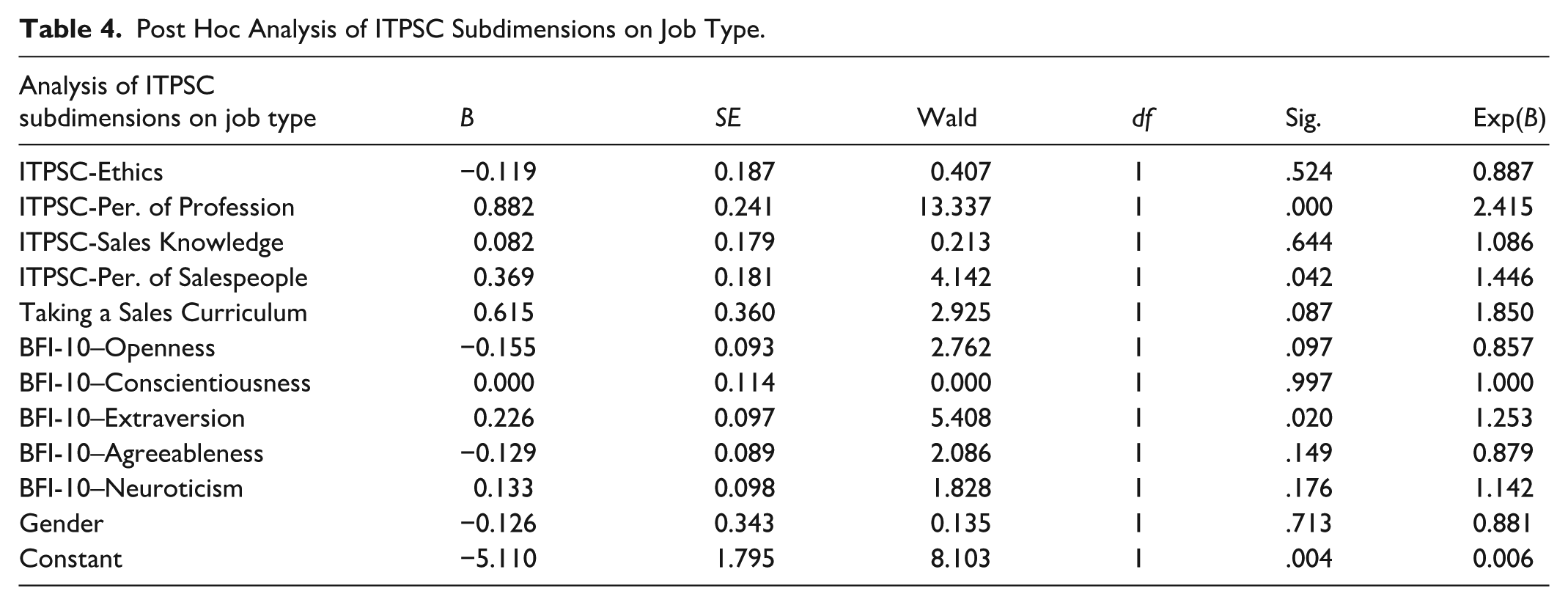
We conducted a post hoc analysis including the subdimensions of the ITPSC scale to investigate potential differential effects. The results presented in Table 4 show that the ethics and sales knowledge subscales are non-significant (Exp(B) = 0.887, p = .524 and Exp(B) = 1.086, p = .644) while perceptions of the profession (Exp(B) = 2.415, p < .001) and salespeople (Exp(B) = 1.446, p = .042) are significant drivers of sales role choice post-graduation. Individually, the perception of the profession subscale is stronger (Exp(B) = 2.415) than the ITPSC (Exp(B) = 2.18). This finding is in line with Beuk et al. (2023) and Peltier et al. (2014), which show that the perception of the sales profession is the strongest antecedent of the intent to pursue a sales career. No other work has attempted to ascertain if the behavioral attitudes toward selling would differentially impact different sales roles such as sales versus FLE. And despite the dominance of one ITPSC dimension, this work is the first to track participants into their careers to provide the crucial link between career intention and actual placement.
Post Hoc Analysis of ITPSC Subdimensions on Job Type.
Discussion, Implications, Conclusion and Limitations
Discussion
This paper uses repeated testing of the dependent variable (sales jobs post-graduation) instead of a single multinomial logit model. This is due to the failure of the third model to reach significance, as ITPSC is not a good predictor of non-sales-related FLE job choice. This is an important finding, as a portion of the sales literature (generally outside of the Journal of Personal Selling & Sales Management) refers to (strategic) FLEs as a catch-all for sales roles instead of delineating between sales roles (e.g., Plouffe et al., 2016; Vieira et al., 2021; Yoo & Arnold, 2019). Our paper shows that caution should be used if researchers treat FLE and sales roles as synonymous. In this study, because of Model 3’s non-significance, the risk of false positives is less of a concern. In addition, the sales jobs model (Model 1) is a subset of the FLE including sales (Model 2). By including all three models, we show that the ITPSC’s ability to explain FLE roles (including sales) is due to the reality that many frontline roles happen to be in sales, not because they are synonymous.
When testing for mediation of taking a sales curriculum, we find interesting results. First, taking a sales curriculum does not mediate the effect of ITPSC on a first job in sales, but it does partially mediate the effect of ITPSC on a first job as a FLE. Again, this is important as not all frontline roles are synonymous with sales roles.
Implications for the Literature
This study’s first-ever longitudinal sample shows that formal sales courses may not be the main factor associated with sales job selection. Instead, this study shows that initial expectations and perceptions—intent upon first exposure to collegiate sales education—are the factors most associated in this study with post-college sales employment. This finding calls into question much of the literature’s focus on creating educational interventions and attempting to grow the pool of students engaged in sales education. Essentially, business students’ sales career intentions may be formed before students have the option to specialize in a sales education tract, and these early intentions persist well into their early careers. This is not only true of selling roles but also of selling associated frontline roles. ITPSC is very predictive—both of those who will enroll in a sales curriculum and those who will select sales employment. Students with the highest ITPSC scores were 5.7 times more likely to follow a college sales curriculum (major, minor, certificate, or advanced senior-level sales course) than those with the lowest ITPSC scores, as measured when they took the second year (200-level) introduction to marketing course. Much of the literature has focused on how to interest students in sales courses and, thus, how best to expose these students to sales roles, professionals, and selling experiences. This paper shows that the ITPSC is predictive of continued sales education and maintains this predictive ability for initial graduate employment.
While this study does not explore the precursors of ITPSC scores among college students, it may be of interest for future marketing education researchers to seek to understand how opinions about sales form in students younger than this study’s sample. At what point are ITPSC scores stable and no longer malleable? While the marketing education literature has largely targeted interventions early in college (see Cummins et al., 2013, 2020, for reviews) to drive changes in the ITPSC, perhaps additional study of pre-college students (e.g., Inks & Avila, 2018) would help further elucidate when classroom-based interventions would be most effective.
Counter to the literature’s assumption is this paper’s finding that sales curricula do not impact sales employment for those already high in initial intent to pursue a sales career. These high ITPSC students are more likely to end up in a sales job after graduation, regardless of whether they take a sales curriculum. Despite enrollment at a school with a long-established sales center offering every possible option for sales enrollment (certificates, major, minor), 69% of students scoring high (above 3) on the ITPSC scale choose not to follow a sales curriculum. That is to say, only a third of students in the already small group inclined toward a sales role actually take sales classes. This finding should be viewed in relation to the overall rate of business students who end up in sales and office support roles post-college, which was found to be 31% in 2017 and 32% in 2011 (Carnevale et al., 2011, 2017). 2 Simply, a third of the entire business student population is employed in a sales/office support role after college, yet very few of these graduates choose to take sales classes regardless of initial interest. While sales-specific courses and programming have been a topic of interest for marketing education as of late, with two special issues dedicated to the topic at the Journal of Marketing Education since 2014, marketing education scholars have yet to answer the question of what drives collegiate sales training. The literature would benefit from researchers approaching this topic from a broader perspective of potential influencers. In addition, the outcome variables of sales training are often short-term, focused on student perception and willingness to pursue careers with firms involved in the classroom training studied (Beuk et al., 2023; Nielson & Cummins, 2019).
Researchers could look to expand the length of study windows and increase the variety of stakeholders represented. Do some industries or roles benefit more from students with sales training? Do students or managers perceive they are better prepared for certain job responsibilities (e.g., conflict resolution, requirements gathering, relationship building) because of collegiate sales training?
Another important finding of this paper is that not only do students’ interest in, knowledge of, and perception of sales and salespeople predict their employment in sales, but also their employment in frontline positions in general. However, when eliminating frontline sales positions from the analysis, the models lost significance. A broader implication is that researchers should be cautious in treating salespeople and FLEs as interchangeable. Finally, this research validates the ITPSC scale as an important tool in connecting students with sales education, extra-curricular activities, and employment that fit their needs and interests.
Implications for Marketing and Sales Education
This research invites several as of yet unanswered questions. In the following section, we detail questions raised by the study and offer avenues for future research in the field. This study’s findings demonstrate that even students who show intent and follow-through in finding sales employment post-graduation are not pursuing sales education in college. Understanding this choice is critical for marketing departments, sales educators, and sales organizations. Sales training upon hire has plummeted. A cross-industry survey of firms between 1996 and 1998 found training lasted 4.56 months on average (Krishnamoorthy et al., 2005). In 2001, average training duration was 3 months, and in 2011 it was 6 weeks (Futrell, 2020). Some inside salespeople receive only 2 days of training instead of the 2 weeks advised (Popp et al., 2017). An often-cited rationale is that new hires already understand the sales process, and time spent on industry and product knowledge is a priority. Research indicates that graduates of university sales programs are more productive and have lower turnover than standard company training (Bolander et al., 2014). Yet, despite a growth in such programs, they are not the norm. Researchers could address this gap by working to:
1. Understand why sales education is not pursued by those with high sales career intent and follow-through.
Some sales organizations have differential product training—longer training for those without technical backgrounds, for example. Do some companies similarly provide a fast-track training for those with prior work or collegiate sales education experience, and a longer sales process training for those with a desire to pursue sales, but without prior exposure? While expensive and cumbersome to integrate for sales organizations, differential and expanded training would show a recognition that most newly graduated sales hires (69% in this cohort) do not have collegiate sales training. Researchers could explore:
2. If differentiated training models exist; and if they prove worthwhile for new hires, sales teams, and customers when targeted to students who did not pursue collegiate sales education.
The question of the value of sales education is further illuminated by this study’s mediation models. While sales education is not shown to differentially impact ITPSC on a sales role post-college, it does impact this cohort’s choice of a FLE role. Simply, students higher on the ITPSC (3 or above) are more likely to choose a FLE role, and this relationship is mediated by the choice of taking a sales curriculum. Why do we find this difference? While it may be tempting to ask if sales education is valuable for students, when finding that only a minority (31%) pursue it despite ample offerings, sales courses appear to encourage students to consider FLE roles. This appearance offers another opportunity for further research by marketing scholars to explore:
3. If sales education encourages FLE role consideration and the mechanism by which this happens. Does sales course knowledge enhance FLE role appreciation and drive student self-discovery of communication skills, which in turn may cause students to be more receptive to FLE careers? Or is the pathway to FLE jobs something entirely different for students engaged in sales education?
This study’s results also invite speculation that the ITPSC scale may be helpful in predicting sales performance among active salespeople. We found some indication that this may indeed be the case. In our sample, only 14 students who started in sales after graduation had left the sales profession by the follow-up. Those with lower ITPSC scores were more likely to have left sales by the follow-up period, although given the small sample, this effect did not reach significance (F(1, 74) = 1.29, p = .26, η2 = .017). Similarly, researchers may want to assess success in these first sales roles and determine if the choice to pursue sales education in college impacts role performance to the degree some have claimed (Sales Education Foundation [SEF], 2023). Thus, future research should explore this directional finding to better understand whether ITPSC can also help predict early career persistence:
4. Is ITPSC predictive of early sales career persistence and success?
Over recent decades, colleges have increased their efforts to connect students with employers. Sales-specific career fairs, class talks, role-plays of lesser-known B2B companies, and job shadowing of sales-affiliated roles may help students understand the variety of sales roles available. In addition, interactions with salespeople have highlighted for students both desirable and less desirable realities of sales careers such as pressure, workload, work-life balance, and pay. Researchers could pursue studies that explore the outcomes of student awareness of sales roles from these experiential offerings. Specifically:
5. How does experiential sales education impact students’ enhanced role awareness?
6. How does experiential sales education impact students’ understanding of their own role aptitudes?
7. How does experiential sales education impact students’ preferences for employment?
The above discussion belies the authors’ own biases—that sales education is valuable for students. Yet, it is entirely possible that students who are high in ITPSC and go on to take sales roles are not differentially benefiting from the choice to pursue further sales education. They may have been on a path toward a career in sales regardless of their sales class enrollment during college.
8. Longitudinal studies like this one that can further validate the ITPSC scale in younger cohorts would offer further exploration of the impact of sales education in college on post-college career choice.
Understanding the benefit of organizational investment in university programming is critical to sales managers and recruitment budgets, and to the sales educators running these educational programs, whose long-term viability is tied to the value they provide.
Conclusion and Limitations
This paper is the first to show a direct link between the widely used intent to pursue a sales career scale (ITPSC) and actual employment in a sales role upon collegiate graduation. The results show that higher ITPSC scores measured early in students’ college careers are predictive of sales employment and frontline sales employment years later. Sales education during college was shown to partially mediate the relationship between intent to pursue and sales and frontline employment. For students who were employed in sales roles after college, ITPSC appeared to be the driver in this model—overpowering sales education, gender, and personality.
However, because this is a longitudinal observational study, omitted-variable bias cannot be ruled out. Students with stronger sales-related career intentions early on may also differ on unmeasured characteristics that influence both subsequent sales course enrollment and post-graduation employment. For example, prior work experience, family exposure to sales, financial pressure, or perceived labor-market opportunities may all factor in to predict who ends up in a sales career.
We mitigate this concern in three important ways. First, ITPSC was measured early in the students’ college careers, an average of 2.6 years before graduation, reducing the likelihood that post-graduation employment shaped the intent measure. Second, the analyses combine survey data with educational records and observed LinkedIn-based employment outcomes rather than relying solely on the same-source self-reports. Third, the models include theoretically relevant controls, including gender and Big Five personality traits. We also explored the effect of having a sales role model as a control variable, but found that it did not meaningfully improve our models.
The persistence of the ITPSC relationship at both first employment and the post-graduation follow-up suggests that the association is not limited to a single point in time. Still, because students were not randomly assigned to sales education or career pathways, the results should be interpreted as evidence of longitudinal predictive validity and theoretically consistent association, rather than as definitive causal evidence that high ITPSC or sales education independently causes sales employment.
Finally, the study is limited as it follows a COVID-19-impacted student cohort from a single university, and it cannot be ruled out that this impacted some of our findings.
Footnotes
Appendix
Item Wording and Descriptive Statistics
| Full sample |
Sales job |
FLE job |
FLE no sales |
||||||
|---|---|---|---|---|---|---|---|---|---|
| Mean | SD | Mean | SD | Mean | SD | Mean | SD | ||
|
|
|
|
|
|
|
|
|
|
|
| ITPSC1 | I am interested in pursuing a sales position when I graduate | 2.76 | 1.25 | 3.61 | 1.12 | 3.21 | 1.29 | 2.60 | 1.31 |
| ITPSC2 | Obtaining a position in sales is a priority for me after graduation | 2.48 | 1.23 | 3.24 | 1.17 | 2.89 | 1.30 | 2.38 | 1.32 |
| ITPSC3 | Obtaining a sales support position would interest me | 2.98 | 1.20 | 3.71 | 1.08 | 3.35 | 1.23 | 2.79 | 1.25 |
| ITPSC4 | At some time during my career, I will probably hold a position in sales | 3.19 | 1.22 | 3.83 | 1.12 | 3.53 | 1.22 | 3.09 | 1.23 |
|
|
|
|
|
|
|
|
|
|
|
| ETHICS1 | Salespeople stretch the truth to make a sale | 3.03 | 1.06 | 2.75 | 1.19 | 2.84 | 1.15 | 2.98 | 1.10 |
| ETHICS2 | Salespeople take advantage of uneducated buyers | 2.95 | 1.10 | 2.64 | 1.17 | 2.79 | 1.16 | 3.02 | 1.12 |
| ETHICS3 | Salespeople misrepresent guarantees and/or warranties | 2.43 | .96 | 2.24 | .96 | 2.31 | .96 | 2.42 | .95 |
| ETHICS4 | Salespeople make something up when they do not know the answer to a question | 2.49 | 1.04 | 2.53 | 1.17 | 2.55 | 1.09 | 2.58 | .97 |
| ETHICS5 | Salespeople inflate the benefits of the products they sell | 3.14 | 1.03 | 3.16 | 1.07 | 3.15 | 1.06 | 3.13 | 1.04 |
| ETHICS6 | Salespeople sell products that people do not need | 2.67 | 1.11 | 2.46 | 1.23 | 2.55 | 1.16 | 2.68 | 1.05 |
| ETHICS7 | Salespeople are more unethical than those in other business fields | 2.37 | 1.02 | 2.25 | 1.14 | 2.33 | 1.15 | 2.45 | 1.17 |
|
|
|
|
|
|
|
|
|
|
|
| PROF1 | A sales career/selling gives a sense of accomplishment to me | 3.01 | 1.21 | 3.70 | 1.05 | 3.32 | 1.23 | 2.74 | 1.27 |
| PROF2 | Sales is doing something worthwhile on the job | 3.59 | 1.04 | 4.10 | .91 | 3.86 | 1.05 | 3.51 | 1.15 |
| PROF3 | The sales profession is personally satisfying | 3.33 | 1.19 | 3.96 | 1.15 | 3.67 | 1.25 | 3.23 | 1.28 |
| PROF4 | The sales profession is interesting | 3.61 | 1.11 | 4.29 | 0.81 | 3.97 | 1.04 | 3.49 | 1.15 |
| PROF5 | The sales profession is exciting | 3.43 | 1.16 | 4.10 | 0.95 | 3.73 | 1.16 | 3.17 | 1.22 |
| PROF6 | The sales profession is valuable | 3.97 | 0.92 | 4.21 | 0.84 | 4.15 | 0.92 | 4.06 | 1.03 |
|
|
|
|
|
|
|
|
|
|
|
| KNOW1 | I understand sales concepts and how to apply them | 3.29 | 1.09 | 3.61 | 0.97 | 3.50 | 1.06 | 3.32 | 1.16 |
| KNOW2 | I understand the sales process | 3.49 | 1.10 | 3.83 | 1.00 | 3.73 | 1.08 | 3.58 | 1.18 |
| KNOW3 | I know how to structure a sales presentation | 2.97 | 1.21 | 3.40 | 1.19 | 3.32 | 1.20 | 3.19 | 1.21 |
| KNOW4 | I understand what a sales career is all about | 3.34 | 1.09 | 3.65 | 1.07 | 3.53 | 1.11 | 3.34 | 1.14 |
| KNOW5 | I understand what a salesperson does on a daily basis | 3.33 | 1.11 | 3.60 | 1.14 | 3.52 | 1.15 | 3.40 | 1.17 |
| KNOW6 | I am confident in my ability to apply sales techniques | 3.20 | 1.19 | 3.63 | 1.15 | 3.48 | 1.17 | 3.26 | 1.16 |
|
|
|
|
|
|
|
|
|
|
|
| PERCP1 | Salespeople are perceived favorably by others | 2.72 | 0.92 | 2.95 | 0.99 | 2.85 | 0.93 | 2.70 | 0.82 |
| PERCP2 | Salespeople are respected by others | 3.01 | 0.96 | 3.31 | 0.94 | 3.19 | 0.94 | 3.00 | 0.92 |
| PERCP3 | Salespeople are admired by others for what they do | 2.76 | 0.93 | 2.90 | 0.94 | 2.88 | 0.98 | 2.85 | 1.05 |
|
|
|
|
|
|
|
|
|
|
|
| BFI5 | I see myself as someone who has few artistic interests (Rev) | 3.10 | 1.32 | 3.24 | 1.30 | 3.02 | 1.32 | 2.70 | 1.31 |
| BFI10 | I see myself as someone who has an active imagination | 4.08 | 0.91 | 4.16 | 0.86 | 4.16 | 0.83 | 4.15 | 0.79 |
|
|
|
|
|
|
|
|
|
|
|
| BFI3 | I see myself as someone who tends to be lazy (Rev) | 2.58 | 1.12 | 2.40 | 1.12 | 2.45 | 1.15 | 2.53 | 1.20 |
| BFI8 | I see myself as someone who does a thorough job | 4.42 | 0.67 | 4.46 | 0.59 | 4.48 | 0.61 | 4.51 | 0.64 |
|
|
|
|
|
|
|
|
|
|
|
| BFI1 | I see myself as someone who is reserved (Rev) | 3.30 | 1.08 | 3.03 | 1.19 | 3.13 | 1.15 | 3.28 | 1.08 |
| BFI6 | I see myself as someone who is outgoing, sociable | 3.90 | 1.05 | 4.34 | 0.81 | 4.23 | 0.93 | 4.06 | 1.06 |
|
|
|
|
|
|
|
|
|
|
|
| BFI2 | I see myself as someone who is generally trusting | 4.24 | 0.95 | 4.30 | 0.95 | 4.32 | 0.90 | 4.34 | 0.83 |
| BFI7 | I see myself as someone who tends to find fault with others (Rev) | 2.97 | 0.98 | 2.98 | 1.01 | 2.89 | 1.00 | 2.77 | 0.99 |
| BFI11 | I see myself as someone who is considerate and kind to almost everyone | 4.38 | 0.76 | 4.36 | 0.75 | 4.43 | 0.70 | 4.53 | 0.61 |
|
|
|
|
|
|
|
|
|
|
|
| BFI4 | I see myself as someone who is relaxed, handles stress well (Rev) | 3.53 | 1.11 | 3.56 | 1.03 | 3.55 | 1.05 | 3.53 | 1.08 |
| BFI9 | I see myself as someone who gets nervous easily | 3.36 | 1.16 | 3.16 | 1.22 | 3.31 | 1.16 | 3.53 | 1.05 |

Funding
The authors received no financial support for the research, authorship, and/or publication of this article.
Declaration of Conflicting Interests
The authors declared no potential conflicts of interest with respect to the research, authorship, and/or publication of this article.