






Abstract
Although work-related duties are performed via teleworking in all sectors, the U.S. federal government has taken the lead in offering telework arrangements to its employees; thereby causing a proliferation of the number of employees in the federal government who telework. In spite of this occurrence, public organization research has largely ignored the effect of teleworking on government employees. As a result, the goal of this article is to examine the association between several teleworking arrangements and work motivation in a federal government agency—a test of social exchange theory. After controlling for organizational, job, and individual characteristics, as well as mission attainment, the empirical analysis revealed that teleworkers (frequent and infrequent) did not consistently have higher levels of work motivation than nonteleworkers, providing only partial support for social exchange theory. The implications of these findings are thoroughly discussed in the article.
Within the past two decades, many employees have been given the opportunity to perform some or all of their duties at home or at an alternative location. This flexible work arrangement, which is referred to as teleworking, is gaining popularity because of its presumed benefits to organizations in the way of increased performance, greater ability to attract and recruit the best and the brightest, and higher retention (Durst, 1999). Although work-related duties are performed via teleworking in all sectors, the U.S. federal government has taken the lead in offering this type of arrangement to its employees (Facer & Wadsworth, 2008). For instance, presidential directives have been issued and legislation has been passed mandating the presence of telework in government agencies; budgetary threats have been used as a means to force agencies to offer this program to eligible employees, and pilot programs have been instituted to determine the efficacy of this arrangement (Green & Roberts, 2010). As a result of these efforts, since the 1990s the federal government has seen a dramatic increase in the number (as well as the percentages) of government employees who have participated in this arrangement.
Despite the proliferation of employees’ teleworking in public agencies, public organization research has largely ignored this flexible work arrangement. This article, therefore, seeks to draw attention to the field of telework by examining it in the U.S. federal government. In so doing, this article extends public organization literature by exploring the nexus between the various teleworking arrangements and work motivation, therein testing the venerable social exchange theory that presumes teleworkers are more motivated than nonteleworkers. Furthermore, examining this connection is important because this flexible work arrangement was implemented, to some extent, to increase the work motivation of government employees (U.S. General Accounting Office, 2003); additionally, no studies were found that examined this effect in U.S. government agencies.
This article examines the association between telework and work motivation using the following structure. First is a detailed description of telework and its purported benefits. Second, hypotheses are formulated from work motivation and social exchange theory. Third, the methods section explains the items from the Office of Personnel Management’s Federal Employee View Point Survey (FedView) that was used to measure the hypothesized variables. The fourth part of the article explains the results of the model followed by a discussion of the findings. Last are the limitations of the research design, directions for future research, and the conclusion.
Telework
Telework, alternatively called telecommuting, is a flexible work arrangement that affords employees the ability to “periodically, regularly, or exclusively perform work for their employers from home or another remote location that is equipped with the appropriate computer based technology to transfer work to the central organization” (Hunton & Norman, 2010, p. 67). Although telecommuting is commonly thought to have first began in the 1970s as a result of the oil crisis (Bailey & Kurland, 2002), this practice did not become popular until the early 1990s, after which the percentage of teleworking employees proliferated. According to the U.S. Department of Transportation (2006), for example, the number of U.S. workers who telecommuted increased by more than 200% from 1992 to 2002. The Department of Transportation also indicated that the average number of days per workweek spent telecommuting increased during the same period from 1 to 2 days to 3 to 4 days.
Regarding sectors, employees from the private, nonprofit, and public sectors routinely perform their tasks away from their employer. In the federal government, Congress has robustly supported telecommuting as a part of its human capital initiative by first passing legislation in 1990 that was designed to give agencies the tools they needed to implement telecommuting, including the funds to construct telework centers, and by giving two federal agencies—the General Services Administration and the Office of Personnel Management—the lead role in implementation. Congress also passed Public Law 106-356 in 2000 mandating that, to the extent possible, all eligible employees be allowed to telework at least one day a week (Major, Verive, & Joice, 2008). To gauge the effectiveness of this legislation, the Office of Personnel Management even began asking federal government employees questions pertaining to the availability and satisfaction of telework in its Federal Human Capital Survey (FHCS) and FedView.
Why did Congress pass this telecommuting legislation as a part of its human capital initiative? The most obvious explanation is that Congress saw telework as a tool that could benefit employees, agencies, and society (U.S. General Accounting Office, 2003). In terms of employee-related benefits, teleworking lowers the transportation cost (and parking costs) associated with driving to and from the traditional office. Telecommuting has also been lauded as a way for workers to balance the demands of work and family (e.g., Maruyama, Hopkinson, & James, 2009). For instance, telecommuters are able to devote more time to their families because they spend fewer hours each week commuting and because they are often able to work from home, allowing them to work on their own time. In a survey involving 863 teleworkers in the federal government, Major et al. (2008) even found that the dependents of teleworkers benefited from telework. For example, the surveyed employees reported that telecommuting improved the health of their children because they had enough time to cook healthier meals, attend to their children when they were sick, and nurse their infants as needed.
Another employee-related benefit of teleworking is that it aids compliance with the Americans with Disabilities Act, offering “the possibility of an accessible, barrier-free workplace, flexible scheduling, and the elimination of disability-related bias or discrimination” (West & Anderson, 2005, p. 117). Furthermore, as many severely disabled employees are qualified but are unable to get to work, this benefit allows the skills and abilities of these employees to be fully utilized through teleworking arrangements (Mello, 2007), reducing the likelihood that organizations will not hire them.
In terms of organizational benefits, teleworking can increase employee performance and the organization’s bottom line. Major et al. (2008) indicated that 60% of teleworkers stated that their job performance improved as a result of this flexible arrangement. The content analysis of this qualitative study revealed that performance increased because teleworkers felt more motivated, had fewer interruptions than they did at the office, and had less anxiety about the care of their dependents. Moreover, Martinez et al. (2007) surveyed 156 Spanish firms and found that telework had a positive impact on both financial performance and strategic flexibility.
An additional organizational benefit of telecommuting is that it can decrease agency expenses (Bailey & Kurland, 2002). A study that took place over a decade concluded that telecommuting reduced the cost of facilities by 35%, turnover by 20%, and training costs by 25% (Major et al., 2008). Another even found that it reduced corporate travelling costs (Andrew, 2004).
Last, telcommuting can benefit society. The U.S. Department of Transportation (2006) noted that teleworking can reduce energy consumption (e.g., oil and electricity), air pollution, traffic accidents, and the maintenance of such infrastructure as roads, bridges, and buildings. Obviously, a reduction in each area would mean a net savings for government as well as citizens. Given that teleworkers often work from home, another societal benefit is that government can continue to function in the event of a natural or a man-made disaster (Mello, 2007). This means citizens can continue to receive some services, such as having claims processed, when catastrophes preclude government employees from driving to their agencies.
With that background on telework, the discussion now turns to the hypotheses that were formulated from work motivation and social exchange research.
Formulation of Hypotheses
Work Motivation
The concept of work motivation refers to external and intrinsic factors that drive employees to work harder by affecting the “direction,” “intensity,” and “duration” of their job-related activities (Locke & Latham, 2004, p. 388). As the productivity of employees is important to agencies, scholars have spent a considerable amount of time studying and explaining this concept beginning with the Hawthorne studies in the 1930s that first explored components of work motivation (Roethlisberger & Dickson, 1939). Although there are many factors related to work motivation, the focus of this article is on job satisfaction, organizational commitment, and job involvement.
Job satisfaction, referring “to how content an individual is with his or her job” (West & Berman 2009, p. 329), is an often-studied factor in organizational research. When conceptualizing work motivation, some scholars do not include job satisfaction. Others argue for the inclusion of job satisfaction because of its effect on turnover and absenteeism as well as its connection to other motivational factors (Locke & Latham, 2004; Moynihan & Pandey, 2007). This article espouses the latter view and job satisfaction is included under the broad concept of motivation.
The next work motivation factor is organizational commitment, which is manifested when employees embrace the agency’s goals and values, are willing to give the organization an enormous effort, and have a desire to remain with the organization (Steers, 1977). Another way workers demonstrate organizational commitment is through their loyalty and the bond they develop with their employing agency (Bozeman & Perrewe, 2001). From the organization’s perspective, organizational commitment is highly desirable because it increases employee retention, thereby reducing costs associated with turnover.
Finally, job involvement can be characterized as an employee’s psychological identification to his or her job as well as the extent to which the job is central to the employee’s identity (Lawler & Hall, 1970). Another definition is that it is the “degree to which a person’s work performance affects his self-esteem” (Lodahl & Kejner, 1965, p. 25). In other words, work is very important to a person who has high levels of job involvement.
As is the case with many of the work motivation factors, job satisfaction, organizational commitment, and job involvement interact with each other. In Locke and Latham’s (2004) integrated model of work motivation, for instance, job satisfaction enhances both organizational commitment and job involvement. However, these factors are kept separate in this article for theoretical reasons and because they are different constructs that can be clearly distinguished from one another (e.g., Moynihan & Pandey, 2007).
Teleworking and Work Motivation Hypotheses
In the public sector, two competing and sometimes concomitant theories have been put forth to explain factors related to public employees’ work motivation. The first assumes managing in the private sector is different than it is in the public sector in that government workers respond differently to motivation factors. Proponents of this theory argue that public workers have higher levels of public service motivation; that is, government workers are imbued with altruistic motives and a desire to serve society (e.g., Caillier, 2010; Perry & Wise, 1990; Rainey & Steinbauer, 1999; Scott & Pandey, 2005) and as such, are motivated more by intrinsic factors than extrinsic factors (Moon, 2000). For instance, government workers could earn more money in the private sector but still remain (Perry & Wise, 1990), suggesting something other than money is a motivator. As a further indication of government workers’ desire to serve society, proponents of public service motivation point to differences between employees in the two sectors documented outside the workplace—that is, public servants were more likely to donate blood and volunteer for charitable causes than were for-profit employees (Houston 2006).
More central to the research focus, the alternative social exchange theory states that individuals are morally obligated to reciprocate after they are treated favorably and that the repayment of these benefits (the reciprocation) strengthens the bond in the interpersonal relationship (Eisenberger, Armeli, Rexwinkel, Lynch, & Rhoades, 2001; Eisenberger, Fasolo, & Davis-LaMastro, 1990). Thus social exchange theory, which is also rooted in public choice theory (Anderfuhren-Biget, Varone, Giauque, & Ritz, 2010) and the norm of reciprocity (Gouldner, 1960), is often used to explain psychological attachments and interactions that occur in society, including those between married couples (e.g., Nakonezny & Denton, 2008) and between patients and health care providers (e.g., Hamrin, McCarthy, & Tyson, 2010).
In government agencies, this theory has also been used to explain the employee–employer relationship (Anderfuhren-Biget et al., 2010; Gould-Williams, 2007; Haar, 2006; Noblet & Rodwell, 2009). That is, social exchanges are favorable actions “initiated by an organization’s treatment of its employees, with the expectation that such treatment will be eventually reciprocated” (Gould-Williams & Davies, 2005, p. 3). Furthermore, to trigger the social exchange, the action must be voluntary, solely up to the discretion of the manager and organization (Blau, 1964). Therefore, according to this theory, government workers are egoistic and, when given voluntary acts of goodwill by managers and organizations, are appreciative and feel obligated to reciprocate in ways important to the organization, such as elevated work motivation (Anderfuhren-Biget et al., 2010). Some voluntary acts of goodwill in the workplace that have been found to compel employees to action are categorized as fair rewards, human resource practices, and involvement in decision making (Anderfuhren-Biget et al., 2010; Gould-Williams & Davies, 2007; Haar, 2006; Noblet & Rodwell, 2009).
On this foundation, proponents of this theory, unlike proponents of public service motivation, believe management of government workers is similar to their private sector counterparts in that employees in both types of organizations respond to extrinsic human resource and management motivators. When considering both theories, empirical support in general, is found for social exchange theory as well as public service motivation (e.g., Moon, 2000 and Moynihan and Pandey, 2007 found factors from both theories to be motivators), suggesting public employees are both egoistic and altruistic.
Although seldom examined in public organizations (e.g., Harrick, Vanek, & Michlitsch, 1986; Facer & Wadsworth, 2008; Wadsworth, Facer, & Arbon, 2010), flexible work arrangements are another kind of voluntary action that can compel employees to reciprocate (Martinez-Sanchez, Perez-Perez, de-Luis-Carnicer, & Vela-Jimenez, 2007), because it is discretionary and affords employees with something they strongly desire—a greater ability to balance work and life (Bailey & Kurland, 2002). Thus, the argument is that employees feel indebted to the organization when managers allow them to perform some or all of their work by telecommuting and as a result the relationship between the employer and employee is strengthened, providing a situation where employees feel they are obligated to pay the organization back in the way of elevating their work motivation. Therefore, the following hypothesis is then proposed,
Hypothesis 1: Teleworkers in each arrangement will report higher levels of work motivation (job satisfaction, organizational commitment, and job involvement) than will nonteleworkers.
As the teleworking arrangement is discretionary and based on individual negotiations between the employer and employee, some employees will inevitably be afforded more opportunities to telework in their workweek than others. This greater opportunity may be due to managerial philosophy as well as employee performance, expertise, negotiation skills, and home situation. Consequently, some employees will telework frequently, whereas others infrequently. For instance, the amount of time employees’ telecommute varies (U.S. Department of Transportation, 2006), with most only utilizing this flexible arrangement a few days a month (e.g., Eisenberger et al., 2001). Thus, those who telework a few days a month—infrequent teleworkers—are given a lesser benefit than those who telework frequently. According to social exchange theory, this would mean frequent teleworkers would have higher levels of work motivation than infrequent teleworkers, as the theory also states that the level of reciprocity will increase as the level of benefit increases (e.g., Eisenberger et al., 2001). Therefore, the following hypothesis is proposed:
Hypothesis 2: Frequent teleworkers will report higher levels of work motivation (job satisfaction, organizational commitment, and job involvement) than infrequent teleworkers.
Method
Survey Administration and Sample
Survey data from the 2010 FedView, previously the Federal Human Capital Survey, were used to test the hypotheses. The 2010 FedView was administered by the Office of Personnel Management to permanent federal employees in large and small independent agencies, comprising 97% of the entire executive branch workforce. Of the 504,609 surveys that were sent to full-time federal government employees, 263,475 were returned for a response rate of 52%. 1 A comparison of respondent characteristics and the Office of Personnel Management’s workforce characteristics for 2006 (the most recent) reveal that the percentage of women and minorities in the survey were 3.1 and 5 points higher, respectively, than what was reported by the Office of Personnel Management (U.S. Office of Personnel Management, 2006). Therefore the respondent characteristics in the sample are slightly different and could be due to survey administration, response bias, or hiring practices and demand for government jobs since 2006. Regarding recruitment and demand, it is important to mention that the gender and minority percentages remained relatively stable from 2002 to 2006.
This particular survey was ideal for this study because it clearly distinguished teleworkers from nonteleworkers. However, only data from the Department of Health and Human Services (DHHS) was included in the research model. This department was chosen because (a) it is large, (b) it has a large percentage of employees who are eligible for telework (98%) compared to other agencies, (c) it has steadily increased its percentage of teleworkers in comparison to other federal agencies (U.S. Office of Personnel Management, 2009), and (d) comparisons can be made within one agency, thereby controlling for agency functions, culture, and size.
Furthermore, examining telework in the U.S. federal government was important because the federal government has been using this flexible work arrangement as a way, in part, to elevate the work motivation of civil service employees (U.S. General Accounting Office, 2003). An empirical analysis of the survey data was therefore needed to determine if this increase in work motivation actually occurred. Following is a discussion of the survey items that were used to measure the independent and dependent variables. See the appendix for a more detailed description of the items and their coding mechanisms.
Dependent Variables
Several dependent variables pertaining to work motivation were included in the models. The first measure for work motivation is job satisfaction. Similar to other research (e.g., Rubin, 2009), a single item was used to measure job satisfaction. The item was “Considering everything, how satisfied are you with your job?”
The next variable is organizational commitment, and this article utilized a normative commitment scale that was similar to the one identified by Lee and Whitford (2008). Specifically, the scale included the following items: “I recommend my organization as a good place to work”; “I have a high level of respect for my organization’s senior leaders”; and, “in my organization, leaders generate high levels of motivation and commitment in the workforce.” The reported scores were averaged for the items, and the Cronbach’s alpha for the scale was .87. A caveat to this scale is that it does not precisely measure normative commitment. This is usually the case when government administered surveys that were designed for human capital purposes are then used by researchers to test theories. However, this scale is a reasonable measure of normative organizational commitment.
The last dependent variable is job involvement. As mentioned, job involvement refers to the extent to which the job is central to the employee’s identity (Lawler & Hall, 1970). The items that best represented this definition in the FedView survey were, “My work gives me a feeling of personal accomplishment” and “I like the kind of work I do.” The scores for the scale were averaged, and the Cronbach’s alpha for the scale was .79. Similar to commitment, a caveat is that this scale does not precisely measure involvement.
As mentioned, research indicates that there is an interaction between job involvement, job satisfaction, and organizational commitment. To determine the extent to which these factors were distinct and could be modeled separately, a factor analysis and Varimax rotation were conducted on each individual item. The result of the analysis demonstrated that the items representing job involvement and organizational commitment loaded on different components, suggesting they are distinct. Job satisfaction, however, partially loaded on both components but with much lower scores (in the .5 range as opposed to .7 and .8 for the other items in their respective component). This therefore suggests job satisfaction is a separate factor.
Several factors are presumed to be associated with work motivation, and these variables can be subdivided into the following categories: human resource management (HRM) and organizational characteristics, job characteristics, mission attainment, and individual characteristics.
HRM and Organizational Characteristics
Several HRM and organizational characteristics were included in the model, and each of these variables represents a social exchange. That is, these variables are voluntary actions undertaken by managers and HRM personnel to compel employees to reciprocate. The main variable in the model representing a social exchange is whether or not an employee telecommutes, and it was taken from the following item in the 2010 FedView survey: “Please select the response below that BEST describes your teleworking situation.” Moreover, the response categories to this item were “I telework on a regular basis,” “I telework infrequently,” “I do not telework because I have to be physically present,” “I do not telework because I have technical issues,” “I do not telework because I am not allowed to,” and “I do not telework because I choose not to.” As each of these arrangements is distinct (i.e., frequent teleworkers are different than infrequent teleworkers as the latter telecommutes less than one day a week), the variable was coded nominally in each model so that the likelihood of each response category was compared to either frequent or infrequent teleworking. For instance, frequent teleworkers were the reference category in the first model (Table 1) and the other responses were compared to it. In the second model (Table 2), infrequent teleworkers were the reference category and, therefore compared to the other nonteleworking categories. Moreover, frequent teleworkers were not compared to infrequent teleworkers in Table 2 because this examination was done in Table 1.
Results of Generalized Linear Model on Work Motivation (Job Satisfaction, Organizational Commitment, and Job Involvement)

Reference category is frequent telework.
p < .05. **p < .01. ***p < .001.
Results of Generalized Linear Model on Work Motivation (Job Satisfaction, Organizational Commitment, and Job Involvement)

Notes: Reference category is infrequent telework.
p < .05. **p < .01. ***p < .001.
There are other HRM and organizational variables that were included that represent a social exchange. First is the level of empowerment employees have in performing their duties; and Gould-Williams and Davies (2005) found that empowerment was positively associated with employee motivation to work. The next social exchange factor found to be associated with work motivation and included in the model, was the extent to which management encourages team work (Gould-Williams & Davies, 2005). The last social exchange factor measures the level of support regarding job-related tasks workers receive from their managers. This variable was also linked to work motivation (Gould-Williams & Davies, 2005).
Job Characteristics
The next category represents job characteristics. This category consists of role ambiguity, which occurs when employees’ duties are unclear; and the items that were used to measure this characteristic were “I have enough information to do my job well” (Reversed) and “I know what is expected of me on the job” (Reversed). The Cronbach’s alpha was .74. This scale for role ambiguity is similar to the one that was developed by Rizzo, House, and Lirtzman (1970), and it was included because Moynihan and Pandey (2007) found it to be significant in explaining the job satisfaction and commitment levels of employees. The next job characteristic variable is employee perceptions regarding their workload, and the item was “my workload is reasonable.” Perceived workload was included because overworked employees have low levels of motivation (e.g., Cole, Panchanadeswaran, & Daining, 2004). Last is the extent to which employees are satisfied with their pay, which has been shown to affect work motivation (e.g., West & Berman, 2009).
Mission Attainment
An intrinsic variable that was included in the model is the extent to which employees perceive the organization is accomplishing its mission (referred to here as mission attainment). Although public service motivation is not measured directly in the model (others such as Moon, 2000 examined public service motivation indirectly) mission attainment captures a component of public service motivation—that is, rational motives. For instance, government workers are motivated to perform work that benefits society, which is the mission of some government agencies (Perry & Wise, 1990). As a result, workers—those with high public service motivation—are motivated when they perceive the agency is attaining its mission (Boardman & Sundquist, 2009). However, a caveat is that the measure for mission attainment is much narrower than the concept of public service motivation (Rainey & Steinbauer, 1999).
Individual Characteristics
In any attitudinal study, individual characteristics need to be included. As a result, supervisory status, gender, minority, age, pay grade, and tenure were included in the models. Research also suggested that these variables have an effect on each dependent variable (e.g., Moynihan & Pandey, 2007).
Results
Who Teleworks in Federal Government Agencies?
Table 3 provides the sample characteristics of teleworkers and nonteleworkers in the DHHS. As demonstrated, 46.5 % of women teleworked, whereas 39.7 % of men did, indicating that greater percentages of women took part in this flexible arrangement. Major et al. (2008) also found that a majority of the teleworkers in their federal government survey were women. However, large studies across sectors consistently indicate that men teleworkers outnumber women teleworkers (see Bailey & Kurland, 2002). A possible reason why this large-scale government study differed from other large studies that included all sectors is that gender differences among teleworkers may be due to the types of women and men that are attracted to each sector. For instance, women may choose to work in the public sector because they want to spend more time with their family and this same value system may lead them to opt for telecommuting more often than men. Therefore, these disparate findings may be due to differences in the populations of the two sectors. Further research is therefore needed to determine why women are more likely to telework than men in the federal government and not in other sectors. Next, 38% of all minorities teleworked, compared to 49% of nonminorities—a difference of roughly 11%. This indicates that minorities are less likely to telework than nonminorities. Last, employees who spent less than a year with the agency were less likely to telework and employees who were less than 29 years of age and greater than 60 were less likely to perform their duties via this arrangement.
Sample Characteristics of Teleworkers and Nonteleworkers
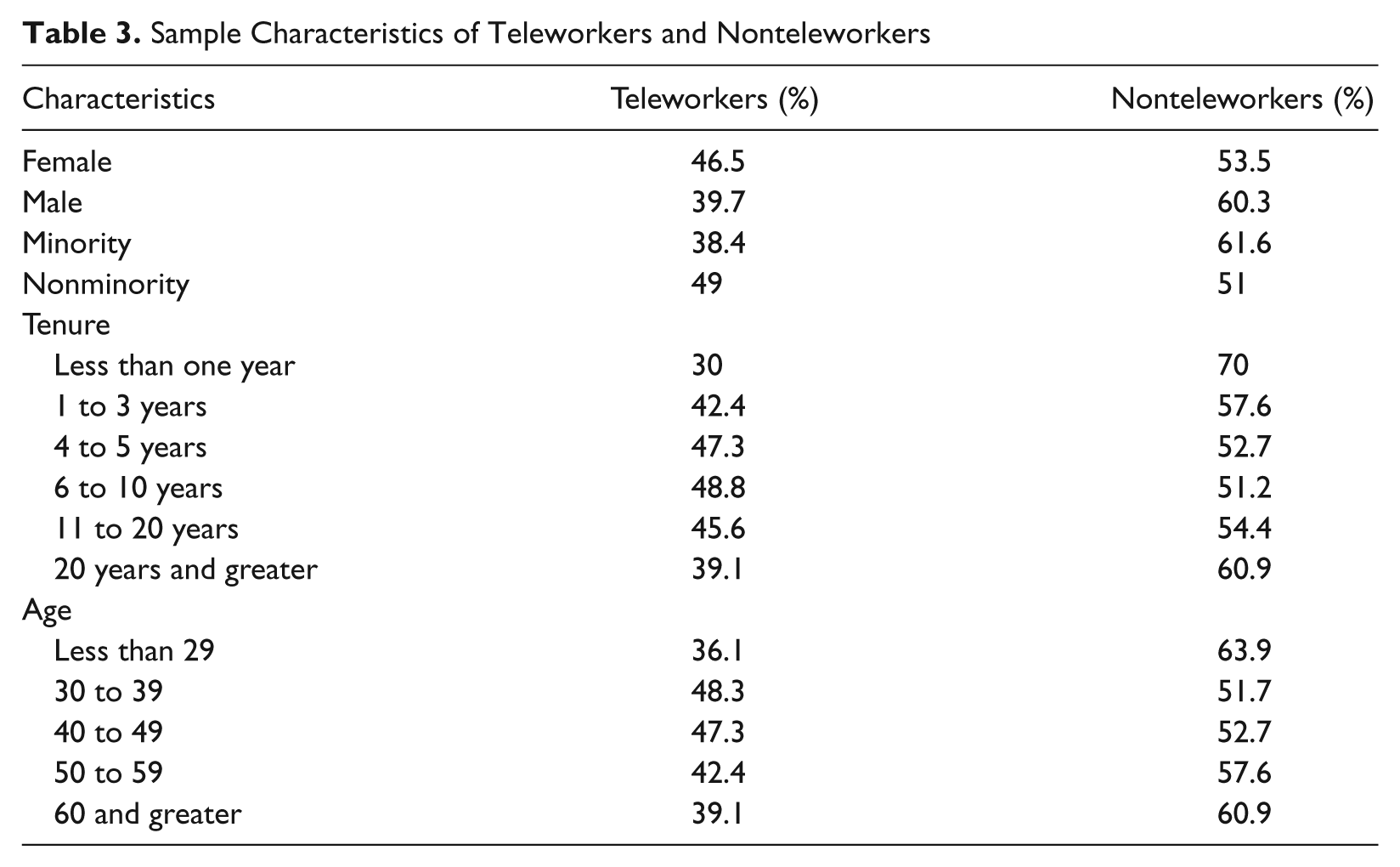
Table 4 and Table 5 display the descriptive and correlation statistics for the variables in the model. Although not depicted in the table as it is a nominal variable, a breakdown of all DHHS’ employees in the sample revealed that the single largest percentage of people teleworked frequently (22.8), followed by infrequent teleworkers (21.4), those not allowed to (17.8), those who chose not to (17.4), those who had to be physically present (15.3), and those who could not because of technical issues (5.3). In terms of the dependent variables, Table 5 indicates that there is a fairly high level of correlation between job satisfaction, job involvement, and organizational commitment. This is not surprising as others have found an interaction between these variables (Moynihan & Pandey, 2007). However, as mentioned earlier, the results from a factor analysis suggested that the items representing these variables are distinct.
Descriptive Statistics for Survey Respondents

Measures of Correlations and Reliabilities of Variables

Note: FT = frequent teleworkers; INFT = infrequent teleworkers; PP = physically present; TI = technical issues; NA = not allowed; CNT = chose not to, Teleworking variables cannot show correlation with one another because they are restricted variables, *Significant at the .01 level.
Additionally, the telework variables in Table 5 were restricted to those workers who met specific criteria. For instance, the variable FT/INFT only includes workers who telework frequently and infrequently, excluding the other conditions. In other words, each telework variable was coded dichotomously. As a result, these telework variables cannot receive a correlation statistic when matched with other telework variables. The other variables in the model, however, are not restricted. Some caution should therefore be taken when analyzing the correlation statistics between the teleworking arrangements and the other independent variables because only a portion of the sample was included.
After examining the teleworking arrangements, the bivariate relationships indicate that most of the variables were significantly (p = .01) related to work motivation, with FT/NA and INFT/NA posting the highest r. (The meanings of these variables are depicted at the bottom of the table.) Many of the teleworking variables also have negative signs—the opposite of what was expected. When compared to the other social exchange variables, the correlation statistic for teleworking was considerably lower. For instance, employees who were empowered, worked under managers who supported teamwork, and were supported by their supervisors were more likely to be satisfied (r = .60, .44, and .58, respectively; p = .01), committed (r = .71, .49, and .59, respectively; p = .01), and involved (r = .49, .34, and .42, respectively; p = .01). These findings are consistent with social exchange theory. Moreover, respondents who believed the organization was attaining its mission were also more likely to be satisfied (r = .52; p = .01), committed (r = .67; p = .01), and involved (r = .41; p = .01). Therefore, support was found for values related to public service motivation. Although these relationships are intriguing, each variable in the model needs to be controlled before a definitive judgment can be made regarding the hypotheses.
A generalized linear model was utilized to estimate the research model. This estimator, which extends the general linear model, linearly relates factors and covariates in a single model, allowing for a nonnormal distribution in the dependent variable (Norusis, 2008). Regarding the research model, this means all of the categories of telework could be examined as one variable, compared to a reference category, and fitted in one model instead of running several different models with telework as a dichotomous variable, similarly to the bivariate table. For instance, frequent teleworkers are compared to the other teleworking arrangements in the first model and infrequent teleworkers are evaluated to the remaining arrangements in the second model, while controlling for the other variables in the model. Thus, frequent teleworkers are the reference category in Table 1 and infrequent teleworkers are the reference category in Table 2.
Similar to other linear models, the generalized linear model assumes the factors are interval scales and that the model is devoid of multicollinearity. Regarding the use of Likert-type ordinal items, Jaccard and Wan (1996) suggested that linear models are good estimators not affecting Type I and Type II errors, especially when the scales are equal to 5 (which is the case with job satisfaction) and much greater than 5 (which is the case with the averaged factors, job involvement, and organizational commitment). Tests were also conducted to detect the presence of multicollinearity, and it revealed that the models were not unduly influenced by multicollinearity. 2 Therefore the generalized linear model is a reasonable estimator. An important note is that, unlike other linear models, a generalized linear model does not compute an R2. However, the bivariate statistics indicate that the model explains a fair amount of the variation in work motivation.
As demonstrated in Table 1, infrequent teleworkers had higher levels of each work motivation factor—job satisfaction, organizational commitment, and work motivation—than frequent teleworkers did (p < .05). This finding failed to support Hypothesis 2. Employees who were required to be physically present had higher levels of each work motivation factor than did frequent teleworkers. Moreover, employees who could not telework because of technical issues and those who choose not to telework were also found to have higher levels than did frequent teleworkers for one work motivation factor: organizational commitment. This finding, therefore, does not support Hypothesis 1, which assumed frequent teleworkers (in comparison to the other nontelework arrangements) would have higher levels. However, employees who were not allowed to telework reported lower levels of work motivation (job satisfaction, organization commitment, and work motivation), when compared to frequent teleworkers. This finding does support Hypothesis 1. In sum, only partial support was found for Hypothesis 1.
Other key variables were statistically significant across each dependent variable. Employees reporting high levels of the social exchange variables empowerment and supervisory support were more likely to have high levels of work motivation (p = .000). Government workers who believed their organization was accomplishing its mission had higher levels of work motivation than those believing the opposite (p = .000). Additionally, job characteristic factors, role ambiguity (negative), and satisfaction with pay (positive), were associated with higher work motivation (p = .000). In fact, these variables were more important predictors of work motivation than were the teleworking arrangements. Last, supervisors were more motivated and employees in higher pay grades had lower levels of job satisfaction and organizational commitment but higher levels of job involvement than employees in lower pay grades.
In Table 2, infrequent teleworkers had higher levels of work motivation than employees who were not allowed to telework (p = .000). These former teleworkers also reported higher levels of job satisfaction and involvement than did employees with technical issues and employees who chose not to telework. This particular finding supports Hypothesis 1, which assumed infrequent teleworkers have higher motivation levels than nonteleworkers. Like Model 4, full support was not found for Hypothesis 1. Employees who had to be physically present had higher levels of job involvement than did infrequent teleworkers. Moreover, a statistically significant difference was not found for the other work motivation factors (p > .05).
Also similar to the other model (Table 1), the social exchange variables and the factor representing public service motivation values (mission attainment) were statistically significant, with their expected positive signs (p = .000). Role ambiguity and reasonable workload were also related to work motivation, posting the same signs. These aforementioned variables, once again, were also more important predictors than teleworking.
Discussion and Implications
What do these finding suggest regarding teleworking and work motivation in the DHHS? Teleworkers did not necessarily exhibit higher levels of work motivation, casting some doubt on the utility of using telework as a social exchange factor. First, frequent teleworkers were found to be less motivated in each work motivation factor than were infrequent teleworkers in the DHHS, contradicting a tenet of social exchange theory which assumes motivation will increase as the level of employee benefit rises. An explanation is that the relationship between work motivation and the amount of days workers telecommuted is curvilinear. Golden (2006), for instance, found job satisfaction to be at its apex when employees telecommuted about two days but then began to decline slightly as workers telecommuted more than that. Therefore, frequent teleworkers were less motivated than infrequent teleworkers in the study. Why did job satisfaction decline after 2 days of telecommuting? Golden found that extensive teleworking reduced needed face-to-face interactions between employees and managers as well as between employees and coworkers, causing employees to feel isolated. A caveat, however, is that the research model only examined frequent and infrequent teleworkers—that is, a dichotomous variable was used—and not the number of days in the workweek employees spent teleworking, like Golden (2006) did. Another caveat is that the linear models in the article are not designed to measure the curvilinear relationship. Nevertheless, the research model does lend some support to Golden’s findings.
Regarding organizations and managers, this finding strongly implies that managers should not expect organizational values to increase incrementally as benefits increase. This finding also highlights that benefits often come with a negative consequence; that is too much of a benefit can be detrimental not only to the organization but to the worker as well. Therefore, organizations should offer benefits in a deliberate manner, finding a level that works for the organization as well as the worker. This finding regarding frequent and infrequent teleworkers also suggests that periodic face-to-face-activities, such as meetings and parties, should be planned with frequent teleworkers to reduce the isolation caused from working at home. Such activities could also increase participation among employees which was also linked to work motivation in the model.
Second, in the DHHS, frequent teleworkers reported lower levels of work motivation than did employees whose jobs required them to be physically present. Moreover, the latter employees had higher job involvement levels than infrequent teleworkers. There is at least one possible reason for this occurrence. Employees in this arrangement are, for example, law enforcement officers and security personnel, and they might be more motivated when compared to employees in other job classifications who can feasibly perform their work at an alternative location. Employee job classifications were not included in the questionnaire, rendering it impossible to examine this effect.
Third, DHHS’s frequent teleworkers reported lower levels of organizational commitment than those who could not telecommute because of technical difficulties, whereas infrequent teleworkers were more satisfied and more involved in their jobs than these nonteleworkers. Although the latter finding was expected, the former was contrary to expectations. This finding therefore raises more questions than it answers. In particular, what causes these employees to be more motivated in comparison to frequent teleworkers? Is it the type of job they have? Is it that they are appreciative to the agency for trying? Or, is it that frequent teleworkers aren’t that motivated? Concerning the latter question and mentioned earlier, frequent teleworkers may be less motivated because they are not getting an intrinsic need: face-to-face interaction (Golden, 2006).
Fourth, the research model indicates that DHHS employees who were not allowed to telework reported lower levels of work motivation than teleworkers—both frequent and infrequent. In fact, this variable was the only one that was negative and significant in each work motivation factor across models. This variable also had the strongest bivariate relationship. There are two possible explanations for this occurrence. First, both teleworkers and employees who were denied this arrangement were eligible, possibly meaning that when employees qualify for this arrangement, the offer by itself boosts work motivation. Furthermore, employees who declined the arrangement were also in this eligible category and they also reported higher work motivation levels than employees who were denied. As mentioned earlier, the aforementioned workers—those with technical difficulties and those who had to be physically present—did not qualify for this arrangement. As a result, social exchange theory—a voluntary favorable action causes employees to reciprocate—could occur under this condition. That is, for social exchange to occur employees need to be eligible and they need to be offered the benefit, regardless of whether or not they accept it. Stated another way, employees who are offered the desirable benefit may feel obliged to reciprocate, even if they do not accept the offer. This would explain why employees who chose not to accept teleworking had higher work-motivation levels than those who were denied and it would partially explain why consistent work motivation differences were not found between telecommuters and those who chose not to.
Another explanation is that individuals who were denied had the lowest reported levels (not just among those who were eligible but among the myriad arrangements in the research model) because they qualified for and were denied the benefit. Simply put, their motivation levels decreased after they were passed over. A counter argument could also be made: workers who were not satisfied, committed, and involved in their jobs were not allowed to telework. However, a study conducted by the U.S. General Accounting Office (2003) found that the main reason why employees were not offered the arrangement was because of managerial resistance to change, suggesting the counter argument may not be valid. Other studies outside of government also suggest that the opposing argument is not valid (e.g., Hunton & Norman, 2010).
Fifth, other social exchange predictors, namely empowerment, team work supported, and supervisory support, were more robustly associated with work motivation, questioning the efficacy of using telecommuting as a social exchange factor to elevate organizational values. For instance, the bivariate relationships indicate that DHHS employees who were empowered, and who worked under managers supporting teamwork and them personally, had work motivation correlations ranging from a low of .34 to a high of .71. However, the correlations were .14 to .23 for the dichotomous variables, frequent teleworkers and those not allowed to as well as infrequent teleworkers and those not allowed to. The implication to managers is that they should employ those social exchange factors that are the most effective. Moreover, mission attainment, which represents a public service motivation value, was also significant, with a strong bivariate association. This suggests that agencies should consider recruiting and hiring individuals with public service motivation values and those that fit the organization (commonly called person–organization fit) to increase work motivation levels in agencies.
Sixth, as mentioned, each of the social exchange factors as well as mission attainment (a variable that represents a value in public service motivation theory) was significant. This suggests DHHS government workers are both egoistic and altruistic. More precisely, regarding egoism, this finding suggests employees are motivated by such extrinsic rewards as fair rewards, human resource practices, and involvement in decision making (Anderfuhren-Biget et al., 2010; Gould-Williams & Davies, 2007; Haar, 2006; Noblet & Rodwell, 2009). Concerning altruism, this finding implies government employees possess altruistic motives and a desire to serve society (e.g., Caillier, 2010; Perry & Wise, 1990; Rainey & Steinbauer, 1999; Scott & Pandey, 2005), or simply put, public service motivation, as government employees were motivated by the variable representing public service motivation values. It also validates previous research that found government workers to be motivated by public service motivation factors as well as extrinsic factors (Moon, 2000; Moynihan & Pandey, 2007). To summarize, these findings offer some support to Bailey and Kurland (2002), who after examining the extant literature, concluded that there is not enough evidence to state definitively that teleworkers have a higher work motivation.
Limitations and Directions for Future Research
There are several limitations to this research that need to be noted. First, a cross-sectional research design was utilized, rendering it impossible to determine the extent to which telework affected work motivation over time. Therefore, causality cannot be deduced from the results. To determine exactly how telecommuting changes employee work motivation levels, future research should seek to utilize panel data that examines the work motivation of employees extensively before, during, and after they decide to participate in this arrangement. The work motivation levels of nonteleworkers should also be examined as a control group over the same time period for comparison purposes.
A second limitation is that this study was conducted on employees in the DHHS. As work motivation may be impacted by the function of agencies (e.g., human services, regulatory, distributive, and so forth), generalizations to other agencies should be made with caution. This study was also conducted at the federal level, which of course limits generalizations to other sectors and other levels of government.
Third, the measures for organizational commitment and job involvement were not perfect. Although these measures are consistent with some of the underlying principles of these dependent variables, they do not capture the full meaning of what it means for employees to be committed and involved. When examining work motivation, researchers can further this area of study by using items for these factors that have been developed and tested (see Meyer, Stanley, Herscovitch, & Topolnytsky, 2002, and Lodahl & Kejner, 1965). Fourth, the FedView data set was limited in that it did not have items to measure additional factors that could have affected work motivation. Scholars should therefore test a more comprehensive model of work motivation, using theories developed by such scholars as Locke and Latham (2004) as a guide. Fifth, the FedView survey did not ask employees specific questions about the type of job they had. For instance, does work motivation differ by job type and if so, what effect does this have on the relationship between telework and work motivation?
Finally, the sample comprised about 20,000 federal government workers, making it a large-scale sample. This means some of the associations that were found here may not have been statistically significant in a smaller sample. For instance, the bivariate relationships between the teleworking arrangements and the work motivation factors were significant but with low correlation statistics. Therefore, the sample size should be taken into consideration when interpreting the research findings.
Conclusion
The goal of the article was to test the social exchange hypothesis by examining the association between telework and work motivation. In so doing, a model was identified and tested on U.S. federal government employees working in the Department of Health and Human Services, making at least three important contributions to the field of organizational behavior in general and public organization studies in particular. First, the work motivation of employees in several distinct teleworking arrangements were examined, providing public managers with guidance regarding how work motivation is associated with these arrangements. For instance, infrequent teleworkers were found to be more motivated than frequent teleworkers, suggesting that the level of benefit employees receive increases work motivation up to a point, after which it diminishes. Therefore, the relationship between social exchange and alternative working arrangements seems to be curvilinear. Additionally, employees who were denied this arrangement were found to have the lowest reported levels of work motivation, suggesting these employees will be the least productive because work motivation is often associated with performance (Gould-Williams & Davies, 2007). Last, the models also demonstrated that teleworkers did not have consistently higher work motivation scores than did employees with technical difficulties, employees who chose not to telework, and employees who could not telework because their job required them to be physically present.
The next contribution concerns the relative impact of teleworking on work motivation. More specifically, teleworking, although significant in many instances, had a far lesser impact on work motivation than did the other social exchange and public service motivation factors. This does not diminish the overall utility of telecommuting, however, as it provides many other benefits, namely a reduction in energy and administrative costs, preventing work stoppages due to catastrophes, and compliance with the Americans with Disabilities Act. But, these findings do question the efficacy of using telecommuting as a social exchange factor—that is, as a means to increase the work motivation level of employees—or, at least, dampens expectations regarding the effect.
Footnotes
Appendix
|
Job satisfaction Considering everything, how satisfied are you with your job? Organizational commitment I recommend my organization as a good place to work I have a high level of respect for my organization’s senior leaders In my organization, leaders generate high levels of motivation and commitment in the workforce Job involvement My work gives me a feeling of personal accomplishment I like the kind of work I do> Telework Table 1 (Model 1): 7 = telework on a regular basis (at least one day a week; reference variable); 2 = I telework infrequently (less than one entire day a week); 3 = I do not telework because I have to physically present on the job; 4 = I do not telework because I have technical issues, 5 = I do not telework because I am not allowed to, even though I have the kind of job where I can telework; and 6 = I do not telework because I choose not to telework. Table 2 (Model 2): 7 = I telework infrequently (less than one entire day a week; reference variable); 2 = I do not telework because I have to physically present on the job; 3 = I do not telework because I have technical issues, 4 = I do not telework because I am not allowed to, even though I have the kind of job where I can telework; and 5 = I do not telework because I choose not to telework. Empowerment Employees have a feeling of personal empowerment with respect to work processes Team work supported The people I work with cooperate to get the job done Supervisory support My supervisor/team leader provides me with constructive suggestions to improve my job performance Role ambiguity I have enough information to do my job well (Reversed) I know what is expected of me on the job (Reversed) Reasonable workload My workload is reasonable Pay satisfaction Considering everything, how satisfied are you with your pay? Mission attainment My agency is successful at accomplishing its mission Supervisor 1 = Supervisor or manager/executive; 0 = Nonsupervisor/team leader Male 1 = male; 0 = female Minority 1 = minority; 0 = nonminority Age 1 = 29 and below; 2 = 30-39; 3 = 40 -49; 4 = 50 – 59; 5 = 60 and older Pay 1 = GS 1-12; 2 = GS 13-15; 4 = SES/SL/ST Tenure 1 = less than 1 year; 2 = l to 3 years; 3 = 4 to 5 years; 4 = 6 to 10 years; 5 = 11 to 14 years; 6 = 15 to 20 years; 7 = more than 20 years |

Note: The scale for job satisfaction, pay satisfaction is 1= very dissatisfied, 2 = dissatisfied, 3 = neither satisfied nor dissatisfied, 4 = satisfied, 5 = very satisfied. The scale for organizational commitment, job involvement, empowerment, team work supported, supervisory support, role ambiguity, workload, and mission attainment is 1 = strongly disagree; 2 = disagree; 3 = neither agree nor disagree; 4 = agree; 5 = strongly agree.
The author(s) declared no potential conflicts of interest with respect to the research, authorship, and/or publication of this article.
The author(s) received no financial support for the research, authorship, and/or publication of this article.