







Abstract
Outsourcing public service provision to the private and nonprofit sectors has been well-documented and studied for over two decades as manifestations of the hollow state, but there is a relatively new phenomenon at local levels of government that has until recently eluded the attention of researchers in public administration and policy: private governments. Increasingly, U.S. citizens are far more likely to reside in a development operated by a homeowner’s association, rather than (or in addition to) a city government. Services are provided by these private entities, funded by association dues, and governed by covenants, conditions and restrictions, drafted largely by developers. As administrative units, how do these developments interact with local governments? Using data from the first national survey of large homeowner associations, we present evidence that their perceptions of local government are significantly influenced by the degree to which they set themselves apart in private enclaves, and we offer some recommendations for further research of the implications that these perceptions pose.
The “public administration problem” has leaped beyond the borders of the public agency and now embraces a wide assortment of “third parties” that are intimately involved in the implementation, and often the management, of the public’s business. (Salamon, 2002, 2)
Introduction
Fifty years ago, Ostrom, Tiebout and Warren (1961) imagined how local governments might operate if the provision of public services were separated from their production. The intervening years have seen no reduction in the range of government activity, but the means of producing public services have changed so dramatically, especially by contracting out services to the private or nonprofit sectors, that the local polis has been termed third-party government, government by proxy, or a hollow state (Cigler, 1989; Milward, Provan, & Else, 1993.) The extensive literature on contracting out envisions a role for government, albeit a changed one. Governments still must choose the services to be outsourced, secure funding, determine the contract terms, select the contractors, and monitor the contract’s outcomes (Stein, 1990). In other words, government services have been outsourced, but governance has not.
A new form of private local government offers services as well as governance but has eluded the attention of researchers in public administration and policy. Homeowners associations (HOAs) provide urban services, hold elections, “tax” residents, and regulate their behavior (McCabe, 2011). In 1989, HOAs were identified as the most extensive privatization effort in the United States (U.S. Advisory Commission on Intergovernmental Relations (ACIR, 1989) and since that time HOAs have become so prolific that they now far outnumber local governments. The populations of large communities governed by HOAs rival those of small to midsized cities, yet we know little about these organizations or their operations. This article seeks both to fill this information gap and to consider the HOA phenomenon as an unexpected accessory to the hollow state, a perspective that raises familiar questions to public administration scholars.
Discussions of the hollow state focus on the way that services traditionally produced by governments have increasingly been provided through alternative means, especially via contracts with nonprofit and private firms. At its best, finding new ways to deliver services would encourage innovation and wed the efficiency norms of business with the accountability norms of democratic governments. At its worst, the hollow state substitutes the stable control of government provision for the uncertain continuity of networks of public, private, and nonprofit providers (Milward & Provan, 2000). Some warn that this approach may prompt allocation deliberations—about who should receive what kinds of services and how—to be driven by questions of cost and efficiency, with other values lost in the shuffle. Pushing decisions once debated in public squares into private spheres could weaken the tie between public service and public accountability and undermine the legitimacy of public agencies (Terry, 1998).
The metaphor of the hollow state has gained such widespread acceptance that it has been applied to nearly all local government contracting arrangements for service provision. Contracting among governments, interlocal agreements (Agranoff & McGuire, 1998), informal arrangements, or formal contacts between public and private actors or networks (O’Toole, 1997, 2010) have been assigned the hollow state title. Following Milward and Provan (2000) we concentrate on crossing boundaries between public and private actors as well as on the distance between government decision-making and service delivery.
As Milward and Provan (2000) stated:
By the hollow state we mean the degree of separation between a government and the services it funds (i.e., the number of layers between the source and the use of funds). For instance, the Arizona behavioral health system has four layers between the federal substance abuse and mental health block grant and the client: no services are provided until the third or fourth layer. (Milward & Provan, 2000, p. 362).
The distance between government action (what should be provided) and actual service delivery (how it should be provided) is central to our inquiry into HOAs. Distancing service funding from delivery may leave the public unaware of where their services come from, what their taxes and fees pay for, and what their governments actually do. Our interest lies in understanding that distance through the perceptions that private providers, in this case HOA community managers, have of local government and service recipients.
Drawing from literature in urban affairs, economics and law, this article first places HOAs in context, discussing their genesis, growth and organization as well as their “fit” in the scheme of local governance. We then turn our attention to large HOA communities, the nearest analogue to cities and towns. Reporting the results of a 2005 survey, we describe these communities’ characteristics, their role as service providers, and their relationships with local governments. Next, our analysis concentrates on distinctions among HOA communities that create varying degrees of distance between the community and local government and tests whether these distinctions affect HOA managers’ perceptions of local governments. We conclude by considering some of the implications of HOAs and their service provision with reference to the constructs of the hollow state.
HOAs in Context: Origins, Organization, and Fit
HOAs were somewhat uncommon in the 1970s, but their numbers rose in response to a dilemma. Soaring land prices led to changes in large-scale real estate development patterns and new environmental regulations made development on some land increasingly problematic. Real estate developments began to cluster housing on some portions of the property setting aside space to meet environmental regulations as well as providing amenities and infrastructure—all known as “common areas”—elsewhere. HOAs were established to provide for long-term maintenance of the commons (Hyatt, 2000). 1
The HOAs are created long before construction begins. After designing a new community, the developer files a kind of master deed restriction known as covenants, conditions and restrictions (CC&Rs) with the local government land records agency. The CC&Rs establish the HOA and articulate its powers and duties; restrict the land’s use; set aesthetic standards; and create rules to govern future homeowners’ behavior. The CC&Rs’ obligations are permanent; they “run with the land.” Buying property in the HOA community automatically makes the new owners HOA members and signals their agreement to follow the CC&Rs and the HOA’s rules.
Since the late 1980s, the number of HOAs has surged, but their exact number is unclear. HOAs are not counted by the census or by the state or local governments where they are located. The Community Association Institute (CAI), an organization that promotes the interests of association-governed communities as well as trains and certifies community managers, estimates that there were 158,800 HOAs in 2009. 2 The magnitude of this figure becomes clear when compared with local governments in the United States. In 2007, there were 39,044 municipal and county governments in the United States. (U.S. Census Bureau, 2007). Including special districts and school districts boosts the total to 89,476. HOAs presently outnumber cities and counties by more than four-to-one and all local general and special purpose governments by almost two-to-one. HOAs are most prevalent in the south and west, consistent with recent growth trends.
When first set up, the developer controls the HOA and usually incorporates it as a nonprofit corporation, an action that brings the organization under the rubric of business, not municipal, corporate law. Like most corporations, the HOA is governed by a board of directors. HOA members elect board members to their jobs, but the initial HOA board is appointed by the developer, who typically has a three-to-one voting advantage over other HOA members. This mechanism means that the developer can essentially outvote homeowner members of the HOA until 75 % of the homes have been purchased. This provision is especially important in large residential developments, which can take years to build completely (Hyatt, 1985, 2000).
HOA boards of directors are unpaid volunteers. As decision makers, board members are responsible for enforcing the CC&Rs as well as for making and enforcing new policies. Unlike government bodies, policy-making, implementation and enforcement are combined in HOAs’ boards of directors. To carry out their responsibilities, boards may hire a professional community manager or management firm to run the community or opt for self-management. Despite apparent structural similarities between council-manager cities and HOA communities, the differences between them push traditional understanding about policy making and implementation into uncharted territory. When HOAs are self-managed, the expression, execution and enforcement of policy are merged into a single body. At the other extreme, when boards hire a management firm rather than an individual manager, the firm may have the authority to hire or fire a community manager. These options essentially add new end points to the continuum of policy responsibility, making HOAs a fertile ground for the study of public management and governance (McCabe, 2011).
Private Governments and Local Governance
HOAs establish a level of governance, rules and services that are superimposed on existing cities, counties and districts, creating distinct community enclaves that range in size from a small number to several thousand homes. There are few systematic studies of HOAs, save for the early surveys by the ACIR (1989) and Dilger (1992), yet there is no shortage of viewpoints about HOAs and their effects. HOAs have been praised as efficiency-enhancing private governments and damned as enclaves of self-interested secessionists. Proponents of the efficiency argument often assume Tiebout sorting among mobile potential residents seeking to match their preferences with service levels, types and prices offered across public and private communities. This effect is efficiency-enhancing by definition. Formal models of private service provision within a larger, public arena come to equilibrium when public spending is lowered overall, with high service demanders contented with more, privately provided services and low service demanders satisfied with fewer services and lower tax bills (Epple & Romano, 1996; Helsley & Strange, 1998).
As political entities, HOAs are often depicted as petty or undemocratic internally (Franzese, 2002; McKenzie, 1994), with the potential to influence local political choices outside their boundaries. Examples of HOAs’ political clout include New Jersey’s decision to reimburse HOA members for the tax cost of internally provided services (Nelson, 2005) as well as HOAs’ involvement in the San Fernando Valley’s attempt to secede from Los Angeles (Purcell, 2001, Sonenshein, 2004). Whether these impacts are common or rare is unknown, and instances of HOAs’ positive contributions to their host governments are undocumented.
Residency in a HOA does not exempt a citizen from paying local taxes; indeed, residents may not know which services are paid for through tax dollars and which are provided through HOA fees. As evidenced by recent work, HOAs not only offer services that are traditionally provided through local governments; they may actually duplicate services (McCabe & Tao, 2006). Unlike the hollow state model, however, local governments do not contract for services in HOAs. The local governments provide the regulatory framework within which developers operate, and developers determine which services the HOAs will offer. Funding for services, the usual hallmark of a hollow state, is left to the private sector. With HOAs, it is the use of local regulatory power to structure private sector behavior that defines the distance between public authority and private provision, and thus echoes the hollow state model.
HOAs are established through local governments and offer their host governments several appealing possibilities. HOAs can preserve green space, produce property tax revenue and reduce infrastructure costs, at least within the new HOA communities (McCabe, 2005). These potential gains are so attractive that many local governments require that developers both provide infrastructure within their projects and establish HOAs for its upkeep (McCabe, 2006; Siegel, 2007; Winokur, 1998). In Lang and LeFurgy’s (2007) “boomburbs,” large fast growing suburban cities, HOAs provide most of the urban services city residents receive. Despite hints of HOAs’ potential impacts on local governments, there is a dearth of basic information about HOA communities, particularly on the large-scale communities, which most closely resemble cities.
We address this information gap by reporting the results and analysis of the first national survey of large-scale community managers. In doing this, we follow the example of the ICMA (International City and County Managers Association), which has surveyed city managers about the actions of their municipalities and questioned city clerks about the structure and practices of their governments for decades. The ICMA surveys thousands of governments and boasts a response rate of nearly 30% (http://icma.org/en/results/surveying/survey_research). Adopting this approach for HOA community managers enables us to offer perspectives from the private side of the service divide. We anticipate that empirical evidence on HOA community manager perceptions will raise awareness in public administration circles about the characteristics and actions of homeowners associations and the attitudes of their managers. We also hope this new context will invigorate the discussion of the complexities of private provision of traditionally public services that the hollow state model began.
The Survey
The survey instrument elicits basic information about the HOA community (population, housing type, services offered, etc.) as well as the community manager’s perceptions of their community’s relationships with local government. Like the earlier national surveys of homeowner associations, we worked in cooperation with the Community Association Institute. Unlike earlier studies, however, this survey concentrates only on the “large-scale community,” which CAI defines as one with at least 1,200 housing units, a minimum of 1,000 acres, and an annual operating budget of US$1.5 million or more (http://www.caionline.org). There were multiple reasons for concentrating on large-scale communities, but the most compelling was their comparability to cities. Nearly half the incorporated cities in the United States are similar in size to large-scale HOA communities (U.S. Census Bureau, 2002) and could be expected to face comparable service demands, management concerns and governance issues. Public managers may find fresh insights when considering these issues from a private government’s managerial perspective. Finally, because local governments do not maintain directories of the HOAs within their boundaries, we expected that the presence of one or more large-scale HOA community in a city or county would offer a clear opportunity for considering the relationship between public and private governments.
CAI provided a membership list of their large-scale community group. The membership list was screened to assure each community was allotted only one response, resulting in a set of 436 discrete, large-scale communities. Given the small population, we took a census rather than sample of the communities. Following CAI Research Foundation staff’s recommendations, we used Zoomerang to conduct an Internet-based survey, which we sent to all 436 communities.
The survey instruments were addressed to the community managers, the private counterparts of city managers, and contained questions about the communities’ characteristics, service provision, and governance, as well as the respondents’ perceptions of their community’s relationship with local governments. Governance questions were modeled on ICMA’s Municipal Form of Government Survey 2001 and the remaining questions on the USACIR’s 1989 survey. Respondents were guaranteed anonymity. (Survey questions are available from the authors).
Keeping in mind the limitations of survey research and the potential problems with nonrespondent bias (Dillman, 2000), we took several steps to increase response rates and to assure that all types of large-scale communities were represented. The CAI urged members to respond to the first round of surveys, sent in January 2005, followed by a second round in March. In February and May 2005, CAI members without email addresses were telephoned and directed to a secure website to complete the survey. After telephone and mailed reminders, 175 complete responses had been returned by June, providing a 40 % response rate.
As is the norm for survey research, drawing inferences demands caution on at least two fronts. First, the responses express the views of community managers about how their communities operate, just as surveys of city managers convey their perceptions of the cities they serve. In both cases, the responses represent the expert opinion of each organization’s chief administrative officer. Care must also be taken in generalizing survey results, and this problem is especially perplexing when the population parameters are unknown. Erring on the side of caution, these results may be generalized to CAI’s large-scale communities. The next section presents descriptive statistics of all communities surveyed, the services they provided, and the managers’ perceptions of their relations with local governments. This is followed by a discussion of three community subtypes and an analysis of whether these distinctions create measurably different perceptions of the distance between the community and local governments.
Survey Respondents: An Overview
The survey respondents represented all regions of the United States, with concentrations in the south (43 %) and west (41 %). 3 Less than 15 % of the communities were founded before 1970, a pattern consistent with regional growth and development trends from the 1970s through the present, reflecting both population shifts that favored the south and west as well as state and local governments’ growing affinity for planned community developments (McCabe, 2005, Pack, 2005). A majority of (56 %) communities were located within an incorporated municipality.
Respondents noted the number of homes or lots in each community rather than the number of people but offered population estimates that ranged from 100 to 83,000 residents. With only 10 communities reporting populations of more than 30,000 people, the distribution was highly skewed, with the other 165 respondents placing community populations at 20,000 or less. An estimated population of 10,000 was the modal response, with a mean of 7,724 and a median of 3,700.
A minority of communities offered only one kind of housing, such as all single-family homes (26%), or multifamily housing (3%). Nearly half (48%) of the communities were predominantly single family, but included other types of housing such as townhouses, duplexes, condominiums, or apartments. The variation in housing types indicates underlying differences in community populations in terms of age, income, lifestyles, and preferences. This inference is consistent with Gordon’s (2004) analysis of HOA populations in California, which found that HOAs had greater income heterogeneity but less racial diversity than other neighborhoods.
To some extent, a community’s housing dictates the organization of its governing structure. When a community includes multifamily housing, each building must have its own condominium association to establish clear property rights, leading to higher numbers of associations in these cases. The number of HOAs in these large communities ranged from 1 to 136. The distribution of HOAs across communities was negatively skewed. On average, there were ten HOAs per community, but the modal response was one, with 45% of the communities relying on a single association. A simple multiple regression on the number of HOAs by population and housing type found the number of HOAs per community was a function of population size and housing type, so that the number of HOAs increased with the community population but diminished as the share of single-family homes rose. In other words, the manager of a large HOA community may be accountable to multiple associations, much as a city manager is accountable to multiple neighborhoods.
Privately Provided Services
Economists have theorized that HOAs are more efficient service providers than local governments because market forces lead developers to supply the optimal mix of collective goods and service levels (Boudreaux & Holcombe, 2002). This claim remains untested, but the communities surveyed provided services such as maintenance, recreation, security, transportation, and public works, traditionally services provided by local governments. Nearly all (97%) communities provided grounds keeping services, an expected outcome given HOAs’ objective of maintaining common property. Recreational amenities were the next most frequently provided service and included facilities such as swimming pools (82%), community centers (77%), playgrounds (67%), and sports fields (43%). Most communities provided security services such as patrols (63%), gates (66%) or guards (48%) as well as transportation services ranging from street construction (33%), maintenance (62%), and bike paths (51%). Most communities provided public works services such as storm drainage maintenance (61%) or trash collection (41%). Gated communities provided significantly more public works including drinking water, sewer, cable, trash collection, and the initial construction of streets than their ungated counterparts. This suggests that gated communities in general are more likely to substitute private services for government-provided services.
Attitudes toward Local Governments
The literature’s characterization of HOAs as either a refuge from urban strife or a technocratic island of efficiency suggests that HOA communities’ relationships with local governments would range from negative to null. When community managers responded to questions about the connections between their community and local governments, however, our survey found generally positive views.
Community managers reported good relationships overall with local governments. About 67% of the managers felt local governments were responsive to their community’s needs and interests. Perhaps more importantly, only 15% disagreed with that viewpoint. In Table 1, we collapsed the two end categories (i.e., combined the “agree” categories into one, and the “disagree” categories into another) and eliminated the middle category. We then highlight managers’ opinions across three general areas: fiscal responsibility, civic or political engagement, and public safety to better illustrate the “for” and “against” nature of responses.
Relationship Between Homeowners Association (HOA) Communities and Local Governments: Community Managers’ Views
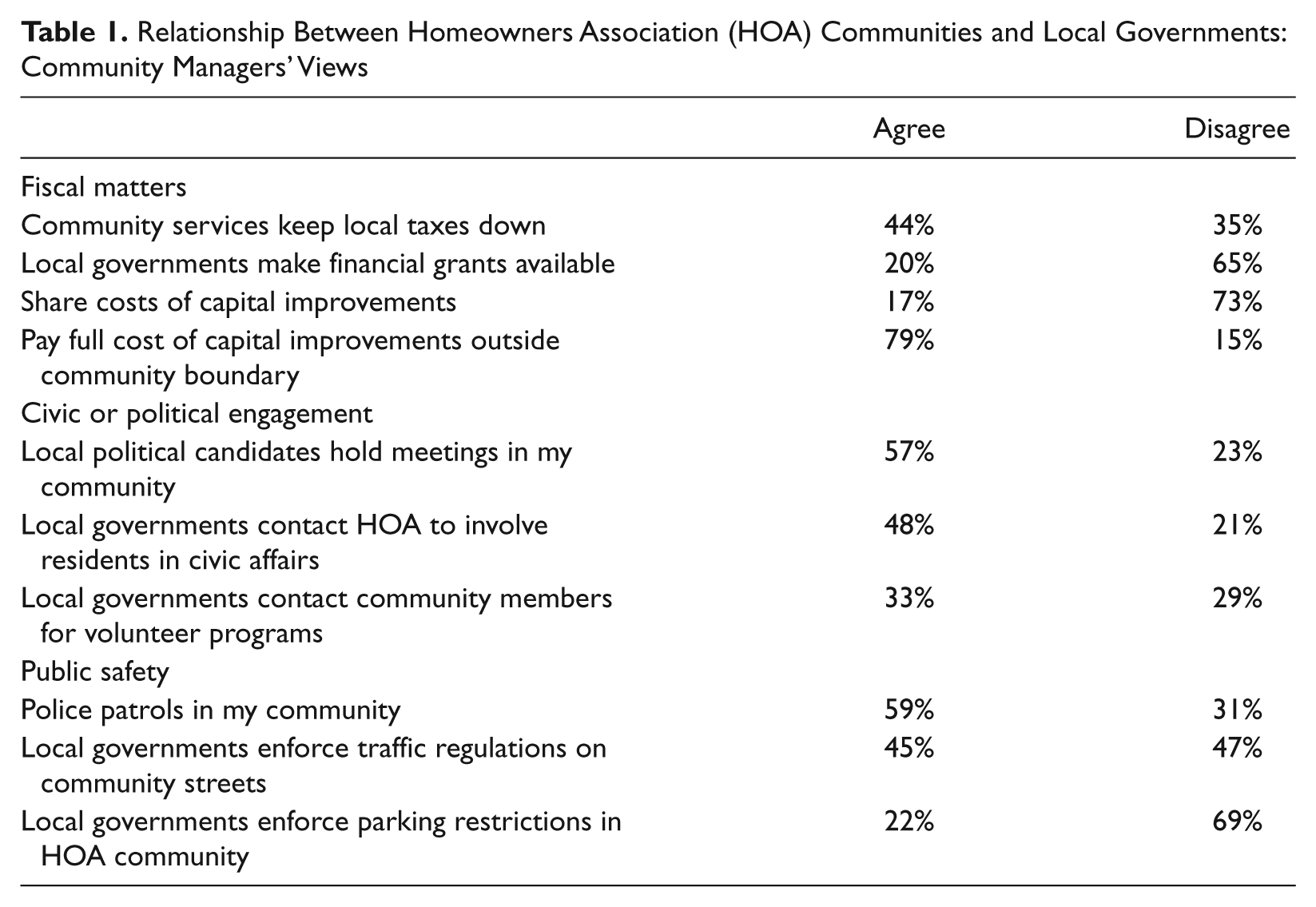
In terms of fiscal responsibility, the lines between public and private governments are bright. Community managers reported little revenue sharing. Local governments maintained full financial responsibility for capital projects (such as traffic lights) outside the HOA boundaries, and the HOA communities paid for capital projects within their borders. Few local governments made financial grants available to these private cities.
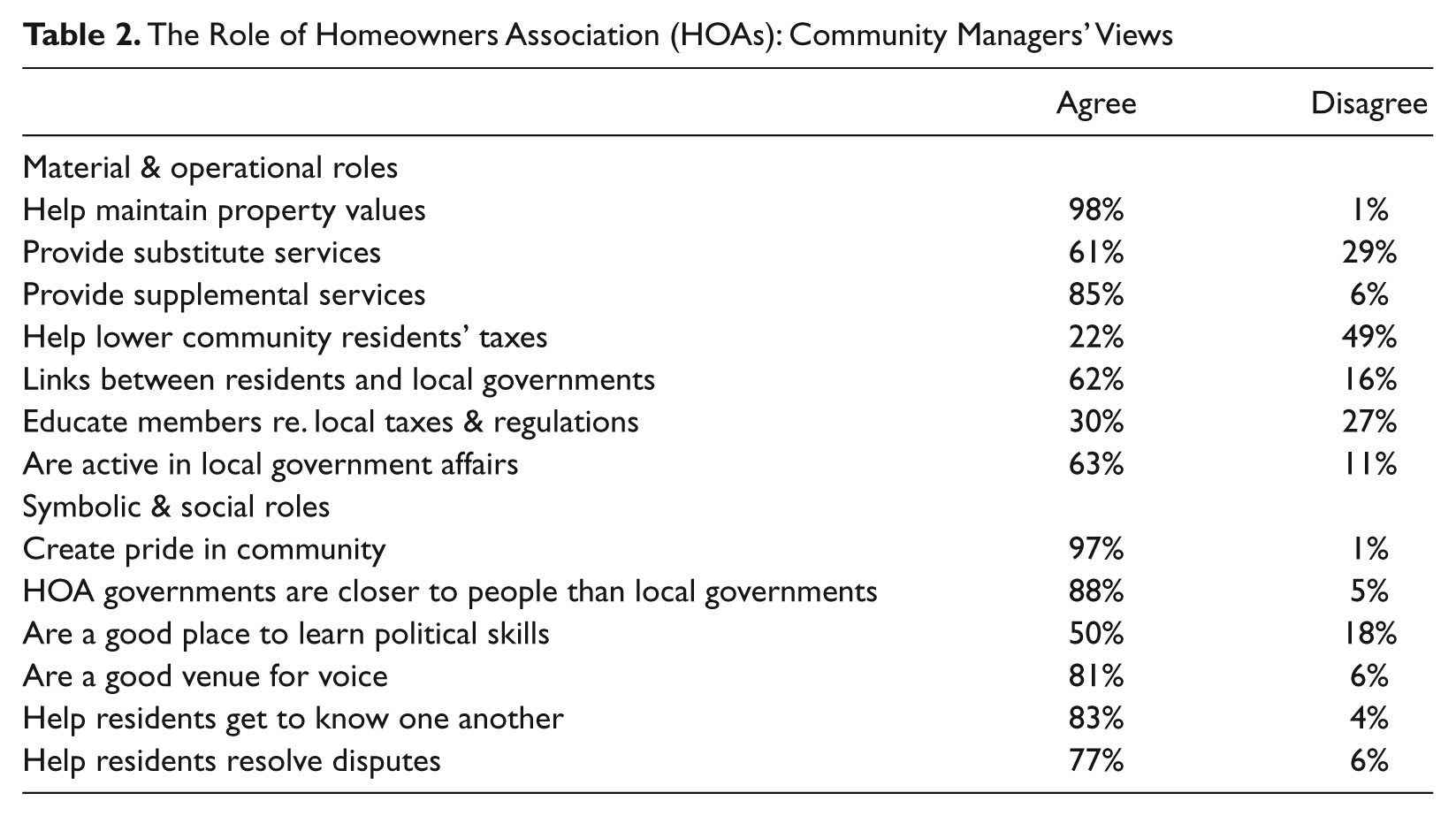
In addition, managers were asked to note their level of agreement with a series of statements about the HOAs that operated within their communities. The statements covered material, social, and symbolic actions. In many areas, there was little variation in community managers’ opinions. They were nearly unanimous in their belief that their HOAs help maintain property values (98% strongly agreed or agreed) and create community pride (97% strongly agreed or agreed). Nearly all the respondents (94%) also believed that residents turned to the community management, rather than to local governments, for problems within their neighborhoods. Generally, the managers gave their community’s HOAs high marks in providing government that is closer to the people than local governments (88%), providing a venue for citizens to voice their opinions (81%), helping residents get to know one another (83%), and assisting them in resolving disputes (77%; please see Table 2). Most managers felt that HOAs provided an effective link between the residents and local governments and reported that the HOAs were active in local government affairs. Local governments instigate some involvement with HOA communities, and candidates for local office are especially attentive. Local political candidates hold meetings in HOA communities, as 57% of the managers reported. In addition, some local governments contact the HOAs to involve residents in civic affairs (48%) or serve as volunteers (33%) (please see Table 1). Most managers did not see the HOAs as a vehicle for informing members about local taxes or regulations, and felt that services offered in the community did little to keep residents’ tax bills down (please see Table 2).
The Role of Homeowners Association (HOAs): Community Managers’ Views
Gates, Developer Control, and Location
Large HOA communities can be distinguished by at least three characteristics that create varying degrees of distance between the private community and its local government. Gated communities have been singled out as a “fortress America” (Blakely & Snyder, 1997) where residents retreat from the hoi polloi and the trials of civic life (Low, 2003). Gated communities, with more exclusive services, may represent a greater privatization of community interests than their ungated counterparts and create more distance between community residents and local government. Second, communities under the developer’s control may still fall under the purview of local governments seeking to affect their progress. In addition, developers sometimes subsidize community services when they control the community, leaving subsequent, resident-controlled boards ill-prepared to grapple with questions of service levels, quality, and cost (McKenzie, 1994). As a result, managers’ perceptions about local governments may differ in these community subtypes. Finally, HOA communities located in cities may have very different service demands than those in unincorporated areas (McCabe & Tao, 2006). The distance from local government may be much greater when HOAs are located in unincorporated areas than when they are in a city. These differences structure our statistical analysis.
Most managers (66%) reported their communities were entirely or partially gated, with the remainder counted as ungated. Information about the communities’ build-out determined whether the residents or the developer controlled the board. Roughly half (87) of the managers reported that their communities were completely built out, and another 29% (51) that their communities were 75% built out. We categorized the remaining communities as developer-dominated. Given the typical three-to-one voting advantage granted to developers over owners (Hyatt, 1985, 2000; McKenzie, 1994), 75% build-out represents a tipping point where the developers and residents share control of the board. Restricting the classification of developer-dominated communities to those between 0% and 50% built is a conservative measure, but one that assures that the developer indeed retains control of the association board. And finally, a total of 98 or 56% of the communities were located within incorporated municipalities.
Analysis
In addition to the data collected on the presence of gates, developer control, and incorporation, we were able to take advantage of the added inferential power of ordinal logistic regression to be used with our Likert-type scale measures for attitudinal responses. This simultaneously allows us to say more than would a typical Chi-square test, while avoiding the distortion usually rendered using an ordinary least squares (OLS) analysis for survey data. Because ordinal logistic regression is still not commonly used as a statistical method in public administration literature, we include a brief explanation of how it differs from OLS and regular logistic regression, and how to interpret coefficients.
Unlike OLS, which tries to minimize error (residuals) to maximize fit (the regression sum of squares), ordered logistic regression uses maximum likelihood estimation. Maximum likelihood estimates parameters based on the conditional probability that the dependent variable will demonstrate a particular state given the presence of independent variables. Using data collected, a likelihood function can estimate a parameter that maximizes the likelihood of the occurrence of the dependent variable. Intuitively, this is similar to the approach of OLS, where parameter statistics are generated by minimizing the residuals to find the best fitting linear relationship between the dependent variable and each of the independent variables, holding all other independent variables constant (Berry, 1993). Also, like OLS, the estimated parameters only describe the data in hand, which in most cases represents a sample of a larger population. Estimating parameters is only the first step. The second step is to determine the goodness of fit between the independent and dependent variables. Third, the question of whether the variables included in the estimation are relevant to the model is determined through the significance of the parameters. And finally, the interpretation of impact for the significant parameters can be determined. It is here that maximum likelihood estimation can differ substantially from OLS (Hosmer & Lemeshow, 2001, pp. 11-12).
For those familiar with techniques such as logistic regression (often called logit), this explanation will not differ much (Fox, 1997, Gujarati, 2003). Ordered logistic regression differs from logistic regression in only one respect: the dependent variable is ordinal, and therefore, each category of the variable is treated as a separate dichotomous measure. For example, if the dependent variable is measured as taking one of three mutually exclusive and exhaustive values, “low,” “medium” or “high,” then each case will be associated with only one of the three states. Ordered logistic regression then estimates parameters for two equations simultaneously: the first equation models the odds of the independent variables rendering a “low” response versus the odds of rendering a “medium” or “high” response; and, the second equation models the odds of the independent variable rendering a “low” or “medium” response versus the odds of rendering a “high” response. Thus it models cumulative probability (Agresti, 1989; Anderson, 1984; McCullagh, 1980), and the coefficients produced can be interpreted as explaining how the variance in the independent variables improves or reduces the likelihood, or odds, of the occurrence of each of the different states of the dependent variable. If the independent variables are dichotomous (such as “gated” and “ungated”), this can be a very powerful way to examine the degree to which belonging to one community versus another shifts attitudes about local government (Feinberg, 1980).
Expectations
To answer our questions of interest, we broke the data out into three separate comparisons of perceptions: (a) gated versus ungated communities; (b) developer-dominated versus board-run communities; and (c) communities in cities versus communities in unincorporated areas. Because we were primarily concerned with HOA community managers perceptions of local governments, we concentrated on the survey questions that asked HOA managers to characterize their relationships with local governments across a wide range of issues, including taxation, service provision, and political campaigning. These attitudinal responses were given for multipart questions 31 and 32 using a Likert-type scale, where responses were coded from 1 to 5 for “strongly agree” to “strongly disagree.” We also included a control variable for population, because there is substantial variation in the population of association communities. Thus the equation we are modeling is simple:

Where
Overall Findings
Using STATA to calculate our equations, we found several instances of significant differences between the categories of interest in terms of the public/private service divide and in terms of attitudes about local governments. For all but three of these instances, the population size was a significant factor as well (see Table 3), but the size of the impact was very small. For the three instances where population did not play a significant role, we interpret this to mean that regardless of size, HOAs in the category of interest responded differently in significant ways.
Significant Attitudinal Responses
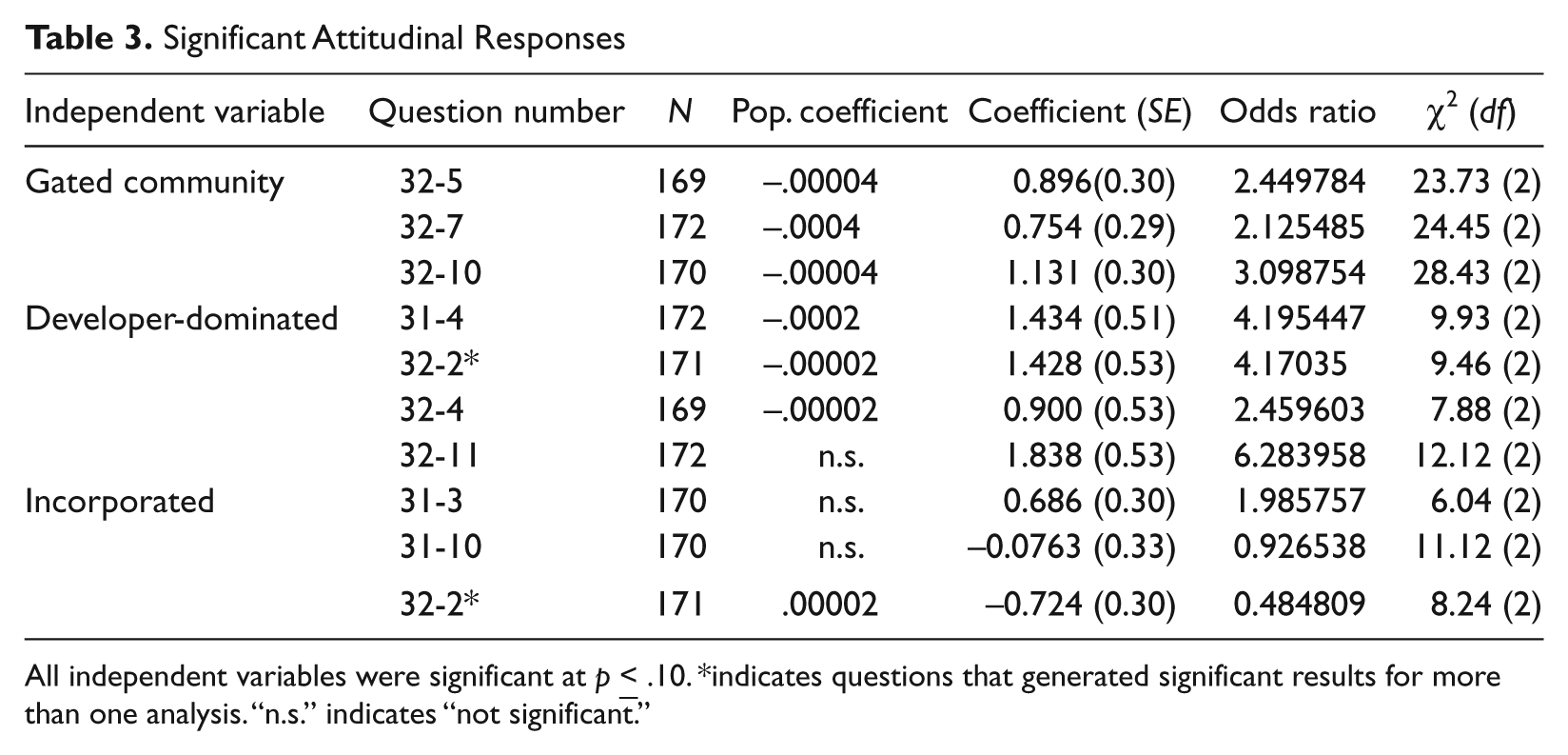
All independent variables were significant at p ≤ .10. *indicates questions that generated significant results for more than one analysis. “n.s.” indicates “not significant.”
There are three things that we found interesting about the overall findings. First, the three different categories demonstrated remarkably little overlap in terms of the causal variables (see Table 4). Second, out of a total of twenty-one questions, there were only three or four for each category that generated significant relationships between independent and dependent variables. Third, for ordered logit, the distribution of cases across the independent variables can affect the goodness of fit measures in unusual ways—when the independent categories have relatively equal distribution of cases, as in the “gated” analysis, the Chi-squared measures are generally stronger. The unequal distribution of cases in the board domination and community location analyses led to significant model performance, but at lower levels of significance.
Significant Survey Questions
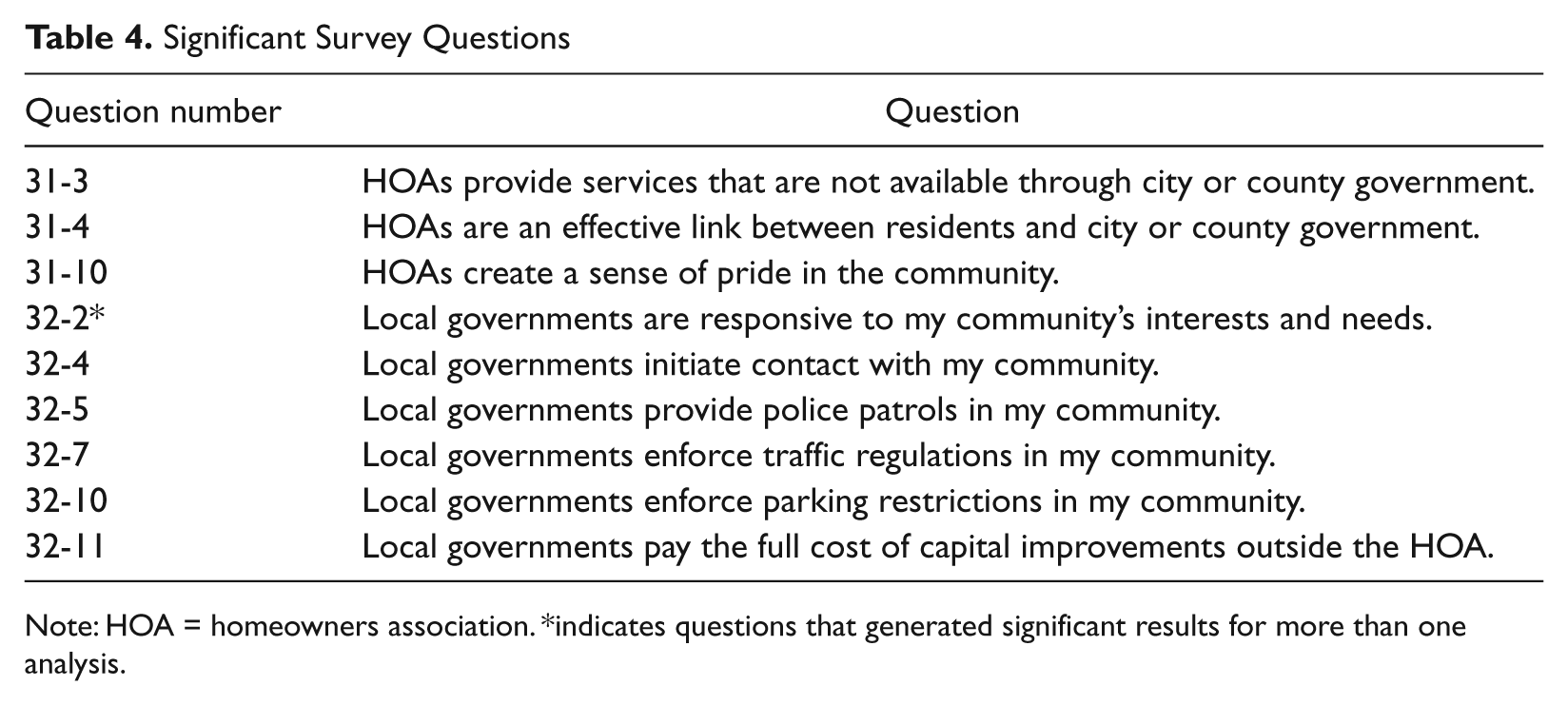
Note: HOA = homeowners association. *indicates questions that generated significant results for more than one analysis.
Results for Gated Communities
Gated communities have been hypothesized to be the epitome of secession from the broader civic fabric of society. As often as they are portrayed as enclaves of seclusion and privilege, however, they are also held up as model experiments in Tiebout sorting, matching residents with the exclusive services they require and for which they are therefore willing to pay (Agan & Tabarrok, 2005). Are they really that different? Our analysis seems to indicate that they are, especially as they get larger, but perhaps not to the extent that present literature argues.
As indicated in Table 3, we are reporting the results that were significant for each category of interest. For gated communities, the responses to three questions yielded significant results. Gated communities were more likely to provide their own security force (Question 32-5), enforce their own traffic regulations (Question 32-7), and to enforce their own parking regulations (Question 32-10) than their ungated counterparts. The magnitude of this likelihood can also be stated by taking the exponent of the coefficients, so we can say that gated communities would be, for example, 1.131 times more likely than ungated communities to disagree that local governments enforce parking restrictions. Although these may seem somewhat trivial, the pattern is rather striking. Clearly, within gated communities, the perceptions of jurisdiction are different. One of the clear mandates that gated communities perceive as theirs is the provision of security and the maintenance of order.
Results for Developer-Controlled Communities
Some of the more surprising results came out of the comparisons of developer-controlled communities (less than 50% ownership by homeowners) and communities that were “built out” (75% or more homes bought by homeowners). On four questions, communities that were still controlled by the developer had significantly different responses to communities that were controlled by residents. HOAs that were developer-controlled were more likely than their owner counterparts to disagree with the following statements, “HOAs are an effective link between residents and city or county government” (four times), “Local governments are responsive to my community’s interests and needs”(four times), “Local governments initiate contact with my community to involve residents in civic affairs”(two times), and “Local governments pay the full cost of capital improvements outside the borders of my community.” In fact, managers from developer-controlled communities were more than six times more likely as those from owner-dominated communities to disagree with the last statement (please see Table 3).
These findings are interesting for two reasons in particular. First, private governments are seen as a matter of concern because of the perception of common self-interest being served between developers and local governments by the creation of such entities. If a developer approaches a local government with a proposal that will turn present nonrevenue yielding property into a source of revenue for many years to come, both parties see themselves as winners. Thus, one would expect initial relations to be good as both parties benefit. This is not reflected in our findings. Second, one might expect developers to see themselves as working closely with local government officials to ensure good relations over an extended period of time. Our findings refute the expected sense of bonhomie.
We see two possible explanations. First is the nature of the distribution of cases across the two categories. There are far more owner-dominated communities than developer-dominated communities in our sample (135 to 36, or a ratio of ~3.5 to 1), thus potentially skewing the analysis by underrepresenting the views of managers in developer-dominated communities. Second, it could be that developers are in this for the short-term: create a community, concentrate on selling off units, get out as quickly as possible to maximize return and move on. Thus investing themselves in the cultivation of good working relationships with local government officials may be viewed as inefficient. This may be especially true if there is high turnover among local politicians.
Results for HOAs in Cities
The last set of comparisons examined differences between HOAs located within cities or unincorporated areas. For Question 31 (see Table 3), the differences in location were evident in two sets of responses: whether HOAs provided services not provided by local government (31-3); and whether HOAs fostered a sense of pride (Q31-10). For Question 32, only one question yielded significant differences—whether the local government was responsive to community needs (Q32-2). In contrast to previous categories, HOAs in incorporated areas were more likely to agree with statements (negative coefficients) than HOAs in unincorporated areas, suggesting that in cities, where governments were literally closer, respondents saw their communities as distinct entities that were providing a sense of collective identity. Finally, HOAs within incorporated areas found their local governments to be responsive to a much greater degree (nearly twice as much) than their unincorporated counterparts.
Discussion and Conclusions
In the most extreme case, local governments in the hollow state would operate as empty shells that arrange for but neither produce nor disseminate services. Suburban cities that grew rapidly over the 1990s and early 2000s and rely extensively on HOAs to provide urban services, at least at the neighborhood level (Lang & Lefurgy, 2007), approximate this organizational approach. This transformation clearly privatizes urban services but it fails to fit within the outlines of the hollow state.
Syntheses of more than 20 years of literature on the hollow state have identified its key characteristics, few of which apply neatly to the HOA communities we studied. Milward and Provan (2000) drew from their research to pinpoint three hallmarks: divorcing government funding and service delivery; jointly producing services; and arranging networks, rather than managing a hierarchy of service providers. In the hollow state, government’s service provision role is monetary, and funds can pass through layers of public, private, or nonprofit entities before services actually reach the recipient. Two correlates follow from these principles: increased distance between government action and service delivery and a greater reliance on nonprofit organizations as service providers (Barbieri & Salvatore, 2010). The HOA communities we studied meet few of these criteria.
Most HOAs are nonprofit organizations and HOA communities provide their residents with services, some of which local governments may have provided before the advent of private governments. In the true hollow state model, local governments would procure but not produce community services, but this is not the case here. Instead, local governments shed monetary responsibility for HOA services, which need not adhere to the standards that local governments must follow (McCabe, 2006). HOA residents pay for their communities’ services through assessments and fees, without local government oversight. Local governments retain fiscal responsibility for public goods and services outside the HOA community boundaries, according to our survey, and continue to provide services such as police protection jurisdiction-wide. In addition, local governments neither share revenues nor provide grants to the communities we studied. In our study, urban services were jointly—but most often separately—produced between the HOA community and local governments.
As for the final characteristic, government’s role in the hollow state involves arranging networks of service providers. Public managers may have assumed this role in providing urban services through HOAs, but this is an empirical question that has yet to be addressed. Urban services in the boomburbs could be coordinated so that HOA communities provide their own private services, but local governments knit the communities together with public services. However, local governments may take a more laissez faire approach and use their regulatory processes simply to allow HOA communities to emerge, bit by bit (McCabe, 2011). Carlee (2011, 550) sees HOAs as another expression of the “dynamic and creative nature” of American local government in which new independent entities are established in lieu of seeking systematic, centralized reform.
HOA communities are private governments, not yet another example of the hollow state. Their service provision is not distant from the recipients, and their legal structure prevents the accountability and legitimacy issues that plague the hollow state in two distinct ways. First, residents’ buying property in an HOA community are parties to an agreement that makes them members of the association. Second, HOA members elect their boards of directors and can assume leadership roles in the organization themselves. Community managers believe HOAs create governments that are closer to the people than local governments are.
The analyses presented here offer a complex look at an increasingly ubiquitous phenomenon. There is some support for the proposition that gated HOAs create enclaves of security. However, whether this means that such enclaves are civically disengaged is far from clear. There are no distinctions between gated and ungated communities in terms of local governments’—or local political candidates’—efforts to engage them. But the political variables in our analysis were tied to population, not necessarily to signs of privilege. Local politicians do pay attention to HOAs, but apparently not because of the draw of elite politics. If anything, our analysis suggests that numbers still win the day in local politics.
In their relations with local governments, there is evidence that local governments and HOAs cooperate rather than compete in areas where they share jurisdiction. However, the survey also indicates that HOAs do not necessarily see local governments as “good neighbors” when the HOAs are still governed by developers. This could be an indication that local governments, despite the shared incentives offered by development, are not the ever-willing partners they are often portrayed to be. If the relationship between developers and local governments is less than cozy, this may be an indication of good governance rather than the opposite.
Once a community has filled, it is more likely to have links with local governments. This could indicate that rather than enclaves of secession, HOAs may actually serve as training grounds for democratic action. There are indeed many critics within the HOA community that decry the very things that Agan and Tabarrok (2005) argue contribute to the success of HOAs in maintaining property values: the enforcement of restrictive covenants and the regulation of the commons. If residents see such restrictions as oppressive or an infringement of their property rights, they may resort to processes long familiar to political scientists: organize, heighten the visibility of issues, seek to garner support to induce change, and increase participation in the governance process. As such, they may see local governments as sources of information on the process, if not content, of democratic accountability.
Footnotes
Declaration of Conflicting Interests
The author(s) declared no potential conflicts of interest with respect to the research, authorship, and/or publication of this article.
Funding
The author(s) received no financial support for the research, authorship, and/or publication of this article.