






Abstract
Participation in collaborative advocacy organizations is one of the most common advocacy tactics pursued by nonprofit organizations. However, field-level dynamics and norms around collaboration may be changing with the growth of public-private intermediary organizations. Using a lens that brings together theories of structuration and institutional entrepreneurship, this research investigates (a) how intermediary organizations structure advocacy opportunities and institutionalize new advocacy practices at the field level, and (b) how member organizations interpret those opportunities and practices. Qualitative findings from a regional homeless services policy field demonstrate that intermediary organizations gain members and thus, power, based on their position in the policy field and through their ability to connect members to valuable government contacts. In this field, participation in public-private intermediary organizations has surpassed involvement in traditional advocacy coalitions as providers are motivated to meet organizational legitimacy goals as much as advocacy goals.
Keywords
With the growth in privatization and devolution, nonprofits have become increasingly responsible for the bulk of social service delivery in the United States and are often dependent on government funds to do that work (Smith & Lipsky, 1993). As a result, there has also been growth in a variety of collaborative governance processes intended to increase sharing of responsibility and incorporate nonprofit service providers as stakeholders in funding and policy decision making (Ansell & Gash, 2008). Collaborative governance processes provide opportunities for service providers in the form of access to resources, policy makers, and information. Because of this, they also play an important, but frequently unrecognized, role in facilitating policy advocacy involvement. By serving as a formal mechanism for connecting service providers with policy makers, collaborative governance processes have the potential to greatly expand the advocacy engagement of ground-level providers.
This may be particularly true when these governance processes or structures take the form of intermediary organizations, which Honig (2004, p. 66) defines as “organizations that operate between policy makers and policy implementers to enable changes in roles and practices for both parties.” 1 Intermediary organizations are generally not formed exclusively for the purpose of advocacy but rather to coordinate public and private systems of care in a geographic region or field of practice and their use is growing rapidly (Shea, 2011). These collaborative organizations intentionally include participants from both the public and private sectors and serve several different functions, including helping member organizations access funding, improve services, expand the reach of their programs, and engage in policy advocacy (Bruton & Williamson, 2005; Sandfort, 2011).
These groups may be important outlets for advocacy because collaboration, generally, has long been cited as an ideal way for nonprofit organizations with limited resources to become involved in policy advocacy (Andrews & Edwards, 2004). Research indicates 66% to 87% of nonprofits are involved in such collaborations (Salamon, Geller, & Lorentz, 2008). Nonprofits in human services fields may find themselves particularly reliant on collaboration for advocacy as they face severe time and resource constraints and must balance advocacy participation with their main activity of service provision (Salamon et al., 2008).
In the literature on advocacy collaboration, however, scholars have paid little attention to the role of intermediary organizations. This article addresses that gap by demonstrating how intermediary organizations may be changing the way that human service providers participate in advocacy collaboration. This research investigates how different types of collaborative organizations (e.g., coalitions, intermediary organizations) position themselves in the policy field, how member organizations choose between collaborative opportunities in order to gain legitimacy, and how this process shapes the practice of advocacy in the organizational field. Understanding more about this process is important because as intermediary organizations grow in popularity and more providers are participating in them they may be replacing other forms of advocacy involvement, changing the way that advocacy is understood and performed in the nonprofit human services sector. For example, their reshaping of the field may have implications for whose voices are heard and what policy priorities are advanced.
Much of the research on collaboration has focused on the effectiveness or outcomes of collaborative advocacy work. This research differs in that it focuses on collaboration as an institutional process with important implications for field restructuring and the shaping of advocacy practices (Phillips, Lawrence, & Hardy, 2000). I argue that intermediary organizations are new organizational forms that play a powerful role in the structuration of organizational fields. Although theory would predict that these organizations shape institutional environments, it provides little guidance as to how or in what ways. This research fills that gap by exploring how a particular intermediary organization type—Department of Housing and Urban Development (HUD) mandated Continuums of Care (CoCs)—has reshaped the organizational field for homeless service providers and the implications of that for advocacy involvement. It shows how CoCs take advantage of their institutional and structural position to shape nonprofit advocacy, and, in doing so, reveals how nonprofit providers experience the utility of membership in collaborative organizations and the implications of that for nonprofit advocacy.
Using qualitative data from a study of homeless service organizations in Chicago, three research questions are addressed. First, why do providers become more heavily involved in some collaborations more than others? Second, in what ways do intermediary organizations serve to constrain and enable advocacy involvement by individual organizations? Third, how does the existence and action of these groups—along with the simultaneous action of their members—shape the structure and dynamics of advocacy in the organizational field?
Overall, findings demonstrate that the institutional power and legitimacy possessed by intermediary organizations is strongly attractive to service providers for material and symbolic reasons. Materially, members see these organizations as being able to better broker government funding resources than other kinds of advocacy collaboratives. Symbolically, members see opportunities to gain legitimacy for their own organizations by virtue of being associated with an intermediary. Because of the limited time and resources they have to devote to advocacy, however, this means that service providers participate in intermediary organizations at the expense of other, more direct, modes of advocacy engagement. This both enables and constrains advocacy in the sector in that it allows for a more organized voice at the field level but focuses advocacy activities on maintaining funding streams over challenging current policy priorities.
Collaboration in an Advocacy Context
Collaboration has been defined as “a cooperative relationship between organizations that relies on neither market nor hierarchical mechanisms of control” (Phillips et al., 2000, p. 24). As such, there are many ways that nonprofit providers can collaborate on advocacy, but collaborating through provider-led coalitions has long been the norm in human service fields. These groups, generally comprised of service providers operating in the same policy field and geographic location, allow providers to share information and join forces to resist or promote specific policy changes. They are generally assumed to be operating outside of government, perhaps as an adversarial party (Dluhy, 1990).
Another outlet for advocacy collaboration is membership in an independent advocacy organization. These organizations can vary from issue-based advocates, such as the National Coalition Against Domestic Violence, to associations of organizations working in a specific policy field (e.g., mental health, etc.) that function as trade associations, to state and national associations of nonprofits. There is evidence that these groups may be growing in both number and strength (Balassiano & Chandler, 2010). They are distinct from coalitions because they are generally formed as independent organizations with a professional staff. They often provide issue alerts and public policy information to a wide network of member or affiliate organizations. Like coalitions, they operate outside of government, often in an established interest group role.
Increased formal and informal collaboration between government agencies and service providers, however, may be affecting the way that collaborative advocacy is performed in the human services. The growth of government contracting and collaborative governance means nonprofit providers are no longer situated “outside” of government (if they ever were), and can be better understood as partners with it (Salamon, 1995). In this paper, I argue that the growth of intermediary organizations may be creating important new opportunities for providers to advocate within the system itself, changing how collaboration on advocacy is done.
Attention to the role of intermediary organizations has been growing, along with their use (Benjamin, 2010; Bruton & Williamson, 2005; Shea, 2011). These intentionally collaborative organizations, which are often private but can be housed in the public sector, operate in many fields besides homeless services, including community development (Glickman & Servon, 1998), mental health (Provan & Milward, 2001), and education (Honig, 2004). Public sector interest in creating intermediary organizations has grown particularly in highly privatized fields where nonprofits provide large amounts of government-funded services. Overall, the role of intermediary organizations is to coordinate services and serve as a clearinghouse for information and resources (Shea, 2011). Specific tasks include providing technical assistance, facilitating peer learning, distributing resources, and facilitating advocacy (Sandfort, 2011).
This article focuses on the advocacy role of intermediary organizations. Although not all see themselves as advocates, intermediary organizations serve an important role in completing the feedback loop between service providers and funding agencies about implementation challenges. They often work to raise policy awareness among members and some actively participate in lobbying and other advocacy tactics. Their established and formal connections with government partners provide a uniquely powerful pathway through which providers can make their voices heard. Through membership in these organizations, providers have greater access to policy makers and heightened legitimacy as coproducers of public policy and regulations.
The importance of their role to both government actors and individual providers allows them to aggregate legitimacy, giving them a particularly privileged position in the policy field. That said, their interstitial location also means that they can be held responsible for shaping or narrowing agendas, imperfectly communicating information, or otherwise serving one party’s interests over another (Benjamin, 2010; Shea, 2011). The sometimes contradictory demands placed on these organizations—upwards accountability to government and downwards accountability to providers—are particularly visible in the context of advocacy where values and goals may explicitly clash (Bruton & Williamson, 2005).
Institutional Entrepreneurship and the Institutionalization of Advocacy
New institutional theory posits that organizational behavior, such as advocacy, is largely shaped by the socially constructed values, norms, and practices that dominate in its institutional environment (DiMaggio & Powell, 1983; Meyer & Rowan, 1977; Zucker, 1977). Because organizations in the same field are subject to largely the same pressures, they become isomorphic to one another through coercive (e.g., regulatory pressures), normative (e.g., professional beliefs), and mimetic (e.g., legitimacy seeking) processes (DiMaggio & Powell, 1983). This affects collaborative advocacy activity in that specific modes of collaboration become accepted and understood as the norm in particular organizational fields (Alter & Hage, 1993). In the human services that has traditionally been provider-led coalitions. This article explores how the growth of intermediary organizations may be changing that.
Despite its popularity and utility in explaining organizational action, new institutional theory has been critiqued for its lack of attention to issues of agency and change (Clemens & Cook, 1999; Oliver, 1991). In response, scholars have proposed the notion of the institutional entrepreneur to explain how certain actors are empowered to challenge existing institutions and shape them to their interests (DiMaggio, 1988). Institutional entrepreneurs are actors that take advantage of contradictory institutional logics (Rao & Giorgi, 2006) and privileged position (Battilana, 2006) to shape organizational fields. While much of the current literature has examined the conditions that give rise to opportunities for institutional entrepreneurship, few have studied their effects, that is, how organizations in the field respond to institutional entrepreneurship efforts. This article examines the outcomes of institutional entrepreneurship by showing how organizations in the field of homeless services have responded to the institutional entrepreneurship efforts of an intermediary organization.
Institutions and organizational fields are the outcome of structuration processes (Barley & Tolbert, 1997; DiMaggio & Powell, 1983; Giddens, 1984). Structuration theory informs this study by suggesting that how and why advocacy is participated in changes over time, as a result of individual agencies choosing a different set of practices and those practices then strengthening structures that reinforce that pattern of behavior (Sewell, 1992). Structuration theory helps us see that through a structural change in the way that advocacy is being done (e.g., advocacy through participation in intermediary organizations) organizations have changed their conceptions of how and why they should participate in advocacy. Specifically, as agencies have chosen to join with a local intermediary organization, they have come to see advocacy as a more professionalized, insider activity focused largely around maintenance of government contracts.
Recent conceptual work has suggested that interorganizational networks are essential to understanding the structuration process in organizational fields (McQuarrie & Marwell, 2009; Stone & Sandfort, 2009). Phillips et al. (2000) point out that while institutional fields provide the rules and norms by which collaborative practices operate, collaboration can also be a powerful tool for reproducing or altering those rules and norms. I argue here that this may be particularly true in the social services and also when it comes to advocacy. Because advocacy, as an activity, includes attempts to shape field level norms and practices, it may be a particularly useful way to explore the structuration process (Scott, Deschenes, Hopkins, Newman, & McLaughlin, 2006).
Hardy and Phillips (1998) suggest that three forms of power are particularly important in understanding the dynamics of collaborative activity in organizational fields: formal authority, the control of critical resources, and legitimacy. Collaborative structures that possess these forms of power (such as intermediary organizations) are able to work as institutional entrepreneurs and contribute to reshaping organizational fields in ways that less powerful actors cannot. This is partly because these forms of power allow them to drive coercive, mimetic, or normative isomorphism (Phillips et al., 2000). Furthermore, collaborations that combine members of different organizational fields (such as intermediary organizations) are thought to be more likely to produce new field-level norms than collaborations where all members are part of the same field (such as is the case with coalitions and advocacy organizations; Phillips et al., 2000).
Homeless Services as a Policy Field
This research investigates these processes in the field of homeless services. Research on advocacy in specific policy fields is useful as it focuses attention on how the policy environment shapes organizational networks, strategy, and interests (Scott et al., 2006). Organizations are embedded within specific policy contexts; to understand organizational decision making, that policy context must be made explicit (Stone & Sandfort, 2009).
The field of homeless services provides a rich example in which to study these trends. Although charitable organizations have long provided relief for the homeless, in the United States homelessness really emerged as a policy field with the passage of the Stewart B. McKinney Homeless Assistance Act (later renamed the McKinney-Vento Homeless Assistance Act) in 1987. This was the first federal law to specifically address and fund assistance to the homeless. With this law, federal spending for homeless services went from virtually zero in 1986, to US$2.1 billion projected for fiscal year 2011-2012. Today, most homeless services are supported through this funding mechanism, administered by the federal Department of Housing and Urban Development (HUD).
Initially, individual providers applied directly to HUD for these funds. Beginning in 1994, however, to encourage community-wide planning and coordination, HUD began to require providers in local communities to come together to submit a single application, known as the Continuum of Care (CoC) application. However, the CoC was not just a process but also a mandate for a new formal organizational structure. Local communities must identify a lead agency, decide how regions will be broken up, and create an inclusive governance structure. Thus, CoCs are best understood as intermediary organizations, brought about by HUDs efforts to advance collaborative governance. Other fields that use a similar process (to a greater or lesser degree) include mental health and early childhood education.
CoCs have two main tasks: (a) facilitating regional coordination and planning, and (b) conducting long range strategic planning and year round oversight. In many regions, including Chicago, they are also in charge of administering and tracking progress on municipal 10-Year Plans to End Homelessness. Little empirical data exists on their advocacy role. Many do participate actively in advocacy, however, with a substantial portion being formed out of existing advocacy coalitions or including advocacy explicitly in their mission statements. Otherwise, although over 500 CoCs have been created in the United States in the last 15 years, they have received very little scholarly attention.
Method
One regional policy field, homeless services in the city of Chicago, was selected for study to maximize understanding of how the field-level policy context and other specific environmental conditions may affect advocacy involvement in collaborative organizations. A qualitative approach was chosen as the most appropriate method for understanding the nuances of institutional change and the processes behind institutional entrepreneurship. Data was collected primarily from in-depth interviews with directors of individual homeless service agencies as well as key staff in local collaborative organizations. I also conducted participant observation at various coalition meetings and field-level gatherings from 2008 through 2011.
Homeless service nonprofits were defined as those organizations with 501(c)(3) status where at least one of the organizations’ three largest programs specifically focused on serving the homeless. These organizations ranged from small emergency shelters to large multiservice providers. All the organizations in this study were primarily focused on direct service provision, not advocacy. Using databases and membership lists maintained by the National Center for Charitable Statistics, GuideStar and the Chicago Alliance to End Homelessness, 84 such organizations were identified as currently operating in the city in August of 2008.
The sampling procedure was designed to produce findings representative of this relatively small population. To ensure that both large and small organizations were represented, the population was first stratified by size (as measured by expenditures) into seven groups. Organizations of different types (e.g., food pantries, shelters, youth-specific) were then randomly chosen out of each group to ensure diversity in type of service area. This process resulted in an initial sample of 52 organizations.
Executive directors were selected as interviewees because most organizations did not have a specific staff member to oversee advocacy, and the executive director was thought to have the best overall understanding of agency functioning and collaborative partners. A letter was sent to each organization selected for the study, notifying them of their inclusion. Executive directors were then contacted by telephone to schedule an interview. In-depth semistructured interviews were conducted face-to-face at each organization. The interviews lasted an average of 1.25 hr and focused on the organization’s participation in policy advocacy, the reasons behind the organization’s advocacy choices, and the organization’s structure, finances, and collaborations with other organizations. Ultimately, 42 directors could be contacted, agreed to participate, and were interviewed. The response rate was 81% with data collected from exactly half of the population of homeless service nonprofits in Chicago.
From these interviews the names of relevant collaborative organizations were generated. Collaborative organizations that were mentioned by more than two respondents were then contacted for interviews. These interviews were held in-person with relevant staff of the collaborative organizations. These interviews also lasted between 1 and 2 hr and focused on the organizations history, advocacy posture, recent campaigns, and membership strategy.
All interviews were digitally recorded, professionally transcribed, and then downloaded into Nvivo 8, a software package that was used to facilitate data management and analysis. An explanation-building technique similar to that described by Yin (2009) was used as the primary analytic method. This process entailed considering a series of initial theoretical explanations about both collaborative advocacy behavior and then iteratively revising those explanations with themes that emerged from the data (Aronson, 1995). The coding scheme used both inductive and deductive techniques in that theory driven codes were used to initially cut and analyze the data and then transcripts were coded inductively using a data-driven approach (Patton, 2002). This coding scheme was developed using an iterative process with each transcript read and coded multiple times by two researchers as codes were refined and combined.
Extensive memoing was used throughout the analytic process. Memos were written for each case directly after each interview and then again during the analysis phase. Memos were also written on emergent themes relating to collaborative activity and potential connections to theory (Miles & Huberman, 1994). Field notes from the participant observation were used in the memos to contextualize and add nuance to themes that emerged from the interviews. Member checking was completed near the end of the analysis to heighten the rigor of this analysis (Padgett, 2008). This was done in two ways. First, an initial report reflecting major themes from the analysis was shared with all respondents and feedback was requested. Second, findings were discussed in person with organizational representatives attending advocacy coalition meetings. Unless otherwise indicated, quotes used in this article were chosen for their representativeness.
Findings
Data from the interviews reveal a clear portrait of the importance of collaboration for advocacy involvement in this field. Engagement in advocacy was very high (93%, N = 39) and every provider who reported involvement in advocacy also reported involvement in collaborative advocacy organizations. For almost half of those that advocated (46%), the only advocacy they did was through collaboration.
However, participation in traditional provider-led coalitions was not the primary way service providers collaborated on advocacy. Instead, respondents were overwhelmingly referring to participation in two independent organizations: an advocacy organization and the regional CoC intermediary organization. Both are formal, have their own professional staff, raise their own money, and have limited accountability to their memberships. Each of these groups was mentioned by 74% of those organizations that advocated. By contrast, one other group—the only true “coalition”—was mentioned by about 20% (all from a specific subfield) and no other group was mentioned by more than two respondents. Clearly, these two organizations occupy privileged positions when it comes to coordinating advocacy in the field. They are the focus of this article. Below are brief descriptions of each, a summary of which can be found in Table 1.
Overview of Coalitions Playing a Major Advocacy Role.
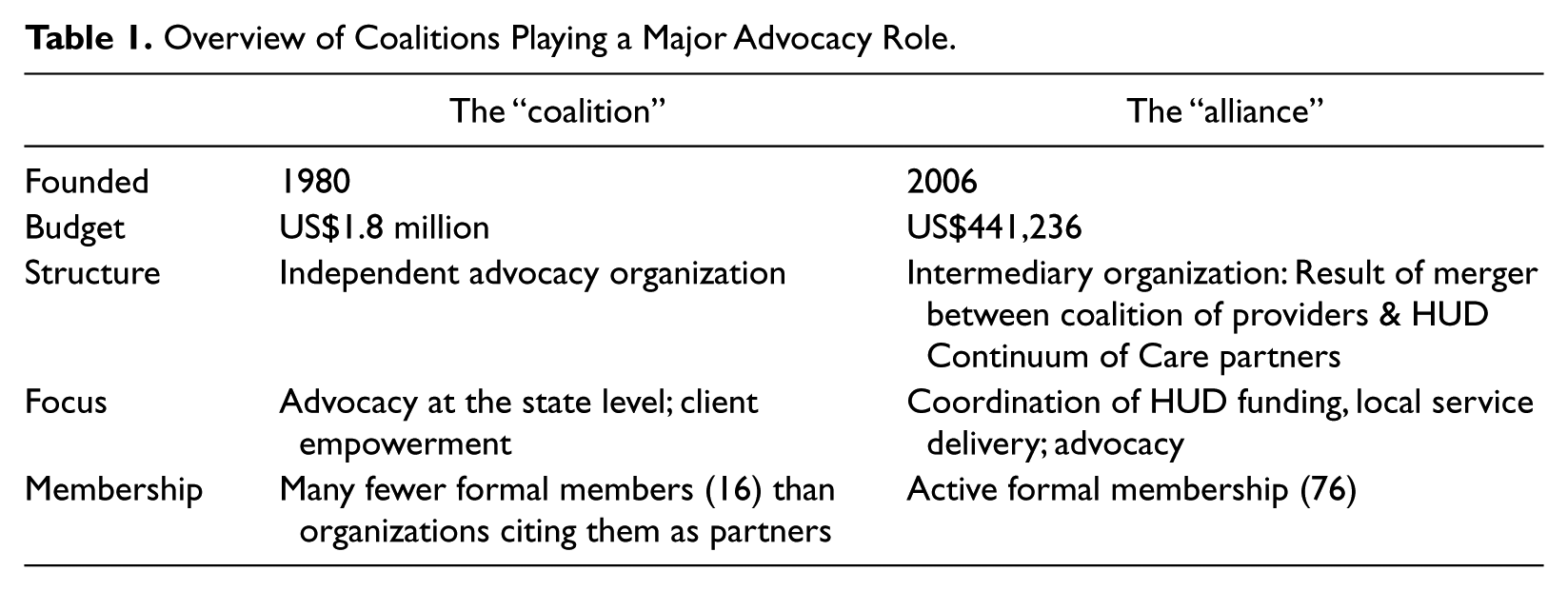
The Chicago Coalition for the Homeless: Founded in 1980, this freestanding advocacy organization had a 1.8 million dollar budget in 2008, comprised entirely of private donations. They focus their advocacy energies at the state level and are known for their efforts to mobilize and train people who are or have been homeless to become involved in advocacy. Service providers can become “members” by giving them a US$50 donation, but few do so. Only 16 local providers were listed as formal members at the time of data collection although many more providers indicated that they collaborated with them, often by serving on various campaign committees. That said, they have little actual influence over organizational governance decisions.
The Chicago Alliance to End Homelessness: Founded in 2006, this intermediary organization is the result of a merger between a large coalition of service providers called the Partnership to End Homelessness, and the city’s Continuum of Care process. Thus its roots are in both a traditional “coalition” model and a government coordinated model. They focus their advocacy energy at the local and federal level. Their budget in 2008 was only US$441,236, and included government funding. In 2010 they had 76 formal members—almost every provider in the city. These members pay dues up to US$500. Alliance members are involved in a variety of different committees, which are advisory to the board of directors, so there is some (though not complete) accountability to the membership.
Although both organizations had many providers claim to collaborate with them, when probed more deeply, providers were much more involved in the Alliance than the Coalition. Many managers served on one or more committees at the Alliance and most others attended meetings regularly and spoke knowledgeably about the Alliance’s recent activity. This participation was often integrated into their agency in very fundamental ways. For example, one manager noted that “In terms of organized advocacy, I encourage my senior staff to all become a part of the greater fabric of the city. They’re all involved in planning groups in the Chicago Alliance to End Homelessness—the continuum of care.”
On the other hand, most providers who said they were involved with the Coalition were often only involved to the extent that their clients were and did not personally have much interaction with them. For example, one manager reported,
I don’t [have much interaction with the coalition]. I read their materials. They had a presentation; about eight months ago, I went to one of them. I don’t know them very well, but we certainly use their materials in our grants. We pay our membership; we belong to it.
Another said,
We’ve been members (of the Coalition); I’m not sure if we’re members now. I know that when things get tight financially sometimes we’ve dropped out. But I see them all the time and I think they’re terrific, I support their work.
Thus, managers appreciate the Coalition and support them, but their support is much more symbolic and casual in comparison to their active day-to-day participation in the Alliance.
In fact, many reported that they had recently chosen to become more involved with the Alliance and less involved with the Coalition, often for material reasons. As one manager noted,
There was a time when Chicago Coalition for the Homeless was the only advocacy group around homelessness in the city, so every organization that was involved in homelessness would have been a member. That was pretty standard. But then, the Alliance, they’re who also oversees the distribution of the HUD funding that comes to Chicago, so if you want your HUD money, you know, you’re involved with them now.
Another supported this thought when she said,
I mean I am interested in the Coalition. I really do think that they’re great. I had a relationship with them in the past and worked with them on various committees and stuff. But I haven’t been so involved. Just because I’m focusing more on the Chicago Alliance and not so much on the Coalition because that’s what I’m able to do.
Interestingly, despite their arms-length involvement, as the last quote indicated, when asked how they felt about the activities of these groups, it was clear that from an advocacy perspective many felt that the advocacy conducted by the Coalition was vital to the success of their field. As one provider tellingly noted,
The Alliance—it’s a fine balance. They are more tied to the city, Chicago Department of Housing, they want to get grants from them. The Coalition doesn’t have that, so they’re a little bit freer to say what they think, to carry a bigger bat, take the gloves off a little. And I think that’s important . . . I would say it’s more effective, because they’re not limited by working with different government agencies to get the money.
Many organizations agreed that “The Coalition for the Homeless is very active, very forefront in advocacy . . . I think they’re very effective.” On the other hand, they also agreed with the sentiment behind this statement about the Alliance, “They are trying, but I think they are protectionist rather than taking a more positive vision of ‘this is what we need.’”
Institutional Power and the Rise of the Alliance
Why, if providers had such respect for the Coalition, were they more involved in Alliance? First, most service providers had time and resource constraints that limited their ability to meaningfully participate in more than one collaborative organization. Almost all managers were clear that although they would like to be more involved in collaborative advocacy work, they simply didn’t have the time and felt they needed to choose between groups. Second, they chose the Alliance to be that organization because they felt they “had” be involved in the Alliance, that they would be perceived as less legitimate if they did not participate. More specifically, in their view, membership in the Alliance was necessary for material, symbolic, and structural reasons: (a) to maintain funding, (b) to maintain legitimacy, and (c) networking opportunities. In other words, they chose this outlet not because of synergy in regard to advocacy goals but for very instrumental reasons related to institutional concerns and organizational maintenance.
The sense the providers had that participation in the Alliance was vital to organizational success is a reflection of this organization’s formal authority, high degree of institutional legitimacy, and power over needed resources (Hardy & Philips, 1998). The Alliance was imbued with this power from the start because of the legitimacy derived from its association with HUD, the major funder in the field, the fact that it emerged from the popular old providers association, and its high degree of institutional embeddedness in city and federal government. As a result of these factors, the Alliance is institutionally and structurally positioned to have the strongest voice in terms of communicating norms and expectations for the field. These are expressed through coercive, normative, and mimetic mechanisms (DiMaggio & Powell, 1983).
First, the Alliance has close ties to government funders, both structurally and institutionally. Because so many homeless service providers are at least partially funded by HUD (about 83% of respondents), and because the Alliance has some control over those funds, if an organization wants to have a say in their dispersal then it is necessary to be involved in the Alliance. Furthermore, managers believe being involved in the Alliance will increase their personal access to government decision makers and promote attention to their service population—homeless youth, for example, as opposed to the chronically homeless. One manager explained this by saying,
It’s obviously very important to be involved with the Alliance because it’s where a big chunk of our funding comes through. It’s making the decisions about what kinds of organizations or programs are going to be valued, how the rankings are going to be done. So we have a very real interest in being a part of it.
In this way the Alliance’s regulatory and funding role creates coercive pressure for organizations to become involved.
Second, managers believed that membership in the Alliance would help them become more integrated into the field and be seen as “serious players.” Organizational leaders felt that involvement in the Alliance would increase their legitimacy in both the policy field and the community of providers. To not be involved in the Alliance effectively meant isolation from the professional community. As one manager pointed out, “We realized early on that this is an entity that we had to become involved with, we had to adapt to. We couldn’t be outliers.” In other words, strong normative pressure existed to participate in the form of professional expectations.
Third, the fact that most managers felt compelled to participate because of funding and legitimacy concerns resulted in Alliance meetings being important sites for networking. Because “everyone” goes to their meetings they are the place to see and be seen. For example,
We can’t be everywhere, but there are certain key things. They need to know that we’re there . . . Then we get more recognition and people know what we’re all about . . . I think the person at the top needs to show his face.
Another summed up this mimetic pressure by saying that “any organization that’s smart these days is going to be a part of all of those groups.”
In sum, isomorphic pressures to work with the Alliance were driven by members’ desires to gain structural position and legitimacy, which membership with the intermediary organization could bestow and collaboration with the Coalition could not. Due to time and resource constraints, this often came at the expense of more direct advocacy, or work with the Coalition.
Structuring the Field by Enabling and Constraining Advocacy Involvement
Because individual providers have chosen to join the Alliance in such high numbers, the Alliance has quickly grown to being a powerful advocacy outlet. It also possesses a range of tools that help structure its field position, as described above. This has simultaneously constrained and enabled specific kinds of advocacy involvement on the part of local nonprofit service providers. In this way, the Alliance has played an important role in the structuration of the field. In terms of enabling advocacy, it has done so by providing (a) a new pathway for organizations with little advocacy experience and (b) the potential for a stronger unified voice in the field. The two major constraints are (a) the crowding out of other advocacy outlets due to time and resource constraints, and (b) the fact that the Alliance has become a new level at which organizations need to expend limited advocacy energy.
Enabling Advocacy: By providing a path for inexperienced organizations to be involved in advocacy, the Alliance has restructured the way advocacy is done in the homeless services sector. Specifically, it has increased the pool of participants. Many providers saw this as beneficial as they faced barriers in learning how to engage in the policy process. One manager, who does participate in advocacy through the Alliance, but not otherwise, said
I think the hardest thing about doing any type of advocacy is understanding . . . the whole process about who to advocate to and when and why—I don’t know if that’s really in our purveyance . . . it’s really much easier to depend on the National Alliance or the Chicago Alliance to do something like that.
Many organizations, particularly those with limited budgets, shared this feeling. They appreciated getting action alerts and being kept up to date on policy changes. Ostensibly these organizations could have gotten the same benefit from belonging to the Coalition, as the Coalition engages in many of the same activities. However, because organizations do not see institutional rewards from participation in the Coalition, organizations that were not already committed to advocacy never participated in the Coalition to the same extent as they now participate in the Alliance. Because the Alliance plays multiple roles, it is better able to mobilize organizations with a low initial interest in advocacy.
This mobilization of previously uninvolved organizations, as well as the Alliance’s high degree of institutional legitimacy, has resulted in the creation of a stronger unified voice for the field. Because virtually every homeless service provider in the city collaborates with them, the Alliance can speak with considerable legitimacy on their behalf. Instead of leaving it to policy makers to sort through the wide range of preferences and priorities found in the field, the Alliance sorts out differences in the field internally so as to maximize their message when it counts. Of course, this can also be seen as a constraint in that it may limit the voice or advocacy effectiveness of providers who have a viewpoint that is different from that of the Alliance.
Constraining Advocacy: Despite the opportunities for advocacy it has brought, the growth of the Alliance has also constrained advocacy in the field in several ways. One major constraint is that significant opportunity costs have resulted in reduced participation in non-Alliance-directed advocacy. Small- and medium-sized organizations are most affected by this because they don’t have the resources to do additional advocacy on their own, but believe they must participate in the Alliance. This is partly what leads to the high percentage of organizations participating in advocacy but it also changes what advocacy means. When asked what they did in terms of advocacy, they often replied, “I go to meetings.” In a sense, this allows them to say they are doing something that “counts” as advocacy, but actually their involvement is fairly minimal.
Related to this, because the Alliance has become such a strong voice on behalf of the field and they control substantial resources, managers believe that it is crucial that they advocate to the Alliance as well as with the Alliance. To have an influence on the field, individual providers now need to make sure that the Alliance takes up their agenda as well as individual policymakers’. One manager explained the process by saying
We have representation in the Alliance, but often, there are special interest groups that manipulate processes . . . You have people who come, participate, get on certain committees, make certain motions to get certain activities in place, and then it’s going to benefit certain types of programs.
Thus, to try and ensure that the types of services they provide continue to receive adequate funding, managers feel that they must advocate for their support within the Alliance itself.
Ultimately, this adds an additional layer to the advocacy agendas of many organizations. The following quote captures both how the Alliance has not only created an important new demand on time but also how important it has become from an institutional perspective:
So we have a lot of responsibility, it’s a lot of time, but I’m clear we’re investing this time because we’re expecting a return. It’s a self-interest that we have. Our self-interest is that there will be specific policy measures made, that there will be a certain level of increased funding made for a specific population that we will then directly benefit from.
Implications of Field Restructuring for Advocacy
Thus the Alliance came to dominate the field by attracting more providers, and attracting more of their time, than what had been done by the Coalition. As a representative of the Alliance said,
Our membership has increased substantially—I mean it has more than doubled from the formation and so meetings have gotten bigger and bigger . . . We have this reputation of very involved providers who collaborate beautifully with each other as well as with government.
Because the Alliance and the Coalition also differ in regard to the way they carry out their advocacy, however, the growth of the Alliance has led to new norms around advocacy emerging in the field. The Alliance and the Coalition differ in regard to their advocacy posture (insider versus outsider) and their advocacy focus (maintaining funding versus spurring larger policy change). As providers have become more involved with the Alliance, their advocacy choices have come to mirror the Alliance’s more than the Coalition’s. Thus, the shift in providers’ focus from the Coalition to the Alliance has restructured the field, changing the way providers engage in advocacy and shaping new understandings of what constitutes legitimate advocacy activities.
First, in regard to tactics, the Alliance plays a strong insider role, exploiting its connections and maintaining a strong professional stance. The Coalition historically has been much more aggressive and sometimes engages in disruptive outsider protests and actions. From an institutional logics perspective these distinctions can be seen as contradictory logics: the Alliance uses a cooperative logic in their advocacy work and the Coalition has historically used an oppositional logic. As a representative of the Alliance noted,
We consider ourselves very much relationship-based advocates . . . .There seems to be with community groups a natural desire to be adversarial, but what I found with most people in government is that they’re trying to get done the same thing that you are. They just have different resources and limitations.
In contrast, a representative of the Coalition described their tactics by saying,
Although we very much value relationships, our primary responsibility is to our constituency, which is homeless people. So we are always trying to maintain those relationships and keep that balance, but we’re also not afraid to go out and push people. So that can be with direct action, demonstrations, and using the media which, of course, is a critical, critical tool to any campaign we do.
An example of how this logic manifests itself in concrete action is seen in examples of recent approaches to advocacy given by each of the groups. A person from the Coalition told a story about escalating tactics with city council members, moving from asking for a hearing, to organizing demonstrations in front of their offices, to actually showing up at their personal homes. In contrast, a person from the Alliance told a story about bringing boxes of Krispy Kreme donuts to the state capital. After a legislator or legislative staff met with a provider or a formerly homeless person and heard their story about why more funding was needed, they got a donut.
The different approaches to advocacy engaged in by the two groups is recognized by providers, and was summed up by one manager who said,
Whereas I think the Coalition is definitely agitators, the Alliance is more like a community builder. I think for some issues . . . the Coalition can be more stubborn, or sort of agitated. The Alliance’s approach is, like, “Oh, well, how can we be more cooperative? How can we bring them more into our fold?”
This has shifted the way that members identify appropriate and useful outlets for advocacy. With providers now increasingly turning to the Alliance to direct their advocacy effort, they also tend to adopt the facilitative “partnership” advocacy tone that the Alliance promotes, and eschew an adversarial stance. For example, one manager reported that in the past they were more “belligerent” in their advocacy posture, saying they were more similar to the Coalition. They have shifted their posture around those things now, though, to try to “work more quietly and establish long-term relationships with our elected officials.” Another said, “We see ourselves as having a little bit different public posture than they (the Coalition) do. And so we will differ with them on tactics at times.” In this way, the Alliance has legitimated certain forms of advocacy activities, which, as other actors in the field adopt them, become institutionalized.
Another way this intermediary organization has restructured the field is seen in the Alliances greater focus on maintaining funding as opposed to challenging the current agenda or altering perceptions of the homeless. For example, a representative of the Coalition reported that,
our top priority is always to focus on housing and affordable housing because that’s the one thing that everyone who is homeless needs, but there’s so many other issues related to the criminal justice system and education and healthcare and employment that come into play that we end up working on a really broad array of issues.
These include a major program called the Prostitution Alternatives Roundtable and facilitating access to housing for people with criminal backgrounds. In contrast, a representative of the Alliance reported that, “So one of the biggest was the preservation and increase of funding, and we did that at the federal, state, and local level.” They also worked on the state homeless prevention fund and the rental housing support, but when asked to describe their biggest success, they mentioned making sure that some of the money from the sale of the Chicago Skyway went to fund homeless service agencies.
In some ways, coevolution on the part of the Coalition and the Alliance has led to each taking on a specific niche for their advocacy that is recognized by providers. Saying you are “working with” one group or another on a specific issue can serve as a signaling device about organizational priorities on that issue. This often boils down to expressions of legitimacy, for example, wanting to be seen as committed to “authentic” social justice for the poor by working with the Coalition versus wanting to be seen as professionals who are willing to work within the constraints of government policy by working with the Alliance. Many organizations want to be seen as both, but if forced to choose (which, due to resource constraints they believe they are) they generally choose the “partnership” path that comes along with working primarily with the Alliance. As one manager said,
I love the Coalition, they’re much better they used to be, but we take a very non angry approach to advocacy here, so we feel that we do much better to always have personal relationships and friends in elected positions and to try to make the most of those and to work with those for the bigger picture to keep them informed. Versus picketing, or demonstrating.
That said, having both groups be active in advocacy may be good for the field because they can play off each another. As one provider said,
It’s very hard. I know the people at the Alliance. They have to walk a tightrope. That’s why you need the Coalition, some group that’s not beholden to making sure the Department of Housing turns over another million and a half this year.
To some extent, others free ride on the Coalition when it comes to taking a more aggressive advocacy stance. The existence of the Coalition also makes advocacy that is focused on maintaining existing funding appear more moderate and viable. As one representative from the Alliance put it, “I always say about the Coalition that they’re the mad dogs that you have tied up at the fence, and that’s a very useful thing to have. ‘Deal with us or you’re going to have to deal with them.’” Specific policy outcomes include the Alliance winning increases in HUD funding and a stronger, more well-funded, Plan to End Homelessness, which the Coalition does not fully support. Notably, the Coalition has also had some major successes at the state level, some of which were joint projects with the Alliance and some were not. Ultimately, it seems unlikely that the Coalition will fade away due to the growth of the Alliance; their fund-raising has remained strong and they remain respected in the field. Rather, the two groups will likely pursue increasingly distinct niches, with the Coalition focusing on issues that are important to homeless community but not related to basic service provision.
Discussion
This study has demonstrated how intermediary organizations can play an institutional entrepreneurship role and how organizations in a given policy field may respond to those efforts. In this case, it resulted in the restructuration of advocacy norms in the field of homeless services in Chicago. Nonprofit providers shifted both their advocacy attention and approach to find alignment with an intermediary organization that demonstrated a different approach to advocacy than existing advocacy collaborations. This study provides additional support to the idea that interorganizational networks are essential to understanding the structuration process in organizational fields (McQuarrie & Marwell, 2009). Structuration theory helps us see that through a structural change in the way that advocacy is being done (e.g., advocacy through participation in intermediary organizations) providers have changed their conceptions of what advocacy is and why they should participate in it.
Findings revealed that nonprofit homeless service providers in this field recognize and choose to become involved with specific collaborative organizations based on their position in the policy field. Furthermore, providers structure their involvement to meet organizational legitimacy goals as much as advocacy goals. Providers choose carefully who to align themselves with because these collaborative organizations play important field-defining roles. In the case of intermediary organizations, these roles are material, symbolic, and structural. Materially, they provide access to resources, like government funding. Symbolically, they serve as important sites of legitimation and signal organizational priorities. Structurally, they serve as important sites for networking and help meet a variety of mission and organizationally related goals.
The Alliance’s possession of formal authority, control of critical resources, and institutional legitimacy made them an instantly powerful institutional actor with the ability to dominate the field. They are unlikely to lose this legitimacy as long as they maintain close ties to government—in this case, those ties promote legitimacy rather than threaten it. Their work and institutional power has reshaped the regional field of homeless services by tying the collective voice of service providers to an advocacy process that is primarily about funding. The Alliance—and the actions of its members—has also reshaped the field by promoting a more facilitative advocacy posture and lessening dependence on the Coalition to be the unified voice.
The shift many providers have made to depending on an intermediary organization to be their primary advocacy collaboration has structured the way their members identify appropriate and useful outlets for advocacy with a focus on maintaining state and local funding streams as opposed to other issues. The power of intermediary organizations to reshape fields is evident in this case in that individual providers have adopted the specific set of advocacy practices promoted by the Alliance. By doing this, their actions have created, and are now reinforcing, new norms about how advocacy should be performed, namely, as a professional insider relationship, not one of contention or pressure.
Essentially, providers saw the Coalition and the Alliance as operating according to two different institutional logics (Thornton, 2004). Historically, providers saw the Coalition as following an oppositional logic: that advocacy was best done outside of government and required challenging government positions. The Alliance was seen as following a cooperative logic: that advocacy is best done through inside channels and requires close, trusting relationships with policy makers. As providers chose to collaborate primarily with the Alliance for the organizational legitimacy reasons mentioned above, a cooperative logic around advocacy became dominant in the field.
The Alliance drew organizations away from more active involvement in the Coalition and pushed them into advocacy that is more focused on protecting government funding and moderating disputes internal to the field, such as which specific field (e.g., supportive housing, youth services) will get more funding. At the same time, however, because of the power it draws from its coordinating role, it is able to mobilize an enormous amount of individual providers that probably wouldn’t be involved in advocacy otherwise. Providers, particularly small- to medium-sized organizations, find it difficult to access to prominent policy makers but have fairly easy access to staff members at the Alliance. Thus, as an intermediary organization, the Alliance serves not only as a mediator between providers and government but also as a buffer.
This study comes with several limitations. Most notably, as data was collected from a single setting, the generalizability of this study is unknown. However, comparable intermediary processes are happening in other social service fields, such as mental health and early childhood education. Future research should investigate the degree to which processes happening in those fields are similar as well as how CoCs in other regions have influenced advocacy in the homeless services field. This may differ by how the CoC is structured, its history, and the collaborative approach it takes. Methods that allow for cross case comparison, beyond the in-depth look provided here, will help provide additional insight into the ways in which intermediary organizations play field structuring roles.
Ultimately, what this shift in the field level norms around collaboration means for advocacy is probably mixed. Although intermediary organizations may help provide pathways for organizations to get involved, they also place serious constraints on the kinds of messages that are seen as acceptable and create new levels at which advocacy energy needs to be placed. For example, organizations now often advocate to the Alliance about their needs, rather than advocating to government and policy makers directly. Organizations’ dependence on the Alliance may also constrain their independent organizational voice.
The implications for public administration are many. Intermediary organizations, like the CoC model, are a growing trend, but primarily because of the important role they are thought to play in facilitating public-private dialogue and assisting in regional coordination. This study shows that they can influence the fields in which they operate in other important ways as well. The ways in which their entry may reshape organizational fields is important for public managers to be aware of as they design these processes and as they participate in them. The influence of intermediary groups is only likely to grow with new forms of local service coordination resulting from the interplay of the growth of government contracting, devolution, and budgetary shortfalls.
Additionally, these findings suggest that to understand advocacy decisions by any one organization we need to understand the larger pattern of advocacy relationships in the field. Advocacy research needs to move beyond investigating what individual organizations do and focus more on studying systems of organizations. The growth of intermediary organizations could be a positive for social service fields in terms of helping to create a unified voice but could be negative if providers feel their interests—or the interests of their clients—are not being served. The degree to which providers may actually be coopted by intermediary organizations—through their access to considerable resources—should also be explored further (Selznick, 1949).
Finally, having a better understanding of how nonprofits negotiate and understand relationships with government decision makers may assist public managers in efforts to improve collaborative governance while simultaneously preserving the independent advocacy voice of nonprofit providers. If intermediary organizations are to maximize their potential to be powerful advocates for the clients they represent, they will not only participate in advocacy but also ensure that their advocacy agenda goes beyond the brokering of resources to address the systemic inequalities that lead to homelessness. To ensure legitimacy, they need to find ways to meaningfully integrate a diverse group of providers and consumers. Intermediary organizations, like the CoCs, likely vary widely in the degree to which they are able, or even try, to accomplish these goals. Future research should aim to discover the conditions under which they are most likely to achieve them.
Footnotes
Acknowledgements
The author would like to thank Theresa Anasti for her research assistance and the anonymous research participants for their time. Thanks also go to Jodi Sandfort and Paul-Brian McInerney for their helpful comments on previous drafts of this manuscript.
Declaration of Conflicting Interests
The author(s) declared no potential conflicts of interest with respect to the research, authorship, and/or publication of this article.
Funding
The author(s) disclosed receipt of the following financial support for the research, authorship, and/or publication of this article: This work was supported by the Renée Logan Faculty Research Fund and the SSA Fund for Faculty Research at the University of Chicago.