







Abstract
This research focuses on public service provision in the context of an important emerging urban policy issue: increasing numbers of roaming animals in distressed cities in the United States. The case of urban animal welfare policy illustrates a policy domain that relies heavily on informal networks of nonprofit organizations for service provision. How these networks function and the interaction between nonprofit and public entities says much about how cities will be able to respond to increasingly changing policy environments. Based on survey and network analysis of organizations involved in animal welfare service provision in Detroit, the following conclusions are drawn: Urban animal welfare services are much broader than simple animal “control” and encompass the physical, behavioral, and emotional well-being of animals; less common aspects of animal welfare services evidence the highest levels of cooperation; a fragmented network of nonprofit rescues and public entities is providing animal welfare services in the City of Detroit although nonprofit providers dominate; and collaborative service networks vary greatly in size, density, and composition depending on different aspects of services provided.
This research focuses on public service delivery in the context of an important emerging urban policy issue: the numbers of roaming and homeless animals in distressed cities in the United States. Increasing economic stress and the concomitant reduction in public financial resources in the wake of the Great Recession make it extremely difficult for local governments to respond to changing public policy environments, address new public problems, and provide new or expanded services. The case of urban animal welfare policy illustrates a domain that relies heavily, and in some cities almost exclusively, on networks of nonprofit organizations for service provision. How these networks function and the interaction between nonprofit and public entities says much about how cities will be able to respond to new policy environments.
Companion animal overpopulation is a growing problem in the United States; a fertile cat can produce one to two litters of four to six kittens per year, and the average fertile dog produces one litter with an average of four to six puppies annually. 1 Given that there are an estimated 70 million stray cats and dogs in the country and that only 10% of animals received by animal shelters are spayed or neutered, the potential for animal overpopulation is extreme. 1 In addition to strays, an average of 324,5001 animals are relinquished to animal shelters yearly by their owners due to family disruption (divorce, death), foreclosure, economic problems, or minor behavioral issues. 2 Current estimates of animals in shelters in the United States range from three to eight million. 3 Since there are only about 13,600 community animal shelters, euthanasia due to overcrowding is common 4 ; estimates of animals euthanized in shelters annually vary widely, from 4 to 17 million (Bartlett, Bartlett, Walshaw, & Halstead, 2005). It has been estimated that US$2,400 million public dollars were spent on shelters in 2007 and that communities across the United States spend about US$8 per capita annually on shelters 5 ; animal services are commonly provided at the local level of government. Yet, little extant research exists on this service area; city managers indicate that the need to address animal issues took them by surprise once on the job (Swindell, Hilvert, & Thoreson, in press).
Stray and feral cats and dogs are a visible aspect of the animal welfare problem in many urban areas in the United States. A long acknowledged problem in cities worldwide, free-roaming animals are a serious public health, safety, and policy issue in many distressed urban centers (Estrada-Franco et al., 2006; Suzán & Ceballos, 2005). Estimates of stray and feral dogs in the City of Detroit, the focus of this study, range from 3,000 to 50,000. Although the higher figure is unlikely (as it would represent a dog for every 14 residents), even 3,000 would mean 1,000 dogs per each of the now three animal control officers in the city. Urban free-roaming dogs specifically raise a number of serious public policy risks: public health threats including increased exposure to dog bites and transmission of zoonotic diseases such as rabies and leptospirosis, 6 criminality related to dog fighting and animal cruelty, visible signs of physical disorder within communities, health threats to owned animals and urban wildlife, and humane concerns for the dogs themselves.
This study focuses on the service provision environment for emerging urban problems specifically examining informal collaborative networks of public and nonprofit organizations. In the context of weak public sector governing capacity, how are new service needs addressed and what are the relationships between the nonprofit and public sectors? The urban animal welfare service environment explored here suggests what may happen in public service provision in other rapidly changing problem areas such as natural hazard emergencies, disease outbreaks, or problems not even on the urban policy radar. It makes several contributions to the literature on urban service provision: it (a) describes and explores the parameters of a public service not well examined in the extant literature—animal welfare—that has important implications for human and animal health and safety in urban areas; (b) provides baseline information on the extent of service collaboration between public and nonprofit organizations, the nature of service provision networks, and initial findings on patterns of collaboration from which further hypotheses can be developed and tested regarding the nature of informal service networks; and (c) provides baseline data on informal networks that can serve as the starting point for longitudinal analysis of network change and development.
Animal Welfare Policy
Because this research focuses on service provision related to urban animal welfare a brief discussion of the policy domain is necessary; there is a dearth of research on urban animal policy. In a narrow sense, many communities have animal ordinances and animal control functions to enforce those ordinances. Model local animal ordinances have been recommended by the National Animal Interest Alliance to include a wide range of issues: licensing and rabies vaccinations; leash requirements; definitions of “at-risk” and “dangerous” animals (typically dogs); licensing of feral cat colonies; animal control/welfare advisory boards; investigation of cruelty, abuse, and neglect cases; training for animal control personnel; regulations for adequate care; and antitethering ordinances. 7 However, there is no research to assess how closely actual policies match the recommended model ordinances. In addition, there is a great deal more to ensuring animal welfare than even these “best practices” would suggest. There is a good bit of contention regarding a definition of “animal welfare” and much of the somewhat dated published work focuses on use of animals in research and food production (Brambell, 1965; Stafleu, Grommers, & Vorstenbosch, 1996). Generally, however, definitions of animal welfare are quite broad, for example, “A state of complete mental and physical health, where the animal is in harmony with its environment” (Hughes, 1976, quoted in Fraser, 1995, p. 111). This suggests that animal welfare is achieved only if both biological fitness (Barnett & Hemsworth, 1990) and an optimal mental state (Dawkins, 1990) are present and an animal can fulfill its needs and wants (Curtis, 1985) including cognitive and species-specific behavior needs (Stafleu et al.,1996). Duncan and Dawkins (1983) indicate that animal welfare is only achieved if both physical and mental health are present, if the animal lives in harmony with its environment and can adapt to the environment without suffering, and if the animal’s feelings are considered. Thus, “one should take the question ‘when does an animal’s life go well?’ as a starting point for animal welfare” (Stafleu et al., 1996, p. 227).
The animal welfare function in U.S. cities is often seen as one of “animal control” meaning that stray animals should be removed from the streets, held temporarily in case owners come forward, and then disposed of in some manner, either through transfer to an animal shelter or through euthanasia. Providing animal welfare services, on the contrary, requires more of local providers because the well-being of the animal more broadly defined must be taken into consideration. Animal welfare policies must protect both the health and safety of the human population of a city but also the health and safety of the animals. In addition to exploring service collaborations for an emerging urban problem, the analysis to follow also delineates the parameters of the animal welfare service function, which again can serve as the base of future research given that very little is known about this common service area and in light of the increasing pressure placed on local animal services as a result of roaming dogs in many cities. 8
Service Collaboration and Networks
Service Collaboration
With devolution and strained municipal budgets, local services are increasingly being provided through partnerships and collaboration between nonprofits and public entities (Keyes, Schwartz, Vidal, & Bratt, 1996; Van Slyke, 2007). Organizations collaborate for a variety of reasons including enhanced ability to influence policy decisions, creating or expanding capacity to deliver public goods and services, pooling resources, increasing access to information and expertise, and strengthening individual and collective capacity to, and effectiveness in, addressing community-wide issues (Agranoff & McGuire, 2003; Huang & Provan, 2007; O’Toole, 1997). Collaboration is particularly necessary when stakeholders are not organized, there is disparity in resources and levels of expertise among stakeholders, problems are characterized by technical complexity, unilateral efforts are unlikely to produce effective solutions, and where existing processes for addressing problems have proved insufficient (London, 1995). All of these circumstances appear operative in the area of local animal welfare services (Reese, 2015).
Research suggests that organizations are more likely to work together if they share norms and values and have some preexisting track record of cooperation leading to social capital upon which to build more systematic collaboration (Kwon & Feiock, 2010; Lin, 2001; Malatesta & Smith, 2014; Romzek & LeRoux, 2012). Cooperation is also facilitated by geographic proximity and similarity among the participating organizations, particularly in their socioeconomic attributes (Feiock, 2007; Lee & Feiock, 2011). Larger, older, and more diversified organizations also appear to have more cooperative ties because of their greater potential for resource exchange (Banaszak-Holl, Allen, Mor, & Schott, 1998; Foster & Meinhard, 2002; Guo & Acar, 2005; Huang & Provan, 2007). Indeed, it has been suggested that resource sufficiency is a particularly important contextual factor in collaboration with “turbulent conditions” likely to demand the pooling of resources (Pfeffer & Salancik, 1978; Singer & Yankey, 1991).
It is important to consider collaboration across a spectrum of policy activities as it can range from simple sharing of information and client referral, through joint delivery of services, to a complete merger of the collaborating organizations (Kohm, La Piana, & Gowdy, 2000; Murray, 1998; Snavely & Tracy, 2002) with each point demanding different levels of resource commitment and organizational autonomy (Zajac & D’Aunno, 1993). Cooperation on less complex activities that do not demand the relinquishment of organization autonomy is more common (Guo & Acar, 2005). However, research has also suggested that cooperation is more likely for activities that demand greater resources or higher skill levels due to technical complexity (Jackson-Elmoore, Hula, & Reese, 2011; London, 1995; Singer & Yankey, 1991). In the case of the primarily informal collaborations present in the animal welfare service community, organizations generally do not make an ongoing commitment to the partnership but rather come together for specific or temporary purposes (Reese, 2015).
Collaborative Networks
Networks are an increasingly common focus of the public policy and administration literature. Some confusion arises, however, because the concept has been used to refer to different phenomena. “Policy network” has traditionally referred to those groups involved in public decision making such as legislative committees, interest groups, and public agencies related to a specific policy area. Such networks have also been variously called iron or cozy triangles (Heclo, 1978; Peterson, 1993) and refer specifically to the decision stage of policy making. “Governance networks,” on the other hand, are venues where policy making and implementation is joined, for example, where nonprofit and public entities engage in both decision making and service provision (Bogason & Musso, 2006; Hula & Jackson-Elmoore, 2001). This research specifically focuses on the role of “collaborative service networks” that focus on policy implementation and have been defined as follows:
Collections of government agencies, nonprofits, and for-profits that work together to provide a public good, service, or “value” when a single public agency is unable to create the good or service on its own and/or the private sector is unable or unwilling to provide the goods or services in the desired quantities. (Isett, Mergel, Leroux, Mische, & Rethemeyer, 2011, p. 158)
Networks generally imply “patterns of interaction of multiple-organizational systems” (Frederickson, 1997, p. 85) and can take on various forms: “cooperation, including joint ventures, strategic alliances, collaborations, and consortia” (Provan, Fish, & Sydow, 2007, p. 481). These networks link interdependent actors in a nonhierarchical, self-organizing arrangement in which formal lines of authority are blurred (Rhodes, 2006). 9 Membership extends beyond local government, and in many cases, beyond local bureaucratic control (Agranoff & McGuire, 1998; Borzel, 1998; Isett et al., 2011). The resources necessary to address critical urban issues are assumed to be dispersed across a range of actors. Indeed, policy networks may be so nonhierarchical that government is neither rowing nor steering the public policy boat (Osborne & Gaebler, 1992). In addition, the actors formally responsible for political decisions may well not be the most influential in the formation and implementation of policy (Adam & Kriesi, 2007). Networks also imply “shared values, trust, solidarity, or consensus” (Wollman, 2003, p. 595) and are likely to form around specific policy problems; hence, there may be multiple relatively independent policy networks in a single city (Kenis & Schneider, 1991) creating a “pattern of ‘nested’ or ‘bundled’ contractual relationships and collaborative partnerships” (Romzek & LeRoux, 2012, p. 442).
Informal collaborative networks are particularly ripe for study due to the tendency of extant work to focus on formal networks that are sanctioned or organized by government, that is, where municipalities contract with or provide subsidies to groups to produce or coproduce services. 10 Networks to address emerging urban problems are likely to be informal, developing out of grassroots cooperation among nongovernmental entities, and as such, may not be consciously constructed, that is, participants may not be aware of or attempting to deliberately form a collaborative network but are rather creating dyadic partnerships in an effort to address pressing problems with limited resources. Indeed, a national study of homeless services found that most service cooperation does not involve formal agreements (Gazley, 2008): “Government agencies and nonprofit organizations interact in myriad ways, both formally and informally, to meet public needs, accomplish common agendas, or wrestle over definitions of the common good” (p. 142).
Informal collaborations are maintained based on reciprocity and trust rather than on formal contracts (Alter & Hage, 1993; Coleman, 1990). Thus, “network” is likely to represent both a metaphorical and utilitarian role, that is, it is an organizing concept as well as a tool to understand service provision systems (see Isett et al., 2011). Informal networks are often seen as emergent structures for building capacity that allow members to “exchange information and technologies, sequence programming, exchange resource opportunities, pool client contacts, and enhance access opportunities that lead to new programming avenues” (Agranoff, 2007, p. 10). It will be argued here that, in the case of a rapidly changing problem stream and extremely limited public resources, an informal collaborative network can arise explicitly to deliver services not produced or provided by the public sector. Furthermore, because animal welfare service networks in this context are informal, lacking centralized coordination, it is likely that they will contain cliques, subnetworks or clusters based on particular aspects of service (Morrissey, Calloway, Ridgley, Goldman, & Paulson, 1994; Provan et al., 2007; Proven & Sebastian, 1998) or based on geography (Owen-Smith & Powell, 2004). For this reason, collaborative arrangements for different service delivery aspects are explored.
The Detroit Case
Much has been written and broadcast in the media about the problem of stray/feral dogs in Detroit. 11 Responses to a survey of animal welfare organizations yielded an estimated mean of 7,692 dogs and 18,000 cats roaming free in the city (high estimates on the survey were 50,000 dogs and 150,000 cats). 12 Detroit Animal Control (DAC) is the city entity responsible for the public sector response to animal welfare issues. Long part of the Department of Health and Wellness, DAC was moved into the police department in 2014, and back to Health and Wellness in 2015. Resources for DAC have fluctuated somewhat since 2005 when budget data became available online. From a funding high of US$1,741,492 in 2009-2010, the budget dropped by more than 15% to a low of US$1,434,269 in 2012-2013. In 2013-2014, the mayor recommended a significant increase to US$1,817,907 along with the move to the police department. Staffing has remained relatively flat, however, between 21 and 23 employees; only three of these are licensed animal control officers at the time of this writing. These individuals are the only staff able to trap or otherwise collect animals off the streets of Detroit under state law (for a more detailed discussion, see Reese, 2015).
DAC is also responsible for running a state licensed animal shelter. Animals coming into DAC custody go to this shelter for the state mandated 4-day stray holding period, 13 are evaluated, and some are released to the Michigan Humane Society (MHS) in Detroit for adoption. Based on shelter best practice guidelines, a variety of optimal animal welfare services might be provided including medical care, adoptions, behavior modification and enrichment, humane education, foster care, and abuse and neglect investigation, for example. 14 DAC does not provide any of these aspects of animal welfare service. Thus, public resources devoted to animal welfare and the level of public service provided are extremely limited. Although mandated by the Michigan Department of Agriculture and Rural Development (MDARD) to report animal intake and disposition numbers, DAC had neglected to report until 2012. Numbers for that reporting period show an intake of 1,145 dogs of which 844 were euthanized or 74%, and 133 cats of which 35 were euthanized or 26%. The 2013 annual shelter report indicated that DAC euthanized 97% of the animals in its custody. Although DAC is supposed to undergo an annual MDARD site inspection, this has not been conducted in recent years due to “scheduling problems.” Based on their high euthanization rates and questionable shelter inspection status, service quality is arguably quite low.
While, at one time, the DAC shelter used outside volunteers and adopted animals directly from the facility, it is currently a black box in that no outsiders are allowed to volunteer or access the animals there. 15 Decision making regarding which and how many animals are deemed “adoptable” and hence sent to MHS is a topic of much contention in the animal welfare community. DAC policy (although not codified in Detroit City ordinances) is that pit bull type dogs are deemed inherently “unadoptable” and are euthanized after their holding periods. 16 Only their owners may get them out of the shelter; release to rescue groups is prohibited, again according to DAC internal policy. Thus, policy practices at DAC are also questionable. In short, public provision does not cover the full range of the needed service, is of very low quality, has no oversight, and does not appear sufficient to address the problem at hand.
It is useful at this point to discuss the nature of licensed animal shelters. What they have in common is being licensed and hence regulated by the state as noted. However, their funding mechanisms differ. DAC, for example, is a city “pound” funded by municipal revenue. The Humane Society of Huron Valley (HSHV) is also a licensed animal shelter; it is nonprofit and receives its funding from government contracts (with Washtenaw County and the City of Plymouth), donations, fund-raisers, and revenue from their veterinary clinic and adoption fees. Thus, the distinction between licensed shelters and nonprofit organizations is not really one of profit but more of accountability (to the state and a municipality), the extent of the public sector role, and the extent to which the entity is an “open” facility which generally indicates volume of animals. Open shelters which serve a particular area under contract must take in all animals from the service region regardless of capacity. Nonprofit rescues can and do deny services when they are at capacity and can limit the nature of animals served. This distinction is much like that between public and private schools where the latter can “cream” students and limit their numbers. Open shelters with municipal contracts must serve all that arrive from the designated service area. In the discussion to follow, shelters will be referred to as public organizations although they are on a continuum between nonprofit and public.
Research Questions
Because of the dearth of literature on informal networks and because this study focuses on the nature of service provision for an emerging urban problem, it explores research questions as opposed to hypotheses although several expectations directly related to cooperation are also posed. There are several reasons why it is difficult to develop hypotheses a priori in the absence of research on this urban service area and the organizations engaged in it. First, animal welfare does not neatly fit within many of the service areas previously explored using network analysis: economic development; public safety; social, human, and health services; and low income housing, for example (Feiock, Lee, & Park, 2012; Gazley, 2008; Jackson-Elmoore et al., 2011). Animal welfare services include aspects of health services but also public safety (bites, dog fighting, abuse), social services (supporting dog owners, humane education, food donations), policy input, and litigation (abuse cases). Second, many aspects of animal welfare service provision remain unknown, including the extent of governmental contracting, the prevalence of nonprofit providers, the range and nature of nonprofit providers, and, most importantly, the basic parameters of the services provided. Finally, at least in Detroit, there is only a very limited public sector role, unlike economic development, for example. Thus, it is unclear whether findings from the public administration literature on networks with public sector leadership are applicable here. Thus, the network component of the analysis to follow emphasizes description and visualization of sets of network relationships. Overall, it is expected that, absent public sector governing capacity, services are likely to be provided by an informal network of public, private, and nonprofit sector organizations and actors, dominated by the nonprofit sector. More specifically, the following questions are addressed:
Method
Population and Network Boundaries
Detroit was selected as the focus of the study because of its high levels of socioeconomic distress and housing foreclosure and abandonment leading to neighborhood disorder, numbers of “un-homed” cats and dogs, and de-urbanization and reforestation that contribute to an environment where roaming animals increasingly come into contact with humans and other wildlife. Detroit was also selected because of its long-term economic decline and limited public sector resources, as well as lack of stable governing system or regime, making it an interesting case for examining informal policy networks and coalitions (Bockmeyer, 2000; Reese, Sands, & Skidmore, 2014).
The starting point for the analysis was to specify the boundaries of the animal welfare system in Detroit. Neither the animals nor the groups involved with them remain neatly within the political borders of the city. Furthermore, many nonprofit organizations that work with animal issues in Detroit are not located there. Prior to the selection of network boundaries, an intensive case study was conducted. This consisted of analysis of news reports from the two major Detroit newspapers (2000-2013), interviews with selected nonprofit organizations and shelter administrators to provide contextual background, attendance at meetings related to animal welfare, participant observation, and examination of social media.
Scholars differ in their assessment of researcher-specified network bounding. Some suggest that they are not ideal because they can be artificial; however, the combination of using a large geographic area and case study analysis prior to boundary selection minimizes this effect (Isett et al., 2011). Furthermore, other scholars indicate that determining network boundaries is most validly left to researchers based on their extant knowledge of the existence and activities of the particular network to be studied (Provan et al., 2007). Based on the case analysis, it was determined that nine counties encompassed all of the animal rescue organizations that appeared to be working within Detroit or received animals from the City: Oakland, Macomb, Washtenaw, Wayne, Monroe, St. Clair, Lapeer, Genesee, and Livingston.
The methodology involved an online survey conducted on the population of animal welfare organizations working in Detroit. 17 A list of these organizations was developed using data from Facebook, Adopt-a-pet, the Michigan Annual Animal Shelter activity report, The Rescue Shelter website, and the Michigan Dog Rescue Directory; 315 organizations fell within the geographic area of interest. Respondents to the survey were also asked to identify other organizations they worked with; these were examined to see whether any were missing from the original list and these also received surveys. 18 The goal then was to map the structure of a complete or “whole” network as opposed to focusing on individual organizations (see Provan et al., 2007, and Isett et al., 2011, for more discussion on this).
Survey
The survey questions were developed based on the case study noted above, particularly the interviews with rescue and shelter personnel. The survey was also vetted by several of these individuals. In addition to forced-choice and open-ended questions about activities, problem perceptions, and cooperative relationships, a central purpose of the survey was to conduct a social network analysis on responding organizations. Open-ended questions asked respondents to indicate what other groups they worked with for five different purposes: to recruit volunteers, to share resources, for fund-raising, to provide animal rescue services, and to promote particular public policies. These five activity areas were selected because they summarize the individual activities presented in the frequency analysis and/or focus on essential resources. For the purposes of network mapping, groups were classified as nonprofit rescue, licensed animal shelter, municipal entity, 19 or national group. For the statistical analyses of centrality and betweenness, these categories were collapsed into public entities/shelters and rescue groups. 20 Networks for three of the five activities included on the survey—fund-raising, rescue services, and policy advocacy—are discussed here. 21
Response Rate
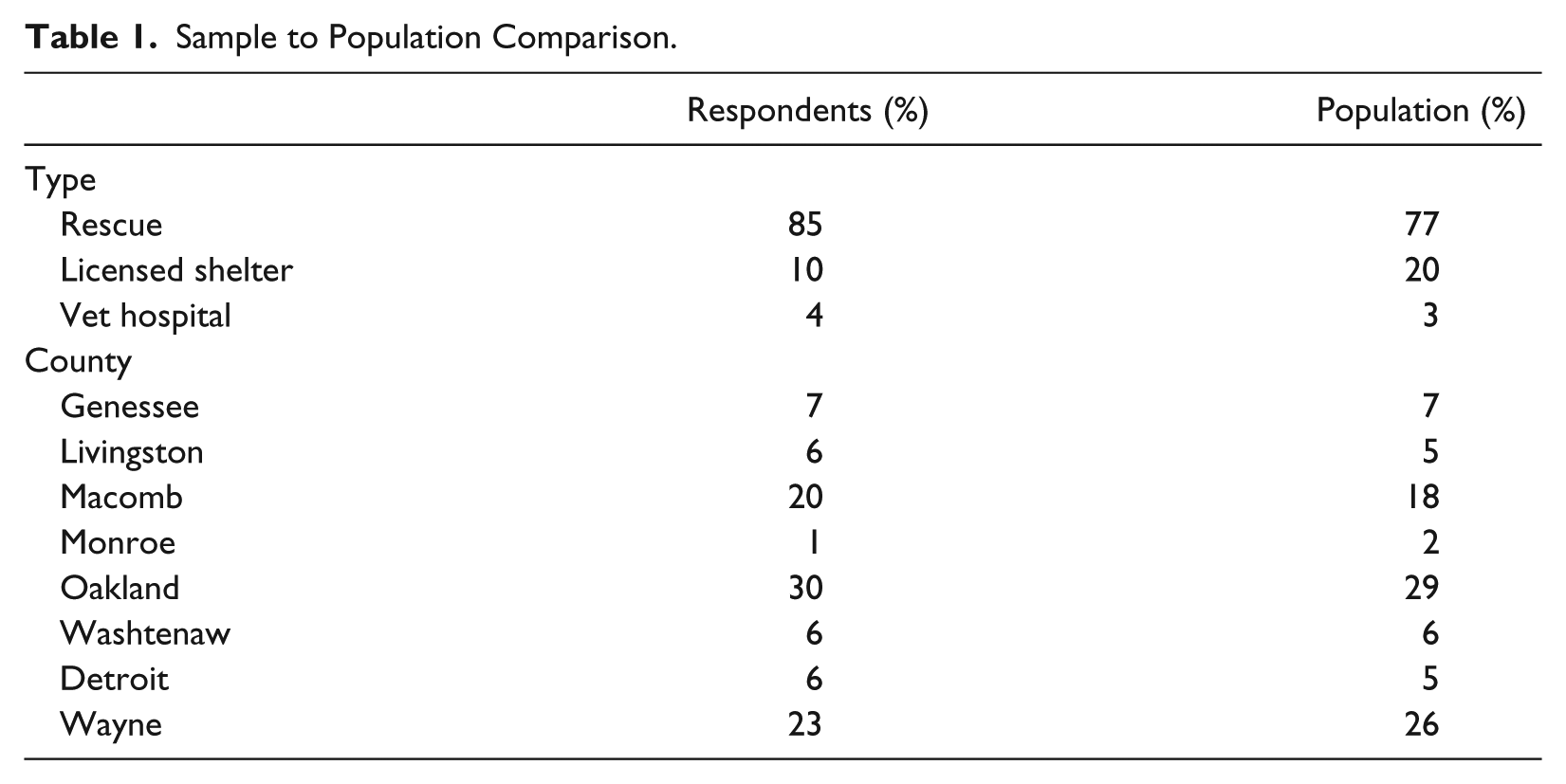
Fifty organizations did not have valid email or postal addresses, 61 were either no longer in existence or represented animal control operations that used other shelters, and five were pet stores that had weekend displays of adoptable animals from other shelters or rescues. There is instability in this population as many organizations are small, informal, and thus come and go. Based on the 199 organizations with valid addresses still operating, 68 responded to the survey for a response rate of 34%. Response rate for the network portion of the analysis is lower, however (12%), because missing organizations result in a lack of information on many possible ties. 22 Thus, the network findings describe partial connections between groups and should be taken as exploratory only. Table 1 provides a comparison between the respondents and the population on type of organization and county of origin (the only variables available for the population). Responding organizations match the population in location. In both groups, rescues dominate although their representation is relatively higher among responding organizations than in the population.
Sample to Population Comparison.
Social Network Analysis
Networks are described both by the actors within them (composition) and the relationships between the actors (structure; Wasserman & Faust, 1999). There can be a single-dominant actor or several organizations sharing power leading to a structure with multiple power nodes. The range of types of actors can lead to heterogeneous or relatively homogeneous networks. Social network analysis allows for exploration of ties, connections, and attachments among groups and focuses on the social context and behavior among actors (Durland & Fredericks, 2005; Jablin & Putnam, 2001). The program UCINET, version 6.166 (www.analytictech.com), was used to analyze the survey questions explicitly included for this purpose and has been used in much other research on local level cooperative networks (Borgatti, 2002; Borgatti, Everett, & Freeman, 2002; Huang & Provan, 2007; Lee & Feiock, 2011). 23 More specifically, respondents were asked to identify the organizations that they cooperated with for the several purposes just noted but were not asked to specify the direction of these relationships. Based on the responses, network plots were developed to describe overall network structure and the embeddedness of individual organizations.
Nature of the Responding Animal Welfare Groups
Most of the groups responding to the survey provide services for both dogs and cats (46%). The next most common client foci are “other” (17%) and specific breeds of dogs (excluding bully breeds, 14%): Only 3% of the groups focus specifically on pit bull type dogs. Open-ended responses to the “other” category identified a wide variety of clients with no type of animal predominating: wildlife, farm animals, small dogs, ferrets, kittens, exotics, rabbits, hamsters, guinea pigs, hedgehogs, and chickens. The age of the responding organizations range from less than a year to 136 years (one began to protect the welfare of cart horses) with a mean of 19 years. A majority of the organizations report having 501 c 3 statuses (81%); however, examination of internal revenue service (IRS) data on Guidstar 24 indicates that, in reality, only 32% are formally registered as 501 c 3 organizations. The organizations most commonly focus their work across Southeast Michigan (30%) and in suburban Detroit (26%). Only 8% of the groups focus on Detroit and its immediate suburbs and 4% focus solely on Detroit. Thus, while many of the groups provide services in the city, their scope is broader and almost all have their primary address outside the city. Employees range from zero to 200 with a mean of 10; 67% of responding organizations have no paid employees. Volunteers are more numerous, ranging from zero to 500 with a mean of 58; only one organization has no volunteers. The large number of organizations with no paid employees coupled with the fact that a minority are actually registered as tax exempt does raise the issue of the extent to which these are “organizations” as opposed to individuals. That only one organization indicated no volunteers with most having a reasonable number (median = 20) suggests that although not formally tax exempt, responding groups are organized to the extent that they involve more than an single person, have a number of volunteers, and are listed on state and national websites as organizations.
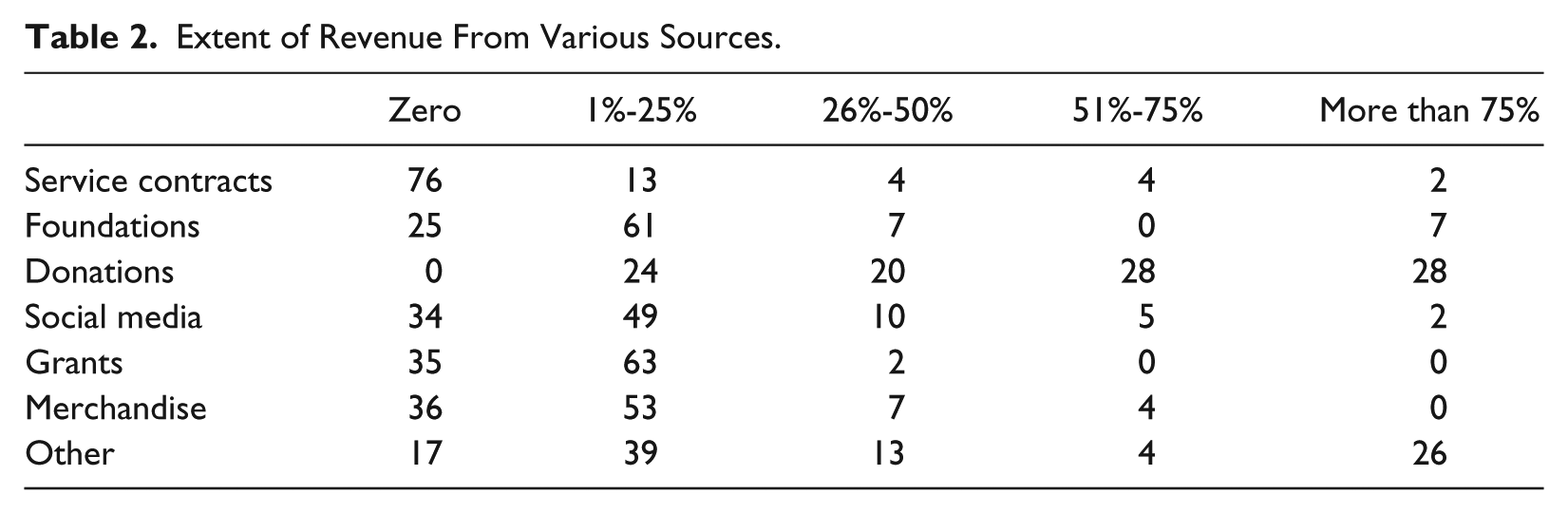
Donations are the most important source of revenue for the animal welfare groups (Table 2). Regarding “other” sources, the most frequently mentioned source is the rescue organizer’s pockets. Additional sources of revenue mentioned include garage sales and other types of fund-raisers and revenue from adoption fees. More than 60% of the responding groups have at least some revenue both from foundations and from grants but those sources remain under 25% of the total.
Extent of Revenue From Various Sources.
Data Analysis
Scope and Nature of Services
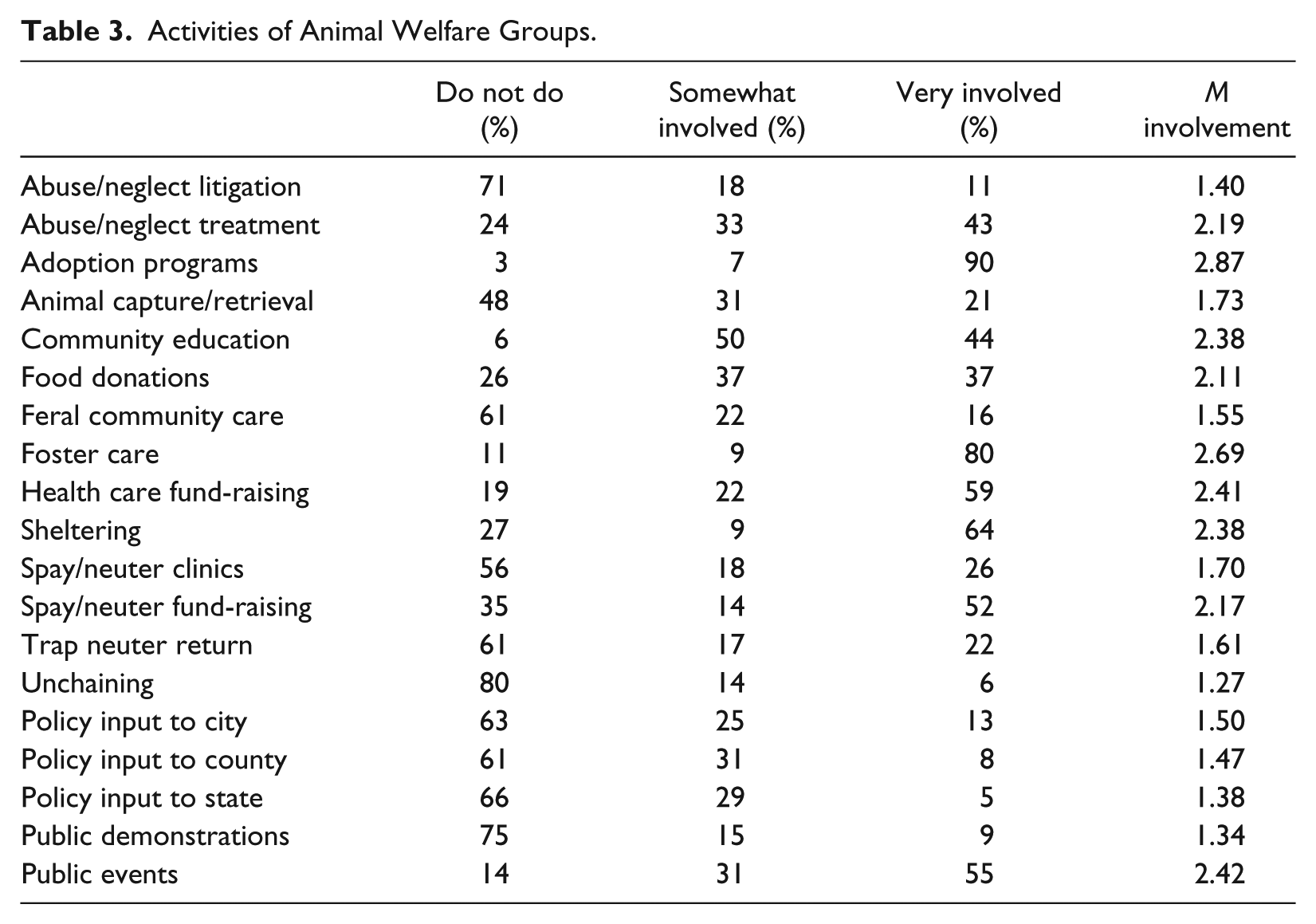
The following analysis focuses on the scope and nature of urban animal welfare services and identifies the types of organizations specializing in particular aspects of service. The most common activities of responding organizations are adoption programs and foster care; many of the groups also provide treatment for abused and neglected animals (Table 3). Based on interviews with service providers and work in the field, abuse and neglect activities include behavioral training to address such issues as fear and fear aggression, separation anxiety, acclimation to indoor living, socialization with people and other animals, and basic obedience commands. Fund-raising to provide or subsidize health care and spay/neutering and for food donations is also common. Many of the groups engage in community education regarding all aspects of animal care and welfare. Service provision specifically for cats is not quite as typical and often includes trap, neuter, and return programs (TNR). 25 The groups are least likely to be involved in policy advocacy; more than 60% of the groups have never provided policy input to any level of government or participated in public demonstrations.
Activities of Animal Welfare Groups.
There are some significant differences among types of organizations and service activities. Organizations focused on Detroit are significantly more likely to engage in the following: working to get tethered 26 animals off their chains (χ2 = 8.53), policy input to city government (χ2 = 13.28), and public demonstrations (χ2 = 7.10). 27 Licensed animal shelters are significantly more likely than nonprofit rescues to engage in: abuse/neglect litigation (χ2 = 18.79) and treatment (χ2 = 6.10), animal capture/retrieval (χ2 = 12.17), spay/neutering clinics (χ2 = 14.53), and policy input to city (χ2 = 6.62), county (χ2 = 6.03), and state governments (χ2 = 10.40). Older organizations with more staff and volunteers are significantly more likely to engage in the provision of several services: abuse/neglect litigation (Pearson correlation = .403), animal capture/retrieval (.373), spay/neuter clinics (.395), and policy input to state government (.452). 28
In summary, the service activities most commonly conducted by responding organizations include adoption, foster care, abuse/neglect treatment, funding for health care and sterilization services, food banks, and community education. Although policy advocacy and abuse/neglect litigation are less common activities of animal welfare service providers some organizations do engage in these activities. Thus, the data support the contention that animal welfare services are much broader than simple animal “control” and encompass the physical, behavioral, and emotional well-being of animals. There does appear to be specialization in the types of services organizations provide. Those located in, and focused on, the City of Detroit are more likely to engage in policy advocacy. Licensed animal shelters and those with greater resources are more likely to engage in litigation, policy advocacy, animal capture, and spay/neuter services. These activities tend to require greater resources and animal capture in particular requires state licensed animal control officers who tend to work for local governments or larger shelters. Animal rescues, however, appear to be more focused on the basic elements of fostering, adoption, and behavioral remediation.
Service Cooperation
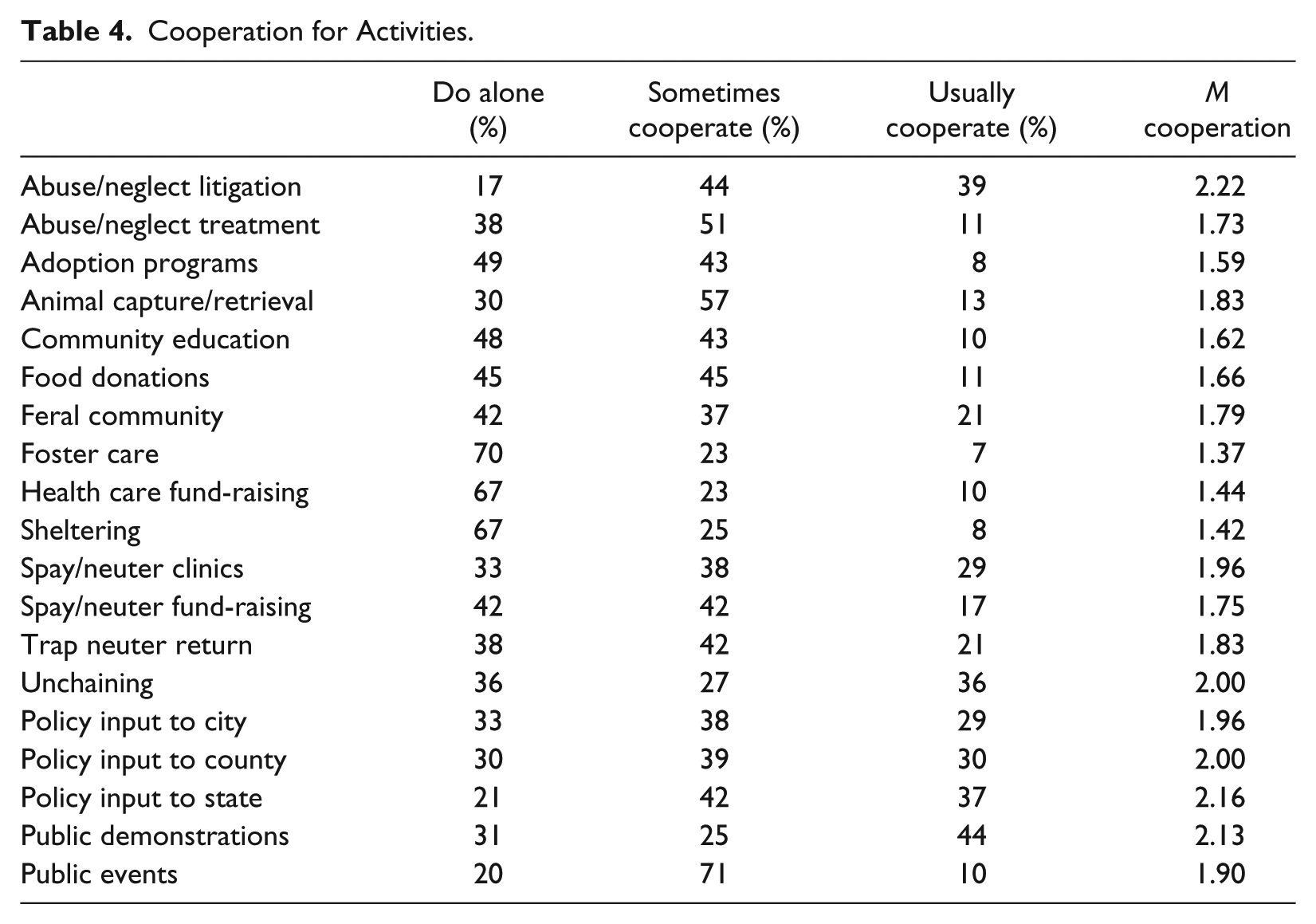
While the activity data indicate that organizations provide a range of the city’s animal welfare services, this does not necessarily mean that they are doing so in a cooperative manner. While there is cooperation among the groups, many of the most common activities are done independently: foster care, sheltering, fund-raising for health care, and adoption programs (Table 4). The highest cooperation rates are for the less common activities, particularly policy advocacy and litigation. Other activities that are often done in cooperation include spay and neutering clinics and working to get dogs off of chains outside homes. TNR and feral colony maintenance and animal retrieval/capture are also frequently done cooperatively.
Cooperation for Activities.
The organizations responding to the survey are most likely to cooperate with animal shelters and rescue groups outside the city of Detroit (Ms of 2.82 and 2.79 on a 5-point scale with 5 representing the highest level of cooperation). The next most common partner is city departments (2.39); interviews suggest that this is typically the Detroit Police Department where some officers have good working relationships with the rescue community. Detroit rescues and neighborhood groups are the next most common partners (2.22 and 2.09, respectively). The organizations are least likely to cooperate with Community Development Corporations (M = 1.53), DAC (1.55), state-level departments (1.55), and animal shelters inside Detroit (2.00).
There are no significant correlations between type of organization (shelter vs. nonprofit rescue), Detroit focus versus wider focus, or extent of organizational resources (age, staff, and volunteers) and whether individual activities are done cooperatively. 29 Organizations with more resources (Pearson correlation = .52), those focused on Detroit (χ2 = 21.59), and licensed shelters (χ2 = 23.71) are significantly more likely to cooperate with other public entities; there are no significant correlations between these variables and tendency to cooperate with nonprofit rescues. 30 In summary, animal welfare organizations are most likely to cooperate on activities that tend not to be the primary focus of the individual groups. Many of these activities demand special skills and/or are costly (litigation and medical clinics) or are most effectively done with large numbers of people (public demonstrations).
Service Provision Networks
As previously noted, network diagrams for three service areas are used to address the nature of the service provision network and to explore potential connections between public and nonprofit organizations. Three networks are discussed in detail below.
Fund-raising
The network for fund-raising has relatively low network degree centralization (4.40%), only the policy advocacy network is lower (Figure 1). 31 Only 28 organizations are included; on average, an organization in this network is directly connected to .568 other organizations. Thus, the network for fund-raising is quite decentralized; no single organization dominates. Although betweenness measures should be viewed with caution due to missing data, the betweenness centrality index for the network is 0.22%—the lowest of all the networks 32 ; it is only 0.22% similar to a hypothetical network in which one organization has the maximum possible betweenness and on average an organization lies on the shortest path between .309 pairs of other organizations. Indeed, only nine organizations—all nonprofit rescues—have any intermediary role. Thus, the diagram shows a network with a number of disconnected pieces, where typically just two organizations work with each other, unconnected to any others. In almost all cases, the members are nonprofit rescues or national interest groups (only two licensed animal shelters are included).
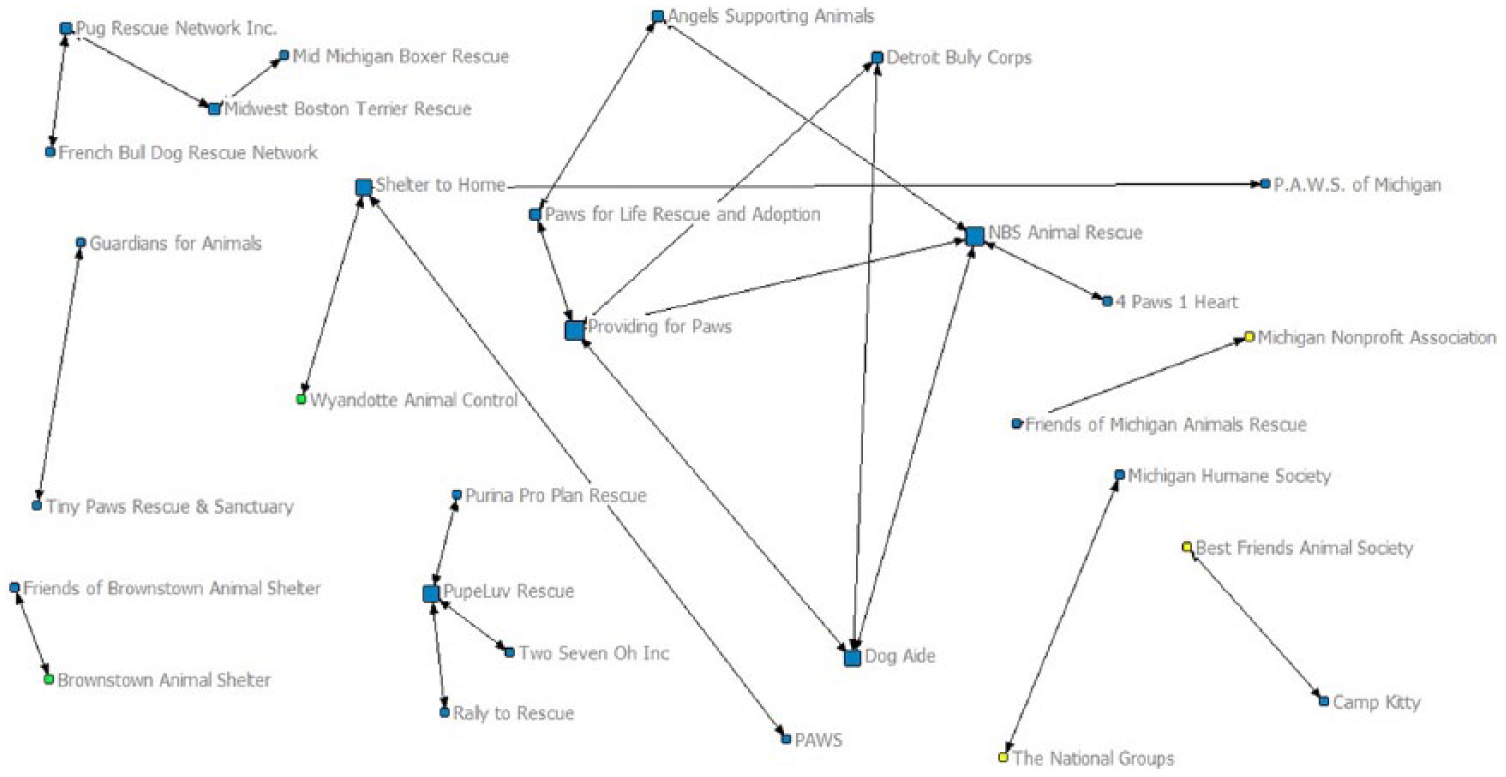
Network for fund-raising.
Another way of characterizing networks is through an examination of the “social fabric” or macrostructures that shape the interaction patterns of individual groups within them. The external-internal (E-I) index explores the macrostructure by placing groups in two categories: rescues not affiliated with municipalities and licensed shelters/public organizations. 33 Internal linkages predominate within the fund-raising network meaning that rescues are more likely to be connected to other rescues and shelters with other shelters: E-I index = −.565. Indeed, this network has the most negative score of the five explored here indicating primarily internal connections.
Rescue services
Not surprisingly, given the responses to the questions about primary activities, the network for providing animal rescue services contains the highest number of organizations among the three discussed here (second overall to the network for resource sharing, Figure 2). It has the highest network centralization (9.75) and the second highest average direct connections (1.274). The network for providing rescue services is 9.75% similar to a hypothetical network where one organization has the maximum possible degree centrality and all others have the minimum possible. On average, an organization in this network is directly connected to 1.274 other organizations.
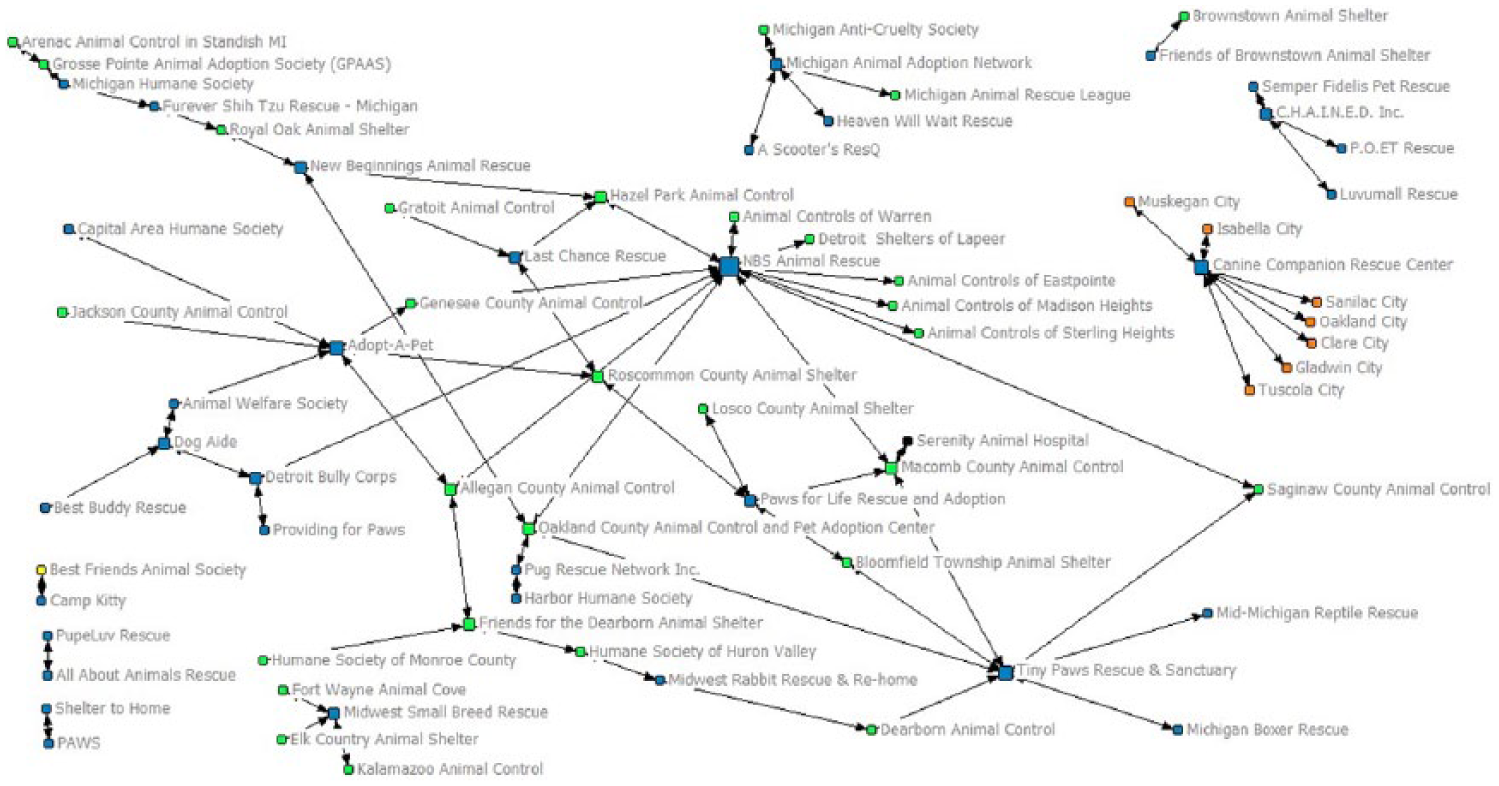
Network for rescue services.
Relatively more activities are done within chains of intermediary organizations (30 organizations hold intermediary positions) than in the fund-raising network and there is a more even balance between nonprofit rescues and public organizations. This network is 7.65% similar to a hypothetical network in which one organization has the maximum possible betweenness and on average an organization lies on the shortest path between 24.159 pairs of other organizations. Clearly providing the core of animal welfare services involves a denser network of all types of organizations—nonprofit rescues, however, have the most centralized positions and are more likely to act as intermediaries (17 intermediaries are rescues, 13 are shelters). 34
This is the only network area where licensed shelters are connected to each other. This is the case for two primary reasons: Shelters transfer animals to each other depending on volume or type of animal served and shelters with large veterinary hospitals spay and neuter animals under contract to other shelters. There are few disconnected pieces of the network for animal rescue services. In addition, it is the only one where external ties predominate (E-I index = .361), in other words, where rescues and shelters cooperate with each other.
Policy advocacy
The policy advocacy network contains more organizations (31) than the fund-raising network but is less centralized (4.31%). On average, an organization in this network is directly connected to .554 other organizations, and the network is only 0.43% similar to a hypothetical network in which one organization has the maximum possible betweenness; on average, an organization lies on the shortest path between .735 pairs of other organizations (Figure 3). Thus, while 31 organizations are involved in the network, only 12 act in any intermediary capacity. There are small groups or cliques of connected organizations but no ties between them. Organizations in the Puppy Mill Awareness node are located in western suburbs of Detroit and connect through Adopt a Pet to a group of Genesee county organizations. The Keeshond groups are all located in Oakland County and the Dog Aide groups focus on Detroit. Thus, it appears that there is considerable provincialism in the advocacy network—groups work with others that are close geographically. Internal ties predominate for the policy advocacy network (E-I = −.391), that is, rescues work with other rescues and shelters with shelters.
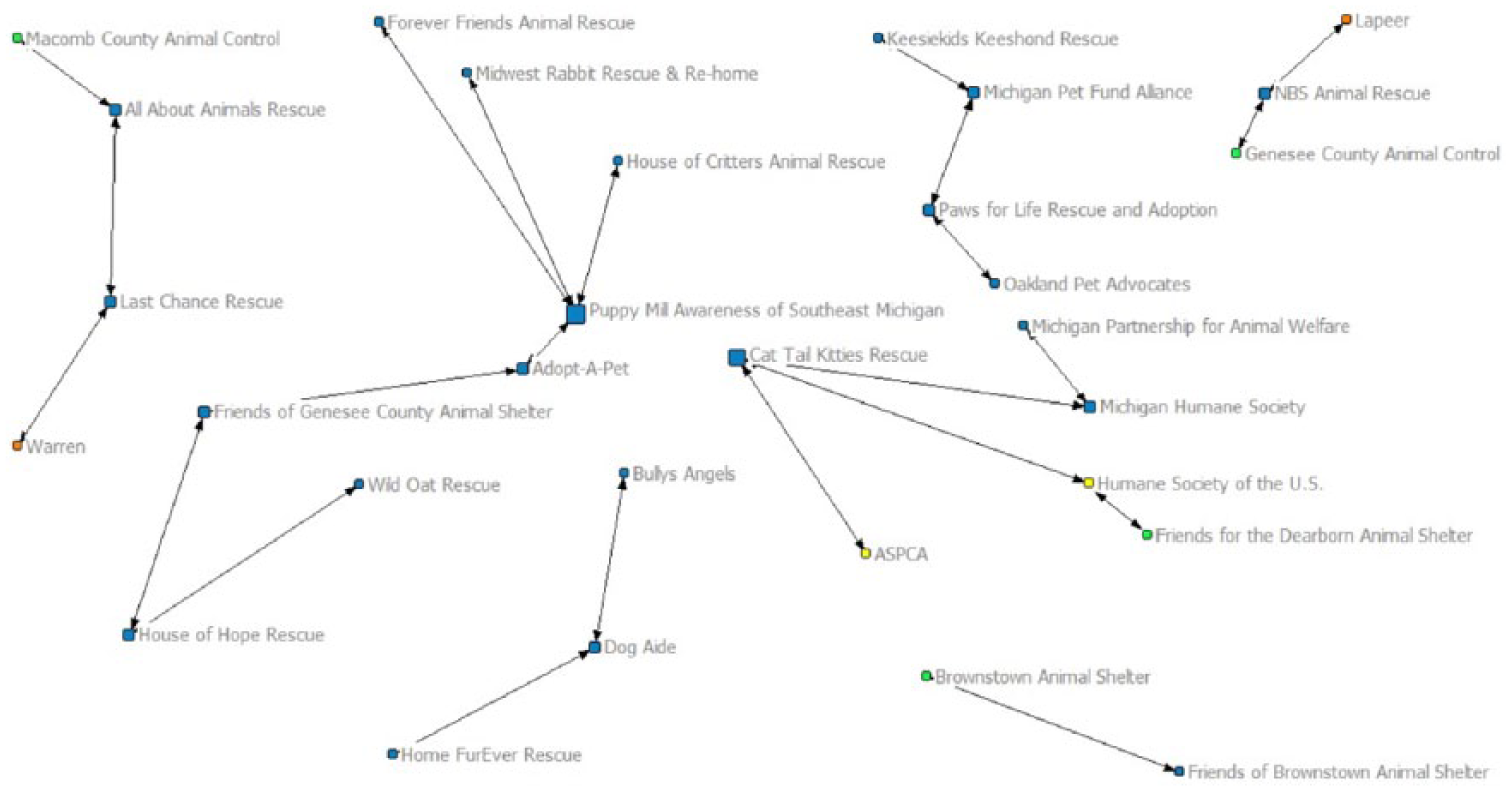
Network for policy advocacy.
It is useful to provide a brief summary across all five of the networks (again, only three are shown here). The networks with the greatest number of organizations are those for resource sharing and rescue services (Table 5). These have the highest number of ties and more connections are made through another organization. This is somewhat at odds with expectations drawn from the literature that there would be more cooperation on the less complex aspects of service (sharing volunteers or fund-raising) as the provision of rescue services appears to be the most challenging activity among those explored here. There are the fewest organizations in the network for sharing the resource of volunteers and average direct connections are the lowest of all the networks. There are more external than internal ties for only the rescue network. An examination of E-I scores for each responding organization indicates that shelters tend to be more externally connected than rescues overall. The survey data indicated less positive relations between nonprofit rescues and shelters than with other rescues, particularly shelters in Detroit. This may limit the external ties of the rescues. Furthermore, much of the interaction between rescues and shelters involves the pulling of animals from the latter to get them in rescue with the former.
Network Statistics.
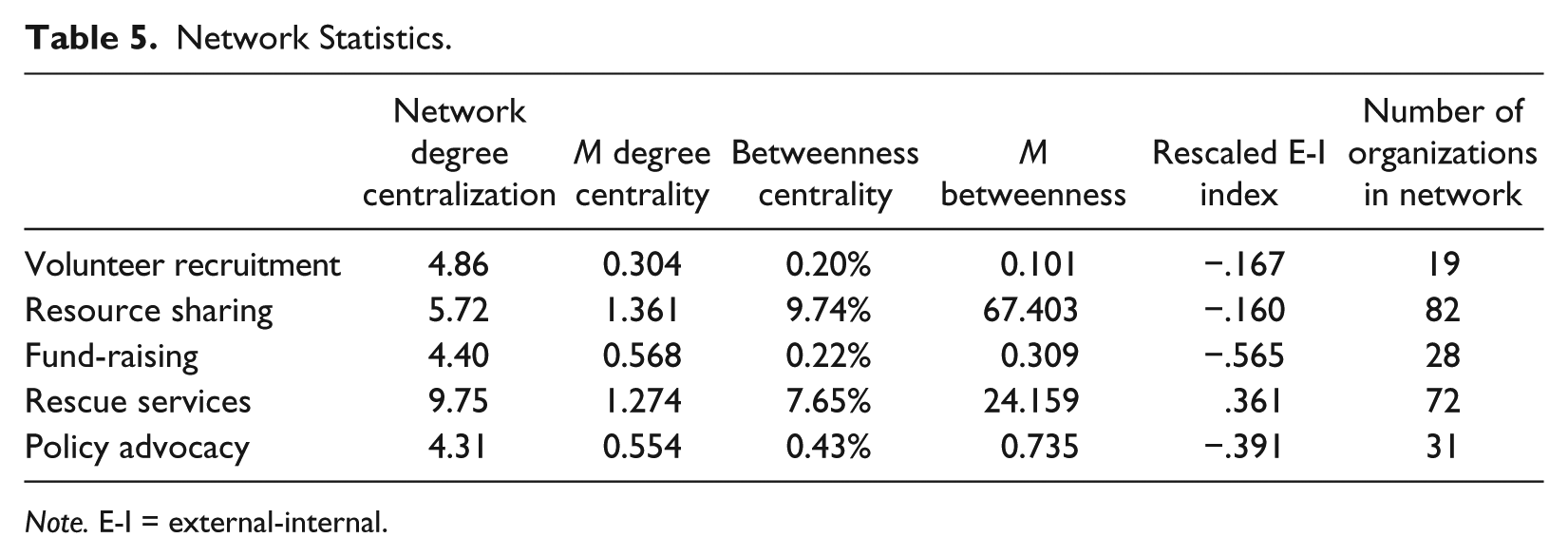
Note. E-I = external-internal.
Best Connected Organizations and the Role of Geography
It has already been noted that geographic proximity appears to enhance cooperation, particularly for policy advocacy, as suggested by the broader public administration literature. However, the role of geography is important in animal welfare service provision in another way; specifically organizations that focus most intensively on serving Detroit are not necessarily well represented in the networks. An open-ended question asked respondents to identify the groups they considered most active in animal welfare in the City of Detroit. The most common responses were as follows: the MHS Detroit shelter (23 mentions); C.H.A.I.N.E.D. (11); Dog Aide, All About Animals, and Detroit Dog Rescue (DDR; eight each); Detroit Bully Corps (seven); and the Michigan Anti-Cruelty Society and Home Furever (six each). Looking across the networks, DDR is not included in any network and Home Furever and the Anti-Cruelty Society are included in only one each; in neither case do they have an intermediary role. 35
The best connected Detroit-focused groups are Dog Aide and the MHS that have high centralization and betweenness scores in all the networks save that for sharing volunteers. C.H.A.I.N.E.D. is central and intermediary in networks for sharing resources and rescue services; All About Animals is central in sharing resources and policy advocacy; and Detroit Bully Corps is central for sharing resources, fund-raising and rescue services, and acts as an intermediary for sharing resources and policy advocacy. The groups most frequently high on centrality and betweenness across the five networks—Shelter to Home, PAWS, NBS, Tiny Paws, Providing for Paws, Adopt-a-Pet, PupeLuv—do not primarily serve the animals of the City of Detroit although they may foster, adopt, or otherwise support them in small numbers. This suggests that the animal welfare service provision community within the City of Detroit is less well-connected with the region and state generally. The number of network memberships is not significantly correlated with resources, type of organization, age, or Detroit focus. Better connected organizations 36 appear to provide significantly more rescue services (Pearson correlation = .46), engage in greater fund-raising activities (.35), and advocacy (.42), but there is no apparent explanation for why some organizations participate in more networks than others.
An examination of the most connected organizations in each of the three networks explored here suggests few commonalities. The five most connected organizations in the fund-raising network exhibit some similarities; they are all nonprofit rescues, are below the mean age of responding organizations as well as the mean numbers of staff and volunteers, and tend to rely less heavily on government contracts but more on social media and merchandise sales compared with mean responses among all organizations. In short, it appears that for fund-raising, the literature expectation that smaller organizations with lower resources will be more likely to cooperate is supported here. Examination of the best connected organizations in the rescue service network shows no commonalities in funding, resources, age, geography, or client base. Geographic proximity appears to be the only commonality among the better connected organizations in the policy advocacy network.
Discussion and Conclusion
Summary
A variety of nonprofit and public entities are providing animal welfare services in the city of Detroit: sometimes in cooperation, but oftentimes not. The role of the city in these networks, in the form of DAC, is quite weak, often controversial, restricted to a very small part of the spectrum of needed services, and, if measured by euthanization rates, of quite low quality. The majority of other animal welfare organizations do not cooperate with DAC and when there are interactions, they are largely negative. The same is true for the other two licensed animal shelters in the City; outcomes are poor and any cooperative relationships typically involve transferring animals from the high-kill shelters to rescue groups.
Nonprofit provision dominates the service area. The extent of cooperation across organizational boundaries is limited, however. Rescues tend to cooperate with other rescues and shelters with shelters. Organizations located in, or focusing on, Detroit cooperate with each other but tend not to work with organizations outside the city. The rescue service network is the only one where external ties predominate over internal ones: in other words, where public (in the form of shelters) and nonprofit (rescues) organizations have ties to each other. 37
The networks vary greatly in size and composition depending on different aspects of services provided. The network for fund-raising is relatively small, has dyads but few chains of relationships, is primarily composed of rescue organizations, and thus appears to be in disconnected pieces. The network for the provision of rescue services is much denser, centralized, and includes the most intermediary organizations. In addition, ties cross the rescue/shelter divide. Finally, the policy advocacy network includes the fewest cooperative ties with small cliques apparently based on geography.
It appears that collaboration is more likely to occur for activities that are more complex or resource intensive or that rely on specific skill sets, such as policy advocacy, litigation, or spay/neuter clinics, or that may present greater danger to the volunteers upon which most of the nonprofits rely (abuse and neglect treatment and animal capture, for example). Many basic aspects of animal welfare service provision are not done cooperatively: raising funds for health care and food, foster care, and adoption events. The extent of homophily in the informal networks under consideration is mixed. Cooperation between public and nonprofit organizations is limited; rescues tend to cooperate with other rescues and licensed shelters with shelters. Cooperation appears to be facilitated by proximity, but the divide between Detroit and the larger region appears to inhibit cooperation. Again, for most activities, age of the organization, resources, and client focus do not appear to facilitate or inhibit collaboration.
Limitations and Future Research
There are several limitations to this relatively exploratory research that raise interesting questions for future work. Because of the dearth of knowledge about networks of organizations involved in animal welfare services, this study has focused on a single service and a single metropolitan area. Hence, potential generalizability is limited. However, the findings here about informal collaborative networks suggest several conclusions that can form the basis for future hypothesis testing: (a) For emerging urban problems, collaborations are likely to be limited and fragmented; (b) patterns of collaboration vary by activity; (c) while collaboration is more likely for activities that require greater skills, resources, and numbers, it is not necessarily the case that networks are more likely to form for lower commitment activities such as fund-raising; (d) while proximity appears to foster collaboration, it can also inhibit it if organizations need to bridge important political, economic, and cultural boundaries; (e) the role of local governments in service networks for emerging problems may be very limited particularly when local monetary and leadership resources are minimal and where animosity between nonprofits and local governments is high. This last issue may pose a barrier to the development of more formal networks over time. Formal government contracting or privatization tends to develop as conditions of trust grow among participants and as sufficient potential service providers enter the market (Feiock, 2007; Larson, 1992; LeRoux, Brandenburger, & Pandey, 2010). At least in Detroit, those conditions of trust are insufficient to foster collaboration between the public and nonprofit sector.
Further research needs to explore network patterns in other cities that vary on a number of dimensions including geography, economic condition, and governing system. The descriptive understanding provided here can be used in further work that uses stochastic network analysis to test hypothesized network structures both over time in Detroit and in comparison with other cities (Feiock et al., 2012). In addition, while this research has focused on only one service area, the detailed information on the parameters of that service function could be explored in other cities to determine similarities and differences in approaches to animal welfare. This is particularly important given that recent interviews with city administrators indicate that managing animal welfare issues are an increasingly costly and challenging aspect of local government administration (Swindell et al., in press).
The analysis here focuses on static networks and there is little research generally on change in networks over time. Longitudinal research could expand on these findings to address additional questions not amenable to cross-sectional analysis. The limited work on network change has used repeated surveys of the same network over time in combination with face-to-face interviews (Koch, Galaskiewicz, & Pierson, 2015). While longitudinal waves of network surveys may miss fluidity in networks between measurements, combining them with intensive interviews would allow researchers to gain a sense of changes between formal measurements.
It would be interesting to know whether there is a natural progression or evolution from one aspect of service to another. For example, does cooperation begin with rescue service provision and then move on to the sharing of volunteers or policy advocacy over time as trust and a track record of cooperative relations develop and are sustained? It has been argued here that weak local government plus a rapidly changing problem environment (pressures on existing animal services posed by roaming dogs) lead to the development of networked governance. It would interesting to know whether, as distressed cities become more familiar with the challenges of roaming animals, the public sector role and hence the networks change. It would also be important to explore the potential progression from informal to formal network arrangements. For example, are the informal collaborative networks identified here a means for establishing more formal arrangements whereby the city of Detroit would contract with groups of nonprofits to provide services?
It would also be useful to conduct more qualitative analysis to explore in more detail why organizations chose to cooperate, what are the barriers to cooperation, and how they select partners. Such interviews could also include an explicit focus on governing within the service networks; few studies have examined network governing systems (Provan et al., 2007). Particularly in informal networks, it would be interesting to know whether there are underlying governing structures that are not readily apparent, whether members perceive the need for more codified governing arrangements, and which organizations or types of organizations might most readily take up that role.
Given the initial information about animal welfare service provision and cooperation presented here future surveys can be constructed to facilitate hypothesis testing, for example, whether particular structural effects such as reciprocity (mutual exchanges between actors) and social clustering (tight links to police noncooperation), can be observed (Feiock et al., 2012; Lubell, Henry, & McCoy, 2010). Future surveys should also include questions that can explicitly test hypotheses related to competition (do perceptions of competition reduce ties), trust (does trust increase an organization’s ties), longevity of ties, quality of relationships, the role of reputation and questions of power (e.g., are central actors really more powerful in the network; Cook & Emerson, 1977; Huang & Provan, 2007).
Final Thoughts
The findings of this study shed light on a variety of aspects of politics and policy making in cities lacking public leadership capacity, under severe resource constraints, and facing a changing and complex problem area. Detroit is a city that has not had a stable governing regime since the 1960s; even then, the regime was transitory. It currently suffers from a surfeit of problems and a lack of resources to address them (Reese et al., 2014). The confluence of a lack of governing capacity and resources and problem overload and complexity appears to make collaborative governance a necessity. The extent of cooperation is affected by the particular aspect of the service at hand, the nature of the organizations (whether focused on Detroit and shelter/public vs. nonprofit/rescue status), and geographic proximity (which is both a facilitator and barrier to collaboration depending on service activity). However, in light of the limited- and poor-quality, city-provided services and the animosity between nonprofits and DAC, it appears that the connections between the city and other aspects of the service provision network may take a long time to develop in this case.
As the issues of roaming animals and animal welfare have appeared on the policy scene, the public sector in Detroit has been unable or unwilling to marshal sufficient resources and administrative oversight to effectively address the problem. Into this gap have stepped a number of nonprofit groups that are currently implementing the bulk of animal welfare services. Their collaborative networks, however, remain fragmented; many elements of service provision are not done cooperatively, either among service providers or between nonprofits and the city.
The economic misfortunes that have led to an animal welfare problem in Detroit have taken place over the course of several decades, yet the visibility of the problem is relatively new. In this case, an informal grassroots network of mostly nonprofits is minding the service gap. Is this a model for addressing urban problems that may emerge in the future? Reliance on informal service networks is probably not a viable solution for all emergent problems. Issues such as public health epidemics and environmental hazards, for example, are too critical to be left to “chance” hoping that nonprofits will step up to the plate. Yet, it appears that in conditions of limited public resources, nonprofits can respond to changing policy environments, providing services not covered by the public sector and do so using informal collaborative relationships. However, the public sector could, by more systematically harnessing the considerable potential of nonprofits, at least ensure that in the short run, new problems and service needs are addressed.
Footnotes
Declaration of Conflicting Interests
The author(s) declared no potential conflicts of interest with respect to the research, authorship, and/or publication of this article.
Funding
The author(s) received no financial support for the research, authorship, and/or publication of this article.