






Abstract
This study extends the literature on county government structure by examining the three basic forms of county governments and their long-term effects on regional service spending. An examination of 1,532 U.S. counties between 1977 and 2012 reveals that those with the commission government form produce on average less regional service spending than those with reformed government structures. Examining the two major distinctions in reformed government types reveals that elected executive governments spend on average more than those with the commission-administrator form. However, the amount of increase for elected executive spending was very minor. The findings also reveal that the ability to establish home rule charters alters the effects of government structure for commission and commission-administrator counties. Meanwhile, charter-enabling laws matter little regarding the effects for elected executive counties. The analytical results lead to four major points for consideration regarding the link between county service provision and county institutional arrangements.
Keywords
Since Lineberry and Fowler (1967) presented their conclusions about local government institutional arrangements, increasing attention has been given to the importance of government structure (Boyne, 1992; Carr & Karuppusamy, 2010; Feiock, Jeong, & Kim, 2003; Morgan & Pelissero, 1980; Schneider & Park, 1989). While much of this inquiry stresses the implications of the municipal reform movement, some scholars have placed a special emphasis on what progressive reform meant for the American county (Benton, 2002b; DeSantis & Renner, 1996; Schneider & Park, 1989; Svara, 1996). Specifically, the question for counties comes to whether those with reformed or modernized government structures have a greater capacity to produce government services than those with unreformed structures. It is no secret that the reform movement has had a long-lasting impression on the culture that drives the way local governments behave. However, a shroud of mystery still resides over how progressive reform has impacted the way county governments function today.
Historically, counties served primarily as the administrative arms of the states (Benton, 2002b; Menzel, 1996). They were traditionally thought to be lesser versions of local governments charged only with providing the basic civic necessities of society. Yet, our modern impression of these entities views them as fully functional units charged with providing the expected amenities of urban life. Furthermore, counties, being region-wide institutions that often encompass multiple jurisdictions, are frequently charged with the responsibility of portraying the role of the regional service provider. Given that counties can be essential in the allocation of regional goods, such as land use, development, and public transit, one must consider the importance and implications of their institutional settings on policy choices.
Initially, counties were administered by a collective body of elected officials, but owing to the reform movement of the Progressive Era, counties began to place their administrative leadership under the control of a single executive officer. Ideally, this monistic philosophy of administration would produce the leadership necessary to make counties more responsive to citizens. Prior research on county government settings shed light on this claim by suggesting that counties with executive officials produce more services than those administered by elected boards (Benton, 2002b; Schneider & Park, 1989b). The results of these findings conclude with arguments that advocate the consideration of government structure’s influence on the capacity of counties to provide services. These conclusions lead us to ponder the link between the functional evolution of counties as service providers and the institutional structures governing these functions.
The current research explores this link by focusing on the three basic types of county institutional arrangements and their effects on county regional service spending. First, this research examines whether having a commission form of government versus a modernized (or reformed) government structure affects county spending for regional services. Here, the focal point becomes whether differences exist between counties supervised by a board of commissioners and those supervised by a single executive official. Second, this research focuses primarily on modernized government structures and questions whether differences exist between the two major distinctions in county executive authority. This focus pays special attention to the varying effects between counties having a commission-administrator form of government and those with a commission-elected executive form. Finally, this research follows prior works (Benton, 2002b; Carr, 2006; Farmer, 2011) and places a special emphasis on the establishment of county charters. This phase of analysis examines the effects of the three forms of county government structure under conditions affecting county abilities to establish home rule. If government structure makes a difference, then the governing powers afforded to these structures could have major implications as well.
Regional service provision serves as a setting for this analysis because the roles of counties as the administrative arms of the states traditionally preclude them from expanding their services to function as region-wide service providers (Benton, 2002b). Therefore, this article attempts to assess whether modernized forms of government structure provide counties the capacity to evolve into regional service institutions. The results of this analysis provide four points of interest that provide some perspective behind the link between counties’ roles as service providers and their governing institutional arrangements. These four points highlight the long-term effects of county modernization, the similarities in service growth between commission-administrator and elected executive counties, the influences of home rule authority, and the institutional incentives behind the decisions of county executives.
Progressive Reform: The Empowerment of Counties
For counties, the philosophies and rationality of progressive reform placed a heavy emphasis on the functionality of the government organization and their empowerment as public-service providers (Benton, 2002b; Carr, 2015; Menzel, 1996). This is not to say that counties were immune to the corruption of political machines, but rather many of their problems emerged from their weaker abilities to fully serve the public. Reformers sought changes within counties due to the lack of professionalism among these entities that inhibited them from functioning like “modern” governments. This meant that counties were severely hindered by the absence of a professional executive in their abilities to maintain adequate levels of public responsiveness and accountability. Likewise, the organizational and administrative makeup of counties inherently limited the scope and function of these entities. The archaic and fragmented nature of counties precluded them from having the centralization and flexibility needed to respond to citizens’ growing demands (Benton, 2002b; Menzel, 1996).
Established as the administrative arms of the states, counties’ abilities to function were subdued by their limited home rule in the areas of structural, functional, and fiscal authority (Benton, 2002b). Modernizing the American county involved enhancing county levels of autonomy by executing charters that defined their powers to operate in these three organizational areas. Structural changes included giving counties the authority to choose their form of government. Here, counties could move away from the traditional commission form of government and choose an executive head under the commission-administrator or commission-elected executive form (Benton, 2002b). Meanwhile, functional changes allowed counties to expand and shift the provision of services from traditional functions as explicitly authorized by their states to a wider range of governmental services (DeSantis & Renner, 1993). The call for fiscal reform involved providing counties with the financial flexibility to implement measures to stabilize their budgets. This included such things as giving counties the authority to diversify their revenue structures, issue bonds, adjust their budgetary policies, and improve their expenditure, auditing, and purchasing practices (Benton, 2002b; Menzel, 1996).
Yet, the greatest need for county reform was to overcome structural limitations (Benton, 2002b). Traditionally, county governments functioned under the commission government form. This form consists of a plural executive body typically made of commissioners or administrative officers elected by partisan elections (Duncombe, 1966; Svara, 1996). The higher turnover in political leadership, the ambiguous managerial authority of administrators, and the conflicts and corruption associated with partisan politics have been cited as contributing factors in the ineffectiveness of leadership within commission-led counties (Streib & Waugh, 1991; Svara, 1996). Reformers sought to overcome these problems by pushing for counties to be permitted to abandon this government structure and move toward those that were designed to provide more direct and strengthened leadership. If counties were to overcome the obstacles of ineffective management, then they would need institutional arrangements that provided strong unified positions of executive responsibility. Therefore, “the modern or reformed form of county government that is probably best able to satisfy the expanding service needs of a growing population is one that has either an appointed or elected executive as well as a charter” (Benton, 2002b, p. 473). To this day, advocates of progressive reform continue to defend this sentiment and its importance through institutionalized standards and practices as traditionally upheld in the Model County Charter.
The Changing Roles of County Governments as Service-Delivery Agents
Prior research has explored the underlying question regarding the role of government form in county service-delivery efforts. Much of the literature on U.S. counties recognizes how they have emerged as full-scale services providers (Benton, 2002b, 2003; Benton & Menzel, 1993; Choi, Bae, Kwon, & Feiock, 2010; Park, 1996; Schneider & Park, 1989). The traditional role of counties dictated that they function as state administrative arms, providing only services that were legislatively mandated. Such services, referred to as traditional services, included basic governmental functions such as health, vital statistics, law enforcement, and welfare. However, counties have increasingly expanded their roles to those that provide urban or municipal-like services that include functions such as the operation of parks, libraries, and public utilities (Benton, 2003; Benton & Menzel, 1993).
Much of this service-role expansion can be attributed to factors such as enhancements in information technology. Enhancements of this nature have allowed counties to overcome service provision challenges often presented by county geographic size and transportation limitations. This means that citizens are no longer required to plan a day’s travel to the county seat to handle administrative affairs. Technological enhancements such as web-based applications and social media platforms now allow counties to take advantage of opportunities to innovatively reach out to citizens to effectively distribute and market their goods and services (Edmiston, 2003; Ellison & Hardey, 2013; Howard, 2012; Kingsley et al., 2012).
Counties have also transformed themselves into full-scale service providers due to populations becoming larger and denser within incorporated and unincorporated county areas (Benton, 2005). As urbanization and suburbanization have led to larger and more diverse populations, counties have come to face regional problems that transcend municipal boundaries. To this end, counties have emerged as the regional providers of services such as region-wide transportation, land-use regulation, planning and zoning, and community development (Benton, 2002a). Research in this area suggests that the modernization of counties has given them the capacity to evolve in their service roles to satisfy increasing population demands that span across county regions (Benton, 2002b, 2003).
Linking County Government Structure and Regional Service Spending
Within the capacity of regional service provision, counties are faced with the challenge of having to reconcile the demands of all county residents (both incorporated and unincorporated). Counties are the logical choice for these types of issues as they have legal countywide authority that supersedes state grants of powers to other local governments (Benton, 2002a). Likewise, their unique linking and coordinating capabilities (Benton, 2002a) enable them to provide a type of centralized regional governance that is well suited to resolve countywide dilemmas. Therefore, counties become the preference for cross-jurisdictional services such as sewer, transportation, and emergency response.
As the need for the provision of regional services grew, counties sought legislative means that permitted them to modernize their government structures. Expenditure data examined by Benton (2002b) confirmed this notion. Specifically, counties that could adopt a modernized form of government spent more per capita on regional services than counties that maintained the traditional commission form. Anecdotal evidence provided by others also suggests a link between reformed county governments and greater regional service spending, especially for development (Park, 1996; Schneider & Park, 1989). Although the category of development services may not fully constitute the same meaning as regional services, there is some crossover between these two policy areas. While development is usually defined to assess economic environments, it also generally includes services of a regional nature, such as transportation infrastructure, land use, and business attraction (Choi et al., 2010; Feiock, 2002, 2004; Peterson, 1981). Therefore, reformed or modernized county-expenditure patterns for development might provide hints as to how government structure affects general regional spending. However, this article does not take for granted that development spending and regional spending are completely synonymous. Conversely, some regional services can be fundamentally different from development. This is especially true for regional goods with allocative or redistributive characteristics such as mass transit, elderly programs, and public housing.
Assumptions regarding the effects of executive leadership types point to rational choice and political market explanations that argue that the incentives of executives create entrepreneurial tendencies that spark more efficiency in the supplying of regional goods (Feiock, 2002, 2004, 2007; Lubell, Feiock, & Ramirez, 2005; Ramirez, 2009). These arguments heavily coincide with the innovator and facilitator models of chief executives (Svara, 1996). Executives have selective incentives, whether political or professional to become public entrepreneurs in building coalitions and orchestrating policy outcomes. For elected executives, the political incentives of enhancing their chances for reelection are what drive them to find creative ways to respond to median voter preferences. For appointed officials, professional incentives intertwined with the desire to improve their careers are what drive them to become strategic planners and be innovative in addressing local deficiencies (Feiock, 2007). Studies that place an emphasis on the implementation of development provide hints regarding these assumptions (Feiock, 2004; Feiock et al., 2003; Park, 1996; Schneider & Park, 1989). For example, Feiock et al. (2003) found that population decline and the economic base were important factors in the implementation of certain development policies for cities with elected executive officials, while strategic planning played a bigger role for council-manager cities. Likewise, Clingermayer and Feiock (2001) also contributed when they found a direct positive relationship between mayoral leadership and the adoption of various economic development policies. When it comes to evidence regarding direct spending, Schneider and Park (1989) found that counties with elected executives spent more per capita on development than those under other government forms.
The Consideration of County Home Rule Charters
The grants of autonomy permitted by states influence counties’ service provision abilities (Benton, 2002b; Menzel, 1996). Home rule authority provides a broad array of powers to local governments that enable them to address a variety of local issues without state interference (Benton, 2002b; Krane, Rigos, & Hill, 2000). Jurisdictions lacking powers of home rule are precluded by Dillon’s Rule from providing services that go beyond the scope of those authorized by their states. Empirical analyses covering this issue suggest that counties with established home rule charters generally have higher expenditures for services (Benton, 2002b; Choi et al., 2010; Farmer, 2011b). Higher expenditures for home rule counties can be interpreted as having a greater capacity to enhance service infrastructure. Because broader home rule powers afford counties the abilities to explore additional revenue options, they can expand their services beyond those encompassed within the traditional county role (Benton, 2002b; Choi et al., 2010). Therefore, counties’ abilities to go beyond their state-mandated obligations can have important impacts on their powers to increase spending. Regardless of the type of government structure, more state control leads to more susceptibility to state policy directions. Meanwhile, counties less affected by implications of state politics can choose to focus on other, more benefiting policy areas (Choi et al., 2010). The less control a state has over local jurisdictional decisions, the more influential the local administrative body becomes in dictating policy choices (Benton, 2002b; Carr, 2006; Farmer, 2011).
Hypotheses, Data, and Method of Analysis
This study examines the relationship between county service spending patterns and county institutional arrangements by examining the three basic forms of county government. First, this analysis explores the effects of county modernization by examining whether a nonmodernized government structure affects county spending for regional services. Previous research suggests that the modernization of counties will positively influence the provision of regional services. The literature contends that counties with executive head officials have the expertise and capacity to expand their service base to address the countywide regional requirements of the citizenry. Executive heads provide counties the unified leadership that empowers them to exhibit cross-jurisdictional authority and deliver services to all citizens within its boundaries.
Second, this analysis focuses on the variations in effects between the two major distinctions in county executive authority. This question asks is there a difference in regional service spending between counties headed by appointed executive officials and those headed by elected executives? Much of the literature suggests that counties with elected officials provide the institutional incentives that stimulate the entrepreneurial behavior needed to promote regional policies. The selective incentives embodied in the position of the elected official drives them to behave more opportunistically and become public entrepreneurs or innovative facilitators who are willing to build political coalitions with external stakeholders to resolve cross-jurisdictional dilemmas.
The final portion of this analysis addresses the first two questions, but does so while considering the condition of states enabling counties to establish home rule charters. The level of autonomy afforded to jurisdictions has implications on their abilities to act as self-governing service providers. The literature exploring home rule authority suggests that counties’ abilities to spend on services can be impacted by state mandates legislating local powers to self-govern. Therefore, the condition of state-enabling laws for local charters will likely influence county spending for regional services.
Model and Data
Following prior work that assesses county-expenditure patterns, this analysis uses a time-series cross-sectional design to assess effects that occur across both time and county areas to observe county-expenditure patterns (Choi et al., 2010). It assesses multiple panels of counties using a generalized least squares regression routine that corrects for heteroscedasticity by using a variance matrix more robust than that of ordinary least squares. An evaluation of these data revealed evidence associated with violations of heteroscedasticity. This is primarily due to unequal variance in the estimates caused by uncorrelated effects between counties. Therefore, the method employs regression estimators with panel-heteroscedastic assumptions (Beck & Katz, 1995) to gain asymptotic efficiency. The models also include a lagged dependent variable to account for unknown inertial effects that can cause current shifts in the dependent variable that might otherwise go undetected (Wooldridge, 2009). The dependent variable is per capita expenditures at the currently observed time t, while all independent variables are at time t – 1 (one time unit).
Dependent Variables
The presented questions are examined through an analysis of spending per capita for a sample consisting of U.S. counties with a population of 25,000 or greater in 2012. County-level expenditure data were collected for the years 1977 through 2012 from the U.S. Census Historical Finances of Individual Governments taken from the quinquennial Census of Governments surveys. Therefore, this examination evaluates 1,532 counties every 5 years, producing 12,255 observations across eight time periods. 1 A variable for total county expenditures per capita is observed as a means of comparison with county regional expenditures. The total expenditures variable examines county-level spending across an aggregation of all county service areas. Meanwhile, the variable for regional expenditures per capita aggregates spending across a variety of policy areas deemed as regional services (Benton, 2002a; Benton & Menzel, 1993) and includes economic development, air transportation, mass transit (nonair), housing and community development, environmental protection, natural resources/land use, parking facilities, sewer, public works, and education.
Key Independent Variables
The analysis examines three institutional factors that reflect the primary forms of county government and their behaviors under the condition of charter-enabling state laws. 2 First, this analysis uses commission form as a dichotomous variable that captures whether a county is unreformed, having a commission form of government with no head executive official, as opposed to reformed. Unreformed counties are considered nonmodernized, while the opposite denotes those that are modernized. Second, this research examines the isolated effects of the variations in reformed governments to examine the implications behind the two major distinctions in county executive authority. This analytical phase employs two dichotomous measures, where commission-administrator captures whether a county has an executive head official that was appointed by the county’s legislative body, and elected executive captures whether a county has an executive head official that was elected at large. Finally, this research employs a set of multiplicative interaction terms consisting of the three key independent variables observed against state law permitting county charter. These interaction terms capture the effects of the key independent variables while accounting for the conditional effects of states allowing counties to establish home rule charters. Data for the key explanatory variables come from the U.S. Advisory Commission on Intergovernmental Relations (ACIR) Profile of County Governments 1972, the International City/County Management Association (ICMA) Municipal Yearbook for the years 1983 through 2005, and the ICMA’s Form of Government Survey for the years 1988 through 2002. The author also surveyed individual county government websites to account for any changes in form of government taking place beyond 2005.
Control Variables
All models include variables that control for state law variations, demographic attributes, service demand, service capacity, market attributes, intergovernmental effects, and variations across geographic regions. Variations in state laws are controlled by the variable state law permitting county charter. Because county service provision can be greatly impacted by population size and growth (Benton, 2002a; Farmer, 2015), the logged county population number, population growth between 1972 and 2012, and population density relative to a county’s geographic size control for population changes and county urbanization. Other demographic and service demand characteristics are controlled by the elderly and poverty population percentages. 3 A county’s service capacity is controlled by per capita total county tax revenue, while the growth rates for median household income and private nonagricultural employment control for service market effects. Intergovernmental effects are controlled by the totals for general purpose and special purpose governments within a county. Finally, the models include a set of dummy variables that captures variations in attributes across U.S. geographic regions. The operations, sources, and descriptive statistics for each independent variable are reported in Table 1.
Descriptions and Sources of Modeled Variables.
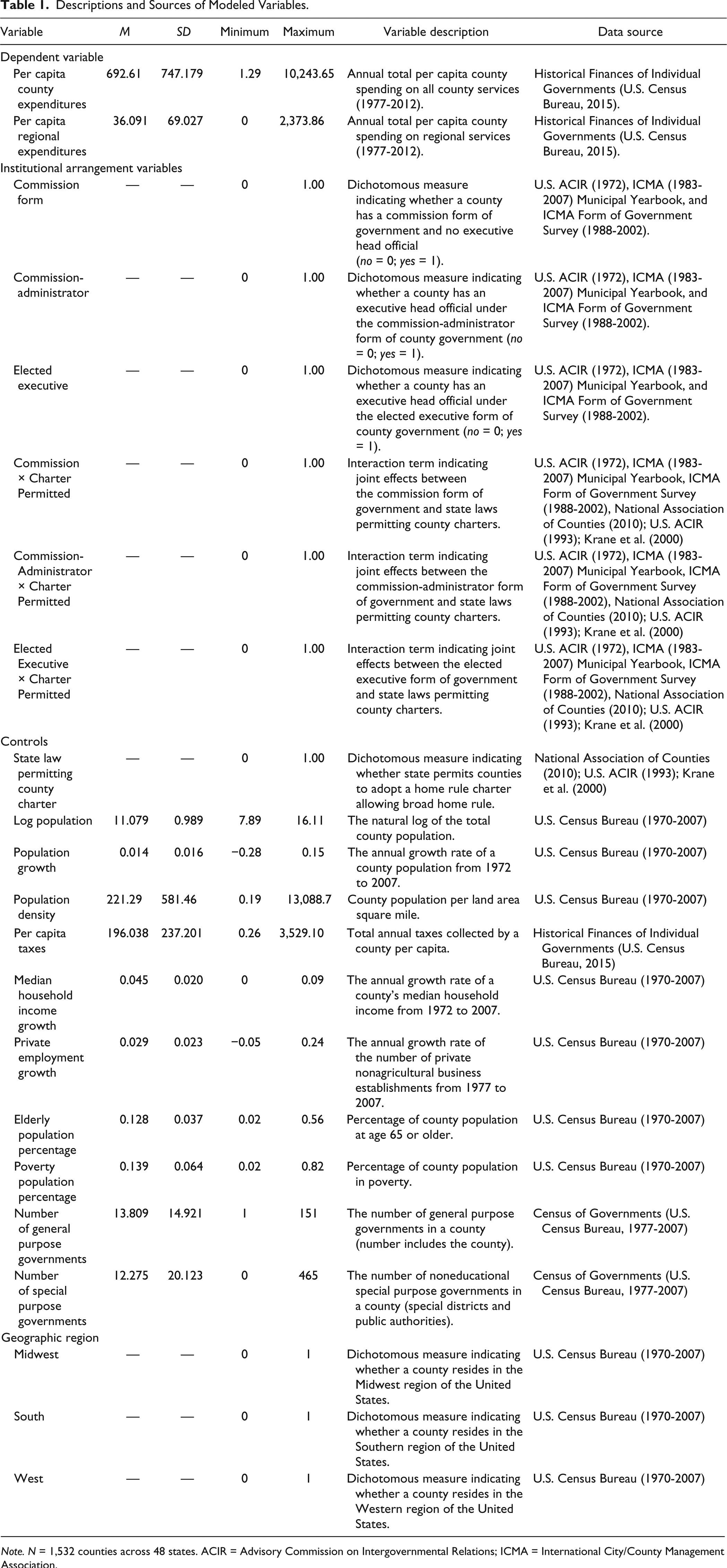
Note. N = 1,532 counties across 48 states. ACIR = Advisory Commission on Intergovernmental Relations; ICMA = International City/County Management Association.
Results
Tables 2 and 3 report the estimates generated by the generalized least squares models. Table 2 reports the unconditional baseline effects of the key independent variables on per capita county spending, while Table 3 reports the conditional effects of these variables using multiplicative interaction terms. The first sets of columns for both tables include the effects generated by the models that examine whether a county is modernized, while the second sets examine the isolated effects of the variations in executive leadership among modernized counties only. All sets of columns display results for total expenditures and regional expenditures, respectively.
Estimates of Unconditional Effects for Total County and Regional County Per Capita Expenditures, 1977-2012.
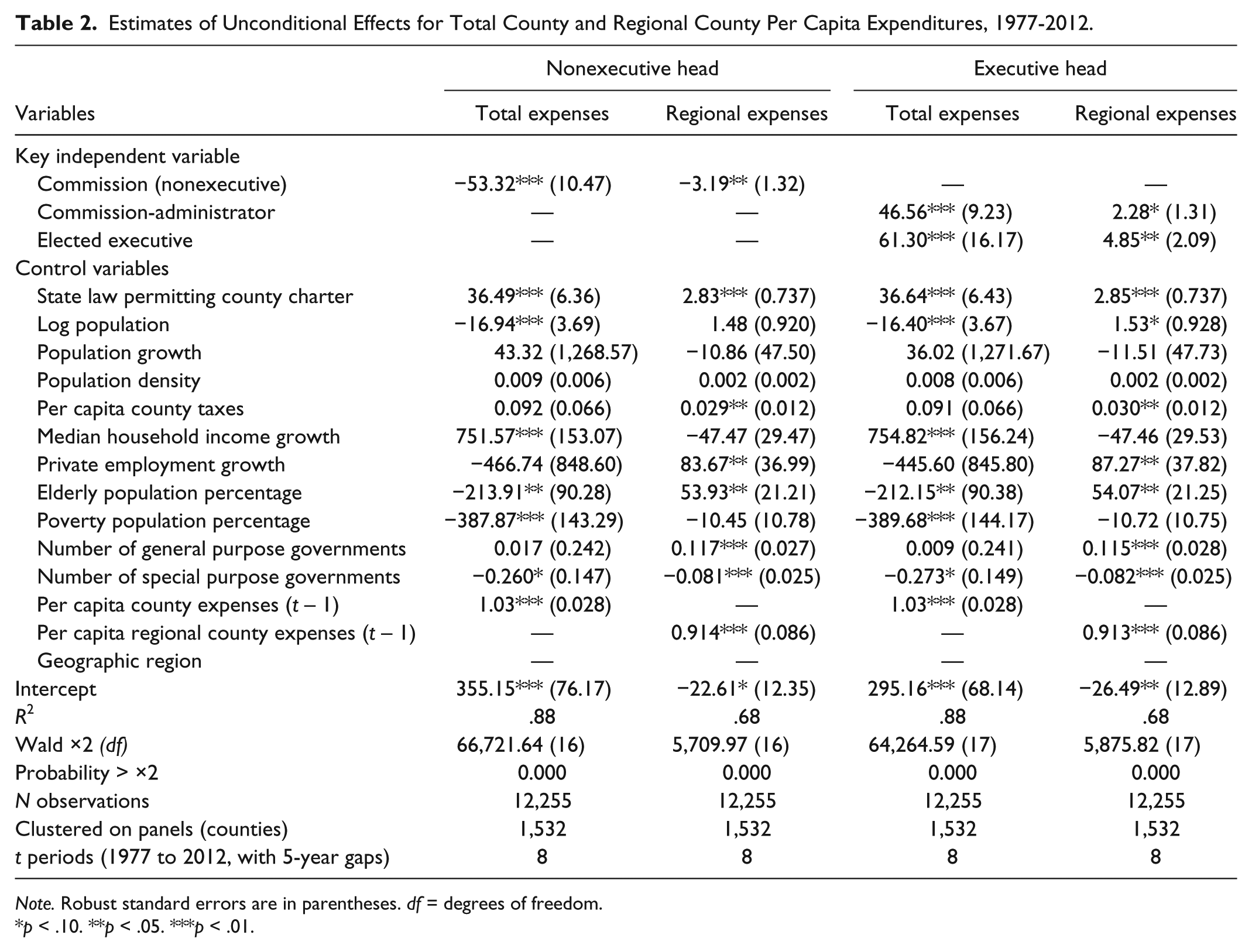
Note. Robust standard errors are in parentheses. df = degrees of freedom.
p < .10. **p < .05. ***p < .01.
Estimates of Conditional Effects for Total County and Regional County Per Capita Expenditures, 1977-2012.
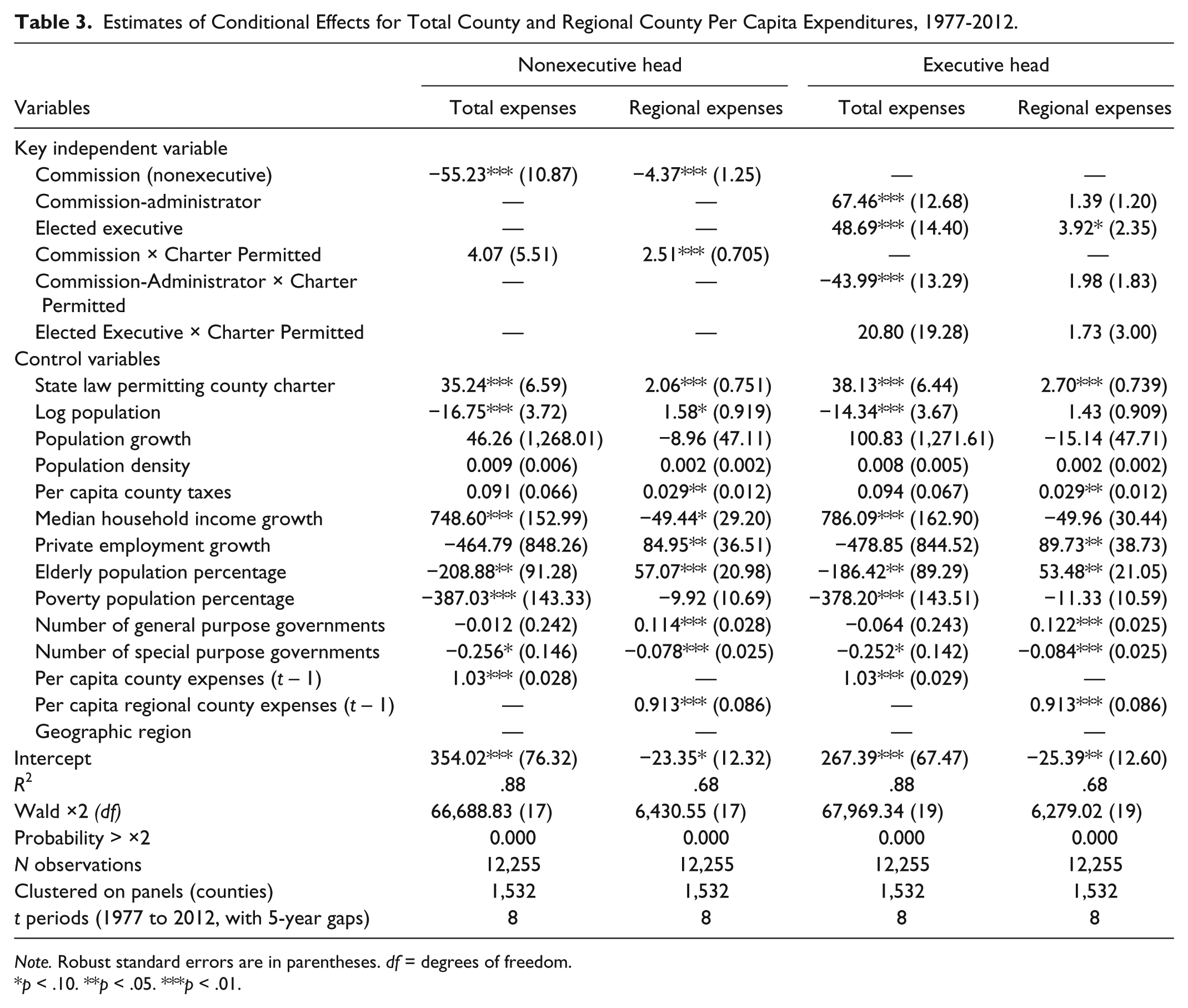
Note. Robust standard errors are in parentheses. df = degrees of freedom.
p < .10. **p < .05. ***p < .01.
While the results generated by the regression estimates display interesting effects as suggested by the coefficients in Tables 2 and 3, conventional outputs such as these can be substantively ambiguous and can provide little insight as to the practical implications behind the quantities of interest (King, Tomz, & Wittenberg, 2000). Therefore, these results are supplemented by a series of postestimation analyses that provide for a more substantive interpretation. Consequently, the results of the unconditional baseline models in Table 2 are interpreted using the postestimation routines that provide the average marginal value and first differences using Monte Carlo simulations as displayed in Table 4. 4
Average Marginal Value and First Differences for Total County and Regional County Per Capita Expenditures.
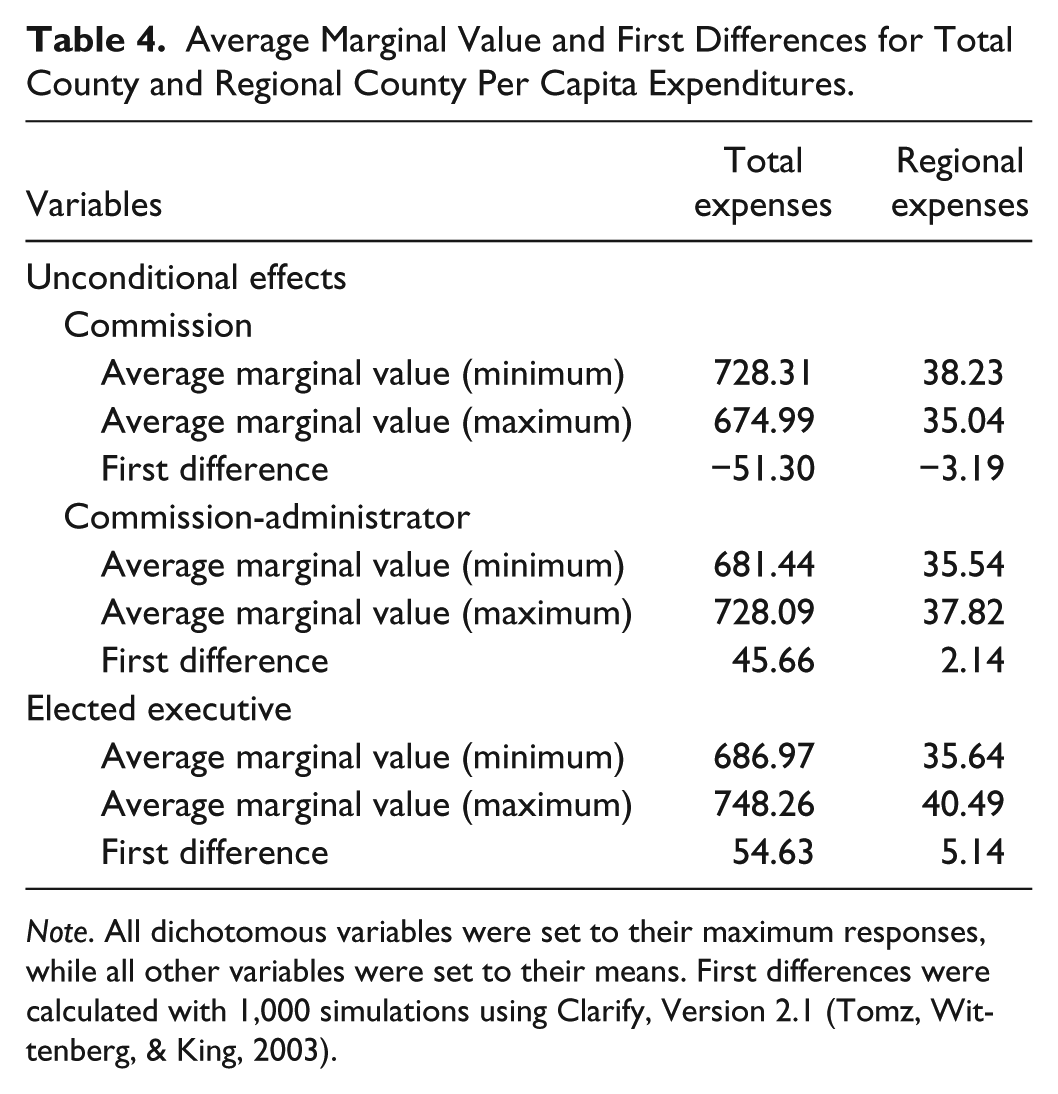
Note. All dichotomous variables were set to their maximum responses, while all other variables were set to their means. First differences were calculated with 1,000 simulations using Clarify, Version 2.1 (Tomz, Wittenberg, & King, 2003).
The findings produced in Table 3 are discussed through an analysis of the Figures 1 to 3 that present the combined marginal effects of the key variables of interest. 5 The plots presented in these figures illustrate the marginal effects of county government structure against changes in the status of state laws permitting county charters. Following prior research that examines the combined effects of political and institutional outcomes (Carr & Farmer, 2011; Farmer, 2015), plots are provided and discussed even when the interaction terms in Table 3 show no statistical significance (see Brambor, Clark, & Golder, 2006). The two-dimensional plots within these figures are generated using the GRINTER STATA utility for graphing marginal effects of interaction terms (Boehmke, 2008). The plots illustrate the marginal effects of the independent variable (X) increased to its maximum value on the dependent variable (Y) as the variable state law permitting county charter (Z) is increased from its minimum to its maximum value, while all other variables remain constant. Continuous variables are held to their mean, while dichotomous variables are set to their maximum value.

Regional expenses and commission form of government (Z = state law permitting county charter).

Regional expenses and commission-administrator form of government (Z = state law permitting county charter).

Regional expenses and elected executive form of government (Z = state law permitting county charter).
Unconditional Effects of County Modernization
Table 4 places a special emphasis on the quantities of interest by providing the average marginal values and first differences for per capita county expenditures. These findings highlight the average effects of the explanatory variable on per capita spending in each county. While holding other explanatory variables constant, the marginal values illustrate how per capita county spending changes as the key independent variable is altered from its minimum to its maximum value. For the first stage of analysis, Table 2 produces an inverse effect for commission form for both total per capita and regional per capita spending. With our attention focused on regional spending, the marginal values in Table 4 provide detail to the extent of this effect. These values reveal that if all counties had a commission form of government, the long-term average per capita value for regional county spending would go down from US$38.23 to US$35.04. This means that if you compared two similar counties, one with a commission form and one with another institutional arrangement, it is highly likely that on average, the commission (nonexecutive headed) county’s per capita spending would be roughly US$3 less than its counterpart. Meanwhile, the first difference value suggests that if we were to observe 1,000 comparable counties, having a commission form of government is estimated to reduce regional spending on average by US$3.19. This finding provides mild support for the earlier stated hypothesis regarding county modernization.
Unconditional Effects of County Executive Types
The next quantities of interest fall under the evaluation of the isolated effects of the two reformed government types. Looking back at Table 2, we can see that both the commission-administrator and the elected executive forms of government produce positive relationships with total per capita and regional per capita spending. Focusing specifically on regional type policies, if all counties were to have a commission-administrator form of government, the average for regional per capita spending would go up from US$35.54 to US$37.82. The first difference value for this measure produces an estimated average increase of US$2.14 per capita. Meanwhile, the average value for regional per capita spending increases from US$35.64 to US$40.49 when all counties are treated as if they have the elected executive form of government. The first difference value suggests that upon observing 1,000 otherwise comparable counties, on average, elected executive counties are estimated to spend US$5.14 more per capita than counties lacking this government form. While this finding does go in the direction of the anticipated hypothesis, elected executive counties are only estimated to spend on average about US$3 more per capita than commission-administrator governments.
Conditional Effects With Laws Enabling Home Rule Authority
Figure 1 is derived from the results in Table 3 and illustrates the marginal effect of having a commission form of government on county per capita regional expenses. Consistent with the findings from Table 2, the plot for this figure illustrates a reductive effect for the commission form of government. Interestingly, this reductive effect becomes weaker as charter-enabling laws move toward its maximum value, which indicates that a state allows its counties to establish home rule charters. The plot in this figure demonstrates that we can no longer be at least 90% confident that the commission government form reduces county spending when states move closer to permitting home rule. That is, as states allow county charters, the commission form of government has less of a reductive effect on regional county spending. Conversely, this reductive effect strengthens as states restrict county autonomy.
Figure 2 shows the marginal effect of the commission-administrator form of government on county regional spending. While the findings of Table 2 suggest that the commission-administrator form has a positive effect on regional spending patterns, the marginal effect in Figure 2 lends contextual support to the related unconditional findings. The plot reveals a stimulating effect for the commission-administrator government form, but only as state laws move closer to permitting county charters. Our confidence in this positive effect diminishes as states become restrictive in their laws that permit counties the legal powers to establish autonomy.
Figure 3 illustrates the effects of the elected executive form on regional spending. The effects illustrated in this figure are consistent with the findings of the unconditional effects in Table 2. Here, the marginal effect of the elected executive form displays a stimulating effect regardless of whether states permit or restrict the establishment of county charters. This suggests that even if states are restrictive in their laws allowing counties to establish local autonomy, the presence of elected executive officials increases county spending for regional services. This finding counters the given hypothesis regarding the contingent effects under the condition of states allowing counties to establish charters, but lends credence to the unconditional hypothesis regarding county executives.
Discussion and Conclusion
Much of the literature that explores county government structure and its effects on policy choices points to the varying characteristics encompassed within the makeup of county institutional settings. This study extends this body of literature by empirically examining the link between these institutional settings and how counties have progressed in service provision over the long run. With a special emphasis placed on regional service spending, this research contends that county executive leadership provides counties a greater capacity to extend their service delivery and meet the greater needs of the citizenry. However, the extent of this capacity becomes scrutinized as we focus on the varying characteristics embodied within the two main distinctions in county executive leadership. In addition, we can think of more issues as we begin to place consideration on the implications that state authority has on counties’ abilities to function as autonomous government establishments. The findings behind the current research bring four points to consider regarding the meaning behind the link between the evolution of counties as service providers and their given institutional arrangements.
Point 1: County Modernization Has Long-Term Effects
First, this study revealed that lacking a modernized form of government can be linked to a reduction in spending for regional services. Because this finding coincides with prior research in this area, it is no surprise to find that commission bodied counties spend less than those with executive headed forms (Benton, 2002b; DeSantis & Renner, 1996; Schneider & Park, 1989b). However, what distinguishes the current findings from prior works is that the findings in question demonstrate consistently less average spending for commission bodied governments over the long term (35 years). This finding was produced for both the total and regional spending observations. This contributes validity to the hypotheses of prior works and suggests that an elected body of commissioners in place of a designated executive leader lacks the required leadership and expertise that it takes to operate a responsive modern government. Countywide demands call for a government that can evolve to meet those demands. If nothing else, we can begin to have more boldness in our thinking as we perceive this concept as less of a philosophy of government institutions and more as reality backed by empirical observation.
Point 2: Similarities Exist Between County Executive Types
Both the commission-administrator and the elected executive forms revealed positive relationships with county regional per capita spending. However, elected executive counties demonstrated slightly higher expenditure rates. This finding lends some support to prior works (Benton, 2002b; Schneider & Park, 1989) and suggests that the elected executive form of government is likely to spend the most in the provision of regional services, as well as total services in general. However, a closer look at the current findings reveals that the disparity in spending between appointed and executive officials is very minor. Both county executive types revealed similar spending patterns among both the total spending and regional spending categories. Whether the executive is an appointed or an elected official, the findings suggest that the nature of these positions subjects them to selective benefits that are associated with enhancing regional policy outcomes. Therefore, the findings hint that both executive types seek to increase regional spending. This also lends some credence to the idea that the institutional incentives inherent within both types of political structures can lead executives to act as public entrepreneurs and seek strategic outcomes to regional dilemmas that affect the greater county area (Clingermayer & Feiock, 2001; Feiock, 2007). Likewise, the findings above also suggest that the executives of both government forms on average may have the propensity to lean toward long-range strategic investments in the implementation of regional services. Although the selective incentives of both executive types are different (Feiock, 2007), the overall outcome is the same. Countywide demands spark executive officials to coordinate efforts to strategically facilitate policy initiation to govern countywide jurisdictions.
Point 3: Home Rule Authority Plays a Major Role in County Spending Choices
While government structure is suggested to matter, state grants of authority to establish home rule revealed important implications for county service spending. For counties under the commission and commission-administrator forms of government, state restrictiveness in county authority plays a heavy role in their abilities to spend for services. While the commission form of government was shown to reduce regional service spending, states with laws permitting county charters appeared to overrule this effect. That is, the reductive presence of the commission government had less power in determining the levels of county spending. Similarly, counties with the commission-administrator form of government only seem to increase spending in states that afford them the power to establish a home rule charter. This not only speaks to how form of government matters, but it more so speaks to the powers that states have over counties when headed by an appointed official or when there is no executive in the first place. Counties under these forms of government seem to be more susceptible to state control.
Point 4: Institutional Incentives of the Elected Executive Can Have Stronger Influences
The conditional findings regarding elected executive counties were very interesting as the presence of state laws for charter home rule made no difference. Regardless of whether states allowed counties to establish charters, the elected executive structure increased regional spending. This finding coincides with Schneider and Park’s (1989) and can be rooted in theoretical frameworks arguing that the incentives of political leadership shape the abilities of officials to effectively deal with external actors (Clingermayer & Feiock, 2001; Feiock, 2007). Political institutions such as partisan elections provide local executives the ability to mobilize external interests in support of certain regional policy initiatives such as economic development (Clingermayer & Feiock, 2001). Holding to this logic, the institutional incentives behind these political structures are what influence actors to effectively bargain with and coordinate the efforts of external stakeholders (Feiock, 2007; Svara, 1996). Successful regional endeavors that result in strong positive development can have great political value for officials seeking to extend their tenure in office. While success in orchestrating policy arrangements can incentivize actors to become public entrepreneurs, strong incentives can also be found behind the need to avoid political turmoil (Miller, 2000). External stakeholders can bring political difficulties through strikes, service stoppages, or by simply minimizing electoral support (Miller, 2000). The desire to neutralize such difficulties can encourage officials to seek policy efforts with higher allocative efficiency to appease the median voter. The institutional incentives driving elected officials to become leaders of region-wide efforts can lead to the desire to obtain credit for minimizing externality problems that directly affect local constituents. Considering this reasoning, elected executives may be highly incentivized and well equipped to garner external support with lobbying powers to overcome state constraints that perpetuate local dilemmas.
Opportunities to Enhance Understanding
Before we can make a definitive determination regarding government structure’s effect on the direction of regional policy decisions, future work must seriously take into consideration the implications and issues behind e-governance and its effect on counties’ capacity to minimize service challenges brought forth by geographic scope. While some county boundaries are smaller and more densely populated, others consist of abundant landscapes and are sparsely inhabited. Rural communities can often lack the expertise and resources that are more accessible to urban areas, thus, making the delivery of public services such as health and education more challenging (Edmiston, 2003; Monnat & Pickett, 2011). The issue of geographic size coupled with insufficient demand makes balancing economies of scale difficult for many rural communities. Edmiston (2003) acknowledged this and discusses how new technologies can improve access to vital government services, resulting in cost-effective ways to sufficiently satisfy vital needs with low demand. This direction of study can provide fertile ground for analyses of government structure that consider how counties utilize information technology to expand county service roles while simultaneously overcoming imbalanced scale economies.
Future work must also fully explore the nature and dimensions of regional governance structures. That is, we must consider the various types of regional institutions (Feiock, 2013) and their connection to the county’s role in regional governance. While an analysis of spending patterns provides clues as to the institutional differences regarding regional decisions, such choices must be observed considering the environments in which county governments operate. The administrative bodies of counties often function within complex environments that are no longer (if they ever were) defined within the black and white parameters of the political-administrative dichotomy. This in consideration of the importance of the roles that states play in counties’ abilities to function amplifies the involvement in understanding county institutional environments. If we also factor in the cross-jurisdictional responsibilities and authority of counties, we may find that they have even greater administrative complexities than their municipal counterparts. Perhaps analyses from this unique perspective can provide opportunities to enhance our understanding of counties as their roles as public-service providers continue to evolve.
Footnotes
Acknowledgements
I wish to thank Benoy Jacob for his thoughtful advice during the development of this article.
Declaration of Conflicting Interests
The author(s) declared no potential conflicts of interest with respect to the research, authorship, and/or publication of this article.
Funding
The author(s) received no financial support for the research, authorship, and/or publication of this article.