







Abstract
Research on public participation in community planning processes often focuses on the design of participation activities and the tensions therein. Past research, however, gives little attention to the question of who makes these design decisions, what public values they hold, and how those values affect decisions about design. Addressing this gap, this study empirically illustrates the connection between public value frames, design choices, and public participation in a collaborative policymaking process. The case analyzed is a local public planning process designed collaboratively by public and private organizations. The analysis uses participant observation, documents, and interviews. Results demonstrate how effective collaborative governance of the design process and interorganizational power-sharing forced partners to reveal, recognize, and interrogate their own public values while navigating others’ values. The collaborative governance of the planning process allowed the organizations to capitalize on, rather than suffer from, differences in values frames by changing tensions in planning to opportunities and increasing equity in public participation. Findings suggest that research attention should be aimed not just at which stakeholders are invited to participate (and how), but at who designs the participation agenda in the first place. Furthermore, findings suggest that public values frame reflection and collaborative governance of participation design can be key practices improving planning and policy outputs.
Keywords
Introduction
Communities face many complex challenges, such as the impacts of climate change or persistent food insecurity. Traditional community planning approaches alone cannot solve these systemic issues. Just as in other facets of local public administration, the field of urban planning has looked to collaborative rationality to address systemic problems (Innes & Booher, 2016). A collaborative approach engages diverse participants representing public and private organizations in a deliberative process. At the same time, planning and other local public administration disciplines face pressure to include community members in planning processes. There is increasing recognition that “lay” community members’ expertise can contribute to the planning process, and so is the expectation that the public should be engaged in problem-solving and governance structures (Nabatchi & Leighninger, 2015). For example, the food movement calls for “food democracy,” or “food citizenship,” as a cross-sector approach that includes lay community members to solve complex problems in the food system (Renting et al., 2012; Scherb et al., 2012).
Since the 1960s, the planning profession has taken public participation seriously, with citizen engagement even being codified into the ethical practice of the American Institute of Certified Planners (Shipley & Utz, 2012). Despite debate over the effectiveness of many of the standard approaches to public participation, participation techniques continue to evolve as citizen involvement has become a mainstay in planning practice. A research focus in planning, as well as in the broader public participation literature, is on the role of local government in engaging the public, with the aim of increasing governance capacity and legitimacy while improving policy outcomes. As a result, public participation research tends to focus on technical design choices, such as the format of participation, which version of the “public” is invited, the level of empowerment of those invited, and the overall goal of participation (Cooper et al., 2006; Fung, 2003; Nabatchi & Amsler, 2014; Shipley & Utz, 2012). Notably, this research does not focus on who makes design choices and how those choices affect opportunities for the public to participate. Furthermore, little research examines how public managers reflect on values in their daily practice (Nabatchi, 2018).
Design decisions are not neutral choices and who makes those decisions matters materially for public participation. As decisions within a social process (Schön & Rein, 1994), public participation design choices are inevitably informed by the implicit and explicit values of the designer. Consequently, representation of different public values in the design of public participation processes depends, in part, on who makes the design decisions (Clark, 2018; Cooper, 1984; Nabatchi, 2012, 2018; Read & Leland, 2011). Value-infused design choices are a form of power over key debates (Lee, 2014). Design choices are opportunities for designers to make executive decisions about areas of disagreement, or tension, in planning, such as between process and outcome, local and specialized knowledge, participatory planning and bureaucracy, or social equity and expertise (Chaskin, 2005; Christensen, 2015; Day, 1997; Howe, 1992; Reece, 2018).
Previous scholarship, such as Fung (2003, 2006, 2015), Cooper et al. (2006), and Bryson et al. (2013), provides a rich understanding of the guidelines and dimensions of public participation design choices (e.g., who is invited, how people interact, the rationale for participation) and the public value that can result from good design (e.g., legitimacy, justice and effective administration, increased citizen capacity). This literature explores critical questions about who gets “invited to the decision-making table” (Raja et al., 2018). Yet, extant literature leaves a relatively little-explored and more fundamental question: who builds the table to which people are invited?
The argument here is that those who get to design the public participation process have fundamental influence over the participation process. Moreover, planning practitioners’ unstated values frame about the role of citizens and the role of government in the policy process inform these design choices (Cooper, 1984; Nabatchi, 2018). By theoretically connecting public values frames in participation design process with resulting opportunities for public(s) to actually participate, this article shifts the discussion from “who should be invited to the table?” to “who makes decisions about how the table is designed?”
The case of food systems planning presented here illustrates how collaborative governance of the actual public engagement design process revealed underlying public value frames held by the designers. 1 Food systems planning provides a good topical area because problems in the food system are often complex, requiring participation of a wide variety of public and private actors in problem-solving (Caton Campbell, 2004; Renting et al., 2012; Sussman & Bassarab, 2017). A greater variety of actors engaging in food systems planning likely increases public value pluralism and tensions in the process. In the case presented here, effective collaboration and interorganizational power-sharing during participation design forced partners to recognize and interrogate their own public values while navigating tensions with the values of others. Once revealed and recognized, public values tensions were able to aid the process of designing public participation processes and resulted in more equitable participation.
Planning and Public Participation
The role of public planners is fundamentally about improving the public environment, including the health and welfare of citizens, by taking a comprehensive approach that is public interest driven and normative (Pothukuchi & Kaufman, 2000). Planners examine community systems (e.g., housing, food, transportation, land use) that create places (Pothukuchi & Kaufman, 2000). They engage in a general planning process that includes community goal-setting or visioning that is most often determined via community participation, data gathering, analysis, plan writing, implementation planning, and monitoring (Kelly, 2012; Loh, 2012). Supporters of direct citizen participation in this process often base their support on theories of democracy, arguing that direct participation can provide legitimacy, justice, effectiveness in policymaking and implementation, protection of freedoms, and internal benefits, such as educative and developmental results (Fung, 2015; Kinzer, 2016; Roberts, 2004; Shipley & Utz, 2012).
Consequently, while public participation plays an important role in the planning profession, it has not always been part of the planning process. Pushback by the public against top-down planning began in the 1960s, as a result of being impacted by urban renewal. Only two decades later, public participation was mainstreamed in the profession (Shipley & Utz, 2012). Yet, the introduction of public participation in planning practice never fully supplanted previous expert-based models of practice. The result is persistent tensions between theoretical approaches to planning practice (Whittemore, 2015).
Participatory planning practice, which has taken a variety of forms over the years, finds its footing in theories of advocacy and communicative planning, both of which are in response to failures of comprehensive rational planning approaches. The hallmarks of comprehensive rational planning include the planner as expert and value-free; the task of planning as technical in nature; and the planning organization as specialized, centralized, and organized by procedure (Dalton, 1986). In response to this model, Davidoff (1965) posited an alternative “advocacy” approach to planning. His argument was that for an effective democracy, public planners should abandon the notion of “value-neutral” planning and embrace pluralism. He further saw planning as a political policymaking process, involving competition among varied community interests within a pluralistic society. Based on these positions, he argued that public planners—rather than trying to neutrally represent a notional homogeneous public interest—should “advocate” for the interests of those who have been marginalized, such as minorities and the poor. What resulted is a planning practice based on an adversarial system of pluralistic planning, modeled after the judicial system.
Communicative planning, like advocacy planning, also conceives of planners as value-oriented participants in the world rather than mere observers (Innes, 1995). As participants, planners wield information as a potent form of power (Forester, 1982). Information controlled by planners can encourage some people to participate while excluding others. It can highlight some options and possibilities and downplay others. Forester (1982) argued that planners “organize cooperation, or acquiescence, or activism . . . organizing attention to options for action, to particular costs and benefits, to particular arguments for and against proposals” (p. 68). Unlike Davidoff’s advocacy planning, Forester builds from Habermas’s theory of universal pragmatics and communicative action, promoting deliberation—rather than competition as articulated by Davidoff—as a way to address power imbalances in planning.
As practice and scholarship continue to build on these theories, a communicative approach evolved into “collaborative” planning. Innes and Booher (2018) fleshed out the types of arrangements of actors and practices that enable communicative action (e.g., diversity of participants, interdependence among participants, and authenticity in dialogue). This planning approach squarely honors local community knowledge as distinct from expert planner knowledge in the planning process.
Participatory approaches to planning use the planning process to transfer power along the “spectrum of participation.” For example, the public can participate when planners consult them during the planning process (e.g., asking them for feedback), but they can also be collaborators in that process by being on a citizens’ advisory committee for a plan (Forester, 1988; International Association for Public Participation, 2014; Kinzer, 2016; Lane, 2005). An advocacy planner catalyzes participation to give voice to others or, if they are unable, to advocate for their interests directly. In contrast, practicing communicative planning is, by definition, a deliberative process; public participation in a facilitated dialogue is meant to rectify power imbalances that produce predetermined, unjust outcomes.
As each shift in planning takes place, remnants of previous modes of planning, and, therefore, conceptualizations of the role of the public, are not entirely replaced by new modes of thought (Whittemore, 2015). These layers of “sediment” may result in tensions in planning practice as it pertains to public participation in the process. Namely tensions may arise between planners playing a facilitation role versus that of an expert in the planning process; empowerment of community members and issues of equity in participation versus efficiency; local knowledge versus specialized knowledge; institutionalized and formalized processes that limit participation versus innovative approaches to participation; and a focus on the process versus the outcome of planning (Chaskin, 2005; Christensen, 2015; Day, 1997; Healey, 1998; Hou & Kinoshita, 2007; Howe, 1992; Reece, 2018). 2 If designing a public participation process by oneself, then decisions about the above practices likely will not be interrogated, and neither will the underlying values that drive these decisions.
Collaboration Governance—The Governance Process
Much has been written on the rise of collaborative governance and the motivations to do so (e.g., complexity of societal problems, limited public resources, and rising dependencies between organizations; Agranoff & McGuire, 2003; Emerson & Nabatchi, 2015; O’Leary et al., 2009; Thomson & Perry, 2006). Emerson and Nabatchi (2015) define collaborative governance as focusing on public policy decision-making and management, made up of the processes and structures that engage people across sectors toward a public purpose that cannot be achieved alone. As such, collaborative governance of planning represents a shift from participatory planning being orchestrated by a single designer (i.e., a public planning department or a private firm contracted by a planning department) to participatory planning being orchestrated by public actors in collaboration with nonstate actors.
Arrangements for collaborative governance processes involve a variety of distinctive characteristics, such as joint decision-making among participants, power-sharing, and shared problem-solving (Thomson & Perry, 2006). These characteristics involve the following four features. First, a lack of authoritative structure and division of labor as governance structures tend to be flat. Ideally, power is used with others rather than over others (Agranoff & McGuire, 2001; Ansell & Gash, 2008), although a variety of power asymmetries can still exist in flat governance structures and hinder power-sharing (Ran & Qi, 2018). Second, participants accept that all other participants have legitimate interests, which does not necessarily mean universal agreement on solutions, but a willingness to support the final decision of the group. Third, participants impose decisions on themselves as they reach an agreement and share responsibility for outcomes. Finally, Thomson and Perry (2006) state that this type of governance emphasizes openness with information sharing and potentially lengthy deliberations and negotiations, which suggests value in frequent face-to-face interactions. It is these factors that distinguish collaboration from lesser forms of cooperation (O’Leary et al., 2009).
These four implications speak to Emerson and Nabatchi’s (2015) notion of the role of “principled engagement,” which includes “fair and civil discourse, open and inclusive communication, balanced by representation of ‘all relevant and significant different interests’ and informed by the perspectives and knowledge of all participants” (p. 59). Overall, for participants, the process of governing collaborative efforts involves a continual process of negotiating, renegotiating, and assessing mutual commitment. This process depends on trust, reciprocity, and shared understanding and results in an iterative and emergent process (Ansell & Gash, 2008; O’Leary et al., 2009; Thomson & Perry, 2006).
Returning to the issue raised at the end of the last section, how might tensions in planning practice (e.g., local knowledge vs. specialized knowledge and efficiency vs. equity) play out in terms of collaborative design of public participation processes? From a normative perspective, the characteristic of principled engagement implies that participants endeavor to be open to discourse and cooperative inquiry across different conceptualizations of the roles of planners and the public (Schön & Rein, 1994). Principled engagement also suggests the importance of reflection on one’s own position on the issue at hand while negotiating and renegotiating with fellow collaborative members, maybe going as far as to change one’s position. Regardless of whether conflicting ideas are reconciled, in a flat governance structure, a resulting public participation design—and the value frame that informs it—would be owned by all who were involved in design.
Theoretical Framework—Action Frames and Public Values
To design public participation opportunities, planners make decisions about the goal(s) of participation, the format and agenda, who is recruited, and the level of empowerment (Bryson et al., 2013; Cooper et al., 2006; Fung, 2003). The variety of actors who make design choices is increasing (Fung, 2015). Traditionally, planning research focuses on two types of designers: public sector planners and the professional planning consultants who are hired by the public sector (Read & Leland, 2011). However, given growing recognition of “lay” expertise, members of civil society are taking on planning roles that do not fit into the public sector planner or professional planning consultant categories (Sager, 2012).
As more types of actors engage in the design process, public participation is informed by a greater variety of “action frames,” interpretive tools made up of values and beliefs about the role of the public in planning (Read & Leland, 2011; Rein & Schön, 1996; Schön & Rein, 1994). For example, Read and Leland (2011) found a difference between the values and beliefs of public sector planners and professional planning consultants. Action frames of planners are developed through tacit knowledge and are influenced by many factors, including professional socialization and training, practice experience, lived experience, and institutional and organizational values (Clark, 2018; Read & Leland, 2011; Schön & Rein, 1994). A designers’ action frame becomes the rationality for design and is revealed in practice (Forester, 1999; Innes & Booher, 2018; Read & Leland, 2011; Rein & Schön, 1996; Schön, 1983; Schön & Rein, 1994).
In the field of public administration, public values frames shape the action, or practice, of governance (Nabatchi, 2018). Public values provide the normative consensus about (a) the rights, benefits, and prerogatives to which citizens should (and should not) be entitled; (b) the obligations of citizens to society, the state, and one another; and (c) the principles on which governments and policies should be based. (Bozeman, 2007, p. 13)
Nabatchi (2018) outlines four public values frames, “political” and “legal,” as part of the democratic ethos, and “organizational” and “market,” as part of the bureaucratic ethos. Cooper’s (1984) work on views of citizenship by public administrators provides a bridge between Nabatchi’s public values frames and the potential role they play in public participation design. The following describes Nabatchi’s frames and uses Cooper’s work to suggest the type of participation opportunities that may result.
Political public values are linked directly to democracy (e.g., participation, representation, political responsiveness, liberty, equality). A political public values frame likely will result in participatory planning approaches, building from communicative or collaborative planning theory. This is closely tied to Cooper’s concept of “high ethical citizenship.” The legal public values frame is about rights, due process, and equity, also resulting in participatory planning approaches, but built from advocacy planning theory. Organizational values reflect a managerial perspective, focused primarily on efficiency and other values such as specialization and expertise, authority, merit, formalization, organizational loyalty, and political neutrality. This frame likely will result in a tendency toward more rational “expert-based” planning approaches. Finally, market values place an emphasis on actions that result in cost savings and efficiency, productivity, flexibility, innovation, and customer service. This frame likely views participation as individualized and transactional, with the community member as the customer.
Public values frames, then, affect how designers view the public, what they may bring to the process, and what they value in the planning process itself, all of which become the action frame affecting participatory design. Views of the public emphasize the “why” of participation. Whether the public are considered to be consumers, clients, interests, citizens, stakeholders, or collaborators has different implications for how they will be invited to engage (Cooper, 1984; Day, 1997; Roberts, 2004). For example, as consumers, the public passively “votes” for public services by using them. As collaborators, the public brings knowledge and experience to the table in the development of solutions.
Fung (2006) contended that the choice of how to view the public depends partly on the context and the public problem at hand. However, the public values frame may predefine the view of the public. If a planner or administrator is designing a public participation process alone (or with individuals with similar frames), then the design is likely rolled out from routine habit, with a singular frame and singular set of beliefs, without interrogating values and perceptions. Without practicing reflexivity in the process, designers are generally unaware of how their values influence the ability to achieve desired values of public participation, such as legitimacy, justice, and effective administration. The aforementioned tensions on how the public interfaces with the planning process would likely not be revealed and considered (e.g., role of the planner as expert vs. facilitator, local vs. specialized knowledge, efficiency vs. equity). Furthermore, one planner, with a single-frame design of public participation opportunities, can design any conflict out of the process, whether intentionally or unintentionally (Lee et al., 2015).
Yet, public administration often entails a multiplicity of value systems that affect practice (Van der Wal & Van Hout, 2009). Furthermore, more nonpublic sector planners develop community plans and planning processes, and as more lay stakeholders engage in public governance structures. The question arises of how potential value pluralism is, or is not, navigated. Values can be described as being in competition with one another, with an alternative view that some can coincide with one another (Van der Wal & Van Hout, 2009).
Theory reviewed in the earlier section suggests that effective collaborative governance arrangements can provide the mechanism to interrogate different frames, and be productive with tensions, rather than resulting in competition. Dialogue among collaborators that share power can be used to reach a new understanding, rather than simply negotiating interests (Innes & Booher, 2018). Furthermore, dialogue about intentions and meaning-making of collaborators enables frame reflection, enabling collaborators to recognize that there are multiple set of legitimate beliefs and values driving design (Innes & Booher, 2018; Schön & Rein, 1994). Finally, dialogue and effective codesign facilitates reflection, learning by dialoging, and practicing together (Schön & Rein, 1994). Forester (1999) builds on by suggesting that the way collaborators dialogue can change values and beliefs of others. Collaborators, while engaging in conversation, learn first to value one another, which provides legitimacy to their reasoning behind design decisions. In other words, collaborators learn and appreciate others’ perspectives as they learn about the collaborators themselves.
Figure 1 illustrates simplified models of a single-public values frame design and its impact on public participation (top) and a multipublic values frame design in the context of effective collaborative governance of the design process (bottom). The gray boxes on the left and dotted arrows note the specific contribution of this article. In cases where only one frame is at play, those values will carry through to the output. In cases of collaborative governance of the design process that engages multiple frames, and embodies the qualities of collaborative governance described earlier, then it is theorized that the resulting output will reflect some combination of the frames. It is important to note that not all values need to be equally present in the design, but that the governing group agrees on the resulting design, whatever it is.
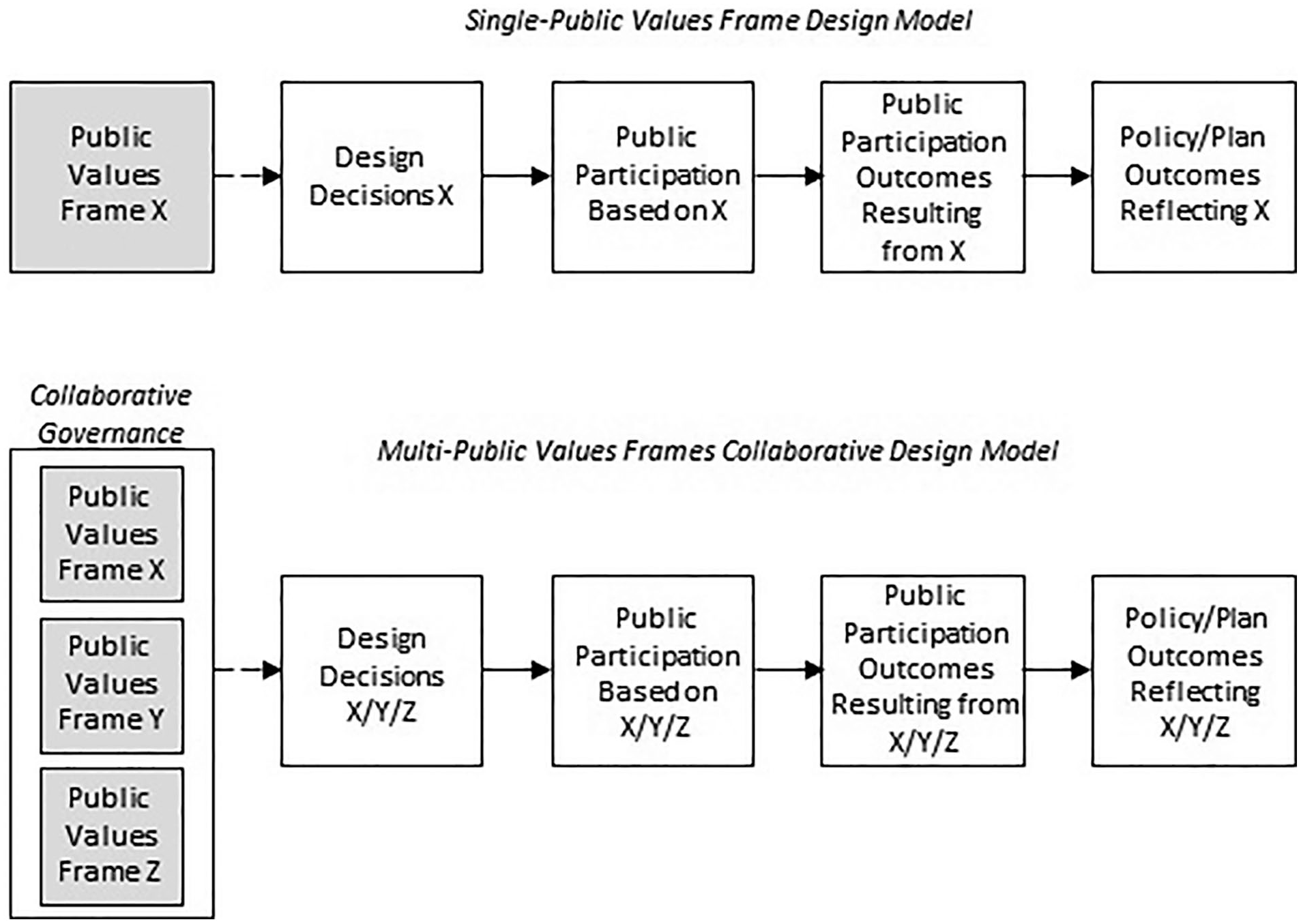
Public values frames and public participation.
This research attempts to determine what values designers bring to the planning process, how they contend with differences in the case of collaborative governance of a planning process, and what the impact is on public participation. As mentioned earlier, food systems planning provides a good topical area because of the complexity of the food system. For instance, more and more cross-sector coalitions, including civil society members, are being developed locally to address food system problems (Sussman & Bassarab, 2017). These coalitions are joining local governments as designers of local planning processes (as a sample of local plans from across the country illustrate, New Haven, CT; Los Angeles, CA; Santa Fe, NM; Douglas County, KS; and Asheville, NC), which introduce nonpublic sector and nonprofessional planners into the design of the planning process.
Study Design and Analysis
This article draws on the Columbus and Franklin County, Ohio Local Food Action Planning (LFAP) as an instrumental case of local planning wherein the public participation process was designed collaboratively between a county planning agency, a city health agency, and a nonprofit organization (Creswell & Miller, 2000). Furthermore, the collaborative governance of the plan resulted in an award-winning plan for best practice. The objectives of the analysis were to reconstruct events of planning and public participation process, understand the interplay between the planning team members’ different planning approaches and underlying beliefs and these events, and explain the governance mechanism that translated beliefs to actions.
Documents, interviews, and participant observations provided the basis for analysis. The documents used include an initial current conditions and vision report, a summary of public comments on the current conditions and vision report, the policy and program recommendation report, the draft potential actions list, six neighborhood reports, working committee minutes (from June 17, 2015, September 30, 2015, December 11, 2015, March 11, 2016, and July 15, 2016), the resulting local food action plan, and web content about who was involved and the planning process. Documents were used to reconstruct events and provide a basis for the interviews.
The LFAP planning team members were interviewed, including two county staff (planners by profession), three city staff (public health professionals), and two staff of a social justice–oriented nonprofit partner. Semi-structured interview questions focused on seven areas: (a) the team and its formation; (b) designing the planning process and it administration; (c) decision-making and leadership in the design; (d) tensions and points of debate in the design and planning process; (e) organizational perspectives of the planning process; (f) perceptions of the public(s) and its role(s) in the planning process; and (g) lessons learned in the planning process. Each interview lasted approximately 90 min. The interviews were transcribed verbatim and coded into NVivo to distill and refine themes related to the research objectives.
The author employed two different coding methods. First, structural coding was employed to analyze the governance process and included coding categories related to the origins of the planning team, team structure, decision-making, the public participation process, and postplan implementation. Structural coding is used to analyze text related to segments of data related to research objectives, which are guided (in this case) by interview questions (Saldaña, 2015). Structural coding is particularly useful when interviewing multiple people with a standardized interview tool (Saldaña, 2015). The second coding method, values coding, examined interviewee’s public values frames, including beliefs (and changing beliefs), underlying philosophies about planning and public participation (to uncover any tensions), and conceptualization of the public(s). This is a method to capture interviewee’s values, beliefs, and attitudes (Saldaña, 2015).
Finally, the author’s experience as a member of the LFAP working committee (not the planning team) and as a member of the Franklin County Local Food Council (FCLFC) (described in more detail, below) resulted in 17 meetings and 50 hr of direct observation and participation over a 13-month period.
These three sources of data (documents, interviews, and action research) were used to track, verify, and triangulate information. To address construct validity, interviewees evaluated the final draft of the paper (Yin, 2003). Interviewees were able to provide additional insights and clarifications. There were no disagreements with the findings and analysis, but interviewees did provide a few corrections and elaboration on some points. To address internal validity, the literature review was used to ground the analysis.
The Case
The capital city of the state of Ohio is Columbus, which is located in Franklin County. A little more than 1.2 million people reside in the county (U.S. Census Bureau, 2015). While many indicators suggest that the Columbus metro region has a robust, recession-proof economy, it does suffer from a host of problems, including those related to food and farming, such as low fruit and vegetable intake, high rates of food insecurity and chronic disease, disparities in access to healthy foods, and a lack of markets for local agricultural products (City of Columbus & Franklin County, 2016; Price, 2015).
The local and regional governments were attentive to these problems. In 2009, the Mid-Ohio Regional Planning Commission convened a working group of public sector staff (e.g., public health professionals, economic developers), nonprofit social service representatives, food distributors, and food retailers to conduct a regional food assessment and plan. A recommendation in the plan was for each county in the region to create a local food policy council. In 2011, a group of volunteer farmers, representatives of local nonprofits, public sector staff, local food business representatives, and staff from the local university agreed to create the council. The purpose was to build relationships across sectors and interest in the food system to improve conditions in the community. The approach taken was to host public forums, share information, colearn new topics, and advocate for a community-wide plan.
At the same time, the city and county governments were engaging in local food initiatives, but these efforts were not coordinated and neither were those of the community groups working to change the local food system. 3 As the FCLFC and community groups increased their activities, requests for funding and resources increased. In recognition of the systemic nature of the food system problems the community faced, the need to coordinate efforts between governments and between governments and the community, and responding to the requests for a more comprehensive plan by local groups, the city and county governments officially launched the public planning process in 2014. The purpose of the LFAP was to provide a framework for common goals and actions to inform public policy and program development, facilitate community collaborations, and direct local funding.
The planning team, which was responsible for designing the public participation process, consisted of three organizations. 4 Columbus Public Health (with three staff primarily involved) led the city effort and the Franklin County Economic Development and Planning Department (with two staff primarily involved) led the county’s effort. One of the staff members from the Columbus Public Health had experience working with the broader community on food-related issues, namely lack of access to healthy food. The lead planner from the county had already shepherded a few food policy initiatives with the FCLFC.
The third organization, brought on at the request of the city legislative lead and hired through the Columbus Public Health, is a local nonprofit called Local Matters (with two staff and a hired consultant, who was a member of the FCLFC, primarily involved). Local Matters has been working for nearly a decade in Columbus. At the time of the planning process, their mission was “to create healthy communities through food education, access and advocacy.” Their long-term vision focuses on social equity in the food system. Their approach, as outlined in their first annual report, is to build long-term, trusting relationships with other community organizations that share their values and to honor the wisdom of neighbors by listening and learning from local expertise. Back in 1998, well before Local Matters was established, their cofounder and Director of Advocacy and Community Outreach was working with other community groups to solve problems in the food system. For example, the director was a key leader in the Mid-Ohio Regional Planning Commission regional assessment and planning process mentioned earlier.
One of the first activities of the project team was to create a working committee akin to a citizens’ advisory committee to provide guidance on the plan and the planning process. Twenty-four people were on the working committee, representing a variety of food system sectors and interests (e.g., food production, distribution, education). Other community members would become involved in the process, as described later.
It is important to note that the planning team and working committee were positioned and embedded in a broader network. Nearly all team members and working committee members had formal and informal relationships with other members. For instance, the nonprofit had partnered in the past with the public health department, and many of the project team and the working committee members were active in the grassroots local food policy council and had worked together on other food system projects over the past 10 years.
Findings
The findings are organized into three sections, following the three research objectives. The first section outlines the planning and public participation process as reported in documents and by interviewees. The second section describes how the interplay between the planning team members’ different planning approaches and underlying beliefs, and their reflections on these differences, affected public participation (positively and negatively). The final section illustrates the governance mechanism behind the planning teams’ reflection on, negotiation (and renegotiation) of their beliefs and values, and the resultant innovative public participation process.
The Planning and Public Participation Process, on Paper
The planning process was conducted in three phases. The first phase documented current needs and assets and created a vision. This began by conducting neighborhood meetings in six of Columbus’s most impoverished neighborhoods and one upper income neighborhood. (See Figure 2 for a timeline of public participation within the overall planning process.) The upper income community was included because it has within its boundaries the highest number of seniors in Columbus. The purpose of these meetings, which engaged more than 170 residents, was to hear firsthand from residents and identify neighborhood-specific problems in accessing healthy food and nutrition education. Each neighborhood meeting resulted in three to five actions to address identified problems. Other primary data were collected for the first phase via four different online surveys aimed at different food system sectors, consumers, producers, processors/distributors, commercial and institutional buyers, and waste recovery, which resulted in responses from approximately 700 more people. Finally, to help with problem setting, a dozen key informants were interviewed.
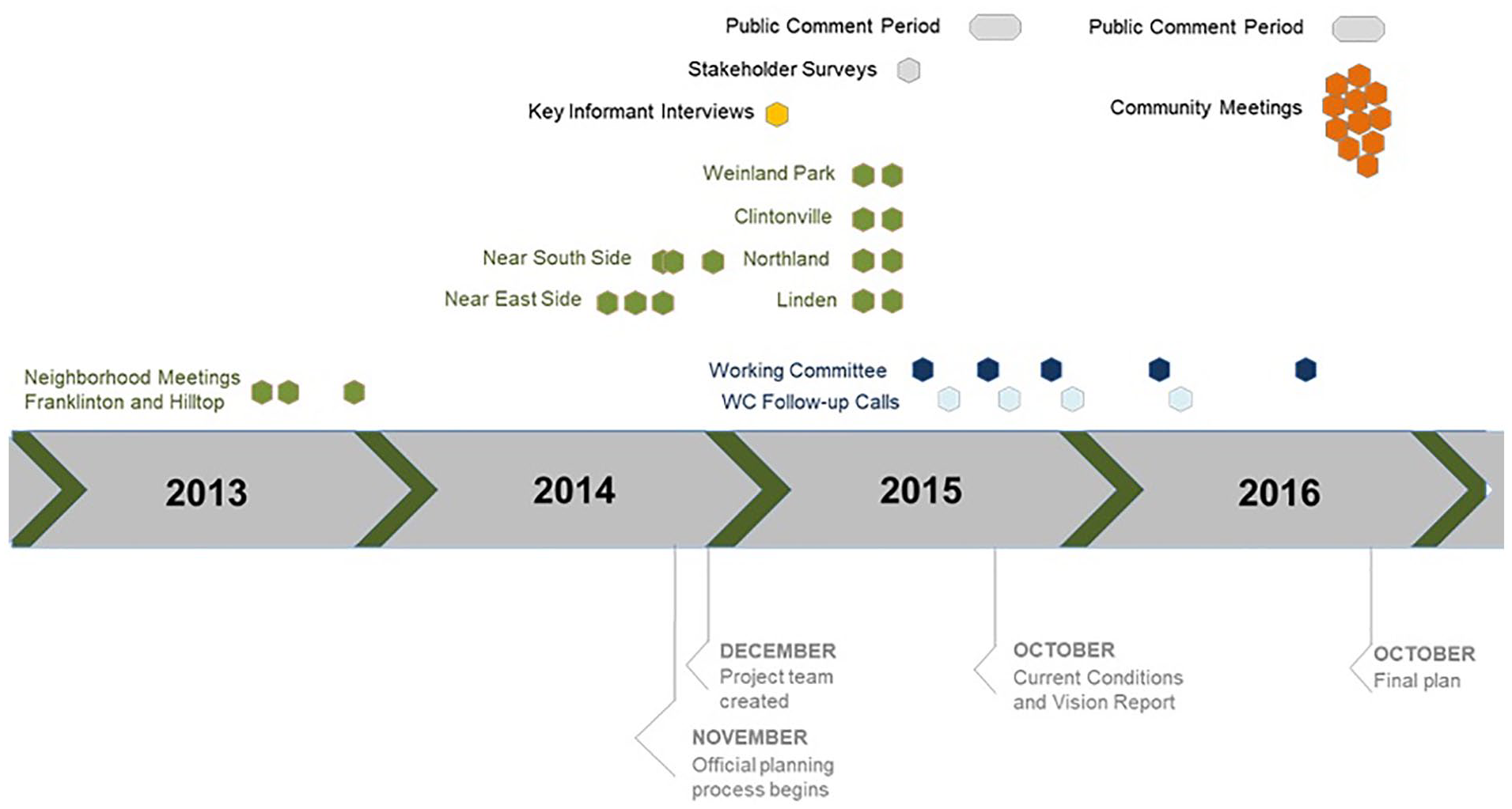
Local food action plan public participation timeline.
Secondary data collection in the planning process included compiling and analyzing published data, such as the population and agricultural censuses, to describe social and economic conditions. In addition, team members compiled and analyzed local, regional, and state plans from across the country. At the very end of this first phase, the working committee met to review draft documents and establish a vision. The resulting vision is “a fair and sustainable food system that benefits our economy, our environment, and all people.” The four goals to achieve the vision are (a) enhance coordination and communication among existing food resources and agencies, (b) improve access to and education about healthy food, affordable food, and local food, (c) increase the role of food in economic development, and (d) prevent food-related waste.
The next phase built on the vision by identifying potential actions that could achieve the vision and goals. Actions identified in the scan of national plans and reports as well as the neighborhood meetings seeded this phase. The three to five actions identified in each of the neighborhood meetings were visually set apart to trace their existence through the plan and bring to light themes across all the neighborhoods. The national scan and neighborhood meetings resulted in 146 actions. Over the course of two meetings, the working committee reviewed these actions and narrowed them down to the 44 that were most promising, impactful, and implementable. The team took these 44 actions and conducted research on each one, including looking for good practices from other communities and asking stakeholders their opinions on whether these actions would help meet the plan vision and the likelihood of implementation. During this process, some actions were combined, resulting in the 35 actions that were included in the policy and program recommendations draft. The working committee reviewed this draft at a final meeting that was open for feedback from the public, which resulted in a set of 27 actions in the final plan.
The final phase of the project included developing a “Getting Started” table for each action, which included guidance on plan implementation that identified potential public and private resources available for implementation, starting steps, and measures for evaluation. Once complete, the working committee reviewed the full draft of Local Food Action Plan and revised it further. The county commissioner and city councilmember reviewed the final draft. Finally, a 6-week public comment period opened.
The public comment period included both a general public online survey and 11 feedback sessions where the team traveled to community and neighborhood meetings. During these meetings, actions were prioritized into those that would have the greatest impact and those that were “low-hanging fruit.” Also during this time, the FCLFC spent its meetings reviewing the plan, dedicating each meeting to a separate area. Furthermore, the council began to map how it saw the council contributing in a community governance structure to help guide implementation of the plan. During this final phase, new issues arose: the need to address healthy equity, cultural competency, and the emergency food system in the plan and the need to develop a governance structure that allows the full engagement of the community in food system efforts.
The Planning and Public Participation Process, in Reality
On paper, the project team planning process was linear and phased. Decision-making regarding the process, however, was not. Each team member’s past professional experiences and underlying values of the public participation process were very different. The county’s approach was a more conventional planning approach that was planned for in advance, was set in planning phases, more likely designed to consult the public in decision-making, and more likely to occur in designated government locations (Nabatchi, 2012). One county planner described how the city did not work the way they did.
They are engaged in what I would describe as a much more iterative or qualitative process where it’s just, “We’re going to gather information, and we are going to see where that leads us, and maybe we’ll think about our priors and we’ll think about all that kind of stuff, and then we’ll do more.”
The city worked with long-established neighborhood health coalitions and was more likely to involve its public in decision-making (Nabatchi, 2012). Finally, the nonprofit’s method was to approach the community using relationships already in place. One of the other team members described the nonprofit’s approach this way: “Let’s question everything, and also coming from a social justice lens, which neither of the other organizations were really coming from.” This organization was more likely to collaborate with the public in decision-making (Nabatchi, 2012).
Given the nonhierarchical governance structure of the team, described in the next section, the public participation planning process was developed collaboratively.
There was a lot of going back and forth and almost like evolution of ideas or idea, yeah ideas for what should be done or how it should be done, because there was so much back and forth between the three different entities.
Collaboration between different organizations, with different cultures, norms, and planning experiences, meant developing a common understanding of the purpose and process of public participation. Each organization needed to translate its way of doing things so the other organizations could see value in what was offered. When referring to the development of a common planning language, one team member said, “Hey, you need to make your spreadsheets so we understand them,” and, “Hey, if we’re going to do touchy feely stuff, it can’t just be fuzzies for the sake of fuzzies. It’s got to be with a goal in mind.”
The new language and approach that resulted was, according to every interviewee, “unique,” “innovative,” or “novel.”
The phases kept the team moving forward in a structured way, but the determination of what was moved forward from phase to phase came directly from the different publics, making it an iterative process with “a lot of feedback loops.” Team members were always looking for peoples’ questions. Then, they would ask themselves, “Have we done enough? Have we addressed all of the things that the working committee identified?” Team members would question their assumptions about issues. When a new issue was raised, they would go back “to individuals who were expert or had a stake and ask, ‘Hey, is this lining up with what you think we should do?’” The questioning of assumptions led to continual adjustments. As new stakes were identified, new members were added to the steering committee.
But this idea of this deeper community engagement, this idea of this structure, of this way of planning. That was a tremendous opportunity for me, was just that way of getting to the three phases, it’s a pretty traditional planning process, but yet . . . how do we get into the community and begin to inform, how do we try to marry . . . we have this tremendous community desire for voice, we have this process by which decisions and plans get made (standard planning practice), and I feel like from, this, I learned so much about how to start connecting those and how to start putting those two things together.
An advantage of developing a new approach to public participation was that it enabled the team to tailor strategies to different individuals and groups. The key informant interviews, survey of food system sectors, and open public comment followed standard practices and addressed different types of participants. However, the neighborhood meetings and the working committee did not follow the standard practice.
The nonprofit engaged directly by going to the city’s most impoverished neighborhoods and holding open meetings even before the official process started. The neighborhood meetings took an asset-based approach to examining the neighborhood food environment and the residents, which meant a focus on local resources and local knowledge. The people in the room guided content with their interests, and the team listened to participants from these neighborhoods in a different way. For example, the planning team tracked inputs from the neighborhoods separately so that they would not be lost when the working committee stakeholders and experts provided input later. The nonprofit recognized that “if you are going to implement something equitably, then you better have planned it equitably as well.” That means that underrepresented community members, particularly those who were thought to benefit from the plan, should be setting the stage for the planning process rather than being brought in once the process got started. To do this, though, engagement worked a bit differently.
Given this unique approach to a local government planning process, the team ran into some difficulties. The neighborhoods “did inform the plan, but we can never figure out exactly how to incorporate them fully into the plan.” The interviews made it clear that one reason is simply the issue of scale—the specific needs of individual neighborhoods are not at the scale of a comprehensive city-county document. The other reason is that these types of public participation activities, which reflect the expertise of one project team organization, are not often part of a comprehensive planning process, which relies on the expertise of another project team organization. One way the planning team dealt with tension in the planning process was to write into the final plan that they would return to the individual neighborhoods to develop and implement culturally appropriate programming, which would have been unnecessary if the neighborhoods had been fully incorporated. Another approach the planning team took was to include some neighborhood voices in the professional working committee.
While the neighborhood meetings were open to the public, occurred within the neighborhoods, and held during the evening hours, the working committee meetings were quite different. The working committee had invite-only meetings of people with expertise and knowledge of the food system that were held during work hours in a central government building. The working committee, while in a standard planning practice form, was atypical in its ultimate function in the LFAP process. The team placed emphasis on the building and strengthening of relationships between the working committee and the team and between team members. While the working committee contained the “usual suspects” from the broader community network of food system stakeholders and experts, several people were added to ensure that all aspects of the food system were covered. The team also purposely paired working committee members together who did not know one another.
Another novel practice was one-on-one follow-up calls with each working committee member after each meeting. This was the nonprofit’s idea, but all the planning team organizations participated in the calls. The purpose was to deepen relationships, test ideas from previous meetings, and allow members time after each meeting to think about the planning process and follow up with new concerns, ideas, and questions. As one interviewee explained, standard planning practice is to develop a steering committee and then use it for feedback, simply “extracting” information. However, in this case, the working committee became an extension of the project team.
All participation was meant to build out the project team’s network to ensure implementation of the final plan. The project team knew the final plan would have roles for the public and private sectors and for civil society. The plan even included a “Getting Started” table for each action, which is a bit unusual in a traditional planning process, as plans usually provide broad guidance, not specifics on implementation. The push to include this came from the nonprofit’s research on national plans, which were discussed in the previous section, and the interviews with the planners who conducted them. They found that many planners they interviewed were frustrated with the lack of implementation.
Governance to Hold (and Build on) the Tension
The planning process described in the previous section contained all the usual tensions around equity and bureaucracy, process and outcome, local and expert knowledge, and institutionalized planning approaches and innovation, as well as clear signs of value pluralism. So why and how did this team hold these tensions and capitalize on them by collaborating on a new approach? The why comes from the collaborative governance structure and its relational foundation that was in place that enabled values to be surfaced, examined, and consciously integrated into the planning process.
During the research interviews for this study, interviewees were asked what the governance structure would look like on paper. One team member’s response sums up the general consensus of team members: “It would look like a big hairy mess [laughs] it literally would just be a pool of people.” Another interviewee described the structure as an “amoeba.” Given the equal partnership between the city and county, the public sponsors did not tap an individual team member or organization to lead the planning process. As such, “[the governance structure] was never defined.” Furthermore, the two different government organizations had different reporting structures that did not interface, and the previous relationships with the contracted nonprofit put that organization on the same level, creating a flat, nonhierarchical governance structure.
The team adhered to a consensus decision model, which meant that conversations around decision points often included vetting options from three distinct perspectives. As one team member said, “We might have different reasons for getting there, but we’re all trying to get to the same end place.” Disagreements, of which there were many, took time to “hash out.” Even the most junior member of the planning team felt on equal footing to disagree with others on the team. As a result, decision-making took longer, and the project team had to invest more time. Interviewees agreed, however, that they “really ended up with a better product at the end of it because of that just deep thinking from those different perspectives.”
Because the planning process was to be completed during an 18- to 24-month window, the project team met weekly and convened several half-day retreats. Despite no one member of the project team knowing all the other team members prior to the project, the team began collaborating soon after initiation of the project. A central reason that collaboration could start so quickly was the existing level of trust resulting from previous relationships between team members and the broader community network, as noted in the case description. As the team began to collaborate, further relationship development deepened trust across the team as a whole. As a result, team members felt they could be vulnerable with one another, which resulted in a willingness to learn from each other, to voice new ideas and ways of working, to challenge others’ ideas, and to openly reflect on their own ideas. The team was able to capitalize on the strengths of team members instead of allowing tensions in designing public participation to stymie their progress. Being embedded in broader community networks, a commitment to addressing public problems, a short time frame for planning, and frequent interactions led to effective collaboration that was able to hold common tensions in public participation planning and build on them toward a more innovative approach.
Discussion
The planning process of the Columbus and Franklin County Local Food Action Plan was designed by three different entities: a traditional planning office, a department of public health, and a social justice–oriented nonprofit. This case of collaborative governance of a planning process provides an opportunity to examine what values designers bring to the collaborative governance of a planning process, how they negotiate those values, and what the impact is on participation. Designers of public participation from different types of organizations and different life and professional experiences likely bring with them different public values frames, which express themselves in common tensions in planning public participation. When multiple parties are designing opportunities for the public to engage, there is the potential for different values frames to compete.
Reviewing the values expressed in the findings, it appears that some project team members expressed an organizational values framework, which reflects a managerial perspective that is focused primarily on efficiency and other values such as specialization and expertise, authority, formalization, and political neutrality. Other team members expressed a political public values framework, which is directly linked to democracy and concepts such as participation, representation, political responsiveness, liberty, and equality. These two frames can be linked to many of the planning tensions. For example, a focus on local knowledge, social equity, noninstitutionalized approaches, and process aligns with the political values frame, while a focus on expert knowledge, structure and efficiency, an institutional and rational approach, and outputs aligns with an organizational values frame.
Instead of competing to allow one organization’s values to shape the process, these three organizations took a collaborative governance approach to designing the process. Their flat decision-making structure meant investing in and working toward consensus, despite all the “hashing-out” that needed to take place. This meant the nonprofit could express its commitment to community engagement, relationship building, and social equity within a formalized government process. Because the nonprofit was a full team member from the start, its values were embedded in each step. The government team members could anchor these values with their expertise in the planning process, public–private coalition building, and overall knowledge of how the public sector works. Participation opportunities could be designed so local knowledge set the stage for expert input.
Overall, the project team brought a “collaborative rationality” to the planning process, making an iterative, looped, and multivalued approach very “rational.” This was not a process of coming to consensus on interests and values, but one of revealing values, interrogating them, reflecting on their influence on design, and developing a consensus on what to do (which was to build from the tension in design choices). Consensus was on the legitimacy of different values, and a consensus on the way forward. It is important to note, however, that the collaborative approach was possible because of the trust between planning team members, which rested on a foundation of trust in the community (built over time as previous food system issues were addressed), a commitment to something larger, and the legitimacy and resources brought by the local government.
While the resultant participation opportunities were varied, and at times innovative, a further note of caution comes from what was learned in the neighborhood meetings: Many practitioners and researchers assume that greater public participation is better, particularly if it includes previously unheard and marginalized voices. However, listening and knowing what to do with what is heard are different things. It was difficult for the planning team to fully integrate participatory approaches in this way.
Broadly, these findings suggest that public participation planning can benefit from designers taking at least two steps. The first step is self-reflexivity on one’s own public values frames, recognizing that one has a frame, that it affects practice, and that the frame is likely limited. This practice of humility enables one to engage with different frames. While this first step is a process of self-discovery, one’s values frame may not be fully understood until it comes in conflict with other frames. As such, the second step is to seek out partnerships with designers who have differing life and professional experiences. This could include seeking out “lay” designers (even individuals who are likely to be affected by the policy output) and other nontraditional planning partners to codesign the participation process. Reflexivity and openness to other frames does not mean accepting the other frame completely. It is possible to recognize and dialogue about frame differences without having to choose a “right” frame. Using techniques such as appreciative inquiry, designing public participation then becomes a conversation both with the situation and with others, and includes social, along with technical, considerations, to result in an emergent design (Schön, 1993).
Public planning departments could support and encourage this practice by creating a culture of self-reflexivity, including a teaching self-critique of habitual practices (Cunliffe & Jun, 2005). Planning process protocols could include specific instructions for planning staff to explore their philosophy of the public participation and to state explicitly assumptions about who the public is (e.g., stakeholder analysis), what their role(s) is, how parties will interact, and the impact participants have on the planning process, in addition to the driving factors for participation. Then, any contradictions in these assumptions can be explored. Furthermore, a standard practice could include an evaluation of whether or not to bring in collaborators to the design process to “unsettle” assumptions and practice and open practice to new opportunities in design (Cunliffe & Jun, 2005). If planning departments use outside consultants, requests for proposals could reflect these standards. The implications of planner and planning department approaches are that the design process will take longer, may cost more, and may result in fewer projects overall.
In regard to the above suggestions, it is important to note that this case study is a single case and application of results would benefit from examining whether the patterns described in this case hold across the broader population of public planners that design public participation. Using the same logic as put forth in Figure 1, the pathway from public values frame through participation design could be tested in a quantitative analysis of a representative sample of planners. In this way, a quantitative analysis and this case would use a “single logic of inference” (p. 300), strengthening empirical claims (Honig, 2019).
Finally, the research presented here is not without limitations. While one of the arguments being made is that a collaborative governance approach to designing public participation in a planning process produced a unique approach by capitalizing on different public values frames, this research is not designed to evaluate effectiveness in that approach. Second, food systems planning may or may not be a unique case in the diversity of values and likelihood of nonplanning practitioners involved in designing public participation.
Conclusion
The case presented here demonstrates that the public values held by designers of public participation fundamentally influence who participates in the planning process and how. Values revealed in this case relate to common tensions in planning, such as between process and outcome, local and specialized knowledge, participatory planning and bureaucracy, and social equity and expertise. Disrupting the assumptions baked into planning practice can improve design. Greater social equity in public participation may rest, in part, on a challenge to values. Public values frame reflection and collaborative governance of participation design can be key practices improving planning and policy outputs.
As it is becoming more common for a wide range of actors from across different sectors, including civil society, to collaborate in public participation design in planning processes, there is greater opportunity for values plurality to be evident in design. Truly collaborative governance of planning processes, built on trust and embedded in broader networks, can hold and capitalize on tensions around public participation and planning, broadening who participates, and how, in the planning process. Finally, the research here suggests that attention needs to shift from who is “invited to the table” to participate, and how, to who is building the table in the first place.
Footnotes
Acknowledgements
Thank you to the entire Local Food Action Planning (LFAP) planning team for allowing me to tell your story. I appreciate your willingness to donate your time and your enthusiasm for this research. I thank Mark Pemberton for his assistance in collecting data on food system plans. I appreciate Aiden Irish for his excellent feedback on several drafts. Finally, I am grateful for the valuable input from the three anonymous reviewers.
Declaration of Conflicting Interests
The author(s) declared no potential conflicts of interest with respect to the research, authorship, and/or publication of this article.
Funding
The author(s) received no financial support for the research, authorship, and/or publication of this article.
