







Abstract
Patronage appointments in government are a continuing issue in many administrative systems. Especially for countries in Latin America and Africa patronage is considered a major impediment to developing more effective administrative systems. A great deal has been written describing patronage and discussing the causes for patronage, but much less research has addressed the dynamics of moving away from patronage to more merit-based systems. This paper reviews the patronage literature and then develops a dynamic feedback model for movement away from patronage. The model links the quality of the services provided by the government, the nature of the political party system, and levels of trust to patronage. The model uses several reinforcing and balancing feedback loops to demonstrate the possible dynamics of change in administrative appointments.
Keywords
At the same time, that patronage is commonly used, it is also commonly abused. The normative standard for public administration is the merit-based career in civil service that should occupy virtually all positions in the public bureaucracy (Peters & Pierre, 2004). Some positions, those involving personal trust and perhaps some aspects of policy advice, can be filled through patronage appointments in an administrative system, but the vast bulk of the public bureaucracy should be, it is argued, recruited, promoted, and managed through merit. Political leaders require chiefs of staff or ministerial cabinets or policy advisors who are personally loyal as well as a large public bureaucracy that will remain more neutral. This argument is in part culturally based, depending upon a conception of good governance involving universalistic criteria.
This normative standard of the career of public service has been accepted for decades, and is assumed to provide well-qualified individuals for government, and further that these politically neutral civil servants can serve any government that comes to power. These civil servants are also assumed to be able to provide fair and impartial services to citizens. Despite that normative standard, many governments continue to maintain large numbers of patronage appointments, and there is some evidence of backsliding by merit systems, even in the most merit-based systems (Dahlström & Niklasson, 2013). Some of this backsliding is more subtle than patronage per se, but it has the same effect of politicizing the public bureaucracy (Peters & Pierre, 2004, 2023). Especially in the Central and Eastern European countries that developed merit systems conforming to international standards as part of the accession process to the European Union, there has been a significant movement back toward patronage (Kopecky et al., 2012; Peters, 2020).
In many of the countries of Latin America (Grindle, 2012; Panizza et al., forthcoming) and Africa (Ariola, 2009; Mutahaba & Kiragu, 2002) patronage remains endemic, as also does in some parts of Asia (Cheung, 2005; Sobari, 2017; Peters et al., forthcoming). A significant proportion of all public jobs available in these countries are dispersed through political leaders and political parties, This persistence of patronage has been true despite numerous attempts at reform and at creating merit systems that can recruit and retain cadres of competent, career public servants.
This paper will first discuss the reasons why patronage is adopted and maintained, when so it has been so widely criticized by scholars, and by international organizations pressing for “good governance” in their donee states. With those explanations in mind, we will then discuss mechanisms through which patronage may be eliminated, or at least reduced. Identifying the mechanisms for reducing or eliminating patronage will provide the background for a dynamic performance governance model of patronage reduction (see Peters & Bianchi, 2020).
The assumption in most public administration literature is that patronage must be stamped out in favor of merit systems (Huber & Ting, 2021). That is an easy position to adopt but it may oversimplify the complexities of administration, especially when there is a limited talent pool available to governments. We are arguing (see below) that there is a fundamental difference between mass patronage that politicizes much or all of the administrative system, and more elite patronage that uses appointments as expert advisors, and political advisors, to assist political leaders in providing governance (Panizza et al., 2019). Eschenburg (1961) argued that elite patronage was crucial for a political party’s capacity to control policy and government, and the utility of more elite patronage persists. Even the most professionalized governments in the world will continue to use patronage appointments to facilitate governing but will have long ago eliminated mass patronage. Thus, controlling levels of mass patronage is important, but some elite patronage will almost certainly remain.
Why is Patronage Adopted?
While patronage may be simply the persistence of administrative patterns from previous undemocratic regimes, it can also be considered a conscious choice by political leaders. This was particularly true for post-colonial regimes that have the opportunity to create a new form of governing, or may be true after a major constitutional change in democratic regimes. Why would a ruler choose to institutionalize widespread use of patronage appointments in the face of general condemnation of the practice by international organizations and students of public administration?. 1 And this choice is especially problematic because of the demonstrable difficulties in reversing the choice once made.
Martin Shefter (1994) has argued that patronage is a viable strategy for political leaders in democratic regimes to build and institutionalize their political parties—party-building. By using the power and the resources of the public sector to provide jobs, this strategy creates a political constituency for those leaders and provides a reason for voters to adhere to the party that is perhaps stronger than ideology or policy positions. This strategy is, however, seemingly most important in democratic regimes where democratization precedes the development of professional civil service, for example, the United States.
Paul Kenny (2014) argues that patronage in the former British colonies of India and Ceylon (Sri Lanka) was adopted as a means of overcoming the centrifugal political forces within the newly independent states—state-building. Both of these new states had significant internal social and economic cleavages with a government would have to cope with. Patronage was one means of coping and attempting to build the power and legitimacy of the central government. This strategy of state-building, as opposed to party building, is also restricted in its scope, applying primarily to newly formed, or reformed, political systems. In many contemporary states, notably in Africa, patronage can be used to create a commitment, or at least acquiescence, to the state by minority groups that might otherwise attempt to undermine the legitimacy of the state (Bissell, 2015).
A third and perhaps more general reason for adopting patronage, or expanding it significantly in the case of states that have been functioning with a professional civil service is to exercise control over government. The party-building strategy is important for political parties that are especially concerned with electoral success, while the control strategy is more important for political parties emphasizing policy and performance. These party leaders will want both policy advisors to assist in designing policies and also “enforcers” within the public bureaucracy to ensure that the policies are implemented as designed (Connaughton, 2015). The proliferation of populist governments has been associated with the use of patronage for control purposes (Bauer et al., 2022).
Much of the patronage associated with control is elite patronage, involving policy advice and oversight, but mass patronage may also be used to ensure implementation. This search for control through mass patronage may be especially evident in populist government that assumes that the existing bureaucracy will be opposed to their policies. At the extreme, this may result in the populist leaders creating a whole new administrative structure composed of loyalists as in Venezuela (Muno & Briceño, 2022).
As noted, once widespread patronage has been created within government it tends to persist. The historical institutionalist argument is, of course, that this is true for most policies, but patronage appears even more resilient than other aspects of public policy or bureaucracy. Some of this resilience may be a function of culture and social values that reinforce commitments to family and group members. In those cases, the use of patronage may be expected, and may possibly contribute to the effectiveness of government (at least in the short-run). But even in societies without strong cultural pressures, patronage may persist because of the political and economic transition costs of firing large numbers of employees.
Why Does Patronage Persist?
To understand ways of reducing levels of patronage in the public sector we need to understand first why it exists at all, and to the extent that it does, and especially why it survives the pressures against it. For less-developed countries, there are significant pressures from donor organizations that want governments to adhere to normative standards of good government. There are also normative pressures for the consolidated democracies to expand neutral competence within their bureaucracies (West, 2005). There are a number of answers to the question of why patronage persists, and we will only be able to highlight some of the more important. Some of the explanations for the persistence of patronage are almost circular. That is the persistence of patronage results from the existence of patronage and the difficulties, at least in the short run, of creating effective alternatives.
(1) A Poorly-Developed Civil Service. The first and perhaps most logical explanation for the persistence of patronage is that the civil service in many countries in the Global South (as well as some in the North) is not well-developed and is incapable of performing the tasks required of the public bureaucracy in a modern state. That poor quality may, in turn, be a function of several other factors. One is simply poor pay and working conditions relative to the private sector. As the economies of some countries within the Global South have improved there are reasonable opportunities for talented people in the private sector, but persistent low wages make the public sector unattractive. The same is true in some Central and Eastern European countries.
The answer to the problem then would appear easy. Improve salaries and benefits and attract more of the “best and brightest” to government employment. But it may not be that simple. First, in some cases the low wages of public employees enable governments to be significantly larger employers than they would be with a more reasonable wage structure. Reducing employment is never a good political strategy so governments are reluctant to do so. In addition, hiring large numbers of people, even for low wages, provides a strong political foundation for a leader or a party in power. And finally, pay systems have tended to become highly compressed in African civil services, in particular, meaning that there is little incentive to work at the top of the system, although there may be at the bottom (Olowu, 2010).
In addition to low pay, uncertainty also appears to influence difficulties in recruiting and retaining highly skilled personnel in the public service. The influence of international donors as well as of “ideas in good currency” have led to almost continuous reforms in many administrative systems of the South. The most pervasive of these reforms were the New Public Management (NPM) reforms which themselves tended to emphasize markets and management rather than the institutionalization of a career in public service. While the influence of NPM has waned, the sense of uncertainty about the goals and practices of the public service has not.
Finally, the persistence of patronage may reflect social and cultural patterns. Societies with strong family and clan structures tend to favor patronage as a means of supporting those social groups (Knox and Janenova, forthcoming). Clientelistic political structures may also find patronage a useful, or even necessary, means of preserving the relationship between patrons and their clients. In addition to familial relationships, some other groups, for example, unions, may influence the appointment of officials in some settings.
(2) Party Systems and Party Competition. The second body of theory about patronage focuses on the role of political parties and party competition in driving patronage, whether in developed or less developed political systems. There are two contradictory arguments here. The conventional wisdom is that higher levels of party competition will reduce the use of patronage appointments (Della Porta, 2004). Higher competition reduces patronage simply because when political parties have monopolies or near-monopolies they have no constraints on using available resources to provide employment to their supporters. The effects of party competition on patronage are affected by several intervening variables, such as economic development (and the existence of a middle class) and the nature of the party system.
The alternative argument is that political competition may be unrelated to levels of patronage, or may in fact increase the level of patronage (Driscoll, 2017). While the argument for competition reducing patronage is largely top-down, that for competition increasing patronage is largely bottom-up. That is when volunteers and loyalists of a party see that there is a strong competition they can threaten to defect unless given some tangible benefits, such as a public sector job. The party leaders therefore may have little option but to supply more benefits to their supporters.
The nature of the party system is very important in these arguments. When there is an institutionalized party system and there are repetitive elections with roughly the same parties involved, then the above logic about the possible effects of competition may hold. If, however, one is operating in a “no party state,” or one in which political parties come and go very frequently, the logic of competition and patronage may be different. Several countries in Latin America, notably Peru (Seawright, 2012), have been characterized as being no-party states, with personalistic politics, and high levels of patronage, rather than party politics dominating. A number of countries in Central and Eastern Europe have had extremely unstable political party systems, with many parties lasting only a single election (Tavits, 2008).
Contemporary populist politics also emphasize the importance of patronage for political parties. Paul Kenny (2019) has argued that if patronage is extensive, especially in less-developed political systems, then more traditional parties are able to resist populist appeals. However, a decline in patronage opens the way to populist politics and threats to attempt to build or maintain liberal democracy. Thus, one of the standard components of reform packages in less-developed countries may pose threats to their democratic politics. The use of patronage is an especially important consideration if the political party is programmatic (Müller & Strøm, 1999) and wants to actually make and implement significant policy changes.
For all of these explanations of patronage involving political parties, the most fundamental issue is gaining and maintaining power. As Merilee Grindle (2012, p. 241) wrote “Patronage persists, not because of historical anomalies or perversity, but because it continues to be a valuable instrument of power,” Political parties use patronage to reward their voters and their activists, as well as to govern more effectively, both of which facilitate their gaining and maintaining political power. Again, this is true in developed countries as well as less-developed cases (see Cooper, 2020)
Types of Patronage
The above discussion should make it clear that there are two major forms of patronage being employed by governments. One is mass patronage which, as a form of distributive politics is used primarily to gain electoral advantage. This form of patronage is closely related to clientelistic politics (Stokes et al., 2013) through which political leaders create patron–client relationships with citizens, exchanging favors (including jobs) for votes. This form of patronage has little to do with governing, other than perhaps creating a quiescent population that will accept the rules made through the government of their patron. Given its political nature, mass patronage tends to be a more problematic form of patronage for governments attempting to make and implement a party program after the election, given the resources that it may divert from other requirements for governance. Further, mass patronage may create difficulties in service delivery, both because of a lack of competence of appointees and because of an unwillingness to deliver services to perceived political opponents.
Elite, or governmental patronage is designed not so much to win votes by giving jobs but to win votes (and also to achieve policy goals) by governing better. Although generally referred to by more polite terms such as the politicization of the civil service (Peters & Pierre, 2004) this form of patronage is found in some form in almost all political systems, even those with the best records of probity in the public service (see Kopecky et al., 2012). Thus, while it might be useful to eliminate some level of governmental patronage, this capacity to bring in highly skilled personnel to the government may be functional (see also Sancino et al., 2017). Thus, as we discuss the reduction of patronage below, we will be focusing more on mass patronage than on elite patronage.
Given these two 2 different forms of patronage, as we begin to think about modeling the reduction or elimination of patronage, we may well need several models. Addressing elite patronage may be easier for the government, given that the individuals involved will tend to have marketable skills in the private sector, or be capable of holding career positions within a civil service. Mass patronage is generally less related to performance on the job, and further is an important mechanism for preserving the power of local political elites. Those political elites are unlikely to want to have that power diminished through a merit system.
Experience in Eliminating Patronage
To develop some ideas about the possibilities of reducing and eliminating patronage it may be useful to examine the historical experiences of administrative systems that have been successful in reducing appointments in the public sector. In particular, there are interesting lessons to be drawn from the creation of the Indian Civil Service (ICS) (Compton, 1968), the diffusion of the ideas of the ICS to the United Kingdom (Cornell & Svensson, 2019), and the further diffusion of the ideas of a merit system to the United States in the form of the Pendleton Act and subsequent effects at institutionalizing a merit system (Johnson & Libecap, 1994). While these cases are now well in the past, the same logics of producing change appear relevant.
To some extent, the initial movement toward competitive recruitment in the ICS—which was largely staffed by British nationals—was facilitated by the role that the East India Company was playing in the governance of India. As a commercial entity, it was not as beset with demands for patronage positions as was the government and could attempt to recruit on the basis of merit. This goal was accomplished initially by requiring new recruits to take a common educational program but later became an examination-based system. The movement of British public administration to the merit system, at least for some of its positions, was a rather simple process of diffusion, with the Northcote–Trevelyan Report noting the value of the ICS system. 3
While instructive in some ways, the example of the elimination of patronage in the ICS and then in British public administration may not be entirely apt for understanding change in contemporary administrative systems. Although a functioning democracy of sorts at the time of reform, British political parties were largely caucuses within Parliament rather than the more organized entities characteristic of modern political parties. Thus, using mass patronage as a means of building a political party was not particularly relevant. Further, the government at the time was relatively small, and lacked programs such as public enterprises, education, and social services that have been the sources of many patronage positions.
The demise of patronage politics in the American states can also provide some ideas about eliminating patronage. Although far from uniform the American states have professionalized their public services and eliminated the range of patronage positions that had existed. While the British case showed patronage being eliminated relatively quickly, the American case—both at the federal level after the Pendleton Act and in the states—has been much more incremental. The pattern in the states has been also markedly different across regions of the country, with Southern states being the laggards.
In the American states party competition was an important component of reform, but the type of competition rather than the amount of competition seemed important for understanding shifts toward a merit system (Ruhil & Camoes, 2003). Politicians began to find that it helped them more to provide direct services to their constituents rather than to give them jobs. This finding in part reflects the relatively weak party systems of the United States with politicians wanting to build personal followings through “pork barrel” programs. Politicians became more individual entrepreneurs rather than representatives of parties and could campaign less expensively by using public money to provide roads, dams, post offices, etc.
At the local level, rather than the state level in the United States, some of the same dynamics of distributive politics were practiced through the urban machines. In places such as Boston, New York, Chicago, and Kansas City powerful local officials built political machines exchanging jobs (and other benefits) for votes. But these machines were largely dismantled by the time of World War II (Boulay & DiGaetano, 1985), with merit-based recruitment being added gradually.
In addition to the distributive politics involved in the movement away from patronage in the American states, there is some element of economic development involved. With economic development, there was less need for the public sector to provide jobs, and other types of benefits could be used to entice potential voters. The creation of middle-class voters who want public services but who do not necessarily want a public sector job seems to be one significant factor in the movement away from patronage.
The American states, as well as the federal government, also demonstrate another structural feature of governments that may affect patronage. The degree of fragmentation of control over the bureaucracy appears important in creating incentives for institutionalizing a merit system. In presidential systems, especially those with relatively powerful legislatures such as the United States, the executive cannot be certain of being able to control the bureaucracy. Therefore, patronage appointments become a less valuable resource for the executive, and moving toward a merit system is more rational politically. 4
While presidentialism creates some potential logics for reducing the level of patronage, parliamentary government, and especially consensual (Lijphart, 2012) parliamentary government, can create pressures to maintain patronage appointments. First, patronage can be important in coalition formation. Most of the literature on coalition formation focuses on ideological proximity and on the minimal size as reasons for including parties in the coalition. For the parties potentially being invited to join the coalition, the principal inducement is assumed to be gaining some ministerial posts, especially posts that are of particular relevance to the constituents of the party.
The above story about forming coalitions tends to exclude the importance of patronage positions in building the coalition. The ability to appoint party faithful to government positions may be important for maintaining those parties, especially small parties that have fewer resources to distribute. Further, smaller parties that are added to a coalition may feel themselves more remote from the career bureaucracy and will be more anxious to have their own policy advisors than would larger “cartel parties” (Katz & Mair, 2009) which have experience working with the career bureaucracy and may feel less need to utilize patronage positions.
Finally, we should note that in consensus political systems there is some tendency to give patronage positions to the opposition parties as well as to coalition members. Thus, these political systems may have more patronage positions than majoritarian systems, but the consequences for policy may not be as great. The use of patronage and the control exercised is less “winner-take-all” and hence there is some moderation in the effects of patronage.
Politicians who come to the office with the opportunity to make patronage appointments are faced with something of a dilemma (see Geddes, 1994). The conventional argument about competition is that it is in the interest of such a politician to convert positions that are filled by patronage to permanent appointments. This practice will enable that political leader to lock in his or her appointees, thus gaining influence over policy into the future. 5 Presumably, then the fear of losing the next election and giving the competition the opportunity to make patronage appointments should lead to the reduction of patronage.
Although this argument sounds very logical, it is perhaps not quite as easy a decision as that. First, even when there is a well-institutionalized party system a political leader may want to be able to make future patronage appointments, or at least his or her party may want that capability. Patronage helps to build and preserve political parties, so eschewing the opportunity to make appointments may not be as manifestly logical as it appears at first sight. Further, the politician may recognize that the skill requirements for positions may change over time, so may want to maintain some flexibility. 6
In addition, the willingness to give up patronage appointments may depend in part on the programmatic nature of the political party. Everything else being equal programmatic political parties will be more interested in locking in their adherents in important positions in government than will less programmatic parties. A political party with a commitment to policies will be more willing to trade off party-building opportunities to be able to ensure some longer-term commitment to their policies within government.
In addition to the political competition explanation for patronage, and the elimination of patronage, there are other possible explanations. One would be political entrepreneurship. (See Grindle, 2012, pp. 9–10) A political leader, or perhaps even an administrative leader, may be willing to invest his or her political capital in creating a merit system. Leaving aside the competitive motives already mentioned, we can also assume that such an entrepreneur may engage in this activity because of a commitment to political values, or because of a desire to modernize administration within their country. The limiting case of the entrepreneurial explanation would be the role of monarchs and authoritarian leaders in institutionalizing merit systems (Lapuente & Nistotskaya, 2009).
Yet a third explanation for the capacity to move away from patronage arises within the structure of the bureaucracy itself. While factors such as the degree of fragmentation of ministerial structures do appear important in explaining patronage (Yesilkagit & Van Thiel, 2008) the principal structural variable appears to be the extent of “off-line” administrative entities. That is, organizations that are within the public sector but which are granted a good deal of autonomy may be good places in which to begin building a merit system, and then that organization can function as an “island of competence” (Geddes, 1994, p. 134; see also McConnell, 2020) in a system otherwise dominated by patronage. 7
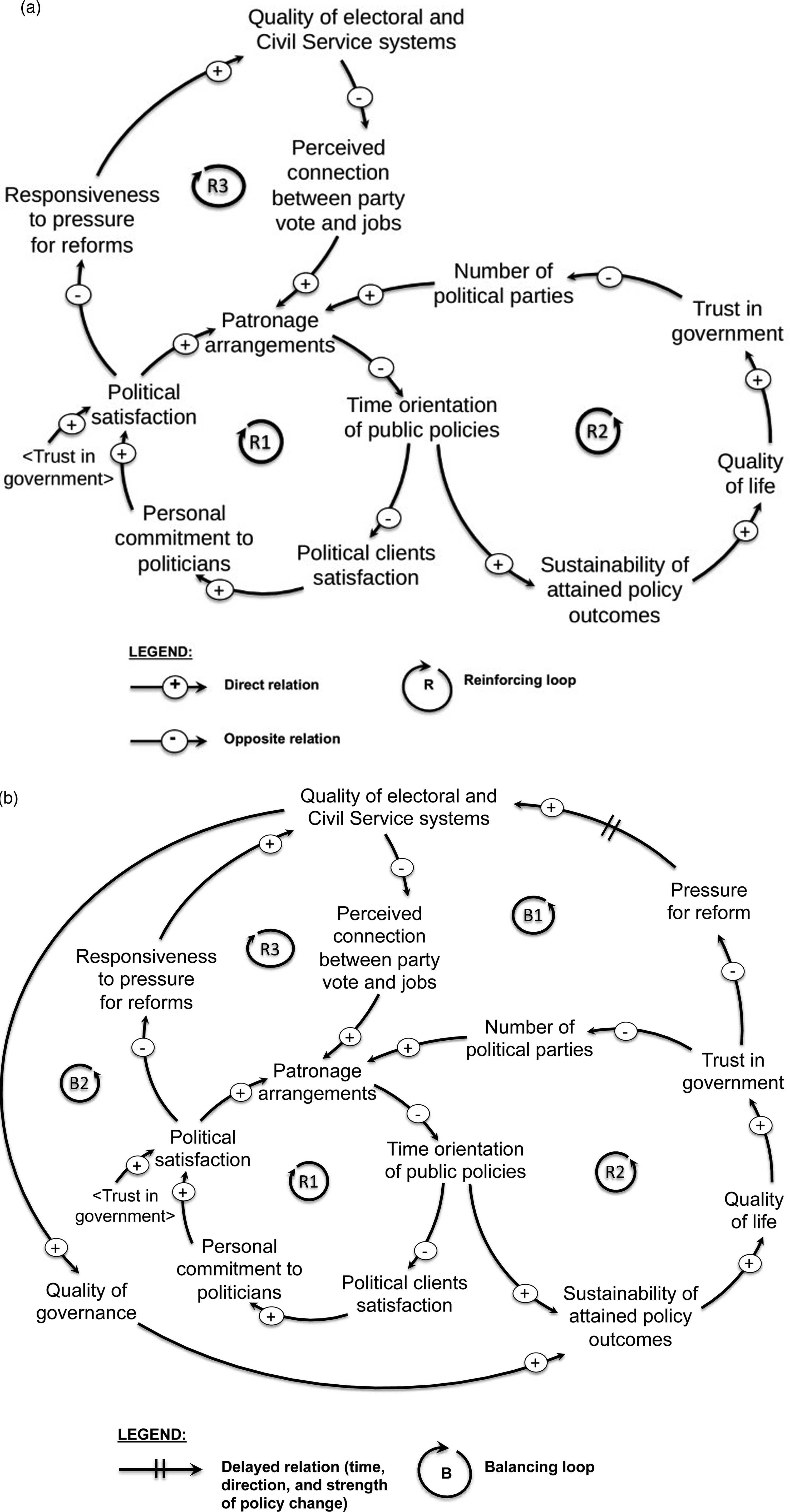
(a) Reinforcing loops associated with patronage arrangements. (b) Balancing loops enhanced by policies leveraging pressure for reform and quality of governance, to move away from patronage.
But the presence of agencies and other autonomous organizations may be a mixed blessing. These organizations, and especially state-owned enterprises, have been the locus for numerous patronage appointments. They may not be covered by civil service laws, to the extent that they exist in high-patronage countries, and the patronage may be less visible to the media and the public. Even in countries with otherwise limited levels of patronage, there may be numerous appointments available in the off-line agencies, for example, quangos in the United Kingdom (Flinders & Skelcher, 2012; Skelcher & Davis, 1998).
A Model for Eliminating or Reducing Patronage
Now, having in mind the factors that contribute to the persistence of widespread patronage in the public sector, as well as something of the experience of the countries that have been able to reduce patronage, we will proceed to build a dynamic model of that process. This model will be an initial attempt to specify the dynamics involved, but at this point cannot add any specific quantitative weights to the linkages among the variables. But it will still provide insights into the social and political processes through which patronage can be reduced.
The first question which arises in building such a model is what factors are manipulable? Some of the variables that affect the adoption and retention of widespread patronage in the public sector are beyond the control of political and administrative leaders, at least in any short-to-medium-term efforts at change. This is true even though these variables may change during the period in which reform efforts are being implemented. For example, Kenny’s emphasis on social fragmentation as a source of patronage may be important but without fundamental social change over decades there is little the policymakers can do about it.
Merilee Grindle (2012) argues that two of the more important factors explaining successful moves away from patronage systems are the presence of reform-minded leaders and the events that make the reform possible. Many political systems have had political leaders interested in reform, but were not capable of pushing through the reforms until there was an appropriate moment—the opening of a policy window, in Kingdon’s terms. A classic example of such an event was the assassination of President James A. Garfield in the United States that led directly to the passage of the Pendleton Act.
The “islands of competence” argument mentioned above points to the importance of understanding government performance as one of the possible causes of a move away from patronage. While in some instances patronage can enhance performance, in many (especially at the lower levels) it reduces accountability and incentives for public servants to perform. Therefore, a long-term experience with a poorly performing patronage bureaucracy may be an impetus for attempting to construct a more effective public service.
The first part of the analysis then is what aspects of the political system as a whole can be manipulated in order to make reductions in patronage more feasible. The most obvious answer to this question is passing a law to create a viable civil service system, but that is more the outcome of the process than one of the political factors leading to that law. Several manipulable political factors do appear to have some relevance for levels of patronage. One such factor would be the fragmentation and institutionalization of the political party system (Mainwaring & Torcal, 2006). Everything else being equal the more fragmented and the less institutionalized is a party system the more likely will be high levels of patronage.
Our assumption is that in highly fragmented and unstable party systems political parties will attempt to solidify their positions and their continued existence by using patronage whenever they are in office. Party systems of this type also will tend to have coalition governments, and frequently coalition governments with large numbers of parties. In such a coalition government all parties will have access to patronage positions and will almost certainly use them to improve their probabilities of being returned to office (to describe this phenomenon, in Italy the metaphoric expression lottizzazione—or “parceling out”—is commonly used). The number of parties within a political system is rather easily manipulable (Taagapera & Shugart, 2017) through changing electoral laws.
Another electoral change that may be beneficial in reducing patronage is to move away from single-member districts if these exist. Having a direct personal connection between the representative in the legislature and appointees makes the clientelistic connection between the job and the vote very direct (see Golden, 2003). This is not to say that proportional representation systems do not have patronage and that voters cannot see the connections between party vote and jobs, but the direct personal connection to constituents may be a more potent linkage. 8 Even a simple movement from open-list to closed list proportional representation. may have some of the same effects by depersonalizing candidate selection to some degree.
The second factor in patronage appointments is the availability of autonomous and quasi-autonomous organizations within the public sector that provide numerous opportunities for patronage appointments (see above). It is certainly possible to make patronage appointments in ministries and other organizations within the mainstream government, but independent agencies and state-owned enterprises have been a more common locus for widespread patronage (see Flinders & Matthews, 2010). Therefore, to the extent that a government can go against the “agency fever” (Pollitt et al., 2001) that still infects governments and keep more public activities in ministries the less likely is patronage.
A third means of reducing the level of patronage may be to centralize politics and government more. As already noted, when looking at examples of successful reductions of patronage, centralization makes it more difficult for local politicians to control appointments and other aspects of distributive politics. Much of the pressure for patronage comes from local political elites who want to be able to reward their supporters, and although it runs against the standard prescriptions for administrative reform, centralization may be useful in enabling more control over positions in the public service.
A fourth, and perhaps counter-intuitive, change in governments would focus on electing executives with extensive government experience, rather than outsiders. While one might expect a political executive who has been involved in government and party politics to be more interested in using patronage appointments, the opposite appears to be true. Outsiders, however, are unaccustomed to working with the career bureaucracy and may consider them part of “the swamp,” in the language of contemporary populists (see Carreras, 2014).
Changes Within the Administrative System?
The level of patronage may also be reduced by making changes within the administrative system itself. Perhaps the most important of these possible changes would be to improve the pay and conditions of service within the civil service. If public employment can provide a reasonable level of compensation for people with talents in the economy, they may be willing to take government jobs, thus limiting the need for numerous patronage appointments at the upper echelons of public administration. This strategy may, however, require some time before the perceived need for these appointments is reduced, and the quality of the civil service is sufficiently high.
If higher pay may mitigate the quality issues within the public bureaucracy, training and professionalization may reduce the control issues for politicians who might want to make patronage appointments. This strategy is much less certain to gain success than that of increasing compensation, but it can be a means through which political leaders can gain confidence that their career public servants will attempt to provide good advice and carry out the programs of the government of the day.
A third possible strategy is to introduce more effective monitoring of the activities of patronage appointees in the public sector (Acemoglu et al., 2011). The assumption here is that patronage appointees, especially those at the lower levels of organizations, are less likely to be effective workers than those who would be employed through a merit system. While this strategy is intended primarily to discourage “shirking” by bureaucrats (see Pierre and Peters, 2018), high levels of monitoring may also make patronage appointments less valuable for both the recipients and the politicians making the appointments. The role of the Government Accountability Office and Inspectors General in the United States in monitoring activities of patronage appointments of the Trump administration is one example of attempts at monitoring, albeit unsuccessful (Baker, 2020).
Both of the first two strategies mentioned above are directed at patronage appointments made at the top of government. Making administrative changes to reduce mass patronage may be more difficult. In many cases, the pay for lower-level positions is higher than in the private sector, and professionalization is less of an option. Further, many of the positions used in mass patronage systems are controlled by local elites rather than by a national system, requiring changing the behaviors, or opportunities, of a large number of politicians necessary. The monitoring strategy mentioned above may produce some changes in behavior, but the local elites may be capable of preventing any serious consequences for shirkers. With these ideas about change in mind, we will proceed to develop a feedback model for moving away from patronage.
A Feedback Model for Framing Patronage Outcomes and for Supporting the Outline of Policies to Move Away from It
In order to understand the persistence of patronage, that is, to outline its short and long-term connections to stakeholders’ perceptions and quality of life, we have sketched a conceptual feedback model to illustrate possible reasons and associated pathways to move away from patronage. Such a model can help local area stakeholders (elected officials, political clients, and other citizens) to detect and understand the causes and effects that patronage may generate. This perspective can support involved stakeholders in pursuing a commonly shared view of the dynamic and complex feedback structure which makes the fabrics that bind patronage with performance governance. This learning process may particularly help elected officials in assessing the political and social sustainability of patronage and detecting the proper time to start reforms that may counteract the negative effects of clientelism. This model is directed at the reduction of mass patronage, rather than at elite-level patronage.
The feedback model we will illustrate provides a basis for discussing how to map relevant strategic resources and performance measures that political leaders and other stakeholders would keep under control through a Dynamic Performance Governance framework (Bianchi et al., 2019). Such an approach may foster the design and implementation of prompt, pervasive, and consistent performance management and governance systems that help governments and community leaders in perceiving weak signals of change and how they would impact outcomes. This may enhance communication, accountability, and collaboration in policy-making, toward the pursuit of sustainable community goals (Bouckaert & Halligan, 2007). It is important to understand that the model maps relationships among variables, and hence can be used to explain either increases or decreases in patronage. We are using it here to demonstrate how decreases can be brought about.
Figure 1a portrays reinforcing 9 (vicious) loops that too intensive patronage may generate. A high patronage intensiveness is the main cause of short-term orientation in policy design and administration. This results from elected officials needing to satisfy the expectations of their clients, generally within the electoral mandate. Such a short-term orientation may increase political clients’ satisfaction, which strengthens their personal ties and commitments to elected officials. This in turn increases elected officials’ satisfaction, and therefore strengthens patronage arrangements (vicious reinforcing loop R1 in Figure 1a).
Reinforcing loop R1 is further boosted in the long run by two other vicious reinforcing loops. In fact, though an increasing short-term orientation in policy design and administration might perhaps insure that policy targets could be effectively met (during the electoral mandate), an excess focus on only narrow and immediate results might lead to a lack of holistic view in policy making, which diverts attention from the achievement of long-term social outcomes. The poor level of outcomes and a discrepancy between that level and the achieved targets (periodically announced by politicians) is usually a primary cause of a gradual decline in the level of trust in government (Van der Meer, 2018), leading to rising citizen dissatisfaction. Without any political entrepreneurship 10 that would detect such social pressures and turn them into reforms improving the quality of governance and society outcomes, mistrust in government often generates a proliferation of political parties, that further increases patronage arrangements (loop R2 in Figure 1a). Also, high political satisfaction, induced by intensive patronage arrangements, systematically discourages the emergence of new political leaders that might entrepreneurially turn the social discontent into a positive force to improve the quality of governance. This implies increasing deficiencies in the political system’s responsiveness to rising pressures for reforms 11 , which are systematically delayed. Two outcomes of the described pattern of behavior are a reduced quality of governance (e.g., due to poor electoral and civil service systems) and further growth in patronage (vicious reinforcing loop R3 in Figure 1a).
Developing the capability of political leaders to promptly perceive the need for reforms is an important prerequisite to enhancing the quality of governance. This would reduce patronage arrangements, which would increase the time horizon of public policies, and improve the quality of achieved outcomes and quality of life. This would also raise trust in government and counterbalance the previously described vicious loops (loop B1 in Figure 1b). However, in those contexts characterized by pervasive use of patronage—as an important component of a society’s cultural system—developing political entrepreneurship may take a long time, especially given the effects of high political satisfaction associated with a rising client affiliation. However, at least in the long run, a rising mistrust in government, combined with increasing political satisfaction, would not be sustainable. In fact, when such mistrust reaches a threshold, the gain in respect that patrons would get from their clients would be offset by the loss of image suffered in society. 12 Therefore, the balancing loop B1 would be fostered by another balancing loop: “patronage arrangements → time orientation → sustainability of policy outcomes → Quality of life → Trust in government → Political satisfaction → Patronage arrangements”. 13
The extended feedback model in Figure 1b also suggests how consistent and pervasive reforms might reduce patronage levels, by detecting the inertial—but growing—negative effects on trust in government, produced by the previously described vicious loops. For instance, electoral system reforms might contribute to reducing patronage in two different manners. First, they might discourage a proliferation of political parties or the deinstitutionalization of the party system, and second they might weaken the perceived connection between party votes and jobs provided to clients. While the first factor (political parties) would contribute to reducing the supply of patronage, the second factor (connection between votes and jobs) would reduce the demand for patronage.
Also, civil service systems reforms might be focused on two main streams: (1) human capital development, and (2) improvements in the institutional and bureaucratic machine of government. The first stream of reforms might imply for instance: (a) investing in staff training and professionalization, and (b) improving pay and conditions of service. In particular, the second policy would indirectly enhance human capital. In fact, it would increase public employment attractiveness, which would mean an improvement of the public sector aptitude to retain its skilled managers and to attract more talented workers from outside the system. The improvement of pay and conditions of service could be also considered as a policy aimed at retaining investments in staff training and professionalization. The second stream of such reforms might imply: (a) centralizing policy and government; (b) reducing public sector fragmentation; (c) enhancing policy coordination; and (d) focusing on electing executives. Both streams of reforms might increase the quality of governance, thus improving the sustainability of attained policy outcomes, and quality of life. This would reduce the social pressure for reform (balancing loop B2 in Figure 1b).
Both loops B1 and B2 in Figure 1b, enhanced by robust reforms, might generate effects that would counterbalance the reinforcing loops associated with patronage. The actual effects of the two forces within the model will depend on the values of a number of variables, and hence would be different in different settings. Even before specifying the dynamics empirically, however, mapping these patterns helps to identify why patronage is more or less persistent.
This mapping of the interactions does provide the foundation for several potential empirical analyses. One such analysis would be the simple regression of some of the factors identified in this model with levels of patronage appointments. Brierly (2020), for example, has examined patronage appointments in Ghana using some of these variables, albeit not in the dynamic manner we have been emphasizing, In particular, she has emphasized the need to generate performance in the public sector by depending on meritocratic appointments in upper-level positions. 14
The second and more important of the empirical analyses would be to use the model we have developed as the basis for further outlining a more detailed quantitative, simulation model. There is evidence to assess the strengths of relationships among some of the variables. Some of this evidence is rather simple order of magnitude information but some are more precise. We could then test the effects of different values of these and other relationships to attempt to understand the sensitivity of patronage arrangements in the public sector to various causal and intervening factors. We could also develop experimental analyses to assess further the impacts of variables (Guedes-Neto & Peters, 2021) That type of analysis could be useful for social scientists, but also for practitioners attempting to alter the ways in which their administrative system performs.
Concluding Remarks
The analysis carried out in this section has illustrated logical connections between variables associated with policies aimed at moving away from patronage. The usefulness of the model here discussed is related to the possibility to involve decision-makers in a learning process aimed at perceiving the dynamic complexity of the feedback structures portrayed in Figure 1a and 1b. Such dynamic complexity involves the possibility that disappointing outcomes might follow in the long run over the achieved positive results in the short-medium term. It also implies that reforms aimed at enabling policies that might pursue sound societal outcomes in the long run might not be sustainable because of poor short-term results. Balancing short vs. long term is a central issue in framing and handling dynamic complexity not only in management but also (and particularly) in governance.
Another implication of such dynamic complexity is the need to search a proper trade-off, not only over time, but also over “space.” This implies the need of exploring the robustness of political reforms, in terms of their capacity to sustain a balanced performance governance improvement, throughout different jurisdictions and administration levels of the public sector. Some political systems may have a greater capacity to implement these reforms than do others, and that comparative element will emerge as yet another parameter in the model. Developing this parameter will require additional empirical research.
More analysis will be needed to test and implement the model here discussed, even on a qualitative basis. In particular, the first limitation of this study is associated with the possibility that other kinds of reforms—beyond those involving electoral and civil service systems—might impact patronage. A second limitation can be related to the need to check under what conditions the logical causality connecting different variables can be empirically verified. A third related limitation is associated with the identification of the intensiveness of the—often non-linear—effects that (under different conditions) each variable may generate on another. A fourth limitation is related to the need to identify possible measures that might surrogate the intangibles included in the illustrated model. A fifth limitation is associated with the identification and analysis of the physical and information delays affecting the feedback loops in the model.
Provided the above limitations, we do not claim, however, that relative simplicity of the model (for portraying analyzed phenomena on a qualitative, rather than also a quantitative basis, and for bounding the size and scope of investigated feedback loops) is a weakness per se. 15 On the contrary, we maintain that the analyzed model can provide a useful starting point for better framing the sustainability of public sector reforms in a relatively uninvestigated field, such as patronage. More research, also involving empirical analysis, will be needed to test and improve the model, in the direction here illustrated. Certainly, at this stage of the research presenting these qualitative models make the relationships among factors more visible, and also illustrates that these are not simple linear relationships but complex interactive patterns of change.
Patronage is an enduring problem for many governments. In addition to the normative demands to create a professional civil service, patronage may reduce the governance capacity of governments. Therefore, finding means of moving away from existing, and often entrenched, patterns of employment within the public sector is an important issue for both academic and practical inquiry in public administration. There is extensive literature on the nature and causes of patronage, and a smaller but suggestive literature on how patronage in the public sector comes to an end.
Footnotes
Declaration of Conflicting Interests
The author(s) declared no potential conflicts of interest with respect to the research, authorship, and/or publication of this article.
Funding
The author(s) received no financial support for the research, authorship, and/or publication of this article.
