






Abstract
The rule of law is foundational to Public Administration (PA), yet the field has long lacked a clear conceptualization of what the rule of law entails and, furthermore, an objective measurement system. Grounded in the “thin” conception of the rule of law and integrated within the public administration context, we propose a three-dimensional framework: Regulations, Organization, and Decision-making. We operationalize this framework as the Public Administration Rule of Law Index (PARLI), a composite measure built from three level-1 and seven level-2 indicators, using objective data to ensure replicability. We apply this index to measure the rule of law in China's 31 provinces (2020–2024) and validate it by examining its relationship with key socioeconomic outcomes. The results align with theoretical expectations: PARLI scores are positively correlated with entrepreneurship and innovation but negatively correlated with government responsiveness. These findings simultaneously confirm the measure's validity and reveal the inherent tensions in applying the rule of law within the public administration. This study makes two primary contributions. First, it provides scholars with a coherent framework to overcome knowledge fragmentation and cumulate scientific inquiry. Second, it offers a replicable and objective measurement toolkit for policy analysis.
Introduction
The fields of public administration and law were initially regarded as inseparable (Goodnow, 1905; Dimock, 1980). Although the disciplines gradually diverged, scholars continue to affirm the rule of law as a foundational core of contemporary public administration (Rosenbloom, 1983; Zalmanovitch, 2014). Despite this consensus, the field of public administration has struggled to develop a clear and unified conceptualization of the rule of law. This conceptual ambiguity has become particularly problematic in an era of administrative state (Sunstein & Vermeule, 2020), where public administration must be constrained by the rule of law to ensure legitimacy, yet it also requires empowerment through the rule of law to exercise the discretion necessary for good governance (Lynn Jr, 2009; Shapiro, 1994).
To address this challenge, this paper seeks to develop a robust framework for understanding and measuring the rule of law within public administration. We ground our framework in the “thin” rather “thick” conception (Craig, 2017; Peerenboom, 2003; Tamanaha, 2004), a choice that avoids ideological contestation and provides a more coherent and unified foundation for analysis. A review of prominent indices—including the Worldwide Governance Indicators, Bertelsmann Transformation Index, and the World Justice Project's Rule of Law Index—reveals significant shortcomings, namely: conceptual incoherence, an imbalance between de jure and de facto dimensions, and an over-reliance on subjective data.
Building on this critique, we propose a three-dimensional framework that directly resolves the field's measurement challenges. Our framework tends to bridge the de jure-de facto divide by analyzing three core administrative functions: Regulations, which embody the formal, written law (de jure); and Organization and Decision-Making, which together reveal how that law is implemented, enforced, and experienced in practice (de facto). Each dimension is further specified by sub-dimensions. This structure allows for a holistic yet disaggregated analysis of the rule of law within public administration.
To operationalize this framework, we introduce the Public Administration Rule of Law Index (PARLI). The index is composed of three level-1 indicators (the core dimensions) and seven level-2 indicators (sub-dimensions). It is constructed using a bottom-up, weighted aggregation method based on expert scoring, with objective indicators normalized through a base-year standardization technique to ensure robust longitudinal analysis.
We apply this index to assess the rule of law in China's 31 provinces from 2020 to 2024 and validate our measure by examining its relationship with key socioeconomic outcomes. Our empirical analysis reveals that a higher PARLI score is positively correlated with regional entrepreneurship and innovation but negatively correlated with government responsiveness. These findings align with the “law and finance” (e.g., Ash et al., 2025) and “administrative ossification” (e.g., Yackee & Yackee, 2010) literature, respectively, thereby validating our conceptualization. Furthermore, our results highlight the inherent tensions within the rule of law, demonstrating that while it can foster economic dynamism, its rigorous procedural demands may slow administrative response times. Analysis of the constituent indicators provides deeper insights: the Regulation dimension primarily drives entrepreneurship, the Decision-Making dimension hinders government responsiveness, and fostering innovation requires a holistic rule of law system encompassing all three dimensions.
In sum, this article conceptualizes and measures the rule of law in public administration, making two primary contributions. First, it provides public administration scholars with a coherent framework of rule of law for scientific inquiry, helping to overcome knowledge fragmentation in this critical area. Second, the objective and replicable PARLI measure offers policymakers and scholars a tool for longitudinal and cross-regional analysis, with the novel dataset for China's provinces paving the way for further empirical work.
The remainder of this article proceeds as follows. The second section reviews the relevant literature, first establishing the foundational role of the rule of law in public administration and then highlighting the conceptual ambiguity that has hindered systematic research. The third section develops our conceptual framework, detailing the three core dimensions of the rule of law in public administration: Regulations, Organization, and Decision-Making. The fourth section operationalizes this framework by introducing the PARLI. In the fifth section, we present an empirical analysis that validates the PARLI by examining its correlations with key socioeconomic outcomes. Finally, the sixth section concludes by discussing our key findings, contributions, and limitations, while also outlining promising avenues for future research.
Literature Review
Rule of Law in Public Administration
The Rule of Law as an Important Source for Public Administration
The rule of law is a cornerstone of democratic governance and is intrinsically linked to the practice of public administration. This close relationship has deep historical roots, with early scholarship viewing the two as inseparable. Wilson (1887), for example, argued that “public administration is the detailed and systematic execution of public law.” Goodnow (1905) also sought to firmly ground the field in legal implementation. He defined administrative law as the rules governing public administration to ensure the fair and efficient enforcement of laws. Although public administration and law began to diverge in the 1920s 1 and were largely considered separate fields by the 1940s, they originally constituted a unified field of study rooted in both continental European administrative law and early British political science (Dimock, 1980).
This historical unity underscores that the rule of law is not merely an external constraint but an integral part of the identity of public administration. Although tensions occasionally arise between legal and managerial perspectives, law remains an indispensable foundation of the field. Rosenbloom (1983) and Zalmanovitch (2014) observe that the law along with management and politics/policy form the foundational core of contemporary public administration. Zalmanovitch contends that the “trielectic” among management, politcs/policy, and law form the identity of public administration in theory and practice. He convincingly maintains “that there is a trialectic system of relationships among three pillars of public administration” that generates “configurations [and] temporary arrangements geared toward” policy formulation and implementation.
In a similar vein, Kerwin (1997) argues that “law is … what the whole of public administration is about” (p.26). Lynn Jr (2009) criticized public administration for its benign neglect of the rule of law, warning that such disregard undermines both the legitimacy and usefulness of the field. He argued that this creates an urgent need to restore concerted attention to the rule of law to public administration.
A synthesis of this literature suggests that the rule of law's function in public administration operates through several core principles.
Ambiguity Defining the Rule of law in PA Study and its Challenges
Although scholars have extensively examined the function of law in public administration, the field lacks a clear and unified conceptualization of the rule of law. This conceptual ambiguity presents significant challenges
On a scholarly level, this ambiguity undermines scientific inquiry. Without a common language grounded in sound conceptual premises (Møller & Skaaning, 2014, p. 176), discussions remain fragmented, marginalizing the topic and hindering the accumulation of knowledge. This conceptual deficit, in turn, stifles empirical analysis. Without a clearly defined concept, the rule of law in administration cannot be measured, its evolution cannot be tracked, and meaningful cross-national or cross-cultural comparisons are unattainable. This severely restricts theoretical exploration of the factors that shape it.
Furthermore, the absence of conceptual clarity has profound practical consequences. It weakens the effectiveness of reforms by creating a disconnect between administrative initiatives, which typically prioritize efficiency, and rule-of-law programs, which focus on human rights and normative standards. This failure to integrate efforts creates governance gaps where administrative systems fall short of rule-of-law ideals (Zajac-Sannerholm, 2012, p. 76).
To address these shortcomings, it is essential to revisit the core concept of the rule of law in order to construct a robust conceptual framework tailored for public administration.
Definition of Rule of Law
The definition of the rule of law has historically been a vague and confusing topic, with various competing proposals (Stein, 2019). Fallon (1997) identifies four ideal-typical conceptions of the rule of law: historicist, formalist, legal process, and substantive. Kleinfeld (2006) advances two primary approaches to defining the rule of law: one based on desired societal ends, and the other on institutional attributes. Bedner (2010) puts forth a conceptual framework that dissects definitions into procedural, substantive, and control mechanism elements. While these frameworks offer unique valuable lenses, many of their core distinctions can be effectively captured by the most widely accepted definitional framework: the distinction between a formal/thin conception of the rule of law and a substantive/thick conception of the rule of law (Craig, 2017; Peerenboom, 2003; Tamanaha, 2004).
The formal/thin conception of the rule of law emphasizes the formal or instrumental aspects of the legal system, focusing on its proper and effective functioning in guiding human behavior. As Joseph Raz explains, “If the rule of law is the rule of good law, then to explain its nature is to propose a complete social philosophy. But if so, the term has no useful function” (Raz, 2017). In the thin conception, both government officials and citizens are bound by the law, which promises a degree of predictability and limits arbitrariness. Thus, the thin conception of the rule of law can provide some protection of individual rights and liberties, although it does not involve evaluations of the substance or quality of the law itself. Prominent proponents of the thin conception include Lon Fuller (1969), Joseph Raz (2017), and John Finnis (2011). Table 1 summarizes their core principles, which is adapted from Skaaning (2010).
Principles of the Rule of Law.
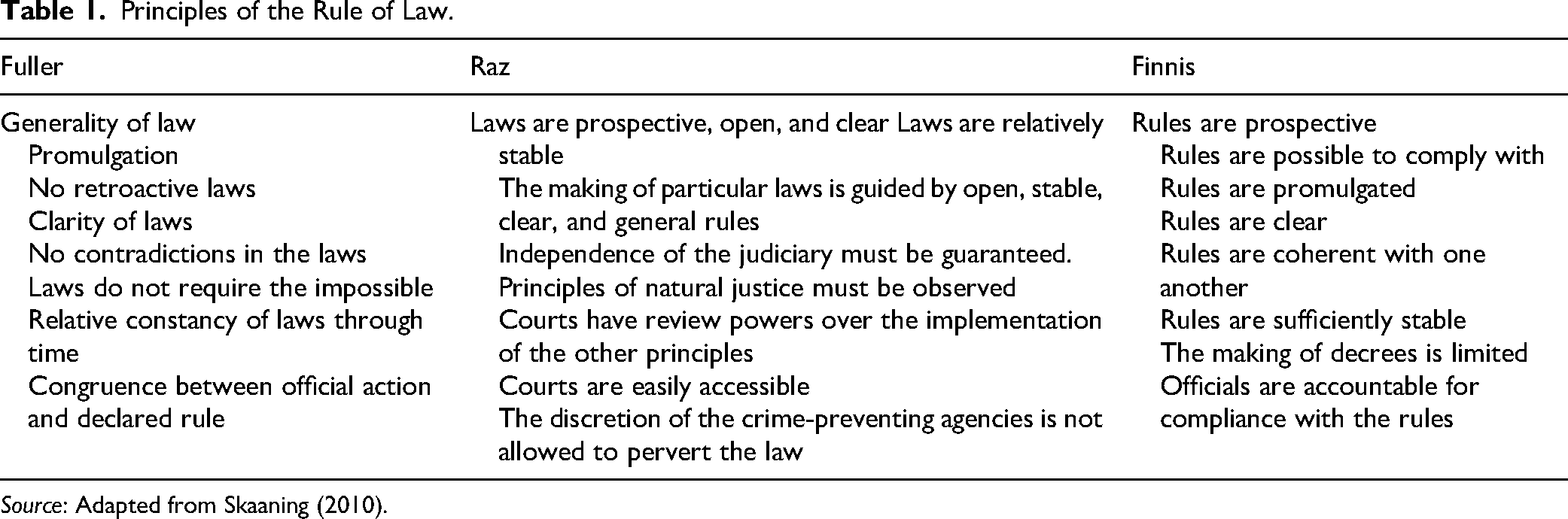
Source: Adapted from Skaaning (2010).
The thick or substantive conception of the rule of law is predicated on the thin or formal conception, incorporating more substantial elements. Randall Peerenboom (2002) summarizes these elements as incorporating aspects of political morality, including specific economic arrangements (e.g., free-market capitalism or central planning), forms of government (e.g., democracy or single-party socialism), and conceptions of human rights. Lord Tom Bingham (2011) advocates for a thick rule of law, asserting that the law must provide adequate protection for fundamental human rights.
The thick conception of the rule of law offers a concise representation of an ideal state and has the potential to influence political discourse within specific countries by placing politically controversial issues under the framework of the rule of law (Bedner, 2018). However, the incorporation of specific concepts related to economic, political order, or human rights into the rule of law can thwart the establishment of a shared consensus on its interpretation. A more pragmatic and precise challenge arises from the potential for this broad conception to engender unrealistic expectations regarding the rule of law. “When the legal system falls short of one's particular conception of what is just, it is then criticized, leading to a backlash against the rule of law as an empty concept or, worse yet, a mask for oppression.” (Peerenboom, 2003)
Conversely, the thin conception theory is more unified and coherent. Thus it can provide a clear focus for discussions and facilitate focused, substantive, and productive discourse. This is particularly salient in cross-cultural communication, where the thin conception can circumvent larger disputes related to political morality (Peerenboom, 2003). Additionally, the thin conception offers distinct advantages in terms of theorization, measurement, and causal analysis, thereby serving as a foundational framework for subsequent empirical research (Møller, 2018). Furthermore, the thin concept also has the advantage of being politically and ideologically neutral, which is more likely to gain support from different political factions (Peerenboom, 2003; Summers, 1988). However, it is imperative to acknowledge that the satisfaction of the criteria of the thin rule of law does not guarantee the justice or quality of the resulting legal state (Summers, 1993).
Measurement of Rule of Law
Quantitative measurement of the rule of law began in the 1990s, largely under the ideological influence of the Washington Consensus (Krever, 2011; Santos, 2016; Urueña, 2015). Within this framework, law was perceived as a critical social institution capable of determining transaction costs and thereby influencing economic development. Consequently, proponents conducted extensive cross-country research using indicators to demonstrate correlations between the rule of law and economic growth (Urueña, 2015). To the best of available evidence, the earliest verifiable index is the Worldwide Governance Indicators (WGI), which has included a rule of law variable since 1996 (Kaufmann et al., 2010). Following this, a proliferation of indices emerged, including the Bertelsmann Transformation Index (BTI), Freedom House (FH), the Heritage Foundation (HF), and the World Justice Project's (WJP) Rule of Law Index. Among these, the WJP's index is unique in its ambition to measure the notion comprehensively in its own right, whereas most other indices have viewed the rule of law primarily as an instrumental tool for achieving development or good governance (Urueña, 2015).
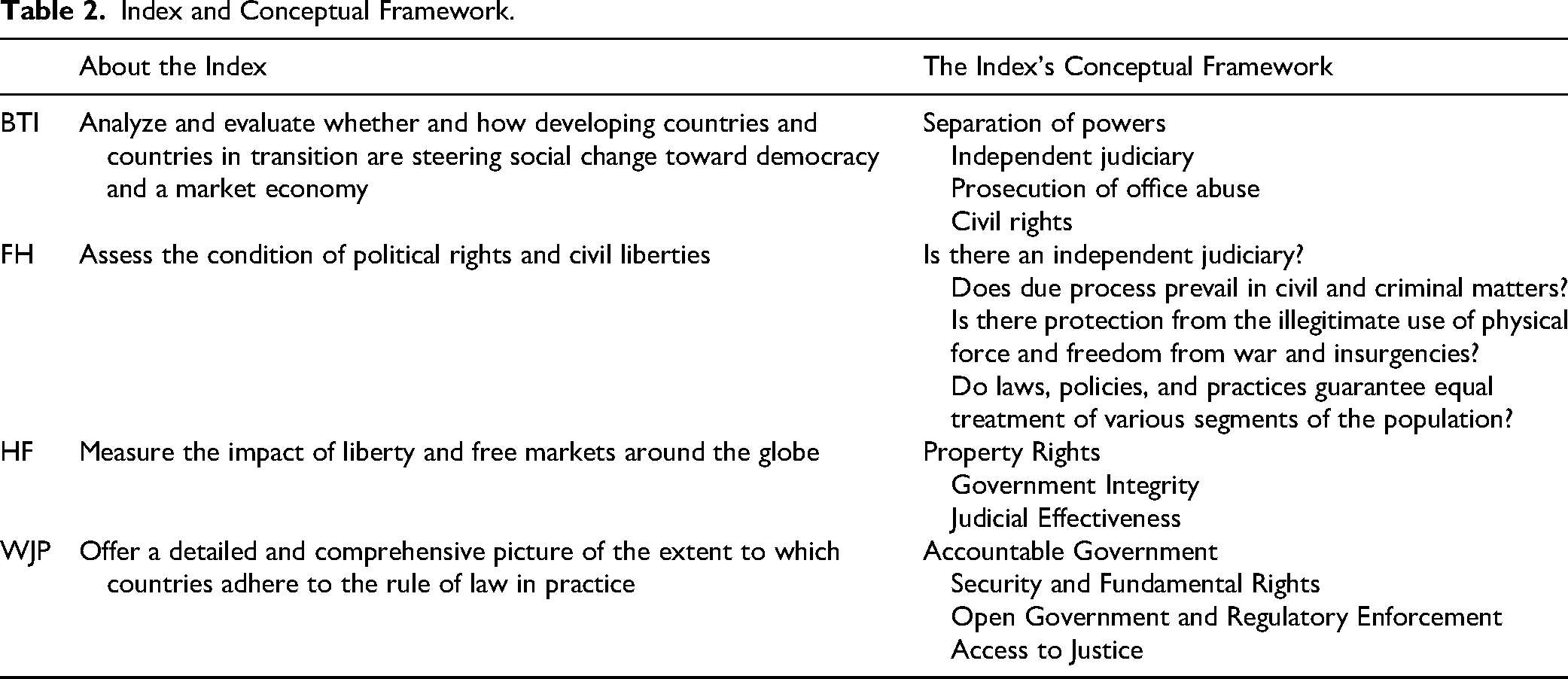
Despite this proliferation, a fundamental critique targets the very foundation of these indices: their lack of theoretical coherence. This conceptual ambiguity, echoing the definitional debates discussed previously, means the research agenda has not been systematically framed (Nardulli et al., 2013). For instance, as shown in Table 2, widely used indices such as BTI and FH fail to capture core attributes of a thin conception of the rule of law, omitting criteria such as clarity, consistency, and stability. The problem is compounded by the inclusion of divergent substantive elements, which undermines both the validity and utility of these measures. Such conceptual over-extension risks conflating the rule of law with other socio-political phenomena, leading to misleading conclusions about its impact (Nardulli et al., 2013; Skaaning, 2010).
Index and Conceptual Framework.
This foundational conceptual weakness inevitably generates significant methodological challenges, beginning with the nature of the data employed. A key problem is the lack of objective data, which compels most indices to rely heavily on perceptions. This reliance on subjective data is problematic, as such assessments can be influenced by “the respondent's own theories, ideologies, prejudices, and so forth,” raising significant reliability issues (Voigt, 2012, p. 269). Validity concerns are equally acute; for example, surveys of foreign investors may not accurately capture a country's legal system due to information biases (Ginsburg, 2011). Compounding these challenges, much of the data is derivative rather than original, and respondents may rely on pre-existing index scores to formulate their answers, creating a feedback loop that undermines both reliability and validity over time (Davis, 2014).
Beyond flawed data sources, further weaknesses emerge in how these data are processed. The aggregation of disparate indicators into a single score often lacks a sound theoretical basis (Skaaning, 2010). Stefan Voigt (2012) critiques this practice, arguing that in the absence of a complete theory, aggregation is “necessarily arbitrary.” This critique extends to even the most influential measures; for instance, the WJP Index has faced criticism for its lack of clarity on how its various dimensions are aggregated and weighted (Gowder, 2016).
Another methodological flaw is the systematic imbalance between the measurement of de facto and de jure dimensions. Ideally, measures should assess both the quality of legal norms (de jure) and the quality of their implementation (de facto) (Voigt, 2012). However, existing indices tend to emphasize the de facto dimension while systematically neglecting the de jure content of legal norms. To remedy this, scholars advocate for a more comprehensive approach that measures the normative framework, institutional capacity, and enforcement practices distinctly (Davis, 2014).
Finally, and perhaps most critically, these conceptual and methodological flaws are compounded by systemic bias. Existing indices have been criticized for exhibiting an “OECD or Global North bias,” implicitly evaluating global legal systems through the lens of wealthy, well-functioning states (Davis, 2014; Møller & Skaaning, 2011). Moreover, these measures often embed “policy preferences over the structure of private property rights, and business-elite oriented questions” (Kurtz & Schrank, 2007, p. 543). This bias is not accidental; it is exacerbated by powerful actors influencing indicator development, resulting in datasets that disproportionately reflect their interests (Davis, 2014). As a result, the reliability and impartiality of these indices are fundamentally compromised.
In summary, the existing landscape of rule of law measurement is fraught with significant challenges, including reliance on subjective data, conceptual incoherence, a skewed focus on practice over norms, and systemic biases. These shortcomings collectively underscore the urgent need for a new conceptual framework that is theoretically grounded, conceptually precise, and methodologically balanced. The following section will begin to construct such a framework.
Conceptualizing the Rule of Law in PA
As previously mentioned, ideally, the measurement of the rule of law should encompass both de jure and de facto dimensions (Voigt, 2012). Within the context of public administration, the de jure aspect refers to the formal regulations that public agencies establish and apply. The de facto dimension comprises two key elements: the actual enforcement of regulations via agency decision-making, and the organizations entrusted with that enforcement.
Building on this distinction, we posit that the rule of law in public administration can be understood through three key components: regulations, organization, and decision-making. This framework captures the essential functions of administrative agencies while also aligning with the tripartite model of legal norms, institutions, and practices articulated by Davis (2014). Moreover, the framework is intentionally grounded in a thin conception of the rule of law. This approach enhances its practical and analytical utility by avoiding ideological debates (Skaaning, 2010), making it more suitable for comparative analysis.
The Regulations in Public Administration
Adherence to the rule of law in regulatory practice is fundamental to the legitimacy of public administration. Regulations are essential instruments of governance. As Kerwin and Furlong (2019) observe, regulations are issued by administrative agencies and function as rules designed to shape future conditions (p. 8). Because legislatures often lack the expertise and capacity to engage in detailed policymaking, they authorize agencies to issue legally binding rules that advance public objectives. Consequently, rulemaking has become a core function of administrative agencies. Although grounded in statutory law, regulations often exert a broader and more immediate impact than statutes. In fact, they are frequently the government's most influential tool for shaping citizens’ daily lives (Kerwin & Furlong, 2019). We argue that for regulations to comply with the rule of law, they must satisfy three essential criteria: legitimacy, transparency, and completeness.
First, legitimacy rests on two key sub-dimensions: the clarity of legal authorization and a proper hierarchy of rules. Legal authorization requires that any regulation be legally mandated and aligned with a statutory purpose (Kerwin & Furlong, 2019). Beyond this, maintaining a clear hierarchy of rules is crucial. While administrative agencies issue formal regulations, they also produce guidelines, policy statements, and technical manuals. These nonlegislative guidance documents should not ordinarily create new legal obligations for the public (Anthony, 1992). Yet both in countries where administrative law is still developing and where rulemaking procedures are operationally dysfunctional as in the U.S., governments often issue binding guidance documents as a substitute for formal regulation. In doing so, they bypass the notice-and-comment process and other procedural safeguards established by administrative procedure laws, largely for reasons of expediency (Raso, 2015; Zhan, 1992). Accordingly, a higher proportion of formal regulations may signal a stronger institutional commitment to the rule of law by respecting the proper hierarchy of legal norms as well as efficacious procedures.
Second, transparency requires both information disclosure and public participation, which introduce democratic legitimacy into administrative rulemaking (Kerwin & Furlong, 2019, p. 54). Under the Administrative Procedure Act (APA), agencies must explain proposed rules, publish drafts in advance, and provide meaningful opportunities for public comment. This process allows stakeholders to participate in rulemaking by submitting arguments and evidence, thereby ensuring that agencies base their decisions on adequate information while also constraining administrative discretion (Harter, 1983, p. 1404). Such participation not only enhances regulatory quality but also reinforces legitimacy (Levin, 1992, pp. 1504–1505).
Third, completeness requires comprehensive rulemaking that encompasses both the full range of administrative domains and the entire regulatory process. Davis (1969) described clear and authoritative rules as “one of the greatest inventions of modern government” (p. 65). Such rules limit bureaucratic discretion while clarifying both the obligations of the state and the rights of citizens (Kerwin & Furlong, 2019, p. 31). Clouser McCann and Shipan (2022), in their study of major federal legislation enacted between 1947 and 2016, found that nearly all significant U.S. laws contained provisions delegating authority to administrative agencies. To promote fairness and predictability, a comprehensive regulatory framework should govern the full scope of administrative activity, ensuring that procedural rules, in particular, are clear and exhaustive. This is especially crucial in areas that directly affect individual rights—such as administrative penalties—where strict adherence to due process must be guaranteed.
The Organization of Public Administration
Public administration is primarily conducted by government officials working within structured organizational systems. At the organizational level, the implementation of the rule of law depends on two key dimensions: the Legal Competence of Government Officials and the organization's Legal-Administrative Capacity.
The first dimension, Legal Competence of Government Officials, focuses on civil servants themselves, as they play a central role in protecting democratic institutions (Roberts, 2023, p. 122). This dimension can be examined through five interrelated aspects: Legal Expertise, Legal Awareness, Legal Liability, the Legal Right of Government Officials, and Depoliticization of Government Officials.
First, Legal Expertise forms the foundation of a law-abiding administration. Public officials must develop and maintain a thorough understanding of the duties and limitations established by the Constitution and statutory law (Lee & Rosenbloom, 2005). As Koenig and Beckett (2005) observe, officials “have the duty to know the law and act in a lawful manner” (p. 1). A sound knowledge of legal frameworks not only supports effective governance but also reduces the likelihood of judicial intervention, thereby helping to avoid costly delays and unnecessary use of resources (Cooper, 2015). In light of these considerations, Newbold (2011) emphasizes that legal education should be regarded as an essential element in the professional training of public administrators.
However, mere technical knowledge is insufficient without a deeper appreciation of the law's underlying values. Therefore, public officials must possess a profound Legal Awareness that extends beyond technical proficiency. This awareness involves internalizing legal values, which is demonstrated in practical terms through compliance with the law. In the wave of constitutional litigation that began in the 1970s, the increased risk of lawsuits prompted governments to invest heavily in legal training to cultivate this awareness. The goal was to ensure officials fully understood their constitutional duties as prescribed by law (Roberts, 2023, pp. 129–130). A prime example is the U.K. government's handbook, The Judge Over Your Shoulder, first issued in 1987. This guide explained basic administrative law principles to civil servants and encouraged compliance to avoid legal challenges (James, 1996, p. 621). Legal training is an important means of cultivating legal awareness among civil servants, as regular internal training is essential to keep personnel informed of evolving legal standards. This is especially crucial for street-level officials who apply law and policy directly to citizens (Lee & Rosenbloom, 2005, p. 38).
This emphasis on competence and legal awareness is driven not only by a desire for good governance but also by the significant legal risks that officials face. This leads to the third aspect: Legal Liability. The principle of liability ensures that legal standards are not merely aspirational but enforceable. Before the 1950s, officials were largely protected by the doctrine of official immunity from lawsuits for monetary damages. This legal landscape shifted during the civil liberties revolution in the United States, which compelled public agencies to reform their practices (Roberts, 2023). In Monroe v. Pape (1961), the Supreme Court affirmed an individual's right to sue local and state officials for constitutional violations under 42 U.S.C. §1983. Subsequently, in Bivens v. Six Unknown Named Federal Narcotics Agents (1971), the Supreme Court allowed citizens to sue federal officials directly for monetary damages when their fourth amendment constitutional rights were violated. These judicial shifts highlight the growing importance of public official accountability, particularly as increasing political power has been vested in non-elected administrators within the administrative state (Rosenbloom, 1980; see also Rosenbloom & Rene, 2016).
The fourth dimension of legal Competence acknowledges that while officials are held to high standards of accountability, the rule of law also protects their legal rights as public employees. The U.S. Supreme Court significantly expanded these protections in the wake of the civil liberties revolution. For instance, protections have displaced the traditional doctrine of privilege in areas such as freedom of speech, provided it does not significantly disrupt the effective functioning of the agency and is not a “work product” such as a report (Pickering v. Board of Education, 1968; Garcetti v. Ceballos, 2006); protection against political dismissal (Branti v. Finkel, 1980); procedural due process rights (Cleveland Board of Education v. Loudermill, 1985); minimum wage and overtime standards (Garcia v. San Antonio Metropolitan Transit Authority, 1985); and protection under the Age Discrimination in Employment Act (Gomez-Perez v. Potter, 2008; Mitchell, 2009). However, these rights are not absolute and must be balanced with the need for governmental efficiency and effectiveness (Roberts, 2023, p. 127). This principle is evidenced in rulings that allow warrantless workplace administrative searches (O’Connor v. Ortega, 1987; City of Ontario v. Quon, 2010).
The fifth and final aspect is Depoliticization of Government Officials, which shields public officials from the influence of short-term partisan interests and provides essential safeguards for the impartial enforcement of the law. Civil service reform has been central to this process. By establishing a merit-based personnel management system, governments have sought to depoliticize public administration (World Bank, 2000). Such reforms ensure that officials serve the public interest rather than partisan agendas (Roberts, 2023). This commitment to impartiality is also critical for building state capacity and market confidence (Flinders & Buller, 2006). Since the nineteenth century, many countries have pursued this goal by introducing open recruitment and merit-based promotion, significantly reducing political patronage, and establishing independent civil service commissions (Flinders & Buller, 2006).
Beyond the competence of individual officials, upholding the rule of law also depends on an organization's legal-administrative capacity. This capacity is manifested through specialized internal structures that ensure legal compliance and accountability. It primarily encompasses two components: legal affairs agencies and internal disciplinary bodies. Legal affairs agencies serve as the internal legal authority within administrative departments. These agencies provide legal counsel, draft regulations, and represent the institution in legal proceedings, thereby institutionalizing legal expertise. Internal disciplinary bodies are tasked with reinforcing legal and ethical norms from within. These institutions investigate allegations of official misconduct, corruption, or abuse of power, imposing disciplinary measures when necessary. Together, these bodies ensure that the principle of legal accountability is not merely an external threat from the courts but also an internal commitment to self-regulation.
The development of this internal capacity is a recognized trend. Agencies often respond to heightened judicial oversight by expanding their specialized legal agencies and prioritizing the hiring of personnel with legal training (Waltenburg & Swinford, 1999, p. 247). Empirical research confirms this, showing that agencies facing a higher probability of judicial review are more likely to recruit “judicialized personnel”—individuals skilled at navigating the complex, formalized procedures favored by courts (Limbocker et al., 2022, p. 611).
Decision-Making of Public Administration
Administrative decision-making is central to public governance. These decisions not only precipitate action but also largely determine its success or failure (Bozeman & Pandey, 2004). Consequently, the legitimacy of governance and its adherence to the rule of law depend on the legality of these decisions. As Herbert A. Simon (1944) established, decision-making—defined as “the process of choice which leads to action”—is virtually synonymous s with administration itself. Therefore, we argue that embedding the rule of law in administrative decisions requires attention to two interdependent dimensions: the legal compliance of decision-making and the judicialization of the decision-making.
The first dimension, Legal compliance, is assessed through two key factors: the legality of decision outcomes and the administrative execution of judicial decisions. The first factor indicates the ability of administrative decisions to withstand judicial review. The second factor represents the willingness of agencies to actively enforce court rulings. Judicial review is the mechanism by which courts examine the legality, reasonableness, and fairness of administrative decisions, with the authority to annul unlawful actions or compel actions that have been unlawfully refused. Legal compliance also requires the administrativ execution of judicial decisions. While judicial review rests on the assumption that agencies will comply with court orders (Parrillo, 2018), the reality is often more complex. As Parrillo (2018) observes, “agency compliance with court orders is imperfect and fraught” (p. 687), often involving delicate negotiations among agencies, judges, and plaintiffs (Parrillo, 2019). Ultimately, adherence to the rule of law requires agencies to respect judicial authority, and the degree to which they implement court rulings reflects the extent of their commitment to legal principles.
The second dimension, the Judicialization of decision-making, includes the increasing use of trial-like procedures for making decisions and the direct involvement of judges in decision-making (Ginsburg, 2008; Limbocker et al., 2022; Smith, 1985). First, the formalization of decision-making procedures represents “judicialization from within,” which emphasizes the value of due process. Particularly when individual rights are at risk, procedural fairness provides a fundamental safeguard against arbitrary, capricious, or unreasonable government action. Second, judicialization also occurs “from without,” a process characterized by courts and judges increasingly intervening in or even shaping policymaking through constitutional review and related mechanisms (Vallinder, 1995).
Based on the above discussion, Figure 1 illustrates the conceptual model of the rule of law in public administration.
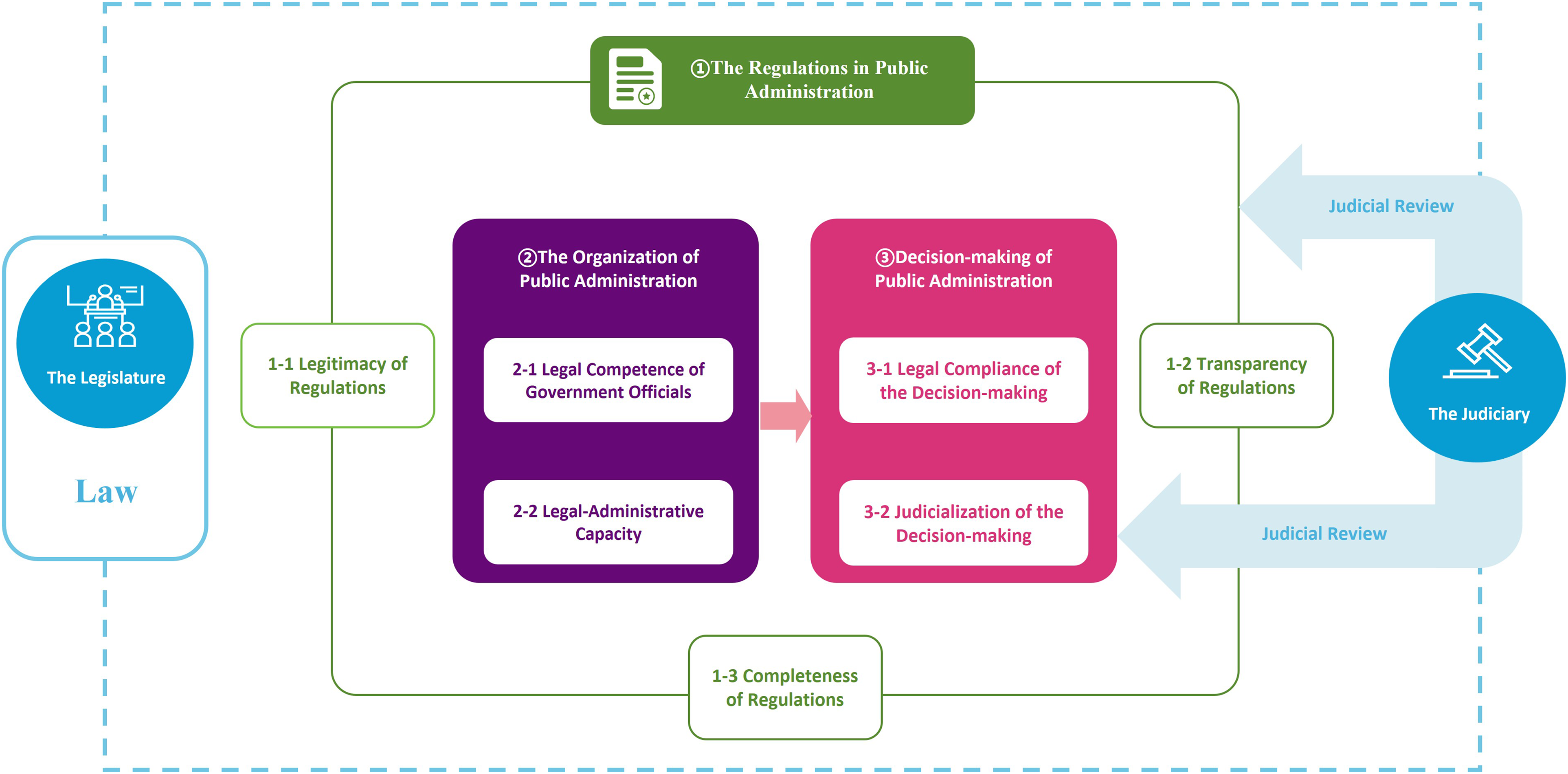
The conceptual framework of PARLI.
Measuring the Rule of Law in PA
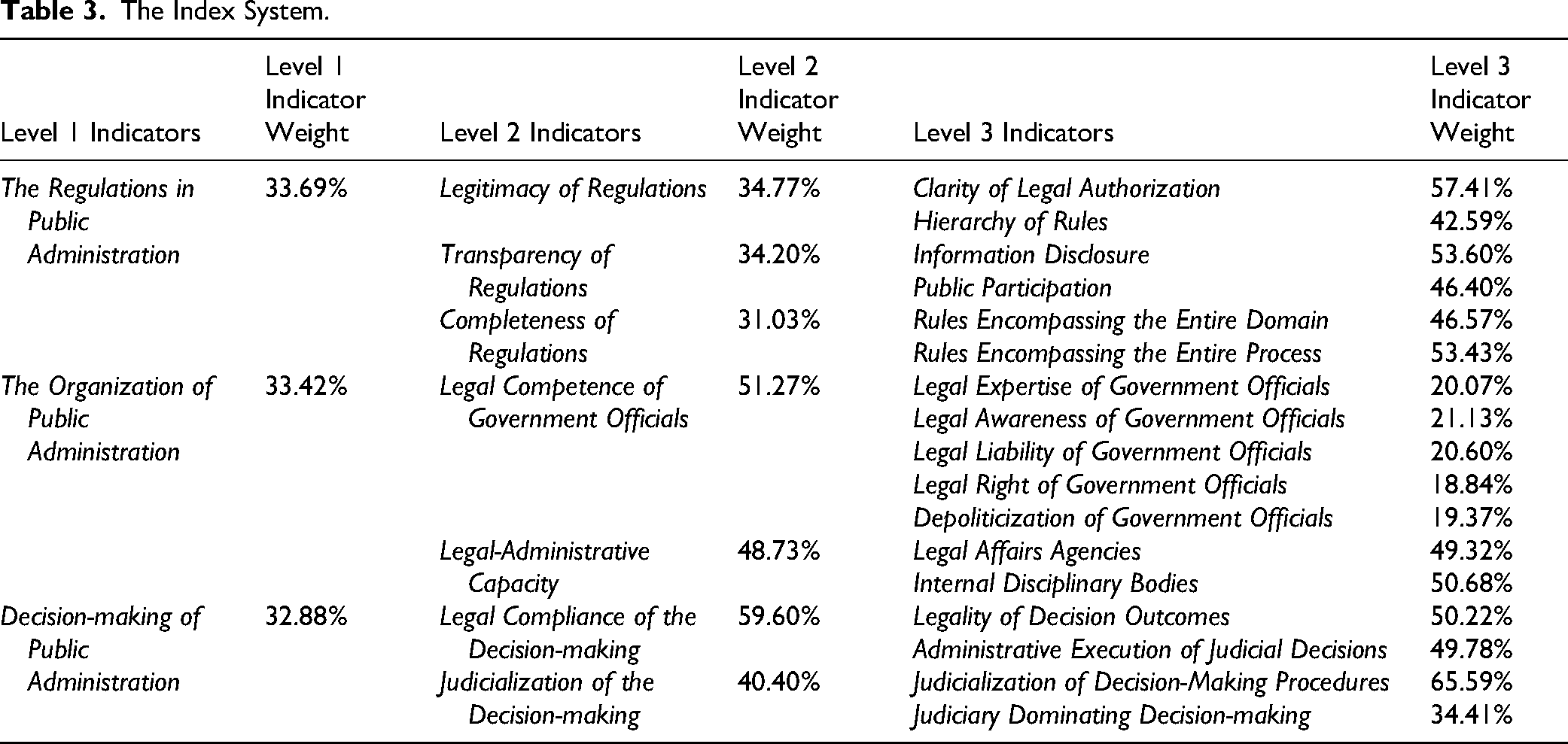
Building on this foundation, we introduce the Public Administration Rule of Law Index (PARLI). The index is conceptually structured around three primary dimensions, which function as the level 1 indicators. These dimensions are further disaggregated into seven level 2 indicators. The empirical basis of this framework is a set of objective level 3 indicators, collected as original data. Through a bottom-up aggregation process, these level 3 indicators are used to construct the scores for the seven level 2 indicators, which subsequently determine the final scores for the three level 1 dimensions. We have aimed to construct a coherent framework in which every indicator is both theoretically robust and empirically validated by objective, verifiable data.
Construction Process and Methods
To determine the weights of the indicators, this study utilized an expert scoring method to reflect their relative importance within the system. First, we convened an expert advisory panel of 15 members, comprising five legal professionals (two lawyers and three judges), five government officials, and five legal scholars (including two international experts). Panelists were provided with consultation questionnaires that contained detailed descriptions of the indicator system and its definitions. The experts were then instructed to score the relative importance of the indicators within each level. These scores were statistically aggregated to determine the final weight for each indicator, as presented in Table 3.
The Index System.
The final index scores were then calculated using a bottom-up, weighted aggregation method. Specifically, the scores of indicators at a lower level were multiplied by their corresponding weights and then summed to generate the score for the higher-level indicator.
The normalization of each indicator involved a multi-step process to ensure comparability across both dimensions and time. To enhance the temporal comparability of the data and mitigate the impact of outliers, we begin by applying a 1% winsorization to mitigate the influence of extreme values. Subsequently, a base year was established to serve as a stable benchmark. All indicators were then standardized using a Z-score method relative to the mean and standard deviation of this base year. This approach ensures that a standardized score reflects the indicator's deviation from the base-year norm, allowing for meaningful analysis of trends over time. The specific formula is as follows: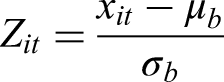
Finally, a final normalization step is performed to enhance interpretability and enable performance tracking against a fixed benchmark. The overall Z-scores are transformed using a min-max method, anchored to the base year's performance range, which maps the maximum and minimum values of the base year to 100 and 60, respectively. This approach allows for a clear analysis of progress or regression over time against a stable historical benchmark, thereby allowing scores in subsequent years to exceed 100. The formula is as follows: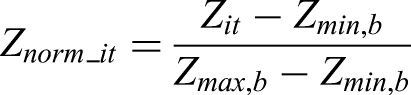
The Public Administration Rule of Law Index (PARLI) developed in this study exhibits several characteristics:
First, it is conceptually grounded in a thin conception of the rule of law. By adopting an instrumentalist perspective, this approach is designed to mitigate ideological bias, thereby facilitating more effective cross-national and cross-cultural comparisons. Furthermore, constructing a coherent index on this basis provides a solid foundation for future explorations of the thick rule of law.
Second, the index is comprehensive and multi-dimensional. It integrates theoretical insights from both public administration and legal studies to measure not only the procedural application of the rule of law (its practice) but also its substantive content as codified in laws and regulations (its normative framework). This allows for a more holistic depiction of the state of the rule of law within public agencies. The theoretically grounded nature of all indicators enhances PARLI's utility as a tool for both academic analysis and practical reform.
Third, the index is built exclusively on objective data. Eschewing subjective survey-based measures, PARLI relies on data derived primarily from publicly available government information. This ensures a high degree of transparency, accessibility, and replicability. In principle, this allows PARLI to be applied to any administrative region where such government information is disclosed.
Fourth, it is designed for robust longitudinal analysis. Through the use of a base-year standardization technique, the index ensures that scores are comparable across different years. This feature enables users to reliably track and analyze trends in the performance of public administration rule of law over time.
Practical Application Across China
Specifically, this study employs the index system to assess the rule of law in China's public administration, based on data collected from 31 Chinese provinces for the period 2020–2024. The data collection process is systematically organized around three core dimensions of public administration: regulations, organization, and decision-making. Each dimension is evaluated through a set of carefully selected and constructed indicators.
Regulations in Public Administration
The first dimension assesses the quality of public administration regulations through their completeness, transparency, and legitimacy.
Legitimacy of regulations was assessed through the Clarity of Legal Authorization and the Hierarchy of Rules. The Clarity of Legal Authorization was determined by the proportion of newly effective regulations that explicitly cite the higher-level laws upon which they are based. The Hierarchy of Rules was measured by the ratio of newly effective government regulations to the total number of newly effective difang guifanxing wenjian (地方规范性文件), or local normative documents, issued by the provincial government annually. In the Chinese legal system, these local normative documents are binding instruments that hold a lower legal status and often undergo less stringent review processes than formal government regulations. A higher ratio is therefore indicative of a greater reliance on more robust and legitimate forms of rulemaking.
Transparency of Regulations was evaluated based on Information Disclosure and Public Participation. Information Disclosure was quantified by calculating the percentage of newly effective regulations each year that were accompanied by explanatory materials such as press conferences, interpretive articles, or videos. Similarly, Public Participation was measured by the proportion of new regulations for which public opinions were solicited, and seminars were conducted. Data for both transparency indicators were systematically collected from official government websites and other public information platforms.
Completeness of Regulations was evaluated based on their scope and procedural comprehensiveness. To assess the breadth of regulatory coverage, a manual coding process was applied to all government regulations in effect as of December 31 of each year. These regulations were systematically categorized into 824 distinct topics, including areas such as fire safety management, motor vehicle administration, and administrative mediation. The Rules Encompassing the Entire Domain indicator was then calculated as the ratio of topics covered by a province's regulations to the total number of regulatory topics identified nationwide. For procedural completeness, the study focused on administrative penalties as a representative administrative action, as this is the action that most directly and significantly infringes upon public rights and interests. In accordance with the Administrative Penalty Law of the People's Republic of China, the administrative penalty process comprises 19 distinct steps designed to meet due process requirements. These include procedures such as recusal, hearings, and the public disclosure of administrative decisions. The Rules Encompassing the Entire Process indicator was measured by the proportion of these steps that are explicitly addressed in each province's administrative penalty regulations.
Organization of Public Administration
The second dimension of the study examines the organization of public administration, with a focus on the Legal Competence of Government Officials and the Legal-Administrative Capacity.
Legal Competence of Government Officials was assessed using five indicators.
Legal-Administrative Capacity was assessed by measuring the institutional resources and legal professionalization of its two core components: Legal Affairs Agencies and Internal Disciplinary Bodies. The strength of Legal Affairs Agencies was measured by combining two components: first, the proportion of their civil service recruits required to have a legal background in the provincial legal affairs agencies (Sifaju, 司法局), and second, the agency's annual expenditure as a share of the total provincial fiscal settlement. A similar composite measure was applied to evaluate Internal Disciplinary Bodies, combining the proportion of recruits with legal training in the provincial Commissions for Discipline Inspection and Supervision (Jiancha Weiyuanhui, 监察委员会) with their corresponding share of the provincial fiscal settlement. Because the annual expenditure data for these agencies were not consistently available, we addressed missing values as follows: where final account data were unavailable for a given province and year, the budget data from the subsequent fiscal year was used as a proxy.
Decision-Making of Public Administration
The final dimension centers on the decision-making processes within public administration, specifically their legal compliance and judicialization.
Legal Compliance of the Decision-Making was assessed through the Legality of Decision Outcomes and the Administrative Execution of Judicial Decisions. (1)
Judicialization Of Decision-Making was evaluated by the Judicialization of Decision-Making Procedures and the Judiciary Dominating Decision-making.
PARLI in China from 2020–2024
The following Table 4 summarizes the data for China's Public Administration Rule of Law Index (PARLI) and its Level 1 Indicators from 2020 to 2024. In the data processing, the scores for the overall index and its component indicators for 2020, the baseline year, were first normalized. The data for subsequent years were then standardized against the 2020 baseline.
Descriptive Statistics of the PARLI and Its Level 1 Indicators for China, 2020–2024.
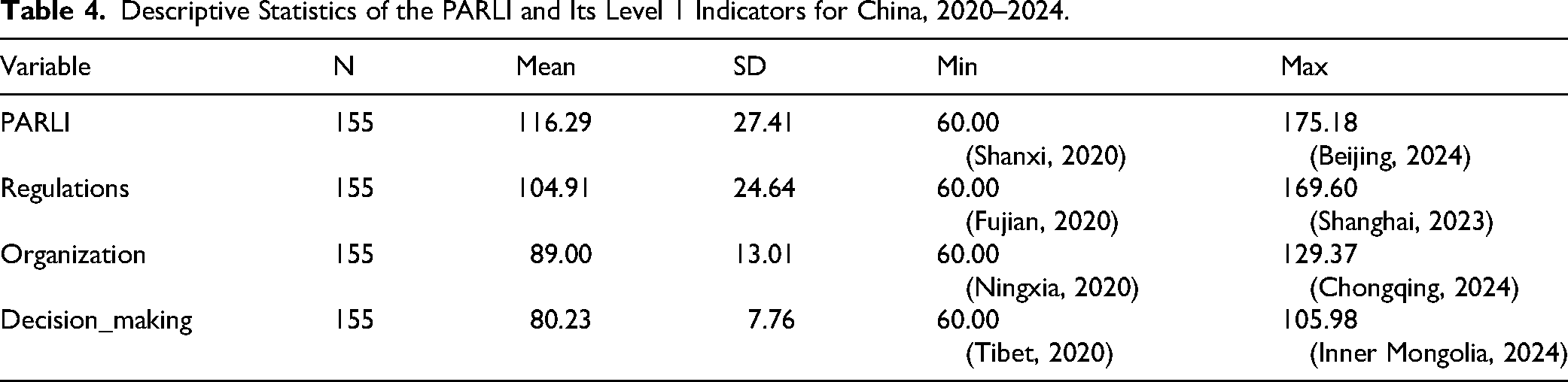
Figure 2 illustrates China's overall PARLI from 2020 to 2024, calculated using three distinct methodologies. A key finding is that regardless of the weighting method employed, China's PARLI demonstrated a consistent upward trend during this period, indicating significant overall progress.
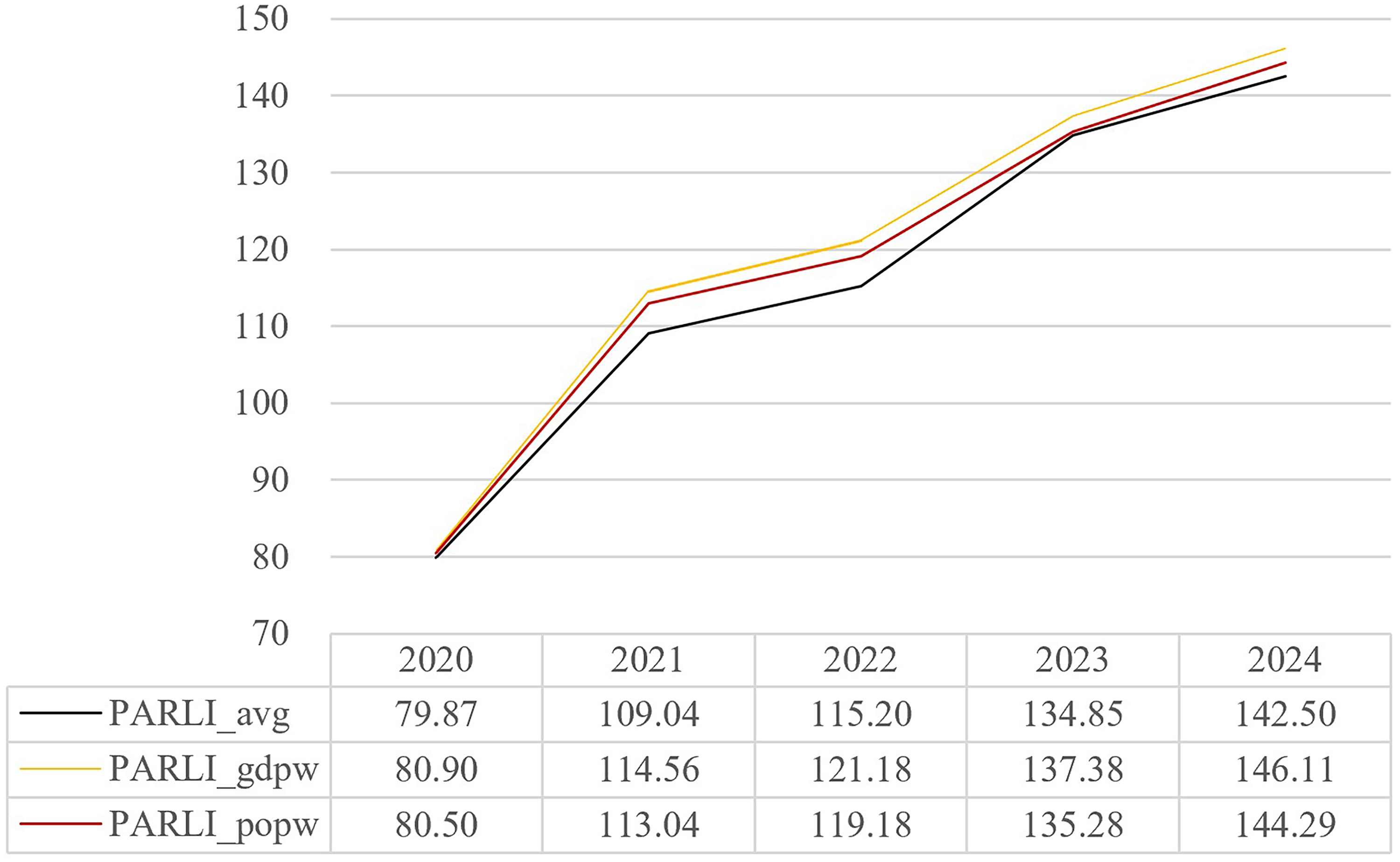
Trends in China's average PARLI by weighting methodology, 2020–2024.
Furthermore, the improvement in the rule of law has been balanced across different regions. The results calculated using the arithmetic mean, GDP-weighted average, and population-weighted average are highly consistent. The close alignment of the three curves suggests that the advancement in the rule of law is a widespread phenomenon, not confined to provinces with specific levels of economic development or population sizes.
Although the GDP-weighted index is consistently higher than the other two indices, and the arithmetic mean index is the lowest, the overall differences are minimal. This suggests that while regions with higher economic development may play a slightly leading role in advancing the rule of law, these small disparities primarily underscore the absence of regional divergence. Overall, the development of rule of law in public administration across China's provinces appears to be balanced and coordinated.
However, this overall regional balance masks internal imbalances. As shown in Figure 3, an analysis of the average scores for the three Level 2 indicators—Regulation, Organization, and Decision-Making—from 2020 to 2024 reveals that development across these dimensions was significantly unbalanced.
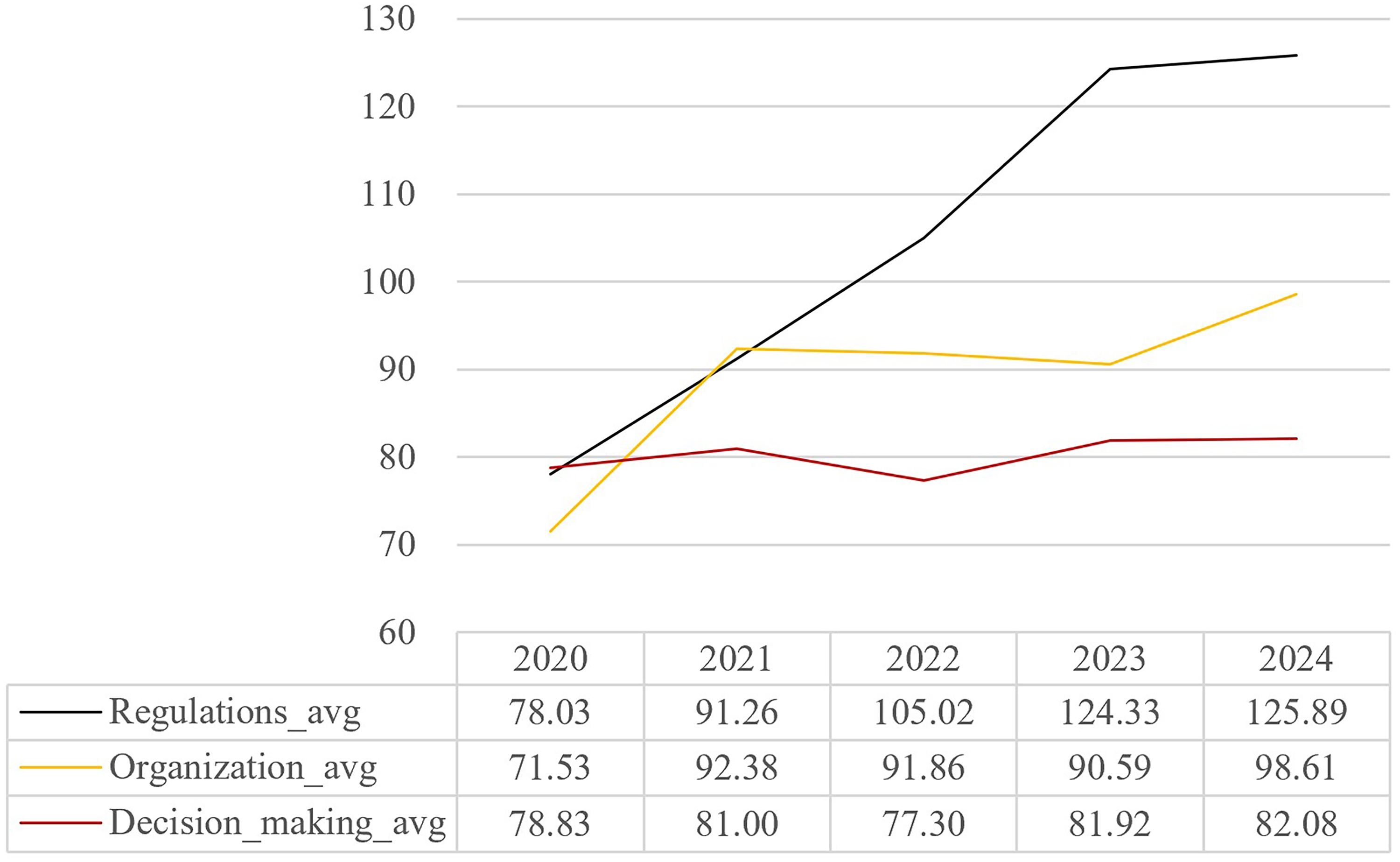
Trends in average scores of PARLI's level 1 indicators in China, 2020–2024.
Regulations were the primary driver of the overall PARLI's growth, achieving substantial growth with its score rising by 47.86 points over the five-year period. In contrast, progress in the Organization and Decision-Making dimensions lagged significantly. The score for Organization fluctuated but showed a modest overall increase, with a total growth of approximately 27 points over the five years. Meanwhile, the Decision-Making dimension showed no significant change, remaining stagnant at a low level throughout the period.
Significant provincial variations are also evident. Figure 4 presents the average PARLI scores of all 31 provinces over the five-year period. Beijing and Shanghai, as the nation's political and economic centers, ranked first and second respectively, with average scores of 138.50 and 134.96.
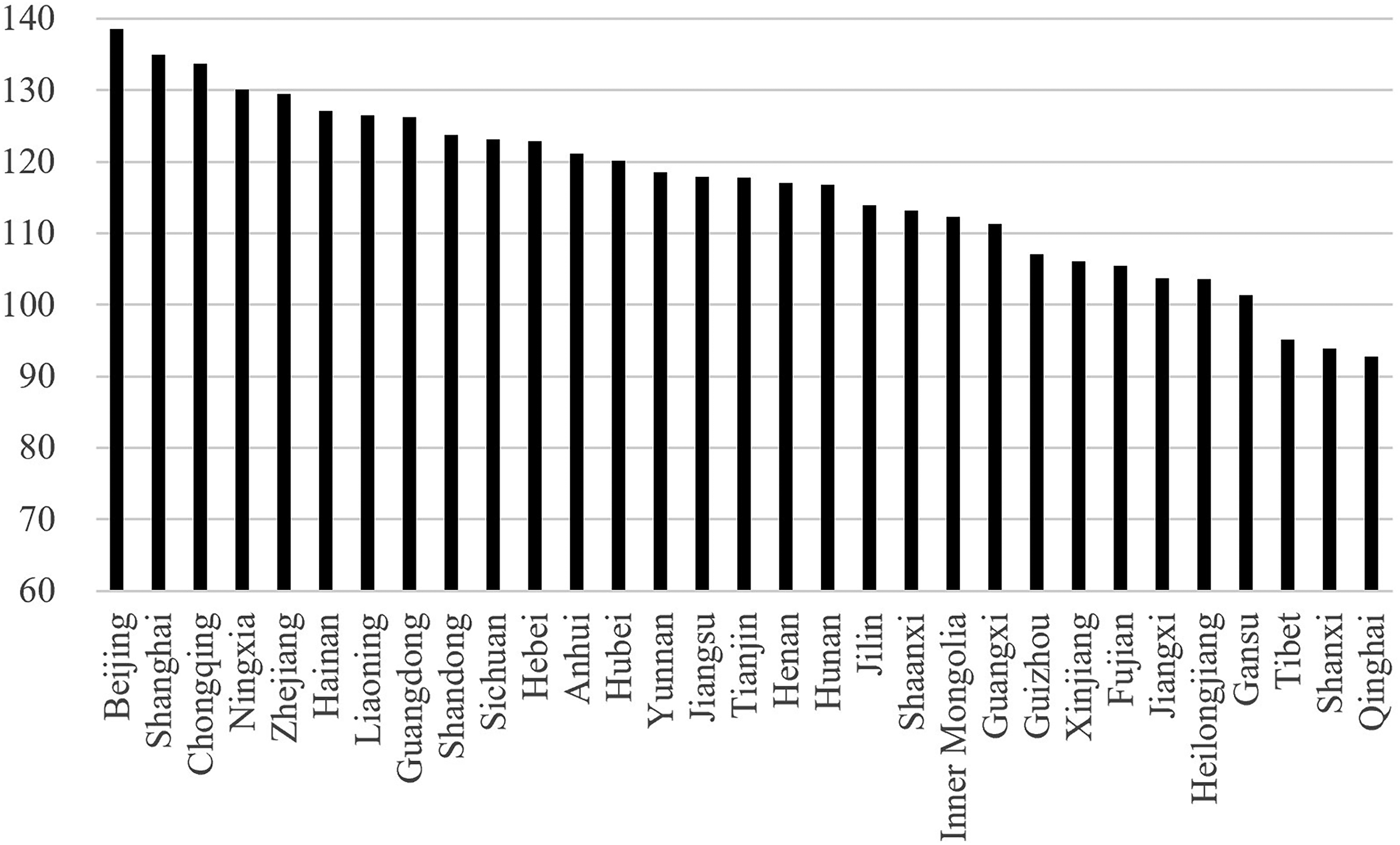
Average PARLI scores by province, 2020–2024.
Furthermore, the box plot in Figure 5 reveals two contrasting trends. While the median and maximum provincial scores show a consistent upward trend, the distribution of these scores has become increasingly dispersed, indicating a growing divergence among provinces. The outliers, marked as dots, further emphasize this disparity, identifying several lagging provinces, notably Tibet and Qinghai in 2021 and Guangxi in 2024.
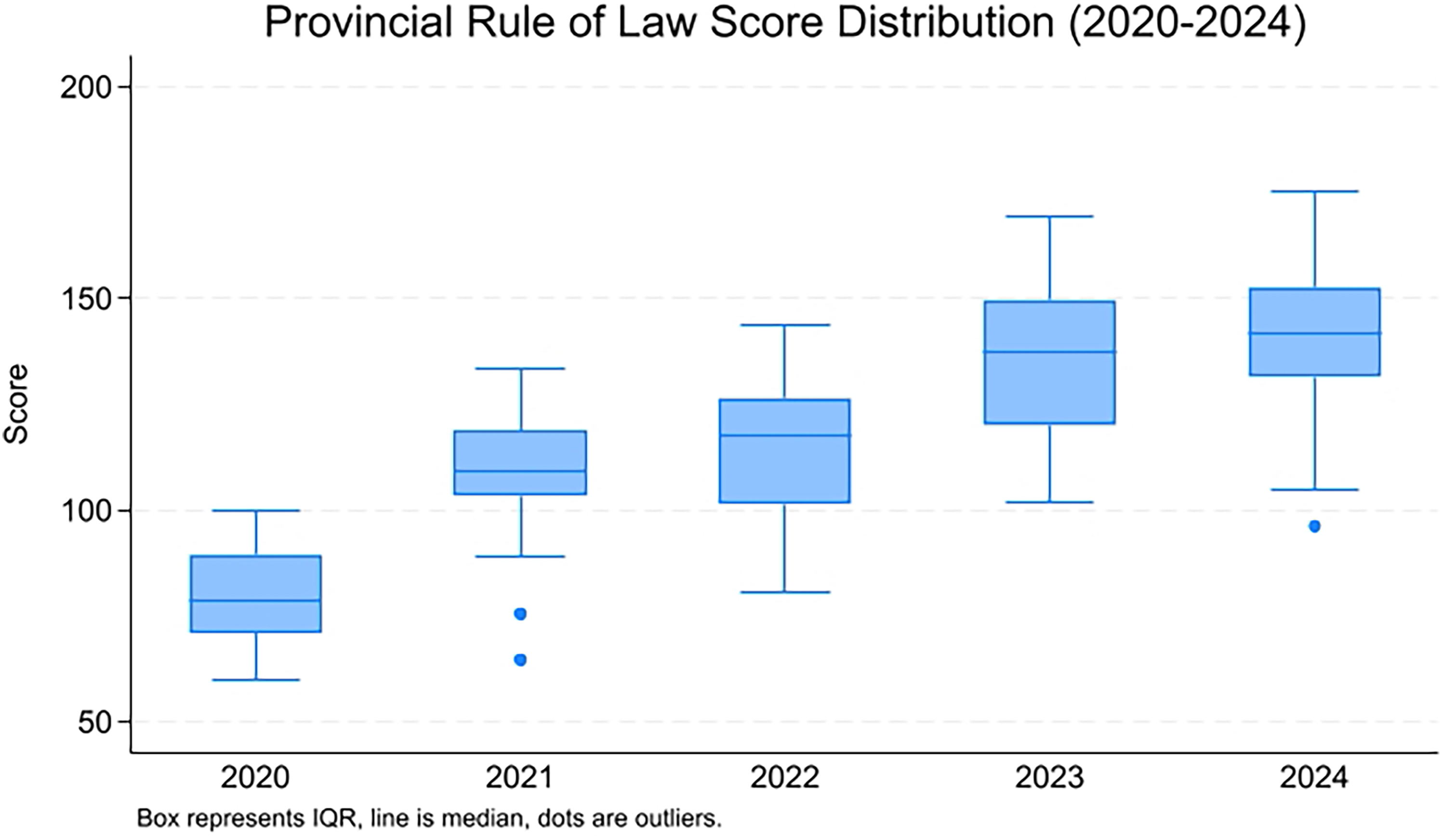
Evolution of the distribution of provincial PARLI scores, 2020–2024.
Further Empirical Analysis of the PARLI in China
We test the index's validity by using the PARLI as a proxy for the rule of law in public administration in China and analyzing its correlation with key socioeconomic indicators.
Rule of Law in PA and Regional Entrepreneurship
To examine the relationship between the rule of law in public administration and regional entrepreneurship, this study analyzes a balanced panel dataset covering 31 Chinese provinces from 2020 to 2024. We employ a two-way fixed-effects model, with standard errors clustered at the province level to control for both time-invariant provincial characteristics and province-invariant time shocks. The model is specified as follows:
The dependent variable, Lnfirm, is the natural logarithm of newly registered business enterprises in a province, which serves as a proxy for regional entrepreneurial activity. The primary independent variable is the PARLI index, developed for this study. This index was rescaled by dividing it by 100 to improve the interpretability of the regression coefficients. Accordingly, its coefficient represents the estimated change in the dependent variable for each one-unit increase in the rescaled score, corresponding to a 100-point increase on the original index. This index captures provincial rule of law performance across three dimensions: Regulations, Organization, and Decision Making.
The model also includes a set of control variables (Controlsit) to account for other factors that could potentially be associated with entrepreneurial activity. These include the natural logarithms of provincial GDP (Lngdp), resident population (Lnpop), R&D expenditure (Lntech), the number of higher education institutions (Lnschool), higher education enrollment (Lnstudent), and foreign direct investment (Lnfdi). The analysis further controls for the provincial fiscal self-sufficiency rate (Self_Finance), measured as the ratio of local general public budget revenue to local general public budget expenditure. Finally, the model incorporates province (αi) and year (γt) fixed effects to control for unobserved heterogeneity that is constant within provinces over time and across all provinces in a given year.
Table 5 presents the regression results examining the impact of the PARLI and its sub-dimensions on regional entrepreneurship. Column (1) shows that the overall PARLI index has a positive and statistically significant associated with entrepreneurship. The coefficient of 0.258 indicates that, ceteris paribus, a 100-point increase in the PARLI score is associated with a 25.8% increase in newly registered firms. This result is consistent with the hypothesis that a higher level of rule of law in public administration fosters a more conducive business environment, which in turn stimulates regional entrepreneurial activity.
PARLI and Regional Enterprise Development.
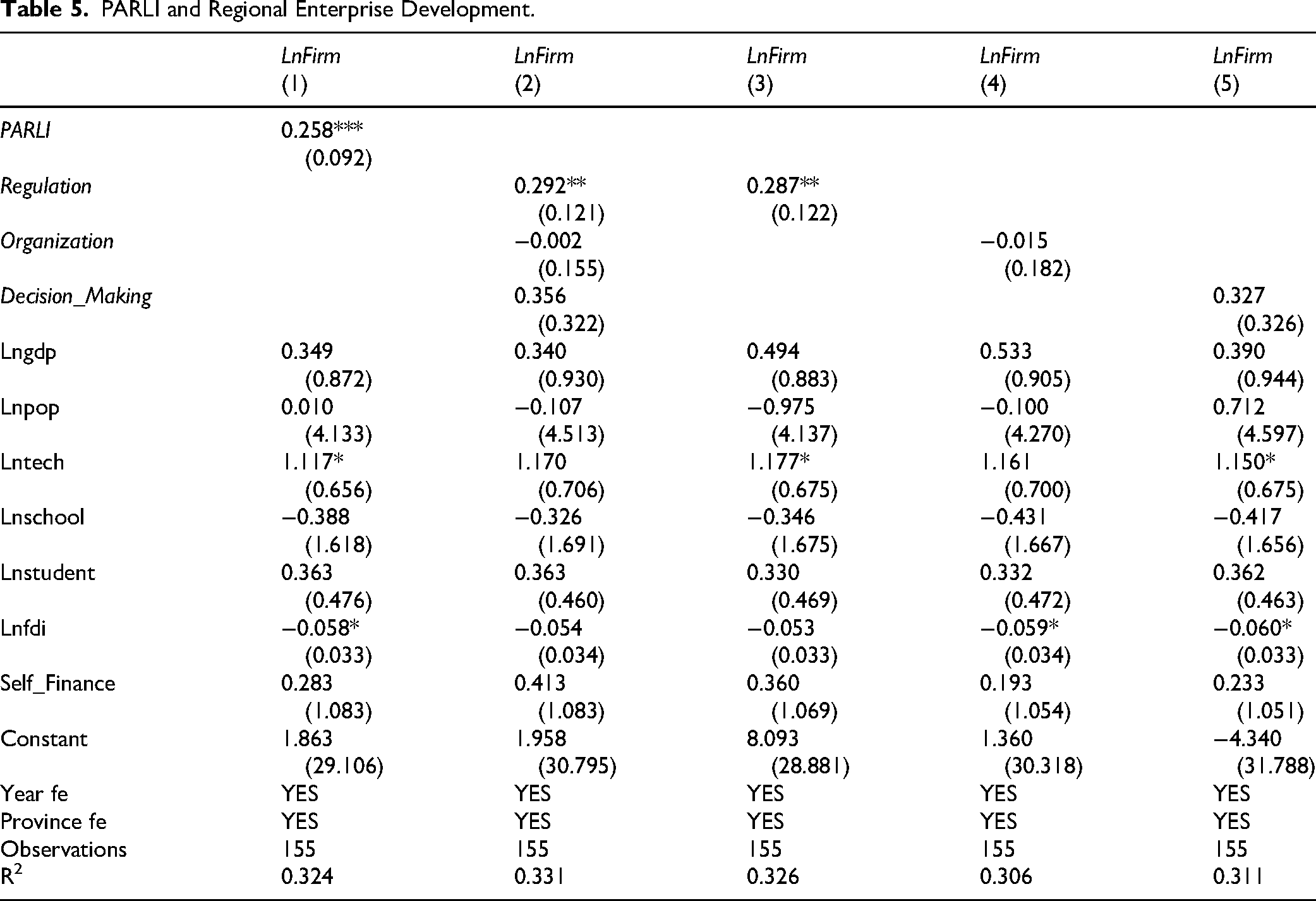
Analysis of the PARLI index's three dimensions in Columns (2)-(5) indicates that only the Regulations dimension positively and significantly affects entrepreneurial activity. In contrast, the Organization and Decision-Making dimensions show no statistically significant impact. This suggests that the quality of a province's regulatory system is a critical factor in promoting new business ventures.
A closer examination of the sub-indicators for each dimension offers additional insights in Table 6. Within the Regulations dimension, the legitimacy of regulations—defined by the clarity of legal authorization and a proper hierarchy of rules—has a significant positive effect on entrepreneurship. However, the completeness and transparency of these regulations do not have a statistically significant relationship with new business creation.
Sub-Indicators of PARLI and Regional Enterprise Development.
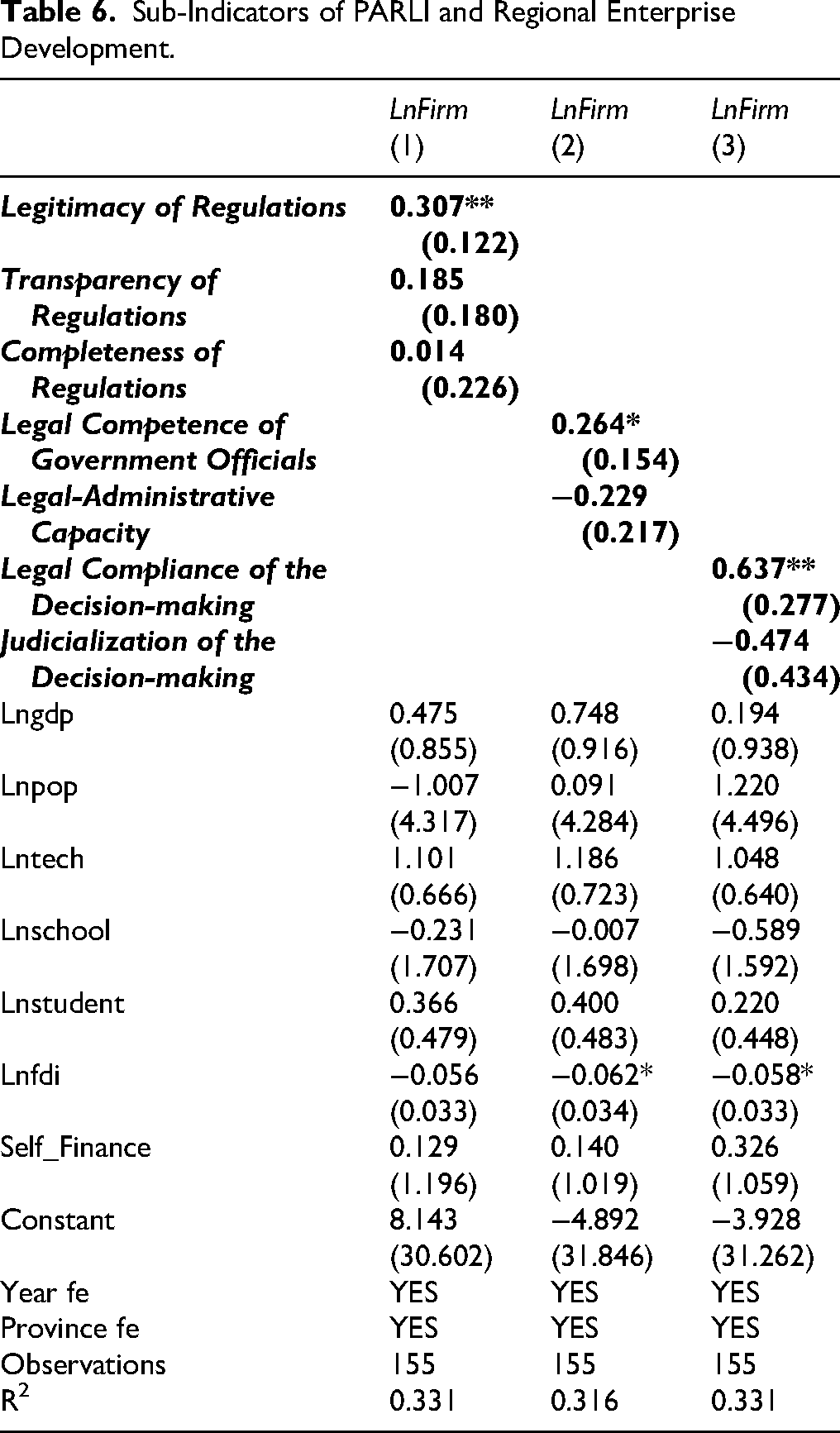
Regarding the Organization dimension, the legal competence of government officials emerges as a significant positive factor. This finding implies that the rule of law proficiency of government officials positively influences regional entrepreneurship, whereas legal-administrative capacity shows no discernible effect. Finally, in the Decision-Making dimension, the legal compliance of administrative decisions, as measured by the legality of their outcomes and the execution of judicial rulings, is a strong positive determinant of entrepreneurship. These findings suggest that an environment with legitimate rules, legally proficient administrators, and compliant administrative decisions is most favorable for fostering entrepreneurship.
Rule of Law in PA and Regional Innovation
To further assess the impact of the rule of law in public administration on regional innovation, this study uses a two-way fixed-effects model with the following specification:
The dependent variable, Lnpatent, is the natural logarithm of the annual number of patents granted in a province, serving as a standard proxy for regional innovation output. The key explanatory variable is the PARLI. The model incorporates several control variables relevant to innovation, including the natural logarithms of provincial GDP (Lngdp), resident population (Lnpop), R&D expenditure (Lntech), the number of higher education institutions (Lnschool), higher education enrollment (Lnstudent), foreign direct investment (Lnfdi) and the provincial fiscal self-sufficiency rate (Self_Finance). Finally, the model includes province and year fixed effects to account for unobserved heterogeneity.
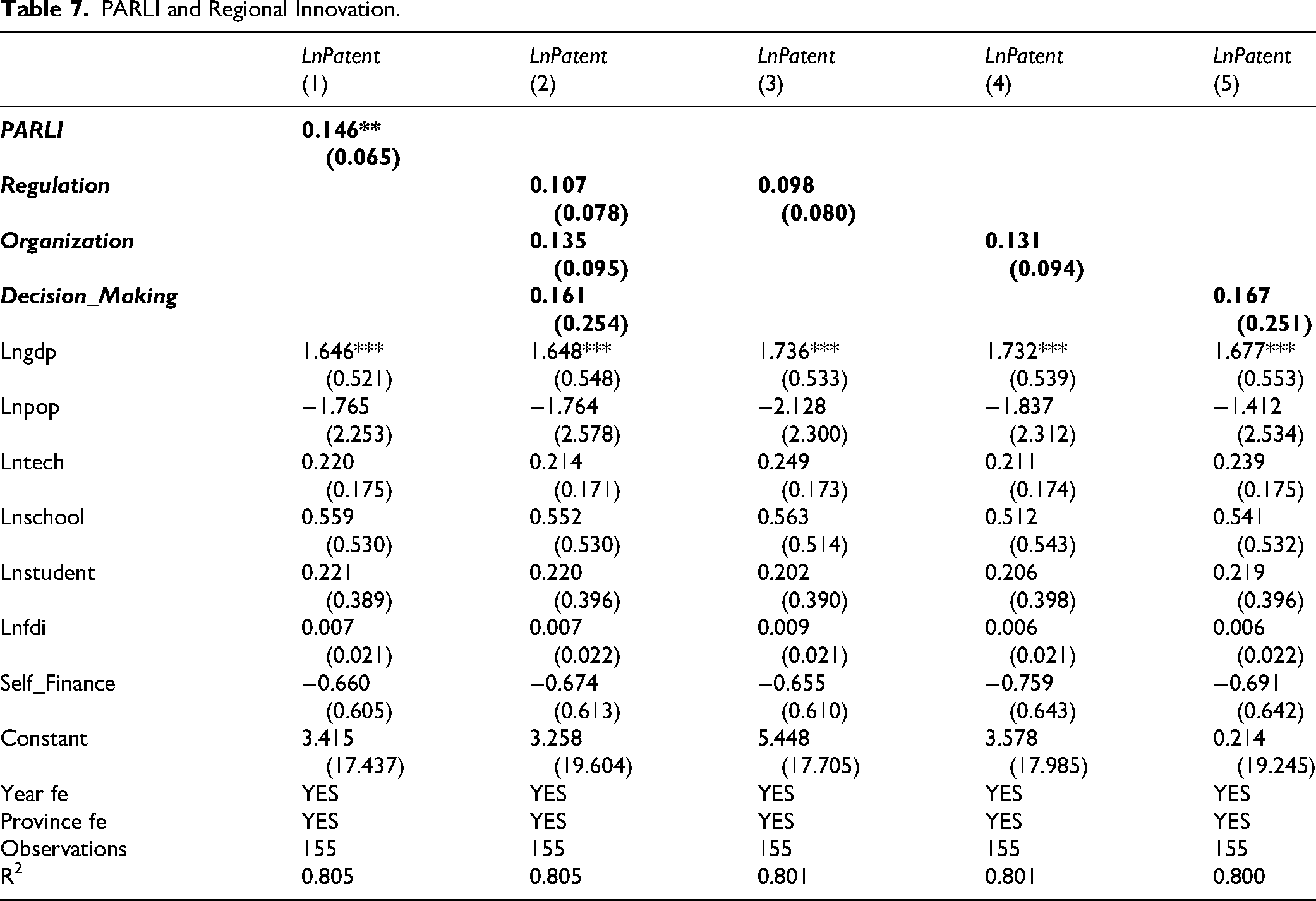
Table 7 shows the effect of the PARLI index and its three sub-dimensions on regional innovation. The overall PARLI has a positive impact on innovation in a region. Specifically, a higher score in the rule of law in public administration corresponds to a greater number of granted patents. The coefficient is 0.146, indicating that a 100-point increase in the index score is associated with a 14.6% rise in the number of patents granted. However, an examination of the sub-dimensions in Columns (2)-(5) shows that none of the three dimensions—Regulations, Organization, or Decision-Making—are individually statistically significant. This suggests that the influence of the rule of law in public administration on innovation is likely due to the holistic effect of its components rather than any single dimension.
PARLI and Regional Innovation.
A more detailed analysis of the sub-indicators, shown in Table 8, reveals a more complex picture. Within the Regulations dimension, only the completeness of regulations has a significant positive impact on regional innovation. This sub-indicator measures the extent to which regulations cover a range of regulated domains and administrative decision-making processes. In the Organization dimension, none of the sub-indicators are significant. The results for the Decision-Making dimension are particularly noteworthy as they show divergent effects. While the legal compliance of decision-making significantly promotes innovation, the judicialization of the Decision-making—which measures the degree of court intervention in administrative decisions—has a significant negative impact.
Sub-Indicators of PARLI and Regional Innovation.
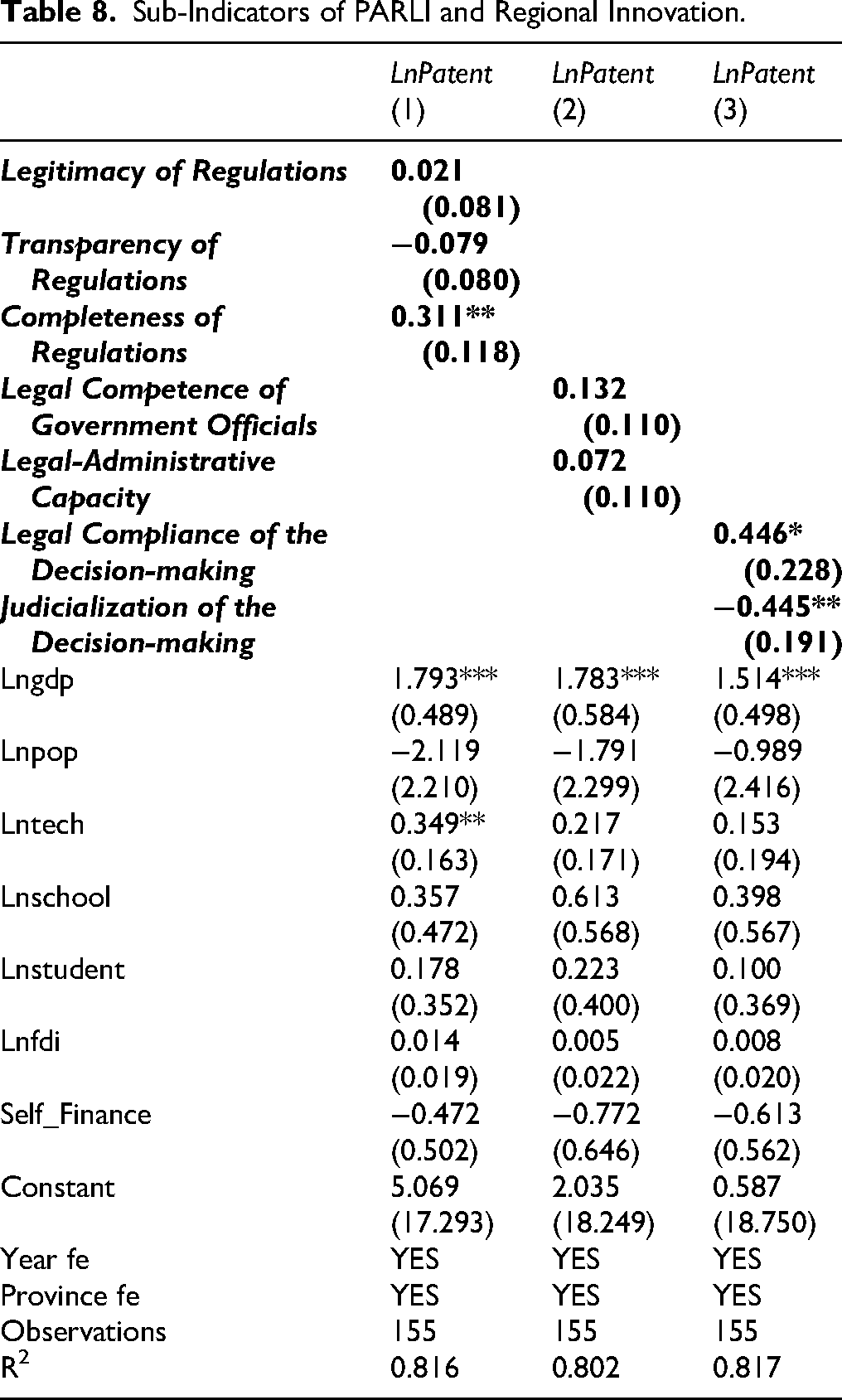
These findings suggest that the positive relationship between the rule of law and innovation is driven by two key factors: a complete regulatory framework and adherence to legal procedure in administrative decision-making. However, the adverse effect of judicialization highlights a potential trade-off. Excessive exposure of administrative actions to judicial review may lead to procedural rigidity, stifling the risk-taking and flexibility essential for innovation.
Rule of Law in PA and Government Responsiveness
Finally, we examine the effect of the public administration rule of law on government responsiveness using the following specification:
The dependent variable in this study is Lnday, representing the natural logarithm of the average number of days a local government takes to respond to public inquiries posted on the official Local Leader Message Board. A higher value for Lnday indicates slower government responsiveness. The primary independent variable is PARLI. The model includes several control variables to account for potential confounding factors. These include the natural logarithm of per capita GDP (Lngdpper), the natural logarithm of the number of complaints on the Local Leader Message Board (Lnnum), provincial fiscal capacity (Fiscal_Capacity), measured as the ratio of fiscal revenue to GDP, the provincial fiscal self-sufficiency rate (Self_Finance), the number of colleges and universities per 10,000 people (Perschool), university students per 100,000 people (University_Students), the proportion of public sector staff (Staff), and the mobile internet penetration rate (Internet). The model employs a fixed-effects specification, and standard errors are clustered at the province level.
Table 9 reports the effects of the PARLI and its three sub-dimensions on government responsiveness. Column (1) shows that higher levels of the public administration rule of law negatively affect government responsiveness. In other words, the higher the score on PARLI, the longer it takes local governments to respond to citizen messages, reflecting lower efficiency. Specifically, a 100-point increase in the PARLI score causes to an estimated 58.7% increase in average response time after exponentiating the log coefficient. This finding highlights a potential tension between legal procedures and administrative efficiency. A more developed rule-of-law system often demands greater procedural rigor—such as compliance reviews and legal risk assessments—before an official response can be issued. Furthermore, such systems may encourage risk-averse behavior, as officials often delay responses to ensure full compliance and avoid accountability for potential errors.
PARLI and Government Responsiveness.
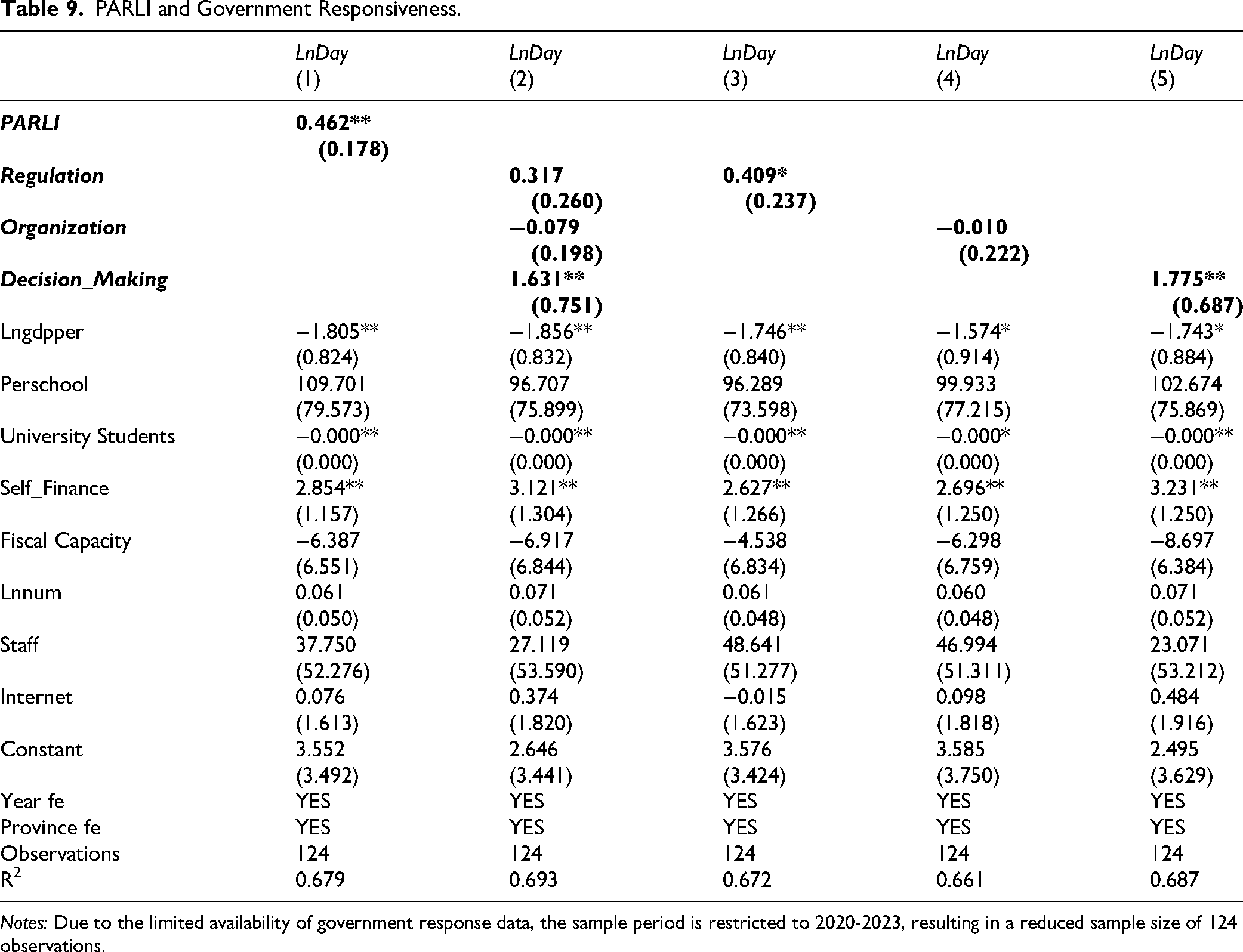
Notes: Due to the limited availability of government response data, the sample period is restricted to 2020-2023, resulting in a reduced sample size of 124 observations.
An examination of the individual PARLI dimensions indicates that this negative impact is driven primarily by the Decision-Making dimension. As shown in Column (3), the coefficient for Decision-Making is 1.631, which implies that a 100-point increase in this dimension's score is associated with an estimated 163.1% increase in government response time. The Regulations dimension also shows a marginally significant positive effect, whereas the association of the Organization dimension is not statistically significant.
Table 10 displays the effects of the Level 2 indicators of the PARLI on government responsiveness. The results show that the completeness of public administration rules has a significant adverse impact on government responsiveness, increasing the average number of days required for a response and thereby reducing efficiency. In contrast, the legitimacy and transparency of these regulations do not have a statistically significant effect.
Sub-Indicators of PARLI and Government Responsiveness.
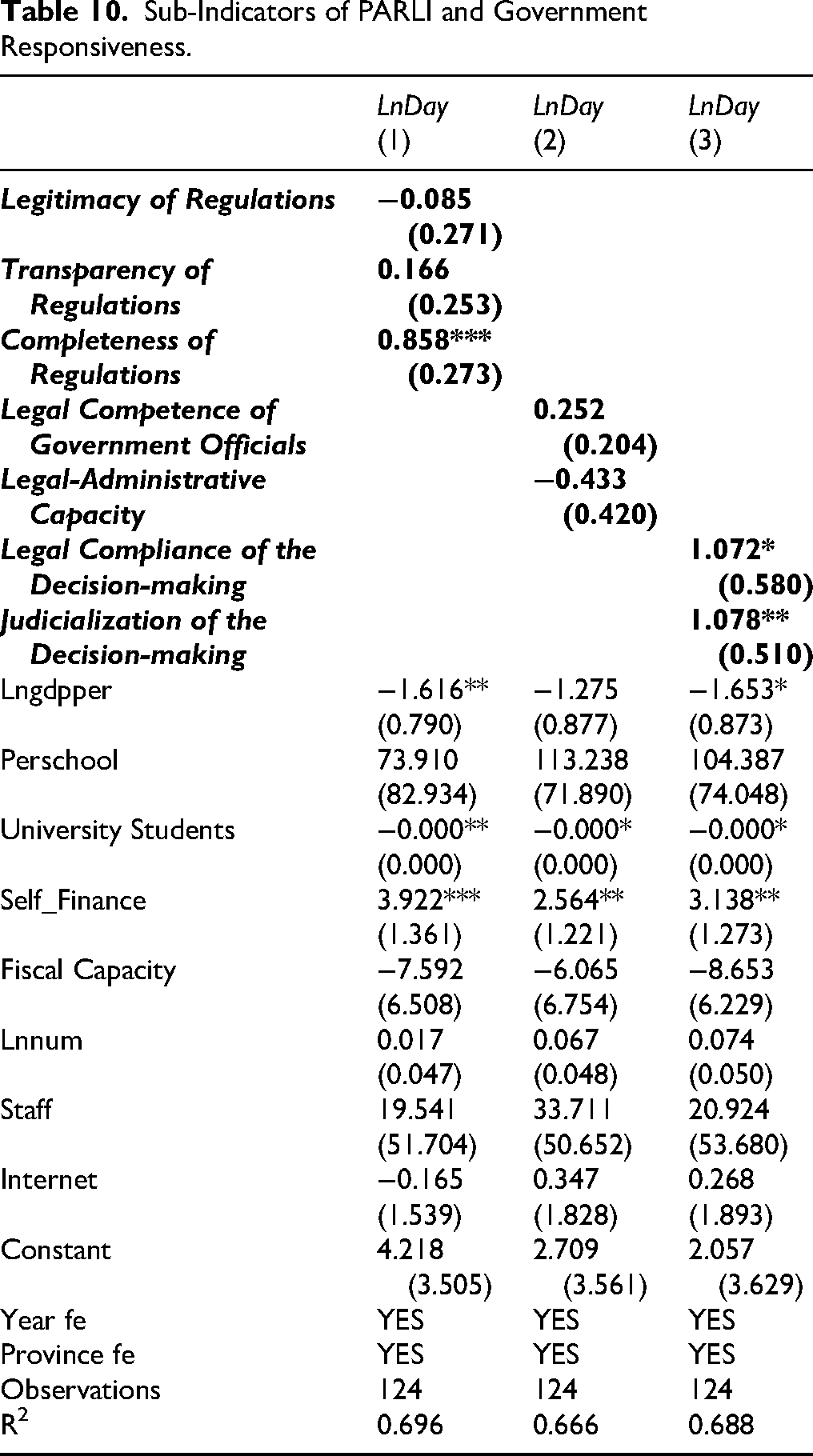
Furthermore, within the decision-making dimension, both the legal compliance and the judicialization of decisions significantly increase the time the government takes to respond. This suggests a deterrent effect stemming from judicial oversight of administrative decisions. The indicators within the Organization dimension, however, show no statistically significant impact on government responsiveness.
Discussion and Conclusion
Public administration research has long lacked a clear conceptualization of what the rule of law entails and, furthermore, lacks an objective measurement system. Based on thin concept of the rule of law, this study proposes a three-dimensional framework for understanding the rule of law in public administration: regulations, organization, and decision-making. This framework captures both the de jure aspects of the rule of law (the formal regulations agencies create) and its de facto dimensions (the actual enforcement of these rules by organization through their decision-making) (Voigt, 2012).
To operationalize this framework, we developed the Public Administration Rule of Law Index (PARLI), composed of three level-1 indicators (the core dimensions) and seven level-2 indicators. We then constructed the index for Chinese provinces from 2020–2024. This involved measuring the level-2 indicators with objective data and using a weighted aggregation, based on an expert scoring method, to calculate level-1 indicators and the final PARLI score. Finally, we validate our approach through an empirical analysis demonstrating a significant relationship between PARLI scores and socioeconomic performance.
Overall, our empirical findings validate the proposed conceptualization and measurement of the rule of law in public administration. We demonstrate that a higher level of rule of law correlates positively with key socioeconomic outcomes, including regional entrepreneurship and innovation. These results align with established academic theories, suggesting that a robust rule of law fosters a more conducive business environment, thereby stimulating entrepreneurial activity and innovation (Ash et al., 2025). At the same time, we found that the rule of law is negatively correlated with government responsiveness. This supports the notion that increased procedural rigor, while essential for legality, can lead to a form of “administrative ossification” (Yackee & Yackee, 2010) that may limit administrative responsiveness.
Our analysis of PARLI's constituent indicators provides further insights. The positive impact of the rule of law on entrepreneurship appears to stem primarily from the Regulation dimension, particularly the legitimacy of government regulations (i.e., the clarity of legal authorization and a proper hierarchy of rules). Conversely, the negative effect on government responsiveness is driven more by the Decision-Making dimension; both legal compliance and the judicialization of decisions significantly increase the time the government takes to respond. Finally, the positive association with innovation emerges only at the composite PARLI level. This suggests that fostering innovation requires a holistic rule of law system encompassing all three dimensions—Regulations, Organization, and Decision-Making—as no single dimension alone was significantly associated with this outcome.
Strengths and Limitations
This article conceptualizes and measures the rule of law in public administration, making two primary contributions to both scholarly discussion and practical application.
First, this study provides public administration scholars with a coherent framework for the scientific inquiry of the rule of law. Although the rule of law is an integral part of public administration's identity, the field has lacked a clear and unified conceptualization. Our research, grounded in the core concept of the rule of law and its de jure and de facto manifestations, offers a comprehensive framework that allows for a more holistic understanding of its operation within public agencies. A key advantage of this holistic approach is its ability to unveil the rule of law's internal tensions. For example, our findings highlight the double-edged nature of the Judicialization of Decision-making, which is negatively associated with both innovation and government responsiveness. This framework also helps public administration scholars overcome the fragmentation of knowledge and foster cumulative research.
Second, the proposed PARLI measurement provides policymakers and researchers with a practical toolkit for policy analysis and reform. The index is built exclusively on objective data and designed for robust longitudinal analysis, features that enable replication and comparison, thereby making it possible for scholars to construct similar panel datasets in other national contexts. This opens the door for rigorous cross-national analysis. Furthermore, we provide a tangible contribution in the form of a novel dataset of original PARLI indicators for China's provinces, creating immediate opportunities for empirical research on the development of the rule of law in Chinese public administration.
This study also has several limitations. First, the index was tested exclusively with data from China. Therefore, its application in different national contexts requires further validation by international scholars. Second, a more rigorous research design is necessary to conduct causal analysis using the index. At present, our work is confined to a preliminary correlational examination. Finally, the study was confined to a formal, or “thin,” conception of the rule of law, which emphasizes procedural attributes. Future work should collaboratively explore an indicator system that includes a substantive, or “thick,” conception of the rule of law.
Avenues for Future Research
By providing a replicable, objective measure, this study unlocks a new research agenda for the administrative rule of law. Scholars can now move beyond single-country case studies to conduct large-N comparative analyses on its determinants, or perform longitudinal analyses to track its evolution. The index also enables more complex causal inquiries. It can serve as a dependent variable to identify which political or economic reforms most effectively strengthen the rule of law, or as an independent variable to empirically test its impact on critical outcomes like government performance, public trust, and political responsiveness. Finally, it can be employed as a moderating or mediating variable to explore the conditions under which legal frameworks enhance or constrain administrative action.
Footnotes

Ethics Approval Statement
This study does not involve any issues requiring ethical approval.
Patient Consent Statement
This study does not involve any issues requiring patient consent.
Author Contribution
Tianhao Chen (First Author) conceived and designed the project and drafted the manuscirpt. Weirui Wei helped with data collection and analysis, as well as contributing to paper writing. Yipo Su contributed to paper writing. Jieting Chen contributed to data collection and analysis. Huizhong Gong contributed to data collection and analysis. Yu Sheng (Corresponding Author) contributed to the conceptual framework, data collection and data analysis.
Funding
The authors disclosed receipt of the following financial support for the research, authorship, and/or publication of this article: This research was supported by the Major Research Project of Philosophy and Social Sciences, Ministry of Education (Grant No. 2025JZDZ044); the High Level Project in Arts, Humanities and Social Sciences, Tsinghua University (Grant No. 2024TSG08101); the China Scholarship Council (Grant No. 202506210196); and the Basic Research Seed Fund Program of the School of Public Policy and Management, Tsinghua University (Grant No. JCZZ2025001).
Declaration of Conflicting Interests
The authors declared no potential conflicts of interest with respect to the research, authorship, and/or publication of this article.
Data Availability Statement
The data that support the findings of this study are available from the corresponding author upon reasonable request.
Permission to Reproduce Material from Other Sources
The data are obtained from publicly available sources.