







Abstract
American beliefs about social class are not always accurate. Up to half of Americans claim to belong to the middle class, and many believe in an egalitarian society where social mobility is possible. These misperceptions have been attributed, in part, to the mass media. This work sets out to explore whether images of and messages about social class in advertising may contribute to such misperceptions. The class structure pictured in advertising is examined using a large representative sample of American print advertising from 1950 to 2015. First, a content analysis is used to identify what images of social class are depicted in advertising and in what proportion. Then, a qualitative approach is taken to identify what messages those images convey. Findings are presented for each social class. Together the findings suggest that advertising blurs the lines between social classes and diffuses the potential for class conflict. Importantly, this work also notes that advertising representations of the lower and working class are markedly positive, differing from other forms of mass media in important ways. This work calls for increased attention to social class in the marketing literature and is a crucial step in considering the societal effects of marketing messages.
Beliefs about social class in the United States are dominated by the perception of a large middle class. Nearly half of Americans believe they belong to the middle class (Newport 2015). Since 1972, the General Social Survey has asked people what class they believe they occupy and an average of 45% of respondents claim middle class status, a number that holds fairly steady across years. Americans also believe that the United States is an egalitarian society, where economic advancement is widely available, and that those who work hard and are talented will get ahead regardless of the circumstances of their birth; Americans believe in the American Dream (Kluegel and Smith 1986; Vanneman and Cannon 1987). These beliefs continue despite the fact that the fortunes of different social classes have varied over time. Immediately following WWII, the United States experienced an economic expansion in which all social classes participated. Yet, by the 1970s, this growth had stalled and began to reverse in what is known as the Great U-turn (Harrison and Bluestone 1988). American society moved from roughly equal real-income growth across socio-economic strata to historic inequality in wages, earnings, and consumption (Gottschalk and Danziger 2005; Heathcote, Perri, and Violante 2010; Leicht and Fitzgerald 2014; Piketty and Saez 2006; Schulman 2001). Real middle-class incomes declined and both inflation and recessions battered the middle class (Fischer, Hout, and Stiles 2006; Goldin and Margo 1991; Harrison and Bluestone 1988; Kendall 2011; Samuel 2014) At the same time, the top fifth of income earners, and particularly the very top, took a greater share of income (Fischer, Hout, and Stiles 2006).
Why are Americans so likely to believe they are middle class and that advancement is possible when reality suggests otherwise? Such misperceptions have been ascribed to images perpetuated in the mass media. Mantsios (2007, p. 641) suggests that Americans continue to believe they belong to the middle class because the media blurs the lines between social classes. He further suggests that Americans believe that the American Dream is possible because “the media hides gross inequalities from public view. In those instances when inequalities are revealed, Americans are provided with messages that obscure the nature of class realities” (Mantsios 2007, p. 636). This paper sets out to explore the idea that class messages in advertising may contribute to misperceptions about social class. To do this, first, a content analysis is used to identify what images of social class are depicted in advertising and in what proportion. Then, a qualitative approach is taken to identify what messages those images convey. The discussion considers how such images and messages might reasonably reproduce longstanding beliefs about the class structure and beliefs about how class works in the United States.
Surprisingly, social class is not widely discussed in marketing despite the fact that “social class is one of the most fundamental dimensions of social organization, influencing almost every aspect of our lives” (Henry and Caldwell 2008, p. 387). Images of social class are not well documented in advertising either, which is even more surprising given that advertising portrayals of other social divisions such as race, ethnicity, gender, sexuality, and age have been investigated extensively. Cui (2001) identified 48 studies of racial and ethnic groups in advertising that appear before 1997 alone. Eisend (2010) identified 84 articles on gender portrayals in television, and radio advertising and print advertising has also been considered extensively (Whipple and Courtney 1985; Wolin 2003). While less common, age (Gantzl, Gartenberg, and Rainbow 1980; Peterson 1992; Peterson and Ross 1997; Roy and Harwood 1997; Swayne and Greco 1997) and sexuality (Branchik 2007) have also been investigated. Even the portrayal of animals has been documented (Spears, Mowen, and Chakraborty 1996), and yet social class in advertising remains infrequent and fragmented. Exceptions include the examination of a twenty-year historical period (Marchand 1985), an exploration of the marketers’ imagined consumer (Cayla and Elson 2012), a brief discussion of a single social class (Belk 1987; Hirschman 1990; O’Barr 1994; Paulson and O’Guinn 2012), or purchases of a specific product by each social class (Quickenden and Kover 2007). These works form an important starting point in this investigation of social class but leave questions unanswered about the overall class structure, its representation, and the messages conveyed by such images.
In asking such questions, two components of a macromarketing perspective are emphasized. First, this paper considers “marketing in general and data which depict marketing in general” (Bartels and Jenkins 1977, p. 17). The most widespread advertising messages from a range of top circulation publications are being considered in their entirety, rather than investigating a specific brand, a specific ad, or a piece of an advertisement such as a headline. Second, advertising messages are considered from a societal perspective (Fisk and Nason 1982; Shawver and Nickels 1981; Wilkie and Moore 2006). This work raises questions about how advertising messages about social class might reinforce certain beliefs about class such as the belief in a large middle class or the possibility of social mobility. Also considered is whether advertising emphasizes a consumption-oriented route to achieving social mobility. Such questions do not address the effectiveness of a specific marketing message but rather how such messages contribute to societal-level expectations about social class and consumption. Importantly, understanding how social class is portrayed and what messages about class are conveyed act as starting points for determining what effect these messages may have on society in general.
Social Class in America: Definitions, Perceptions, and Reality
Before exploring how social class has been depicted in advertising, it is first necessary to understand the nature of social class in America. Social class is a complex and contested topic that defies easy definitions. In its most basic form, social class refers to the organization of individuals into groups that are then arranged hierarchically in a society. This idea has its origins in the work of Karl Marx where social class was determined by whether or not an individual owned the means of production (Marx and Engels 1906). Max Weber expanded on this definition and identified three components that determined class: economic position, social status or prestige, and power (Weber (2010) [1921]). It is this multifaceted approach that continues to influence sociologists today. Contemporary researchers often use socioeconomic status, which is a composite measure including educational level, occupational prestige, income, and sometimes wealth. While none of these definitions perfectly align with one another, in general, they all arrange people into groups based on economic circumstances and some measure of prestige.
However, arranging people into groups creates conceptual and practical problems. Debate continues to surround which are the best indicators to use, how to measure each, and how to control for additional factors such as the number of income earners and the size of the household. When using a composite measure such as socioeconomic status, individuals may rate highly on one aspect such as education but low on another such as income and thus do not fit neatly into any one social class, a state known as status inconsistency. Differences may also arise between an individual’s objective social class and her/his subjective belief, particularly in the United States where individuals over-claim middle-class status.
Different researchers also identify different numbers of social classes. An approach which dominated American sociology mid-century was Warner’s division of the lower, middle and upper classes which were then each subdivided into upper and lower groups (Warner, Meeker, and Ells 1949). Today, four or five classes are commonly used to describe the class structure in the United States, and these include the lower class, the working class, the middle class, often the upper-middle class, and the upper class. The General Social Survey and many Roper opinion polls, for example, use these categories. The drawback to using such a categorization is that finer grained class distinctions and nuances may be overlooked. Despite ongoing debates about the number of social classes or the indicators used to separate one class from another, social class is a construct that contemporary consumers understand. Asking an American about social class does not end with a blank stare but an answer (Coleman, Rainwater, and McClelland 1978; Hout 2008; Jackman 1979; Jackman and Jackman 1973; Payne and Grew 2005; Vanneman and Cannon 1987).
However, Americans also hold some misperceptions about social class. Large national surveys show that almost half of Americans think of themselves as middle class. Gallup surveys conducted over the past 15 years show that up to 48% think of themselves as middle class when given five class options to choose from (Newport 2015). The General Social Survey has asked this question since 1972 with similar results. This percentage is much larger than the 32% actually belonging to the middle class (Thompson and Hickey 2005). Mantsios (2007, p. 641) suggests that this misperception results from the news media which creates a “universal middle class” by blurring the lines between the working class and upper class.
There also appear to be widespread misperceptions about the American Dream. James Truslow Adams ((2012) [1931], p. 405) describes the American Dream in this way: “Life should be better and richer and fuller for everyone, with opportunity for each according to ability or achievement” and this opportunity should be regardless of social class or circumstances of birth. This notion of the American Dream is composed of three interrelated ideas: opportunity, meritocracy, and upward mobility. In a study of American beliefs about opportunity and class structure, Kluegel and Smith (1986) found that a majority of Americans believe that opportunity for economic advancement is widely available. They also found that Americans believe that opportunity is relatively meritocratic in that those who work hard and are talented will get ahead. Americans believe that social mobility is not only possible but probable (Kluegel and Smith 1986) despite the fact that social mobility in the United States is lower than in many other industrialized countries (see Blanden 2013 as well as Solon 2002 for a review).
Social Class in Advertising: An Ideological Perspective
To investigate whether advertising may contribute to misperceptions about social class, we must understand advertising as an ideological medium able to transmit messages about social class. Advertising performs many roles, from providing information to entertaining audiences to transmitting ideological messages. This last point is important because it suggests that advertising conveys messages to viewers about how the world works. Such a view of advertising as an ideological agent is well-established (Ewen 2001; Goldman and Papson 1996; Schudson 1984). Here, ideology is considered to be “a discursive field in which self-promoting social powers conflict and collide over questions central to the reproduction of social power as a whole” (Eagleton 2007, p. 29). This definition is distinguished from others in that advertising promotes and legitimates certain ideas, but these ideas don’t have to be false. Ideology is commonly experienced as a set of widely accepted social beliefs such as appropriate aspirational ideals.
Further, ideology need not be intentional by either the producers or consumers of an advertisement. Using images and language in a way consistent with a given ideology, or interpreting an advertisement in such a way, may simply be unconscious. Regardless of the intent, advertising can be ideological. The existence of a large and upwardly-mobile middle class reinforces the perception that many Americans are middle class and that social mobility is possible. But if the middle class is being diminished, along with a real decline in upward social mobility, the question becomes whether advertising responds in any noticeable way or simply carries on.
As an ideological agent, advertising advances capitalism (Ewen 2001; Schudson 1984). Ads don’t just promote a single product but promote all brands, market capitalism, and consumer society in general (Ewen 2001; Goldman and Papson 1996; Schudson 1984). For example, Schudson’s (1984) theory of capitalist realism sets up an analogy in which advertising is to capitalism what Soviet Realist Art was to the communist nation state. Soviet-era art had to meet certain objectives to ensure that it would educate consumers in the spirit of communism. Schudson (1984) argues that American advertising is equally ideological and prescriptive. Advertising is optimistic, focuses on the new, and assumes progress. Advertising “does not claim to picture reality as it is but reality as it should be – life and lives worth emulating” (Schudson 1984, p. 215). Ohman (1996, pp. 210-11) reiterates this point, describing the overall picture presented by advertising as a “cheerful world” which “exuded confidence about the present and optimism about the future. [Advertisements] admitted no doubts about the social system.” Leiss, Kline, and Jhally (1997, p. 32) describe how skewed images of reality, such as a world depicted by advertising as free from class conflict, works to cover up and de-problematize social inequalities, all while simultaneously trying to sell brands, goods, and services.
The study of ideology has been explored in the marketing literature (Crockett and Wallendorf 2004; Hirschman 1993; Kozinets 2008) and has been applied to advertising. For example, Zhao and Belk (2008) use a semiotic approach to examine how Chinese advertising appropriates and reconfigures communist propaganda to promote consumption. They provide a number of examples of instances in which advertising took an image or symbol from communist messaging and used it to promote a good or service as well as consumption in general. In another example, Hirschman (1990) uses a close reading of magazine articles and advertisements targeted to the upper classes to identify the dominant themes that constitute the ideology of affluence.
Occasionally, scholars have noted social class and related ideologies as they appear in advertising. O’Barr (1994), for example, examines “others” in American travel advertising. He describes how portraying poor foreigners is less problematic than portraying poor Americans. Geographic and cultural distance are used to make the poverty of foreigners less threatening to the American class structure rather than confronting inequality in the United States. Paulson and O’Guinn (2012) examine images of the working class in advertising and find that the use of the working class “does not closely follow social, political, or economic changes. If anything, increasingly nostalgic images contradict the disappearance of blue-collar jobs” (Paulson and O’Guinn 2012, p. 50). The ideal of upward mobility is reinforced in ads that suggest education, the use of products, or simply consumption can improve one’s social standing. Ohman’s (1996, p. 208) study of early 20th-century advertising also describes how the portrayal of the lower classes “generally connoted failure to use the product.” Marchand’s (1985) analysis of advertising between 1920 and 1940 describes the use of a “foreshortened” class spectrum (Marchand 1985, p. 198), depicting a wealthy aristocracy, a well-to-do upper-middle class, and a cozy middle class. The working and lower classes appear only to accessorize the consumption of the upper classes. Marchand describes how advertising’s images of the upper class “suggest how easily the advertised product would eliminate barriers to upward mobility.” (1985, p. 195, see also Ohman 1996, p. 208). In other words, upward social mobility can be purchased through marketed branded goods and services.
But it is not just what is seen in ads, but what remains unseen as well. Mantsios (2007, p. 636) describes how such imagery in the mass media hides other messages about class: The United States is the most highly stratified society in the industrialized world. Class distinctions operate in virtually every aspect of our lives […]. Yet remarkably, we, as a nation, retain illusions about living in an egalitarian society. We maintain these illusions, in large part, because the media hides gross inequalities from public view. In those instances when inequalities are revealed, we are provided with messages that obscure the nature of class realities and blame the victims.
This research sets out to correct this lack by asking how social class is portrayed in advertising and what messages and themes those portrayals convey about social class. We know that Americans hold unrealistic beliefs about belonging to the middle class and having the opportunity for advancement. Perhaps this misperception is attributable, at least in part, to the images and themes of social class presented in advertising. To explore this question, a content analysis is used to identify what images of social class are depicted in advertising and in what proportion. The content analysis also reveals unique visual cues that are used to convey social class. Then, a qualitative approach is taken to identify what messages those images convey. The discussion considers how such images and messages might reasonably reproduce longstanding beliefs about the class structure and how class works in the United States.
Methodology
To systematize the analysis of advertising images, a content analysis was conducted first to assess the proportion of each social class that is portrayed in mass circulation American print advertisements between 1950 and 2015. Then, a qualitative analysis was used to investigate the messages and themes that have been used to portray each social class.
Data Collection
Advertisements between 1950 and 2015 were collected using a multi-stage sampling frame that selected ten random advertisements from one randomly selected issue of each of ten magazines with the highest circulation. This was done every fifth year, resulting in a sample that included 1399 advertisements (one issue only contained nine ads). Half of this sample was used to code social class and identify themes. The remaining half was used to ensure theoretical saturation for the qualitative analysis. The post-World War Two period was selected because it has been termed “a consumer’s republic” and is a period of consumer culture with increasing levels of advertising and consumption (Cohen 2003; Halberstam 1994).
Decennial years were chosen so that advertising could be compared to U.S. Census data. The highest circulation magazines were then identified to reflect images that most Americans were likely to see (see Table 1). Circulations were obtained from the Audit Bureau of Circulation (now the Alliance for Audited Media). One issue per magazine per year was randomly selected. Individual ads of one-quarter page or larger were then taken from randomly selected pages.
Sampling of High Circulation Magazines.
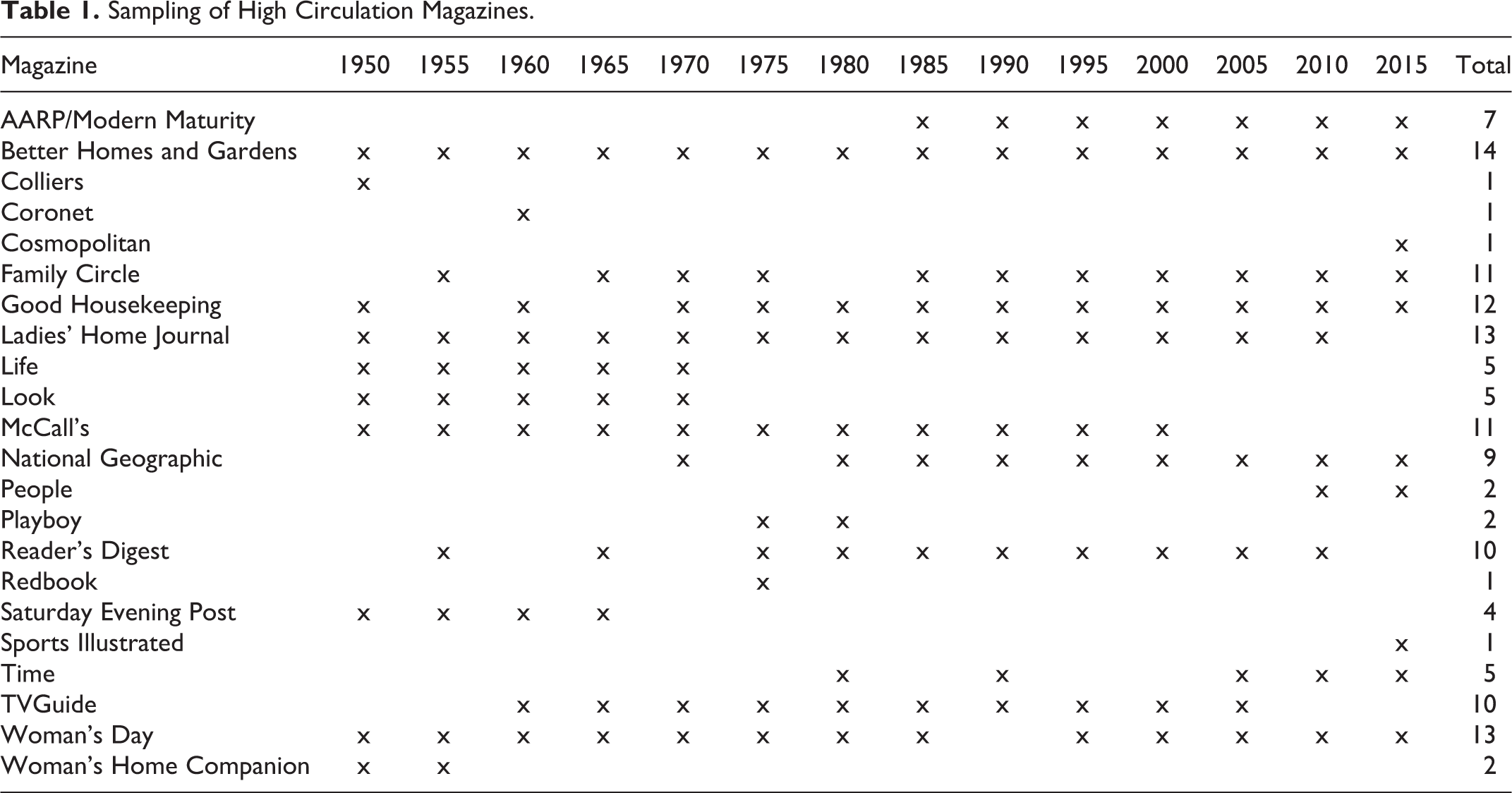
The magazines in the sample reflect magazines that were most popular in the United States to provide a glimpse into what Americans were seeing in advertising. The objective was to understand what images of social class looked like in advertising in general, rather than in any specific publication. Such a sampling also avoided the problem of magazines with different start and end dates. Some of the most popular magazines in America today didn’t exist in 1950, and some popular magazines have gone out of print during the sampling period. This variation in sampling means that the magazines in the sample were not the same from year to year.
Although the magazines in the sample change from year to year, it does not appear to be a major factor affecting the composition of the data set because the magazines all target a mass audience. The magazine with the lowest median household income of readers is AARP The Magazine (although this varies by edition), while the highest is for Time magazine. The readers of Better Homes and Gardens, Family Circle, Ladies’ Home Journal, and Reader’s Digest all had median incomes in the $50,000’s. This rate compares to a national median household income of $53,657 in 2014 according to the Current Population Survey (DeNavas-Walt and Proctor 2015). While median incomes of the magazine audience closely reflect the nation as a whole, the magazines also target a surprisingly wide demographic spread. Data from Experian reveals that most magazines in the sample are read by individuals across the income spectrum. For example, 17.3% of readers of Better Homes and Gardens had a household income of less than $25,000 or less, and 6.2% had a household income of $75,000 or more. Information such as this reveals that most magazines in the sample were truly mass publications, read by individuals across the income spectrum. Only Time and National Geographic consistently skew toward higher income groups (Experian 2009). Furthermore, the sample remains balanced between women’s magazines and general interest magazines. The consistent income range and gender of the audiences of the magazines in the sample provides confidence that the changing makeup of magazines is not a major factor affecting the composition of the data set.
Coding
Using the decennial half of the data set (years ending in 0), each individual person that appeared in an ad was coded according to gender, race, and social class. Of the 699 ads in the decennial half of the sample, there were 358 ads that included a person, and a total of 834 individuals were coded. Characteristics of each ad were also noted in the data set but not coded for: the brand, product category, text headline, number of people shown, and the background setting. Particular attention was given to coding social class. The most common definitions of class use socioeconomic indexes that consider a combination of income, occupational prestige, and educational attainment. Using a five-class structure captured key differences between different strata and has been widely used in public opinion polling, making it a useful benchmark. In such a formulation, members of the lower class are unemployed, underemployed, or rely on government assistance. The working class is often thought of as blue or pink collar workers. Many work in routinized jobs, do clerical work, participate in the service industry, or work in the trades. Having only attained a high school education is common. The middle class is composed of white collar workers with a bachelor’s degree, while the upper middle class is made up of professionals with a graduate education. The upper class is reserved for the very wealthy, celebrities, and politicians, often with ivy-league educations (Thompson and Hickey 2005).
This demographic information, encompassing education, occupation, and income was provided to the coders to assist in making their determinations. However, advertising does not always picture occupation, income, or educational attainment. The consumption-oriented nature of advertising may also mean that cues such as apparel, products or services, and leisure activities, or stylistic preferences are used to indicate social class. Bourdieu (1984) described how one’s taste, consumption, and aesthetic choices are related to class. Holt (1997) elaborates this in an American context. He finds that the working class prefers items that are well-made, comfortable, durable, and functional. In contrast, those from middle or upper middle class emphasize formal aesthetic qualities, fashionability, and self-expression in their consumption. However, consumption does not give rise to social class but rather is theorized to covary with it. For this reason, the coders were encouraged to use any visual information appearing in the advertisement or inferences based on that information to make their class determination. Specific visual cues were not identified a priori, but rather the coders were asked to infer social class in the same way that readers are expected to infer social class. In addition, the coders were asked what visual information they used to make their evaluation to understand what visual cues were associated with images of each social class. For example, an ad that pictures individuals eating at a restaurant does not contain an explicit mention of income, education, and probably not occupation for the central figures. Instead, their social class must be inferred. A restaurant with white tablecloths, a complete table setting, and patrons dressed in suit coats may suggest an expensive dinner and by extension an upper-middle-class individual. In contrast, patrons pictured in a diner, wearing jeans and rugged work jackets may suggest that the individuals pictured belong to the working class. By providing the coders with only the definitions of what constitutes each social class, these visual cues were allowed to emerge.
The comments from the coders reveal that a wide variety of cues were used including personal grooming and appearance, occupation, activity, setting, product ownership, and ad copy to support the given classification. Distinct and uniform patterns emerged among the cues used to identify each class related to clothing, appearance, and home furnishings. When occupation was depicted in an advertisement the coders were more certain of their coding. Interpretations appropriate to the historical period are also evident. In the 1950s, being able to afford to fly on an airline suggested upper-middle-class status to the coders. When visual cues were absent, social class was much more difficult to code. In a diaper ad featuring a baby wearing only a diaper and placed near a box of diapers with a white background, the coder felt unable to assign a social class. Mass advertising is predicated on the idea that the audience shares interpretive conventions, common knowledge, and a visual language that allows them to interpret the ad in largely the same way. The comments provided by the three coders affirm that they used similar visual cues to identify the social class of the individuals pictured. The demographic guidelines provided to the coders, and the visual cues used to infer social class, are provided in Table 2.
Coding for Social Class.
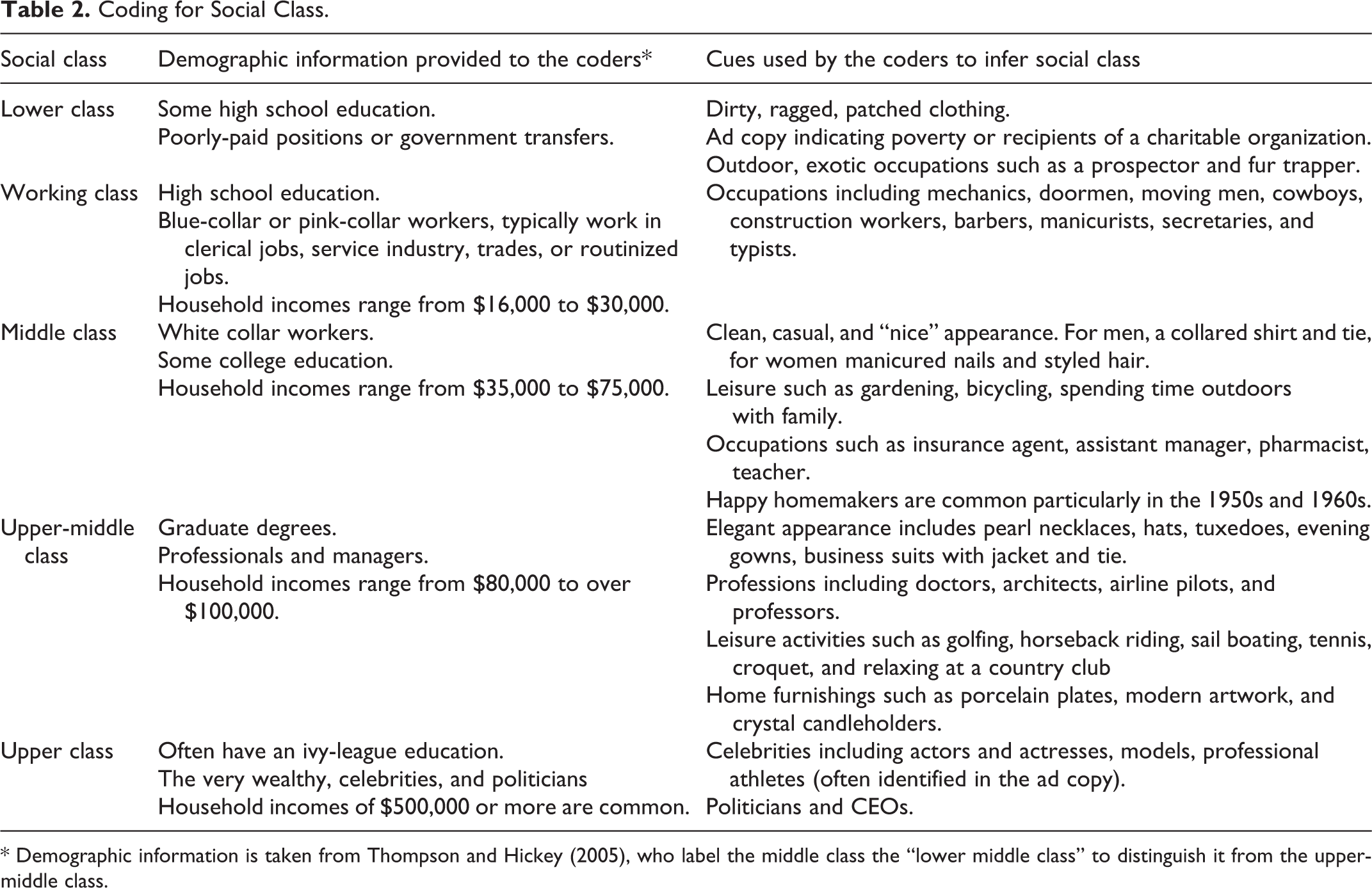
* Demographic information is taken from Thompson and Hickey (2005), who label the middle class the “lower middle class” to distinguish it from the upper-middle class.
Three coders and one back-up coder were employed to evaluate social class. Training for the coders was extensive. They were familiarized with the underlying sociology of class identification and the historical context. The coding was made easier because advertisements, as Marchand (1985), Ohman (1996, p. 184-95), and Schudson (1984, p. 212) have noted, tend to use individuals to represent larger demographic categories. After four training sessions, our coders were quite adept at identifying and justifying social class in a manner consistent with the underlying sociology. To enhance the reliability of this effort, a number of procedures suggested by Kolbe and Burnett (1991) were used. Measures were pre-tested and refined using ads not in the data set, the coders were in training sessions, the coders were given written rules and instructions, and they coded independently. To measure the reliability of the coding effort, Krippendorff’s alpha was calculated for gender, race, and social class using syntax provided by Hayes and Krippendorff (2007). While Krippendorff’s alpha is a more conservative measure of reliability than percent agreement, the reliability values here closely match those of other content analyses of magazine advertising. For example, Tse, Belk, and Zhou (1989) report a range of agreement from 65% to 97%. While not directly comparable because of the use of multiple coders, nominal and ordinal categories, and thus a different and more conservative reliability coefficient, our coefficient for class was 77.7%. While the interpretation of an ad involved subjectivity on the part of the coder, the high degree of agreement among our coders provides confidence in the results.
When conducting a content analysis, questions arise about what images to include and how to categorize them, even when a clearly defined coding scheme has been developed. In this inquiry, questions arose regarding anthropomorphized products, spokes-characters, and indistinct crowds. Thirty such representations were excluded from the analysis because they did not fit in the established coding categories of age, race, gender, or class or were too blurry to code. When only a body part appeared in an ad, for example, an arm and hand, it was included in the analysis if there were at least some distinguishing characteristics (for example it wasn’t just an outline) and the coders were allowed to identify if the image did not provide enough information.
Analysis
Analysis of the class, race, and gender of each individual pictured was conducted by assigning the value agreed on by at least two coders. In cases of disagreement, the third value was often an adjacent category. In cases of greater disagreement, the coders discussed the ad with the authors and came to a final decision. Among the 699 decennial year advertisements, a total of 358 ads contained representations of people, totaling 834 individuals. The coders were unable to categorize the social class in six portrayals and these are reported in the results. The results are reported by both the number and proportion of individuals belonging to each social class, and by the number and proportion of advertisements that include each social class. Changes in the proportion of each class from year to year are tested for significance using a p-test. A set of calculations that includes changes between any given decades is also provided.
In addition to the quantitative analysis, a qualitative approach was taken to explore class themes in advertising. First, each author individually read through all the ads decennial year advertisements, made notes on each ad, and identified themes that emerged, for example themes of aspiration or status. These themes were not limited to the image of the person but included any element of the advertisement such as the copy or style as well. Emergent themes were then organized together, compared between authors, and refined. Themes were also compared between ads, categories, brands, and years to search for boundary conditions and changes over time. Particular attention was given to differences between social classes. This type of constant comparison analysis allowed the unique nature of advertising themes about class to emerge. Counter-examples and negative cases were also sought in the data set (Corbin and Strauss 2014). The second half of the data set, made up of years ending in five, was used like a validation sample. This set of ads was viewed in light of the emergent themes to ensure accuracy, consistency, and to check that theoretical saturation was reached.
Findings
First, we report the overall social landscape of advertising as it related to actual and subjective measures of social class membership in the United States. Then, findings about each social class are reported beginning with the lower class and moving up. We conclude by considering the routes of social mobility and changes over time depicted in advertising.
The Social Landscape of Advertising
The findings are reported in Tables 3 and 4 as the number of individuals of each social class that appear overall and the number of ads that include a given social class. For example, 52.8% of all individuals pictured in ads between 1950 and 2010 belong to the middle class, and 61.2% of ads with people include middle-class individuals.
Social Class as Depicted in Advertising, 1950 to 2010.
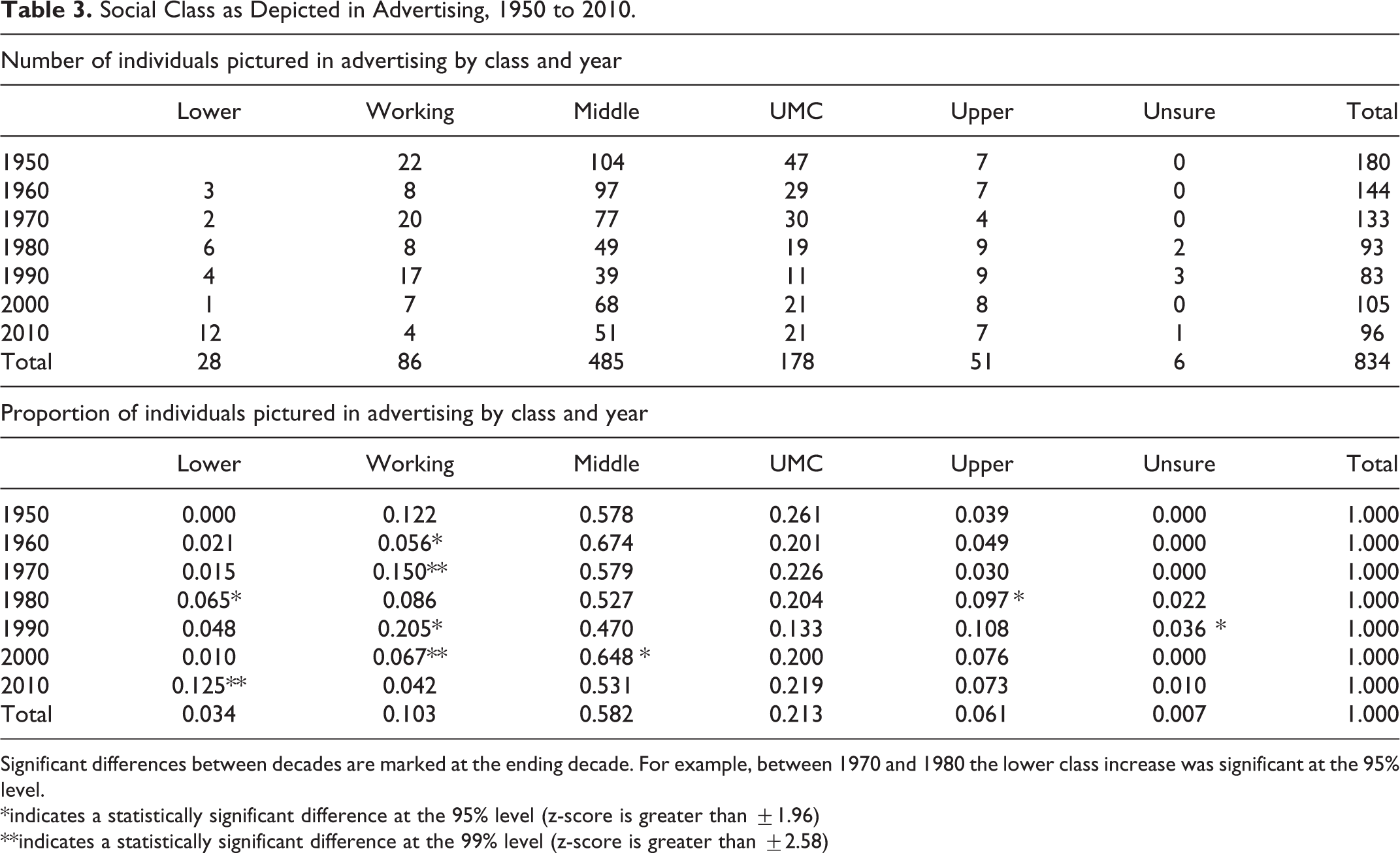
Significant differences between decades are marked at the ending decade. For example, between 1970 and 1980 the lower class increase was significant at the 95% level.
*indicates a statistically significant difference at the 95% level (z-score is greater than ±1.96)
**indicates a statistically significant difference at the 99% level (z-score is greater than ±2.58)
Advertisements Including Images of Each Social Class, 1950 to 2010.
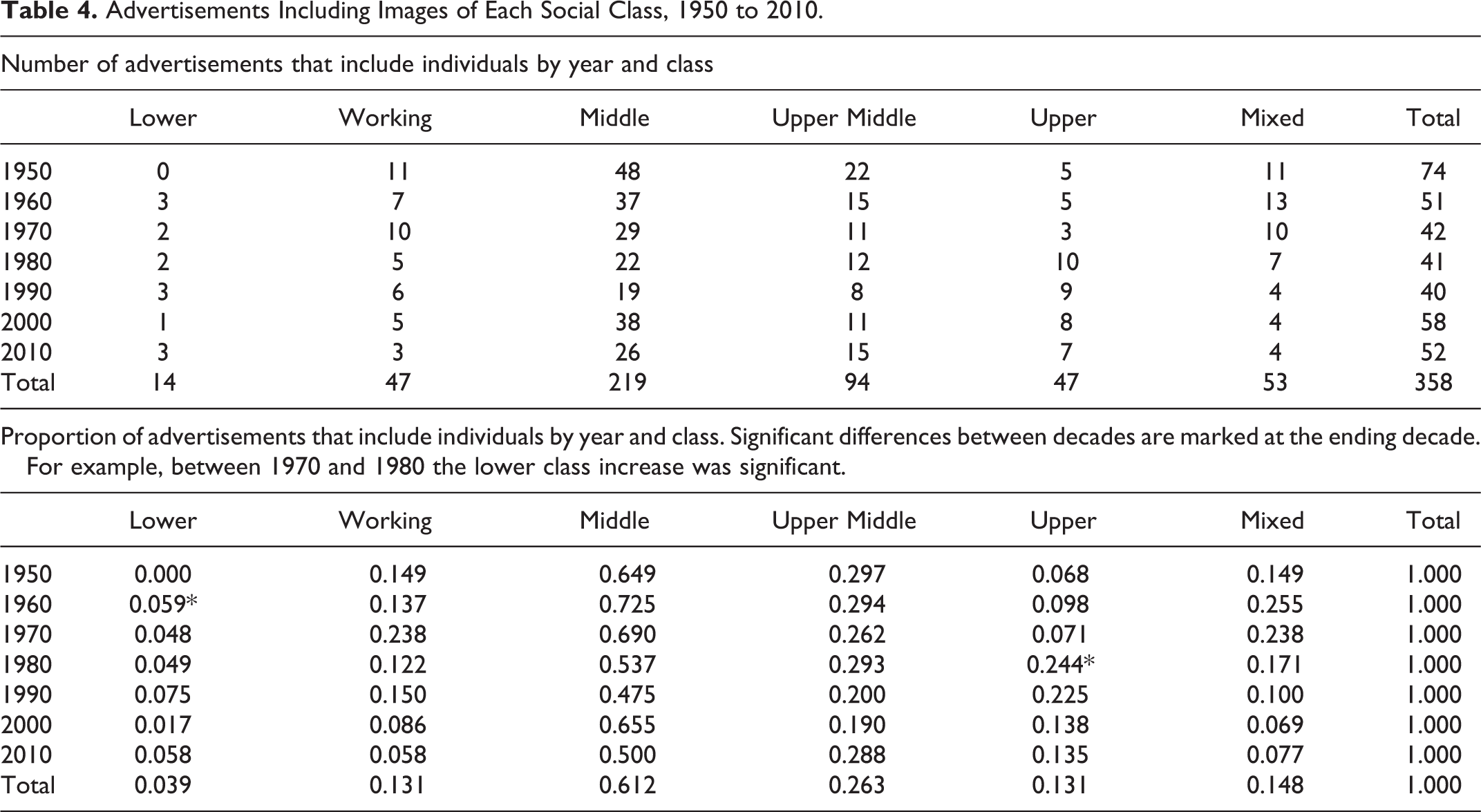
Overall, the middle, upper middle, and upper classes are greatly overrepresented when compared to the actual class makeup of the United States (Thompson and Hickey 2005), or subjective claims of social class (Newport 2015; Norton and Ariely 2011). In contrast, the working and lower class are underrepresented, as reported in Tables 2 and 3. This finding reinforces the idea that the United States is a middle and upper-middle class nation and more closely matches subjective perceptions of social class than objective reality. Nearly half of Americans think of themselves as middle class (Hout 2007; Newport 2015), in contrast to the third of Americans that objectively fall into the middle class (Thompson and Hickey 2005). Why do so many people believe that they are middle class? Mantsios (2007) suggests that the media blurs lines between classes contributing to a belief that everyone is middle class. Although it should be noted that advertising may just as likely repeat the common belief as create it. Our data do not allow us to make this determination. It is also important to note that the representations of a large middle class observed here in print is not just a result of the publications targeting a middle-class audience. The magazines are read by a wide spectrum of the American public and include all classes in their readership.
Next, the unique ways each social class are pictured in advertising are reported. These themes are reviewed starting with the lower class and moving up. In addition, messages about aspiration are plentiful and convey messages about how social class works and are commented on, followed by changes observed over time.
The Lower Class: Philanthropy, Separate Spaces
When identifying the lower class, the coders used cues such as ad copy, appearance, and activity to identify members. Some advertisements were for charitable organizations and described the individuals as poor or in need. For example, an ad for WaterAid asked for donations to help “the world’s poorest people.” Appearance and activity also provided cues. In an advertisement that includes an image from a Norman Rockwell painting, the coders identified the children pictured as lower class, citing their beat-up, dirty, ragged, and patched clothing. An Alaskan 49er panning for gold in the wilderness and a fur trapper in the Canadian wilderness were also coded as lower class.
For most of the sixty-year period, the lower class only rarely appears in mass circulation print advertising, averaging 3.4% of the individuals pictured. This number is much lower than the 20% of the actual proportion of the population that belongs to what is conventionally termed the lower class (Thompson and Hickey 2005), or even the approximately 10% subjectively belonging to the lower class (CBS News 2010). Advertising portrays a social landscape that is almost without poor people. This is to be expected of an aspirational media meant to sell products. However, some lower class individuals do appear, which raises the question: if advertising is aspirational, why are individuals from the lower class represented at all?
First, the poor are typically included in advertisements for charitable or philanthropic causes or in corporate advertising that describes a firm’s social responsibility initiatives. For example, Figure 1 shows an advertisement by the toothpaste brand Crest raising money for the Save the Children Dental Foundation pictures a young boy with a teddy bear, facing away from the viewer, looking down, with the headline “Kids who need to see a dentist most are usually the ones who can afford it least.” The coders identified the text, the charitable organization, and the posture of the child as indicating his lower class status. Other charitable ads similarly depict a pitiful child with requests for an associated cause including immunization, hunger, and learning disabilities. The increase in lower class individuals between 2000 and 2010 is a result of the growth of corporate social responsibility advertising, images which picture a significant number of poor people. For example, a household cleaner by SC Johnson describes sourcing ingredients from poor African farmers that help them send their children to school, and PepsiCo describes its water reclamation efforts in Africa and Asia. In such advertisements, the lower class is made up of the deserving poor, those who are worthy of empathy and assistance. They are not the habitually lazy or criminals, but rather people down on their luck.

Advertisement for save the children dental foundation (appeared in a 1990 issue of Better Homes and Gardens).
There is, however, another style of presentation that separates the lower class and, in doing so, similarly renders them unproblematic for consumer culture, a theme labeled here as “separate spheres.” In the rare instances when the lower class is even seen, they are often separated from other classes by visual convention. This is done either through a visual trope such as a box, or visual differences in time or location. For example, Figure 2 is an advertisement for “Janitor in a Drum.” The janitor is identified by the coders as lower class because of his occupation, while the woman and child are identified as middle class as a result of their neat appearance and the woman presumably being a homemaker. This advertisement pictures a maintenance worker pushing a fictionalized large container of the cleaning product to service an aircraft at night, while a middle-class mother and child in daylight are enclosed within a separate space by the use of an inset box. Here both visual means (the box) and temporal means (day and night) separate the social classes. In other cases, separation is achieved by employing lower class members as fictional and/or historic figures, often solitary, separated in time and reality from contemporary consumers. Examples of this usage include an Alaskan 49er panning for gold, a Native American in traditional costume (1960), the explorer and prospector “Yukon Jack” appearing in the frigid Canadian wilderness (1960), and two young children in patched clothes leaning against one another in a Norman Rockwell painting (1990).
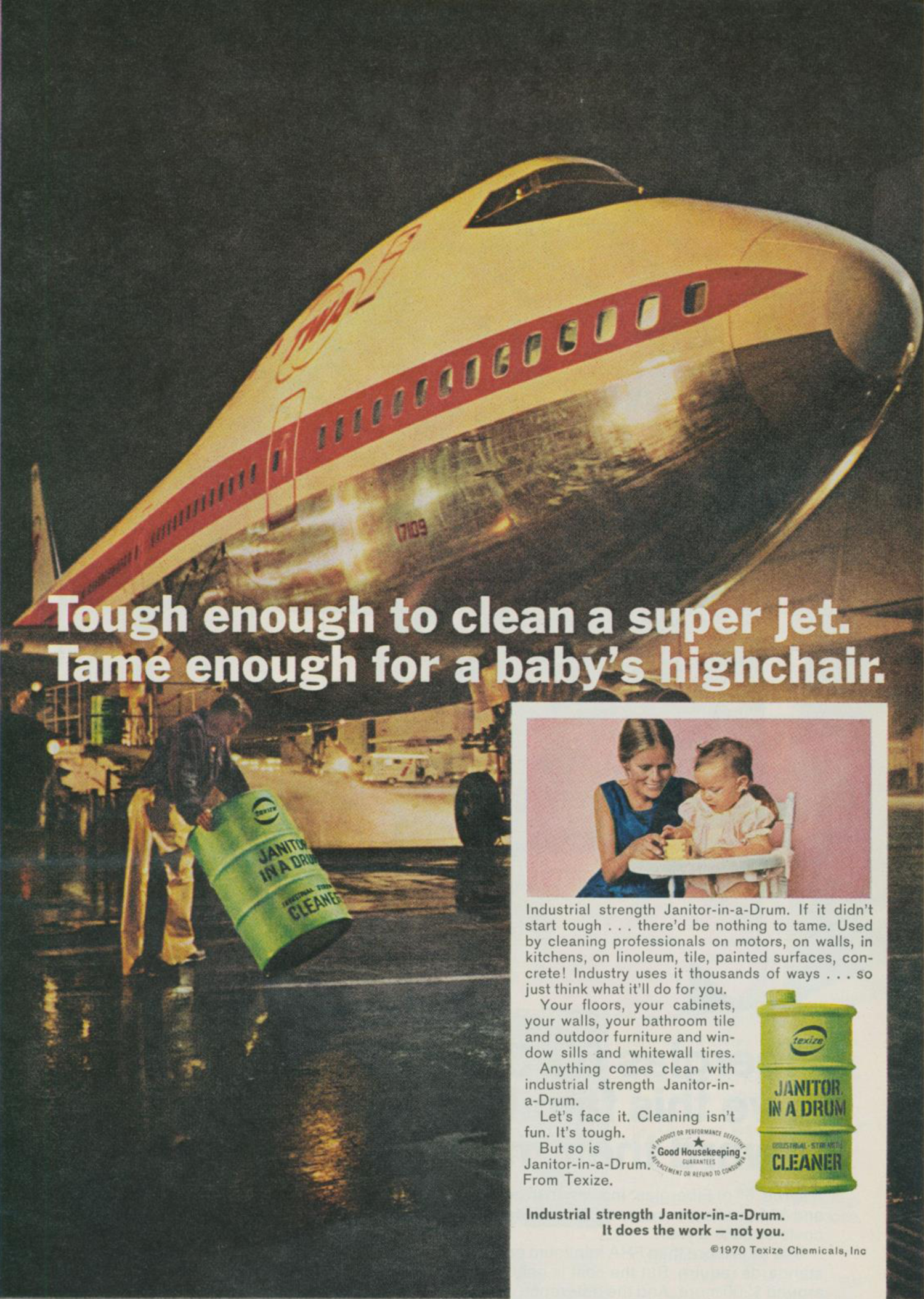
Advertisement for Janitor in a Drum (appeared in a 1970 issue of Better Homes and Gardens).
The separate worlds range from the rugged frontier to “Main Street” America, but all represent lost worlds with a nostalgic tone. It is the authenticity and nostalgia in these images the advertisers hope consumers associate with the brand (Gilmore and Pine 2007). The use of such images makes class differences distant and less problematic than those in the present, making the image safe for a consumer society and consistent with the goals of capitalist realism. It should be noted that such separation has been similarly noted (in passing) as a way of neutralizing or diffusing the threat from racial minorities (Colfax and Sternberg 1972; Kassarjian 1969; O’Barr 1994) or the poor or working class (Adams and Raisborough 2008; Charlesworth 2000; Isenberg 2017, p. 276). In addition, the separate spaces help create an image of the lower class as a romantic or even an exotic other, and thus a source of cultural capital. Recent descriptions of consumer culture emphasize the importance of authenticity (Gilmore and Pine 2007), and some have suggested that careful appropriation of lower class symbols can be used as a mark of this type of status (Holt 2004). Thus in terms of capitalist realism, including the lower class, but separating them, serves to associate the product with certain desired attributes in a non-threatening and less contaminating manner.
The Working Class: Secret Knowledge
Because the working class is often pictured as working, occupation was the most commonly used cue used to identify those in the working class. Mechanics, doormen, moving men, cowboys, construction workers, barbers, manicurists, secretaries, and typists were all identified as working class.
As with the lower class, the working class is underrepresented in advertising. When they are pictured, they are often shown working. In such depictions, working class individuals are valorized for their grounded knowledge and authenticity while serving others more fortunate, a theme labeled here as “secret knowledge.” In such images, the working class possesses valuable knowledge that is unknown to those above them in the social order but can be acquired via consumption. Consider the advertisement for Palmolive presented in Figure 3. A manicurist, her working class status evident through her occupation and her name embroidered on her uniform, tells her client a secret: you don’t need a fancy, high priced product to soften your hands: Palmolive dishwashing soap is perfect for the job, and it just costs pennies. Madge provides valuable knowledge that the client does not and would not possess. The common sense, authenticity, and folksy-wisdom of the working class is leveraged, much in the same way that Holt (2004) explains the authenticity of populist worlds and related mythology. Of course, authenticity is a core appeal in brand management (Gilmore and Pine 2007).

Advertisement for Palmolive (appeared in a 1970 issue of Family Circle).
This theme is repeated throughout the sample: members of the working class, by virtue of an intersection between working expertise and class-knowledge, help the moneyed, sheltered, unaware, and even helpless middle-, upper-middle-, and upper-class consumers. Consistent with capitalist realism (Schudson 1984), the upper classes are made less problematic when they are shown as a bit helpless and hapless without the assistance of the more capable and authentic working class.
In advertising, the theme of secret knowledge valorizes the working class, shows they have something of worth to give the more fortunate, and shows a commonality of interest and branded goods that transcend class. Such representation may also help work out class tensions in a safe way. Showing working class lives in this manner expands on Schudson’s (1984) assertion that capitalist realism shows people living lives worth living – advertising depicts all lives as worth emulating, not just middle- or upper-class lives. Showing happy workers resonates with American ideologies of wealth and materialism that emphasize hard work and upward social mobility, cornerstones of American class and consumption myths and ideologies (Belk 1987), and mitigates class resentment by perpetuating the idea that money doesn’t buy happiness (Thomas and Callahan 1982).
The Middle Class: Domestic Idyll, Inverted Idyll
The coders used a variety of cues to judge middle-class status. In terms of appearance, “nice,” clean, and casual clothes indicated middle-class status. For men, this often meant a collared shirt and tie. For women, it often meant manicured nails and styled hair. The type of leisure was also mentioned, particularly gardening, bicycling, and spending time outdoors with family. Occupations associated with the middle class included insurance agents, assistant managers, pharmacists, and teachers. Many of ads in 1950 and 1960 pictured women as happy homemakers caring for children or doing housework although this decreases in the 1970s and 1980s as women are increasingly pictured working and fathers assume some childcare duties. Apparel and hairstyles also become more casual. Homes were also described as “nice” and vacation destinations tended to be domestic rather than international. In addition, the affordability of the product was sometimes considered by the coders.
Most commonly, the middle class is pictured in a theme we label a “domestic idyll.” Advertisements in this theme portray members of a nuclear family cozily ensconced at home. The mother is always present as are the children, commonly one boy and one girl. The father may also be pictured. Domesticity runs high. Mothers are busy preparing food for children, watching them play, or engaging in light housekeeping. The scene is also set in a nice, cozy home or outside in the garden. Two such examples are provided in Figure 4. In the advertisement for Campbell’s, a mother has prepared soup and sandwiches for her two children who eagerly await the delicious dish. Such a theme may seem relegated to 1950s food advertising, but it appears routinely in every decade for a variety of products including appliances, medicines, and automobiles, as shown in the Oldsmobile advertisement from 2000. Coders felt that the nice dress of mother and children, the mother’s styled hair, her apparent homemaker status, and the “nice” house of the 1950 advertisement indicated middle class. For the Oldsmobile advertisement, the neighborhood, kids playing soccer, and mother caring for her family were indicative of the middle-class to coders. In recent decades, this theme has also encompassed families of various racial and ethnic backgrounds. An African American man coaches his son’s little league game, while a Hispanic mother treats her daughter to McDonald’s with the same cozy domesticity of the middle class domestic idyll.
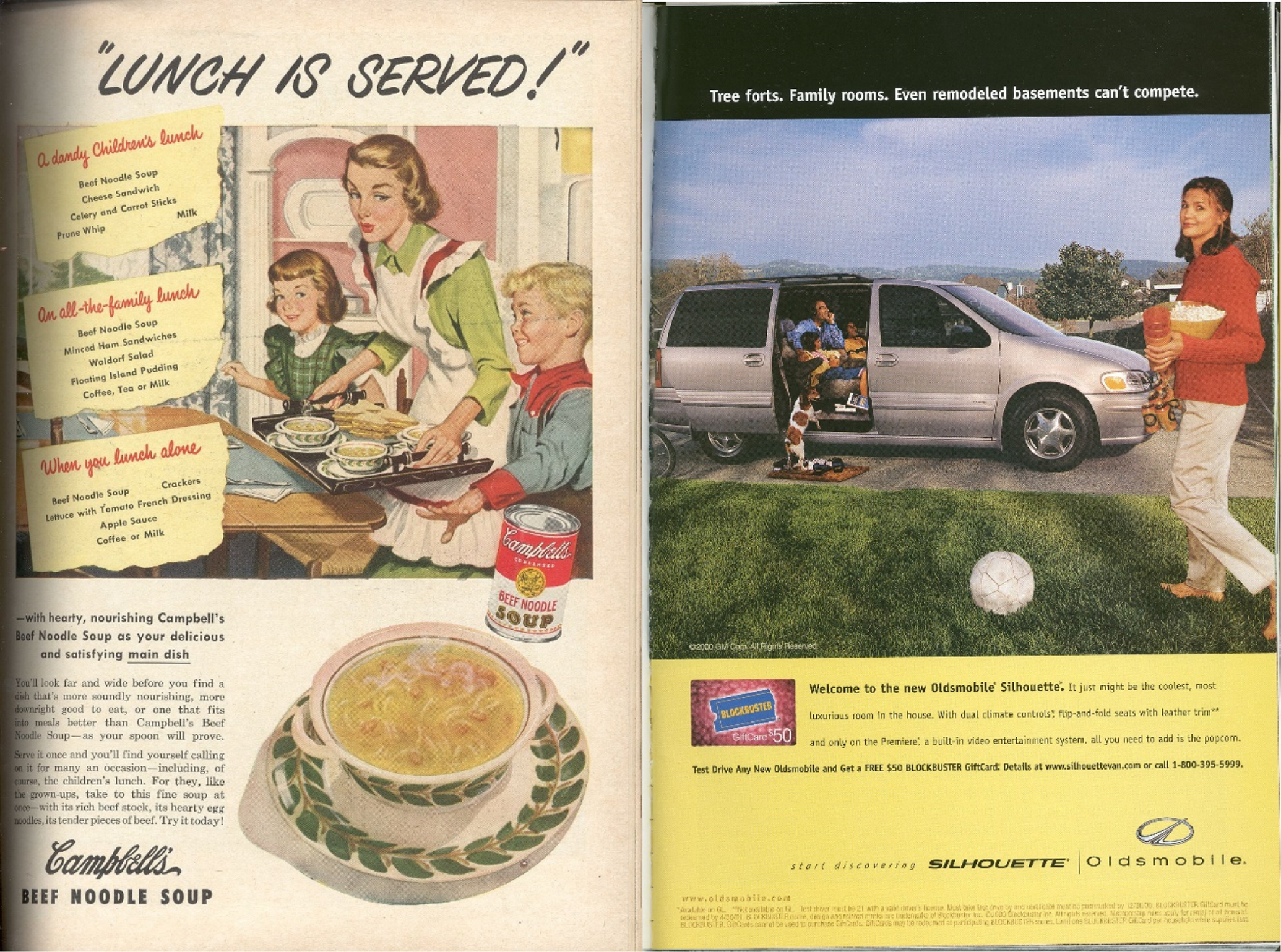
Advertisements for Campbell’s Soup and Oldsmobile (appeared in a 1950 issue of Good Housekeeping and a 2000 issue of National Geographic, respectively).
What messages might this theme convey about social class? Mantsios (2007, p. 641) suggests that so many Americans mistakenly believe they are middle class because the media blurs the lines between the working class and upper class to create a “universal middle.” The portrayal of the middle class in advertising also seems to encourage individuals to think of themselves in middle-class terms. In contrast to the working class, which is largely identifiable by their occupation, the middle class is not marked out as explicitly. The closely cropped settings reveal little about the size of a home or property. The leisure activities associated with the middle class such as gardening could just as easily be enjoyed by the working or the upper-middle class, encouraging identification by both. The overwhelming size of the middle class portrayed in advertising, averaging 58.2% of individuals and appearing in 61.2% of advertisements also seems to encourage people to think of themselves as middle-class.
Occasional negative cases did arise in which the domestic idyll was disrupted for humorous effect. While these instances were never frequent, they are an important counterpoint. For example, a 2005 advertisement for Mr. Clean Magic Eraser, a cleaning product, shows an illustrated scene in which are hosting a party while their parents are away on vacation. Pizza, chips, soda, milk, and juice are spilled on the floor. The pets are running free. There is graffiti on the wall and a child rollerblading through the house. However, Mr. Clean Magic Eraser promises to restore order before the parents return. In another ad, this time from 1970, an overworked mother stands at a stove with her hands thrown up. The pot is steaming, the dog is barking, and her child nearby is crying. She doesn’t have time for a wet shampoo, she says, but the branded product Psssssst shampoo is instant and offers relief. Interestingly, these inversions are also temporary. A branded product always stands at the ready to clean up, reorganize, and restore the domestic idyll. It may also be that such gentle parodies of the domestic idyll help encourage identification with the middle class because they acknowledge and make some space for domestic imperfection.
The Upper-Middle Class: Consumption Voyeurism, Promising Taste and Providing Instructions
When identifying the upper-middle class, the coders often relied on appearance and leisure activities. Such individuals were frequently described as “elegant” and pictured wearing pearl necklaces, elaborate hats, tuxedoes, and evening gowns, or business suits with a jacket and tie. Leisure activities were also commonly used cues. Golfing was the most frequent, but other activities included horseback riding, sail boating, tennis, croquet, and relaxing at a country club. Doctors were the most common profession associated with the upper-middle-class, but architects, airline pilots, and professors were also noted. These professionals also often interact with middle-class clients. Home furnishings were also occasionally used to indicate upper-middle class status and items such as porcelain plates, modern artwork, and crystal candleholders were particular cues. Sophisticated readings by the coders, appropriate to the historical period, are also evident. In the 1950s, being able to afford to fly on an airline suggested upper-middle-class status to the coders.
A common theme used to represent the aspirational upper middle class is to show viewers a secret peek, a voyeuristic glimpse, at how this class of consumers lives and consumes without revealing the viewer’s gaze or violating the privacy of the moment. Again, this trope is unique to ads representing the upper-middle class. In most cases, such images include a couple engaged in leisurely but intimate conversation, usually conveyed by showing their heads and bodies pressed closely together. Their private space is framed by a door or a screen, a trompe l’oeil turn of a page, or a pane of glass separates them from the viewer. No other class is consistently presented this way. Only with representations of the upper-middle class do we see the consumers with their backs or sides toward us. The reader of the ad never meets their gaze. By visual convention, this means they do not know that we, the readers, are observing. We see them relaxed and enjoying a materially bountiful life. If photography is used, upper-middle-class consumers are often photographed in these ads at a slight distance, or in soft focus. This visual trope is exemplified in Figure 5 showing a 1990 ad for Tetley Tea in which a couple relaxes on their porch overlooking the ocean. While occupation and fine home furnishings are absent, coders felt that the beachfront property, sailboats pictured, and leisure of the couple indicated upper-middle class status.

Advertisement for Tetley Tea (appeared in a 1990 issue of Better Homes and Gardens).
The logic of such images allows consumers to glimpse in, to see what Goffman (1956) called “backstage” behaviors or private moments. Backstage moments are theorized as more honest (Goffman 1956) than more front-stage or socially performative ones. It allows those aspiring to the upper middle class to observe, but without having to interact with them. It is a way to train consumers in the appropriate class behaviors. Interestingly, while the Tetley Tea advertisement pictures the upper middle class, the text seems to speak to the middle class when using phrases like “Betcha gonna like it better, too.” Speaking in the voice of the middle class about the upper-middle seems to further blur the line between the upper middle and the middle class as Mantsios (2007) suggested.
In a related theme, ads associated with the upper middle class reveal the product qualities that make for a unique taste aesthetic, a trope labeled here as “promising taste and providing instructions.” Consumer taste has long been a marker of social class (Bourdieu 1984; Holt 1998). These seem to be speaking to middle-class individuals who aspire to be upper-middle class, offering instruction on how certain subtle product attributes create a superior product. They address the presumed anxiety of those trying to move up by educating the middle class, and possibly the working class, on matters of taste and authentic consumption performance.
Ads in this vein instruct consumers how to consume in a tasteful way, while the text ensures that the reader is knowledgeable about what makes a quality product in the category. For example, an ad for Heublein (1960, pictured in Figure 6) first reminds the consumer that it is “(pronounced hugh-bline)” and goes on to promise that “You, too, can command the perfect Manhattan” and then tells consumers how to mix the drink with “no fear of failures.” The ad pictures a confident man clapping his hands, while a Manhattan pours itself, accompanied by small images of proper serving situations: at a party, a picnic, or after dinner.
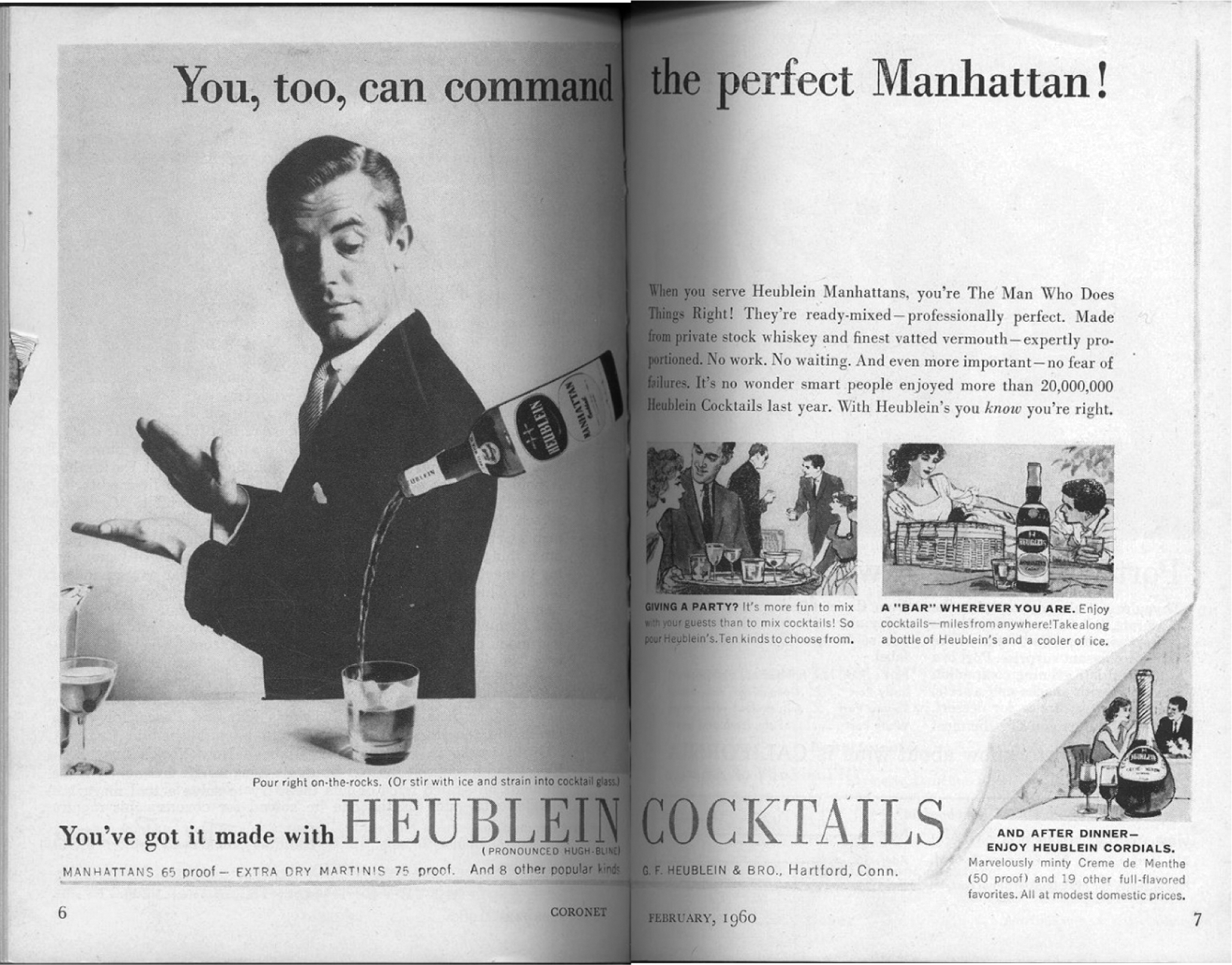
Advertisement for Heublein (appeared in a 1960 issue of Coronet).
Lord Calvert Whiskey (1960) similarly provides instructions for tasteful consumption and appreciation. The bottle is artfully arranged alongside a globe, a golden box, draped fabric, and a medal which the text helpfully describes as “The coveted Grand Prix Amércain – presented each year to a few rare products by a committee of French connoisseurs” which Lord Calvert deserves because its international taste is “skillfully blended to please discriminating people all over the world.…to appeal to a cultivated taste that knows no national boundaries.” An ad for the winery of Ernest and Julio Gallo describes the art of the corksmith (1980). While this focus on taste and appreciation is a common appeal across in the spirits category (Leroux, J&B, Crown, Christian Brothers), it also appears for some brands of luggage, food, and autos.
By learning and deploying the standards of taste described in the ad, the middle-class viewer is offered entrée into the upper middle class through consumption. While this appeal never disappears, a newer incarnation emerges in the 1980s and 1990s and predominates thereafter. This revision promotes tasteful consumption as self-expression and self-discovery, rather than strict adherence to dictates of taste. Such advertising appeals are similar to the revised manner in which taste is revealed in the social class literature. Peterson and colleagues (Peterson and Simkus 1992; Peterson and Kern 1996) identified a new pattern of consumption that distinguished better-off consumers. Rather than preferring exclusively highbrow cultural goods, the authors found that high-status consumers preferred to consume a range of music genres (highbrow and lowbrow), a pattern they called cultural omnivorism. Both versions of this theme explicitly tie taste and cultural knowledge to consumer behavior and upward social mobility. Taste is linked through morals and manners to dominant ideologies (Lamont 1992).
The Upper Class: Democracy of Afflictions
The upper class is made up of the very wealthy as well as celebrities, politicians, CEOs. In the data set, the most common indicator that marked out a member of the upper class was being a celebrity. The coders were easily able to identify celebrities because they were named in the ad copy, and the source of their fame was described or indicated. Actors and actresses were common, as were models and professional athletes. Occasionally, CEO’s and politicians were also pictured and named, making identification easier. The upper class makes up an average of 6.1% of the individuals that appear in the decennial sample of ads and appear in 13.1% of the advertisements. This rate stands in contrast to the 1% of the actual population that statistically belongs to the upper class (Beeghley 2000; Gilbert 2008; Thompson and Hickey 2005). Some overrepresentation is to be expected. After all, advertising is supposed to be aspirational.
Interestingly, the very wealthy were almost never pictured. A single individual, among more than 800, was coded as simply a rich person without being an identifiable celebrity. Gone are the royalty, nobility, and captains of industry that Marchand identified (1985, pp. 195-96). Instead, the wealthy are more often actors, actresses, athletes, and models. These accessible, likable, popular celebrities reinforce an acceptable ideology of affluence in that they earned their wealth (Belk 1987). However, celebrities move up by a more obscure process than education, the common route advocated for social mobility. Showing celebrities rather than aristocrats decreases the perceived barriers to upward social mobility, despite the empirical reality of static occupational mobility (Biblarz, Bengston, and Bucur 1996) and the threat of declining upward mobility (Gilbert 2008, pp. 129-30).
These celebrities are shown as having the same embarrassing problem as consumers of lesser means. Marchand (1985) identified this theme as a “democracy of afflictions,” in which even the rich are plagued by afflictions like athlete’s foot and dandruff, thereby humanizing the wealthy and showing them to be vulnerable to common problems. The sample contains several similar ads showing a celebrity suffering from a common ailment and endorsing the advertised product as the solution. Actress Angela Lansbury uses Bufferin for the occasional headache, baseball player Hank Aaron uses Aflexa to promote joint flexibility, model Margeaux Hemmingway uses Diet 7Up to maintain her figure. In Figure 3, we see Brooke Shields in such a glamour-shot for Latisse. The images are typically in the style of studio portraits shot from the chest up, with the celebrity gazing directly at the camera and out at the consumer. The celebrity appears flawlessly beautiful or peerless in talent. And yet a common affliction draws us together, as does the branded solution. Aligning the consumer and the celebrity in both concern and consumption helps erase class differences and is thus beneficial to a consumer society built on the myth of being a “classless society.”
Routes of Social Mobility: Occupational Training for the Working Class, Education for the Middle Class
Aspiration and open social mobility are key components of the American class ideology (Cohen 2003; Cross 2000; Halberstam 1994; Hanson and Zogby 2010), and feature prominently in advertising. Of course, advertising is meant to be aspirational, but a small subset of advertising directly promises social mobility and, in doing so, reveals assumptions about how social class works. Themes of mobility are also used in different ways when applied to different social classes.
For the working class, mobility through occupational training is advanced. In these ads, social mobility is described as not only possible but probable through for-profit job training programs. For example, in 1960, a testimonial from H. P. Galloway tells how the Lewis Hotel Training School turned his life around, “studying enabled me to step ahead of men who had been in the business for many years” to be appointed as a hotel manager. Two decades later, a similar testimonial by Deborah Hart tells how selling Avon lets her earn money and also spend time mothering her daughter. In 2005, a full-page ad for studying medical transcription promises not just money, but the ability to set your own hours, spend time with family, and gain the “prestige of working for doctors.”
In these advertisements, the promises are consistent – first and foremost is an increase in income, often stated in explicit dollar terms. Along with money comes an increase in social status, often described as success, prestige, and material well-being. This finding is consistent with Sennett’s (2003) argument that it is really respect, or a perceived lack of it, that gives meaning to social inequality. With a more respectful job, consumers will attain more respect within society. This advertising theme implicitly promises more respect for those in the middle class and those who aspire to get there via the advertised product. This theme is consistent with the beliefs of a majority of Americans that economic advancement is widely available, that hard work will help individuals get ahead, and that education is an important path to social mobility (Kluegel and Smith 1986). While occupational training promises to help the working class move up, education for one’s children is encouraged for the middle class. Educational products for children appear with regularity in the data. Advertisements advocate books (1960), microscopes (1960), phonics learning sets (1990), software (2005), and medication (2005) to help children achieve academic success, and improve their odds at a better life.
These ads would seem to contradict Marchand’s observation that advertising typically downplays hard work in favor of branded products as the route to mobility (Marchand 1985, p. 199). That may have been more the case in the 1920s and 1930s period covered by Marchand (1985), but less so since World War Two. Instead, we see in these ads a reproduction of a dominant American ideology of work and education as the path to greater success and entrée to the American middle class. Interestingly, while this theme never made up a majority of advertisements, it did endure from the beginning of the period under study until the end, despite the economic and demographic changes that occurred, including diminished upward mobility, challenged public education, and flat income growth in the middle class during those seventy years (Temin 2017).
Changes over Time
Advertising, at least in regards to depictions of social class, changes very little over the decades. This lack of change is in contrast to other changes in society which are reflected in advertising depictions. For example, between 1950 and 2015, portrayals of women shift from homemakers to career women, men are increasingly pictured performing childcare duties, and racial and ethnic minorities appear with increasing frequency and respectability. And yet the shifts in the fortunes of each social class are barely perceptible through the lens of advertising, either quantitatively or qualitatively. In some cases, the proportion of a given social class pictured fluctuates over the years, but for the working class and lower class, these fluctuations are driven by a few ads with many people pictured. For the upper-middle class, there are no statistically significant changes between decennial years in either the number of upper-middle class members or the number of ads in which they are included.
While the middle class remains overrepresented in advertising, change also occurs over time. Between 1960 and 1990, the percentage of middle-class representations steadily declines. This decrease is consistent with the long hollowing out of the American class structure that begins in the 1970s, including the decline of middle incomes, rising inflation, a recession, and the general sense of a middle class squeeze (Fischer, Hout, and Stiles 2006; Goldin and Margo 1991; Harrison and Bluestone 1988; Kendall 2011; Samuel 2014). The percentage of middle-class representations rallies in 2000 back to 1960 levels (64.8%), and then drops back to 53.1% in 2010. This last drop follows on the heels of the recession of 2008 to 2009. Despite fluctuations that appear to follow from changes in the economic landscape, advertising continues to picture a world filled with the middle- and upper-middle classes.
Discussion
Importantly, this work moves toward a better understanding and explication of how advertising contributes to the ideologies of class, while simultaneously selling branded goods. Taken as a whole, advertising does not present a single monolithic story about social class but rather a constellation of related images and messages that together reiterates three core ideologies of American social class. First, Americans over-claim middle-class status, a practice that advertising appears to bolster. At times, the middle class in advertising is twice the size of the actual middle class. The middle class is also pictured in a way that encourages identification from readers and the blurring of the middle and upper-middle classes reinforces this idea. Second, advertising messages that promise social mobility buttress the idea of the American Dream. Advertisements featuring the upper-middle class provide instructions about how to appreciate certain products, making mobility seem possible. The use of upper-class celebrities rather than the hereditary rich seems to do the same. In advertising, at least, the American Dream is alive and well. Third, images in advertising downplay class conflict and prerequisites for conflict such as inequality. This finding emerges from representations of the lower and working classes. The lower class is rarely pictured. When they do appear, the lower class is composed of the deserving poor, especially children, or is distanced in time and space from contemporary Americans, reducing the potential for conflict. The working class is pictured as happy and helpful, authentic rather than antagonistic. They are happily working to help consumers above them. Even the middle, upper-middle and upper classes are positively portrayed. Overt class teasing, tensions, or hostility are virtually absent, sending the message that there is no need for discontent or resentment along class lines.
The images depicted in advertising, particularly of the lower and working class, also stand in contrast to depictions of social class that have been found in other forms of mass media. In advertising, the lower class is composed of the deserving poor. In other forms of mass media, the portrayal of the lower class is more diverse and includes negative portrayals with an emphasis on dependency and deviance (Kendall 2011). For example, news coverage of welfare reform portrays recipients as childlike, hyperfertile, and lazy (Kelly 2010), and magazine articles frame welfare as creating dependency among recipients (Misra, Moller, and Karides 2003). Poor southerners have been intentionally depicted as the “white trash type” on the news (Isenberg 2017, p. 247), and as hillbillies in television sitcoms: “hapless,” “inferior,” “irredeemable yokels,” and “evolutionary throwbacks” (Isenberg 2017, pp. 233-37). The working class is also pictured positively in advertising when compared to other forms of mass media. In television dramas, the working-class male is characterized as a buffoon: “dumb, immature, irresponsible, or lacking in common sense” and requiring the help of his family or spouse (Butsch 2003 p. 576; Butsch and Glennon 1983). The working class has been pictured on television as “rednecks,” “white trash,” “bigots,” and “slobs” (Kendall 2011, pp. 142-52; Isenberg 2017). In film, the working class appears as “dangerous” (Ehrenreich 1990) or living in a “pathological environment” that corrupts the entire class (Gandal 2007). In contrast, in advertising the working class is pictured as hard working and as a source of authentic wisdom. It isn’t that advertising depictions are less stereotyped, but that advertising depictions are almost universally positive (see Taylor and Stern 1997 for a discussion of positive racial stereotypes).
With messages about social class documented, researchers may also want to consider what effect a distorted picture of social class might reasonably have on society. If advertising legitimates certain ideas, then the invisibility of the lower class is problematic in the same way that absent or stereotypical images of gender, race, age, and sexual orientation are problematic. Such silencing and stereotyping is also relevant higher up the social class ladder. What effect do positive stereotypes of the working class have on members of the working class or others above them? If class conflict is not pictured, the absence suggests that class conflict isn’t a problem that exists, making it even more difficult to address. Given the current discourse on class and particularly income inequality, it is important to question what role marketing and advertising play in reinforcing inequality, as well as the morality and ethics of such a role. On the one hand, it is hard to fault advertising for being overtly capitalist and picturing a world of prosperity and abundance and that promises upward mobility and access to the American Dream. However, there is a conferred legitimacy in representing things, and associating social mobility with the purchase of specific products downplays the role of structural barriers to mobility as well as the role of individual effort. If advertising depicts status as bought rather than earned, this work also contributes to a stream of literature identifying advertising as a potential source of materialism in American culture (Belk and Pollay 1985).
These findings are accompanied by certain limitations. Sampling from magazines with different target markets may highlight counter-trends or exceptions. Sampling from additional years, or sampling a greater number of advertisements per year, may reveal more nuances. Certainly investigations of a single product category may add to our understanding of the how portrayals of social class change over time. In addition, definitions of social class and distinctions between classes are hotly contested and complicate the coding and, in turn, the results. Status inconsistency, when individuals are high in one area of social class such as income, and lower in another, such as occupational prestige, are also not well accounted for in the coding procedure. A different coding procedure that included more classes or different definitions of social class may produce different results. Finer distinctions between classes, intersections with other stratifications such as race or gender, and a class categorization that focuses on more than occupation, education, and income may also help reveal new findings and move class theorizing forward.
Three particular issues with the five-class system used here deserve attention. First, celebrities do not fit particularly well with the hereditary rich, yet both are grouped together in the upper class. Some celebrities are also closely associated with the working class, such as Larry the Cable Guy or Jeff Foxworthy, making their upper class categorization problematic. Second, the growth of the service economy and pink collar work challenges traditional conceptions of the working class. Third, the intersection of social class with other forms of stratification deserves attention. For example, Crockett (2017) considers how middle-class African Americans use different types of consumption to mark out competing types of respectability, an important component of stratification. Such competing forms of consumption may be advocated in advertising, possibly varying by type of publication or target audience. Considering these limitations reveals the need for additional research and more sophisticated theorizing on social class.
Perhaps the biggest limitation is that this work did not attempt to show that advertising portrayals influence individual consumers. A large body of work exists which demonstrates that mediated social representations such as advertising can affect people’s thoughts, behaviors, attitudes, and their very perception of reality (Berger and Luckman 1966; Gerbner et al. 2002; O’Guinn and Shrum 1997; Signorielli and Morgan 1990). Exactly how this plays out in the case of social class is an important direction for future research. For example, are people who have experienced social mobility or status inconsistency more likely to find certain advertising appeals persuasive? It is also worth considering what these systematic and enduring distortions reveal about marketer’s assumptions about what and whom consumers want to see, and how they want to see it. If brand advertising affects consumers, then investigating the production of such material could offer valuable insight in how to alter that process.
Importantly, this works seeks to spur interest in the intersection of social class, marketing practice, ideology, and consumption. Many questions exist at this intersection. There is a need to understand both the psychology and sociology of class positions and their relationship to consumer behavior. For example, how does the accumulation of goods contribute to a sense of entitlement? How do pervasive images of middle class material comforts contribute to a sense of disappointment among those unable to emulate them? What exactly do marketers believe consumers aspire to? Despite these pressing questions, social class and associated constructs have been overlooked in advertising and consumption research, despite the fact that class and indicators such as income and taste are hallmarks of consumer segmentation and target marketing strategies, and are often used as advertising appeals. Increasing inequality and the hollowing out of the middle class suggests that class and consumption theories need updating. We hope that this look at the middle classes in advertising is just the beginning of a revived sociology of class and consumption (Henry 2005), or a marketing literature of class and advertising.
Footnotes
Declaration of Conflicting Interests
The author(s) declared no potential conflicts of interest with respect to the research, authorship, and/or publication of this article.
Funding
The author(s) received no financial support for the research, authorship, and/or publication of this article.