







Abstract
Frontier markets of the world are countries with promising long-term rewards for investors, but risky and uncertain prospects in the next few years. These pre-emerging markets include such countries as Nigeria, Bangladesh, Jordan and Lebanon. Although sustainable business practices have appeared in frontier markets, the fragility and volatility of these markets raise the question about the nature of consumer support for sustainability in these challenging markets. Specifically, not much is currently known about factors influencing consumers’ purchasing support for firms pursuing sustainable business practices in frontier markets. This study contributes to macromarketers’ understanding of frontier markets by addressing consumers’ support for sustainable business practices in Lebanon. Structural equation modeling results of survey responses suggest that sustainable business practices influence purchasing of Lebanese consumers and are positively affected by antecedents, such as 1) Attitude toward Business Benevolence, 2) Environmental Values, and 3) Concern about Business Ethics. These results correspond to those from a US sample suggesting that support for sustainable business is not merely a phenomenon for developed markets—but for frontier markets, as well.
Keywords
Introduction
Musacchio and Werker (2016) define frontier economies as those characterized by 1) faltering prosperity, 2) arbitrary enforcement of rules and regulations, and 3) corruption. Lebanon is such a frontier economy.
Berlin-based Transparency International (TI)—an NGO monitoring corruption in countries of the world—scores Lebanon, Nigeria and Iran the same in its index of public-sector corruption (TI 2020). The experts and business persons contributing to TI's index rank Lebanon in the 17th percentile for transparency across countries of the world—below the median of countries in the Middle East region, which is a region regarded by TI as highly corrupt.
Despite such corruption challenges and the need for better governance in frontier markets, economic opportunity in these countries endures (Gani 2021), and could be high in the long-term (S&P 2018). Not surprisingly, scholars have conducted research in these frontier markets in recent years to better understand sustainability-related phenomena, such as energy demand in Bangladesh (Murshed 2021), resilient and sustainable cities in Jordan (Shamout, Boarin, and Wilkinson 2021), and the energy-water-food nexus in Lebanon (Al-Thani and Al-Ansari 2021).
Researchers increasingly converge on a definition of sustainability that features three dimensions (social, environmental and economic) that correspond to Triple Bottom Line of “people, planet and profits” (Peterson 2021, p. 234). The social dimension of the Triple Bottom Line would benefit stakeholders of firms, such as members of local communities, employees and society at large. Sustainable business practices would be those intentional actions of firms to pursue the Triple Bottom Line (Hasan et al. 2019). High achieving firms in sustainable business practices could also seek alleviating problems related to global issues, such as climate change, corruption, water, poverty, pandemics, and inequality of various types (Peterson 2022).
During the final years of the Lebanese civil war, the UN's Brundtland Commission published Our Common Future in 1987 launching an era of increased awareness for sustainable development featuring the Triple Bottom Line (Brundtland 1987). But how has this era of sustainable development affected consumers in a country like Lebanon that faces a series of lingering existential challenges (Leonhardt and Yar 2021) along with newly appearing ones each year? What can be learned in Lebanon that would help understand the potential for sustainable development in other frontier markets?
Currently, little is known about the receptivity of consumers to sustainable business practices in frontier markets. However, anyone breathing air in Beirut or Dhaka, Bangladesh pungent with the smell of uncollected garbage understands that human health could be dramatically improved if business and civic leaders in these cities collaborated to improve air quality in these cities (Odell and Ali 2016). But how willing are consumers in such locales to engage with firms that pursue sustainable business practices? What would be the antecedents of consumer support for firms’ sustainable business practices in the context of a multi-cultural frontier market? Finally, how do these antecedents of support for sustainable business practices in a frontier market compare with such support in a developed market? The purpose of this study is to answer these questions, so that scholars can develop theory about sustainable development of frontier markets and that practitioners can gain insights about the potential demand for businesses pursuing sustainable business practices in frontier markets.
A literature review begins the study in which the researchers provide the theoretical background for the hypotheses which follow. Researchers then offer details about a survey of Lebanese consumers, as well as the results of analysis using structural equation modeling. Discussion of these results anchors the last part of the article.
Literature Review
From the very founding of the field of macromarketing by Charles C. Slater in 1976, macromarketers took focus on explaining phenomena related to marketing systems in developing markets, such as South America and Africa (Nason 2010). As the domain of macromarketing scholarship developed, developing markets (poor countries) became one of the six established sub-domains of macromarketing along with quality of life, the natural environment, ethics, marketing systems, and marketing history (Peterson 2021, p. 16).
Important aspects of consumer demand and consumption in developing markets include macro factors (such as the geography, population, politics, economy, culture and infrastructure), as well as the attributes of consumers (such as their income level, cultural capital, and ability to access and navigate in markets) (Shultz et al. 2012). In a review of the literature on development and markets, Figueiredo et al. (2015) noted the complexities in economic and human development that arise from the sociocultural context and situational embedding of consumer experience. For example, crises tend to impact developing countries harder as can be seen in the case of Lebanon which has suffered civil war, foreign invasion/occupation (twice by different neighboring countries’ armies—Israel and Syria) and massive refugee inflows from Syria which began in 2011 (Shultz et al. 2020).
Importantly, macromarketing scholars and development scholars now acknowledge that consumers are not passive actors in markets (Mittelstaedt et al. 2014). Consumers co-create with firms in both developed and developing countries (Peterson 2022). Surprisingly, consumers co-create with each other and often become vendors themselves in post-conflict settings, such as the Arizona Market in Bosnia—formerly the site of armed conflict (Sredl, Shultz, and Brečić 2017). In the realm of sustainability, consumers also enable a circular economy characterized by resource loops that result in less waste (Claudy and Peterson 2022).
Frontier Markets and Sustainable Business Practices
There is limited literature that has examined the adoption of sustainable business practices in frontier markets. Even though the nature of frontier markets makes them more desperate for sustainable business practices compared to developed markets, investors have been slow to integrate sustainability into their investment processes (Odell and Ali 2016). Some studies argue for the adoption of tailored corporate social responsibility (CSR) strategies (e.g., Munro, Arli, and Rundle-Thiele 2018) because different nationalities and regions in emerging and frontier markets prefer different types of initiatives (e.g., Environmental or Local Issues) (Munro 2013).
A working paper on corporate responsibility practices of emerging-market companies shows significant diversity in their adoption of sustainable business practices—often with sharp differences between countries within the same region (Baskin and Gordon 2015). Visser (2008) stresses the necessity of advancing research on CSR policies at multiple levels (international, regional, national, and sectoral), and specifically identifies religion as a potentially influential variable to be studied. Taken together, there are many calls for more nuanced research on the unique factors that influence the adoption of sustainable business practices and CSR for firms across diverse contexts, but little research on consumers’ support for firms pursuing sustainable business practices through consumers’ purchasing behavior.
Challenges for Lebanese Society
There is a lot to like about a frontier market like Lebanon, such as a Mediterranean climate, a beautiful seaside setting for its capital, and a culture of business and trade that traces its roots to the sea-faring Phoenician civilization of antiquity (Woolmer 2021). However, the patchwork of different religious communities in Lebanon (that characterize all of the Eastern Mediterranean, also called the Levant) found themselves embroiled in a bitter sectarian-based civil war from 1975–1990 that devastated the country (Arsan 2018; Hägerdal 2021).
Since the end of the civil war, the central government (scripted by the country's constitution to be weak) has struggled to lead the Arabic country of 7.6 million (Majdalani 2021). As a result, institutional adversity characterizes Lebanon, as it does in other developing countries, and raises uncertainty about sustainable development there (Nwoba, Boso, and Robson 2021).
Interventions by neighboring countries—both intentional and unintentional—have complicated Lebanon's development since the onset of the civil war (Humud 2018). Israel invaded in 1982 to fight Palestinians operating in Southern Lebanon (Khalifé and Montmorillon 2021). Syria invaded in 1976 and did not leave until 2005 (Geukjian 2014).
Syria's own civil war that began in 2011 resulted in 1.5 million refugees pouring into Lebanon (Buckner, Spencer, and Cha 2018). Most of these refugees do not want to return to Syria due to political conditions there and now live in Lebanon in extreme poverty (Karasapan and Shah 2021). Given the struggles of Lebanon, observers term the situation of Syrian refugees there as a crisis within a crisis.
Despite Lebanon's challenges in recent decades, its promise for development continues to entice multinational enterprises, as well as global investors who now classify Lebanon as a frontier market—small and risky, but capable of providing high long-run potential (S&P 2018). In 2018, the S&P Frontier Benchmark Index included Lebanon, Jordan, Nigeria, Vietnam, Bangladesh, Sri Lanka, and Cyprus among the 33 countries on this list of pre-emerging markets.
Although Lebanon is proclaimed to be a secular state, religious sectarianism is deeply rooted in the political landscape of Lebanon (Weiss 2009). The 1943 National Pact (securing independence from France), and the 1989 Taif Accords (signaling the move to end the civil war) both formalized proportional representation in the government for Lebanon's officially recognized religious groups (Humud 2018). A result of such a power sharing arrangement is that Lebanon has taken no census since 1932. Taking a census would likely disrupt the status quo of power sharing in the country because the percentage of Christians has markedly declined since 1932 (Raji et al. 2018).
Gridlock characterizes the national government, because the top positions are constitutionally assigned to officials from the Maronite, Sunni, and Shia groups and each religious group has a fixed allocation of seats in parliament (Hoffman and Bagdanov 2020). What this means is that Lebanese voters cast votes for their religious group's candidates in elections and are excluded from voting for all candidates in elections.
As a result of such power sharing in Lebanon's politics, new initiatives by the national government rarely occur while an informal patronage system allocates government contracts to supporters of the current leaders. In the presence of such “clientelistic mafia practices” (Majdalani 2021), regulation of business is weak or non-existent. Frequently, business interests go unchecked with regard to their impact on the natural environment or societal interests. An example of this neoliberal economic reality in Lebanon is the construction of more high-rise real-estate developments claiming more of the coastline near Beirut.
Lebanon also faces a detrimental economic crisis, commonly ascribed to the corruption and mismanagement of foreign reserves leading to a falling exchange rate (Youssef 2020; Leonhardt and Yar 2021). In addition to the Syrian refugees arriving since 2011, Human Rights Watch estimates more than 300,000 Palestinian refugees and their descendants live in Lebanon without citizenship (which precludes them from receiving government services, owning land and entering into desirable occupations) (Wood 2011). Moreover, Lebanon is host to an influx of refugees, causing additional strain on the allocation of the limited resources and further complications regarding the religious composition of the country (Kheireddine, Soares, and Rodrigues 2021). These challenges coupled with sectarianism on a political and social level exacerbate the turmoil within the country (Christophersen 2018).
Theory Grounding the Study
This study uses the theoretical framing and methodological approach of Peterson et al. (2021) in their investigation of consumer support for sustainable business practices. While the study by Peterson et al. focused upon consumers in the US, the current study takes aim at consumers in the frontier market of Lebanon.
In brief, Peterson et al. (2021) employed a macromarketing perspective in pursuing understanding of sustainable consumption in a holistic way that included both individual values, as well as business and environmental inputs (Kilbourne, McDonagh, and Prothero 1997). Using a sample of US consumers, researchers found evidence that support for sustainable businesses likely results from a cognitive process in which consumers’ values are positively related to sustainable marketing and the sustainable products/services offered.
Value-belief-norm theory (Stern et al. 1999) and sustainable marketing theory (Lunde 2018) guided the Peterson et al. (2021) study. According to value-belief-norm theory, consumers’ values (e.g., valuing of the nature environment or social justice) will influence their beliefs that then guide expected norms in the marketplace, such as consumer support for sustainable business.
Going beyond the triple-bottom-line view of sustainability, Lunde (2018) offered a five-dimensional GREEN framework for sustainable marketing. The first letter of the first word for these five dimensions spell the acrostic “GREEN” and include dimensions that would represent 1) the globalized exchange implying charitable actions, 2) responsibility to the natural environment, 3) equitable actions toward all stakeholders, 4) ethical actions, and 5) necessary delivery of benefits of from business.
Support for Sustainable Business represents the dependent variable (DV) in our study. This DV is similar to support for SBP, but captures the consumer-related phenomena of the marketplace regarding sustainable products and services. For example, the dimensions of this DV include 1) the likelihood to purchase from firms employing SBPs, 2) the likelihood to recommend firms involved with SBPs.
This study utilizes the five dimensions of the GREEN framework of Lunde (2018) as antecedents of the DV—Support for Sustainable Business. Using the GREEN framework grounds this study in sustainable marketing theory, as well as allows comparisons of consumer perspectives in frontier markets with those of consumers in a developed market on similar issues regarding the phenomenon of SBP's influence on consumers in the marketplace. Figure 1 depicts these five antecedent-dimensions of consumers’ support for sustainable business, which serve as potential targets for sustainable marketing programs. However, researchers do not understand well the relative influence of these five antecedent dimensions on consumer support for businesses employing sustainable business practices.
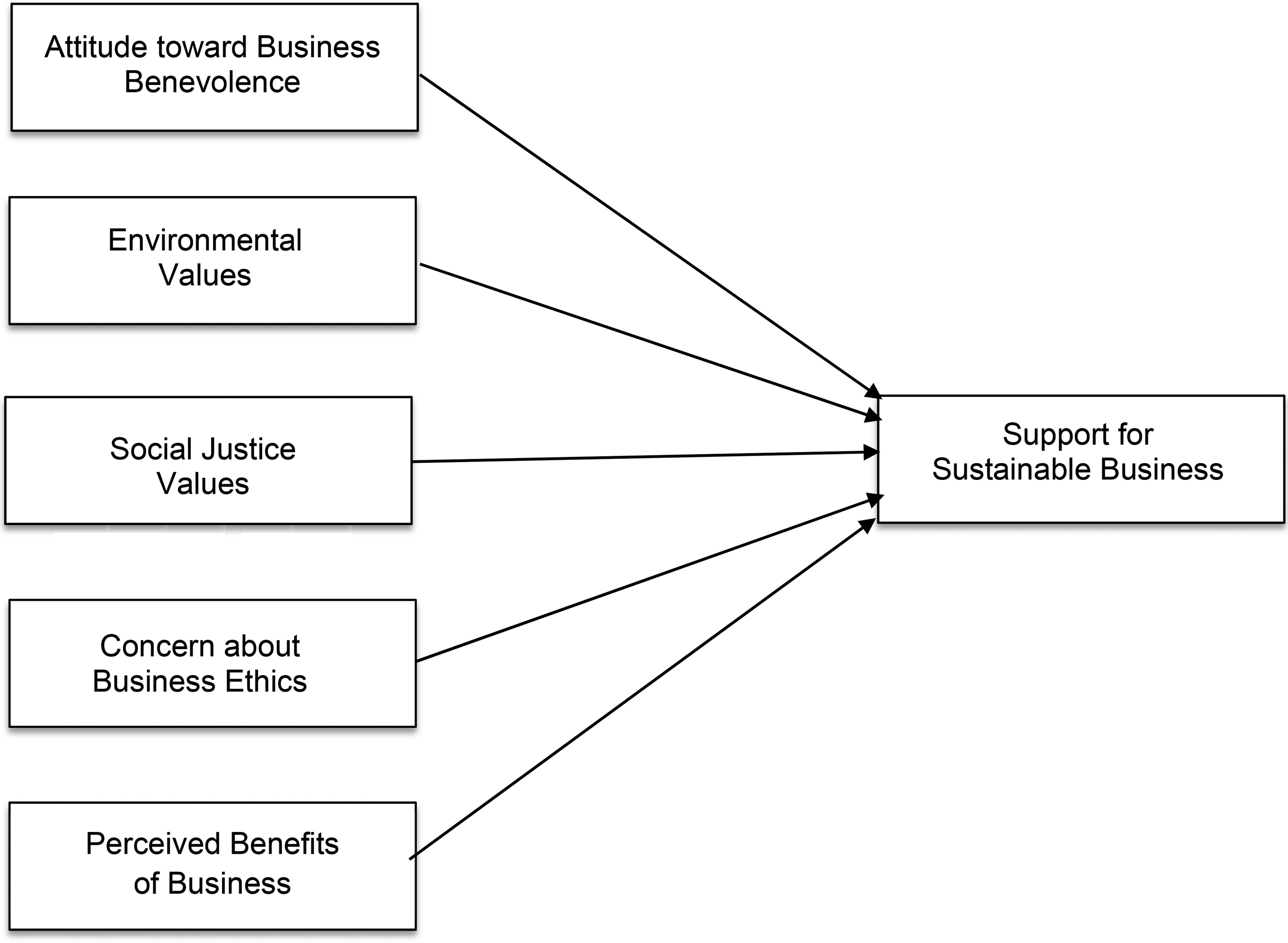
Conceptualization of the Core Model of the Study.
Development of the Hypotheses
In recent years, corporate social responsibility (CSR) has taken a higher profile in the conduct of firms in the marketplace (Kim, Park, and Shrum 2022), As Peterson et al. (2021) proposed, consumers should favor benevolent actions of businesses. Accordingly, consumers with higher attitudes toward business benevolence should indicate more support for sustainable business. With the rise of a broadened approach to the market by corporations adopting a stakeholder approach in which CSR efforts featuring corporate philanthropy takes a high profile, the first hypothesis of the study follows:
Attitude toward business benevolence will positively affect SBPs influence on purchasing.
Effect of Environment Values on Support for Sustainable Business. In a similar way to the Social Justice Values, the study proposes that consumers’ valuing of the natural environment will also positively influence support for sustainable business. According to value-belief-norm theory, consumers have valued objects that appear threatened (such as the natural environment) and later resonate with a movement focused on protecting the threatened object (such as environmentalism) (Stern et al. 1999; Peterson et al. 2021).
Considering that placing value on the natural environment is intertwined with the objective of SBPs, individuals who do possess that belief are more likely to advocate for SBPs. That increased likelihood stems from an increased appreciation of one's immediate surroundings. Dietz, Fitzgerald, and Shwom (2005) believe that this shift in perspective will lead to the formation of new individual norms and standards in the way one treats their immediate surroundings. This newly formulated standard, as a result of the improved natural environment value, can display itself in multiple ways: political activism, non-activist political behaviors such as voting, and private sphere actions such as consumer choices and behaviors in organizations where pro-environmental policies might be endorsed.
An individual's environment values positively influences Support for Sustainable Business.
Effect of Social Justice Values on SBPs. As previously proposed for Environmental Values, consumers have valued objects that appear threatened (such as equal access to society's resources) and later resonate with protecting the threatened object (such as social justice activism) (Stern et al. 1999). Consumer beliefs that their actions can help protect or restore the valued object feel an obligation (personal norm) for action that creates a motivation to provide support for a movement aiming to nurture social justice. As in Peterson et al. (2021), this study proposes that consumers’ valuing of social justice will also positively influence support for SBPs.
Nowadays, general sustainability and SBPs are mainly served by social justice, which is considered a primary ethical value. Winston (2011) has stated that primary values result in an elevation of practice of SBPs. By the same token, as a person is more inclined toward social justice and ethics, the person starts to desire more practice of SBPs and environmental friendliness: the desire to avoid resource exploitation in particular. According to Peterson (2021), firms in pursuit of SBPs can receive more positive support from consumers who care about businesses assisting in the protection of the environment and increasing social justice value.
General minimization of waste, the practice of SBPs, and higher motivation to follow a more environmentally–green way of living are all attributes of just social values that correspondingly rise together with each other. Gore (2010) states that morals, ethical values, and contempt against exploitation—all of which are connected to social justice values—should drive for a more sustainable environment for both current and future generations. This highlights the relationship between strong social justice values and favoritism toward SBPs.
An individual's degree of social justice values positively influences Support for Sustainable Business.
Consumers bring wariness to market transactions with businesses because of businesses’ ethical practices toward other non-consumer stakeholders, such as society, institutions, and other businesses (Layton 2015). Businesses lapse into unethical behavior when they dodge taxes, overpay CEOs, bribe government officials, or yield excessive influence through lobbying (Peterson 2021). Because sustainable business practices emphasize doing right by stakeholders, researchers have identified a positive relationship between concerns about the ethical conduct of business and support for sustainable business practices (Peterson et al. 2021). Accordingly, this study investigates the following hypothesis: An individual's concern about the ethics of businesses positively influences Support for Sustainable Business.
According to Social Exchange Theory, exchange depends on rewarding actions from others and if benefits do not continue to flow between exchange partners, then exchange will stop (Baker, Hill, and Baker 2015). Lunde (2018) proposed that necessary quality-of-life and well-being had to be delivered to consumers by firms pursuing sustainable business practices. In other words, if sustainable firms do not deliver goods and services that improve the quality of life for consumers, then these firms will not be perceived as sustainable firms by consumers. Accordingly, this study investigates the following hypothesis: The perceived benefits of business activity in marketplaces positively influences Support for Sustainable Business.
The five hypotheses comprise the core model of the study. Figure 1 depicts this conceptual model.
Effect of Religiosity on SBPs. Lebanon is a multi-religious society comprised of Muslims, Christians and Druze (Christophersen 2018). With the progression of time, the positive correlation between the degree of religiosity and the practice of Sustainable Business Practices (SBPs) continues to present itself. For example, many sources have introduced the concepts of dominion and stewardship to explain how religiosity and support for sustainability relate to each other. Orellano, Valor, and Chuvieco (2020) propose that religiousness within an individual hones an inclination toward stewardship in regard to the environment. Stewardship—a concept prominent in Christianity, openly features the planning and management of resources. In a similar way, the Quran teaches that whatever a Muslim possesses is actually owned by Allah, therefore Muslims take on a trustee role in the created world (Sanders 2021).
According to El Jurdi, Batat, and Jafari (2017), a positive relationship between religious beliefs and SBPs does exist. Some scholars identify 650 references to ecological protection in the Quran. For example, “And he has raised high and has devised (for all things) a balance so that you might never transgress the balance: weigh, therefore (your deeds) with equity, and do not upset the balance,” (verse 55:7–9 of the Quran). This verse exemplifies the call on Muslims to support business practices that maintain the balance intended by God. A theme throughout the Quran (such as verses 6:165 and 7:10) is that the world was bestowed upon people as a gift from Allah, and should therefore be protected by people faithful to him. The teachings in the Quran on caring for the creation of Allah connects to the support of SBPs.
Scholars of Buddhism have also identified a link between the teachings in Buddhism and sustainability (Song 2021). Macromarketing scholars have concluded that religion shapes sustainable consumption indirectly by affecting attitudes, values, self-efficacy, social norms, and identity (El Jurdi, Batat, and Jafari 2017).
The role of income for consumers is an important one in a frontier economy, such as Lebanon, because economic growth continues at the aggregate level, but many citizens still struggle to survive (Jallat and Shultz 2011). Macromarketing scholars have noted that country-development efforts often benefit a limited subset of the population, such as affluent consumers (Figueiredo et al. 2015) who consume at the level of elites in developed countries (Schaefer and Crane 2005). Accordingly, the study proposes a second research question similar to the first research question:
In sum, these two research questions and the five hypotheses guide this investigation of consumer support for sustainable business in a frontier market. The target for the investigation is contributing to understanding for how value-belief theory and sustainable marketing theory might apply in a frontier market context.
Overview of the Study Set in Lebanon
This study seeks to understand more about the values underlying sustainable intentions from a unique vantage point. Instead of a survey with affluent western participants, interviewers ventured into the streets of Lebanese neighborhoods to gauge the thoughts of consumers about sustainable business practices and related concepts. Lebanon is among the most intriguingly diverse countries in the world with its sectarian mix of different religions. About two-thirds of the population is Muslim (31.9 percent Sunni, 31 percent Shia, and small percentages of Alawites and Ismailis) and nearly one-third is Christian (US State Department 2019). The study sought to assess potential differences between the different sects and whether the religious affiliations may influence people's attitudes toward sustainability.
More specifically, the research team sought to understand participants’ support of Sustainable Business Practices (SBPs). Since business production is one of the primary sources of pollution, SBPs are essential to combat that trend (Fowler and Hope 2007). This has implications for both the achievement of SDGs, but also the plans of businesses to expand their sales of sustainable products. Companies like Unilever, that sees its Sustainable Living Brands delivering 75 percent of the company's growth (Unilever 2019), have a stake in whether developing countries have an appetite for sustainable products.
In order to collect data for this research, interviewers met face-to-face with survey respondents in the neighborhoods of Lebanon. Researchers designed the survey to capture consumer perspectives on the variables thought to influence support for sustainability (Support for Sustainable Business)—specifically, 1) Attitude toward Business Benevolence 2) Environmental Values, 3) Social Justice Values, 4) Concern about Business Ethics, and 5) Perceived Benefits of Business.
Scholars have noted the important role of religion in the cauldron of complex and interacting forces that characterize Lebanese society (DeQuero-Navarro et al. 2020). Scholars have also noted the delicate nature of political life in Lebanon regularly strained by crises (such as massive influxes of refugees from neighboring countries) with which the weak confessional state of Lebanon struggles to cope (Jallat and Shultz 2011). In such a post-conflict society marked by sectarian tensions, citizens’ religiosity might moderate support for sustainable business in a society living in a burdened ecosystem.
Scholars have declared that societal systems are overwhelmed in Lebanon with resource scarcity evidenced by 1) water shortages, 2) health services, 3) reduced education services, 4) increased commodity prices and 5) deficient public services (DeQuero-Navarro et al. 2020). Such resource scarcity impacts the poor in Lebanon the most. Accordingly, researchers perceived that support for firms pursuing sustainable business practices might be moderated by not only citizens’ religiosity, but citizens’ income level.
Researchers sought to understand if responses of consumers in Lebanon on questions about these five antecedent constructs influence support for sustainable business. Additionally, does one's reported affiliation with a faith tradition in Lebanon or one's income group moderate consumers’ support for sustainable business?
Methods
The purpose of this study is to better explain Lebanese consumers’ support for sustainable business practices. Specifically, this study analyzed responses from field research in Lebanon using in-person interviewing. Researchers assessed the five hypotheses of the study by employing structural equation modeling (SEM) using AMOS ( Blunch 2013). In this way, the study used a common-factor analysis approach in its conduct of SEM.
The study featured field research in a frontier economy—a rarely done method given the recent history of Lebanon (Hourani 2019) which has endured a sectarian-based civil-war from 1975–1990 and its lingering societal tensions (Haugbolle 2005). Interviewers went into neighborhoods around Lebanon for face-to-face interviewing in the Arabic language (McGorry 2000).
Researchers addressed the potential of social desirability in our face-to-face interviewing method (Krumpal 2013). To minimize social-desirability bias, researchers assured respondents about the confidentiality and anonymity of their responses. Researchers also made sure each interviewers and respondents were of the same gender to conform to existing cultural habits and customs in the region. Finally, interviewers recorded answers from respondents in a neutral manner to minimize respondents’ concerns about how their responses would be viewed.
The final sample for the study consisted of 217 respondents. Twenty-six of the respondents chose to take the survey in English, rather than in Arabic. More than half of the respondents (54 per cent) came from Beirut—the major city. Mount Lebanon—a mountain range in the north Lebanon—accounted for the next largest group of respondents (29 per cent), while South Lebanon accounted for 14 per cent of respondents. In sum, the field interviewing went to different parts of Lebanon, despite the security issues faced in a strife-torn country. Overcoming such challenges represents a valuable dimension of the study's methodological rigor. Although the challenge of collecting this data again limited it to being a cross-sectional study, this is a shortcoming of most social science research using survey methodology (Malhotra, Peterson, and Uslay 2006). Although obtaining a large sample was prohibitively difficult, the sample size is adequate based on the rule of thumb of at least 30 cases per factor (Wolf et al. 2013), as we have over the 180 cases for the six factors in our analysis.
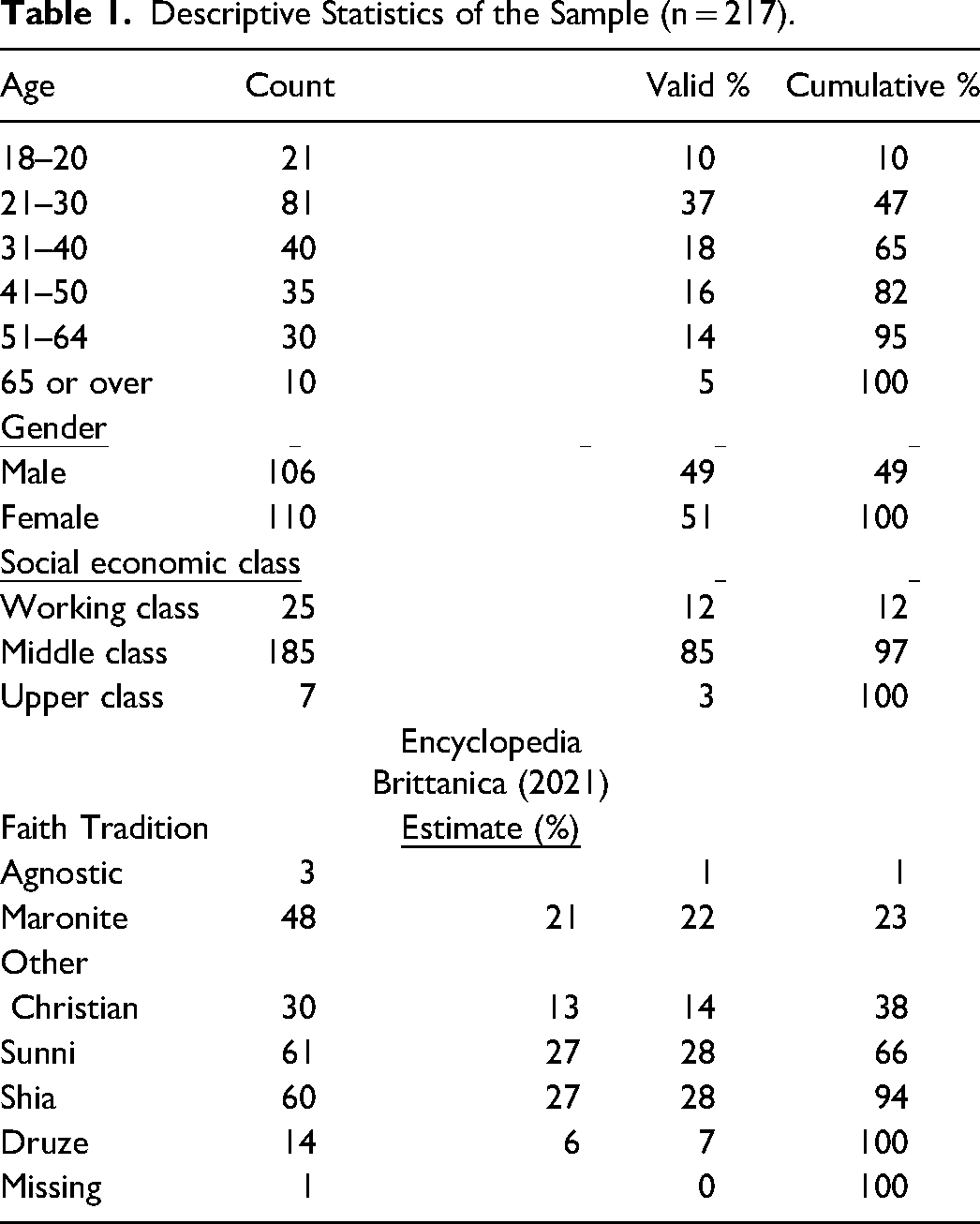
Table 1 presents a profile of the sample on three demographic variables: 1) age, 2) gender, 3) socio-economics, and 4) faith tradition. As can be seen, those under 30 years of age accounted for 47 per cent of the sample, while males and females comprised about equal parts of the sample, and the middle class comprised 85 per cent of the sample. While Lebanon remains the only country in the world to not conduct a census since the end of World War II, the portions for the three dominant religious groups are the largest in the sample: Maronite 22 per cent, Sunni Muslim 28 per cent, and Shia Muslim 28 per cent. Those from the Druze faith tradition comprise 7 per cent of the sample. As can be seen in Table 1, the faith-tradition profile of the study's sample is almost identical to recent estimates. In sum, the sample profile of the study appears representative of consumers in Lebanon on important demographic dimensions.
Descriptive Statistics of the Sample (n = 217).
Results
Descriptive Statistics
Table 2 presents the descriptive statistics for the items used to operationalize the constructs of the study: 1) Attitude toward Business Benevolence, 2) Environmental Values, 3) Social Justice Values, 4) Concern about Business Ethics, 5) Perceived Benefits of Business, and 6) Support for Sustainable Business. These statistics include values for each item's mean, standard deviation, skewness and kurtosis.
Items for Constructs of the Study (7-pt. Scales).
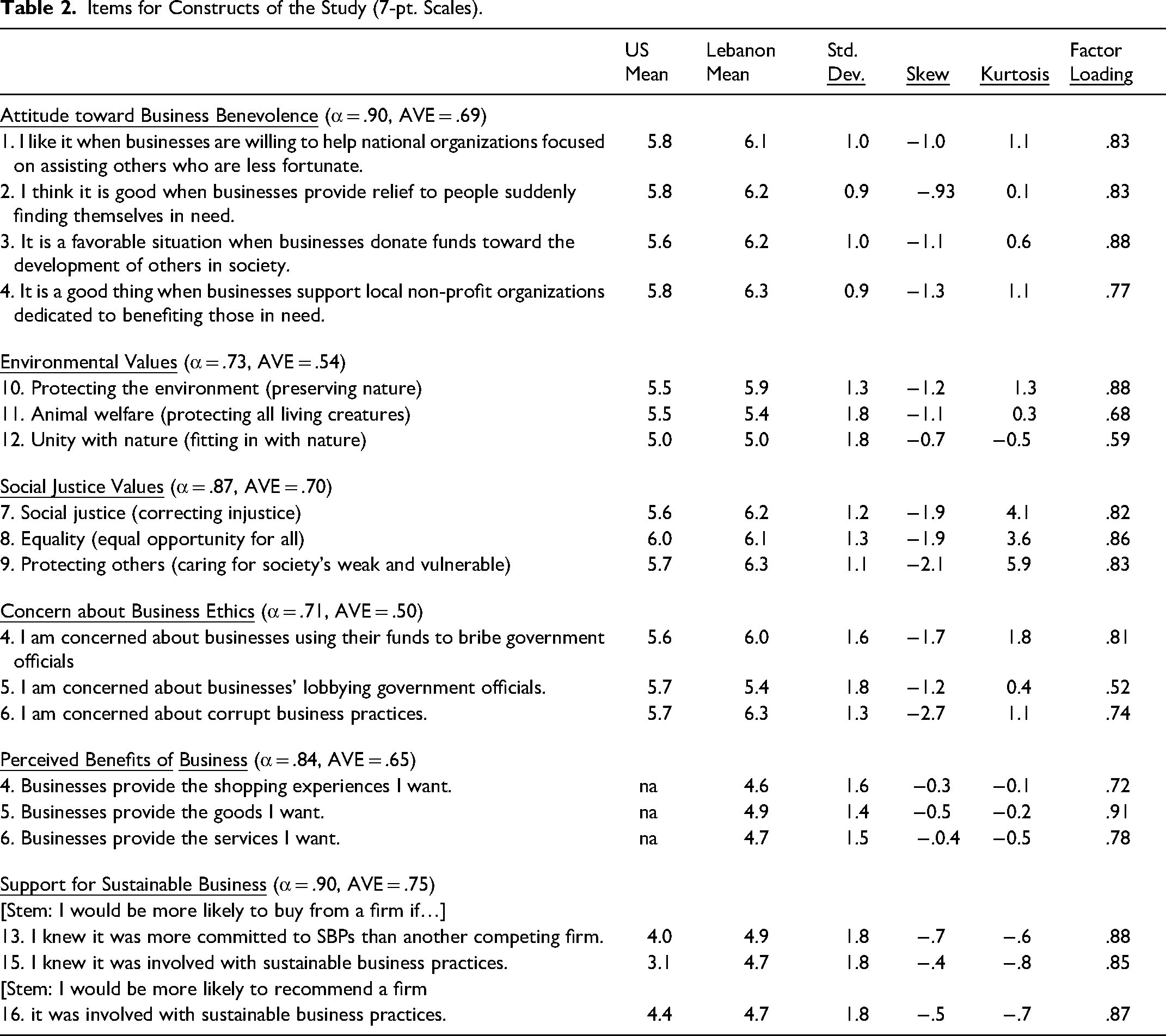
In the first column of Table 2, one can find the corresponding mean values for a US sample comprised of 304 respondents. This data comes from Peterson et al. (2021). As one can see, the Lebanese sample returns comparable means (and with the exception of one question) a bit higher means than the US sample. This is an important comparison because it suggests that consumers in a frontier market of Lebanon do not find sustainable business practices (and constructs related to SBPs) irrelevant, but find them to be comparable (if not a bit more favorable than consumers in a developed market), such as the US.
Table 2 also presents results of unidimensionality analysis: 1) Cronbach's alpha as a measure of construct reliability, 2) the average variance extracted for each factor (AVE), and the factor loading of each item in common factor analysis employed in unidimensionality analysis.
To measure Environmental Values, the study used the approach taken in Schwartz's (1992) value survey that measured the degree that personally important values guide decisions and actions in life. Studies in 82 countries of the world have shown the applicability of items operationalizing the Schwartz Theory of Basic Values. The items for this study are derived from the universalism dimension of Schwartz's values that address the welfare of all people and nature. Three of the items represented the Social-Justice Values, and three represented the Environmental Values. Other researchers have adapted the items for Environmental Values and called them biospheric values (Stern, Dietz, and Guagnano 1998; De Groot and Steg 2008). Each of these items used a seven-point scale (1 = “not at all important”; 7 = “extremely important”).
To measure Pperceived Benefits of Business, researchers used the three items related to business provisioning from Peterson, Ekici, and Hunt (2010). To measure the remaining items of the study, researchers used items from Peterson et al. (2021) which successfully operationalized Attitude toward Business Benevolence and Support for Sustainable Business.
Construct Unidimensionality Analysis
This study followed the paradigm for scale development proposed by Gerbing and Anderson (1988) in which a composite score calculated as the unweighted sum would provide an estimate of the underlying construct. Such a composite score has value only to the extent each of the measures is acceptably unidimensional—pointing to the existence of a single trait or construct underlying a set of measures. A combination of exploratory factor analysis and confirmatory factor analysis was employed to refine the set of items proposed as constructs in this paradigm until satisfactory levels of unidimensionality emerged after successive item pruning steps.
Each construct was evaluated for unidimensionality individually with its own factor analysis. According to Hair et al. (2010), an acceptable sample size for a factor analysis would be one no less than 50 and with a 10:1 ratio of respondents/objects to variables being analyzed. The factor analyses conducted exceeded these threshold levels for sample size.
The items in Table 2 posted average-variance-extracted (AVE) percentages from 54 per cent to 75 per cent. The corresponding composite reliability measures—Cronbach's alpha—all proved to be healthy and ranged from 0.71 to 0.90.
Assessment of Common Method Variance
To assess whether common method variance affected the items representing the constructs of the study, the research team employed the Harman single-factor test, a statistical technique used to assess common method bias (Podsakoff et al. 2003). Accordingly, the exploratory factor analysis using all items representing the multiple-item constructs produced not one factor but a five-factor model explaining more than 63 per cent of the variance. No single factor accounted for more than 50% of the variance (the highest was 28.6 per cent). These results suggest that common method bias is not a problem in the data in the study.
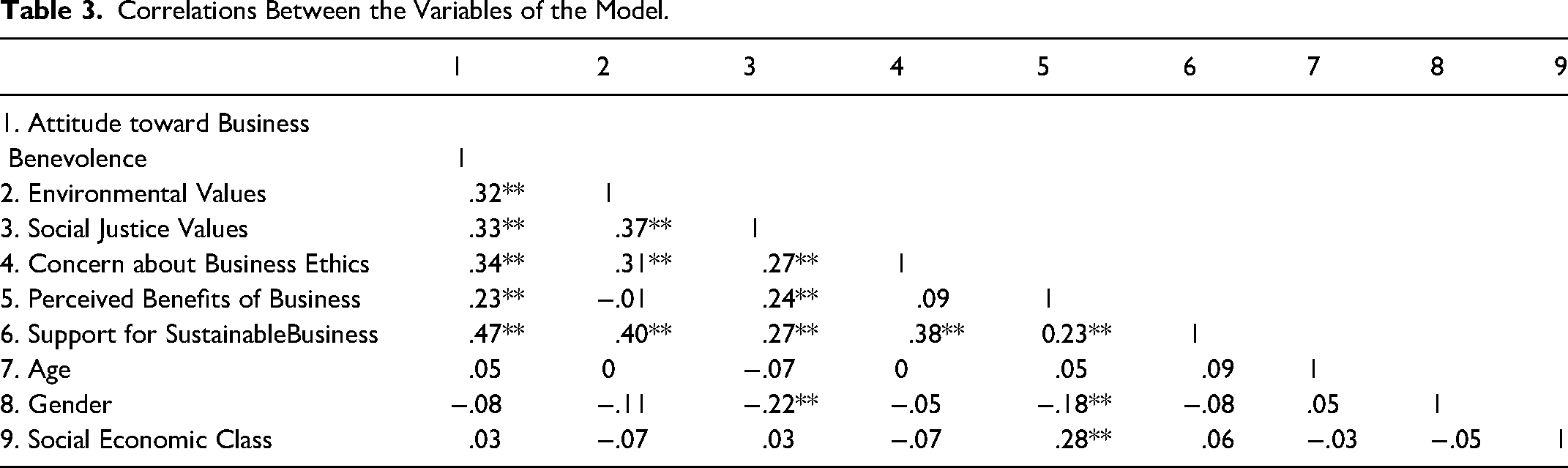
An examination of the construct correlation matrix (reported in Table 3) indicates whether any of the constructs correlate extremely highly. In this study, none of the constructs are above 0.50, well below the 0.90 threshold for concern of common method variance (Pavlou, Liang, and Xue 2007).
Correlations Between the Variables of the Model.
Structural Equation Modeling and Testing of the Hypotheses
Prior to running SEM, researchers conducted a confirmatory factor analysis. The results suggested a good fit (Chi-square with 137 df = 295.6, TLI = 0.90, CFI = 0.93 and RMSEA = 0.07). Based on these results, researchers then moved to structural equation modeling. Figure 2 depicts the results of SEM for the model of the study (n = 217). This model also posted a good fit (Chi-square with 139 df = 299.7, TLI = 0.90, CFI = 0.93 and RMSEA = 0.07).
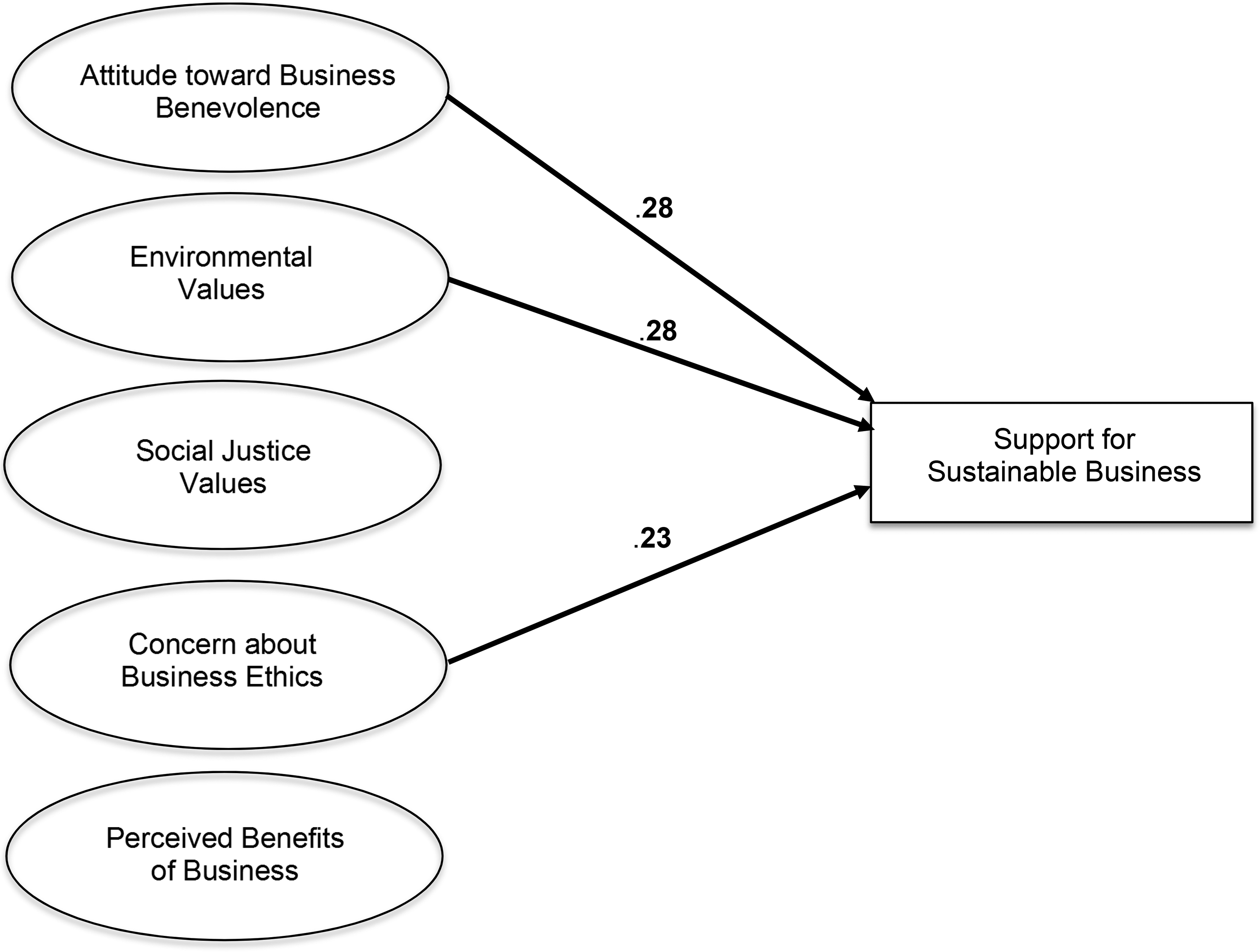
Structural Equation Modeling Results for the Full Model of the Study. χ2 = 435.3 with 196 Degrees of Freedom.
In the model of Figure 2, three of the paths from the exogenous constructs posted standardized path coefficients statistically significant at p = 0.05. However, two proposed linkages from the Social Justice Values construct and from the Perceived Benefits of Business construct did not post standardized path coefficients statistically significant at p = .05. The standardized path coefficients of the links from the exogenous constructs to Support for Sustainable Business follow: Attitude toward Business Benevolence (0.28), Environmental Values (0.28), Social Justice Values (-.04), Concern about Business Ethics (0.23), and Perceived Benefits of Business (0.13). The results of the SEM analysis provide support for H1, H2 and H4.
Evaluation of the Research Questions. In order to understand the possible moderating effect of 1) religiosity, and 2) income on the relationships of the model, researchers conducted multi-group modeling using structural equation modeling (Hair et al. 2010; Khavul et al. 2010). The Religiosity variable used in the first multi-group modeling was constructed by taking the self-reported religiosity variable (7-point scale) and creating a new variable with those at or below the mean value receiving a value of “0” and those above the mean value receiving a value of “1”. The less-religious group comprised 48 per cent of the sample. The Income variable used in multi-group modeling was a dichotomous variable representing those with lower income and those with higher income in Lebanon. Researchers used the break point of $1,500 in monthly income that is close to the estimate of the average monthly household income in Lebanon in 2018 (World Bank 2018). The lower-income group composed 52 per cent of the sample.
In both multi-group analyses using structural equation modeling, modeling results suggested no differences in the standardized path coefficients across the sub-groups being compared. In sum, these results suggest that neither religiosity, nor income, have a moderating effect on the relationships depicted in the model of Figure 2.
As an additional test, we conducted moderation analyses with Hayes ( 2022) PROCESS Model 1 with 5000 bootstrapped samples. We tested whether age, social class, religiosity, or income moderated the effect of the independent variables (Attitude toward Business Benevolence, Environmental Values, Social Justice Values, Concern about Business Ethics, and Perceived Benefits of Business) on the dependent variable (Support for Sustainable Business). There were no significant interaction effects for any of the relationships (ps > .05), and all confidence intervals included zero, offering further support for the absence of moderating effects of consumer characteristics.
Discussion
Interpreting Results of the Study
The results of the study provided support for three of the five hypotheses of the study. Here, structural equation modeling found evidence that 1) Attitude Toward Business Benevolence, 2) Environmental Values, and 3) Concern about Business Ethics each positively influence consumers’ purchase behavior with firms implementing sustainable business practices. The results of modeling depicted in Figure 2 did not provide support for H3 (the proposed linkage between Social Justice Values and Support for Sustainable Business), nor H5 (the proposed linkage between Perceived Benefits of Business and Support for Sustainable Business).
Despite the ongoing stresses of living in a frontier market, such as Lebanon with all of its different crises (political, economic and refugee-related), consumers’ responses suggest linkages exist between three of the five proposed antecedents and Support for Sustainable Business. Notably, the standardized path coefficients in SEM suggest that the antecedent constructs that proved to have a statistically significant relationship with the DV at p = .05 had very similar values (between .23 and .28). Additionally, the relatively high mean values for items representing Support for Sustainable Business (as can be seen in Table 2 and in Figure 2) suggest consumers want to see sustainable development furthered in Lebanon.
Table 2 also allows a comparison between the means of the Lebanese sample and the means from a US sample on corresponding items in the two studies in which the Lebanese sample shows comparable (if not a bit higher means) on these same items. In short, consumers in the frontier market of Lebanon compare favorably to the US sample in their expressed support for sustainable business and the antecedents of sustainable business. The readiness of consumers in a frontier market, such as Lebanon, to support sustainable business is a major insight from the study.
Another important insight about Support for Sustainable Business in Lebanon is that the pattern of statistically significant relationships between antecedents and the DV in the model were identical to the pattern of relationships identified in the Peterson et al. (2021) study which used US consumers. While the Lebanon modeling suggested parity in the strength of relationships between the statistically significant relationships, the US modeling suggested that Environmental Values had a much stronger influence on the dependent variable of that study termed “Support for Sustainable Businesses” (.59 in the US model compared to .28 in the Lebanon model). In an obverse way, Concern about Business Ethics had a weaker influence in the US model (.13) compared to the Lebanon model (.23). This suggests that concern about businesses’ part in corruption in Lebanon is more impactful on the DV when compared to the US sample. This likely is due to more widespread corruption in Lebanon (TI 2020).
In sum, the pattern of antecedents contributing to Support for Sustainable Business in Lebanon is similar to that in the US. This suggests that consumers in a frontier market, such as Lebanon, think about SBPs’ influence on their purchase behavior like those consumers in a developed market, such as the US. This is a major insight coming from this study.
Explaining Support for Sustainable Business Practices
Prothero and McDonagh (2021, p. 169) have called macromarketing scholars to embrace the socio-political in sustainability macromarketing. In other words, the wide embrace of sustainability across individuals in society, as well as the role of government, must also be parts of macromarketing explanations for sustainability phenomena. In this way, Prothero and McDonagh call for cultural change in societies around the world which would frequently be led by government.
In the context of Lebanese society which has a chronically weak government unable to adequately regulate businesses or citizens, the results of this study (with relatively high levels of intention to purchase from firms pursuing sustainable business practices) show promise that the Lebanese consumers have a desire to see sustainability efforts of firms succeed. In other words, Prothero and McDonagh's call for government-led cultural change that would shift to support of sustainable business practices in the marketplace is not likely to occur in the context of a frontier market like Lebanon in the coming years. However, a consumer led shift to support sustainable business in marketplaces of Lebanon could occur in the coming years. This is also a major finding of the study.
Why should such support for sustainability exist in a frontier market such as Lebanon with all of the stress from ongoing crises (political, economic and social)? Part of the answer could be attributed to the level of human development in Lebanon. The country posts a score of 0.744 on the UNDP's Human Development Index (HDI) that places it at 92 in a ranking of 189 of the world's countries on the HDI (UNDP 2021). This places Lebanon in the 51st percentile of countries on the HDI. Lebanon finds itself seven places behind China on the HDI. The life expectancy at birth in Lebanon is 78.9 years (same as the US), mean years of schooling is 8.7 years (Mexico's is 8.8), and gross national income per capita in purchasing power parity terms is $14, 655 (Brazil's is $14,263). In sum, Lebanon manifests undeniable development in human development, despite aggravating challenges which persist year after year—and have worsened in recent years.
International business scholars have found evidence for a positive relationship between consumers’ sustainable behaviors and cosmopolitanism (having a worldwide focus, rather than a provincial one) (Grinstein and Riefler 2015). Important aspects of Lebanon's history bring an increased level of cosmopolitanism to Lebanon's culture.
After World War I and the dissolution of the Ottoman Empire, France took control of the region now known as Lebanon (Humud 2018). At the time, many Maronite Christians sought a Christian state under French protection (Crighton et al. 1991). A debate about Lebanese identity began which in some ways continues today. In 1943, Lebanon achieved independence from France, but cultural and economic ties have continued.
Another unique characteristic of Lebanon contributing to increased cosmopolitanism among consumers there is Lebanon's vast diaspora—estimated to be more than 15 million worldwide (Williams 2021). This is almost 2.5 times the size of the current population of about 6 million Lebanese living in Lebanon—a country of 10,400 square kilometers—a little smaller than Jamaica (Mapfight 2023). (The refugees in Lebanon add an additional 25 per cent to the Lebanese population.)
Lebanon's diaspora has nurtured connections with the home country from the early nineteenth century and onwards and thereby brings increased awareness of happenings beyond the borders of Lebanon to citizens of Lebanon (Goulordava 2020). The Lebanese diaspora now resides in South America (70 per cent), North America (21 per cent), Oceania (3.6 per cent), Europe (3.5 per cent), and the Middle East, North Africa and Asia (0.2 per cent) (Pukas 2018). The Lebanese government estimates that 7 million persons of Lebanese birth or descent live in Brazil, and 1.5 million in Argentina. Over the years, Lebanese migrants have earned a reputation for business acumen and entrepreneurship. Mexican businessman Carlos Slim, once the world's wealthiest person, is of Lebanese descent and maintains ties to Lebanon (Williams 2021).
Members of the Lebanese diaspora have maintained ties to Lebanon through remittances to family members ($7.4 billion in 2019), through savings deposited in Lebanese banks, and through vacation and travel to Lebanon (Williams 2021). Importantly, more than 1.2 million Lebanese living abroad can vote in Lebanese elections. Such cultural and economic ties are a source for boosting awareness and acceptance of sustainable business practices. This means that despite the institutional adversity afflicting Lebanon in the form of the national government's prolonged ineffectiveness, Lebanon's connection to a global diaspora would likely prime Lebanese consumers to like and to accept the idea of supporting businesses pursuing sustainable business practices.
Lebanon Since the Study
Worsening conditions characterize Lebanon in recent years (Majdalani 2021). Since the time of data collection for this study (Spring 2018), the crises in Lebanon have markedly deteriorated. The World Bank (2021) reports that Lebanon's GDP shrank from $55 billion in 2018 to $33 billion in 2020—a scary drop of 40 per cent in GDP per capita—regarded by the World Bank as one of the three worst economic crises in the world since the 1850s in the effects on living standards. The related monetary collapse brought hyperinflation of 84 per cent in 2020. More than half the population is now below the poverty line.
The compound crises have resulted in rolling blackouts and reduced supplies of water as electricity and water utilities cannot pay their bills (World Bank 2021, p. 15). In September 2022, electricity “illuminations” on the grid would occur for two hours a day—usually between 2 am and 3 am (Abdulrahim 2022). Citizens with the means and desire for these services operate their own electric generators and buy water from water tankers—both expensive options. The continuing breakdown of sanitation services increases the spread of water-borne diseases. Meanwhile, the global pandemic of COVID-19 did not spare Lebanon. Worryingly, but not surprisingly, Asd’a BCW Arab Youth Survey conducted in October 2020 disclosed that 77 per cent of young Lebanese were actively trying to leave Lebanon (Williams 2021).
In sum, while researchers conducted data collection in Lebanon during a time of aggravating crises, these crises have markedly worsened. The study captured consumers in a frontier market contending with institutional adversity (Nwoba, Boso, and Robson 2021). In this way, the results of the study give researchers understanding about other frontier markets with weak institutions and sectarian tensions. Many countries of the world fit this profile, such as Nigeria, Kenya, Kazakhstan, Bangladesh, Pakistan, and Serbia (MSCI 2021).
Qualitative Field Interviews
In order to better understand the impact of the worsening conditions in Lebanon since the data collections of the study in 2018, one of the co-authors who lives in Lebanon conducted eighteen face-to-face interviews in September 2022 in Lebanon. These interviews typically lasted approximately 12 min each, and were conducted with consumers of both genders and of various ages and social conditions.
The analysis of the interviews disclosed that respondents’ purchase intention for sustainable products between 2018 and 2022 has likely changed. In 2018, respondents indicated they were more likely to purchase a socially engaged brand than in 2022. This purchase intention was conditioned by a price difference perceived as acceptable. However, in the current economic conditions, price has become the first criterion for consumer purchases, followed by quality and social commitment. “Even if the company is not socially responsible, I will still buy its brand if it is of a higher quality” (Female, 40 years old, Mount Lebanon).
Currently, high unemployment, weakening purchasing power, health concerns, lack of security, and the virtual disappearance of pension benefits are of more concern to the Lebanese than preserving the natural environment. One of the interviewees, for example, said “Interest in the environment depends on the conditions in which one lives. How can a person who cannot meet his basic needs think of sacrificing his purchasing power for organic products that are more expensive than ordinary products?” (Male, 23 years old, Beirut).
In addition, it was found that the level of trust in organic and/or sustainable products from local businesses has sunk. “Would a company that can barely pay the salaries of its employees, a company that does not have the financial means to purchase quality raw materials, be able to produce sustainable and environmentally friendly products?” (Male, 26 years old, Beirut).
This lack of trust in local businesses is due to these businesses being perceived as not giving sufficient importance to sustainable business practices. One of the interviewees explained things this way: “There is a lack of awareness and interest from companies regarding sustainable products. Lack of inspection, lack of quality control and lack of eco-friendly raw materials lead to this situation. All of this is expected when the situation is chaotic” (Female, 65 years old, Mount Lebanon). Encouragingly, some respondents believe that there are still a few businesses that care about the environment, people and the economy and that young startups are more oriented toward sustainable business.
A phenomenon caused by the current economic crisis and which, in the near future, could become a real trend in Lebanon, is that of purchasing second-hand products. The qualitative field interviews disclosed that Lebanese consumers who are concerned about the natural environment are increasingly turning to the second-hand market because second-hand products do not generate additional environmental effects as those created from new materials and manufacturing. This insight corresponds with other research finding that consumers with higher levels of environmental responsibility and an active moral identity are more likely to purchase environmentally friendly products (Wu and Yang 2018; Yue et al. 2020). Second-hand products are also cheaper to buy and for financially stressed consumers, this price difference matters.
Conclusion
Researchers in this study sought to 1) explain the degree to which consumers in a frontier market express support for firms pursuing sustainable business practices, and 2) gauging the relationship of possible antecedents of such support. Importantly, consumers in Lebanon who are confronted with daily challenges resulting from chronically persisting crises (of a political, economic and social nature), reported general support for purchasing from firms practicing sustainability. Of the antecedents, the structural equation modeling identified three antecedents (Attitude Toward Business Benevolence and Environmental Values each with standardized path coefficients of .28, and Concern about Business Ethics at .23).
These findings should motivate future stakeholders and investors to fund sustainability oriented projects in frontier markets. Despite potential ongoing crises in these countries, the data from this study suggest that the populations are still inclined to purchase from firms practicing sustainability. As Attitude Toward Business Benevolence and Environmental Values proved to have the largest influence on purchasing support for sustainably-oriented firms, companies would be wise to emphasize concepts related to these in their integrated marketing communications. For example, firms could highlight their community philanthropy, as well as their regard for the natural environment. Given the worsening crisis in Lebanon, firms involved in the relief of human suffering and the improvement of infrastructure will likely be rewarded by consumer support—not only now—but in the future when conditions improve in this frontier market.
A limit of this study is the cross-sectional nature of the data collection undertaken, but this is a shortcoming of most social science research using survey methodology. While the data collection did not capture the troubling decline of life in Lebanon since 2018, the focus of the study was to better understand antecedents of support for sustainable business practices among consumers in a frontier market chronically plagued by weak institutions and by sectarian tension. Likewise, an important finding of the study was the expressed support for sustainable business practices which is encouraging not only for scholars of sustainability, but also practitioners intent on conducting operations with sustainability in mind.
A valuable research effort in the future would be returning to Lebanon and expanding to other frontier countries in the Levant and broader Middle East. This would allow researchers to understand if consumer support for sustainability has changed since 2018—before the precipitous descent into economic recession. Would the antecedents of Support for Sustainable Business be stronger or weaker? Would the scope of sustainably-sourced products tighten to water and food because of health concerns resulting from a breakdown of utility services and from disruptions of food supplies? How would price moderate support for sustainable business now? Each of these questions could be included in an updated study of consumers in the frontier market of Lebanon and beyond in order to further understanding about a range of daunting conditions in frontier markets.
Footnotes
Acknowledgments
Our hearts go out to the Lebanese people who have endured so during the years of this research. We thank our research assistants, especially Subhi Taha and Vagif Huseynov, for their support in the project. May you lead the next generation in sustainable business practices. We also thank the editorial team and anonymous reviewers for their support.
Associate Editor
Cliff Shultz
Declaration of Conflicting Interests
The author(s) declared no potential conflicts of interest with respect to the research, authorship, and/or publication of this article.
Funding
The author(s) received no financial support for the research, authorship, and/or publication of this article.
