







Abstract
This study explores the potential of marketing to resolve international conflicts by integrating metaphysical insights. Traditionally seen as an economic tool, marketing can influence societal norms and foster interconnectedness, contributing to peacebuilding efforts. The paper examines traditional conflict resolution methods such as diplomacy, sanctions, and military interventions, highlighting their limitations. It argues that marketing strategies can transform societal perceptions and promote cooperation when aligned with metaphysical principles such as collective consciousness and empathy. The paper also encourages marketers to use Nudge Theory for ethical engagement and behavioral change, emphasizing long-term gains over short-term disputes. By addressing gaps in the literature, this paper underscores the need for further exploration of the metaphysical dimensions of marketing in conflict resolution. It concludes by suggesting that marketing offers a promising alternative to traditional methods for fostering a more harmonious and interconnected global society.
Keywords
Introduction
Traditionally studied as mechanisms of exchange of goods and services, marketing can have a far-reaching influence in shaping societal norms and behaviors. Beyond its monetary role, it can reduce conflicts by shaping perceptions and fostering interconnectedness (Shultz and Holbrook 1999). A good example is marketing campaigns that could influence public opinion and help create peace in ongoing conflicts, such as the war between Russia and Ukraine, through common cultural and historical binds to be used as a basis for reconciliation. Both countries have extensive ties with an intertwining history through linguistic, religious, and cultural relations that could be played up in well-targeted marketing campaigns to soften public sentiment and promote dialogue. For instance, it can be shared heritage: the common historical narratives familiar to everyone on both sides that would breed understanding and empathy with their adversaries. Systematic amplification of such narratives in marketing may work toward moving away from adversarial positions toward more conciliatory ones with opportunities for peaceful ways out and may also aid post-war reconstruction activities. This paper will delve further into the metaphysical dimensions of marketing as a conflict resolution tool, focusing on transforming societal consciousness toward fostering unity and shared values. The primary research question for this study is, “How can marketing contribute to international conflicts being resolved through metaphysical insights?” Through novel integration of metaphysical insights with contemporary marketing theories, this paper lays out a framework to solve the problems that arise in international disputes and emphasizes the transformational power of marketing toward global harmony (Thaler and Sunstein 2021).
Literature Review
The intersection of marketing and conflict resolution is a relatively novel area of research, yet its potential impact is significant. In today's digital age, marketing strategies—particularly on social media—have played a crucial role in shaping and sometimes intensifying conflicts. In the context of the Israel-Palestine conflict, polarized narratives on social media have not only exaggerated tensions but also entrenched divisions among stakeholders. These platforms have been used by various actors, from governments to activists, to amplify their perspectives, often leading to a cycle of escalating hostility (Van Dijck 2013). From a metaphysical perspective, this can be understood through the concept of “digital karma,” where the negative energy and intentions that spread online resonate and manifest in the real world, perpetuating a cycle of conflict. This reflects the metaphysical principle that collective consciousness and the energy of shared thoughts and actions can shape reality, either exacerbating division or fostering unity, depending on the message's nature. This phenomenon underscores the dual nature of digital marketing in conflict situations. While it has the potential to promote peace and mutual understanding, it can equally contribute to deepening divides and prolonging conflicts when driven by negative or divisive goals.
Traditional Conflict Resolution Approaches
Traditional approaches to conflict resolution include diplomacy, sanctions, and military interventions. Diplomacy and negotiation are often seen as the first line of action in resolving disputes. Zartman and Berman (1982) discuss the effectiveness of negotiation in international conflicts, highlighting its ability to facilitate dialogue and compromise. However, they also note limitations, such as power imbalances and the potential for prolonged discussions without tangible outcomes. As Kaldor (2013) outlined, sanctions aim to pressure states into compliance without using military force. However, the effectiveness of sanctions is debated, as they can exacerbate tensions and harm civilian populations more than intended. Sanctions often reinforce dualistic thinking, creating an “us vs. them” mentality that can “deepen divisions” rather than resolve conflicts (Kaldor 2013, p. 105).
Military interventions are considered a last resort in conflict resolution due to their complex implications and potential for long-term repercussions. Kaldor (2013) discusses the impact of military actions, emphasizing that while they can deter aggression and provide immediate solutions, they often fail to address the underlying causes of conflict. For example, in the long-standing India-Pakistan conflict over Kashmir, military engagements have frequently escalated tensions without leading to sustainable peace, highlighting the limitations of force-based approaches. This viewpoint is supported by Betts (1994), who argues that military interventions can sometimes exacerbate tensions by reinforcing the very power structures and grievances that led to conflict in the first place. Military interventions’ high human and economic costs further underscore the need for alternative, more sustainable approaches (Huntington 2011). Military interventions can lead to significant collateral damage, including civilian casualties and infrastructure destruction, which can foster resentment and hostility among affected populations (Luttwak 1999). Such outcomes can undermine the legitimacy of intervening forces and prolong instability in the region. Moreover, military interventions can create power vacuums, as seen in conflicts like those in Iraq and Libya, where the removal of authoritarian regimes led to prolonged periods of chaos and violence (Doyle and Sambanis 2000). The complexity of modern conflicts often involves multiple actors and overlapping interests, making military solutions ineffective for achieving lasting peace. The unintended consequences of military interventions can include the spread of extremism, as seen in what happened in Iraq in the aftermath of the U.S. invasion, which contributed to the rise of groups like ISIS (Byman 2015). Additionally, military interventions can strain international relations, as they often involve cross-border actions that can be perceived as violations of sovereignty, leading to geopolitical tensions (Paris 1997).
Alternative approaches, such as marketing mitigations, offer more sustainable solutions by addressing the root causes of conflict and promoting reconciliation (Richmond 2001). These methods emphasize building trust, fostering dialogue, and supporting local governance structures to create conditions conducive to lasting peace.
Marketing as a Tool for Social Influence and Economic Interdependency
Marketing's role in shaping societal perceptions and behaviors has been widely studied in consumer research, but its application in conflict resolution is a burgeoning field. Research shows marketing strategies can influence public perception and foster dialogue between conflicting parties (Varey 2013). By crafting narratives that resonate with varied audiences, marketing can bridge gaps and promote understanding. For instance, marketing efforts were instrumental in the Northern Ireland peace process, where campaigns that emphasized shared cultural heritage between Catholics and Protestants helped to foster mutual respect and contribute to the Good Friday Agreement. Marketing can catalyze change by highlighting the benefits of peace and cooperation over conflict (Shultz and Holbrook 1999). Through targeted campaigns, marketers can shift societal values toward more ethical and harmonious practices (Fisk 1967). The concept of collective consciousness, as discussed by Sheldrake (2005), suggests that marketing can influence the shared beliefs and values of a society. By fostering a collective consciousness focused on empathy and cooperation, marketing can contribute to a more peaceful world.
Using economic incentives in conflict resolution is another area where marketing can play a pivotal role. Prahalad (2005) discusses how businesses can leverage marketing to create cross-border partnerships that promote economic interdependence. By highlighting the economic benefits of peace and stability, marketing can drive stakeholders to prioritize cooperation over confrontation. Fairtrade initiatives and corporate social responsibility (CSR) exemplify how marketing can foster economic collaboration. These approaches benefit businesses by enhancing their reputations, reducing tensions, and promoting peace through shared economic interests (Klein and Leffler 1981).
Gaps in the Literature
Despite the promising insights from the current research, significant gaps still exist in understanding the full potential of marketing in conflict resolution. Notably, there needs to be more metaphysical investigations into the nature of conflicts and the role marketing can play in resolving them. While marketing's ability to influence perceptions and behaviors is recognized, the more profound philosophical implications and potential for transforming societal consciousness have yet to be thoroughly investigated (Sheldrake 2005; Varey 2013). This paper aims to bridge these research gaps by exploring how marketing, viewed through a metaphysical lens, can contribute to building a more harmonious and interconnected world.
Nature and Metaphysical Foundations of Conflicts
Conflicts arise from various causes, ranging from individual disagreements to large-scale international wars. At the individual level, conflicts may stem from differing opinions, escalating into more severe disputes if not resolved peacefully. Group conflicts often emerge from economic interests, political power struggles, or social inequalities, leading to social instability or even civil wars. International conflicts arise when nations dispute resources, territorial claims, or ideological differences. Understanding the nature of these conflicts is crucial for analyzing their causes and potential resolutions (Huntington 2011; Tilly 2003).
Metaphysical insights can help us gain a deeper understanding of conflict. They emphasize the role of cognitive limitations in perpetuating disputes. Philosophers like Kant have explored the idea that our perception of reality is inherently limited by cognitive biases and ignorance, contributing to misunderstandings and conflicts (Allison 2004). Kant's concepts of phenomena and noumena highlight the distinction between our perception and the underlying reality, suggesting that conflicts are often rooted in misperceptions and incomplete understanding. In the Israel-Palestine conflict, for instance, entrenched narratives and historical grievances on both sides reflect deeply ingrained perceptions that continue to fuel the conflict.
The inevitability of conflicts is further underscored by Realist Theory in international relations, which posits that conflicts are an inherent part of the international system due to anarchy and states’ self-interest (Morgenthau 1973). Realist Theory suggests that conflicts arise because states operate in a self-help system where each seeks to maximize its power and security, leading to competition and potential conflict (Huntington 2011).
The metaphysical foundation of conflicts also considers the influence of collective consciousness. This concept suggests that a group or society's collective beliefs and attitudes can shape conflict dynamics. Conflicts are more likely to arise and persist if a society's collective consciousness is dominated by fear, competition, and division (Sheldrake 2005). Conversely, a collective consciousness centered on empathy, cooperation, and mutual respect can create an environment conducive to peace and harmony (Wright and Wright 1983).
Critiquing Traditional Conflict Resolution Methods
Traditional conflict resolution methods, such as diplomacy, sanctions, and military interventions, have limitations that often hinder their effectiveness. Diplomacy and negotiation, while promoting dialogue and understanding, can be slow and are usually constrained by power imbalances and the need for compromise. Sanctions aim to pressure states into compliance but frequently harm civilian populations and can exacerbate tensions, leading to entrenched adversarial relationships. Military interventions may provide immediate solutions but come with high human and economic costs, often failing to address the underlying causes of conflict (Kaldor 2013).
As shown in Table 1, the comparative analysis of conflict resolution strategies reveals the advantages and disadvantages of each approach. For example, while diplomatic efforts like the Camp David Accords between Egypt and Israel in 1978 successfully promoted lasting peace, other negotiations like the Minsk agreements in the Ukraine conflict have struggled to achieve sustainable outcomes due to power imbalances and geopolitical complexities. While diplomatic solutions promote dialogue and mutual understanding, they may be hindered by power imbalances. Sanctions can pressure states without military intervention but often harm civilian populations. Military interventions offer immediate solutions but focus on power and control, contrary to metaphysical ideals. Marketing, however, influences perceptions and fosters unity, enhancing collective consciousness and shared values, thus aligning with metaphysical principles.
Comparative Analysis of Conflict Resolutions with Metaphysical Insights.
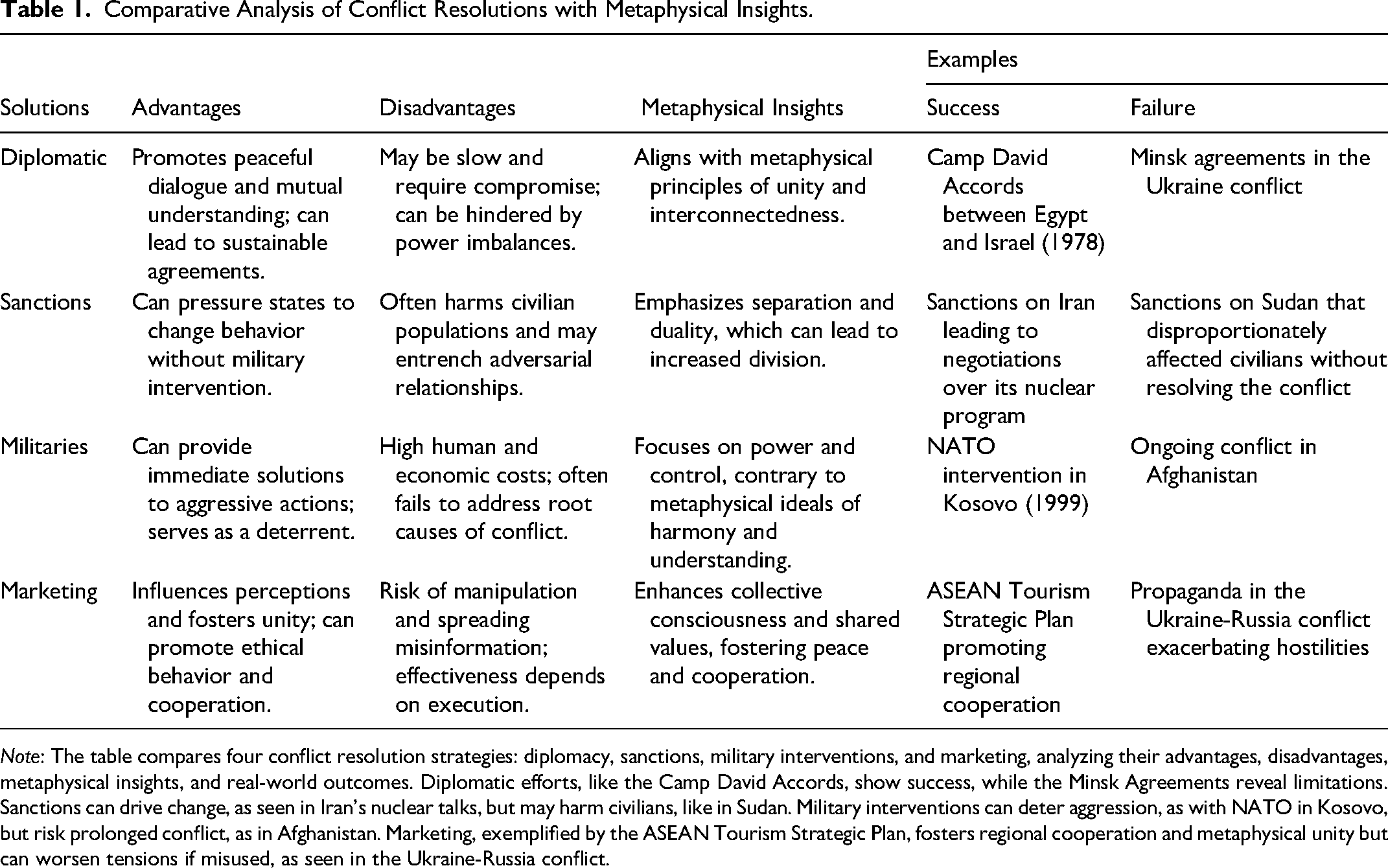
Note: The table compares four conflict resolution strategies: diplomacy, sanctions, military interventions, and marketing, analyzing their advantages, disadvantages, metaphysical insights, and real-world outcomes. Diplomatic efforts, like the Camp David Accords, show success, while the Minsk Agreements reveal limitations. Sanctions can drive change, as seen in Iran's nuclear talks, but may harm civilians, like in Sudan. Military interventions can deter aggression, as with NATO in Kosovo, but risk prolonged conflict, as in Afghanistan. Marketing, exemplified by the ASEAN Tourism Strategic Plan, fosters regional cooperation and metaphysical unity but can worsen tensions if misused, as seen in the Ukraine-Russia conflict.
New Roles of Marketing in Resolving Conflicts
In the modern global landscape, marketing is emerging as a potent tool for conflict resolution, transcending its traditional role of promoting goods and services. Marketing can address the underlying issues that drive conflicts by influencing perceptions, creating economic incentives, and guiding behavioral changes. Unlike traditional conflict resolution methods that often focus on immediate solutions, marketing strategies can facilitate long-term peace by transforming societal attitudes and behaviors. Integrating marketing with metaphysical insights offers a comprehensive framework for understanding and resolving conflicts, emphasizing empathy, cooperation, and shared values. Metaphysical concepts such as collective consciousness, the interconnectedness of human experiences, and the law of attraction provide a deeper understanding of the dynamics at play in conflict situations. This paper explores three innovative roles of marketing in conflict resolution: shaping perceptions and narratives, providing economic incentives, and promoting ethical engagement through Nudge Theory. By leveraging these strategies, marketing can build a more harmonious and interconnected world.
Marketing as the Tool for Shaping Perceptions and Narratives
Marketing can drive societal transformation by promoting ethical engagement and justice. Marketing can positively influence societal norms by addressing demand heterogeneity and creating narratives that resonate with diverse audiences (Fisk 1967). This involves crafting messages highlighting the benefits of collaboration and the shared humanity of conflicting parties. The metaphysical concept of collective consciousness suggests that the thoughts and actions of individuals and nations are interconnected, influencing the global state of peace and conflict. According to this view, marketing can be seen as tapping into and shaping this collective consciousness to foster empathy, cooperation, and mutual benefit (Sheldrake 2005). The law of attraction, another metaphysical concept, posits that positive thoughts and intentions can attract positive outcomes (Hicks and Hicks 2006). By emphasizing shared values and goals, marketing can create a more conducive environment for peace, shifting societal perceptions toward unity and understanding. By framing conflict as a shared challenge rather than a divisive issue, marketing can help unify disparate groups around common objectives and ideals.
Marketing as Economic Incentives in Conflict Resolution
Marketing can also serve as an economic incentive to resolve conflicts by encouraging collaboration and shared prosperity. Economic incentives can motivate conflicting parties to work together toward mutually beneficial outcomes. The metaphysical principle of mutual interdependence highlights how economic ties can foster cooperation by recognizing the shared interests of conflicting parties (Layton 2015). For example, businesses can leverage marketing to create cross-border partnerships that promote economic interdependence, reducing the likelihood of conflict. By highlighting the economic benefits of peace and stability, marketing can drive stakeholders to prioritize cooperation over confrontation (Prahalad 2005). Initiatives such as fair trade and corporate social responsibility can also be marketing tools to foster economic collaboration and reduce tensions (Klein and Leffler 1981). These initiatives resonate with the metaphysical understanding that economic actions are deeply interconnected with social and ethical outcomes, encouraging a holistic approach to conflict resolution that considers material and spiritual dimensions.
Promoting Ethical Engagement and Behavioral Change: the Role of Nudge Theory
Nudge Theory offers a framework for understanding how subtle environmental changes can influence behavior without restricting freedom of choice (Thaler and Sunstein 2021). This theory has been applied in various fields, including public health and environmental policy, but its application in conflict resolution is still emerging. Metaphysically, nudges align with the idea that small, intentional actions can lead to significant shifts in consciousness and behavior over time. For example, positive nudges in media coverage can significantly influence international relations by shaping public perception and guiding policy, a phenomenon that can be explained through metaphysical theories of interdependence and collective consciousness. In the 1970s and 1980s, U.S. media portrayed China as a strategic partner during the Cold War, encouraging the American public and policymakers to view China as an essential ally rather than a competitor. This positive framing highlighted mutual benefits, such as economic cooperation and diplomatic breakthroughs, including President Nixon's historic visit to China in 1972, creating an environment conducive to long-term collaboration across trade, science, and culture (Ikenberry 2008). From a metaphysical perspective, this narrative of interconnectedness fostered a collective belief in shared prosperity, reinforcing the idea that economic ties could enhance global cooperation and peace. As a result, China's integration into the global economy was seen as a positive step toward mutual benefit. However, negative nudges in media coverage have disrupted this metaphysical foundation in recent years. This negative framing has contributed to a growing perception of China as a political and economic aggressor, fueling economic decoupling and a retreat from globalization (Lardy 2019). This decoupling, in turn, has intensified pressures on political leaders from both sides to adopt more rigid and uncompromising stances, thus perpetuating a vicious cycle of escalating trade and technological conflict. The contrast between the positive nudges of the past and the current negative framing demonstrates how strategic media narratives, grounded in metaphysical beliefs, can either promote cooperation or deepen conflict, with profound implications for global stability and interdependence. However, the transformative potential of marketing in conflict resolution is inspiring, with the nudge approach proving highly effective in framing choices and negotiations to highlight mutual benefits (Sunstein 2014). For example, marketing campaigns that utilize nudge principles can encourage conflicting parties to adopt collaborative mindsets, emphasizing long-term gains over short-term disputes. Employing metaphysical insights and marketing strategies can transform how conflicts are perceived and addressed, fostering a more harmonious and interconnected world.
As marketing concepts are employed, the impact of cultural differences on strategies and the necessity for tailored approaches in different geopolitical contexts become critical. Cultural dimensions such as individualism versus collectivism, power distance, and uncertainty avoidance significantly influence consumer behavior and marketing effectiveness (Hofstede 2001; Trompenaars and Hampden-Turner 2011). From a metaphysical perspective, these cultural dimensions reflect deeper collective consciousness and shared values that shape societal behaviors and expectations. These cultural factors shape how marketing messages are perceived and can determine the success or failure of campaigns across diverse regions (Layton 2015; Nakata and Huang 2005). Understanding these cultural nuances is critical for crafting strategies that resonate with local values and communication styles, which can be seen as aligning with the metaphysical concept of interconnectedness and the law of attraction—where messages that resonate deeply are more likely to foster positive outcomes. This alignment enhances the potential of marketing to promote cooperation and peace in conflict-prone areas (Ghemawat 2001). This cultural sensitivity is essential for marketing to effectively contribute to global conflict resolution efforts by tapping into the collective consciousness and promoting empathy and mutual understanding (Schwartz 1994), especially in deeply entrenched disputes like the Israeli-Palestinian conflict, where metaphysical, cultural beliefs play a significant role. While changing these deeply held beliefs may prove challenging, the focus can shift toward mutual respect and coexistence. Cultural exchanges offer opportunities for both communities to better understand each other's perspectives without necessarily agreeing with them. Acknowledging the legitimacy of the other side's beliefs can reduce hostility and pave the way for peaceful coexistence. Encouraging the inclusion of both narratives in educational systems and public discourse helps each side recognize the humanity and valid concerns of the other, fostering collective empathy. This approach is not about forcing agreement but understanding that both cultures are meaningful to those who hold them. Research has shown that educational initiatives promoting cross-cultural understanding can significantly reduce prejudice and improve relationships between conflicting groups (Salomon and Nevo 2005). Fostering cultural understanding paves the way for cultivating a more harmonious and cooperative environment, where pursuing lasting conflict resolution becomes possible, even amidst differing metaphysical beliefs.
Propositions for Future Research
Building on the investigation, three major propositions are proposed to guide future research in exploring the role of marketing in conflict resolution:
Proposition 1: Exploring the Integration of Marketing and Metaphysics
Future research should delve into the systematic integration of metaphysical principles within marketing strategies to enhance their effectiveness in conflict resolution. Metaphysical concepts such as collective consciousness and the law of attraction offer profound insights into the underlying psychological and spiritual dynamics that influence human behavior (Hicks and Hicks 2006; Sheldrake 2005). By examining the impact of collective consciousness on consumer behavior, researchers can explore how shared beliefs and values influence purchasing decisions and social interactions (Jung 2014). This understanding can be leveraged to create marketing campaigns that resonate more deeply, promoting global empathy and cooperation.
Integrating metaphysical insights into marketing requires an interdisciplinary approach that combines philosophy, psychology, and marketing (Wilber 2001). Such an approach allows for developing comprehensive frameworks that address the psychological and spiritual dimensions of conflict resolution. For example, understanding the interconnectedness of individuals and communities can help marketers design messages emphasizing shared human experiences and common goals, fostering a sense of unity and collaboration (Capra 1996). Additionally, exploring the role of intention and mindfulness in marketing can lead to strategies that align with ethical and moral values, promoting long-term peace and sustainability (Shultz and Holbrook 1999).
This interdisciplinary integration challenges traditional marketing paradigms by emphasizing the importance of spiritual well-being and ethical engagement alongside economic objectives. By incorporating metaphysical principles into marketing strategies, businesses can play a pivotal role in addressing global conflicts, contributing to a more harmonious and interconnected world. Future research should focus on empirical studies that validate these theoretical frameworks, providing evidence of the transformative potential of marketing in conflict resolution (cf. Thaler and Sunstein 2021).
Proposition 2: Investigating Cultural Variations in Marketing's Role
Future research should explore the impact of cultural differences on the perception and effectiveness of marketing strategies in various geopolitical contexts. Cultural values, beliefs, and norms significantly influence consumer behavior and decision-making processes (Hofstede 2001; Schwartz 1994). These cultural frameworks can be viewed through a metaphysical lens, where collective consciousness and shared values represent the more profound spiritual and societal dynamics that drive behavior. Comparative studies across different regions can identify best practices and help tailor marketing approaches to specific cultural settings, ensuring strategies are both practical and culturally appropriate.
From a metaphysical perspective, understanding cultural nuances involves recognizing the interconnectedness of human experiences and the collective energies that shape societies. This understanding can reveal how marketing messages resonate with diverse populations and adapt them to be culturally sensitive and contextually relevant (Trompenaars and Hampden-Turner 2011). This is particularly important in conflict resolution, where misaligned messages exacerbate tensions rather than promote cooperation (Nakata and Huang 2005). Culturally informed marketing strategies can foster understanding and collaboration by aligning with target audiences’ values and communication styles, enhancing their potential to contribute to peacebuilding efforts (Ghemawat 2001). By integrating metaphysical concepts into marketing strategies, businesses can respect and leverage cultural diversity to promote harmony and conflict resolution. This proposition highlights the importance of cultural understanding in formulating global marketing strategies, emphasizing the need for tailored approaches that align with the spiritual and cultural dimensions of diverse communities to achieve more harmonious interactions and successful conflict resolution.
Proposition 3: Empirical Validation of Marketing's Impact on Conflict Resolution
Empirical studies are needed to validate the theoretical notions discussed in this paper, which explore the intersection of marketing and metaphysical principles in conflict resolution. This involves designing experiments and case studies to assess the real-world impact of marketing strategies on mitigating conflicts and promoting peace. By empirically testing these concepts, researchers can provide concrete evidence of marketing's efficacy in conflict resolution, paving the way for more practical applications and policy implementations.
Empirical validation involves exploring how marketing strategies align with collective consciousness and interconnectedness principles. These principles suggest marketing can influence individual behaviors and broader social dynamics, contributing to peace and conflict (Sheldrake 2005). Researchers can better understand effective conflict resolution's spiritual and psychological underpinnings by examining how marketing campaigns resonate with collective energies and societal values.
Empirical studies can also explore the role of intention and mindfulness in marketing, assessing how these metaphysical elements contribute to fostering empathy, cooperation, and understanding among conflicting parties (Layton 2009). By integrating these metaphysical insights into empirical research, we can better understand marketing's potential as a transformative tool for peacebuilding. For instance, the Sudan conflict resolution process offers a compelling example of how these metaphysical insights can be integrated into empirical research to assess marketing's transformative potential. During the peace negotiations in Sudan, efforts to emphasize shared national identity and a collective vision for the future were crucial in bridging divisions and fostering reconciliation. This approach, viewed through collective consciousness, aimed to heal long-standing animosities by appealing to a sense of unity and shared purpose. By framing the peace process as an inclusive journey toward a stable and prosperous nation, the stakeholders can transcend past grievances, leading to significant milestones in the peace process. Van Dijck (2013) supports this perspective by highlighting how digital platforms can amplify such messages, reinforcing collective consciousness and contributing to peacebuilding. This example underscores the potential for marketing strategies to shift the broader societal dynamics toward peace and cooperation when aligned with metaphysical principles.
The propositions presented in this paper highlight the transformative potential of marketing in conflict resolution through metaphysical insights. By integrating collective consciousness and cultural nuances, marketing strategies can enhance empathy and cooperation. Future research should empirically validate these approaches, demonstrating marketing's efficacy as a catalyst for peace. This integration of metaphysical and empirical perspectives can offer new solutions for global challenges, bridging the gap between theory and practice and positioning marketing as a powerful tool for fostering positive change in complex geopolitical landscapes.
Conclusion and Limitations
This commentary has explored the potential of marketing as a powerful tool for resolving international conflicts. Integrating metaphysical insights with marketing strategies can reshape societal perceptions and foster a collective consciousness focused on peace and cooperation (Schwartz 1994). The application of Nudge Theory further enhances the ability to promote ethical engagement and behavioral change, providing a novel approach to conflict resolution (Thaler and Sunstein 2021). While traditional methods such as diplomacy, sanctions, and military interventions have their place, they often fail to address the complexities of modern conflicts (Kaldor 2013; Zartman and Berman 1982). Marketing offers an alternative pathway, emphasizing interconnectedness and shared values. This paper adds incremental contributions to the literature by highlighting the transformative potential of marketing in conflict resolution, suggesting new avenues for research and practical application. Future research should continue to explore the metaphysical dimensions of marketing and their impact on conflict resolution, further validating the theoretical notions discussed in this paper (cf. Sheldrake 2005; Wright and Wright 1983).
Footnotes
Associate Editor
M. Joseph Sirgy
Declaration of Conflicting Interests
The author declared no potential conflicts of interest with respect to the research, authorship, and/or publication of this article.
Funding
The author received no financial support for the research, authorship, and/or publication of this article.
