






Abstract
Markets are dynamic systems evolving in response to societal, economic, and technological shifts. This commentary presents the Four-Stage Model of Marketing Systems, a theoretical framework grounded in Weber's concepts of formal and substantive rationality while also building upon and extending existing frameworks. The model traces market evolution across four phases: hierarchical formal markets, DIY markets, prosumer-driven platforms, and participatory prosumption collectivities. Emphasizing the transition from efficiency-focused “power-over” systems to inclusive, sustainable “power-with” systems, it integrates insights on governance, equity, and societal well-being. By examining examples like Stocksy and FairBnB, the commentary demonstrates how participatory models can address systemic challenges, such as inequality and ecological degradation, while fostering sustainable growth. The model has significant implications for marketing theory, policy, and practice, offering pathways to reimagine markets as tools for collective progress. This paper concludes with a call for interdisciplinary collaboration to align market systems with the values of equity, sustainability, and inclusivity.
Keywords
Introduction
Markets are dynamic systems that continuously evolve in response to societal, economic, and technological changes (Layton 2015; Vargo et al. 2017; Kelleci 2024). Before the Industrial Revolution, markets were deeply embedded within local communities and shaped by substantive rationality, as conceptualized by Weber 1978. Substantive rationality emphasizes collaboration, shared values, and decision-making processes guided by societal well-being rather than profit maximization. In contrast, formal rationality, also conceptualized by Weber 1978, prioritizes efficiency and profit maximization as the primary drivers of economic activity. Pre-industrial markets, therefore, were characterized by interpersonal relationships, cooperative governance, and resource-sharing, where economic activities were aligned closely with cultural, ethical, and social norms (Polanyi 1944). This collaboration-oriented structure prioritized community welfare and equitable value distribution, fostering social cohesion over efficiency.
The advent of the Industrial Revolution marked a significant transformation in market systems. The rise of industrialization and mass production introduced formal rationality emphasizing efficiency and profit maximization (Weber 1978). This shift underpinned modern market systems, driving unprecedented economic growth but often sidelining societal and ecological well-being. Power was centralized within hierarchical organizations, with decision-making focused on shareholder value, often at the expense of equity and inclusivity (Kelleci 2024). While this efficiency-driven model accelerated economic progress, it also laid the groundwork for many systemic problems afflicting markets today.
In our contemporary era, markets grapple with unprecedented crises, such as escalating income inequality and worsening ecological degradation. The World Inequality Report (2022) reveals that the wealthiest 1% of the global population controls nearly half of the world's wealth, exposing significant disparities in resource distribution. At the same time, the Intergovernmental Panel on Climate Change (IPCC) (2021) highlights the irreversible environmental damage caused by unsustainable production and consumption practices. These challenges underscore the urgent need to reimagine market structures that integrate societal values with economic objectives, moving beyond the limitations of formal rationality to address sustainability, equity, and inclusivity.
This commentary builds on my previous contributions to the Journal of Macromarketing, specifically the Four-Stage Model of Value Creation for Sustainability-Oriented Marketing (Kelleci 2022) and the Power-Based Typology of Marketing Systems (Kelleci 2024). Extending these frameworks, it introduces the Four-Stage Model of Marketing Systems Evolution, offering a comprehensive lens to understand how markets transition from centralized, efficiency-driven systems to participatory, sustainable, and inclusive models. Rooted in Weber's (Weber 1978) distinction between formal and substantive rationality, this expanded model integrates insights on power dynamics, highlighting the shift from power-over systems, which prioritize hierarchy and efficiency, to power-with systems, which emphasize collaboration, shared governance, and equitable value distribution (Kelleci 2024). This transition is further reflected in changes to value types: from value-in-exchange, focused on transactional relationships, to value-in-use and value-in-access, emphasizing consumer participation, and ultimately to value-in-participation, where shared governance and collaboration redefine value creation and value distribution (Kelleci 2022).
The Four-Stage Model outlines the evolution of market systems through the following phases:
This transition from power-over to power-with systems, as well as value types, mirrors broader societal shifts toward inclusivity, sustainability, and collaboration. Real-world examples, such as Stocksy (2024), a photographer-owned platform cooperative, and FairBnB (2024), which reinvests profits into local communities, illustrate the principles of Phase IV. These platforms challenge traditional market paradigms, demonstrating how participatory models can address systemic challenges while balancing economic and social objectives.
As dissatisfaction with traditional market systems grows, the Four-Stage Model offers a pathway for scholars, practitioners, and policymakers to explore new market structures that prioritize societal well-being alongside economic growth. By transitioning from formal to substantive rationality, markets have the potential to address pressing global challenges and pave the way for a more equitable and sustainable future.
This paper is organized as follows: Section 2 presents the theoretical foundations and stages of the Four-Stage Model of Marketing Systems Evolution. Section 3 examines the rise of digital prosumption collectivities, emphasizing their transformative potential for fostering equity, inclusivity, and sustainable value distribution. Section 4 investigates the capacity of bottom-up managed prosumer markets to drive sustainable and inclusive economic growth, analyzing their implications for societal, economic, and environmental resilience. Finally, Section 5 discusses the broader implications of the Four-Stage Model, offering insights into theory, policy, and practice, and concluding with directions for future research.
This commentary underscores the evolving role of markets as mechanisms for collective progress rather than instruments of pure profit maximization. By bridging historical and contemporary perspectives, it seeks to illuminate how markets can transition toward systems that reflect societal values, addressing the interconnected challenges of inequality and environmental sustainability.
The Four-Stage Model of Marketing Systems Evolution
Markets are not monolithic; they evolve through distinct phases that reflect shifts in societal values, economic systems, and technological capabilities. The Four-Stage Model of Marketing Systems Evolution captures this progression by integrating Weber's (Weber 1978) distinction between formal and substantive rationality with power dynamics in marketing systems. This framework provides a structured lens to understand how market systems transition from centralized, efficiency-driven structures to participatory, value-driven models.
Theoretical Foundations of the Four-Stage Model
The Four-Stage Model is grounded in two primary theoretical pillars, namely: (i) Weber's (Weber 1978) rationality framework and (ii) power dynamics in marketing systems, as discussed in Kelleci (2024).
With respect to the rationality framework, Weber 1978 distinguishes between two types of rationality in economic action:
Formal Rationality: Prioritizes efficiency, standardization, and predictability, often at the expense of social equity and long-term sustainability. Substantive Rationality: Focuses on societal well-being, ethical considerations, and collective values.
Traditional markets, driven by formal rationality, prioritized profit maximization and scalability during industrialization. However, as societal priorities have shifted toward inclusivity and sustainability, markets have increasingly embodied substantive rationality, aligning economic practices with broader social goals (Scholz 2016).
Building on Weber's (Weber 1978) insights, the model also incorporates the role of power structures in shaping market evolution. Traditional power-over systems focus on authority, perpetuating hierarchical decision-making and resource control. In contrast, power-with systems emphasize collaboration, participatory governance, and equitable value distribution (Kelleci 2024). This transition is accompanied by shifts in value types: from value-in-exchange, which prioritizes transactional efficiency, to value-in-use and value-in-access, reflecting increased consumer participation, and ultimately to value-in-participation, where collaboration and shared governance redefine the creation and distribution of value (Kelleci 2022). Together, these theoretical foundations provide a lens to analyze how markets evolve in response to societal, technological, and environmental pressures.
The Four Stages of Market Evolution
The Four-Stage Model outlines the progression of market systems across four distinct phases. Each phase represents a unique configuration of rationality, power structure, market dynamics, and value types.
Phase I: Top-Down Managed Formal Markets
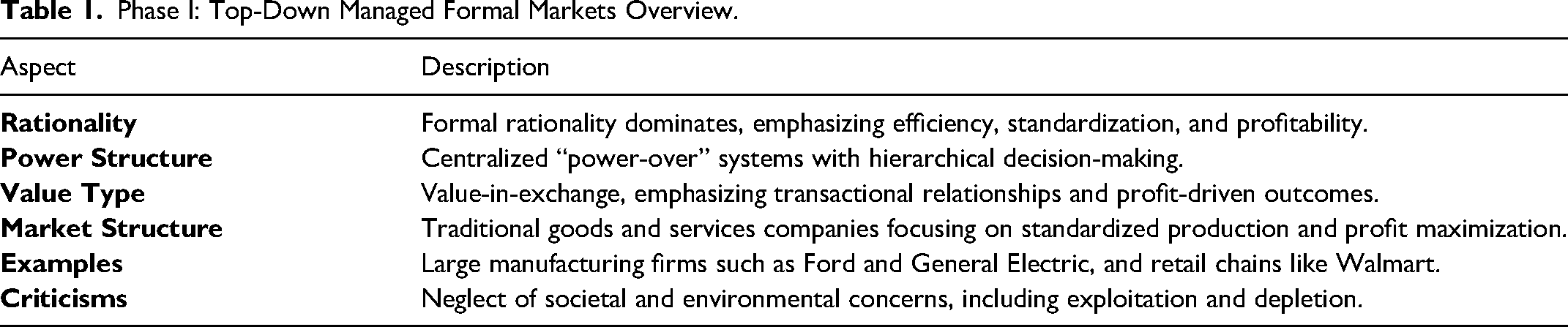
Phase I markets are characterized by a top-down, formally managed approach dominated by formal rationality, which prioritizes efficiency, standardization, and profitability. This phase also emphasizes value-in-exchange, as discussed by Kelleci (2022), focusing on transactional relationships aimed at maximizing profit. Centralized “power-over” systems govern these markets through hierarchical decision-making structures. Traditional goods and services companies, such as Ford and General Electric, as well as retail chains like Walmart, exemplify this phase. Iconic innovations, such as Ford's assembly-line production, epitomize the focus on efficiency and cost minimization, setting the foundation for modern mass production systems (Chandler 1990). However, this profit-centric approach often ignored societal and environmental concerns, leading to criticisms of exploitation and resource depletion. Refer to Table 1 for an overview of Phase I, which outlines the key characteristics of Top-Down Managed Formal Markets.
Phase II: Top-Down Managed DIY Markets
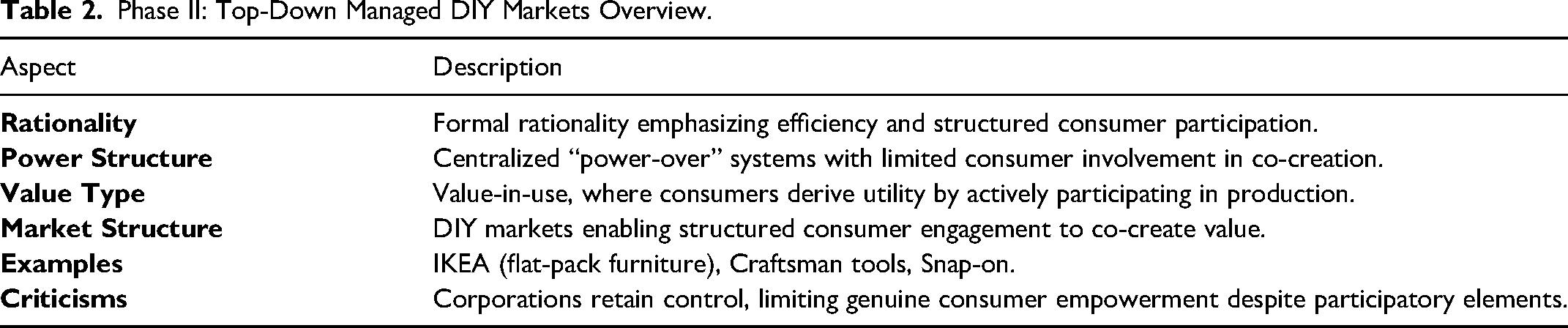
Phase II markets emphasize formal rationality and efficiency by integrating structured consumer participation into production processes. This phase aligns with the concept of value-in-use, where consumers derive utility by actively contributing to co-creating value (Payne, Storbacka, and Frow 2008). For example, DIY models such as IKEA's flat-pack furniture and Craftsman tools reduce labor costs while fostering consumer engagement. Although Kelleci (2022) does not explicitly discuss value-in-use, this lens provides a useful perspective for analyzing such examples. However, these markets remain governed by centralized “power-over” systems, where corporations retain control over production and distribution. While participatory approaches encourage consumer involvement, their potential for genuine empowerment is limited by the persistence of traditional corporate hierarchies. This transitional stage highlights a balance between consumer participation and centralized governance, ultimately reinforcing corporate control. Refer to Table 2 for an overview of Phase II, highlighting the characteristics of Top-Down Managed DIY Markets.
Phase II: Top-Down Managed DIY Markets Overview.
Phase III: Top-Down Managed Prosumer Markets
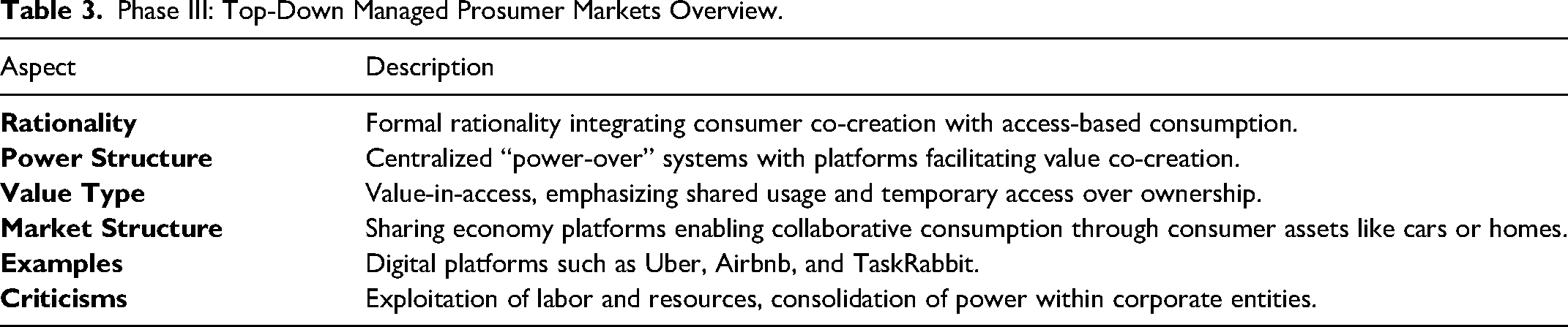
Phase III markets represent the rise of the digital prosumer, characterized by a top-down approach where formal rationality integrates consumer co-creation with a renewed focus on access rather than ownership. This phase aligns with value-in-access, as discussed by Kelleci (2022), where consumers utilize shared resources through digital platforms, fostering collaborative consumption without the need for ownership. Platforms such as Uber, Airbnb, and TaskRabbit epitomize this phase by leveraging consumer assets like cars and homes to deliver services. While these platforms enable flexibility and innovation, they maintain centralized governance, consolidating power and profit within corporate entities. As Kenney and Zysman (2016) and Srnicek (2017) argue, these systems perpetuate hierarchical “power-over” dynamics under the guise of empowerment. Critics, including Kelleci (2024), argue that such models exploit labor and resources, raising concerns about their long-term sustainability and equitable value distribution. Despite these challenges, Phase III highlights the transformative role of digital prosumers, blending production and consumption in ways that redefine market participation and efficiency. See Table 3 for a summary of Phase III, detailing the features of Top-Down Managed Prosumer Markets.
Phase III: Top-Down Managed Prosumer Markets Overview.
Phase IV: Bottom-Up Managed Prosumer Markets
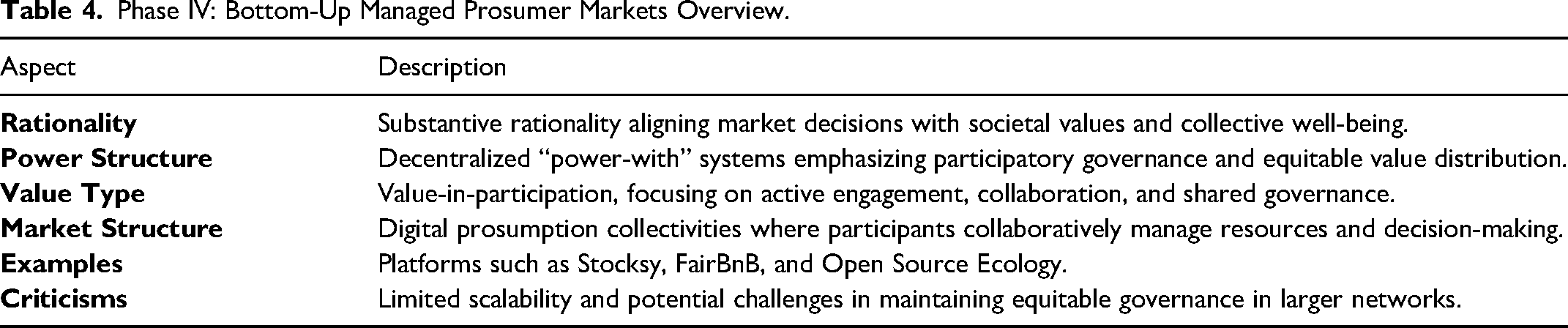
Phase IV markets represent the emergence of bottom-up managed prosumer systems, where substantive rationality takes precedence, aligning market decisions with societal values and collective well-being. This phase emphasizes value-in-participation, as discussed by Kelleci (2022), focusing on active engagement, collaboration, and equitable value distribution. Power is decentralized, transitioning from “power-over” systems to “power-with” systems that prioritize participatory governance and shared control over resources (Kelleci 2024). Platforms like Stocksy (2024) exemplify the principles of this phase by redistributing profits among members and granting governance rights, fostering a sense of ownership and community. Similarly, FairBnB (2024) reinvests profits into local communities, emphasizing social impact over shareholder returns. These markets challenge traditional hierarchies and promote an equitable and sustainable economic model, as they prioritize solidarity, inclusivity, and shared responsibility in decision-making. However, criticisms of Phase IV include concerns about limited scalability and the difficulty of maintaining equitable governance in larger, more complex networks. While these systems offer a transformative approach to market systems, their reliance on decentralized governance can create inefficiencies and challenges in decision-making as they scale (Scholz 2016). Nonetheless, Phase IV provides a forward-looking framework for markets to align with emerging trends in collective action and sustainable development. Refer to Table 4 for a summary of Phase IV, focusing on the features of Bottom-Up Managed Prosumer Markets.
Phase IV: Bottom-Up Managed Prosumer Markets Overview.
Drivers of Market Evolution
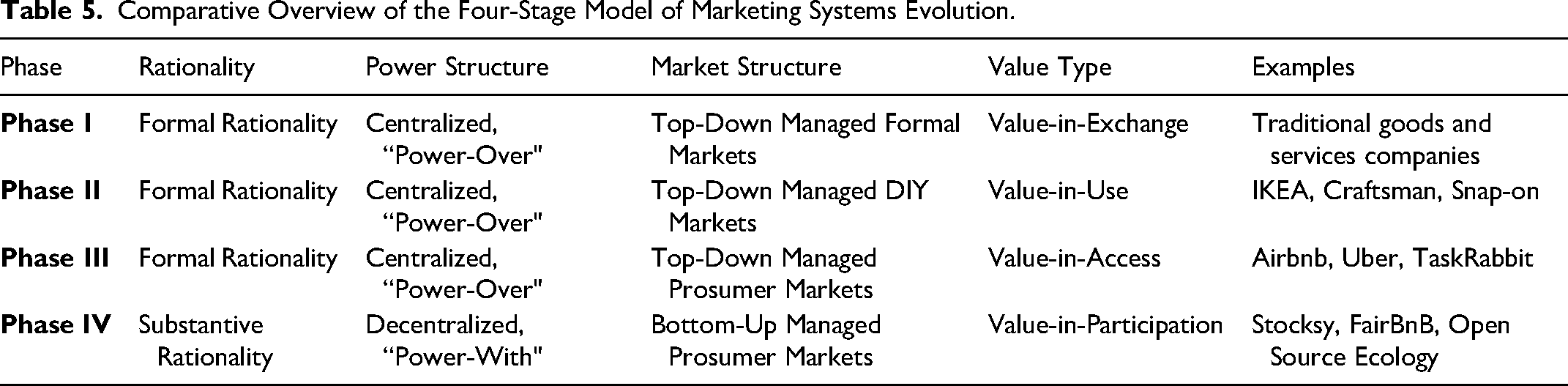
The progression of market systems through the four phases is influenced by several key drivers. First, technological advancements, such as the internet, blockchain, and artificial intelligence, have played a pivotal role in enabling decentralized governance and participatory decision-making. These innovations empower individuals and organizations to engage in markets in ways that were previously unattainable (Tapscott and Tapscott 2016; Kelleci 2024). Second, shifting consumer expectations have significantly shaped market evolution. Modern consumers increasingly demand transparency, equity, and sustainability in market systems, reflecting a growing preference for ethical and socially responsible practices (Rifkin 2014). These changing preferences push markets toward more inclusive and participatory models. Finally, policy and regulation have served as crucial drivers of change. Governments and international organizations are implementing frameworks designed to foster inclusive and sustainable markets. Initiatives like the United Nations Sustainable Development Goals exemplify the growing institutional support for market systems that prioritize societal well-being alongside economic growth. These factors collectively propel the evolution of market systems, shaping their transition across the four phases. Refer to Table 5 for a comparative overview of the Four-Stage Model of Marketing Systems Evolution.
Comparative Overview of the Four-Stage Model of Marketing Systems Evolution.
The Rise of Digital Prosumption Collectivities: From Value Co-Creation to Equitable Value Distribution
The discussion in this section emphasizes the transformative potential of prosumption collectivities, particularly their alignment with Phase IV principles. These collectivities signify a transformative shift in how markets create, distribute, and govern value. By integrating producers and consumers into unified ecosystems, they challenge the dominance of traditional markets focused on efficiency and profit maximization. Digital technologies have reduced barriers to participation and decentralized economic activities, fostering new forms of collaboration where consumers actively engage in production, distribution, and governance processes (Bauwens 2005; Rifkin 2014; Kelleci 2024). Digital prosumption collectivities represent the evolution of markets from formal rationality, which prioritizes efficiency and profit, toward substantive rationality, which emphasizes societal values and collective well-being (Weber 1978). These platforms promote inclusivity, equity, and sustainability, aligning with the broader transition from Phase III to Phase IV in the Four-Stage Model of Marketing Systems Evolution.
From Value Co-Creation to Equitable Value Distribution
Early digital platforms introduced value co-creation, where consumers actively shaped goods and services. Platforms like Airbnb and Uber exemplified this by enabling users to contribute assets, such as homes and vehicles, and labor to the value creation process. While these platforms provided flexibility and monetization opportunities, they perpetuated traditional “power-over” structures, consolidating decision-making authority and profits within centralized corporate entities (Belk 2014; Srnicek 2017). In contrast, digital prosumption collectivities prioritize equitable value distribution, sharing economic benefits and governance responsibilities among participants. These platforms challenge asymmetrical power dynamics by focusing on transparency, inclusivity, and shared ownership (Scholz 2016). For instance, Stocksy (2024), a photographer-owned platform cooperative, redistributes profits among its members and grants equal voting rights. Similarly, FairBnB (2024) reinvests a portion of its profits into local community projects, fostering economic resilience and mitigating negative externalities of tourism. Open Source Ecology (2024), a global network that develops open-source industrial machines, further emphasizes equitable access to resources and innovation by sharing designs freely, challenging proprietary models. These platforms demonstrate the shift from co-creation, which often disproportionately benefits platform owners, to equitable distribution, where value is shared among all stakeholders.
The Evolution of Digital Prosumption Collectivities
Digital prosumption collectivities emerged as a response to the limitations of traditional markets and digital platforms. They align with broader societal demands for equity, sustainability, and participatory governance. This evolution can be understood through three key developments. First, technological advancements, such as blockchain and peer-to-peer networks, have enabled decentralized governance and transparent value distribution. Blockchain cooperatives allow participants to track transactions without intermediaries, enhancing trust and reducing costs (Tapscott and Tapscott 2016). Platforms like Holochain (2024) extend these capabilities by enabling distributed data storage and governance, fostering greater autonomy and collaboration. Second, shifting consumer preferences have driven this evolution. Consumers increasingly value transparency, ethical practices, and sustainability in their economic engagements. Research highlights that Millennials and Gen Z prefer platforms and brands committed to social and environmental responsibility (Nielsen 2015). Prosumption collectivities cater to these preferences, offering alternatives to extractive economic models. Third, rising economic and social inequalities have increased demand for alternative systems. The World Inequality Report (2022) highlights the growing wealth gap between the global elite and the majority population. Digital prosumption collectivities address these disparities by democratizing access to resources and ensuring that economic benefits are distributed equitably.
Core Principles of Digital Prosumption Collectivities
Digital prosumption collectivities are characterized by principles that distinguish them from traditional digital platforms. Decentralized governance is a key feature, empowering participants to engage in decision-making processes. Unlike traditional platforms where corporate executives dominate governance, platforms like Stocksy (2024) operate on a one-member-one-vote basis, ensuring equal representation. Equitable value distribution is another defining characteristic. For example, FairBnB (2024) reinvests profits into community development projects, creating a cycle of local economic growth and social impact. Sustainability and societal impact are also central to these platforms. Open Source Ecology (2024), for instance, promotes long-term sustainability by providing open-access technologies that reduce ecological footprints. Additionally, transparency and accountability are essential. Blockchain cooperatives, for example, provide immutable records of transactions and governance decisions, enhancing trust among participants.
Challenges and Limitations
Despite their transformative potential, digital prosumption collectivities face significant challenges that hinder scalability and broader adoption. Regulatory barriers remain a major obstacle, as legal frameworks in many countries fail to support platform cooperatives and decentralized markets. Tax codes and labor laws, designed for traditional businesses, often exclude these innovative models (Scholz 2016). Cultural resistance also poses a challenge. Consumers accustomed to traditional platforms may hesitate to adopt new models, requiring sustained efforts to build trust and awareness. Technological complexity further adds to these difficulties. While technologies like blockchain offer promising solutions, their complexity can create barriers to entry for participants with limited technical knowledge (Tapscott and Tapscott 2016). Moreover, funding and scalability remain critical issues. Many prosumption collectivities struggle to secure funding for expansion, as they prioritize equitable practices over profit maximization. Competing with profit-driven platforms like Uber and Airbnb exacerbates these challenges.
Future Directions for Digital Prosumption Collectivities
To fully realize their potential, digital prosumption collectivities must address these challenges while leveraging their strengths. Policy advocacy is critical, as governments and policymakers should establish supportive legal frameworks for platform cooperatives. Italy's cooperative laws provide a useful model for fostering these systems (Lomuscio, Tortia, and Cori 2023).
Technological innovation can lower barriers to participation. User-friendly tools can make prosumption collectivities more accessible and inclusive. Collaborative networks can further enhance scalability and resilience. Building alliances among cooperatives amplifies their collective impact. Global networks like the Platform Cooperative Consortium (2024) exemplify the power of collaboration in advancing shared goals. Public awareness campaigns are equally vital. Educating consumers about the benefits of prosumption collectivities, along with highlighting success stories like Stocksy and FairBnB, can inspire trust and participation. By prioritizing decentralized governance, equitable value distribution, and sustainability, digital prosumption collectivities challenge traditional “power-over” systems. As they continue to evolve, they offer a compelling blueprint for inclusive and sustainable markets aligned with societal values. Further exploration of their broader implications for economic growth and societal well-being remains essential.
Can Bottom-Up Managed Prosumer Markets Drive Sustainable and Inclusive Economic Growth?
This section explores how bottom-up managed markets align with sustainability and inclusivity goals, showcasing their economic and social potential. Grounded in substantive rationality and participatory governance, these markets offer an alternative to traditional economic systems by balancing societal values, environmental sustainability, and inclusivity. They challenge the conventional focus on short-term profit maximization, demonstrating how collaborative models can address pressing global challenges.
Sustainability is central to the long-term economic potential of bottom-up markets. Unlike traditional markets, which externalize environmental costs, these systems integrate ecological considerations into their practices. Circular economy models prioritize resource efficiency, waste reduction, and material reuse. For instance, Open Source Ecology (2024) develops modular, repairable tools that reduce waste and promote conservation. Localized economies enhance resilience by reinvesting in communities and reducing reliance on global supply chains. FairBnB (2024), for example, directs profits toward local projects, strengthening infrastructure and fostering growth. Environmental innovation also plays a vital role, addressing ecological challenges through solutions like renewable energy and sustainable agriculture. The Open Food Network, which connects local producers and consumers, reduces food system carbon footprints by shortening supply chains (Scholz 2016). By integrating sustainability, these markets provide a path for economic growth within ecological limits.
Inclusivity is equally pivotal in bottom-up markets. Decentralized decision-making empowers marginalized groups, fostering equitable value distribution. Stocksy (2024), a photographer-owned cooperative, ensures participants have ownership and voting rights, distributing economic benefits and decision-making authority equitably (Scholz 2016). Redistribution of wealth further addresses inequality by directing profits toward underprivileged areas. FairBnB (2024), for example, reinvests in communities to narrow wealth gaps and support local development. Social impact is integral, creating opportunities for disadvantaged groups to engage in economic activities. Open Source Ecology (2024) provides training and resources for sustainable livelihoods, enabling participation in underserved regions. Through inclusivity, these markets promote economic equity and social cohesion.
The transformative potential of bottom-up managed prosumer markets lies in their ability to redefine growth beyond traditional metrics like GDP. Decentralized value creation leverages collective contributions to generate innovative outcomes. Wikipedia exemplifies this by producing high-quality, global-scale knowledge without hierarchical control (Benkler 2006). These markets also enhance resilience against economic shocks by distributing risk among participants. Local cooperatives, for instance, maintained activity during the 2008 financial crisis, when centralized systems faltered (Birchall 2013). Alternative metrics, such as Social Return on Investment (SROI), capture the social and environmental benefits generated by these markets, offering a more holistic measure of success (Rifkin 2014). By broadening growth metrics, bottom-up markets demonstrate their viability as engines of sustainable and inclusive economic progress.
Despite their promise, bottom-up markets face challenges that limit their scalability. Regulatory barriers often favor hierarchical corporations, creating obstacles for platform cooperatives. Cooperative businesses, for instance, struggle to access financing due to restrictive policies designed for traditional models (Scholz 2016). Cultural resistance complicates adoption, requiring sustained efforts to shift mindsets toward collaboration and equity. Technological gaps also hinder participation, as complex tools like blockchain can deter users with limited expertise (Tapscott and Tapscott 2016). Moreover, competition with profit-driven platforms poses a significant hurdle, as larger systems often dominate markets through scale and resources. Addressing these barriers is essential for these markets to reach their full potential.
Policymakers play a crucial role in fostering bottom-up managed markets. Supportive legal frameworks, such as Italy's cooperative laws, provide a template for enabling participatory governance structures (Birchall 2013). Financial incentives, including subsidies, grants, and tax breaks, can support the development of platforms prioritizing inclusivity and sustainability. Public awareness campaigns are equally vital, educating consumers about the benefits of collaborative models to drive adoption. Investments in user-friendly digital tools can lower technological barriers and enhance scalability. By implementing these measures, governments can create an environment where bottom-up markets thrive.
Future directions for bottom-up managed markets should focus on advancing research and practical initiatives. Empirical studies are needed to quantify their social, environmental, and economic impacts, providing evidence for broader adoption. Building international networks of prosumer platforms can foster knowledge sharing and mutual support. Technological innovation, including blockchain and AI, can improve efficiency and scalability. Exploring partnerships with public institutions may also uncover pathways for scaling these systems. Bottom-up markets challenge traditional hierarchies and extractive practices, offering a transformative approach to economic systems. By aligning with societal values, they present a blueprint for addressing global challenges and fostering inclusive prosperity. While scaling requires overcoming significant barriers, their potential to drive sustainable and equitable growth underscores the need for deeper exploration of their implications.
Discussion and Implications
The Four-Stage Model of Marketing Systems Evolution offers a novel framework for understanding the transformation of market systems from efficiency-driven, hierarchical structures to participatory, sustainable, and inclusive models. This section reflects on the broader implications of this transition, exploring its relevance to marketing theory, practice, policy, and future research.
Theoretical Contributions
The Four-Stage Model makes several significant contributions to marketing and organizational theory by redefining the role of markets in addressing societal challenges. The model synthesizes Weber's (Weber 1978) concepts of formal and substantive rationality with power dynamics to explain the evolution of markets. By demonstrating the transition from “power-over” systems to “power-with” systems, it challenges traditional economic assumptions that prioritize efficiency and profit maximization. The model also reframes market evolution by framing it as a continuum influenced by societal values, technology, and power structures. This perspective broadens the scope of marketing theory, positioning markets not only as economic mechanisms but also as tools for social transformation (Polanyi 1944). A key focus of the model is on prosumption collectivities, highlighting the rise of digital prosumption collectivities as a distinct phenomenon in market evolution. It offers a framework for studying their governance, value distribution, and societal impact (Bauwens 2005; Scholz 2016). Finally, the model provides interdisciplinary insights by drawing from sociology, economics, and environmental studies, bridging disciplinary gaps and enriching the understanding of how markets can contribute to sustainable development and social equity. These theoretical contributions lay the foundation for future research and practical applications, positioning marketing as a discipline that actively engages with societal challenges.
Practical Implications
The Four-Stage Model provides actionable insights for practitioners, including businesses, entrepreneurs, and platform designers, seeking to align their operations with emerging societal priorities. It offers guidance for designing equitable platforms by emphasizing equitable value distribution and participatory governance. For example, companies can adopt cooperative ownership structures or implement profit-sharing mechanisms to foster inclusivity. The model also underscores the importance of aligning with consumer expectations. Consumers increasingly demand transparency, sustainability, and ethical practices. Platforms that prioritize these values, such as Stocksy and FairBnB, have demonstrated competitive advantages in attracting and retaining users. Leveraging technological innovation is another critical takeaway. Digital tools such as blockchain and peer-to-peer networks can enable decentralized governance and transparent value distribution, empowering businesses to align their practices with Phase IV principles. Finally, the model highlights the need to address systemic challenges. Businesses can adopt circular economy principles and reinvest in local communities to address environmental and social challenges. These practices not only enhance brand reputation but also contribute to long-term resilience.
Policy Implications
Policymakers play a vital role in supporting the transition to sustainable and inclusive markets. Legal frameworks tailored to platform cooperatives can address regulatory hurdles that limit scalability. Governments should implement policies recognizing cooperative ownership models and incentivize participatory governance through tax benefits and subsidies. Financial support, such as grants and low-interest loans, can enable platforms to scale while maintaining commitments to equity and sustainability. Education and public awareness campaigns can promote the benefits of collaborative economic models, driving consumer and investor engagement. International organizations can establish global standards for sustainable markets, encouraging the adoption of best practices worldwide. By fostering these systems, policymakers can facilitate an equitable and sustainable economic future.
Broader Societal Implications
The transition to bottom-up managed markets has far-reaching societal implications. By decentralizing decision-making and redistributing economic benefits, these markets empower communities to take control of their economic futures. They reduce inequality by creating opportunities for marginalized groups to participate in and benefit from economic activities. Decentralized systems are inherently resilient, providing stability during economic and environmental shocks. Moreover, the principles of collaboration, equity, and sustainability embedded in these markets inspire broader cultural shifts toward shared responsibility and collective action.
Future Research Directions
The Four-Stage Model opens avenues for further study. Empirical research is needed to validate its principles and examine how market stages manifest across industries and regions. The integration of technologies like AI and blockchain should be explored to understand their role in enabling decentralized governance and value distribution. Addressing scalability challenges is critical; studies should identify barriers and propose strategies to expand bottom-up markets without compromising core principles. Cross-cultural research can reveal how regional differences affect the adoption and success of these systems. Developing new metrics, such as those measuring social, environmental, and economic impacts, is essential for a comprehensive evaluation of prosumption markets’ effectiveness.
Concluding Reflections
The Four-Stage Model of Marketing Systems Evolution offers a blueprint for reimagining markets as tools for collective progress rather than instruments of exploitation. By integrating societal values, participatory governance, and sustainable practices, bottom-up managed prosumer markets represent a critical step toward addressing global challenges. However, realizing this potential requires coordinated efforts from scholars, practitioners, policymakers, and communities. While the challenges are significant, the principles of Phase IV markets provide a hopeful vision for the future—one where economic systems align with the values of equity, sustainability, and inclusivity. This commentary invites further exploration and collaboration, emphasizing the role of marketing in shaping a more equitable and sustainable world. By reimagining markets as tools for collective progress, the Four-Stage Model offers a vision for addressing global challenges. It calls on scholars, practitioners, and policymakers to collaborate in shaping a future where markets align with the values of equity, sustainability, and inclusivity.
Phase I: Top-Down Managed Formal Markets Overview.
Footnotes
Acknowledgments
I would like to thank Prof. M. Joseph Sirgy for his invaluable guidance in refining this commentary. His detailed feedback and suggestions shaped this commentary and were instrumental in bringing it to its final form.
Associate Editor
M. Joseph Sirgy
Declaration of Conflicting Interests
The author declared no potential conflicts of interest with respect to the research, authorship, and/or publication of this article.
Funding
The author received no financial support for the research, authorship, and/or publication of this article.
