







Abstract
Social marketing faces interconnected challenges across identity formation, educational provision, and global knowledge representation. Existing scholarship treats these as separate problems, but this paper argues they are manifestations of competing institutional logics: market logic privileging commercial orientation, academic logic rewarding methodological conformity, and public welfare logic demanding transformative social impact. Underpinning these tensions are epistemological questions about what counts as valid knowledge and whose knowledge is recognised, questions that existing frameworks have not systematically addressed. We introduce the Disciplinary Advancement Framework for Social Marketing (DAfSM), which provides analytical tools for engaging with these tensions deliberately rather than reproducing them unconsciously. DAfSM integrates institutional logics theory to diagnose competing pressures, institutional work to specify how actors create, maintain, and disrupt disciplinary structures, and reflective equilibrium as a method for iteratively navigating tensions that resist permanent resolution. Drawing on philosophical accounts of knowledge as socially situated and contextually grounded, the framework distinguishes structural exclusion from paradigmatic exclusion as two analytically separate mechanisms through which Global South and community knowledge is marginalised within the discipline. An illustrative application to the African Social Marketing Association (AfSMA) demonstrates the framework's diagnostic and generative capacity across identity, educational, and epistemic domains. The paper contributes a theoretically grounded framework that moves beyond mapping disciplinary tensions to enabling strategic engagement with them, with transferable implications for applied disciplines facing analogous contradictions between institutional legitimacy and transformative capacity.
Keywords
Introduction
The marketing discipline has long confronted an unresolved tension between its role as a managerial technology serving organisational interests and its potential as a social science examining how exchange processes shape societal outcomes. The American Marketing Association's successive definitional revisions, from the 1985 emphasis on organisational planning through the 2007 recognition of marketing as benefiting ‘society at large’, reflect this ongoing struggle (Wilkie & Moore, 2003). Dholakia et al. (2020) trace how the broadening of the marketing concept became entangled with neoliberal ideology, producing what they term an ‘unwitting corruption’ whereby marketing's conceptual apparatus increasingly naturalises market logics across all domains of social life.
Social marketing, defined as the application of marketing principles and techniques to influence behaviours that benefit individuals and society (Andreasen, 1994; Kotler & Zaltman, 1971), emerged as an effort to redirect marketing capabilities toward addressing social, health, and environmental challenges (Dietrich et al., 2022). Five decades of development have produced dedicated journals (Truong, 2014) and professional associations spanning six continents, including the recent African Social Marketing Association (AfSMA) (Akbar et al., 2021; Cateriano-Arévalo et al., 2022; Ellis et al., 2026). The field has also seen extensive application across multiple domains. These include public health (Gordon et al., 2016; Grier & Bryant, 2005), environmental sustainability (McKenzie-Mohr, 2011; Peattie & Peattie, 2009), and social policy (Donovan, 2011; French & Blair-Stevens, 2007), as well as more recent interventions targeting intergroup relations, inclusion, and measurable educational outcomes such as student wellbeing and academic performance within institutional contexts (Campbell et al., 2026).
Yet social marketing's identity crisis is nested within marketing's own unsettled disciplinary architecture. Despite its intellectual productivity, marketing remains internally segmented across strategic, behavioural and analytical domains whose conceptual trajectories only partially converge (Kozlenkova et al., 2025). This structural differentiation complicates efforts to articulate a stable normative centre for the discipline and leaves unresolved whether marketing ultimately legitimates itself through organisational performance, societal contribution or a fragile reconciliation of both. In this context, social marketing cannot anchor its identity to a parent discipline whose own mandate remains institutionally negotiated rather than definitively settled. The resulting instability is threefold: jurisdictional ambiguity about what falls within social marketing's proper domain (Abbott, 2001), epistemic subordination to the commercial marketing paradigms from which it derives its tools, and normative ambition that exceeds its institutional power to deliver systemic change.
Understanding this identity requires distinguishing social marketing from the broader ‘Better Marketing for a Better World’ movement, which Chandy et al. (2021) define as the use of marketing activities and ideas to impact outcomes beyond financial performance of firms. This umbrella encompasses corporate social responsibility (Crane et al., 2014; Maon et al., 2010), sustainability marketing (Belz & Peattie, 2012; Kumar & Christodoulopoulou, 2014), and cause-related marketing, all of which operate within existing market structures without interrogating whether those mechanisms might themselves constitute part of the problem. Social marketing, particularly in its critical variants (Gordon, 2011; Gordon et al., 2022), holds at least the potential to interrogate the structural conditions that necessitate behavioural interventions, whilst macro-social marketing (Kennedy, 2016; Kennedy & Smith, 2022) targets upstream systemic change. Conflating these approaches obscures what is distinctively challenging about social marketing: its simultaneous dependence upon and critique of the discipline from which it derives its institutional legitimacy.
Social marketing's critics have articulated these challenges from several vantage points. The most persistent criticism concerns the field's emphasis on individual behaviour change at the expense of structural analysis (Gordon et al., 2022; Lefebvre, 2011, 2013). A related critique positions social marketing as an instrument of neoliberal governance that reinforces the premise that market mechanisms are appropriate tools for all social challenges (Dholakia et al., 2020; Gordon et al., 2016). From a decolonial perspective, social marketing's theoretical frameworks and knowledge hierarchies reproduce Global North perspectives whilst marginalising alternative ways of understanding social problems (Connell, 2007; Jafari, 2022; Raciti, 2021; Santos, 2014). A fourth criticism concerns paternalism: Gordon et al. (2016) raise the fundamental question of who decides what constitutes ‘social good’ and whose values guide behavioural objectives, observing that different ethical and political perspectives produce markedly different answers. These critiques expose internal contradictions about social marketing's relationship to the institutional structures and market logics it simultaneously utilises and claims to transcend. The term ‘contradiction’ is used throughout this paper not in its strict logical sense of mutual exclusion, but in the sense established within institutional logics theory: the simultaneous operation of competing pressures that pull actors and organisations in different directions, generating tensions that require ongoing navigation rather than permanent resolution (Seo & Creed, 2002; Thornton et al., 2012).
Underpinning these contradictions are epistemological questions about what counts as valid knowledge and how knowledge claims are justified. Epistemology, the branch of philosophy concerned with the nature, sources, and limits of knowledge, is not merely an abstract concern. In applied disciplines, epistemological commitments determine which research methods are valued, whose evidence is recognised, and which forms of understanding are excluded from scholarly discourse. Social marketing's dominant frameworks, largely positivist and derived from commercial marketing traditions, reflect a mechanistic and formistic orientation to knowledge that privileges codified, generalisable, and formally articulated evidence (Tsoukas, 1994), whilst marginalising practitioner knowledge, Indigenous ways of knowing, and culturally embedded understandings of social change (Raciti, 2021; Santos, 2014). In using the term ‘knowledge’ to describe these forms of understanding, this paper draws on philosophical accounts of knowledge as socially situated (Williams, M., 2001), alongside work in knowledge studies that conceptualises knowledge as emerging through different processes of articulation linking procedural understanding with contextual insight (Williams, R., 2006). Rather than treating knowledge as a singular, hierarchical construct, this paper draws on Williams, R. (2006) in understanding it as the outcome of different processes of articulation linking procedural understanding with contextual insight. From this perspective, formal academic knowledge represents only one form of objectified knowledge, produced through processes that abstract from context and standardise information for broader transferability, whilst other forms of knowledge remain embedded in lived experience, narrative, and situated practice. Such forms correspond to what Williams, R. (2006) describes as ante-formal and contextual knowledge, which retain their connection to specific social settings and practical action.
This view is consistent with Lindkvist's (2005) account of knowledge as situated within communities and collectivities of practice, where knowing is constituted through participation, shared experience, and the development of context-specific competencies rather than solely through the acquisition of formalised, abstract expertise. Knowledge, in this sense, is not detached from its producers but is embedded in social relations and practices, and its validity is established through its effectiveness within particular contexts. The argument, therefore, is not that community and practitioner understanding escapes the requirement of justification, but that the forms of justification it employs are specific to the epistemic frameworks within which it is produced. As Tsoukas (1994) demonstrates, different types of knowledge, whether formistic, mechanistic, contextualist, or organicist, operate according to distinct assumptions, logics, and criteria of validation that are not reducible to a single overarching standard. Community-based and practitioner knowledge can thus be understood as operating within contextualist and practice-based epistemologies, where validity is grounded in situated relevance, coherence with lived experience, and practical efficacy, rather than in abstraction, generalisability, or methodological formalisation alone.
These contradictions manifest across three interconnected domains. First, definitional ambiguity continues to undermine theoretical coherence despite consensus efforts (French et al., 2020; iSMA, 2014). Boundary disputes persist with behavioural economics (Dolan et al., 2012; Thaler & Sunstein, 2008), corporate social responsibility (Crane et al., 2014; Maon et al., 2010), and sustainability marketing (Belz & Peattie, 2012; Kumar and Christodoulopoulou, 2014), whilst internal debates continue about proper scope and methods (Andreasen, 2002; Hastings, 2003; Lefebvre, 2011). Second, educational provision remains structurally fragmented across business schools (Kelly, 2009, 2013), public health (Biroscak et al., 2014), development studies (White, 2018), and policy analysis (Harris, 2022), creating inconsistencies in graduate preparation despite dedicated programmes at select institutions (Cateriano-Arévalo et al., 2022; Foote et al., 2023; Kennedy et al., 2022; Lee, 2020). Most business schools retain commercially focused models shaped by neoliberal institutional logics (Dholakia et al., 2020), with critical gaps around power analysis, cultural competency, and reflexive practice (Kubacki et al., 2017). Third, scholarly knowledge production continues to be shaped by Global North institutions and epistemologies, even as marketing and social change practices are enacted across diverse global contexts (Kravets & Varman, 2022; Santos & Laczniak, 2009). Schmidtke et al. (2021) found that interventions in low and middle-income countries frequently underutilise core principles because these were developed without attention to local constraints, whilst Kubacki and Szablewska (2019) demonstrate that Indigenous-led interventions incorporating traditional knowledge systems outperform conventional approaches yet remain peripheral to mainstream discourse (Jafari, 2022; Varman & Belk, 2012). As Gordon et al. (2016) observe, social marketing remains ‘fairly ethno-centric’, with most academic literature and key thinkers emanating from Anglo-Saxon and Western perspectives.
These challenges are not merely operational inconveniences but fundamental tensions about how applied disciplines develop institutional legitimacy, the recognition and acceptance of a field's authority and knowledge claims by academic institutions, funding bodies, and policy communities (Tadajewski, 2010), whilst maintaining capacity for transformative social change (Varman et al., 2022). These dynamics can be understood through the lens of institutional logics theory (Friedland & Alford, 1991; Thornton et al., 2012), which holds that social life is organised by multiple institutional orders, each constituting distinct patterns of practices, assumptions, values, and beliefs through which individuals and organisations produce and reproduce their material and symbolic lives. Each institutional order supplies its own logic: a set of organising principles that defines what counts as appropriate action, legitimate authority, and valid knowledge within that sphere. Crucially, institutional logics are not mutually exclusive: organisations and fields regularly operate at the intersection of multiple logics simultaneously, generating tensions that actors must navigate through ongoing institutional work rather than resolve permanently (Thornton et al., 2012). Social marketing operates at precisely such an intersection: the market logic governing business schools and funding bodies, which encompasses orientations toward efficiency, exchange, competition, and innovation but whose dominant expression in the context of higher education governance takes the form of commercial relevance, employability metrics, and revenue generation. The public welfare logic of health and development sectors and the academic logic of universities complete this intersection. Each logic defines different criteria for legitimate knowledge, appropriate methods, and successful outcomes. Advancement therefore requires not paradigm replacement but reflexive institutional work, deliberate efforts to create, maintain, and disrupt disciplinary arrangements across these competing logics (Lawrence & Suddaby, 2006). Current scholarship treats these as separate problems, whether calls for definitional clarity (Gordon et al., 2022), curriculum standardisation (Cateriano-Arévalo et al., 2022), or increased Global South representation (Alonso Vazquez & Aya Pastrana, 2022). We argue instead that they are interconnected manifestations of deeper questions about disciplinary development in an era of global wicked problems that demand systemic rather than ameliorative responses. As Haase (2025) demonstrates, pressing global problems require scientific disciplines to examine the nexus of knowledge, action, and values that determines their capacity to act, raising questions about what a discipline researches, how it researches, and whose interests its knowledge production serves.
This analysis extends macromarketing scholarship's longstanding concern with how marketing systems reproduce or challenge structural inequalities (Layton, 2015; Mittelstaedt et al., 2014; Varman et al., 2022). Whilst macromarketing has productively examined power dynamics within market systems, including how patterns of economic exchange perpetuate disadvantage (Varman & Belk, 2012) and how marketing ideologies colonise non-Western contexts (Jafari, 2022), less systematic attention has been paid to how these same dynamics operate within the structures of marketing scholarship itself. Social marketing represents a particularly revealing case for such analysis. As a subfield explicitly oriented toward societal transformation rather than commercial profit, it operates at the intersection of market logics and social change imperatives. These are precisely the sites of tension that macromarketing scholarship has long identified as analytically productive (Layton, 2007). However, the institutionalisation of social marketing within academic structures primarily designed to serve commercial interests generates fundamental contradictions. These contradictions reflect the same patterns of inequality and exclusion that macromarketing scholars have documented within the wider market systems. The framework we propose applies the critical lens of macromarketing in a reflexive manner, focusing on how marketing's disciplinary structures, including its knowledge validation processes, educational models, and institutional hierarchies, influence which forms of transformation are considered possible or legitimate. This reflexive approach addresses what Tadajewski (2010) identifies as a tendency within marketing scholarship to critique external market systems whilst leaving its own institutional arrangements largely unexamined. By analysing the development of social marketing as a discipline through the conceptual tools of macromarketing, we demonstrate that power asymmetries, epistemic hierarchies, and structural contradictions operate not only in markets but also within the academic institutions that claim to study and reform them. In doing so, we contribute to the broader macromarketing project of understanding how marketing systems, including academic systems of knowledge production, act as arenas in which societal possibilities are both constrained and contested.
This paper introduces the Disciplinary Advancement Framework for Social Marketing (DAfSM), a meta-theoretical framework examining how identity formation, pedagogical structures, and knowledge production patterns interact to shape disciplinary evolution. Drawing on Kuhn's (1962) analysis of scientific paradigms, Abbott's (2001) sociology of professions, and decolonial approaches to knowledge systems (Connell, 2007; Santos, 2014), DAfSM addresses the research question: How can social marketing advance as a globally inclusive, pedagogically coherent, and institutionally legitimate discipline whilst preserving its capacity for transformative social change? Our contribution is threefold. First, building on Dietrich et al. (2022) and Truong et al. (2018), we provide the first integrated examination of how identity formation, educational provision, and global knowledge representation interact in social marketing's development. Second, we introduce DAfSM as a framework for understanding disciplinary advancement in applied fields facing similar tensions, extending Jaakkola's (2020) model of conceptual contribution to meta-theoretical analysis. Third, we articulate analytically grounded implications for educators, researchers, and institutions seeking to strengthen social marketing's disciplinary foundations whilst enhancing global inclusivity.
The paper proceeds through four sections. We begin by analysing contemporary dynamics across our three domains, synthesising evidence from systematic reviews, bibliometric analyses, and institutional surveys. We then develop theoretical foundations for DAfSM, integrating disciplinary studies (Becher & Trowler, 2001; Krishnan, 2009), critical pedagogy (Freire, 1970; hooks, 1994), and epistemic justice theory (Fricker, 2007; Santos, 2014). Next, we operationalise the framework through detailed analysis of each domain and their interactions. We conclude by discussing implications for social marketing's evolution and proposing a research agenda for empirical testing and refinement.
Contemporary Dynamics in Social Marketing: Progress, Tensions, and Evolving Challenges
Lee's observation reveals a fundamental paradox: social marketing has achieved considerable institutional success whilst simultaneously struggling with basic recognition and understanding. This contradiction signals deeper structural problems that transcend simple communication failures. Despite five decades of development evidenced by dedicated journals, professional associations across nine countries, and widespread application across public health and policy domains (Akbar et al., 2021; Cateriano-Arévalo et al., 2022; Deshpande, 2019), the field confronts persistent challenges that reveal tensions between institutional legitimacy and transformative capacity. These challenges manifest across three interconnected domains that existing scholarship has treated as separate issues requiring independent solutions. We argue instead that they represent symptoms of more fundamental questions about how applied disciplines develop in complex, globalized contexts where traditional academic models may be inadequate for addressing systemic social problems.
Identity Formation: the Limits of Consensus-Building
The question of disciplinary identity exposes contradictions between social marketing's democratic aspirations and the inherent hierarchical knowledge structures within which it finds itself. The International Social Marketing Association's 2014 consensus definition represents the most comprehensive attempt at global definitional agreement: “Social marketing seeks to develop and integrate marketing concepts with other approaches to influence behaviour that benefit individuals and communities for the greater social good. Social Marketing practice is guided by ethical principles. It seeks to integrate research, best practice, theory, audience and partnership insight, to inform the delivery of competition sensitive and segmented social change programmes that are effective, efficient, equitable and sustainable” (iSMA, 2014).
Whilst unprecedented in its collaborative process, this definition simultaneously reveals the field's underlying anxiety about institutional acceptance. The emphasis on ‘integrating marketing concepts with other approaches’ suggests defensive positioning rather than confident disciplinary identity, whilst terms like ‘competition sensitive’ and ‘segmented social change’ programmes embed market logics within social transformation language. Andreasen's (1994, p. 1) earlier definition emphasised “the adaptation of commercial marketing technologies”, foregrounding technological transfer from commercial contexts, and more recent definitions by scholars like Coffie et al. (2024) maintain this focus on behaviour change, not the sale of products and services whilst distinguishing social marketing's societal benefits from commercial marketing's financial gains. Yet these definitional evolutions obscure fundamental questions about power, structural inequality, and the limits of individual behaviour change approaches. The progression from Kotler and Zaltman's (1971, p. 5) foundational formulation, which spoke of “influencing the acceptability of social ideas,” to the current emphasis on voluntary behaviour change maintains the assumption that social problems can be addressed through individual-level interventions rather than structural transformation. This semantic narrowing reveals how the field has constrained its scope whilst claiming expansion: the original formulation suggested possibilities for social transformation through challenging dominant ideas, whilst contemporary definitions focus on individual behaviour modification within existing social structures. This evolution tends to reflect accommodation to institutional expectations rather than critical engagement with systemic problems, suggesting a pattern of epistemic subordination that may constrain social marketing's transformative capacity.
These definitional tensions have material consequences for practitioners. Akbar et al.'s (2021) qualitative study of expert practitioners and academics identified what they termed “the social marketing paradox”: that social marketing “is not often very good at promoting social marketing” (p. 379). Identity problems manifest practically in persistent confusion with social media marketing, negative associations with commercial marketing practices, and the adoption of alternative descriptors by funding organisations. As one practitioner candidly noted: “If USAID is gonna give me $30 million, I’m gonna call it whatever USAID calls it” (Akbar et al., 2021, p. 378). These accounts reveal how institutional pressure to conform to funder preferences may matter more than definitional consensus in determining disciplinary coherence. Reading through the lens of institutional logics (Thornton et al., 2012), what Akbar et al. demonstrated is not merely a branding problem but a conflict between the academic logic that privileges definitional precision and the funding logic that rewards strategic ambiguity. Practitioners navigate between these competing logics daily, performing what Lawrence and Suddaby (2006) term ‘institutional work’ as the ongoing effort to maintain professional identity whilst adapting to institutional demands that undermine that identity.
The relationship between social marketing and behavioural economics epitomises these dynamics, revealing how boundary fluidity celebrated as disciplinary evolution may actually signal institutional marginalisation. The UK Government's 2010 establishment of the Behavioural Insights Team marked a decisive institutional shift away from social marketing toward behavioural economics as the preferred framework for public policy interventions (Dolan et al., 2012). This transition occurred despite social marketing's decades of practice experience in precisely the domains behavioural economics claimed as its own: voluntary behaviour change for social benefit, audience segmentation, and evidence-based intervention design. The National Social Marketing Centre, established in 2006 as a governmental institution championing social marketing approaches, was restructured in 2012 as a community interest company operating primarily through consultancy, reflecting institutional displacement rather than evolution (French & Blair-Stevens, 2007). This displacement demands interrogation beyond simple competition between approaches. Behavioural economics adopted core social marketing principles (audience insight, choice architecture, systematic evaluation) whilst positioning these within economic frameworks that proved institutionally more palatable than marketing language (Thaler & Sunstein, 2008). The MINDSPACE framework (Messenger, Incentives, Norms, Defaults, Salience, Priming, Affect, Commitments, Ego) operationalised behavioural influence strategies that social marketers had long employed, yet presented them through psychological and economic vocabularies that circumvented marketing's negative commercial associations (Dolan et al., 2012). As Akbar et al. (2021) posits, practitioners report that funding agencies finding ‘social marketing’ problematic readily accept identical approaches labelled as ‘behavioural insights’ or ‘nudge interventions.’ The material consequences extended beyond terminology: reduced public funding for social marketing research and education, decreased demand for social marketing expertise, and erosion of professional identity among practitioners who increasingly describe their work using alternative frameworks to secure resources. These are not abstract concerns about disciplinary purity but concrete impacts on people's careers, institutional capacity, and the field's ability to reproduce itself (Akbar et al., 2021). As Firestone et al. (2017) argues, comparative reviews find similar outcomes between social marketing and behavioural economics interventions, suggesting that the displacement reflects not superior effectiveness but the greater institutional palatability of economic language to policymakers.
This pattern raises a question that social marketing scholarship has insufficiently addressed: does such boundary fluidity represent productive convergence or epistemic appropriation, the adoption of methodologies by fields with greater institutional power whilst the originating discipline loses visibility and resources? Dietrich et al.'s (2022) celebration of convergence as evidence that social marketing concepts ‘have been adopted into the mainstream’ reflects one perspective. Abbott's (2001) sociology of professions similarly suggests that boundary blurring often accompanies disciplinary evolution, and insisting on rigid boundaries may impede fields seeking to address complex social problems. Yet this interpretation overlooks the material consequences. When Unilever's Sustainable Living Plan employs behavioural change strategies within its corporate social responsibility framework, or when behavioural economics adopts audience segmentation and systematic evaluation, these may signal not social marketing's influence but its absorption into existing market logics (Dietrich et al., 2022). Through an institutional logics lens, what appears as disciplinary convergence can be understood as reflecting the dominance of market logic over public welfare logic: the same practices tend to gain institutional support when articulated through economic vocabularies acceptable to policymakers, whilst their social marketing origins risk becoming invisible (Thornton et al., 2012).
The field thus faces a genuine dilemma that definitional refinement alone cannot resolve. Pursuing institutional legitimacy may require adopting precisely the economistic framings that constrain social marketing's capacity for critical engagement with the market logics underlying social problems. Maintaining critical distance may ensure intellectual integrity whilst guaranteeing institutional marginalisation. This suggests that social marketing's identity problems reflect not inadequate definitional clarity but structural incompatibility between transformation-oriented disciplines and institutional frameworks that privilege economic rationality. Recent theoretical developments illustrate this tension. Proposals for macro social marketing and systems social marketing (Kennedy and Smith, 2022; Rodriguez-Sanchez, 2023) expand social marketing's scope without questioning its foundational assumptions about voluntary behaviour change and market mechanisms. Even critical social marketing, which Gordon et al. (2022, p. 1046) position as working for “emancipatory social change” rather than “fiddling around the edges”, remains constrained by social marketing's institutional location within academic and policy structures that privilege market-oriented frameworks. The persistent confusion between social marketing and social media marketing (Akbar et al., 2021) is symptomatic not of semantic similarity but of a deeper condition: both operate within market-oriented frameworks that prioritise technique over structural analysis. Disciplinary advancement is unlikely to occur through better branding or clearer definitions alone when deeper institutional structures tend to favour certain epistemologies over others regardless of practical effectiveness or theoretical sophistication.
DAfSM conceptualises these identity dynamics not as problems to be solved through better definitions but as ongoing tensions to be navigated through reflexive institutional work. Advancement requires not consensus, which risks further accommodation to dominant logics, but the development of institutional capacity to sustain productive tension between securing the legitimacy needed for policy influence and maintaining the critical distance needed for transformative ambition. As we demonstrate below, these identity tensions cascade directly into the educational structures through which the next generation of social marketing scholars and practitioners are formed.
Educational Landscapes: Diversity, Innovation, and Structural Challenges
Educational structures reveal the depth of social marketing's institutional contradictions. The presence of formal academic courses, modules, and degree programmes remains a significant determinant of a field's standing and recognition (Cateriano-Arévalo et al., 2022; Foote et al., 2023; Kelly, 2009, 2013). Yet the scarcity of standalone social marketing programmes, particularly within business schools (Andreasen, 2002; Kelly, 2013), reflects more than resource constraints; it signals fundamental tensions between market-oriented pedagogical frameworks and transformative social change education. Through the lens of institutional logics (Thornton et al., 2012), this scarcity becomes analytically legible: business schools are governed primarily by market logic, which privileges commercially oriented curricula that generate tuition revenue, corporate partnerships, and employability metrics. Social marketing, oriented toward public welfare rather than commercial performance, fits awkwardly within this logic, producing not merely fragmented provision but structural misalignment between social marketing's transformative ambitions and the institutional logics governing the organisations in which it is taught.
A review of social marketing pedagogy literature reveals these contradictions in practice. Whilst ongoing pedagogical discussions have focused on what and how to teach social marketing (Harris, 2022; Kelly, 2013; Kennedy et al., 2022), far less attention has been paid to developing higher educational programmes that equip learners with capabilities needed to address the contention between marketing and wellbeing. Current approaches emphasise technical competencies such as campaign design, audience segmentation, and behaviour change techniques, whilst systematically avoiding critical analysis of the systems that create the problems social marketing seeks to address (Kubacki et al., 2017; Lee, 2020).
Key pedagogical gaps persist around issues such as campaign complexity, evolving intervention modalities, and applied project management (Lee, 2020). Building on Kelly's earlier insights (2009, 2013), Lee (2020) argued that the persistent scarcity of social marketing courses within higher education has produced a generation of graduates lacking the strategic competencies necessary for behavioural and social change initiatives. This shortfall is echoed by Robinson et al. (2019), who found insufficient social marketing expertise among practitioners in conservation, further suggesting that current educational offerings are out of sync with societal demands. The absence of critical theory and participatory pedagogy in many programmes (Kubacki et al., 2017) compounds these limitations. When Kennedy et al. (2022) propose social marketing as pedagogy, encouraging students to apply behavioural principles to their own lives, this represents a shift from content delivery to experiential transformation. However, such approaches, whilst valuable, often stop short of developing critical consciousness about structural inequality and power relations that necessitate behaviour change interventions.
Geographic disparities further constrain the field's educational development. Cateriano-Arévalo et al. (2022) emphasised that programme availability creates substantial barriers for learners in the Global South. Building on their quantitative mapping of social marketing courses globally, Foote et al. (2023) show that opportunities for formal academic engagement remain concentrated in the Global North, resulting in a persistent North–South divide with major implications for knowledge equity. The impact is structural such that many students from the Global South must migrate to Northern institutions to access training, which constrains the diversity of perspectives shaping the field. Recent research by Foote et al. (2023) offers further evidence of these disparities, noting incremental progress in course availability but also frequent discontinuation due to faculty shortages. These patterns reflect broader dynamics within marketing education. Helm et al. (2024), surveying 200 marketing faculty internationally, identified three clusters by orientation toward transformative pedagogy: Engaged, Conflicted, and Traditionalist. Their findings reveal that even faculty who recognise the need for pedagogical transformation encounter institutional barriers, including disciplinary norms, reward structures, and curricular inertia, that constrain change. Recent curriculum analyses in adjacent domains confirm these structural and pedagogical gaps. Langan et al. (2023) examined sustainability content in 529 AACSB-accredited marketing programmes and found that fewer than half offered dedicated courses addressing the United Nations Sustainable Development Goals (SDGs). Their findings revealed staged variation in curriculum ambition, from superficial mentions to fully integrated critical sustainability frameworks. This staged model echoes the piecemeal nature of social marketing's curricular presence and underscores the need for structured, progressive pathways.
The challenge extends beyond curriculum content to pedagogical philosophy. As Atkinson-Toal (2024) notes, transdisciplinary and experiential curricula are increasingly seen as necessary to prepare learners for complex, interrelated global problems. Yet most business schools retain traditional, commercially focused models of marketing education. Whilst traditional marketing pedagogy prepares students for commercial roles, the growing complexity of global ‘wicked problems’ necessitates marketing strategies that engage more directly with social and developmental challenges. This tension raises fundamental questions about social marketing's educational trajectory. Calls for standalone social marketing degrees (Harris, 2022; Lee, 2020; White, 2018) may address recognition problems but risk institutionalising current limitations within dedicated programmes rather than addressing underlying pedagogical contradictions. As Harris (2022) puts it, citing Peattie and Peattie (2003, p. 365), it is time to ask whether social marketing is “ready to fly solo” and reduce its “dependence on commercial marketing theory.” However, without fundamental reconsideration of what social marketing education should accomplish and how it relates to broader questions of social transformation, standalone programmes may simply reproduce existing approaches at greater scale.
The future of social marketing education thus depends not merely on institutional expansion but on resolving the paradigmatic tensions between market-oriented pedagogy and transformative social change. This requires moving beyond technical competency development toward educational approaches that develop critical consciousness alongside practical skills, preparing graduates who can both implement programmes and understand the systemic contexts that make such programmes necessary.
Global Knowledge Representation: Achievements, Asymmetries, and Epistemic Inclusion
Global engagement in social marketing reveals both substantial practice development and persistent knowledge asymmetries. Whilst interventions operate across diverse cultural and economic contexts, theoretical leadership and publication remain concentrated in Global North institutions, creating what Kravets and Varman (2022) identify as hierarchical knowledge structures that reflect deeper patterns of epistemic colonialism. Understanding these hierarchies requires differentiating between the types of knowledge at stake and the distinct mechanisms through which each is marginalised (Haase, 2025). Scientific knowledge, generated through formal research following established methodological protocols, constitutes one form. Scholarly knowledge, codified through peer-reviewed publication and theoretical contribution, represents the institutionally validated currency of academic disciplines. Practitioner knowledge, generated through contextually grounded intervention design, implementation, and evaluation, captures insights that formal research often cannot access. Contextual knowledge, embedded in cultural practices, community relationships, and locally specific understandings of social problems, provides the foundation upon which effective interventions ultimately depend (Raciti, 2021; Santos, 2014). The problem is not that these knowledge types exist in tension, which is inevitable in applied disciplines, but that academic structures simultaneously marginalise practitioner and contextual knowledge at two distinct points: at the point of access and at the point of evaluation.
Epistemic exclusion in social marketing operates through two analytically distinct mechanisms that existing scholarship has not consistently separated. The first is structural exclusion: scholars from Global South institutions who do adhere to the established methodological standards and disciplinary objectives of social marketing find their work systematically disadvantaged through prestige hierarchies, geographic imbalances in editorial gatekeeping, citation network dependencies, and unequal access to publishing infrastructure (Foote et al., 2024; Jafari, 2022). The second is paradigmatic exclusion: scholars and practitioners whose knowledge claims are grounded in epistemological traditions that differ from the positivist conventions dominant in social marketing encounter rejection not because they fail to meet existing standards but because the evaluative frameworks themselves do not accommodate their criteria for valid knowledge. This constitutes what Fricker (2007) terms ‘hermeneutical injustice’: a gap in a field's collective interpretive resources for recognising what counts as legitimate evidence. The problem lies not in a deficit in the knowledge being produced, but in the interpretive frameworks available to assess it. Both forms of exclusion are documented in the literature reviewed below, and they demand different responses. Structural exclusion calls primarily for redistributing access to existing scholarly infrastructure. Paradigmatic exclusion requires a more fundamental examination of whether that infrastructure is adequate for the discipline's stated purposes.
It is important to clarify, however, that this argument does not rest on a claim that Northern and Southern scholarship pursue fundamentally different intellectual objectives. Values such as explanation, rigour, and commitment to societal benefit are widely shared across geographic and epistemological traditions. As Haase (2025) demonstrates, these represent common epistemic anchors for marketing subdisciplines even where their institutional expression varies considerably. The argument advanced here is therefore more specific: it is not that Global South scholars lack commitment to these values, but that the institutional structures through which such values are enacted, including editorial boards, citation hierarchies, theoretical canons, and methodological conventions, have been constructed within and for particular institutional contexts, and tend to disadvantage knowledge claims that are equally rigorous but differently grounded. The goal is not the development of entirely separate epistemic standards but the expansion of the discipline's capacity for recognising rigour as it manifests across different knowledge traditions. Santo'’s (2014) ecology of knowledges provides the constructive orientation here: rather than ranking knowledge systems vertically, it positions them horizontally, recognising that different traditions illuminate different dimensions of social problems and that the discipline is analytically impoverished when it treats methodological diversity as deficiency rather than as intellectual resource.
Empirical evidence reveals the complexity of these patterns across both modes of exclusion. Schmidtke et al.'s (2021) systematic review found that social marketing interventions in low- and middle-income countries often underutilise core principles such as segmentation and exchange, primarily due to resource and institutional constraints rather than conceptual gaps. This points to structural exclusion: scholars and practitioners in these contexts are not absent from social marketing activity, but the conditions under which they operate prevent their insights from registering within formal scholarly channels. However, the framing of such studies is itself analytically revealing. Positioning locally adapted approaches as implementation failures rather than as alternative knowledge frameworks reflects what Santos (2014) terms ‘epistemic violence’, the systematic devaluation of non-Western ways of knowing and problem-solving and is indicative of paradigmatic exclusion operating through the very evaluative language used to assess practice.
Firestone et al.'s (2017) systematic review identified numerous successful interventions addressing HIV, reproductive health, and childhood nutrition across multiple continents. Yet these achievements remain documented primarily through implementation rather than academic publication, suggesting that academic representation lags behind practical development due to structural barriers rather than absence of innovation. Even when Indigenous co-production reaches academic publication, structural constraints remain visible. Cateriano-Arévalo et al.'s (2025) breakfast intervention with Shipibo-Konibo communities achieved behavioural outcomes and high participant satisfaction, yet their evaluation framework grounded in Social Cognitive Theory with pre-specified constructs and statistical hypothesis testing could not adequately capture the relational and epistemological dimensions central to Shipibo ways of knowing. Their conclusion that the study “raises more questions than answers” (p. 37) reveals the fundamental incompatibility between Indigenous knowledge systems and conventional social marketing evaluation paradigms. Similarly, Harris et al.'s (2025) breakfast intervention with young military personnel achieved documented behavioural success and participant satisfaction, yet evaluation through nine pre-specified Social Cognitive Theory constructs detected change in only one variable, exemplifying how Western theoretical frameworks, when unable to capture programme effectiveness, position the inadequacy as methodological limitation rather than paradigm incommensurability. Alonso Vazquez and Aya Pastrana (2022) provide extensive evidence of social marketing applications across Latin America, revealing successful adaptations across diverse contexts from childhood nutrition programmes to urban environmental campaigns. This innovation occurs largely outside formal academic structures, raising questions about whether knowledge production systems systematically exclude locally grounded, culturally responsive approaches. Kubacki and Szablewska's (2019) analysis demonstrates that interventions with Indigenous populations achieve better outcomes when grounded in culturally specific methodologies such as community co-design, storytelling, and Indigenous-led evaluation. Their systematic review found that successful interventions incorporated indigenous frameworks like Te whare tapa whā (Māori health framework) and community empowerment approaches. However, such approaches remain peripheral in mainstream academic discourse despite demonstrated effectiveness. What distinguishes these epistemological traditions from the positivist frameworks dominant in social marketing is not lower rigour but different criteria for what constitutes valid evidence: relational accountability rather than researcher objectivity, holistic assessment rather than variable isolation, and narrative coherence rather than statistical significance. The alternatives to Western metrics are not simply different measurement instruments but fundamentally different conceptions of what evidence means and how knowledge claims are justified. Raciti (2021) argues for the decolonisation of social marketing, calling for research by, with, and for indigenous communities rather than perpetuating Northern and Western knowledge systems that systematically exclude Indigenous epistemologies.
Raciti (2021) explicitly names what this peripheralisation represents: universities perpetuating epistemicide, the systematic destruction of First Nations epistemologies and pedagogies. Her provocation identifies that holism, non-linearity, reflexivity, narrative-based sharing, and connection to community and land have always been Aboriginal pedagogies, yet contemporary social marketing frames these as novel systems thinking tools emerging from Western scholarship. This reveals a troubling pattern: Indigenous methodologies developed over millennia are appropriated, repackaged through Western academic language, and credited to Northern theorists. Raciti calls for decolonising social marketing to create an ecology of knowledge systems rather than dominance by Northern and Western epistemologies. However, whilst she poses provocative questions about social marketers’ complicity in perpetuating these structures, she explicitly offers no solutions, noting this would stifle readers’ growth as woke professionals. This positioning exemplifies a limitation we identify: consciousness-raising about epistemic injustice proves necessary but insufficient without frameworks for structural transformation.
Through an institutional logics lens (Thornton et al., 2012), this privileging becomes structurally explicable: academic logic rewards methodological conformity, theoretical citation networks, and peer-reviewed publication in established journals, all of which systematically advantage scholars trained within and producing knowledge for Northern institutional contexts. The language of ‘underutilisation’ and ‘adaptation’ reveals embedded assumptions about whose knowledge counts as universal and whose requires modification. Jafari's (2022) institutional analysis adds critical complexity, arguing that non-Western institutions often reinforce Western knowledge hierarchies through their academic structures and evaluation systems. This creates complicit marginalisation: the active participation of Global South institutions in devaluing their own epistemic traditions through adoption of Northern standards for international recognition. When universities structure social marketing programmes around Western theoretical frameworks, publish primarily in Northern journals, and evaluate faculty success through Western metrics, they reproduce the hierarchies that marginalise local knowledge systems.
The gap between practice innovation and academic visibility exposes fundamental problems. Lee's (2020) demonstration of global applications spanning diverse issues reveals that whilst the field claims global reach, the theoretical frameworks guiding interventions remain predominantly Western. Lee notes that when practitioners encounter funding agencies finding social marketing problematic, they adopt alternative terms, suggesting the field's global presence may be less robust than institutional metrics indicate. Connell's (2007) concept of ‘Southern Theory’ provides a framework for understanding these dynamics. Rather than viewing Global South contributions as local variations of universal Northern theories, Southern Theory recognises different epistemic traditions as legitimate knowledge systems with their own analytical frameworks and explanatory power. Applied to social marketing, this would mean recognising Indigenous approaches to behaviour change, community-led development methodologies, and culturally specific intervention designs not as adaptations but as theoretical contributions capable of informing global practice.
These knowledge asymmetries are compounded by what Foote et al. (2023) identify as the academic-practitioner gap in social marketing. Beyond academics, social marketing practitioners leverage concepts, theories, and frameworks to manage and deploy interventions globally, yet they often lack the capacity, institutional support, or academic training to document these successes within formal scholarly channels. Foote et al. (2023) present through their analysis of social marketing education that practitioners and academics operate in largely separate spheres, resulting in reduced rigour and relevance across both groups. This creates a troubling pattern: practitioners implement innovative, contextually grounded interventions that generate valuable insights, but these remain invisible to academic knowledge production. The result is a perpetual disconnection where theory development occurs largely disconnected from practice innovation, and practitioners cannot contribute to the theoretical evolution of the field that guides their work. As one practitioner expressed, “I couldn't care less about publishing in the journals” (Foote et al., 2024, p. 29). Foote et al. (2024) further observed that practitioners often do not read academic journals because the content is perceived as dated, overly abstract, insufficiently relevant to practice, or written using inaccessible language (p. 28).
Moreover, regimented academic writing conventions constrain practitioners from demonstrating the broader societal impacts of their interventions. The technical requirements of academic publishing (theoretical positioning, methodological rigour, literature engagement) prove inaccessible to practitioners working in resource-constrained settings or outside academic institutions, particularly in the Global South where these barriers intersect with geographic and economic constraints. This structural barrier ensures that knowledge flows primarily in one direction: from academia to practice, rarely the reverse. Recognising this problem, the Journal of Social Marketing introduced ‘Behavioural Insights Reports’ specifically for submissions reporting empirical research with actionable insights for practitioners (Foote et al., 2024). Whilst this represents progress, it addresses symptoms rather than causes of the structural and paradigmatic exclusion identified above. As Foote et al. (2024) argue, the challenge extends beyond publication formats to encompass fundamental questions about how different systems, structures, procedures, and policies shape what counts as legitimate knowledge and who can contribute to disciplinary development.
Gordon et al.'s (2016) editorial in the Journal of Marketing Management acknowledged social marketing's ethnocentrism, noting that most academic discourse, key thinkers, and conference keynotes emanate from Anglo-Saxon and Western perspectives. They proposed various remedies: featuring more diverse keynote speakers at conferences, encouraging journals to publish work from non-Western scholars, creating special issues for non-Western perspectives, and providing academic writing workshops at conferences to build capacity. Whilst these interventions address visible symptoms of marginalisation, they operate within the assumption that existing academic structures remain fundamentally sound and simply need broader participation. This approach exemplifies what we term inclusive marginalisation: efforts to diversify representation without transforming the epistemic structures that determine whose knowledge counts as legitimate. Gordon et al.'s proposed solutions assume that once non-Western scholars learn to write in academically acceptable formats and gain access to Northern publication channels, equity will follow. However, this framing positions the problem as insufficient access rather than examining whether the structures themselves systematically devalue certain forms of knowledge. Academic writing workshops, for instance, teach scholars to conform to Western conventions rather than questioning whether those conventions adequately capture diverse ways of knowing. Special issues for non-Western perspectives risk ghettoising such work rather than integrating it into mainstream theoretical development. Conference keynotes featuring more diverse speakers may increase visibility without addressing the deeper question of whose theoretical frameworks guide the field's evolution. The practitioners and scholars producing innovative work across the Global South thus face a double bind: remain invisible to mainstream academic discourse or gain visibility by translating their insights into forms that may fundamentally alter their meaning and value.
Notable exceptions demonstrate that alternative models are possible. Markets, Globalization and Development Review (MGDR) has for nearly a decade encouraged contributions with global, macro, and non-hegemonic orientations from alternative marketplaces, envisioning alternative routes to prosperity beyond Northern paradigms. The Journal of Macromarketing has similarly played a significant role in nurturing macro-social critical thought, providing a prominent Northern journal open to publishing critical research from non-Western contexts and challenging the field to confront its structural assumptions. Yet such endeavours remain a minority within academic publishing, and their existence does not resolve the deeper structural question of whether individual journals can compensate for systemic epistemic exclusion. Addressing these asymmetries requires more than geographic expansion or alternative publication formats. It demands recognition of alternative frameworks, context-specific ways of knowing, and practice-generated insights as central rather than supplementary to the discipline's evolution. Until social marketing confronts whose knowledge counts and how it should be produced, efforts to address global asymmetries will remain cosmetic rather than transformative.
The Interconnected Nature of Disciplinary Challenges
The preceding three sections have shown that social marketing's challenges across identity, pedagogy, and knowledge representation are not independent problems amenable to isolated solutions. What the analysis reveals is something more significant: the cascading character of tensions across these domains, such that difficulties in any one area actively reinforce difficulties in the others. Definitional ambiguities that position social marketing defensively within academic hierarchies connect directly to educational structures governed by market logic that marginalise critical pedagogy in favour of technical training, which in turn relate to knowledge production systems shaped by academic logic that privileges Northern theoretical frameworks whilst systematically excluding practitioner-generated insights and Indigenous knowledge systems. The academic and practitioner disconnect identified by Foote et al. (2024) intersects with geographic and epistemic asymmetries in particularly problematic ways: practitioners in the Global South face compounded barriers, lacking institutional support for academic publishing, working within resource constraints that Northern frameworks ignore, and producing innovations that academic structures cannot recognise as theoretical contributions. Meanwhile, successful Indigenous-led interventions remain peripheral precisely because evaluation paradigms grounded in Western theoretical frameworks cannot adequately capture their effectiveness, as evidenced by studies where documented behavioural success registers as methodological limitation rather than paradigm inadequacy (Cateriano-Arévalo et al., 2025; Harris et al., 2025).
These patterns reveal how interventions in any single domain may inadvertently reinforce the conditions they purport to resolve. Treating boundary fluidity as productive obscures questions about co-option versus transformation. Emphasising technical education without critical consciousness produces graduates who can implement programmes but cannot analyse the systemic conditions that necessitate intervention. Pursuing geographic expansion through existing institutional structures reproduces rather than transforms epistemic hierarchies. Lefebvre (2011, 2013) has long argued for social marketing's expansion beyond individual behaviour change toward upstream structural interventions, positioning social marketing as inherently political. Yet his calls, though widely cited, have been minimally implemented, exemplifying how social marketing scholarship can acknowledge structural critiques whilst maintaining practice focused on individual-level interventions. Addressing these cascading effects requires a framework capable of making the systemic character of these tensions visible and providing analytical resources for navigating them deliberately rather than reproducing them unconsciously.
The Disciplinary Advancement Framework for Social Marketing (DAfSM)
The preceding analysis has mapped the cascading character of social marketing's challenges across identity formation, educational provision, and global knowledge representation, showing how competing institutional logics simultaneously shape and constrain what actors in each domain can do. What is needed is not a further diagnosis of these tensions but a framework that equips scholars, educators, and practitioners to engage with them deliberately.
This section introduces the Disciplinary Advancement Framework for Social Marketing (DAfSM), a meta-theoretical framework designed not to resolve these tensions, which may be irresolvable within current institutional structures, but to provide analytical resources for navigating them through deliberate institutional work. DAfSM's contribution extends beyond synthesis. Building on Jaakkola's (2020) typology of conceptual contributions, the framework operates at the meta-theoretical level: it does not generate testable propositions about social marketing interventions but provides conceptual architecture for understanding how disciplinary structures shape what interventions are considered possible, legitimate, or valuable. In doing so, it extends existing frameworks of disciplinary evolution by specifying both the mechanism and method of advancement. The mechanism is institutional work (Lawrence & Suddaby, 2006); the method is reflective equilibrium, the iterative process through which actors move back and forth between general principles and particular judgements, adjusting each in light of the other until a provisional coherence is achieved (Doorn & Taebi, 2018; Rawls, 1999).
Theoretical Foundations: Engaging Competing Traditions
The DAfSM draws on theoretical traditions that themselves embody the tensions social marketing must navigate. Rather than imposing premature synthesis, the framework pursues provisional coherence through reflective equilibrium, an iterative structured process of adjustment of background theories, principles, and situated judgements that treats coherence as an ongoing achievement rather than a settled state (Doorn & Taebi, 2018; Kraus et al., 2024; Rawls, 1999). Kuhn's (1962) analysis of scientific paradigms provides the starting point. Kuhn demonstrates that disciplines achieve coherence through shared exemplars, agreed methods, and collective problem definitions, what he terms ‘normal science.’ Applied to social marketing, the concept illuminates why definitional consensus has proven elusive: the field lacks the paradigmatic agreement that Kuhn identifies as foundational to disciplinary identity. However, Kuhn's framework presupposes a trajectory toward single-paradigm coherence that may be inappropriate for applied fields operating across multiple knowledge traditions. Social marketing may be better understood as permanently multi-paradigmatic, requiring frameworks that sustain productive coexistence among competing approaches rather than pursuing paradigmatic convergence that would necessarily exclude some.
Abbott's (2001) sociology of professions provides a more generative analytical lens. Abbott demonstrates that disciplines and professions develop not through internal paradigmatic consolidation but through external jurisdictional competition: the ongoing contest over which fields control which problem domains. Social marketing's identity crisis, viewed through Abbott, is fundamentally a jurisdictional dispute. The behavioural economics displacement documented above represents not an internal definitional failure but a jurisdictional contest in which a competitor with greater institutional power successfully claimed social marketing's problem domain. Crucially, Abbott shows that jurisdictional boundaries are never permanently settled but are continuously contested through what he terms ‘boundary work.’ This reframes identity formation from a problem to be solved through better definitions to an ongoing process requiring strategic engagement.
Decolonial scholarship challenges the epistemological assumptions underlying both Kuhn and Abbott, whose frameworks emerged from and largely describe Western academic institutions. Connell's (2007) concept of ‘Southern Theory’ demonstrates that knowledge produced outside metropolitan centres possesses its own theoretical frameworks and explanatory power, rather than constituting local applications of universal Northern theories. Santo'’s (2014) ‘ecology of knowledges’ provides a constructive alternative to epistemological hierarchy: rather than ranking knowledge systems vertically, an ecology of knowledges positions them horizontally, recognising that different traditions illuminate different aspects of social problems. Fricker's (2007) concept of epistemic injustice, encompassing both testimonial injustice (prejudicial credibility deficit) and hermeneutical injustice (gaps in collective interpretive resources), provides analytical precision for identifying how particular knowledge systems are marginalised.
These frameworks illuminate a distinction that is central to DAfSM's argument about knowledge exclusion, and which requires explicit clarification in light of empirical evidence from social marketing practice. Where structural exclusion disadvantages Global South scholars whose research operates within recognisably academic conventions, paradigmatic exclusion operates more directly through the privileging of particular knowledge forms within disciplinary and professional structures. In practice, this most visibly affects community and contextual knowledge, that is, knowledge generated through lived experience, cultural practice, and local engagement rather than through formalised research protocols. Evidence from social marketing interventions demonstrates that such knowledge is not peripheral: successful campaigns depend on detailed understanding of local beliefs, social norms, and interpersonal communication processes, all of which are grounded in community contexts (Green et al., 2019). These are therefore not simply different sources of data, but distinct modes of knowing, with different relationships to practice and problem-solving.
That difference, however, does not in itself imply hierarchy. The continued marginalisation of community-derived knowledge is better understood as a consequence of how the field defines and validates legitimate knowledge. As the discipline has matured, processes of professionalisation, standard-setting, and certification have consolidated authority within institutional structures that prioritise codified, generalisable, and academically validated forms of knowledge (Kassirer et al., 2019). At the same time, the field remains characterised by ongoing conceptual fragmentation and competing paradigmatic orientations, rather than a single settled framework (Wood, 2012), suggesting that existing hierarchies are not epistemically necessary but contingently maintained.
What is required, therefore, is not the assimilation of community knowledge into dominant academic forms, but a more explicit recognition of its role within applied contexts. Empirical evidence shows that without incorporating locally grounded knowledge, interventions are less effective in achieving behaviour change, particularly in complex social and environmental settings (Green et al., 2019). This supports a position in which community-derived insights are treated not as supplementary inputs but as integral components of intervention design and implementation, contributing forms of understanding that formal research alone cannot generate. This orientation avoids both uncritical celebration of knowledge diversity and the incorporation of marginal perspectives into unchanged evaluative frameworks.
For social marketing, this implies that Indigenous health frameworks, community-led development methodologies, and practitioner-generated intervention knowledge should be treated as essential sources of insight with their own context-specific validity, rather than as extensions of formal academic theory. Recognising their contribution does not require collapsing differences between knowledge forms, but does require developing evaluative approaches capable of engaging with multiple forms of evidence in ways that reflect the applied, practice-oriented nature of the field.
A further philosophical clarification is warranted regarding what justifies the use of the term ‘knowledge’ to describe community and contextual understanding. Drawing on philosophical accounts of knowledge as a socially situated and contextually grounded achievement (Williams, M., 2001; Williams, R., 2006), this paper does not treat knowledge as a singular, hierarchical construct but as the outcome of different processes of articulation linking procedural understanding with contextual insight. Formal academic knowledge represents one form of objectified knowledge, produced through processes that abstract from context and standardise information for broader transferability, whilst other forms of knowledge remain embedded in lived experience, narrative, and situated practice. Such forms correspond to what Williams, R. (2006) describes as ante-formal and contextual knowledge, retaining their connection to specific social settings and practical action. This view is consistent with Lindkvist's (2005) account of knowledge as situated within communities and collectivities of practice, where knowing is constituted through participation, shared experience, and the development of context-specific competencies rather than solely through the acquisition of formalised, abstract expertise.
Knowledge, in this sense, is not detached from its producers but embedded in social relations and practices, and its validity is established through its effectiveness within particular contexts. As Tsoukas (1994) demonstrates, different types of knowledge, whether formistic, mechanistic, contextualist, or organicist, operate according to distinct assumptions, logics, and criteria of validation that are not reducible to a single overarching standard. Community-based and practitioner knowledge can thus be understood as operating within contextualist and practice-based epistemologies, where validity is grounded in situated relevance, coherence with lived experience, and practical efficacy, rather than in abstraction, generalisability, or methodological formalisation alone. The argument is therefore not that community and practitioner understanding escapes the requirement of justification, but that the forms of justification it employs are specific to the epistemic frameworks within which it is produced, and that academic validation structures have historically failed to recognise these as constituting genuine epistemic processes.
Critical pedagogy, particularly Freire's (1970) distinction between ‘banking’ education (depositing predetermined knowledge into passive students) and ‘problem-posing’ education (collaborative inquiry into the conditions that structure learners’ lives), addresses DAfSM's pedagogical domain directly. hook'’s (1994) extension of Freire into ‘engaged pedagogy’ demonstrates that transformative education requires not merely different content but fundamentally different relationships between educators, learners, and knowledge itself. The tension between Bloom's (1956) taxonomic approach to learning objectives, which enables quality assurance and institutional accountability, and Freire's emancipatory orientation, which resists standardisation as inherently oppressive, cannot be resolved in the abstract. It must be navigated in specific institutional contexts through what Fink (2013) attempts but cannot fully achieve: integration of systematic design with transformative purpose.
Institutional logics theory (Thornton et al., 2012) provides DAfSM's analytical framework, and institutional work (Lawrence and Suddaby, 2006) provides its generative mechanism. Institutional logics are the socially constructed patterns of practices, assumptions, and beliefs through which individuals and organisations produce and reproduce their material and symbolic lives. As established in our analysis, social marketing operates at the intersection of at least three competing logics: market logic (governing business schools through criteria of commercial relevance, employability, and revenue generation), academic logic (governing universities through criteria of methodological rigour, peer-reviewed publication, and theoretical contribution), and public welfare logic (governing health and development sectors through criteria of population impact, equity, and community engagement). Each logic defines different criteria for legitimate knowledge, appropriate methods, and successful outcomes. These competing logics parallel the intra-disciplinary division between macro- and micromarketing that Haase (2025) analyses through the values-in-science framework, where value orientations regarding public interest versus private value proved essential for disciplinary divergence. Social marketing's tensions are structurally analogous: the field must navigate between logics that privilege managerial effectiveness for organisational clients and logics oriented toward societal wellbeing and the common good.
Institutional work, the purposive action of individuals and organisations aimed at creating, maintaining, and disrupting institutions (Lawrence and Suddaby, 2006), provides the mechanism through which actors navigate these competing logics. This is what ‘navigation’ concretely means within DAfSM: not passive awareness of tensions but deliberate effort to create new institutional arrangements (founding AfSMA, developing alternative publication formats), maintain existing ones that serve transformative purposes (sustaining critical pedagogy programmes within hostile business school environments), and disrupt arrangements that reproduce exclusion (challenging evaluation criteria that privilege Northern epistemologies). Critical scholars including Ozanne et al. (2015) and Varman et al. (2022) have argued that formal institutionalisation within Western academic structures may fundamentally contradict fields rooted in social change. DAfSM takes this critique seriously: institutional work is not naive reformism but strategic engagement that acknowledges the possibility that working within constraining structures may be the only available path whilst those structures persist. The mechanism is not metaphorical: institutional work involves concrete practices including advocacy, theorising, educating, lobbying, defining boundaries, and constructing identities (Lawrence & Suddaby, 2006). DAfSM maps where this work is needed and what forms it might take across the three domains.
Framework Architecture: Three Domains of Institutional Work
The DAfSM comprises three interdependent domains, each representing a site of ongoing institutional work rather than a static pillar. These domains correspond to the three forms of institutional work Lawrence and Suddaby (2006) identify: creating, maintaining, and disrupting institutional arrangements. In practice, all three forms operate simultaneously within each domain, generating the productive tensions that DAfSM makes visible.
These three domains form a system of interconnected tensions rather than separable problems. Identity formation that achieves institutional legitimacy through narrow definition simultaneously constrains pedagogical scope and excludes knowledge traditions that fall outside definitional boundaries. Educational standardisation that ensures quality simultaneously marginalises the contextual responsiveness on which effective interventions depend. Epistemic inclusion that operates within unchanged evaluation structures may diversify participation whilst reproducing substantive exclusion. DAfSM's value lies in making these cascading effects visible and providing the analytical vocabulary (institutional logics, institutional work, reflective equilibrium) for navigating them deliberately (Table 1).
The DAfSM Framework: Competing Logics, Institutional Work, and Sites of Negotiation.
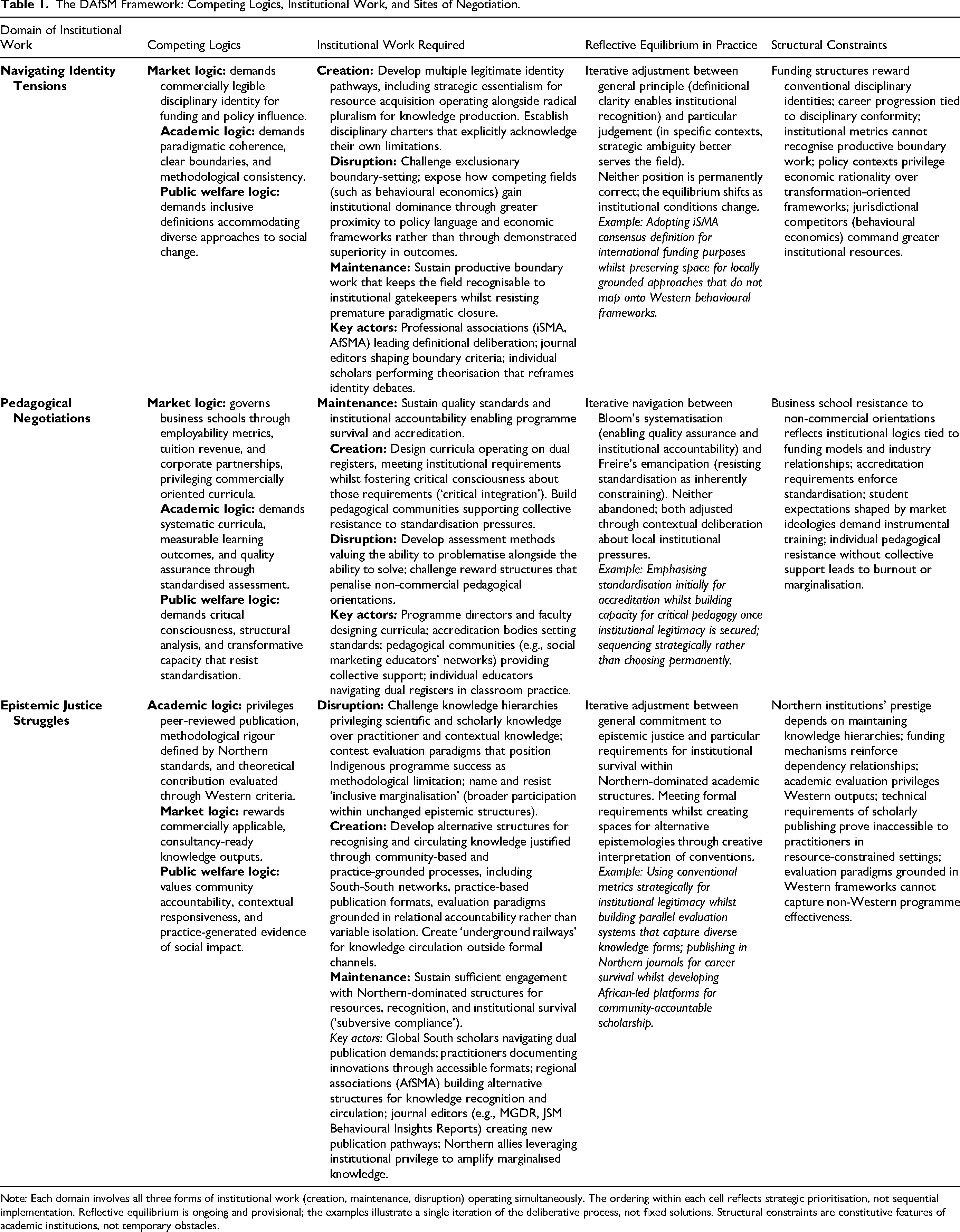
Note: Each domain involves all three forms of institutional work (creation, maintenance, disruption) operating simultaneously. The ordering within each cell reflects strategic prioritisation, not sequential implementation. Reflective equilibrium is ongoing and provisional; the examples illustrate a single iteration of the deliberative process, not fixed solutions. Structural constraints are constitutive features of academic institutions, not temporary obstacles.
Illustrative Application: AfSMA and the DAfSM Lens
The recently established African Social Marketing Association (AfSMA), launched following the inaugural Pan-African conference in 2023, illustrates how DAfSM's analytical apparatus operates in a concrete institutional context. This section offers an illustrative application of the framework's diagnostic logic rather than a full empirical case study: its purpose is to demonstrate how DAfSM's constructs become analytically productive when brought to bear on a specific institutional setting, not to provide comprehensive empirical documentation of AfSMA's development. Viewed through DAfSM, AfSMA's development involves simultaneous institutional work across all three domains, generating tensions that require ongoing navigation rather than one-time resolution, particularly in a context where African social marketing contributions have historically been marginalised within global discourse (Ellis et al., 2026). In the identity domain, AfSMA performs creation work: establishing an African social marketing identity that draws on both the global field's conceptual resources and distinctly African traditions of community mobilisation, ubuntu philosophy, and collective wellbeing. The tension is immediate. Conforming to iSMA's consensus definition secures global recognition and access to international networks, reflecting the role of professional associations in defining disciplinary boundaries and competencies (Kassirer et al., 2019), but may marginalise Indigenous African approaches that do not map neatly onto Western behavioural frameworks. This tension is compounded by the historical underrepresentation of African contributions within dominant social marketing narratives (Ellis et al., 2026). The reflective equilibrium response involves iterative adjustment: adopting sufficient definitional alignment for institutional purposes whilst explicitly preserving space for approaches grounded in African epistemological traditions.
In the pedagogical domain, AfSMA faces maintenance and creation work simultaneously: building curriculum that meets international accreditation standards (maintenance of institutional legitimacy) whilst developing pedagogical approaches responsive to African social challenges, resource constraints, and learning traditions (creation of alternatives). As Helm et al. (2024) indicate, even faculty committed to transformation encounter institutional barriers. This reflects broader patterns in which social marketing education remains fragmented and unevenly institutionalised across Africa, often lacking coordinated integration into formal curricula (Ellis et al., 2026). African educators must navigate the additional complexity that Western-trained faculty may reproduce Northern pedagogical models not from conviction but from lack of institutionally supported alternatives. In the epistemic domain, AfSMA confronts the sharpest tension. Publishing in Northern journals secures international visibility and individual career advancement, but channels African intellectual production into forms that may not serve local communities, contributing to the underrepresentation of African research in core social marketing journals despite substantial practice and scholarship (Ellis et al., 2026). AfSMA's disruption work involves developing complementary structures for recognising and circulating knowledge justified through African community-based and practice-grounded mechanisms, including African-led conferences, regional publication platforms, and evaluation frameworks grounded in community accountability rather than Northern methodological protocols, whilst its maintenance work involves sustaining sufficient engagement with Northern-dominated structures for resources and recognition. Neither full disengagement nor full accommodation serves AfSMA's purposes; the equilibrium must be continuously renegotiated.
This illustration demonstrates DAfSM's generative capacity. Without the framework, AfSMA's challenges appear as separate operational problems: branding, curriculum design, and publication strategy. Through DAfSM, they become visible as interconnected expressions of competing institutional logics requiring coordinated institutional work. The framework does not prescribe what AfSMA should do but provides diagnostic resources for understanding why particular decisions generate particular tensions, and analytical vocabulary for deliberating about trade-offs collectively rather than experiencing them as individual failures. This is particularly consequential in contexts where emerging associations are simultaneously building communities of practice and formalising professional structures (Kassirer et al., 2019).
What DAfSM Enables: From Unconscious Reproduction to Strategic Navigation
Before specifying what DAfSM enables, it is important to clarify what the framework is and is not designed to accomplish, since a meta-theoretical framework of this kind operates across multiple registers that can otherwise appear to blur into one another. DAfSM functions primarily as a diagnostic framework: its core purpose is to identify which institutional logics are operative in a given disciplinary context, to map how competing pressures interact across the domains of identity, pedagogy, and knowledge representation, and to make visible the cascading effects that isolated interventions cannot address. It also operates in a critical register, evaluating how existing institutional arrangements reproduce exclusion and marginalisation, and naming the structural character of problems that practitioners and scholars typically experience as individual or local difficulties. At certain points, the framework gestures toward a prescriptive register, suggesting strategic orientations such as subversive compliance, critical integration, and reflective sequencing. However, DAfSM does not prescribe specific courses of action, because the appropriate response to any given tension depends fundamentally on local institutional conditions, the resources available to particular actors, and the stage of a field's or organisation's development. What the framework offers instead is analytical vocabulary for deliberating about those responses collectively and theoretically, rather than tackling them ad hoc. Readers should therefore engage with DAfSM as a framework for structured deliberation rather than as an implementation guide, and should understand its normative content as identifying orientations worth pursuing rather than prescribing the means through which they must be pursued.
The value of DAfSM lies not in resolving contradictions that may be irresolvable within current institutional structures, but in transforming how scholars, educators, and practitioners engage with these contradictions. Without analytical frameworks that make structural tensions visible, well-intentioned actors typically respond to disciplinary challenges through what might be termed ‘naïve amelioration': implementing isolated solutions that inadvertently reproduce the problems they seek to address. For instance, calls for more Global South representation on editorial boards may increase geographic diversity whilst maintaining unchanged evaluation criteria that privilege Northern epistemologies, producing the ‘inclusive marginalisation’ identified above. Similarly, curriculum standardisation efforts intended to ensure quality may inadvertently eliminate the contextual responsiveness that enables transformative pedagogy. DAfSM prevents such inadvertent reproduction by providing conceptual vocabulary for identifying when apparent solutions actually reinforce existing hierarchies.
The framework enables three forms of strategic navigation that unconscious engagement with contradictions cannot achieve. Each involves the deliberate institutional work (Lawrence & Suddaby, 2006) and iterative reflective equilibrium (Rawls, 1999) specified in the framework architecture above, applied to concrete disciplinary challenges. First, DAfSM provides diagnostic capacity for identifying which contradictions are operative in specific contexts. When a social marketing programme struggles with identity recognition, DAfSM helps distinguish whether the problem stems from definitional ambiguity (requiring clearer articulation), productive boundary fluidity (requiring strategic ambiguity), or institutional resistance to non-commercial orientations (requiring political organising rather than clearer definitions). Without this diagnostic capacity, interventions address symptoms rather than underlying structural tensions.
Second, the framework enables strategic prioritisation by making visible the trade-offs inherent in navigating contradictions. A university designing a social marketing programme faces simultaneous pressures for institutional legitimacy (favouring standardisation) and transformative capacity (favouring local adaptation). DAfSM enables conscious deliberation about which tension to prioritise at different developmental stages, perhaps emphasising standardisation initially for accreditation whilst building capacity for local adaptation once institutional legitimacy is secured. This strategic sequencing differs fundamentally from unconscious accommodation to whichever pressure proves strongest at any given moment.
Third, DAfSM facilitates collective organising by providing shared vocabulary for discussing contradictions that individuals often experience as personal failures or institutional peculiarities. When educators struggle to balance critical pedagogy with institutional assessment requirements, they typically experience this as individual inadequacy rather than structural contradiction. DAfSM's conceptual framework reveals these as systemic tensions requiring collective response rather than individual solutions, enabling coordination across institutions and contexts. This collective dimension proves particularly crucial for challenging structural barriers that individual compliance cannot overcome. For example, practitioners unable to publish in academic journals typically attribute this to personal deficiencies in writing skills or theoretical knowledge. DAfSM reframes this as epistemic exclusion built into publication structures, enabling collective organising for alternative structures for recognising and circulating knowledge justified through community-based and practice-grounded processes, rather than individual efforts to conform to exclusionary criteria.
The framework thus functions as what organisation theorists term a ‘boundary object’: providing sufficient structure to coordinate action across diverse contexts whilst remaining flexible enough to accommodate contextual variation (Star and Griesemer, 1989). Scholars can use DAfSM to analyse how definitional debates in their specific contexts reflect broader identity tensions. Educators can employ it to design curricula that navigate local institutional pressures whilst maintaining critical commitments. Practitioners can invoke it to articulate why certain interventions succeed despite failure to meet conventional evaluation criteria. Professional associations can utilise it to design policies that acknowledge rather than obscure inherent tensions in their missions. This coordinating function distinguishes DAfSM from purely critical analysis that identifies problems without enabling action, or from prescriptive frameworks that offer false solutions to structural contradictions.
Scope and Transferability Beyond Social Marketing
Whilst developed for social marketing, DAfSM's analytical architecture addresses tensions common to applied disciplines that pursue transformative social purposes within institutional structures designed for other ends. Fields including public health, social work, development studies, and environmental management face analogous tensions between institutional legitimacy and transformative capacity, between standardised curricula and contextual responsiveness, and between Northern knowledge hierarchies and local epistemic traditions. DAfSM's theoretical contribution thus extends beyond its immediate case. The framework offers a transferable model for understanding how applied disciplines can pursue what we have termed reflexive institutional work: deliberate, theoretically informed engagement with the competing logics that structure disciplinary development, guided by reflective equilibrium as a method for navigating tensions that resist permanent resolution. This extends Abbott's (2001) analysis of jurisdictional competition by specifying the mechanism (institutional work) through which actors engage with competing jurisdictional claims, and extends Kuhn's (1962) paradigm theory by providing a framework for disciplines that may be permanently multi-paradigmatic rather than moving toward single-paradigm coherence.
Directions for Empirical Investigation
DAfSM's analytical architecture generates specific empirical questions that existing scholarship has not addressed. Four directions merit particular attention: (1) what forms of institutional work (creation, maintenance, disruption) prove most effective for challenging epistemic hierarchies within applied disciplines, and how do local configurations of competing logics, for instance between social marketing programmes housed within business schools versus public health faculties, shape the institutional work available to actors? (2) How do actors navigate the tension between institutional legitimacy and transformative capacity at different stages of disciplinary development, and does the iterative process of reflective equilibrium that DAfSM theorises actually describe how disciplinary tensions are negotiated over time, or do actors tend instead toward rigid adherence or wholesale capitulation to dominant logics? (3) How does strategic sequencing between standardisation and critical pedagogy influence programme survival and transformative orientation, and what institutional conditions enable the conscious prioritisation that DAfSM distinguishes from unconscious accommodation? (4) Under what conditions do alternative structures for recognising and circulating knowledge, such as practitioner-focused publication formats and Indigenous-led evaluation frameworks, shift rather than reproduce dominant academic logics, and does DAfSM's diagnostic capacity produce measurably different outcomes compared with atheoretical responses to disciplinary tensions? These questions invite comparative, longitudinal, and institutional research capable of testing DAfSM's analytical claims and refining its application across contexts. They position DAfSM not as an endpoint but as a platform for cumulative institutional research into the dynamics of disciplinary development.
Conclusion: toward Reflexive Disciplinary Advancement
Rather than offering a conventional implementation roadmap with predetermined deliverables, DAfSM conceptualises disciplinary advancement as ongoing institutional work within and against the competing logics that structure social marketing's development. This positions the framework not as a technical blueprint but as providing analytical tools for what might be termed critical pragmatism: pursuing achievable changes whilst maintaining awareness of their limitations, working within institutions whilst constantly identifying spaces for manoeuvre. This positioning responds to what Haase (2025) identifies as the central challenge for marketing subdisciplines in a values-in-science world: ensuring that the link between knowledge and action is not severed by methodological commitments that exclude the normative, but rather enriched by explicit engagement with the values that shape scholarly choices. The mechanism is not abstract. Institutional work (Lawrence & Suddaby, 2006) involves concrete practices of creation, maintenance, and disruption, directed by the iterative method of reflective equilibrium (Rawls, 1999) through which actors adjust general commitments and particular judgements as institutional conditions evolve. Implementation in this context becomes political engagement requiring multiple forms of resistance and accommodation simultaneously.
This engagement demands what we have termed ‘subversive compliance’: using institutional processes strategically for legitimacy whilst building parallel structures that embody alternative possibilities. It requires building alliances across difference, coalition politics that maintain solidarity despite disagreement and present strategic unity whilst preserving internal diversity. This challenges conventional academic tendencies toward theoretical purity and methodological orthodoxy, demanding instead pragmatic alliances that may involve uncomfortable compromises. The work requires recognising that transformation occurs through generational change rather than immediate revolution, necessitating long-term organising that prepares successors who can continue efforts even when original advocates face exhaustion or co-option. Perhaps most challengingly, this approach demands sustaining what might be termed ‘critical hope’: maintaining possibility for change whilst acknowledging structural constraints, celebrating incremental gains whilst recognising their limitations, and finding meaning in the navigation process itself rather than only in predetermined outcomes.
Whilst structural constraints are real and persistent, DAfSM enables strategic action rather than paralysis. By naming contradictions explicitly and specifying which competing logics are operative, the framework allows scholars, educators, and practitioners to make informed choices about which compromises serve transformative goals and which reproduce hierarchies. The examples documented throughout this analysis demonstrate that spaces for transformation exist even within constraining structures: the iSMA consensus process as creation work navigating identity tensions; emerging regional organising efforts through AfSMA in Africa and across Latin America as disruption work challenging epistemic hierarchies; innovative pedagogical experiments such as Kennedy et al.'s (2022) ‘social marketing as pedagogy’ as maintenance work sustaining critical commitments within constraining business school environments; and alternative publication formats such as the Journal of Social Marketing's Behavioural Insights Reports as creation work opening new pathways for practitioner knowledge. These are not naïve celebrations of incremental change, but recognition that strategic navigation of contradictions differs fundamentally from unconscious reproduction of them.
DAfSM's contribution lies not in resolving tensions that may be irresolvable, but in transforming unavoidable complicity into strategic complicity: working within systems whilst systematically building capacity to transform them. This critical pragmatism positions social marketing not as a field forever trapped by contradictions, but as one capable of leveraging those very tensions as sites for generative change. The value lies in enabling the reflexive capacity, diagnostic precision, and collective coordination necessary for social marketing to advance as a globally inclusive, pedagogically coherent, and institutionally legitimate discipline genuinely capable of contributing to transformative social change.
Footnotes
Associate Editor
Michaela Haase

Funding
The authors received no financial support for the research, authorship, and/or publication of this article.
Declaration of Conflicting Interests
The authors declared no potential conflicts of interest with respect to the research, authorship, and/or publication of this article.