







Abstract
Elections are among the most consequential market-like systems in any democracy, yet macromarketing has never systematically analysed them. DeQuero-Navarro et al. argued that advancing macromarketing's understanding of market–society relationships requires interdisciplinary collaboration that broadens the field's analytical scope and extends its conceptual resources to scholars working in adjacent domains. This paper answers that call by demonstrating how macromarketing's foundational principles can be applied to political communication systems to generate analytical insights that neither political marketing nor electoral scholarship has been able to produce alone. Drawing on Mittelstaedt et al.'s foundational principles, Layton's marketing systems framework, and Meade and Nason's systems-theoretic macromarketing, the paper develops the Electoral Marketing System (EMS)—an integrated conceptual framework specifying actors, communication flows, structural moderators, emotional mechanisms, and emergent outcomes—as a pedagogical tool for applying macromarketing principles in electoral contexts. The EMS is not a parallel framework to the political marketing system literature; rather, the political marketing system is best understood as one important subset operating within the broader EMS, just as the advertising industry operates within the larger marketing system. Nigeria's 2023 presidential election illustrates the EMS framework across four temporal stages—from pre-primary antecedent forces through electoral marketplace constitution, campaign period, election event, and post-election feedback effects—demonstrating how unprecedented digital mobilisation coexisted with 26.71% voter turnout, the lowest in the Fourth Republic. The engagement-participation gap is shown to be an emergent property of the EMS rather than a failure of individual campaigns, and information disorder is identified as a systemic externality of competitive mobilisation. A five-direction research agenda and a full instructional guide for educators conclude, mapping opportunities for macromarketing scholarship in electoral contexts.
Keywords
Introduction
On 25 February 2023, three presidential campaigns converged on a single election day in Africa's most populous democracy. Bola Tinubu's campaign's ‘Emi lokan’ declaration had electrified Yoruba political networks through an institutional-authoritative communication architecture—built on traditional media, incumbency resources, and state apparatus. Peter Obi's Obidient movement built a new communication infrastructure on social media, WhatsApp, and peer-to-peer mobilisation, producing daily viral content that mainstream media could not ignore. Atiku Abubakar's PDP machinery mobilised across northern strongholds through television advertising and delegate-level cash transactions that had been structured months earlier (Adebiyi et al., 2025). The Independent National Electoral Commission (INEC) (2023) registered over 93 million voters. Campaign hashtags had trended nationally for months. Nevertheless, only 26.71% of registered voters cast ballots (INEC, 2023), the lowest turnout in the Fourth Republic's history, a 17-percentage-point collapse from 2019.
This paper argues that the field of macromarketing provides the necessary analytical framework to explain this paradox, and its absence from electoral scholarship represents a significant gap in both its intellectual history and its societal relevance.
The paradox of high engagement but low voter turnout can be explained by competing mobilisation incentives and information externalities that conventional frameworks overlook. Existing studies of Nigeria's 2023 election examined social media mobilisation (Bassey et al., 2024; Owagboriaye, 2024), identity politics and regional voting patterns (Danjibo, Ashindorbe & Owonikoko, 2024; Namo & Attah, 2024), electoral technology failures (Adebogun et al., 2025), and interpersonal communication dynamics (Akinyemi-Oke, 2024)—each contributes something valuable. However, no one has asked what happens when these forces interact simultaneously, which is precisely what happened on election day. The engagement-participation gap remains unexplained by individual studies. It is produced by their collective subject matter.
The distinction between studying components in isolation and their systemic interaction is the core intellectual territory of macromarketing. Since its mid-century emergence as part of marketing's paradigm broadening (Shaw & Jones, 2005), macromarketing has been defined by three foundational principles: markets are systems; markets are heterogeneous; and market actions have far-reaching consequences beyond organisational boundaries (Mittelstaedt et al., 2006). Layton (2007) operationalised this through the marketing systems framework, defining a marketing system as ‘a network of actors, linked through exchange processes, jointly producing and distributing assortments.’ In an election, candidates, parties, electoral commissions, media organisations, digital platforms, interpersonal networks, and voters jointly produce and distribute assortments of political value—information, promises, identity claims, emotional appeals, and legitimacy—through structured exchange processes that extend to the health of the democratic system.
Despite this natural fit, macromarketing has never entered the electoral domain. DeQuero-Navarro et al. (2020), in their panoramic review of the macromarketing literature published in this journal, called for macromarketers to collaborate with scholars from other disciplines, noting that ‘advancing the study of the markets/marketing/society relationships requires interdisciplinary effort’ and that macromarketers ‘should be encouraged to collaborate with scholars from other disciplines that connect with stakeholder interests, both to expand the range of factors and measures considered and to share our macromarketing perspective.’ Electoral politics represents precisely this kind of interdisciplinary opportunity. Meanwhile, political marketing has developed sophisticated analyses of electoral phenomena from a fundamentally different epistemological orientation. Henneberg (2008) diagnosed political marketing's central limitation as a ‘dominating tendency of focusing research on campaign applications of marketing instruments,' Cwalina et al. (2012) proposed a macro-micro architecture, and Kubler et al. (2025) demonstrated empirically that political marketing systems exhibit dynamic feedback effects. These contributions advance the field significantly, but none draw on macromarketing's distinctive analytical vocabulary of externalities, welfare consequences, and system-level outcomes.
This paper makes three contributions. First, it shows why elections qualify as marketing systems under macromarketing's foundational principles and why macromarketing's analytical apparatus addresses electoral phenomena that political marketing's current orientation cannot capture. Second, it develops the Electoral Marketing System (EMS)—an integrated conceptual framework that operationalises macromarketing's systems architecture for electoral contexts. Third, it illustrates the EMS framework through Nigeria's 2023 presidential election, demonstrating that the engagement-participation gap is an emergent system property produced by the simultaneous interaction of digital mobilisation, institutional trust failures, identity-structured cleavages, information disorder cascades, and access barriers.
A terminological clarification is necessary at the outset. This paper positions the political marketing system literature and the Electoral Marketing System (EMS) not as distinct parallel frameworks but as operating at different levels of the same analytical hierarchy. The political marketing system literature—developed by Henneberg (2008), Cwalina et al. (2012), and Kubler et al. (2025)—describes how political actors deploy marketing principles and techniques within electoral contexts. This is analogous to how the advertising industry operates within the broader marketing system: the advertising industry captures an important set of interactions and practices, but the marketing system as a whole encompasses a broader and more integrative set of factors, institutions, and consequences. The Electoral Marketing System (EMS), by contrast, is a macromarketing lens applied to the full electoral context—specifying actors, communication flows, structural moderators, emotional mechanisms, emergent outputs, and feedback effects. The political marketing system literature is best understood as capturing one important dimension of what occurs within the EMS, rather than as a competing or parallel framework. The EMS is designed to complement and extend the political marketing system literature by supplying the macro-level systems architecture that it currently lacks. ‘EMS’ is capitalised consistently when referring to this framework specifically, to signal its status as a defined conceptual contribution.
This paper functions pedagogically as well as theoretically. Beyond establishing the Electoral Marketing System (EMS) framework as a conceptual contribution, it demonstrates how political marketers, electoral scholars, and macromarketing researchers can use macromarketing's analytical vocabulary—actors, flows, structures, externalities, emergent properties, and welfare consequences—to analyse electoral phenomena that existing frameworks cannot fully capture. Nigeria's 2023 presidential election serves as the illustrative case study through which this application is demonstrated, chosen precisely because its paradoxical combination of high engagement and historically low turnout makes every dimension of the EMS analytically visible.
Pedagogical Purpose Statement
The EMS framework is designed for use in courses where marketing systems theory, political communication, and democratic governance intersect. Three disciplinary homes offer the strongest fit. In marketing, students of macromarketing and marketing systems gain a contemporary high-stakes case demonstrating the field's applied relevance beyond commercial contexts; students of marketing ethics and public policy engage with systemic externality logic through a governance application that raises regulatory and platform accountability questions. In political science, students of electoral systems and African politics gain a cross-disciplinary lens that situates campaign dynamics within system-level welfare evaluation and enables systematic comparison across electoral contexts. In communication studies, students of political communication gain a systems-level alternative to agenda-setting and framing approaches, where information disorder is treated as a structural externality rather than a discrete media phenomenon.
The framework's five analytical dimensions—actors, flows, structural moderators, emergent outputs, and feedback effects—translate directly into structured classroom discussion protocols. Appendix A provides instructional guidance for educators, including suggested courses by discipline, learning objectives, and ten reflective questions for students that move progressively from understanding the framework to applying and critically evaluating it.
To explore these contributions, the paper is structured as follows. The next section establishes macromarketing's foundational principles and argues for their applicability to electoral politics. The third section examines political marketing's epistemological orientation and the specific analytical capacities that macromarketing provides. The fourth section presents the integrated conceptual framework, and the fifth section illustrates it using Nigeria 2023 presidential election. The final section proposes a research agenda.
The Field of Macromarketing and Its Untested Electoral Domain
Intellectual Foundations
Macromarketing occupies a distinctive position within the broader history of marketing thought. Shaw and Jones (2005), in their landmark history of schools of marketing thought, traced the field's emergence to the mid-twentieth century paradigm shift that broadened marketing from firm-level management thinking to a societal institution. Where the managerial tradition asks how organisations can market more effectively, macromarketing asks what marketing does to society—and what society does to marketing. That distinction is not merely a matter of scope. It is a difference in the unit of analysis, the types of questions considered legitimate, and the evaluative criteria applied to outcomes.
Mittelstaedt et al. (2006) synthesised twenty-five years of macromarketing research into three foundational principles that together constitute the field's theoretical core. First, that markets are systems—not collections of independent transactions but structured networks of actors whose interactions produce outcomes that cannot be understood by examining any single participant in isolation. The second holds that markets are heterogeneous—that marketing systems differ across contexts in ways that matter for both their functioning and their consequences. The third, and most distinctive, holds that the actions of market participants have consequences extending far beyond organisational boundaries—consequences that include externalities, welfare effects, and systemic outcomes that no individual actor intends or controls.
It is this third principle that gives macromarketing its distinctive analytical power. The concept of externalities—costs or benefits produced by market activity but borne by parties not directly involved in the exchange—enables macromarketing to ask questions that other marketing traditions cannot. When a food marketing system produces obesity, that is an externality. When a financial marketing system produces a credit crisis, that is an externality. And, as this paper argues, when an Electoral Marketing System (EMS) produces democratic disengagement at scale, that too is an externality—one that macromarketing is uniquely equipped to analyse.
Layton's (2007) marketing systems framework provided the operational architecture for this analysis. Layton defined a marketing system as ‘a network of actors, linked through exchange processes, jointly producing and distributing assortments.’ The framework specifies five analytical dimensions—the actors who participate in the system; the flows of goods, services, information, and value between them; the structures (institutional, regulatory, cultural) that constrain and enable those flows; the outputs or assortments the system produces; and the feedback effects through which outputs reshape the system's conditions. This framework has been applied productively to food systems, agricultural markets in developing economies, and transitional market systems. Its application to electoral politics, however, has never been attempted.
Meade and Nason (1991) contributed the systems-theoretic grounding that complements Layton's relational framework. Their call for a ‘unified theory of macromarketing’ rooted in systems theory argued that macromarketing's core concern is with the emergent properties of marketing systems—outcomes that arise from the interaction of system components rather than from any single component. This concept of emergence is central to the argument this paper develops: the engagement-participation gap observed in Nigeria's 2023 election is precisely such an emergent property, produced by the simultaneous interaction of multiple system forces rather than by any individual campaign strategy, technology failure, or voter disposition.
The Electoral Agora: Agorology as the Conceptual Foundation
The title of this paper deliberately invokes Mittelstaedt et al.'s (2006) concept of the agora. Agorology—the study of the agora—is not merely a rhetorical device. It is the specific conceptual architecture within which macromarketing has theorised how markets function as social institutions. The agora, in the Greek democratic tradition, was the public space where citizens gathered to exchange goods, ideas, and political positions—where commercial activity, political deliberation, and civic identity were not separate spheres but an integrated system. Mittelstaedt et al. (2006) argued that macromarketing is fundamentally the study of the agora: the analysis of the systems through which societies produce and distribute value and of the consequences of those systems for the societies that contain them.
The electoral marketplace is an agora in the strictest sense. It is the institutional space where political value is produced and exchanged—identity claims, promises, policy commitments, and the fundamental democratic claim that government derives its legitimacy and authority from the consent of the governed. These are the assortments—in Layton's (2007) systems language—that the Electoral Marketing System (EMS) jointly produces and distributes.
Why Elections Are Marketing Systems
The claim that elections constitute marketing systems requires demonstrating that elections satisfy the definitional criteria of macromarketing's frameworks. Consider Layton's (2007) five dimensions in the context of a presidential election. The actors involved are identifiable and interdependent—political parties and their candidates, the electoral management body, traditional and digital media organisations, social media platforms, civil society organisations, community and religious leaders, and voters themselves. These actors are linked through exchange processes—not only the formal exchange of votes for representation but also the continuous exchanges of information, persuasion, identity claims, emotional appeals, endorsements, and legitimacy. The system jointly produces and distributes assortments of political value—policy promises, candidate images, party brands, accountability narratives, identity affirmations, and democratic legitimacy itself.
One definitional question requires direct engagement. Layton's (2007) marketing systems framework specifies actors linked through exchange processes, and classical exchange theory has historically centred on the transfer of value mediated by money. Elections involve no monetary exchange between candidates and voters. Does this disqualify them from the Electoral Marketing System (EMS) framework?
Macromarketing's own intellectual foundations suggest not. Bagozzi's (1975) foundational account of marketing as exchange established that exchange does not require monetary mediation—it requires the transfer of something of value between parties who mutually benefit from the transaction. Bagozzi identified complex exchange as involving mutual relationships among multiple parties simultaneously, none of which need be monetary. In the Electoral Marketing System (EMS), voters transfer political mandate and legitimacy to elected representatives; candidates transfer policy commitments, identity representation, and accountability claims to voters; the electoral management body transfers procedural legitimacy and institutional credibility to the process as a whole. These are genuine transfers of genuine value—political value, democratic value, legitimacy—circulating through a structured network of actors. The exchange property is present. It is non-monetary. Indeed, barter systems have long been part of macromarketing's analytical range, and monetary exchange has never been a definitional requirement for a marketing system to qualify as such.
Layton (2009), in extending the marketing systems framework to questions of economic growth and quality of life, broadened its scope to accommodate systems where jointly produced and distributed assortments include information, legitimacy, and social value rather than commercial goods. The electoral context falls within this extended definition.
Furthermore, Mittelstaedt et al.'s (2006) second foundational principle—that markets are heterogeneous—anticipates precisely this kind of structural variation. An Electoral Marketing System (EMS) does not need to be identical to a commercial marketing system to qualify as a marketing system. It needs to satisfy the definitional criteria at the systems level: structured actors, exchange processes, jointly produced assortments, structural moderators, and feedback effects. On each of these criteria, the electoral context qualifies.
The distinction between monetary and non-monetary exchange is therefore not a disqualifying boundary but an analytically productive difference—one that macromarketing's foundational principles were designed to accommodate and one that makes the electoral domain a particularly instructive test case for the field's systems architecture.
The structural dimension is equally clear: Electoral Marketing Systems (EMS) operate within regulatory frameworks (electoral laws, media regulations, and campaign finance rules) and institutional architectures (voting technology design and organisation of polling units). Cultural structures (identity cleavages and regional political traditions) and technological structures (platform algorithms and biometric accreditation) further shape electoral outcomes. These structures are not background conditions—they are constitutive elements of the EMS that shape every exchange within it.
The feedback dimension is the most analytically significant. Electoral Marketing Systems (EMS) are not static. The outputs of one electoral cycle—election results, perceptions of fairness, trust in institutions, and patterns of participation and abstention—become the structural conditions of the next cycle. When an election produces widespread distrust in the electoral commission, that distrust becomes a structural constraint on voter participation in subsequent elections. Kubler et al. (2025) confirmed empirically that political marketing systems exhibit precisely these dynamic feedback effects, providing evidence from the political marketing tradition that supports the Electoral Marketing System (EMS) framework developed here.
Mittelstaedt et al.'s (2006) three principles map onto electoral politics with striking precision. Elections are systems: the outcome of any election is produced by the interaction of all system actors, not by any single campaign or institution. Elections are heterogeneous: the Electoral Marketing System (EMS) in Nigeria—shaped by ethno-religious cleavages, a federal structure spanning six geopolitical zones, and a specific combination of biometric technology and social media infrastructure—operates fundamentally differently from those in established democracies. Furthermore, electoral actions have consequences that extend far beyond organisational boundaries: when campaigns use disinformation as a competitive strategy, the externality—degraded public trust, democratic disengagement, and reduced electoral legitimacy—is borne not by the campaigns that produce it but by the democratic system as a whole.
A Note on the EMS Temporal Scope and Pre-Primary Antecedents
The EMS framework's four-stage temporal structure begins at the presidential primaries. This scope decision warrants explicit acknowledgement. Analytically, the primaries are where the system's actors, resource asymmetries, and legitimacy conditions are first formally constituted. However, the decision to enter the primaries—who runs, under what conditions, and supported by what networks—is itself shaped by cultural, political, and economic forces that predate any formal electoral announcement. In the United States context, for instance, the 2026 midterm candidates’ decisions to run are influenced not only by their own backgrounds and strengths but by the economic environment, the health policy landscape, and the accumulated effects of prior electoral cycles. In Nigeria's context, the structural conditions that produced the Obidient movement—youth unemployment, digital infrastructure growth, and the accumulated legitimacy deficit of the established parties—were cultural and economic antecedents that the primaries formalised rather than created.
This paper treats these pre-primary forces as inputs to Stage 1 rather than as a separate Stage 0 for reasons of analytical tractability. The EMS as a system begins when actors formally constitute themselves as exchange participants. But instructors and researchers applying the framework comparatively should treat Stage 1 as analytically porous on its upstream side: the electoral marketplace constitution is itself a product of the broader societal marketing system, and the EMS framework should not be read as suggesting that an election begins in a structural vacuum.
The Interdisciplinary Opportunity
Despite this natural fit, macromarketing has never entered the electoral domain. DeQuero-Navarro et al. (2020) mapped the field's intellectual terrain across three decades in their panoramic review, identifying the domains to which macromarketing's systems framework has been applied: sustainability and environmental markets, quality of life, ethics and distributive justice, market development in transitional economies, food systems, and public policy. Electoral politics does not appear among them. DeQuero-Navarro et al. (2020) called for exactly the kind of interdisciplinary expansion this paper undertakes: macromarketers collaborating with scholars from other disciplines to expand the range of factors and measures considered and to share the macromarketing perspective.
The absence reflects disciplinary boundaries, not a judgment on the domain's importance. Macromarketing scholars publish in marketing journals and attend marketing conferences (including the Journal of Macromarketing and the annual macromarketing conference); political marketing scholars publish in the Journal of Political Marketing, Political Communication, and cognate journals. The two communities share no conferences, no editorial boards, and few citation networks. Filling the gap requires the combination of macromarketing theoretical grounding and electoral domain expertise that this disciplinary divide makes rare.
This paper addresses that gap directly. It takes macromarketing's foundational principles and operational frameworks and applies them, for the first time, to an electoral context. The objective is not merely to demonstrate that the Electoral Marketing System (EMS) framework fits, which the preceding analysis has established, but to show—pedagogically—that it reveals analytical insights about electoral phenomena that the existing literature, working within other traditions, has been unable to produce.
Political Marketing's Epistemological Orientation and What Macromarketing Provides
Since its early conceptualisation by Scammell (1999) and Butler and Collins (1994), political marketing has evolved into a critical component of democratic practice. The field now encompasses substantial work on campaign strategy, voter behaviour, political branding, digital mobilisation, and the professionalisation of electoral communication. Characterising this literature as intellectually shallow would be inaccurate. Nevertheless, it does have a persistent epistemological orientation—one that several leading scholars have diagnosed.
Henneberg (2008) made a pivotal methodological intervention by highlighting the central issue in political marketing: the overwhelming focus on campaign applications of marketing instruments. His argument was not that campaign-level research is illegitimate, but that it is insufficient. Campaign-level research studies a component of the system while treating the system itself as background. Henneberg called for a ‘wider stance’ in which the political sphere itself becomes the object of inquiry.
Cwalina et al. (2012) took a significant step toward answering it with their macro-micro framework for political marketing. They proposed integrating macrostructures—the broad social, political, legal, economic, and technological context—and microstructures—the behaviour of individual voters, candidates, and institutions. Their framework was conceptually ambitious and intellectually generative, identifying the right problem: connecting system-level conditions to individual-level behaviour. Attempts to operationalise this architecture on a specific election have remained limited due to challenges in data collection and the complexity of integrating macro- and micro-level analyses.
Kubler et al. (2025) advanced the field's systems orientation by demonstrating empirically that political marketing systems exhibit dynamic feedback effects. Campaign inputs feed back into electoral outputs through measurable pathways, providing empirical evidence for what had previously been a conceptual claim: that political marketing operates as a system with feedback dynamics rather than a linear process.
These three contributions—Henneberg's epistemological diagnosis, Cwalina et al.'s macro-micro architecture, and Kubler et al.'s empirical systems evidence—move political marketing toward a systems orientation from within its own conceptual vocabulary. That vocabulary, despite its sophistication, lacks three essential analytical capacities provided by macromarketing.
What Macromarketing Adds
The first capacity is the concept of systemic externalities. Macromarketing asks who bears the costs of the system's operation and whether those costs serve or harm society. In Nigeria, three presidential campaigns simultaneously deployed competitive mobilisation strategies, producing information disorder as a by-product. The disinformation, misinformation, and malinformation generated were not campaign failures but externalities of the Electoral Marketing System (EMS) itself—costs produced by normal functioning and borne by citizens, institutions, and the electoral process. Wardle and Derakhshan's (2017) taxonomy of information disorder provides the vocabulary for describing what was produced; macromarketing's externalities framework explains why it was produced and who bears the cost.
The second capacity is the concept of emergent system properties. Meade and Nason (1991) argued that macromarketing focuses on outcomes arising from interactions among system components rather than on any single component. When voter turnout in Nigeria's 2023 election collapsed to 26.71%, despite unprecedented campaign activity, the dominant explanation locates the cause in a single variable or actor. Macromarketing's concept of emergence offers a different explanation: the turnout collapse is an Electoral Marketing System (EMS) property, produced by the simultaneous interaction of high-intensity platform mobilisation, institutional trust failures, identity-structured cleavage moderation, information disorder cascades, and logistical access barriers. No single actor produced this outcome. No single-variable remedy can address it.
Macromarketing's third capacity is welfare evaluation. Mittelstaedt et al. (2006) founded the field on the premise that marketing systems should be evaluated not only by efficiency but also by their consequences for societal welfare. Applied to electoral politics, this requires specifying what electoral welfare means and then evaluating whether the Electoral Marketing System (EMS) produces it. Electoral welfare, as defined in this framework, has three dimensions: participatory inclusivity (voter turnout), informational quality (the information environment's ability to enable informed choice), and systemic legitimacy (the electoral process's ability to generate authoritative outcomes).
A well-functioning Electoral Marketing System (EMS) scores high on all three dimensions. Nigeria's 2023 system failed on all three: 26.71% turnout, an information environment saturated with disinformation, and an election result contested through extended legal proceedings. The winning candidate received 8,794,726 votes (36.6% of valid votes cast; 9.4% of the registered electorate). Whether this outcome constitutes democratic health or failure is a welfare question, and macromarketing's welfare evaluation capacity is designed to answer it.
Osuagwu (2008) noted that political marketing practices in developing democracies are ‘coloured by environmental issues,’ including weak institutional infrastructure. Macromarketing transforms this observation into a sharper analytical tool: weak institutional infrastructure is a structural component of the Electoral Marketing System (EMS) that interacts with campaign communication strategies, platform architectures, and identity structures to produce specific system-level outcomes. The distinction between acknowledging context and analysing system structure is the distinction between description and explanation.
Rather than replacing political marketing, macromarketing enriches it by offering a systems-level, welfare-oriented framework that contextualises campaign and voter insights, allowing for a deeper evaluation of their societal impacts.
The Electoral Marketing System (EMS): An Integrated Conceptual Framework
This framework applies macromarketing's systems architecture specifically to electoral contexts. It is built on Layton's (2007) five analytical dimensions—actors, flows, structures, outputs, and feedback—and grounded in Mittelstaedt et al.'s (2006) three foundational principles. The Electoral Marketing System (EMS) integrates insights from political marketing theory, strategic political communication, emotional psychology, and information disorder research—because the EMS contains dimensions that no single theory can cover alone.
System Actors
The Electoral Marketing System (EMS) comprises five categories of actors. The first is campaign sub-systems. In Nigeria's 2023 election, three structurally distinct sub-systems emerged: the Tinubu/APC campaign operated an institutional-authoritative architecture; the Atiku/PDP campaign operated an opposition-reformist architecture; the Obi/LP campaign operated a decentralised digital architecture. Flaherty et al.'s (2020) distinction between evolutionary (bottom-up) and institutional (top-down) dynamics captures why the LP campaign was structurally different from the APC and PDP campaigns at the systems level.
The second is the electoral management institution. INEC's deployment of the Bimodal Voter Accreditation System (BVAS) across 176,846 polling units and the INEC Result Viewing Portal (IReV) for real-time results transmission constituted a technology architecture that became a structural component of the Electoral Marketing System (EMS). The technology's performance—98% biometric accreditation success but delayed IReV uploads due to a database configuration error (INEC, 2023)—generated trust dynamics that cascaded through the entire system.
The third is media and platform actors. Platform algorithms amplify content based on engagement metrics, particularly arousal, regardless of veracity—creating a structural bias toward high-arousal content, including disinformation, as explained by the Pleasure-Arousal-Dominance model (Mehrabian, 1996) and confirmed empirically by Kubler et al. (2025).
The fourth is interpersonal networks. Community and religious leaders, family members, peer groups, and local opinion leaders constitute the interpersonal layer of the Electoral Marketing System (EMS). Interpersonal communication serves as the primary mechanism for converting mediated campaign exposure into voting behaviour, challenging the dominant emphasis on digital mobilisation.
The fifth is voters as system co-producers. In the Electoral Marketing System (EMS), voters are not passive recipients of campaign messages. They are active participants consuming, interpreting, sharing, distorting, and resisting political communication. Their aggregate behaviour, including the decision not to vote, feeds back into the system's structural conditions.
Communication Flows
The Electoral Marketing System (EMS) generates four types of communication flows: persuasive, information disorder, emotional, and institutional.
Persuasive flows comprise intentional campaign messages produced by campaign sub-systems. Strategic political communication theory (Stromback & Kiousis, 2011) and agenda-setting theory (McCombs & Shaw, 1972) explain how these flows compete for salience.
Information disorder flows comprise disinformation (false content deliberately created and spread), misinformation (false content unintentionally spread), and malinformation (true content weaponised to cause harm) that circulate through the Electoral Marketing System (EMS) as by-products of competitive mobilisation. Wardle and Derakhshan's (2017) tripartite taxonomy provides the analytical vocabulary. Pamment's (2020) ABCDE diagnostic tool maps who produces information disorder, in what volume, through which channels, and with what electoral effect. Ibrahim and Ekdale (2025) documented how Nigerian campaigns hired ‘social media entrepreneurs’ to produce fabricated narratives, establishing that information disorder in the 2023 election was a systemic product of competitive campaign dynamics.
Emotional flows comprise affective responses—enthusiasm, anxiety, anger, hope, fear—generated by campaign communication. Affective Intelligence Theory (Ridout & Searles, 2011) specifies two systems: the disposition system (enthusiasm), reinforcing partisan commitments and motivating turnout; and the surveillance system (anxiety), prompting information-seeking that can suppress participation under low institutional trust. The PAD model (Mehrabian, 1996) explains why high-arousal content achieves disproportionate algorithmic amplification.
Institutional flows comprise official communications from the electoral management body, observation reports, judicial rulings, and regulatory pronouncements shaping the legitimacy structure of the information environment.
Structural Moderators
The Electoral Marketing System (EMS) operates within five categories of structural moderators. Identity cleavage structures are the most consequential in the Nigerian context: Erdmann (2007) demonstrated that ethnic and regional cleavages function as structural determinants pre-conditioning how political messages are received. Institutional trust structures encompass citizens’ confidence in the electoral management body and the reliability of electoral technology—dynamic structures shaped by prior system outputs. Regulatory and legal structures include the Electoral Act 2022, which introduced the legal basis for BVAS and IReV deployment. Technology architectures encompass both the electoral commission's systems and platform algorithms governing digital communication flows. Economic and security structures include poverty, transportation costs, and the security environment—material barriers to engagement conversion.
Emotional Mechanisms
The Electoral Marketing System (EMS) framework specifies Affective Intelligence Theory and the PAD model as psychological sub-mechanisms generating system-level engagement and participation outcomes. This integration is original: no prior marketing system model has incorporated emotional mechanisms as endogenous components, as the scope of the literature confirms. Enthusiasm reinforces partisan loyalty and motivates turnout. Anxiety prompts deliberation but suppresses participation under low institutional trust. The PAD model explains why digital platforms structurally favour anxiety-producing content, generating a system that systematically activates the surveillance system and suppresses participation.
The Emergent System Output: the Engagement-Participation Gap
The Electoral Marketing System's (EMS) central claim is that the engagement-participation gap—intense upstream engagement with low downstream participation—is an emergent property of the EMS, produced by the simultaneous interaction of high-intensity platform mobilisation that activates engagement without converting it to polling-unit attendance; institutional trust failures that activate anxiety-driven disengagement; identity-structured cleavages that moderate campaign message reception in ways that fragment rather than unify the electorate; information disorder cascades that degrade the information environment; and economic, logistical, and security barriers that impose material costs on the final conversion step.
Addressing this emergent property requires a multifaceted approach. More social media mobilisation will not solve it. Better technology will not solve it—BVAS achieved 98% biometric success. More fact-checking will not solve it—information disorder is a systemic externality. Macromarketing's contribution is the recognition that emergent system properties require system-level analysis and intervention.
Feedback Effects
The Electoral Marketing System (EMS)'s final dimension specifies the feedback loop through which system outputs become structural conditions for the next cycle. The 26.71% turnout of 2023 is both a Stage 3 output and a Stage 1 input for 2027. As a structural moderator for 2027, it operates through three channels: eroded institutional trust; normalised non-participation (when 73% of registered voters abstain without consequence, abstention becomes a rational prior); and delegitimised outcomes (a governing administration with a sub-10% mandate faces structural legitimacy constraints). Layton (2007) identified feedback as a defining feature of marketing systems. Kubler et al. (2025) confirmed it empirically. The EMS framework specifies it as the mechanism through which a single election's outputs reshape the structural moderators of the next cycle—producing either a self-reinforcing cycle of democratic disengagement or a virtuous cycle of democratic recovery. (Figure 1)
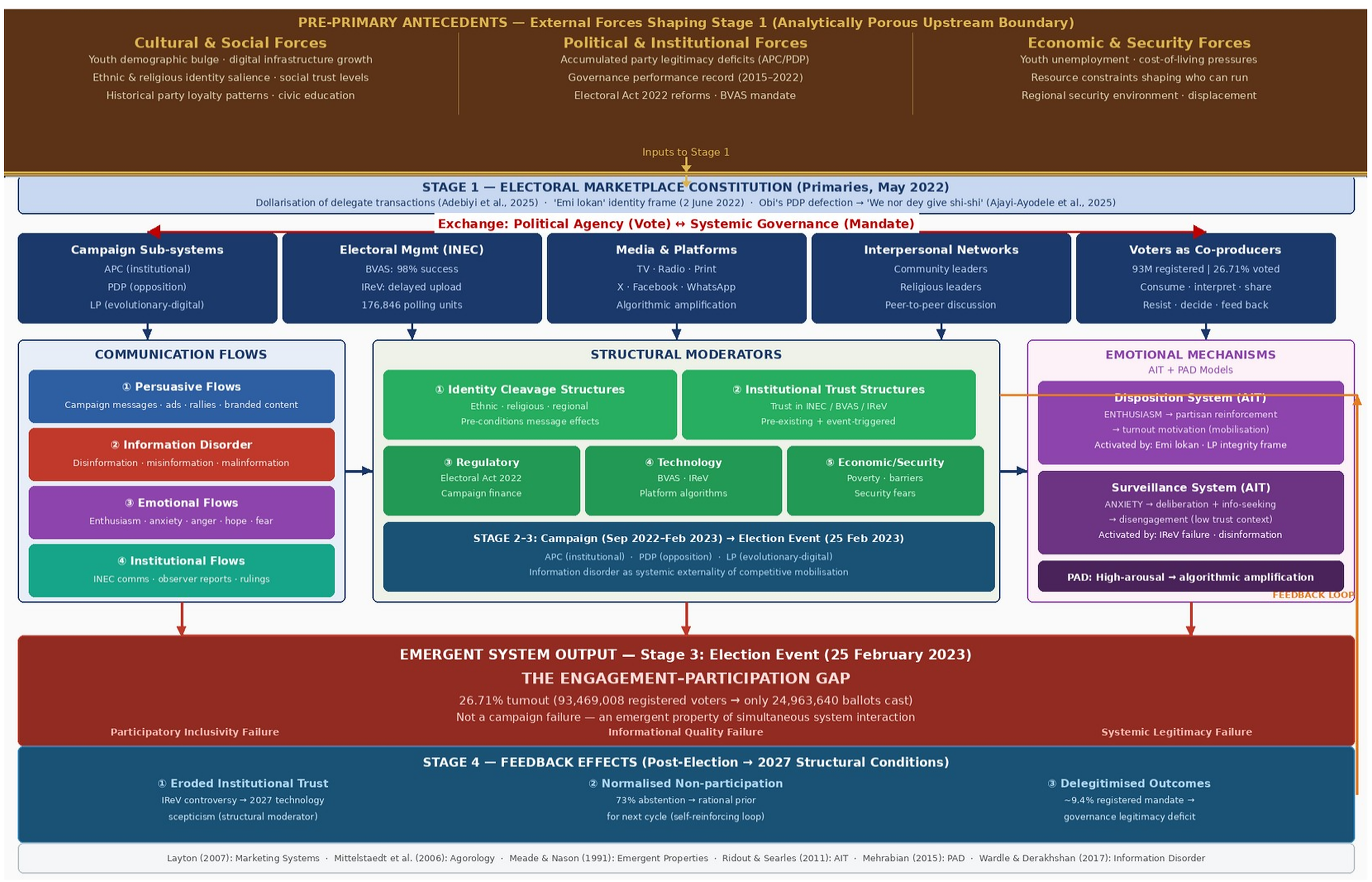
The electoral marketing system (EMS)—integrated conceptual model. The model is organised across six zones. A Pre-Primary Antecedents band (top) identifies the external forces shaping Stage 1 across three columns—Cultural and Social Forces, Political and Institutional Forces, and Economic and Security Forces—and connects to the main model through a downward arrow labelled “Inputs to Stage 1,” marking the analytically porous upstream boundary of the EMS. Below the antecedents band, the model shows five actor categories (upper tier), four communication flow types (left), structural moderators (centre), emotional mechanisms (right), emergent output (bottom centre), and feedback loop (bottom). The core exchange relationship—Political Agency (Vote) ↔ Systemic Governance (Mandate)—is labelled on the exchange pathway between voters and campaign sub-systems, confirming that the EMS satisfies the exchange property through non-monetary value transfer. Source: Author's integrated conceptual framework (2026), applying the Electoral Marketing System (EMS) to Nigeria's 2023 presidential election.
Illustrative Application: Nigeria's 2023 Presidential Election
The Electoral Marketing System (EMS) framework produces analytical insights about Nigeria's 2023 presidential election that the existing literature has been unable to generate. The illustration follows the system's four-stage temporal structure: the presidential primaries (Stage 1), which set the structural conditions; the campaign period (Stage 2), where communication systems operated; the election event (Stage 3), which tested system stress; and the post-election evaluation (Stage 4), which generated feedback effects. This staging is itself a contribution of the EMS framework: conventional electoral analyses typically begin at Stage 2. The EMS analysis begins where the system formally constituted itself—while acknowledging that the pre-primary cultural, political, and economic antecedents discussed in Section 2 are inputs to Stage 1 rather than products of it.
Stage 1: the Primaries as Electoral Marketplace Constitution (May 2022)
The Electoral Marketing System (EMS) formally began with the presidential primaries, during which three events established its structural conditions.
First, dollarisation of delegate transactions. Adebiyi et al. (2025) documented dollar-denominated payments to delegates as a systematic feature of the candidate selection process. In macromarketing terms, the primary elections functioned as the marketplace constitution stage, establishing the Electoral Marketing System (EMS)'s actors, resource asymmetries, and legitimacy conditions before any campaign message was delivered to a voter.
Second, Tinubu's ‘Emi lokan’ speech on 2 June 2022. Delivered as a delegate-targeting identity claim, the speech became the dominant national electoral frame. This Stage 1 communication event activated the AIT disposition system among Yoruba voters while simultaneously activating the surveillance system among non-Yoruba voters—a dual activation that single-campaign analysis cannot capture.
Third, Obi's defection from the PDP and the emergence of the ‘We nor dey give shi-shi’ counter-positioning. In Flaherty et al.'s (2020) terms, the Obidient movement was a bottom-up system dynamics emerging in response to the APC and PDP's top-down primary processes. Ajayi-Ayodele et al. (2025) found that the slogan activated integrity-based enthusiasm among youth but was also weaponised by opposing campaigns as malinformation. By Stage 1, the EMS's structural conditions were set. No analysis starting at the campaign period can account for these antecedents.
Stage 2: the Campaign Period (September 2022 - February 2023)
The three campaign sub-systems operated simultaneously within the Electoral Marketing System (EMS), each deploying a different communication architecture. The coexistence of institutional-authoritative, oppositional-accountability, and decentralised-digital architectures in the same information space produced a structurally incoherent communication environment. Voters received conflicting messages across platforms with distinct emotional registers. The information disorder generated during this period was a systemic externality of three competing mobilisation logics operating simultaneously: each campaign's strategic communication generated disinformation and malinformation targeting the others, producing an aggregate information environment in which the total volume of polluted information exceeded what any single campaign intended.
Ibrahim and Ekdale (2025) documented how campaigns hired ‘social media entrepreneurs’ to produce and amplify fabricated narratives. Wardle and Derakhshan's (2017) taxonomy captures what was produced: disinformation, misinformation, and malinformation. In macromarketing terms, this information disorder was a systemic externality of the Electoral Marketing System (EMS)'s competitive mobilisation—a cost produced by the system's normal functioning and borne by the democratic system as a whole.
Stage 3: the Election Event (25 February 2023)
Election day exposed the interaction between the Electoral Marketing System (EMS)'s technology architecture, institutional trust structures, and emotional mechanisms. BVAS performed with a 98% success rate across 176,846 polling units (INEC, 2023). However, when the first presidential result did not appear on the IReV portal until approximately 8:55 pm due to a database configuration error, the damage to institutional trust was swift and irreversible. The EMS explains why: the delay activated the AIT surveillance system in voters primed by months of information disorder narratives. BVAS's success was invisible; IReV's failure was publicly visible. This asymmetry triggered a trust cascade that no explanation could reverse.
The 26.71% turnout figure is the Electoral Marketing System's (EMS) aggregate output, reflecting the simultaneous operation of all system forces: campaign mobilisation that generated engagement but not participation; identity cleavage moderation that fragmented the electorate; institutional trust dynamics that converted technology problems into participation suppression; information disorder that activated anxiety-driven disengagement; and material barriers that imposed real costs on the final conversion step.
Stage 4: Feedback Effects (Post-Election)
The Electoral Marketing System (EMS) continued producing outputs on election night. Eroded institutional trust: the IReV controversy and extended legal challenges produced a measurable decline in confidence in INEC, which becomes a structural moderator for 2027. Delegitimised outcomes: a president elected by approximately 9.4% of the registered electorate governs with a legitimacy deficit. Normalised non-participation: when 73% of registered voters do not vote without consequence, non-participation becomes a rational default. The EMS's feedback loop is self-reinforcing.
What the EMS Framework Reveals That Existing Literature Does Not
The Electoral Marketing System (EMS) analysis yields three insights unavailable to existing literature. First, the engagement-participation gap is an emergent EMS property, not a campaign failure—it cannot be attributed to any single actor's inadequate mobilisation effort. Second, information disorder is a systemic externality of the EMS's competitive mobilisation, not a discrete media problem—fact-checking addresses symptoms; system-level regulation addresses causes. Third, the EMS began at the primaries, not at the campaign: the dollarisation of delegate transactions, the identity frames, and the structural conditions that produced the Obidient movement were established before any voter was mobilised. These insights are available only through a framework designed to analyse systems as wholes, identify emergent properties, and evaluate consequences for societal welfare.
Discussion and Research Agenda
What Macromarketing Gains
Applying macromarketing's systems framework to Nigeria's 2023 presidential election shows that its foundational principles apply to electoral contexts. The Electoral Marketing System (EMS)'s temporal compression—completing its cycle from primaries to post-election feedback in a matter of months—makes system dynamics observable in real time, allowing macromarketing scholars to study emergent properties and externalities with unusual clarity.
Welfare stakes in the Electoral Marketing System (EMS) are clear-cut. When the EMS produces a turnout of 26.71%, the welfare question is not abstract. It is concrete, measurable, and consequential for every citizen within the system's boundaries. Layton's (2007) marketing systems framework adapted to the electoral context with minimal modification, demonstrating its flexibility. The reinterpretation of assortments as political value—information, promises, identity claims, emotional appeals, and legitimacy—is consistent with the broadened conception of marketing advocated by macromarketing (Shaw & Jones, 2005) and extends it into a domain fundamental to marketing's constructive engagement with society (Shultz, 2007).
Mittelstaedt et al.'s (2006) concept of consequences extending beyond organisational boundaries proved most analytically powerful. Identifying information disorder as a systemic externality of competitive mobilisation changes the analytical frame: if campaigns produce disinformation, the solution is to regulate campaigns. If disinformation is a systemic externality produced by the competitive dynamics of the Electoral Marketing System (EMS) itself, the solution must address system structure, not individual actors.
What Political Marketing Gains
The Electoral Marketing System (EMS) framework does not displace existing political marketing contributions; it situates them. Henneberg's (2008) call for a broader perspective finds its operational answer in macromarketing's systems architecture. Cwalina et al.'s (2012) macro-micro framework identifies the right analytical problem but lacks the conceptual vocabulary for analysing the macro level on its own terms—macromarketing provides that vocabulary. Kubler et al.'s (2025) empirical evidence confirms the warrant for systems analysis. Political marketing excels at explaining campaign dynamics; the EMS framework excels at explaining system-level outcomes. The two traditions complement each other.
Pedagogical Implications
The Electoral Marketing System (EMS) framework is designed to be teachable and transferable. Its five analytical dimensions—actors, flows, structures, outputs, and feedback—provide a structured checklist that political marketers and electoral scholars can apply to any electoral context. Each dimension generates specific analytical questions: Who are the system actors and what communication architectures do they deploy? What types of flows—persuasive, information disorder, emotional, institutional—are circulating, and through which channels? What structural moderators—identity cleavages, institutional trust, regulatory frameworks, technology architectures, economic and security conditions—are shaping how those flows are received? What emergent outputs is the EMS producing, and do those outputs constitute electoral welfare or electoral failure? What feedback effects are those outputs generating for the next electoral cycle?
These are macromarketing questions applied to political contexts. They are questions that the political marketing literature has not systematically asked because it has lacked the analytical vocabulary to formulate them. The Electoral Marketing System (EMS) framework provides that vocabulary. Political marketers who apply it to their electoral context will find that it surfaces system-level dynamics—externalities, emergent properties, welfare consequences—that campaign-level analysis cannot reveal. Electoral scholars who apply it will find that it connects their case-specific findings to a broader theoretical tradition with comparative and normative reach.
The Nigeria 2023 case study demonstrates this application across all four temporal stages. The primaries as marketplace constitution reveals structural conditions invisible to campaign-period analysis. The campaign period as simultaneous multi-architecture operation reveals information disorder as a systemic externality. The election event as system stress test reveals the technology trust paradox. The post-election period as feedback generator reveals the self-reinforcing cycle of democratic disengagement. Researchers applying the Electoral Marketing System (EMS) framework to other contexts—Kenya 2027, South Africa 2024, Brazil 2026, and India 2024—will find that the framework's dimensions adapt to each context's specific structural moderators while maintaining the analytical architecture that makes cross-case comparison possible.
Research Agenda
The Electoral Marketing System (EMS) framework opens five research directions for macromarketing scholarship. First, comparative analysis of EMS across contexts—Kenya, Ghana, South Africa, and beyond—to test the framework's transferability and demonstrate its capacity to explain divergent outcomes. Second, longitudinal systems analysis within a single country: tracking how the 2023 election's outputs reshape Nigeria's 2027 EMS would test macromarketing's feedback mechanisms. Third, quantitative modelling—structural equation models, system dynamics simulations, agent-based models—to operationalise the EMS's causal architecture; ongoing doctoral research employing structural equation modelling with Afrobarometer data tests specific path relationships within the framework. Fourth, the political economy of electoral externalities—examining vote-buying, media capture, platform manipulation, and access barriers as EMS-produced costs. Fifth, normative macromarketing and electoral system design: what institutional arrangements, technology architectures, regulatory frameworks, and media ecosystems constitute a well-functioning EMS? Shultz (2007) argued for marketing as constructive engagement; the electoral domain provides perhaps the most consequential arena in which that constructive engagement can be applied.
Conclusion
Macromarketing has spent decades studying markets as systems with consequences that extend beyond organisational boundaries. Elections are such systems. The engagement-participation gap in Nigeria's 2023 presidential election is an emergent property of the Electoral Marketing System (EMS), produced by the simultaneous interaction of competing campaign architectures, institutional trust dynamics, identity-structured cleavages, information disorder externalities, and material access barriers. No single-variable analysis explains it. No campaign-level framework fully captures it. The EMS's analytical architecture—with its distinctive capacity to identify actors, map flows, specify structural moderators, diagnose externalities, and evaluate welfare consequences—provides the framework that this phenomenon and electoral politics more broadly have needed and lacked.
The proposed research agenda, ranging from comparative EMS analysis to normative questions of electoral system design, ensures that this initial application paves the way for further inquiry.
The Electoral Marketing System (EMS) framework is offered as a pedagogical resource as well as a theoretical contribution—a structured set of analytical tools that macromarketing researchers can bring to electoral contexts and that political marketers can use to understand the systemic dimensions of their practice. Macromarketing has spent decades developing the vocabulary for analysing markets as systems with consequences for societal welfare. Elections are such systems. The EMS framework developed here demonstrates how that vocabulary applies—and invites the scholarly community to apply it further, in other electoral contexts, at other temporal scales, and with other methodological tools.
DeQuero-Navarro et al. (2020) called for macromarketers to collaborate with scholars from other disciplines to expand the range of factors considered and share the macromarketing perspective with those whose work connects to markets, marketing, and society. This paper answers that call by bringing macromarketing into the electoral domain for the first time—pedagogically, theoretically, and with an open invitation to the next generation of macromarketing scholars to take the EMS into the field. The electoral agora awaits further investigation.
Footnotes
Associate Editor
Julie Stanton

Funding
The author received no financial support for the research, authorship, and/or publication of this article.
Declaration of Conflicting Interests
The author declared no potential conflicts of interest with respect to the research, authorship, and/or publication of this article.