






Abstract
Generative artificial intelligence (GenAI) is reshaping how power, trust, and agency are distributed across market systems. This study examines the earliest phase of GenAI adoption, analyzing 478,232 tweets posted between November 2022 and April 2023 following the public release of ChatGPT, to understand how stakeholders negotiated autonomy, vulnerability, and control in algorithm-mediated environments. Topic modeling reveals a dual narrative in which GenAI was embraced for its creative augmentation while simultaneously prompting concern about opacity, fairness, and diminished influence. These patterns illuminate the trust-power paradox, the tension between relying on GenAI for enhanced capability and experiencing reduced agency through centralized, opaque decision structures. Drawing from these insights, we develop three conceptual models, the Stakeholder Experience Matrix, the Emancipatory Readiness Funnel, and the Ethical AI Governance Compass, which together explain how early encounters with GenAI shape conditions for stakeholder emancipation and socially responsible marketing. The study advances macromarketing scholarship by linking early public meaning making to structural mechanisms of trust, empowerment, and governance, and offers a foundation for designing AI systems that strengthen rather than constrain stakeholder agency.
Keywords
Introduction
The rapid diffusion of generative artificial intelligence (GenAI) has intensified long-standing macromarketing debates concerning consumer sovereignty, emancipation, vulnerability, and structural power. Unlike earlier AI systems, GenAI produces language, images, and decisions that mediate relationships between firms and their stakeholders. In doing so, it reconfigures how authority, visibility, and influence are distributed within market systems, making questions of agency, justice, and governance newly salient at the macro-level.
This transformation raises two interrelated macromarketing questions grounded in the emancipation and sovereignty tradition (Dobscha & Ozanne, 2001; Firat & Dholakia, 1998; Fisk, 1981; Layton, 2015). Under what conditions do algorithm-mediated systems expand stakeholder agency, and when might they constrain it in ways that undermine marketplace justice and consumer sovereignty? How should institutions govern AI systems so that distributions of power, transparency, and recourse remain aligned with commitments to fairness, dignity, and participation? These questions motivate our examination of what we term the trust-power paradox, which we define as a structural condition in which stakeholders develop confidence in GenAI's functional outputs while experiencing limited influence over the institutional decisions and governance arrangements that shape those outputs. By clarifying the mechanisms through which algorithm-mediated environments may support or complicate sovereignty, we extend the macromarketing emancipation tradition and build on prior analyses of market power asymmetries (Dholakia, 2012; Shultz, 2007).
Early public reactions to ChatGPT between November 2022 and April 2023 illustrate how this paradox emerged during initial sensemaking. Many users described GenAI as creatively augmentative and productivity-enhancing, emphasizing expanded access to knowledge-based capabilities. Others expressed concern about job security, misinformation, and diminished control (Shankar, 2024). These tensions were especially visible during early adoption, when expectations were fluid and governance norms unsettled. Public responses to model withdrawals, system updates, and restricted user choice reveal ongoing negotiation over institutional authority, often accompanied by demands for transparency and recourse (Grewal et al., 2024a; Kreps et al., 2023; Messner et al., 2025). Trust in system performance did not preclude skepticism about decision-making processes. Such dynamics align with critiques that AI development may concentrate authority and reproduce structural asymmetries (Fowler et al., 2024).
Organizational contexts reveal parallel tensions. Firms deploy GenAI to enhance personalization, automate decision processes, and improve efficiency, yet such deployments raise concerns about bias, opacity, and uneven value creation (Chan & Choi, 2025; Grewal et al., 2024b). Even when framed as augmentative, GenAI reshapes work practices, influences skill development, and alters oversight relationships, particularly where implementation lacks transparency or employee participation (Acemoglu & Restrepo, 2019; Dholakia & Firat, 2019; Dholakia et al., 2025). Stakeholders may value outputs while questioning how institutional choices shape their opportunities.
Within macromarketing, institutional trust is treated as a system-level condition rather than solely an interpersonal attribute (Dixon, 1984; Layton & Grossbart, 2006). Trust supports exchange, competition, and innovation (Hunt, 2000; Hunt, 2007) and influences perceptions of legitimacy and quality of life (Baktir & Watson, 2021; Ekici & Peterson, 2009). However, scholarship suggests that trust can have contingent effects. Both erosion and overconcentration may weaken monitoring and invite governance challenges (Manis et al., 2024; Redmond, 2018). These insights are particularly relevant for GenAI, which operates as a centralized and rapidly diffusing market infrastructure whose governance arrangements shape how trust and accountability are experienced.
Drawing on systems-based perspectives (Watson & Wu, 2022; Wooliscroft, 2021), we examine how early public discourse reflects conditional trust in GenAI platforms, as stakeholders evaluated performance alongside governance practices. When confidence in functional outputs expands without corresponding clarity or influence over institutional arrangements, tensions between reliance and agency may become salient. These observations underscore how GenAI reshapes the balance between empowerment and control. While GenAI expands cognitive and creative capacities, it also raises concerns about fairness, transparency, and inclusion, particularly for vulnerable groups (Hill & Sharma, 2020). Such concerns resonate with arguments that technological infrastructures can reinforce global dependencies and structural asymmetries (Fowler et al., 2024). Within the macromarketing emancipation tradition, sovereignty depends on interpretive clarity, meaningful participation, and accessible recourse (Dobscha & Ozanne, 2001; Firat & Dholakia, 1998; Fisk, 1981; Kilbourne et al., 1997; Layton, 2007, 2015; Mittelstaedt et al., 2006; Wooliscroft, 2016).
Building on this foundation, we conceptualize emancipation as encompassing four dimensions: interpretive agency (the capacity to understand and evaluate how AI systems function), participatory agency (meaningful influence over how those systems are designed and deployed), equitable inclusion (protection from systematically uneven harms and benefits), and governance agency (access to accountability mechanisms and recourse when systems fail or cause harm). To explore how these dimensions were articulated during early adoption, we analyze 478,232 publicly accessible tweets about ChatGPT and GenAI posted during the first six months following its release. Using Latent Dirichlet Allocation (LDA) topic modeling, we identify recurring themes in early discourse. This interpretive analysis informs the development of three conceptual models: the Stakeholder Experience Matrix, the Emancipatory Readiness Funnel, and the Ethical AI Governance Compass.
Together, these models advance macromarketing scholarship by offering a structural account of the trust-power paradox and linking early public sensemaking to system-level dynamics of trust, empowerment, and governance. They also provide guidance for managers and policymakers by clarifying how design and governance choices shape stakeholder agency and institutional legitimacy during early GenAI adoption. The study presents a framework connecting scholarly diagnosis and managerial practice to guide GenAI governance in ways that preserve sovereignty, foster trust, and support socially responsible market systems.
The Double-Edged Nature of GenAI: Transformations, Disruptions, and Stakeholder Tensions
GenAI is reorganizing consumer and organizational environments through automated content creation and simulated interaction (Davenport et al., 2020). As it diffuses across marketing and workplace contexts, it amplifies both empowering and constraining features of digital markets (Chan & Choi, 2025; Grewal et al., 2021; Grewal et al., 2025). Building on Fisk's framing of macromarketing as the study of marketing systems and their societal consequences, and extending the consumer sovereignty and emancipation tradition, we conceptualize GenAI as a structural force reshaping institutional dynamics (Firat & Dholakia, 1998; Fisk, 1981; Kilbourne et al., 1997; Layton, 2007, 2015; Sirgy & Su, 2000; Wilkie & Moore, 2006). In this capacity, GenAI provides a lens for examining how institutional arrangements distribute equity, vulnerability, and stakeholder agency, consistent with critiques that dominant market logics obscure structural asymmetries (Campbell et al., 2013; Fisk, 1981; Kilbourne et al., 1997; Layton, 2007, 2015; Shultz, 2007).
GenAI enables creative augmentation, cognitive assistance, and personalization (Chan & Choi, 2025; Grewal et al., 2021), yet these capabilities coexist with concerns regarding opacity, dependency, and algorithmic influence (Airoldi & Rokka, 2022; Huang & Rust, 2021, 2022). Automation of drafting and summarizing increases efficiency while shifting control over everyday cognitive labor (Huang & Rust, 2018). Hyper-personalization may reduce decision burdens but also reposition users into more passive roles (André et al., 2018). In blended human-machine interactions, accountability and authenticity become less discernible (Luo et al., 2019; Luo et al., 2021), raising questions about how agency is exercised in digitally mediated environments.
These tensions resonate with post-human currents in marketing scholarship that conceptualize agency as hybrid and distributed (Belk et al., 2020; Giesler & Venkatesh, 2005). Algorithmic systems shape subjectivity and decision authority rather than functioning solely as tools. Research on heteromation and human-technology integration shows how digital infrastructures redistribute cognitive labor and influence within market systems (Dholakia & Firat, 2019; Thyroff et al., 2023), while work on digitally extended selves suggests that AI systems help configure identity and participation (Belk, 2013; Puntoni, 2024). GenAI thus represents a reconfiguration of how agency is structured across consumers, employees, and organizations.
Organizations encounter similar tensions. While GenAI streamlines workflows and enhances decision support, its deployment raises concerns about uneven value creation, ethical design, and diminished autonomy where human judgment and algorithmic advice intersect (Grewal et al., 2025; Guha et al., 2021; Hermann & Puntoni, 2025; Jin et al., 2025; Zimmerman et al., 2024). Employees lacking visibility into algorithmic processes may respond with skepticism or disengagement (Eilert & Robinson, 2025; Messner et al., 2025), echoing macromarketing concerns regarding distributive justice and dignity of work (Ferrell & Ferrell, 2024; Prothero et al., 2011; Thyroff et al., 2023). Ethical scholarship highlights risks of opacity: hidden system logic can facilitate moral disengagement (Bachmann, 2019) and shape judgment without accountability (Danaher, 2019). Even effective systems may be rejected when perceived as unfair or misaligned with expectations (Granulo et al., 2021; Longoni et al., 2019). Governance models emphasizing transparency and participation have therefore been proposed (Eilert & Robinson, 2025; Guha et al., 2024; Kunz & Wirtz, 2024; Wu et al., 2022).
Despite these advances, limited research examines how stakeholders interpret GenAI during early adoption, when interpretations shape governance expectations and whether AI reinforces or undermines emancipation (Dobscha & Ozanne, 2001; Firat & Dholakia, 1998, 2006). The following section examines how these tensions surfaced in early public discourse, providing the empirical grounding for the conceptual mechanisms developed in Section 4.
Social Media Signals of the Trust-Power Paradox: A Study of GenAI Discourse on X
Data Collection and Sampling Frame
To explore how stakeholders interpreted GenAI during its earliest phase of public exposure, we examined English-language posts on X (formerly Twitter) that referenced artificial intelligence, ChatGPT, or related GenAI technologies. Our aim in this section is not prediction but interpretive insight to ground the conceptual mechanisms developed later. The dataset spans November 2022 through April 2023, the six-month period immediately following the release and rapid diffusion of ChatGPT, offering a rare view of spontaneous, unstructured discourse before institutional narratives and governance norms stabilized.
Tweets were identified using a custom dictionary based on the top-thirty high-frequency GenAI hashtags retrieved through RiteTag for the relevant period. The dictionary included widely used terms such as #ai, #chatgpt, #openai, #generativeai, and #genai, with the full list provided in Appendix-A (Table A1). To retain only unique, organic expressions of sentiment, we removed retweets, duplicates, and highly-repetitive automated content. We also excluded posts exhibiting bot-like patterns such as near-identical phrasing across accounts. After these steps, the final dataset consisted of 478,232 English-language tweets referencing at least one GenAI-related hashtag.
Preprocessing and Data Preparation
We prepared the text to ensure that thematic structure could be reliably analyzed. Nonlinguistic elements such as URLs, emojis, and user-mentions were removed, and all text was normalized to lowercase. Tokens were lemmatized to consolidate inflected forms, and both standard and domain-specific stop words were removed. Hashtags were retained as signals of discourse content but treated as standard tokens. These steps preserved user-level diversity while minimizing noise that could obscure emergent patterns. A complete summary of preprocessing procedures appears in Appendix-A.
Topic Modeling Procedure
Latent Dirichlet Allocation (LDA) was used to identify the major patterns of meaning within the corpus. LDA is well-established for uncovering recurring themes in large, unstructured text collections (Blei et al., 2003; O’Callaghan et al., 2015; Jelodar et al., 2019; Wen & Laporte, 2025). To determine the number of topics that best represented early GenAI discourse, we estimated multiple candidate models and evaluated them using standard coherence diagnostics (O’Callaghan et al., 2015), consistent with best practices. As detailed in Appendix-A, the twenty-one topic solution offered the strongest balance of coherence and interpretability; fewer topics merged distinct discussions, while more fragmented otherwise stable themes.
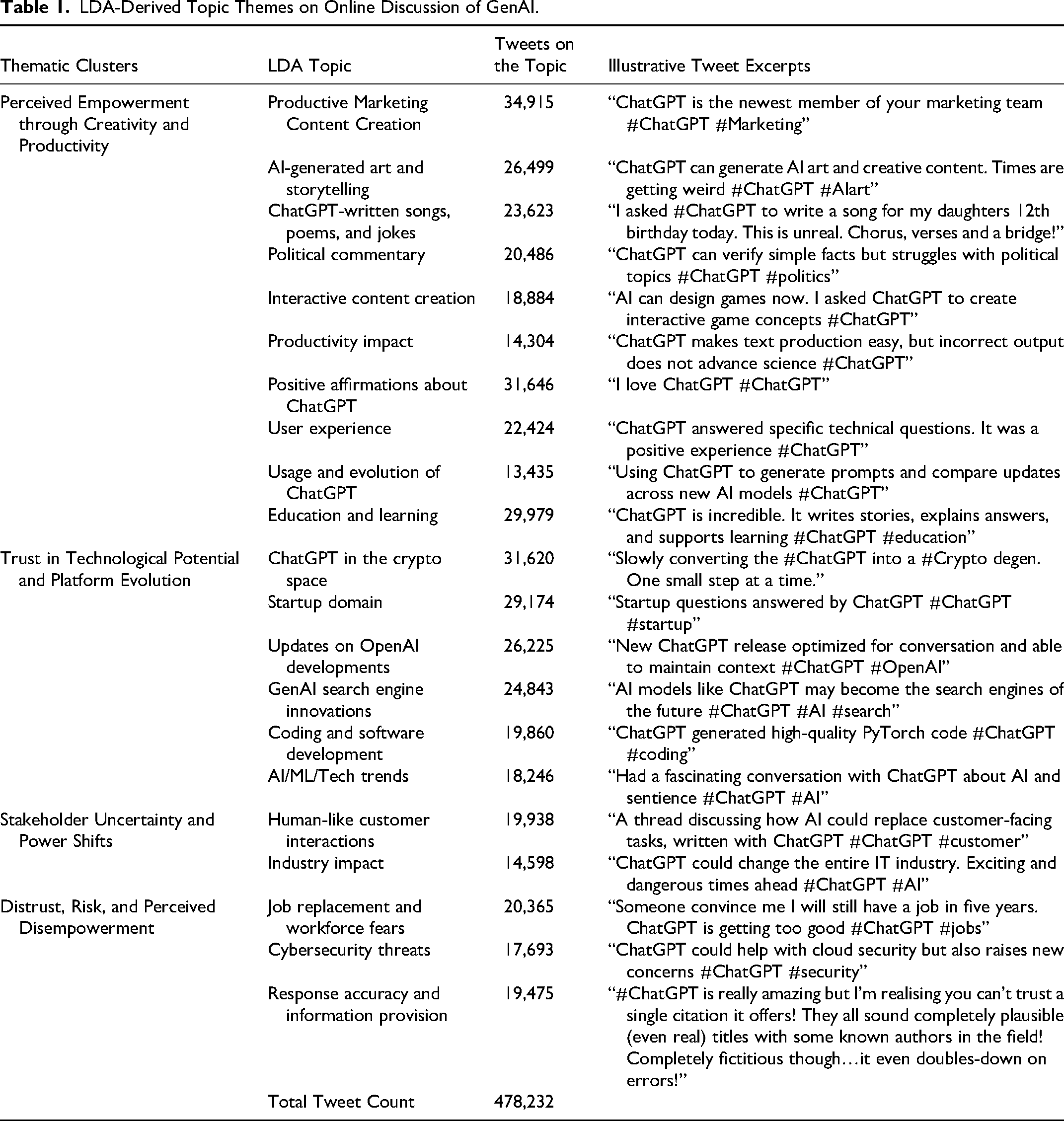
The final model was estimated using Gibbs sampling. We then applied a systematic interpretive procedure widely used in topic modeling to derive higher-order thematic structure. First, we reviewed each topic's highest-probability terms and representative tweets to establish its semantic focus. Second, we compared topics for thematic convergence and divergence. Third, following established inductive practices, we grouped the twenty-one topics into four broader clusters that captured the dominant interpretive frames through which users engaged GenAI: Perceived Empowerment through Creativity and Productivity, Trust in Technological Potential and Platform Evolution, Stakeholder Uncertainty and Power Shifts, and Distrust, Risk, and Perceived Disempowerment. Table 1 summarizes these clusters and provides illustrative tweet examples. Additional methodological detail, including full pseudocode for the modeling pipeline, appears in Appendix-A (Table A2).
LDA-Derived Topic Themes on Online Discussion of GenAI.
To assess the stability of the identified thematic structure, we conducted a series of robustness checks commonly recommended for exploratory topic modeling. Specifically, we re-estimated the final twenty-one topic LDA model under multiple random initializations and alternative sparsity assumptions. Models were re-run using five different random seeds and alternative alpha values (α = 1.0 and α = 0.5), while holding all other parameters constant.
To evaluate overlap across specifications, we compared the top-probability term sets for each topic using Jaccard similarity. Across random initializations, mean top-term Jaccard similarity values ranged from 0.033 to 0.085. These values reflect the known behavior of LDA, in which each topic draws from a large vocabulary and high-probability terms rarely overlap exactly across runs even when the underlying thematic structure is substantively identical (O’Callaghan et al., 2015). Measured overlap is further reduced by label-switching, whereby semantically equivalent topics may be assigned different index numbers across runs, making direct term-set comparison a conservative rather than informative test of stability. Thematic coherence is therefore better assessed by examining whether the same interpretable clusters recur across specifications than by term-level overlap alone. Importantly, no alternative specification produced substantively different higher-order thematic clusters. These checks suggest that the four-cluster structure reported in Table 1 reflects stable patterns of early GenAI discourse rather than artifacts of model initialization or parameter choice.
Integrated Illustrative Evidence and Temporal Patterns in Early GenAI Discourse
Illustrative tweets in Table 1 clarify how the four thematic clusters capture early stakeholder interpretations of GenAI. The first cluster, Perceived Empowerment through Creativity and Productivity, reflects strong enthusiasm for augmentation, with users describing ChatGPT as expanding capabilities through coding assistance, storytelling, and other complex tasks. This suggests that many early adopters experienced GenAI as a collaborative partner that enhanced personal agency. The second cluster, Trust in Technological Potential and Platform Evolution, combines admiration for system performance with unease about rapid improvement and institutional decision-making; tweets describing ChatGPT as impressive yet unsettling indicate that users evaluated not only technical reliability but also provider intentions, highlighting expectations for transparency, stability, and governance. The third cluster, Stakeholder Uncertainty and Power Shifts, reflects concern about how GenAI might redistribute expertise and influence, with posts anticipating major industry change showing that users were attentive to broader structural implications for control, visibility, and authority within markets and organizations. The fourth cluster, Distrust, Risk, and Perceived Disempowerment, highlights fears related to job loss, opaque reasoning, and harmful outputs, with tweets expressing anxiety about employment security, misinformation, or unpredictable model behavior revealing how vulnerability and diminished autonomy became central themes in early GenAI discourse.
Beyond thematic differentiation, Figure 1 reveals distinct temporal dynamics across the six-month observation window. Discourses on Perceived Empowerment through Creativity and Productivity emerged immediately following ChatGPT's release and remained dominant throughout the period, exhibiting only modest fluctuation. Trust in Technological Potential and Platform Evolution increased gradually over time, indicating that iterative system updates and platform modifications sustained attention to institutional governance rather than resolving uncertainty, while Distrust, Risk, and Perceived Disempowerment intensified during the early months before stabilizing, and Stakeholder Uncertainty and Power Shifts persisted at consistently lower levels rather than dissipating. These patterns indicate that early GenAI adoption was characterized by the simultaneous persistence of enthusiasm and concern rather than a linear trajectory toward acceptance or rejection. From a macromarketing perspective, this coexistence suggests that trust in GenAI was conditional and continuously renegotiated rather than progressively consolidated, with performance-based appreciation failing to displace governance-related anxieties and early legitimacy formation unfolding alongside sustained attention to institutional power, accountability, and stakeholder voice.
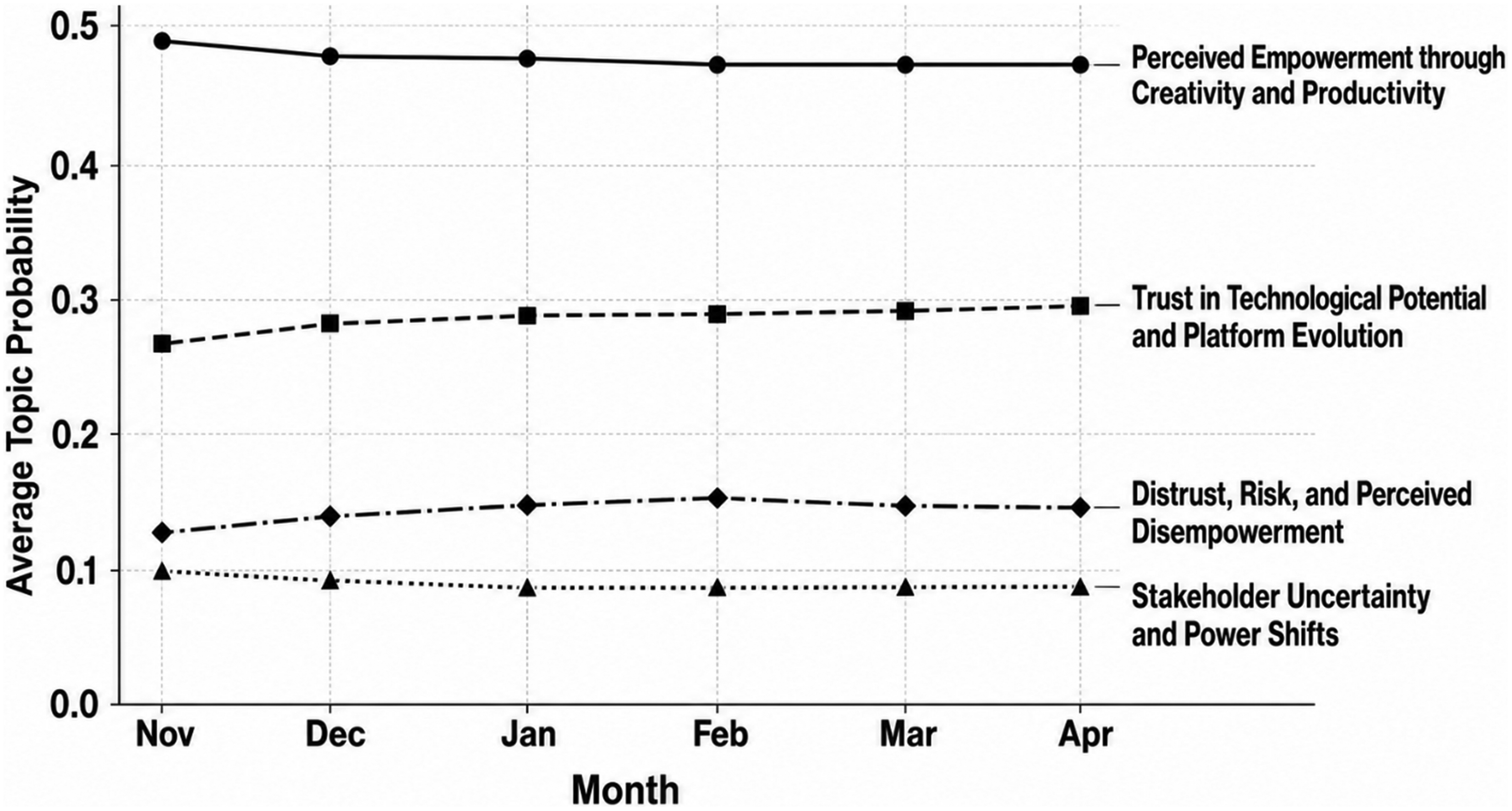
Monthly evolution of GenAI discourse clusters (November 2022-April 2023).
At the market-system level, these dynamics point toward broader structural implications. When confidence in technological capability coexists with persistent concerns about transparency and influence, emerging tensions between reliance and agency come into view within algorithm-mediated environments. Such tensions illuminate conditions under which questions of oversight, participation, and accountability become salient, and the persistence of governance-related themes highlights potential pressures on organizations and policymakers to address visibility, recourse, and stakeholder inclusion as GenAI becomes further embedded in market systems. The thematic and temporal structure identified through LDA offers interpretive insight into how each cluster in Table 1 contributes a distinct dimension to this picture. The first captures moments in which GenAI is experienced as augmentative and creativity-enhancing, revealing how interpretive agency is built when systems are transparent and capability-expanding. The second underscores that technical capability alone does not secure institutional confidence, showing how participatory agency is constrained when stakeholders are excluded from governance and oversight decisions. The third highlights how concerns about structural power and shifting influence shape stakeholder interpretation, exposing threats to equitable inclusion as expertise and authority are redistributed unevenly across market actors. The fourth reveals how opacity and constrained agency are associated with resistance and disengagement, demonstrating how governance agency erodes when accountability mechanisms are absent or inaccessible. Collectively, these patterns reveal that the earliest encounters with GenAI already implicated the core conditions of emancipation. Enthusiasm for augmentation, unease about institutional governance, concerns about power redistribution, and fears about limited recourse did not unfold sequentially but surfaced simultaneously and persisted throughout the observation window, suggesting that trust in GenAI was continuously renegotiated against evolving governance expectations rather than progressively consolidated, together motivating the propositions advanced in Section 4.
Conceptual Development of the Trust-Power Paradox
Our analysis of early GenAI discourse revealed consistent duality: stakeholders expressed both optimism and apprehension, describing GenAI as empowering in some instances and constraining in others. These patterns, reflected in the LDA clusters of empowerment, emerging trust concerns, uncertainty about shifting power, and perceived disempowerment, highlight the underlying mechanisms through which trust and agency are negotiated (Puntoni, 2024). This tension aligns closely with the macromarketing canon examining how market institutions shape freedom, vulnerability, and distribution of power (Fisk, 1981; Kilbourne et al., 1997; Shultz & Holbrook, 2009).
Central to this tradition is consumer sovereignty, which requires access to information, agency, and protection from domination for individuals to participate freely in market systems. The emancipation literature underscores interpretive capacity and meaningful participation as foundations for marketplace justice, enabling consumers and employees to challenge or reshape institutional arrangements (Dobscha & Ozanne, 2001; Firat & Dholakia, 1998). GenAI activates these concerns by restructuring channels of visibility, choice, and influence in algorithm-mediated environments.
Trust in AI outputs alone does not guarantee empowerment. Rather, trust becomes entangled with institutional choices concerning transparency, inclusion, and oversight. Each mechanism generates a proposition about stakeholder experience, collectively forming the conceptual foundation of the Stakeholder Experience Matrix and the Emancipatory Readiness Funnel. The LDA-derived patterns provide empirical grounding for these mechanisms, demonstrating how trust and empowerment co-evolve in GenAI contexts and extending the macromarketing emancipation tradition into digitally mediated systems.
Transparency, Explainability, and Value Alignment as Foundations of Trust
Macromarketing scholarship emphasizes interpretive agency as essential for emancipation, since individuals cannot contest or influence market structures without understanding them (Dobscha & Ozanne, 2001; Gopaldas, 2013). Stakeholders therefore place greater trust in GenAI when systems are transparent, interpretable, and aligned with their values. Early reactions revealed enthusiasm for efficiency alongside concerns about opaque reasoning, accuracy limitations, and unclear data flows.
Explainability is not merely a technical feature but a structural condition that supports sovereignty and equitable participation (Kilbourne et al., 1997; Shultz & Holbrook, 2009). Black box systems concentrate interpretive power within institutions, weakening user autonomy and widening information asymmetries. Value alignment reinforces this further: deployments perceived as extractive or manipulative contradict macromarketing expectations that markets should advance justice and shared welfare (Prothero et al., 2011), while practices such as transparent rationales, opt-out routes, and human oversight reflect Layton’s (2007, 2015) emphasis on equitable information flows and inclusive participation. These conditions apply equally to the consumer and employee stakeholder groups that anchor our propositions within macromarketing systems.
Trust in GenAI strengthens when systems are transparent, interpretable, and consistent with stakeholder values and expectations.
Empowerment Through Human Augmentation Rather Than Replacement
Macromarketing has long defined emancipation as increased capacity, competence, and influence within market systems (Firat & Dholakia, 1998; Mittelstaedt et al., 2006). Stakeholders feel empowered when GenAI expands their capability while preserving decision authority and opportunities for participation. In consumer contexts, augmentation enhances creativity and decision quality without restricting control. Systems framed as assistive or co-creative are perceived as more participatory and fairer, consistent with macromarketing insights regarding humane, expertise respecting market design (Prothero et al., 2011).
In organizational contexts, empowerment grows when AI deployments include human oversight, training, and participatory design, practices reflecting Layton's (2015) view of adaptive market systems in which all actors must retain meaningful influence over value flows. Conversely, deployments emphasizing replacement or imposing surveillance diminish agency, morale, and trust, echoing post-humanist critiques of how algorithmic systems displace human authorship.
Perceived empowerment increases when GenAI is positioned and experienced as a tool that enhances human agency instead of substituting for human judgment.
Consequences of Low-Trust and Low-Empowerment
Macromarketing research shows that when systems deprioritize fairness, participation, and wellbeing, stakeholders experience vulnerability and powerlessness (Kilbourne et al., 1997; Shultz & Holbrook, 2009). GenAI deployments that lack transparency and do not preserve user agency produce this same combination of low trust and low empowerment. For consumers, algorithmic personalization perceived as opaque or exploitative prompts avoidance or backlash (Dobscha & Ozanne, 2001; Gopaldas, 2013), and AI that undermines autonomy or ethical expectations prompts principled refusal (Danaher, 2019).
Employees experience comparable effects when GenAI is introduced without transparency or meaningful participation. Replacement-oriented framing, unclear decision pathways, or limited opportunities for input violate macromarketing principles emphasizing dignity, participatory governance, and humane work systems (Mittelstaedt et al., 2006; Prothero et al., 2011). Such breakdowns erode institutional legitimacy and destabilize adoption trajectories.
Stakeholders are more likely to resist or disengage from GenAI when they perceive the system as neither trustworthy nor empowering.
Together, these propositions clarify how transparency, augmentation, and perceived agency shape early stakeholder interpretations of GenAI, and why trust and empowerment diverge across contexts. The next section introduces the Stakeholder Experience Matrix, which translates these mechanisms into a diagnostic framework mapping distinct experiential configurations for consumers and employees.
Navigating the Trust-Power Paradox Through the Stakeholder Experience Matrix
The Stakeholder Experience Matrix (SEM), as illustrated in Figure 2, translates the empirical patterns identified through the LDA clusters into a conceptual structure that explains how trust and empowerment interact during early encounters with GenAI. Building on the mechanisms defined in Section 4, the SEM illustrates how variations in transparency, explainability, and value alignment (Proposition 1), perceptions of augmentation or displacement (Proposition 2), and experiences of declining trust and agency (Proposition 3) generate four distinct experiential configurations. These quadrants capture how consumers and employees adopt, resist, or reinterpret GenAI under uncertainty and how the trust-power paradox unfolds across market and organizational contexts.
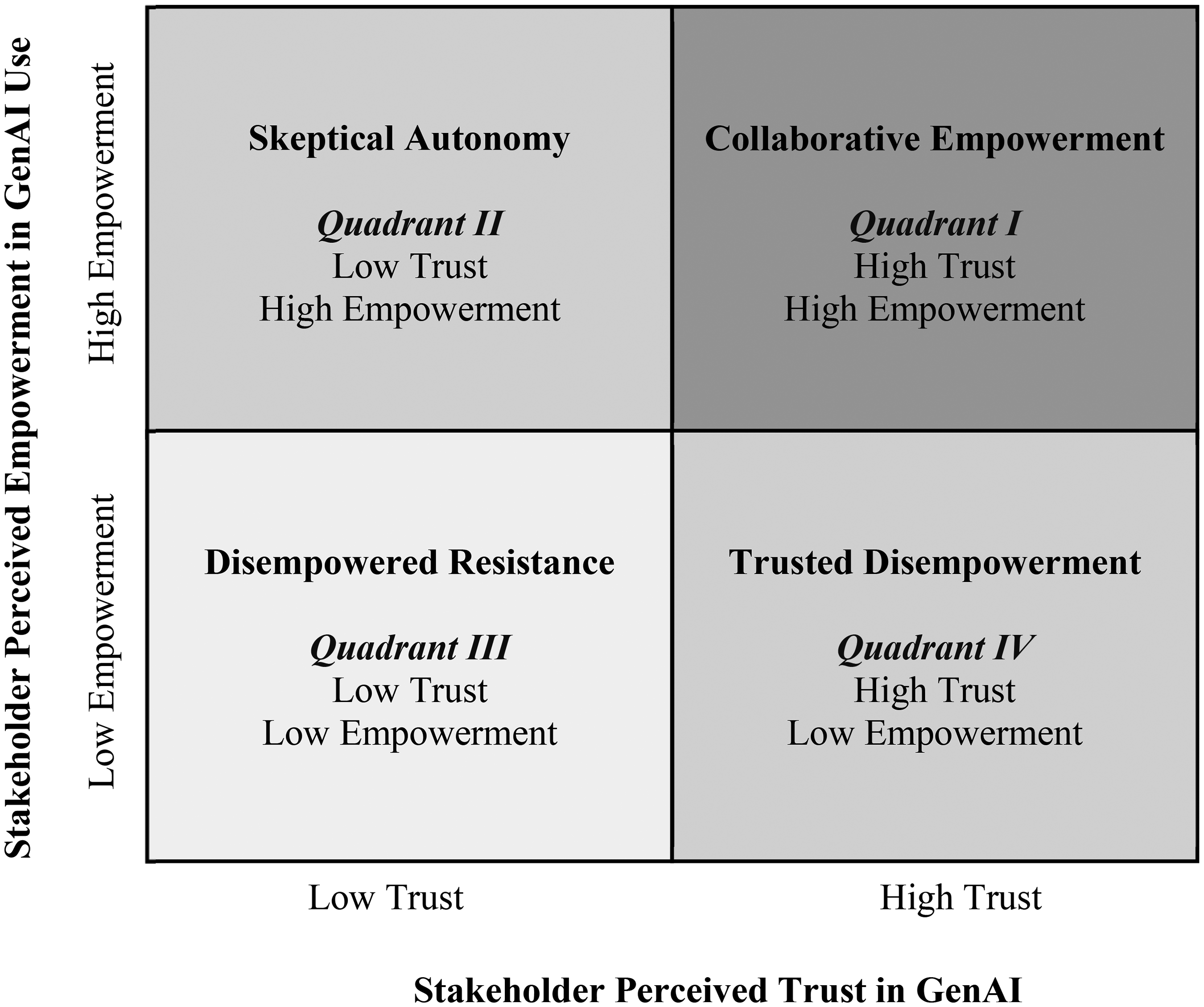
Stakeholder experience matrix highlighting the trust-power paradox in GenAI.
Collaborative Empowerment (Quadrant I: High Trust × High Empowerment) reflects the most constructive adoption environment, where stakeholders trust AI outputs and maintain influence over system operations. Transparency, explainability, and value alignment support trust (Proposition 1), while augmentation rather than substitution strengthens empowerment (Proposition 2). Training, participatory design, and human oversight reinforce perceived legitimacy and foster creativity, co-production, and innovation. Quadrant I represents the aspirational condition for addressing the trust-power paradox.
Skeptical Autonomy (Quadrant II: Low Trust × High Empowerment) describes capable users who nevertheless question AI's fairness, governance, or institutional intent. This pattern reflects tweets in the Trust in Technological Potential and Platform Evolution cluster in Table 1 where users viewed ChatGPT as highly capable yet expressed concern about unclear motives or governance decisions. Opaque logic, limited disclosure, or unclear data practices weaken trust even when functional empowerment is high (Proposition 1), leaving individuals feeling proficient but excluded from deployment or oversight decisions. As a transitional state, movement toward Quadrant I or Quadrant III depends on whether governance practices reduce or exacerbate uncertainty.
Disempowered Resistance (Quadrant III: Low Trust × Low Empowerment) represents conditions in which both trust and empowerment are low (Proposition 3). Consumers may view AI as intrusive or manipulative, and employees may associate it with surveillance, substitution, or diminished discretion. Such dynamics erode autonomy and institutional trust, particularly when automation is poorly communicated or imposed without participation. Quadrant III signals weakened legitimacy and requires governance interventions that restore transparency and agency.
Trusted Disempowerment (Quadrant IV: High Trust × Low Empowerment) captures stakeholders who trust AI performance but lack meaningful influence over how decisions are made or applied. Limited control can produce frustration as users recognize underlying power asymmetries, potentially shifting experiences toward Quadrant III. Empowerment-enhancing practices such as participatory design, adjustable controls, and recourse pathways can redirect stakeholders toward Quadrant I. Quadrant IV highlights the need for governance mechanisms supporting interpretive agency alongside performance-based trust.
Taken together, the quadrants illustrate how trust and empowerment shape adoption experiences and how governance choices influence movement between them. The SEM functions as both a diagnostic and developmental framework, providing the foundation for the Emancipatory Readiness Funnel introduced in Section 6.
The Emancipatory Readiness Funnel: Reclaiming Stakeholder Agency in the Age of AI
While the SEM diagnoses experiential conditions at a single point in time, the Emancipatory Readiness Funnel (ERF) captures how those conditions evolve as stakeholders interact with and interpret algorithm-mediated systems within broader market structures. The ERF explains how stakeholders move from initial exposure to GenAI toward deeper engagement or, alternatively, toward resistance, as shaped by institutional arrangements and governance practices. It traces how transparency and alignment (Proposition 1), augmentation or displacement (Proposition 2), and declining trust and agency (Proposition 3) influence shifts in interpretive capacity, participatory influence, and perceived legitimacy over time.
The ERF comprises six sequential stages (Awareness, Understanding, Trial, Integration, Reinforcement, and Disengagement or Advocacy), summarized in Table 2 and each linked to the mechanisms developed in Section 4. Movement across stages depends on governance choices that shape whether stakeholders achieve interpretive clarity, retain meaningful influence, and evaluate AI systems as legitimate within the broader marketing system.
Emancipatory Readiness Funnel: Stages, Propositions, and Matrix Pathways.
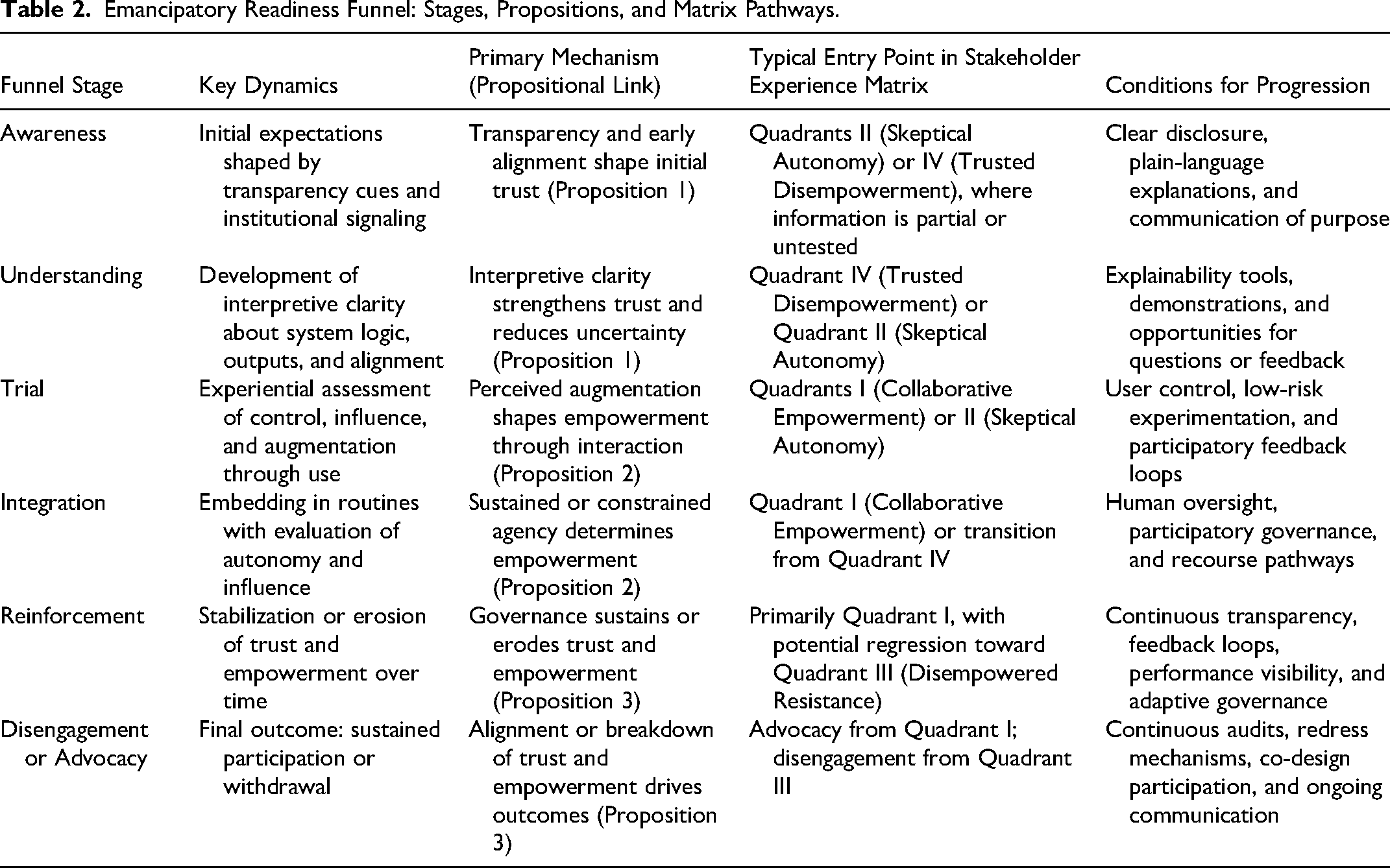
Awareness (Stage 1) marks the moment stakeholders first encounter GenAI and begin forming interpretations of its purpose and legitimacy. Initial expectations are shaped by transparency cues and institutional signaling, with clear disclosures regarding system design, data use, and purpose supporting more stable interpretations, whereas ambiguity generates uncertainty and positions stakeholders in Quadrants II or IV where information remains partial or untested (Proposition 1). Understanding (Stage 2) deepens initial impressions as stakeholders develop interpretive clarity about system logic, outputs, and alignment. Explainability tools and opportunities for feedback strengthen interpretive agency and reduce uncertainty, moving stakeholders toward more informed evaluations of whether the system aligns with their interests and values (Proposition 1).
Trial (Stage 3) moves stakeholders from interpretation to action, as low-stakes experimentation allows them to assess influence, control, and augmentation through use. Agency becomes experiential as perceived augmentation shapes empowerment through interaction, with positive experiences positioning stakeholders in Quadrant I and misalignment sustaining skepticism in Quadrant II (Proposition 2). Integration (Stage 4) arrives when GenAI becomes embedded in everyday routines and decision processes. Whether agency is sustained or constrained through institutional arrangements determines empowerment at this stage, with human oversight, participatory governance, and recourse pathways supporting movement toward or within Quadrant I, while restrictive or opaque systems risk regression toward Quadrant IV (Proposition 2).
Reinforcement (Stage 5) determines whether early momentum holds, as governance practices either sustain or erode trust and empowerment over time. Continuous transparency, feedback loops, and adaptive governance reinforce legitimacy and stabilize stakeholders in Quadrant I, whereas declining visibility or stakeholder voice increases the likelihood of regression toward Quadrant III (Proposition 3). Disengagement or Advocacy (Stage 6) resolves the trajectory into one of two outcomes: sustained participation and advocacy from Quadrant I when trust and empowerment remain aligned, or withdrawal and disengagement from Quadrant III when opacity and constrained influence persist, capturing whether stakeholder agency is ultimately supported or undermined within the broader market system (Proposition 3).
The ERF and the SEM provide complementary perspectives on stakeholder experience. The SEM captures configurations of trust and empowerment at a given point in time, whereas the ERF traces how stakeholders move across these configurations through a structured six-stage process. Awareness and Understanding establish the interpretive foundation, shaping early trust and the capacity to evaluate system alignment. Trial and Integration translate interpretation into experience, as stakeholders assess their influence, agency, and the degree to which GenAI augments rather than constrains their judgment. Reinforcement consolidates or erodes these conditions through ongoing governance practices, and Disengagement or Advocacy resolves the trajectory into active advocacy and sustained participation or disengagement and withdrawal from the broader market system. Across these six stages, the ERF traces how interpretive agency, participatory agency, equitable inclusion, and governance agency are either cultivated or constrained through governance choices. Together, the two models clarify how institutional arrangements and design choices structure sovereignty, autonomy, and participation across the full arc of GenAI adoption, and provide the basis for the governance principles developed in Section 7.
The Ethical AI Governance Compass: Anchoring Responsible Early Adoption
The SEM and the ERF show how trust and empowerment shape stakeholder responses to GenAI and how these responses evolve over time. The Ethical AI Governance Compass extends these diagnostic frameworks by translating macromarketing and socially responsible marketing commitments into governance principles that can guide responsible early adoption. These concerns reflect the macromarketing emancipation tradition, which holds that market systems should expand rather than restrict human agency (Dobscha & Ozanne, 2001; Firat & Dholakia, 1998; Fisk, 1981; Kilbourne et al., 1997; Layton, 2007, 2015). Socially responsible marketing further emphasizes that marketing systems should promote wellbeing, protect vulnerable actors, and distribute benefits and risks fairly (Prothero et al., 2011), and underscores firm responsibility for anticipating and addressing the societal consequences of innovation while upholding justice and dignity (Ferrell & Ferrell, 2024). The Compass (Figure 3) distills these commitments into four interrelated pillars.
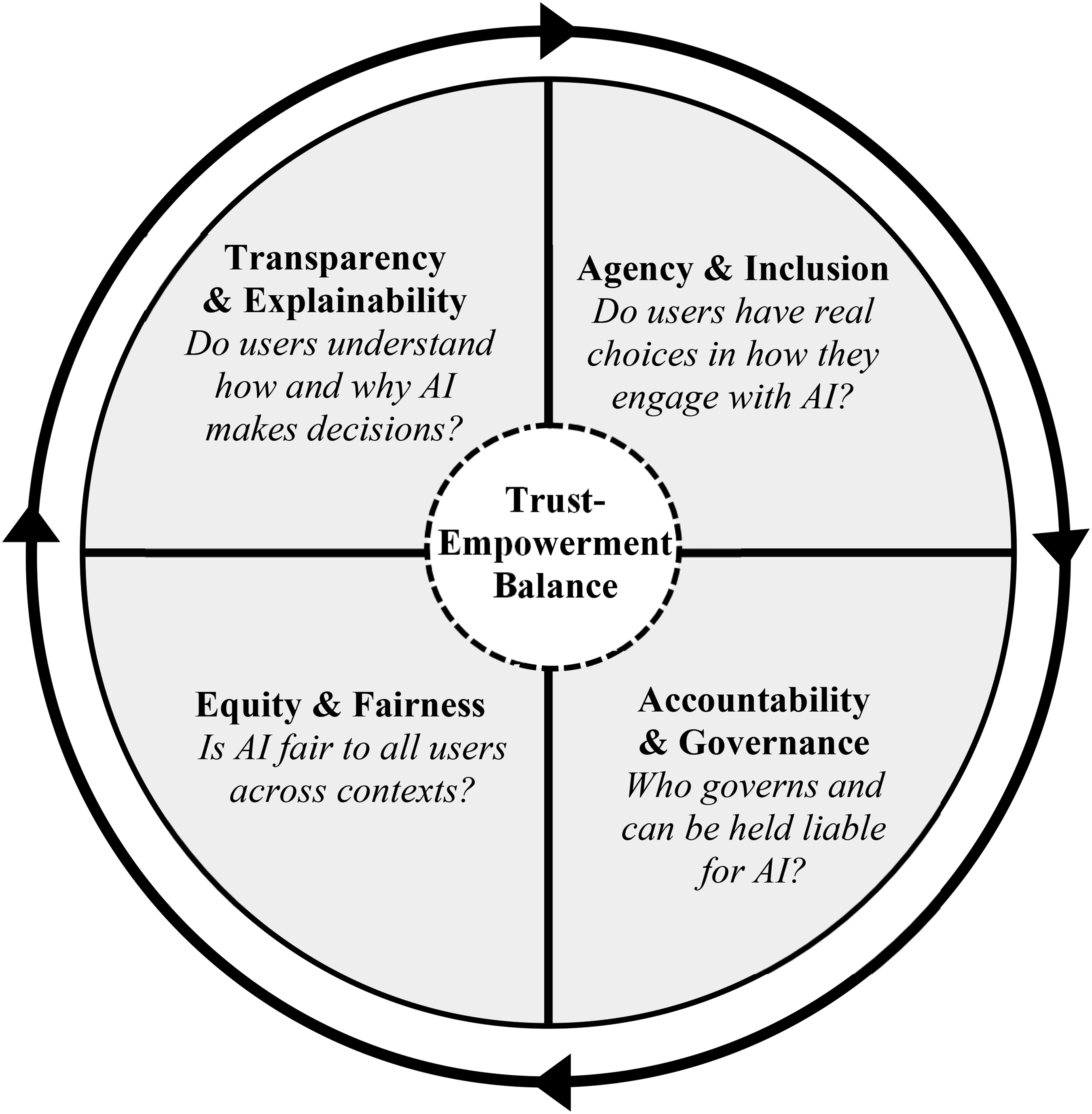
The ethical AI governance compass for responsible ai implementation.
Transparency and explainability support interpretive agency by making key system assumptions visible, including how outputs are generated, what data practices shape them, and what limitations are known. This pillar clarifies what stakeholders can reasonably trust and what remains uncertain. Agency and inclusion center meaningful stakeholder influence over how GenAI is used in practice; rather than equating adoption with acceptance, this pillar emphasizes voice, choice, and participation in design and deployment so that augmentation does not become quiet displacement of autonomy. Equity and fairness address distributional consequences, especially for vulnerable groups, by foregrounding whether GenAI produces systematically uneven risks and benefits across contexts, directing attention to how harms, exclusions, or discrimination can emerge through routine use. Accountability and governance specify who is responsible when GenAI systems fail or cause harm and what mechanisms enable correction, appeal, and oversight. These conditions are central to institutional legitimacy and serve as safeguards for stakeholder rights (Ferrell & Ferrell, 2024).
Collectively, the four pillars operationalize the dimensions of emancipation introduced in this study: Transparency and Explainability enhance interpretive agency, Agency and Inclusion strengthen participatory agency, Equity and Fairness promote equitable inclusion, and Accountability and Governance safeguard governance agency. They provide a normative orientation for evaluating whether GenAI adoption supports emancipation or reinforces disempowerment and establish the foundation for the operational assessment in Section 8.
Practical Emancipation Indicators: Operationalizing Trust-Power Dynamics
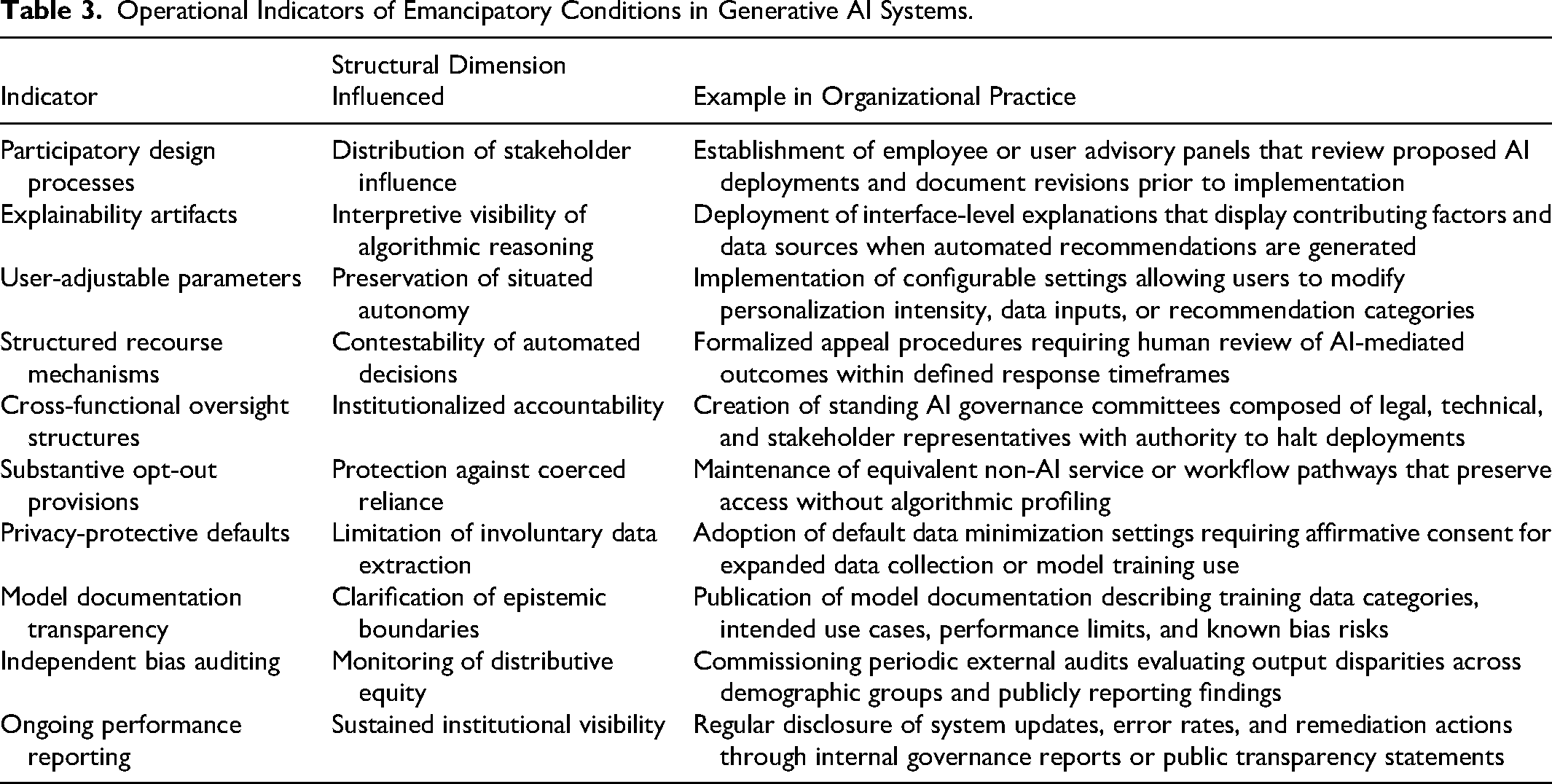
The Ethical AI Governance Compass outlines normative commitments to transparency, agency, fairness, and accountability. Practical emancipation indicators extend this framework by identifying how those commitments become materially embedded in system design and institutional practice. In macromarketing, emancipation is understood as a structural condition shaped by arrangements that expand interpretive capacity, enable participation, and reduce vulnerability (Dobscha & Ozanne, 2001; Firat & Dholakia, 1998; Fisk, 1981; Kilbourne et al., 1997; Layton, 2007, 2015; Mittelstaedt et al., 2006). Applied to GenAI, this involves institutional features that shape whether stakeholders can understand, influence, and contest algorithmic outputs within human-technology systems (Fowler et al., 2024; Thyroff et al., 2023). The discourse patterns examined earlier suggest that trust and skepticism are closely tied to the visibility of governance choices and meaningful recourse. Structural commitments acquire significance when reflected in observable features of deployment.
Table 3 summarizes indicators and their organizational manifestations. Each indicator corresponds to a domain in which institutional decisions influence interpretive clarity, participatory influence, distributive equity, or accountability. By making these domains explicit, the table renders visible the structural conditions through which trust-power dynamics are sustained, unsettled, or renegotiated.
Operational Indicators of Emancipatory Conditions in Generative AI Systems.
General Discussion
Positioning the Theoretical Contribution Within Established Literature
This study contributes to macromarketing scholarship by reframing early GenAI adoption as a structural problem of institutional design rather than a narrow issue of technology acceptance. Existing research on artificial intelligence frequently centers performance optimization, efficiency gains, and associated risks such as bias or surveillance (Eysenbach, 2023; Huang & Rust, 2021, 2022; Paschen et al., 2020; Peres et al., 2023). While valuable, these approaches often treat trust as a response to technological capability and empowerment as an outcome of usability. Our analysis instead positions trust and empowerment as structurally mediated conditions shaped by governance arrangements, institutional visibility, and distributions of influence. Central to this reframing is a multidimensional conception of emancipation encompassing interpretive agency, participatory agency, equitable inclusion, and governance agency, dimensions that the SEM, ERF, and Compass collectively operationalize across diagnostic, temporal, and normative registers.
The concept of the trust-power paradox advances this shift by theorizing how trust in AI outputs can coexist with constrained stakeholder agency. Rather than conceptualizing trust as a purely attitudinal variable, we frame it as embedded within institutional configurations that allocate interpretive authority and decision influence. This perspective extends macromarketing analyses of power asymmetry (Dholakia, 2012; Shultz, 2007) by demonstrating how algorithmic infrastructures reorganize participation and contestability within marketing systems. At the system level, this reorganization acquires structural significance when governance arrangements concentrate interpretive authority and decision influence within platform institutions rather than distributing them across market actors. Quadrant I's collaborative empowerment thus represents not only an aspirational condition for individual stakeholders but a structural prerequisite for macromarketing-level emancipation, wherein transparency, participatory design, and augmentation are institutionalized to preserve sovereignty and accountability across the marketing system as a whole. Similarly, when ERF progression toward advocacy becomes widespread across stakeholder groups rather than remaining episodic, it signals the kind of distributed interpretive agency and participatory governance that system-level emancipation requires, connecting individual adoption trajectories to the structural conditions through which macromarketing commitments to justice, dignity, and meaningful participation are sustained or undermined.
The study also extends institutional trust scholarship. Macromarketing research has long emphasized the system-level role of trust in sustaining exchange and legitimacy (Dixon, 1984; Ekici & Peterson, 2009; Hunt, 2000, 2007; Layton & Grossbart, 2006; Manis et al., 2024; Redmond, 2018). Our findings suggest that in algorithm-mediated environments, trust formation may become decoupled from stakeholder influence, revealing tensions between reliance on system outputs and stakeholders’ capacity to influence the institutional arrangements that govern them. By connecting early public sensemaking to these dynamics, we offer a framework for examining how governance design shapes the relationship between reliance and agency.
The paper further contributes to adoption research by integrating structural and temporal dimensions. Dominant models such as the Technology Acceptance Model and Diffusion of Innovations emphasize perceived usefulness and diffusion trajectories (Davis, 1989; Parasuraman, 2000; Rogers, 2003). We complement these approaches by foregrounding legitimacy, interpretive clarity, and participation as central to adoption pathways.
Methodologically, the study introduces large-scale topic modeling into interpretive macromarketing inquiry (Wen & Laporte, 2025; Wooliscroft, 2016). By analyzing 478,232 public posts during the earliest phase of GenAI diffusion, we identify emergent patterns of stakeholder meaning-making at scale. This computational approach surfaces system-level themes that inform conceptual development while remaining grounded in interpretive analysis. The study illustrates how digital trace data can complement theoretical inquiry into evolving institutional phenomena.
Finally, the SEM, the ERF, and the Compass collectively provide a structured framework for analyzing how governance arrangements shape early AI adoption. Rather than offering prescriptive solutions, these models supply evaluative criteria for examining how algorithmic infrastructures reorganize power, participation, and legitimacy in market systems. Taken together, this work advances macromarketing by linking early stakeholder sensemaking, institutional trust dynamics, and governance design within a coherent structural framework for understanding GenAI.
Managerial Implications
Translating the trust-power paradox into practice requires more than theoretical diagnosis. This section explains how organizations can use the SEM, the ERF, and the Compass to guide governance and design decisions that support stakeholder agency during GenAI deployment.
Applied Example: Integrating the Framework in Practice
Consider a firm evaluating the introduction of an internal AI copilot to support writing, information retrieval, and task automation. The SEM suggests that early employee responses are unlikely to be uniform. Some may trust the system and readily integrate it into their workflow. Others may rely on its outputs while questioning the governance processes underlying its operation. A third group may privilege their own expertise and critically assess system accuracy or fairness. Still others may experience both low trust and low empowerment, particularly where concerns about surveillance or displacement arise. These variations illustrate how different combinations of perceived trust and agency shape initial interpretations of AI deployment.
The ERF provides a temporal perspective on how these responses may evolve. Progression from awareness to sustained integration depends not only on perceived usefulness but also on interpretive clarity, opportunities for voice, and accessible recourse. Clear communication about system capabilities and limitations, participatory training processes, and visible feedback channels are associated with deeper engagement. By contrast, opacity in system logic, limited override options, or unclear accountability structures may slow progression and reinforce skepticism.
The Ethical AI Governance Compass offers structural guidance for sustaining emancipatory outcomes. Transparency clarifies data sources and system boundaries. Agency is reinforced when users retain meaningful influence over how AI tools operate in practice. Fairness directs attention to uneven impacts across roles or groups. Accountability specifies responsibility when errors occur or harms arise. Governance arrangements that render these conditions visible are more likely to support forms of trust that remain connected to empowerment rather than detached from it.
Applying the Frameworks Across Organizational Contexts
Beyond the illustrative case, the integrated use of these frameworks encourages organizations to treat GenAI deployment as an ongoing governance process rather than a discrete implementation event. Variation in stakeholder interpretation calls for differentiated communication and oversight rather than uniform rollout strategies. Attention to how engagement evolves over time highlights points at which transparency, participation, or recourse may require reinforcement.
Institutional design therefore becomes central to sustaining legitimacy. Governance arrangements that render system boundaries intelligible, preserve stakeholder influence, and maintain avenues for contestation are more likely to stabilize trust while preserving empowerment. Assessing perceptions of autonomy, clarity, and procedural fairness provides insight into how institutional configurations are experienced in practice. Such evaluation enables adaptive refinement of governance structures while remaining aligned with macromarketing commitments to justice, dignity, and responsible innovation.
Limitations and Future Directions
While this study offers theoretical and empirical insight into early stakeholder responses to GenAI, several limitations suggest avenues for further research. The analysis focuses on consumers and employees during early adoption, and other actors, including regulators, educators, healthcare professionals, investors, and vulnerable communities, may interpret trust, empowerment, risk, and accountability differently across institutional contexts. Examining these groups would deepen understanding of how the trust-power paradox manifests beyond consumer and employee settings.
The data derive from discourse on X (formerly Twitter). Although the platform provides high-volume, real-time commentary, its demographic composition and communicative norms may shape observed themes. Extending analysis to platforms such as Reddit, LinkedIn, or professional forums would broaden interpretive diversity and strengthen contextual robustness. The dataset also includes only English-language posts, and cross-linguistic and cross-cultural comparisons would clarify how interpretations of AI legitimacy and risk differ across jurisdictions where cultural norms, regulatory traditions, and institutional trust conditions vary considerably.
The study relies on short-form public discourse, which topic modeling leverages effectively to identify stable thematic patterns across large corpora, particularly in early diffusion contexts characterized by rapid and spontaneous expression. Complementing this approach with longer-form materials, including policy documents, organizational communications, or deliberative forums, would allow future research to examine how governance narratives evolve as institutional arrangements mature. The SEM and ERF are conceptually derived from interpretive analysis rather than causal testing, and subsequent studies could employ surveys, experiments, interviews, or simulation methods to assess how variations in transparency, participation, or oversight influence trust and empowerment trajectories.
Institutional and regulatory environments further shape the conditions under which GenAI systems are adopted. Differences in data governance regimes, labor protections, and digital literacy may influence both opportunity structures and vulnerability patterns, and comparative and longitudinal research would clarify how trust and empowerment dynamics shift as governance frameworks evolve. These limitations point toward continued inquiry into how algorithm-mediated systems reorganize market structures, stakeholder agency, and institutional legitimacy across diverse contexts.
Footnotes
Associate Editor
Jie Fowler

Funding
The authors received no financial support for the research, authorship, and/or publication of this article.
Declaration of Conflicting Interests
The authors declared no potential conflicts of interest with respect to the research, authorship, and/or publication of this article.
Author Biographies
Appendix A. Data Collection and Analytic Procedures
Summary of Data Retrieval, Preparation, and Topic Modeling Procedures. Pseudocode for Topic Modeling Procedures.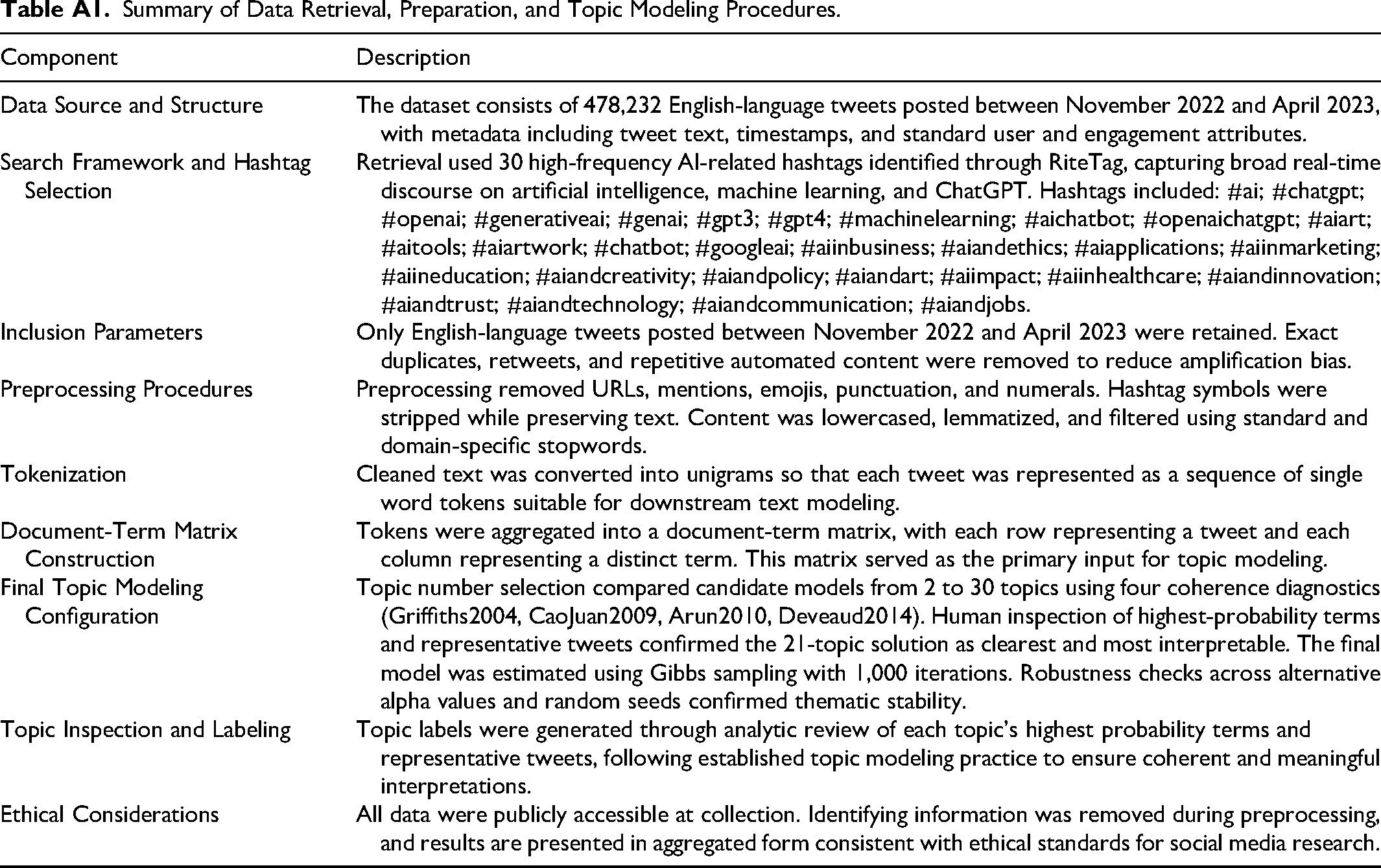
Component
Description
Data Source and Structure
The dataset consists of 478,232 English-language tweets posted between November 2022 and April 2023, with metadata including tweet text, timestamps, and standard user and engagement attributes.
Search Framework and Hashtag Selection
Retrieval used 30 high-frequency AI-related hashtags identified through RiteTag, capturing broad real-time discourse on artificial intelligence, machine learning, and ChatGPT. Hashtags included: #ai; #chatgpt; #openai; #generativeai; #genai; #gpt3; #gpt4; #machinelearning; #aichatbot; #openaichatgpt; #aiart; #aitools; #aiartwork; #chatbot; #googleai; #aiinbusiness; #aiandethics; #aiapplications; #aiinmarketing; #aiineducation; #aiandcreativity; #aiandpolicy; #aiandart; #aiimpact; #aiinhealthcare; #aiandinnovation; #aiandtrust; #aiandtechnology; #aiandcommunication; #aiandjobs.
Inclusion Parameters
Only English-language tweets posted between November 2022 and April 2023 were retained. Exact duplicates, retweets, and repetitive automated content were removed to reduce amplification bias.
Preprocessing Procedures
Preprocessing removed URLs, mentions, emojis, punctuation, and numerals. Hashtag symbols were stripped while preserving text. Content was lowercased, lemmatized, and filtered using standard and domain-specific stopwords.
Tokenization
Cleaned text was converted into unigrams so that each tweet was represented as a sequence of single word tokens suitable for downstream text modeling.
Document-Term Matrix Construction
Tokens were aggregated into a document-term matrix, with each row representing a tweet and each column representing a distinct term. This matrix served as the primary input for topic modeling.
Final Topic Modeling Configuration
Topic number selection compared candidate models from 2 to 30 topics using four coherence diagnostics (Griffiths2004, CaoJuan2009, Arun2010, Deveaud2014). Human inspection of highest-probability terms and representative tweets confirmed the 21-topic solution as clearest and most interpretable. The final model was estimated using Gibbs sampling with 1,000 iterations. Robustness checks across alternative alpha values and random seeds confirmed thematic stability.
Topic Inspection and Labeling
Topic labels were generated through analytic review of each topic's highest probability terms and representative tweets, following established topic modeling practice to ensure coherent and meaningful interpretations.
Ethical Considerations
All data were publicly accessible at collection. Identifying information was removed during preprocessing, and results are presented in aggregated form consistent with ethical standards for social media research.
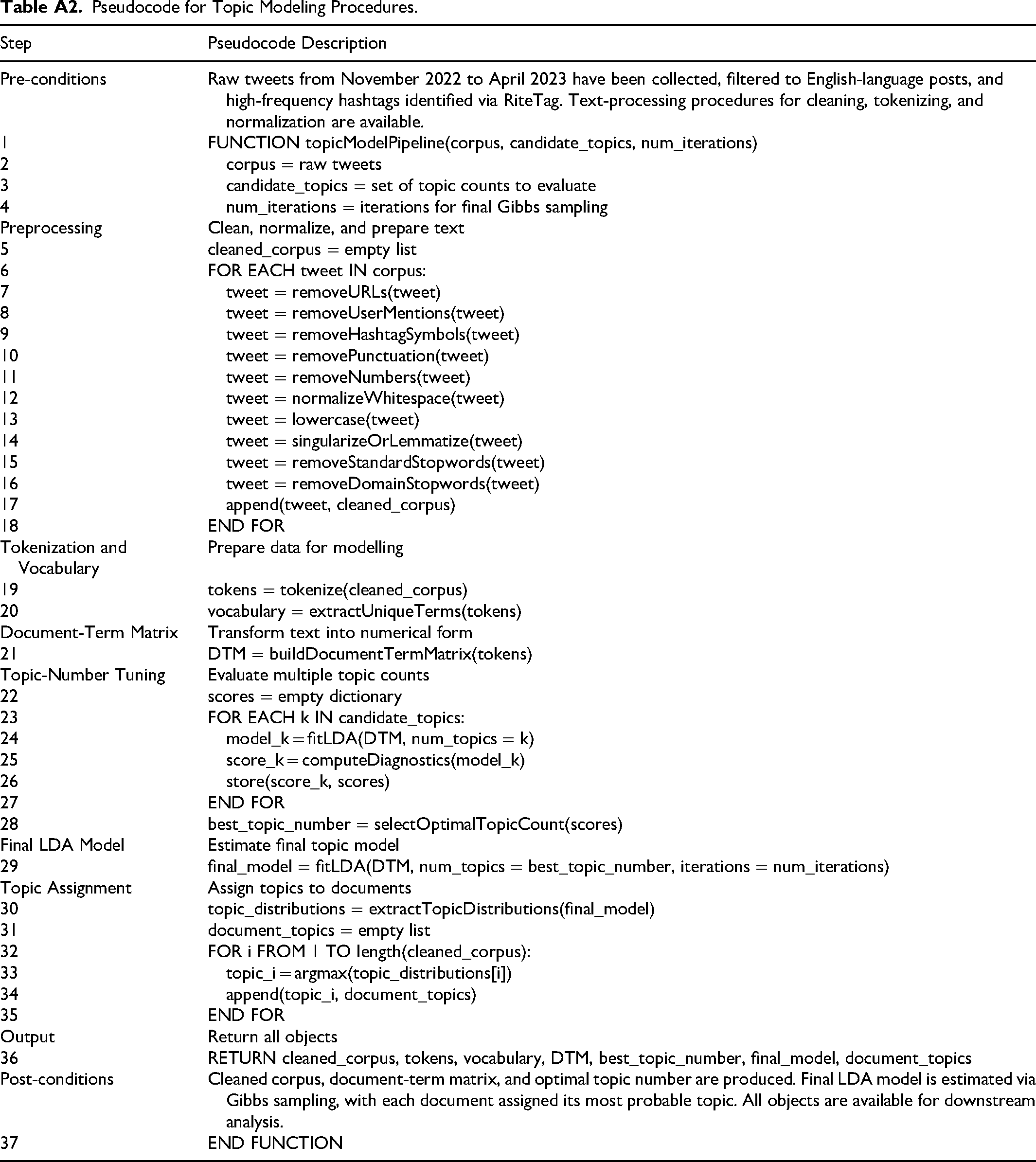
Step
Pseudocode Description
Pre-conditions
Raw tweets from November 2022 to April 2023 have been collected, filtered to English-language posts, and high-frequency hashtags identified via RiteTag. Text-processing procedures for cleaning, tokenizing, and normalization are available.
1
FUNCTION topicModelPipeline(corpus, candidate_topics, num_iterations)
2
corpus = raw tweets
3
candidate_topics = set of topic counts to evaluate
4
num_iterations = iterations for final Gibbs sampling
Preprocessing
Clean, normalize, and prepare text
5
cleaned_corpus = empty list
6
FOR EACH tweet IN corpus:
7
tweet = removeURLs(tweet)
8
tweet = removeUserMentions(tweet)
9
tweet = removeHashtagSymbols(tweet)
10
tweet = removePunctuation(tweet)
11
tweet = removeNumbers(tweet)
12
tweet = normalizeWhitespace(tweet)
13
tweet = lowercase(tweet)
14
tweet = singularizeOrLemmatize(tweet)
15
tweet = removeStandardStopwords(tweet)
16
tweet = removeDomainStopwords(tweet)
17
append(tweet, cleaned_corpus)
18
END FOR
Tokenization and Vocabulary
Prepare data for modelling
19
tokens = tokenize(cleaned_corpus)
20
vocabulary = extractUniqueTerms(tokens)
Document-Term Matrix
Transform text into numerical form
21
DTM = buildDocumentTermMatrix(tokens)
Topic-Number Tuning
Evaluate multiple topic counts
22
scores = empty dictionary
23
FOR EACH k IN candidate_topics:
24
model_k = fitLDA(DTM, num_topics = k)
25
score_k = computeDiagnostics(model_k)
26
store(score_k, scores)
27
END FOR
28
best_topic_number = selectOptimalTopicCount(scores)
Final LDA Model
Estimate final topic model
29
final_model = fitLDA(DTM, num_topics = best_topic_number, iterations = num_iterations)
Topic Assignment
Assign topics to documents
30
topic_distributions = extractTopicDistributions(final_model)
31
document_topics = empty list
32
FOR i FROM 1 TO length(cleaned_corpus):
33
topic_i = argmax(topic_distributions[i])
34
append(topic_i, document_topics)
35
END FOR
Output
Return all objects
36
RETURN cleaned_corpus, tokens, vocabulary, DTM, best_topic_number, final_model, document_topics
Post-conditions
Cleaned corpus, document-term matrix, and optimal topic number are produced. Final LDA model is estimated via Gibbs sampling, with each document assigned its most probable topic. All objects are available for downstream analysis.
37
END FUNCTION