






Abstract
Contemporary marketing systems are facing increasing ecological constraints, active stakeholder pressures, and increasing imperatives for institutional accountability. Despite this, the dominant market logics remain heavily focused on short-term performance and profit maximization, hindering their ability to maintain legitimacy and societal trust. This article constructs a macromarketing framework centered on virtue, redefining sustainable marketing as a strategic and ethical institution integrated into democratic systems. It is grounded in the normative foundations of prudence (phronesis), justice, and integrity, which are incorporated into the Triple Bottom Line (TBL) perspective, societal marketing theory, and Aristotelian virtue ethics to ensure institutional alignment between market activity and collective welfare. The model proposed posits a series of ideas that link sustainable marketing approach, ethical governance strategies, and system-level value generation to human flourishing (eudaimonia).
Keywords
Introduction
Marketing systems in the twenty-first century are increasingly dynamic and extending beyond the traditional goal of maximizing profits and transactional value creation toward sustainability, inclusivity, and societal well-being (Kelleci, 2025; Kraus et al., 2018). Heightened stakeholder expectations, ecological constraints, ethical accountability demands, and greater focus on social well-being characterize them. Contemporary marketing systems increasingly operate under conditions of ecological constraint, stakeholder scrutiny, and institutional legitimacy pressures (Azimi et al., 2026; Buckley et al., 2017; Kelecha, 2026; Shepherd & Patzelt, 2023).
Sustainability literature frequently emphasizes integrating economic performance, social fairness, and environmental stewardship across both organizational and market activities (Belz & Binder, 2017; Bocken & Geradts, 2020; Di Vaio et al., 2022; Hockerts & Wüstenhagen, 2010; Kilbourne & LaForge, 2010; Schaltegger et al., 2019). Other studies, within sustainability and marketing research (Markman et al., 2016; Tarnanidis et al., 2019; Tarnanidis, 2022) have bolstered the operationalization of TBL through multidimensional constructs, such as internal social values (like employee well-being and safety), external social values (like community engagement), environmental values (like resource efficiency), and economic values (like long-term resilience). In combination, these approaches view sustainability as a core concept that shapes governance, strategy, and legitimacy.
At the same time, macromarketing scholarship has progressively rethought marketing as a societal institution rather than merely a managerial function (Morales, 2026). Societal marketing stands out from traditional marketing by focusing on responsible value creation that balances corporate objectives with consumer welfare and society's long-term interests (Kotler, 1972; Kotler et al., 2019; Roy, 2025). The philosophy of sustainable marketing extends this logic by incorporating environmental and ethical criteria into product design, supply-chain governance, brand propositions, and stakeholder communication in contemporary scholarship (McDonagh & Prothero, 2014; Sanclemente-Téllez, 2017). Marketing legitimacy in market systems that are becoming more transparent relies on aligning sustainability claims with operational implementation. To reconsider the normative foundations of marketing systems, Aristotelian virtue ethics offers a complementary moral perspective. Aristotle's concept of eudaimonia, a conception of human flourishing, emphasizes the importance of living a life guided by virtue, reason, and civic responsibility, rather than merely by happiness (Crisp 2014; Di Basilio 2022; Kenny 2016). In virtue ethics, character formation and practical wisdom (phronesis) are emphasized, suggesting that ethical excellence in leadership is important for shaping organizational culture, stakeholder trust, and institutional legitimacy (Annas, 2015; Grant, 2011; Örnek, 2025). This lens encourages marketing actors and institutional leaders to consider not only what is profitable but also what benefits employee well-being, communities, and future generations.
Through a problematization approach, this study challenges the implicit assumption that sustainable marketing systems can be fully comprehended through solely instrumental, managerial, or legitimacy-based perspectives (Alvesson & Sandberg, 2011). The study focuses on normative macromarketing inquiry that concerns the long-term viability of markets and democratic societies by embedding virtue ethics into marketing systems analysis.
An integrative concept methodology is utilized in this study to combine and expand current research on macromarketing, sustainable entrepreneurship, stakeholder theory, and Aristotelian virtue ethics (Jaakkola, 2020; Snyder, 2019; Torraco, 2005). This approach is compatible with theoretical research that problematizes implicit assumptions and develops alternative theoretical framings (Alvesson & Sandberg, 2011, 2020). Furthermore, the approach is widely used in theory-building research in management and marketing scholarship, as evidenced by the statements of MacInnis (2011) and Jaakkola (2020). The current study progresses through three stages:
First, we identified fundamental theoretical streams relevant to sustainable marketing systems, including the literature on the TBL and sustainable entrepreneurship, societal and sustainable marketing theory, Aristotelian virtue ethics, and contemporary business ethics scholarship. We selected these streams considering their conceptual relevance to institutional legitimacy, stakeholder governance, and the establishment of long-term socio-ecological values.
Second, we conducted a structured search for peer-reviewed academic sources across major scholarly databases, including Scopus, Web of Science, ScienceDirect, Google Scholar, and other bibliometric platforms.
Literature was included if it (1) engaged explicitly with marketing systems, sustainable marketing, stakeholder theory, or virtue ethics; (2) addressed normative, institutional, or legitimacy dimensions of market activity; and (3) offered conceptual or theoretical contributions relevant to systemic marketing governance. Literature was excluded if it focused narrowly on firm-level CSR implementation without systemic implications, treated sustainability solely as operational efficiency, or failed to engage with the normative or institutional dimensions of marketing systems.
The review prioritized foundational works and influential contributions from 1980 onward, while incorporating classical philosophical sources where theoretically necessary. The analytical process followed an iterative, abductive approach, moving between domains of virtue ethics, marketing systems theory, and sustainability scholarship to identify conceptual tensions and to synthesize a recursive framework architecture.
In essence, the propositions were crafted from a consistent theoretical pattern found in sustainability governance literature, stakeholder theory, and Aristotelian discussions of prudence, justice, and institutional responsibility. The analysis adopted a different approach to aggregating empirical findings, clarifying underlying assumptions, normative foundations, and institutional implications across traditions. Our structure combines virtuous leadership, a sustainable marketing orientation, ethical governance mechanisms, sustainable value creation, and human flourishing, in line with the theory-building guidelines (Jaakkola, 2020; MacInnis, 2011). A set of directional propositions (P1–P5) was used to formalize these relationships, enabling conceptual clarity and facilitating future empirical testing.
Literature Review
To elucidate the cross-disciplinary underpinnings of the proposed virtue-centered sustainable marketing system framework, Table 1 outlines the key theoretical sources that guided its development. The framework incorporates sustainability-focused viewpoints, stakeholder management, sociocultural marketing principles, Aristotelian moral philosophy, and macro-marketing system scholarship.
Theoretical Streams Informing Framework Development.
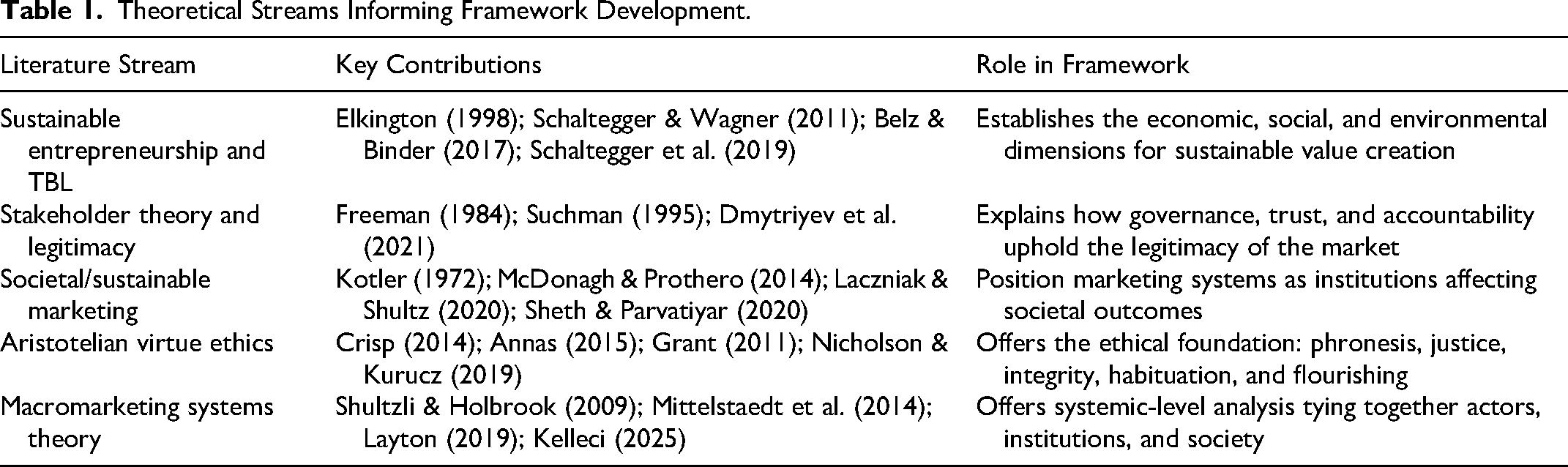
Unlike conventional marketing management, which tends to focus on transactional efficiency and competitive positioning, sustainable entrepreneurship increasingly involves pursuing opportunities that generate economic value while contributing to social and environmental outcomes (Hockerts & Wüstenhagen, 2010; Schaltegger et al., 2017). Sustainable entrepreneurship recognizes trade-offs and manages them through innovation, governance, and long-term orientation, not just harmony, in order to achieve sustainability and profitability (Belz & Binder, 2017). Structured sustainability evaluation frameworks strengthen governance credibility within marketing systems by formalizing trade-offs rather than masking institutional tensions (Tarnanidis et al., 2025).
TBL suggests that examining organizational performance should take into account three interdependent dimensions: (a) economic prosperity, (b) social equity, and (c) environmental protection (Elkington, 1998). In addition, in situations of ecological constraints and stakeholder activism, firms that focus solely on financial performance can experience short-term success, but this success can be fragile. Hence, an enterprise's management of social and environmental dependencies is a crucial factor in long-term resilience. (Rosário et al., 2022; Schaltegger & Wagner, 2011; Terán-Yépez et al., 2020).
Recent empirical research has made it easier to operate TBL in specific industries and contexts (Nguyen et al., 2023). Sustainability has been viewed as a complex construct in agriculture and manufacturing, encompassing worker safety, product integrity, community contributions, resource efficiency, and financial sustainability (Tarnanidis et al., 2019). Within marketing systems, TBL-oriented governance creates structural conditions for long-term institutional resilience.
Stakeholder theory provides an essential explanation for why sustainability and ethics have become central to entrepreneurship. According to the stakeholder theory, firms are accountable to several stakeholder groups, including employees, customers, suppliers, communities, regulators, and financiers, not just shareholders (Edward Freeman & Phillips, 2015; Freeman, 1984; Mahajan et al., 2023). In marketing systems operating under ecological constraints and institutional scrutiny, stakeholder dynamics become structurally central. They are amplifying the consequences of governance decisions across multiple actor groups. The concept of legitimacy is an intersection of stakeholder-oriented entrepreneurship and the notion that an organization's actions are desirable, appropriate, and in line with socially constructed norms and values. In modern markets, legitimacy is established through transparency, media scrutiny, digital communication, and the expectation that businesses contribute to society's welfare (Crane et al., 2019, 2021).
Furthermore, sustainability and ethics are strategically inextricable in this place. The growing body of research on sustainable entrepreneurship indicates that ethical governance serves as an effective means to manage risks and enhance resilience. In doing so, it helps protect ventures from external shocks and legitimacy crises(Dmytriyev et al., 2021; Schaltegger et al., 2017; Shepherd & Patzelt, 2023). For instance, investing in safety protocols, audit systems, and transparency reporting is not just about compliance; it is also about institutional safeguards that protect stakeholder trust and mitigate negative risks. In addition to enhancing the normative depth of stakeholder theory, virtue ethics clarifies that ethical responsibilities are not merely instrumental. Fair treatment of stakeholders is not just a way to maintain legitimacy; it is a moral imperative rooted in justice and human dignity (Annas, 2015; Belak & Pevec Rozman, 2012; Di Basilio, 2022). Thus, according to stakeholder theory, ethical behavior is important for organizational survival, while virtue ethics emphasizes its role in moral integrity and collective flourishing.
In contemporary markets, ethical governance becomes strategically essential due to the interdependence of economic, social, and environmental values, as stakeholder theory and legitimacy perspectives explain within the TBL framework. Unlike prior sustainable marketing models that frame responsibility primarily as risk mitigation or stakeholder alignment, this article develops a recursive virtue-based marketing systems framework. In accordance with problematization-oriented theory development, the framework questions the conventional instrumental approach to sustainability in marketing systems research (Alvesson & Sandberg, 2011). The framework conceptualizes sustainable marketing as a civic institution oriented toward human flourishing (eudaimonia) as the ultimate standard of legitimacy.
Sustainable Marketing Systems and Organizational Strategy
This section focuses on marketing as a strategic and ethical mechanism rather than merely a functional activity, grounded in the conceptual foundations of sustainable entrepreneurship and stakeholder governance that underpin the legitimacy of entrepreneurial ventures, the creation of shared value, and the fulfillment of broader societal expectations. Through the development of the societal marketing concept, various researchers challenged this narrow orientation by arguing that businesses may balance three interdependent objectives: company profitability, customer satisfaction, and society's long-term interests (Hill & Martin, 2014; Kang & James, 2007; Kotler, 1972; Laczniak & Shultz, 2020; Lee & Kotler, 2019).
Long-term societal costs, including public health burdens, environmental degradation, and social inequality, may be imposed by products that provide short-term satisfaction (Hoffmann, 2026). Therefore, marketing is not neutral in this sense, as it affects consumption patterns and societal outcomes (Diener & Seligman, 2004; Hawkins et al., 2026; Varadarajan, 2014). This shift is particularly significant in contemporary entrepreneurship. In highly competitive environments, start-ups and growth ventures often focus on differentiation and rapid scaling. Nevertheless, social marketing necessitates entrepreneurs to determine if their innovations contribute to or undermine collective welfare.
Sustainable marketing extends the social logic by incorporating environmental responsibility and ethical accountability into product design, supply chain governance, branding, and stakeholder communication, as part of societal logic (Belz et al., 2025; Kemper & Ballantine, 2019; McDonagh & Prothero, 2014; Sheth & Parvatiyar, 2020). In the current framework, sustainable marketing in entrepreneurial contexts implies a strategic approach in which organizations combine environmental stewardship, stakeholder accountability, and long-term socio-ecological considerations into marketing and governance strategies under conditions of market competition and institutional scrutiny (Crittenden et al., 2011). The following four interrelated dimensions are presented as analytical principles that characterize this orientation within organizational and marketing systems contexts: Durable relationships are more important for long-term value creation strategies than immediate revenue maximization. Integrating environmental impacts across the product lifecycle into strategic planning is crucial for resource stewardship. Verifiable practices can support sustainable and responsible claims. Stakeholder integration is necessary for marketing to acknowledge and engage diverse stakeholder interests rather than focusing solely on consumer demand.
Sustainable marketing depends on consistency between symbolic communication and operational conduct. Marketing narratives that support sustainability without significant organizational changes are at risk of accusations of greenwashing and erosion of legitimacy(Delmas & Burbano, 2011; Lyon & Montgomery, 2015). Digitally networked markets often display inconsistencies between rhetoric and practice at a rapid pace. On that basis, sustainable marketing requires consistency in symbolic communication and operational conduct. In terms of strategy, sustainable marketing is becoming increasingly associated with competitive advantage. Kramer and Porter's (2011) approach of ‘creating shared value’ suggests that firms can achieve economic benefits by addressing social problems embedded in their value chains. Likewise, research on business models for sustainability emphasizes the importance of innovation in resource efficiency, circular production, and inclusive value creation to generate both financial and societal benefits (Schaltegger et al., 2017; Bocken & Geradts, 2020).
The role of marketing is crucial in creating organizational legitimacy. In markets that prioritize stakeholder involvement, brand equity is closely connected to perceptions of integrity, responsibility, and authenticity. As a result, the evaluation of firms by consumers and investors has expanded beyond product attributes to encompass governance standards, environmental commitments, and ethical consistency (Bitektine et al., 2018; Gnes & Vermeulen, 2018; Özturan & Grinstein, 2021). If organizations promote sustainability narratives without implementing the relevant governance systems, they risk reputational crises that undermine trust and long-term value.
Furthermore, sustainable marketing reshapes strategic decision-making for entrepreneurs in multiple ways. Emerging marketing systems research increasingly views markets as institutional structures that integrate sustainability, inclusivity, participatory governance, and societal well-being into value creation processes (Kelleci, 2025). Internalizing social and environmental externalities into business models is preferable to externalizing them. It is necessary to invest in governance systems that can support sustainability claims. Thirdly, it reframes marketing performance metrics by adding stakeholder trust, long-term brand equity, and reputational resilience.
On the other hand, sustainable marketing does not reject profitability; instead, it highlights the importance of legitimacy and ethical alignment for achieving long-term profitability. Investing in volatile socio-ecological environments can result in short-term gains but long-term vulnerability for ventures that ignore sustainability risks. This discussion is furthered in the next section by introducing Aristotelian virtue ethics as a normative framework to explain why sustainable marketing and stakeholder responsibility are not merely strategic adaptations, but also expressions of moral character and the fostering of collective prosperity.
Within macromarketing scholarship specifically, Kellec'’s (2025) four-stage model of marketing systems evolution identifies inclusivity and societal participation as markers of advanced market development. This framework extends the trajectory by grounding the normative conditions for that evolution in virtue-based governance. Sheth and Parvatiya'’s (2020) market-driving conception of sustainable marketing similarly demands proactive institutional transformation rather than reactive adaptation, consistent with the virtuous leadership posture described in P1. Laczniak and Shult'’s (2020) doctrine of socially responsible marketing provides the closest antecedent to the present framework; however, that work focuses primarily on normative prescriptions for marketing managers rather than on the recursive, system-level institutional mechanisms linking governance, value creation, and flourishing developed here.
Leadership, Virtue Ethics, and Marketing System Governance
How firms can align profitability with social and environmental responsibility is explained by the strategic logic of sustainable entrepreneurship and marketing. The normative question of why organizational decision makers should prioritize long-term societal welfare over short-term advantage when competitive pressures intensify cannot be fully addressed by strategy alone. To provide a solution, the chapter turns to Aristotelian virtue ethics, a philosophical foundation for ethical enterprise rooted in character, practical wisdom, and human flourishing. Aristotelian virtue ethics emphasizes the development of character in decision makers rather than formal compliance mechanisms. In this viewpoint, organizational values such as prudence, courage, justice, and integrity do not exist in an abstract form, but rather as developed attitudes that shape how leaders handle trade-offs among profitability, stakeholder well-being, environmental responsibility, and institutional legitimacy.
Eudaimonia, commonly called human flourishing, is, according to Aristotle in the Nicomachean Ethics, the highest human good (Crisp, 2014). Also, eudaimonia is a life that is characterized by virtue and reason, compared to pleasure, wealth, or status. In addition, Aristotelian flourishing (eudaimonia) stands apart from related concepts such as subjective well-being, quality of life, stakeholder satisfaction, and social sustainability. Although these concepts may emphasize welfare outcomes, material conditions, or perceived satisfaction, eudaimonia is more fundamentally defined as cultivating human capabilities and virtuous participation in institutional and civic life by establishing conditions that enable individuals and communities to flourish over time.. Apart from that, it is important to acknowledge that flourishing is a process that involves both individuals and groups: a just and stable society is essential for individuals to thrive, and institutions are crucial in shaping these conditions (Annas, 2015; Grant, 2011; Nicholson & Kurucz, 2019; Solomon, 2004). Several virtues are of utmost importance in entrepreneurial leadership. The capacity to make judgments that are context-sensitive and forward-looking is called prudence (phronesis) Justice encompasses the fair and just distribution of benefits, burdens, and opportunities among stakeholders, while acknowledging that market systems can create structural inequalities and conflicting commitments Integrity is the concordance between stated values and actual behavior. Courage is the capacity to maintain ethical standards regardless of competition. Responsibility involves acknowledging the broader effects of entrepreneurial actions.
Aristotle's framework is dominated by prudence (phronesis). It refers to the ability to consider what is beneficial and sound in specific circumstances thoroughly. Prudent leadership enables leaders to balance competing goods without succumbing to short-termism in uncertain entrepreneurial environments characterized by rapid growth, resource constraints, and market volatility. Ethical governance in marketing systems requires more than regulatory compliance and exercising wise judgment under pressure; it also entails this perspective (Kurczewska, 2025). The moral dimension of governance decisions is highlighted by virtue ethics, which complements sustainable entrepreneurship theory. While regulation compliance may create minimum standards, virtue demands aspirational excellence. Leaders who promote prudence and justice incorporate ethical reflection into strategic deliberation, which prevents reactive or opportunistic behavior (Georgiadis & Sarigiannidis, 2024; Zimatore & Greco, 2022).
Aristotelian prudence does not assume that entrepreneurs can reconcile all stakeholder interests without conflict. The concept of virtue ethics recognizes that market actors frequently encounter competing, and sometimes irreconcilable, goods. Aristotelian theory suggests that phronesis is necessary because there is no universal formula for resolving these conflicts. Virtuous judgment requires practical deliberation in uncertain, moral, and institutional contexts, rather than mechanically applying sustainability principles.
Notably, Aristotelian virtue ethics does not confine ethical accountability solely to individual actions. Virtues are developed through the formation of habits, repeated engagement in practices, and involvement in institutional settings where moral perspectives may be either strengthened or weakened. Consequently, maintaining virtue-driven marketing frameworks necessitates organizational climates that foster pragmatic discernment, open discussion, and ethical handling of conflicting stakeholder interests. Structures of governance, leadership styles, reward systems, and organizational norms determine whether traits like prudence, justice, and integrity become enduring institutional strengths rather than fleeting personal inclinations.
This viewpoint also takes into account market limitations. Certain values, such as ecological sustainability, human dignity, and civic faith, often cannot be adequately safeguarded solely through market-based mechanisms. Therefore, virtuous governance necessitates consideration of how to equitably allocate benefits and burdens among stakeholders, particularly when economic efficiency clashes with broader social obligations.
The quality of institutions within a political community depends on flourishing, as Aristotle recognized. A stable democratic life requires ethical participation and shared accountability. In democratic systems, modern enterprises can operate and benefit from public infrastructure, legal protections, and social trust. Therefore, they are responsible for civic duties beyond their limited shareholder interests (Crane et al., 2019). By neglecting safety standards, exploiting labor, or engaging in misleading communication, firms not only violate regulations but also undermine the trust structures that underpin democratic markets. Aristotle's view of the political community implies that markets cannot be understood as morally separate from civic life. The existence of marketing systems depends on institutional trust, legal stability, and shared ethical norms maintained collectively, not solely through market exchange. This civic aspect supports the argument that entrepreneurship is a socially embedded institution rather than an isolated market activity. When viewed as expressions of virtuous citizenship within democratic systems, sustainable marketing and stakeholder governance acquire a more profound meaning (Papadopoulos, 2012; Wijnberg, 2000).
The emphasis of sustainable marketing is on creating long-term value, integrating stakeholders, and being transparent. Virtue ethics explains how ethical organizational decision-makers sustain commitments through their moral character under competitive pressure. From this, it can be inferred that, without virtuous leadership, sustainability initiatives are at risk of becoming mere symbolic gestures or reputational strategies. Thus, sustainable marketing can be viewed as the operational manifestation of virtuous behavior in an organization. Marketing systems and organizational governance can be rethought as a vehicle for enduring human flourishing rather than short-term gain when strategic foresight is combined with moral character. The structural relationship between sustainable marketing and virtue ethics is still fragmented. While sustainable marketing explains how firms may align with societal expectations, it also explains why leaders ought to pursue collective flourishing. These streams are integrated into a proposition-based macromarketing framework in the section that follows.
Theoretical Framework and Propositions
The integration of both offers a more comprehensive model of ethical and sustainable entrepreneurship, while each provides significant insight on its own. Firms must ensure that their sustainable marketing is balanced between profitability, consumer satisfaction, and society's long-term welfare. To pursue the highest good, leaders have to cultivate moral character and exercise practical wisdom (phronesis) within the framework of Aristotelian virtue ethics. By synthesizing these frameworks, sustainable and ethically oriented entrepreneurship within sustainable marketing systems is viewed as a strategic, morally embedded practice grounded in five core dimensions that can be used to articulate the convergence between sustainable marketing and Aristotelian virtue ethics, as illustrated in Table 2.
Convergence Between Sustainable Marketing and Aristotelian Virtue Ethics.

Next, we provide additional analytical explanations of the five core dimensions of the framework that were previously analyzed.
Societal Marketing and Virtue Ethics
Societal marketing requires firms to consider long-term societal welfare and profitability in market decision-making, thereby fostering ethical accountability (Crane & Desmond 2002; Kotler, 1972; Rodriguez-Sanchez, 2023; Szablewska & Kubacki, 2019). Virtue ethics enhances this requirement by highlighting the importance of cultivated character over regulatory enforcement alone in accountability (Annas, 2015). Entrepreneurial strategy requires guidance not only from competitive analysis but also from moral deliberation.
Sustainable Development and Prudence
Having a long-term orientation and systematic awareness is crucial for sustainable development. Aristotle's phronesis precisely captures this capacity for contextually sensitive judgment. Prudent entrepreneurs understand that short-term gains achieved at the expense of safety, ecological integrity, or stakeholder trust can negatively affect long-term viability (Bocken & Geradts, 2020; Patzelt & Shepherd, 2011; Tarnanidis et al., 2026). As a result, practical wisdom becomes a strategic skill.
Producing Value for Stakeholders and Justice
The concept of creating value for stakeholders encompasses other entities, such as employees, customers, communities, and the environment. Stakeholder theory posits that organizations increase legitimacy and sustain long-term relationships by incorporating the interests and claims of various stakeholder groups into their governance processes (Awa et al., 2024; Freeman, 1984; Freudenreich et al., 2020). Ethical entrepreneurship consequently necessitates consideration of how advantages, liabilities, and potential repercussions are allocated among different stakeholder groups. Allocating benefits and burdens across stakeholder groups requires attention to justice and fairness in ethical entrepreneurship.
Brands Built on Trust and Αuthenticity
For a contemporary market to be legitimate, trust and authenticity are crucial. The consistency between corporate rhetoric and practice in claims is increasingly scrutinized by consumers, especially when it comes to purpose-driven topics like sustainability (Lemon & Verhoef, 2016). Furthermore, transparency, accountability, and ethical consistency are essential for long-term stakeholder trust and loyalty in authentic brand strategies (Regany & Longo, 2023). Besides, to be sustainable, marketing should be coherent with operational conduct. Aristotle's virtue of integrity strengthens this alignment. Reputational erosion occurs when communication diverges from practice (Lyon & Montgomery, 2015). Thus, transparency in governance is necessary for both strategic purposes and moral reasons.
Human-Centered Value Creation and Eudaimonia
The core of entrepreneurial activity is human well-being, which is the focus of human-centered value creation. This dimension emphasizes the importance of business outcomes that improve quality of life rather than just optimizing economic outputs, drawing on concepts such as human flourishing and well-being (Assiouras et al., 2023; Lee & Sirgy, 2025; Zarkada, 2026). Later developments in marketing theory increasingly emphasized human-centered value creation, technological responsibility, and societal well-being (Kotler, 2011; Kotler et al., 2019, 2021, 2023). Similarly, Aristotle's eudaimonia posits the ultimate objective as the development of the whole society. Since enterprises are better off at both the individual and institutional levels when they contribute to employee well-being, environmental stewardship, and community resilience, this suggests that entrepreneurship contributes to collective welfare rather than just to firm performance.
The theory framework in Figure 1 combines sustainability-focused marketing perspectives, stakeholder governance, and Aristotelian virtue ethics. The model encompasses virtue ethics, sustainable marketing scholarship, and strategic governance perspectives to explain how ethical leadership fosters the creation of sustainable value and long-term societal well-being.
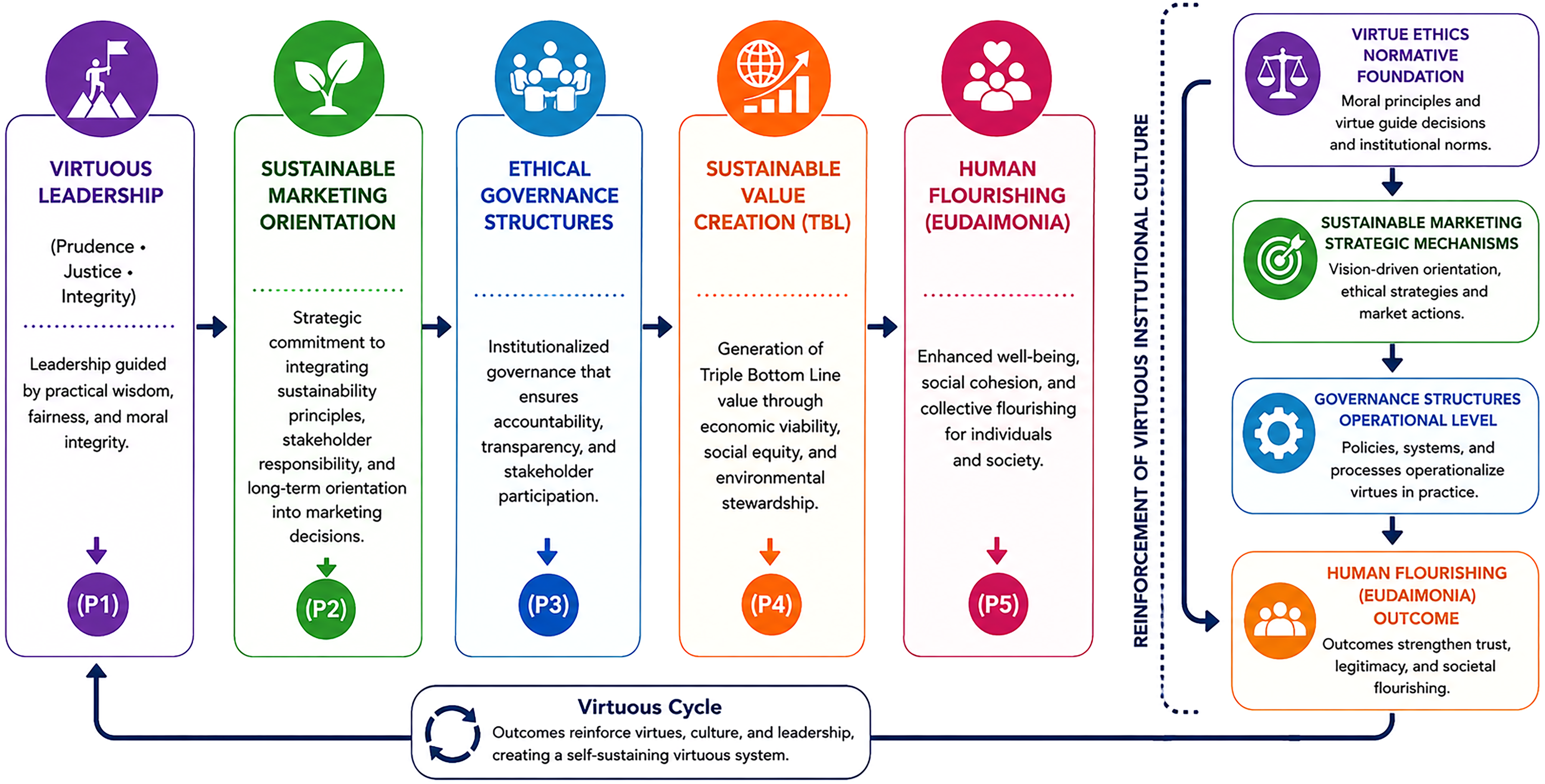
Aristotelian virtue-based framework for sustainable marketing and entrepreneurial strategy.
Drawing on Aristotelian virtue ethics, these fundamental moral traits guide strategic decision-making and organizational conduct. Virtuous leadership directly influences the development of a sustainable marketing orientation. In this, market activities are aligned with ethical responsibility and long-term stakeholder value, according to Proposition 1. Proposition 2 (P2) promotes the establishment of ethical governance structures through sustainable marketing approaches, ensuring accountability, transparency, and responsible resource management. Organizational systems are institutionalized through these governance mechanisms, with ethical principles. Ethical governance and sustainable value creation are integrated into Proposition 3 (P3) through the TBL framework, with economic viability, social equity, and environmental stewardship being included. This stage shows how virtue is operationalized into measurable organizational outcomes. Proposition 4 (P4) extends beyond the results for firms to the impact on society, suggesting that creating sustainable value leads to human flourishing (eudaimonia), a central concept in Aristotelian philosophy that addresses well-being. Finally, Proposition 5 (P5) establishes a feedback loop that reinforces and sustains a virtuous institutional culture by achieving human flourishing.
The framework posits sustainable marketing as a process driven by virtue rather than strategic orientation, integrating ethical leadership, governance, and long-term societal well-being into entrepreneurial practice.
Leadership with Virtue and Sustainable Marketing Orientation
Construct Definition: Entrepreneurial leadership in this framework refers to leadership characterized by prudence, justice, integrity, and courage, and that takes into account long-term stakeholder well-being when making strategic decisions (Annas, 2015; Grant, 2011).
Sustainable marketing orientation is positively associated with entrepreneurial leadership under conditions of stakeholder scrutiny, institutional transparency, and long-term reputational dependence.
Proposition 1 indicates that sustainable marketing orientation is not only about adapting to market demand or regulatory pressure, but also about displaying virtuous entrepreneurial leadership. This perspective suggests that sustainability is a strategic commitment driven by character rather than a reactive or compliance-based practice. The theory behind Proposition 1 is rooted in Aristotelian virtue ethics and the development of marketing thought towards sustainability. Aristotle's Nicomachean Ethics (Crisp, 2014) holds that virtuous action is derived from cultivated character traits, specifically phronesis (practical wisdom), within his virtue-ethical perspective. Practical wisdom allows leaders to make well-informed decisions that benefit not only themselves but the broader community. Entrepreneurs can balance competing interests and evaluate long-term consequences with prudent judgment, while justice ensures fairness towards stakeholders.
On the other hand, to achieve consistency between values and actions, integrity is the key, while courage is the key to committing to ethical principles even when facing competitive pressure. By expanding marketing beyond transactional exchange, Philip Kotler (1972, 2011) advocated for marketing systems to consider societal welfare. The sustainable marketing orientation was built on this foundation, integrating environmental stewardship and social responsibility into strategic decision-making. The theoretical logic that connects virtue ethics to a sustainable marketing approach begins as follows: Leaders with virtuous dispositions are more likely to internalize ethical responsibilities, exercise long-term practical wisdom, and maintain inclusive stakeholder consideration - each of which aligns with sustainable marketing orientation.
Thus, we can argue that entrepreneurial leaders with these virtues are theoretically more likely to adopt a sustainable marketing approach, as such an approach reflects their moral commitments and practical reasoning for the common good. These choices demonstrate how virtuous entrepreneurial leadership can translate into a sustainable marketing approach by embedding in product design, branding, and stakeholder engagement.
Sustainable Marketing Orientation and Ethical Governance Structures
Organizations adopting sustainable marketing orientations are more likely to develop ethical governance structures when faced with external stakeholder monitoring and institutional scrutiny.
Proposition 2 argues that sustainable marketing is an important component of governance reform, not just a communication strategy. Firms need to establish ethical governance systems to maintain credibility, legitimacy, and long-term stakeholder trust as sustainability becomes integrated into market positioning. The theoretical foundation of Proposition 2 is institutional theory, stakeholder theory, and legitimacy theory. Strategic communication integrates environmental stewardship, social responsibility, and long-term stakeholder value into both transactional exchange and short-term brand positioning within a sustainable marketing approach. When sustainability is part of a company's market positioning, it creates expectations of consistency between what it claims and what it does. To maintain legitimacy, organizations are expected to align their actions with societal norms, as per legitimacy theory (Suchman, 1995). Firms are more likely to be scrutinized by regulators, investors, NGOs, and consumers when marketing strategies explicitly reference societal welfare. Internal governance mechanisms and external sustainability commitments are aligned through institutional pressure stemming from this exposure (Gulluscio, 2023). One prominent case is when symbolic sustainability communication fails to align with substantive organizational change, as Delmas and Burbano (2011) describe. The legitimacy of firms adopting sustainable marketing requires them to institutionalize their commitments by: Providing sustainability reports and ESG disclosures through transparent mechanisms Structured dialogue with employees, communities, and regulators is part of stakeholder engagement processes. Monitoring environmental and social risks across supply chains is part of risk management systems. Ensuring accountability through audit committees, compliance systems, and independent oversight.
Sustainable marketing extends the firm's responsibility beyond shareholders to multiple stakeholder groups from a stakeholder theory perspective (Dmytriyev et al., 2021; Freeman, 1984; Gonzalez-Padron et al., 2016). The management of these expanded relational obligations requires the evolution of governance structures.
Ethical Governance Structures and Sustainable Value Creation
The argument that a sustainable marketing orientation should be institutionalized within organizational and market structures is supported by Proposition 3, which shifts the focus from strategic intent to structural implementation. Ethical governance involves formal oversight, accountability mechanisms, and stakeholder inclusion processes, while virtuous leadership and sustainable marketing orientation establish normative direction. Decision-making systems designed by governance structures translate moral principles into systems that align economic performance with social equity and environmental protection. In other words, the degree to which ethical governance mechanisms are integrated into organizational and marketing systems affects the sustainability of value creation across the three dimensions of the Triple Bottom Line.
Sustainable value creation is positively associated with ethical governance structures in economic, social, and environmental dimensions.
The philosophy behind Proposition 3 draws on the TBL framework, stakeholder theory, and the sustainability governance literature. The TBL, introduced by John Elkington, defines how firms perform by encompassing economic prosperity, environmental quality, and social responsibility (Elkington, 1998). Nevertheless, implementing formal governance mechanisms that align strategy with sustainability objectives is necessary to achieve balanced performance across these dimensions. Without governance oversight, sustainability initiatives risk remaining symbolic rather than substantive (Belz & Binder, 2017; Belz et al., 2025; Burbano et al., 2023; Delmas & Burbano, 2011; Tarnanidis et al., 2019; Tarnanidis, 2022). From the perspective of stakeholder theory, firms can achieve long-term value by establishing partnerships with multiple stakeholders rather than prioritizing short-term shareholder returns (Freeman, 1984). The operationalization of stakeholder inclusion can be achieved through ethical governance structures, including board-level sustainability oversight, transparent reporting systems, and accountability safeguards, ensuring that corporate decision-making processes incorporate fairness, transparency, and responsibility.
A proper moral framework for achieving balanced TBL values can be established by governing according to Aristotelian virtues, notably prudence (phronesis) and justice. Prudence is the capacity of leaders to make well-informed decisions concerning long-term outcomes, with an emphasis on incorporating economic sustainability, environmental responsibility, and social well-being in Aristotelian terms. Strategic priorities align with long-term stakeholders’ interests and protect intergenerational value, while prudential governance considers risks. Aristotelian ethics lays a basis for evaluating fairness in stakeholder treatment and the division of organizational benefits and burdens through justice. In a TBL framework, this indicates that there is no waste of economic gains due to environmental degradation or social inequality. Judging governance systems towards inclusive decision-making requires justice, which reinforces stakeholder engagement, transparency, and accountability.
Integrating virtue and governance is supported by empirical research efforts. Firms benefit from incorporating sustainability criteria into board oversight, executive incentives, and control systems, resulting in superior long-term financial performance and reduced environmental and reputational risks (Eccles et al., 2014; Schaltegger et al., 2017). Technical efficiency is not the sole cause of these outcomes; rather, it is the institutionalization of virtuous reasoning within corporate structures. When viewed as a whole, the Aristotelian-TBL logic is sequential and cumulative: Ethical governance thus serves as the structural bridge between moral intent and balanced TBL performance.
Moral character can be translated into sustainable TBL performance and contribute to broader societal well-being through ethical governance, which serves as the structural embodiment of virtue within the firm. The ultimate significance of sustainable value creation lies in its contribution to human flourishing (eudaimonia), while ensuring balanced economic, social, and environmental performance.
Sustainable Value Creation and Human Flourishing
Sustainable value creation is positively associated with human flourishing (eudaimonia).
Sustainable value creation is about creating value that is balanced across the economic, social, and environmental dimensions of the Triple Bottom Line.When these dimensions are institutionally balanced, sustainable value creation and human flourishing can be strengthened rather than short-term financial extraction. In Proposition 4, we have Aristotelian virtue ethics and contemporary theories of responsible entrepreneurship as our starting points. In his Aristotelian philosophy, Aristotle held that human flourishing is the ultimate end (telos) of social and economic activity. Flourishing is a result of virtuous action within a just and well-ordered community, not just material wealth. Aristotelian ethics establishes a normative basis for evaluating economic systems by emphasizing collective and individual flourishing. The Triple Bottom Line framework articulates sustainable value creation by balancing economic prosperity, social equity, and environmental stewardship. Both individual dignity and collective stability are impacted by entrepreneurial ventures that provide safe working conditions, promote ecological responsibility, and institutionalize responsible and inclusive governance practices. Through their actions, institutional systems can foster trust, social cohesion, and long-term resilience. Research on responsible and purpose-driven entrepreneurship argues that ventures addressing societal grand challenges enhance socio-ecological resilience and collective well-being (Buckley et al., 2017). Sustainable enterprises create environments conducive to long-term human development rather than short-term extraction by strengthening institutional legitimacy and stakeholder trust. As a result, the theoretical logic goes as follows: Sustainable value creation is balanced between economic, social, and environmental objectives. The generation of balanced value enhances legitimacy and trust among stakeholders. Institutional and socio-ecological resilience is strengthened by legitimacy and trust. Human flourishing (eudaimonia) is possible due to the conditions provided by resilient and just institutions.
Sustainable entrepreneurship is a moral and institutional contributor to collective flourishing in this way.
Human Flourishing and Reinforcement of Virtuous Culture
Human flourishing within marketing systems is positively associated with a virtuous institutional culture.
Institutional legitimacy, stakeholder trust, and sustained ethical governance practices are expected to strengthen the relationship between human flourishing and virtuous organizational culture. The framework is transformed by Proposition 5, which conceptualizes human flourishing as a reinforcing condition of virtuous marketing systems, thereby generating a recursive dynamic. In Aristotle's Aristotelian virtue ethics, flourishing (eudaimonia) is defined as the realization of human capabilities in an ordered community guided by reason and virtue. In Aristotelian ethics, virtues are acquired by habitual practice, repeated practice, and involvement in institutional communities that reinforce moral learning over time. The process of ethical judgment is not only an individual attribute, but also socially embedded and influenced by organizational culture, governance norms, and political institutions (Annas, 2015). The institution's well-being, legitimacy, and socio-ecological resilience are enhanced by sustainable value creation across economic, social, and environmental domains (Buckley et al., 2017; Schaltegger et al., 2019). Institutional trust in marketing systems is a crucial stabilizing resource when governance structures create fair labor conditions, environmental restoration, and transparent accountability mechanisms. (Laczniak & Shultz, 2020). Such legitimacy is beneficial in bolstering reputational capital and reducing transaction uncertainty (Suchman, 1995). These positive systemic outcomes can facilitate moral learning and cultural internalization. Leaders who operate in environments of trust and legitimacy are more likely to internalize virtues such as prudence, justice, and integrity as normative standards rather than as external constraints. Institutional contexts that promote ethical governance strengthen virtuous dispositions over time in virtue ethics, which involves forming moral character through repeated engagement in virtuous practices (Annas, 2015). Relational stability and long-term value creation are the foundations of trust, which are emphasized in stakeholder theory (Freeman, 1984).
Marketing systems can be stabilized by embedding ethical norms into institutional routines, regulatory expectations, and industry standards in flourishing environments, as seen from a macromarketing perspective (Layton, 2019; Mittelstaedt et al., 2014). When sustainable governance practices lead to tangible improvements in stakeholder welfare and ecological resilience, they reinforce norms. Transparency, fairness, and long-term responsibility are gradually being incorporated into the marketing system. The process of flourishing is not just the culmination of sustainable entrepreneurship, but a generative process that builds a virtuous leadership culture. The framework goes beyond linear causality and proposes a cycle that reinforces itself, with virtuous leadership enabling sustainable marketing and governance, while sustainable value creation promotes human and institutional flourishing.
Theoretical Contributions: Reframing Sustainable Marketing Systems as Virtue-Governed Civic Institutions
This article makes substantive, conceptually interrelated contributions to macromarketing scholarship.
First, it offers normative clarification by presenting eudaimonia as the moral aim of marketing systems. Even though contemporary sustainability discourse in marketing has improved in incorporating environmental and social concerns, it is often anchored in instrumental rationality to justify responsibility through resilience, risk mitigation, or competitive advantage. By applying Aristotelian virtue ethics to marketing systems, the evaluative standard shifts from strategic utility to collective flourishing. It goes beyond compliance-based or performance-driven logics and places sustainability within a coherent moral philosophy (Laczniak & Shultz, 2020).
Second, the article provides a way to integrate conceptual ideas across theoretical traditions commonly viewed as separate but interconnected streams. The managerial or strategic paradigms have greatly influenced the evolution of Societal marketing, sustainable marketing, and the Triple Bottom Line (Kotler, 1972; McDonagh & Prothero, 2014; Schaltegger et al., 2017). By combining virtue ethics with additive theorizing, the framework surpasses additive theorizing and outlines a structurally coherent model. The model connects moral character, strategic orientation, governance mechanisms, and system-level outcomes. This integration strengthens the theoretical coherence of sustainability-oriented marketing scholarship by reducing conceptual fragmentation.
Third, the article is promoting the institutional restructuring of marketing systems. Instead of treating marketing as a purely transactional or value-delivering function, the framework views it as a civic institution integrated into democratic and socio-ecological structures (Layton, 2019; Mittelstaedt et al., 2014). By placing marketing systems within broader debates about institutional stability and societal resilience, the article emphasizes legitimacy, stakeholder trust, and governance alignment.
Fourth, the development of the P1–P5 proposition structure is a factor in cumulative theory-building. Integrative models that clarify causal pathways are the primary focus of macromarketing scholarship, rather than relying exclusively on normative critique (ShultzIi & Holbrook, 2009). The framework suggested formalizes the connections among virtuous leadership, sustainable marketing mindsets, ethical governance structures, sustainable value generation, and human flourishing. By defining these links, the model improves analytical precision and sets the foundation for future empirical testing and comparative inquiry.
The framework contributes to macromarketing scholarship by elucidating not only the importance of sustainable governance. Furthermore, the functioning of virtue-based judgment in marketing systems is often challenged by institutional rules, and stakeholder demands often clash.
Discussion and Implications
A deeper comprehension of marketing systems is emerging through the integration of sustainability scholarship, societal marketing theory, and Aristotelian virtue ethics. Instead of seeing markets as simple, efficiency-driven exchanges influenced mainly by consumer response, this perspective treats marketing systems as institutional frameworks integrated into socio-ecological and democratic settings (Layton, 2019; Mittelstaedt et al., 2014). It broadens the examination of existing marketing system frameworks by highlighting that assessing market performance involves not just coordination effectiveness but also considering legitimacy, ethical governance, and their contributions to collective well-being.
While Layton's (2019) systems logic accounts for coordination among market participants, it fails to directly tackle the moral intent behind marketing systems. Through the incorporation of Aristotelian virtue ethics, the framework considers eudaimonia as a more comprehensive evaluation standard, implying that economic performance is essential but not sufficient alone; it must also contribute to institutional stability and societal well-being (Belak & Pevec Rozman, 2012; Crisp, 2014). Therefore, sustainable marketing evolves from a reactive strategic move to external demands to a fundamental structural necessity for sustained market credibility.
This insight also points out the shortcomings of sustainability approaches that are primarily based on symbolic communication or isolated corporate responsibility efforts. Without embedding sustainability initiatives into governance frameworks, these efforts remain susceptible to greenwashing and risk losing legitimacy (Delmas & Burbano, 2011). Thus, mechanisms like ESG scrutiny, supply-chain responsibility, transparent systems, and stakeholder involvement become vital organizational safeguards that enhance trust and fortify resilience (Eccles et al., 2014; Schaltegger et al., 2017; Suchman, 1995).
Ultimately, the framework recognizes virtue as a form of governance capital. Prudence, justice, integrity, and courage exemplify institutional strengths that inform decision-making in multifaceted stakeholder environments, rather than lofty ethical principles (Annas, 2015; Shepherd & Patzelt, 2023). Integrating these values into managerial frameworks can enhance the consistency of ethics, bolster stakeholder confidence, and promote long-term stability.
Taken collectively, these arguments indicate that virtue-driven governance enhances the link between sustainable marketing approaches, institutional faith, and overall systemic resilience over time. The sections that follow delve into the managerial, policy, and research implications stemming from this framework. Managerially, the focus shifts from symbolic sustainability to governance integration
The institutional implications of virtue-based marketing systems extend beyond individual firms to the architecture of markets themselves. Rather than prescribing firm-level compliance routines, the framework identifies conditions under which market systems, as a whole, become structurally capable of sustaining legitimate, flourishing-oriented governance. Three institutional implications follow:
First, to align strategic incentives with long-term socio-ecological performance, industry governance bodies and institutional investors should establish sustainability performance standards that apply across market sectors rather than merely within individual firms (Eccles et al., 2014). Such alignment is necessary to protect sustainability commitments from short-term performance pressures.
Second, regulatory frameworks should require third-party verification of sustainability marketing claims as a structural market condition, reducing information asymmetries system-wide (Delmas & Burbano, 2011). In transparent digital markets, institutional trust erodes quickly when narratives and practices diverge. The framework suggests that the credibility of sustainability communication strategies can be enhanced through governance oversight.
Third, national and sectoral reporting standards should incorporate stakeholder trust and socio-ecological resilience metrics alongside financial indicators, legitimizing these as standard measures of market system health (Freeman, 1984). Even though it is used as institutional capital in marketing systems, trust remains undermeasured relative to financial outcomes. The framework suggests that broader accountability may be supported by incorporating stakeholder-oriented indicators into organizational performance metrics.
Overall, cultivating practical wisdom (phronesis), ethical reasoning, and moral courage is necessary for leadership development programs to move beyond technical competence (Shepherd & Patzelt, 2023). The ability to navigate complex trade-offs under uncertainty is necessary for sustainable marketing systems, not just structures. The framework indicates that sustainable marketing systems depend not only on formal governance mechanisms but also on the practical judgment and moral character of organizational actors operating under conditions of institutional complexity.
Policy Implications: Legitimacy and Systemic Stability
The policy implications of virtue-based marketing systems focus on institutional conditions rather than traditional sustainability regulations, which are geared towards prudential governance, stakeholder legitimacy, and long-term socio-economic stability. The framework demonstrates the structural relationship between transparency in governance and legitimacy in the market. Regulating regimes that promote disclosure of ESGs, protect stakeholders, and accountability in supply chains not only constrain firms but also stabilize marketing systems. They reduce information asymmetries and opportunistic behavior (Laczniak & Shultz, 2020; Suchman, 1995).
Research Implications: Toward Empirical and System-Level Validation
The framework also introduces a structured, focused research agenda focused on cumulative theory development.
First, longitudinal studies are necessary to determine if virtue-oriented governance structures increase resilience, stakeholder trust, and long-term financial stability. Such research could test the proposed connection between moral capital and systemic performance. Second, the development of measurement is still of utmost importance. Empirical rigor and comparative inquiry could be enhanced by institutionalizing virtues, such as prudence, justice, and integrity, at the organizational and market-system levels. Third, in environments that are characterized by increased transparency and stakeholder activism (Delmas & Burbano, 2011), comparative analyses are required to distinguish between substantive and symbolic sustainable marketing practices. Having a clear understanding of these differences is essential for determining the conditions under which sustainability improves or undermines legitimacy.
Future research should analyze feedback loops among governance quality, stakeholder trust, and socio-ecological outcomes using system dynamics modeling and network analysis (Layton, 2019). By using these approaches, macromarketing research will switch towards adaptive, recursive representations of institutional evolution rather than static models. As socio-ecological pressures increase and institutional trust becomes more fragile, interdisciplinary collaboration between marketing scholars, sustainability researchers, and moral philosophers is crucial (Buckley et al., 2017).
Limitations and Future Research Direction
This study's integrative ambition is constrained by several limitations that call for further theoretical refinement and empirical investigation.
First, the framework is based on concepts and propositions. While it outlines the directional connections between virtuous leadership, sustainable marketing orientation, governance mechanisms, and human flourishing, empirical testing has not yet been conducted. Future studies should examine whether virtue-oriented governance structures can significantly enhance stakeholders’ trust, legitimacy, and resilience in marketing systems. Dynamic feedback effects between legitimacy, sustainability performance, and market stability may be particularly valuable for capture using longitudinal and mixed-method designs.
Second, the normative foundation is primarily built upon Aristotelian virtue ethics. Despite the richness of virtue theory's account of character, prudence (phronesis), and flourishing (eudaimonia), other ethical frameworks, such as deontological, care-based, or non-Western traditions, may offer complementary approaches to marketing responsibility and institutional accountability. Comparative ethical analyses could enrich macromarketing scholarship by examining how different moral traditions shape sustainable marketing systems.
Third, while this framework highlights the significance of virtuous leadership and ethical governance, it should not suggest that individual moral character can entirely bypass all systemic limitations in contemporary marketing systems. Structural power asymmetries, shareholder return expectations, global supply-chain inequalities, competitive pressures, and market incentives that reward short-term or unsustainable behavior may constrain virtuous actors’ ability to implement sustainability-oriented decisions. Future macromarketing studies should focus on how institutional frameworks, regulatory mechanisms, and market structures impact the translation of virtue-based evaluations into lasting results.
Acknowledging these limitations, this article is presented as a foundation for an emerging research program rather than a definitive account. As ecological pressures intensify and stakeholder scrutiny increases, integrating sustainability, governance, and moral philosophy into marketing systems research becomes increasingly necessary. The propositions put forward in this article ought to be construed as conceptual premises aimed at fostering theoretical development rather than as clearly defined empirical hypotheses. Future investigations ought to refine construct operationalization, boundary conditions, mediating factors, and measurement methodologies before conducting formal hypothesis testing.
Conclusion: Toward a Virtue-Governed Macromarketing Paradigm
This work argues that the dominant instrumental logic of sustainable marketing — framing responsibility as risk mitigation, reputational strategy, or competitive differentiation — is theoretically insufficient to address the challenges facing contemporary marketing systems. By integrating Aristotelian virtue ethics with marketing systems theory and the Triple Bottom Line framework, the paper has developed a recursive, proposition-based macromarketing framework in which legitimacy, governance, and human flourishing are constitutively - not instrumentally - connected. This study conceives sustainable marketing as a civic institution by combining the Triple Bottom Line framework, societal marketing theory, and Aristotelian virtue ethics.
The framework goes beyond instrumental sustainability rationales that justify responsibility solely by mitigating risk or gaining recognition. Instead, the moral telos of marketing systems is rooted in the idea of eudaimonia, which is the development of human flourishing. From this viewpoint, profitability is still essential, but it is redefined as a necessary but insufficient condition for market success. From a virtue-based perspective, long-term market legitimacy requires aligning economic performance with prudence, justice, and integrity. Such alignment could boost legitimacy by fostering trust, socio-ecological resilience, and democratic stability among stakeholders.
The propositions provide a conceptual example of how virtuous leadership shapes sustainable marketing orientation. Additionally, ethical governance can be institutionalized through sustainable orientation, and governance structures facilitate the creation of balanced TBL value. Moreover, the creation of sustainable values fosters flourishing environments, which, in turn, strengthens ethical culture. Marketing systems have been re-envisioned as adaptive moral infrastructures that can self-reinforce or erode, using a recursive architecture rather than static exchange mechanisms.
The recursive architecture operates through three identifiable system-level mechanisms. First, legitimacy accumulation: when sustainable value creation visibly improves stakeholder welfare and ecological conditions, market actors (including regulators, consumers, and institutional investors) revise their expectations of what constitutes acceptable market conduct. It raises the normative floor for the entire system. Second, cultural sedimentation: repeated governance practices grounded in prudence and justice become embedded in industry standards, professional norms, and regulatory frameworks over time. They structurally constrain future actors toward virtuous conduct even in the absence of individual moral formation. Third, trust-based coordination: institutions that consistently align marketing claims with operational conduct reduce information asymmetries in the market. It reduces transaction costs and enables more cooperative, long-horizon forms of value creation. These three mechanisms explain why the framework is recursive rather than simply cyclical. Each iteration of the loop does not merely return to its starting point but reconstitutes the institutional conditions in which virtue, governance, and flourishing operate.
Consequently, this research calls for a renewed and rigorous interrogation of macromarketing theory and inquiry. Markets should be scrutinized not just for their allocative efficiency or innovative capacity, but also for their capacity to maintain resilient institutions and foster enduring collective well-being. Sustainable marketing is transformed from strategic adaptation to civic responsibility. Using ethics, justice, and integrity can help in serving not only the exchange but the conditions that make it socially and morally viable.
Footnotes
Associate Editor
Alexander Nill

Ethical Approval and Informed Consent
This article is conceptual and theoretical in nature and does not involve human participants, human data, or animal subjects. Ethical approval and informed consent were therefore not required.
Author Contributions
T.T. conceived the study and developed the theoretical framework. S.N. contributed to conceptual refinement and theoretical integration. V.K.M. assisted with literature synthesis and governance analysis. B.S. contributed to sustainable marketing strategy and manuscript revision, N.O.-F. supervision. All authors reviewed and approved the final manuscript.
Funding
The authors received no financial support for the research, authorship, and/or publication of this article.
Declaration of Conflicting Interests
The authors declared no potential conflicts of interest with respect to the research, authorship, and/or publication of this article.
Data Availability Statement
No empirical data were generated or analyzed in this study. Data sharing does not apply to this article.