







Abstract
In lucid dreams, the dreamer is aware that one is dreaming; however, this does not necessary imply that the dreamer has complete control over the ongoing dream narrative. The present study explored the extent to which the lucid dreamers are able to control their dreams, as well as underlying factors. An online survey was completed by 528 respondents, of whom 386 had lucid dream experience. According to their reports, full control over the dream body is possible in about two thirds of cases, while control of the dream environment and the ability to maintain dream awareness are possible in less than half of cases. The main predictors of lucid dream control were higher lucid dream frequency and dispositional mindfulness in wakefulness, as well as younger age. The findings suggest that by cultivating mindfulness lucid dreamers might be able to develop greater dream control; however, further longitudinal research is needed.
Introduction
A common used definition of a lucid dream states that in a lucid dream, one is aware that one is dreaming during the dream. Thus it is possible to wake up deliberately, or to influence the action of the dream actively, or to observe the course of the dream passively. (Stumbrys, Erlacher, & Schredl, 2013a, p. 54)
Dream awareness (lucid insight) and dream control might be considered as separate features of dream consciousness in lucid dreams (Voss, Schermelleh-Engel, Windt, Frenzel, & Hobson, 2013). Naturally, dream awareness could be assumed as a prerequisite for dream control: At first, the dreamer has to become aware of dreaming and of the potential to control the dream, and only then dream control can be exercised (cf. Stewart & Koulack, 1989). For example, in the Tibetan dream yoga tradition, a practitioner first aims to develop dream awareness (lucidity), then to stabilize and maintain it, and only then one starts to actively manipulate the dream plot (Wangyal, 1998). However, dream control may be possible even without dream awareness, and some authors (e.g., Purcell, Mullington, Moffitt, Hoffmann, & Pigeau, 1986) consider dream awareness or lucidity to be a higher level cognitive skill than dream control.
A recent survey (Stumbrys, Erlacher, Johnson, & Schredl, 2014) showed that in only 44% of cases, lucid dreamers are successful in accomplishing their waking intentions in lucid dreams. The most frequently mentioned reasons for unsuccessful trials were a premature awakening, difficulties in execution, and insufficient lucidity. In another survey of a large Brazilian sample (n = 3,427; of which 77% had at least one lucid dream experience), 48% of the respondents reported to control their lucid dreams frequently or very frequently, 42% rarely or very rarely, 6.4% always, and 3.6% never (Mota-Rolim et al., 2013). Further, a study in German, school children and young adults aged 6 to 19 years showed that dream control is not very prevalent in young lucid dreamers—only 37% of their participants reported the ability to change the dream plot (Voss, Frenzel, Koppehele-Gossel, & Hobson, 2012). At least partial dream control was found to be most frequent in 7 year old, at similar levels for ages 9 to 16 years and at lower levels thereafter, suggesting that younger maturing brain might be more prone to natural lucid dream control.
Personality dimensions such as openness to experience and thin boundaries have been found to be associated with a greater ability to control the dream in questionnaire studies that looked specifically into dreams with dream control (Hicks, Bautista, & Hicks, 1999; Yu, 2012). Interestingly, one recent study also found elevated dream control in psychotic patients (Mota, Resende, Mota-Rolim, Copelli, & Ribeiro, 2016). Both openness to experience and thin boundaries have been linked with psychopathology, as well as creativity, implying a general underlying core of more positive flow-type schizotypy (Nelson & Rawlings, 2010; Rawlings, Twomey, Burns, & Morris, 1998), which may also be linked to lucid dream control. Indeed, lucid dreamers seem to be more creative than nonlucid dreamers (Blagrove & Hartnell, 2000; Zink & Pietrowsky, 2013).
On the other hand, greater dream control is associated with the higher frequency of lucid dream experience (Voss et al., 2012; Wolpin, Marston, Randolph, & Clothier, 1992; but see Mota-Rolim et al., 2013). Further, more frequent lucid dreamers are more successful in executing their intended actions in lucid dreams, can better recall them, and have longer lucid dreams (Stumbrys et al., 2014). This implies that lucid dreaming is the ability that could be developed and mastered, and more experienced lucid dreamers can exercise greater control over the dream. In neurophysiological terms, this can be linked to the prefrontal brain regions, associated with metaawareness, cognitive control, and lucid dreaming: More frequent lucid dreamers appear to have a greater gray matter density in those areas (Filevich, Dresler, Brick, & Kühn, 2015; Stumbrys, Erlacher, & Schredl, 2013b).
Notably, the same brain regions are also associated with mindfulness (Creswell, Way, Eisenberger, & Lieberman, 2007; Farb et al., 2007), conceptualized as the ability to direct attention to the present moment with a nonjudgmental attitude (Baer, 2003). Dispositional mindfulness in wakefulness was found to be associated with lucid dream frequency, implying the continuity of metacognition across waking and dreaming (Stumbrys, Erlacher, & Malinowski, 2015). Considering that the attentional control mechanisms seem to play the central role in the development of mindfulness skills (Malinowski, 2013), it might be hypothesized that dispositional mindfulness in wakefulness would also be related to the attentional control mechanisms in the dream state, that is, to the ability to control the dream.
Additional support for the hypothesis comes from video game play research. More frequent video gamers have more lucid dreams and more dream control (Gackenbach, 2006, 2009), likely due to increased metacognitive qualities of their dreams (Gackenbach & Kuruvilla, 2013). This also allows video gamers to have less threatening dream content and may help as a protection against nightmares (Gackenbach, Ellerman, & Hall, 2011). Further, video gaming has been associated with mindfulness at least during the game play (Gackenbach & Bown, 2011). Video gaming may contribute to the development of attentional mechanisms (Boot, Kramer, Simons, Fabiani, & Gratton, 2008) and, according to Gackenbach (2008), may produce similar effects as meditation practice on the development of consciousness. A recent study corroborates this idea suggesting that video game play may serve a particular role in developing dream control (Gackenbach, Swanston, & Stark, 2015).
The aim of the present study was to investigate the different facets of dream control in lucid dreams (i.e., the ability to maintain dream lucidity, to control the dream body, and to control the dream environment), as well as explore possible influencing factors, including lucid dream frequency and dispositional mindfulness.
Methods
Participants
A total of 528 participants (290 men and 238 women) completed an online questionnaire. Their ages ranged from 11 to 67 years, with the mean age of 26.4 ± 10.6 years. There were 161 working professionals, 152 students, 125 schoolchildren, 34 in vocational training, 8 housewives or husbands, 4 retired, 20 unemployed, and 5 at military or civilian service (18 participants marked other occupation and 1 participant did not provide information).
Material
The questionnaire was about dreams, lucid dreams, and mental health. Besides biographical data (age, gender, and occupation), it included items about dreams, dream control, and dispositional mindfulness. Lucid dream frequency was measured by an 8-point scale (0 = never, 1 = less than once a year, 2 = about once a year, 3 = about 2 to 4 times a year, 4 = about once a month, 5 = about 2 to 3 times a month, 6 = about once a week, and 7 = several times a week) with a high retest reliability (r = .89, p < .001, N = 93; Stumbrys et al., 2013a). To ensure a clear understanding of lucid dreaming, a short definition was provided: In a lucid dream, one is aware that one is dreaming during the dream. Thus it is possible to wake up deliberately, or to influence the action of the dream actively, or to observe the course of the dream passively (Stumbrys et al., 2013a, p. 54). (for importance of a clear definition, see Snyder & Gackenbach, 1988)
Dispositional mindfulness was assessed with the Freiburg Mindfulness Inventory (FMI; Walach et al., 2004), consisting of 14 items (one reversed), scored on a 4-point scale (1 = rarely, 2 = occasionally, 3 = fairly often, and 4 = almost always). The internal consistency of the FMI in this study was good (Cronbach’s α = .82) and comparable to previous reports (Cronbach’s α = .86, N = 246; Walach et al., 2004).
Procedure
The study was conducted in German. The online questionnaire was posted on the German website on lucid dreaming (http://www.klartraum.de) between August 22, 2007 and January 8, 2008. The newsletter with an explicit reference to the study was sent by email to approximately 1,500 registered users of the website. The survey was anonymous; however, participants were asked to provide their email address in order to minimize the risk of multiple responses to the questionnaire.
Statistical Analysis
SPSS (Version 17) was used for statistical analysis. For each aspect of dream control (e.g., maintenance of lucidity), a logistic regression analysis with age, gender, lucid dream frequency, and dispositional mindfulness (FMI) as independent variables was calculated.
Results
A total of 386 respondents (73.1%) reported that they had at least one lucid dream; 263 respondents (49.8%) had at least one lucid dream per month and following Snyder and Gackenbach (1988) can be classified as frequent lucid dreamers. The median for lucid dream frequency for this subsample was “5” (2–3 times a month) and for the whole sample “4” (once a month). The average FMI score was 39.0 ± 6.3 (495 responses).
Reported Abilities of Dream Control (in Percentage).

Regression Analysis for Dream Control With Age, Gender, Lucid Dream Frequency, and Dispositional Mindfulness (FMI) as Independent Variables.
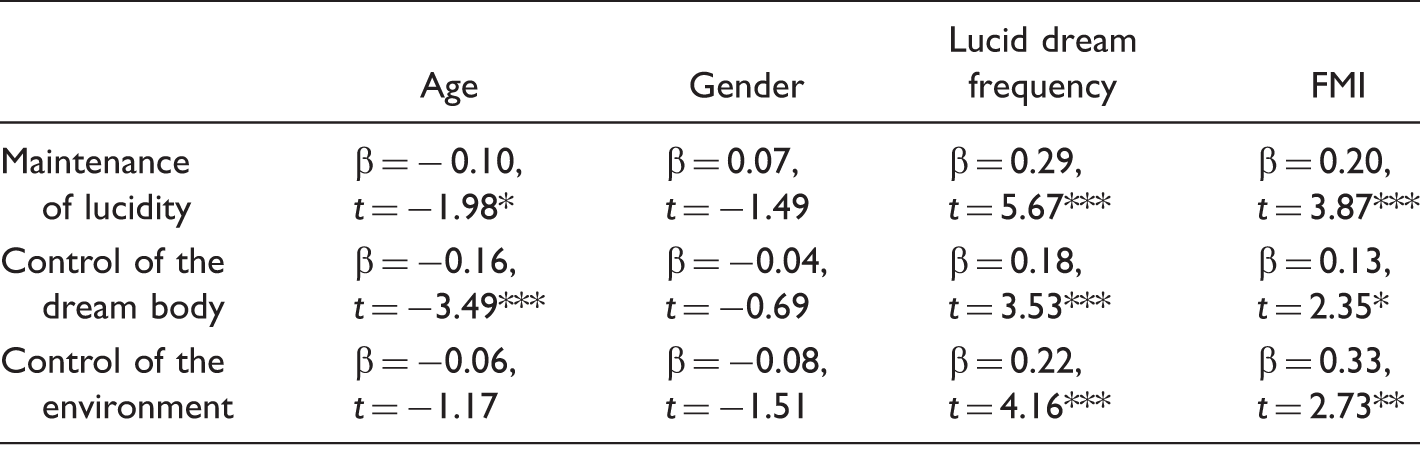
Note. FMI = Freiburg Mindfulness Inventory.
p < .05. **p < .01. ***p < .001.
Discussion
According to the reports of lucid dreamers, they are able to have the full control over their dream body in about two thirds of cases, while control of the dream environment and of dream awareness seems to be possible in less than a half of occasions. The main predictors of lucid dream control were higher lucid dream frequency and dispositional mindfulness in wakefulness, as well as younger age.
Before discussing the results, it has to be considered that the survey was based on a sample which has much higher frequency and prevalence of lucid dreaming than the general population (cf. Saunders, Roe, Smith, & Clegg, 2016) but nevertheless comparable to other online surveys of lucid dreamers (e.g., Mota-Rolim et al., 2013; Stumbrys et al., 2014). Because the participants were self-selected due to their interest in lucid dream research, the generalizations of these findings should be cautious, also considering that the data were collected via an online questionnaire. Comparative analyses, however, do not show that data gathered via the Internet are tainted by false responses and appear to be at least as good as data gathered via traditional methods (Gosling, Vazire, Srivastava, & John, 2004).
The reports of survey respondents indicate that the easiest aspect of dream control is the control of the dream body, present in majority of lucid dreams. Control of the dream environment and maintenance of dream lucidity were present in less than half of the dreams. These findings are easily interpretable in the context of our waking experiences: While normally we do have the control of our body, the control of our attention (conscious awareness) is much more complicated (cf. Fox, Nijeboer, Solomonova, Domhoff, & Christoff, 2013) and of the waking environment is hardly possible. It also concurs with the analogy by Waggoner (2009) of a sailor controlling the sea.
The observed relationship between the different aspects of dream control and dispositional mindfulness backs up the assumption of transferable attentional control between waking and dreaming (Malinowski, 2013; Stumbrys et al., 2015). It further suggests that the ability to control the dream might be developed by increasing dispositional mindfulness in wakefulness, for example, by using mindfulness meditation and yoga techniques (Carmody & Baer, 2008), however, to verify these assertions, longitudinal studies are needed. Previous research has showed that meditation can promote lucid dreaming (Reed, 1978; Sparrow, Thurston, & Carlson, 2013), and meditators tend to report more lucid dreams than nonmeditators (Gackenbach, Cranson, & Alexander, 1986; Hunt & Ogilvie, 1988). The present study indicates that mindfulness benefits dream control not only via increased lucid dream frequency but also in addition to that (as the effects were present when controlling for lucid dream frequency). These findings are in accordance with a long-standing Tibetan dream yoga tradition, where meditation is used as a core technique to master both dream lucidity and dream control (Wallace, 2012; Wangyal, 1998).
In the contemporary environment as a viable alternative, especially for younger individuals, video gaming perhaps might be suggested as a tool to increase dream control and, possibly, mindfulness (Gackenbach & Bown, 2011; Gackenbach et al., 2015). However again, longitudinal studies are needed to verify these claims.
The association between lucid dream frequency and dream control is in line with previous research (Stumbrys et al., 2014; Wolpin et al., 1992) and corroborates the idea that lucid dreaming is the ability which could be developed and mastered. The finding that younger participants exercise more dream control (in terms of control over their dream body and of maintenance of lucidity) suggests that individuals might be prone to lucid dreaming and dream control while the brain is still maturing (Voss et al., 2012). Lucid dreams of younger people seem also to be somewhat longer (Stumbrys et al., 2014). Hence younger people might be more natural lucid dreamers and therefore be better able to maintain their dream lucidity and control their dream body.
In summary, the present study shows that lucid dreamers in their lucid dreams have the greatest control over their dream bodies, whereas the control over the dream environment and the ability to maintain lucidity are somewhat less frequent. Nevertheless, dream control increases with lucid dream frequency, suggesting that this is an ability which could be developed and mastered. Further, it is also associated with dispositional mindfulness in wakefulness, and therefore lucid dreamers, who want to exercise a greater control in their lucid dreams, can be advised to cultivate mindfulness while awake, for example, by practicing mindfulness meditation or yoga, or by engaging in comprehensive mindfulness training programs, such as mindfulness-based stress reduction or mindfulness-based cognitive therapy (Kabat-Zinn, 1990; Segal, Williams, & Teasdale, 2002). An alternative approach might be an immersion in video games. However, to verify these assumptions, longitudinal studies are needed.
Footnotes
Declaration of Conflicting Interests
The authors declared no potential conflicts of interest with respect to the research, authorship, and/or publication of this article.
Funding
The authors received no financial support for the research, authorship, and/or publication of this article.