







Abstract
As dreaming is a universal phenomenon, it seems natural that everyone has a more or less explicitly defined attitude toward dreams. Recent studies indicate that positive and negative attitude toward dream scales—even given there is considerable overlap—might not be related to the same variables. The findings of the present online survey (N = 2,056) using 22 attitude items indicated that positive and negative attitudes can be differentiated through confirmatory factor analysis and that variables like age, education, and frequent dream recall are differentially associated with positive and negative attitudes toward dreams. It would be very interesting to expand this study to investigate whether other variables, personality dimensions, general skepticism and so on, are associated with positive and negative attitudes toward dreams in different ways.
Dreaming, defined as subjective experiences during sleep, is a universal phenomenon, even though not every person can recall a dream every night (Schredl, 2018). Dreams play a role in almost every culture (Hoss & Gongloff, 2019; Laughlin, 2011; Parman, 1991), and talking about dreams is also quite common (Schredl, Berres, Klingauf, Schellhaas, & Göritz, 2014). So, it seems natural that everyone has a more or less explicitly defined attitude toward dreams ranging from negative views like “Dreams are garbage products of the mind” (Olsen, Schredl, & Carlsson, 2016, p. 162) to more positive attitudes like “Dreams are a good way of learning about my true feelings” (Bulkeley & Schredl, 2019, p. 77). One of the first attitude toward dreams scales included 16 items that were positively (“I believe that dreams are one of the most important ways to understand myself”, p. 914) and negatively worded (“I do not pay attention to my dreams”, p. 914) into one scale yielding a Cronbach’s α = .69 (Cernovsky, 1984). The assumption is that it is a unidimensional construct ranging from very negative attitudes to very positive attitudes. Other authors (Beaulieu-Prevost, Simard, & Zadra, 2009; Hill, Diemer, & Heaton, 1997; Schredl, Ciric, Götz, & Wittmann, 2003; Schredl & Doll, 2001) followed that idea and combined negative attitudes and positive attitudes into a single scale. Another approach was to develop a scale measuring the magnitude of positive attitudes toward dreams (Robbins & Tanck, 1988; Schredl, Brenner, & Faul, 2002; Selterman, 2016) with a high internal consistency (α = .910) and high retest reliability (r = .842; Schredl et al., 2014).
Schredl, Nürnberg, and Weiler (1996) constructed three different six-item scales measuring a positive attitude toward dreams (e.g., “I like dreaming” (p. 614)), a neutral attitude (e.g., “I did not work on my dreams” (p. 614)), and a negative attitude (e.g., “Persons that recall many dreams have a lot of difficulties” (p. 614)) and found that the correlation between the positive and negative attitudes scales was quite low: r = −.406, thus, only sharing 16.5% of the variance. As expected in a sample of psychology students who are interested in psychological topics like dreams, the average of the positive attitude scale was much higher when compared with the negative attitudes scale (Schredl et al., 1996). In a representative survey in Germany (N = 2,019), 41.36% of the participants agreed to “I like dreaming very much; dreams are recreation and a diversion” (Schredl, 2013, p. 196). On the other hand, 53.75% of the participants agreed to the statement “Dreams are nonsense; I do not pay attention to them at all” and 18.23% agreed to both statements (Schredl, 2013). Furthermore, agreeing to the positive statement decreases with age but an increased percentage of agreeing to the negative statement with age was not found, whereas the gender effect was comparable, that is, women tended to agree more often to the positive statement and less often to the negative statement compared with men (Schredl, 2013). Almost similar findings were reported for a representative U.S. American sample (N = 5,255): Agreeing to the statement “Dreams are a good way of learning about my true feelings (p. 77)” declined with age but also—to a lesser extent—agreeing to the statement “Dreams are random nonsense from the brain (p. 77)” (Bulkeley & Schredl, 2019), indicating that positive and negative attitudes are not just two poles of one dimension. As in the study of Schredl (2013), dream recall frequency was more strongly associated with the positive attitude statement (standardized estimate = .2015, logistic regression with age, gender, education, and dream recall frequency) than with the negative attitude statement (standardized estimate = −.0429; Bulkeley & Schredl, 2019). In contrast to Schredl (2013), the American population agreed more strongly to the positive item compared with the negative item, and the correlation between those two 5-point items was quite small (r = −.262; Bulkeley & Schredl, 2019). Taken together, these findings indicate that there is, of course, a substantial correlation between negative and positive attitudes toward dreams but there is some evidence that attitude toward dreams is not a simple unidimensional scale but that positive and negative attitudes toward dreams might be partially independent and, thus, related to other variables differently.
The aim of the present investigation was to study whether positive and negative attitudes toward dreaming can be differentiated using confirmatory factor analysis (CFA). Based on previous findings, it was tested to see whether sociodemographic variables differentially relate to positive and negative attitudes toward dreams.
Method
Research Instrument
For eliciting dream recall frequency, a 6-point scale (coded as 0 = never, 2 = about once a month, 3 = about 2 to 3 times a month, 4 = about once a week, 5 = several times a week, and 6 = almost every morning) was presented. Due to a programming error, the category “less than once a month” of the original scale was not presented. The retest reliability of the original scale is high: r = .85 for an average interval of about 55 days (Schredl, 2004).
Different facets of attitude toward dreams were measured using 22 items with a 5-point format (0 = not at all, 1 = not that much, 2 = partly, 3 = somewhat, and 4 = totally). Six items, for example, “I think that dreaming is in general a very interesting phenomenon” were adopted from the Mannheim Dream Questionnaire (MADRE) (Schredl et al., 2014). Based on a literature review, 16 additional items eliciting positive or negative attitudes toward dreams were developed, for example, “Thinking about dreams is a waste of time” or “I believe that dreams help to process the day” The full item list can be found in the Appendix.
Regarding sociodemographic variables, age, gender (male, female), and education in six categories (see “Procedure and Participants” section) were elicited.
Procedure and Participants
The online survey was completed by 2,056 persons (1,212 women, 844 men) between April 4, 2019, and April 15, 2019. The mean age of the sample was 52.48 ± 14.23 years (range: 19–95 years). The level of education was distributed as follows: 19 persons had not graduated from school, 278 had 9 years of education, 626 had 10 years of education, 482 completed their A-levels, 595 had graduated from university, and 56 had a doctoral or higher degree. The link for the study was sent via e-mail all persons who were registered at http://www.wisopanel.net. Within this, panel persons with an interest in online studies and with heterogenic demographic backgrounds are registered. All participants who completed the questionnaire within the a priori selected 11 days were included in the analysis; no data were dropped. All variables relevant to the research purpose of the paper were included. An a priori power analysis was not performed. Unfortunately, ethnicity and nationality were not elicited; as the questionnaire was presented in German, most of the participants lived in Germany and the other participants were from Austria and Switzerland. For some surveys, prizes or money are offered for study participation, but this study was completely voluntary and unpaid. Materials and data are available upon reasonable request.
Statistical procedures were carried out with the SAS 9.4 software package for Windows. To carry out the CFA, the lavaan package (Gana & Broc, 2019) within R version 3.6.1 was used. For the attitude toward dreams scales, multiple linear regression analyses were computed. The asymptotic z test was used to compare two correlation coefficients (positive attitude toward dreams and dream recall frequency vs. negative attitude toward dreams and dream recall frequency).
Results
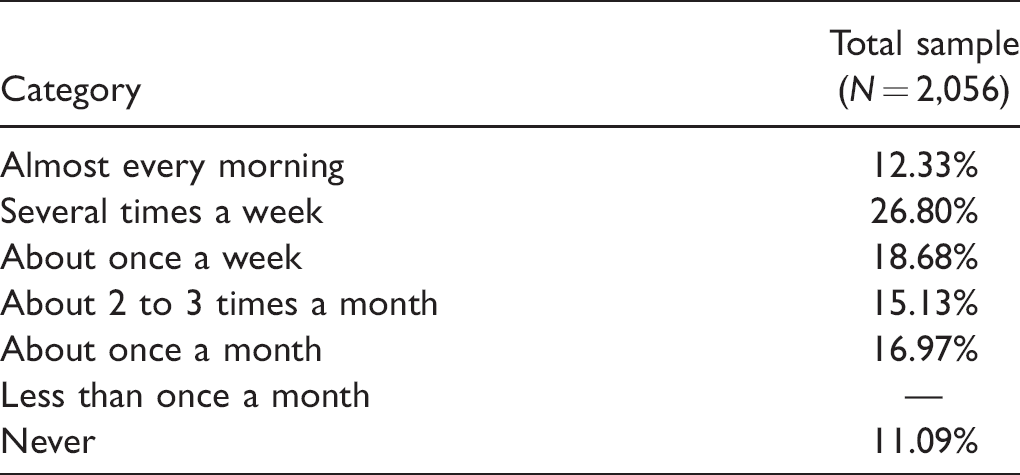
The distribution of scores on the dream recall frequency scale for the total sample is depicted in Table 1. About 58% of the participants recalled dreams at least once a week and about 11% stated that they never recalled dreams. The means and standard deviation of the 22 attitude toward dreams items are shown in Table 2. The results of the CFA using two factors are depicted in Figure 1. The root mean square error of approximation was .088, the comparative fit index .894, and the standardized root mean square residual .047 (χ2 = 3,487.4, df = 208, p < .0001). If only one factor was used as an alternative model, root mean square error of approximation was .120, comparative fit index .801, and standardized root mean square residual .071 (χ2 = 6,378.3, df = 209, p < .0001). Comparing the two model fit statistics yielded a highly significant difference (χ2 = 2,890.9, p < .0001).
Dream Recall Frequency.
Means and SD of the 22 Attitude Toward Dreams Items (N = 2,056).
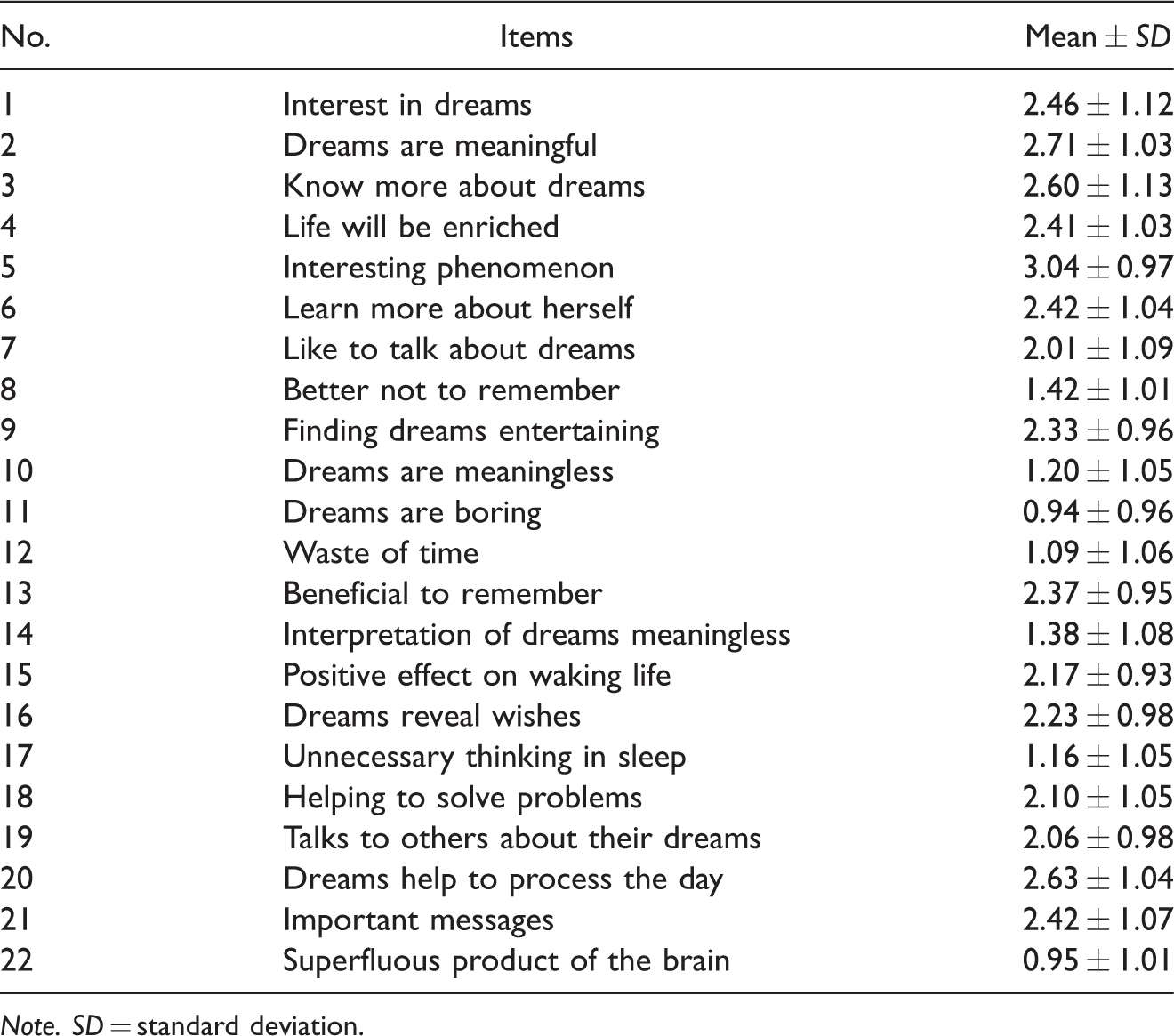
Note. SD = standard deviation.
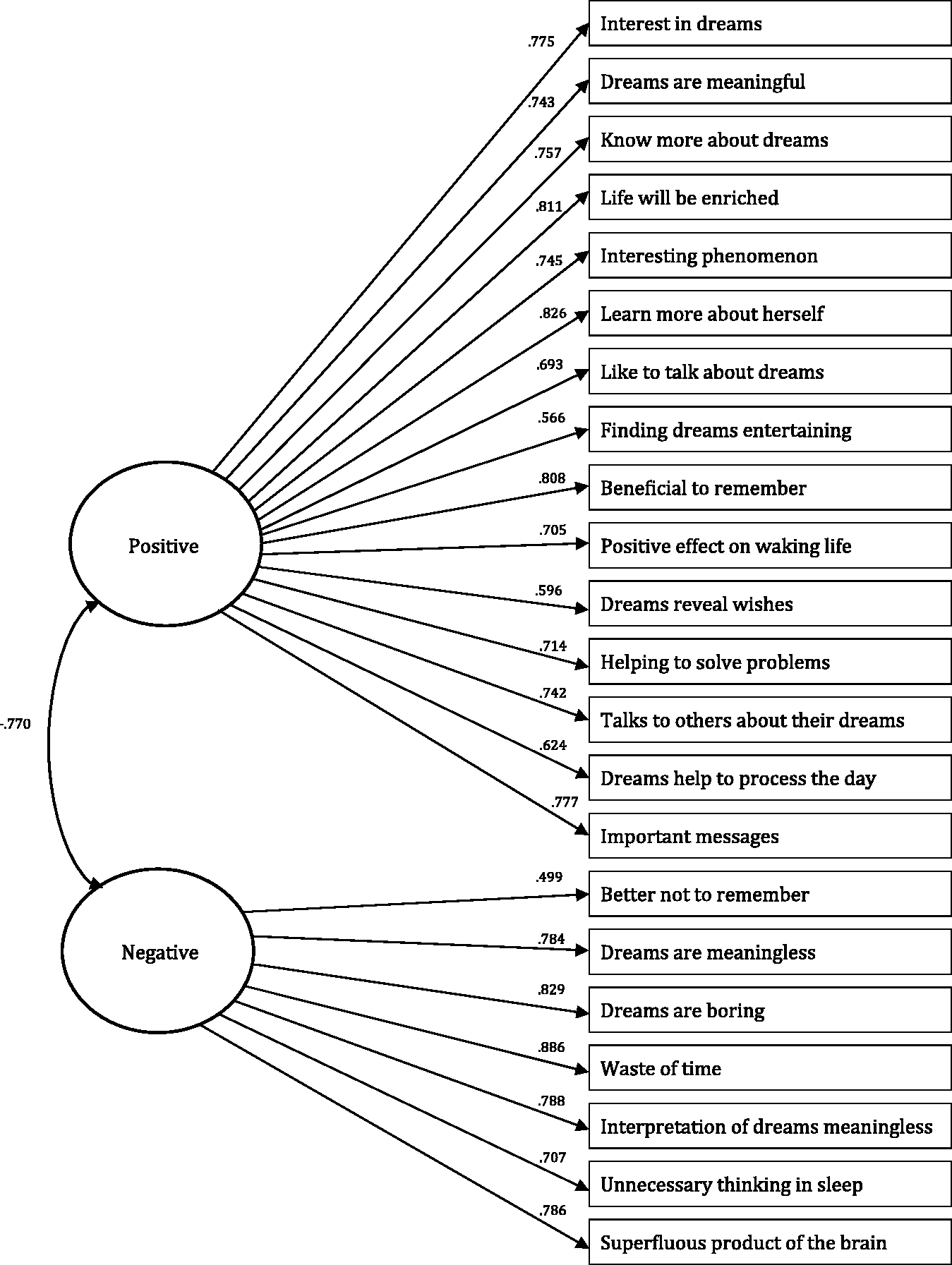
Confirmatory factor analysis of the 22 attitude toward dreams items (N = 2,056) including standardized indices.
Cronbach’s α of the positive attitudes scale that consisted of 15 items (1, 2, 3, 4, 5, 6, 7, 9, 13, 15, 16, 18, 19, 20, and 21) was α = .944. The negative attitudes scale that consisted of seven items (8, 10, 11, 12, 14, 17, and 22) yielded a Cronbach’s alpha of α = .903. The mean of the positive attitudes scale (2.40 ± 0.77) was significantly higher compared with the mean of the negative attitudes scale (1.16 ± 0.82; t = 38.3, p < .0001, d = .844). The intercorrelation of the two scales was r = −.696 (slightly lower than the correlations between the factors in the CFA model in Figure 1) and, thus, the two scales shared 48.4% variance. The absolute values of the correlations of the two scales differed significantly: r = .351 (positive attitudes scale—dream recall frequency) versus r = −.240 (negative attitudes scale—dream recall frequency), z = 7.1, p < .0001.
The regression analyses including age, gender, education, and dream recall frequency indicate that positive attitudes toward dreams decrease with age whereas age was not associated with negative attitude toward dreams (see Table 3). The magnitude of the association with gender of both scales was roughly comparable, that is, women showed more positive and less negative attitudes toward dreams. Whereas higher education was associated with a less negative attitude toward dreams, education was not associated with the positive attitudes scale. As reported earlier, the association between dream recall frequency and positive attitudes scale was stronger than the association between dream recall frequency and negative attitude.
Regression Analyses for the Two Attitude Toward Dreams Scales.
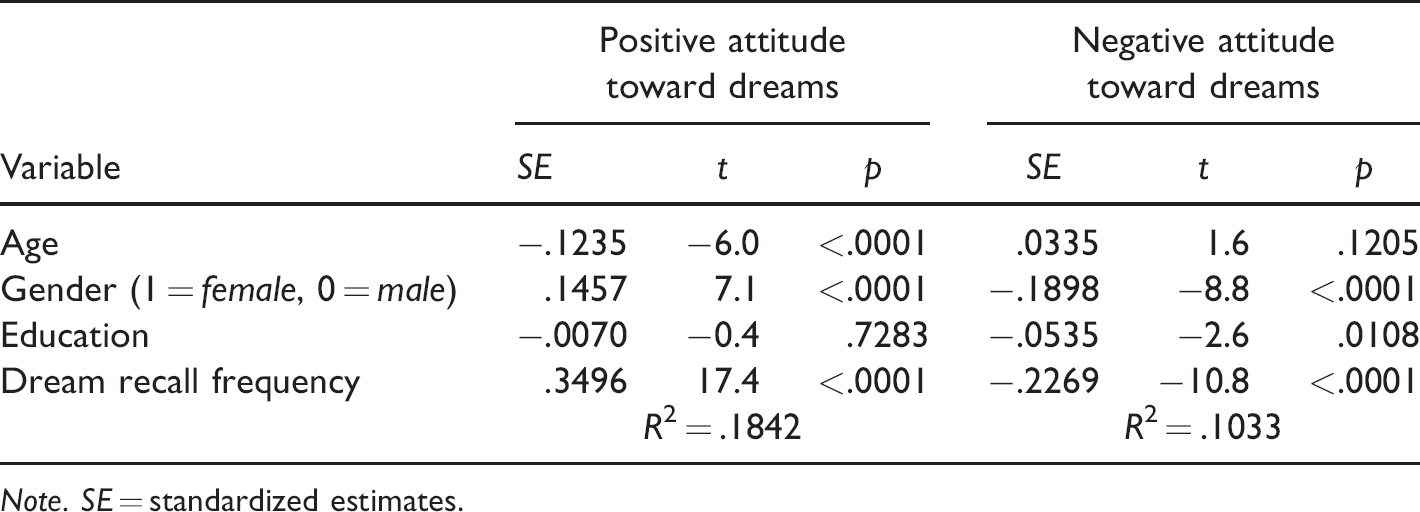
Note. SE = standardized estimates.
Discussion
Overall, the findings of the confirmatory factor analyses indicate that two factors (positive and negative attitudes) showed an improved model fit compared with the one-factor model, even though the intercorrelation of the two scales is high (about 50% shared variance). This strong intercorrelation suggests that a more complex model (higher order factor underlying the two correlated factors) might even yield a better fit of the data. Nevertheless, variables like age, education, and frequent dream recall are differentially associated with positive and negative attitudes toward dreams, indicating that these attitudes might not represent the poles of a unidimensional construct.
From a methodological viewpoint, it has to be mentioned that the sample—even though the age range and the diversity in education were large—was not representative. The participants volunteered for a dream study and, thus, dream recall frequency was on average considerably higher when compared with representative samples reported in Schredl et al. (2014) with an effect size of d = .924 (difference in dream recall frequency between online sample compared with representative samples). This might explain why the mean of the positive attitudes toward dreams scale outweighed the mean of the negative ones, also with a large effect size. It would be interesting to study representative samples in this regard, since in a German representative sample negative attitudes were more often found than positive ones (Schredl, 2013) whereas in a U.S. sample, it was the other way around (Bulkeley & Schredl, 2019). Despite the difference in mean dream recall frequency, it could be demonstrated that variables related to dream recall frequency like age and gender showed similar patterns in the online sample compared with the representative samples (Schredl et al., 2014) and, thus, support the validity of the regression analyses including sociodemographic variables.
Even though several items and scales measuring attitude toward dreams have been developed (Bulkeley & Schredl, 2019; Cernovsky, 1984; Hill et al., 1997; Robbins & Tanck, 1988; Schredl, 2013; Schredl et al., 2002, 2014), systematic studies attempting to differentiate between a general attitude toward dreaming, for example, “I like dreaming” (Schredl et al., 1996, p. 614), dream-related behavior, for example, “Have you ever speculated about the possible meaning of one of your dreams?” (Hill et al., 1997, p. 55), personal significance, for example, “Dreaming is of importance to me” (Selterman, 2016, p. 35), or knowledge about dreaming, for example, “Dreams are a good way of learning about true feelings” (Bulkeley & Schredl, 2019, p. 77) have not been carried out. The statements “Dreams are a superfluous product of the brain” or “Dreams can help to solve problems” might also be viewed as reflecting knowledge about dreaming; however, in this study, these statements are highly correlated with more general attitude scales. It would be very interesting to collect a large pool of items covering a variety of different aspects associated with dreaming and carry out exploratory and confirmatory factor analyses. These empirical approaches should inform conceptual and theoretical work that is needed to specify the relevant constructs more clearly.
For the 22 items used in this study, the fit of the two-factor model was satisfactory whereas the fit of the one-factor model was not. The high intercorrelation indicated that the two constructs of positive attitudes toward dreams and negative attitude toward dreams are closely related, but the nonshared variance (about 50%) cannot be explained by measurement errors alone and, thus, indicate that there are clear differences. This assumption is supported by the differential association pattern of the two scales with sociodemographic variables and dream recall frequency. Positive attitude toward dreams is much more closely related to dream recall frequency than negative attitude toward dreams indicating that the negative attitude scale might be associated with other variables, personality, general skepticism, and so on (as the variance explained by dream recall frequency is considerably smaller). It would be very interesting to investigate whether such variables are also differentially correlated with positive and negative attitudes. Age was associated with a decrease in positive attitude toward dreams, possibly reflecting cohort effects (the age effect on dream recall frequency has been statistically controlled), but there was no similar increase in negative attitudes. Although the effect is very small, higher education was associated with less negative attitude toward dreams (no effect of education on positive attitude was found). Within this study, the variables for testing differential relationship patterns with positive and negative attitude toward dreams were selected for convenience and were not theory-driven. It would be very interesting to study whether personality traits, general attitudes regarding psychological topics, or other variables might help to explain the differences found in this study.
These findings raise the question as to how a person develops his or her attitude toward dreams, for example, is there an effect of the parents’ attitudes toward dreams or an effect of knowledge about dreaming (which might explain the education effect found in this study)? Schredl, Buscher, Haaß, Scheuermann, and Uhrig (2015), for example, hypothesized that gender-specific dream socialization (girls talk about dreams much more often than boys) might explain the well-documented gender difference in dream recall frequency in young adults with women tending to recall their dreams more often than men (Schredl & Reinhard, 2008). Interestingly, both attitude scales were associated with gender with a comparable magnitude, that is, women showed more positive and less negative attitudes toward dreams. The findings of Bulkeley and Schredl (2019) that Black citizens of the United States reported more positive and less negative attitudes toward dreams than White citizens (additional persons with Hispanic background tend to have more negative attitudes toward dreams) clearly indicated that culture can strongly affect the persons’ attitudes toward dreams. That is, surveys using reliable scales measuring positive and negative attitudes toward dreams in countries with diverse cultural backgrounds would be very desirable.
To summarize, positive and negative attitudes toward dreams are closely (inversely) related, but there might be other variables outside the general attitudes dimension like personality dimensions, general skepticism, and so on, that might be associated with positive and negative attitudes toward dreams differently. Given the large variety of variables that are associated with attitudes toward dreaming, future investigations can clarify the theoretical foundation of the attitude toward dreams concept and study larger item pools to develop even more reliable attitude scales.
Appendix: Translated List of Attitude Toward Dreams Items
How strong is your interest in dreams? I think that dreams are meaningful. I want to know more about dreams. If somebody can recall and interpret his/her dreams, his/her life will be enriched. I think that dreaming is in general a very interesting phenomenon. A person who reflects on her dreams is certainly able to learn more about herself. I like to talk about dreams. It is better not to remember one’s dreams. I find dreams entertaining. Dreams are meaningless. Dreams are boring for me. Thinking about dreams is a waste of time. It is beneficial to remember dreams. The interpretation of dreams is meaningless. Dreams have a positive effect on waking life. I believe that dreams reveal wishes. Dreams are unnecessarily ongoing thinking in sleep. Dreams can help to solve problems. Whoever talks to others about their dreams gets to know themselves better. I believe that dreams help to process the day. Dreams can contain important messages. Dreams are a superfluous product of the brain.
Footnotes
Declaration of Conflicting Interests
The authors declared no potential conflicts of interest with respect to the research, authorship, and/or publication of this article.
Funding
The authors received no financial support for the research, authorship, and/or publication of this article.