







Abstract
The present study examined the relationships between people's romantic loneliness, parasocial love (PSL), and imagined interaction (II) with media figures they viewed as romantic partners. Two hundred and twenty four college students in a Chinese university participated in the survey study. Romantic loneliness was negatively related to PSL moderated by gender. The negative relationship only emerged in males but not in females. People who had II with the personae had stronger PSL in contrast those who didn’t. PSL was positively related to II's attributes of frequency and valence and functions of compensation and relationship maintenance. Frequency of II negatively mediated the relationship between romantic loneliness and PSL.
One of the most striking characteristics of modern media is the creation of a bond between media characters or figures (called “personae”) and audiences. This bond, illusive in essence but similar to a real-life relationship in many aspects, is called parasocial relationship (PSR, Horton and Wohl, 1956). The core characteristics of PSR are twofold. On the one hand, it is illusive because it is “one-sided, nondialectical, controlled by the performer, and not susceptible of mutual development” (p. 215). On the other hand, it is real because audiences may regard it as genuine and interpret personae's behavior as reciprocal. Despite PSR's core characteristics, its diversity needs to be recognized (Cohen, 1997). Audiences may view personae as lovers, friends, idols, counselors, models or other forms of social relations (Horton & Wohl, 1956), and therefore the type of PSR needs to be specified in parasocial research (Stever, 2009; Tukachinsky, 2011). One particular type of PSR that has recently drawn researchers’ attention is parasocial love (PSL), namely, audiences’ illusive romantic love with personae (Adam, 2019; Adam & Sizemore, 2013; Erickson & Dal Cin, 2018; Schnarre & Adam, 2017; Tukachinsky & Dorros, 2018). The surge of interests in this particular type of PSR may not be coincidental. Although Horton and Wohl (1956) admitted the diversity of PSR, they defined PSR as “intimacy at a distance” and the romantic characteristics and functions of PSR were accentuated in their seminal work.
In Horton and Wohl's discussion of “personality programs” (e.g., the late night radio show Lonesome Gal and the television show Count Sheep), the relationship between these programs and loneliness was frequently mentioned. This marks the beginning of an influential line of PSR research: the investigation into PSR as a functional alternative to meet people's social needs. However, the studies in this line have yielded mixed research findings. We contend that the mixed findings may be due to the lack of specification of different types of PSR and different types of loneliness. As mentioned above, researchers have called for differentiating between different types of PSR. As to loneliness, although researchers have empirically examined different types of loneliness (e.g., Di’Tommaso et al., 2004; Weiss, 1973, 1974), this issue is largely ignored in parasocial literature.
Abundant research has shown that the development of PSR, a long-term and cross-situational illusive relationship, depends on parasocial interaction (PSI) which is audiences’ situational involvement with personae during media use processes (Dibble et al., 2016; Giles, 2002; Hartmann et al., 2008). However, it is inadequate to just focus on how PSR exists and develops through PSI during viewing processes. More research attention needs to be paid to how PSR grows and evolves outside media use processes. We propose that the investigation into the concept of imagined interaction (II) can contribute to unraveling how PSR is kept active and progressive when audiences are not using media. Although PSR and II have the shared foundation of using imagination for social purposes (Gleason et al., 2020), the majority of the II studies focus on II's role in intrapersonal and interpersonal relationship (Bodie et al., 2013).
Therefore, the goal of the present study is to investigate the relationships between audiences’ romantic loneliness, PSL with the personae they view as romantic partners, and II with the personae. Because of the non-reciprocal nature of PSL and our interest in how it is maintained outside media use processes, in this study we focus on II's attributes of frequency and valence and its functions of compensation and relationship maintenance. As to II's other attributes (proactivity, retroactivity, variety, discrepancy, specificity, and self-dominance) and functions (self-understanding, rehearsal, catharsis, and conflict-management), we leave them to further studies such as one comparing PSI and II with personae.
PSR and Loneliness
Humans have a basic need for social interaction. If this need cannot be fully satisfied through social interaction with other humans, an alternative way is to use mediated fare for media interaction (Nordlund, 1978). The investigation into PSR as a functional alternative to meet people's social needs can be traced back to the Horton & Wohl; (1956) original work of PSR. In their work, two paths of reasoning on this subject were outlined: compensation and complementation. In the former path, the two researchers proposed that it is very natural for people who feel isolated and lonely to seek sociability and love wherever they think they can find it. When personae are available as the objects of love, especially when they possess the desired qualities to win the lonely and isolated people's hearts, PSR with the personae can compensate for these people's social deficit. In the latter path, the researchers proposed that to the majority of people, PSR is complementary to normal social life as it “provides a social milieu in which the everyday assumptions and understandings of primary group interaction and sociability are demonstrated and reaffirmed” (p.223).
Some anecdotal “extreme para-sociability” incidents in history, such as John Hinkley Jr.'s attempted assassination of President Ronald Reagan to impress the actress Jodie Foster with whom he was obsessed, seem to prove the validity of the compensation reasoning. However, the PSR involved in these incidents is pathological as it is viewed as a substitute for interpersonal relationship in real life (Horton & Wohl, 1956). Subsequent empirical PSR studies using general public samples yielded mixed findings regarding the two paths of reasoning. Although PSR is found to be positively related to media consumption, the conjectured link between deficient social relationships and PSR, indicated by the compensation reasoning, is not established. In comparison, the complementation reasoning has received support in general. People with higher propensity for social interaction are more conductive to PSR, and PSR is positively related to people's interaction potential and actual interaction engaged in their daily life (Chory-Assad & Yanen, 2005; Rosengren & Windahl, 1972; Rubin et al., 1985; Tsao, 1996). Moreover, loneliness is found to be related to people's stress on dissolutions of PSR, suggesting that people's psychological composition does contribute in some ways to PSR on its dissolution but not development. One possibility is that lonely audiences are more likely to be dependent on the PSRs with their favorite personae and thus feel more stressed on the dissolutions (Eyal & Cohen, 2006). These mixed research findings can be caused by the variations of samples, measurement, media, and personae across different PSR studies. We contend that they may also be attributable to the lack of specification of different types of PSR and loneliness.
Parasocial Love
Social relationships are distinct from one another for their different functions to meet people's different needs (e.g., guidance, reliable alliance, reassurance of worth, attachment, social integration, and opportunity for nurturance, Weiss, 1974). By the same token, depending on how people regard personae, there should be different types of PSRs that vary in nature (e.g., romantic attachment, filial attachment, worship, etc., Stever, 2009). As Tukachinsky (2011) contended, “in the same way that it is impossible to speak of social relationships as a single, homogeneous phenomenon, the definition and conceptual assessment of PSR should account for the various types of parasocial experiences” (p.75). Earlier parasocial research has primarily focused on the quantitative nature of PSR or the components of PSR, while the qualitative differences between different types of PSR hasn’t drawn researchers’ attention until recently.
Tukachinsky (2011) proposed a theorization of dividing PSR into PSL and parasocial friendship (PSF). In a survey study, the researcher asked the research participants to choose two media figures, one they “feel affinity towards” (PSF) and the other one they “are attracted to and in love with” (PSL). Then the participants answered a series of questions regarding personal attraction, closeness, companionship, trust, solidarity and romantic love for each of the two figures respectively. Factor analysis showed that PSL consists of physical attraction and strong emotional responses (e.g., admiration, mood change) while PSF consists of communication (disclosure and advice seeking) and support and companionship (trust, sharing, and mutual support).
A number of subsequent studies which followed Tukachinsky; (2011) reasoning focused on PSL in particular. On the one hand, PSL resembles romantic relationship in real life in term of its social functions and thus can be complementary to the latter one. Stronger PSL is positively related to more perceived benefits (e.g. increased happiness, decreased loneliness, and feeling better after interaction) which are similar to those benefits obtained from real-life romantic relationships (Adam & Sizemore, 2013; Erickson & Dal Cin, 2018). On the other hand, PSL can negatively influence real-life romantic relationships. Stronger PSL during adolescence is related to lower relationship satisfaction and less favorable perceptions of current romantic partners (Tukachinsky & Dorros, 2018). More involvement in PSL with media figures is related to more idealized romantic beliefs and increased negative evaluations of sexual experience (Erickson & Dal Cin, 2018). People may view their romantic partners’ PSL involvement as infidelity which constitutes a threat to romantic relationships (Adam, 2019; Schnarre & Adam, 2017). Furthermore, the audiences who view personae as romantic partners are more negatively influenced by the personae's romantic relationship announcements in contrast to those who view them as friends (Hu et al., 2020).
Different Types of Loneliness
Loneliness is a discrepancy between one's desired and achieved levels of social relationship (Peplau & Perlman, 1979). According to the attachment-cognitive approach, different types of relationships meet people's different social needs and thus cannot replace one another (Bowlby, 1969). Accordingly, loneliness resulting from different sources, which suggests the failure to gratify different types of social needs, is qualitatively different from one another (Di; ommaso et al., 2004). The researchers who employed this approach divided loneliness into emotional loneliness and social loneliness (Weiss, 1973). Emotional loneliness, which can be further divided into family loneliness and romantic loneliness, results from the deficit of an attachment to intimate others. It is characterized by anxiety and apprehension as the attachment with intimate others mainly provides a sense of security. In contrast, social loneliness is caused by the deficiency of a sense of belongingness to a general social network. It is marked by boredom and exclusion in that peer engagement generally offers a feeling of social integration (Di; ommaso & Spinner, 1993).
The uniqueness of different types of loneliness has generally been supported in social psychology research. Although different types of loneliness have a common core, they have distinct determinants and are associated with different affective and behavioral reactions. The sense of being unattached and the feeling of alienation are the major reasons of loneliness, but the former is associated with romantic relationship deficit and the latter is associated with social loneliness caused by resettling (Rubinstein & Shaver, 1982). Frequency of dates and involvement is significantly related to romantic loneliness but either not significantly or weakly related to family and social loneliness (Di; ommaso & Spinner, 1993). The presence of a romantic partner is associated with romantic loneliness whereas the closeness to social networks is related to social loneliness (Green et al., 2001).
The above-reviewed research on loneliness suggests the necessity of examining specific types of loneliness instead of treating loneliness as a global trait in parasocial research. However, this issue is largely ignored in parasocial literature. As far as the authors of the present study know, there is only one study in parasocial literature that has taken this issue into consideration. Wang et al. (2008) investigated how audiences’ unfulfilled interpersonal needs due to loneliness are met by PSR with their favorite television characters. After an overview of the conceptual and methodological issues caused by investigating general loneliness in PSR research, the researchers differentiated between emotional (family and romantic) and social loneliness and proposed that different types of loneliness are related to PSR differently. As to PSR and romantic loneliness in particular, the researchers contended that it is debatable to view PSR as a functional alternative to romantic relationship. On the one hand, personae may not be satisfactory alternatives to real-life romantic partners due to the lack of physical intimacy. On the other hand, romantically lonely individuals may be more available to develop PSR with personae. The researchers conducted a survey study by using an American college student sample and found no significant relationship between PSR and romantic loneliness. It is noteworthy that the researchers did not take the type of PSR into consideration and may be this is the cause to the non-significant relationship finding. Therefore, on the basis of our earlier discussion of PSL in this work, we posit the following research question:
RQ1: Is romantic loneliness related to PSL?
The Role of Gender
Research has shown gender differences in terms of using media to cope with negative inner states. Males tend to be more externally driven and thus rely more on media for the purpose of adjusting inner states. In contrast, females are less reliant on media but are more inclined to turn to other avenues (e.g., more intimate friends) for that purpose (Tannen, 1991). Although positive states predict media use for both men and women, gender differences emerge when it comes to negative states. Women who feel negative about their romantic relationships do not appear to use media to escape from the unpleasant states, while men's negative mood states are associated with the use of media (Bhatia & Desmond, 1993).
Gender differences have also been reported in prior research on PSR development (Cohen, 1997; Wang et al., 2008) and deterioration (Cohen, 2010; Hu et al., 2020). Women have stronger PSR with their favorite media characters in comparison to men. Men form stronger PSR with their favorite characters when they are more anxious about their romantic partners. In contrast, women's PSR with their favorite characters is stronger when they feel more secure in their romantic relationships. The results suggest that men use PSR to deal with fears of being abandoned and women use PSR to complement secure attachments (Cohen, 1997).
When facing the incidents that threaten their PSR with personae, women are more responsive than men to the incidents. In Cohen's (2010) study investigating people's reactions to same-gender friends’ and same-gender media figures’ major moral, minor moral, social, and trust expectancy violations, the female respondents reported greater anticipated reductions in closeness in response to all four expectancy violations. Female respondents also had greater variation in their reactions to expectancy violations than males. Similarly, Hu et al. (2020) found that female fans expected greater closeness reduction and more negative reactions in response to media figures’ romantic relationship announcements.
Nevertheless, when researchers implicitly or explicitly specify the types of PSR and compare men and women in terms of the strength a certain type of PSR in particular, gender difference either disappears or exhibits different patterns than above. For example, Greenwood and Long (2011) found no gender difference in PSR for opposite sex media figures while women reported stronger PSR for same-sex media figures than did men. Adam and Sizemore (2013) found no gender difference in PSL or the perceived benefits and costs derived from PSL. Hu et al.’s (2020) study shows that men and women were not significantly different from each other in either PSL or PSF.
Wang et al. (2008) discovered the moderating effects of gender on the relationship between romantic loneliness and PSR. For women, romantic loneliness was not significantly related to PSR, suggesting that women's romantic loneliness may be satisfied by other social relations that exist in their social network. For men, their PSR decreased as romantic loneliness increased, indicating that romantically lonely men may spend time on seeking a romantic partner rather than on engaging with television characters. These research findings challenge the functional alternative reasoning because the positive relationship between PSR and romantic loneliness did not emerge in either men or women.
Wang et al.’s (2008) findings on women are similar to the results of Tannen; (1991) and Bhatia and Desmond's (1993) studies, but their findings on men exhibited an opposite pattern. This may be because Wang et al. (2008) focused on loneliness in particular while Tannen (1991) and Bhatia and Desmond (1993) examined negative states in general (e.g., unhappy, blue, angry, frustrated, and worried, etc.). However, as discussed earlier in this work, although Wang et al. (2008) specified different types of loneliness, they examined the general PSR without specifying the types of PSR. This adds some uncertainties to the interpretation of the mechanism underlying the research findings on gender. For instance, the relationship between romantic loneliness and PSR was not significant for women may be because the female respondents in the study happened to predominantly view their favorite characters as friends. In order to further the understanding of the role of gender in romantic loneliness and PSL, we propose the second research question:
RQ2: Does gender moderate the relationship between romantic loneliness and PSL?
II with Personae
II is an individual's internal dialogue with others when the individual is not engaged in actual interaction with the others. It is a process of social cognition and mental imagery in which an individual imagines and therefore indirectly experiences communicative encounters with other people (Honeycutt & Cantrill, 2001). It can keep the relationships alive and contribute to relationship development when the relationship partners are absent (Honeycutt, 2003). Over the past few decades, the studies on II have formed an influential body of research for communication and social cognition scholars, but it has predominantly focused on interpersonal relational encounters (e.g., family, friends, romantic partners, colleagues, and so forth) with whom people have actual interaction.
A number of studies have shown that II can also originate in people's imaginary friends when these friends are actually absent in their real life (e.g., Gleason et al., 2000; Taylor, 1999). Recognizing the prevalence of media and its profound influence on society, Honeycutt and Cantrill (2001) pointed out that although II can help people think about their relationships with other interpersonal encounters, it can also occur with someone they’ve never met before such as television characters and celebrities. Similarly, in a widely-cited literature review of parasocial research, Giles (2002) proposed a PSR development model in which II with personae constitutes an important stage. A few recent studies have examined the connections between II and PSR. For example, sports fans’ use of various functions of II with their favorite teams is related to their identification with the teams, mental states, and behavioral outcomes. Among these functions, the relationship maintenance function may suggest potential PSR between sport team fans and their favorite teams’ players/coaches (Keaton et al., 2014). Gleason et al. (2020) examined the relationships between adolescents’ PSR with their liked same-sex celebrities and their recollection of II with imaginary friends in childhood. The researchers found that they were unrelated to each other and related to social environment differently. This finding may suggest that during different developmental stages PSR and II are employed for different purposes and tasks. Madison et al. (2019) explored the influence of II with the former US president Donald Trump on the post-election depression, helplessness, and trauma. Negative II was one of the responses that people had to their candidates’ electoral defeat. Madison et al. (2016) took a functionalist approach and investigated the specific attributes and functions of II with personae that can predict using PSR to compensate for real-life interaction. The researchers found that the self-dominance and variety attributes and the rehearsal and self-understanding functions were positive predictors of compensation while the retroactivity attribute was a negative predictor.
As mentioned earlier, PSR is derived from and facilitated by PSI. PSI is an asymmetrical cognitive, affective and behavioral interaction that occurs in the situational processes of character perception and elaboration during media exposure (Hartmann et al., 2008). The research findings that PSI is susceptible to personae's verbal and bodily addressing styles as well as media production technique suggest that the presence of personae is a necessary condition to PSI (Auter, 1992; Auter & Davis, 1991; Hartmann & Goldhoorn, 2011; Lee & Jang, 2013). However, the maintenance and development of PSR may not only occur during media exposure. PSR is a long-term, enduring, and cross-situational relationship which can exist outside the media use process, as Caughey (1984) puts it, “viewers may continue to engage in parasocial relationships when the set is turned off, just as people continue in interpersonal relationships when the other is not present” (as cited in Rubin and McHugh, 1987, p. 280). In contrast to PSI, II is an individual's internal dialogue between self and others either proactive or retroactive depending on whether it occurs before or after an actual interaction (Bodie et al., 2013). We contend that II can facilitate PSR outside media exposure for its two important functions: compensation and relational maintenance. Compensation function refers to people using II with a communication partner in place of a real interaction when the communication partner is physically or emotionally unavailable. It needs to be noted that the term compensation here is different from the “compensation” in the above-mentioned compensation hypothesis in PSR research. In the hypothesis, “compensation” means that people use PSR with personae in media to make up for the deficiency in interpersonal relationships in real life. Relational maintenance function of II describes how people keep a relationship alive by using II to aid relational development with communication partners (Honeycutt, 2003, 2008, 2009).
These two functions resonate with researchers’ findings on how PSI facilitates PSR. Personae's “break the fourth wall” strategies blur the distance between audiences and personae. PSI creates a sense of intimacy in audiences although the personae are unavailable for actual interaction. Repeated PSI over time keeps PSR alive thus facilitates PSR development (Rubin & McHugh, 1987; Wirth, 2006). II with personae and PSI seem to be two different routes (outside vs. within media use processes) with similar nature (illusive interaction without other communication partners’ actual participation) which serve two common functions (compensation and maintenance). PSI has been found to be a positive indicator of PSR (e.g., Hu, 2016), so it is viable to predict that II with personae is a positive indicator of PSR too. Research shows that II occurs primarily with romantic partners (Edwards et al., 1988) and the subject of the present study is PSL, so two hypotheses are advanced to address this prediction in PSL in particular.
H1: Compared to those who don’t have II with the personae they view as romantic partners, people who have II with the personae have stronger PSL with the personae. H2: For people who have II with the personae they view as romantic partners, their PSL with the personae is positively related to their II with the personae.
II is found to be negatively related to loneliness, suggesting that lonelier individuals are less likely to experience such mental conversations (Edwards et al., 1988). It may be because lonelier individuals have fewer actual conversations to review and rehearse. In other words, fewer actual interactions leave lonelier individuals with fewer real resources for constructing II (Honeycutt & Cantrill, 2001). In addition, lonely people experience less satisfaction and more negative emotions in IIs than do the nonlonely (Honeycutt et al., 1989). This finding is not surprising in that both proactive and retroactive II is based on the experience of real interaction. Loneliness has been found to be related to negative interaction experiences such as perception of low communication competence (Page et al., 1992; Spitzberg & Canary, 1985), rejection from others (Cassidy & Asher, 1992), and low self-ratings as well as low expectation of others’ ratings on self (Jones et al., 1983). Since higher levels of loneliness are associated with more unpleasant interaction experiences, the replay (retroactive II) and the rehearsal (proactive II) of the unpleasant interaction experiences are more likely to be more unpleasant too.
Honeycutt and Cantrill (2001) proposed that one source available for people to cope with loneliness is to engage in an imagined dialogue with personae, thereby creating PSR that is fostered through II. This proposition is distinct from the compensation hypothesis in PSR literature because it suggests that II is a mediator between loneliness and PSR. Prior social psychology research on strategies to cope with loneliness may suggest the viability of this proposition. Brennan (1982) and Peplau and Perlman (1982) proposed that reducing the salience of relationship deficiency and dissatisfaction is a basic strategy to cope with loneliness (the other two are improving social relationships and adjusting desires for social relationships). As reviewed earlier, loneliness is associated with unavailability of social relationships and negative interaction experiences. A persona, on the other hand, is readily available 24/7 with the prevalence of media. In addition, a persona is a product of media industry and those who are viewed as lovers are usually characterized by attractive looks and peculiar virtues such as charm and sexiness. II with the personae is derived from viewers’ exposure to these appealing characteristics portrayed in front of cameras. Furthermore, unlike a real life romantic partner, a persona doesn’t have actual interaction with viewers. People's II with the personae thus are unlikely to be associated with rejection, perceptions of low communication competence, or other negative experiences correlated with loneliness. Therefore, romantically lonely individuals may engage in II with the personae in order to avoid attending to the sense of deficiency and/or the unpleasant experiences in real-life romantic relationships. Through II with the personae, people's PSL with the personae is fostered. To test this reasoning, we advanced a hypothesis as follows.
H3: People's II with the personae they view as romantic partners mediates the relationship between people's romantic loneliness and their PSL with the personae.
Method
Sample
The studies on II have predominantly adopted Western samples, although the examination using the samples from non-Western cultures started early in II research. For instance, Petress (1995) found that II in both proactive and retroactive forms was prevalent in new Chinese students who were about to start their graduate studies in the US. It enabled the students to seek help in securing admission, interact with American advisors, and cope with anxiety before their study overseas began. The researcher contended that the research into international and intercultural dynamics of II use is essential. A couple of later cross-cultural comparison studies have revealed both the universality and the uniqueness of II in different cultures (McCann et al., 2010; McCann & Honeycutt, 2006).
In order to expand the understanding of II in non-Western culture, we enrolled our research participants from a large public university in eastern China. After gaining the university's institutional review board (IRB)'s approval, we sent our enrollment advertisement email to the students in various classes in the university. A total of 224 students participated in the study for extra credits. The sample ranged in age from 18 to 27 (M = 21.33, SD = 1.78). Thirty one percent were male (N = 70) and 69% were female (N = 154).
Procedure
An online questionnaire was administered. The scales used in the questionnaire were translated into Chinese by two bilingual (Chinese and English) scholars. Then another bilingual (Chinese and English) English major scholar conducted several cycles of back translation. We invited three Chinese college graduate students from various majors to check the Chinese-translated questionnaire and present recommendations about necessary adjustments.
In the questionnaire, we first asked the participants to name a media figure with whom they had PSL. It began with a brief statement which reads as follows. “Sometimes people have a feeling similar to romantic relationship about a media figure (e.g., actors/actresses, singers, news anchors, athletes, etc.). For instance, they may imagine what it will be like if he or she is their boyfriend or girlfriend. It can be a very short crush or long-term affection. Please think for a moment about whether you have such a feeling about a certain media figure. If so, please name the media figure. If you have such a feeling about more than one media figure, name the one whom you love most. If you don’t have such a feeling about any media figure, please answer no and exit this survey.” After the research participants named the media figure, they completed a set of questions that measured their PSL with the media figure, II with the media figure, and romantic loneliness. Twenty one participants reported that they did not have a media figure that was viewed as a romantic partner, so their data were not included in the data analysis.
Ethical Consent
The procedure for this study, as described earlier, received ethical approval from the IRB of the university. Respondents provided consent in the consent form page before the questionnaire. They were required to indicate agreement before proceeding with the study.
Measures
PSL was measured with the PSL subscale in the Multiple-PSR scale devised by Tukachinsky (2011). The PSL items included such statements as “I think the media figure is quite handsome/pretty,” “For me, the media figure could be the perfect romantic partner,” and so forth.
As to II, we started our measurement with a filter question to differentiate between those who had and those who didn’t have II with their PSL media figures. The question reads as follows. “When people have a feeling of romantic relationship with a media figure, they sometimes imagine how they would interact with the media figure. Have you recently had such imagined interaction with the media figure you’ve named above?” If the participants answered “yes,” they were instructed to continue. If the participants reported “no,” they were asked to skip the II items. II was measured with the modified frequency, valence, compensation, and relational maintenance subscales of the II scale by Honeycutt (2009). The first two subscales represent the quantitative (how often II occurs) and qualitative (the pleasantness of II) attributes of II respectively. The last two subscales reflect II's functions of compensation and relationship maintenance. The subscales, originally designed to measure II with real life relations, were slightly modified to fit the goals of the present study. For instance, a valence item was modified as “my imagined interaction with the media figure was usually enjoyable.”
Romantic loneliness was measured with the romantic loneliness subscale in the short version of the Social and Emotional Loneliness Scale for Adults (SELSA, Di’Tommaso et al., 2004). The romantic loneliness items included such statements as “I wish I had a more satisfying romantic relationship,” “I have a romantic partner with whom I share my most intimate thoughts and feelings (reverse coded),” and so forth.
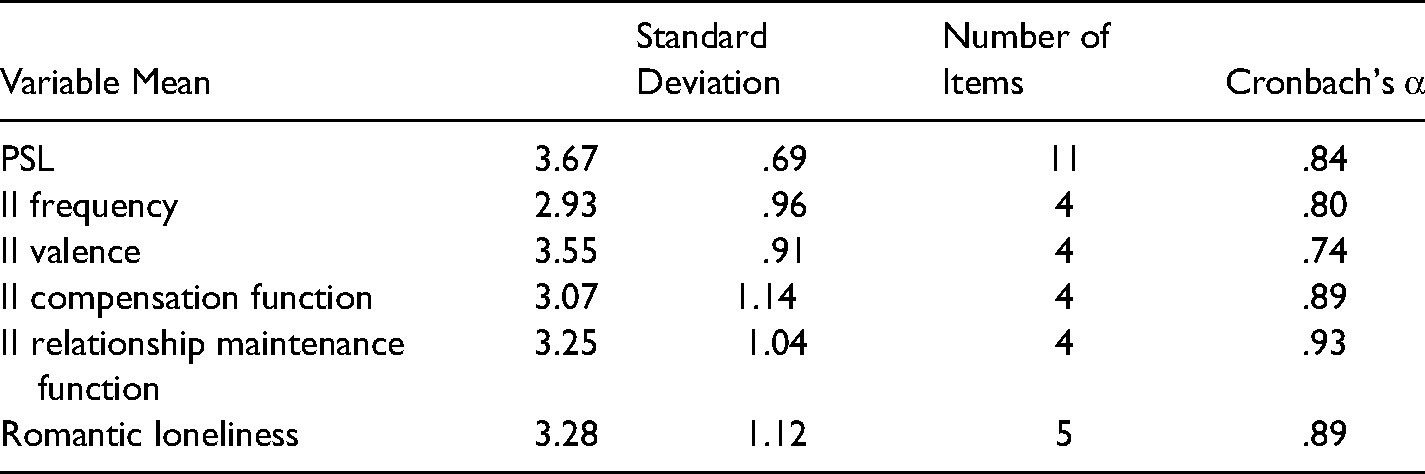
All the items of the scales were measured on a 5-point Likert scale (1 = strongly disagree, 5 = strongly agree). See Table 1 and Table 2 for the means, standard deviations, scale reliability coefficients, and correlations.
Means, Standard Deviations, and Scale Reliability.
Correlations Between PSL, II Frequency, II Valence, II Compensation Function, II Relationship Maintenance Function, and Romantic Loneliness.
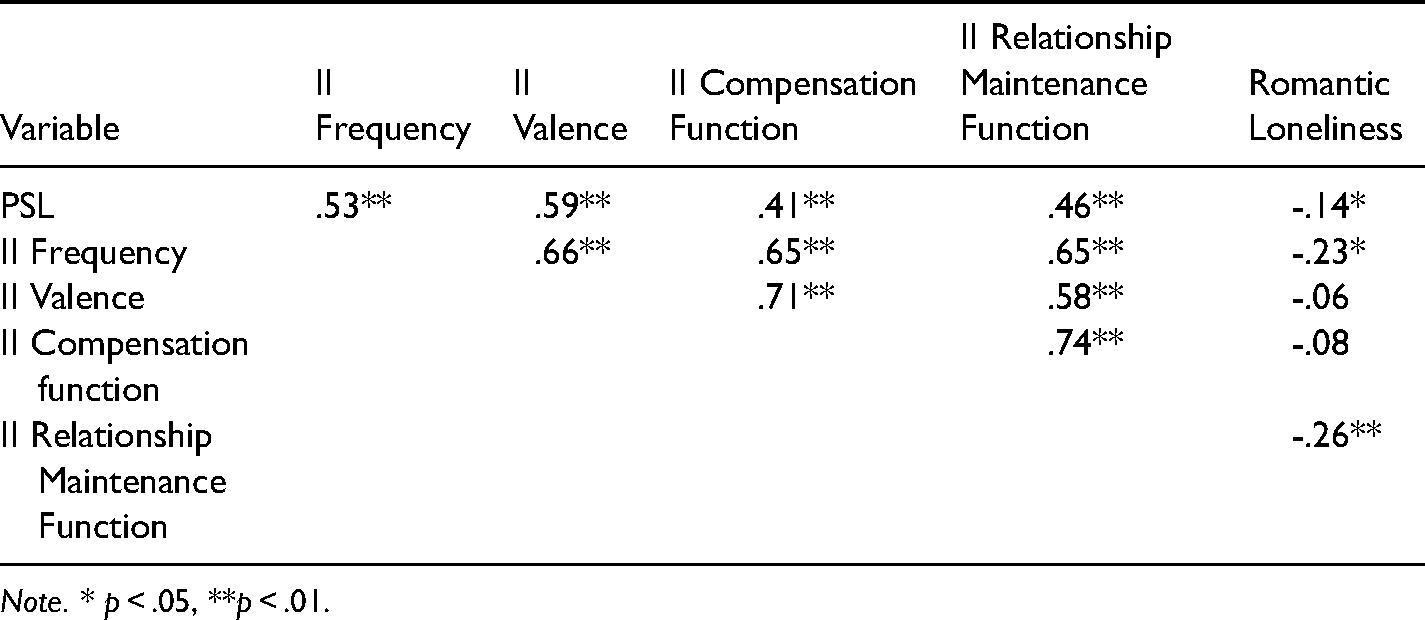
Note. * p < .05, **p < .01.
Results
Research Question 1
In the first research question, we asked whether romantic loneliness is related to PSL. As Table 2 shows, a negative relationship between the two variables emerged, r = −.14, p < .05, suggesting that those with less romantic loneliness had stronger PSL with the media figures they loved.
Research Question 2
In the second research question, we asked whether gender moderates the relationship between romantic loneliness and PSL. We first examined whether men and women were different in terms of romantic loneliness and PSL. Two independent samples t-tests were performed. Men (M = 3.36, SD = 1.10) and women (M = 3.25, SD = 1.14) were not significantly different from each other in romantic loneliness, t = .61, p = .54. Men (M = 3.42, SD = .75) were significantly lower than women (M = 3.77, SD = .64) in PSL, t = -3.19, p < .01. To investigate the research question, a moderation analysis was performed using PROCESS. The outcome variable for the analysis was PSL, the predictor variable was romantic loneliness, and gender was the moderating variable. The model was significant, R2 = .11, F(3, 199) = 8.38, p < .001. The interaction effect of romantic loneliness and gender on PSL was significant, B = .30, 95% CI [.12, .49], t = 3.23, p < .01. The conditional effects of romantic loneliness on PSL showed corresponding results. For females, the conditional effects was not significant, B = −.00, 95% CI [−.10, .10], t = −.06, p = .95. For males, the effects of romantic loneliness on PSL was significant, B = −.31, 95% CI [−.47, -.15], t = −3.79, p < .001. These results identified gender as a moderator of the relationship between romantic loneliness and PSL. Specifically, there was no significant relationship between romantic loneliness and PSL for females, while less romantically lonely males had stronger PSL with the media figures they loved.
Hypothesis 1
In order to test the hypothesis that people who have II with the personae they love have stronger PSL in comparison to those who don’t, we conducted an independent samples t-test with whether having II as the independent variable and PSL as the dependent variable. Among all the research participants, 60% (n = 121) had II with their PSL personae. The PSL scores of these participants (M = 3.88, SD = .60) was significantly higher than the PSL scores of those without II (M = 3.36, SD = .69), t = 5.67, p < .001. Therefore, this hypothesis was supported.
Hypothesis 2
In the second hypothesis, we predicted that PSL is positively related to II. First, as Table 2 shows, PSL is positively related to the two attributes and the two functions of II. Second, we conducted a two-stage hierarchical multiple regression with PSL as the dependent variable. Gender was entered at the first stage of the regression as the control variable. II's frequency, valence, compensation, and relational maintenance were entered at the second stage. The correlations between the multiple regression variables are reported in Table 2 and the regression statistics are in Table 3.
Hierarchical Multiple Regression Analysis for Variables Predicting PSL.
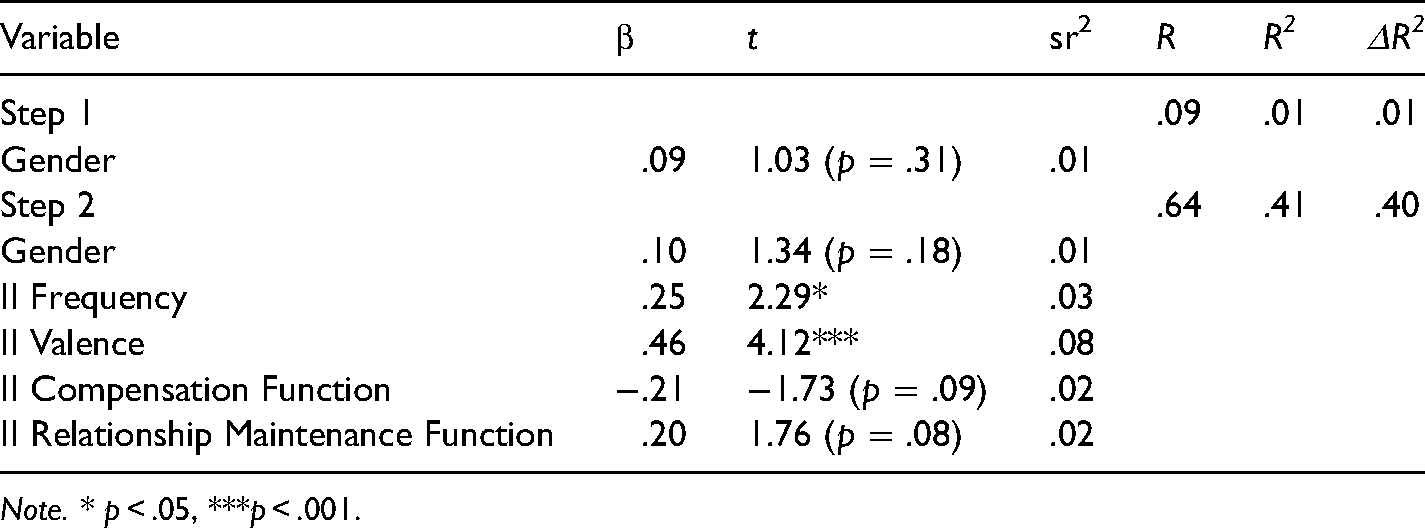
Note. * p < .05, ***p < .001.
The hierarchical multiple regression revealed that at the first stage, gender did not significantly contribute to the regression model, F(1, 119) = 1.06, p = .31) and accounted for 1% of the variation in PSL. Introducing the variables of II's attributes and functions at the second stage explained an additional 40% of variation in PSL and this change in R² was significant, F(4, 115) = 19.61, p < .001. Therefore, our second hypothesis was supported. When all the independent variables were included in the regression model at the second stage, neither compensation nor relationship maintenance was a significant predictor of PSL.
Hypothesis 3
The third hypothesis predicted that II mediates the relationship between romantic loneliness and PSL. To test this hypothesis, we used bootstrapping procedures (Preacher & Hayes, 2008). Romantic loneliness was treated as the predictor variable, PSL was treated as the outcome variable, and II's frequency, valence, compensation, and relationship maintenance were treated as the mediators. Unstandardized indirect effects were computed for each of 5,000 bootstrapped samples, and the 95% confidence interval was computed by determining the indirect effects at the 2.5th and 97.5th percentiles. The two attributes and the two functions of II were entered simultaneously because of their relatively high correlations with one another (rs ranged from .58 to .74; VanderWeele & Vansteelandt, 2014).
We first found the significant negative direct effects of romantic loneliness on II's frequency, t = -2.53, p < .05, and relationship maintenance, t = -.2.88, p < .01. These results suggest that less romantically lonely individuals were more frequently engaged in II with their PSL personae and were more engaged in II with the personae for the purpose of maintaining PSL.
The total indirect effect of romantic loneliness on PSL mediated by the four mediators was -.06, 95% CI [-.13, .01]. We proceeded with testing the individual indirect effect mediated by each of the four mediators. The indirect effect of romantic loneliness on PSL mediated by II's frequency was -.03, 95% CI [-.079, -.001]. Thus, the indirect effect was statistically significant. This result suggests that people's romantic loneliness has a negative indirect effect on PSL via the frequency of their II with personae. As people's romantic loneliness increases, they are less frequently engaged in II with their PSL personae and their PSL decreases with the decreasing frequency of II. The indirect effects mediated by II's valence, compensation, and relational maintenance respectively were -.01, 95% CI [-.08, .03], .01, 95% CI [-.01, .06], and -.02, 95% CI [-.073, .002]. Therefore, the indirect effects mediated by these three variables were not significant.
Discussion
In the present study, we aimed at revealing the relationships between people's PSL, romantic loneliness, and II with the media figures they view as romantic partners. Romantic loneliness was negatively related to PSL and this relationship was moderated by gender. Only males exhibited such a negative relationship while females didn’t. The PSL of those who had II with the personae they viewed as romantic partners was stronger than the PSL of those who didn’t. There was a positive relationship between PSL and II. Frequency of II with the PSL personae mediated the relationship between romantic loneliness and PSL.
The findings of the first two research questions on romantic loneliness, PSL, and gender are worth attention. First of all, it seems to be a viable direction to specify the types of loneliness by source and the types of PSR by how audiences view personae. A significant relationship between romantic loneliness and PSL emerged in this study. This is different from the non-significant results reported in some of the prior studies which did not distinguish between different types of PSR or identify the sources of loneliness. This study joins a few other recent studies (e.g., Madison & Porter, 2015; Wang et al., 2008) to revisit the discussion of PSR's function to meet people's social needs. The prior studies on this subject, especially those following Rubin et al.'s (1985) approach, may have concealed distinct mechanisms underlying how people's relationship deficiency is related to their PSR with personae. In this study, we extend the thrust of these studies by applying greater specificity in PSR and loneliness analyses. Although the correlation nature of the study prevents us from making causality predictions, the significant relationship finding can be treated as a threshold for more refined investigation into this subject in the future.
Second, the negative relationship between romantic loneliness and PSL, together with the finding of the negative direct effects of romantic loneliness on II's frequency and relationship maintenance function, further challenges compensation hypothesis and supports the complementary hypothesis. These findings are especially noteworthy considering that we “matched” the type of loneliness with the type of personae and thus ruled out the possible confounding results caused by the mixture of different types of loneliness and PSR. These findings show that less romantically lonely people not only developed stronger PSL but also were engaged in II with the personae they viewed as romantic partners more often and more for PSL maintenance purpose. This is consistent with prior research showing that people with higher propensity for social interaction are more conductive to PSR. These results suggest that PSL is experienced as of the same order as romantic relationship. People's PSL is a complementary but not a compensatory functional alternative to their romantic relationships. People's engagement in II for the PSL maintenance purpose serves as an extension of their sociability for romantic relationships into imaginary worlds.
Third, gender turns out to moderate the relationship between romantic loneliness and PSL. Although females had stronger PSL than did males, the negative relationship between romantic loneliness and PSL emerged in males but not in females. This moderation pattern has also been reported in Wang et al.'s (2008) study reviewed above. Such a finding may be explained by Tannen; (1991) and Bhatia and Desmond's (1993) studies showing that people's media usage to cope with negative states vary by gender. It is opposite to Cohen; (1997) study results maybe because we measured romantic loneliness while Cohen (1997) focused on attachment styles (anxiety vs. security). Considering the abundant evidence showing the difference between males and females in romantic relationship development and the mixed research findings on this topic in PSR literature, gender seems to be a factor that parasocial researchers must consider.
Duck (1980) suggested that interpersonal research move “outside” direct relational encounters and focus on the time people spend alone replaying or planning futures for relationships. This suggestion, proposed during the early stage of II research, directed researchers’ attention to the determinants of relational development outside immediate interaction (Edwards et al., 1988). By the same token, in this study we suggested incorporating the concept of II into PSR research to enrich the prior research on how PSI during media use processes contributes to PSR development. Sixty percent of the research participants reported that they had II experiences with their PSL personae. This confirms Honeycutt & Cantrill; (2001) proposition that II can occur with personae in media. The result that PSL was stronger for those who had II with personae than for those who didn’t, as well as the positive relationship between PSL and II with personae, indicates that II is a positive indicator of PSL. These findings are consistent with those on II with real life relational encounters (Honeycutt, 2010). In the multiple regression model testing the second hypothesis, II explained 40% of the variance of PSL controlling for gender and II's frequency and valence were significant predictors of PSL. These results reveal that people keep their PSL active outside media use processes via engagement in II with the personae. Those who engage in II more often and have more pleasant II have stronger PSL. They constitute empirical evidence to support Giles; (2002) model regarding II's role in PSR development. They may further reflect a broader picture that media, as a core element in people's daily life, routinely expose people to personae and mold these personae into the substance of people's living experiences including imagination (Piccirillo, 1986). Future researchers may compare the different attributes and functions of II with different dimensions of PSI (e.g., the PSI-Process Scales, Schramm and Hartmann, 2008) to investigate how these two constructs are related to each other and how they jointly influence PSL.
We found in this study that II's frequency was a negative mediator of the relationship between romantic loneliness and PSL, suggesting that people's romantic loneliness influences their PSL through how often they are engaged in II with their PSL personae. However, the direction of the mediating effect is opposite to what Honeycutt and Cantrill (2001) have predicted. The two researchers’ proposition suggests that more loneliness is associated with higher levels of PSR via more engagement in II, while our finding indicates that higher levels of romantic loneliness are associated with lower levels of PSL via less frequent II. This finding further discloses the mechanism of the result of the first research question. How often people are engaged in II outside their media use processes does play a role between people's romantic loneliness and their PSL.
Despite the implications of these research findings, the results should be interpreted with caution given the inherent limitations of the research design. First, the personae we focused on in this study were media figures, while a number of other studies on similar topics have examined fictional characters and reported different findings (e.g., Cohen, 1997; Wang et al., 2008). The difference between media figures and fictional characters lies in the continuity of media figures’ representation across different programs and media outlets (Giles, 2002). Jennifer Aniston can appear as a runaway bride relocated in New York City in the sitcom Friends, a successful actress on The Oprah Winfrey Show, and the ex-wife of the actor Brad Pitt on People magazine. In contrast, 007 is always the British MI6 spy equipped with most advanced weapons and charm throughout the James Bond movie series. Fictional characters possess the peculiar virtue of being “standardized” based on the “formula” of production (Horton & Wohl, 1956), as opposed to media figures who may exhibit multiple facets on screen. Moreover, the characteristics of fictional characters can influence audiences’ perception of the attributes of the actors who play the characters (Tal-Or & Papirman, 2007), suggesting additional complexities of PSR with media figures and fictional characters in some cases. Authenticity/realism is a key element in user–figure relationships (Giles, 2002), so readers need to be careful to generalize this study's findings to other types of personae especially fictional characters.
Second, despite the wide variety of different types of PSR, we only examined the personae that were considered as romantic partners in this study. Different types of PSRs have different correlates and their development follow distinct routes (Tukachinsky, 2011). It is yet to be explored what findings will emerge if the present study is replicated on other types of PSRs such as PSF.
Third, we used four subscales of the II scale by Honeycutt (2009) to measure people's II with media figures. The II scale was originally designed to measure II with interpersonal relations. Although the four subscales achieved satisfactory reliabilities in this study, the scale's validity needs to be tested when it is applied to the analysis of media figures. Madison et al. (2016) developed the parasociability characteristics and functions scales to examine people's usage of PSR with their favorite television characters to compensate for real-life interaction. Future researchers should continue to explore the operationalization of II in mediated-relationship context based on these initial research endeavors.
Fourth, we used a Chinese sample in this study while the prior research on PSR and loneliness as well as the studies on II has predominantly been conducted in the US involving American samples. We did not include cultural constructs (e.g., collectivism/individualism, long-term/short-term orientation, masculinity/femininity, and so forth), so we were unable to identify whether the self-report data regarding romantic loneliness, PSL, and II in this study were influenced by the participants’ culture. Cross-cultural studies have revealed cultural differences of PSR (Schmid & Klimmt, 2011), romantic loneliness and closeness in romantic relationships (Seepersad et al., 2008), and II (Honeycutt, 2003). McCann et al. (2010) compared the college students from Japan, Thailand, and the US in terms of the relationships between II and four types of cultural patterns (vertical collectivism, horizontal collectivism, vertical individualism, and horizontal individualism). The findings showed that not only the endorsement of cultural patterns but also its relationship with the valence of II varied by culture. Future researchers may follow this approach and further explore how culture influences people's II with media figures.
In conclusion, the present study enriches PSR literature by revealing the relationship between romantic loneliness and PSL as well the moderation effect of gender. This shows the importance of specifying the type of loneliness and PSR and the necessity to analyze gender difference when investigating people's PSR with personae for social needs. It also demonstrates that PSR is facilitated by II outside media use processes, which broadens the prior research revealing PSR's dependence on PSI during media use processes. The negative relationship between romantic loneliness and PSL, as well as the negative direct effects of romantic loneliness on II's frequency and relationship maintenance function, shows that when romantic loneliness increases people not only have lower levels of PSL but also engage in II with their PSL personae less often and less for the PSL maintenance purpose. These findings provide new evidence to challenge the compensation hypothesis. Furthermore, the mediating effect of II's frequency reflects the mechanism underlying the relationship between romantic loneliness and PSL. The findings of the present study which is exploratory in nature are constructive for future studies in this line of research.
