







Abstract
The present study tests the idea that individuals high on both trait Openness-to-Experience and fluid intelligence can suffer from an overactive mental state that depletes cognitive capability and leads to restless and impulsive behavior. In all, 118 participants (58 females, 59 males) were tested using the multidimensional assessment of fluid intelligence (GIA), an Open-to-Experience trait measure (HEXACO), and Levenson's secondary psychopathy questionnaire. Although analysis of variance (ANOVA) analyses revealed no interaction between Openness and fluid intelligence, an examination of the lower-order items of Openness and GIA revealed significant interactions in the female sample, particularly with esthetic appreciation. The results also suggest Openness as a unique predictor of secondary psychopathy, however the same does not hold true for fluid intelligence. The findings are discussed in relation to personnel selection procedures. Key considerations for attention capacity and activation theory are proposed. Sample size limitations are acknowledged.
Two major individual domains that have received considerable attention in the personnel selection literature are ability and personality variables (Furnham & Treglown, 2018). With regard to ability, cognitive intelligence has been established as the best predictor of work performance across cultures in spite of the various conceptualizations and psychometric measures issues (Nisbett et al., 2012). Intelligence has also been associated with lower deviance at work, such that individuals with high intelligence are less likely to act impulsively and engage in counterproductive work behavior (CWB) due to their ability to consider the consequences of their actions (Dilchert et al., 2007).
Besides targeting smart individuals, organisations are also increasingly seeking creative and innovative employees to join their workforce in order to fuel organisational growth and sustain a competitive advantage (Zhang & Bartol, 2010). Creativity in the workplace has thus become an increasingly important determinant of organizational performance, success, and long-term survival (Anderson et al., 2014). Increasing attention is being paid to the determinants of creative and innovative behaviour (George & Zhou, 2001). Openness-to-experience is the most relevant personality trait as it has been shown to relate to most creativity outcome measures (Dollinger et al., 2004). Therefore, it could be argued that cognitive ability and Openness are both essential predictors of individual success in the workplace.
Openness
In light of the ‘too much of a good thing’ (TMGT) effect (or curvilinearlity) Openness and intelligence as generally “positive individual differences” could potentially lead to negative work-related outcomes. For instance, high openness levels can lead to rebellious and non-conforming behaviors in the workplace due to an intrinsic need for novelty and variety (Ashton et al., 2000). Openness can also induce lower levels of organizational commitment and greater voluntary turnover, given individuals with high openness are likely to seek novel experiences, hence are more willing to pursue job alternatives (Erdheim et al., 2006). Further, individuals with high intelligence are more likely to experience boredom on the job due to the lack of intellectual challenges which can lead to lower levels of job satisfaction and higher turnover levels (Maltarich et al., 2010).
Subclinical Psychopathy
Two factors of psychopathy have been distinguished, namely primary and secondary psychopathy. Primary psychopathy focuses on affective- interpersonal deficits mainly relating to the exploitative use of others through callous and manipulative behaviour. Secondary psychopathy focuses on lifestyle and behavioral traits characterized by impulsivity, restlessness, disinhibition, boredom susceptibility, and antisocial behaviour (Levenson et al., 1995). Individuals high on secondary psychopathy are char 2000 acterized with high impulsive tendencies which prompt them to spontaneously respond to stimuli, thus are more likely to engage in aberrant and obstructive workplace behaviour. Possible deviant behaviors within this context include absenteeism, inappropriate physical and verbal actions, destruction of company property, theft, and sabotage (Wu & LeBreton, 2011). Secondary psychopathy has also been found to negatively correlate with Conscientiousness (Harpur et al., 1989), and the compliance factor of Agreeableness (Keiser & Ross, 2011). Individuals high on secondary psychopathy are characterized by a lack of diligence, and compliance with responsibilities and deadlines in workplace settings, which ultimately leads to performance decrements (Kennealy et al., 2007).
Cognitive Similarities Between Psychopathy and Openness
Assessing personality variants of psychopathy in a noninstitutional population provides support for a relation between psychopathy and openness (Paulhus & Williams, 2002). Similarly, individuals high on primary and secondary subtypes of psychopathy have been shown to possess higher levels of openness than non-psychopaths (Lee & Salekin, 2010). High openness is characterized by the proactive seeking of novel information and experiences and reduced auditory latent inhibition, referring to the capacity of screening out stimuli previously experienced as irrelevant (Peterson & Carson, 2000). Whilst a decrease in cognitive inhibition may be advantageous in certain scenarios, as it can lead to creative outcomes, it has been associated with global and secondary psychopathy in others (Poythress & Hall, 2011). On the other hand, reduced cognitive inhibition has been correlated with impulsivity, a central characteristic of secondary psychopathy (Boxer & Duran, 2009). An earlier study involving an attentional task to assess for cognitive dysfunction within the normal population found a positive correlation between high impulsivity scores and reduced latent inhibition (Gray et al., 2002).
There is a positive correlation between openness and secondary psychopathy.
Fluid Intelligence
Fluid intelligence is associated with processing novel information and involves abstract reasoning and short-term memory capabilities. Crystallized intelligence refers to consolidated, or acquired, knowledge from education or life experiences (Cattell, 1987; McDaniel & Banks, 2010). A plethora of meta- analyses have demonstrated the importance of assessing general cognitive intelligence at work (Kuncel et al., 2004; Richardson & Norgate, 2015).
The TMGT effect posits that seemingly beneficial antecedents can lead to detrimental consequences when taken too far, or in certain contexts under the presence of specific moderators (Pierce & Aguinis, 2013). This argument dates back to Simonton's (1994) proposition of a curvilinear relation between IQ and work-place success where individuals with lower IQ can sometimes outperform their higher IQ counterparts.
The majority of the research argues that higher levels of intelligence could compensate for decreased cognitive inhibition which may prevent information overflow and reduce the likelihood of pathological behaviors (Carson et al., 2003). However, drawing on attention capacity theory and activation theory, this paper proposes a new theory-driven approach that argues otherwise.
There is a positive correlation between fluid intelligence and secondary psychopathy.
Attention Capacity Theory and Activation Theory
Kahneman's (1973) attention capacity theory proposes that individuals have a limited attentional and cognitive capacity that can restrict the ability to attend to several simultaneous stimuli. Studies have indicated higher performance abilities on tasks involving divided attention (i.e., dual or competing simultaneous tasks) in individuals with higher intelligence as compared to their lower counterparts, due to improved information processing capabilities (Fogarty & Stankov, 1982; Furnham, 2008).
High levels of intelligence are associated with heightened attentional control, regarded as an effortful cognitive process that serves to process a large amount of information (Heitz et al., 2005). Therefore, it may be contended that intellectual ability is linked to a higher individual tendency and ability to attend to several simultaneous stimuli which increases individual activation levels even further (Eysenck, 1977). Research stemming from activation theory posits that moderate activation levels are most conducive to performance, such that extremes in activation can lead to performance decrements (Gardner, 1986). A curvilinear relation between activation levels and optimal task performance has been proposed in the earlier literature (Gardner, 1986; Scott, 1966), because moderate activation levels are associated with optimal storage and use of task-relevant information (Eysenck, 1985; Humphreys & Revelle, 1984). Deviances from moderate activation levels have been shown to affect the processing of task-based information, thus leading to performance decrements (Gardner, 1986, 1990; Janssen, 2001). This contradicts the aforementioned postulated argument which associates higher levels of intelligence with consistently effective coping with information overload (e.g., in cases of reduced cognitive inhibition; Carson et al., 2003).
Moreover, stimuli leading to experienced activation levels can arise from sources other than cognitive differences including contextual task demands and individual personality variables (Gardner, 1990). Openness is an important personality trait that engenders high resting levels of activation due to an oversensitivity to stimuli and which involves a heightened scope of awareness and a wider access to thoughts and feeling maintained simultaneously (McCrae & Costa, 1997). Novel and complex stimuli can lead to excessively high activation levels (Zhang & Bartol, 2010).
There is a significant interaction between openness and fluid intelligence when predicting secondary psychopathy.
Method
Participants
There were 118 participants (58 females, 59 males), with ages ranging between 19 and 61 years (M = 38.39, SD = 10.77). In all, 17.8% were senior leaders, 24.6% managers (13.6% middle managers, 11% first-line managers), and 31.4% non-managers. Participants were also of mixed ethnicities: 68.8% White, 12.7% Black, and the remaining belong to other ethnicities (e.g., Asian, Latin American, Mixed). Participants were surveyed from different organizations worldwide spanning a wide- range of industries, most commonly Manufacturing (n = 16, 13.6%), Business and Management Consultancy (n = 9, 7.6%), and Information Technology (n = 8, 6.8%). Most frequently specified job functions included Human Resources (n = 10, 8.47%), Engineering or Technology (n = 10, 8.47%), and Finance (n = 9, 7.63%). They came from various educational backgrounds, the most listed being BA/BSc (n = 19, 16.10%), A-Levels/12th Grade (n = 16, 13.56%), and Masters level education (n = 8, 6.78%). Most of the participants were in full-time employment (68.64%, n = 81), whereas 7.63% (n = 9) were working part-time, 5.08% (n = 6) were self-employed, and 13.56% (n = 16) were unemployed.
Measures
General Intelligence Assessment (GIA)
The GIA is a computer-based test measure which has five different tests: reasoning, perceptual speed, number speed/accuracy, word meaning and spatial visualization. It has high internal validity where the test-retest correlations on individual test scores have been found to range from .75 to .86. It correlates with the established Raven's progressive matrices test of intelligence (r = .74; Dann, 2015; Furnham & Treglown, 2018). In this study, the internal consistency of GIA scores across the different sub-tests was .79.
HEXACO Personality Inventory–Revised (HEXACO-PI-R) (Lee & Ashton, 2004) based on six consistent personality factors found across different lexical personality studies. The personality traits include Honesty/Humility, Emotionality, Extraversion, Agreeableness, Conscientiousness, and Openness to Experience. Each of the six personality traits subsume 4 lower-order facets.
Levenson et al.'s (1995) Secondary Psychopathy Scale
The 10-items pertaining to the secondary psychopathy measure was used in this study. The coefficient alpha for the secondary psychopathy scale of the Levenson’s Self-Report Psychopathy Scale (LSRP) is .64 in line with previous research using the secondary psychopathy scale (e.g., Brinkley et al., 2001)
Procedure
Participants took the GIA test as part of a selection procedure administered by a British psychometric test publisher. Participants opted to be a part of an additional research panel where they were later sent a second survey containing the openness and secondary psychopathy questionnaires. The time between completing the GIA questionnaire and the second survey was 77 days on average.
Results
Correlations
All Participants
Table 1 provides the means, standard deviations, and bivariate correlations for all of the study variables, including age. Note: correlations with sex were point bi-serial correlations. Age was not correlated with any of the variables. Openness and general trainability index (GTI) were not significantly correlated with secondary psychopathy. Unconventionality, reasoning, and word meaning significantly and positively correlated with secondary psychopathy, whereas esthetic experience significantly and negatively correlated with secondary psychopathy. Unconventionality and reasoning showed a significant positive correlation.
Descriptive Statistics and Correlations among Study Variables.
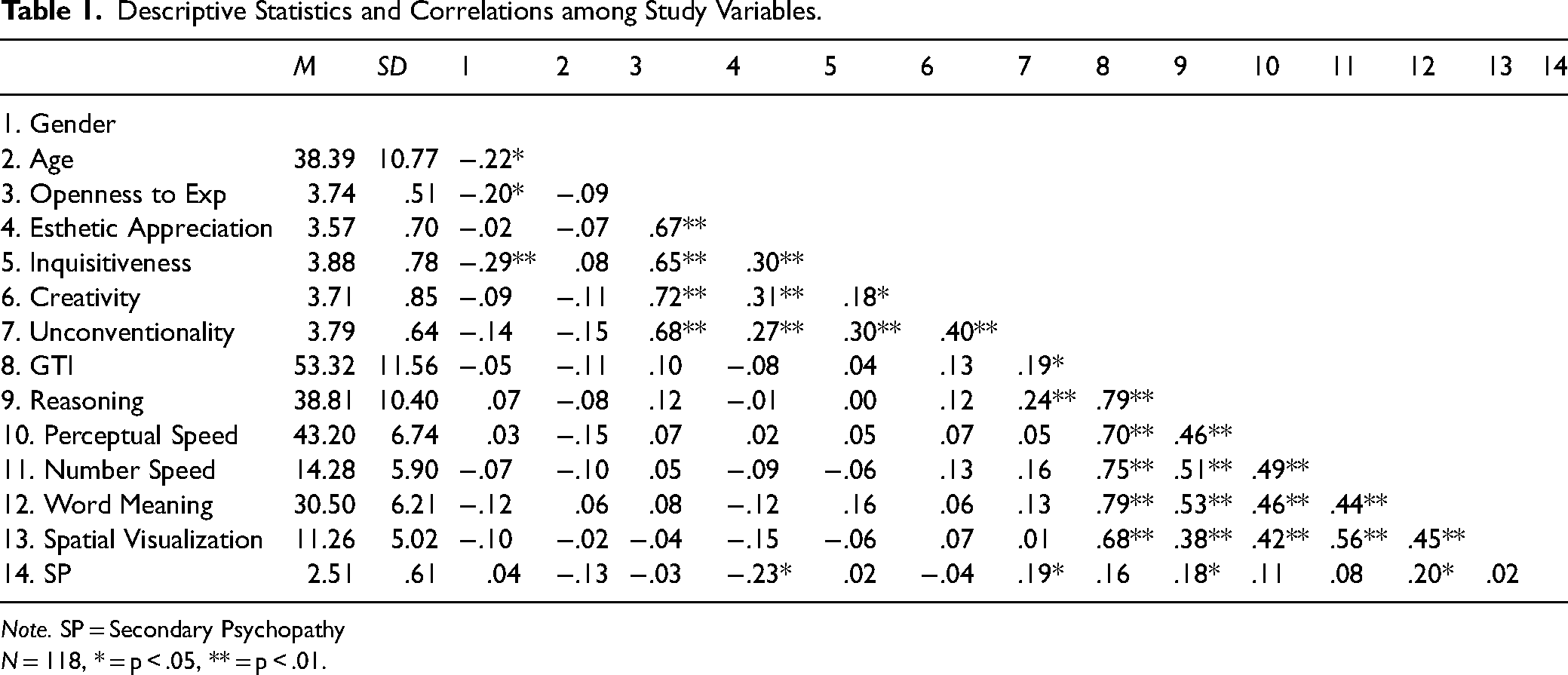
Note. SP = Secondary Psychopathy
N = 118, * = p < .05, ** = p < .01.
Gender
Table 2 shows there was no significant correlation between age and any of the study variables, except with unconventionality in the male sample. However, similar to all participants and unlike for males, the female sample revealed a significant positive correlation between unconventionality and reasoning.
Study variable Correlations by Gender.
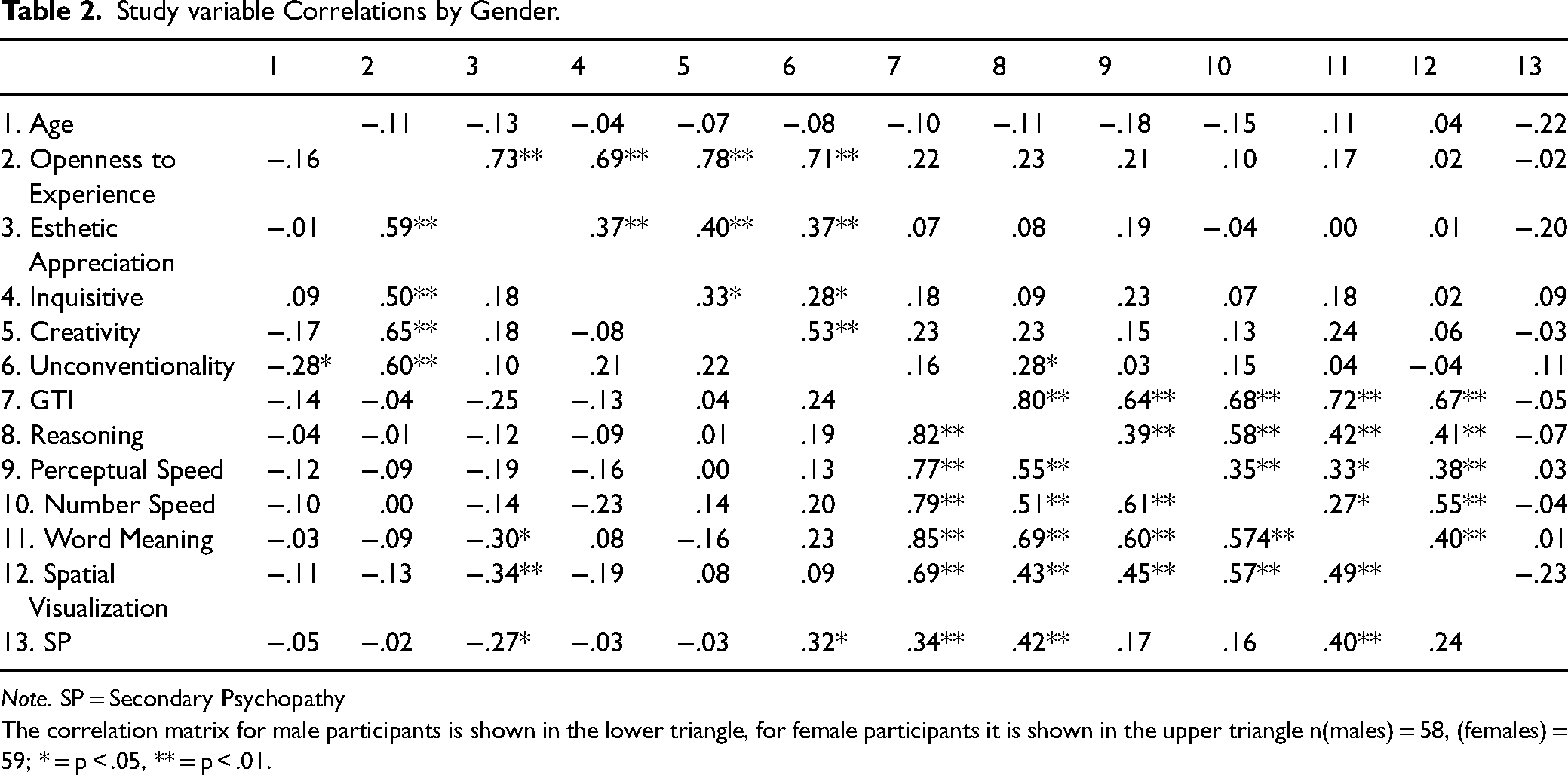
Note. SP = Secondary Psychopathy
The correlation matrix for male participants is shown in the lower triangle, for female participants it is shown in the upper triangle n(males) = 58, (females) = 59; * = p < .05, ** = p < .01.
Regressions
Two different hierarchical regression series were performed, both with secondary psychopathy as the criterion variable (see Table 3). The first hierarchical model included Openness and GTI as predictor variables, after which the interaction between Openness and GTI was incorporated in the model to test for any incremental variance. This model was non-significant when run on all three samples, such that the interaction between Openness and GTI was non-significant. A second series of hierarchical regressions were conducted factoring in the lower order items of openness and fluid intelligence that displayed a significant correlation with secondary psychopathy, namely esthetic appreciation, unconventionality, word meaning, and reasoning.
Regression of Openness and Fluid Intelligence Factors on Secondary Psychopathy, Overall and by Gender.
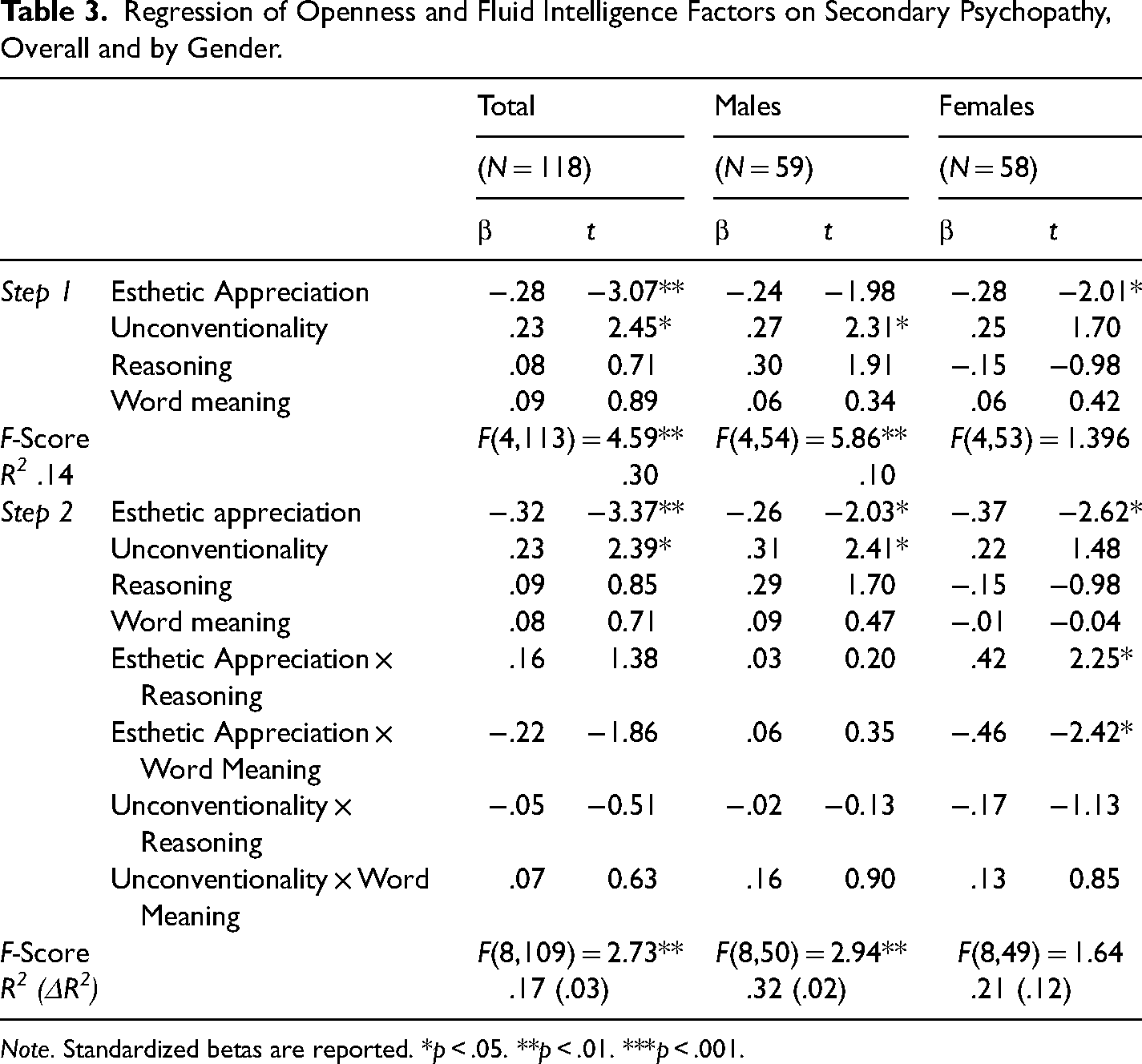
Note. Standardized betas are reported. *p < .05. **p < .01. ***p < .001.
The first step involved controlling for potential confounding variables that can interfere with evaluating the unique variance of each of the independent variables. Gender was not included as a control variable, since separate regressions were then conducted on males and females. Even though previous research has shown a decline in secondary psychopathy with age (Lander et al., 2011), age was not controlled for as it did not demonstrate a significant correlation with secondary psychopathy in both correlation tables. Since education is highly correlated with fluid intelligence, controlling for education can reduce the amount of explainable variance in secondary psychopathy predicted by fluid intelligence. Therefore, interaction variables were tested without controlling for any other variables in order to maximize the statistical power of the model (Bernerth & Aguinis, 2016). Step 1 of the hierarchical regression model entered in Esthetic Appreciation, Unconventionality, Word Meaning, and Reasoning as the independent variables and Secondary Psychopathy as the dependent variable. To then assess the distinctiveness and uniqueness of the interaction effects, Step 2 jointly tested the four possible interaction variables; Esthetic Appreciation × Reasoning, Esthetic Appreciation × Word Meaning, Unconventionality × Reasoning, Unconventionality × Word Meaning. The interaction effects were also tested in separate models, for instance through a model including only Esthetic Appreciation, Reasoning, and Esthetic Appreciation × Reasoning as independent variables, however the significance, direction, and relation of the interactions remained nearly unchanged.
In the first step, esthetic appreciation was a negative, significant predictor of secondary psychopathy in the total, male, and female sample. Unconventionality was a positive, significant predictor of secondary psychopathy in the total and male sample.
Incorporating the interaction terms in the second step of the model explained 17% (3% additional) of the variance in secondary psychopathy in the total sample, 32% (2% additional) in the male sample, and 21% (12% additional) in the female sample. In the overall model, esthetic appreciation remained as a significant predictor across samples, and unconventionality was also a significant predictor in the total and male samples. Out of the four interaction variables, none were significant in the total and male sample, however, that the interaction between esthetic appreciation and word meaning was on the verge of significance in the total sample (β = −.22, p = .065). The overall models were statistically significant at p < .001 for the total, F(8,109) = 2.73, and male, F(8,50) = 2.94, samples. In the female sample, the overall model was not statistically significant F(8,49) = 1.64, p > .05. Nonetheless, two of the interaction variables significantly contributed to the prediction of secondary psychopathy (Table 3). The interaction between esthetic appreciation and reasoning indicated a positive, significant predictor of secondary psychopathy, whereas the interaction between esthetic appreciation and word meaning indicated a negative, significant predictor of secondary psychopathy.
Discussion
The current study aimed to extend the literature by investigating whether trait openness, as well as, fluid intelligence can lead to derailing performance behaviors best encapsulated in secondary psychopathy. Even though the main hypotheses of this study were not supported, the results reveal interesting implications for research and applied organizational practice. First, the absence of a significant correlation between openness and secondary psychopathy in the overall sample does not support the first hypothesis which tests for a positive significant relation between openness and secondary psychopathy. Nonetheless, when considering the lower-order facets of openness, two of the facets, esthetic appreciation and unconventionality, displayed a significant relation with secondary psychopathy. However, contrary to the hypothesized positive relation between openness and secondary psychopathy, the regression models revealed esthetic appreciation as a significant negative predictor of secondary psychopathy across the overall, female, and male samples. Individuals with a greater appreciation affinity for exploring their surrounding were less likely to display secondary psychopathy. This is supported by the extant literature which holds that esthetic appreciation involves an increased need for cognitive and attentional control by inhibiting irrelevant stimuli in order to direct attention to focus on the object of interest (Cupchik et al., 2009). Attentional control is a cognitive mechanism lacking in higher levels of secondary psychopathy (Poythress & Hall, 2011).
In line with the hypothesized positive relation between openness and secondary psychopathy however, individuals with a higher tendency for unconventionality were more likely to display secondary psychopathy. Previous research similarly found individuals with higher levels of originality during a creative idea generation task to score higher on global psychopathy. This links originality to a decreased level of latent inhibition, a cognitive notion similarly characterizing secondary psychopathy (Fink et al., 2012; Stavridou & Furnham, 1996). Unconventionality, however, was only a significant positive predictor in the overall and male regression models, which is potentially explained by higher mean-level scores of unconventionality and secondary psychopathy scores in males as compared to females (Matud et al., 2007). Another possible explanation can be attributed to the association of unconventionality with verbal aggression (Levy & Anderson, 2006), concordant with the research claiming higher aggression levels as a component of secondary psychopathy in males only (Falkenbach, 2008).
Originality has not only been linked to decreased levels of latent inhibition, but also to higher levels of intellectual ability (Carson et al., 2003). Consistently, the results show a positive correlation between unconventionality and reasoning, which supports the rationale of testing the possible interaction between openness and fluid intelligence. Given that the originality of ideas is closely linked to higher levels of cognitive intelligence (Carson et al., 2003), and given that the findings reporting a positive association between unconventionality, as a facet of openness, and secondary psychopathy, openness and fluid intelligence might interact under certain circumstances leading to behaviors associated with secondary psychopathy. It is also worth noting that the results indicated decreases in originality with higher age in the male sample. Less willingness to risk original solutions, as well as social variables, including occupational and social roles, offer possible explanations for the decline of unconventionality with age (Ruth & Birren, 1985). However, a review of the literature revealed no related explanation as to why this relation was only present in the male sample. In summary, given the correlations at the facet level and the fact that the facets have different directions of correlations with secondary psychopathy, it is possible that the effects are confounded at the openness factor level.
In a similar manner, the second hypothesis testing for a significant positive correlation between fluid intelligence and secondary psychopathy was only partially supported. The results indicated a non-significant correlation between the overall GTI score and secondary psychopathy, however two of the sub-tests, word meaning and reasoning, reported significant positive correlations with secondary psychopathy. This is consistent with previous literature positing that the relation between psychopathy and intelligence varies depending on the type of intelligence, measurement instrument, sample size, and the factor of psychopathy involved (DeLisi et al., 2010). Even though there is limited research relating word meaning as measured by the GIA and secondary psychopathy, the relation can be linked to studies on emotional language processing. Word comprehension is usually enhanced for emotionally valenced words as compared to emotionally neutral words in normal populations (Williamson et al., 1991).
However, studies have shown deficits in verbal emotional processing in individuals high on global psychopathy (e.g., Long & Titone, 2007). This has been attributed to a lower activation of the amygdala region of the brain in individuals with high levels of global psychopathy (Kiehl et al., 2009), or due to difficulties in processing the semantic aspects of words (Brinkley et al., 2005). In sharp contrast, the findings of this study contradict the research as they report an improved word meaning score in individuals high on secondary psychopathy. However, this might be due to the lack of emotionally valenced words in the word meaning task of this study. As such, in order to examine whether semantic processing is impaired in individuals high on global psychopathy, future studies must include lexical studies while controlling for the valence of words in order to test whether it is affect-language interactions or more fundamental deficits in general semantic processing that impair word processing in psychopaths (Blair et al., 2006).
On the other hand, given the insignificant correlations between the factor-level variables (GIA and openness) each with secondary psychopathy, and the fact that different aspects of cognitive ability and facets of personality are differentially related to each other (Chamorro-Premuzic, & Furnham, 2005), can help explain the insignificant interaction between GIA and openness, therefore not supporting the final hypothesis of this study. Nonetheless, regression models accounting for the possible interactions between certain lower-order facets of openness and fluid intelligence revealed interesting findings. To begin with, only in the female sample did two of the interaction variables explain significant additional unique variance in secondary psychopathy in addition to the main effects.
Even though reasoning alone was not a significant predictor in the female model, it was shown to moderate the relation between esthetic appreciation and secondary psychopathy, such that higher levels of reasoning further decreased secondary psychopathy. The interaction between reasoning and esthetic appreciation can be linked to similar biological cognitive mechanisms related to an activation of the prefrontal cortex (PFC) of the brain. This is exhibited in an experiment revealing an activation of the lateral PFC when participants belonged to the esthetic viewing orientation of the study (Cupchik et al., 2009). As such, an interaction between esthetic appreciation and reasoning is to be expected as both reflect an activation of the PFC which ultimately focuses attention by suppressing external stimuli (Cupchik et al., 2009), a notion characterizing lower levels of secondary psychopathy (Stavridou & Furnham, 1996). This contradicts the idea that higher levels of secondary psychopathy when openness and fluid intelligence interact, however is consistent with the previous literature arguing that high intelligence can compensate for reduced levels of latent inhibition in individuals with high openness, which in turn leads to creative or enhanced performance as opposed to restlessness and impulsivity illustrated in secondary psychopathy (Carson et al., 2003)
On the other hand, the results showing the significant interaction between esthetic appreciation and word meaning shows higher levels of word meaning to accentuate the negative relation between esthetic appreciation and secondary psychopathy. This is in line with the aforementioned discussion about improved word processing scores in individuals low on secondary psychopathy due to a relatively enhanced ability to understand and appreciate feelings as compared to their higher counterparts. In turn, this ties into a higher affinity to explore one's surrounding. (Ross et al., 2004). Nonetheless, the fact that the interaction effects showed significant only in the female sample could be due to lower base rates of secondary psychopathy in women which allows for more possible increases. If this is the case, then secondary psychopathy is the wrong construct to examine due to the inherent gender differences masking the potential predictive validity of the considered constructs in the male sample. An analysis of the findings also supports the notion that secondary psychopathy has a divergent pattern of associations across gender. Nevertheless, given the limited research on gender differences in secondary psychopathy, possible explanations clarifying the divergent relations were not found in a review of the literature.
Like all others, this study was not without its limitations. Perhaps the most important of which is the sample size. Whilst this N would be considered quite adequate for experimental study it is somewhat underpowered for a study such as this. It is not easy to get working adults to complete both robust multi-dimensional intelligence tests as well as personality measures. However, it remains important to try to replicate these findings on a bigger and more representative population. Equally it would have been most desirable to have more information on each participant such as their work history, their creative past-times and any problems they may have had with the law. Finally, though all the measures we used were psychometrically sound and robust it would have been desirable to have a measure of primary as well as secondary psychopathology.
Footnotes
Data Availability
This is obtainable from the author upon request.
Ethics
This was sought and obtained (CEHP/514/2017).
Declaration of Conflicting Interests
The author(s) declared no potential conflicts of interest with respect to the research, authorship, and/or publication of this article.
Funding
The author(s) received no financial support for the research, authorship, and/or publication of this article.
Informed Consent
Participants gave consent for their anonymised data to be analysed and published.
