







Abstract
In a recent article the authors inferred classical composer similarities on the basis of their common and distinct personal (individual) musical influences. In this paper, the authors examine how much, if any, additional explanation can be added when ‘ecological’ measures (i.e., other characteristics such as time period, geographical location, school association, instrumentation emphases, etc.) are also taken into account. Although the two methods do not generate identical similarities rankings, their combination does provide, arguably, an improved system of ranking.
Keywords
Introduction: Composer Similarities
Charles H. Smith created The Classical Music Navigator (Smith, 2000; hereafter referred to as CMN) as a combined reference work and experiment in music education (see Smith & Georges, 2014 for a review of the philosophy and methodology underlying the CMN). The core of the CMN approach is the collection of composer-related data: specifically, on composer influences, and on various secondary form and style characteristics (later referred to as ‘ecological’ characteristics). The personal influences part of the database consists of, for each of the 500 composers treated, those other composers identified to have had an influence on their work. Smith and Georges (2014) used these data to infer degrees of similarity among the 500 composers and proposed the use of three similarities indices (in an approach akin to biosystematic analyses of biotas or phylogenetic relations) by means of pairwise comparison of presence–absence data (i.e., in analogy to presence–absence of characters within a group of taxonomic units, or of regional units in a spatial, biogeographic, sense). Note was taken that a second collection of data in the CMN associates each of the 500 composers with characteristics such as time period, geographical location, school association, instrumentation emphases, and so forth depicted for convenience here as ‘ecological categories’. In this new paper, we group the latter from the CMN into 298 variable categories (see Appendix for a list) with the objective of examining how much, if any, additional explanation can be added through them to the personal influences-based rankings of similarity.
To illustrate, Figure 1 focuses on three composers in the CMN. Figure 1(a) diagrams all composers flagged in the CMN as having influenced Joseph Haydn, Wolfgang Amadeus Mozart, and Franz Schubert. These three Austrian composers, born, respectively, in 1732, 1756, and 1792, are typically associated with the Classical Period of Western classical music. Even a casual listening suggests style similarities across them, although to most ears Haydn and Mozart would probably sound ‘closer’ than Haydn and Schubert, or Mozart and Schubert.
1
Observe in Figure 1(a) that these three composers share in common two particular influences: Handel and Gluck. But the important characteristic to notice is that the number of shared influences fluctuates between pairs. For example, besides Handel and Gluck, there are no further common influences between Schubert and Haydn; there are, however, two additional common influences between Schubert and Mozart (M. Haydn and J. S. Bach) and five additional common influences between Haydn and Mozart (Fux, Hasse, C. P. E. Bach, G. B. Sammartini, and J. Stamitz). Our contention is that the greater number of common personal influences between Haydn and Mozart is likely to be reflected in a tighter proximity of the musical styles of these two composers as compared with the styles of Schubert and Mozart, let alone of Schubert and Haydn. Figure 1(b) presents a similar message with respect to some (there unnamed) ecological categories that might be used to characterize a composer. Eight categories are associated with all three composers, reflecting an overall similarity of these three Austrian Classical Period composers in terms of their sharing a particular spatial-temporal musical niche. However, Haydn and Mozart share nine additional ecological categories, while Haydn and Schubert share just one additional ecological category, and Mozart and Schubert share five additional ones. In this case, therefore, the ecological categories data seem to corroborate the personal influences data, again pointing to a greater similarity of Haydn and Mozart.
(a) Composer personal influences network—J. Haydn, W. A. Mozart, and Schubert. (b) Composer ecological categories network—J. Haydn, W. A. Mozart, and Schubert.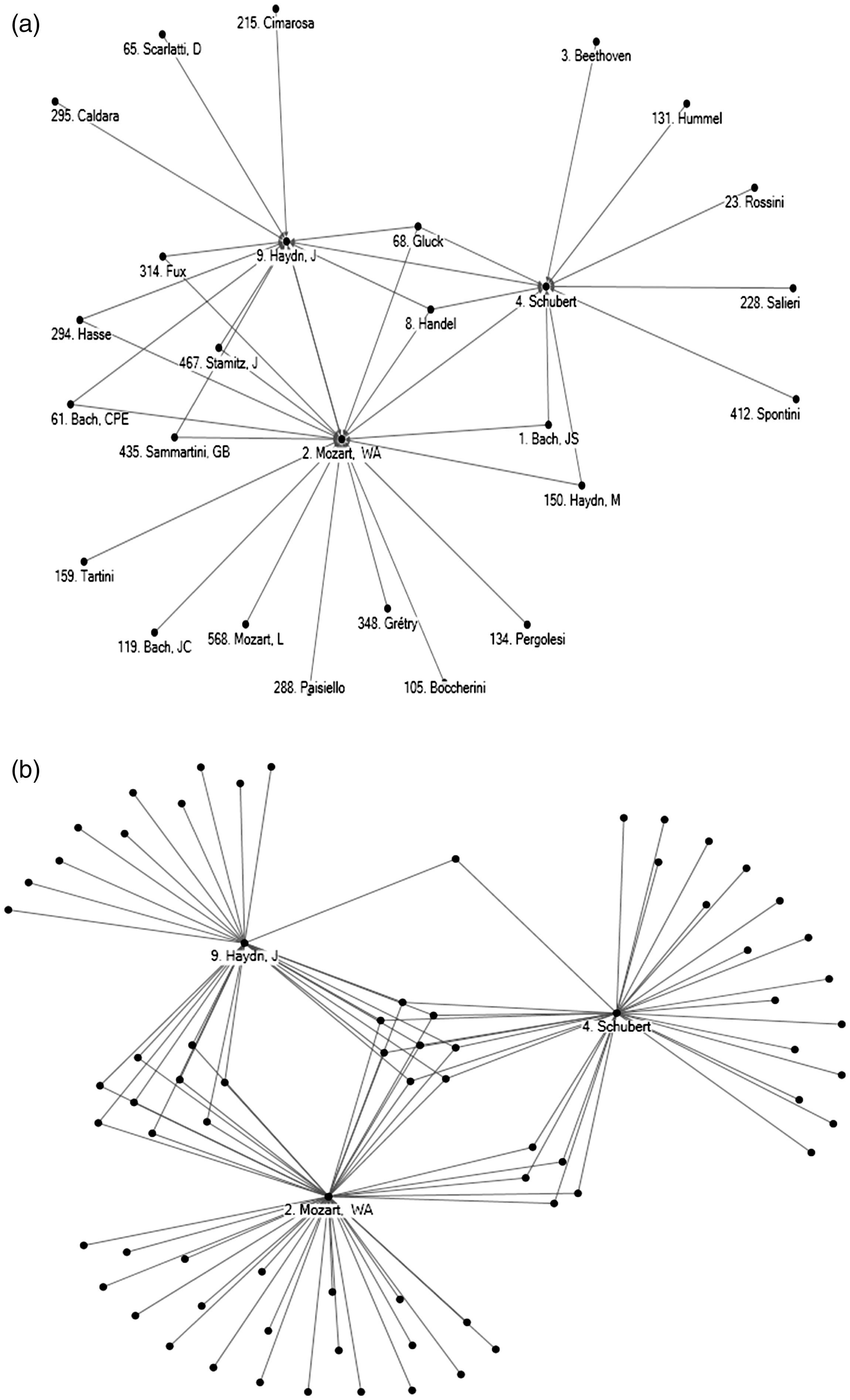
Even if shared personal influences and common ecological categories tend to reflect similarities in the compositional style of composers, distinct personal influences and ecological categories may yet increase the distance between the musical styles of any pair of composers. For example, as shown in Figure 1(a), Schubert has five musical influences that he does not share with Mozart (Beethoven, Hummel, Rossini, Salieri, and Spontini), while Mozart has 12 distinct influences that he does not share with Schubert (Fux, Hasse, J. Stamitz, C. P. E. Bach, J. C. Bach, Grétry, Tartini, Paisiello, Boccherini, Pergolesi, L. Mozart, and G. B. Sammartini). Additionally, although Schubert and Mozart share 13 ecological categories (Figure 1(b)), Schubert can be characterized by 18 additional categories that do not characterize Mozart, while Mozart has 30 additional categories that do not characterize Schubert—ultimately speaking to probable differences between the musical oeuvres of the two composers. The same argument can be made of the relative proximity of Debussy and Ravel when compared with Bartók in Figure 2(a) and (b), on the basis of shared and distinct personal influences and ecological categories between pairs of composers. Thus, to recap, our theory is that although common personal influences and ecological categories tend to reflect (or even explain) style similarities between pair of composers, distinct influences and ecological categories should have the opposite effect of increasing the distance (i.e., reflecting greater differences) between musical styles of composers.
(a) Composer personal influences network—Debussy, Ravel, and Bartók. (b) Composer ecological categories network—Debussy, Ravel, and Bartók.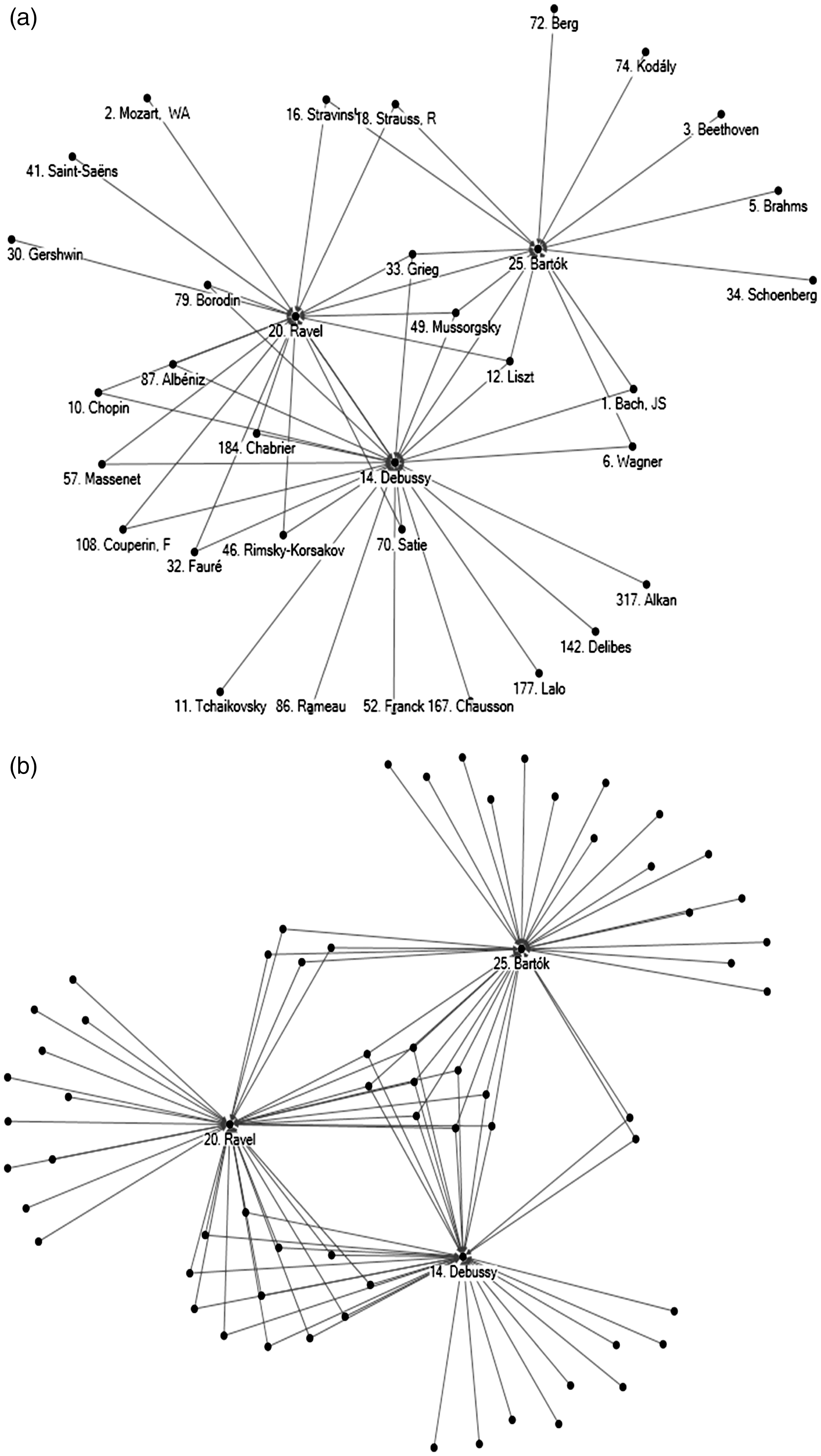
Although an inspection of diagrams such as Figures 1 and 2 is useful to visualizing relative similarities among the composers, Smith and Georges (2014) also developed a method for generating similarity scores between any pair of composers, based on these common and distinct personal influences. This is reminiscent of the approaches used in biodiversity analyses to identify relational patterns useful to explaining the historical evolution of the forms under study. See Cheetham and Hazel (1969) and Hayek (1994) for good surveys of such studies, and the related ‘measures of association’ (also named in a somewhat interchangeable way ‘similarity’, ‘resemblance’, or ‘matching’ indices). Dozens of measures of association have been constructed and applied in the biosystematics literature, and after an investigation of some of their relative qualities, Smith and Georges (2014) decided to concentrate on three specific similarity indices to link pairings of composers i and j included in the database of 500 composers: the Jaccard (1901) index, the Smith (1983) index, and the binomial index of dispersion (Potthoff & Whittinghill, 1966).
In this new paper, we explore the robustness of our earlier results by attempting to infer composer similarities on the basis of ecological categories, instead of personal influences. We further propose combining the ecological and personal influences to assess similarities, arguing that this should produce a general improvement in the similarity rankings.
Methods
The analysis methods for this new study are essentially the same as those reported in Smith and Georges (2014). In that work, C is the set of 500 composers in the database, and for any pair of composers (i,j) for
The methodology with respect to the set of 298 ecological categories, E, given in Appendix, is similar. This time, however, we are interested in capturing whether an ecological category
Finally, for the analysis combining personal influences and ecological categories, we want to capture whether a composer
Results
Composer Similarities Index—Personal Influences Database (Chi-square Statistics From the Binomial Index of Dispersion; Potthoff and Whittinghill, 1966).

Note. Tables 1 to 3 and 4 to 6 should be read vertically (column-wise). For example, in Table 1, when considering which composer from among these top-20 figures is the most similar to Debussy (identified in Column 14), we observe that the highest similarity statistic lies opposite Ravel (identified in Row 20). This value, 172.11, is shaded in gray. These relations need not be, and usually are not, symmetrical. For example, among the top-20 composers, Schumann is the most similar to Brahms (106.28), but Liszt, not Brahms, is the most similar to Schumann (171.63), even if the ‘distance’ (similarity) between Schumann and Brahms is the same as the one between Brahms and Schumann (106.28). Finally, note that where a tie occurs, two (or more) cells are shaded in the same column (as in Column 5 in Table 2, where both Mendelssohn and Liszt are identified as equally similar [46.34] to Brahms).
Composer Similarities Index—Ecological Categories Database (Chi-square Statistics From the Binomial Index of Dispersion; Potthoff and Whittinghill, 1966).

Composer Similarities Index—Integration of Personal Influences and Ecological Categories (Chi-square Statistics From the Binomial Index of Dispersion; Potthoff and Whittinghill, 1966).

Top-20 Most Similar Composers to 10 Famous Composers—Personal Influences Database (Chi-square Statistics From the Binomial Index of Dispersion; Potthoff and Whittinghill, 1966).

Top-20 Most Similar Composers to 10 Famous Composers—Ecological Categories Database (Chi-square Statistics From the Binomial Index of Dispersion; Potthoff and Whittinghill, 1966).

Top-20 Most Similar Composers to 10 Famous Composers—Integration of Personal Influences and Ecological Categories (Chi-square Statistics From the Binomial Index of Dispersion; Potthoff and Whittinghill, 1966).

In Table 2, the parallel results for the ecological categories are given. Now we see that among the list of top-20 composers, Ravel, not Puccini, is calculated as most similar to Stravinsky; Verdi, not Ravel, is the most similar to Puccini; Verdi, not Chopin or Mendelssohn, is the most similar to Wagner. These results appear to be closer to our initial expectations. Table 3 shows the results based on combining the personal influences and ecological data. Although the results are generally consistent with those generated with the ecological approach, again some results seem to be more in line with our expectations. For example, when comparing Table 3 with Table 2, we observe that Wagner, not Puccini, is closer to Verdi; Brahms, not Mendelssohn, is closer to Tchaikovsky; Mahler, not Mendelssohn, is closer to Liszt; Liszt, not Beethoven, is closer to Schumann, and finally, Liszt, not Tchaikovsky, is closer to Mendelssohn.
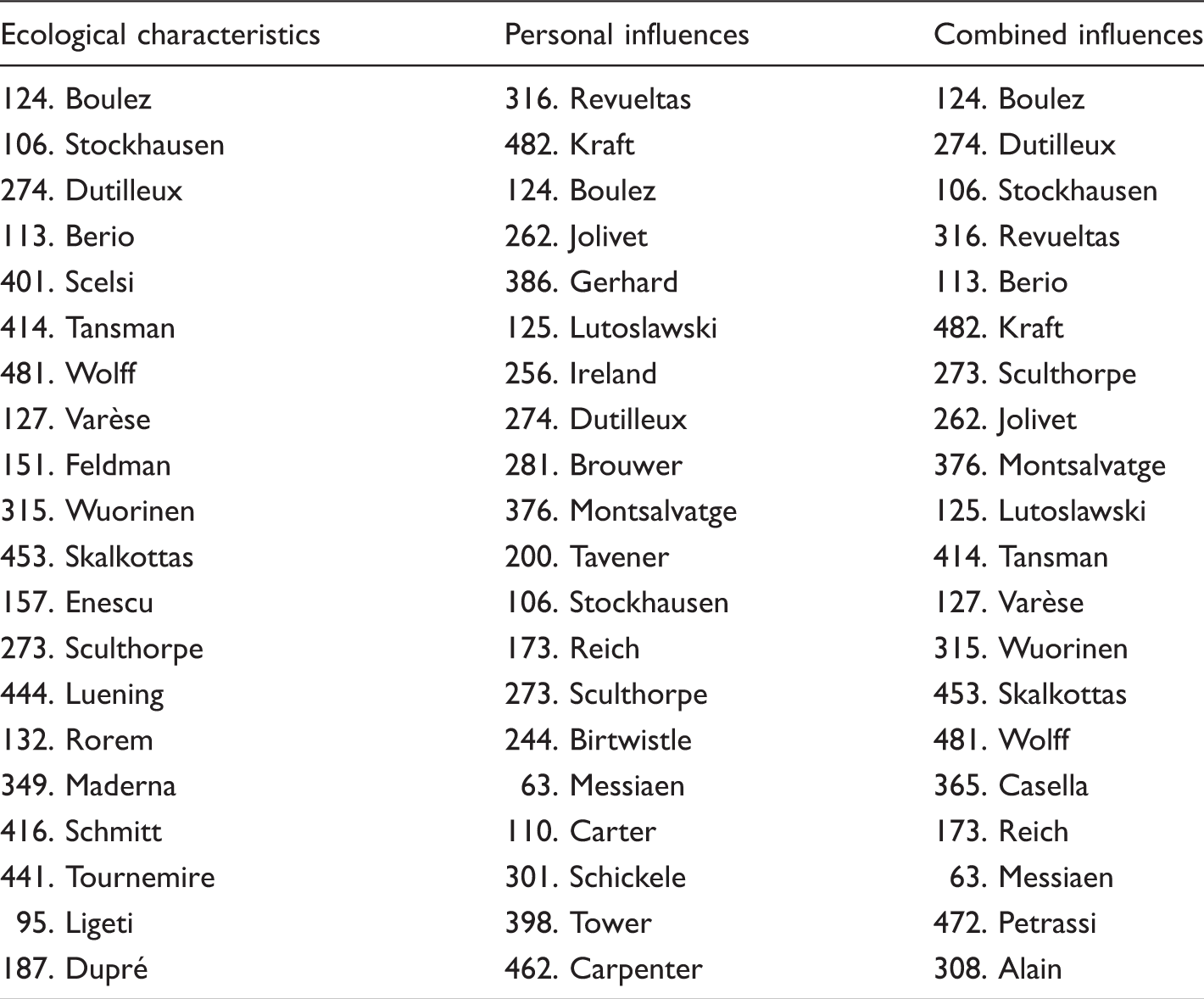
These results focus only on the relations among the major composers, however, and a more enlightening approach to overall trends can be garnered from overall rankings. First, consider Tables 4 to 6, which list the top-20 most similar composers (among all of the 500) to the top-10-ranked composers. As before, results are provided for our three different databases: Table 4 for results from common/distinct personal influences, Table 5 for results based on ecological categories, and Table 6 for results based on a combination of both personal influences and the ecological categories. Inspection of the tables reveals some considerable differences among the three. Most pointedly, there is much variation with respect to the number of names that overlap between Tables 4 and 5. For example, there are 10 names common to the two J. S. Bach lists, but only three names common to the two Chopin lists. This should not be a cause for concern, as the personal influences and ecological data sets reflect quite different kinds of information. In fact, their differences are sometimes constraining, sometimes reinforcing. The following example illustrates the constraining case.
Top-20 Most Similar Composers to Iannis Xenakis, in Rank Order—All Three Similarities Data Sets (Based on Chi-square Statistics From the Binomial Index of Dispersion; Potthoff and Whittinghill, 1966).
Highest Binomial Index of Dispersion Statistics (Potthoff & Whittinghill, 1966) for Each of a Sample of CMN Composers, All Three Similarities Data Sets; Number of Composers Found in Top-40 in Both (1) and (2).
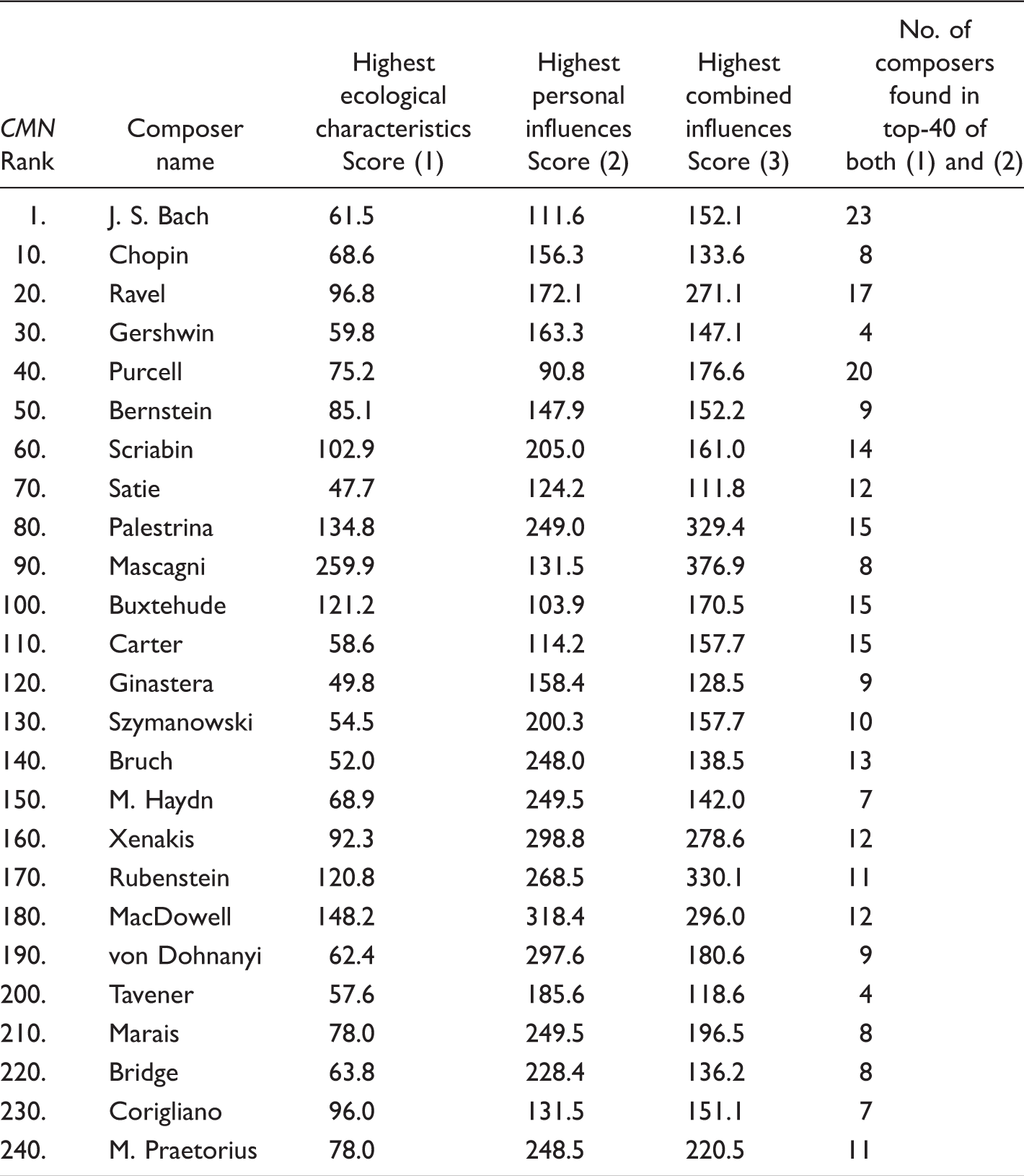
Obviously, there is a lot of variation in both the degrees of composer uniqueness, and what elements contribute to this. In Table 8, Pietro Mascagni is tightly identified by ecological characteristics including time and place, mainly his inclusion in the verismo school of opera composition (along with several other well-known composers); the result is a rather high maximum index value of 259.9. The personal influences data for Mascagni are less diagnostic, but when combined with the ecological data lead to associations with other composers that produce scores that are higher yet, maximizing at 376.9.
By contrast, the highest ecological characteristics score for Erik Satie is a rather low 47.7, and he can be regarded as a more unique individual in this sense. His highest personal influences score is also a relatively low 124.2, as is the 111.8 highest chi-square score that emerges from combining the data types. Should he perhaps be treated more on independent grounds than he usually is, when associated with Impressionist composers such as Debussy and Ravel?
In sum, there is great variation in the degrees to which each of the individual scores seem to affect the combined scores. In the Table 8 sample, Columns 1 and 3 are highly correlated (r = .814), but Columns 2 and 3 less so (r = .368, barely significant at 10% significance), suggesting a higher influence of ecological characteristics on the combined scores. Meanwhile, the means of Columns 2 and 3 are nearly the same (194.1 and 192.6), so in a considerable number of instances the highest combined score is actually lower than the highest personal influences scores alone. In some instances (e.g., Ravel, Purcell, and Palestrina), the two data sets seem to be reinforcing one another; in others (e.g., Chopin, Scriabin, and Bruch), they seem to be constraining one another. These data (and derivative sets) could lead to some interesting kinds of analysis as to the relative effects of each form of influence.
Note that the method here provides more than just a simple check against an existing general similarity assessment: The index values generated represent both a measure of the ‘distance’ between pairs of composers, and a statistical significance test. For example, as shown in Table 3, the chi-square similarity statistic for J.S. Bach and Handel is 120.96. In the dual outcome of presence/absence of common similarities and ecological categories, the degree of freedom is 1 and the critical value at a 5% significance level is thus 3.84. (For significance levels at 1% or 10%, the critical values are 6.63 and 2.70, respectively.) Because 120.96 > 3.84, we can reject the null hypothesis of no association between both composers in favor of the alternative that Bach and Handel are statistically significantly similar. For Bach and Schumann, however, the similarity index is 2.27; thus, we cannot reject the null hypothesis of no association between these two composers both at 1, 5, and 10% significance levels.
But it should also be pointed out that simple statistical significance at these levels is not by itself enough to expose obvious similarities between a given pair of composers. These data are as a set very highly ordered, and the mere sharing of as few as two influences is probably enough in most cases here to produce an association score that is statistically significant. The case of Xenakis was mentioned earlier; it turns out that both he and John Ireland (who most would agree does not have a lot in common with Xenakis in terms of actual musical product) count as influences Bartók, Debussy, and Stravinsky. Thus, much higher chi-square values should be looked to here to provide more assurance as to the existence of an ‘observable similarity’. Exactly how much higher is a debatable point for the moment, though scores of at least 50.0 for the ecological characteristics evaluations, and 100.0 for the personal influences and combined ecological characteristics/personal influences results provide reasonable ad hoc standards for now. In any case, situations such as the Xenakis/Ireland one provide food for thought: In what ways might this commonality of influence have found its way into their music in similar ways, despite returning outwardly quite different results?
Discussion and Conclusion
This paper investigates two approaches that quantify the relative similarities existing between given pairings of composers. The first approach, initially proposed by Smith and Georges (2014), infers composer similarities from the personal influences on them; the second approach applies 298 ecological categories (i.e., composer characteristics such as time period, geographical location, school association, instrumentation emphases, etc.: see Appendix) to the same ends. We originally expected the second approach to provide simple confirmation for the findings of the first, but the situation turned out to be both more complex, and more interesting, than this.
The fourth data column in Table 8 provides evidence that the two approaches produce results that are not wholly independent of one another; the column mean is 11.24, which is much greater than the value of 3.2 that would be expected were all the associations merely of random form. 4 In that sample, there are 23 composers who are in both of the ‘top 40’ lists associated with J. S Bach, but only four who are in both for Gershwin and Tavener. Still, Bach, Gershwin, and Tavener’s ecological associations produced similar highest chi-square scores, while the ‘influences’ data produced higher highest chi-square scores for Gershwin and Tavener.
There are some fairly obvious explanations for some of the results, though these only provide glimpses. A preliminary review of all the data suggests, for example, that very high similarities scores are not restricted to either earlier or later time periods or places, though they turn up among distinct schools of composers (e.g., Italian Renaissance composers, or late 19th century ‘verismo’ opera composers). Very low scores, we might think, should be associated with composers working outside the mainstream—though many or most of these may have been too unique to generate imitators. On the other hand, some of these may have hit upon the right formula. Could it be true, in fact, that the actual most revolutionary composers are also exposed in this data set by their relatively low similarities scores? Through this line of thinking, should we consider that lasting innovation may be due more to ‘influence’ by a more unique set of personal and ecological factors than the apparent actual productions seem to indicate? J. S. Bach and Wolfgang Amadeus Mozart are two cases in point: Both of these supreme masters, neither generally thought of as being great innovators, produce rather low similarities scores (as shown in Tables 4 and 5). And, even should this kind of verdict prove attractive, perhaps this was a reality only more characteristic of earlier times than more recent ones.
It will take some time to sort through the relationships that are underscoring the results reported here, but three things appear central to such development. First, the data still suffer from some spottiness, as many of the less significant composers on the list of 500 remain incompletely studied, or even commented upon. We are hoping to reduce this problem with another large-scale literature review, currently in its planning stages.
Second, some of the ‘spottiness’ just alluded to can be reduced by adding in another set of data collected in the CMN: what might be termed general (personal) influences. These consist of influences on individual composers that are identified only generically; for example, as ‘jazz', ‘folk music', ‘Baroque composers', and so forth. Fully a third of the influences data contained in the CMN are of this type. We did not apply them at this time so as not to complicate the discussion, but once the planned literature review noted above has been completed, this information can be integrated in with the rest.
Third, it is time to start invoking some actual models that can be tested through the data, once these are satisfactorily representative. The most likely basis for such modeling is an evolutionary one—perhaps, even, a near-Darwinian one: Clearly, the overall development of Western classical music styles is not due to simple creative genius alone, but to the influence of past masters and genres, as constrained or facilitated by the cultural conditions of time and place. Darwinian biological models have been applied to many aspects of cultural evolution (see Linquist, 2010 for one good survey), but not so much to music history (but see Gatherer, 1997). While the analogy between biological change and musical change may not be a stretch, however, it remains necessary to exert some caution, as Linquist (2010) notes:
However, when conducting this sort of analysis it is important to distinguish two different sources of cultural similarity. Some shared traditions are inherited from a common ancestor while others are independently invented by a process analogous to convergent evolution. Only shared derived traditions carry information about ancestral relationships; convergent traditions are a source of noise that can generate overestimates of the relatedness among cultures. (p. xix)
Footnotes
Declaration of Conflicting Interests
The authors declared no potential conflicts of interest with respect to the research, authorship, and/or publication of this article.
Funding
The authors received no financial support for the research, authorship, and/or publication of this article.