







Abstract
In this study, we examined whether exposure to art can promote an abstract mindset. Specifically, based on construal level theory, we tested the relationship between artistic cues and an abstract mindset, and how this mindset could in turn impact prosocial choice. Experiment 1 (N = 54) revealed that artistic cues lead participants to consider more abstract features than concrete features. In Experiment 2 (N = 83), it was shown that the effect of artistic cues on an abstract mindset is mediated by psychological distance. In addition, this abstract mindset was shown to mediate the link between artistic cues and prosocial choice. The findings of this study highlight the mechanisms that extend the effects of art beyond preference to choice and thought.
Keywords
A long-standing notion exists that people perceive art differently than other objects (Joy & Sherry, 2003). Extensive investigations into the perception and appreciation of art have led to the establishment of art as a distinct field of inquiry (Berlyne, 1974; Funch, 1997). However, there have been few discussions regarding how art can influence an individual’s judgment from a business management perspective. Specifically, while art is being increasingly utilized as an important tool for corporate strategy, limited research has been conducted to empirically study the effectiveness of using art from a marketing perspective. Furthermore, only a few academic studies have empirically investigated what roles art plays in this context. Until now, researchers have primarily focused on the consequential aspects of artistic cues from a macro perspective. For example, previous researches have suggested that using art in business strategizing can enhance brand image (Colbert, Nantel, Bilodeau, & Rich, 2001; Durand, de Gouveia, & Berman, 1996; Javalgi, Traylor, Gross, & Lampman, 1994; Varadarajan & Menon, 1988) or corporate values (Kim & Kim, 2010). However, in order to fully understand how artistic cues work, an investigation into an individual’s psychological mechanism is essential.
This article highlights that aesthetic experience, in the form of an exposure to artistic (vs. nonartistic) cues, promotes an abstract (vs. concrete) mindset. And then, abstract mindset is expected to enhance prosocial choice. In particular, this study proposes that people primarily consider abstract features when appreciating art (vs. nonart). Furthermore, consideration of abstract features of art would influence subsequent behavior unrelated to art, such as prosocial choice.
Theoretical Background
Influence of Artistic Cues on an Abstract Mindset
Art, particularly after the modern era, often expresses abstract forms and concepts rather than imitating the real world. Abstract conceptuality can spontaneously stimulate people to search for meaning (Fróis & Silva, 2014), cognitive orientation, and interpretation (Kreitler & Kreitler, 1972; Leder, Belke, Oeberst, & Augusin, 2004). A good example is Marchel Duchamp’s Fountain (1917), the men’s urinal displayed in a prominent art museum, which led people to “think” of the artwork’s inherent meaning. In contrast, nonart such as a mundane object, a urinal in a toilet, is immediately recognizable and understandable and does not involve a search for meaning to the same extent.
In other words, from a psychological perspective, nonrepresentational artistic cues are hypothesized to employ the abstract mindset. The concept of mindset refers to general cognitive operations with specific features that facilitate a given task. Among various mindsets, the current research is focusing on the abstract and concrete mindsets. The abstract mindset is defined as involving those operations that are broad, leading to decontextualized information processing, and are more inclusive of information that is not immediately available (Malkoc, Zauberman, & Bettman, 2010). Alternatively, the concrete mindset is defined as involving cognitive operations that are context-bound and include information structures in the immediate situation. Abstract (vs. concrete) mindset affects how new information regarding an upcoming task is interpreted in a more complex way (vs. concretely; Freitas, Gollwitzer, & Trope, 2004). In particular, thinking in abstract aims or meanings (vs. concrete procedure) for certain activities increases the accessibility of cognitive operations concerning that activity at a high level (vs. a low level). The current research explores whether nonrepresentational artistic cues affect the persistence of such mindsets and their effects on subsequent decision making, particularly in terms of prosocial choice.
Role of Psychological Distance
To explain the mechanism of artistic cues with regard to an abstract mindset, the present research focuses on the role of psychological distance, relying on the construal level theory (CLT), which is one of the best-examined recent theories in social psychology (Liberman, Trope, & Stephan, 2007; Trope & Liberman, 2003).
CLT provides a parsimonious explanation about the influence of psychological distance on construal level changes. It posits that if things become more psychologically distant, people think about them at progressively higher levels of abstraction. To illustrate, when people imagine themselves reading a science fiction book in distant (vs. near) future, they use more abstract descriptions (e.g., “broadening horizons”; Liberman & Trope, 1998). Proximal events are more concrete in nature, allowing more detailed thinking, whereas distant future events are more imprecise due to limited information, promoting abstract thinking.
As a result of the constant co-occurrence of temporarily distant events and abstractness, people habitually think in more abstract ways whenever they think about a more distant event (Förster, Özelsel, & Epstude, 2010). Specifically, thinking of distant future leads to more “why” identification (vs. “how” identification; Liberman, Sagristano, & Trope, 2002), distinguishing superordinate purpose (vs. subordinate means; Day & Bartels, 2004), and employing global processing (vs. local processing; Förster et al., 2010).
In addition, if people frequently and consistently experience certain ways of thinking on certain occasions, only subtle reminders of these experiences are sufficient to prime their way of thinking (Förster, Friedman, Butterbach, & Sassenberg 2005; Förster et al., 2010). Priming refers to the incidental activation of knowledge structures such as trait concepts and stereotypes. Many studies have shown that not only the trait concepts or stereotypes but also unrelated situations may carry over for a time to exert an unintended influence on behavior (Bargh, 1994; Higgins, 1996). For example, even seeing the logo of the Apple company (Fitzsimons, Chartrand, & Fitzsimons, 2008) or being in a disordered room (Vohs, Redden, & Rahinel, 2013) activates the goal of creativity and increases creative performance.
In relation to CLT, recent studies indicate that a subtle reminder of a concept that is implicitly associated with psychological distance can stimulate abstract thinking (Förster et al., 2010). For example, subtle cues of love (vs. lust) can automatically initiate global ways of processing owing to a strong association between long-term perspective and the concept of love (i.e., long-term commitment, life partner, etc.).
We would like to apply this logic to the art domain. We argue that art and nonart differ with respect to their psychological distance and, therefore, differently affect mindsets. In particular, art tends to be associated with “long-term” valued objects. Such perceptions would involve temporally distant perspectives, while nonart, which include mundane objects that exist in the “here and now,” do not necessarily involve such remote perspectives. An association of art may present itself in the consumers’ memory, and as such, a subtle reminder of “art” can habitually engender those processes.
Influence of the Abstract Mindset on Prosocial Behavior
Recent studies have examined the influence of the abstract mindset on prosociality in situations where it promotes fairness, others’ interests, and collective welfare while damaging self-interest (Giacomantonio, De Dreu, Shalvi, Sligte, & Leder, 2010; Kortenkamp & Moore, 2006). Specifically, the abstract mindset can increase cooperation in resource dilemmas (Sanna, Chang, Parks, & Kennedy, 2009), blood donation (Choi, Park, & Oh, 2012), and integrative agreements and negotiations (Giacomantonio et al., 2010; Henderson, Trope, & Carnevale, 2006).
Recent consumer behavior research has also reported consistent results regarding “value of fit”: that is, activated mindsets affect the type of information to which consumers assign more value during product evaluation. Some product information can be more influential during evaluation when it matches the consumers’ mindset, as activated at the time of judgment. In particular, when people evaluate a product under an abstract (vs. concrete) mindset, it is more likely to make them focus on the high-level (vs. low-level) benefits of the product. Therefore, when a mindset with a higher abstraction level is activated, products having virtuous and socially desirable values, as reflected in high-level construals (e.g., morality, altruism, or beneficial to others in need), are considered more positive than products with practical and self-oriented values, which are reflected in low-level construals (e.g., efficiency, materialism, and convenience; Agerström & Björklund, 2009a; Torelli & Kaikati, 2009).
Overview of the Study
This article proceeds as follows: Experiment 1 examines the role of art in activating an abstract mindset. Experiment 2 expands on this role and an abstract mindset in the realm of prosocial choice. Furthermore, this study aims to demonstrate that an abstract mindset induced by artistic cues is caused by the psychological distance availed by art.
Experiment 1
The study primarily aimed to establish evidence for investigating whether artistic cues can truly enhance a consumer’s abstract mindset. In particular, it was expected that those in the art priming condition would focus more on a stimulus’s high-level aspects such as ascription of meaning and symbolism than its low-level aspects such as monetary value and material.
Method
Pretest
The purpose of a separate pretest (N = 29) is to confirm that the candidate art image is perceived as art and also to rule out the influence of potential intermediate variables on abstractness. In Experiment 1, the candidate stimulus for the work of art was a painting by René Magritt (Personal Values), based on the recommendation of three art and art history experts. The nonart image was a picture of mundane objects involving a composition and objects similar to the Magritt painting (e.g., a bluish glass cup; see Appendix A for images in Experiment 1).
A pretest confirmed that participants more strongly perceived the candidate art image as art (“Do you agree that it is a work of art? On a scale of 1 = definitely disagree to 5 = definitely agree; MMagritt = 4.38 vs. MNonart = 2.72, t(28) = −6.04, p < .001). Moreover, both images were considered equivalent in the perception of a positive mood as “happy” (MMagritt = 2.72 vs. MNonart = 3.00, t(28) = 1.27, p > .05) and “enjoyable” (MMagritt = 3.10 vs. MNonart = 3.14, t(28) = .13, p > .05) While many studies suggest that positive mood influences abstractness based on the broaden and build theory (Fredrickson, 1998; Isen, 2000; Isen & Daubman, 1984), our current results in the pretest rule out such possibility.
Participants and design
The study took the form of a one-factorial design with the factor of priming art (vs. nonart). In sum, 54 university students (23 female, 31 male) voluntarily participated, and 3,000 Korean Won (approximately US$2.50) was offered as an incentive to participate in the study. They were randomly assigned to a condition: 26 respondents were assigned to the art priming condition, and 28 respondents to the nonart condition.
Materials and procedure
Priming
Upon arrival, participants were given unlimited time to observe either an art image or a nonart image and to write down their emotions, moods, or questions regarding the image they observed. The computer displaying the image was programmed so that the following question appeared only after at least 30 seconds had passed, to prevent any careless responses.
Abstract mindset
Abstract (vs. concrete) mindsets were estimated by a self-reported appreciation focus. As an abstract mindset was activated, “why” related concerns were augmented, but “how” related concerns were discounted (Liberman & Trope, 1998).
After some filler questions, a questionnaire designed to assess the focus of appreciation was administered to the participants so as to determine whether they demonstrated high- or low-level abstraction during their appreciation of the stimuli. Including two filler questions, a total of five questions were presented (see Appendix B). Participants were asked to report on the level to which they considered an abstract aspect (“How much did you consider ‘meaning or symbolism’?”) and a concrete aspect (“How much did you consider ‘monetary value’; how much did you consider the ‘material/method of production?”). All questions were answered on a 7-point Likert scale (on a scale from 1 = not at all to 7 = very much). Questions were presented in random order.
Art involvement
Finally, we assessed participants’ general involvement with art by having them report the period of art training except for regular courses in school on 5-point scale (on a scale from 1 = not at all to 5 = longer than 3 years). And also we measured general attitude toward visual art by asking how much they enjoy art; how much they know about visual art; how much they relate with art appreciation; how much they reflect on themselves through art; and how much art is important in their lives (on a scale from 1 = not at all to 5 = very much). We combined all items to form an art involvement index (α = .80)
Results
Abstract mindset
Difference in Self-Reported Appreciation Focus Between Art and Nonart Priming in Experiment 1.
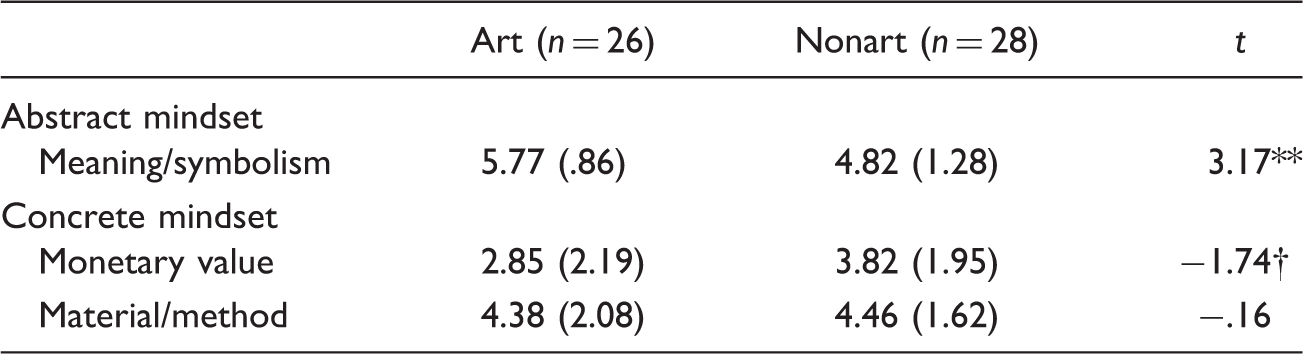
Note. Standard deviations for the means are shown in parentheses.
†p < .10. **p < .01.
Art involvement
Furthermore, participants in the two conditions reported no differences in art involvement (MMagritt = 2.80 vs. MNonart = 2.71, n.s.). Importantly, the art involvement index was not significantly influenced by abstract mindset. Specifically, including the variable as covariates in the analysis revealed no significant effects.
Discussion
The results of Experiment 1 highlight whether artistic cues affect abstract mindset, in particular, artistic cues leading participants to ascribe meaning to the artwork.
However, there are some limitations for measuring the abstract mindset: Additional factors exist that represent abstract (vs. concrete) mindsets besides “meaning/symbolism,” “monetary value,” or “material/method of production.” For example, serving as classifications for Bower and Karlin (1974), color, brush stroke, size, and composition are typically observable, thus providing concrete information, whereas emotion, usage, and genre are nonobservable, and are thus the abstract aspects of the visual stimuli. Therefore, indirect measurement should be performed to acquire a broader spectrum of focus in future studies.
Based on these findings, we aimed to examine the role of the abstract mindset when induced by artistic cues in the domain of prosocial choice. We also attempted to examine the mediating role of psychological distance and the abstract mindset in this framework.
Experiment 2
Experiment 2 primarily aimed to examine whether the abstract mindset, as induced by artistic cues, enhances prosocial choice. Furthermore, this study aimed to investigate the mechanism underlying the link between artistic cues and an abstract mindset. CLT is drawn on to clarify the mechanism by which artistic cues can affect an abstract mindset. In particular, it is anticipated that psychological distance plays a mediating role in the relationship between artistic cues and an abstract mindset; artistic cues are likely to be associated with more psychological distance compared with nonart cues and should therefore ultimately lead people to think at a higher level.
Method
Participants and design
The experiment was conducted in two distinct phases: an art (vs. nonart) priming phase and a phase evaluating product concepts to assess their appeal with respect to prosocial, over proself, aspects.
A total of 83 university students (42 female, 39 male) voluntarily participated, and 3,000 Korean Won (approximately US$2.50) was offered as an incentive to participate in the study. The current study was introduced as a series of completely unrelated tasks that were combined in one experimental session for economic reasons. They were told that if the task would cause any inconvenience, they could stop at any time. We randomly assigned participants to art or nonart conditions. Participants were informed that these studies were completely unrelated but were being held simultaneously only for practical reasons.
The stimulus for Kandinsky’s art condition (Yellow-Red-Blue) and the stimulus for the nonart condition were identical to Experiment 1 (see Appendix A for images in Experiment 2.
Materials and procedure
Priming
All participants were asked to observe an image and take notes. The specific priming process was identical to that in Experiment 1.
Prosocial choice
Pretest: A separate pretest (N = 26) was conducted to examine whether participants actually perceived the prosocial concept as prosocial and the proself concept as proself (see Appendix C for product concepts in Experiment 2). The regular line for a juice commonly promotes quality and great taste (“Our juice is always from the ripest, most nutritious fruits picked in season to ensure the freshest and most refreshing taste.”). The prosocial concept includes prosocial benefits in terms of payment and package (“A certain portion of our profits immediately goes to family farms. The packaging is 100% recyclable, which is beneficial to the neighborhood and the environment.”), while a proself concept involves the perception of self-oriented benefits (“It is fancy and easy to grip and carry since it is designed by a famous designer. Now, with the current discount, it is even more economical.”).
The results confirmed that the prosocial concept is perceived as more “ethical” (Mprosocial = 3.77 vs. Mproself = 2.65, t(25) = 6.25, p < .001) and “good hearted” (Mprosocial = 3.81 vs. Mproself = 3.31, t(25) = 2.96, p < .001), compared with the proself concept. However, they were equivalent in “preference” (Mprosocial = 3.46 vs. Mproself = 3.38, t(25) = .44, p > .05) and the perception of “healthiness” (Mprosocial = 3.58 vs. Mproself = 3.35, t(25) = 1.29, p > .05), “tastiness” (Mprosocial = 3.54 vs. Mproself = 3.65, t(25) = − .76, p > .05), and “uniqueness” (Mprosocial = 2.92 vs. Mproself = 2.81, t(25) = .618, p > .05).
All participants viewed two product concepts for a juice together, with one concept being promoted as having prosocial appeal and the other concept being promoted as having proself appeal.
Choice
Immediately after reading the concepts, respondents were asked to choose their preferred option (on a binary scale of 1 = prosocial to 0 = proself) in random order.
Abstract mindset
An abstract mindset was estimated both directly and indirectly. First, questions for self-reported appreciation focus were provided as in Experiment 1 (see Appendix B). Then, content analysis was performed to determine the level of abstract (vs. concrete) attention paid by artistic (vs. nonartistic) cues.
For the content analysis, participants’ thoughts reported during the art (vs. nonart) priming were collected. The coder was blind to the hypotheses and trained in the classification scheme that we had developed (Smith, 2000).
Then, the coders classified each thought into the following categories: (a) concrete thoughts, that is, those relating to objective, observable, and subordinate information regarding the stimuli (e.g., color, composition, material, size, arrangement, and any physical traits of the stimulus); and (b) abstract thoughts, that is, those relating to less observable and superordinate information based on participants’ interpretations of the stimuli (e.g., emotion, usage, genre, general understanding, subjective judgment, or interpretation).
The dependent measure was the ratio of abstract thoughts among the total number of mentions. The mean of the reported total number of thoughts was 2.72, and the ratio of abstract thoughts was 1.62.
Psychological distance
Finally, temporal distance perceived from a stimulus was provided, along with several filler questions. The questions were adapted from Förster et al. (2010): “Do you think that the image has long-term value?” All questions were answered on a 7-point Likert scale (1 = definitely disagree to 7 = definitely agree). Questions were presented in random order.
Art involvement
Participants responded to the same art involvement index questions (α = .81) that were employed in Experiment 1.
Results
Abstract mindset
Differences in Self-Reported Appreciation Focus Between Art and Nonart Priming in Experiment 2.
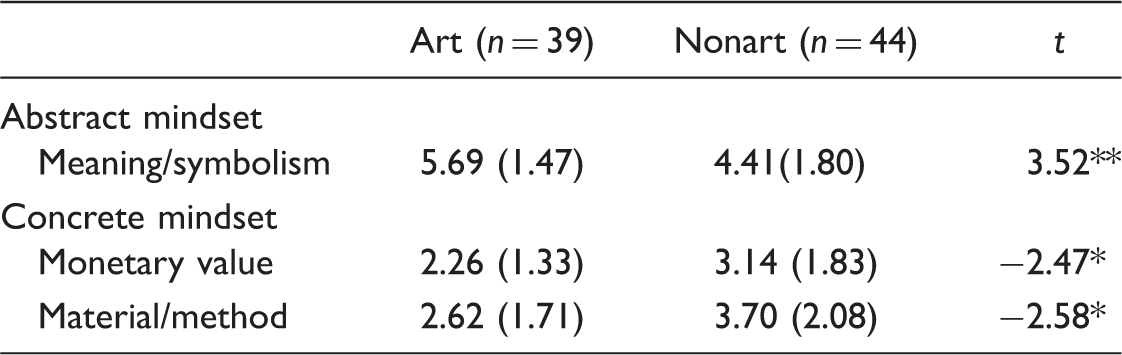
Note. Standard deviations for the means are shown in parentheses.
*p < .05. **p < .01.
Difference in Ratio of Abstract Thoughts Between Art and Nonart Priming in Experiment 2.

Note. Standard deviations for the means are shown in parentheses.
*p < .05.
However, the total number of thoughts recorded by participants in the art priming group (Mart = 2.59) was identical to the number recorded by the nonart priming group (MNonart = 2.84, t(81) = .75, n.s.), thus confirming that the presence of art does not affect the overall amount of thoughts but only heightens the level of abstractness within it.
Participants in each condition reported no differences in art involvement (Mart = 2.63 vs. MNonart = 2.62, n.s.). Importantly, art involvement also did not significantly influence an abstract mindset. Specifically, including the variable as covariates in the analysis revealed no significant effects.
Abstract mindset as a mediator between artistic cues and prosocial choice
Mediation analysis was performed using an SPSS macro developed by Preacher and Hayes (2009) to determine whether art priming activates an abstract mindset and ultimately enhances prosocial choice.
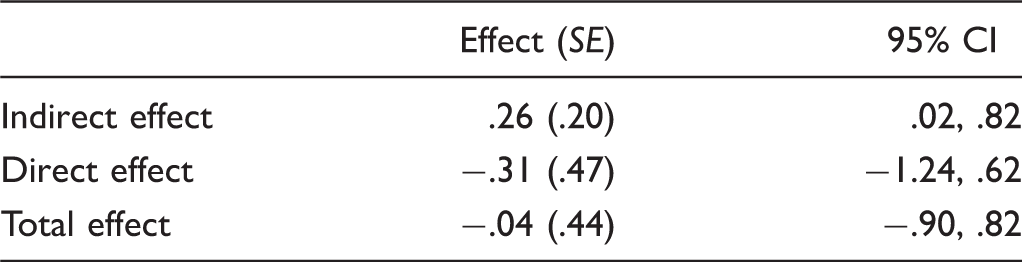
First, a regression test revealed that artistic cues do lead to an abstract mindset, given the higher ratio of abstract thoughts (b = .20, p < .05); furthermore, an analysis of the logistic regression revealed that an abstract mindset leads to prosocial choice (b = 1.27, p < .05; see Figure 1). However, a significant direct effect from artistic cues to prosocial choice was not observed. Finally, a bootstrapping analysis demonstrated a significant indirect effect through abstract mindset, suggesting indirect-only mediation (Zhao, Lynch, & Chen, 2010; see Table 4).
Mediation effect of abstract mindset between artistic cues with prosocial choice (N = 83). Test of the Indirect Effect of Abstract Mindset Between Artistic and Prosocial Choice via the Bootstrapping Method in Experiment 2. Note. N = 83. SE = standard error; CI = confidence interval.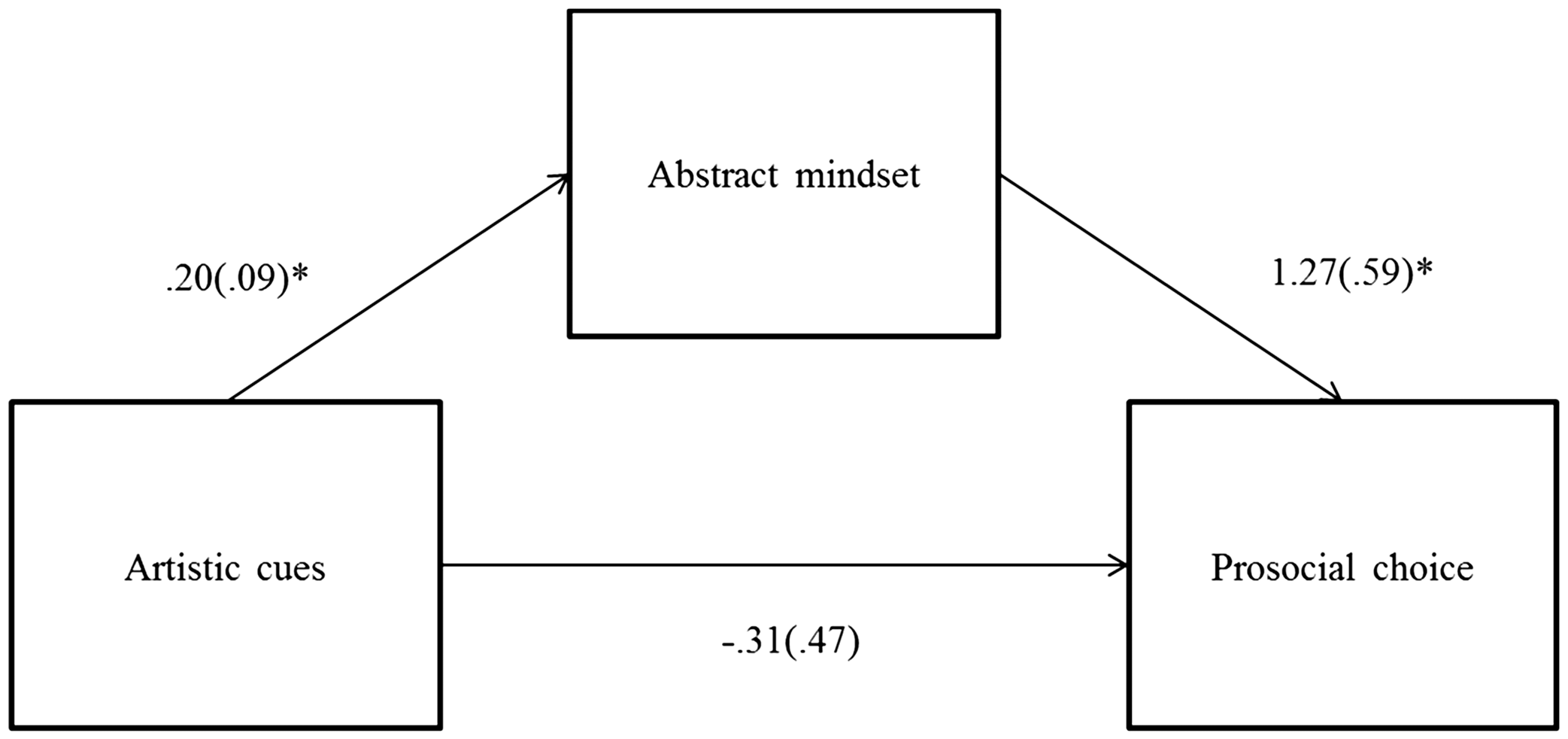
Psychological distance as a mediator between artistic cues and abstract mindset
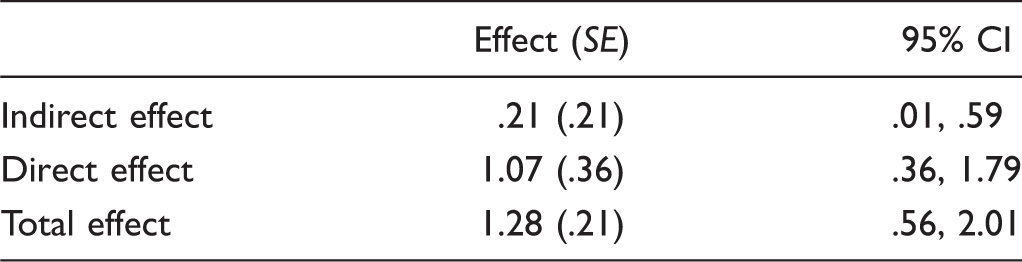
Psychological distance, as measured by longer temporal values, mediates the relationship between art (vs. nonart) and an abstract mindset. In particular, a regression test revealed artistic cues lead to stronger abstract focus (i.e., self-reported appreciation focus on “meaning and symbolism”). Both regression analyses revealed that pathways from art (vs. nonart) to psychological distance (b = .61, t(81) = 2.00, p < .05) and from psychological distance to abstract mindset (b = .34, t(80) = 2.67, p < .01; see Figure 2) were shown to be significant. Furthermore, a significant direct effect was observed from artistic cues to abstract mindset (b = 1.07, t(80) = 2.98, p < .01). Finally, the results of a bootstrapping analysis supported the indirect effect through psychological distance as significant, suggesting complementary mediation (Zhao et al., 2010; see Table 5).
Mediation effect of psychological distance between artistic cues with an abstract mindset (N = 83). Test of the Indirect Effect of Psychological Distance Between Artistic Cues and an Abstract Mindset via the Bootstrapping Method in Experiment 2. Note. N = 83. Standard errors are shown in parentheses.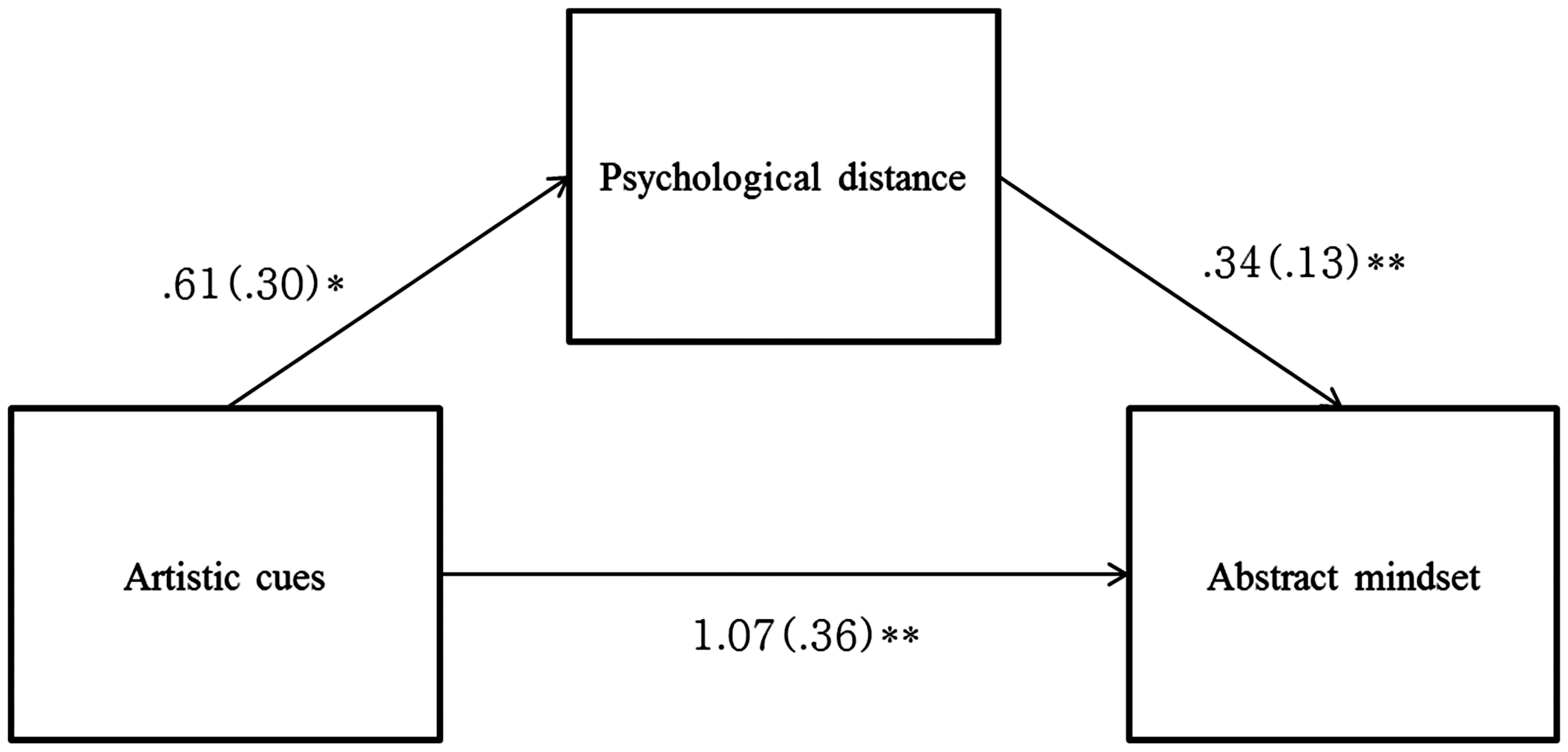
Discussion
The results of Experiment 2 have demonstrated that artistic cues indirectly affect prosocial choice through the mediation of an abstract mindset. This study conceptually replicated the findings of Experiment 1, thus showing that artistic cues activate an abstract mindset. Regarding the mechanism between artistic cues and mindsets, psychological distance was successfully defined as a mediator.
General Discussion
The central idea of this research is that artistic cues potentially influence consumers’ choice, specifically by promoting acceptance of prosocial appeal over proself appeal. The mechanism of this relationship is driven by an abstract mindset induced by artistic cues.
A series of experiments was conducted which supported these predictions. First, Experiment 1 revealed that when people are exposed to artistic cues, a higher construal, such as an ascription of the artwork’s meaning, is automatically represented.
More importantly, Experiment 2 demonstrated the capability of accommodating and explaining the abstraction process in CLT. As such, the results of Experiment 2 provide evidence that psychological distance influences abstract mindset as perceived from artistic cues. In particular, when artistic cues are provided, people consider a temporally distant object as having “long-term” value. This perception not only reduces subordinated “how” considerations but also enhances the superordinate “why” considerations.
In conclusion, but most importantly, Experiment 2 successfully demonstrated a shift in mindset in the prosocial choice domain. The activated abstract mindset trigged by artistic cues can provoke prosocial choice. This convergence enhances our confidence in the posited conceptualization.
Contributions and Implications
The current investigation expands our knowledge on the role of art. In particular, this study investigated the individual’s psychological mechanism to fully understand how artistic cues work. More importantly, this research conceptualizes the role of artistic cues within a framework based on CLT. It further develops previous art research by introducing psychological distance and the abstract mindset as important consequences of artistic cues.
Moreover, the current investigation is the first to highlight the role of artistic cues related to prosocial choice. Therefore, our current work goes one step further by examining the indirect influence of artistic cues on consumers’ specific judgments in a prosocial choice situation.
We believe that this work highlights CLT as an underlying mechanism of artistic cues, especially in the product evaluation context. An especially important contribution of the current framework is that it opens up the opportunity for further exploration of the various consequences of psychological distance and the abstract mindset within the art domain. For example, research on CLT has largely focused on social cognitive areas such as person perception (Nussbaum, Trope, & Liberman, 2003), self-control (Fujita, Trope, Liberman, & Levin-Sagi, 2006), problem-solving (Förster, Friedman, & Liberman, 2004), and morality (Agerström & Björklund, 2009a, 2009b). The present work extends its application to the domain of art.
Limitations and Future Research
A critic may argue against the generalizability of the results in terms of different arts, genres, or forms. The current research attempted to choose equivalent stimuli sets by only varying art vs. nonart through a pretest. However, art or nonart primes cannot completely capture an artwork’s full complexity. Future studies would benefit from priming mindsets using a variety of art and nonart stimuli to determine the generality of the reported effects to a broader set of stimuli. Moreover future research could also use subliminal priming, which can exclude more conscious processes and demand characteristics.
Moreover, although current research only emphasizes appreciation focus for measuring an abstract mindset induced by artistic cues, future research could explore various indications of the relationship between artistic cues with an abstract mindset. For example, categorization theory (Rosch & Mervis, 1975), concept formation (Medin & Smith, 1984), and action identification (Vallacher & Wegner, 1987) would be useful foundations for defining the relationship between artistic cues and an abstract mindset. Especially, the framework of GLOMOsys theory could be used to further integrate current findings to provide alternative evidence regarding the link between art and abstractness beyond what CLT can provide (Förster & Dannenberg, 2010).
Moreover, because artistic cues did not affect prosocial choice directly, precise interpretation and further exploration of intermediaries in the model is required. For example, suppression variable between artistic cues with prosocial choice may provide opportunity to acquire deeper understanding of the relationship among variables (Rucker, Preacher, Tormala, & Petty, 2011).
Lastly, future research could also explore other dimensions of psychological distance beyond the temporal distance that has been affected by artistic cues. Previous studies suggested that time, space, social distance and hypotheticality constitute different distance dimensions (Trope & Liberman, 2010). Although the different types of distances are all cognitively related, the various distance dimensions may differ in other respects. Therefore, exploring different distance dimensions induced by artistic cues and the various consequences will be an effective direction for future research.
Footnotes
Appendix A
Declaration of Conflicting Interests
The authors declared no potential conflicts of interest with respect to the research, authorship, and/or publication of this article.
Funding
The authors received no financial support for the research, authorship, and/or publication of this article.