







Abstract
The aim of this research was to investigate the extent to which psychological factors interfere with conscious rational problem-solving in constructing a cinematic narrative’s causal connections during film viewing. Talk-aloud protocol was used to record subjects’ verbal reactions during watching films. Viewers’ texts were analyzed to determine the type and the quantity of causal inferences. This enabled us to determine which parts of the narratives provoked high matching of causal inferences. The results demonstrate recurring correlation between causal thinking and the personality trait openness to experience. In the second study, classical and nonclassical types of narrative were compared in terms of provoking causal inferences. The results demonstrate that classical narrative provokes significantly more causal inferences than nonclassical narrative, and that classical and nonclassical narratives rely equally on personality traits in causal construction.
Keywords
Most art theories of the second half of the 20th century agree that the emotional reactions and conceptual interpretation of a work of art are a result of both the work’s structure and the viewers’, readers’, or listeners’ individual input (de Man, 1979; Eco, 1962; Iser, 1976). However, we do not know the extent to which each of these two sides informs artistic reception. We think that this is an empirical question, which may lead to different results in different art forms, styles, or genres. Furthermore, the results could be different if we talk about emotional response and conceptual interpretation. So, if we want to understand the ways in which aesthetic texts exert their influences on the audience, and how individuals in the audience read the text in their own ways, we must specify the aspects of the work of art we place under scrutiny. In our series of studies, we attempted to investigate the nature of causal attributions during film viewing.
The overwhelming majority of audiovisual media products that audiences encounter is organized in a narrative form. To study audiences’ reactions to films and other audiovisual products involves studying narrative understanding. At the core of narrative understanding seems to be the viewer’s construction of causal relations (Trabasso, van den Broek, & Suh, 1989). For some theorists, causality is part of the definition of narration (Todorov, 1981; see more in Mar & Oatley, 2008). Inasmuch as one conceives of a narrative as describing a situational change or as the series of (inter)actions of autonomous intentional agents, causality is without any doubt an indispensable part of it.
Narration and Causality
The causal construction of literary narratives with the interrelation of the features of the mental representations of the texts has been researched by Trabasso, van den Broek and their colleagues. Trabasso et al. (1989) have developed what they call the Transactional Causal Network model as a result of their empirical experiments with readers. This model describes not only different types of causal relationships between sentences in stories but also how the sentences fit into an episodic structure of the stories. In Magliano’s (1999) summary, settings enable all other categories. Events can physically cause events and psychologically cause characters to have goals and reactions. Goals can motivate other goals and attempts. Attempts can enable attempts and physically cause outcomes. Outcomes, as well as events, can psychologically cause characters to have reactions and goals. Outcomes can also enable attempts (Magliano, 1999, pp. 58–59). The model was applied successfully to textoids, folk tales, literary texts, think-aloud protocols, life stories, and dreams and can predict offline measures of memory, such as the content of free recall protocols, story summary protocols, judgments about the importance of story sentences, as well as online behaviors, such as sentence reading times, or inferences during thinking-aloud protocols.
Van den Broek, Rohleder, and Narvaez (1996) reported the results of a series of experiments with literary texts using the causal network model and found that 50% of the variance in recall was explained by causal connectivity between the events. However, setting statements, or events with emotional or graphic impact, and the overall theme of the text were recalled more often than one would expect on the basis of their causal connections alone. Van den Broek, Risden, and Husebye-Hartmann (1995) further developed their model pointing out that readers’ standards of causal coherence, such as personal expectations regarding the causally coherent continuity of the text and individual level of causal sufficiency, also determine the inferential activities. This is as far as literary studies of text processing research have gone in involving readers’ individual differences into explanations of inferential activity. In turn, attribution theory has taken into account personality traits to explain causal thinking. Our goal in this research is to test this insight about causal inferences in the context of film narratives.
Causal Thinking and Cinematic Narration
Understanding causal relations in real life involves two different processes. One is causal perception the other is causal thinking. As opposed to perceiving physical causation automatically (causal perception), post hoc construction of causal relations (causal thinking) is viewed as a high level and conscious, rational mental activity (Michotte, 1963), and the two seem also to be processed by different hemispheres of the brain (Fugelsang, Roser, Corballis, Gazzaniga, & Dunbar, 2005; Roser, Fugelsang, Dunbar, Corballis, & Gazzaniga, 2005). Since causal perception is related to visual perception of moving objects, when watching a cinematic narrative viewers have to recur to both processes in order to construct causal links between events seen on the screen. Causal perception seems to be automatic and can be associated with object perception (Csibra, 2000), whereas causal thinking is slower and involves high level processes independent from visual perception. We expect that verbal comments of viewers would relate mostly, if not exclusively to causal connections needing high-level inferential activity, but not to those immediately given through visual perception. We therefore think that categories of causal thinking (i.e., types of causal inferences) developed in literary studies can also be used in studying causal thinking with regard to cinematic narratives.
Research into causal thinking has shown that personality factors often interfere with rational calculation of causes. Using the Attributional Style Questionnaire, Mitchell (1989) found that Extraversion (the preference for seeking stimulation in the company of others, talkativeness, and dominancy) and Emotional Stability (the tendency to tolerate high stress situations vs. experience unpleasant emotions easily) showed the strongest relationships with attributional style. In theoretical reformulations of Weiner’s attribution theory (Weiner & Kukla, 1970) on the causes of success and failure, optimistic and pessimistic attribution style has been differentiated, and the latter was empirically found to have a connection with decreased Emotional stability (see the review by Sweeton & Deerrose, 2010). This raises the question as to what extent causal thinking is driven by cues provided by the film on the one hand, and by individual factors of the viewer when watching a film on the other. Films place time pressure on the viewers, such that the viewers have to process the narrative information in a given timeframe, since they cannot delay the arrival of new narrative information. In other words, a film viewer in the cinema cannot cont-rol the flow of information (Busselle & Bilandzic, 2009). We think that because of this time pressure placed by films on the viewer’s inferential activity this interference can be best observed in viewers while watching films. We propose that if personality factors were to interfere with immediate processing of causal connections of a filmic narrative, it is likely to happen at the high-level causal thinking part. We do not exclude, however, that the low-level causal perception part can also be influenced by individual psychological factors, but this would be the subject of a follow-up study.
There has been much valuable research on the causal construction of cinematic narratives (Bordwell, 1985; Branigan, 1992), but very few on how real moviegoers try to construct the causal relations of a film while watching it (see Tan & Diteweg, 1996). The most influential constructionist theory of narrative understanding has been proposed by David Bordwell. His approach is based on a rationalistic problem-solving model. He supposes that the viewer actively constructs the film narrative by closely following the narrative’s cues, constantly making inferences during watching a film. In Bordwell’s (1985) account, a film’s story (“fabula” in his wording) is a “set of inferences” (p. 51) for which the narrative structure provides the basis. The inferences are made on three levels: time, space, and causality. Bordwell’s theory of narrative modes is based on the ways narrative structure manipulates these three levels. Time, space, and causal relations can be made easy to construct and can be blurred in various ways. Although Bordwell provides a detailed and sophisticated description of the ways narrative causality can be manipulated (blurred, suspended, omitted in narratives), he does not discuss the problem of whether or not the viewer’s inferential mental activity remains unchanged no matter which narrative mode they are exposed to. Bordwell’s model is an active fully aware viewer playing a problem-solving game while watching a film. His model contains a spectator with only one type of mental process: inferences based on temporal, spatial, and causal cues, and that applies for the processing of all of his narrative modes. Bordwell discusses individual differences in understanding only in terms of errors or deliberate misconstructions by the viewer (p. 39). However, Bordwell’s theory of narrative understanding does not exclude the possibility that mental processes other than looking for time, space, and causal continuity could be at work in narrative understanding. His theory simply does not contain any hypotheses in this regard. The only alternative to the rational inferential strategy he mentions is the “wait-and-see” strategy when no immediate confirmation of time–space–causal inferences is provided by the narrative (p. 38). So, the question remains as to what the spectators in fact do when causal cues are missing or inconsistent in a cinematic narrative: do they continue to look for such cues, do they simply “wait and see,” or do they recur to some other mental operations to make sense of what they see? In our second study, we tackled these questions.
Branigan (1992) also emphasizes the constructive nature of narrative understanding. In his account, narrative understanding entails mobilization of what he calls a “narrative schema” that “represents a particular story as an abstract grouping of knowledge based on an underlying schema” (p. 16). However, Branigan brings in the problem of individual differences by emphasizing the viewer’s own experience in applying schemata, thereby focusing more on the viewer in explaining narrative understanding: “… an individual segments an event according to an explicit, or implicit, theory (or theories) of experience” (p. 28). Branigan’s (1992) account allows several different constructions of the narrative based on what experiential schemata a given spectator uses while watching a film: Whatever a spectator first believes may be enough to drive the story forward. (. . .) If the text can suggest enough “intervening” and “enabling” causes, a narrative schema will tend to generate a resolution, which can be imagined as the closure of a “unique” cause implicit in the opening of the story. This allows the story to be made “unique” in many different ways to many spectators! (p. 30)
Personality Characteristics in Aesthetic Reception
While research into causal inference in literature or in film does not refer to personality factors in its explanations, there is a tradition of doing so in the research of aesthetic appreciation currently informing research into emotional processing in art reception (Weibel, Wissmath, & Stricker, 2011). Although the subject of this study is causal understanding and not aesthetic appreciation, we believe that our research could shed some insights regarding the relationship between causal understanding and aesthetic appreciation. The “Big Five” (Caprara, Barbaranelli, Borgogni, & Perugini, 1993) is the model used most often to investigate level of enjoyment and frequency of emotional reactions in empirical aesthetics research. It describes personality alongside five traits: Emotional stability and Extraversion were already elaborated referring to Michell’s results. Openness to Experience reflects the degree of intellectual and cultural curiosity, creativity, and a tolerance for novelty and variety a person has. Agreeableness is a person’s tendency to be compassionate and cooperative with others, but it also includes submissiveness and naivety, and finally, Conscientiousness reflects the degree of being organized and shows self-discipline, acting dutifully, as well as the capacity for achieving aims. Robust results indicate that 33% of the variance in emotional experiences related to artistic objects is explained by Openness to new experience (Furnham & Chamorro-Premuzic, 2004). Research also confirms the role of Emotional stability or Neuroticism in enjoyment; however, the direction of the relationship is unclear (Weibel et al., 2011).
Other research suggests the importance of attachment style, characteristic of the person in emotionally intimate relationships, determines the capacity to identify a wide range of emotions experienced by fictional characters (László & Fülöp, 2007). The adult attachment model of Fraley, Waller, and Brennan (2000) distinguishes between two main factors: avoidance and attachment-related anxiety. Avoidant people underestimate the significance of close relationships in their lives and behave rather distancing in intimate situations. Attachment-related anxiety refers to the degree of fear of the inequality of intimate relationships. Attachment style is also reported to have an effect on perceptible changes in viewers’ emotions after the reception of the work of art (Djikic, Oatley, Zoeterman, & Peterson, 2009). We do not know about studies focusing on the influence of attachment style on cognitive factors during the interpretation of a work of art. However, research in developmental psychology suggests that operating metacognitive functions, that is, attributing emotions, intentions, and various mental states to others in interpersonal relationships, is in fact biased by attachment style (Fonagy & Target, 2005; Main, 1991). Accordingly, we intuit that the attribution of causes and intentions to fictional characters and events is different with a secure versus an insecure attachment style.
Focusing on the role of causality in the aesthetic meaning-making process requires more specific personality measurements, which provide information about attributing causality and coherence to persons and events in real life. In our research, we used the Sense of Coherence concept and scale (Antonovsky, 1987) which describes a global orientation expressing the extent to which one has a pervasive, enduring, yet dynamic feeling of confidence that (a) the stimuli deriving from one’s internal and external environments in the course of life are structured, predictable, and explicable; (b) the resources are available to one to meet the demands posed by these stimuli; and (c) these demands are challenges, worthy of investment and engagement (p. 9). This scale was used for determining correlations between the characteristics of life narratives and personality traits (Laszlo, 2008), but we do not know about any study that has applied it in aesthetics research.
Research Questions and Hypotheses
Three questions were tackled in the following two studies: first, is there a difference in different parts of the narrative structure in terms of provoking similar or different causal inferences? Second, can personality factors at least in part be held responsible for individual differences of the viewers when they construct causal connections in a narrative? Third, is there a difference between different narrative structures (classical and nonclassical) in invoking individual differences? By answering these questions not only will we get a clearer insight into narrative understanding, but we will also be able to contribute insights to the psychological literature on personality factors influencing rational thinking.
The studies were based on the assumption that if at certain points of the narrative causal inferences of viewers match significantly, then the reason must be the overwhelming effect of some narrative device that works uniformly for all or most of the viewers despite their individual differences. Similarly, if causal inferences of most viewers match at given points of the narrative, then this suggests that the inferential activity is provoked by the flow of the narrative.
Most classical narratives are constructed using a three- or four-act structure (Field, 2005; Trottier, 2014). In a classically constructed narrative, four important structural points are distinguished: (a) The end of the first act, where the story’s main direction is determined; (b) the “midpoint,” where an important twist takes place in the main storyline; (c) the end of act two, where the main hero arrives to a dead end; and (d) toward the end of act three/four where the main conflicts are solved. We expect that if viewers’ inferential activities match significantly at all, this will happen at one or more of these dramaturgical points. Conversely, if matching of the inferential activity is low, it is likely that individual differences in the mental processes play a more important role, which we expect to happen outside of these points. As such, we can test two hypotheses: There are certain structural points of the narrative which direct viewers inferential activities more than others, and these points will be predicted by traditional dramaturgical analyses. Second: Where inferential activities do not match significantly, viewers’ reactions are rather driven by psychological factors, such as personality characteristics. We believe that higher correlation between personality traits and inferential activity at these points will be an indicator of the impact of individual differences on inferential thinking. To test these hypotheses, we needed a film that was midway between a highly standardized genre film and an entirely nonclassical author film. We needed a causally coherent narrative, but one that contained a sufficient number of events that do not contribute to the causal development of the main story.
With the same basic assumption, we can also compare narratives with different narrative structures: one with causally linked events, and with clearly motivated characters (classical), and another one with causally unrelated episodes, and with characters with no explicit motivations (nonclassical). This is important in order to see what impact the causal construction of the narrative has on viewers’ activity. Bordwell’s account of narrative understanding allows for two contradicting hypotheses. It can be the case that the viewer tries to use the same mental processes to follow both classical and nonclassical narratives. If so, in the latter case causal responses would be more frequent, because there the causal connections are obscured or missing, and the more they are difficult to figure out the more the viewers keep looking for causal relations. Bordwell’s account, however, does not exclude the contrary either. We may as well suppose that if the narrative does not systematically support the viewer’s searching for causal cues, the viewer stops using this strategy, and attempts to follow the film with the help of mental processes at least partly different from what is needed for following classical narratives. By comparing viewers’ inferential patterns (i.e., matching and correlation with personality factors), we can test these hypotheses. The question will be whether or not a causally less structured narrative provokes more, less, or the same amount of causal inferences than a classical narrative. In case we find either more or less causal inferences in one case, the next step would be to find out whether viewers activity show less or more matching, which could be another indicator of difference in mental processes used in processing classical and nonclassical narratives. More or less correlation with personality factors would indicate more or less reliance on subjective factors in understanding in one case or the other. This could be a test of the widespread critical intuition according to which nonclassical narrative rely more on spectator’s mental participation (Hawkins, 2000; Leder, Belke, Oeberst, & Augustin, 2004). Regarding our concrete hypotheses about the relations between causal thinking during film-viewing and personality traits, we suppose that Extraversion (Mitchell, 1989) and Openness (Furnham & Chamorro-Premuzic, 2004) will have a positive correlation with identifying causal relations in the plot. Taking into account the controversial results of the literature involving lower Emotional stability (Weibel et al., 2011), we hypothesize that there will be a relation of this personality trait and Attachment-related anxiety with causal activity during film viewing.
Study 1
Method
Participants
Participants were 26 voluntary students studying film part-time or full-time at Eötvös Loránd University Budapest. One student’s results were excluded from the data analysis due to familiarity with the film. Altogether, 19 people completed the whole procedure (8 males and 11 females). Their ages ranged from 19 to 42 years (average age: 26.3 years). Students participated in the study for credit compensation, but they did not receive individual feedback on their results. With this homogeneous audience in terms of age and cultural background, we aimed at neutralizing the most important social dimensions that influence taste and aesthetic sensibility as much as possible (see Lee, Garlough, Friedland, & Shah, 2012).
Materials
The study consisted of two major parts, each requiring different equipment.
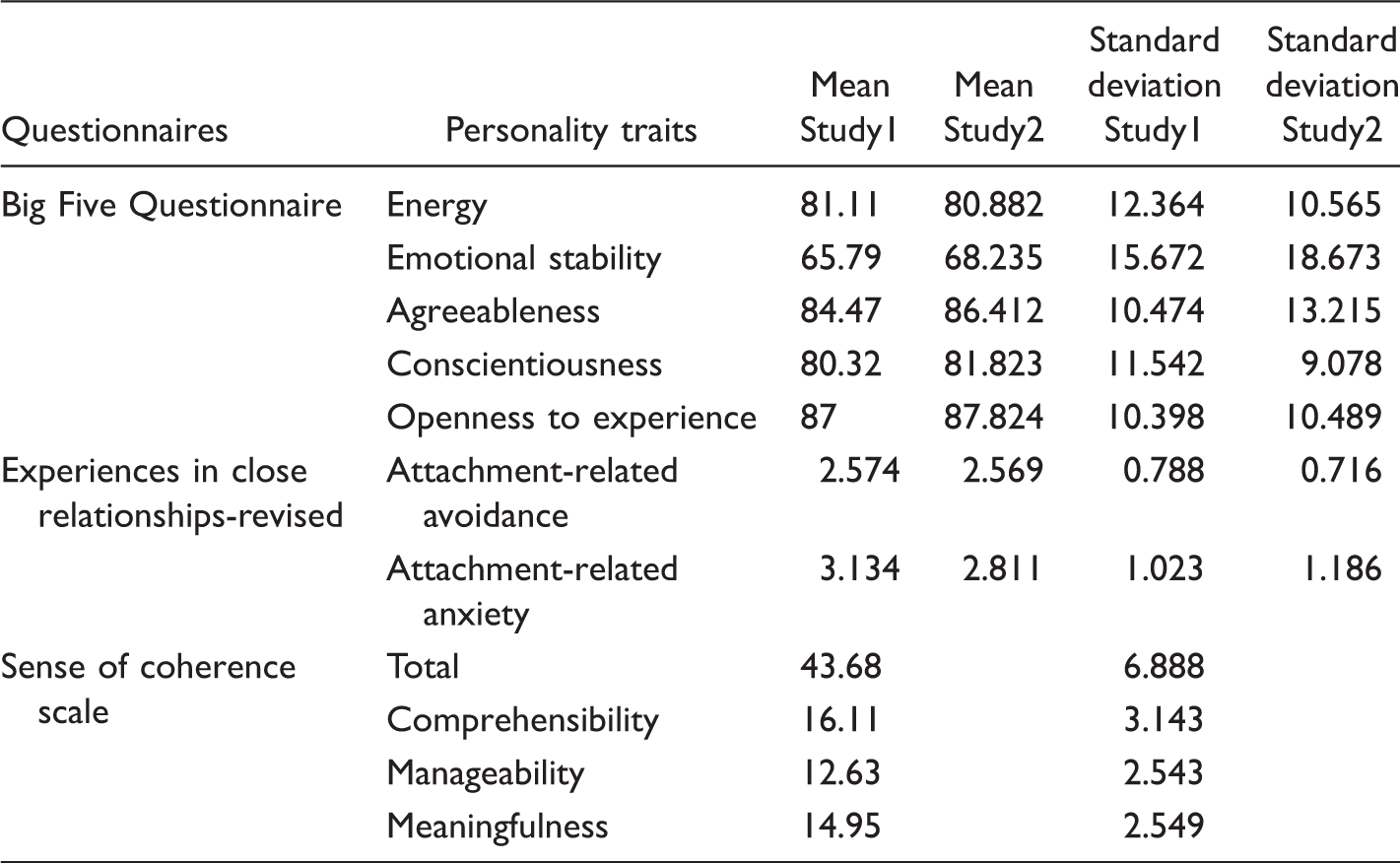
In the film viewing part, we used the film The Man Without a Past (Kaurismäki, 2002), sound registering devices, and headphones. This film was chosen for its coherent causal structure, linear chronology, the secret contained in the biggest part of the story provoking curiosity, and for the fact that in spite of the coherent causal structure, it contains some coincidental events that are loosely connected causally. In sum, this film seemed to be a good vehicle for various viewer behaviors. It seemed to sufficiently control the viewer’s inferential activity, yet left enough space for uncontrolled speculation by the viewer, and strictly speaking does not belong to any common genres that would drive too strongly the viewers’ expectations (see a detailed description of the plot of the film in the Appendix). After viewing the film, participants answered test questions, which included demographic characteristics (such as gender, age, level of education, profession) and specific questions relating to the viewers’ familiarity with the film, comprehension, and recollection of the film’s plot. The participants also had to complete valid psychological tests, which were selected in order to test the effect of personality traits, attachment style, and cognitive characteristics on the reception of the work of art. The measurements were as follows: For the big five personality traits, we used the Big Five Questionnaire (BFQ; Caprara et al., 1993 translated and adapted into Hungarian by Rózsa, Kő, & Oláh, 2006), which assesses Emotional stability, Energy, Openness to Experience, Agreeableness, and Conscientiousness. Attachment style was assessed by The Experiences in Close Relationships-Revised Questionnaire (ECR-R, Fraley et al., 2000, translated and adapted into Hungarian by Nagy, 2005), which comprises two scales: attachment-related avoidance and attachment-related anxiety. Measuring the subjects’ orientation of making coherence, we used the Sense of Coherence Scale (Antonovsky, 1987), which consists of three subscales: Comprehensibility (the tendency to believe that a cognitive structure exists to understand the inner and outer stimulus around oneself), Manageability (a belief to handle stressful situations), and Meaningfulness (having the motivation that life is worthy enough to put the energy into problem-solving).
Procedure
The film The Man Without a Past by Kaurismäki (2002) was shown to 26 students who were asked to make running, online comments to identify the processes of the formation of meaning, by way of continuously recording every question, comment, conclusion, or remark that occurred to them in connection with the story during screening with a sound recording device. To avoid interference of sounds, they listened to the film’s sound via headphones. Following the viewing of the film, they were asked to write down the summary of the film’s plot to collect the offline representation of the story. Two days later, they answered further questions about the film to test whether they elaborated more on story comprehension. (Because most of them did not, we did not use those data.) At the same time, they filled out psychological tests so that differences of causal attribution could be observed.
Analysis and Results
Causal Categories of the Analysis Together With Examples From the Online Comments of Film-Viewers.
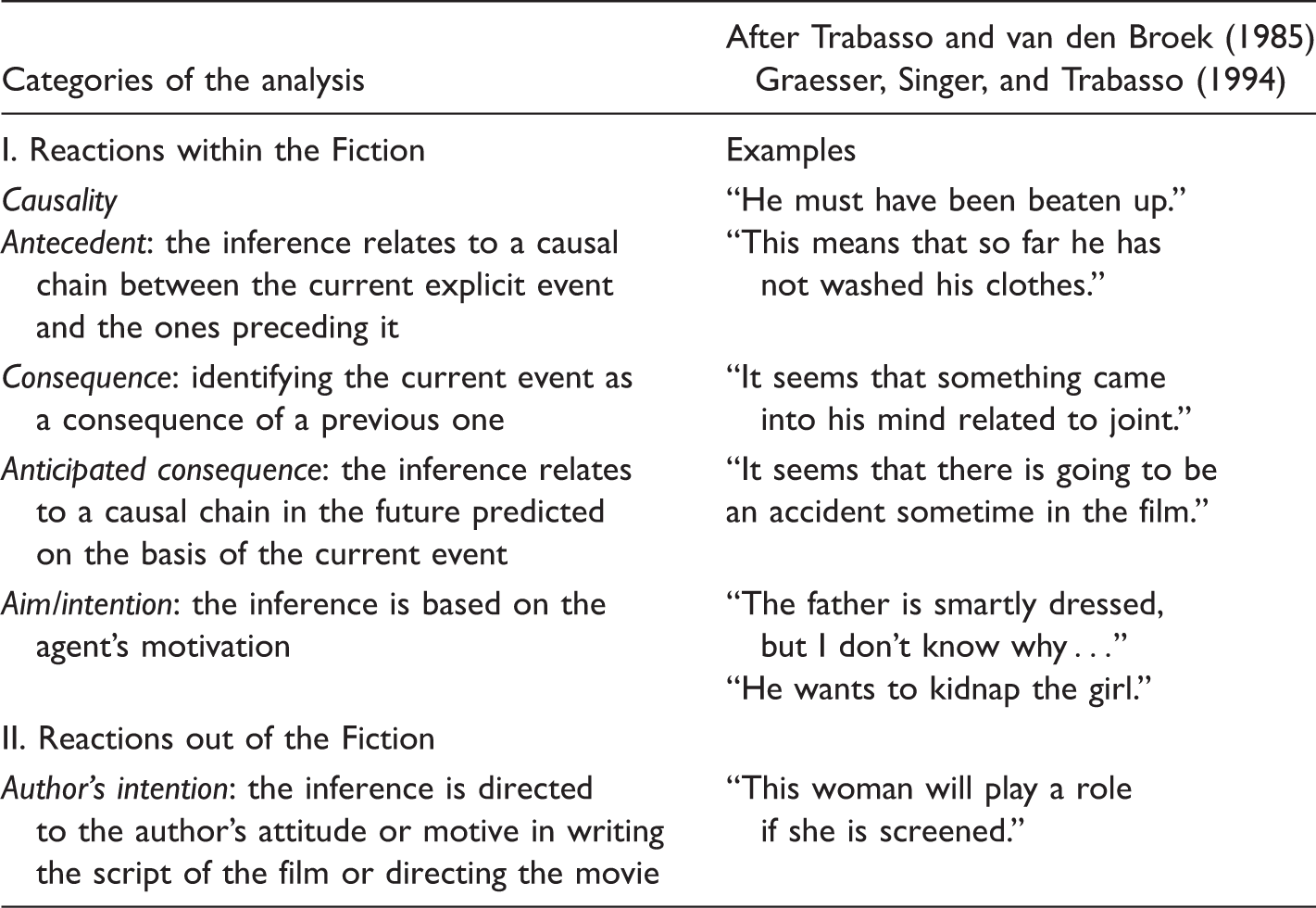
A film scholar (the first author of the present article) broke down the narrative to 174 micro-events. We defined an event as any visual, acoustic or narrative element, which changed either the course of action, the knowledge of the characters or the viewer, or the emotional status of the characters or the viewer. Sometimes an event was a series of actions lasting up to several minutes, other times an event could be just a visual or sound effect lasting only several seconds.
As the first step of the statistical analysis, a group of events was specified where the causal links of the specific event to its narrative environment was not obvious and could not be figured out unambiguously later. To link these events to the causal chain of the narrative requires the viewer to make strong hypotheses. For example, in one scene the protagonist receives a giant cigar from the lawyer whom he does not know and who helps him to be released from police custody. This event is in no way explained in the film, and it cannot be considered as a trivial act either in a real life situation or in any film genres. In such cases, we supposed that the viewer has to construct his or her own explanation. We found 30 events of this kind in the film. We compared the mean of the number of causal comments given to such events (M = 8.9, SD = 2.98) with the mean of the number of responses given to the rest of the events (M = 6.8, SD = 3.38) by a two-sample t test. We observed a significant difference, t(196) = − 2.688, p < .001.
A Summary of the Sequences of The Man Without a Past (Kaurismäki, 2002).
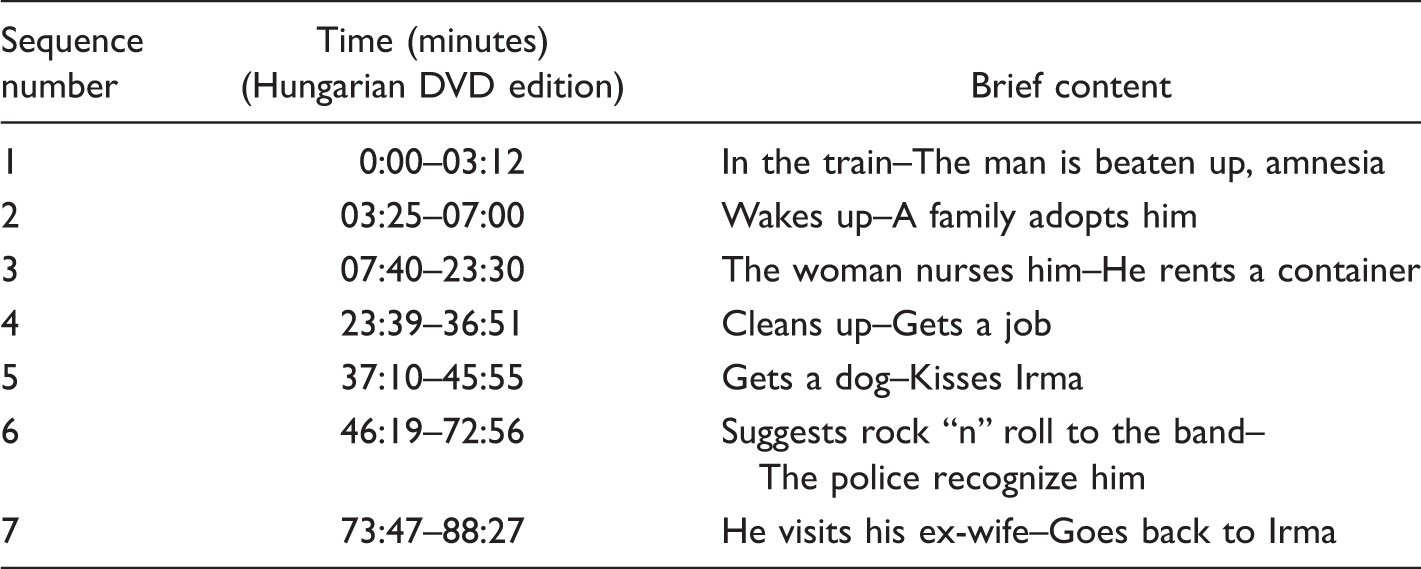
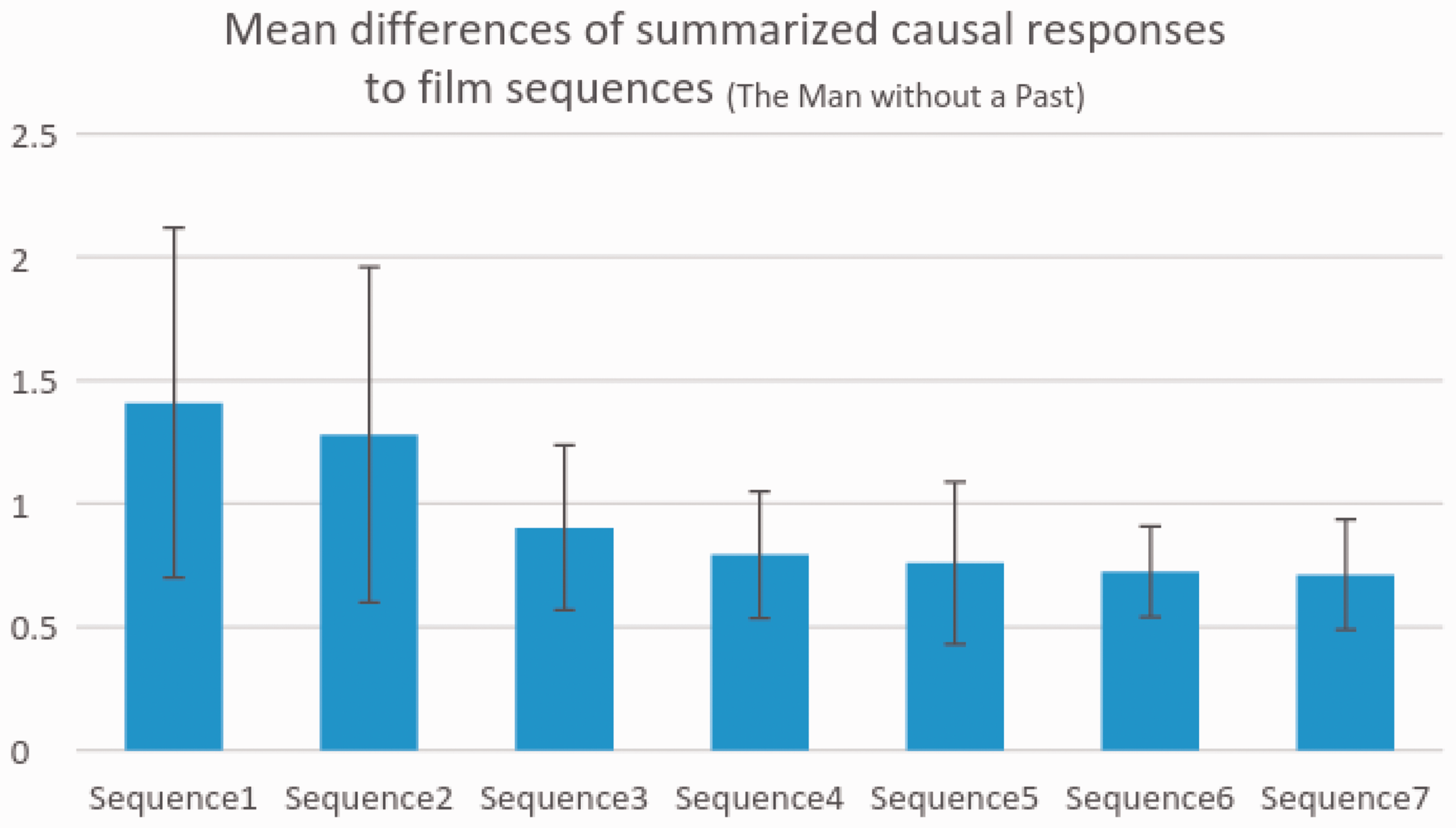
Sequences 1, 2, and 3 of the film (The Man Without a Past) provoked higher causal inference reactions in viewers (significant differences are between the first and second sequences and all other sequences (corrected p < .01); between the second and third sequences, the corrected p < .05, and between the third and the sixth and seventh pairs of means, corrected p < .05 in both cases.
To have a more detailed picture of causal inferences, we executed the same statistical analysis on each causal category. Considering the references to the aims of the protagonist or other fictional character, the result of the test was significant, F(6, 1.881) = 9.652, p = .001. Bonferroni’s post hoc test indicated that Sequence 1 provoked the most aim-responses as compared to all other sequences except Sequence 2 (corrected p < .01 in all cases except Sequence 5 [corrected p < .05]). Sequence 7 provoked the least aim-responses (corrected p < .01 in the cases of all other sequences except Sequence 2, where the difference was not significant). Furthermore, there was a significant difference between Sequences 3 and 6 pairs of means (corrected p < .01).
The distribution of the inferences of the author’s intent also reflects the impact of the film’s structure (in Sequence 2, the hero seemingly dies): A significant difference among the sequences’ means, F(6, 1.651) = 5.297, p = .016, emerges in the peak of Sequence 2 compared to all other sequences except the first, and of Sequence 3 and between the fourth and the sixth pairs of means.
The category of attaching a current event to its antecedents showed no significant differences across the sequences, unlike the category registering the consequences F(6, 2.466) = 7.365, p = .001. According to the Bonferroni post hoc test, Sequence 2 provoked the most causal consequence reactions (corrected p < .01 in cases of Sequences 1 and 3, and corrected p < .05 in cases of Sequences 4, 5, and 7). Sequence 6 also had a significantly higher number of causal consequences than Sequence 3 (corrected p < .01).
Our last causal category is inferences to unseen, future consequences of the events (anticipated consequence), the distribution of which was significantly different from that of the rest of the sequences, F(6, 1.904) = 7.613, p = .003. In the Bonferroni post hoc test, Sequences 1 and 2 provoked the most inferences (for Sequence 1 corrected p < .01 in all other sequences, whereas for Sequence 2 corrected p < .05 in all other sequences except each other), and Sequence 3 significantly more than Sequence 6 (corrected p < .05).
Descriptive Statistics of the Questionnaires Used in Our Samples (Study1: N = 19; Study2: N = 16).
Discussion of Study 1
Our main question in Study 1 was whether there are specific parts of a film narrative where causal inference is associated with personality traits rather than the narrative structure/cues of the film. The analysis of the distribution of causal inferences given by the 19 viewers indicated that highly matching responses coincide with important plot points (e.g., setting/exposition, conflict, resolution) in each causal category. The results show that Sequences 1, 2, and 3 provoke the most causal inferences, which suggests that these sequences contain structural points in the narrative which provoke similar responses by the viewers. In other words, these responses are likely to be independent of the viewers’ cognitive and personality traits or relational patterns. For example, the first segment, which gives the setting of the narrative but leaves the background and the motivations of the hero unclear, provoked the most superordinate goal inferences. The second segment gives some consequences of the first and raises further questions in connection with the intent of the author. The large amount of causal consequence type responses in Sequence 2 in which the hero seems to die can be easily explained by the “structural affects” theory of Brewer and Lichtenstein. According to their theory, placing a significant outcome (such as death) at an earlier point in the story will arouse certain intensive emotions in the reader, who tries to find out the circumstances which might have led to this state (László & Cupchik, 1995). In addition, the protagonist’s aims in Sequence 1 are unclear, which explains why there are many comments about the author’s intention.
Sequences 1, 2, and 3 were the richest in provoking inferences about anticipated consequences based on the current events and the schematic knowledge of the viewers. This confirms the results of Olson, Mack, and Duffy (1981), according to which the exposition of the story provokes the most hypotheses regarding future events in readers. The interrelation of registering the causal consequences was also influenced by the structure of the film. In Sequence 1, a brutal attack takes place, the consequences of which are depicted in Sequence 2 (the hero loses his memory). At the end of Sequence 5, the amnestic hero is recognized by the police, which allows him and the viewer to fill in the gaps of the past in Sequence 6. This explains the significantly higher number of causal consequences in Sequence 6.
Our results suggest that viewers’ causal responses match the most important plot points of the film as expected. In terms of classical narrative structure, the exposition of act one (Sequence 1), the end of act one (Sequence 3), and the end of act two (Sequence 5) provoked the most matching causal responses. As predicted, the role of personality traits such as Openness to experience and the belief in the Meaningfulness of life become stronger in dramaturgically less important narrative sequences where they are the main factors in influencing causal inferences. This suggests that personality factors and narrative structure alternate in exerting their respective influence on causal attribution. The global faith in the Meaningfulness of life events was the most decisive in informing references to the antecedents of current events in the narrative, a causal category, which was clearly not controlled by structural cues of the film. This suggests that those who interpret the demands deriving from one’s internal and external environments as challenges, worthy of investment and engagement, are also the ones who put energy into searching for the reasons for current events in previous events when trying to making sense of the plot of a film. In other words, readers and viewers ready to look for meaning in life are more motivated to look for causal antecedents in works of art too.
In the case of registering consequences and looking for the author’s intention, both the narrative cues and the personality factors play important roles. The expected relationships between causal understanding and personality traits have been confirmed in cases of Openness to experience and Attachment-related anxiety. The significant correlation between causal consequences and the Openness to new experiences suggests that those who are more open to new stimuli are the ones who can accept a wider range of events in the film as they are, without questioning them. Author’s intent correlated significantly with Attachment-related anxiety, which suggests that the ones who are more fearful of the inequality of their intimate relationships step out of the world of fiction more frequently to reflect on the underlying organizing principle of the movie. This result confirms our expectation of a link between causal processing and Attachment-related anxiety, although it sheds light on a much more specific relationship between cognitive inferential activity and emotional regulation during film viewing.
However, our results did not show the role of Emotional stability and Extraversion in influencing causal thinking during film-viewing, as we had hypothesized. It could be that Extraversion plays a smaller role in an aesthetic context. Regarding Emotional stability we will refer back to this result in the General Discussion, where the results of another study focusing on the connections between causal inferential activity and personality traits are also discussed. We find the partial replication of our first study extremely important, due to the fact that we used linear correlations to determine the connections between causal inferential activity and personality traits. We nevertheless do acknowledge the inflated potential for false positives with a large number of correlation tests.
We compared the mean of the number of causal comments given to events where the causal links were not obvious, and therefore needed the viewer to make strong hypotheses with the mean number of causal comments given to events where causal links were easy to figure out. The significant difference suggests that events that are difficult to explain, in fact, provoke a significantly higher number of causal comments with a lower standard deviation than the rest of the narrative. As obvious as this result may seem, it is far from being trivial, since more than half of the subjects on average did not react to those events, which allows the conclusion that even in these cases, factors other than the narrative cues play a role in the viewers’ thinking about causal relations. This could also corroborate the hypothesis that in a film consisting of episodes causally unrelated or difficult to explain causally, the viewer’s causal inferential activity is higher than in the case of an explicit causal chain of events. We will see that this is not the case, and we will suggest an explanation for that finding.
Study 2: Comparing the Causal Responses to Films With Different Structures of Causal Coherence
In our second study, we investigated the effect of the film’s causal structure on the viewer’s meaning-making process. The question was whether the distribution of causal reactions to specific parts of the film narrative is different in a classical linear narrative structure (FILM1) from the distribution in a film with an episodic structure with no identifiable aims followed by the protagonist and without any explicit continuity between the consecutive events (FILM2). If we suppose the same type of activity by the viewer irrespective of the film’s narrative structure, we either would expect no difference between viewers’ reactions to classical and nonclassical narrative types, or that the film, which hides the explicit aims of the protagonist, requires more active inference processing from the viewer. It follows that the number of causal reactions in FILM2 will be the same or higher than in FILM1, and that the causal representation of FILM2 will be influenced more by the personal characteristics of the viewer than in FILM1.
Participants
Participants were 17 voluntary students mainly from Eötvös Loránd University Budapest (16 people completed the whole procedure, 7 men and 9 women). No one had seen the films before. Their ages ranged from 18 to 45 years (average age: 22.76 years). The students participated in this study for credit compensation.
Materials and Procedure
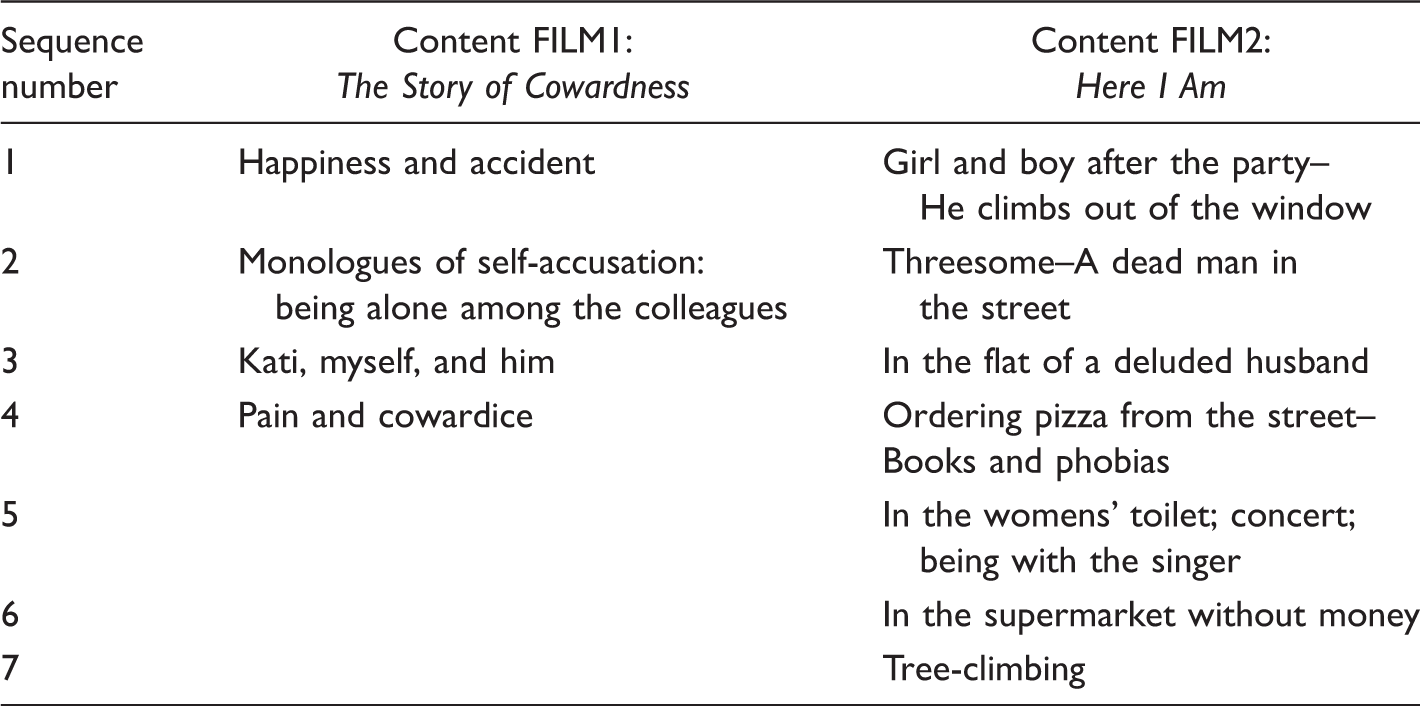
Two short films with different narrative structures were screened. FILM1 (The Story of a Coward, 1966, Zsolt Kézdi-Kovács, 14 minutes) has a classical linear narrative. The film tells the story of a young geologist who is driving to a conference. On the road, his car is passed by a friend’s car heading to the same conference. This friend is married to a woman both of them had courted before. The two of them start to race on the road passing each other. The friend seems to win leaving the hero behind, but soon after it turns out that he suffers a fatal accident. The hero arrives to the conference where he meets his friend’s wife, who is expecting her husband to arrive, but he fails to tell her about the accident. Although he struggles with his conscience about what to do, the police arrive bringing the news about the tragedy. He is left there in shame. FILM2 (Here I Am, 2010, Bálint Szimler, 35 minutes) has a noncausal, episodic narrative, where the aim of the hero is unknown, and there are no explicit links between the episodes. The film consists of seven episodes linked solely by the presence of the main character, a young man getting involved briefly with the life of various people he joins or accidentally meets. He makes contact with unknown people on the street, gets involved with human conflicts, and connects people who do not know each other and who he himself meets for the first time. The characters of the episodes do not recur in the film, and there is no verbal or narrative reference to them in other episodes. There is no reference to any intention or goal of the main character. In Study 1, we gathered evidence that overall film length does not influence the activity of causal thinking. Causal inferential activity decreased after the first half of The Man Without a Past, but during the second half of the film, there was no significant decrease in viewers’ causal inferences till the end. In other words, it is unlikely that the difference of 21 minutes in playing time between FILM1 and FILM2, has any effect on the eventual difference between the causal reactions to the two films and we can exclude the possibility that eventual decrease of causal reactions is due to mere fatigue.
The rest of the technical equipment used in this research was the same as in Study 1. The test questions right after viewing the films included demographic characteristics (such as gender, age, level of education, profession), writing down the summary of the film’s plot, and a direct question assessing whether there had been any part of the film that the viewers did not understand. This study started with a personality test followed by watching the first and the second movie while commenting online and answering the test questions after each viewing. The personality tests were partly the same as in the first study (BFQ and ECR-R).
Results
The categories and the method of analyzing the online comments were the same as in Study 1. First, a film scholar divided both FILM1 and FILM2 into micro-events (42 and 67 events, respectively), and then events that contained a causal cue were distinguished. We compared the mean number of causal comments given to such events (MFILM1 = 0.86, SDFILM1 = 0.77; MFILM2 = 0.27, SDFILM2 = 0.41) with the mean number of responses given to the rest of the events without causal cues (MFILM1 = 0.27; SDFILM1 = 0.26; MFILM2 = 0.19, SDFILM2 = 0.15) by independent sample t tests. We observed a significant difference, tFILM1(36.84) = −3.64, p = .001, in the case of FILM1 but not in the case of FILM2, tFILM2(15.05) = −0.75, p = .48, which suggests that in the case of a film with a noncoherent causal structure, causal cues do not drive viewers’ causal inferences.
A Summary of the Sequences of the Short Films.
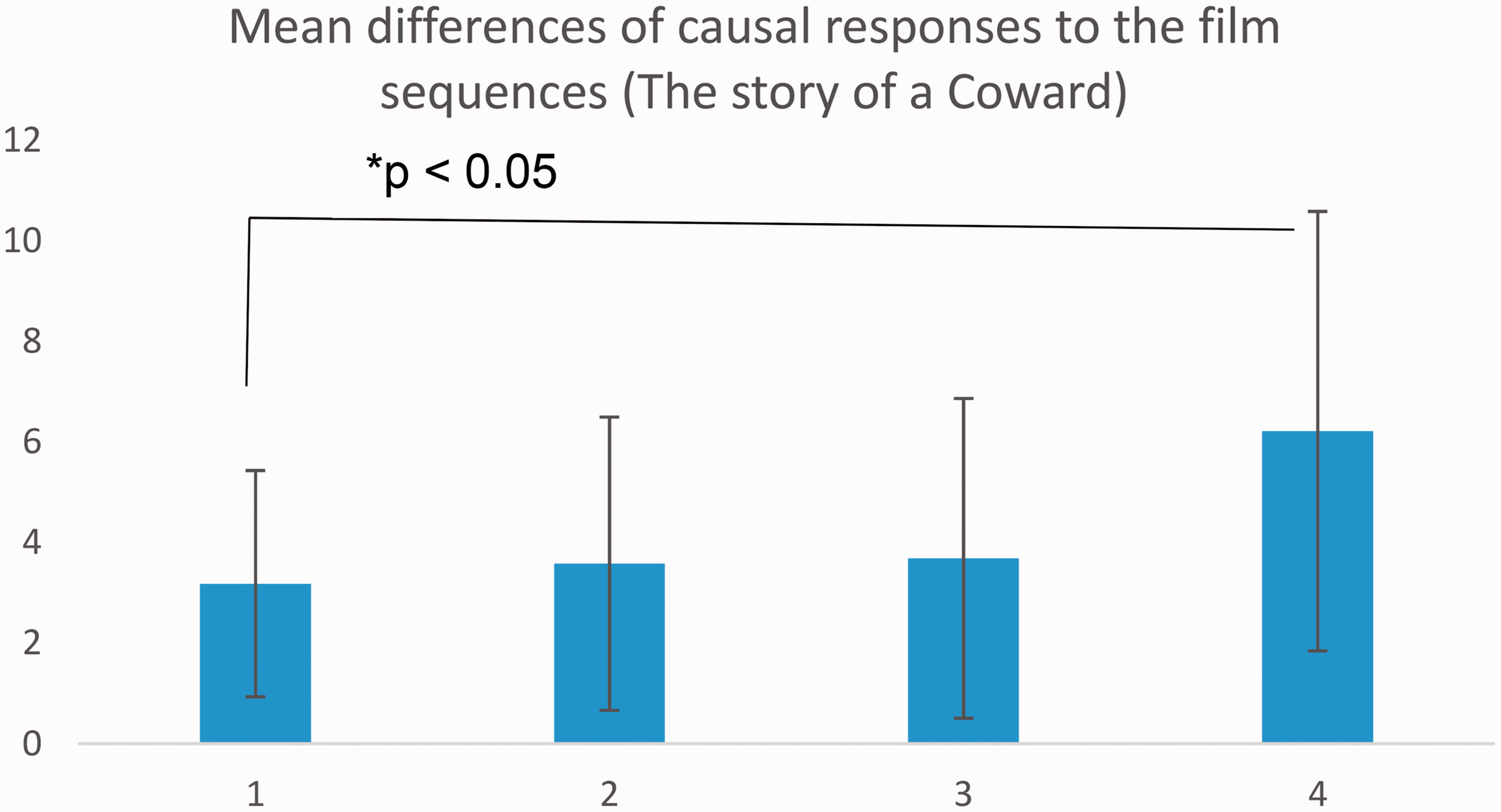
Sequence 4 on axis “x” of FILM1 (The Story of a Coward) provoked higher causal inference reactions in viewers.
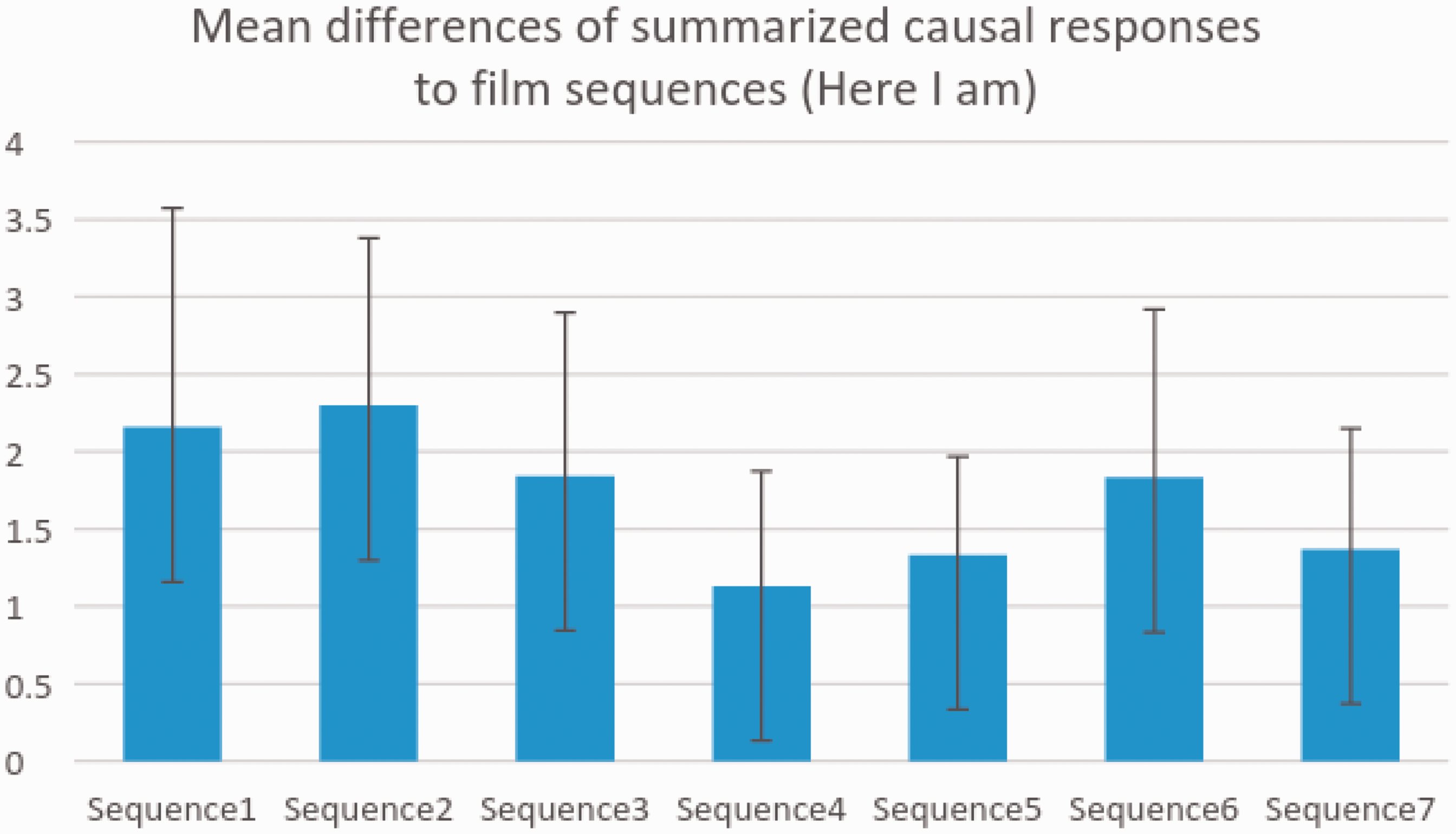
Sequences 1, 2, and 3 of FILM2 (Here I am) provoked higher causal inference reactions in viewers (Sequence 2 surpassed Sequences 4 and 7 [corrected p < .01] and Sequence 5 [corrected p < .05]. Sequence 4 also provoked significantly less causal inferences than Sequences 1 and 3 [corrected p < .05]).
Correlations Between Online Causal Comments and Personality Characteristics in the Three Films.
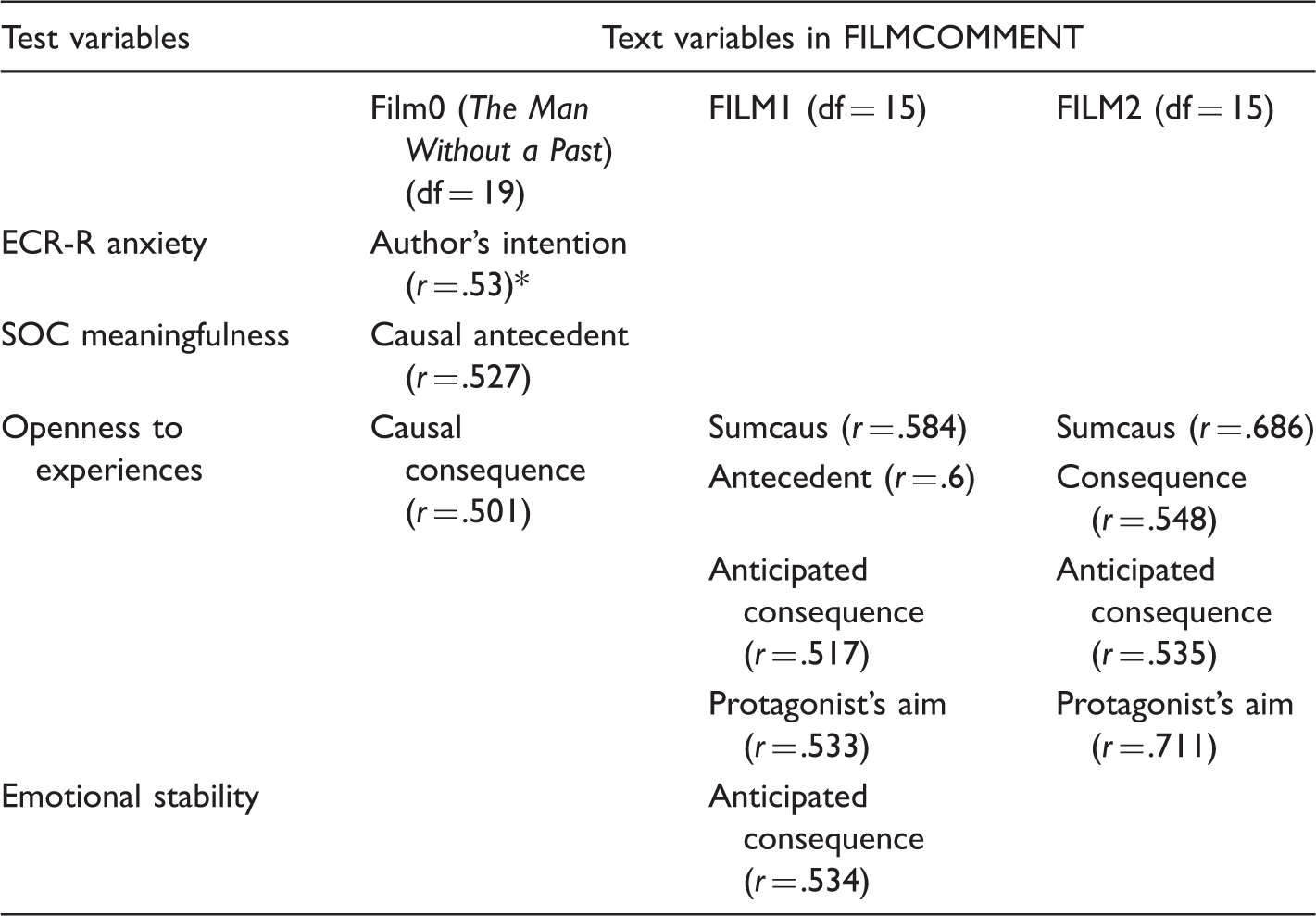
Note. ECR-R = The Experiences in Close Relationships-Revised Questionnaire; SOC = Sense of Coherence.
All p < .05.
Comparing the Amount of Causal Inferences in Two Short Films With Highly Different Causal Coherence Structure.

Discussion of Study 2
As in the first study, in some segments of both films viewers’ causal reactions matched independently of their personal characteristics. High matching of viewers’ responses could be detected in relation to parts of the narratives having narrative or dramaturgical significance (e.g., setting/exposition, resolution, etc.). The role of the specific structure of the film narrative in directing the viewers’ causal inferences was especially conspicuous in the case of FILM1, where the last sequence of the film provoked the most causal inferences. A plausible explanation of this result is that this is the most decisive sequence of FILM1, where the title of the movie is explained. It is important to emphasize that in contrast to Study 1, in this study no significant difference was detected between the individual causal categories. Only the distribution of the summarized causal inferences varied significantly following the narrative structure. A possible explanation would involve the difference in length between the two films as a decisive factor of causal processing, a greater length allowing for more complex and subtle causal structure.
After controlling for the number and length of the segments of the films, the classical linear narrative provoked a significantly higher number of causal inferences in each causal category. This suggests that narrative with clear causal structure directs the causal responses more effectively. Contrary to our expectation, the film, which hides the explicit aims of the protagonist, did not provoke more active inference processing from the viewers. This result is far from trivial since one could reasonably argue that the lack of causal cues (as in FILM2) would incite the viewer to look for explanations generating more online causal reactions in order to understand the plot. The result suggests that the viewers adapt to the noncausal structure of FILM2 by reducing causal thinking. This suggests that there is a difference between mental activities needed to process a classical versus a nonclassical narrative.
In this study, Openness to experience also seemed to have an overall effect regarding the interest and the willingness to step into a new fictional world in the case of both films, which is congruent with most of the literature on personality determinants of aesthetic reaction (Furnham & Chamorro-Premuzic, 2004; Kuiken, Miall, & Sikora, 2004). Regardless of the film’s narrative form, the more tolerant and open viewers are, the more ready they are to search for the antecedents of the current events in a film, to attribute motivations to fictional characters, and to use their knowledge about the interpersonal world to find out the potential consequences of current events. In FILM1, anticipated consequences were also related to Emotional Control which indicates that being able to form anticipated outcomes of a certain narrative requires the emotional stability of the viewer. These results are congruent with out previous hypotheses formulated in Study1.
Although a nonclassical narrative does not provoke a higher number of causal inferences, the results confirm another hypothesis that the processing of this type of narrative is influenced more by the personal characteristics of the viewer than the processing of a classical type narrative. The correlations between the online causal categories and the personality characteristics were considerably stronger in each category in FILM2 than in FILM1 (see Table 5). That is, the more causally incoherent the narrative, the more decisive the viewers’ personality traits in the meaning-making process.
General Discussion
Regarding our first question, as to whether or not different parts of a cinematic narrative provoke similar or dissimilar causal inferences in viewers, the answer is quite straightforward. Considering the narrative structure, at important dramaturgical points—exposition, important turns, resolution—viewer’s causal reactions are highly similar. At other points, viewers’ causal thinking is rather randomly distributed, which means that they are not driven by the narrative structure, but are due to viewers’ individual mental processes. This suggests that viewer’s causal construction is only partly predictable and manipulated by the narrative. There is a considerable freedom as to how and when viewers let themselves be driven by the narrative, which may also have further impact on their mental construction of the narrative.
Regarding our second question, whether personality factors are responsible at least in part for difference in causal construction of the narrative, our studies yielded some convincing answers. Even though there were no individual traits that correlated with the same causal category in all three films, Openness to experience had an overall effect on causal understanding in both short movies as well as on the category of causal consequences in The Man Without a Past. Attachment-related anxiety, Emotional Control and Meaningfulness also correlated with different causal inferences but only in the case of one film. Since construction of causal connection lies in the core of narrative understanding and interpretation, if personality traits were to interfere with the rational construction of a narrative’s causal system, then there is at least one psychological factor explaining differences of interpretation. From this result, we may also conclude that individual films can be specific as to which personality characteristics they call upon that are important in the reception process. This allows for the assumption that some character types are more receptive to certain narratives than to others. We suppose that, taking the genre and specific themes of the film into account, taxonomy of personality traits relevant for the reception of particular film types could be developed.
Regarding the third question related to the difference between classical and nonclassical narrative in causal construction, our results were rather unexpected. First of all, the high matching of viewers’ causal responses at decisive sequences of the narrative confirms Bordwell’s “active viewer” hypothesis, which is based on the fundamental process whereby the viewer reacts to the cues provided by the narrative and makes causal inferences based on those cues. However, we found that the total amounts of viewers’ causal responses to the events and also the causal responses in each causal category were significantly higher in the case of a narrative having a strong causal structure (classical) as opposed to a narrative with an unmotivated hero and with an episodic structure (nonclassical). This result clearly suggests that inferential mental activity is not the same in the two cases. If the viewers applied the same mental operation during processing the film, we should expect the same or even higher amount of causal reactions to the nonclassical type, which hides causal connections, thereby provoking the viewer to continuously ask questions. This is not what seems to happen. Apparently a different attitude seems to take place in this case. After realizing that this will not be a conventional causally structured narrative, viewers simply stop using causal inference to understand the narrative (as shown in Figure 3).
In the light of this result, we can explain why we found in Study 1 a significant difference between causal reactions given to events with and without causal connections. The film’s narrative structure sets the viewer’s mind to look for causal cues or to do something else altogether. When a film prompts a search for causal cues, the viewer’s search for explanation becomes even more active. In contrast in a film where the viewer’s mind is prompted not to look for causal cues, unrelated or unexplained events provoke less causal inferences. This suggests that different narrative types require different cognitive processes by the viewer to which they readily adapt. The next step should be to investigate what exactly this other type of cognitive processing not relying on causal connections consists in.
Correlating personality traits with causal responses did not show differences between the classical and the nonclassical narratives, which suggests that when it comes to causal inferences, the influence of personality factors remains the same. These results do not inform us about the extent of the impact of psychological and emotional factors in the case of interpreting a narrative not involving causal inferences. Our prediction would be that other processes of interpretation depend more on those factors in the case of a nonclassical narrative, the investigation of which would be another step forward in this research. Nevertheless, what we can assert is that although a classical type of narrative involves a very active causal inferential process, it is however much less uniform than could be expected from the fact that these narratives have a strong and explicit causal structure. Indeed, in many points, viewers’ inferential activity is largely independent of the text, and the high correlation with some personality factors suggests that at these points even rational causal inferences (let alone associations or emotional reactions) are influenced by personality factors also, and that this is accounts for differences in interpretation rather than simple misunderstanding. Confirming a common opinion, we suggest that processing of nonclassical narratives require stronger contribution by the viewer’s personality than understanding classical films. However, we propose that nonclassical art films do not require more mental activity from the viewer than classical narratives, rather they seem to require different types of mental activity, the exact nature of which remains to be determined precisely in future research. An important further question of this research should be to determine to what extent these “alternative” mental processes are controlled by the film by means other than narrative causal logic, and to what extent the viewer is allowed to follow their individual mental paths. Two more issues may be relevant in this regard for further studies. One is the role of appreciation regarding the viewer’s readiness to follow the narrative’s lead, and the other is the role of the viewer’s habituation to watching nonclassical films in their readiness to abandon the search for causal cues.
Footnotes
Appendix: Detailed Description of the Plot of the Film The Man Without a Past ( Kaurismäki,2002 )
Acknowledgments
The authors would like to thank the three anonymous readers for their thorough and thoughtful comments.
Declaration of Conflicting Interests
The authors declared no potential conflicts of interest with respect to the research, authorship, and/or publication of this article.
Funding
The authors received no financial support for the research, authorship, and/or publication of this article.