







Abstract
This study aimed to examine the mediating effects of cognitive style on the relationship between music competence and creative thinking. The participants were college students from a university in Eastern China. The categorization between rationality and experientiality (intuition) was adopted to measure students’ cognitive styles. A model was formulated in which music competence predicted cognitive style, which in turn predicted creativity. Structural equation modeling with Mplus 7.4 was utilized to examine the model fit and mediating effects. The result showed that (a) the model fit was acceptable; (b) both rationality and experientiality functioned as significant mediators on the path from music ability to creativity; and (c) the mediating effect of rationality was significantly greater than that of experientiality. The model presented an overall description of the relationships among the four variables; additionally, it revealed that rationality played a more prominent role than intuition did in creative thought.
Many studies have shown that people's musical competence is positively associated with creativity (e.g., Gibson et al., 2009; Hallam, 2010). However, the mechanism through which music competence affects creative tendencies remains an open question. This study examined the mediating roles of cognitive style on the relationship between music competence and creativity. The division of rationality and intuition was adopted to measure students’ cognitive styles. Previous studies have shown that music training is associated with learners’ rational and intuitive thinking (Wu, 2004), and the latter impacts their creativity (Garfield et al., 2001; Wu & Chiou, 2008). Therefore, a conceptual model could be formulated in which music competence predicted rationality and intuition, and the latter anticipated creative thinking. In the model, rationality and intuition served as mediating variables.
The result would provide empirical evidence on the interventional roles of cognitive style on musicality-based creative thinking. Such a finding could help psychologists and educators better understand the functions of music ability and aid in reevaluating the role of music education in curricula.
Literature Review
Music Competence
Music competence has been interpreted in different ways by researchers. Gembris (1997) divided these interpretations throughout history into three phases. The first phase (1800 to early 1900) was defined as the phenomenological approach. In this phase, music talent was viewed as a person's ability to appreciate and perform music. The typical measurement scales were subjective questionnaires. The second phase (early 1900 to the present) is called the psychometric approach, in which researchers try to measure musical ability objectively. The objects are perceptual aspects of music, such as pitch, melody, and rhythm. The third phase (1980 to the present) can be defined as the music meaning approach, in which music competence refers to people's ability to make sense of music. Gembris (1997) valued the first and third approaches, viewing music aptitude as listeners’ ability to understand the meaning of music. He stated, “understanding musicality as the ability to generate musical meaning is a more promising way to arrive at more valid insights about the nature of musicality” (p. 21). He also advocated using self-report questionnaires to tap listeners’ ability to appreciate or perform music.
The objective and subjective methods are two commonly adopted approaches in gauging music ability. The former adopts psychometrics and standardized testing to measure music skills, such as melody, pitch, timbre, tuning, rhythm, and tempo. Gordon's (1989) Advanced Measures of Music Audiation, and Law and Zentner's (2012) Profile of Music Perception Skills belong to this category. Subjective methods use self-report questionnaires to assess listeners’ music participation and perceptual ability. Müllensiefen et al.'s (2014) Goldsmiths Musical Sophistication Index and Dan et al.'s (2021) Aesthetic Competence Scale fall into this category.
Cognitive Style
Cognitive style can be defined as a person's habitual approach to processing information (Riding et al., 2003). There are various classifications of cognitive style, for example, the division between heuristic and analytic (Evans, 1984), implicit and explicit (Reber, 1993), associative and rule-based (Sloman, 1996), or experiential and rational systems (Epstein, 1994). Stanovich and West (2000) grouped these categorizations into System 1 and System 2. System 1 was characterized as a controlled, conscious, and rational thinking process, and System 2 as an automatic, unconscious, and experiential process. However, Evans (2008) pointed out that to group multiple cognitive styles into just two systems might be a mistake, given that not all features of these categories could be covered by the dual-process system.
Epstein's (1994) cognitive-experiential self-theory distinguished between “what people think” and “what they feel” within information processing, which he named rational and experiential (intuitive) cognitive styles. The rational style meant that people processed the information by reasoning and logic, which could be characterized as conscious, verbal, and affect-free. The experiential style denoted people dealing with questions intuitively and holistically, characterized as preconscious, nonverbal, and affect loading. Based on this theory, Epstein et al. (1996) developed the Rational–Experiential Inventory (REI), evaluating the two cognitive styles of rationality and experientiality. In 1999, Pacini and Epstein revised the REI and developed a new version, with 20 items in each dimension. The two cognitive styles are considered independent and interactive, and people may score high or low on both.
The categorization of rationality and experientiality matches findings in neuroscience research. Neuroscience suggests that the left and right hemispheres of the brain have different functions. While the left hemisphere is responsible for language, mathematics, and logical thinking, the right accounts for intuition, forms, and perceptual coherence. While each hemisphere performs its own functions, they are closely linked and coordinated to form a unified control system (Wallace, 1986).
Creativity
Creativity can be defined as the capacity to produce something new and task-appropriate (Lubart, 1994; Ward & Kolomyts, 2019). Being creative is essential in today's changing world and is also the key to success in life or work (Glaveanu & Kaufman, 2019). Researchers examined creativity from different perspectives, concerning its prerequisites, processes, underlying structures, and circumstances (Kaufman & Glaveanu, 2019). A variety of psychometric methods have been developed to evaluate people's creative tendencies and activities (Plucker et al., 2019). At the same time, a series of teaching strategies were developed to nurture students’ creative thinking, including experiential learning, teamwork, and tolerating ambiguity (Ayob et al., 2011; Sawyer, 2006; Sternberg, 2019).
Referring to Guilford's (1950) divergent thinking theory, Williams (1980) developed the Creativity Assessment Packet (CAP), which has become a widely used instrument in assessing students’ creativity. CAP consisted of two parts, namely creativity thinking activities and creativity tendency scale (CTS). The former asks students to complete 12 unfinished pictures, assessing the six dimensions of thinking activity: fluency, openness, flexibility, originality, elaboration, and title. The latter is a self-report inventory, measuring students’ creative personality, comprising four dimensions, namely curiosity, imagination, challenge, and risk-taking. Taiwanese researchers Lin and Wang (1999) later developed a Chinese edition of CAP, in which CTS still enclosed the original four dimensions. The author only chose CTS to measure creativity, as self-report measures can be used to assess creativity as an independent category (Plucker et al., 2019; Snyder et al., 2019).
Relationship Between Music Competence, Cognitive Style, and Creativity
Research has revealed that there are associations among the four factors of music: competence, rationality, intuition, and creativity. On the relationship between music competence and cognitive style, Wu (2004) noted that music involved melody, harmony, orchestration, etc., which were naturally related to reasoning. Moreover, feeling was an essential factor in music appreciation; therefore, it was also associated with intuition. Silvia et al.'s (2016) study revealed that music training was associated with the student’s auditory discrimination abilities and general intelligence.
Music aptitude is related to creativity. Hallam (2010) reported that children with music training scored higher on creative ability tests than controls. Gibson et al. (2009) demonstrated that musicians exhibited higher creative personalities than nonmusicians. Goncy and Waehler (2006) found that music experience was positively related to creative personality traits.
Meanwhile, the research results concerning the influence of rationality and intuition on creativity have been inconsistent and even contradictory. In examining the relationship between reasoning and creativity, Wu and Chiou (2008) found that relativistic and dialectical thinking was positively associated with college students’ creative performance. In relativistic thinking, students recognize that different opinions can exist, because problems can be viewed from different angles, and with dialectical thinking, they are able to tolerate contradictions and view them as chances for intellectual growth. Palmiero et al. (2020) connoted that the rational decision-making styles could predict students’ divergent thinking, whereas the intuitive decision-making style had no such effect. In reviewing the literature about the relationship between reasoning and creativity, Guignard and Lubart's (2016) concluded that reasoning had no connection with creative thinking for children and adolescents, but for adults, they were closely related.
In terms of the link between intuition and creativity, Raidl and Lubart (2001) found that people favoring intuition scored higher on divergent thinking tests and creative production tasks. Garfield et al. (2001) reported that people who adopted intuitive creativity techniques generated more novel and paradigm-modifying ideas than those appealing to analytical techniques. Eubanks et al. (2010) uncovered that people with higher intuitive ability could figure out more solutions to problem-solving tasks than those with lower intuitive ability.
Based on the above-mentioned research findings, a model could be formulated in which music competence predicted rationality (Silvia et al., 2016; Wu, 2004) and intuition (Wu, 2004), and rationality predicted creativity (Guignard & Lubart, 2016; Palmiero et al., 2020; Wu & Chiou, 2008), so did intuition (Eubanks et al., 2010; Garfield et al., 2001; Raidl & Lubart, 2001). Music competence was associated with creativity (Gibson et al., 2009; Goncy & Waehler, 2006; Hallam, 2010). In the model, rationality and intuition served as the mediating variables on the path from music competence to creativity. It was hypothesized that
The model fit was acceptable. Music competence significantly predicted cognitive style and creativity. The cognitive style was related to creativity. The mediating effects of rationality and intuition were significant.
Method
Participants
The participants were undergraduate students recruited from a comprehensive university in Eastern China. Convenience sampling (i.e., using whole classes) was adopted for recruitment. Students were from different majors, such as psychology, Chinese, and physical education. The questionnaires were distributed to students during class time with permission from the teachers. The students were informed that the participation was anonymous and voluntary, and there was no negative effect if they refused or discontinued participation. The final sample included 440 students, of which 298 (67.7%) were women and 142 (32.3%) were men. Their ages ranged between 18.6 and 22.5.
Measures
Music Competence Scale
Dan et al. (2021) developed the Aesthetic Competence Scale to measure students’ aesthetic appreciation ability. It contained four subscales, namely music, drawing, literature, and film, each comprising five items. The subscale of music appreciation was chosen to measure students’ music competence. An example item was, “I can understand the artistic image of music.” The Cronbach's α was .80, showing that the internal consistency reliability was good.
The REI
Pacini and Epstein's (1999) REI was revised so that it could be given to Chinese participants. Sixteen items were retained after the revision, with eight items in each dimension. An example of the rationality dimension was, “I have no problem thinking things through carefully,” and an example of the experientiality dimension was, “using my gut feelings usually works well for me in figuring out problems in my life.” The values of Cronbach's α for both dimensions were .83, indicating that it was a reliable instrument.
The CTS
The CTS was adopted to measure students’ creative thinking. The CTS was based on Lin and Wang's (1999) Chinese version of the CAP (Williams, 1980), measuring the four dimensions of curiosity, imagination, challenge, and risk-taking. The scale had 20 items, with five items in each dimension. An example item was, “trying a new game or activity is an interesting thing.” Students’ creativity score was the sum of the four components. The Cronbach's α of the four components ranged between .74 and .78, and the total scale was .88, showing the internal consistency reliabilities were good.
For all measures, students answered the questions on a 5-point Likert scale. Higher scores indicated higher levels of music competence, rationality, experientiality, and creativity tendency.
Analysis Method
The model consisted of four latent variables, namely music competence, rationality, experientiality, and creativity. Music competence had five items as indicators. Rationality and experientiality had eight items, respectively. To reduce the item number, the parceling method was adopted to randomly combine two items into one. Hence, rationality and experientiality had four indicators each. Creativity had four dimensions as its indicators (i.e., curiosity, imagination, challenge, and risk-taking). SPSS 24 (IBM) was used in the descriptive analysis, and structural equation modeling (SEM) using Mplus 7.4 was adopted to examine the model fit, estimate the path parameters, and compare the indirect effects of mediators.
Results
Preliminary Analysis
The means, standard deviations, and correlations of the variables are presented in Table 1. The table shows that all variables correlated significantly with each other and in the expected directions. However, the correlations between music competence and other variables were low (.17–.37). The associations between rationality and intuition (.11) and intuition and creativity (.37) were also low. Only the association between rationality and creativity was at a moderate level (.47). The correlation coefficients among the four components of creativity ranged between low and moderate levels (.34–.56).
Correlations, Means, and Standard Deviations (SDs) of the Variables.
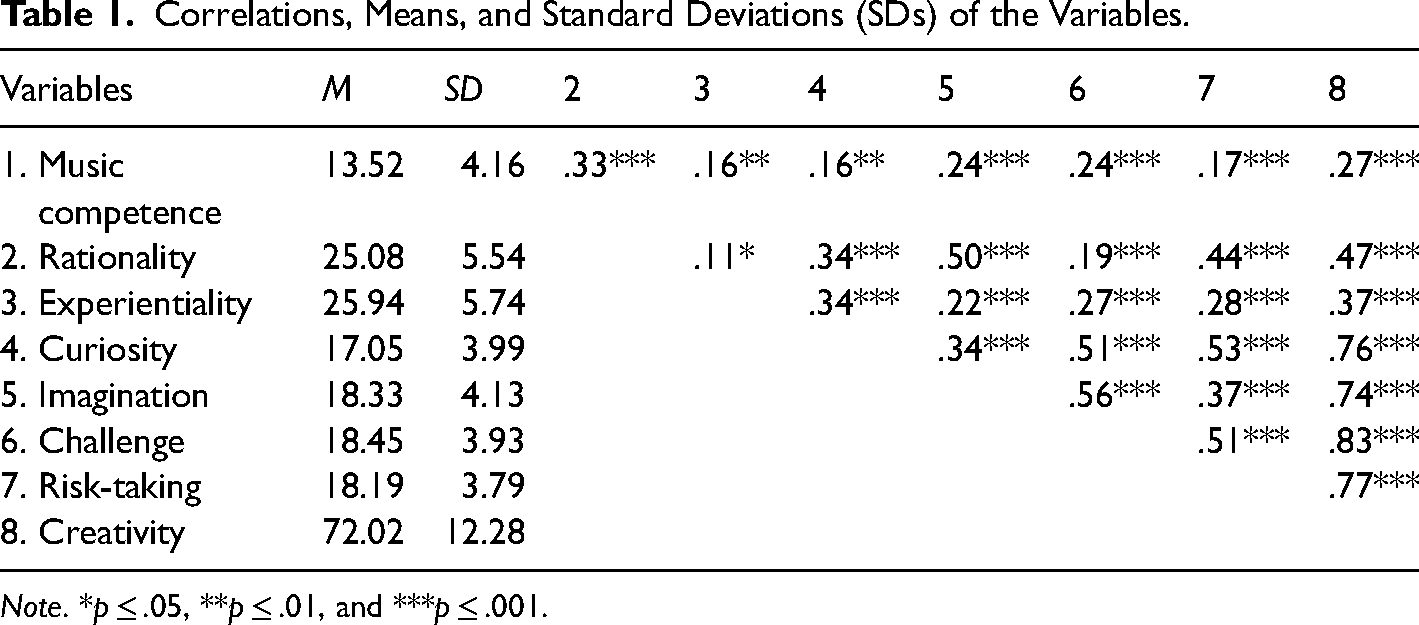
Note. *p ≤ .05, **p ≤ .01, and ***p ≤ .001.
Model Summary
The SEM analysis indicated that the factor loadings of the four latent variables were good (> .50). Specifically, the factor loadings of music competence were between .55 and .70; those for rationality were between .57 and .79; for intuition, they were between .64 and .76; and for creativity, they were between .58 and .76. The analysis produced the following model fit indices: χ2(113) = 422.69, p < .001; comparative fit index (CFI) = .87; Tucker Lewis index (TLI) = .85; root mean square error of approximation (RMSEA) = .079; standardized root mean square residual (SRMR) = .059. Although χ2 was significant, the ratio between χ2 (422.69) and the degrees of freedom (113) was 3.74, <5. The values of CFI and TLI were close to the acceptable criteria of .90. Both RMSEA and SRMR were below .08. Therefore, it was concluded that the model was acceptable, and Hypothesis 1 was confirmed.
The path parameters designated that music competence significantly predicted rationality (standardized effect size d = .44) and experientiality (d = .18), but it was unable to predict creativity anymore (d = −.04 and p = .64). Hypothesis 2 was partly supported. Both rationality and experientiality were significantly related to creativity (d = .59 and .38, respectively), therefore, Hypothesis 3 was confirmed. The correlation between the residues of rationality and experientiality was insignificant (r = .05 and p = .54). Figure 1 illustrates this model.
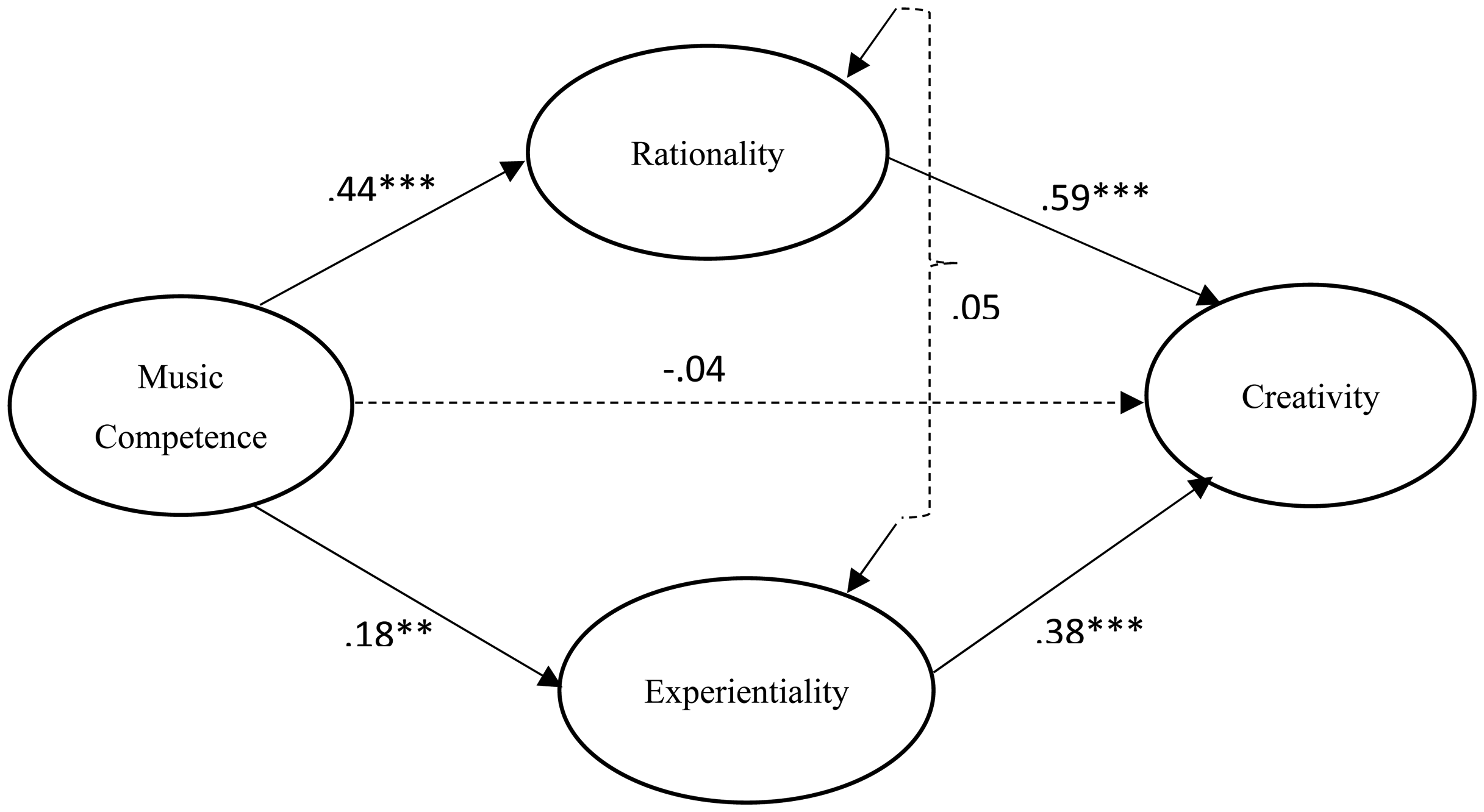
The path coefficients of the model.
Examining the Mediating Effects
The total effect from music competence to creativity was .29 (p < .001), which could be divided into the indirect effects by the two mediators .33 (p < .001) and the direct effect from competence to creativity −.04 (p = .64). The indirect effect could be further divided into the indirect effect by rationality (d = .26 and p < .001) and that by experientiality (d = .07 and p = .01). Both the mediating effects of rationality and experientiality were significant; therefore, Hypothesis 4 was supported. The post hoc test revealed that the mediating effect of rationality was significantly higher than that of experientiality, Δd = .19 and p = .01.
Discussion
Interpretation of the Results
The model presented an overall description of the relationships among the four variables of music competence, rationality, intuition, and creativity, in which creativity included curiosity, imagination, challenge, and risk-taking. The path parameters indicated that music competence could significantly predict rationality and intuition, which in turn predicted creativity. Both rationality and intuition served as significant mediators in the relation between musicality and creativity. The findings demonstrated that as music competence increased, so did rationality and intuition, which contributed to students’ creativity in sequence. In addition, with rationality and intuition as the indirect variables, the association between music competence and creativity became insignificant, showing that rationality and intuition functioned as full interventional variables, that is, no other cognitive thinking style existed on the route.
Rationality and intuition were positively correlated. The correlation indicated that the two variables were not opposite or bipolar; instead, they were independent and likely to promote each other. The comparison of the mediators’ effects specified that the mediating effect of rationality was significantly higher than that of intuition. It provided empirical evidence that the role of rationality was more important than that of intuition in creative thought. The model was proved to be acceptable, showing that it could be considered an effective pattern to describe the relationships of the four variables.
In the past few decades, there existed disputes on the importance of rationality and intuition in creativity. Some psychologists believed that scientific discovery relied on logical reasoning (Simonton, 2016). Weisberg (1986) posited that creative thinking did not necessarily involve imagination but instead evolved through a series of conscious steps. Contrastingly, some researchers emphasized the role of intuition. Bastick (1982) suggested that intuition was the first stage in the creative process, which was later verified by logical thinking. The selection of analytic methods for verification was also guided by intuition. Langer (1989) argued that creativity arose through an intuitive experience, while rational thinking served only to confirm “old mindsets” and “rigid categories.”
The third school of thought emphasized both. Clark (1979) proposed that both rationality and intuition were required attributes of creative people. Simon (1987) stated, “intuition is not a process that operates independently of analysis; rather, the two processes are essential complementary components of effective decision-making systems” (p. 61). Sadler-Smith and Burke (2009) suggested that the two cognitive styles interplayed in an iterative way during the decision-making process. The present study seemed to prove that both styles were conducive to creative thought.
At the same time, it further proved that the mediating effect of rationality was greater than that of intuition. Yet, it is worth mentioning the view of Smith and DeCoster (2000). They proposed that the intuitive processing model was based on the accumulation of experiences, and it relied on acquired knowledge to fill in the information automatically. In contrast, the logic processing model was based on socially transmitted and culturally shared rules, which employed intentionally acquired knowledge as rules to guide processing. Since the logic processing model relied on rules of logic inference, it was more reliable than that of intuitive processing.
Implication for Education
Esthetics and creativity are inherently related (Smith, 2014). Unfortunately, ignoring art education in favor of science courses is a common phenomenon in modern school systems worldwide. In China, art education only exists in name, and it is very common for primary and secondary schools to convert art courses into science courses. Realizing the scarcity of art education, China's Ministry of Education recently increased the requirements for it, including music education. However, how it will impact the curricula and class environments and whether it will enhance students’ artistic accomplishments remains unknown.
Researchers have different opinions on the attribution of music aptitude. Some hold the view that it is shaped by heredity (Gagne, 1999; Gingras et al., 2015; Swaminathan et al., 2017), and some insist that it is molded by the environment (Ericsson & Charness, 1994; Sloboda & Howe, 1991). The third group advocates that music aptitude has impacts from both nature and nurture (Mrazik & Dombrowski, 2010; Ruthsatz et al., 2008). The authors intend to embrace the view of the third group that music aptitude is partly inherited, but can also be learned. Still, because the development of musical ability usually takes a long time, it has a certain degree of stability.
Guignard and Lubart (2016) stated that “The development of reasoning is often viewed as an important educational goal” (p. 282). The learning tasks (e.g., understanding, analysis, and synthesis) are designed to develop students’ logical thinking. In scientific research, hypothesis tests, theory constructions, and generalization also involve reference and reasoning. Regardless, the training of intuition is not considered a part of the traditional curriculum (Sadler-Smith & Burke, 2009). Some researchers offered suggestions on how to develop learners’ intuitive abilities. For example, Bruner (1960) mentioned that emphasizing the structure of knowledge and heuristic teaching might develop students’ intuition. Sadler-Smith and Burke (2009) made some suggestions for fostering intuition in management students, such as giving feedback to intuitive ideas, being aware of decision-making biases, and attending more practice sessions. However, it seems these methods are difficult to implement in practice. Based on this study's findings, music education, or more broadly, art education, may be an effective way to advance students’ capabilities for rationality and intuition.
The present study's limitations are obvious: First, it was limited to college students; whether the model might apply to children and adolescents has yet to be determined. Notably, Guignard and Lubart's (2016) reported that logical thinking had no connection with creativity in young students. Second, our sample was limited to Chinese participants, whose music accomplishment was limited, given that Chinese school systems have not paid enough attention to art education. More studies should be conducted with counterparts in Western countries. Third, creativity was measured through subjective questionnaires. More objective methods should be employed to measure creativity and verify the model. It is expected that future studies would address these questions.
Footnotes
Declaration of Conflicting Interests
The author declared no potential conflicts of interest with respect to the research, authorship, and/or publication of this article.
Ethics Statement
No ethics committee approval is required in China in conducting the survey research.
Funding
The author received no financial support for the research, authorship, and/or publication of this article.
