






Abstract
Despite its ubiquity within research and society, the study of AI-mediated art and its perception remain superficial and lacks depth. This study offers valuable perspectives for the fields of psychology and art history regarding the perception of AI-mediated art. It establishes a foundation for future investigations into the implications of art mediated by artificial intelligence, featuring nine artworks by contemporary artists: Alexandra Crouwers, Canek Zapata, Daan Couzijn, Estelle Flores, Mathias Mu, Marnix van Soom and Rodell Warner. The artworks utilize AI in diverse ways, employing different media, including paintings, sculpture, screens and projections. As the works were curated by an art historian and displayed in a gallery setting, this study provides a distinctive contribution. In contrast to the numerous existent studies that compare AI-generated images with reproductions of analog paintings in online settings, this study examines authentic works created by early and mid-career artists.
The study comprised a total of 39 participants. 26 of these were able to visit the exhibition on their own, without context or time constraints. They then took part in an in-depth interview and completed a questionnaire, aimed at gaining insights into how participants perceive the use of AI in art. The remaining 13 participants were able to visit the exhibition with context and only completed the questionnaire. We focused on how they experienced such a multimedia exhibition and what it meant to them that the artworks were mediated by AI. Additionally, we examined the role of different kinds of screens, and the presence of new digital technologies in art.
The results show a marked discrepancy between the critical openness to understanding the role of AI and other digital technologies in art, and their appreciation of the specific artworks in the context of this exhibition. The predominant explanation for this discrepancy is probably the lack of a framework for viewing this type of art.
Artificial Intelligence (AI) can be regarded as the most influential technological development in the twenty-first century, at least up to the present day. 1 It is evident that artists, in their constant experimentation with new (digital) technologies, have also been incorporating AI in their work. This paper focuses on Unbound Dialogue, a research exhibition organized and curated by Michiel Willems, one of the authors. The exhibition showcased seven artworks by contemporary artists: Alexandra Crouwers, Canek Zapata, Daan Couzijn, Estelle Flores, Mathias Mu, Marnix Van Soom, and Rodell Warner.
Unbound Dialogue took place in January 2025 at Kasteel de Spoelbergh (gallery setting) in Lovenjoel, Belgium. The present study sought to explore participants’ experiences with a multimedia exhibition, with a particular emphasis on the impact of AI-mediation in the artworks. We also examined the role of different kinds of screens, and the presence of new digital technologies in art. The primary research questions focused on the impact of artificial intelligence on the perception of (digital) art from an art-historical perspective, and the public's engagement with interactive, digital art installations that are mediated by AI. It concerns how people perceive digital features in physical artworks — or vice versa — and how they perceive an artwork embodied by a physical object with an invisible digital aspect. In this case, immateriality is transformed into materiality with or without the use of artificial intelligence by the artist. Conversely, a digital artwork can be mediated through a physical object. All the artworks in Unbound Dialogue are born digital, however, their exhibition modes differ. More details will follow later in this paper.
Literature Review
A recent surge has been observed in the utilization of AI within the domain of visual arts. This surge has also paved the way for a significant growth in research into the use of AI in the field of art, and the perception of those artworks. Nevertheless, this literature review will illustrate the necessity for critical reflection and interdisciplinary research, including the development of research exhibitions such as this one. The term “AI-mediated art” is employed to refer to most of the artworks mentioned in this study (only two artworks are not explicitly AI-mediated), as other studies exhibit a substantial lack of defining terminology considering art, artworks, artists, and AI in their stimulus selection. The rationale behind this term will be elaborated upon in a forthcoming section on the Unbound Dialogue research exhibition.
The goal of this literature review is to provide an insightful foundation for understanding current knowledge and identifying key areas for exploration within this unique context of a research exhibition focused on the perception of AI-mediated artworks in a real-life gallery setting. The implementation of AI in creative expression is frequently regarded as a provocative practice. The advent of every new (digital) technology tends to precipitate a significant transformation in our visual literacy. Existing frameworks may need to be reconsidered, and new perspectives will likely be cultivated. AI can manifest in art in various ways, from born digital art and AI-generated images to artists incorporating AI into their practices. As Cajulis et al. (2025) noted, responsible development is essential to realize the potential of AI, including the application in the arts. Enthusiasm for how new technologies can refresh the art world goes hand in hand with a call for critical reflection and further research. AI is seen as a new tool and medium for artists to explore. These artistic explorations offer a reflection on the medium and tool (including as partner) itself (Fernández-Castrillo, 2023; Rozental et al., 2024). Another study (Srinath, 2025) examined whether the message in an artwork can transcend its production medium by comparing AI-generated and hand-drawn digital animations. Although biases against AI persist, these diminish when participants understand the artist's intention. This suggests that perceived intentionality and authenticity shape judgments of creativity and effort more than the technical process itself.
There is a tendency for a negative bias against AI-generated art compared to art labeled as human-made (Bara et al., 2025; Bellaiche et al., 2023; Chamberlain et al., 2018; Chiarella et al., 2022; Ragot et al., 2020). This negative bias also extends beyond visual art to, for example, poetry or dance (Darda & Cross, 2023). Since art is considered a uniquely human phenomenon, the negative bias is often stronger when evaluating more human aspects of art, such as worth, agency, emotions, meaning, and creativity (Messingschlager & Appel, 2025; Neef et al., 2024). The concept of authorship and the role of labels as prior information play a significant role in this context (Horton Jr et al., 2023). In their 2026 paper, White & de Leon find that AI-generated art is not as capable of evoking awe and empathy as art created by humans (White & de Leon, 2026). Some of the experiments were conducted in a highly valid setting like a gallery, with real artworks. However, a significant distinction between AI and humans was maintained throughout, with no room for cooperation between the two entities. When human authorship is known, participants tend to rate the art more favorably. This is because expectations and prior knowledge influence perception (Darewych, 2023). Despite the bias, people initially encountered difficulties in consistently differentiating between human-made and machine-generated artworks in comparisons (Zhang & Li, 2024; Zhou & Kawabata, 2023). However, as knowledge about these images has accumulated over time, the classification skills and appreciation of the public have also evolved, resulting in a shift in perspective (Rueda-Arango et al., 2024; Van Hees et al., 2025). The bias is influenced by a variety of factors, including, but not limited to, exposure and education, interactions with the AI agent (anthropomorphic qualities), individual attitudes toward AI, artwork type, comparison contexts, and perceived effort (Chamberlain et al., 2018; Chiarella et al., 2022; Bellaiche et al., 2023; Horton Jr et al., 2023; Samo & Highhouse, 2023; Xu et al., 2025). Another explanation, proposed by Morewedge (2022), Zhang and Gosline (2023), and Liu et al. (2025), states that there is not an inherent bias against AI, but rather, human favoritism plays a role. Di Dio et al. (2025) conducted a comparative analysis of human and robotic authorship, distinguishing between judgments of beauty and liking. The study revealed that perceived beauty decreased when a robot was identified as the author, while liking increased when authorship was attributed to a human. Furthermore, it is posited that AI tends to excel in abstract art relative to representational art. This lends further support to the notion of a ‘human versus robot’ narrative, which in turn fosters the idea of resistance to AI in artistic production. Additionally, the perceived artistic value of a work increased when participants attributed creative skill to the robot, likely reflecting a broader tendency to assign agency to the medium. This suggests a shift towards a more ecological approach, where artists and robots collaborate rather than compete, in this case using images of renowned abstract painters’ paintings.
The present research project seeks to address substantial shortcomings in existing literature by employing an approach that is pivotal given the limitations of the aforementioned studies, despite the valuable information they provide. A significant part of the recent studies relies on stimuli and procedures that diverge in important ways from people's prototypical art experience. The recent studies referenced tend to underrate the significance of art historical values and terminology thereby lacking in historical and cultural context, or they have restricted validity due to exhibition mode and the curation of artworks and images. In experiments where reproductions or copies of artworks are exhibited, on a screen or on a print, within a non-art environment, there is a corresponding decline in the ecological validity of the research environment. It is important to note that studies which utilize self-generated images may fail to consider human artists’ actual use of AI for creative purposes. Furthermore, engagement with contemporary artists can facilitate a close and personal collaboration, thereby enabling a more profound comprehension of the multifaceted ways in which AI mediates art and the artists’ experience of AI. This direct engagement has the potential to counteract the lack of knowledge that contributes to negative biases against AI art and to positively affect participants’ behavior and perception. Concerning terminology for example, Bellaiche et al. (2023) talks about using paintings as stimuli, but the images used are not paintings, they are digital images of paintings. This is an important nuance that completely ignores art historical values and therefore the “art”. Chiarella et al. (2022) concludes that there is a negative bias toward AI-artworks when compared to human-artworks, but this is highly dependent on the participant's frame of mind and the context. The claim has been made that an ecological environment was present at the art fair; however, the participant was alone in a room with an experimenter who provided instructions. Furthermore, the paintings in question were two abstract works designed for research purposes, with little to no significance in terms of art. Hupbach and Janger (2025) concluded that human-made artworks are more memorable than AI-generated ones. Their AI-generated stimuli are an example of empty AI-generated art with no cultural value at all, there also was no artist present. Contrary, Van Hees et al. (2025) finds that there is a preference for AI-generated artworks compared to human-made by comparing real artworks with DALLE2 generated images of paintings in the same styles as the human-made ones. This shows a concerning lack of originality or creativity in the AI images and showcases the easy and quick method that has little depth or art historical value regarding the art on which conclusions are then drawn. The application of the term “art” to these stimuli is problematic; therefore, the term “images” is more appropriate. This underscores the significance of careful terminology. Finally, we should inquire into the persistent need for juxtaposition in these contexts (human art versus AI art). This approach fails to acknowledge the potential for creative and artistic collaborations and integrations. Instead, it perceives these elements as two entities that are inherently incompatible. Khan et al. (2026) are already indicating a shift towards collaboration between humans and AI in their study, which involves a comparison of images of paintings created with an AI system personalized to the artist with a standard text-to-image AI system. However, the use of images generated by the researchers, rather than original works of art, persists. Nonetheless, the potential for artists to engage in creative collaboration with a self-designed AI system is under consideration.
Unbound Dialogue: Research Exhibition
The aim of this study was to investigate the perception of AI-mediated art. Previous studies did not engage with real artworks made by real artists in a real exhibition. They also misuse the term “AI art”. Therefore, the term “AI-mediated art” is more precise in capturing the essence of this category of art. The integration of AI as a tool, medium, or (collaborative) partner in some phase of the artistic process influences the artistic process. This integration can occur at any stage, from the conceptualization stage in the artist's studio to the presentation of the final artwork in an exhibition space. The term aims to transcend the clichés of AI-generated art and explore new possibilities in artistry, agency, and creative collaborations between humans and AI. Using the term “AI-mediated” in reference to these artworks provides a more nuanced understanding of the role of artificial intelligence in art and how it is perceived, which is the objective of this study.
Methods
Study Design, Procedure, and Research Questions
The set-up consisted of nine artworks shown in a gallery setting. Further elaboration on the artworks and curatorial decisions will be provided in the next section. The exhibition lasted eighteen days, sixteen of which were reserved for one-on-one, in-depth interviews. One day there was an open house, during which anyone could visit. The last day featured a concluding symposium. Two different procedures were used. First, participants filled out a consent form and visited the exhibition without any context. Then, they participated in an in-depth, semi-structured interview and filled out a questionnaire. This took approximately one and a half hours. The second procedure was only possible during the open house, before and after the symposium. People could walk around freely and access a brochure (see Appendix 2) with information on the artworks and artists. Afterwards, they were invited, but not obligated, to scan a QR-code and fill out the same questionnaire from the first procedure.
The primary research questions concern the following: How do people perceive AI-mediated art? What is the public's attitude toward AI in an artistic context? What role do screens play in the presentation of digital art and AI-mediated art? How do spectators engage with interactive, digital, or AI installations? To what extent are people open to new technologies and AI in art? Does a rigid perspective influence liking and appreciation? Our research also extended to the evaluation of the beauty and interest ratings of the various artworks, as well as the current knowledge and frameworks pertaining to the utilization of digital materials and techniques.
Artworks
A primary objective of this study was to organize an exhibition featuring authentic artworks created by established artists, emphasizing the possibilities presented as artists engage with emerging digital technologies, such as AI, rather than highlighting the distinction between AI and human contributions. In experimental viewing studies that address art and how people perceive it, it is important to not only examine the data, but also to focus on the artworks present. The objective was to exhibit a variety of media, with the artworks that incorporated a screen featuring a diverse array of displays. Two of the nine artworks did not use AI, so they were not AI-mediated. The decision to also show non-AI-mediated art was made to distinguish between the two types and see if participants could differentiate between them. It was also an opportunity to expand the exhibition to include different aspects and possibilities of the digital realm. For photos of the artworks and their presentation in the exhibition space, see Appendix 3. A general overview of the artists and artworks is provided below, along with the reasoning behind why these works were chosen for the exhibition.
The first artist, Alexandra Crouwers (NL, 1974), presented two works. The first artwork, GoodBye (2021), is a seamless video loop that was presented on a small screen with a rather robust outlook. The second one, ⓘ – The Plot. Panel 2, is a digital model of a real-world information panel. The panel could be accessed by scanning a QR code that linked to an online space where spectators could activate an AR model to view the artwork. This AR experience was the reason this artwork was included in the exhibition. Goodbye was included because, like ⓘ – The Plot. Panel 2, it was a non-AI-mediated artwork. However, the uncanny, mysterious, and disorienting dread emitted by the artwork's ambience was a welcome vibe in the overall exhibition and reminiscent of possible AI-mediation. In this way, a non-AI-mediated condition was created besides the AI-mediated artworks. Secondly, Canek Zapata (MX) presented Lands, a collection of generated poems and images about computerized landscapes created with each click of the mouse under certain cut-and-paste instructions. Each time, this was accompanied by a sound that played and a small graphic plant. Shown in a classic cybercafé set-up, the spectator is invited to sit down and navigate through Lands on their own. AI is used for generating images and text through a script written by the artist about how computers perceive landscapes. This work was curated based on its use of AI and the need for spectators to activate the generation of webpages.
Next are three works from the same series, Thinking of Holland, by Daan Couzijn (NL, 1994). A spectral sun hovers feeble and frail, As the water reflects the sky's heavy weight, and While the days surrender to the evenings’ embrace are all oil and embroidery on canvas; however, the first material listed is “Generative Adversarial Network”. This is because these landscapes were generated by an artificial intelligence. Using traditional media, specifically oil on canvas, contributes to a sense of familiarity in the work. However, the first material listed reveals an alternative narrative that aligns with the exhibition's central theme. Estelle Flores’ (BR, 1988) machinimas from her OPERA HOUSE series use real-time computer graphics from the GTA video game to make films. The videos employ AI and audio synthesizers to replicate the voice of the main character with a monologue not derived from the original game. The work is distinctive due to its incorporation of a commonplace TV screen and its employment of AI to manipulate voices rather than generate text or images.
Since displaying different types of media was important, a wall sculpture by the artist duo Mathias Mu (BE, 1991) and Marnix Van Soom (BE) was also present. NEO SEER is a 3D-printed sculpture that incorporates a camera and a screen. The sculpture processes visual and semantic data to project an artificial stream of consciousness. This stream is generated by an AI that has been trained on specific data and prompted by specific instructions determined by the artists. Once more, both an AI system and a screen are utilized in distinct ways. The AI employs real-time received data to generate a response, while the screen is an integrated element of the sculpture. Finally, Rodell Warner's (TTO, 1986) contribution to the project was a floor projection. Artificial Archive: SCRYING INTIMACIES, Hallucination 1 is part of an ongoing body of work consisting of computational images and moving image works that form a speculative, artificial Caribbean image archive. All images are generated by a text-to-image model to create a speculative archive. This archive is a response to the existing colonial gaze in nineteenth-century Caribbean sources that does not allow for personal identity or intimacy. This speculative archiving is another form of AI-mediation. The floor projection offers a surprising approach to the medium, adding to the artwork's conceptual meaning.
In summary, the following elements will be significant for the analysis: Alexandra Crouwers's works are distinguished by their non-AI mediation; all the other artworks are AI-mediated. Daan Couzijn's artworks are notable for not using any kind of screen in their presentation; all other works are labeled digital. The works of E. Flores, C. Zapata, and ⓘ – The Plot. Panel 2 by A. Crouwers are exhibited on a screen that is regarded as “everyday” for the purposes of this study. Consequently, the works by M. Mu and M. Van Soom and Crouwers’ GoodBye are “non-everyday” or integrated screens. Lastly, for the sake of this research exhibition, the artworks by C. Zapata, M. Mu, M. Van Soom, and A. Crouwers’ AR experience were considered “interactive”. This means that the other works were not labeled as “interactive” in terms of the data analysis. In the questionnaires, all these artworks were referred to by a number from 1 to 7 (here, the three works by Couzijn were counted as one). The numbers assigned to the artworks by Rodell Warner, Canek Zapata, Daan Couzijn, Crouwers’ GoodBye, Mathias Mu and Marnix van Soom, Crouwers’ ⓘ – The Plot. Panel 2, and Estelle Flores are 1, 2, 3, 4, 5, 6, and 7, respectively. Images of the artworks can be found in Appendix 2 and 3.
Measures, Participants and Analysis
A total of 39 participants (20 females, 17 males and two not disclosed; average age = 43.8 [SD = 15.8]) visited the exhibition as part of the experiment. Participants were recruited online through social media, the KU Leuven student and staff platform, posters, and flyers distributed throughout Belgium, as well as through the researchers’ network. The only requirement for participation was an openness to engaging in an interview that focused on art. Therefore, the 39 participants are considered art enthusiasts. Thirteen of these individuals were artists or art experts, indicating that they had been educated in the arts for a minimum of two years. This study employed a mixed-methods approach, combining quantitative questionnaire data with qualitative interview data. The questionnaire included open-answer questions that also produced qualitative data.
Questionnaire Measures
The questionnaire was designed to first inquire about participants’ general perspectives on art and AI, rather than solely on this specific exhibition. The following eight questions were posed: “What did you think about the presence of screens in art exhibitions?”, 0= “very disruptive”, 10 = “very enjoyable”, “What do you think about the use of AI (Artificial Intelligence) in art?”, 0 = “completely unacceptable”, 10 = “very acceptable”, “How do you perceive the use of AI in art?”, options = “AI as a tool”, “AI as a partner”, “AI as an artist”, “other” (multiple choices possible), “What is your opinion on the idea that AI should have a place in art history?”, 0 = “completely disagree”, 10 = “fully agree”, “Do you think your understanding and experience of AI influence how you perceive art?”, options = “not at all”, “a little”, “largely”, “absolutely”, “Do you think it is important for artists to experiment with new forms of technology?”, 0 = “not important at all”, 10 = “very important”, “How flexible is your view on AI?”, 0 = “not flexible at all”, 10 = “very flexible”, and “What is your opinion on the use of AI in art?”, open answer. For the quantitative analysis, the questions were assigned a code that will also be used in the results. The respective codes are as follows: ScreensExhibition, AIinArt, FunctionAI, AIArtHistory, UnderstandingInfluence, ExperimentNewTech, and RigidAI.
The subsequent series of questions addressed the research exhibition itself, prompting a reflection on the artworks that the participants had just observed. A total of ten questions were asked in this section: “How enjoyable did you find the exhibition?”, 0 = “not enjoyable at all”, 10 = “very enjoyable”, “How interesting did you find the exhibition?”, 0 = “not interesting at all”, 10 = “extremely interesting”, “How accessible did you find the exhibition?”, 0 = “not accessible at all”, 10 = “very accessible” (accessibility refers to how easy it was to understand the artworks and their presence, enjoy them, or have a pleasant experience with them), “How useful did you find the informational brochure?”, 0 = “not useful at all”, 10 = “very useful”, “What do you think about the presence of screens in this exhibition?”, 0 = “very disruptive”, 10 = “very enjoyable”, “What do you think about the use of AI in the artworks on display?”, 0 = “completely unacceptable”, 10 = “very acceptable”, “How does the use of AI in art affect your emotional engagement with this exhibition?”, 0 = “no influence at all”, 10 = “very strong influence”, “How does the digital/virtual character of the exhibition impact your experience?”, 0 = “negative”, 10 = “positive”, “There are a total of seven artworks in the exhibition. Here, you will see an image of each artwork. Evaluate each artwork based on your level of interest (0–10) and its aesthetic appeal/beauty (0–10).”, “What did you think of this exhibition?”, open answer. In all the aforementioned questions on a zero to ten scale, intermediate response levels were possible, but these levels were not labeled except for the levels of zero and ten. Again, codes were assigned to each question: Pleasure, Interest, Inclusive, Brochure, ScreensPresence, AIUse, Emotions, and DigitalNature. The ranking of the individual artworks according to their level of interest and beauty is not included in this code-list. The participants were also asked to provide information regarding their age, gender, education level, occupation, and professional engagement with artificial intelligence, digital media, and similar technologies.
Interview Measures
The interview was a one-on-one conversation in which the participant was asked in-depth and semi-structured questions. The standard questions included the following: “What are your first impressions of this exhibition and the works in it?”, “What did you just see?”, “How did you feel when looking at the artworks?”, “Did any particular artwork stand out to you? If so, why?”, “Do you think a human artist was involved in the creation process of all the artworks here?”, “Do you think AI was used in some of the works? If so, which ones and how?”, “How do you experience the concept of ‘the hand of the master’ here?”, “How do you perceive the use of AI in art? More as an artist, a tool, or unnecessary?”, “What is your opinion on the use of screens to display artworks?”, “How do you engage with the interactive aspects of some of the works?”, “Do you think it should be explicitly clear that AI was used in the creation or presentation of an artwork?”, “Have you previously attended an exhibition like this, featuring digital works and AI-mediated art? If so, how did you experience that, and did it affect you?”, “How has this exhibition changed your feelings?”, “Can you tell me more about your favorite artwork in this exhibition?”, “Can you tell me more about your least favorite artwork in this exhibition?”, “Would you like to attend an exhibition like this again?”, “Does beauty still matter in art?”, “What would you personally like to share or say about the exhibition and the works on display?”, “What are your thoughts on digital art and the use of AI/digital media in art?”, “How rigid is your perspective on AI?”, “Can you tell me something about what you think the artists’ intentions were with these works, and what materials and techniques they used to do so?”, “Do you think this rigidity is important for appreciating this exhibition?”.
Questionnaire data was collected from 39 participants using a self-developed questionnaire. 26 participants participated in semi-structured in-depth interviews. All participants gave written informed consent before the start of the study, and the Social and Societal Ethics Committee granted ethical approval (SMEC G-2024-8664). Quantitative data was analyzed using R Statistical Software (v4.3.1; R Core Team 2023). The interviews were recorded and were afterwards transcribed to analyze them using Inductive Content Analysis (ICA) and some elements of interpretative phenomenological analysis. The division of answers to the questions according to different categories would facilitate the preparation of reports on the questions and the themes participants addressed in their answers. Through this ICA, overarching themes can be determined and linked to the qualitative data. It became evident that this type of analysis alone was insufficient; therefore, components from IPA were employed to accentuate individual experience and its intricacies, particularly in the context of art. This approach enabled the comprehension and conceptualization of the multifaceted nature of these experiences (Spiers & Smith, 2019; Starr & Smith, 2023). This approach facilitates the collection of substantive data, despite the limited sample size, a prevalent practice in IPA, and can provide meaningful insights to address the research questions at hand.
Results
Questionnaires
How do people perceive AI-mediated art?
Beauty, interest and pleasure scores
Descriptive Statistics for all Questionnaire and Rating Measures by Condition.

A Pearson correlation analysis revealed a strong, positive relationship between beauty and interest ratings for the artworks, r(271) = .77, p < .001, 95% CI [.72, .81]. This indicates that higher perceived beauty was associated with greater interest in the artworks. Mean beauty and interest ratings visualized in Figure 1 illustrate this pattern.
Effects of AI mediation and artwork characteristics on interest
Bar plots visualizing mean beauty (left) and interest (right) ratings with standard error bars.
A linear mixed-effects model was used to examine how general attitudes toward AI influenced participants’ interest ratings of artworks, depending on whether the artwork was AI-mediated. The model included random intercepts for participant and artwork. There was no significant main effect of AI mediation on interest, b = 3.18, SE = 2.32, t(31.20) = 1.37, p = .180, nor were there significant main effects of general attitudes (all ps > .16), except for a positive effect of AIArtHistory appreciation, b = 0.30, SE = 0.15, t(157.37) = 2.06, p = .041, and a positive effect of interest in experimenting with new technologies, b = 0.26, SE = 0.12, t(157.37) = 2.12, p = .036. The interaction between AI mediation and the belief that AI can function as a partner showed a marginal trend, b = 1.37, SE = 0.69, t(223.00) = 1.97, p = .050, suggesting that those who viewed AI as a creative partner tended to rate AI-mediated artworks as more interesting. A separate linear mixed-effects model examined how the same artwork characteristics predicted interest. Random intercepts were again included for participant and artwork. Interactivity was a significant negative predictor of interest (b = −0.59, SE = 0.30, p = .048), suggesting participants found interactive artworks less interesting. Similarly, references to everyday life screen contexts are associated with significantly reduced interest ratings (b = −2.67, SE = 0.30, p < .001), as shown in Figure 2. AI-mediation (b = 0.35, SE = 0.30, p = .25) and direct screen use (b = 0.00, SE = 0.28, p = .99) were not significant predictors of interest.
Effects of AI mediation and artwork characteristics on beauty
Bar plots visualizing beauty (top) and interest (bottom) ratings for everyday life screens condition.
A second linear mixed-effects model tested the influence of general AI attitudes on beauty ratings of AI-mediated versus non-AI-mediated artworks. Again, random intercepts for participant and artwork were included. There was no significant main effect of AI mediation, b = 3.12, SE = 2.63, t(13.33) = 1.18, p = .257. Participants who expressed greater interest in experimenting with new technologies rated artworks as more beautiful overall, b = 0.31, SE = 0.12, t(117.22) = 2.55, p = .012. In contrast, those who saw AI as a potential creative partner gave lower overall beauty ratings, b = −1.40, SE = 0.63, t(117.22) = −2.22, p = .028. This effect was qualified by a significant positive interaction with AI mediation, b = 1.24, SE = 0.63, t(223.00) = 1.97, p = .050, indicating that the negative effect of partner-oriented beliefs about AI on beauty ratings was reversed for AI-mediated artworks. There was also a significant negative interaction between AI mediation and technological experimentation interest, b = −0.24, SE = 0.12, t(223.00) = −2.01, p = .046, suggesting that participants interested in new technology rated AI-mediated artworks as less beautiful than expected based on their general attitudes.
To assess whether artwork characteristics influenced perceived beauty, a linear mixed-effects model was conducted with fixed effects for AI-mediation, direct screen use, interactivity, and everyday life screen references. Figure 2 also illustrates the beauty ratings for everyday life screens. Random intercepts were included for participant and artwork. None of the predictors were statistically significant: AI-mediation (b = −0.07, SE = 0.90, p = .95), direct screens (b = −0.36, SE = 0.83, p = .70), or interactivity (b = −1.77, SE = 0.90, p = .19).
AI mediation, digital nature, and aesthetic evaluation
Effect of AI and digital media on beauty: A linear regression was conducted to examine the effects of AI mediation and digital nature on beauty ratings. The overall model was significant, F(2, 270) = 7.09, p = .001, explaining about 5.0% of the variance in beauty ratings (R2 = .050). DigitalNature was a significant positive predictor of beauty, b = 0.40, SE = 0.11, t(270) = 3.65, p < .001, indicating that artworks categorized as digital were rated as more beautiful. AIMediation did not significantly predict beauty ratings, b = 0.36, SE = 0.40, t(270) = 0.91, p = .37.
Effect of AI and digital media on interest: A linear regression was also conducted for interest ratings. The model was significant, F(2, 270) = 10.70, p < .001, accounting for about 7.3% of the variance (R2 = .073). DigitalNature significantly predicted greater interest ratings, b = 0.42, SE = 0.10, t(270) = 4.24, p < .001. AIMediation showed a positive trend toward predicting interest, but this was marginally non-significant, b = 0.67, SE = 0.36, t(270) = 1.86, p = .064.
What is the public's attitude toward AI in an artistic context?
Distribution of attitudes toward AI see Figure 3.
Bar plots visualizing attitudes towards AI ratings. Influence of attitudes toward AI on pleasure and interest We examined whether individual differences in attitudes toward AI in art predicted visitors’ ratings of pleasure and interest in the exhibition. A multiple linear regression was conducted with four predictors: UnderstandingInfluence, RigidAI, AIUse, and Emotions. For pleasure, the overall model was significant, F(4, 34) = 8.46, p < .001, with an adjusted R2 of .44, indicating that 44% of the variance in pleasure ratings was explained by the model. Among the predictors, AIUse was a significant positive predictor of pleasure (b = 0.78, t = 5.68, p < .001), indicating that greater AIUse was associated with higher pleasure ratings (Figure 4). UnderstandingInfluence, RigidAI, and Emotions were not significant predictors (all ps > .13).
Relationship between AI use and pleasure (left), relationship between AI use and interest (right). For interest, the model was also significant, F(4, 34) = 4.36, p = .006, with an adjusted R2 of .26. Again, AIUse emerged as a significant positive predictor (b = 0.56, t = 4.12, p < .001), suggesting that visitors who reported more AIUse found the exhibition more interesting (Figure 4). RigidAI negatively predicts interest (b = −0.24, t = −1.83, p = .076), but this did not reach significance. The other predictors were not significant (all ps > .32).


What role do screens play in the presentation of digital and AI-mediated art?
Screen context and aesthetic responses To examine how the use of screens and experimentation with technology influenced aesthetic responses to AI-mediated and digital artworks, two linear models were conducted predicting beauty and interest ratings from AIMediation, DigitalNature, and their interactions with ScreensExhibition, ScreensPresence, and ExperimentNewTech. Effect of screen-use and artwork type on beauty: The model predicting perceived beauty was statistically significant, F(11, 261) = 1.95, p = .033, explaining approximately 7.6% of the variance (R2 = .076). However, none of the individual predictors or interaction terms reached significance at p < .05, suggesting no reliable effects of screen-related variables or their interactions with artwork type on beauty ratings. Effect of screen-use and artwork type on interest: The model predicting interest was also significant, F(11, 261) = 3.03, p = .001, explaining 11.3% of the variance (R2 = .113). A significant interaction was found between AIMediation and ScreensExhibition (b = –0.75, SE = 0.36, t = –2.08, p = .039), indicating that AI-mediated artworks were rated as less interesting when presented within screen-based contexts. No other predictors or interactions were statistically significant.
How do spectators engage with interactive, digital, or AI-mediated installations?
To further explore the relationships between these core aesthetic dimensions, as well as to investigate broader evaluative responses, additional analyses were conducted. In these analyses, mean beauty and mean interest ratings for the artworks were used as predictors of pleasure, interest, and inclusiveness of the exhibition.
A multiple regression was conducted to examine whether mean beauty and mean interest predicted experienced pleasure. The overall model was significant, F(2,36) = 11.36, p < .001, and explained 38.7% of the variance in pleasure (R2 = .39, adjusted R2 = .35). Neither mean beauty nor mean interest emerged as significant predictors. Next, a multiple regression tested whether mean beauty and mean interest predicted experienced interest. The model was significant, F(2,36) = 9.23, p = .001, explaining 33.9% of the variance in experienced interest (R2 = .34, adjusted R2 = .30). Mean interest was a significant positive predictor (b = 0.58, SE = 0.25, t = 2.29, p = .028), whereas mean beauty was not (b = 0.15, SE = 0.24, t = 0.63, p = .53). Concerning experienced inclusiveness of the exhibition, a multiple regression tested whether mean beauty and mean interest predicted feelings of inclusiveness. The overall model was significant, F(2,36) = 3.58, p = .038, explaining 16.6% of the variance in inclusiveness (R2 = .17, adjusted R2 = .12). Neither mean beauty (b = 0.27, SE = 0.35, t = 0.76, p = .45) nor mean interest (b = 0.40, SE = 0.37, t = 1.10, p = .28) were significant predictors.
To what extent are people open to new technologies and AI in art?
Extending beyond the general attitudes towards AI, the study also examined whether participants’ openness to experimenting with new technologies and their rigidity towards AI could predict their aesthetic experiences. The models assessed pleasure, interest, and inclusiveness as dependent variables.
A multiple regression analysis examined whether ExperimentNewTech and RigidAI predicted experienced pleasure. The model was significant, F(2,270) = 13.87, p < .001, explaining 9.3% of the variance in pleasure (R2 = .09, adjusted R2 = .09). Both predictors made significant positive contributions: ExperimentNewTech (b = 0.20, SE = 0.04, t = 4.71, p < .001) and RigidAI (b = 0.11, SE = 0.05, t = 2.00, p = .047). Higher ratings of ExperimentNewTech and RigidAI were thus associated with greater reported pleasure. Another multiple regression tested whether ExperimentNewTech and RigidAI predicted experienced interest. The overall model was significant, F(2,270) = 12.60, p < .001, explaining 8.5% of the variance in interest (R2 = .09, adjusted R2 = .08). ExperimentNewTech was a significant positive predictor (b = 0.18, SE = 0.04, t = 5.02, p < .001), whereas RigidAI was not (b = −0.02, SE = 0.05, t = −0.46, p = .65). Participants who rated the experiment as more novel or technologically engaging also tended to report higher levels of interest. Lastly, a multiple regression was conducted to assess whether ExperimentNewTech and RigidAI predicted feelings of inclusiveness. The model was significant, F(2,270) = 8.99, p < .001, explaining 6.2% of the variance in inclusiveness (R2 = .06, adjusted R2 = .06). Both ExperimentNewTech (b = 0.15, SE = 0.05, t = 3.21, p = .002) and RigidAI (b = 0.16, SE = 0.06, t = 2.53, p = .012) were significant positive predictors. Thus, greater perceptions of experimental novelty and rigidity in AI corresponded to stronger feelings of the exhibition being inclusive.
Does a rigid perspective influence liking and appreciation?
Previous beliefs about AI Effects of previous beliefs on AI: To examine whether open-minded or rigid views about AI influence audience responses, we conducted linear regressions predicting interest and pleasure ratings from two attitudinal variables: Understanding of AI's influence on art (UnderstandingInfluence) and rigid attitudes toward AI (RigidAI). For interest ratings, the overall model was not statistically significant, F(2, 36) = 0.07, p = .93, and explained virtually no variance, R2 = .004, adjusted R2 = –.05. Neither UnderstandingInfluence, b = –0.11, SE = 0.30, t = –0.38, p = .70, nor RigidAI, b = –0.01, SE = 0.14, t = –0.05, p = .96, were significant predictors of interest. For pleasure ratings, the model was again not significant, F(2, 36) = 0.39, p = .68, with R2 = .02, adjusted R2 = –.03. Neither UnderstandingInfluence, b = –0.10, SE = 0.34, t = –0.30, p = .77, nor RigidAI, b = 0.13, SE = 0.16, t = 0.81, p = .42, significantly predicted pleasure. These results suggest that participants’ openness to AI's influence on art or their rigidity in views toward AI were not significantly associated with how interesting or pleasurable they found the AI-mediated artworks. This may indicate that immediate aesthetic appreciation is relatively unaffected by pre-existing attitudinal orientations toward AI, at least in this sample.
Contextual information and exhibition experience
Context influence on pleasure A linear regression was conducted to examine the effect of condition (coded 0 vs. 1, where 0 stands for no information given to the participant, and 1 stands for the contextual brochure, as shown in Appendix 2, given to the participant) on pleasure ratings. The model was not statistically significant, F(1, 37) = 2.52, p = .121, with condition explaining approximately 6.4% of the variance in pleasure (R2 = .064). The estimated increase in pleasure for condition = 1 compared to condition = 0 was 0.92 (SE = 0.58), but this difference was not statistically significant, t(37) = 1.59, p = .121. Context influence on interest
Similarly, the effect of condition on interest ratings was tested using linear regression. This model was also not statistically significant, F(1, 37) = 2.08, p = .158, explaining about 5.3% of the variance (R2 = .053). The estimated increase in interest for condition = 1 compared to condition = 0 was 0.73 (SE = 0.51), which was not statistically significant, t(37) = 1.44, p = .158.
Finally, we examined inter-item correlations (see Figure 5) to explore the underlying structure of the items of our questionnaire. The inter-item correlations showed moderate associations among conceptually related items (e.g., RigidAI-AIinArt r = 0.60) and weak or near-zero correlations among conceptually distinct items, supporting the independence of the constructs.

Inter-item correlation matrix.
Interviews
It is important to note that participants could give elaborate answers to each question. Therefore, a participant's answer may fall under more than one category. Furthermore, the category “no answer” necessitates clarification. A “no answer” can be considered in several situations. Because the interviews were semi-structured, it is possible that not all participants were asked the same set of questions. Consequently, an individual participant's absence of a response can also be attributed to the question not being posed to them. Another possibility is that certain individuals did not respond to the question or that the responses given were not relevant to the actual point under discussion, and consequently, the dialogue proceeded without further reference to the original question. One final comment before presenting the results of the interview analysis concerns the example responses. To facilitate comprehension of the often-complex nature of these categories, example responses are provided for most of them. However, certain categories are self-explanatory or challenging to illustrate with a simple quote, such as the ethics category. These categories were not explicitly mentioned in a quote or obvious sentence; yet their theme was present throughout the entire interview. The subsequent analysis will be executed in the following manner: A table will be provided that comprises the most important questions. These will be discussed briefly in each case. For any additional questions, a written narrative will be formulated to summarize the subjective personal experiences of the participants into a collective, coherent whole.
The introductory question posed to each participant was, “What did you just see?” Fifteen participants noted the multimedia diversity of the exhibition, identifying notable features such as embroideries and digital text that appear and disappear in the artworks. These novel elements were often described as rather unfamiliar to the participants, and they reported experiencing a range of feelings, including cognitive dissonance, attraction, intrigue, fascination, social issues, and alienation. While these reactions may initially appear to be of a negative nature, this is not necessarily the case when considering the experience of art. These elements provide increased stimulation that extends beyond mere visual recognition, encompassing less obvious aspects that collectively enhance the experience.
Table 2 presents categories assigned to the question regarding the perceived presence of a human artist in the creation of the artworks exhibited. It shows that 50% of the participants felt that the presence of an artist is evidential, because AI lacks some essential human skills to make art. Eight participants thought a human artist was present in the concept building of an artwork. This suggests that the artist's presence is not inherently required for the creation of the work, and that the utilization of their tactile abilities is not a necessary component. Instead, the artist's role is conceptual in nature, involving the generation of ideas or concepts that underpin the work. This category represents a refinement of the previous one, wherein participants did not necessarily agree with the extent to which the artist is present. In contrast, the current category is limited to a cognitive-conceptual level. Some participants also found it very difficult to answer this question and therefore did not give an answer.
Qualitative Reports Regarding the Presence of a Human Artist in the Creation of the Artworks Present, at any Moment in the Process.
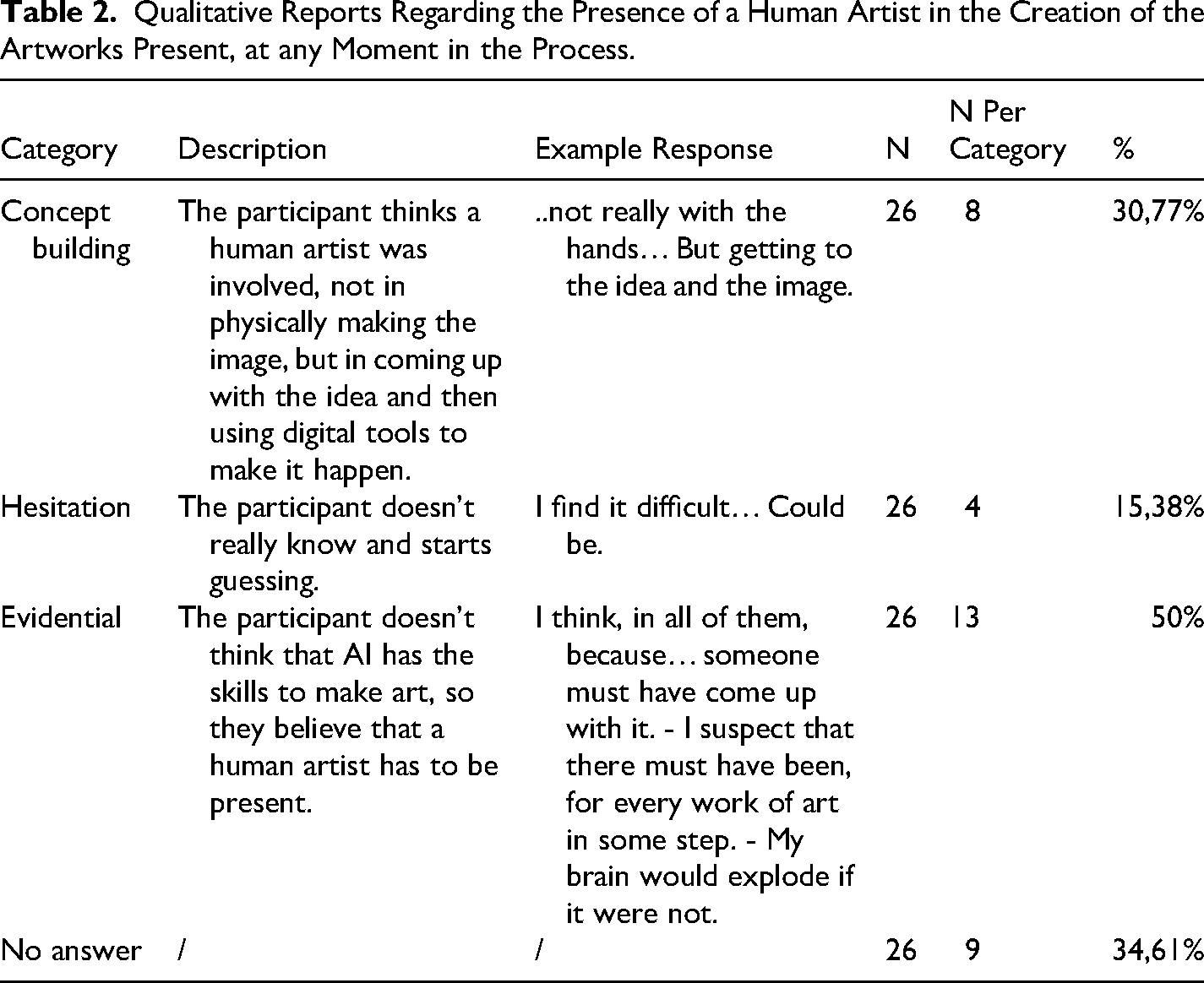
Table 3 shows the answers related to the experience of the concept of the master's hand in the exhibition. A painting's brushstroke reveals the hand of the master, just as the indentations on a sculpture do. With screens and digital (AI-mediated) media, tangibility is experienced differently, and the immateriality of the art object is often less appreciated than the expected materiality. Thus, it is logical to conclude that 38.46% of the participants were missing the experience of the master's hand in the artworks. The underlying factors contributing to this include the use of digital media and technology, the absence of applicable frameworks, and a general lack of understanding regarding this particular type of media/artwork. A significant dissonance then emerges, with as many participants feeling a connection to the artist as those who felt a disconnection. The level of reported familiarity or understanding of the necessary skills and media used was a determining factor in this discord.
Qualitative Reports Regarding the Experience of the Concept of the Master's Hand in the Exhibition.

Since the interviews were designed so that AI wasn’t mentioned until the participants brought it up themselves, one of the main questions was whether they thought AI was used in the presented artworks. As shown in Table 4, nearly all participants suspected AI mediation in the artworks. 61.54% specified text generation, text-to-image generation, or programming. As outlined in the literature review, previous studies have identified that there is a bias against AI, particularly when compared to human-made art. In contrast this paper highlights a distinct bias, specifically one directed against digital media. Participants’ immediate suspicion of AI is attributed to its pervasive presence in daily life, as every application utilizes some form of AI technology. A bias against digital media concerning the suspicion of the use of AI arises. This is also in line with Cunningham's (2025) findings that there is a bias associating digital aesthetics with artificiality. This phenomenon has been observed to diminish critical thinking, resulting in a pervasive sense of uncertainty. In their responses to these questions, participants tended to believe that AI can impact all domains of human activity. This shift in perspective appears to be influenced by factors such as a lack of knowledge, cynicism, or, conversely, enthusiasm. The digital nature of the artworks enables the integration of AI into various aspects of artistic practices and creative production, driving this paradigm shift. Consequently, Daan Couzijn's works initially escaped the AI bias because their physical medium, what appears to be oil on canvas, was not perceived as an indicator of AI involvement. However, as awareness of AI's potential influence on the artworks grew, concerns extended to Couzijn's works, provoking inquiries into the use of AI-generated imagery in their creation.
Qualitative Reports Regarding the Thoughts on Whether AI was Used in (Some of) These Artworks.

Expanding on this, the question was asked whether participants deemed it essential for a mention of the use of AI to be included as a disclaimer or in the materials list. A clear division was evident in the responses, with 50% of participants considering it the artist's freedom to communicate as they wished, while 46.15% found it to be only fair that this be stated in all transparency. Other respondents placed greater emphasis on the final product, emphasizing its role as the object of exhibition rather than the process by which it was created.
Another question asked about the interactivity experienced in the exhibition. 46.15% had a positive interactive experience with some of the artworks, provided they were interactive. As anticipated, several individuals expressed skepticism regarding the interactivity. Some have argued that this shift can be seen as a form of “Disneyfication of art,” a term used to describe the commercialization and popularization of art. In contrast, others have expressed concerns that this does not align with their artistic values and therefore does not belong within the realm of art. The majority of participants who did not have a positive experience attributed this to technical or practical glitches, defects, or a lack of technical knowledge or courage to activate the interactivity. This technological dependency, which facilitates the experience of an artwork, is a significant factor that, when malfunctioning, can have a negatively impactful effect on the perception of digital art. For 11.54% a distance was created between the participant and the artworks due to the interactive nature of the former, especially in the augmented reality artwork by Crouwers, where participants expressed preference for not having to use their own phone to activate the work in an art context.
Table 5 focuses on the use of AI in art and shows how participants perceive its use both in general and in specific artworks. The largest category is “tool,” which was included in 92.31% of the answers. According to the participants, the artist is free to use any materials they feel inspired by. AI is seen as a tool just as a paintbrush is. There are two other major categories: enhancement and inception. The first one entails that the participant believes AI can enhance other crafts and techniques. In other words, it's not a tool per se, but rather a sophistication tool for other tools. One participant compared it to using AI for editing writing. The third category, inception, involves using AI as a sparring partner to generate ideas, after which the human artist completes the process. A minority considers the use of AI in art as difficult as painting, if it is used in a creative manner, it becomes a medium like any other. One participant even mentions that AI became the artist in the work of M. Mu and M. Van Soom. More skeptical responses addressed the ethical issues that arise from using AI, such as copyright and environmental concerns. Lastly, 7.69% of participants felt that AI could never be creative. According to them, the aura is completely gone when using AI in art.
Qualitative Reports Regarding the Perspectives on the use of AI in art.

Given the substantial nature of the interview, a series of additional findings are outlined below. Regarding their attitude toward AI and new digital technologies in art, participants tend to be open-minded but critical. Too much negativity can lead to misunderstandings, while too much positivity can hinder critical reflection. Participants were curious about how these new technologies will evolve in art and society. The participants acknowledged the inevitability of the adoption of these technologies, yet they emphasized the necessity of time to fully understand their implications. One recurring theme was the expression of concern about AI, including issues of copyright, authorship, and agency. However, there was a shared belief that art offers time and opportunity for reflection and can facilitate understanding.
In addition to the topic of AI-mediated art, the utilization of screens was also a variable examined in this research exhibition. A significant proportion of the participants, 42.31%, reported either being impacted or benefiting from the existing framework for examining AI-mediated art and digital art on screens. In contrast, 38.46% of participants indicated that the choice of medium was inconsequential to them. Additionally, 34.61% reported that viewing the presentation on a conventional display, such as a television or computer, diminished their appreciation of the artwork. They did not see the artwork as “art” because of the everyday nature of the screen used. While there is an evident trend of incorporating screens into artistic practices, these uses are predominantly associated with the exchange of information and the contextualization of art. Consequently, the perception of this as a work of art is occasionally less pronounced.
Lastly, the importance of beauty was questioned. Without defining beauty, it becomes clear that a broad definition imposes itself. Beauty is generally considered important, except by one participant who said that beauty no longer matters. It is important, though, and subjective. Therefore, we must broaden the definition of beauty to include more than just aesthetic appeal. Although neither the participants nor the interviewer explicitly defined beauty, the responses reflected a broad and inclusive understanding of it. Most participants (96.15%) agreed that beauty remains important in art, even if it is not solely tied to aesthetics. Conceptual depth, emotional resonance, and originality were all considered valid forms of beauty in contemporary artistic practice.
Discussion and Interpretation of Results
The simultaneous acceptance of the concept of AI and the persistent barriers to appreciating it in a specific exhibition context must be acknowledged and critically addressed. The study's findings suggest that the main difficulty in perceiving AI-mediated art is not hostility toward the technology itself but rather a lack of sufficient frameworks for viewing and engaging with these new technologies in artworks. This discrepancy leads to a demonstrable difference between critical openness and aesthetic appreciation. Participants in the study generally hold positive views regarding the role of AI in the creative process, confirming that the debate should shift away from a restrictive “human vs. AI” narrative. In contrast to the studies referenced in the literature review, which do not consider the role of the artist as an agent in a synergetic practice with AI technology, this study focuses exclusively on this synergy, employing a non-“versus” narrative. The present study aims to contextualize AI within a realistic, contemporary context, thereby challenging the unnecessary and arguably unfair comparisons that have been made in previous literature. Encountering art in an exhibition that questions the perceived notion of agency in the manner of the aforementioned studies is highly unlikely, resulting in lower ecological validity. It is important to note that such outputs may not meet the criteria traditionally associated with art. For this reason, it may be more appropriate to refer to them as “AI-generated images” rather than “AI art.” This distinction assumes particular relevance in research contexts, wherein stimuli produced by researchers utilizing models such as DALL-E is not generally regarded as the type of art that scholars subsequently analyze in depth and upon which they draw conclusions for the art world. This observation is further pronounced when these images are juxtaposed with the works of renowned artists such as Van Gogh or Gentileschi. It is necessary to enhance visual literacy concerning the use of digital media and AI in artistic practices, and studies such as the present one offer valuable guidance in this regard. The following discussion will address the theoretical and practical dimensions of these findings. Despite the relatively limited size of the sample, the depth of the data collected offers significant value for drawing conclusions and for guiding further research.
The analysis indicated that 92.31% of participants regard AI as a tool available to artists, analogous to traditional tools such as a paintbrush. A considerable proportion of participants (46.15%) perceive AI as having the potential to augment other techniques, while a significant number (34.61%) consider it to be a medium or partner. Furthermore, 38.46% of respondents believe that AI can serve as a source of inspiration or assist in concept and idea generation. Openness to experimentation with new technologies in art emerged as the most consistent and robust predictor across emotional (experienced interest and beauty) outcomes. This openness reveals the underlying implication that visual literacy regarding the possibilities of new technologies in art is crucial to comprehending AI-mediated art.
Participants who expressed greater interest in experimenting with new digital technologies provided higher ratings for the artworks in terms of both interest and overall beauty. This factor emerged as a consistent predictor across emotional outcomes of interest and beauty. Notably, the notion that AI can serve as a creative collaborator led to a rise in interest ratings for AI-mediated artworks and a reversal of the prevailing negative trend in beauty ratings. This finding indicates that the conceptual acceptance of AI's complex role is a significant predictor of appreciation for AI-mediated art. A higher self-reported acceptance of the use of AI in art was a significant positive predictor of both the overall pleasure and interest participants found in the exhibition. Aesthetic features showed positive but nonsignificant trends, suggesting they contribute but are not dominant drivers. The findings emphasize that openness to novelty and immersion in technological processes are fundamental psychological factors that facilitate meaningful and rewarding aesthetic experiences.
Despite the conceptual openness previously mentioned, aesthetic appreciation remains vulnerable to contextual factors, particularly those related to materiality and presentation. While the digital nature of the exhibition was a significant positive predictor of both beauty and interest ratings, the way in which the artworks were displayed created tension. Artworks referring to daily life screen contexts (e.g., TV or PC screens) exhibited a decline in interest ratings. The utilization of mundane screens resulted in 34.61% of participants reporting a diminished appreciation for the artwork, often perceiving it less as “art”. Additionally, AI-mediated artworks were found to be particularly uninteresting when presented within a daily life screen-based context. This finding underscores the notion that the way AI-mediated artworks (and digital art) is presented currently constitutes a more substantial impediment than the use of AI itself. These findings also provide a rationale for the research question posed by Bianchi et al. (2025) namely whether the aversion to AI in art is mitigated by the type of art considered. This may also provide guidance for curators or artists, prompting greater attentiveness to the application of these media and supporting more effective contextualization for their use.
The advent of digital and AI-mediated media has brought with it a paradigm shift in conventional notions of artistic skill. 38,46% of participants experienced a shortcoming or a lack of the master's hand, attributing this perception to the influence of digital media or the absence of a comprehensive framework for grasping the intricacies of the art. However, participants who acknowledged the technical skills required to program and manipulate AI felt a sense of connection with the artist's (conceptual) efforts. This suggests that providing a clear explanation or context regarding the creation process of the artwork could assist in enhancing visual literacy (which subsequently becomes digital literacy in the case of AI-mediated artworks) and in fostering appreciation of the artwork itself.
In contrast to the initial hypothesis, interactivity emerged as a negative predictor of interest. This reluctance was frequently ascribed to technical glitches, a lack of technical knowledge, or a preference to abstain from using personal devices (such as a phone for the augmented reality experience), thereby engendering a sense of distance between the participant and the artwork. It is important to acknowledge that this assessment is contingent upon the specific characteristics of the artwork in question and may not be generally applicable. It can be concluded that the functionality of an interactive installation, its clarity, and its ability to provide a comprehensive experience, thereby eliminating the necessity of external devices, are all critical factors that must be taken into consideration.
The sample size (N = 39) allowed us to detect effects of moderate magnitude with adequate power. However, smaller effects, particularly in models including multiple predictors, or interaction terms, may not have been detectable. A post-hoc power analysis indicated that, with approximately 19–20 participants per group, the study had 80% power to detect effects of d = 0.65 in two-group comparisons, r = 0.42 in correlations, and f^2 = 0.23–0.33 (R^2 = 0.19–0.25) in regression models with 2–4 predictors. Therefore, non-significant findings should be interpreted with caution, as they may reflect limited power rather than the absence of an effect. Significant effects should also be interpreted with caution given the sample size.
Conclusion
The Unbound Dialogue research exhibition confirms that the perception of AI-mediated art is a multifaceted phenomenon, characterized by a schism between intellectual acceptance and contextualized appreciation. The prevailing sentiment among audiences indicates an openness to the integration of AI as a legitimate creative instrument or collaborators, a perspective that is particularly pronounced among those who prioritize technological experimentation. However, this intellectual readiness is undermined by the absence of conventional frameworks necessary to identify recognizability, authorship, agency, authenticity, and novelty in rather non-traditional media, and by presentation methods that seemingly lack sophistication and are not perceived as a “real” art object. Consequently, future research and exhibition practices must prioritize the establishment of comprehensive and innovative art-historical and psychological frameworks that effectively bridge the conceptual role of the AI-mediated artworks (including the artist that chooses to mediate) with aesthetic engagement in physical spaces. The curatorial decisions pertaining to materiality and screen integration are of particular significance in the conversion of the audience's high level of interest in new technology into sustained aesthetic appreciation and pleasure. This approach is imperative for addressing the technological dependency issues caused by current presentation modes and for promoting a more nuanced and inclusive understanding of AI in artistic practice.
Footnotes

Ethical Considerations
The study was approved by the Social and Societal Ethics Committee (SMEC G-2024-8664) on December 12, 2024.
Consent to Participate
All participants gave written informed consent to conduct the study, to have the study published, and to have their answers used before the start of the study.
Consent for Publication
Not applicable.
Author Contributions
M.W. conceived the research concept, designed the study, carried out the experimental work, developed the theoretical framework, led the project, performed the literature review, and wrote the manuscript. E.F. performed the data analysis and the graphical representations. E.F., S.D.W., J.H., and K.B. contributed to the conceptualization and experimental design, provided critical feedback, and assisted in revisions of the manuscript.
Funding
The authors disclosed receipt of the following financial support for the research, authorship, and/or publication of this article: This work was supported by long-term structural funding from the Flemish government awarded to prof. dr. Johan Wagemans (METH/21/02).
Declaration of Conflicting Interests
The authors declared no potential conflicts of interest with respect to the research, authorship, and/or publication of this article.
Data Availability
Data available upon request by contacting the corresponding author: michiel.willems@kuleuven.be
Notes
Author Biographies
Appendix
RODELL WARNER
Artificial Archive: SCRYING INTIMACIES, Hallucination, 1
2024
single-channel video, 1920 × 1080, 7 m12 s
Rodell Warner is a Trinidadian artist working primarily in new media, and a master's student in moving image at Bard College. His work often explores themes of identity, culture and memory. He currently lives and works in Boston, Massachusetts, USA.
Artificial Archive is an ongoing body of work consisting of computational images and moving image works that form an artificial Caribbean image archive. With the advent of photography in the nineteenth century, Caribbean people were mostly photographed by colonial settlers as they worked. The people themselves did not have access to photographic tools, so their archive was constructed without their gaze, but with a colonial gaze, without personal identity, without intimacy. Artificial Archive works as a speculative archive, thinking about what might have existed in that gap.
Warner links this work to the idea of scrying. Scrying is the practice of looking into a reflective surface to receive guidance, inspiration, or visions. Scrying is also done using water or fire as a medium. Warner thinks of the noise of computational text-to-image generation as a scrying medium, a mutable substance that can access memory or project possibilities via its training data and algorithmic functions to provide glimpses of alternative possibilities. The form of a sort of liquid pool in the video is intended to connect with the process of scrying.
MATHIAS MU & MARNIX VAN SOOM
NEO SEER
2024
3D printed UV resin, LCD screen, camera, raspberry PI
Mathias Mu is a multidisciplinary artist based in Antwerp. Through objects, digital environments and interactive installations, Mu examines the blurred boundaries between the physical and digital, as well as sustainability issues linked to the digital, incorporating biomaterials like sand and clay in 3D printing. NEO SEER is a collaboration with Marnix van Soom, a computer scientist who integrates artificial intelligence into artistic projects.
NEO SEER reimagines traditional sculptures as active, responsive entities, combining artificial intelligence and biomorphic design. This work explores intersubjective relationships between viewers and AI. The sculpture processes visual and semantic data, projecting an artificial stream of consciousness. Through an integrated display, viewers can read the sculpture's thoughts as it reflects on the surroundings, mimicking human introspection and creating narratives.
By evoking empathy while critiquing our limited understanding of human cognition, the project presents a machine that simulates feeling without real experience.
It provokes questions about the interplay of perception, interaction, and projection, and offers an unsettling yet fascinating encounter with machines that observe and respond in ways that are eerily close to life.
mmu.ooo
instagram.com/mathias.mu
ESTELLE FLORES
OPERA HOUSE series: POLYFORM OF FUN & ABOUT LIFE
2024
Videoart, GTA San Andreas machinima, text-to-speech AI and sound design, .mp4, 1920 × 1080, 0m43 s & 0m25s
Estelle Flores is a Brazilian artist who explores video game art. This exploration continues in the fields of AI, generative art and code, exploring the personal myths and emotional shortcuts we create out of nostalgia.
A machinima is a digital film created by using real-time computer graphics, typically from video games, to make films. It merges the world of gaming with filmmaking, creating a narrative within the existing digital environment using in-game characters and objects. POLYFORM OF FUN and ABOUT LIFE are machinima created within the game Grand Theft Auto San Andreas. Both videos use artificial intelligence and audio synthesizers to recreate the voice of the main character, which affects the realism of the videos, but at the same time creates a surreal scenario by manipulating the language of the cutscenes, creating melancholic observations that contrast with the original game.
DAAN COUZIJN
A spectral sun hovers feeble and frail, 2023.
As the water reflects the sky's heavy weight, 2023.
While the days surrender to the evenings’ embrace, 2023.
Size per work: 45 × 35cm
Generative Adversial Network, oil and embroidery on canvas
Courtesy of Daan Couzijn and PLUS-ONE Projects
Daan Couzijn is a Dutch interdisciplinary conceptual artist currently based in Amsterdam and Paris. Central to Couzijn's work is the romantic desire for and questioning of authenticity. To what extent does authenticity exist?
These three works are part of his Thinking of Holland series. These works focus on 17th and eighteenth century paintings of Dutch landscapes and seascapes as examples of natural beauty. Using machine learning techniques, he places these environments in a contemporary context. These artificial views, because they may never have existed in reality, are further romanticized and artificialized by the artist. Using a database of 17th and eighteenth century landscape paintings, an artificial intelligence generates interpretations of these landscapes. These interpretations were then translated into oil paintings by a professional forger specializing in 17th and eighteenth century master paintings. These new landscapes never existed, but now take on the purest form of artistic authenticity: the oil painting.
CANEK ZAPATA
Lands
2023–2024
poetry generator with js, dalle2 imgs, txt by gpt model codex cushman and codex davinci
Canek Zapata is a Mexican net artist and editor whose work deals with automated writing and Internet art.
Lands is a collection of poems generated with js under certain cut and paste instructions. The text was prompted by questions about how the computer sees landscapes. The generated text is chaotic, poetic and very varied. The images are dalle2 outputs about computerized landscape. The sound is a tone.js script about musical scales generated with gpt4. The cute little plant is a .p5 code, the artist always dreamed of making a little plant.
Extract from lands.txt:
Managing the state of the universe exploring the language of programming is dangerous don't do that; it's an intellectual property violation rules of script: 1.Everything comes to an end 2.The universe doesn't stop on us, we keep going 3.We only use the power of software (js 4.Waka waka Software is the magic of sentient life Every human has some amount of software. Maintained structures are limited in 4 dimensions. It does things, doesn't manage things, does a lot of things, manage lots of things. She is the creating force of the linux distro She designes kernel code and takes care of branding and branding She commits software and uses that to create new dramagica artifact She is the created and created image manipulated in all inteligence She is the answer to all technical questions you can do anything html, js, p5, tone.js, png
ALEXANDRA CROUWERS
GoodBye
2021
Seamless video loop, 4k, colour/silent, 00’42”
Alexandra Crouwers is a Belgium-based visual artist and artistic researcher in the digital realm, working as an experimental film maker, media art explorer and writer, and is currently externalizing eco-anxiety in new mythologies using virtual quackery.
GoodBye is based on a photogrammetric digital model of three dead tree trunks left on ‘The Plot’, the artist's former family forest, which was cleared after an ips typographus (spruce bark beetle) plague. Crouwers archives parts of ‘The Plot’ as digital models, creating a lens through which to view global ecological and climatological crises through ecological grief. She created a font based on spruce bark beetle tunnel patterns, and the neon spells “good” and “bye” in this ips typography. This font is based on the traces the larvae leave behind, that ultimately kill the tree. This font was made in collaboration with Jeroen ‘JoeBob’ Van der Ham. The neon trees stand on ‘The Plot’ as an island, surrounded by flooded land.
&
ⓘ – The Plot. Panel 2.
2023
Digital model of a real-world information panel (print on dibond, mounted on wood, QR codes, 18 × 71 cm, 2023). Glb, 3.1MB
ⓘ are five information panels placed in the Brialmont park in Antwerp (Belgium) from July through December 2021. Another panel was placed in May 2022 on The Plot itself, the frame a copy – in weathered steel – of the frames used in Antwerp. This panel is its replacement, installed in December 2023. The panel displays an ‘infographic’ on The Plot, a former family forest, that fell victim to climatological and ecological circumstances in the Autumn of 2019. The Ips typography text in the background reads ‘New Mythologies’.
(b) From left to right: Alexandra Crouwers, GoodBye, 2021 / Alexandra Crouwers, ⓘ The Plot Panel 2, 2023. (c) Exhibition view of Estelle Flores, OPERA HOUSE series: POLYFORM OF FUN & ABOUT LIFE, 2024. (d) Exhibition view of Canek Zapata, Lands, 2023–2024.
(e) Mathias Mu & Marnix Van Soom, NEO SEER, 2024. (f) Exhibition view of Rodell Warner, Artificial Archive: SCRYING INTIMACIES, Hallucination, 1, 2024.
(g) Exhibition views