







Abstract
This study investigates the impact of narrative voice (first-person vs third-person) and reception mode (reading vs listening) on empathy, identification, and parasocial interaction in literary engagement. It is motivated by contradictory findings regarding how narrative voice influences readers’ emotional and cognitive responses to literary texts, as well as the question of whether audiobooks condition the impact of narrative voice. In an experiment, participants engaged with a novella with first- or third-person narration presented in either written or audiobook format. Although the results indicate that narrative voice does not affect social emotions, listening to an audiobook reduced self-oriented emotions, such as empathic stress and emotional involvement, relative to reading print. No significant effects were observed for all other subdimensions related to empathy, identification, and parasocial interaction. It thus appears that by introducing an audiobook performance as a layer of distance, participants were prevented from experiencing strong self-oriented emotions.
Central to the experience of reading or listening to a literary text is the opportunity for readers to immerse themselves in the thoughts and emotions of the characters, draw inferences about their intentions and behaviours, and anticipate an emotional and behavioural world for the fictional characters based on their own experiences (Hartner, 2012; Jacob et al., 2020; Lusin, 2014). This requires having the chance to take part in a situation from an observational role (Breithaupt, 2009; Mar et al., 2011). The narrative perspective – the textually anchored viewpoint that is chosen and directs the focus, thereby shaping the relationships between characters, objects, actions, or events – offered by a narrative text may be crucial to the intensity of the aesthetic and emotional experience during reading or listening.
Literary studies and narratology have long investigated the construction and implications of perspectivization within narrative texts (Niederhoff, 2009; Stocker, 2003). However, the narrative techniques or textual features covered by the term narrative perspective are ambiguous within the theoretical discourse, as different terminology has emerged to describe similar narrative structures (Bonheim, 1990; Schmid, 2014; van Peer & Chatman, 2001). The term perspective is often imprecisely defined and can encompass a range of aspects, including grammatical person (e.g., a first- or third-person narrator), functional role (authorial vs reflector), cognitive dimensions (narrator's knowledge relative to that of the characters), topological relationship (internal or external viewpoint, proximity to the events), and axiological dimensions, involving evaluative stance and subjective or objective representation (Schmeling, 1991). Due to the varied narrative structures studied under the umbrella term of narrative perspective and the diversity of reader effects examined, the empirical findings in this area remain inconsistent.
In this context, it has frequently been posited that different narrative perspectives can lead to different reading experiences (Martínez & Scheffel, 2016; van Krieken et al., 2017). Empirical research has, however, explored different aspects of perspective in narrative discourse, yielding ambiguous results of how narrative perspective affects reception (Bohan & Filik, 2018; Dixon & Bortolussi, 2019; Eekhof et al., 2023; Kaakinen et al., 2002; Oatley, 1999). This ambiguity is primarily due to the diverse aspects investigated across studies. For example, one study showed that lexical viewpoint markers are less important than the reader's social-cognitive abilities for experiencing social emotions and character engagement during reading (Eekhof et al., 2023). However, another study reported that, in general, the reading perspective (relevant vs irrelevant) did not affect the quality of the overall semantic representation and recollection of a text; only participants with a low working memory span were affected by the perspective (Bohan and Filik, 2018). In contrast, other studies have found perspective-relevant information to have a positive effect on the processing of informational texts relative to perspective-irrelevant information and demonstrated that perceptual attribution supports character reliability and narratorial affinity, which increases the reader's adoption of that character's stance (Dixon & Bortolussi, 2019; Kaakinen et al., 2002).
For this study, we integrate and extend previous research on literary processing by concentrating on the specific aspect of narrative voice, which, in Genette's (1994) approach to narratology, forms a core dimension of narrative perspective. Genette's framework has been adopted because his internationally established terminology provides one of the most comprehensive and systematically articulated models for describing perspectivization, while allowing for the precise and separable manipulation of textual properties in empirical analysis (e.g., Niederhoff, 2009). Narrative voice is often referred to as point of view or defined by personal pronoun; it is typically distinguished as either a first-person (homodiegetic) or third-person (heterodiegetic) perspective. Studies focusing on the effects of narrative voice suggest that adopting perspectives based on pronouns (I/he/she/they) is not universal or necessary for comprehension, but rather depends on the narrative context and the reader's tendency to immerse themselves in the described events (Brunyé et al., 2009; Brunyé et al., 2016). Indeed, in some cases third-person narration may enhance the perceived trustworthiness of the narrative's information (van Lissa et al., 2016).
Narrative Voice and Social Emotions
Social emotions such as empathy with characters, identification, and parasocial interaction can confidently be regarded as key components of immersion into literary worlds, and thus among the primary motivations for reading literary texts (Eekhof et al., 2023; Green & Brock, 2000; Jacobs & Lüdtke, 2017). The term empathy encompasses different psychological phenomena, and there is no standard definition of this concept (Batson, 2009). Here, we understand empathy as “a vicarious emotion comprised of multiple subcomponents that allow individuals to recognize and share the cognitive and/or affective state of a perceived other” (Mumper & Gerrig, 2017, p. 110). Empathy also forms the basis for identification (Cohen, 2001). When the readers of a narrative adopt the character's identity, they “simulate the feelings and thoughts appropriate for the events that occur” (Cohen, 2001, p. 252). Identification is defined as “a process that consists of increasing loss of self-awareness and its temporary replacement with heightened emotional and cognitive connections with a character […] as a response to textual features that are intended to provoke identification” (p. 251). Parasocial interaction represents yet another important emotional and cognitive dimension of a person's mediated experience. This construct refers to the recipients’ experiences and behaviours that typically occur in a (two-way) communicative situation with a real counterpart but in this case with a character or real person as a response to consumed content such as television, radio, social media streams, or reels (Appel et al., 2002). This concept is also applicable and measurable with self-report scales for the reception of literary texts (Ingram & Luckett, 2019 ; Liebers & Schramm, 2017).
By altering the relationship between the reader and a character, narrative voice might affect the reader's social emotions linked to the literary characters. Seeing the character as a proxy for the self (first-person) or as another person (third-person) could affect the degree to which a reader empathizes, identifies, and feels a parasocial engagement with that character. However, the empirical research linking narrative voice to literary social emotions is still sparse. Some studies from the area of health communication and health education can inform expectations, but the impact of narrative voice on the readers’ emotions is not clear. Some studies do not find a significant difference in social emotions when reading the same text as first- or third-person narration, while others find a higher level of social emotion when the text is written as either a third-person narration or a first-person narration (Banerjee & Greene, 2012; Chen & Bell, 2022; Igartua et al., 2021; Ma et al., 2023).
While some research has used novel excerpts or short stories as stimuli, the question of whether the effects of narrative voice on social emotions translate to the reading of literature is far from answered. Three studies have used, among other scales, the Emotional Engagement subscale of the Story World Absorption Scale, which measures subjective feelings of empathy, sympathy, and identification for and with a character (Kuijpers et al., 2014). While Hartung et al. (2016) did not find a significant association between emotional engagement and narrative voice, in a replication study with a larger sample, emotional engagement was stronger when the stories were presented as first-person narrations, and this finding has also been confirmed by two other studies (Hartung et al., 2017a; Samur et al., 2021). A study by Wimmer et al. (2021) showed that narrative perspective (narrative voice and focalization) does not seem to have a significant effect on the extent to which narratives modulate social and moral cognition, either directly or indirectly via transportation and identification. However, studies exploring the effect of narrative voice on identification alone have shown different results. For example, Segal et al. (1997) reported a higher identification with the protagonist when reading stories with first-person narration, while other studies explicitly analysing the effect of narrative voice on identification with a stigmatized protagonist did not find a significant effect (Christy, 2018; Kim et al., 2020). The perceived similarity between the reader and the described character might also affect the relationship between narrative voice and experience taking (i.e., complete identification with the character). Reading a first-person narrative with a similar character elicits levels of higher experience taking than reading a third-person narrative or a narrative containing a character less similar to the reader (Kaufman & Libby, 2012).
To the best of our knowledge, the effect of narrative voice on parasocial interaction has not been explored. In a social media context, parasocial interaction is positively associated with social presence, a concept widely applied in mediated environments such as online platforms, virtual reality, and film, with various definitions across different contexts describing the sense of being there with another real and sentient person (Kim & Song, 2016; Kreijns et al., 2022; Oh et al., 2018). The only published study connecting social presence with written text – in this case, the feeling of social presence used as the sense of togetherness with the character – showed that social presence is greater when reading a first-person narration (Kim et al., 2020). Given the review of extant literature above, our first hypotheses are:
H1a: Narrative voice (first-person vs third-person) affects empathy with the protagonist of a literary text.
H1b: Narrative voice (first-person vs third-person) affects identification with the protagonist of a literary text.
H1c: Narrative voice (first-person vs third-person) affects parasocial interaction with the protagonist of a literary text.
Narrative Voice in Reading Versus Listening
The question of the significance of narrative voice becomes even more important as the consumption of literary texts in the form of audiobooks is on the rise globally (The European and International Bookseller Federation, 2024). In the United States alone, audiobook revenue grew almost 80% within the last five years, and more than 50% of US-American adults listened to an audiobook in 2024 (Anderson, 2025; Audio Publishers Association, 2025). Numerous studies have also highlighted the critical role of the performing voice in shaping emotional responses such as empathy, sympathy, and other absorption experiences (Björkén-Nyberg 2020; Have & Pedersen, 2016; Lange et al., 2022). The performing voice of an audiobook is an integral part of the reception and gives the text an additional dimension that changes the literary experience (Spjeldnæs & Karlsen, 2022). A vocal performance can also significantly alter the tone of the narrative, influencing emotional interpretation and overall evaluation (Björkén-Nyberg, 2020). Emotional connections, such as empathy and identification with characters, may therefore change when a performing voice presents the story (using first-person or third-person pronouns) and replaces the reader's possible internal voice with that of a real human being or an artificial intelligence (AI) agent. A performing voice introduces an additional dimension to the text, potentially intensifying emotional involvement and, thus, empathy. The combination of the steadily increasing relevance of audiobooks coupled with insights into the importance of vocal performance in the audio reception of literature leads us to inquire whether, and to what extent, the meaning of narrative voice shifts when a text is heard rather than read.
Thus far, any differences in the effects of narrative perspective while listening to an audiobook compared to reading a written text on empathy, identification, and parasocial interaction are not clear. Two experimental studies have reported contradicting results about general trait empathy (not specific empathy with the protagonist of the story) after listening to or reading a story. Alexandri (2022) reported that general trait empathy did not change after listening to an audiobook but decreased after reading the text. In contrast, Somers (2020) did not find a difference in general trait empathy after reading or listening to a story.
The empirical studies are similarly sparse and the results contradictory when looking at empathy with the character in a story. Alexandri (2022) found that participants’ emotional engagement was smaller when they listened to the audiobook compared to reading the written text. Even less is known about the effect of audiobooks on identification. An accent can influence perceived similarity with a character, which could lead to more – but also to less – identification with the protagonist, depending on the listener and the voice performance (Dragojevic et al., 2024). The influence of the narrative voice on the parasocial interaction may also shift when a text is consumed through an audiobook rather than being read, as the voice of the audiobook performer could significantly affect this relationship.
Participants in qualitative studies tend to report that they enjoy audiobooks, because they enjoy listening to someone speaking, and that audiobooks function as a companion and help them to feel less alone (Best et al., 2020; Kosch et al., 2025; Tattersall Wallin, 2022). Other auditory formats such as podcasts and radio can also spark parasocial interaction (Schramm et al., 2024). Nevertheless, a study comparing human and synthetically generated voices reading audiobooks found a rather low level of parasocial interaction, while another study connected parasocial interaction when reading stories to recognition and pleasantness (Gregg, 2022; Vinney & Vinney, 2017). To the best of our knowledge, however, no studies have specifically examined the differential effects of audiobooks on parasocial interaction relative to written texts.
The audiobook performer's interpretation of a first-person narration may also provoke different listener responses compared to an internally generated first-person voice during silent reading. The adoption of the “I” of a text might be more difficult for a listener when there is an auditory opponent claiming the “I” for themselves in the form of the performing voice. However, a study using fMRI found no significant difference in brain activation related to narrative voice when participants listened to two short stories, which aligned with their subjective evaluations of emotional engagement (Hartung et al., 2017a). These findings suggest that the additional facet of a performing voice might cancel out the effects of the narrative voice. The body of research remains limited, however, and more studies on the effect of audiobook listening in general but also in association with narrative voice on social emotions are needed to draw definitive conclusions. Thus, our second and third hypotheses are:
H2a: Reception mode affects the readers’/listeners’ empathy with the protagonist.
H2b: Reception mode affects the readers’/listeners’ identification with the protagonist.
H2c: Reception mode affects the readers’/listeners’ parasocial interaction with the protagonist.
H3a: There is an interaction between narrative voice and reception mode in terms of their effect on empathy.
H3b: There is an interaction between narrative voice and reception mode in terms of their effect identification.
H3c: There is an interaction between narrative voice and reception mode in terms of their effect on parasocial interaction.
Methods
We followed the research and publication ethics from the American Psychological Association Ethical Principles of Psychologists and Code of Conduct. This study received the approval from the Institutional Review Board of the Faculty of Social Science, University of Vienna. The stimulus materials and data are uploaded here: https://osf.io/kzqp3/overview?view_only=91294332fe6745c5a4890626932180b3.
Sample
For an apriori power analysis, we used the size of the effect of narrative voice on narrative engagement reported by Samur et al. (2021). This suggested an N = 90 would be sufficient. However, because other studies did not find a significant effect, we planned to have at least twice as many participants in our sample (after excluding participants). The original sample therefore consisted of 225 participants. We excluded participants if they fell asleep during the audiobook listening conditions (N = 11) or due to technical issues (N = 1), language barriers (N = 4), and prior knowledge of the original text (N = 1).
The final sample thus consisted of 208 German-speaking participants (mean age: 33.55 (SD = 13.31), 18–74 years; 168 women, 35 men, 5 nonbinary people). As we were interested in participants who interact with literature in some way in their leisure time, we recruited them via posters and flyers at physical (audio-)bookstores and libraries, as well as online in relevant social media groups. Participants received €20 for their participation in the experiment.
Setting and Procedure
The experiment used a between-subjects 2 × 2 factorial design with four experimental groups. One group read the text presented as a first-person narration (N = 55), one group read the text presented as a third-person narration (N = 56), one group listened to the text via an audiobook presented as a first-person narration (N = 46), and one group listened to the text via an audiobook presented as a third-person narration (N = 51). The participants were randomly assigned to one of the four experimental groups. Before reading/listening to the text, participants gave their written consent to participate in the experiment. They were then seated in a comfortable reading chair, and the stimulus was administered through a printed book or an audiobook played through external speakers. The participants listened to the audiobook via speakers placed about two metres away from them and were allowed to adjust the volume to their liking. After reading or listening, the participants filled out the empathy, identification, and parasocial interaction questionnaires, and lastly, a short demographic questionnaire (always in the same order). Afterward, the participants were informed about the goal of the study and received their remuneration.
Materials
Stimulus
We used the novella Ein Abschied (A Farewell) written by the highly renowned Austrian author Arthur Schnitzler, first published in 1896, and already praised by contemporaries for the convincing psychological portrayal of the main character (Lindner, 2016). The narrative perspective plays an important role in Schnitzler's works and is widely regarded as a significant contribution to literary modernism, along with the psychological depiction of the inner life and intense emotionalization of the characters (Hubmann, 2013; Scheffel, 1999; Szendi, 2000). The story is about a man waiting for his married lover and becoming increasingly desperate over the course of several days until he learns that she had fallen terminally ill and ultimately died. The burden the protagonist has to bear is that, until the very end, he cannot reveal himself to his lover's family, cannot say goodbye, and wonders why he has always denied his relationship with her. The story was originally written from a third-person perspective and features the author's typical style of describing the protagonist's inner feelings and thoughts.
We selected this text because it allowed us to create a manipulated version by simply changing the pronouns, without the need to make any further alterations, thus resulting in a first-person narrative that maintained almost exactly the same length. As we manipulated the text, we were not able to use the original printed book. We therefore printed identical-looking paperback books containing one of the two text versions and other short stories by the same author. In its original version, the text is 6,365 words long, and the manipulated version was 6,362 words long. The mean reading time for the two reading conditions was 27.18 min (SD = 7.89; first-person narration: 26.20 min, SD = 6.92); third-person narration 28.42 min, SD = 8.68).
Because we manipulated the text, we were also not able to use the original audiobook. We therefore hired a professional audiobook performer to read both versions of the text. In a small pilot study, we asked participants (N = 37) how well the audiobook performer's voice suited the text and for their overall evaluation of the performing voice using two multiple-choice questions and one open question for general notes. The performing voice was rated M = 4.08 (SD = 0.98) as professional and M = 3.73 (SD = 1.15) as appropriate for the text (on a 5-point Likert scale). The performing voice was often described by the participants in the pilot study as adequate for the text, pleasant, clear, deep, and husky, but also calm, unemotional, and neutral, which suited the parts of the text that the participants heard. The critique was mostly that the voice was too neutral. However, as the results were to our satisfaction, we used these recordings. The first-person audiobook version was 41 min, and the third-person audiobook version was 42 min.
Instruments
To evaluate the participants’ empathy towards and identification with the protagonist, we used the subfactors sympathy/empathy, empathic distress, and identification from a German translation of the Narrative and Aesthetic Feelings scale by Koopman (2015). These subfactors consisted of 13 items, which were rated on a 7-point Likert scale. For the audiobook conditions, we used slightly adapted versions of these items. The whole scale was translated using the TRAPD approach (Translation, Review, Adjudication, Pretest, Documentation). In our sample the Cronbach's α values for these factors were: sympathy/empathy: α = .81, empathic distress: α = .83, identification: α = .59. Due to insufficient internal consistency, we had to exclude the identification subfactor by Koopman (2015); however, we still used the identification subscale by Appel et al. (2002, see below).
From the German Aspekte des Leseerlebens scale (aspects of the reading experience) developed by Appel et al. (2002), we used the subfactors emotional involvement; the subfactor identification with its sub facets admiration, similarity versus distance, and compassion; and parasocial interaction; these three subscales comprised 20 items, which are rated on a 6-point Likert scale. In our sample, the Cronbach's α values for these factors were: emotional involvement: α = .85, admiration: α = .77; similarity versus distance: α = .71, compassion: α = .63, and parasocial interaction: α = .71. Correlations are shown in Table 1.
Sub-Scale Correlations.
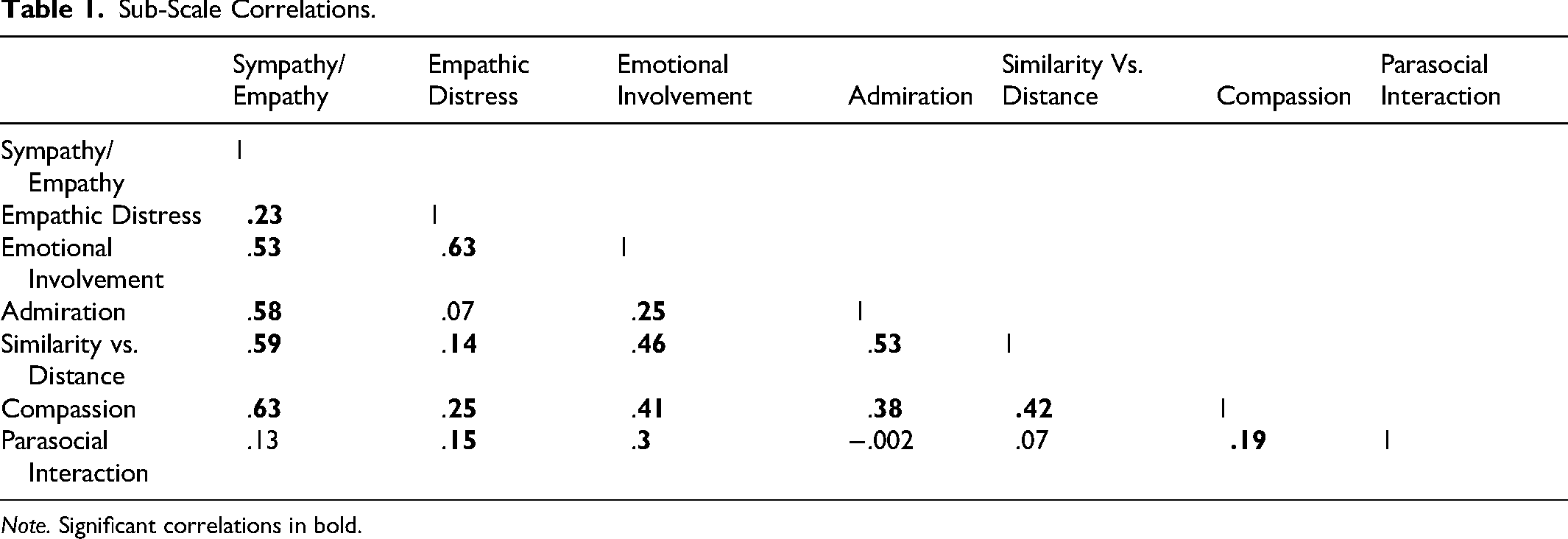
Note. Significant correlations in bold.
Data Analysis
To analyse the interaction of the independent variables, we conducted a 2 × 2 factorial ANOVA with reception mode (audiobook listening/print reading) and narrative voice (first-person/third-person) as between-subject factors in SPSS version 30. Because most of our results were not significant, we conducted equivalence tests using TOSTER (Lakens & Caldwell, 2017). We set the bounds to η2 = .0587, as the lower bound for a medium effect is η2 = .0588, so even if an effect exists, it would be small at best (Cohen, 1988). Our level of significance was p = .05.
Results
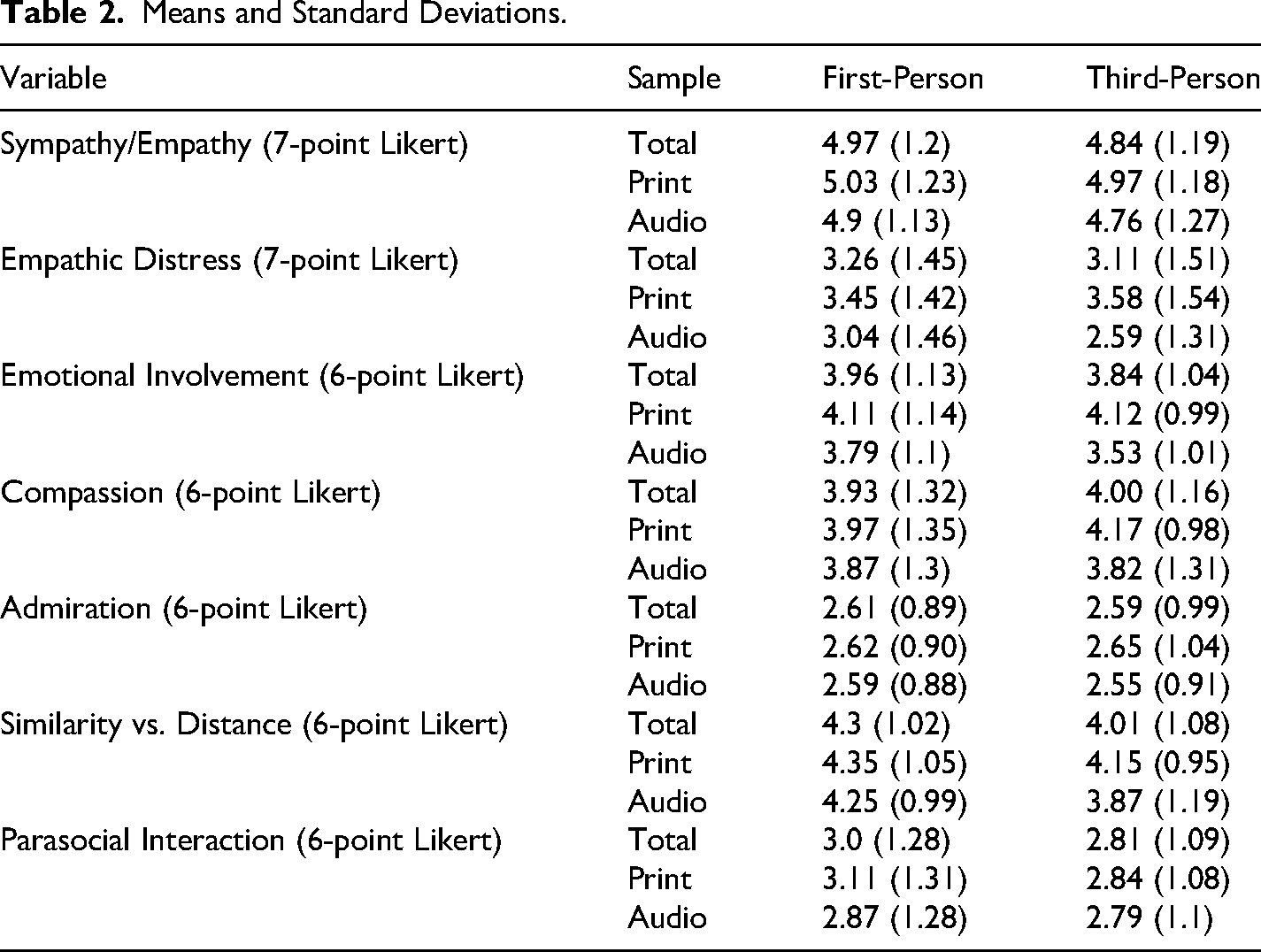
The mean results for each condition are shown in Table 2. The hypotheses were that the narrative voice (first-person vs third-person), the reception mode (print reading vs audiobook listening), and the interaction of these variables would affect empathy, identification, and social interaction with the protagonist. Our results did not, however, support the assumptions that narrative voice affects any of the measured social emotions. Neither the main effects nor the interaction effects were significant (see Table 3). Further, most of the main effects of reception mode were also not significant. Only participants in the print conditions experienced significant higher empathic distress and emotional involvement (see Table 3). The equivalence tests showed that all non-significant effects would be small at best (see supplementary material).
Means and Standard Deviations.
ANOVA Results.
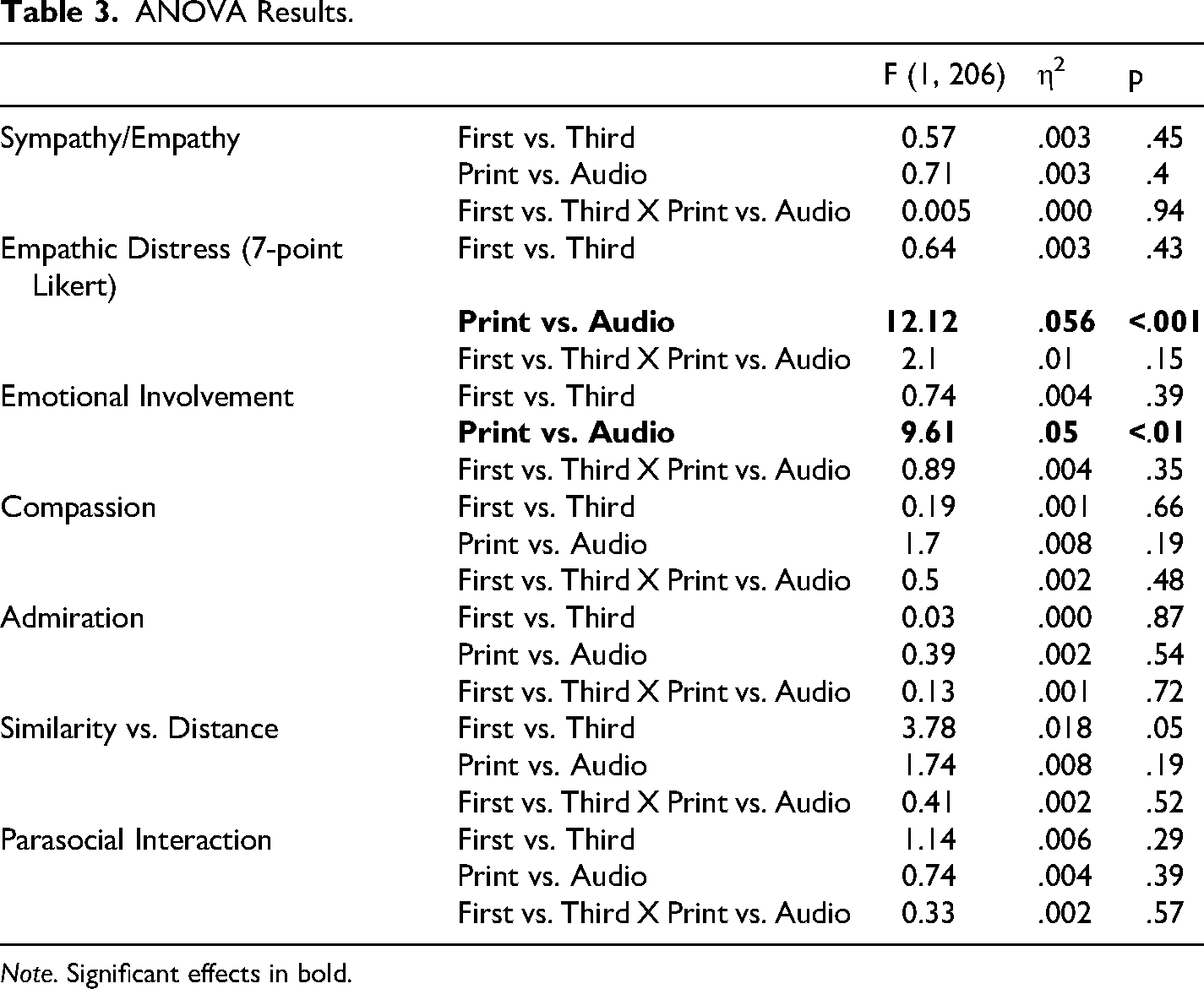
Note. Significant effects in bold.
Discussion
Given the contradictory findings in existing research on the effects of narrative voice on reading experiences and the absence of studies examining whether audiobooks affect this impact, this study explored how narrative voice (first-person vs third-person) and reception mode (reading vs listening) affect empathy, identification, and parasocial interaction during engagement with a literary text. Contrary to widespread theoretical assumptions (Martínez & Scheffel, 2016; Van Krieken et al., 2017), the results showed that narrative voice did not significantly affect different measured dimensions of empathy (i.e., emotional involvement, emotional distress, or sympathy with characters), concepts associated with identification (e.g., admiration, similarity vs distance, and compassion), or parasocial interaction when engaging with literary texts.
These findings align with previous empirical studies that also reported results contradicting theoretical assumptions about the influence of narrative perspective on emotional responses to literature (Eekhof et al., 2023; Hartung et al., 2016). A plausible explanation for these theory-conflicting findings is that emotional engagement may be moderated by additional factors, such as the nature of the text itself. In this study, Arthur Schnitzler's Ein Abschied, a novella with rich psychological depth, may have fostered empathy regardless of narrative voice due to its intense focus on the protagonist's inner feelings and thoughts, whether presented from the first-person or third-person perspective. Because the text could be easily manipulated regarding personal pronouns, the difference between narrative voices may not have been significant. This suggests that the emotional depth of the content might outweigh the structural aspect of perspective, which indicates that literary characteristics can modulate the effect of narrative voice. The results of other studies support this claim and have shown that narrative focalization is a more important aspect of narrative perspective than narrative voice (Houghton, 2021; Jumpertz & Tary, 2020). Or perhaps literary theorist Wayne Booth was right, and the distinction between first-person and third-person perspective is “perhaps the most overworked distinction,” and “[t]o say a story is told in the first or the third person will tell us nothing of importance unless we become more precise and describe how the peculiar qualities of the narrators relate to specific effects” (Booth, 1961, p. 150).
As such, future studies should pay closer attention to how the narrative voice interacts with features of the narrative itself or the narrator/main character. Another limitation of our findings is that we only used one text with one main character. Given the potential influence of character on identification, future studies should give more character variety by using more texts with different characters.
Most results for the effect of reception mode were not significant. We did not find that reception mode had any effect on participants’ sympathy/empathy with the characters or on any of the three subfactors of identification (i.e., admiration, distance vs similarity, and compassion). However, we did find a significant main effect of reception mode on empathic distress and emotional involvement. Participants reading the printed text experienced stronger emotions than participants listening to the audiobook, which is in line with the results by Alexandri (2022).
Batson et al. (1987) differentiate between two types of emotions evoked by perceiving the suffering of others – empathy and personal distress (which we call empathic distress in this article). While sympathy/empathy (e.g., feeling sympathy or compassion) is directed to the feelings of others, this was not affected by reception mode or narrative voice in our study. However, the strong negative feeling of empathic distress or emotional involvement, which is a more self-oriented state that includes feelings such as being upset or alarmed, was dependent on the reception mode. Participants in the print conditions exhibited significantly higher levels of empathic distress and emotional involvement.
The findings therefore point to the possibility that, in general, listening allows for deep cognitive and emotional processing just like reading the text and fosters an empathic connection with the protagonist. However, audiobooks introduce an additional interpretive layer through the performing voice and thus add a level of distance, which might not reduce the listener's sympathy and empathy with the described person, but provides a buffer against stronger self-oriented feelings such as empathic distress and emotional involvement. Nevertheless, in general, self-oriented feelings might be one of the most important aspects of fiction reading: “When one reads a piece of non-fiction one wants to be informed, but when one reads a novel, short story, or poem, one wants to be moved” (Mar et al., 2011, p. 822). Thus, the overall impression readers or listeners take from their reception of the text might be fundamentally different when reading or listening. Combining quantitative with qualitative measures could shed more light on this topic. Previous studies have also reported mixed results on the effect of the reception mode (reading vs listening) on empathy. For example, Somers (2020) did not find that reading mode had any effect on trait empathy. Although we did not study trait empathy, but rather empathy and identification with a narrative character, most of our results were also not significant. However, controlling for trait empathy could provide greater insight into these reception processes.
We also did not find a significant effect for reading mode on parasocial interaction. While Gregg (2022) found that parasocial interaction was generally low in their sample when listening to audiobooks, our data showed a moderate outcome. Because we used an unfamiliar voice actor, the chances are also low that the results were purely driven by the voice and it is more likely they were driven by the description of the literary character. Thus, parasocial interaction with literary characters might not be as high as with characters from visual content, such as fictional film characters or real persons, such as radio or podcast hosts, but it is still measurable (Schramm et al., 2024). Given that audiobook listeners often describe having favourite audiobook performers, studying parasocial interaction with familiar voices could yield different results (Kosch et al., 2025). Further, as AI-generated voices increasingly serve as viable substitutes for human audiobook narrators, the role of parasocial interaction may shift in the near future, given the potential rise of individualized and generic AI-generated audiobook performances (Ahrens-Schwabe et al., 2026).
An additional key limitation of this study, as with empirical reading research in general, is that laboratory experiments do not replicate natural reading or listening conditions. It is important to acknowledge that the reception of literary texts, whether read or heard, is fundamentally shaped by a complex interplay of factors, including reader intention, motivation, text selection, individual disposition, and, most critically, situational and contextual variables. As a result, participants’ reading experiences may not reflect their typical engagement with literary texts. Knowing that their individual reception is being studied and assessed in some way may alter participants’ reading approach and shift their focus towards extracting information for potential questions. This leads to a level of concentrated attention that may be uncommon for both reading and listening in natural situations. This issue is particularly relevant for audiobook listening, which is often undertaken as a secondary and sideline activity (Anderson, 2021; Kosch et al., 2024; Noorda & Berens, 2021). The focused, solitary listening that occurs in the lab is therefore uncharacteristic, which makes it potentially difficult to generalize these findings to real-world listening habits. Accordingly, future research in literary reading should place greater emphasis on controlling for or systematically examining situational context.
The empirical study of the emotional effects of literary reading also faces several challenges, because it is difficult to distinguish between the reception process and its outcomes, while emotional effects are often short-lived and elusive (Christmann & Groeben, 2013). Readers may also struggle to identify or categorize their emotions after reading, and there is a risk that these emotions are reinterpreted, suppressed, or denied in empirical test settings. As audiobooks continue to gain prominence, it will be essential to further investigate how these emerging forms of literary consumption affect our engagement with certain narrative modes of representation. The challenges of simulating natural reading or listening conditions in laboratory settings warrant the development of more externally validated methodologies in which the consumption of literature comes closer to real-life experiences.
Conclusion
Although theoretical assumptions suggest that narrative voice in literary texts may influence social emotions such as empathy, identification and parasocial interactions, existing empirical studies, including our own, reveal no measurable differences. This absence of any significant effects for narrative voice remains stable for all aspects of social emotions even across various modality conditions, such as listening to an audiobook performed by an external voice in contrast to silent reading. Our results also suggest that listening to audiobooks as a sole activity, without additional distractions, is not a shallower form of literature reception than reading the text and mostly induces the same social emotions. Only for self-oriented aspects of empathy did the print readers experience higher emotions than the audiobook listeners.
These considerations make it evident that narrative features and different modes of reception cannot be understood or analysed in isolation. Rather, the reception of literary texts is inherently multidimensional, such that its various components must always be examined in relation to one another. Consequently, future questions in reading research must systematically account for the interdependence between reader-specific characteristics, modalities of engagement, situational and practical contexts, as well as textual features themselves. Only by considering these dimensions in combination can we begin to grasp the full dynamics of literary reception.
Supplemental Material
sj-docx-1-art-10.1177_02762374261451144 - Supplemental material for First- or Third-Person: The Impact of Narrative Voice and Reception Mode on Empathy, Identification, and Parasocial Interaction in Literary Engagement
Supplemental material, sj-docx-1-art-10.1177_02762374261451144 for First- or Third-Person: The Impact of Narrative Voice and Reception Mode on Empathy, Identification, and Parasocial Interaction in Literary Engagement by Annika Ahrens-Schwabe, Lukas Kosch, Hajo G. Boomgaarden and Günther Stocker in Empirical Studies of the Arts
Footnotes
Acknowledgments
We would like to thank our student research assistants Marlene Haslinger-Fenzl and Victoria Zwiletitsch for their help conducting the experiment.

Ethical Considerations
We followed the research and publication ethics from the American Psychological Association (APA) Ethical Principles of Psychologists and Code of Conduct. Further, this study was approved by the Institutional Review Board of the Faculty of Social Science, University of Vienna, confirmation number 1065.
Consent to Participate
Participants signed a written consent form.
Consent for Publication
Participants signed a written consent form.
Author Contribution Statement
Annika Ahrens-Schwabe: Conceptualization, Methodology, Formal analysis, Data Curation, Writing – Original Draft, Writing – Review & Editing, Supervision, Funding acquisition.
Lukas Kosch: Conceptualization, Methodology, Investigation, Writing – Review & Editing, Supervision, Project administration, Funding acquisition.
Günther Stocker: Conceptualization, Methodology, Writing – Review & Editing, Supervision, Funding acquisition.
Hajo G. Boomgaarden: Conceptualization, Methodology, Writing – Review & Editing, Supervision, Funding acquisition.
Funding
The authors disclosed receipt of the following financial support for the research, authorship, and/or publication of this article: The results presented here are part of the “Listening to Literature” project P 36032-G, funded by the Austrian Science Fund (FWF).
Declaration of Conflicting Interests
The authors declared no potential conflicts of interest with respect to the research, authorship, and/or publication of this article.
Data Availability
Supplemental Material
Supplemental material for this article is available online.
Author Biographies
References
Supplementary Material
Please find the following supplemental material available below.
For Open Access articles published under a Creative Commons License, all supplemental material carries the same license as the article it is associated with.
For non-Open Access articles published, all supplemental material carries a non-exclusive license, and permission requests for re-use of supplemental material or any part of supplemental material shall be sent directly to the copyright owner as specified in the copyright notice associated with the article.
